STOCHASTIC SIMULATION MODEL FOR A LONG DISTANCE SAND TRANSPORTATION PROCESS
*J. Kang Texas A&M University
3137 TAMU College Station, TX 77845
(*Corresponding author: [email protected]) S. Ahn
Samsung C&T Corporation Seoul, South Korea
STOCHASTIC SIMULATION MODEL FOR A LONG DISTANCE SAND TRANSPORTATION PROCESS
ABSTRACT
Large-scale land reclamation has been undertaken in Singapore since the 1960s. In the early years, the fill materials excavated from the hills. In recent years, sea sand is the main source of the fill materials. The contractors used to import the sea sand from the neighbouring countries such as Indonesia. However, in early 2000, the sea sand import from Indonesia and Malaysia was banned. Cambodia, Myanmar, and Philippine therefore became the alternative sources for sea sand. Distance between the jobsite and these countries is over 1,200 km, and transporting sea sand from these areas became a critical issue that could affect the contractor’s performance. Figuring out the right combination of transportation means for a long-distance sand transportation would be challenging because of uncertain situations. We developed a stochastic simulation model, using ARENA, to figure out the right quantity of small-size barges, bulk carriers, and loading/unloading equipment, which could help project managers yield the most production for sand transportation. This paper presents how we developed the simulation model, how it was applied to figure out the optimum combination among various size barges, different bulk carriers, and various types of loading/unloading equipment, for the sand transportation project in Singapore.
KEYWORDS Arena Simulation, Sand Transportation
INTRODUCTION
Large-scale land reclamation has been undertaken in Singapore since the 1960s. The total area of Singapore was 582 km2 prior to 1960. The demand for more land has been rising as the population increases. They needed more land for expanding commercial and industrial activities and transportation including roads, expressways, port, and airport facilities. By 1990, the total land area of Singapore increased to 633 km2. This was an increase of 51.5k m2, which made up 8.9% of its total land area. The Singapore government wants another increase of 100 km2 by 2030, for which they plan to launch several large-scale land reclamation projects.
ISSUES WITH LANDFILL MATERIALS
The landfill method has been used to reclaim land in Singapore. In the early years, the fill materials excavated from the hills in Bedok, Siglap, Tampines and Jurong were used to reclaim land. In recent years, sea sand obtained from the seabed has been the main source of fill materials. The contractors used to import the sea sand from the neighbouring countries such as Indonesia. However, in early 2000, the sea sand import from Indonesia and Malaysia was banned, and then Cambodia, Myanmar, and Philippine became the alternative sources for sea sand. Distance between the landfill site in Singapore and these countries is over 1,000 km, and therefore the transportation of sand from these countries became one of the critical issues affecting the contractor’s performance.
At least two transportation means can be considered for long-distance sea-sand transportation: bulk carriers and barge. When the bulk carriers are chosen, one has to consider the use of small barges to collect sands at various locations in Cambodia, for instance, and bring them to the bulk carriers for a long trip to Singapore. Once the bulk carrier arrives in Singapore near the project jobsite, sands are unloaded to small barges and then transported to the designated location for reclamation. When the large-scale barges are chosen for long-distance transportation, one may not need to use small barrages to move sands around at the job site. Instead, the large-scale barges could be transported directly to the designated location for reclamation.
Figuring out the productivity of a certain combination of sand transportation and loading/unloading systems for a new project would not be easy because of the uneven productivity of individual operators, unpredictable weather condition, and potential site congestion. Developing a sand transportation plan in a foreign country is even harder because of uncertain local situations. For example, more international projects demand the use of local labours and it is not easy to figure out their productivity at the early stage of project planning. Calculating the actual productivity of a certain combination of the transportation means is critical for improvement. However, in many cases, it has not been easy to understand the transportation system’s actual operational pattern in real time and figure out what is affecting its productivity.
STOCHASTIC SIMULATION
Stochastic simulation is one of techniques that can be used to predict the productivity of a network of activities while reasonably handling the uncertain conditions of those activities. Attempts to solve stochastic problems in construction started in late 1960s as Au et al. (1969) applied a random number technique to a construction bidding game. This concept was later used for the development of the CYCLONE (Halpin 1973) that became the basis for a number of construction simulation systems such as MicroCYCLONE (Lluch and Halpin 1981), INSIGHT (Paulson 1987), RESQUE (Chang and Carr 1987), and PROSIDYC (Halpin and Martinez 1999). With the advent of simulation methods, the construction industry started using the simulation technology for resource optimization and productivity improvement. For instance, PROSIDYC has been used on over 30 projects including, tunnels, maritime projects, dams, highways, etc. and increased productivity by at least 20% (Halpin and Martinez 1999). The Construction Industry Institute (CII) expected that 3D construction simulation technology based on stochastic probability would facilitate to develop a reasonable construction plan that minimizes the impact of unforeseen variables (CII 2001). FIATECH, another research consortium in the U.S. leading the efforts to best utilize emerging technologies for improving construction quality, presented lately that the construction simulation is one of the top 10 future technologies sought by many construction companies (Wood and Alvarez 2005). Texas A&M University and other universities in the U.S. have reported the benefits of using the stochastic simulation in construction planning (Kang, Ahn, and Nam 2007, Kang, Chae, and Park 2007).
The authors however found it somewhat intricate to use CYCLONE to simulate the congested situation at the sand loading and unloading areas. Dummy activities were needed to express the speed reduction of the process. From the literature review, the authors found that Arena, developed based on the SIMAN simulation language (Pegden 1992), would facilitate to model the sand carrier’s speed reduction at the sand loading and unloading areas. Arena offers a graphical user interface that helps users build an experimental model by placing various modules that represent processes or logic. The flow of entities traveling these modules is defined by connecting modules together using connector lines. Icons representing entities in the workout sheet are moving as simulation time runs, which is convenient way of checking whether the simulation model is working as intended. Knowing the Arena’s transportation model offers some logics handling the traffic congestion issues, our research team was wondering how well the Arena simulation model would handle a long-distance sand transportation process.
To test how well the Arena simulation model would handle a long-distance sand transportation process, we contacted one contractor working on the land reclamation project in Singapore. They were using sands transported from Cambodia, which is 1,200 km away from their job site. They dredged river sands in the Kohkong or Tatai area in Cambodia and brought them to Jurong Island in Singapore, where the land reclamation project was executed. They used 3 different transportation means to bring sands from Cambodia: 58,000 ton Bulk Carrier, 42,000 ton Bulk Carrier, and 15,000 ton Barge. Information of these transportation means is summarized in the following table.
Table 1 – Information for Simulation Modeling Type Bulk Carrier Type 1
(58,000 ton)
Bulk Carrier Type 2 (42,000 ton)
Barge (15,000 ton) Loading Min. 2.5 Days
Max. 9.5 Days Most Likely 4.1 Days
Min. 2.25 Days Max. 8.6 Days Most Likely 3.7 Days
Min. 3 Days Max. 6 Days
Most Likely 3.7 Days Travel Distance 1,200 km 1,200 km 1,200 km Traveling Speed Min. 400 km/day Max. 600 km/day Min. 400 km/day Max. 600 km/day Min. 133 km/day Max 150 km/day Unloading Min. 3 Days
Max. 7.8 Days Most Likely 4.8 Days
Min. 2.8 Days Max. 6.7 Days Most Likely 4.4 Days
Min. 20 Hours Max 30 Hours Most Likely 24 Hours The research team also visited the job site to monitor how the bulk carrier works, interviewed the bulk carrier operator, and collected the following information:
• No two cranes are working together to unload sands from the same cargo in order to secure safety. • Barges can be moored on both sides of the bulk carrier.
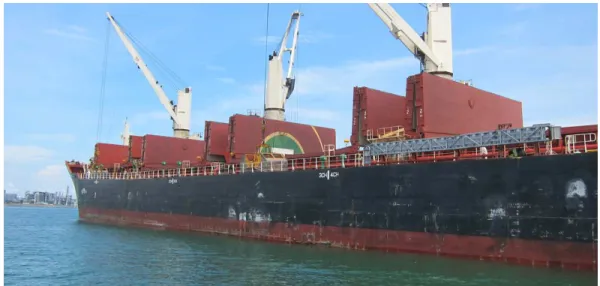
The following photos show the bulk carrier that we visited for the interview.
Figure 1 – Bulk carrier being used for long-distance sand transportation CREATION OF THE SIMULATION MODEL
Using information collected from the project team, the following Arena model was developed. The model was designed to handle the process of 1) loading sands in Cambodia, 2) transporting them to Singapore, 3) unloading sands in Singapore, and 4) bringing the empty carriers back to Cambodia. It also handles the time variation of these operations and potential congestions at the loading or unloading spots.
Figure 2 – Arena model developed to present the long-distance sand transportation process The simulation model presents how sands are transported through a network of activities. As a first step, our model assumes that 10,000 ton of sands are dredged in Cambodia every day. Then the model checks if carriers are available at the dredging sites. If no carriers are available, then the model asks the carriers to travel back to the sand dredging spot. For the loading or unloading process, the model picks up the elapsed time randomly within the given range. To handle the variation of travel time, the triangular distribution was used to define the variation range. Once the sand unloading process is done, the simulation model releases the bulk carrier, so that it can travel back to the sand loading spot. The total volume of sands transported from the sand loading spot to the land reclamation site is then recorded, and used later for sensitivity analysis.
SENSITIVITY ANALYSIS
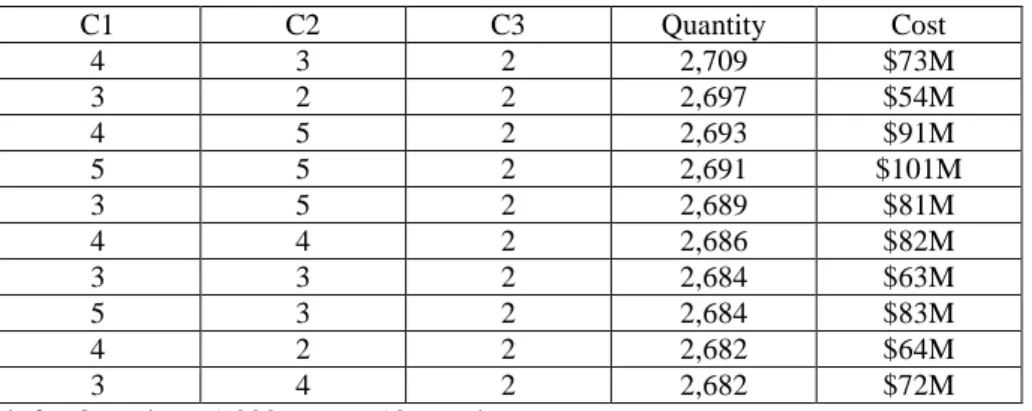
To figure out the combination of various transportation means that would best transport sands from Cambodia to Singapore, we changed the number of 3 different types of transportation from 2 to 6, and created 125 different cases. For each and every case, we iterated the simulation model for 100 times to determine the average amount of sands to be transported. The quantities of sands to be transported with 125 cases are then sorted out and presented in the following table.
Table 2 - Table: Top 10 combination of transportation means for sand transportation
C1 C2 C3 Quantity Cost 4 3 2 2,709 $73M 3 2 2 2,697 $54M 4 5 2 2,693 $91M 5 5 2 2,691 $101M 3 5 2 2,689 $81M 4 4 2 2,686 $82M 3 3 2 2,684 $63M 5 3 2 2,684 $83M 4 2 2 2,682 $64M 3 4 2 2,682 $72M
Cost = C1 * 10 + C2 * 9 + C3 * 3
As shown in the table, when 4 units of transportation type 1 (58,000 ton bulk carrier), 3 units of type 2 (42,000 ton bulk carrier), and 2 units of type 3 (15,000 ton barge) are chosen, contractor would receive 2,709,000 ton of sands annually from Cambodia. When $10M is assumed for the annual cost of transportation type 1, $9M for transportation, and $2M for transportation, the annual cost of this transportation combination would be $73M. Considering the cost of transportation means, one may notice that the second combination would be more cost efficient because it would cost significantly less but yield a most the same amount of sands. As demonstrated, the outcome of this sensitivity analysis therefore could help project manager make informed decision as to how many transportation means he has to use for the successful project execution.
CONCLUSION
This paper presents the Arena model we developed to simulate a 1,200km sand transportation process between Cambodia and Singapore. The model was designed to handle the process of 1) loading sands in Cambodia, 2) transporting them to Singapore, 3) unloading sands in Singapore, and 4) bringing the empty carriers back to Cambodia. Three different transportation means were assigned for this process: 58,000 ton Bulk Carrier, 42,000 ton Bulk Carrier, and 15,000 ton Barge. A special module was added to check if carriers are available, and then bring them back to the sand dredging spot. We changed the number of 3 different types of transportation from 2 to 6, and created 125 different cases. The sensitivity analysis informed us that 4 58,000-ton bulk carriers, 3 42,000-ton bulk carriers, and 2 15,000-ton barges would transport more sand than other combinations. However, looking at the cost of these transportation means, one may want to use the 3 58,000-ton bulk carriers, 2 42,000-ton bulk carriers, and 2 15,000-ton barges instead.
The Arena model developed to simulate the long-distance sand transportation process appears to well reflect the real situation. The graphical representation of the simulation model gave us confidence that our model was making a logical sense. The Arena’s transportation module effectively handled the potential traffic at the loading/unloading site. Our team noticed the heavy traffic congestion were taking place at the sand-dredging site, which many need to be carefully compared with the situation on the jobsite. Sensitivity analysis took a significant amount of time, and our team is currently investigating the use of visual Basic to automate the process of sensitivity analysis.
REFERENCES
Au, T., Bostleman R., and Parti E. (1969). “Construction Management Game - Deterministic Model”, Journal of the Construction Division, ASCE Vol. 95:25-38.
Chang, D. Y. and Carr, R. I. (1987). “RESQUE: A Resource Oriented Simulation System for Multiple Resource Constrained Processes”, Proceedings of the PMI Seminar/Symposium, Milwaukee, Wisconsin, 4-19.
CII (2001) “Electronic Simulation in Construction”, CII Report RR154-11.
Halpin, D. W. (1973). “An Investigation of the Use of Simulation Networks for Modeling Construction Operations”, Ph.D. thesis presented to the University of Illinois at Urbana-Champaign, Illinois. Halpin, D. W. and Martinez, L. (1999). “Real World Applications of Construction Process Simulation”,
Proceedings of the 31st Conference on Winter Simulation, Phoenix, Arizona, 956-962. Kang J, Ahn S, Nam J (2007) “Configuration of Rock Transportation System using Visual Simulation.”
Kang J, Chae J W, and Park W (2007) “Estimation of Cargo Handling Capacity of a Floating Container Terminal using 3D Simulation.” 7th World Congress on Structural and Multidisciplinary Optimization, Seoul, Korea.
Lluch J. F., and Halpin D.W. (1981). “Analysis of Construction Operations Using Microcomputers”, Journal of the Construction Division, ASCE Vol. 108 No. C01:129-145.
Paulson, Boyd C., Jr. (1987). “Interactive Graphics for Simulating Construction Operations”, Journal of the Construction Division, ASCE, 104(1):69-76.
Pegden, C. D. and Davis, D. A. (1992). “Arena: A SIMAN/Cinema-based hierarchal modeling system”, Proceedings of the 1992 Writer Simulation Conference, 390-399.