TUTORIAL 7 – STABILITY ANALYSIS
This tutorial is specifically written for students studying the EC module D227 – Control
System Engineering but is also useful for any student studying control.
On completion of this tutorial, you should be able to do the following.
•
Explain the basic definition of system instability.
•
Explain and plot Nyquist diagrams.
•
Explain and calculate gain and phase margins.
•
Explain and produce Bode plots.
The next tutorial continues the study of stability.
If you are not familiar with instrumentation used in control engineering, you should
complete the tutorials on Instrumentation Systems.
In order to complete the theoretical part of this tutorial, you must be familiar with basic
mechanical and electrical science.
You must also be familiar with the use of transfer functions and the Laplace Transform
(see maths tutorials).
1. INSTABILITY
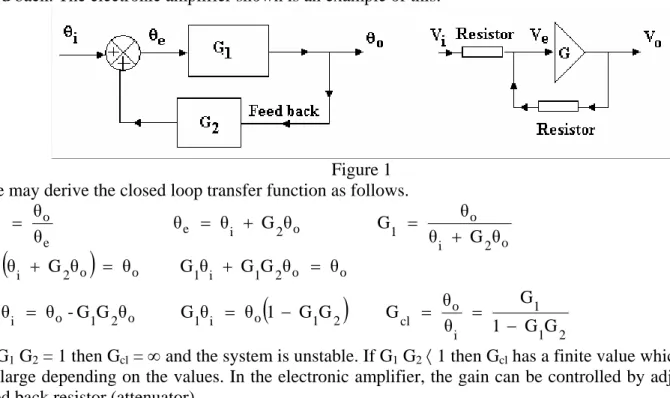
Consider a system in which the signals are added instead of subtracted by the summer. This is positive feed back. The electronic amplifier shown is an example of this.
Figure 1 We may derive the closed loop transfer function as follows.
(
)
(
)
2 1 1 i o cl 2 1 o i 1 o 2 1 o i 1 o o 2 1 i 1 o o 2 i 1 o 2 i o 1 o 2 i e e o 1 G G 1 G θ θ G G G 1 θ θ G θ G G -θ θ G θ θ G G θ G θ θ G θ G θ G θ θ G θ G θ θ θ θ G − = = − = = = + = + + = + = =If G1 G2 = 1 then Gcl = ∞ and the system is unstable. If G1 G2 〈 1 then Gcl has a finite value which is small
or large depending on the values. In the electronic amplifier, the gain can be controlled by adjusting the feed back resistor (attenuator).
Suppose G1 = 1 and G2 = 0.8 Gcl = 1/(1- 0.8) = 5
Suppose G1 = 1 and G2 = 0.99 Gcl = 1/(1- 0.99) = 100
The closer the value of G2 is to 1 the higher the overall gain. It is essential that G2 is an attenuator if the
system is not to be unstable.
A system designed for negative feed back with a summer that subtracts should be stable but when the signals vary, such as with a sinusoidal signal, it is possible for them to become unstable.
Consider an automatic control system such as the stabilisers on a ship. When the ship rolls, the stabilisers change angle to bring it back before the roll becomes uncomfortably large. If the stabilisers moved the wrong way, the ship would roll further. This should not happen with a well designed system but there are reasons and causes that can make such a thing happen. Suppose the ship was rolling back and forth at its natural frequency. All ships should have a righting force when they roll because of the buoyancy and will roll at a natural frequency defined by the weight, size and distribution of mass and so on. The sensor detects the roll and the hydraulic system is activated to move the stabiliser fins. Suppose that the hydraulics move too slow (perhaps a leak in the line) and by the time the stabilisers have responded, the ship has already righted itself and started to roll the other way. The stabilisers will now be in the wrong position and will make the ship roll even further. The time delay has made matters worse instead of better and this is basically what instability is about.
Another example of positive feed back is when you place a microphone in front of a loud speaker and get a loud oscillation. Another example is when you push a child on swing. If you give a small push at the start of each swing, the swing will move higher and higher. You are adding energy to the system, the opposite affect of damping. If you stop pushing, friction will slowly bring it back to rest.
With positive feedback, energy is added to the system making the output grow out of control. A system would not be designed with positive feedback but when a sinusoidal signal is applied, it is possible for the negative feedback to be converted into positive feedback. This occurs when the phase shift of the feedback is 180o to the input and the gain of the system is one or more. When this happens, the feedback reinforces the error instead of reducing it.
2. NYQUIST DIAGRAMS
A system with negative feed back becomes unstable if the signal arriving back at the summer is larger than the input signal and has shifted 180o relative to it. Consider the block diagram of the closed loop system. A sinusoidal signal is put in and the feed back is subtracted with the summer to produce the error. Due to time delay the feed back is 180o out of phase with the input. When they are summed the result is an error signal larger than the input signal. This will produce instability and the output will grow and grow.
Figure 2
A method of checking if this is going to happen is to disconnect the feed back at the summer and measure the feed back over a wide range of frequencies.
Figure 3
If it is found that there is a frequency that produces a phase shift of 180o and there is a gain in the signal, then instability will result. The Nyquist diagram is the locus of the open loop transfer function plotted on the complex plane. If a system is inherently unstable, the Nyquist diagram will enclose the point -1 (the point where the phase angle is 180o and unity gain).
Consider the following system.
The transfer function relating θi and θ is G(s) G1 x G2 x G3 = K/{s(1+s)(1+2s)}. Converting this into a
complex number (s = jω) we find
{
}
{
} {
9ω (ω 2ω )}
2ω K(ω j ) 2ω (ω 9ω 3ω K ) jω G( 3 4 3 3 4 2 − + − − − + − = )The polar plot below (Nyquist Diagram) is shown for K = 1 and K = 0.4. We can see that at the 180o position the radius is less than 1 when K = 1 so the system will be stable. When K = 2 the radius is greater than 1 so the system is unstable. We conclude that turning up the gain makes the system become unstable.
Figure 5
The plot will cross the real axis when ω = 2ω3 or ω = 0.707 and this is true for all frequencies. The plot
will enclose the -1 point if
{
}
{
}
1 so thelimit is when K 3ω 9ω (ω 2ω )) 2ω (ω 9ω 3ω K 2 4 3 3 4 2 − + = − − ≤ − + −
Putting ω = 0.707 the limiting value of K is 1.5 ALTERNATIVE METHOD
There is another way to solve this and similar problems. The transfer function is broken down into separate components so in the above case we have:
2s) (1 1 x s) (1 1 x s K G(s) + +
= Each is turned into polar co-ordinates (see previous tutorial).
( ) 2ω tan angle and 4ω 1 1 of radius a produces 2s 1 1 ω tan angle and ω 1 1 of radius a produces s 1 1 radii all for 90 -of angle an and ω K of radius a produces s K 1 -2 1 -2 o + + + +
When we multiply polar coordinates remember that the resultant radius is the product of the individual radii and the resultant angle is the sum of the individual angles. The polar coordinates of the transfer function are then:
( )ω tan 2ω tan 90 -is Angle ω 4 1 1 x ω 1 1 x ω K is Radius o -1 -1 2 2 + − − +
Put ω = 0.707 Radius = 1.414 x 0.8165 x 0.577 = 0.667 K Angle = -90 - 35.26 - 54.74 = -180o
3 PHASE MARGIN and GAIN MARGIN
3.1 PHASE MARGIN
This is the additional phase lag which is needed to bring the system to the limit of stability. In other words it is the angle between the point -1 and the vector of magnitude 1.
3.2 GAIN MARGIN
This is the additional gain required to bring the system to the limit of stability.
Figure 6
WORKED EXAMPLE No.1
The open loop transfer function of a system is G(s) = 200/{(1+2S)(3+S)(5+S)}. Produce a polar plot for ω = 3 to ω = 10. Determine the phase and gain margin.
SOLUTION
Now add the three sets of angles and multiply the three sets of radii and plot the results.
Figure 7
The region of interest is where the plot is -180o and the radius is 1. This would require a much more accurate plot around the region for ω = 3 to 5 as shown below.
Figure 8
The phase margin is 180 – 166 = 14o The gain margin is 1 – 0.65 = 0.35
SELF ASSESSMENT EXERCISE No.1
1 Determine the steady state gain and primary time constant for G(s) = 10/(s + 5). Determine the polar coordinates when ω = 1/T
(Gain = 2 and Radius = 1.414 and angle = -45o)
2. Determine the steady state gain for G(s) = 0.5/{(s+2)(s+10)}. Determine the polar coordinates when ω = 0.5
(Gain = 0.025 , R1 = 0.0243 φ1 = -16.9o)
3. The open loop transfer function of a system is G(s) = 80/{(s+1)(s+2)(s+4)}. Produce a polar plot for ω = 3 to ω = 10. Determine the phase and gain margin. (0.11 and 3.5o).
4. BODE PLOTS
These are logarithmic plots of the magnitude (radius of the polar plot) and phase angle of the transfer function. First consider how to express the gain in decibels.
Strictly G is a power gain and G = Power out/Power In If the power in and out were electric then we may say
in in out out I V I V G =
Using Ohms Law this with the same value of Resistance at input and output this becomes 2 i 2 o 2 i 2 o I I or V V G = Expressing G in decibels i o i o 2 i 2 o I I log 20 or V V log 20 V V log 10 G(db) = =
From this, it is usual to express the modulus of G as ⎟G⎟ = 20 log⎟ (θo/θi)⎟
Note that the gain in db is the 20 log R where R is the radius of the polar plot in previous examples. Consider the transfer function
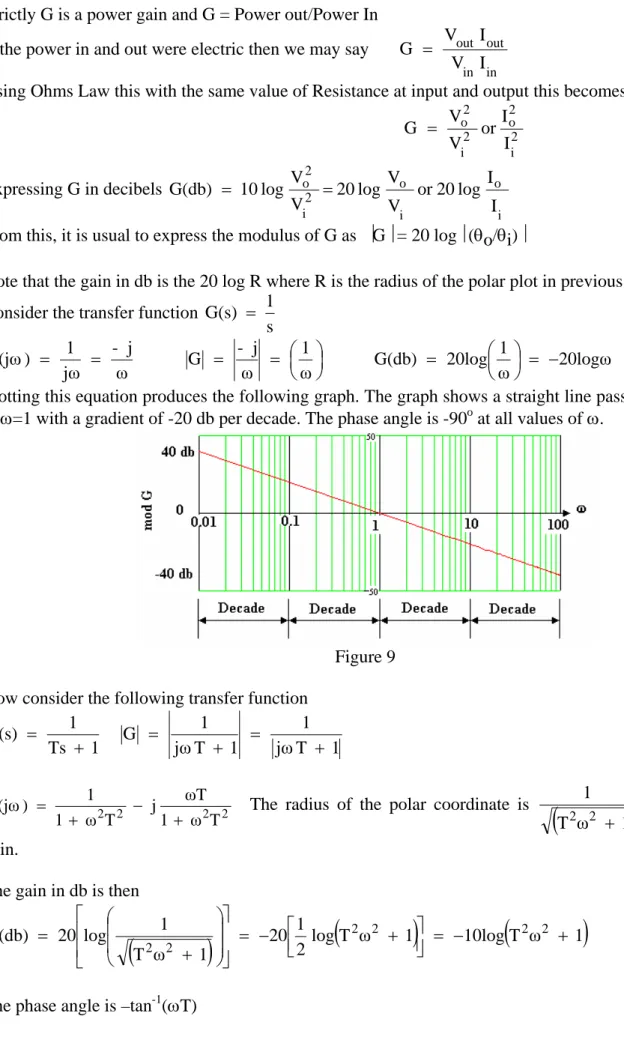
s 1 G(s) = 20logω ω 1 20log G(db) ω 1 ω j -G ω j -jω 1 ) G(jω ⎟ = − ⎠ ⎞ ⎜ ⎝ ⎛ = ⎟ ⎠ ⎞ ⎜ ⎝ ⎛ = = = =
Plotting this equation produces the following graph. The graph shows a straight line passing through 0 db at ω=1 with a gradient of -20 db per decade. The phase angle is -90o at all values of ω.
Figure 9 Now consider the following transfer function
1 T jω 1 1 T jω 1 G 1 Ts 1 G(s) + = + = + = 2 2 2 2 1 ω T ωT j T ω 1 1 ) G(jω + − +
= The radius of the polar coordinate is
(
T ω 1)
1 2
2 + and this is the gain.
The gain in db is then
(
)
log(
T ω 1)
10log(
T ω 1 2 1 20 1 ω T 1 log 20 G(db) 2 2 2 2 2 2 ⎥⎦ = − + ⎤ ⎢⎣ ⎡ + − = ⎥ ⎥ ⎦ ⎤ ⎢ ⎢ ⎣ ⎡ ⎟ ⎟ ⎠ ⎞ ⎜ ⎜ ⎝ ⎛ + =)
If we put T = 1 as a convenient example, and plot the result, we get two distinct straight lines shown on the left graph. The horizontal line is produced by very small values of ω and so it is called the LOW FREQUENCY ASYMPTOTE. The sloping straight line occurs at high values of ω and is called the HIGH FREQUENCY ASYMPTOTE and has a gradient of -20 db per decade. The two lines meet at the breakpoint frequency or natural frequency given by ωn=1/T = 1 in this case.
The graph on the right shows phase angle plotted against ω and it goes from 0 to -90o. The 45o point occurs at the break point frequency.
Figure 10
Now consider the following transfer function. (Standard first order response to a step input) T) jω (1 jω K ) G(jω sT) s(1 K G(s) + = + =
Note there is an easier way to find ⎟G⎟ as follows. Separate the two parts and find the modulus of each separately. 2 2T ω (1 1 jω 1 K G + = ⎟ ⎟ ⎠ ⎞ ⎜ ⎜ ⎝ ⎛ + ⎟ ⎠ ⎞ ⎜ ⎝ ⎛ = + = + = + = + = = 2 2 2 2 2 2 T ω 1 1 ω 1 K T ω 1 1 ω 1 K G T ω 1 1 T jω 1 1 T jω 1 1 ω 1 jω 1 jω 1
Taking logs we get
(
)
(
)
⎥⎦⎤ ⎢⎣ ⎡ − − + = + − − = ⎟ ⎟ ⎠ ⎞ ⎜ ⎜ ⎝ ⎛ + + ⎟ ⎠ ⎞ ⎜ ⎝ ⎛ + = 2 2 2 2 2 2 T ω 1 log 2 1 logω logK 20 db G Log T ω 1 log 2 1 logω logK G Log T ω 1 1 log ω 1 log logK G LogThere are three components to this and we may plot all three separately as shown. The graph for the complete equation is the sum of the three components. The result is that the graph has two distinctive slopes of -20 db per decade and -40 db per decade. (K and T were taken arbitrarily as 10 giving a breakpoint of ω = 1/T = 0.1.
Figure 11
The plot of phase angle against frequency on the logarithmic scale shows that the phase angle shifts by 90o every time it passes through a breakpoint frequency. The plot for the case under examination is shown.
WORKED EXAMPLE No. 2 A system has a transfer function
1) s(Ts
1 G(s)
+
= Where the time constant T is 0.5 seconds. Plot the Bode diagram for gain and phase angle. Find the low frequency gain per decade, the high frequency gain per decade and the break point frequency.
SOLUTION
(
)
(
)
⎥⎦⎤ = − ⎜⎝⎛ ⎟⎠⎞ ⎢⎣ ⎡− − + = ⎟ ⎟ ⎠ ⎞ ⎜ ⎜ ⎝ ⎛ + ⎟ ⎠ ⎞ ⎜ ⎝ ⎛ = + = ⎟⎟ ⎠ ⎞ ⎜⎜ ⎝ ⎛ + = + = − ωT 1 tan -90 1 T ω log 2 1 logω 20 (db) G 1 T ω 1 ω 1 1 T jω 1 jω 1 G 1 T jω 1 jω 1 G(jω( 1 Ts s 1 G(s) 1 2 2 2 2 φ ω 0.001 0.01 0.1 1.0 10 100 1000 -log ω 3 2 1 0 -1 -2 -3-½log(ω2T2+1) tiny tiny tiny -0.048 -0.707 -1.707 -2.707
Total Gain (units) 3 2 1 -.048 -1.707 -3.707 -5.707
Total Gain db 60 40 20 -0.96 -34.14 -74.14 -114.14
φ degrees -90 -90.3 -92.9 -117 -169 -179 - 180
Examining the table we see that the gain drops by 20 db per decade at low frequencies and by 40 db per decade for high frequencies. Plotting the graph on logarithmic paper reveals a breakpoint frequency of 2 rad/s which is also found by ωn = 1/T = 1/0.5 = 2
A quick way of drawing an approximate Bode plot is to evaluate the gain in db at the breakpoint frequency and draw asymptotes with a slope of -20 db per decade prior to it and -40 db per decade after it. The phase angle may be found by adding the two components.
1 T jω 1 jω 1 = ) G(jω 1) s(Ts 1 G(s) + + + =
The phase angle for the first part is the angle of a vector at position -1/ω on the j axis which corresponds to -90o.
The phase angle of the second part is the angle of a vector at -1 on the real axis and - ωT on the j axis. The two phase angles may be added to produce the overall result.
A quick way to draw the Bode phase plot is to note that the break point frequency occurs at the mid point of the phase shift (-135o in this case) so draw the asymptotes such that they change by -90o at each breakpoint frequency.
GAIN AND PHASE MARGINS FROM THE BODE PLOT
Gain and phase margins may be found from Bode plots as follows. Locate the point where the gain is zero db (unity gain) and project down onto the phase diagram. The phase margin is the margin between the phase plot and -180o.
Locate the point where the phase angle reaches ±180o. Project this back to the gain plot and the gain margin is the margin between this point and the zero db level. If the gain is increased until this is zero, the system becomes unstable.
WORKED EXAMPLE No.3
Draw the asymptotes of the Bode plots for the systems having a transfer function
(
Ts 1)
(T s 1) K G(s) 2 1 + + =K is 10, T1 is 2 seconds and T2 is 0.2 seconds. Find the value of K which makes the system stable. SOLUTION
The two break point frequencies are 1/T1 = 1/2 = 0.5 rad/s and 1/T2 = 1/0.2 = 5 rad/s.
GAIN
Locate the two frequencies and draw the asymptotes. The first one is 20 db/decade up to 0.5 rad/s. The second one is -20 db per decade until it intercepts 5 rad/s. From then on it is -40 db per decade. PHASE
The phase angle diagram is no so easy to construct from asymptotes. Locate the break point frequencies. These mark the mid points between 0 and 90o (45o) for both functions. (K has zero angle). The resultant phase angle varies from 0 to -180o reaching -135o half way between the break points.
Figure 14
The phase angle reaches 180o at around ω = 110 rad/s. The gain at 110 rad/s is about -60 db hence the gain margin is about 60 db. To make the gain unity (zero db) we need an extra gain of:
60 = 20 log G G = 1000
SELF ASSESSMENT EXERCISE No.2
1. A system has a transfer function
1) s s(T 4 G(s) + = T is 0.1 seconds.
What is the steady state gain? (4)
What is the low frequency gain per decade, the high frequency gain per decade and the break point frequency? (-20 db, -40 db and 10 rad/s)
2. A system has a transfer function
(
Ts 1)
(T s 1) 1 G(s) 2 1 + + =T1 is 0.25 seconds and T2 is 0.15 seconds.
Find the low frequency gain per decade, the high frequency gain per decade and the break point frequencies. (0 db, -40 db and 4 rad/s and 6.7 rad/s)
Find the gain margin and phase margin. (-80 db and 0o approximately)
3. Draw the asymptotes of the Bode plots for the systems having a transfer function
(
Ts 1)
(T s 1) K G(s) 2 1 + + =K is 2, T1 is 0.1 seconds and T2 is 10 seconds.
Find the gain margin and the value of K which makes the system stable. (130 db and 3 x 10⁶ approx)
4. The diagram shows the bode gain and phase plot for a system. Determine the gain margin and whether or not the system is stable. (45 db and 10o approx Unstable)