Gold Standard for the Global Goals
Key Project Information & Project Design Document (PDD)
KEY PROJECT INFORMATION
Title of Project: Bac Lieu Wind Power Plant
Brief description of Project: Bac Lieu Province Wind Power Plant includes the construction of a near-shore wind power farm on the area of 540 ha along the East Dam (De Dong) of Bac Lieu city, Bac Lieu province, Viet Nam with total capacity of 99.2 MW and gross annual electricity output of 335.2 GWh2. The project involves the installation of 62 wind turbines at capacity of 1.6 MW each in two phases.
Expected Implemetation Date: Expected duration of Project:
Implementation date: 20/06/2013
1st crediting period: 20/06/2013 to 19/06/2020 2nd crediting period: 20/06/2020 to 19/06/2027 Project Developer: Cong Ly Construction – Trading – Tourism Co.,
Ltd
Project Representative: Swiss Carbon Assets Ltd Project Participants and any communities
involved:
Cong Ly Construction – Trading – Tourism Co., Ltd
Swiss Carbon Assets Ltd Version of PDD:
Date of Version:
2.0
24/11/2020 Host Country / Location: Viet Nam Certification Pathway (Project
Certificatin/Impact Statements & Products
Impact Statements & Products1 Activity Requirements applied:
(mark GS4GG if none relevant)
GS4GG
Methodologies applied: Applied Methodology: ACM0002: Grid-connected electricity generation from renewable sources - Version 20.0
Product Requirements applied: N/A
Regular/Retroactive: Retroactive
SDG Impacts: 1 – SDG 7
2 – SDG 8 3 – SDG 13
Estimated amount of SDG Impact Certified 1 – SDG 7 – 99.2 MW of clean energy
2 – SDG 8 – 100% of the employees have access to training, healthcare, insurances and better income
3 – SDG 13 – 293,814 tCO2e/ year.
1The first creding period of the project was from 20/06/2013 to 19/06/2020. The completion of re-validation for renewal of the second crediting period is beyond the last date of the first CP, it means that no cerified impact statements shall be claimed for the period of delay
SECTION A.
Description of project
A.1. Purpose and general description of project
Bac Lieu Province Wind Power Plant includes the construction of a near-shore wind power farm on the area of 540 ha along the East Dam (De Dong) of Bac Lieu city, Bac Lieu province, Viet Nam with total capacity of 99.2 MW and gross annual electricity output of 335.2 GWh. The project involves the installation of 62 wind turbines at capacity of 1.6 MW each in two phases.
In the first phase, 10 wind turbines will be installed on 80 ha area. The capacity and net electricity output of Phase 1 is 16 MW and 55,355 MWh/year respectively. Phase 2 includes the installation of the remained 52 turbines with combined capacity of 83.2 MW and annual net output of 272,471 MWh.
Prior to the implementation of the project activity, electricity in Viet Nam is generated mainly from fossil fuel sources and is solely distributed to consumers via the unique national electricity grid. The baseline scenario of the project activity is the same as the scenario existing prior to the start of implementation of the project activity.
The project’s purpose is to exploit the wind resources in Bac Lieu province to produce and supply electricity to the national grid under a Power Purchase Agreement (PPA) signed with the Electricity Corporation of Viet Nam (EVN).
The project will reduce the emission of greenhouse gases by replacing electricity generated from fossil fuel fired power plants with zero emissions electricity from a wind power plant. It is expected that the power plant, when in full operation, will result in the reduction of 293,814 tCO2 on average per year and 2,056,698 tCO2 over the second crediting period.
The project activity has been registered at UNFCCC on 13 September 2012 with reference number of the project activity 7250. The crediting period is renewable seven-year period. The first CDM crediting period was from 20 Jun 2013 to 19 Jun 2020. Currently, the project is under implementation to renew to 2nd CDM crediting period (20/06/2020 – 19/06/2027).
The project activity was registered to GS on 13/03/2014 after the commissioning date (retroactive registration) with reference number of 1890 version 2.2. The first GS crediting period was from 20/06/2013 to 19/06/2020. Currently, the project is under GS 2nd crediting period validation process.
To be the first large scale wind power project in the Mekong Delta and the first near-shore wind power project in Viet Nam, the proposed project activity will contribute to sustainable development of local and host country in the following aspects.
A.2.Eligibility of the project under Gold Standard
The project’s contributions to the sustainable development of the local area as well as the host country are as follows:
General contributions towards national sustainable development:
• In recent years, Viet Nam has suffered a critical electricity shortage as a consequence from rapidly increasing demand and insufficient supply, thereby imposing negative impacts on economic growth as well as on daily lives of people. This project activity will be a contribution towards balancing the supply and demand gap. The project will help to lessen the risks of cascading national grid collapse due to overload.
• Reducing reliance on exhaustible fossil fuel based power sources and also reducing the import of fuels for the purpose of power generation.
• Modern and highly efficient turbines and generators will be used in the project and modern technology will be transferred to host country.
• Viet Nam has high potential of wind energy. However, the total installed capacity at present is only 19 MW. The project will therefore accelerate the deployment of wind energy technologies in Viet Nam
Contributions towards local sustainable development: a) Economic well-being
• Once commissioning, this proposed project will increase the industrial share in the economic structure of Bac Lieu province. This proposed project will pay annual tax to the local and State budget.
• This project will facilitate the industrialisation process as well as tourism industry and services inside the province.
• The successful implementation of the project will speed up the commissioning of other wind power projects in the region
b) Social well-being
• The construction and operation of this project activity will result in the employment of the local people and contribute directly to alleviate poverty in the region.
• The project activity will make the scenery of the coastal area more lively and impressive which can be exploited for tourism and recreation.
The project will construct a new 22/110 kV-2 x 63 MVA transformer station and about 18.3 km of 110 kV transmission lines together with the wind farm, which will reduce electricity losses and improve the electricity quality supplied in the region.
This demonstrates that the project activity will contribute positively towards sustainable development. Therefore, it satisfies the sustainable development criteria for CDM projects set by the DNA of Viet Nam.
A.3.Legal ownership of products generated by the project and legal rights to alter use of resources required to service the project
The project owner – Cong Ly Construction – Trading – Tourism Co., Ltd has the legal ownership of the products that generated under Gold Standard Certification and has legal rights concerning changes in use of resources required to service the project for land use, construction, selling electricity license and so on, which is documented in Investment License, Power Purchase Agreement and Certificate of Land use rights.
A.4. Location of project A.4.1. Host Country Viet Nam
A.4.2.Region/State/Province etc. Bac Lieu Province
A.4.3.City/Town/Community etc.
A.4.4.Physical/Geographical location
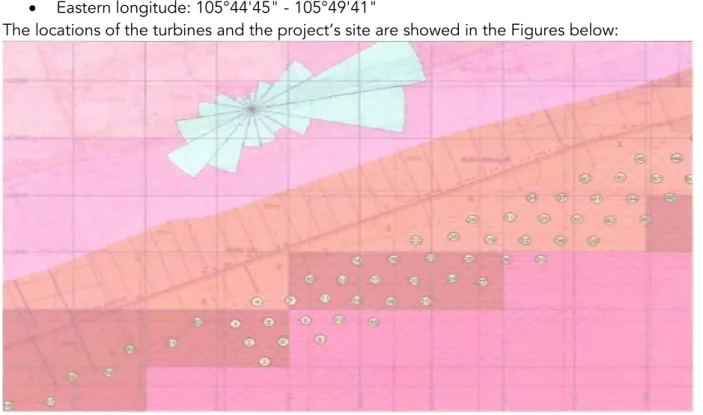
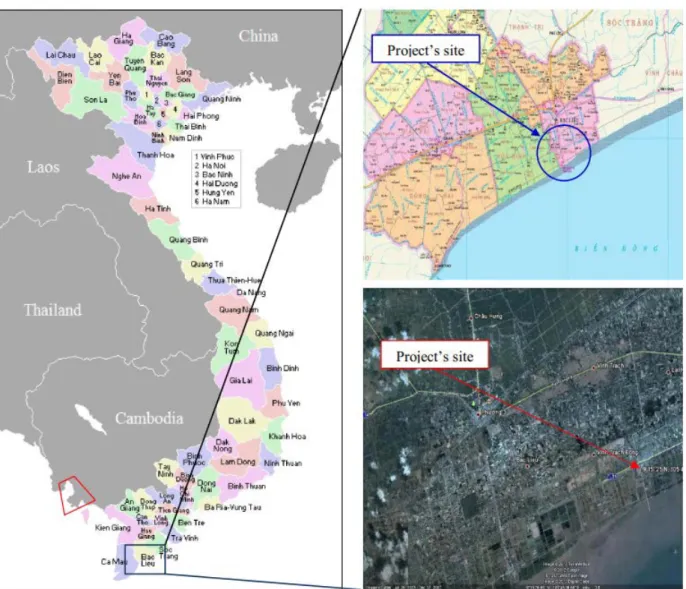
The wind power farm is located in Bac Lieu city, Bac Lieu province, Viet Nam. The turbines were installed along the East Dam of Bac Lieu city within the following coordinates:
• Northern latitude: 9°12'07" - 9°14’38” • Eastern longitude: 105°44'45" - 105°49'41"
The locations of the turbines and the project’s site are showed in the Figures below:
Figure 2: Project’s location A.5.Technologies and/or measures
The project involves the construction of a 99.2 MW grid-connected wind power plant with 62 wind turbines and generators in order to convert kinetic power of the wind to electrical energy, which will be supplied to the national grid at the connection point through the transmission line. At the connection point, the electricity meter systems will be installed. They are digital and bi-directional type to measure the export and import of electricity of Bac Lieu Province Wind Power Plant. The main technical parameters of project are shown in Table below.
The project involves the construction of a 99.2 MW grid-connected wind power plant with 62 wind turbines and generators in order to convert kinetic power of the wind to electrical energy, which will be supplied to the national grid at the connection point through the transmission line. At the connection point, the electricity meter systems will be installed. They are digital and bi-directional type to measure the export and import of electricity of Bac Lieu Province Wind Power Plant. The main technical parameters of project are shown in Table below.
Main parameter Unit Value 1. Turbine2
• Type GE 1.6xle
• Number of installed turbines: + Phase I
+ Phase II
set 10
52
• Rated power kW/ set 1600
• Rotor diameter m 82.5
• Swept area m2 5346
• Tower height m 80/100
• Cut-in wind speed m/s 3.5
• Cut-out wind speed m/s 25
• Survival wind speed m/s 50.1
2. Generator3
• Type Three phases, asynchronous
• Voltage V 690
• Frequency Hz 50
• Rated speed rpm 1915
3. Plant load factor4
• Phase I % 40.38
• Phase II % 38.23
• Combined plant load factor % 38.57
A.6.Scale of the project Large project
A.7.Funding sources of project
The proposed project not using any ODA funding as mentioned in ODA Declaration5
2 Main technical parameters of turbines are extracted from the Feasibility Study Report of the document. 3 Main technical parameters of generators are extracted from the Equipment Contract signed with GE.
4 Plant load factor was calculated and confirmed by the independent third party in accordance to EB 48 Annex 11. 5 Non-ODA declaration
A.8.Assessment that project complies with ‘gender sensitive’ requirements
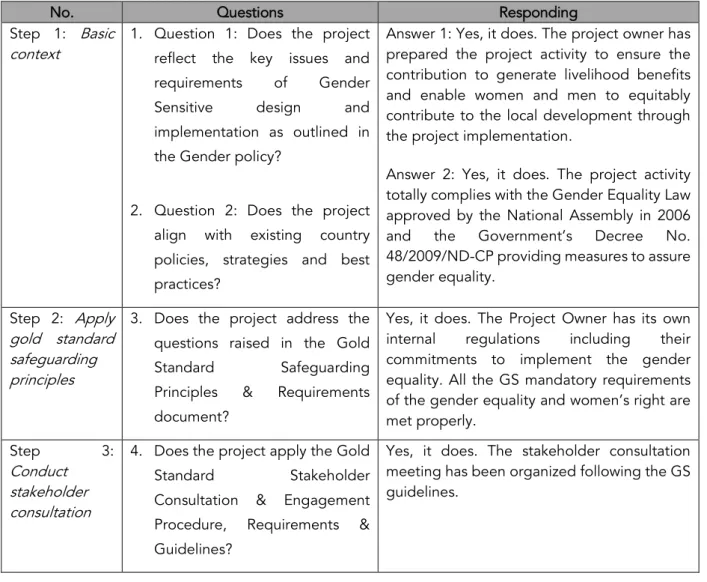
According to the Gender equality requirements guidelines version 1.1, the gender sensitive requirements includes three steps: basic context, apply gold standards safeguarding principles, and conduct stakeholder consultation, which are illustrated in the following table.
Table 2: Gender sensitive assessment
No. Questions Responding
Step 1: Basic context
1. Question 1: Does the project reflect the key issues and requirements of Gender Sensitive design and implementation as outlined in the Gender policy?
2. Question 2: Does the project align with existing country policies, strategies and best practices?
Answer 1: Yes, it does. The project owner has prepared the project activity to ensure the contribution to generate livelihood benefits and enable women and men to equitably contribute to the local development through the project implementation.
Answer 2: Yes, it does. The project activity totally complies with the Gender Equality Law approved by the National Assembly in 2006 and the Government’s Decree No. 48/2009/ND-CP providing measures to assure gender equality.
Step 2: Apply gold standard safeguarding principles
3. Does the project address the questions raised in the Gold
Standard Safeguarding Principles & Requirements document?
Yes, it does. The Project Owner has its own internal regulations including their commitments to implement the gender equality. All the GS mandatory requirements of the gender equality and women’s right are met properly.
Step 3:
Conduct stakeholder consultation
4. Does the project apply the Gold
Standard Stakeholder Consultation & Engagement
Procedure, Requirements & Guidelines?
Yes, it does. The stakeholder consultation meeting has been organized following the GS guidelines.
SECTION B.
Application of selected approved Gold Standard methodology
B.1. Reference of approved methodology Applied methodology:
• Version 20.0 of ACM0002: “Grid-connected electricity generation from renewable sources” (https://cdm.unfccc.int/methodologies/DB/XP2LKUSA61DKUQC0PIWPGWDN8ED5PG)
Related tools:
• Version 07.0 of the Tool07: “Tool to calculate the emission factor for an electricity system” (https://cdm.unfccc.int/methodologies/PAmethodologies/tools/am-tool-07-v7.0.pdf)
• Version 07.0.0 of the Tool01“Tool for the demonstration and assessment of additionality” (http://cdm.unfccc.int/methodologies/PAmethodologies/tools/am-tool-11-v3.0.1.pdf)
• Version 03.0.1 of the Tool11“Assessment of the validity of the original/ current baseline and update of the baseline at the renewal of the crediting period”
B.2. Applicability of methodology
This proposed project is a grid-connected renewable power generation that is then eligible to apply Version 20.0 of ACM0002. More details of the comparison of the project’s characteristics and the applicability criteria as specified in, Version 20.0 of ACM0002 is given in Table below.
Table 1: Comparison of project’s characteristics and eligibility criteria of Version 20.0 of ACM0002 No. Applicability conditions in Version 20.0 of
ACM0002 Characteristics of the project activity Applicability criterion met? 1 This methodology is applicable to
grid-connected renewable energy power generation project activities that:
a) Install a Greenfield power plant; b) Involve a capacity addition to (an)
existing plant(s);
c) Involve a retrofit of (an) existing operating plant(s)/unit(s);
d) Involve a rehabilitation of (an) existing plant(s)/unit(s); or
e)
Involve a replacement of (an) existing plant(s)/unit(s).The project activity consists in the installation of a new grid connected renewable power plants at a site where no renewable power plant was operated prior to the implementation of the project activity (green field plant)
Yes
2 The methodology is applicable under the following conditions:
(a) The project activity may include renewable energy power plant/unit of one of the following types: hydro power plant/unit with or without reservoir, wind power plant/unit, geothermal power plant/unit, solar power plant/unit, wave power plant/unit or tidal power plant/unit;
The project activity is the installation of new wind power plant
Yes
(b) In the case of capacity additions, retrofits, rehabilitations or replacements (except for wind, solar, wave or tidal power capacity addition projects) the existing plant/unit started commercial operation prior to the start of a minimum historical reference period of five years, used for the calculation of baseline emissions and defined in the baseline emission section, and no capacity expansion, retrofit, or rehabilitation of the plant/unit has been undertaken between the start of this minimum historical reference period and the implementation of the project activity.
The project activity is the installation of a new wind power plant
Not applicable
No. Applicability conditions in Version 20.0 of ACM0002 Characteristics of the project activity Applicability criterion met? 3 In case of hydro power plants, one of the
following conditions shall apply:
The project activity is the installation of new wind power plant
Not applicable a) The project activity is implemented in an
existing single or multiple reservoir, with no change in the volume of any of the reservoir or
b) The project activity is implemented in existing single or multiple reservoirs, where the volume of the reservoir(s) is increased and the power density, calculated using equation (7), is greater than 4 W/m2; or
The project activity is the installation of new wind
power plant Not
applicable
c) The project activity results in new single or multiple reservoirs and the power density, calculated using equation (7), is greater than 4 W/m2
The project activity is the installation of new wind
power plant Yes
d) The project activity is an integrated hydro power project involving multiple reservoirs, where the power density for any of the reservoirs, calculated using equation (7), is lower than or equal to 4 W/m2, all of the following conditions shall apply:
(i) The power density calculated using the total installed capacity of the integrated project, as per equation (8), is greater than 4 W/m2;
(ii) Water flow between reservoirs is not used by any other hydropower unit which is not a part of the project activity;
(iii) Installed capacity of the power plant(s) with power density lower than or equal to 4 W/m2 shall be:
a. Lower than or equal to 15 MW; and
b. Less than 10 percent of the installed capacity of integrated hydro power project.
The project activity is the installation of new wind power plant
Not applicable
4 In the case of integrated hydro power projects, project proponent shall:
a) Demonstrate that water flow from upstream power plants/units spill directly to the downstream reservoir and that
This project activity is not an integrated hydropower
plant Not
No. Applicability conditions in Version 20.0 of ACM0002 Characteristics of the project activity Applicability criterion met? collectively constitute to the generation
capacity of the integrated hydro power project; or
b) Provide an analysis of the water balance covering the water fed to power units, with all possible combinations of reservoirs and without the construction of reservoirs. The purpose of water balance is to demonstrate the requirement of specific combination of reservoirs constructed under CDM project activity for the optimization of power output. This demonstration has to be carried out in the specific scenario of water availability in different seasons to optimize the water flow at the inlet of power units. Therefore, this water balance will take into account seasonal flows from river, tributaries (if any), and rainfall for minimum five years prior to implementation of CDM project activity
5 This methodology is not applicable to:
a) Project activities that involve switching from fossil fuels to renewable energy at the site of the project activity, since in this case the baseline may be the continued use of fossil fuels at the site
b) Biomass fired power plants/ units
It is a renewable energy project with no fuel-switch involved
Yes
Yes 6 In the case of retrofits, rehabilitations,
replacements, or capacity additions, this methodology is only applicable if the most plausible baseline scenario, as a result of the identification of baseline scenario, is “the continuation of the current situation, that is to use the power generation equipment that was already in use prior to the implementation of the project activity and undertaking business as usual maintenance”.
The project activity is the installation of new wind
power plant
Not applicable
B.3. Project boundary
According to Version 20.0 of ACM0002, the spatial extent of the project boundary includes the Bac Lieu Province Wind Power Plant and all power plants connected physically to the national electricity grid to which the proposed project is also connected.
The flow diagram of the project boundary is shown in figure 4.
Figure 4: Project boundary
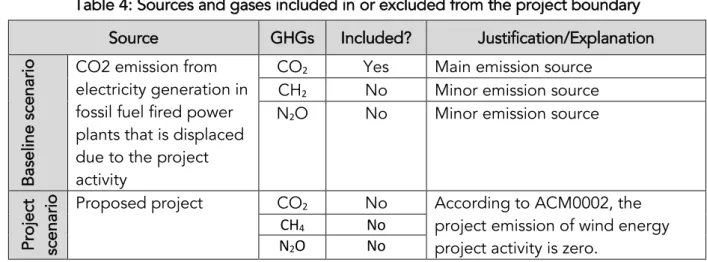
The GHGs and emission sources included in the project boundary are shown in the table 4.
Table 4: Sources and gases included in or excluded from the project boundary
Source GHGs Included? Justification/Explanation
B
asel
ine sc
ena
rio CO2 emission from electricity generation in fossil fuel fired power plants that is displaced due to the project activity
CO2 Yes Main emission source
CH2 No Minor emission source
N2O No Minor emission source
Proj
ec
t
sc
ena
rio Proposed project CO2 No According to ACM0002, the
project emission of wind energy project activity is zero.
CH4 No
N2O No
B.4. Establishment and description of baseline scenario
CDM project standard for project activities, version 02.0, item 10 - Renewal of crediting period, paragraph 282, 283, 284 and 286 says that:
“282. The project participants shall demonstrate the validity of the original baseline or update it in accordance with paragraphs 283-286 below.
283. To demonstrate the validity of the original baseline or its update, the project
participants are not required to re-assess the baseline scenario. Instead, the project participants shall assess the GHG emission reductions or net anthropogenic GHG removals that would have resulted from that scenario”;
GHGs Emission represent by EFCM Viet Nam National Electricity grid Turbines Generators Transformer
Fossil fuel fired power plants GHGs Emission Wind blow Exported Electricity Kinetic Energy Imported Electricity
284. The project participants shall assess and incorporate the impact of national and/or sectoral policies and circumstances, existing at the time of requesting the renewal of the crediting period, on the current baseline GHG emissions, without reassessing the baseline scenario”.
286. If data and parameters used for determining the original baseline, that were
determined ex ante and not monitored during the crediting period, are no longer valid, the project participants shall update such data and parameters in accordance with the “Methodological tool: Assessment of the validity of the original/current baseline and update of the baseline at the renewal of the crediting period.”
Bac Lieu wind power project is a registered CDM project. Therefore, the reassessment of the baseline scenario is not required.
According to version 20.0 of ACM0002, if the project activity includes the installation of a new grid-connected renewable power plant/unit, the baseline scenario is the following:
“Electricity delivered to the grid by the project activity would have otherwise been generated by the operation of grid-connected power plants and by the addition of new generation sources, as reflected in the combined margin calculations described in the “Tool to calculate the emission factor for an electricity system”.
The Viet Nam national electricity grid, which is operated and monopolized by the Electricity Cooperation of Viet Nam (EVN) and is the unique transmission and distribution line, to which all power plants in Viet Nam are physically connected is the project electricity system6.
Thus the baseline scenario of the proposed project is the delivery of equivalent amount of annual power output from the Viet Nam national grid to which the proposed project is also connected. Following the EB guidance on the consideration of national and/or sectoral policies and circumstances in baseline scenarios (EB 22, annex 3) and “Information note on the implementation of E+/E- in the context of project”, EB 53, Annex 32, two types of policies E+ and E- have been examined.
(a) National and/or sectoral policies or regulations that give comparative advantages to more
emissions-intensive technologies or fuels over less emissions-intensive technologies or fuels. Up to
date, the government of Viet Nam has not implemented any such E+ policies that are available and/or to be accessed publicly.
(b) National and/or sectoral policies or regulations that give comparative advantages to less
emissions-intensive technologies over more emissions-intensive technologies (e.g. public subsidies
to promote the diffusion of renewable energy or to finance energy efficiency programs): the latest
comprehensive policy for the power sector in Viet Nam is the National Master Plan on national power development for the period 2006-2015 perspective to 2025 (Master plan VI) approved by the Prime Minister in 2007. For wind power projects, the Prime Minister recently issued the Decision No. 37/2011/QD-TTg dated June 29, 2011 on the mechanism supporting the development of wind power project in Viet Nam. According to paragraph 7(b), Annex 3, EB 22, these policies need not be taken into account in developing the baseline scenario as they are implemented after the adoption by the COP of the CDM M&P (Decision 17/CP.7, 11 November 2001). The tariff applied
in the investment analysis of proposed project is derived from FSR which was designed by an expertise third party and it is not affected by any E+ policies or E- policies.
So, the baseline scenario of this proposed project refers to a hypothetical situation or the delivery of equivalent amount of annual power output from the Viet Nam national grid.
The following national and sectoral policies and circumstances existing at the time of requesting renewal of crediting period have not changed comparing to those at the time of project registration: The delivery of power from the national grid complies with all laws and regulations in Viet Nam. The Viet Nam national electricity grid is operated by EVN (Vietnam Electricity), which has a monopoly on transmission and distribution. All power plants in Viet Nam are physically connected to the national electricity grid. Thus, the above circumstances do not affect the baseline GHG emissions.
The latest report of Emission Factor of Vietnam Electricity System, published by Department of Climate Change, Ministry of Natural Resources and Environment of Vietnam on 12/03/2020 effects the baseline GHG emission, and the reassessment of the baseline emissions by applying the data of the latest report is presented in the section B.6 below.The stepwise procedure to assess the continued validity of the baseline and to update the baseline at the renewal of a crediting period is conducted following methodological tool "Assessment of the validity of the original/current baseline and update of the baseline at the renewal of the crediting period" (Version 03.0.1, EB 66, Annex 47). The tool consists of two steps. The first step provides an approach to evaluate whether the current baseline is still valid for the next crediting period. The second step provides an approach to update the baseline in case that the current baseline is not valid anymore for the next crediting period.
Step 1: Assess the validity of the current baseline for the next crediting period
The "Procedures for the renewal of the crediting period of a registered CDM project activity" approved by the CDM Executive Board require assessing the impact of new relevant national and/or sectoral policies and circumstances on the baseline.
The validity of the current baseline is assessed using the following sub-steps:
Step 1.1: Assess compliance of the current baseline with relevant mandatory national and/or sectoral policies
According to the registered PDD, in the absence of the project activity, electricity which will be supplied to the national grid would come from fossil fuel power plants. The generation of electricity by burning fossil fuels result in CO2 emission into the atmosphere. Hence, the baseline scenario of the project is the electricity delivered to the grid by the project activity that otherwise would have been generated by the operation of grid-connected fossil fuel power plants and by the addition of new generation sources.
Electricity Law No. 28/2004/QH11 dated on 03/12/2004 and Law No. 50/2010/QH12 on "Economical and Efficient use of energy" dated on 17/06/2010 are the main laws that govern the electricity sector in Viet Nam. Their implementation is regulated under Government Decree No. 14/2014/ND-CP on "Stipulating in detail the implementation of electricity law regarding electricity safety" dated on 26/02/2014. National policy and regulation does not mandate setting up renewable power plants from existing capacity. Thus it can be concluded that the current baseline scenario is in compliance with relevant mandatory national and sectoral policies.
There is no impact of circumstances existing at the time of requesting renewal of crediting period on the current baseline emissions.
Step 1.3: Assess whether the continuation of use of current baseline equipment(s) or an investment is the most likely scenario for the crediting period for which renewal is requested.
This sub-step should only be applied if the baseline scenario identified at the validation of the project activity was the continuation of use of the current equipment(s) without any investment and, the projects proponents or third party (or parties) would undertake an investment later due, for example, to the end of the technical lifetime of the equipment(s) before the end of the crediting period or the availability of a new technology.
Assess whether the remaining technical lifetime of the equipment that would have continued to be used in the absence of the project activity, as determined in the CDM-PDD or CDM-PDD-REN, exceeds the crediting period for which renewal is requested.
Take into consideration the market penetration of different technologies. Evaluate the penetration rate of different technologies that are available in the market and evaluate how they could affect the baseline.
If the baseline scenario of the project activity is the continuation of use the current equipment(s) without any investment and the projects proponents or third party(ies) will undertake an investment later, but before the end of a crediting period, then the current baseline needs to be updated for that crediting period or the crediting of emission reductions should be limited to the period before the baseline equipment would cease its operation.
Since the project activity is a greenfield project with a lifetime of 22 operation years, the baseline scenario identified during the validation of the project activity was electricity generation in power plants that are displaced due to the project activity and was not the continuation of use of the current equipment(s) or an investment for the crediting period for which the renewal is requested. This sub-step is not applicable for this project activity.
Step 1.4: Assessment of the validity of the data and parameter.
"Where emission factors, values or emission benchmarks are used and determined only once for the crediting period, they should be updated, except if the emission factors, values or emission benchmarks are based on the historical situation at the site of the project activity prior to the implementation of the project and cannot be updated because the historical situation does not exist anymore as a result of the CDM project activity".
In the registered PDD, the grid emission factor was calculated as per the combined margin approach described in the "Tool to calculate the emission factor for an electricity system" version 01.1. The grid emission factor was calculated as the weighted average of OM & BM; and was fixed ex-ante for the entire crediting period. Since the emission factors that were determined at the start of the first crediting period are not valid anymore, the data and parameters have been updated for the second crediting period.
The OM and BM was obtained from official data provided by DNA Viet Nam on 12/03/2020. This is the most recent data available during the validation of renewal of crediting period.
Considering the guidance provided under this step, calculation of emission factor and baseline emissions are updated for the next crediting period as per step 2.
Step 2.1: Update the current baseline.
The current baseline scenario is still valid.
Step 2.2: Update the data and parameters.
As mentioned in step 1.4, all parameters regarding the grid emission factor are updated in the second crediting period.
B.5. Demonstration of additionality
CDM Project Standard for Project Activities, version 02.0, Item 10. Renewal of crediting period, Paragraph 280 states that:
“For renewal of crediting period of a registered CDM project activity, the project participants are not required to reassess the additionality of the project activity nor update the section of the PDD relating to additionality.”
Bac Lieu wind power project is a registered CDM project. Therefore, the reassessment of the additionality is not required for renewing crediting period.
According to Version 20.0 of ACM0002, the latest version of the “Tool for the demonstration and assessment of additionality” shall be used to demonstrate the additionality of this project activity. Version 07.0.0 of the additionality tool includes the following steps:
Step 1: Identification of alternatives to the project activity consistent with current laws and regulations
Sub-step 1a: Define alternatives to the project activity
Paragraph 8 of version 07.0.0 of the additionality tool states: “Project activities that apply this tool in context of approved consolidated methodology ACM0002, only need to identify that there is at least one credible and feasible alternative that would be more attractive than the proposed project activity.”
We will therefore consider the two scenarios in the following analysis: Alternative 1: The proposed project undertaken without the CDM.
The construction and operation of Bac Lieu Province Wind Power Plant with the total installed capacity of 99.2 MW, without being registered as a CDM project activity.
Alternative 2: Continuation of the current situation.
In this case, the proposed project will not be constructed and the power will be solely supplied from the Viet Nam national grid.
Sub-step 1b: Consistency with mandatory laws and regulations
The alternative 2 “continuation of the current situation” alternative does not face with any barrier from the current law and regulation in Viet Nam because it is the “do-nothing” alternative. The project owner of a proposed project has no obligation to build or invest in the power plant to supply electricity for the local area. Hence this alternative is consistent with mandatory laws and regulations.
The alternative 1 is consistent with mandatory laws and regulations of Viet Nam7.
7This project owner received the investment license for this project on 10 Jan 2011. This proved that this project complies with the law and regulation in Vietnam
Step 2: Investment analysis
Sub-step 2a: Determine appropriate analysis method
The proposed project activity generates financial and economic benefits other than CER revenues, so the simple cost analysis (Option I) is not applicable. Out of the two remaining options, Option II is also not applicable as there are no other credible and realistic baseline scenario alternatives other than electricity supply from the grid. Thus, the benchmark analysis (Option III) is chosen to proof additionality.
Sub-step 2b – Option III: Apply benchmark analysis
The financial indicator selected to assess the project is the project internal rate of return (IRR). As indicated in Annex 05, EB 62: Guidelines on Assessment of Investment Analysis, Version 05, “Local commercial lending rates or weighted average costs of capital (WACC) are appropriate benchmarks
for a project IRR”, the project participant applies the local lending rates available at the time of
making the investment decision as the benchmark.
Weekly, the State Bank of Viet Nam publishes a monetary report that provides the statistic data of the interest rates prevailing in the market during the reporting period. Such a report is published at the website of the State Bank weekly (www.sbv.gov.vn/en/). The benchmark of Bac Lieu Province Wind Power Plant is 14.29%. This benchmark is derived from the average long-term lending rates available from the beginning of 2010 up to the date of making the investment decision. This value is conservative since the actual lending rates at the date of decision making is in between 15.5% - 17%.
This benchmark is selected based on the availability of data published by the government and accessible by the PP. Thus, the benchmark selected is suitable and in accordance with the EB guideline
In conclusion, the applied benchmark is 14.29% is standard as it is based on the data published by the State Bank of Viet Nam.
Sub-step 2c: Calculation and comparison of financial indicators
The key assumptions used to calculate the project IRR of the proposed project are presented in Table below.
Table 5: Key assumption for investment analysis
No Parameter Unit Value Source
1 Gross capacity - Phase 1 - Phase 2 MW 99.2 16 83.2
Feasibility Study Report
2 Total annual net electricity generation - Phase 1 - Phase 2 MWh 327,826 55,355 272,471
The gross power generation subtracts 2.2% as indicated in Feasibility Study Report8. 3 Total investment cost
- Phase 1 - Phase 2
billion VND 4,218.932 775.408 3,443.524
Feasibility Study Report
8Feasibility Study Report
4 Total annual O&M cost - Year 1-2 - Year 3-10 - Year 11-20 US cent/kWh 1 2.2 2.5
Feasibility Study Report
5 Preparation and construction period - Phase 1 - Phase 2 Year 04 02 02
Feasibility Study Report
6 Period of financial
assessment
Year 22 Feasibility Study Report
7 Electricity price US cent/kWh 9.78 Feasibility Study Report 8 Depreciation period
• For the plant • For equipment
year
25 10
Decision 206/2003/QD-BTC issued by Ministry of Finance on 12/12/2003
9 Residual value Billion VND 59.04 According to Decision
206/2003/QD-BTC, the depreciation period of the plant is 25 years while the operational lifetime of the plant is 22 years (20 years of technical lifetime and 2 years different in the operation time of the two Phases) which is shorter than the depreciation period. Residual value is therefore included at the end of assessment period.
10 Pre-tax IRR without CDM % 10.31
This table shows that the IRR of the project was lower than the benchmark at the time of decision making on the proposed project, which is defined as the date of issuance of the Investment Decision for the project by Board of Management on 16 February 2011.
All financial data are available to the DOE for Validation.
Sub-step 2d: Sensitivity analysis
A sensitivity analysis of the project activity has been conducted to test the robustness of the above calculations. According to EB 62, Annex 5: “only variables, including the initial investment cost, that constitute more than 20% of either total project costs or total project revenue should be subjected to reasonable variation”. Although the O&M cost is accounted less than 20% of total investment cost, it is still included in the project sensitivity analysis for more detail about the financial analysis. The following parameters are included for the sensitivity analysis of the project activity:
• Annual electricity output • Total investment cost • O&M cost
• Electricity price
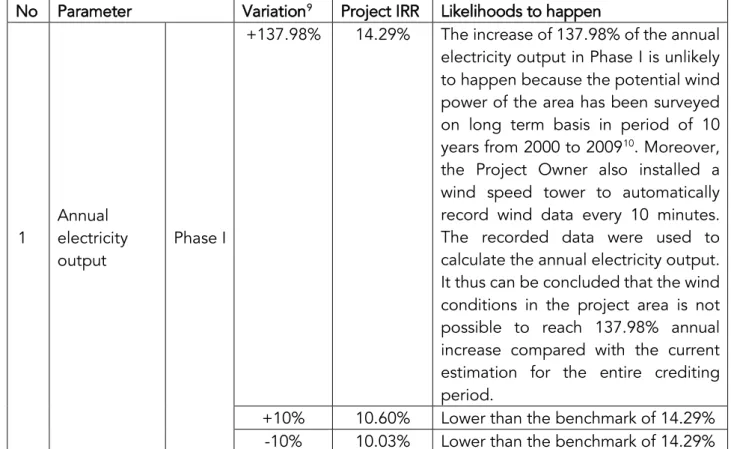
Table 6 shows the impact of variations in key factors on the Project IRR. Table 6: Sensitivity analysis
No Parameter Variation9 Project IRR Likelihoods to happen
1
Annual electricity output
Phase I
+137.98% 14.29% The increase of 137.98% of the annual electricity output in Phase I is unlikely to happen because the potential wind power of the area has been surveyed on long term basis in period of 10 years from 2000 to 200910. Moreover, the Project Owner also installed a wind speed tower to automatically record wind data every 10 minutes. The recorded data were used to calculate the annual electricity output. It thus can be concluded that the wind conditions in the project area is not possible to reach 137.98% annual increase compared with the current estimation for the entire crediting period.
+10% 10.60% Lower than the benchmark of 14.29% -10% 10.03% Lower than the benchmark of 14.29%
9 ±10% is selected according to the Decision No. 2014/QD – BCN issued by the Ministry of Industry, dated 13 June 2007 to provide temporary guidelines for conducting the economic, financial and investment analysis and providing the purchasing-selling price frame for power generation projects. It is also common-practice for sensitivity analysis for additionality demonstration. Furthermore, ±10% is also a common practice rate for sensitivity analysis of a CDM project.
Phase II
+36.62% 14.29% The increase of 36.62% of the annual electricity output in Phase II is unlikely to happen because the potential wind power of the area has been surveyed on long term basis in period of 10 years from 2000 to 200911. Moreover, the Project Owner also installed a wind speed tower to automatically record wind data every 10 minutes. The recorded data were used to calculate the annual electricity output. It thus can be concluded that the wind conditions in the project area is not possible to reach 36.62% annual increase compared with the current estimation for the entire crediting period.
+10% 11.45% Lower than the benchmark of 14.29% -10% 9.13% Lower than the benchmark of 14.29%
2
Total investment cost
Phase I
+10% 10.01% Lower than the benchmark of 14.29% -10% 10.63% Lower than the benchmark of 14.29% -98.66% 14.29% The decrease of 98.66% in the total
investment cost of Phase I is not likely to happen because the inflation, average consumer prices from 2008 until 2015 12 show an annual average increase of 9.197 %.
Phase II
+10% 9.24% Lower than the benchmark of 14.29% -10% 11.52% Lower than the benchmark of 14.29% -29.02% 14.29% The decrease of 29.02% in the total
investment cost in Phase II is not likely to happen because the inflation, average consumer prices from 2008 until 201513 show an annual average increase of 9.197 %.
11 Feasibility Study Report
12 http://www.imf.org/external/pubs/ft/weo/2010/01/weodata/weorept.aspx?sy=2008&ey=2015&scsm=1&ssd=1&sort =country&ds=.&br=1&pr1.x=20&pr1.y=14&c=582&s=PCPIPCH&grp=0&a=#cs1 13 http://www.imf.org/external/pubs/ft/weo/2010/01/weodata/weorept.aspx?sy=2008&ey=2015&scsm=1&ssd=1&sort =country&ds=.&br=1&pr1.x=20&pr1.y=14&c=582&s=PCPIPCH&grp=0&a=#cs1
3 Electricity price
+23.01% 14.29% The increase of 23.01% in tariff annually is impossible since the Ministry of Industry and Trade has informed the Project Owner that the tariff applied to the project will be accordance to the Decision 37/2011/QD-TTg dated 29 June 2011 of the Prime Minister at 7.8 UScent/kwh which is lower than the value in FSR14.
+10% 12.10% Lower than the benchmark of 14.29% -10% 8.42% Lower than the benchmark of 14.29%
4 O&M cost
+10% 9.92% Lower than the benchmark of 14.29% -10% 10.70% Lower than the benchmark of 14.29% -112.26% 14.29% The decrease of 112.26% in the O&M
cost is never happened since no cost for O&M of the project would be incurred by the project owner during the entire operation life is absolutely not realistic.
The benchmark is defined as the expected rate of return, at which the investment project is considered to be financially feasible while project IRR is actual rate of return of the proposed project and calculated based on the project-specific assumptions in the FSR that have been designed by an independent third party and approved by the national authorities. If the project IRR is lower than the benchmark then the project is not financially attractive and subsequently no investments would be made at such project IRR in general.
In conclusion, the proposed project activity is unlikely to be financially attractive. Ongoing financial need:
During the first crediting period, the PPs has conducted 3 times of verification for the monitoring periods as follows:
1st monitoring period: 20/06/2013 – 31/03/2016 – 104110 CERs (issued) 2nd monitoring period: 01/04/2016 – 30/06/2017 – 119120 CERs (issued) 3rd monitoring period: 01/07/2017 – 30/09/2018 – 146111 CERs (issued)
The total 369,341 CERs have been issued for 3 monitoring periods with the total revenue from CERs is about 58,322 EURs without deducting the third party cost.
As mentioned above, the IRR of project without CDM is 10.31%. After receiving financial supporting from CER selling in the 1stcrediting periods, the IRR of project increase insignificantly to 10.32%
and it is still lower than benchmark which is set of 14.29%.
14 Official Letter No. 5080/BCT-DTDL dated 13 June 2012 of the Ministry of Industry and Trade to EVN and Cong Ly Construction-Trading-Tourism Co., Ltd.
During the 2nd crediting period, the project is expected to generate 293,814 GS-CERs annually. With the expected GS-CERs price of around 8 EUR/GS-CER, the total revenue from GS-CER can achieve 2,350,512 EUR/year. The IRR of project without GS/CDM in the 2nd crediting period is 10.32%. After receiving financial supporting from GS CER selling, the IRR of project increase to 10.94%. Therefore, the ongoing financial need derived from GS certification is necessary to reduce unattractiveness of the project and enhance the project’s operation in the 2nd crediting period. This GS finance helps to maintain project activity contributing to the development of local communities in terms of income and employment creation, worker quality increase and emission reduction. Currently, there are no change of policy/market which may impact on the project finance. The impacts of electricity tariff, O&M cost, investment cost and annual electricity export to the national grid have been analyzed in Sub-step 2d above: Sensitivity analysis.
Step 3: Barrier analysis Not applied.
Step 4: Common practice analysis
According to the paragraph 47 of the “Tool for the demonstration and assessment of additionality”, version 06.0.0, EB 65, the project activity falls in the type of “Switch of technology with or without change of energy source, including the use of renewable energies” which listed in the paragraph 6 of the tool. Therefore, the following stepwise approach according to the Additional Tool shall be applied to analyze the common practices for the proposed project.
Sub-step 4a: Calculate applicable output range as +/-50% of the design output or capacity of the proposed project activity.
The proposed project activity has the installed capacity of 99.2 MW.
So applicable output range as +/-50% of the capacity of the proposed project activity is 49.6 MW and 148.8 MW.
Sub-step 4b: In the applicable geographical area, identify all plants that deliver the same output or capacity, within the applicable output range calculated in Step 1, as the proposed project activity and have started commercial operation before the start date of the project.
The entire host country (Viet Nam) was chosen as the applicable geographical area.
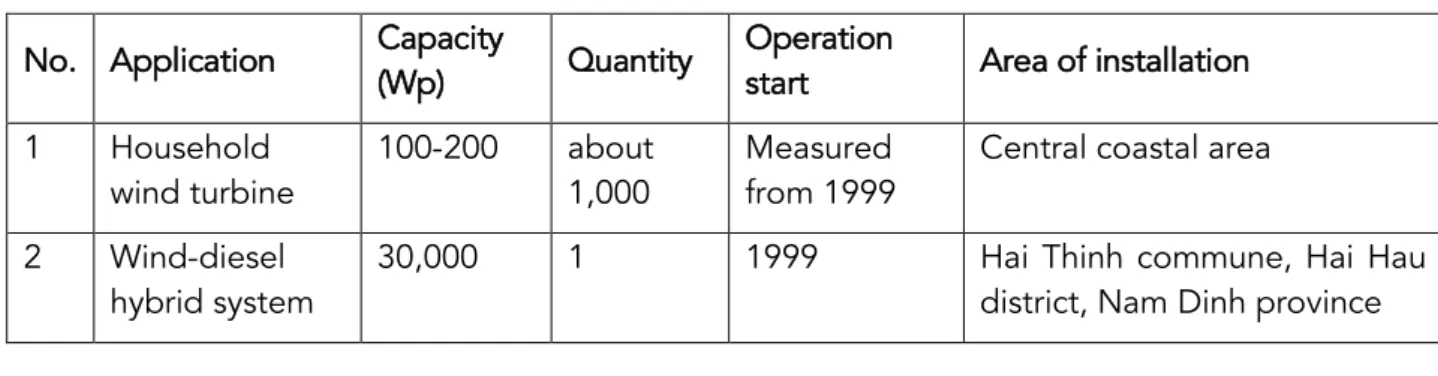
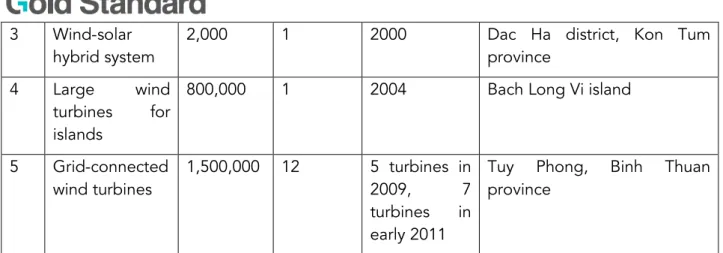
According to the “Information on wind energy of Viet Nam” which was developed under the GIZ/MoIT Wind Energy Project in April 2011, the wind energy applications in Viet Nam that has started operation before the start date of the project are as follows:
Table 7: Wind energy applications in Viet Nam15
No. Application Capacity
(Wp) Quantity
Operation
start Area of installation 1 Household wind turbine 100-200 about 1,000 Measured from 1999
Central coastal area 2 Wind-diesel
hybrid system
30,000 1 1999 Hai Thinh commune, Hai Hau
district, Nam Dinh province
15 Information on wind energy in Vietnam-page 29
3 Wind-solar hybrid system
2,000 1 2000 Dac Ha district, Kon Tum
province
4 Large wind
turbines for islands
800,000 1 2004 Bach Long Vi island
5 Grid-connected wind turbines 1,500,000 12 5 turbines in 2009, 7 turbines in early 2011
Tuy Phong, Binh Thuan province
The table shows that current applications of wind power in Viet Nam are limited and on small scale, which do not fall into the applicable output range as +/-50% of the capacity of the proposed project activity from 49.6 MW to 148.8 MW for common practice analysis.
Moreover, applications no. 1 to 4 are not grid-connected and enjoy different investment conditions from the proposed project activity16
In the applicable geographical area, there is only Binh Thuan Wind Power Plant No.1 (application no. 5) with capacity of 30 MW that is grid-connected and has started commercial operation before the start date of the project. Details of this project are as follows:
Table 8: List of relevant wind power plants for common practice analysis17
N o Name Capacit y MW Elec. outputs 103 MWh Load factor Constructio n starting year Commissioni ng year Investor during the investment and construction period 0 The proposed project 99.2 335,200 38.57% 2010 2012 1 Binh Thuan 30 91.571 37.1 2008 5 turbines in 2009, 7 turbines in 2011 REVN18
16 See further details in “Information on wind energy of Vietnam, GIZ/MoIT wind energy project, April 2011” (http://www.windenergy.org.vn/uploads/Publications/Information_on_wind_energy_in_vietnam_ENG_Final.pdf) 17 Information on wind energy of Vietnam, GIZ/MoIT wind energy project, April 2011
(http://www.windenergy.org.vn/uploads/Publications/Information_on_wind_energy_in_vietnam_ENG_Final.pdf) 18 Vietnam Renewable Energy Joint Stock Company
This sole wind power project in Viet Nam, however, does not fall into the applicable output range
as +/-50% of the capacity of the proposed project activity from 49.6 MW to 148.8 MW and was
registered as CDM project on 6 April 200919. So, one gets N
all = 0.
Sub-step 4c: Identify plants that apply technologies different than the technology applied in the proposed project activity
As stated above, there is no wind power project in Viet Nam that has started commercial operation before the start date of the project without the aid of CDM, therefore Ndiff is ascertained to be 0. Sub-step 4d: Calculate factor F=1-Ndiff/Nall where Ndiff = Nall (= 0) thus Ndiff/ Nall = 1 and the resulted factor F=1-Ndiff/Nall = 0 that is lesser than 0.2 (for common practice, it should be more than 0.2)
Nall-Ndiff = 0 that is smaller than 3 (for common practice, it should be more than 3). Hence, the project activity is not a common practice as by the definition of the EB Guidance at Annex 12, EB 63.
Implementation timeline of the proposed project activity
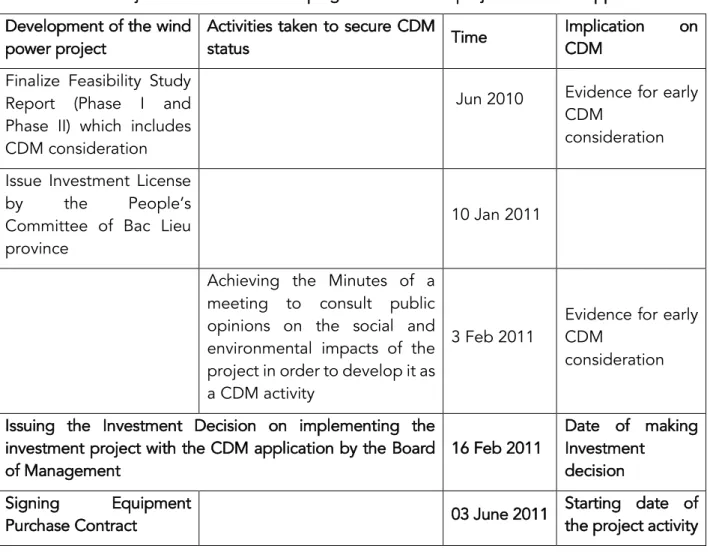
CDM early consideration and the serious actions to secure the CDM status for the project are reflected in the key milestones in the development of the project listed below:
Table 9: Major milestones in developing the investment project and CDM application Development of the wind
power project
Activities taken to secure CDM
status Time
Implication on CDM
Finalize Feasibility Study Report (Phase I and Phase II) which includes CDM consideration
Jun 2010 Evidence for early CDM
consideration Issue Investment License
by the People’s Committee of Bac Lieu province
10 Jan 2011
Achieving the Minutes of a meeting to consult public opinions on the social and environmental impacts of the project in order to develop it as a CDM activity
3 Feb 2011
Evidence for early CDM
consideration
Issuing the Investment Decision on implementing the investment project with the CDM application by the Board of Management 16 Feb 2011 Date of making Investment decision Signing Equipment
Purchase Contract 03 June 2011
Starting date of the project activity
Notification to UNFCCC on idea to develop the project under CDM
2 Nov 2011 Notification to Viet Nam DNA
on idea to develop the project under CDM
16 Nov 2011 Signing Emission Reduction
Purchasing Agreement 7 May 2012 Expected commissioning
date for the 1st phase Jan 2013
Expected commissioning
date for the 2nd phase Jan 2015
In conclusion, the proposed project is additional.
B.6. Sustainable Development Goals (SDG) outcomes B.6.1. Relevant target for each of the three SDGs
SDG 7: Ensure access to affordable, reliable, sustainable and modern energy for all Indicator 7.2.1 – Renewable energy share in the total final energy consumption
Target 7.2: By 2030, increase substantially the share of renewable energy in the global energy mix
SDG 8: Promote sustained, inclusive and sustainable economic growth, full and productive employment and decent work for all
Indicator 8.5.1 – Average hourly earnings of female and male employees, by occupation, age and persons with disabilities
Target 8.5: By 2030, achieve full and productive employment and decent work for all women and men, including for young people and persons with disabilities, and equal pay for work of equal value
SDG 13: Take urgent action to combat climate change and its impacts
Target 13.2: Integrate climate change measures into national policies, strategies and planning
B.6.2. Explanation of methodological choices/approaches for estimating the SDG outcome SDG 7: Ensure access to affordable, reliable, sustainable and modern energy for all
This SDG outcome is measured in accordance with ACM 0002 “Grid-connected electricity
generation from renewable sources” version 20.0 for the net electricity supplied to the national grid
by the project, EGfacility,y (MWh)20. Baseline:
Prior to the implementation of the project activity, electricity in Viet Nam is generated mainly from
fossil fuel sources and is solely distributed to consumers via the unique national electricity grid. Project’s outcome:
This project annually supplements 327,826 MWh of clean and sustainable electricity to the national grid, thereby contributing to the Target 7.2:
By 2030, increase substantially the share of renewable energy in the global energy mix.
SDG 8: Promote sustained, inclusive, and sustainable economic growth, full and productive employment and decent work for all
Baseline:
The project activity is located in Bac Lieu province. The average monthly income per capita of Bac Lieu province in 2018 is 2.595 million VND.
Project’s outcome
The project leads to employment opportunities, which would not have been possible in the baseline scenario. During operation phases, about 70 local employees have been created with average monthly salary of 10 million VND. The average salary of Bac Lieu staffs is higher than the local level21
.
The project contributes to the Target 8.5
- By 2030, achieve full and productive employment and decent work for all women and men, including for young people and persons with disabilities, and equal pay for work of equal value
SDG 13: Take urgent action to combat climate change and its impacts
For the climate combat action, this project directly reduces 293,814 tons of CO2 equivalent/year, thereby the project contributes to the National SDG 13 - Target 13.2 – Integrate climate change measures into national policies, strategies and planning.
This SDG outcome is measured in accordance with ACM0002 “Grid-connected electricity generation from renewable sources” version 20.0 for the emission reductions generated by the project, ERy (tCO2e).
Baseline emissions (BEy)
Baseline emissions include only CO2 emissions from electricity generation from fossil fuel fired power plants that are displaced due to the project activity, calculated as follows:
BEy = EGPJ,y x EFgrid,CM,y Where:
BEy Baseline emissions in year y (tCO2/yr).
EGPJ,y Quantity of net electricity generation that is produced and fed into the grid as a result of the implementation of the CDM project activity in year y (MWh/yr)
EFgrid,CM,y Combined margin CO2 emission factor for grid connected power generation in year y calculated using the latest version of the “Tool to calculate the emission factor for an electricity system”.
Calculation of EGPJ
Because the project activity is the installation of a new grid-connected renewable power plant/unit at a site where no renewable power plant was operated prior to the implementation of the project activity, then:
EGPJ,y = EGfacility,y Where:
EGPJ,y = Quantity of net electricity generation that is produced and fed into the grid as a
result of the implementation of the CDM project activity in year y (MWh/yr)
EGfacility,y = Quantity of net electricity generation supplied by the project plant/unit to the grid
in year y (MWh/yr)
Therefore, the baseline emissions are calculated as follows: BEy = EGfacility,y .EFgrid,CM,y Project emission (PEy)
According to ACM0002, Version 20.0, the project emissions are calculated using the following equation: PEy = PEFF,y + PEGP,y + PEHP,y
Where:
PEy Project emissions in year y (tCO2e/yr)
PEFF,y Project emissions from fossil fuel consumption in year y (tCO2/yr)
PEGP,y Project emissions from the operation of geothermal power plants due to the release of
non-condensable gases in year y (tCO2e/yr)
PEHP,y Project emissions from water reservoirs of hydro power plants in year y (tCO2e/yr)
The proposed project is a wind power plant that neither uses fossil fuel nor operates geothermal power plants or having water reservoirs (i.e. PEFF,y = 0; PEGP,y = 0; PEHP,y = 0); therefore, the project emission is zero:
PEy = 0
Leakage (Ly)
According to ACM0002, Version 20.0 , no leakage emissions are considered. The main emissions potentially giving rise to leakage in the context of electric sector projects are emissions arising due to activities such as power plant construction and upstream emissions from fossil fuel use (e.g. extraction, processing, transport). These emissions sources are neglected.
Emission reductions (ERy)
Emission reductions are calculated as follows:
ERy = BEy - PEy
Where:
ERy Emission reductions in year y (t CO2e/yr).
BEy Baseline emissions in year y (t CO2e/yr)
B.6.3. Data and parameters fixed ex ante for monitoring contribution to each of the three SDGs Relevant SDG Indicator SDG 7 - Indicator 7.2.1 – Renewable energy share in the total final
energy consumption Data/parameter Installed capacity
Unit MW
Description The installed capacity of Bac Lieu Province Wind Power Plant Source of data Equipment specifications
Value(s) applied 99.2 Choice of data or
Measurement methods and procedures
Data provided by manufacturers
Purpose of data The contribution of clean and suitable energy from the project to the national energy mix
Additional comment N/A
Relevant SDG Indicator SDG 13
Data/parameter Grid emission factor
Unit tCO2/MWh
Description Combined margin CO2 emission factor for grid connected power generation in year y calculated using the latest version of “Tool to calculate the emission factor for an electricity system”.
Source of data Data published by DNA Viet Nam Value(s) applied 0.89625
Choice of data or Measurement methods and procedures
As per the “Tool to calculate the emission factor for an electricity system”.
Purpose of data For calculation of the CO2 emission reduction from Bac Lieu Province Wind Power Plant
Additional comment N/A
B.6.4.Ex ante estimation of outcomes linked to each of the three SDGs Project emissions (PEy)
The emissions of this wind power project PEy = 0 Baseline emissions (BEy)
Baseline emissions include only CO2 emissions from electricity generation by fossil fuel fired power plants that are displaced due to the project activity. It is calculated as follows:
,
.
, ,y PJ y grid CM y
Where:
BEy Baseline emissions in year y (t CO2e/yr).
EGPJ,y Quantity of net electricity generation that is produced and fed into the grid as a result of the implementation of the CDM project activity in year y (MWh/yr), and equal to 327,826 MWh/yr
EFgrid,CM,y = 0.89625 tCO2/MWh
Calculation of the emission factor (EF) of the national electricity grid For this renewal crediting period, the emission factor is calculated using:
• Latest national data: The published data by the host country DNA of Viet Nam, Department of Climate Change, Ministry of Natural Resources and Environment of Viet Nam on 12/03/2020; and
• The Version 07.0 of “Tool to calculate the emission factor for an electricity system” valid from 31/08/2018 onward.
The Emission Factor of Viet Nam Electricity System was calculated and published by DNA of Viet Nam, Department of Climate Change, Ministry of Natural Resources and Environment of Viet Nam on 12/03/2020 using Version 07.0 of “Tool to calculate the emission factor for an electricity system”, including:
The operating margin emission factor: EFgrid,OM,y = 0.8795 tCO2/MWh And build margin emission factor: EFgrid,BM,y = 0.9465 tCO2/MWh The combined emission factor is calculated as follows:
EFgrid,CM,y = EFgrid,OM,y × wOM + EFgrid,BM,y × wBM Where:
wOM: Weighting of OM emission factor (%) wBM: Weighting of BM emission factor (%)
However, the DNA report applied the weighting factors of both OM and BM emission are 0.5, which is not applicable for wind power generation project activities.
According to the Version 07.0 of “Tool to calculate the emission factor for an electricity system”, the following default values are used in wind power generation project activities for the first crediting period and for subsequent crediting periods:
wOM = 0.75 and wBM = 0.25
So in the renewal crediting period, the CM emissions factor is derived as follows: EFgrid,CM,y = 0.75 × 0.8795 + 0.25 × 0. 9465 = 0.89625 tCO2/MWh The CM emission factor shall be fixed for the second crediting period.
Therefore:
Leakage (LEy)
As it is stated in ACM0002 version 20.0, no leakage emission is considered. The main emissions potentially giving rise to leakage in the context of electric sector projects are emissions arising due to activities such as power plant construction and upstream emissions from fossil fuel use (e.g. extraction, processing, transport).These emissions sources are neglected.
Emission Reductions (ERy)
Emission reductions are calculated as follows:
ERy = BEy - PEy= 293,814 tCO2/yr B.6.5. Summary of ex ante estimates of each SDG outcome
SDG 7 – Ensure access to affordable, reliable, sustainable and modern energy for all Table 15: Net electricity supplied to national grid
Year Baseline estimate
(tCO2e) Project estimate (MWh) Net benefit (tCO2e) 2020 (from 20/06/2020 to 31/12/2020) 0 174,661 327,826 2021 0 327,826 327,826 2022 0 327,826 327,826 2023 0 327,826 327,826 2024 0 327,826 327,826 2025 0 327,826 327,826 2026 0 327,826 327,826 2017 (from 01/01/2027 to 19/06/2027) 0 153,165 153,165 Total 0 2,294,782 2,294,782
Total number of crediting
years 7
Annual
average over the crediting period
0 327,826 327,826
SDG 8 - Promote inclusive and sustainable economic growth, employment and decent work for all The project leads to employment opportunities which would not have been possible in the baseline scenario. The project provides permanent employment to around 70 people.
A wind project in general does not expose workers to unsafe or unhealthy work environments interms of toxins or chemicals. In addition the project follows national safety rules under (Host Country) Law that covers work safety. The staffs have participated plant operation training from August 2007 to May 2008. After the course, staffs passed the examination have been issued the certificate. Then internal trainings on plant operation have been conducted annually for plant staffs. The project proponent also creates good labor condition for the plant staffs. Every year, all the
employees are checked-up at the medical centers for free using their health insurance via insurance card.
SDG 13 - Take urgent action to combat climate change and its impacts
Table 16: Expected emission reduction in the 2nd crediting period Year Baseline estimate (tCO
2e)
Project estimate
(tCO2e) Net benefit (tCO2e) 2020(from 20/06/2020 to 31/12/2020) 156,540 0 0 2021 293,814 0 0 2022 293,814 0 0 2023 293,814 0 0 2024 293,814 0 0 2025 293,814 0 0 2026 293,814 0 0 2017 (from 01/01/2027 to 19/06/2027) 137,274 0 0 Total 2,056,698 0 0
Total number of crediting
years 7
Annual average over the
crediting period 2,056,698 0 0
B.7. Monitoring plan
B.7.1. Data and parameters to be monitored
Relevant SDG Indicator SDG 13: Climate Action Data/parameter: Annual emission reduction
Unit tCO2e/year
Description The project will generate renewable power, which will displace part of the electricity otherwise supplied by fossil fuel fired power plants, thus GHG emission reductions are achieved via this project
Source of data Parameter ERy in the CDM PDD Value(s) applied 293,814tCO2e
Measurement methods and
procedures According to ACM0002 version 20.0
Monitoring frequency Monthly
QA/QC procedures: Cross-checking with electricity data
Additional comments: N/A
Relevant SDG Indicator SDG 8Indicator 8.5.1 – Average hourly earnings of female and male employees, by occupation, age and persons with disabilities
Data/parameter: - Quality of employment
- Quantitative employment and income generation
- Equal pay for work of equal value for both men and women Unit - Number of employees (for data on quantitative employment)
- Income in USD and VND (for data on income generation)
- List of employees, functions and respective income (for data on equal pay for work of equal value for both men and women)
Description The employees of the project are trained on technical aspects relating to the operation of the wind power plant and provided with labour contracts, medical insurance and regular health-check as well as social insurance and unemployment insurance. The employees of the project are paid higher than the average monthly income per capita of the province. Men and women are paid equally for work of equal value.
Measured/calculated/defau lt
N/A
Source of data Training records, labour contracts, salary records
Value(s) applied 100% of the employees will be trained on technical aspects relating to the operation of the hydropower plant, 100% of the employees will be provided with labour contracts, social and medical insurance.
Number of employees: 79
Average income: 10 million VND per month
Measurement methods and
procedures Checking documents
Monitoring frequency: Once per monitoring period QA/QC procedures: Cross-checking by interviews
Purpose of data: Contribution of the project to provide full and productive employment and decent work for all women and men, including for young people and persons with disabilities, and equal pay for work of equal value
Additional comments: N/A
Relevant SDG Indicator SDG 7 Indicator 7.2.1: Renewable energy share in the total final energy consumption
Data/parameter: Access to affordable and clean energy services
Unit MWh/year
Description Net electricity supplied to the national grid by the proposed project Source of data Parameter EGfacility,y in the CDM PDD
Measurement methods and
procedures Calculating by subtracting EGTwo-way power meters will be installed at the grid-connected point to y,import from EGy,export.
measure the amount of electricity supplied and consumed by the proposed project by the reverse direction. The readings of electricity meter will be continuously measured and monthly recorded. The recorded data will be confirmed by the joint balance sheet which will be signed by the representatives of EVN and the project owner. Electronic data will be archived within the crediting period and 2 years after the end of the crediting period.
Monitoring frequency: Continuous measurement and monthly recording
QA/QC procedures: The uncertainty level of this data is low. The measurement/monitoring equipment should be complied with national standard and technology. These equipment and systems should be calibrated and checked every 2 year.
Purpose of data: Contribution of clean and sustainable energy from the Project to the national grid and to the increase of the share of the renewable energy in the global energy mix.
Additional comments: N/A
B.7.2. Sampling plan Not applicable
B.7.3. Other elements of monitoring plan Not applicable
SECTION C. Duration and crediting period C.1. Duration of project
C.1.1. Start date of project 03/06/2011
C.1.2. Expected operational lifetime of project 22 years
C.2. Crediting period of project C.2.1. Start date of crediting period 20/06/2020 (2nd crediting period)
C.2.2. Total length of crediting period From 20/06/2020 to 19/06/2027
SECTION D. Safeguarding principles assessment
D.1. Analysis of social, economic and environmental impacts Safeguarding principles Mandatory requirements / Assessment questions Assessment of relevance to the project (Yes/ potentially/n o) Justification Mitigation measure (if required) 3.1 Human rights
The Project Developer and the Project shall respect internationally proclaimed human rights and shall not be complicit in violence or human rights abuses of any kind as defined in the Universal Declaration of Human Rights
No Viet Nam ratified
“International
Convention on the Elimination of all Form of Racial Discrimination” on 09/06/1981;
“International Covenant on Civil and Political
Rights” and “International Covenant
on Economic, Social and Cultural Rights” on 24/09/1982;
“Convention on the Elimination of all Forms of Discrimination against Women” on 27/11/1981. Therefore, the project
developer and the
project do respect
nationally and internationally
proclaimed human rights and shall not be complicit in violence or human rights abuses of any kind
N/A
The Project shall not discriminate with regards to participation and inclusion
No Viet Nam ratified
“International
Convention on the Elimination of all Form of Racial Discrimination” on 09/06/1981;
“Convention on the Elimination of all Forms of Discrimination against Women” on 27/11/1981.