The Locality-Aware Adaptive Cache Coherence Protocol
George Kurian
Massachusetts Institute of Technology Cambridge, MA USA
Omer Khan
University of Connecticut Storrs, CT USASrinivas Devadas
Massachusetts Institute of Technology Cambridge, MA USA
ABSTRACT
Next generation multicore applications will process massive amounts of data with significant sharing. Data movement and management impacts memory access latency and con-sumes power. Therefore, harnessing data locality is of fun-damental importance in future processors. We propose a scalable, efficient shared memory cache coherence protocol that enables seamless adaptation between private and log-ically shared caching of on-chip data at the fine granular-ity of cache lines. Our data-centric approach relies on in-hardware yet low-overhead runtime profiling of the locality of each cache line and only allows private caching for data blocks with high spatio-temporal locality. This allows us to better exploit the private caches and enable low-latency, low-energy memory access, while retaining the convenience of shared memory. On a set of parallel benchmarks, our low-overhead locality-aware mechanisms reduce the overall en-ergy by 25% and completion time by 15% in an NoC-based multicore with the Reactive-NUCA on-chip cache organi-zation and the ACKwise limited directory-based coherence protocol.
Categories and Subject Descriptors
C.1.2.g [Processor Architectures]: [Parallel processors]; B.3.2.g [Memory Structures]: [Shared memory]
General Terms
Design, PerformanceKeywords
Cache Coherence, Multicore
This work was funded by the U.S. Government under the DARPA UHPC program, and a faculty startup grant from the University of Connecticut. The views and conclusions contained herein are those of the authors and should not be interpreted as representing the official policies, either ex-pressed or implied, of the U.S. Government.
Permission to make digital or hard copies of all or part of this work for personal or classroom use is granted without fee provided that copies are not made or distributed for profit or commercial advantage and that copies bear this notice and the full citation on the first page. To copy otherwise, to republish, to post on servers or to redistribute to lists, requires prior specific permission and/or a fee.
ISCA’13 Tel-Aviv, Israel
Copyright 2013 ACM 978-1-4503-2079-5/13/06 ...$15.00.
1.
INTRODUCTION
In the era of multicores, programmers now need to in-vest more effort in designing software capable of exploiting multicore parallelism. To reduce memory access latency and power consumption, a programmer can manually orchestrate communication and computation or adopt the familiar pro-gramming paradigm of shared memory. But will current shared memory architectures scale to many cores? This pa-per addresses the question of how to enable low-latency, low-energy memory access while retaining the convenience
of shared memory.
Current semiconductor trends project the advent of single-chip multicores dealing with data at an unprecedented scale. Hence, in future processors, the main bottleneck shifts from computation capabilities to data management, including on-chip memory and communication. Memory scalability is critically constrained by off-chip bandwidth, on-chip latency and energy consumption [11]. Memory access latency and energy consumption are now first-order design constraints.
A large, monolithic physically-shared on-chip cache does not scale beyond a small number of cores, and the only prac-tical option is to physically distribute it in pieces so that ev-ery core is near some portion of the cache [2]. In theory this provides a large amount of aggregate cache capacity and fast private access for each core. Unfortunately, it is difficult to manage distributed private caches effectively as they require architectural support for cache coherence and consistency.
Popular directory-based protocols enable fast local caching to exploit data locality, but scale poorly with increasing core counts [16]. Many recent proposals (e.g., Tagless Direc-tory [23], SPATL[25], SCD [19], and ACKwise [13]) have addressed directory scalability in single-chip multicores us-ing either sharer compression techniques or limited directo-ries that require complex on-chip network capabilities [9]. But they still suffer from a major drawback, that is the pri-vate caches are left unmanaged. A request for data allocates and replicates a data block in the private cache hierarchy even if the data has no spatial or temporal locality. This leads to cache pollution since such low locality data can displace more frequently used data, or suffer from expensive communication due to the coherence protocol. Since on-chip wires are not scaling at the same rate as transistors [11], un-necessary data movement and replication not only impacts latency, but also consumes extra power due to wasteful en-ergy consumption of network and cache resources [16].
A popular option is to organize the last-level cache as log-ically shared, leading to non-uniform cache access (NUCA) [12]. Although the NUCA configuration yields better
on-chip cache utilization, exploiting locality using low-latency private caching becomes even more challenging (as memory latency is now also sensitive to data placement). To ad-dress this problem, coarse-grain data migration and restric-tive replication schemes have been proposed (e.g., Reacrestric-tive- Reactive-NUCA [5]); however, these mechanisms typically assume pri-vate low-level caches and still require directories that leave the private caches unmanaged.
In this paper we propose aLocality-Aware Adaptive
Co-herence protocol to better manage the private caches in
shared memory multicores. When a core makes a memory request that misses the private cache, the coherence pro-tocol either brings the entire cache line using a traditional directory protocol, or just accesses the requested word at the shared cache location. This decision is based on the
spatio-temporal locality of a particular data block. Our approach
relies on runtime profiling of the locality of each cache line and only allows private caching for data blocks with high spatio-temporal locality. We propose a low-overhead (18KB storage per core) yet highly accurate predictive mechanism to track the locality of cache lines in hardware. This local-ity tracking mechanism is decoupled from the sharer tracking structures that cause scalability concerns in cache coherence protocols.
We implement our protocol on top of an existing Private-L1 Shared-L2 cache organization, where the shared L2 cache is physically distributed in slices throughout the chip and managed using Reactive-NUCA’s [5] data placement and migration policy. We choose the ACKwise limited direc-tory protocol because it has been shown to scale to large core counts [13].
OurLocality-Aware Adaptive Coherenceprotocol is
advan-tageous because it:
1. Better exploits on-chip private caches by intelligently controlling data caching and replication.
2. Enables lower memory access latency by trading off unnecessary cache evictions or expensive invalidations with much cheaper word accesses.
3. Lowers energy consumption by better utilizing on-chip network and cache resources.
2.
BACKGROUND
2.1
Related Work
Previous research on cache organizations in multicore pro-cessors mostly focused on the last-level cache (LLC). Propos-als have been made to organize the LLC as private, shared or a combination of both. All other cache levels have tradi-tionally been organized as private to a core [4, 6, 24, 5].
The benefits of having a private or shared LLC organiza-tion depend on the degree of sharing in an applicaorganiza-tion as well as data access patterns. While private LLC organiza-tions have low hit latencies, their off-chip miss rates are high in applications that exhibit high degrees of sharing due to data replication. Shared LLC organizations, on the other hand, have high hit latencies since each request has to com-plete a round-trip over the interconnection network. This hit latency increases as more cores are added since the di-ameter of most on-chip networks increases with the number of cores. However, their off-chip miss rates are low because data is not replicated.
Private LLC organizations limit the cache capacity
avail-able to a thread to that of the private LLC slice. This has an adverse effect on workloads with large private working sets and uneven distribution of working set sizes. Shared LLC organizations are not affected by this issue since they have the flexibility in storing the data of a thread in various locations throughout the LLC.
Both private and shared LLC organizations incur signifi-cant protocol latencies when a writer of a data block inval-idates multiple readers; the impact being directly propor-tional to the degree of sharing of the data block. Previous research has proposed hybrid LLC organizations that com-bine the benefits of private and shared caches. Two such pro-posals are Reactive-NUCA [5] and Victim Replication [24].
Reactive-NUCAclassifies data as private or shared using
OS page tables at page granularity and manages LLC alloca-tion according to the type of data. For a 16-core processor, R-NUCA places private data at the LLC slice of the request-ing core, shared data at a srequest-ingle LLC slice whose location is determined by computing a hash function of the address, and replicates instructions at a single LLC slice for every cluster of 4 cores using a rotational interleaving mechanism.
Victim replicationstarts out with a private L1 and shared
L2 organization and uses the local L2 slice as a victim cache for data that is evicted from the L1 cache. By only replicat-ing the L1 capacity victims, this scheme attempts to combine the low hit latency of private designs with the low off-chip miss rates of shared LLCs.
The above schemes suffer two major drawbacks:
1. They leave the private caches unmanaged. A request for data allocates a cache line in the private cache hi-erarchy even if the data has no spatial or temporal locality. This leads to cache pollution since such low locality data can displace more frequently used data, or suffer from expensive communication due to the co-herence protocol.
2. Management of on-chip data is based on coarse-grain data classification mechanisms and/or pays no atten-tion to the locality of the cache lines. For example, victim replication places all L1 cache victims into the local L2 cache irrespective of whether they will be re-used in the future. R-NUCA has a fixed policy for managing shared data and does not allow less or more replication based on the usefulness of data.
There has been significant research on managing the re-source sharing of the LLC [18, 8]. These schemes either dynamically partition the cache to optimize for applications that benefit from the LLC, or better manage the LLC re-placement policy based on the locality of cache lines in the private caches. To the contrary, our protocol focuses on in-telligent management of private caches. Managing private caches is important because they replicate shared data with-out paying attention to its locality, and they are generally capacity-stressed due to strict size and latency limitations.
Previously, researchers have studied techniques for man-agement of private caches in the context of uniprocessors. In Cache Bursts [15], the private cache fetches the entire cache line on every miss and evicts it as soon as it is detected to be a dead block. This does not accrue the network traffic or memory access latency benefits that our protocol enables by just fetching a single-use word for low locality data.
Selective caching has been suggested in the context of sin-gle processors to selectively cache data in the on-chip caches
Evic%on vs U%liza%on
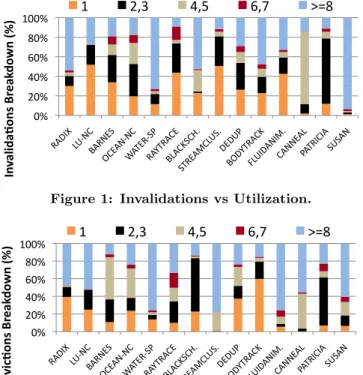
15 0% 20% 40% 60% 80% 100% Ev ic %o ns B re ak do w n (%) 1 2,3 4,5 6,7 >=8 0% 20% 40% 60% 80% 100% In va lid a% on s Br ea kd ow n (%) 1 2,3 4,5 6,7 >=8Figure 1: Invalidations vs Utilization.
Evic%on vs U%liza%on
15 0% 20% 40% 60% 80% 100% Ev ic %o ns B re ak do w n (%) 1 2,3 4,5 6,7 >=8 0% 20% 40% 60% 80% 100% In va lid a% on s Br ea kd ow n (%) 1 2,3 4,5 6,7 >=8Figure 2: Evictions vs Utilization.
based on its locality [21, 10]. Our protocol is based on the similar central idea, but differs from selective caching in two key aspects: (1) In addition to performance we also optimize for energy consumption in the memory system. In [10], the referenced cache line is always brought into a set-associative buffer. To the contrary, our protocol selectively decides to move a cache line from the shared LLC to the private cache or simply accesses the requested word at the shared LLC, thereby reducing the energy consumption of moving unnecessary data through the on-chip network. (2) All prior selective caching proposals have focused on uniprocessors, while in this paper, we target large-scale shared memory multicores running multithreaded applications with shared
data. In addition to the traditional private data, our pro-tocol also tracks the locality of shared data and potentially converts expensive invalidations into much cheaper word ac-cesses that not only improve memory latency but also reduce the energy consumption of the network and cache resources.
2.2
Motivation
In this paper we motivate the need for a locality-aware
allocation of cache lines in the private caches of a shared memory multicore processor. The locality of each cache line is quantified using autilizationmetric. The utilization is de-fined as the number of accesses that are made to the cache line by a core after being brought into its private cache hi-erarchy and before being invalidated or evicted.
Figures 1 and 2 show the percentage of invalidated and evicted cache lines as a function of their utilization. We ob-serve that many cache lines that are evicted or invalidated in the private caches exhibit low locality (e.g., in
stream-cluster, 80% of the cache lines that are invalidated have
utilization<4). To avoid the performance penalties of
inval-idations and evictions, we propose to only bring those cache lines that have high spatio-temporal locality into the private caches. This is accomplished by tracking vital statistics at
the private caches and the on-chip directory to quantify the utilization of data at the granularity of cache lines. This utilization information is subsequently used to classify data as cache line or word accessible.
3.
LOCALITY-AWARE ADAPTIVE CACHE
COHERENCE PROTOCOL
We describe how theLocality-Aware Adaptive Coherence
protocol works by implementing it on top of a Private-L1 Shared-L2 cache organization with R-NUCA’s data place-ment and migration mechanisms and ACKwise limited di-rectory coherence protocol.
3.1
Baseline System
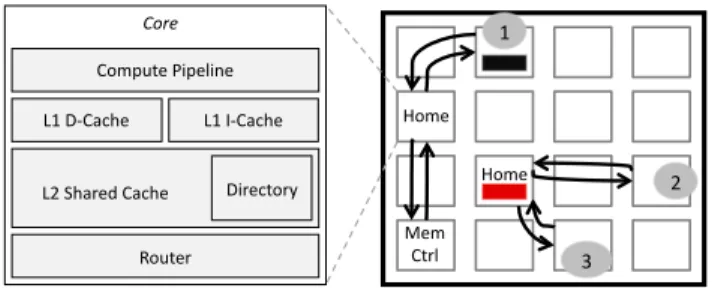
The baseline system is a tiled multicore with an electrical 2-D mesh interconnection network as shown in Figure 3. Each core consists of a compute pipeline, private L1 in-struction and data caches, a physically distributed shared L2 cache with integrated directory, and a network router. The coherence directory is integrated with the L2 slices by extending the L2 tag arrays and tracks the sharing status of the cache lines in the per-core private L1 caches. The pri-vate L1 caches are kept coherent using the ACKwise limited directory-based coherence protocol [13]. Some cores have a connection to a memory controller as well.
The ACKwise protocol maintains a limited set of hard-ware pointers (p) to track the sharers of a cache line. It operates like a full-map protocol when the number of shar-ers is less than or equal to the number of hardware pointshar-ers. When the number of sharers exceeds the number of hardware pointers, the ACKwisepprotocol does not track the identi-ties of the sharers anymore. Instead, it tracks the number
of sharers and performs a broadcast invalidate on an exclu-sive request. However, acknowledgments need to be received from only the actual sharers of the data. In conjunction with a broadcast network, the ACKwise protocol has been shown to scale to large numbers of cores [13]. Our 2-D mesh net-work is also augmented with broadcast support. Each router selectively replicates a broadcast’ed message on its output links such that all cores are reached with a single injection.
3.2
Protocol Operation
We first define a few terms to facilitate describing our protocol.
• Private Sharer: A private sharer is a core which is granted a private copy of a cache line in its L1 cache.
• Remote Sharer: A remote sharer is a core which is
NOT granted a private copy of a cache line. Instead, its L1 cache miss is handled at the shared L2 cache location using word access.
• Private Utilization: Private utilization is the num-ber of times a cache line is used (read or written) by a core in its private L1 cache before it gets invalidated or evicted.
• Remote Utilization: Remote utilization is the num-ber of times a cache line is used (read or written) by a core at the shared L2 cache before it is brought into its L1 cache or gets written to by another core.
• Private Caching Threshold (PCT): The private utilization above or equal to which a core is “promoted” to be a private sharer, and below which a core is “de-moted” to be a remote sharer of a cache line.
Adap%ve Coherence
1 Router
L1 I-‐Cache L1 D-‐Cache
L2 Shared Cache Home 2
1 Mem Ctrl Home 3 Core Compute Pipeline Directory
Figure 3: 1, 2 and 3 are mockup requests show-ing the two modes of accessshow-ing on-chip caches usshow-ing our
locality-aware protocol. Since the black data block has
high locality with respect to the core at 1, the directory at the home-node hands out a private copy of the cache line. On the other hand, the low-localityreddata block
is always cached in a single location at its home-node, and all requests ( 2, 3) are serviced using roundtrip remote-word accesses. 4
Remote
Private
U.liza.on < PCT U.liza.on >= PCTIni.al Remote U.liza.on < PCT
Remote U.liza.on >= PCT
Figure 4: Each cache line is initialized toPrivate with respect to all sharers. Based on the utilization counters that are updated on each memory access to this cache line and the parameterPCT, the sharers are transitioned betweenPrivate andRemote modes. Here utilization = (private+remote) utilization.
Note that a cache line can have both private and remote sharers. We first describe the basic operation of the protocol. Later, we present heuristics that are essential for a cost-efficient hardware implementation. Our protocol starts out as a conventional directory protocol and initializes all cores as private sharers of all cache lines (as shown byInitial in Figure 4). Let us understand the handling of read and write requests under this protocol.
Read Requests: When a core makes a read request and misses in its private L1 cache, the request is sent to the L2 cache. If the cache line is not present in the L2 cache, it is brought in from off-chip memory. The L2 cache then hands out a private read-only copy of the cache line if the core is marked as aprivate sharer in its integrated directory ( 1in Figure 3). (Note that when a cache line is brought in from off-chip memory, all cores start out as private sharers). The core then tracks the locality of the cache line by initializing
aprivate utilization counter in its L1 cache to1and
incre-menting this counter for every subsequent read. Each cache line tag is extended with utilization tracking bits for this purpose as shown in Figure 5.
6
State LRU Tag U0liza0onPrivate
State Tag ACKwise Pointers 1 … p Remote U0liza0on1 Remote U0liza0onn … P/R1 … P/Rn State Tag ACKwise Pointers 1 … p Core ID1 Remote U0liza0on1 Core IDk Remote U0liza0onk … … P/R1 … P/Rk Last Access Timestamp Last Access Timestampn Last Access Timestamp1 RAT-‐Level1 … RAT-‐Levelk …
Figure 5: Each L1 cache tag is extended to include ad-ditional bits for tracking (a) private utilization, and (b) last-access time of the cache line.
6
State LRU Tag U0liza0onPrivate
State Tag ACKwise Pointers 1 … p Remote U0liza0on1 Remote U0liza0onn … P/R1 … P/Rn State Tag ACKwise Pointers 1 … p Core ID1 Remote U0liza0on1 Core IDk Remote U0liza0onk … … P/R1 … P/Rk Last Access Timestamp Last Access Timestampn Last Access Timestamp1 RAT-‐Level1 … RAT-‐Levelk …
Figure 6: ACKwisep-Completeclassifier directory entry.
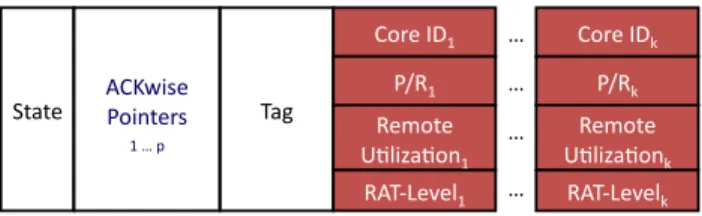
The directory entry contains the state, tag, ACKwisep
pointers as well as (a) mode (P/R), (b) remote utilization counters and (c) last-access timestamps for tracking the locality of all the cores in the system.
On the other hand, if the core is marked as a remote sharer, the integrated directory either increments a core-specific remote utilization counter or resets it to 1 based on the outcome of a Timestamp check (that is described below). If the remote utilization counter has reachedPCT, the requesting core is promoted, i.e., marked as a private sharer and a copy of the cache line is handed over to it (as shown in Figure 4). Otherwise, the L2 cache replies with the requested word ( 2and 3in Figure 3).
The Timestamp check that must be satisfied to
incre-ment the remote utilization counter is as follows. The last-access time of the cache line in the L2 cache is greater than the minimum of the last-access times of all valid cache lines in the same set of the requesting core’s L1 cache. Note that if at least one cache line is invalid in the L1 cache, the above condition is trivially true. Each directory entry is augmented with a per-core remote
uti-lization counter and a last-access timestamp (64-bits wide)
for this purpose as shown in Figure 6. Each L1 cache tag also contains a last-access timestamp (shown in Figure 5) and this information is used to calculate the above mini-mum last-access time in the L1 cache. This minimini-mum is then communicated to the L2 cache on an L1 miss.
The aboveTimestampcheck is added so that when a cache line is brought into the L1 cache, other cache lines that are equally or better utilized are not evicted, i.e., the cache line does not cause L1 cache pollution. For example, consider a benchmark that is looping through a data structure with low locality. Applying the above Timestamp check allows the system to keep a subset of the working set in the L1 cache. Without the Timestamp check, a remote sharer would be promoted to be a private sharer after a few accesses (even if the other lines in the L1 cache are well utilized). This would result in cache lines evicting each other and ping-ponging between the L1 and L2 caches.
Write Requests: When a core makes a write request that misses in its private L1 cache, the request is sent to the L2 cache. The directory performs the following actions if the core is marked as a private sharer: (1) it invalidates all the private sharers of the cache line, (2) it sets the remote utilization counters of all its remote sharers to ‘0’, and (3) it hands out a private read-write copy of the line to the requesting core. The core then tracks the locality of the cache line by initializing the private utilization counter in its L1 cache to 1 and incrementing this counter on every subsequent read/write request.
On the other hand, if the core is marked as a remote sharer, the directory performs the following actions: (1) it invalidates all the private sharers, (2) it sets the remote uti-lization counters of all remote sharers other than the request-ing core to ‘0’, and (3) it increments the remote utilization
counter for the requesting core, or resets it to 1using the
sameTimestampcheck as described earlier for read requests.
If the utilization counter has reachedPCT, the requesting core is promoted and a private read-write copy of the cache line is handed over to it. Otherwise, the word to be written is stored in the L2 cache.
When a core writes to a cache line, the utilization counters of all remote sharers (other than the writer itself) must be set to ‘0’ since they have been unable to demonstrate enough utilization to be promoted. All remote sharers must now build up utilization again to be promoted.
Evictions and Invalidations: When the cache line is re-moved from the private L1 cache due to eviction (conflict or capacity miss) or invalidation (exclusive request by an-other core), the private utilization counter is communicated to the directory along with the acknowledgement message. The directory uses this information along with the remote utilization counter present locally to classify the core as a private or remote sharer in order to handle future requests. If the (private +remote) utilization is≥PCT, the core stays as a private sharer, else it is demoted to a remote sharer (as shown in Figure 4). The remote utilization is added be-cause if the cache line had been brought into the private L1 cache at the time its remote utilization was reset to 1, it would not have been evicted (due to theTimestamp check and the LRU replacement policy of the L1 cache) or invali-dated any earlier. Therefore, the actual utilization observed during this classification phase includes both the private and remote utilization.
Performing classification using the mechanisms described above is expensive due to the area overhead, both at the L1 cache and the directory. Each L1 cache tag needs to store the private utilization and last-access timestamp (a 64-bit field). And each directory entry needs to track locality information (i.e., mode, remote utilization and last-access timestamp) for all the cores. We now describe heuristics to facilitate a cost-effective hardware implementation.
In Section 3.3,we remove the need for tracking the last-access time from the L1 cache and the directory. The basic idea is to approximate the outcome of the Times-tampcheck by using a threshold higher thanPCTfor switch-ing from remote to private mode. This threshold, termed
Remote Access Threshold (RAT)is dynamically learned by
observing the L1 cache set pressure and switches between multiple levels so as to optimize energy and performance.
In Section 3.4, we describe a mechanism for predicting the mode (private/remote) of a core by tracking locality infor-mation for only a limited number of cores at the directory.
3.3
Predicting Remote
→Private Transitions
TheTimestampcheck described earlier served to preserve
well utilized lines in the L1 cache. We approximate this mechanism by making the following two changes to the pro-tocol: (1) de-coupling the threshold for remote-to-private mode transition from that for private-to-remote transition, (2) dynamically adjusting this threshold based on the ob-served L1 cache set pressure.
The threshold for remote-to-private mode transition, i.e., the number of accesses at which a core transitions from a re-mote to private sharer, is termed Rere-mote Access Threshold (RAT). Initially,RATis set equal toPCT(the threshold for private-to-remote mode transition). On an invalidation, if the core is classified as a remote sharer,RATis unchanged.
6
State LRU Tag U0liza0onPrivate
State Tag ACKwise Pointers 1 … p Remote U0liza0on1 Remote U0liza0onn … P/R1 … P/Rn State Tag ACKwise Pointers 1 … p Core ID1 Remote U0liza0on1 Core IDk Remote U0liza0onk … … P/R1 … P/Rk Last Access Timestamp Last Access Timestampn Last Access Timestamp1 RAT-‐Level1 … RAT-‐Levelk …
Figure 7: The limited locality classifier extends the di-rectory entry with mode, utilization, andRAT-level bits for a limited number of cores. A majority vote of the modes of tracked cores is used to classify new cores as private or remote sharers.
This is because the cache set has an invalid line immediately following an invalidation leading to low cache set pressure. Hence, we can assume that the Timestamp check trivially passes on every remote access.
However, on an eviction, if the core is demoted to a remote sharer,RAT is increased to a higher level. This is because an eviction signifies higher cache set pressure. By increas-ing RAT to a higher level, it becomes harder for the core to be promoted to a private sharer, thereby counteracting the cache set pressure. If there are back-to-back evictions, with the core demoted to a remote sharer on each of them,
RAT is further increased to higher levels. However, RAT
is not increased beyond a certain value (RATmax) due to the following two reasons: (1) the core should be able to return to the status of a private sharer if it later shows good locality, and (2) the number of bits needed to track remote utilization should not be too high. Also, beyond a particular
RAT, keeping the core as a remote sharer counteracts the increased cache pressure negligibly, leading to only small im-provements in performance and energy. The protocol is also equipped with a short-cut incase an invalid cache line exists in the L1 cache. In this case, if remote utilization reaches or rises abovePCT, the requesting core is promoted to a private sharer since it will not cause cache pollution. The number of RAT levels used is abbreviated as nRATlevels. RAT is additively increased in equal steps fromPCT to RATmax, the number of steps being equal to (nRATlevels −1).
On the other hand, if the core is classified as a private sharer on an eviction or invalidation, RAT is reset to its starting value ofPCT. Doing this is essential because it pro-vides the core the opportunity to re-learn its classification. Varying theRATin this manner removes the need to track the last-access time both in the L1 cache tag and the direc-tory. However, a field that identifies the currentRAT-level now needs to be added to each directory entry. These bits now replace the last-access timestamp field in Figure 6. The efficacy of this scheme is evaluated in Section 5.2. Based on our observations, RATmax = 16 and nRATlevels = 2 were found to produce results that closely match those produced by theTimestamp-based classification scheme.
3.4
Limited Locality Classifier
The classifier described earlier which keeps track of local-ity information for all cores in the directory entry is termed
theCompletelocality classifier. It has a storage overhead of
60% (calculated in Section 3.6) at 64 cores and over 10×at 1024 cores. In order to mitigate this overhead, we develop a classifier that maintains locality information for a limited number of cores and classifies the other cores as private or remote sharers based on this information.
The locality information for each core consists of (1) the core ID, (2) a mode bit (P/R), (3) a remote utilization counter, and (4) a RAT-level. The classifier that maintains a list of this information for a limited number of cores (k) is termed the Limitedk classifier. Figure 7 shows the in-formation that is tracked by this classifier. The sharer list of ACKwise is not reused for tracking locality information because of its different functionality. While the hardware pointers of ACKwise are used to maintain coherence, the limited locality list serves to classify cores as private or re-mote sharers. Decoupling in this manner also enables the
locality-awareprotocol to be implemented efficiently on top
of other scalable directory organizations. We now describe the working of the limited locality classifier.
At startup, all entries in the limited locality list are free and this is denoted by marking all core IDs’ as INVALID. When a core makes a request to the L2 cache, the directory first checks if the core is already being tracked by the limited locality list. If so, the actions described in Section 3.2 are carried out. Else, the directory checks if a free entry exists. If it does exist, it allocates the entry to the core and the actions described in Section 3.2 are carried out.
Otherwise, the directory checks if a currently tracked core can be replaced. An ideal candidate for replacement is a core that is currently not using the cache line. Such a core is termed an inactive sharer and should ideally relinquish its entry to a core in need of it. A private sharer becomes inactive on an invalidation or an eviction. A remote sharer becomes inactive on a write by another core. If a replace-ment candidate exists, its entry is allocated to the requesting core. The initial mode of the core is obtained by taking a majority vote of the modes of the tracked cores. This is done so as to start off the requester in its most probable mode.
Finally, if no replacement candidate exists, the mode for the requesting core is obtained by taking a majority vote of the modes of all the tracked cores. The limited locality list is left unchanged.
The storage overhead for the Limitedkclassifier is directly proportional to the number of cores (k) for which locality information is tracked. In Section 5.3, we will evaluate the accuracy of theLimitedk classifier. Based on our observa-tions, the Limited3 classifier produces results that closely match and sometimes exceeds those produced by the
Com-pleteclassifier.
3.5
Selection of
PCTThe Private Caching Threshold (PCT) is a parameter to our protocol and combining it with the observed spatio-temporal locality of cache lines, our protocol classifies data as private or remote. The extent to which our protocol im-proves the performance and energy consumption of the sys-tem is a complex function of the application characteristics, the most important being its working set and data shar-ing and access patterns. In Section 5, we will describe how these factors influence performance and energy consumption as PCT is varied for the evaluated benchmarks. We will also show that choosing a staticPCTof 4 for the simulated benchmarks meets our performance and energy consumption improvement goals.
3.6
Overheads of the Locality-Based Protocol
Storage: Thelocality-aware protocol requires extra bits at the directory and private caches to track localityinforma-tion. At the private L1 cache, tracking locality requires 2 bits for the private utilization counter per cache line (assum-ing an optimal PCT of 4). At the directory, the Limited3 classifier tracks locality information for three sharers. Track-ing one sharer requires 4 bits to store the remote utilization counter (assuming an RATmax of 16), 1 bit to store the mode, 1 bit to store theRAT-level (assuming 2RATlevels) and 6 bits to store the core ID (for a 64-core processor). Hence, theLimited3classifier requires an additional 36 (= 3
×12) bits of information per directory entry. TheComplete
classifier, on the other hand, requires 384 (= 64×6) bits of information. The assumptions stated here will be justified in the evaluation section.
The following calculations are for one core but they are applicable for the entire system since all cores are identical. The sizes for the per-core L1-I, L1-D and L2 caches used in our system are shown in Table 1. The directory is in-tegrated with the L2 cache, so each L2 cache line has an associated directory entry. The storage overhead in the L1-I and L1-D caches is 2
512 ×(16 + 32) = 0.19KB. We neglect this in future calculations since it is really small. The stor-age overhead in the directory for the Limited3 classifier is
36×256
64×8 = 18KB. For theComplete classifier, it is 192KB. Now, the storage required for theACKwise4protocol in this processor is 12KB (assuming 24 bits per directory entry) and that for theFull-Mapprotocol is 32KB. Adding up all the storage components, theLimited3 classifier with the
ACKwise4 protocol uses less storage than the
Full-map protocol and 5.7% more storage than the
base-lineACKwise4 protocol(factoring in the L1-I, L1-D and
L2 cache sizes also). TheCompleteclassifier with ACKwise4 uses 60% more storage than the baseline ACKwise4protocol. Cache Accesses: Updating the private utilization counter in a cache requires a read-modify-write operation on every cache hit. This is true even if the cache access is a read. However, the utilization counter, being just 2 bits in length, can be stored in the tag array. Since the tag array already needs to be written on every cache hit to update the re-placement policy (e.g. LRU) counters, our protocol does not incur any additional cache accesses.
Network Traffic: The locality-aware protocol could create network traffic overhead due to the following three reasons: 1. The private utilization counter has to be sent along with the acknowledgement to the directory on an in-validation or an eviction.
2. In addition to the cache line address, the cache line offset and the memory access length has to be com-municated during every cache miss. This is because the requester does not know whether it is a private or remote sharer (only the directory maintains this infor-mation as explained previously).
3. The data word(s) to be written has (have) to be com-municated on every cache miss due to the same reason. Some of these overheads can be hidden while others are accounted for during evaluation as described below.
1. Sending back the utilization counter can be accom-plished without creating additional network flits. For a 48-bit physical address and 64-bit flit size, an invali-dation message requires 42 bits for the physical cache line address, 12 bits for the sender and receiver core
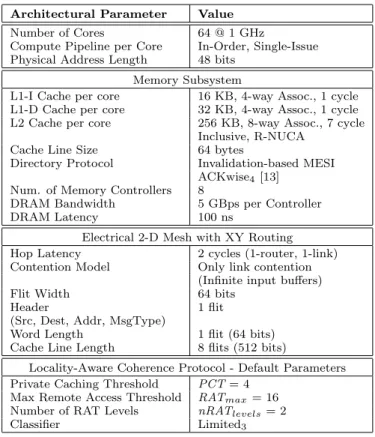
Architectural Parameter Value
Number of Cores 64 @ 1 GHz
Compute Pipeline per Core In-Order, Single-Issue
Physical Address Length 48 bits
Memory Subsystem
L1-I Cache per core 16 KB, 4-way Assoc., 1 cycle
L1-D Cache per core 32 KB, 4-way Assoc., 1 cycle
L2 Cache per core 256 KB, 8-way Assoc., 7 cycle
Inclusive, R-NUCA
Cache Line Size 64 bytes
Directory Protocol Invalidation-based MESI
ACKwise4[13]
Num. of Memory Controllers 8
DRAM Bandwidth 5 GBps per Controller
DRAM Latency 100 ns
Electrical 2-D Mesh with XY Routing
Hop Latency 2 cycles (1-router, 1-link)
Contention Model Only link contention
(Infinite input buffers)
Flit Width 64 bits
Header 1 flit
(Src, Dest, Addr, MsgType)
Word Length 1 flit (64 bits)
Cache Line Length 8 flits (512 bits)
Locality-Aware Coherence Protocol - Default Parameters
Private Caching Threshold PCT= 4
Max Remote Access Threshold RATmax= 16
Number of RAT Levels nRATlevels= 2
Classifier Limited3
Table 1: Architectural parameters for evaluation. IDs and 2 bits for the utilization counter. The remain-ing 8 bits suffice for storremain-ing the message type. 2. The cache line offset needs to be communicated but
not the memory access length. We profiled the memory access lengths for the benchmarks evaluated and found it to be 64 bits in the common case. Memory accesses that are≤64 bits in length are rounded-up to 64 bits while those>64 bits always fetch an entire cache line. Only 1 bit is needed to indicate this difference. 3. The data word to be written (64 bits in length) is
al-ways communicated to the directory on a write miss in the L1 cache. This overhead is accounted for in our evaluation.
3.7
Simpler One-Way Transition Protocol
The complexity of the above protocol could be decreased if cores, once they were classified as remote sharers w.r.t. a cache line would stay in the same mode throughout the program. If this were true, the storage required to track locality information at the directory could be avoided except for the mode bits. The bits to track private utilization at the cache tags would still be required to demote a core to the status of a remote sharer. We term this simpler protocolAdapt1-wayand in Section 5.4, we observe that this protocol
is worse than the original protocol by 34% in completion time and 13% in energy. Hence, a protocol that incorporates dynamic transitioning between both modes is required for efficient operation.
4.
EVALUATION METHODOLOGY
We evaluate a 64-core shared memory multicore. The de-fault architectural parameters used for evaluation are shown in Table 1.
4.1
Performance Models
All experiments are performed using the core, cache hier-archy, coherence protocol, memory system and on-chip inter-connection network models implemented within the Graphite [17] multicore simulator. All the mechanisms and protocol overheads discussed in Section 3 are modeled. The Graphite simulator requires the memory system (including the cache hierarchy) to be functionally correct to complete simulation. This is a good test that all our cache coherence protocols are working correctly given that we have run 21 benchmarks to completion.
TheLocality-Aware Adaptive Coherenceprotocol requires
two separate access widths for reading or writing the shared L2 caches i.e., a word for remote sharers and a cache line for private sharers. For simplicity, we assume the same L2 cache access latency for both word and cache line accesses.
4.2
Energy Models
We evaluate just dynamic energy. For energy evaluations of on-chip electrical network routers and links, we use the DSENT [20] tool. Energy estimates for the L1-I, L1-D and L2 (with integrated directory) caches are obtained using Mc-PAT [14]. The evaluation is performed at the 11 nm tech-nology node to account for future techtech-nology trends.
When calculating the energy consumption of the L2 cache, we assume a word addressable cache architecture. This al-lows our protocol to have a more efficient word access com-pared to a cache line access. We model the dynamic energy consumption of both the word access and the cache line ac-cess in the L2 cache.
4.3
Application Benchmarks
We simulate six SPLASH-2 [22] benchmarks, six PAR-SEC [3] benchmarks, four Parallel-MI-Bench [7], a Travelling-Salesman-Problem (tsp) benchmark, a Depth-First-Search (dfs) benchmark, a Matrix-Multiply (matmul) benchmark, and two graph benchmarks (connected-components &
community-detection) [1] using the Graphite multicore
simulator. The graph benchmarks model social networking based applications.
4.4
Evaluation Metrics
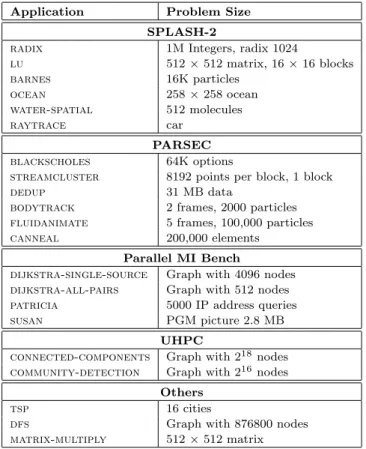
Each application is run to completion using the input sets from Table 2. For each simulation run, we measure the
Com-pletion Time, i.e., the time inparallel region of the
bench-mark; this includes the compute latency, the memory access latency, and the synchronization latency. The memory ac-cess latency is further broken down into four components. (1)L1 to L2 cache latency is the time spent by the L1 cache miss request to the L2 cache and the corresponding reply from the L2 cache including time spent in the network and the first access to the L2 cache. (2)L2 cache waiting timeis the queueing delay incurred because requests to the same cache line must be serialized to ensure memory consis-tency. (3) L2 cache to sharers latencyis the roundtrip time needed to invalidate private sharers and receive their acknowledgments. This also includes time spent request-ing and receivrequest-ing synchronous write-backs. (4) L2 cache to off-chip memory latency is the time spent accessing memory including the time spent communicating with the memory controller and the queueing delay incurred due to finite off-chip bandwidth.
Application Problem Size SPLASH-2
radix 1M Integers, radix 1024
lu 512×512 matrix, 16×16 blocks barnes 16K particles ocean 258×258 ocean water-spatial 512 molecules raytrace car PARSEC blackscholes 64K options
streamcluster 8192 points per block, 1 block
dedup 31 MB data
bodytrack 2 frames, 2000 particles
fluidanimate 5 frames, 100,000 particles
canneal 200,000 elements Parallel MI Bench
dijkstra-single-source Graph with 4096 nodes
dijkstra-all-pairs Graph with 512 nodes
patricia 5000 IP address queries susan PGM picture 2.8 MB
UHPC
connected-components Graph with 218nodes
community-detection Graph with 216nodes
Others
tsp 16 cities
dfs Graph with 876800 nodes
matrix-multiply 512×512 matrix
Table 2: Problem sizes for our parallel benchmarks. system which includes the on-chip caches and the network.
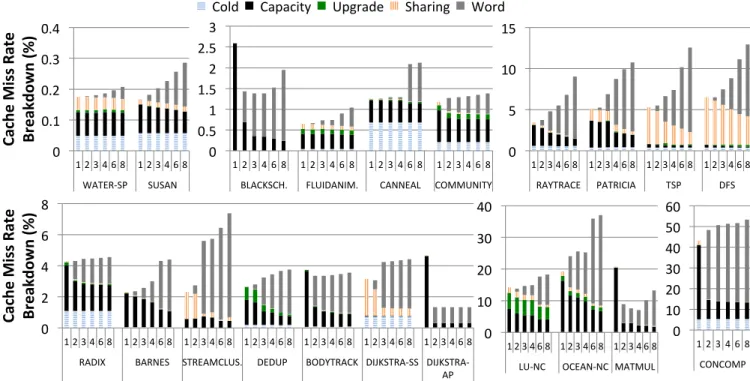
One of the important memory system metrics we track to evaluate our protocol is the various cache miss types. They are as follows: (1)Cold missesare cache misses that occur to a line that has never been previously brought into the cache, (2)Capacity missesare cache misses to a line that was brought in previously but later evicted to make room for another line, (3)Upgrade missesare cache misses to a line in read-only state when an exclusive request is made for it, (4)Sharing missesare cache misses to a line that was brought in previously but was invalidated or downgraded due to an read/write request by another core, and (5)Word missesare cache misses to a line that was remotely accessed previously.
5.
RESULTS
We have compared the baseline ACKwise4 with a full-map directory protocol and the average performance and energy consumption were found to be within 1% of each other. Since the ACKwise protocol scales well with increas-ing core counts, we use that as a baseline throughout this section. The architectural parameters from Table 1 are used for the study unless otherwise stated.
In Section 5.1, we perform a sweep study to understand the trends inEnergyandCompletion Timefor the evaluated benchmarks asPCTis varied. In Section 5.2, we evaluate the approximation scheme for theTimestamp-based classifi-cation and determine the optimal number of remote access threshold levels (nRATlevels) and maximum RAT threshold (RATmax). Next, in Section 5.3, we evaluate the accuracy of the limited locality tracking classifier (Limitedk) by per-forming a sensitivity analysis on k. Section 5.4 compares
the Energy and Completion Time of the protocol against
the simpler one-way transition protocol (Adapt1-way).
5.1
Energy and Completion Time Trends
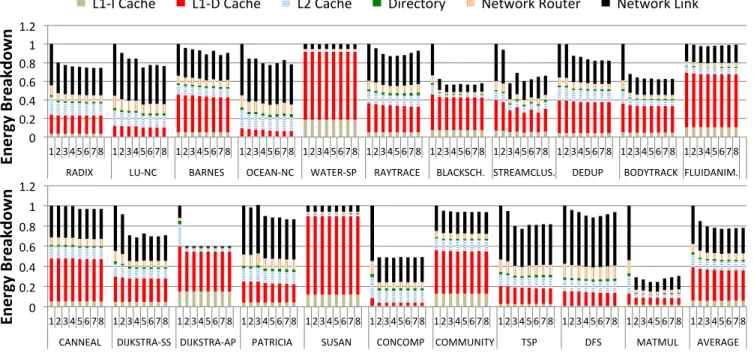
Figures 8 and 9 plot the energy and completion time of the evaluated benchmarks as a function ofPCT. Results are normalized in both cases to aPCT of 1 which corresponds to the baseline R-NUCA system with ACKwise4 directory protocol. Both energy and completion time decrease initially as PCT is increased. As PCT increases to higher values, both completion time and energy start to increase.5.1.1
Energy
We consider the impact that our protocol has on the en-ergy consumption of the memory system (L1-I cache, L1-D cache, L2 cache and directory) and the interconnection net-work (both router and link). The distribution of energy between the caches and network varies across benchmarks and is primarily dependent on the L1-D cache miss rate. For this purpose, the L1-D cache miss rate is plotted along with miss type breakdowns in Figure 10.
Benchmarks such aswater-spandsusanwith low cache miss rates (∼0.2%) dissipate 95% of their energy in the L1 caches while those such asconcompandlu-ncwith higher cache miss rates dissipate more than half of their energy in the network. The energy consumption of the L2 cache com-pared to the L1-I and L1-D caches is also highly dependent on the L1-D cache miss rate. For example, water-sphas negligible L2 cache energy consumption, while ocean-nc’s L2 energy consumption is more than its combined L1-I and L1-D energy consumption.
At the 11nm technology node, network links have a higher contribution to the energy consumption than network routers. This can be attributed to the poor scaling trends of wires compared to transistors. As shown in Figure 8, this trend is observed in all our evaluated benchmarks.
The energy consumption of the directory is negligible com-pared to all other sources of energy consumption. This mo-tivated our decision to put the directory in the L2 cache tag arrays as described earlier. The additional bits required to track locality information at the directory have a negligible effect on energy consumption.
VaryingPCT impacts energy by changing both network traffic and cache accesses. In particular, increasing the value of PCTdecreases the number of private sharers of a cache line and increases the number of remote sharers. This im-pacts the network traffic and cache accesses in the follow-ing three ways. (1) Fetchfollow-ing an entire line on a cache miss in conventional coherence protocols is replaced by multiple word accesses to the shared L2 cache. Note that each word access at the shared L2 cache requires a lookup and an up-date to the utilization counter in the directory as well. (2) Reducing the number of private sharers decreases the num-ber of invalidations (and acknowledgments) required to keep all cached copies of a line coherent. Synchronous write-back requests that are needed to fetch the most recent copy of a line are reduced as well. (3) Since the caching of low-locality data is eliminated, the L1 cache space can be more effectively used for high locality data, thereby decreasing the amount of asynchronous evictions (leading to capacity misses) for such data.
Benchmarks that yield a significant improvement in en-ergy consumption do so by converting either capacity misses
Energy
8 0 0.2 0.4 0.6 0.8 1 1.2 1 2 3 4 5 6 7 8 1 2 3 4 5 6 7 8 1 2 3 4 5 6 7 8 1 2 3 4 5 6 7 8 1 2 3 4 5 6 7 8 1 2 3 4 5 6 7 8 1 2 3 4 5 6 7 8 1 2 3 4 5 6 7 8 1 2 3 4 5 6 7 8 1 2 3 4 5 6 7 8 1 2 3 4 5 6 7 8 RADIX LU-‐NC BARNES OCEAN-‐NC WATER-‐SP RAYTRACE BLACKSCH. STREAMCLUS. DEDUP BODYTRACK FLUIDANIM.En
er
gy
B
re
akd
ow
n
L1-‐I Cache
L1-‐D Cache
L2 Cache
Directory
Network Router
Network Link
0 0.2 0.4 0.6 0.8 1 1.2 1 2 3 4 5 6 7 8 1 2 3 4 5 6 7 8 1 2 3 4 5 6 7 8 1 2 3 4 5 6 7 8 1 2 3 4 5 6 7 8 1 2 3 4 5 6 7 8 1 2 3 4 5 6 7 8 1 2 3 4 5 6 7 8 1 2 3 4 5 6 7 8 1 2 3 4 5 6 7 8 1 2 3 4 5 6 7 8 CANNEAL DIJKSTRA-‐SS DIJKSTRA-‐AP PATRICIA SUSAN CONCOMP COMMUNITY TSP DFS MATMUL AVERAGE
En
er
gy
B
re
akd
ow
n
Figure 8: Variation of Energy with PCT. Results are normalized to a PCT of 1. Note thatAverage and not
Geometric-Mean is plotted here.
7
Comple)on Time
0 0.2 0.4 0.6 0.8 1 1.2 1.4 1 2 3 4 5 6 7 8 1 2 3 4 5 6 7 8 1 2 3 4 5 6 7 8 1 2 3 4 5 6 7 8 1 2 3 4 5 6 7 8 1 2 3 4 5 6 7 8 1 2 3 4 5 6 7 8 1 2 3 4 5 6 7 8 1 2 3 4 5 6 7 8 1 2 3 4 5 6 7 8 1 2 3 4 5 6 7 8 RADIX LU-‐NC BARNES OCEAN-‐NC WATER-‐SP RAYTRACE BLACKSCH. STREAMCLUS. DEDUP BODYTRACK FLUIDANIM.Co
mp
le'o
n Ti
me
Br
ea
kd
ow
n
Compute
L1Cache-‐L2Cache
L2Cache-‐Wai)ng
L2Cache-‐Sharers
L2Cache-‐OffChip
Synchroniza)on
0 0.2 0.4 0.6 0.8 1 1.2 1 2 3 4 5 6 7 8 1 2 3 4 5 6 7 8 1 2 3 4 5 6 7 8 1 2 3 4 5 6 7 8 1 2 3 4 5 6 7 8 1 2 3 4 5 6 7 8 1 2 3 4 5 6 7 8 1 2 3 4 5 6 7 8 1 2 3 4 5 6 7 8 1 2 3 4 5 6 7 8 1 2 3 4 5 6 7 8 CANNEAL DIJKSTRA-‐SS DIJKSTRA-‐AP PATRICIA SUSAN CONCOMP COMMUNITY TSP DFS MATMUL AVERAGE
Co
mp
le'o
n Ti
me
Br
ea
kd
ow
n
Figure 9: Variation of Completion Time with PCT. Results are normalized to a PCT of 1. Note thatAverage
and notGeometric-Mean is plotted here.
(inbodytrack and blackscholes) or sharing misses (in
dijkstra-ssandstreamcluster) into cheaper word misses. This can be observed from Figure 8 when going from a PCT of 1 to 2 in bodytrack and blackscholes and a PCT of 2 to 3 in dijkstra-ss and streamcluster. While a sharing miss is more expensive than a capacity miss due to the additional network traffic generated by invalidations and synchronous write-backs, turning capacity misses into word misses improves cache utilization (and reduces cache pol-lution) by reducing evictions and thereby capacity misses for other cache lines. This is evident in benchmarks like
blackscholes,bodytrack,dijkstra-apandmatmulin
which the cache miss rate drops when switching from a PCT of 1 to 2. Benchmarks likelu-nc, andpatriciaprovide en-ergy benefit by converting both capacity and sharing misses into word misses.
At a PCT of 4, the geometric mean of the energy con-sumption across all benchmarks is less than that at a PCT of 1 by 25%.
5.1.2
Completion Time
9 0 0.1 0.2 0.3 0.4 1 2 3 4 6 8 1 2 3 4 6 8 WATER-‐SP SUSAN
Ca
ch
e
Mi
ss
Ra
te
Br
ea
kd
ow
n
(%)
0 0.5 1 1.5 2 2.5 3 1 2 3 4 6 8 1 2 3 4 6 8 1 2 3 4 6 8 1 2 3 4 6 8
BLACKSCH. FLUIDANIM. CANNEAL COMMUNITY
Cold Capacity Upgrade Sharing Word
0 5 10 15 1 2 3 4 6 8 1 2 3 4 6 8 1 2 3 4 6 8 1 2 3 4 6 8 RAYTRACE PATRICIA TSP DFS 0 2 4 6 8 1 2 3 4 6 8 1 2 3 4 6 8 1 2 3 4 6 8 1 2 3 4 6 8 1 2 3 4 6 8 1 2 3 4 6 8 1 2 3 4 6 8
RADIX BARNES STREAMCLUS. DEDUP BODYTRACK DIJKSTRA-‐SS DIJKSTRA-‐
AP
Ca
ch
e
Mi
ss
Ra
te
Br
ea
kd
ow
n
(%)
0 10 20 30 40 1 2 3 4 6 8 1 2 3 4 6 8 1 2 3 4 6 8
LU-‐NC OCEAN-‐NC MATMUL
0 10 20 30 40 50 60 1 2 3 4 6 8 CONCOMP
Figure 10: L1 Data Cache Miss Rate and Miss Type Breakdown vs PCT. Note that in this graph, the miss rate increases from left to right as well as from top to bottom.
time as well. Noticeable improvements (>5%) occur in 11 out of the 21 evaluated benchmarks. Most of the improve-ments occur for the same reasons as discussed for energy, and can be attributed to our protocol identifying low lo-cality cache lines and converting the capacity and sharing misses on them to cheaper word misses. Benchmarks such asblackscholes,dijkstra-apand matmulexperience a lower miss rate when PCT is increased from 1 to 2 due to better cache utilization. This translates into a lower comple-tion time. Inconcomp, cache utilization does not improve but capacity misses are converted into almost an equal num-ber of word misses. Hence, the completion time improves.
Benchmarks such asstreamclusterandtspshow com-pletion time improvement due to converting expensive shar-ing misses into word misses. From a performance stand-point, sharing misses are expensive because they increase: (1) the L2 cache to sharers latency and (2) the L2 cache waiting time. Note that the L2 cache waiting time of one core may depend on the L2 cache to sharers latency of an-other since requests to the same cache line need to be serial-ized. In these benchmarks, even if cache miss rate increases with PCT, the miss penalty is lower because a word miss is much cheaper than a sharing miss. A word miss does not contribute to the L2 cache to sharers latency and only con-tributes marginally to the L2 cache waiting time. Hence, the above two memory access latency components can be signif-icantly reduced. Reducing these components may decrease synchronization time as well if the responsible memory ac-cesses lie within the critical section. streamclusterand
dijkstra-ssmostly reduce the L2 cache waiting time while
partriciaandtspreduce the L2 cache to sharers latency.
In a few benchmarks such aslu-ncandbarnes, comple-tion time is found to increase after a PCT of 3 because the added number of word misses overwhelms any improvement obtained by reducing capacity misses.
9 0.6 0.7 0.8 0.9 1 1.1 1.2 1 2 3 4 5 6 7 8 10 12 14 16 18 20
Private Caching Threshold (PCT)
Comple3on Time Energy
Figure 11: Variation ofGeometric-Meansof Comple-tion Time and Energy with Private Caching Thresh-old (PCT). Results are normalized to a PCT of 1.
At a PCT of 4, the geometric mean of the completion time across all benchmarks is less than that at a PCT of 1 by 15%.
5.1.3
Static Selection of PCT
To put everything in perspective, we plot the geometric means of theCompletion Time and Energy for our bench-marks in Figure 11. We observe a gradual decrease of com-pletion time up toPCT of 3, constant completion time till aPCTof 4, and an increase in completion time afterward. Energy consumption decreases up toPCT of 5, then stays constant till a PCT of 8 and after that, it starts increas-ing. We conclude that a PCT of 4 meets our goal of si-multaneously improving both completion time and energy consumption. A completion time reduction of 15% and an energy consumption improvement of 25% is obtained when moving fromPCTof 1 to 4.
5.2
Tuning Remote Access Thresholds
As explained in Section 3.3, theTimestamp-based classifi-cation scheme was expensive due to its area overhead, both
11 0.98 1.03 1.08 1.13 Timestamp L-‐1 L-‐2, T-‐8 L-‐2, T-‐16 L-‐4, T-‐8 L-‐4, T-‐16 L-‐8, T-‐16 Comple9on-‐Time Energy
Figure 12: Remote Access Threshold sensitivity study fornRATlevels (L) andRATmax (T)
at the L1 cache and directory. The benefits provided by this scheme can be approximated by having multipleRemote
Ac-cess Threshold (RAT) Levelsand dynamically switching
be-tween them at runtime to counteract the increased L1 cache pressure. We now perform a study to determine the optimal number of threshold levels (nRATlevels) and the maximum threshold (RATmax).
Figure 12 plots the completion time and energy consump-tion for the different points of interest. The results are normalized to that of the Timestamp-based classification scheme. The completion time is almost constant through-out. However, the energy consumption is nearly 9% higher whennRATlevels= 1. With multipleRATlevels (nRATlevels >1), the energy is significantly reduced. Also, the energy consumption withRATmax= 16 is found to be slightly lower (2%) than withRATmax = 8. WithRATmax = 16, there is almost no difference betweennRATlevels = 2,4,8, so we choosenRATlevels= 2 since it minimizes the area overhead.
5.3
Limited Locality Tracking
As explained in Section 3.4, tracking the locality infor-mation for all the cores in the directory results in an area overhead of 60% per core. So, we explore a mechanism that tracks the locality information for only a few cores, and clas-sifies a new core as a private or remote sharer based on a majority vote of the modes of the tracked cores.
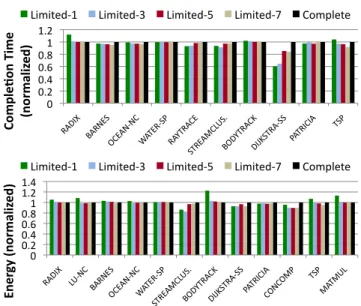
Figure 13 plots the completion time and energy of the benchmarks with the Limitedkclassifier whenkis varied as (1,3,5,7,64). k= 64 corresponds to the Complete classifier. The results are normalized to that of the Complete classifier. The benchmarks that are not shown are identical to
water-sp, i.e., thecompletion time and energy stay constant ask varies. The experiments are run with the best staticPCT
value of 4 obtained in Section 5.1.3. We observe that the completion time and energy consumption of the Limited3 classifier never exceeds by more than 3% the completion time and energy consumption of the Complete classifier.
Instreamclusteranddijkstra-ss, the Limited3 classi-fier does better than the Complete classiclassi-fier because it learns the mode of sharers quicker. While the Complete classifier starts off each sharer of a cache line independently in pri-vate mode, the Limited3 classifier infers the mode of a new sharer from the modes of existing sharers. This enables the Limited3 classifier to put the new sharer in remote mode without the initial per-sharer classification phase. We note that the Complete locality classifier can also be equipped with such a learning short-cut.
Inferring the modes of new sharers from the modes of ex-isting sharers can be harmful too, as is illustrated in the case of radix and bodytrack for the Limited1 classifier. While radix starts off new sharers incorrectly in remote mode, bodytrack starts them off incorrectly in private
12 0 0.2 0.4 0.6 0.8 1 1.2 1.4 Ene rgy (nor m aliz ed)
Limited-‐1 Limited-‐3 Limited-‐5 Limited-‐7 Complete
0 0.2 0.4 0.6 0.8 1 1.2 Co mp le3o n Ti me (nor m aliz ed)
Limited-‐1 Limited-‐3 Limited-‐5 Limited-‐7 Complete
Figure 13: Variation of Completion Time and Energy with the number of hardware locality counters (k) in the Limitedk classifier. Limited64 is identical to the Com-plete classifier. Benchmarks for which results are not shown are identical to WATER-SP, i.e., the Completion
Time andEnergystay constant as kvaries.
mode. This is because the first sharer is classified as re-mote (inradix) and private (inbodytrack). This causes other sharers to also reside in that mode while they actually want to be in the opposite mode. Our observation from the above sensitivity experiment is that tracking the locality in-formation for three sharers suffices to offset such incorrect classifications.
5.4
Simpler One-Way Transition Protocol
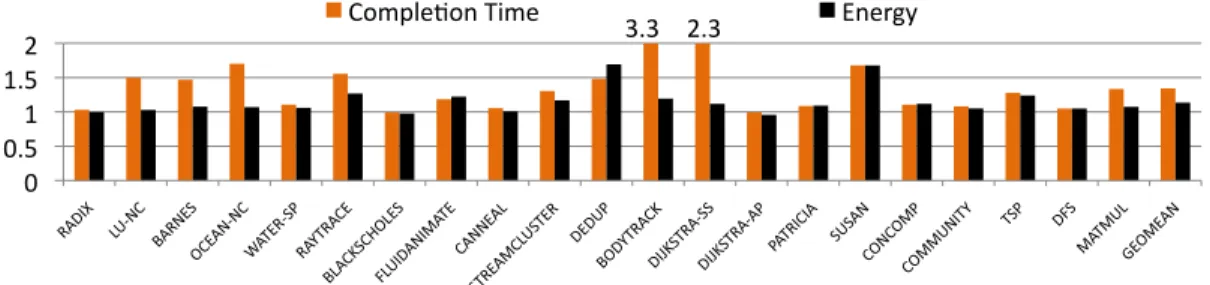
In order to quantify the efficacy of the dynamic nature of our protocol, we compare the protocol to a simpler version having only one-way transitions (Adapt1-way). The simpler version starts off all cores as private sharers and demotes them to remote sharers when the utilization is less than the private caching threshold (PCT). However, these cores then stay as remote sharers throughout the lifetime of the program and can never be promoted. The experiment is run with the bestPCTvalue of 4.Figure 14 plots the ratio of completion time and energy for theAdapt1-wayprotocol over our protocol (which we term
Adapt2-way). Higher the ratio, higher is the need for two-way
transitions. We observe that theAdapt1-wayprotocol is worse in completion time and energy by 34% and 13% respectively. In benchmarks such as bodytrack and dijkstra-ss, the completion time ratio is worse by 3.3×and 2.3×respectively.
6.
CONCLUSION
In this paper, we have proposed alocality-awareadaptive cache coherence protocol that enables seamless adaptation between private and logically shared caching at the fine gran-ularity of cache lines. Our data-centric approach relies on in-hardware runtime profiling of thelocality of each cache line and only allows private caching for data blocks with high spatio-temporal locality. We have proposed low-overhead locality tracking mechanisms and used extensive simulation results to verify their accuracy. We implemented our
proto-13
0
0.5 1
1.5 2
Comple.on Time 3.3 2.3
Energy
Figure 14: Ratio of Completion Time and Energy ofAdapt1-way overAdapt2-way col on top of a Private-L1, Shared-L2 implementation that
uses the Reactive-NUCA data management scheme and the ACKwise4 limited directory protocol. The results indicate that our protocol reduces the overallEnergy Consumption
in a 64-core multicore by 25%, while improving the
Comple-tion Timeby 15%. Our protocol can be implemented with
only 18 KB storage overhead per core when compared to the ACKwise4 limited directory protocol, and has a lower storage overhead than a full-map directory protocol.
7.
REFERENCES
[1] DARPA UHPC Program BAA.https://www.fbo.gov/spg/
ODA/DARPA/CMO/DARPA-BAA-10-37/listing.html, March 2010.
[2] S. Bell, B. Edwards, J. Amann, R. Conlin, K. Joyce, V. Leung, J. MacKay, M. Reif, L. Bao, J. Brown, M. Mattina, C.-C. Miao, C. Ramey, D. Wentzlaff, W. Anderson, E. Berger, N. Fairbanks, D. Khan,
F. Montenegro, J. Stickney, and J. Zook. Tile64 - processor:
A 64-core soc with mesh interconnect. InInternational
Solid-State Circuits Conference, 2008.
[3] C. Bienia, S. Kumar, J. Singh, and K. Li. The PARSEC benchmark suite: characterization and architectural
implications. InInt’l Conference on Parallel Architectures
and Compilation Techniques, 2008.
[4] P. Conway, N. Kalyanasundharam, G. Donley, K. Lepak, and B. Hughes. Cache Hierarchy and Memory Subsystem of
the AMD Opteron Processor.In IEEE Micro, 30(2):16–29,
2010.
[5] N. Hardavellas, M. Ferdman, B. Falsafi, and A. Ailamaki. Reactive NUCA: Near-Optimal Block Placement and
Replication in Distributed Caches. InInt’l Symposium on
Computer Architecture, 2009.
[6] H. Hoffmann, D. Wentzlaff, and A. Agarwal. Remote Store Programming: A memory model for embedded multicore. InInternational Conference on High Performance Embedded Architectures and Compilers, 2010. [7] S. Iqbal, Y. Liang, and H. Grahn. ParMiBench - an
open-source benchmark for embedded multiprocessor
systems.Computer Architecture Letters, 2010.
[8] A. Jaleel, E. Borch, M. Bhandaru, S. C. Steely Jr., and J. Emer. Achieving non-inclusive cache performance with inclusive caches: Temporal locality aware (TLA) cache
management policies. InInt’l Symposium on
Microarchitecture, 2010.
[9] N. E. Jerger, L.-S. Peh, and M. Lipasti. Virtual circuit tree multicasting: A case for on-chip hardware multicast
support. InInt’l Symposium on Computer Architecture,
2008.
[10] T. L. Johnson and W.-M. W. Hwu. Run-time adaptive
cache hierarchy management via reference analysis. InInt’l
Symposium on Computer architecture, 1997. [11] H. Kaul, M. Anders, S. Hsu, A. Agarwal,
R. Krishnamurthy, and S. Borkar. Near-threshold voltage
(NTV) design - opportunities and challenges. InDesign
Automation Conference, 2012.
[12] C. Kim, D. Burger, and S. W. Keckler. An Adaptive,
Non-Uniform Cache Structure for Wire-Delay Dominated
On-Chip Caches. InInt’l Conference on Architectural
Support for Programming Languages and Operating Systems, 2002.
[13] G. Kurian, J. Miller, J. Psota, J. Eastep, J. Liu, J. Michel, L. Kimerling, and A. Agarwal. ATAC: A 1000-Core Cache-Coherent Processor with On-Chip Optical Network. InInt’l Conference on Parallel Architectures and
Compilation Techniques, 2010.
[14] S. Li, J. H. Ahn, R. D. Strong, J. B. Brockman, D. M. Tullsen, and N. P. Jouppi. McPAT: An integrated power, area, and timing modeling framework for multicore and
manycore architectures. InInt’l Symposium on
Microarchitecture, 2009.
[15] H. Liu, M. Ferdman, J. Huh, and D. Burger. Cache Bursts: A new approach for eliminating dead blocks and increasing
cache efficiency. InInt’l Symposium on Microarchitecture,
2008.
[16] M. M. K. Martin, M. D. Hill, and D. J. Sorin. Why on-chip
cache coherence is here to stay.Commun. ACM,
55(7):78–89, July 2012.
[17] J. E. Miller, H. Kasture, G. Kurian, C. G. III, N. Beckmann, C. Celio, J. Eastep, and A. Agarwal. Graphite: A Distributed Parallel Simulator for Multicores. InInt’l Symposium on High Performance Computer Architecture, 2010.
[18] M. K. Qureshi and Y. N. Patt. Utility-Based Cache Partitioning: A low-overhead, high-performance, runtime
mechanism to partition shared caches. InInt’l Symposium
on Microarchitecture, 2006.
[19] D. Sanchez and C. Kozyrakis. SCD: A Scalable Coherence
Directory with Flexible Sharer Set Encoding. InInt’l
Symposium on High Performance Computer Architecture, 2012.
[20] C. Sun, C.-H. O. Chen, G. Kurian, L. Wei, J. Miller, A. Agarwal, L.-S. Peh, and V. Stojanovic. DSENT - a tool connecting emerging photonics with electronics for
opto-electronic networks-on-chip modeling. InInt’l
Symposium on Networks-on-Chip, 2012.
[21] G. Tyson, M. Farrens, J. Matthews, and A. R. Pleszkun. A
modified approach to data cache management. InInt’l
Symposium on Microarchitecture, 1995.
[22] S. C. Woo, M. Ohara, E. Torrie, J. P. Singh, and A. Gupta. The SPLASH-2 Programs: Characterization and
Methodological Considerations. InInt’l Symposium on
Computer Architecture, 1995.
[23] J. Zebchuk, V. Srinivasan, M. K. Qureshi, and
A. Moshovos. A tagless coherence directory. InInt’l
Symposium on Microarchitecture, 2009.
[24] M. Zhang and K. Asanovi´c. Victim Replication:
Maximizing Capacity while Hiding Wire Delay in Tiled
Chip Multiprocessors. InInt’l Symposium on Computer
Architecture, 2005.
[25] H. Zhao, A. Shriraman, S. Dwarkadas, and V. Srinivasan.
SPATL: Honey, I Shrunk the Coherence Directory. InInt’l Conference on Parallel Architectures and Compilation Techniques, 2011.