Mobile Crowdsensing in Software Defined
Opportunistic Networks
著者
LI He, OTA Kaoru, DONG Mianxiong, GUO Minyi
journal or
publication title
IEEE Communications Magazine
volume
55
number
6
page range
140-145
year
2017-06-13
URL
http://hdl.handle.net/10258/00009557
doi: info:doi:10.1109/MCOM.2017.1600719Mobile Crowdsensing in Software Defined
Opportunistic Networks
He Li,
Member, IEEE,
Kaoru Ota,
Member, IEEE,
Mianxiong Dong,
Member, IEEE,
Minyi Guo,
Senior
Member, IEEE
Abstract—Mobile crowdsensing is a new paradigm that sharing sensing data collected by mobile devices such as smartphones and tablets. As mobile devices are usually connected by an oppor-tunistic network for data transferring, it is hard to acknowledge the contribution of each mobile user in network forwarding then find a sustainable incentive mechanism. In this paper, we propose a software defined opportunistic network (SDON) scheme for mobile crowdsensing. We design a centralized control structure to manage the opportunistic network and mobile crowdsensing. By the centralized structure, we also design an incentive mechanism for data forwarding and collection in an SDON and solve the optimal decision of mobile devices and the sensing service provider. From the extensive simulation results, our incentive mechanism performs better than original solutions.
Index Terms—Sustainable mobile crowdsensing, opportunistic network, software defined networking (SDN), incentive mecha-nism
I. INTRODUCTION
In recent years, more and more mobile devices equip sensors such as cameras, accelerometers, digital compasses to support various mobile applications [1]. Meanwhile, these sensors provide rich information about the environment and users’ activities, which are also important sources to measure phenomena of different interest. Mobile crowdsensing is such a new paradigm that organizes the mobile devices and col-lects richness information then provide sensing services for different purposes [2] [3].
For mobile crowdsensing, a significant issue is the incentive mechanism as sensing and data forwarding brings additional energy consumption to participants. As the final sensing infor-mation is numerous valuable, the sensing service provider can spend part of the revenue to motivate mobile users to provide sensing. Usually, the sensing service provider can return some revenue to mobile users who contribute valuable sensing data. Since the cellular network consumes a large amount energy to transfer large sensing data, an opportunistic network is very appropriate for transferring information. In an opportunistic network, mobile devices can transfer information each without determined forwarding route, which is an efficient solution for sensing data forwarding in mobile crowdsensing. A difficulty is the incentive mechanism is ignorant of the forwarding route. However, it is hard to measure the contribution of mobile users who forward data in the opportunistic network. Users
He Li, Kaoru Ota and Mianxiong Dong are with Muroran Insitute of Technology, Japan.
Minyi Guo is with Department of Computer Science and Engineering, Shanghai Jiao Tong University, Shanghai, China.
will escape data forwarding without incentives, and it is hard to maintain a sustainable network for mobile crowdsensing.
Software defined networking (SDN) is an urgent method-ology to manage the opportunistic network [4]. SDN de-couples the data plane and control plane and manages the data forwarding through a centralized controller, which is also able to acknowledge the data forwarding activities of each mobile device. In this paper, we propose a software defined opportunistic network (SDON) structure for mobile crowdsensing. SDON provides find-grained management of the opportunistic network and records the user contributions in data forwarding through accurate statics.
Therefore, we present a sustainable incentive mechanism that returns cellular network traffic to mobile users who con-tribute in mobile crowdsensing, including data collection and forwarding. The incentives for data forwarding can reduce the packet loss then increase energy efficiency since users can re-ceive reimbursements for their additional power consumption in data forwarding. We study the payoff of mobile users and the sensing service provider and formulate the optimization of the incentive mechanism as a leader/follower Stackelberg game. We find the optimal solutions for mobile users and the sensing service provider by solving the convex optimization problems. To evaluate our solution in mobile crowdsensing, we execute extensive simulations, and the results show our solution performs better than original solutions.
The main contributions of this paper are summarized as follows.
• We first proposed an SDON structure for the data for-warding management in crowdsensing. Since the SDON is a prospective methodology, our work is the first work that focuses on mobile crowdsensing in an SDON.
• We then design the sustainable incentive mechanism by returning cellular traffic to participants, including data collection and forwarding. It is a challenging problem which needs to understand thoroughly the mobile crowd-sensing.
• We model the interaction of the sensing service provider
and mobile users as a two-stage Stackelberg game and analyze the game equilibrium. A generic analysis with variable system settings is used for applicability of dif-ferent mobile crowdsensing scenarios.
• We take the performance evaluation of the strategy with extensive simulations with settings from sensing data from realistic mobile devices.
The remainder of this paper is organized as follows. Section II discussed the related works of mobile crowdsensing and
software defined wireless networks. Section III presents the structure of SDON and the incentive mechanism for mobile crowdsensing. The Stackelberg game based incentive mech-anism optimization is described in Section IV. Section V evaluates the proposed incentive mechanism performance in SDON through extensive simulations. Finally, this paper is concluded in Section VI.
II. RELATEDWORK
In this section, we first discuss some related works about crowdsensing and opportunistic networks then introduce the software defined wireless networking.
A. Mobile crowdsensing and opportunistic networks
Several types of networks are able to support mobile crowd-sensing. A straightforward method is transferred sensing data through cellular networks. Since most places are covered by cellular signals, mobile devices can directly upload their col-lected data to the sensing servers through carrier’s networks. However, cellular links are not appropriate for crowdsensing because of the unacceptable cost for a large amount of sensing data [5].
A mobile ad hoc network (MONET) is another solution for mobile crowdsensing [6]. Some works proposed different forwarding strategies for mobile crowdsensing in a MONET. The cost and energy consumption of data transferring with a MONET is much cheaper than that with the cellular network. As the connectivity becomes worse with a lower density of mobile devices, a MONET only works well in the scenarios with dense devices. For transferring data in a sparse mobility environment, some works focus on mobile crowdsensing in a delay tolerant network (DTN). Even though the forwarding path is not always needed by data transferring, the DTN is not efficient because of the ”store and forward” approach [7].
By integrating the merits from MONETs and DTNs, an opportunistic network seems appropriate for mobile crowd-sensing. Sensing data can be transferred by different links from the source to the destination. When there is no forwarding path to the destination, the sensing data can be stored in the relay device, which is similar to a DTN. Because of its flexibility and efficiency, more and more works focus on mobile crowdsensing in an opportunistic network [8].
B. Incentive mobile crowdsensing
An incentive mechanism is another important issue for mobile crowdsensing and many works proposed various in-centive methodology to motivate mobile users participating in crowdsensing. Usually, there are three types of incentive mechanism, entertainment as incentives, service as incentives, and money as incentives. Entertainment as incentives means sensing service provider motivates mobile users participating in mobile crowdsensing just like participating in games. Mo-bile users will feel funny when they contribute their data in crowdsensing. A difficulty of entertainment as incentives is making an interesting game attract enough users [9].
Service as incentives will bring some additional services to participants. A typical method in service as incentives
is exchanging the contribution and consumption of users. The main problem of service as incentives is modeling the payoff of both the sensing service provider and participants consumption in the same services [10]. Money as incentives is similar to service as incentives while money as incentives provides money to participants in mobile crowdsensing. It is more convenient for calculating user payoff based on money rather than service consumption. However, money as a service usually increases the cost of the service provider from inap-propriate strategies or user cheating [11]. However, existing incentive mechanisms mainly focus on the motivating mobile user to participate in data collection. Few works consider the cost of data forwarding in mobile crowdsensing and barely propose appropriate solutions to motivate it.
C. Software defined wireless networking
Software defined wireless networking is a technology to decouple the control plane and data plane in wireless networks. As the management of wireless networks is more complex than the wired networks in datacenters, many researchers proposed different solutions to implement or optimize software defined wireless networking [12].
In wireless networks, spectrum management is an impor-tant issue which is different from the wired network. Some works focus on the SDN-enabled spectrum management in wireless networks. As the controller directly controls all base stations, the spectrum management becomes more dynamic and efficient. The controller can change the communication spectrum between mobile devices and base stations according to the traffic and other metrics. For opportunistic networks, the controller can easily set a communication channel for each pair of mobile devices to improve the network throughput and energy efficiency.
Another profit brought by SDN paradigm is the flexible data forwarding strategy. In traditional ad hoc networks, as the network topology is agnostic to each network node, it is hard to design an efficient forwarding path for each network flow. In software defined wireless ad hoc networks, since the centralized controller is aware of the entire network topology, it is convenient to design an appropriate forwarding strategy for very fine-grained flow control. Thus, in SDN-enabled opportunistic networks, the controller is also able to adjust the forwarding rule for each network flow.
However, a difficult and important issue in software defined wireless networks is the southbound communications [13]. In software defined radio access networks, since devices in access networks are connected to the controller through wired link, it is similar to the traditional SDN scenario in wired networks. However, for a MONET and a vehicle ad hoc network (VANET), since there is no wired connection between the controller and forwarding devices, it is difficult to spread the controller’s message to each device on time.
For improving the stability and security of southbound communications, some works introduce additional networks to connect the controller and devices in the data plane. Usually, a cellular network is introduced to maintain the southbound communications. For example, as most vehicles can access
the cellular network, the controller can easily deploy the forwarding rules through cellular links. Therefore, in this article, we also introduce the cellular links into SDON for the management of data forwarding and incentive mechanism. As SDON provides adequate information about data forwarding, it is possible to motivate mobile users in both data collection and forwarding.
III. SUSTAINABLEMOBILECROWDSENSING INSOFTWARE
DEFINEDOPPORTUNISTICNETWORKS
In this section, we first introduce the main structure and network management of an SDON. Then, we discuss the mobile crowdsensing incentive mechanisms in an SDON.
A. Software Defined Opportunistic Network
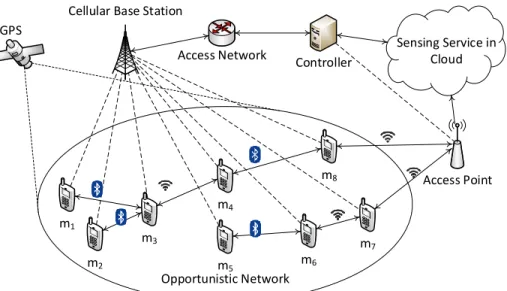
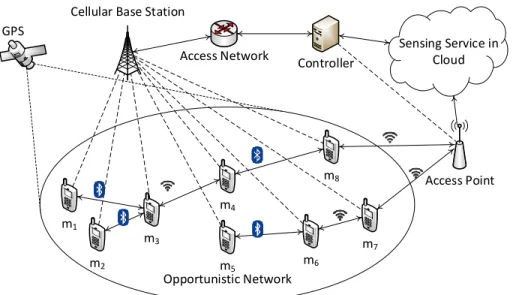
As shown in Fig. 1, we use a small example to show the main structure of SDON. First, mobile device
m1, m2, ....,andm7 are organized into an opportunistic
net-work. Access points connect the opportunistic network to the cloud service. Each mobile device is able to access GPS satellites to get its position. For supporting SDON, each mobile device has a connection to a cellular network and a centralized SDON controller is connected to the cellular access network. Meanwhile, the controller is also connected to all access points.
An SDON usually has two control plane, a data plane, and a control plane. Thus, the data plane consists of the connections between mobile devices and access points and the control plane is the SDON controller. As it is not acceptable to transfer control message through the unstable and high latency links in the opportunistic network, the southbound communications between the control plane and data plane are supported by the cellular access network. As the data traffic in the southbound communications is very light, the cost of the cellular network is almost negligible compared to data flows in the data plane. Based on the SDON structure, we introduce the main processes in the network management. When devicem1enters
the network, the controller connects tom1 through a cellular
link. Then devicem1will update its position, network address,
identification, etc. As each mobile device will timely check its position and send the changed position to the controller during movement, the controller will calculate the forwarding path for devicem1. A forwarding path consists of forwarding
rules in all devices in the path, such as m4 should forward
flow packets from m1 to m8. When a mobile device in the
path receives a new network flow from device m1, it will
request the forwarding rules from the controller. Each rule has a lifetime setting. When the rule is out of date, the device will ask the controller for updating. The controller will timely update the forwarding path and rules of each device. Generally, as the speed of a moving mobile device is not so fast to leave the communication range in a short time period, the timely updating is acceptable. Furthermore, it is possible that the controller can predicate the future position of each device and calculate stable forwarding paths to decrease the southbound communications.
B. Sustainable Incentive Mechanisms for Mobile Crowdsens-ing in SDON
With network management in the SDON, it is convenient to support sustainable incentive mechanisms for crowdsensing since the centralized controller can accurately measure the behavior of each mobile device.
In mobile crowdsensing, there are two activities need in-centivizing, the sensing data collection and data forwarding. If the users do not participate one of these two activities, the mobile sensing will become unsustainable. In original mobile crowdsensing, although it is not hard to acknowledge the activities of the data collection of each mobile device through its identification, lost collected data packets can not be recorded for intensive while the packet loss is inevitable in data forwarding through the opportunistic network. SDON can provide a tracking capability to collect statistics of all sensing data packets in data forwarding. With the packet statistics, it is convenient to make a reimbursement for users who contribute in data collection while collected data packets are lost in the opportunistic network.
Since data forwarding brings additional energy consumption to mobile devices, users will be hard to forward packets with-out reimbursements, which results in packet loss. Thus, the opportunistic network seems not sustainable without incentive mechanisms for data forwarding. However, the activities in data forwarding are very hard to be acknowledged by the crowdsensing providers since the forwarding path of each packet needs to be determined. In the SDON, as the controller communicates with each mobile devices, it is convenient to request forwarded traffic from mobile devices. Meanwhile, as the controller manage all forwarding paths, forwarded traffic is also able to be verified from the collected data packets.
As the example in Fig. 1, when device m1 collects data
for crowdsensing, it will send its data to device m3. As data
packets are forwarded to the network interface of devicem1,
the number of packets in detailed rules will be updated. The controller can ask the packet statics from each mobile device. When device m3 receives the packet from m1, it can decide
whether forwarding the packet tom4. If devicem1 forwards
the packet fromm1, the number of packets in the forwarding
rule will be updated. If a data packet of crowdsensing from devicem1is sent to the cloud, the controller can acknowledge
the contribution of each device in the forwarding path from the rule statics.
Thus, we propose a simple incentive mechanism for mobile crowdsensing in the SDON. For crowdsensing incentivizing, the service provider offers some free service quota to users as reimbursement (incentives) for their contribution. The in-centive based on the service quota is limited by the specific service, which is not always able to increase the utility of users. In our work, we consider the cellular data quota as a good incentive for mobile users. The carriers provide cheap wholesale rates for bulk access through business agreements. It is very appropriate and inexpensive for the crowdsensing service providers as mobile users usually need to pay for cellular traffic. The incentive mechanism will increase cellular traffic of mobile users who contribute in mobile crowdsensing.
m1 m2 m3 m6 m4 m8 m7 Sensing Service in Cloud Controller Access Point Opportunistic Networkm5 Cellular Base Station
Access Network
Fig. 1. Mobile crowdsensing in a software defined opportunistic network
When a mobile device collects and sends data to the sensing service cloud, the sensing service provider will assign some incentive cellular traffic to the device. Meanwhile, incentive traffic is also assigned to those devices which contribute in data forwarding. The main issue of the proposed incentive mechanism is the ratio between the assigned incentive cellular traffic and the data in both collection and forwarding. For higher or lower incentive ratio, the higher cost of incentive traffic or less collected data will decrease the revenue of the sensing service provider. In the next section, we focus on the optimal decision of the incentive ratio in our proposed incentive mechanism.
IV. SUSTAINABLEINCENTIVEMECHANISM
OPTIMIZATION
In this section, we optimize the sustainable incentive mech-anism for maximizing the payoffs of both the sensing service provider and all mobile users.
We first study the payoff of each mobile device. Payoff of a mobile device in mobile crowdsensing consists of revenue and cost [14]. The revenue of a mobile device comes from the additional cellular traffic while the cost from the data col-lection and data forwarding. Let a setM =m1, m2, ..., m|M|
denote all mobile devices and a set T =t1, t2, ..., t|T|denote
all time slots. Thus, we assume each mobile device can decide sensing data or not while the traffic forwarding is decided by the controller. Therefore, we use a set Di =di1, di2, ..., di|T|
to denote the decision of mobile device mi and a set Fi = fi1, fi2, ..., fi|T|to denote forwarded traffic in each time slot.
Let Ec and Ef to denote the unit energy consumption of
data collection and forwarding. The unity function of mobile device mi from incentive cellular traffic is Ui(·). Therefore,
let PiU denote the payoff of mobile device mi, given by PiU = Ui(ηi(Di +Fi))−Ec ·Di −Ef ·Fi while ηi is
the traffic return ratio from the sensing service provider. The utility function of a mobile device mi with elastic services
follows the principle of diminishing marginal returns [15], and the one with inelastic services is a step function such as Ui(ηi(Di+Fi)) = ui if P
|T|
j=1ηi(dij +fij) ≥ Bi, and
Ui(ηi(Di +Fi)) = 0 otherwise, while mobile device mi
downloadingBi bytes of data in a time slot.
Then, we study the payoff of the sensing service provider. As the revenue comes from the data collected from mobile devices, we use a revenue functionRi(·)to denote the revenue
from mobile device mi. Let PiC denote the payoff of the
sensing service provider from mobile device mi, given by PC
i =Ri(Di)−α·ηi·(Di+Fi)whileαis the unit cost of
cellular traffic.
Therefore, as we assume the service provider and mobile devices know all information, the optimization problem of the incentive mechanism can be stated as two stage Stackelberg game, given by maxηi P
C
i in the first step and
max
DiP
U i in the
second step where i ∈ [1,|M|]. In the incentive game, the sensing service provider is the leader and mobile users are followers. Meanwhile, we also assume the 0 < ηi <1 since
the price of the traffic in the opportunistic network is cheaper than that of cellular traffic.
To solve the Stackelberg game, we use a backward induc-tion. We first find the best decision of mobile devicemi then
solve the best decision of the sensing service provider. As the second step is a convex optimization, the best decisiond∗
ij is
resolved by the equation as
dUi(ηi(dij+fij)) ddij
−Ec ηi
= 0 (1)
while the best decisiond∗i =S|T|
j=1{d
∗
ij}.
To find the best decision in the first step, we use the best decision in the second step as the value. Since the first step is also a convex optimization, the best decisionη∗
100 150 200 250 300 350 400 450 500 Number of users 1 2 3 4 5 6 7 8 9 Payoff (dollar) PROPOSED UNIFORM
SENSING DATA ONLY CDP
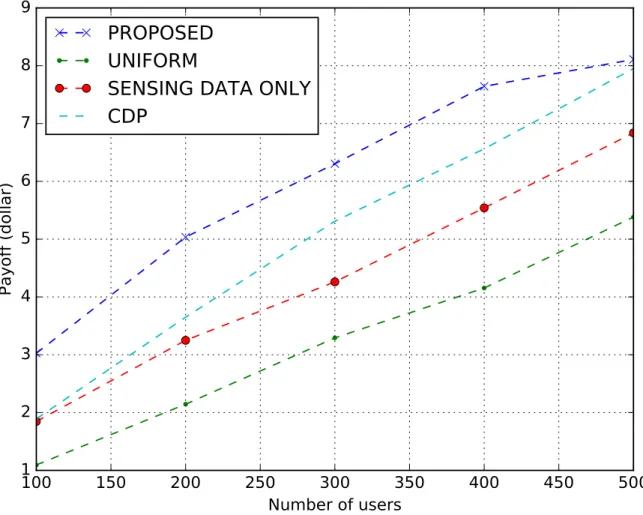
Fig. 2. Incentive mechanism payoffs with a different number of mobile users
by the equation set as
|T| X j=1 dRi(d∗ij) dd∗ ij −α(d∗ij+fij) = 0. (2)
Therefore, we can find the best decision ηi∗ by solving the equation set of (1) and (2). For finding an elastic solution to fit different settings, we choose Newton’s method to numerically solve the equation set.
V. PERFORMANCEEVALUATION
In this section, we first introduce the simulation settings then discuss the results of performance evaluation.
In all simulations, we build a crowdsensing network through python 2.7 and networkx. We set the numbers of nodes and time slots are 100 and 5000, while one slot is 1 second which is a general update period of GPS. The unit consumption of data collection and forwarding per each time slot is 7200µJ and 1500µJ from the general power consumption of cell phones. We set the utility function from the carrier price and the cost from a smartphone charge station. Thus, the user utility function is set to Ui(dij) = 43.2mJ/KiB·dij. We set
the revenue functionRi(di)equal to1.54e−5dollar/KiB·Di,
which is calculated from the value per message of Whatsapp. The price of cellular incentive traffic is set to 2 dollars per gigabyte, which is the lowest price in Japan.
For comparison, we test the payoffs by contribution depen-dent prize (CDP) from an existing literature [14]. We also test the payoffs of two original solutions as follows.
• UNIFORM The sensing service provider returns fix cellular traffic to each participant. Fix cellular traffic is set to 1 KiB per second.
• SENSING DATA ONLY The sensing service provider
returns cellular traffic to the participant who contributes in data collection. The ratio of incentive cellular traffic and collected data is set to 1.
In each simulation, we run the test with 20 times then calculate the average results.
1.0 1.5 2.0 2.5 3.0 3.5 4.0 4.5 5.0 Time (second) 0.0 0.5 1.0 1.5 2.0 2.5 3.0 3.5 Payoff (dollar) PROPOSED UNIFORM
SENSING DATA ONLY CDP
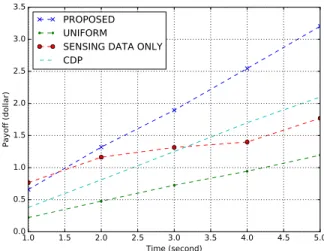
Fig. 3. Incentive mechanism payoffs with different time periods
We first discuss payoffs with a different number of mobile users in the network. We set the number of mobile users from 100 to 500 and increase the number by 100 in each step. From the result shown in Fig. 2, the payoff of each solution is increased with more mobile users in the network. Meanwhile, the payoff of our solution is two times than the UNIFORM solution. With an increasing number of mobile users, the payoff of UNIFORM solution performs worse than the SENSING DATA ONLY solution since some users who contribute nothing still receive incentive traffic. The payoff of CDP model is near to our solution when the number of users increases to 500, as the opportunity of data forwarding is higher with more users even without incentive traffic on it.
Then we study the payoffs with different time periods. We set the number of mobile users to 100, and the number of time slots from 1000 to 5000, which is increased by 1000 in each step. As shown in Fig. 3, the payoffs of all solutions are increased by the increasing time periods. Our solution performs a little worse than SENSING DATA ONLY solution at the begin and better than that after about 1.5 seconds. UNIFORM solution still performs the worst since the additional cost on the users without contribution. CDP solution performs better than SENSING DATA ONLY solution but worse than our solution.
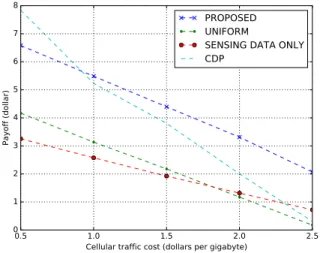
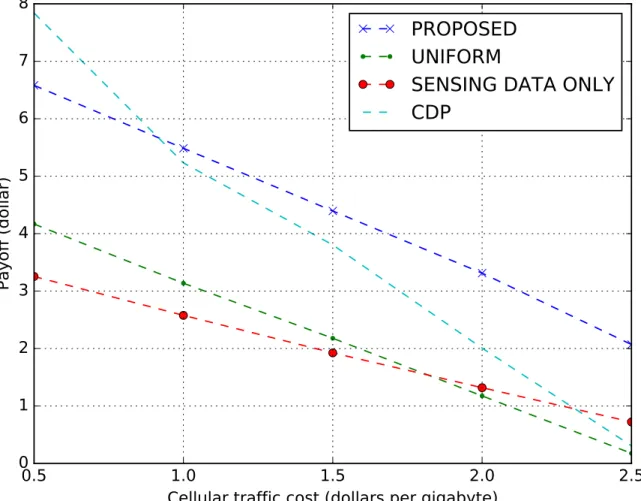
We also study the influence of the cost of cellular traffic. We set the number of the time slots to 5000, and the cost of incentive cellular traffic from 0.5 to 2.5 dollars per gigabyte, which is increased by 0.5 dollars per gigabyte in each step. We compare the payoffs in the simulation results shown in Fig. 4. When the cellular traffic cost is set to 0.5 dollar per gigabyte, CDP performs better than other solutions. Obviously, the cost of incentive cellular traffic will influence the payoffs of the incentive mechanism seriously. When the cost increases more than 2.5 dollars per gigabyte, the payoff the sensing service will be less than zero with UNIFORM, SENSING DATA ONLY and CDP solutions. We also find that UNIFORM solution can perform better than SENSING DATA ONLY solution with lower cost on incentive cellular traffic.
0.5 1.0 1.5 2.0 2.5 Cellular traffic cost (dollars per gigabyte)
0 1 2 3 4 5 6 7 8 Payoff (dollar) PROPOSED UNIFORM
SENSING DATA ONLY CDP
Fig. 4. Incentive mechanism payoffs with different cost on incentive cellular traffic
E
c(
µ
J)
1500 28500E
f(
µ
J)
150 1500η
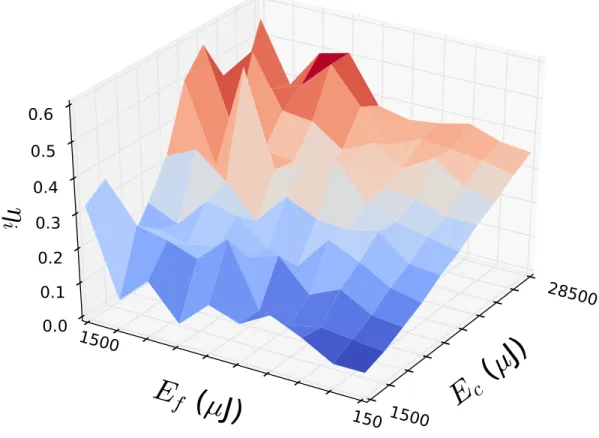
i 0.0 0.1 0.2 0.3 0.4 0.5 0.6Fig. 5. Incentive ratioηiwith different energy consumption in data collection
and forwarding
ratio between incentive cellular traffic and the total data in collection and forwarding. As the ratio in (1) is relevant to the energy consumption of data collection and forwarding, we test the best decision ofηiwith different energy consumption. We
set the cost of incentive cellular traffic is 2 dollar per gigabyte and choose a node mi for the simulation. Then, we adjust
the value of Ec from 1500µJ to 28500µJ, increased 3000µJ
in each step, and the value of Ef from 150µJ to 1500µJ,
increased 150µJ in each step. We find ratio ηi needs to be
increased with the increased energy consumption, as shown in Fig. 5. Ratioηiis increased smoothly with increasingEcwhile
there is an obvious fluctuation of increasedηiwith increasing Ef. This fluctuation is because of the varying forwarded data
as we change the network topology in each simulation. As a result, incentive mechanisms can increase the payoff of the sensing service provider with acceptable cost on incentive cellular traffic. However, since original solutions are not able to motivate users who contribute in data forwarding, UNI-FORM, SENSING DATA ONLY, and CDP solutions perform
worse than our solution which motivates users in both data collection and forwarding.
VI. CONCLUSION
In this paper, we proposed an SDON scheme to improve the management of mobile crowdsensing. We also design an incentive mechanism in the SDON. In the optimization of our incentive mechanism, we first formulate the interaction between participants and the sensing service provider as a two-stage Stackelberg game then find the game equilibrium. For evaluating best strategy in the game equilibrium, we test the payoff of the sensing service provider in extensive simulations. The payoff in the performance evaluation results is higher than the original solutions. In the future, we will implement a prototype of SDON and focus on the scalable management of the mobile crowdsensing.
REFERENCES
[1] J. Ren, Y. Zhang, K. Zhang, and X. Shen, “Exploiting mobile crowd-sourcing for pervasive cloud services: challenges and solutions,”IEEE Communications Magazine, vol. 53, no. 3, pp. 98–105, March 2015. [2] L. Kong, L. He, X. Y. Liu, Y. Gu, M. Y. Wu, and X. Liu,
“Privacy-preserving compressive sensing for crowdsensing based trajectory re-covery,” inProceedings of 2015 IEEE 35th International Conference on Distributed Computing Systems (ICDCS), June 2015, pp. 31–40. [3] L. Kong, D. Zhang, Z. He, Q. Xiang, J. Wan, and M. Tao, “Embracing
big data with compressive sensing: a green approach in industrial wireless networks,”IEEE Communications Magazine, vol. 54, no. 10, pp. 53–59, October 2016.
[4] D. Kreutz, F. M. V. Ramos, P. E. Verłssimo, C. E. Rothenberg, S. Azodolmolky, and S. Uhlig, “Software-defined networking: A com-prehensive survey,”Proceedings of the IEEE, vol. 103, no. 1, pp. 14–76, Jan 2015.
[5] B. Guo, Z. Yu, X. Zhou, and D. Zhang, “From participatory sensing to mobile crowd sensing,” inProceedings of 2014 IEEE International Conference on Pervasive Computing and Communications Workshops (PERCOM Workshops), March 2014, pp. 593–598.
[6] M. Conti and S. Giordano, “Mobile ad hoc networking: milestones, chal-lenges, and new research directions,”IEEE Communications Magazine, vol. 52, no. 1, pp. 85–96, January 2014.
[7] P. Talebifard and V. C. Leung, “Towards a content-centric approach to crowd-sensing in vehicular clouds,”Journal of Systems Architecture, vol. 59, no. 10, Part B, pp. 976 – 984, 2013.
[8] Y. Chon, N. D. Lane, F. Li, H. Cha, and F. Zhao, “Automatically char-acterizing places with opportunistic crowdsensing using smartphones,” inProceedings of the 2012 ACM Conference on Ubiquitous Computing, ser. UbiComp ’12. New York, NY, USA: ACM, 2012, pp. 481–490. [9] N. Avouris and N. Yiannoutsou, “A review of mobile location-based
games for learning across physical and virtual spaces[j],” Journal of Universal Computer Science, vol. 18, no. 15, pp. 2120–2142, 8 2012. [10] K. O. Jordan, I. Sheptykin, B. Grter, and H.-R. Vatterrott2,
“Identifica-tion of structural landmarks in a park using movement data collected in a location-based game,” inProceedings of The First ACM SIGSPATIAL International Workshop on Computational Models of Place, ser. COMP ’13. New York, NY, USA: ACM, 2013, pp. 1:1–1:8.
[11] C. Miao, W. Jiang, L. Su, Y. Li, S. Guo, Z. Qin, H. Xiao, J. Gao, and K. Ren, “Cloud-enabled privacy-preserving truth discovery in crowd sensing systems,” in Proceedings of the 13th ACM Conference on Embedded Networked Sensor Systems, ser. SenSys ’15. New York, NY, USA: ACM, 2015, pp. 183–196.
[12] C. Chaudet and Y. Haddad, “Wireless software defined networks: Chal-lenges and opportunities,” inProceedings of 2013 IEEE International Conference on Microwaves, Communications, Antennas and Electronics Systems (COMCAS), Oct 2013, pp. 1–5.
[13] W. H. Chin, Z. Fan, and R. Haines, “Emerging technologies and research challenges for 5g wireless networks,”IEEE Wireless Communications, vol. 21, no. 2, pp. 106–112, April 2014.
[14] T. Luo, H.-P. Tan, and L. Xia, “Profit-maximizing incentive for partici-patory sensing,” inProceedings of 2014 IEEE Conference on Computer Communications (INFOCOM), 2014, pp. 127–135.
[15] C. Courcoubetis and R. Weber, Pricing communication networks : economics, technology and modelling, ser. Wiley-Interscience Series in Systems and Optimization. Chichester, San Francisco, Weinheim: John Wiley & Sons, 2003.
He Lireceived the B.S., M.S. degrees in Computer Science and Engineering from Huazhong University of Science and Technology in 2007 and 2009, re-spectively, and Ph.D. degree in Computer Science and Engineering from The University of Aizu in 2015. He is currently a Postdoctoral Fellow with Department of Information and Electronic Engi-neering, Muroran Institute of Technology, Japan. His research interests include cloud computing and software defined networking.
Kaoru Ota was born in Aizu Wakamatsu, Japan. She received M.S. degree in Computer Science from Oklahoma State University, USA in 2008, B.S. and Ph.D. degrees in Computer Science and Engineering from The University of Aizu, Japan in 2006, 2012, respectively. She is currently an Assistant Professor with Department of Information and Electronic En-gineering, Muroran Institute of Technology, Japan. She serves as an editor for IEEE Communications Letter.
Mianxiong Dong received B.S., M.S. and Ph.D. in Computer Science and Engineering from The University of Aizu, Japan. He is currently an As-sociate Professor in the Department of Information and Electronic Engineering at Muroran Institute of Technology, Japan. Dr. Dong serves as an Editor for IEEE Communications Surveys and Tutorials, IEEE Network, IEEE Wireless Communications Letters, IEEE Cloud Computing, and IEEE Access.
Minyi Guoreceived the BSc and ME degrees in computer science from Nanjing University, China, and the PhD degree in computer science from the University of Tsukuba, Japan. He is currently a Zhiyuan chair professor and a chair of the De-partment of Computer Science and Engineering, Shanghai Jiao Tong University (SJTU), China. He received the national science fund for distinguished young scholars from NSFC in 2007.
m1 m2 m3 m6 m4 m8 m7 Sensing Service in Cloud Controller Access Point Opportunistic Networkm5 Cellular Base Station
Access Network
100
150
200
250
300
350
400
450
500
Number of users
1
2
3
4
5
6
7
8
9
Payoff (dollar)
PROPOSED
UNIFORM
SENSING DATA ONLY
CDP
1.0
1.5
2.0
2.5
3.0
3.5
4.0
4.5
5.0
Time (second)
0.0
0.5
1.0
1.5
2.0
2.5
3.0
3.5
Payoff (dollar)
PROPOSED
UNIFORM
SENSING DATA ONLY
CDP
0.5
1.0
1.5
2.0
2.5
Cellular traffic cost (dollars per gigabyte)
0
1
2
3
4
5
6
7
8
Payoff (dollar)
PROPOSED
UNIFORM
SENSING DATA ONLY
CDP
E
c
(
µ
J)
1500
28500
E
f
(
µ
J)
150
1500
η
i
0.0
0.1
0.2
0.3
0.4
0.5
0.6