Progress of Theoretical Physics, Vol. 100, No.1, July 1998
The Competition between the
0-
and 7r-Phase Shift
in the Pb-Sr2Ru04-Pb Junction
Carsten HONERKAMP and Manfred SIGRIST*
Theoretische Physik, ETH-Honggerberg, 8093 Ziirich, Switzerland
* Yukawa Institute for Theoretical Physics, Kyoto University
Kyoto 606-8502, Japan
(Received April 21, 1998)
Recent measurements of the Josephson effect between two Ph-films via Sr2Ru04 show a very anomalous temperature dependence of the maximal supercurrent. In this article we show that this result is consistent with the assumption of (spin-triplet) odd-parity pairing. Using a generalized Ginzburg-Landau theory for the specific geometry of the experimental device, it is shown that there are two contributions to the Josephson current. One is due to a proximity-induced s-wave component in Sr2Ru04, and the other is due to the intrinsic odd-parity order parameter. These two components have opposite sign and lead to a competition below the onset of superconductivity in Sr2Ru04 yielding the anomalous properties. Two possible test experiments for this kind of scenario are proposed.
53
During the last year new evidence has been found for unconventional supercon-ductivity in Sr2Ru04. This material is structurally identical to the layered perovskite La2Cu04, one of the parent compounds of high-temperature superconductors. The electronic properties are, however, strikingly different. In its stoichiometric com-position, Sr2Ru04 (SRO) exhibits clear Fermi liquid properties, though it is very anisotropic, so that it may be considered as a two-dimensional Fermi liquid. In the purest samples, superconductivity is observed below a transition temperature Tc as high as 1.5 K. 1)
The low-energy electronic properties are governed by the three 4d t2g-orbitals of the RuH -ions, which are arranged in a square lattice in each Ru02-plane. All three orbitals disperse sufficiently to cross the Fermi energy, leading to three nearly cylindrical Fermi surface sheets, two electron-like and one hole-like. There is a sizable renormalization of the Fermi liquid parameters, indicating strong correlation effects. Thus it seems unlikely that conventional superconductivity with Cooper pairing in the spin singlet s-wave channel is realized. It was suggested that this superconductor could be viewed as the two-dimensional analogue of 3He, showing p-wave spin triplet pairing. 2), 3) This conjecture is supported by the argument that ferromagnetic spin fluctuations are expected to be large, because related compounds of the Ruddelsen-Popper series, e.g. SrRu03 (3D perovskite) and Sr3Ru207 (double layer compound), possess ferromagnetic order at low temperatures. 4)
From the experimental side, there are various data which support the idea of unconventional superconductivity. The transition temperature Tc is highly sensitive to non-magnetic impurities, and already a small concentration of Al can suppress superconductivity completely.5) Furthermore, NQR measurements of 11T1 do not reveal any Hebel-Slichter peak. 6) In a recent muon spin rotation (f-tSR) experiment,
at Pennsylvania State University on March 4, 2016
http://ptp.oxfordjournals.org/
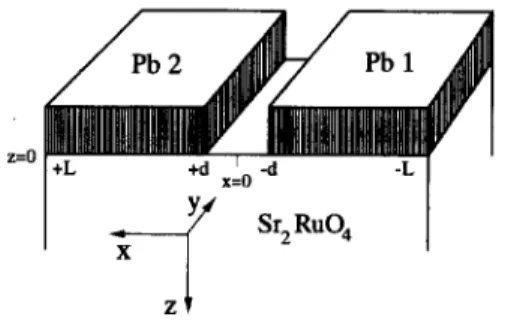
Fig. 1. Geometry of the Pb-SRO-device. The coupling is along the z-axis.
the existence of additional internal mag-netic field contributions in the super-conducting state was observed immedi-ately below Te.7) This feature is
read-ily explained as a consequence of the magnetic properties of a superconduct-ing state with broken time reversal symmetry, analogous to the case of U I-x ThxBeI3 and UPt3.8) This is
cer-tainly only possible for unconventional Cooper pairing. Analyzing the pairing states allowed by symmetry in SRO, we find that time reversal symmetry requires, in general, a multiple phase transition for the spin singlet case, for which there is no indication in the experiments. On the other hand, we find a state among the spin triplet states which breaks time reversal symmetry at the onset of superconductivity, e.g. d(k) = z(kx±iky). Thus, the j1SR experiment provides good evidence for spin triplet pairing. 7) Another very recent experiment studies the behavior of the Josephson effect between two pieces of Pb via a single crystal of SRO. 9) In this paper we argue that the anomalous temperature dependence of the critical current through this device can be considered as a further sign for spin triplet pairing.
The device Jin and coworkers designed for their experiment has the following geometry.9) Two Pb-films are placed on the c-axis oriented surface of SRO (Fig. 1).
The two pieces of Pb are separated by a tiny gap such that supercurrent flowing between them has to pass through the SRO sample. The lead films have TePb ~ 7.2 K, essentially identical to the bulk value, indicating that tunneling contacts to SRO are weak as expected considering the mismatch of Fermi velocities along the c-axis between the two materials. In the normal state of SRO, the critical current Ie of the device increases monotonically with decreasing temperature. Below the onset of superconductivity at Te in SRO, however, Ie drops abruptly, reaches a sharp minimum, and recovers again with lowering temperature. Clearly, if SRO were a conventional superconductor, Ie would rise further monotonically below Te.
The sharp drop and the anomaly in Ie can be understood if we assume that the pairing channel in SRO is different from the conventional one in Pb. Above Te the Josephson current is carried by an s-wave pairing component which is induced in SRO by the proximity effect from the two Pb films and yields a conventional SNS-Josephson contact. Below Te the character of the Josephson effect is altered drastically due to the nature of the superconducting state in SRO. This change is a result of the orbital structure of the superconducting state. In the following we would like to explain why this effect is essentially similar to the situation discussed by Geshkenbein and coworkers, who realized that a spin-triplet superconductor sand-wiched between two conventional superconductors would create an intrinsic 1T-phase shift. 10) The conclusion of the following discussion is that the device functions as a conventional O-junction above and in a small temperature range below Te , while it
turns into a junction with a finite intrinsic 1T-phase shift at low temperature. As we
at Pennsylvania State University on March 4, 2016
http://ptp.oxfordjournals.org/
Competition between the 0- and 7r-Phase Shift 55
will see, this yields very sharp features in the temperature dependence of the critical current.
We examine the junction properties based on a Ginzburg-Landau (GL) model of the device. The GL free energy of SRO describes the properties of a proximity induced (spin-singlet) s-wave order parameter "7s and the intrinsic (spin-triplet) p-wave order parameter belonging to the two-dimensional representation Eu of the tetragonal point group D4h ,
(1)
with '11
=
("7x, "7y) ex (1,±i)
as the stable superconducting bulk phase. This is the only pairing state stable within the weak coupling approach that breaks time reversal symmetry. The corresponding free energy has the form F=
Fs+
Fp+
F s-p in SRO withFs =
J
d3r[asTI"7sI2+
bsl"7sl4+
Ks(IDx"7sI2+
1 Dy"7s 12)+
K~IDz"7sI2],
Fp =
J
d3r[ap(T - Tc)I'I112+
b11'1114+
~b2("7;2"7;
+
"7;17;2)+
b31"7xI21"7yI2+Kl(IDx"7xI2
+
IDY"7yI2)+
K2(IDy"7xI2+
IDx"7yI2)+{K3(Dx"7x)*(Dy"7y)
+
K4(Dy"7x)*(Dx"7y)+
c.c.}2 2 1 ]
+K5(IDz"7xl
+
1 Dz"7y 1 )+
87r ("\7 x A) ,F s-p =
J
d3r[')'11"7s I21'1112+
~,),2("7;2'112
+
"7;'11*2)]. (2)where D
=
"\7 - 27riA/<Po (A: vector potential). All coefficients are real phenomeno-logical parameters. We assume that the transition temperature for the s-wave com-ponent is zero. In order to stabilize the time reversal symmetry breaking phase'11 ex (1, ±i) the parameters must satisfy the conditions b2
>
b3 and b2>
o.
Since both the s-wave and the p-wave components tend to open a gap over the whole Fermi surface, the coupling terms in Fs-p tend to be repulsive, i.e. ')'1>
1'Y21>
o.
Thefact that there are different nearly decoupled Fermi surfaces in this system may re-duce the repulsive nature, since the two components may coexist on separate Fermi surfaces. 11)
Now let us discuss the coupling to the two Pb films. The s-wave order parameter of Pb "70 is taken to be uniform for simplicity, since the tunneling is very weak. In the GL formulation the lowest order coupling between "70 and the s-wave order parameter in SRO has the standard form
(3)
where ts(x)
>
0 is the local coupling constant. The order parameters "70 and '11 couple along the c-axis very weakly for a uniform interface in the case of the state d( k )= z(kx
±
iky). The uniform component contains terms of the form''70
2n ('I1. 'I1)n+
c.c.(n:
integer), which vanish if the relative phase ¢x -cPy
remains constant ±7r /2. Theat Pennsylvania State University on March 4, 2016
http://ptp.oxfordjournals.org/
first finite term appears at fourth order,
1]0
41];1];
+
1]61];21];2,
Le. simultaneously fourCooper pairs have to be transferred through the interface. This term is finite due to the tetragonal symmetry of the Fermi surface (it would vanish for the perfectly cylindrical case).
The situation regarding the lowest order coupling between
1]0
and fJ requires further discussion. Under ideal conditions, a single Cooper pair transfer between a singlet and a triplet superconductor is forbidden by the orthogonality of the spin part of the wave functions. However, in reality the spin wave functions can have a finite overlap due to spin-orbit coupling which generates different pseudospin states in the two superconductors. Thus, the pseudospin singlet state in Pb is, in general, not orthogonal to the pseudospin triplet state in SRO.(It
is difficult to give a quan-titative estimate of this coupling, since it is very sensitive to microscopic details. We assume here that it is of same order of magnitude as the coupling between the singlet order parameters.) A second obstacle for the Cooper pair transfer arises from the different parities of the orbital part of the pair wave functions. This problem can be circumvented by breaking the parity in the region where coupling occurs. 8) The simplest situation occurs if the order parameters at the interface exhibit spatial variation. This aspect can be taken into account in the GL coupling terms, leading toFt,p
=
-1=0
dxdY[{fJ· D)tp1]o+
c.c.], (4)where the gradient D is included in order to arrive at an invariant form for the interface along the c-axis. The gradient provides a measure of the parity breaking.
First, we discuss the situation above Te. The s-wave order parameter
1]s
is induced by the proximity effect from Pb to SRO. For the following calculation we choose the gauge such that1]0
is11]01
in the Pb-film 1 andl1]ole
i¢ in the Pb-film 2. We can solve the GL equations for TJs together with the boundary conditions resulting from the interface term:
(5)
and
8
xTJs Ix=±L=
O. The general solution assuming homogeneity in the y-directionis
00
1]s{x, z) =
L
[an
cos{q~x )e-"'~Z+
,Bn sin{q~x )e-"'~Zl
(6)
n=O
with /l:~
=
(asT+
Ksq~)/K~, q~=
7rn/L and q~=
7r{n+
1/2)/L. The boundary condition Eq. (5) leads toa
=
- tsl1]ol
(ei¢+
1)x {
n LK'/l:' s n
(L - d)/2
n=O
sin(q~d)/q~
n>O
(7)
Inserting this solution back into the free energy we obtain the energy contribution
at Pennsylvania State University on March 4, 2016
http://ptp.oxfordjournals.org/
Competition between the 0- and 7r-Phase Shift 57 of the coupling between Pb and the s-wave order parameter in SRO:
Es
=
-~
1=0
dxts("7o"7s+
"70"7;)
= _
2t;I"701
2 [ "{sin2(q~d)
( A.. 1)LK'
~ 1 12 COS<P+
s n>O "'nqncos2(q~_1d)
}(L -
d?1
+
/I "2 (1 - cos ¢ )+
2 1 ( cos ¢+
1) . "'n-l qn-1 "'0 (8)The analysis of the three terms shows immediately that Es assumes a minimum for
¢
=
27rn (n, integer). Furthermore, we find that the ¢-dependent part vanishesexponentially if d is increased.
The corresponding current-phase relation can now be obtained by calculating the current flowing through one of the two interfaces, say that with Pb-film 1. This leads to
(9)
where ¢ is the phase difference between the two superconducting films. It is easy to see that the maximal current fes (Is = fes sin ¢) increases monotonically with
lowering temperature. 12)
Now let us consider the temperature region below Te , where the order parameter
1J of SRO is finite:
1J= ap(Te - T) ( b b 1, ±~ ")
=
"7p
( 1, ±~ ").
4b1 - 2
+
3(10) The presence of this order parameter reduces the proximity induced s-wave compo-nent, since both are competing on the Fermi surface. This is described by the mixing terms in
F
s-p with /'1>
O. This effect can be incorporated approximatively by usingthe /'1-term as an effective correction to the second order term of
F
8 , leading to thereplacement asT --t asT+/'111J12(T). (Note that the /'2-term vanishes with the order parameter symmetry given in Eq. (10).)
Furthermore, we should include pair breaking effects due to interface scattering, which can be described by a simple calculation of the non-linear GL equation derived from Fp , leading to
1J(Z) = "7p(l, ±i)tanh((z - zo)/~)) (11)
with
~(T)
=
.jK5/ap(Te - T). Then Zo is determined by the boundary condition (12) at z=
0, where l is the extrapolation length. 13) From this we obtainat Pennsylvania State University on March 4, 2016
http://ptp.oxfordjournals.org/
.,,(Z
=
0)=
77p(l,±i) (
Jl+
(l/~)2
-1)
t
(13) for the order parameter at the interface.For the current contribution of the superconducting condensate of SRO, we can make the approximation that .,,(
z)
has no spatial variation along thex
and ydirec-tions. We consider now the coupling at the interfaces to lowest order, i.e., we neglect any change of the relative phase of the order parameter
(¢x - ¢y),
introduced by the Cooper pair transfer between the two superconductors. Thus, only the uniform phase relation plays a role here, and we take." = 177(Z)I(I, i)e-iX with X as a degreeof freedom. Hence the interface energy takes the simple form
Ep
=
-tpl77oll77(z=
O)I[cosx - cos(¢ - X)], (14)which must be minimized with respect to X for given ¢ such that, finally, we obtain
(15) The minimal interface energy is obtained for phase differences ¢ = 7r(2n
+
1);i.e., the device acts in some sense like a 7r-junction, in contrast to the O-junction behavior of the induced s-wave component. This type of 7r-junction is basically the analogue of the sandwich device proposed by Geshkenbein and coworkers for testing of the parity of a superconductor. 10) We again calculate the current-phase relation,
27rC ( •
¢) ¢
Ip
=
Po tpl77oll77(z=
O)lsign sm2
cos2
I . ( .
¢) ¢
= -
cpSlgn sm 2 cos 2' (16)The total current Itot(¢) is the combination of the contributions from Eq. (9) and (16), and the maximal current Imax is obtained by maximizing I I tot I with respect to ¢.
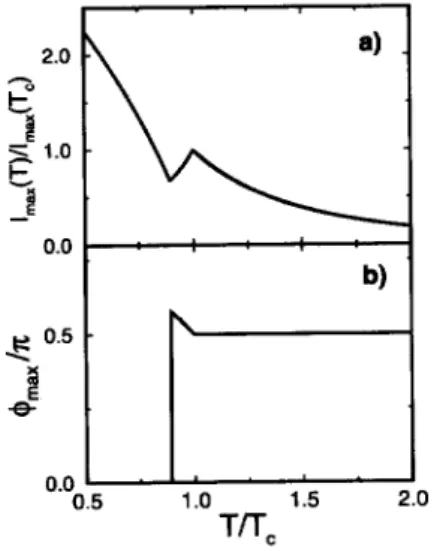
Above Te the induced s-wave component generates a gradually growing Imax with lowering temperature. Immediately below Te, however, Imax drops for two reasons. First, the s-wave order parameter in SRO is slightly diminished by the appearance of the p-wave superconducting phase. Second, and more important, the contribution of the p-wave condensate to Itot has opposite sign. Further below Te there is a discontinuous change of the maximizing phase ¢max which is accompanied by an anomaly of the T-dependence of Imax (see Fig. 2). This anomaly resembles that observed experimentally. Its occurrence is due to the subtle competition between the two contributions to the current, which have to be of a similar magnitude in the intermediate temperature range immediately below Te. In order to obtain the result shown in Fig. 2, we have chosen the parameters in the GL theory so that
the s- and p-wave contribution have a similar magnitude (see the caption of Fig. 2).
The phase difference ¢min which minimizes the energy of the device, E = Es
+
Ep,at Pennsylvania State University on March 4, 2016
http://ptp.oxfordjournals.org/
Competition between the 0- and 7r-Phase Shift 59
is 0 above Te and changes continuously when SRO becomes superconducting and reaches eventually ±7r (see Fig. 3). This intermediate state (0
<
I¢minl<
7r) is two-fold degenerate (¢min=
±I¢minl) and has the phase properties of a Josephson junction with broken time-reversal symmetry.Let us, finally, discuss two further experimental consequences which arise from these properties. First, if we include this device into a superconducting loop, sponta-neous currents should appear below Te for sufficiently large loop inductance. This is analogous to the so-called 7r-loops known in high-temperature superconductors due to d-wave pairing. A second phenomenon is connected with the ac-Josephson effect if we apply a voltage V. The basic frequency of the supercurrent is
a¢/at
= w = ·27rcV/~0.If we analyze the Fourier components of the oscillating current l(¢
=
wt), we findlet)
=
[leB -
~3lcp]
sin(wt) -lcp
L
~n
sin(nwt) ,
(17)n::::24n - 1
which shows that the basic component should change sign at a certain temperature below Te. This could be a good test for this scenario.
In summary, we have shown that the anomalous temperature dependence of the
critical current in the Pb-SRO-Pb device can be explained consistently by assuming a p-wave state which, for example, can have the form d(k) = z(kx
±
iky). Theim-portant aspect of such an odd-parity state is the fact that if s-wave superconductors are brought into contact on two opposite sides an overall phase shift of 7r occurs. This feature, first introduced by Geshkenbein and coworkers, 10) is also found in the
geometry used by Jin and coworkers in their experiment, though it is somewhat
hid-2.0
~
5
1 . 0 0 . 0 1 - - - + - - - + - - - - 1 b) ~ 0.5-.
~
-&-0.0 '--~-'-... - -... ~-... 0.5 1.0 1.5 2.0TlTc
Fig. 2. a) Maximal current passing through the device. b) The phase difference at which the maximal current flows. We use the following parameters: as = ap = 1,
Ks = 1, K~ = K5 = 0.1, b1 = 1, b2 = 2, b3 = -1, /'1 = 0.5, 3tp = ts = 1, I = 1, L = 40, d = 1 and TJo = J l - (T/7)2/5. 1.5 1.0 0.5
~
'E 0.0 ~ -0.5 ·1.0 ·1.5 0.5 1.0 1.5TlTc
Fig. 3. Phase difference which minimizes the energy of the device. Below Tc <Pmin in-creasingly deviates from 0 and continu-ously approaches
±7r.
Note that positive and negative deviation yield the same en-ergy (two-fold degeneracy). The parame-ters used are identical to those in Fig. 2.at Pennsylvania State University on March 4, 2016
http://ptp.oxfordjournals.org/
den there.9) Recently, we noticed that Yamashiro and coworkers came to a similar conclusion after performing a calculation based on the Bogolyubov-de Gennes for-mulation for a configuration slightly different from that we have considered here. 14) In particular, they also interpreted the effect as a sign of odd-parity pairing. In contrast to these authors we would not rule out a non-unitary state based on this experimental data. A non-unitary state like d(k)
=
(x±
ifj)(kx =f iky) 15) would,within our description, lead to similar properties.
There are certain (probably) important aspects of the experiment which have not been addressed in our theory. It was noticed by experimentalists that the SRO sample possesses a certain amount of Ru-metal inclusions. These inclusions are quite likely to be important for the contact between the Pb-films and SRO. While the resulting inhomogeneity is of less importance for the induced s-wave component, it yields modifications for the p-wave part due to the gradient part in Ft,p (Eq. (4)). While in our previous picture the edges of the Pb-films where the coupling changes abruptly were the essential regions of contact, and their orientation was crucial for the phase structure of the Josephson coupling, the inhomogeneous coupling leads to a less decisive picture. In this case the phase of the coupling varies over the interface. If there are a small number of Ru-bridges between Pb and SRO, then by accident the phase shifts in the two contacts may take values which lead to similar conditions as discussed above. However, if the number of contacts is very large then the lowest order contact between the s-wave order parameter of Pb and the p-wave order parameter can be wiped out, and the coupling is effectively of higher order.
The experiment by Jin and coworkers reveals another feature which suggests that only a small number of contacts with small spatial extension apparently dominate the Josephson coupling. They showed that rather high magnetic fields (H
=
500 and 1000 Gauss) suppress the coupling rather weakly. This cannot be understood if the Pb-SRO coupling is homogeneous, which would lead to a severe suppression of the Josephson current. Thus this result is incompatible with the assumption of a homogeneous interface as well as a large number of contacts. However, a few small contacts would indeed be only weakly affected by an external field.Because the anomaly in the temperature dependence of Imax originates from the competition between the two contributions to the Josephson effect in this device, it should disappear, if one of the two components dominates. For example, a smaller gap (i.e., smaller d) between the two Ph-films would support the proximity-induced s-wave contribution and the anomalous behavior would be invisible. Hence, the main result of our discussion is the principle of the competition between the s-wave and p-wave channel. The quantitative aspects are very difficult to handle within any approach, since microscopic details have strong influence on the coupling between Pb and SRO.
The features seen in this experiment can be explained well with the assumption of p-wave superconductivity in SRO. Therefore, together with other experiments such as the J.tSR zero-field relaxation and the NMR-Knight shift, there is an already strong indication for the realization of spin-triplet pairing in this compound. The detailed structure of the order parameter is not completely decided yet and needs further attention from experimental and theoretical sides.
at Pennsylvania State University on March 4, 2016
http://ptp.oxfordjournals.org/
Competition between the 0- and 7f-Phase Shift
61
We would like to thank D. Agterberg, A. Furusaki, S. Ikeda, K. Ishida, R. Jin, Y. Maeno, S. Nishizaki, T. M. Rice and Y. Tanaka for many helpful discussions. C. H. is grateful to many people at the Yukawa Institute for Theoretical Physics for their hospitality during the three weeks when this work was being finished.References 1) Y. Maeno, Physica C282-287 (1997), 206.
2) T. M. Rice and M. Sigrist, J. of Phys. C7 (1995), L643. 3) G. Baskaran, Physica B223 & 224 (1996), 490.
4) T. C. Gibb, R. Greatrex, N. N. Greenwood, D. C. Puxley and K. G. Snowden, J. Solid State Chern. 11 (1974), 17.
G. Cao, S. McCall and J. E. Crow, Phys. Rev. B55 (1997), R672.
5) A. P. Mackenzie, R. K. W. Haselwimmer, A. W. Tyler, G. G. Lonzarich, Y. Mori, S. Nishizaki and Y. Maeno, Phys. Rev. Lett. 80 (1998), 16l.
6) K. Ishida, Y. Kitaoka, K. Asayama, S. Ikdea, S. Nishizaki, Y. Maeno, K. Yoshida and T. Fujita, Phys. Rev. B56 (1997), R505.
7) G. M. Luke, Y. Fudamoto, K. M. Kojima, M. I. Larkin, J. Merrin, B. Nachumi, Y. J. Demura, Y. Maeno, Z. Q. Mao, Y. Mori, H. Nakamura and M. Sigrist, preprint.
8) M. Sigrist and K. Deda, Rev. Mod. Phys. 63 (1991), 239.
9) R. Jin, Y. Zadorozhny, Y. Liu, Y. Mori, Y. Maeno, D. G. Schlom and F. Lichtenberg, preprint.
10) V. D. Geshkenbein, A. I. Larkin and A. Barone, Phys. Rev. B36 (1987), 235. 11) D. F. Agterberg, T. M. Rice and M. Sigrist, Phys. Rev. Lett. 78 (1997), 3374.
12) In this calculation we have assumed that the currents are very small so that we can neglect the vector potential. This yields to a violation of the continuity of the current within SRO, i.e. V' . j
i=
0 in general.13) P. G. de Gennes, Superconductivity of Metals and Alloys (Addison-Wesley Publishing Com-pany, 1966).
14) M. Yamashiro, Y. Tanaka and S. Kashiwaya, preprint.
15) K. Machida, M. Ozaki and T. Ohmi, J. Phys. Soc. Jpn. 65 (1996), 3720. M. Sigrist and M. E. Zhitomirsky, J. Phys. Soc. Jpn. 65 (1996), 3452.
at Pennsylvania State University on March 4, 2016
http://ptp.oxfordjournals.org/