ISSN 1990-9233
© IDOSI Publications, 2014
DOI: 10.5829/idosi.mejsr.2014.20.12.21091
Corresponding Author: Andrey Vladimirovich Ostroukh, Department "Automated Control Systems", Moscow Automobile and Road construction State Technical University (MADI), Moscow, Russia.
Development of Automated Control System for University Research Projects
Andrey Vladimirovich Ostroukh, Mikhail Nikolaevich Krasnyanskiy,1 2
Sergey Viktorovich Karpushkin and Artyom Dmitrievich Obukhov
3 4
Department "Automated Control Systems", Moscow Automobile and Road construction State
1
Technical University (MADI), Moscow, Russia
Vice-Rector for Research and Innovation, Tambov State Technical University (TSTU), Tambov, Russia
2
Professor of the Department "Computer-aided design of processing equipment", Tambov State Technical
3
University (TSTU), Tambov, Russia
Undergraduate student, Tambov State Technical University (TSTU), Tambov, Russia
4
Abstract: Electronic document managementis used in designing, manufacturing and sales of industrial products. The need to develop modern automated information systems is caused by a huge amount of documents to be stored and processed. The paper discusses the issues of constructing such complex electronic document management systems in their interaction with the information systemsof company productcatalogs and other types of electronic documents.These systems are developed to solve a number of tasks,such asensuring fast access to information, storage and protection of documents, document flow management, etc. We describe a mathematical model for electronic catalogsin the form of a graph. Based on traveling salesman problem the task of project optimization has been stated. The authors describe the effect of combined application of electronic productcatalogs and document management systems within the company.
Key words:Document circulation Document flow Electroniccatalogs Document management Automated system
INTRODUCTION Storage of documents with no connection to relevant Today, designing, manufacturing and sales of networked storage can handle such a task. In this respect, industrial products involve large amounts of documents: the synthesis of EDMS and product catalogs is of the project specifications, reports and orders, patents and greatest interest. The introduction of electronic document standards, etc. Safe storage and quick access to these management system can solve a lot of ‘hidden’ problems documents contribute tosustainable development of any and improve the performance of the organization as a company. At the same time, the traditional paper-based whole. First, let usconsider the above mentioned systems document management has plenty of shortcomings, separately.
hence, there is the need to develop and implement
automated information system of electronic document Electronic Document Management System:The main management system (EDMS) [1]. element of the EDMS is a document. Electronic document The introduction of such a system is designed to management system involvesthe arrangement of an solve the main problems of paper documentmanagement: electronic archive and the information flow management, loss of documents, long search for information, large as well as automation of various departments of an storage area, low-speed editing, etc. organization (office, accounting, certification, etc.), The purpose of this paper is to study the possibility possibility to add modules generating contracts, of integration of electronic document management system applications, organizational documents (e.g., for meetings, and electronic product catalogs. conferences) [2, 3].
{ ..., , ..., , ..., }d1 d sn 1 s pm 1 pk , { , } i j w w M = w wi j , ( w wi j) L M , , , ( , ) ( ) ( i j) ( ) w ws t w wi j s t w w FORALL w w ISIN M L M = SUM l
The requirements to modern EDMSsinclude characteristics). Given the large number of entries, their ensuring orderly access to information and strict classification and close links between theproduct improvingcomplex business processes withinan itemswe need todevelop a mathematical model at the organization [4]. The domestic market systems are slowly stage of creating the information system structure and developing in this direction, however, they are lagging related database of product catalogs [13, 14].
behind their foreign counterparts, such as Documentum. In the first phase of the model development we [5]. In this work, this automated system will be used to formed agraph of catalognodes.To illustrate this, we shall consider the main problems solved by EDMS, such as consider the structure comprised of the sets of parts, quick access to information, transparency of document assemblies and products, which together form the final flow, implementation of electronic archiving and project. At the same time, the assemblies and products are protection from unauthorized access. In developing the the nodes of the same level and can be incorporated into EDMS for research and innovation activities it is each other, while the parts are finite elements, forming the necessary to focus on the requirements of the subject basis for the assembly or product.
area, rather than use expensive software with
unnecessary features or free non-optimal solutions. We Introduce the Following Notation: P is a project The practical value of the EDMS implementation is
as follows [6-11]:
Reduction in the time spent on searching and filling out documents.
Secure storage of documents: all documents are digitized, collected on the server andhave backups. Possibility to retrieve accurate information about the authorof the document and all the users to authorize and amend it, with the exact time of the document creation and editing dates.
Full and partial exclusion of paper documentation from the internal circulationwithin the company and the transition to the electronic version of the archive, resulting in the reduction in the costs of document flow management in the organization [12].
Thus, the electronic document management system streamlines the work of documentation, increase the security of the stored data, but at the same timeit is not be linked to actual production [16-27]. At the beginning of this article we mentioned the possibility of integrating productcatalogs into classical EDMS so as to increase the effect achieved through the automation of document management. This brings us to the need to study product catalogs.
Mathematical Model of Product Catalogs: The majority of documents ofa chemical industry company, for example, are based on product catalogsincluding parts, materials, tools, etc. It is necessary to create such an automated system which will enable the user to edit records, search the database and generate orders by retrieving a group of records from the database and extracting the necessary information (cost, structure, physical and economic
document,p , p ...1 2 is a set of all products, s , s ... is a set1 2 of all assemblies, d , d ... is a set of all parts.1 2
Thus, the project can be shown as a graph
p=[W, M], where W- is a set of
vertices; M isa set of oriented branches formed in (w ,wi j ) pairs, which are elements of the set W.
Products, parts and assembliescan be incorporated into each other by the following rules:
Output onlyisparts.
Input and output arenodes that are often presented by assemblies, but at higher levels they can be represented by products.
Input only is a project that is the end product. The edges of the graph are numbered to identify the possible ways of forming the project. As it can be seen from Figure 1, the project can be made with various combinations of vertices (three optionsare indicated). Thus, using the graph, we can assess the projectby various design criteria and if necessary, optimize it using interchangeable components. To ensure the best option, one must find the optimal path [15].
Let be the pathbetween the vertices
wi and wj, with the length of this path;in order to calculate this length each intermediate branch (ws,wt) isassigned a weight factor lws,wt is applicability of the vertexwsin the vertex wt), determining its value: the price of a product, mass of a part, manufacturing time, etc. Thus, the path length from the vertex wi to the vertex wj is equal to:
, , min( w wi j) w wi j l =L M , 0 0, , 0 , 0 , , 0 0 , 0 min min ( ) ( ) min ( ) ( ) ( ) ( ( )) ( ( )) ( ) w P w si w P w P i w pj w P w P j s ISIN M p ISIN M l L M SUM L M SUM L M L M = = + + , ( , ) ( ) ( ) (w Pi ) i j FORALL w w ISIN P F P = SUM l
Fig. 1: Presentation of the project in the form of a graph A full applicability of the nodewi in the nodewj is calculated as a minimum length of the path M :wi,wj
is formulated as traveling salesman problem,which can be
Consequently, the applicability of the partw0 in the method,the branch-and-bound method. As a result of project is determined as the optimum position of the parts solving the problem, the optimal set of parts, assemblies inside the assemblies si, products pj, or in the project P: and products for the given order is formed [15].
Based on the database of products, assemblies, parts and boundary conditions (these are defined by the customer, or the current inventory / business needs and can be expressed in the amount of material / products, cost, company budget enterprise, time slots) we determine the optimal paths in the graph
P. Then the goal function is the function of the project efficiency:
The formulated problem of the project optimization solved by any of the existing methods for extremal combinatorial problems, such as the exhaustive
Software for Product Catalogs: The scripting language type ensure the safety and reliability of informationand PHP and the web server Wampserver (includes Apache, enable to affect directly the efficiency of production as a MySQL, script interpreter PHP, phpMyAdmin) were whole.
used as tools for developing a prototype module of
productcatalogs [16, 17, 22-27]. The design was REFERENCES
implemented in accordance with the principles of
object-oriented programming, as well as the concept of 1. Pechnikova, T.V. and A.V. Pechnikova, 1999.
MVC template: "Practice working with documents in the
Model:The main executable code is packed in a separate 2. Electronic Document Management System class responsible for data checking, database use and http://www.ukessays.co.uk/essays/information-generating some basic elements of data output.
system/electronic-document-management-Controller: Data management, its output to pages as 3. Banker, R.D. and R.J. Kauffman, 2004. "The evolution well as information retrieval from the forms is handled on of research on information systems: A fiftieth-year separate pages by appropriate Model class. Thus, each survey of the literature in Management Science," page performs its tasks in terms of the basic classes of Management Science, 50: 281-298.
Model. 4. Market EDMS 2013: rules dictate developers http://
Representation: The external interface (implemented by 436
Cascading Style Sheets-CSS) is determined separately and 5. EMC Document Information Rights Management applied to all pages of the site.
http://www.emc.com/collateral/software/data-The authorization allows users to edit, add and delete sheet/h3112-irm-services-ds.pdf
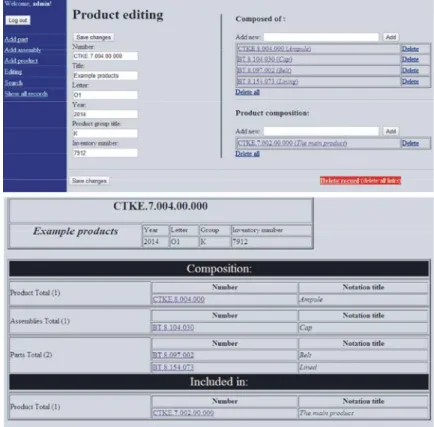
records. Unauthorized users can only view records. 6. Erlane K. Ghani, Kamaruzzaman Muhammad and Figure 2 shows the interface of the developed prototype Jamaliah Said, 2012. "Development of Integrated for the product catalog module. Information Management System Service Quality The developed software is a prototype and suggests Model in an Accounting Faculty" / International further development by adding digital signature Journal of Business and Social Science, 3: 7. functions, intelligent search and creation of a mobile 7. Lucas Ambrósio B. de Oliveira, Natalia Veloso Caldas version of the project. de Vasconcelos and other, 2011. "Contribution of
CONCLUSION Management: Case Study of the Federal University The analysis of the document management system 7(3): 415-422.
and automated product catalogsbrings us to the 8. Glass, R.L. and T.Y. Chen, 2005. "An assessment conclusion that the product catalogscan be optimally of systems and software engineering scholars and integrated into a comprehensive electronic document institutions (1999-2003)," Journal of Systems and management system as an external module. Furthermore, Software, 76: 91-97.
this integration can improve the efficiency of the system 9. Palvia, P., P. Pinjani and E.H. Sibley, 2007. "A profile due to the possibility of storing any lists of parts or of information systems research published in products and referring to specific documents, drawings, Information & Management," Information & reports, patents and other documents. Management, 44: 1-11, Jan
Authorized users of the combined system have 10. Wokocha, C.M., and E.I. Adebayo, 2012. "A Guide to access to both the product database and all Establishing Management Information System in accompanying documents (instructions, technical Tertiary Institutions in Nigeria" African J. Basic & specifications, certificates, etc.). Appl. Sci., 4(3): 83-88.
Obviously, the combined document management 11. Alireza Anvari, Gholam-Abbas Alipourian, systems can be used forstoring and processing of Rohollah Moghimi and Abbas Taleb-Beidokhti, documents in the systems linked to real production and 2012. "An Investigation of Innovation in Higher business processes of an organization. The EDMSsof this Educational Environments-A Consideration of
organization"- "EMOS", pp: 208.
system.php.
www.cnews.ru/reviews/index.shtml?2013/03/05/521
Integrated Management Systems to University of Rio Grande Do Norte " / Journal of Social Sciences
Five Substructures (Technical, Administrative, 21. Ostroukh, A.V., K.A. Barinov and N.E. Surkova, 2013. Information Systems, Information Technology and Computer game modeling organizational structures Knowledge Management)" Middle-East J. Sci. Res., of enterprises and industrial associations. Research
11(9): 1278-1285. Inventy: International Journal Of Engineering And
12. Mubarakzyanov, G.M., I.V. Dilevskiy, 2008. Science, 3(12): 20-29.
"Mathematical Theory of Tasks Explosion Assembly 22. Ostroukh, A.V. and N.E. Surkova, 2011. E-learning Units" / Vestnik KSTU im. A.N. Tupoleva, 1: 83-86. resources in vocational education. Saarbrucken, 13. Pomazanov, A.V., A.I. Belousova, A.O. Vasilyeva Germany: LAP LAMBERT Academic Publishing, 184
and A.V. Ostroukh, 2012. "Database Optimization p. ISBN 978-3-8433-2216-4.
Technique" / In the World of Scientific Discoveries. 23. Ostroukh, A.V., P.A. Petrikov and N.E. Surkova, 2012.
12: 49-54. Corporate training. Process Automation Management
14. Vahid Zharfi and Abolfazl Mirzazadeh, 2013. staff training industry. Saarbrucken, Germany: LAP "A Novel Metaheuristic for Travelling Salesman LAMBERT Academic Publishing, 147 p. ISBN 978-3-Problem" Journal of Industrial Engineering Volume 659-16272-5.
2013, Article ID 347825, 5 pages. 24. Ostroukh, A.V., M.I. Ismoilov and A.V. Merkulov, 15. Levitin A.V., 2011. "Introduction to The Design and 2012. Corporate training. Training of personnel of Analysis of Algorithms". Addison Wesley, pp: 565. enterprises based on a virtual model of the 16. Krasnynskiy, M., A. Nikolaev and A. Ostroukh, 2012. professional community and grid technologies. Application of virtual simulators for training students Saarbrucken, Germany: LAP LAMBERT Academic in the field of chemical engineering and professional Publishing, 129 p. ISBN 978-3-659-23865-9. improvement of petrochemical enterprises personnel. 25. Ostroukh, A.V. and L.V. Vladimorov, 2012. Distance International Journal of Advanced Studies. Vol. 2. No education technologies. Research and development 3. pp. 4. DOI: 10.12731/2227-930X-2012-3-4. of software products for video lectures and 17. Barinov, K., M. Krasnynskiy, A. Malamut and webinars. Saarbrucken, Germany: LAP LAMBERT A. Ostroukh, 2012. Algorithm of Virtual Training Academic Publishing, 97 p. ISBN 978-3-659-24981-5. Complex Designing for Personnel Retraining on 26. Ismoilov, M.I., A.B. Nikolaev and A.V. Ostroukh, Petrochemical Enterprise.. International Journal of 2013. Training and retraining of personnel and Advanced Studies. Vol. 2. No 3. pp. 6. DOI: industrial enterprises of transport complexes using
10.12731/2227-930X-2012-3-6. mobile technology. Saint-Louis, MO, USA:
18. Ostroukh, A.V. and A.B. Nikolaev, 2013. Publishing House Science and Innovation Center, Development of virtual laboratory experiments in 166 p. ISBN 978-0-615-67111-6.
iLABS environment. International Journal Of Applied 27. Ostroukh, A.V., K.A. Barinov, A.B. Nikolaev and And Fundamental Research. 2013. No 2; URL: V.Yu. Stroganov, 2014. Formal methods for the www.science-sd.com/455-24313. synthesis of the organizational structure of the 19. Ostroukh, A.V. and A.B. Nikolaev, 2013. management through the personnel recruitment at the Development of virtual laboratory experiments in industrial enterprises. Journal of Applied Sciences iLabs. International Journal of Online Engineering (JAS). 14, No 5. pp. 474-481. DOI: (IJOE). Vol. 9, No 6. pp. 41-44. DOI: 10.3991/ 10.3923/jas.2014.474.481.
ijoe.v9i6.3176.
20. Ostroukh, A.V., K.A. Barinov, A.B. Nikolaev and V.Yu. Stroganov, 2013. Interactive Game Modeling Concept for Personnel Training at the Industrial Enterprises. World Applied Sciences Journal (WASJ). Vol. 28, No 1. pp. 44-55. DOI: 10.5829/idosi.wasj.2013.28.01.1876.