The Allied Telesis x610 Series is the high performing and scalable
solution for today’s networks, providing an extensive range of
port-density and uplink-connectivity options.
With a choice of 24-port and 48-port
versions and optional 10 Gigabit uplinks,
plus the ability to stack up to eight units,
the x610 Series can connect anything
from a small workgroup to a large
business.
High Performing
The x610 Series features fully
non-blocking switching on all ports, so IPv4
and IPv6 Layer 2 switching and Layer 3
routing occur at wirespeed with low
latency. This is ideal for high-end server
deployments, and, when combined
with a large Layer 3 route table, for
aggregating Gigabit connections.
Powerful Network Management
Meeting the increased management
requirements of modern converged
networks, Allied Telesis Management
Framework (AMF) automates many
everyday tasks including configuration
management. The complete network
can be managed as a
single virtual device with
powerful centralized
management features.
Growing the network
can be accomplished with plug-and-play
simplicity, and network node recovery is
fully zero-touch.
Resilient
The x610 Series provides uninterrupted
access to online applications by
implementing a network with no single
point of failure. Distributing resources
across a stacked group of units means
no network downtime. A fully resilient
solution is created with VCStack™
(Virtual Chassis Stacking), where up
to eight units can form a single virtual
chassis with dual connections to key
servers and access switches. VCStack
can be implemented in
the same cabinet over
copper cabling, or to
remote locations using
fiber.
Allied Telesis EPSRing™ (Ethernet
Protection Switched Rings), technology
provides a high performing resilient
design for distributed networks. A
high-speed solution
where recovery
occurs within as
little as 50ms can be
deployed in
ring-based topologies. Several switches can
form a protected ring, running at up to
10Gbps.
Scalable
The flexibility of the x610 Series, coupled
with the ability to stack multiple units,
ensures a future-proof network. The
choice of 24-port and 48-port versions
and Gigabit or 10 Gigabit uplink ports
enables uplink bandwidth to be tailored
to suit network applications. Expansion
modules are available for local and
long-distance stacking. Long-distance
expansion modules can be configured to
provide two additional 10G ports.
Flexible endpoint deployment is ensured
with the ability to power devices such
as IP phones, security cameras, and
wireless access points directly from the
switch. This convergence of voice, video
and data on today’s networks is enabled
by Power over Ethernet Plus (PoE+),
which delivers the added benefit of
reducing costs.
Secure
Multiple customers can have their own
secure virtual network within the same
physical infrastructure, as the x610
Series switches are able to divide a
single router into multiple independent
virtual routing domains. Layer 3 network
virtualization provided by Virtual Routing
and Forwarding (VRF Lite) creates
independent routing domains, where IP
addresses can overlap without causing
conflict.
A secure network environment is
guaranteed, with powerful control
over network traffic types, secure
management options, and other
multi-layered security features built into the
x610 Series switches.
New Features
»Allied Telesis Management Framework (AMF) »BGP4+ for IPv6
x610 Series
LAYER 3+ NETWORK SWITCHES
Switches
Allied Telesis Management Framework (AMF)
»Allied Telesis Management Framework (AMF) is a sophisticated suite of management tools that provide a simplified approach to network management. Common tasks are automated or made so simple that the every-day running of a network can be achieved without the need for highly-trained, and expensive, network engineers. Powerful features like centralized management, backup, upgrade, auto-provisioning and auto-recovery enable plug-and-play networking and zero-touch management.
VCStack (Virtual Chassis Stacking)
»Create a VCStack of up to eight units with 48Gbps of stacking bandwidth to each unit. VCStack provides a highly available system where network resources are spread out across stacked units, reducing the impact if one of the units fails. Aggregating switch ports on different units across the stack provides excellent network resiliency.
Long-distance Stacking
»Long-distance stacking allows a VCStack to be created over longer distances, perfect for a distributed network environment.
EPSRing (Ethernet Protection Switched Rings)
»EPSRing and 10 Gigabit Ethernet allow several x610 switches to form a high-speed protected ring capable of recovery within as little as 50ms. This feature is perfect for high performance and high availability in enterprise networks.
»SuperLoop Protection (SLP) enables a link between two EPSR nodes to be in separate EPSR domains, improving redundancy and network fault resiliency.
Easy to Manage
»Allied Telesis x610 Layer 3+ switches run the advanced AlliedWare Plus™ Layer 3 fully featured operating system, delivering a rich feature set and an industry-standard CLI. In addition to the CLI, x610 switches feature a comprehensive GUI for easy access to monitoring and configuration.
Industry leading Quality of Service (QoS)
Key Features
»Comprehensive low-latency wirespeed QoS provides flow-based traffic management with full classification, prioritization, traffic shaping and min/max bandwidth profiles. Enjoy boosted network performance and guaranteed delivery of business-critical Ethernet services and applications. Time-critical services such as voice and video take precedence over non- essential services such as file downloads,
maintaining responsiveness of Enterprise applications.
Power over Ethernet Plus (PoE+)
»With PoE, a separate power connection to media endpoints such as IP phones and wireless access points is not necessary. PoE+ provides even greater flexibility, providing the capability to connect devices requiring more power (up to 30 Watts)—for example, tilt and zoom security cameras.
»Build a redundant PoE+ high-availability solution using VCStack and additional RPS units. See the x610 PSU PoE options table on page 5 for details.
Link Layer Discovery Protocol–Media Endpoint Discovery (LLDP–MED)
»LLDP-MED extends LLDP basic network endpoint discovery and management functions. LLDP-MED allows for media endpoint specific messages, providing detailed information on power requirements, network policy, location discovery (for Emergency Call Services) and inventory.
Open Shortest Path First (OSPFv3)
»OSPF is a scalable and adaptive routing protocol for IP networks. The addition of OSPFv3 adds support for IPv6 and further strengthens the Allied Telesis focus on next generation networking.
Network Access Control (NAC)
»NAC allows exceptional control over user access to the network, to mitigate threats to network infrastructure. Allied Telesis x610 switches use IEEE 802.1x port-based authentication in partnership with standards-compliant dynamic VLAN assignment, to assess a user’s adherence to network security policies, and then either grant access or offer remediation.
»If multiple users share a port, multi-authentication can be used. Different users on the same port can be assigned to different VLANs, and so given different levels of network access. Additionally, a guest VLAN can be configured to provide a catch-all for users who aren’t authenticated.
sFlow
»sFlow is an industry standard technology for monitoring high-speed switched networks. It provides complete visibility into network use, enabling performance optimization, usage accounting/billing, and defense against security threats. Sampled packets sent to a collector ensure it always has a real-time view of network traffic.
Dynamic Host Configuration Protocol (DHCPv6)
»DHCPv6 is used to dynamically assign IPv6 addresses to hosts from a central location. Acting as DHCPv6 client enables the switch to receive an IPv6 address, and acting as server enables the switch to dynamically allocate IPv6 addresses to hosts. The DHCPv6 server and client both support the Prefix Delegation feature which allocates a whole IPv6 subnet to a DHCP client. The client, in turn, can allocate addresses from this subnet to the hosts that are connected to it.
Virtual Router Redundancy Protocol (VRRPv3)
»VRRPv3 is a protocol for providing device redundancy, by connecting redundant WAN gateway routers or server access switches in an IPv6 network. It allows a backup router or switch to automatically take over if the primary (master) router or switch fails.
Energy Efficient Ethernet (EEE)
»The x610 Series supports Energy Efficient Ethernet (EEE), which automatically reduces the power consumed by the switch whenever there is no traffic on a port. This sophisticated feature can significantly reduce your operating costs by reducing the power requirements of the switch and any associated cooling equipment.
Key Solutions
VRF
A
VRF
B
Common
VRF
Internet
x610 SeriesCustomer A
Customer B
Shared printerServ
er
A
Serv
B
er
Distributed Core
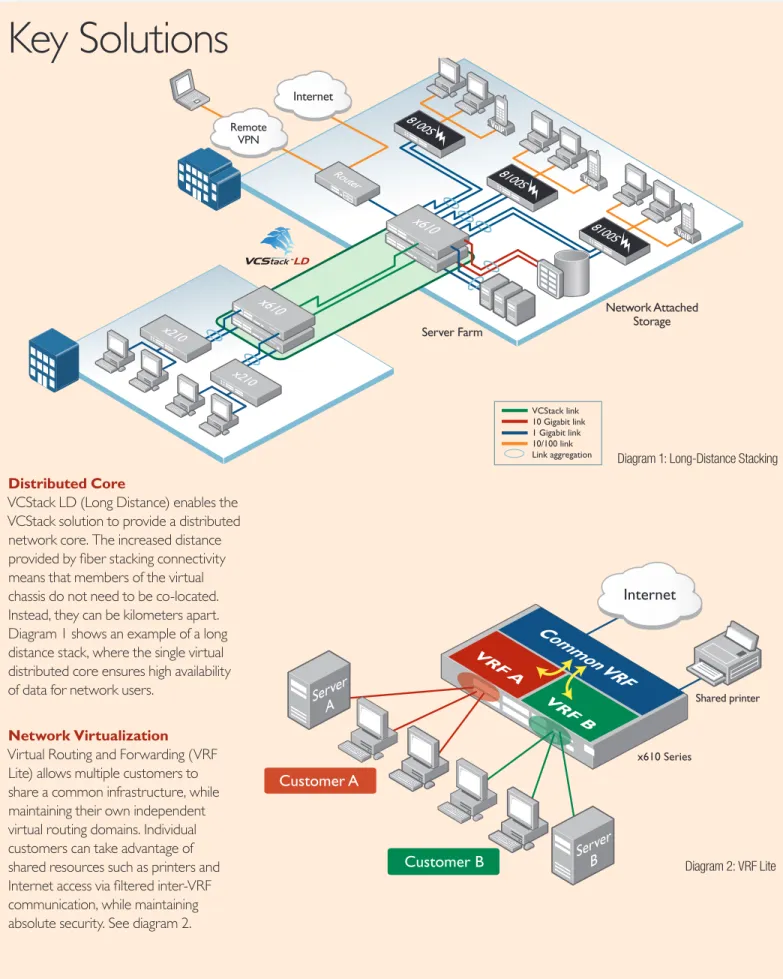
VCStack LD (Long Distance) enables the
VCStack solution to provide a distributed
network core. The increased distance
provided by fiber stacking connectivity
means that members of the virtual
chassis do not need to be co-located.
Instead, they can be kilometers apart.
Diagram 1 shows an example of a long
distance stack, where the single virtual
distributed core ensures high availability
of data for network users.
Network Virtualization
Virtual Routing and Forwarding (VRF
Lite) allows multiple customers to
share a common infrastructure, while
maintaining their own independent
virtual routing domains. Individual
customers can take advantage of
shared resources such as printers and
Internet access via filtered inter-VRF
communication, while maintaining
absolute security. See diagram 2.
Diagram 1: Long-Distance Stacking
Diagram 2: VRF Lite Remote VPN Internet Server Farm
x600
x610
Router 8100S Network Attached Sorage 8100S 8100Sx600
x610
8100S 8100S VCStack link 10 Gigabit link 1 Gigabit link 10/100 link Link aggregation Remote VPN Internet Server Farmx600
x610
Router 8100S Network Attached Storage 8100S 8100Sx600
x610
x210 x210 VCStack link 10 Gigabit link 1 Gigabit link 10/100 link Link AggregationPerformance
»48Gbps of stacking bandwidth »Supports 9KB jumbo frames »Wirespeed multicasting »Up to 32K MAC addresses »8K Layer 3 entries »512MB DDR SDRAM »64MB flash memory
»Packet buffer memory: AT-x610-24Ts - 2MB AT-x610-48Ts - 4MB
Reliability
»Modular AlliedWare Plus operating system »Redundant power supply available to load share with
internal power supply, providing uninterrupted power and extra reliability
»Full environmental monitoring of PSUs, fans, temperature and internal voltages. SNMP traps alert network managers in case of any failure
Expandability
»One expansion bay
»Stackable up to eight units in a VCStack »IPv6 routing license option
»Advanced Layer 3 license option
Flexibility and Compatibility
»Mix up to four x600 and x610 units in the same VCStack
»Gigabit SFP combo ports support any combination of 1000T, 1000X SFPs, 1000SX, 1000LX, 1000ZX or 1000ZX CWDM SFPs
»SFP ports on AT-x610-24SPs/X support any combination of 10/100/1000T, 100FX, 100BX, 1000SX, 1000LX, 1000ZX or 1000ZX CWDM SFPs
Diagnostic Tools
»Built-In Self Test (BIST)
»Optical Digital Diagnostic Monitoring (DDM) »Ping polling for IPv4 and IPv6
»Port mirroring
»TraceRoute for IPv4 and IPv6
General Routing
»Black hole routing
»Directed broadcast forwarding »DNS relay
»Equal Cost Multi Path (ECMP) routing
»Policy-based routing
»Route maps and route redistribution (OSPF, BGP, RIP)
»UDP broadcast helper (IP helper)
»Up to 64 Virtual Routing and Forwarding (VRF Lite) domains (with license)
IPv6 Features
»6to4 tunneling »DHCPv6 relay »DNSv6
»IPv4 and IPv6 dual stack
»Device management over IPv6 networks with SNMPv6, Telnetv6 and SSHv6
»NTPv6
Management
»Allied Telesis Management Framework (AMF) enables powerful centralized management and zero-touch device installation.
»Console management port on the front panel for ease of access
»Eco-friendly mode allows ports and LEDs to be disabled to save power
»Web-based Graphical User Interface (GUI) »Industry-standard CLI with context-sensitive help »SD/SDHC memory card socket allows software
release files, configurations and other files to be stored for backup and distribution to other devices »Powerful CLI scripting engine
»Configurable logs and triggers provide an audit trail of SD card insertion and removal
»Secure Copy (SCP)
»Comprehensive SNMP MIB support for standards-based device management
»Built-in text editor
»Event-based triggers allow user-defined scripts to be executed upon selected system events
Quality of Service (QoS)
»Limit bandwidth per port or per traffic class down to 64kbps
»Wirespeed traffic classification with low latency essential for VoIP and real-time streaming media applications
»Policy-based QoS based on VLAN, Port, MAC and general packet classifiers
»Policy-based storm protection »Extensive remarking capabilities »Taildrop for queue congestion control
»Strict priority, weighted round robin or mixed scheduling
Resiliency Features
»Stacking ports can be configured as 10G Ethernet ports
»Control Plane Prioritization (CPP) ensures the CPU always has sufficient bandwidth to process network control traffic
»Dynamic link failover (host attach)
»Ring (Ethernet Protection Switched Rings) with SuperLoop Protection (SLP)
»Long-Distance stacking (LD-VCStack)
»Loop protection: loop detection and thrash limiting »PVST+ compatibility mode
»STP root guard
»VCStack fast failover minimizes network disruption
Security Features
»Access Control Lists (ACLs)
»Authentication, Authorization and Accounting (AAA) »Configurable auth-fail and guest VLANs
»BPDU protection
»DHCP snooping, IP source guard and Dynamic ARP Inspection (DAI)
»DoS attack blocking and virus throttling »Dynamic VLAN assignment
»MAC address filtering and MAC address lock-down »Network Access and Control (NAC) features manage
endpoint security
»Port-based learn limits (intrusion detection) »Private VLANs provide security and port isolation for
multiple customers using the same VLAN »Strong password security and encryption
»Tri-authentication: MAC-based, web-based and IEEE 802.1x
Environmental Specifications
»Operating temperature range: 0°C to 45°C (32°F to 113°F)
Derated by 1°C per 305 meters (1,000 ft) Operation up to 50°C (122°F) for limited period(s) †
PRODUCT 10/100/1000T (RJ-45) COPPeR PORTs sFP PORTs100/1000X sFP anD 10/100/1000 COmbO PORTs TOTal gigabiT PORTs 10 gigabiT sFP+ PORTs maX POe+ PORTs swiTChingFabRiC FORwaRDing RaTe
aT-x610-24Ts 20 - 4 24 - 2* - 96Gbps 71.4Mpps aT-x610-24Ts-POe+ 20 - 4 24 - 2* 24 96Gbps 71.4Mpps aT-x610-24Ts/X 20 - 4 24 2 4* - 136Gbps 101.2Mpps aT-x610-24Ts/X-POe+ 20 - 4 24 2 4* 24 136Gbps 101.2Mpps aT-x610-24sPs/X - 20 4 24 2 4* - 136Gbps 101.2Mpps aT-x610-48Ts 44 - 4 48 - 2* - 144Gbps 107.1Mpps aT-x610-48Ts-POe+ 44 - 4 48 - 2* 48 144Gbps 107.1Mpps aT-x610-48Ts/X 46 - 2 48 2 4* - 184Gbps 136.9Mpps aT-x610-48Ts/X-POe+ 46 - 2 48 2 4* 48 184Gbps 136.9Mpps
* with AT-x6EM/XS2 module in standalone switch
Specifications
† Not more than the following in a one year period:
PRODUCT wiDTh DePTh heighT mOUnTing weighT
Unpackaged packaged
aT-x610-24Ts 440 mm (17.32 in) 420 mm (16.54 in) 44 mm (1.73 in) Rack-mount 6.3 kg (13.89 lb) 8.8 kg (19.4 lb) aT-x610-24Ts-POe+ 440 mm (17.32 in) 420 mm (16.54 in) 44 mm (1.73 in) Rack-mount 5.6 kg (12.35 lb) 7.6 kg (16.76 lb) aT-x610-24Ts/X 440 mm (17.32 in) 420 mm (16.54 in) 44 mm (1.73 in) Rack-mount 6.3 kg (13.89 lb) 9.7 kg (21.38 lb) aT-x610-24Ts/X-POe+ 440 mm (17.32 in) 420 mm (16.54 in) 44 mm (1.73 in) Rack-mount 5.6 kg (12.35 lb) 7.6 kg (16.76 lb) aT-x610-24sPs/X 440 mm (17.32 in) 420 mm (16.54 in) 44 mm (1.73 in) Rack-mount 6.6 kg (14.55 lb) 9.2 kg (20.3 lb) aT-x610-48Ts 440 mm (17.32 in) 420 mm (16.54 in) 44 mm (1.73 in) Rack-mount 6.7 kg (14.77 lb) 9.0 kg (19.84 lb) aT-x610-48Ts-POe+ 440 mm (17.32 in) 420 mm (16.54 in) 44 mm (1.73 in) Rack-mount 6.0 kg (13.23 lb) 7.8 kg (17.2 lb) aT-x610-48Ts/X 440 mm (17.32 in) 420 mm (16.54 in) 44 mm (1.73 in) Rack-mount 6.8 kg (14.99 lb) 9.8 kg (21.61 lb) aT-x610-48Ts/X-POe+ 440 mm (17.32 in) 420 mm (16.54 in) 44 mm (1.73 in) Rack-mount 6.0 kg (13.23 lb) 8.5 kg (18.74 lb) aT-RPs3000 440 mm (17.32 in) 360 mm (14.17 in) 44 mm (1.73 in) Rack-mount 4.3 kg (9.48 lb) 6.1 kg (13.45 lb) aT-PwR250 aC 150 mm (5.9 in) 27.5 mm (10.83 in) 42 mm (1.65 in) Internal 1.5 kg (3.31 lb) 2.7 kg (5.95 lb) aT-PwR250 DC 150 mm (5.9 in) 27.5 mm (10.83 in) 42 mm (1.65 in) Internal 1.5 kg (3.31 lb) 2.7 kg (5.95 lb) aT-PwR800 150 mm (5.9 in) 27.5 mm (10.83 in) 42 mm (1.65 in) Internal 1.8 kg (3.97 lb) 2.9 kg (6.39 lb) aT-PwR1200 150 mm (5.9 in) 330 mm (13 in) 42 mm (1.65 in) Internal 2.2 kg (4.85 lb) 4.5 kg (9.92 lb) aT-x6em/Xs2 150 mm (5.9 in) 95 mm (3.74 in) 30 mm (1.18 in) Internal 0.2 kg (0.44 lb) 0.5 kg (1.1 lb) aT-stackXg 150 mm (5.9 in) 95 mm (3.74 in) 30 mm (1.18 in) Internal 0.2 kg (0.44 lb) 0.5 kg (1.1 lb)
Physical Specifications
PRODUCT max powerinTeRnal PsU OR aT-PwR250 (nO Poe lOaD) aT-PwR800 (FUll Poe+ lOaD) aT-PwR1200 (FUll Poe+ lOaD)
consUmption dissipationmax heat noise consUmptionmax power dissipationmax heat noise consUmptionmax power dissipationmax heat noise
aT-x610-24Ts 81W 299 BTU/hr 51.2 dBA - - -
-aT-x610-24Ts-POe+ 87W 299 BTU/hr 51.2 dBA 632W 708 BTU/hr 51.8 dBA 930W 913 BTU/hr
aT-x610-24Ts/X 89W 320 BTU/hr 51.2 dBA - - -
-aT-x610-24Ts/X-POe+ 92W 320 BTU/hr 51.2 dBA 636W 729 BTU/hr 51.8 dBA 935W 934 BTU/hr
aT-x610-24sPs/X 96W 375 BTU/hr 51.2 dBA - - -
-aT-x610-48Ts 112W 405 BTU/hr 51.2 dBA - - -
-aT-x610-48Ts-POe+ 119W 405 BTU/hr 51.2 dBA 673W 815 BTU/hr 51.8 dBA 1,027W 1071 BTU/hr
aT-x610-48Ts/X 120W 427 BTU/hr 51.2 dBA - - -
-aT-x610-48Ts/X-POe+ 125W 427 BTU/hr 51.2 dBA 681W 836 BTU/hr 51.8 dBA 1,034W 1092 BTU/hr
Power and Noise Characteristics
POweR sUPPlY
UniT Poe POweR available
maXimUm Poe PORTs sUPPORTeD
class 1
(4.0 w) class 2(7.0 w) class 3(15.4 w) class 4(30 w)
aT-PwR250 - - - -
-aT-PwR800 480W 48 48 31 16
aT-PwR1200 780W 48 48 48 26
PSU PoE Options
Noise tested to ISO7779; front bystander position »Storage temperature range:
-25°C to 70°C (-13°F to 158°F) »Operating relative humidity range:
5% to 90% non-condensing »Storage relative humidity range:
5% to 95% non-condensing »Operating altitude:
3,048 meters maximum (10,000 ft) »Front-to-back forced air cooling
Electrical Approvals and Compliances
»EMC: EN55022 class A, FCC class A, VCCI class A »Immunity: EN55024, EN61000-3-levels 2
(Harmonics), and 3 (Flicker) – AC models only
Safety
»Standards: UL60950-1, CAN/CSA-C22.2 No. 60950-1-03, EN60950-1, EN60825-1, AS/NZS 60950.1
»Certification: UL, cUL, TUV
Restrictions on Hazardous Substances (RoHS) Compliance
»EU RoHS compliant »China RoHS compliant
Country of Origin
»Singapore
PRODUCT PORT sPeeD
10mbps 100mbps 1gbps 10gbps aT-x610-24Ts 80.0µs 10.6µs 4.2µs aT-x610-24Ts/X 80.0µs 10.6µs 4.2µs 3.4µs aT-x610-24sPs/X 80.0µs 10.6µs 4.2µs 3.1µs aT-x610-48Ts 79.3µs 10.6µs 4.2µs aT-x610-48Ts/X 79.3µs 10.7µs 4.2µs 4.9µs Latency (microseconds)
Standards and Protocols AlliedWare Plus Operating System Version 5.4.3
Authentication
RFC 1321 MD5 Message-Digest algorithm RFC 1828 IP authentication using keyed MD5 Border Gateway Protocol (BGP) BGP dynamic capability
BGP outbound route filtering
RFC 1772 Application of the Border Gateway Protocol (BGP) in the Internet
RFC 1997 BGP communities attribute
RFC 2385 Protection of BGP sessions via the TCP MD5 signature option
RFC 2439 BGP route flap damping RFC 2858 Multiprotocol extensions for BGP-4 RFC 2918 Route refresh capability for BGP-4 RFC 3392 Capabilities advertisement with BGP-4 RFC 4271 Border Gateway Protocol 4 (BGP-4) RFC 4360 BGP extended communities
RFC 4456 BGP route reflection - an alternative to full mesh iBGP
RFC 4724 BGP graceful restart
RFC 4893 BGP support for four-octet AS number space RFC 5065 Autonomous system confederations for BGP Encryption
FIPS 180-1 Secure Hash standard (SHA-1) FIPS 186 Digital signature standard (RSA) FIPS 46-3 Data Encryption Standard (DES and 3DES) Ethernet
IEEE 802.1AX Link aggregation (static and LACP) IEEE 802.2 Logical Link Control (LLC) IEEE 802.3 Ethernet
IEEE 802.3ab 1000BASE-T
IEEE 802.3ad Static and dynamic link aggregation IEEE 802.3ae 10 Gigabit Ethernet
IEEE 802.3af Power over Ethernet (PoE) IEEE 802.3at Power over Ethernet Plus (PoE+) IEEE 802.3az Energy Efficient Ethernet (EEE) IEEE 802.3u 100BASE-X
IEEE 802.3x Flow control - full duplex operation IEEE 802.3z 1000BASE-X
General Routing
RFC 768 User Datagram Protocol (UDP) RFC 791 Internet Protocol (IP)
RFC 792 Internet Control Message Protocol (ICMP) RFC 793 Transmission Control Protocol (TCP) RFC 826 Address Resolution Protocol (ARP) RFC 894 Standard for the transmission of IP datagrams
over Ethernet networks RFC 919 Broadcasting Internet datagrams RFC 922 Broadcasting Internet datagrams in the
presence of subnets RFC 932 Subnetwork addressing scheme RFC 950 Internet standard subnetting procedure RFC 951 Bootstrap Protocol (BootP) RFC 1027 Proxy ARP
RFC 1035 DNS client
RFC 1042 Standard for the transmission of IP datagrams over IEEE 802 networks
RFC 1071 Computing the Internet checksum RFC 1122 Internet host requirements RFC 1191 Path MTU discovery RFC 1256 ICMP router discovery messages RFC 1518 An architecture for IP address allocation with
CIDR
RFC 1519 Classless Inter-Domain Routing (CIDR) RFC 1542 Clarifications and extensions for BootP RFC 1591 Domain Name System (DNS) RFC 1812 Requirements for IPv4 routers RFC 1918 IP addressing
RFC 2581 TCP congestion control
IPv6 Features
RFC 1981 Path MTU discovery for IPv6 RFC 2460 IPv6 specification
RFC 2464 Transmission of IPv6 packets over Ethernet networks
RFC 3056 Connection of IPv6 domains via IPv4 clouds RFC 3484 Default address selection for IPv6 RFC 3596 DNS extensions to support IPv6 RFC 4007 IPv6 scoped address architecture RFC 4193 Unique local IPv6 unicast addresses RFC 4291 IPv6 addressing architecture
RFC 4443 Internet Control Message Protocol (ICMPv6) RFC 4861 Neighbor discovery for IPv6
RFC 4862 IPv6 Stateless Address Auto-Configuration (SLAAC)
RFC 5014 IPv6 socket API for source address selection RFC 5095 Deprecation of type 0 routing headers in IPv6 RFC 5175 IPv6 Router Advertisement (RA) flags option RFC 6105 IPv6 Router Advertisement (RA) guard Management
AT Enterprise MIB SNMPv1, v2c and v3
IEEE 802.1AB Link Layer Discovery Protocol (LLDP) RFC 1155 Structure and identification of management
information for TCP/IP-based Internets RFC 1157 Simple Network Management Protocol (SNMP) RFC 1212 Concise MIB definitions
RFC 1213 MIB for network management of TCP/IP-based Internets: MIB-II
RFC 1215 Convention for defining traps for use with the SNMP
RFC 1227 SNMP MUX protocol and MIB RFC 1239 Standard MIB
RFC 1724 RIPv2 MIB extension RFC 2011 SNMPv2 MIB for IP using SMIv2 RFC 2012 SNMPv2 MIB for TCP using SMIv2 RFC 2013 SNMPv2 MIB for UDP using SMIv2 RFC 2096 IP forwarding table MIB
RFC 2578 Structure of Management Information v2 (SMIv2)
RFC 2579 Textual conventions for SMIv2 RFC 2580 Conformance statements for SMIv2 RFC 2674 Definitions of managed objects for bridges with
traffic classes, multicast filtering and VLAN extensions
RFC 2741 Agent extensibility (AgentX) protocol RFC 2787 Definitions of managed objects for VRRP RFC 2819 RMON MIB (groups 1,2,3 and 9) RFC 2863 Interfaces group MIB RFC 3164 Syslog protocol
RFC 3176 sFlow: a method for monitoring traffic in switched and routed networks
RFC 3411 An architecture for describing SNMP management frameworks
RFC 3412 Message processing and dispatching for the SNMP
RFC 3413 SNMP applications
RFC 3414 User-based Security Model (USM) for SNMPv3 RFC 3415 View-based Access Control Model (VACM) for
SNMP
RFC 3416 Version 2 of the protocol operations for the SNMP
RFC 3417 Transport mappings for the SNMP RFC 3418 MIB for SNMP
RFC 3621 Power over Ethernet (PoE) MIB
RFC 3635 Definitions of managed objects for the Ethernet- like interface types
RFC 3636 IEEE 802.3 MAU MIB
RFC 4188 Definitions of managed objects for bridges RFC 4318 Definitions of managed objects for bridges with
RSTP
RFC 4560 Definitions of managed objects for remote ping, traceroute and lookup operations
RFC 6527 Definitions of managed objects for VRRPv3
Multicast Support
Bootstrap Router (BSR) mechanism for PIM-SM IGMP query solicitation
IGMP snooping
IGMP/MLD multicast forwarding (IGMP/MLD proxy) MLD snooping (v1 and v2)
PIM for IPv6
RFC 1112 Host extensions for IP multicasting RFC 2236 Internet Group Management Protocol v2
(IGMPv2)
RFC 2710 Multicast Listener Discovery (MLD) for IPv6 RFC 2715 Interoperability rules for multicast routing
protocols RFC 3376 IGMPv3
RFC 3810 Multicast Listener Discovery v2 (MLDv2) for IPv6
RFC 3973 PIM Dense Mode (DM) RFC 4541 IGMP and MLD snooping switches RFC 4601 Protocol Independent Multicast - Sparse Mode
(PIM-SM): protocol specification (revised) RFC 4604 Using IGMPv3 and MLDv2 for source-specific
multicast
RFC 4607 Source-specific multicast for IP Open Shortest Path First (OSPF) OSPF link-local signaling
OSPF MD5 authentication OSPF restart signaling Out-of-band LSDB resync RFC 1245 OSPF protocol analysis RFC 1246 Experience with the OSPF protocol RFC 1370 Applicability statement for OSPF RFC 1765 OSPF database overflow RFC 2328 OSPFv2
RFC 2370 OSPF opaque LSA option RFC 2740 OSPFv3 for IPv6
RFC 3101 OSPF Not-So-Stubby Area (NSSA) option RFC 3509 Alternative implementations of OSPF area
border routers RFC 3623 Graceful OSPF restart
RFC 3630 Traffic engineering extensions to OSPF RFC 4552 Authentication/confidentiality for OSPFv3 RFC 5329 Traffic engineering extensions to OSPFv3 Quality of Service (QoS)
IEEE 802.1p Priority tagging
RFC 2211 Specification of the controlled-load network element service
RFC 2474 DiffServ precedence for eight queues/port RFC 2475 DiffServ architecture
RFC 2597 DiffServ Assured Forwarding (AF) RFC 2697 A single-rate three-color marker RFC 2698 A two-rate three-color marker RFC 3246 DiffServ Expedited Forwarding (EF) Resiliency Features
IEEE 802.1D MAC bridges
IEEE 802.1s Multiple Spanning Tree Protocol (MSTP) IEEE 802.1w Rapid Spanning Tree Protocol (RSTP) RFC 5798 Virtual Router Redundancy Protocol version 3
(VRRPv3) for IPv4 and IPv6 Routing Information Protocol (RIP) RFC 1058 Routing Information Protocol (RIP) RFC 2080 RIPng for IPv6
RFC 2081 RIPng protocol applicability statement RFC 2082 RIP-2 MD5 authentication RFC 2453 RIPv2
Security Features SSH remote login SSLv2 and SSLv3
TACACS+ authentication and accounting
IEEE 802.1X authentication protocols (TLS, TTLS, PEAP and MD5)
IEEE 802.1X multi-supplicant authentication IEEE 802.1X port-based network access control
RFC 2246 TLS protocol v1.0 RFC 2865 RADIUS RFC 2866 RADIUS accounting
RFC 2868 RADIUS attributes for tunnel protocol support RFC 3546 Transport Layer Security (TLS) extensions RFC 3579 RADIUS support for Extensible Authentication
Protocol (EAP)
RFC 3580 IEEE 802.1x RADIUS usage guidelines RFC 3748 PPP Extensible Authentication Protocol (EAP) RFC 4251 Secure Shell (SSHv2) protocol architecture RFC 4252 Secure Shell (SSHv2) authentication protocol RFC 4253 Secure Shell (SSHv2) transport layer protocol RFC 4254 Secure Shell (SSHv2) connection protocol Services
RFC 854 Telnet protocol specification RFC 855 Telnet option specifications RFC 857 Telnet echo option
RFC 858 Telnet suppress go ahead option RFC 1091 Telnet terminal-type option RFC 1350 Trivial File Transfer Protocol (TFTP) RFC 1985 SMTP service extension RFC 2049 MIME
RFC 2131 DHCPv4 (server, relay and client) RFC 2132 DHCP options and BootP vendor extensions RFC 2554 SMTP service extension for authentication RFC 2616 Hypertext Transfer Protocol - HTTP/1.1 RFC 2821 Simple Mail Transfer Protocol (SMTP) RFC 2822 Internet message format
RFC 3046 DHCP relay agent information option (DHCP option 82)
RFC 3315 DHCPv6 (server, relay and client) RFC 3633 IPv6 prefix options for DHCPv6 RFC 3646 DNS configuration options for DHCPv6 RFC 3993 Subscriber-ID suboption for DHCP relay agent
option
RFC 4330 Simple Network Time Protocol (SNTP) version 4 RFC 5905 Network Time Protocol (NTP) version 4 VLAN Support
Generic VLAN Registration Protocol (GVRP) IEEE 802.1ad Provider bridges (VLAN stacking, Q-in-Q) IEEE 802.1Q Virtual LAN (VLAN) bridges
IEEE 802.1v VLAN classification by protocol and port IEEE 802.3ac VLAN tagging
Voice over IP (VoIP) LLDP-MED ANSI/TIA-1057 Voice VLAN
Feature Licenses
1 The standard switch software supports 64 OSPF routes. The advanced Layer 3 license supports 12K OSPF routes. 2 100 users and 24 NAS can be stored in local RADIUS database with base software.
Ordering Information
AT-x610-24Ts-60
24-port Gigabit switch with 20 x 10/100/1000T (RJ-45) copper ports and 4 additional combo ports (1000X SFP or 10/100/1000T), internal PSU
AT-x610-24Ts-POE+-00
24-port Gigabit switch with 20 x 10/100/1000T (RJ-45) Power over Ethernet (IEEE 802.3at) copper ports and 4 additional combo ports (1000X SFP or 10/100/1000T), removable PSU (PSU not included)
AT-x610-24Ts/X-60
24-port Gigabit switch with 20 x 10/100/1000T (RJ-45) copper ports, 4 additional combo ports (1000X SFP or 10/100/1000T) and 2 x SFP+ 10 Gigabit ports, internal PSU
AT-x610-24Ts/X-PoE+-00
24-port Gigabit switch with 20 x 10/100/1000T (RJ-45) Power over Ethernet (IEEE 802.3at) copper ports, 4 additional combo ports (1000X
SFP or 10/100/1000T) and 2 x SFP+ 10 Gigabit ports, removable PSU (PSU not included)
AT-x610-24SPs/X-60
24-port Gigabit switch with 20 x 100/1000X (SFP) ports, 4 additional combo ports (1000X SFP or 10/100/1000T) and 2 x SFP+ 10 Gigabit ports,
internal PSU
AT-x610-48Ts-60
48-port Gigabit switch with 44 x 10/100/1000T (RJ-45) copper ports and 4 additional combo ports (1000X SFP or 10/100/1000T), internal PSU
AT-x610-48Ts-POE+-00
48-port Gigabit switch with 44 x 10/100/1000T (RJ-45) Power over Ethernet (IEEE 802.3at) copper ports and 4 additional combo ports (1000X SFP or 10/100/1000T), removable PSU (PSU not included)
AT-x610-48Ts/X-60
48-port Gigabit switch with 46 x 10/100/1000T (RJ-45) copper ports, 2 additional combo ports (1000X SFP or 10/100/1000T) and 2 x SFP+ 10 Gigabit ports, internal PSU
x610 Series
name DesCRiPTiOn inClUDes
aT-Fl-x610-01 x610 advanced Layer 3 license »OSPF1
»PIM-SM, DM and SSM »BGP4
»VLAN double tagging (Q-in-Q) »VRF Lite
aT-Fl-x610-02 x610 IPv6 pack »RIPng
»OSPFv3 »BGP4+ for IPv6
»PIMv6-SM »MLDv1 and v2
aT-Fl-RaDiUs-FUll Increase local RADIUS server support limits2 »5000 users
»1000 NAS
AT-x610-48Ts/X-PoE+-00
48-port Gigabit switch with 46 x 10/100/1000T (RJ-45) Power over Ethernet (IEEE 802.3at) copper ports, 2 additional combo ports (1000X SFP or 10/100/1000T) and 2 x SFP+ 10 Gigabit ports, removable PSU (PSU not included)
alliedtelesis
.com
North America Headquarters| 19800 North Creek Parkway | Suite 100 | Bothell | WA 98011 | USA | T: +1 800 424 4284 | F: +1 425 481 3895
Asia-Pacific Headquarters| 11 Tai Seng Link | Singapore | 534182 | T: +65 6383 3832 | F: +65 6383 3830
EMEA & CSA Operations| Incheonweg 7 | 1437 EK Rozenburg | The Netherlands | T: +31 20 7950020 | F: +31 20 7950021
Where xx = 10 for US power cord 20 for no power cord 30 for UK power cord 40 for Australian power cord 50 for European power cord 10GbE SFP+ Modules AT-SP10SR 10GSR 850 nm short-haul, 300 m with MMF AT-SP10LR 10GLR 1310 nm medium-haul, 10 km with SMF AT-SP10ER40/I
10GER 1550 nm long-haul, 40 km with SMF 100Mbps SFP Modules AT-SPFX/2 100FX multi-mode 1310 nm fiber up to 2 km AT-SPFX/15 100FX single-mode 1310 nm fiber up to 15 km AT-SPFXBD-LC-13 100BX Bi-Di (1310 nm Tx, 1550 nm Rx) fiber up to 10 km AT-SPFXBD-LC-15 100BX Bi-Di (1550 nm Tx, 1310nm Rx) fiber up to 10 km
Power Supply Accessories AT-RPS3000-00
Chassis for up to two redundant power supplies (PSUs not included)
AT-PWR250-xx
Additional 250W AC system power supply
AT-PWR250-80
Additional 250W DC system power supply
AT-RPS-CBL1.0
1 meter RPS cable Cables
AT-StackXG/0.5-00
0.5 meter cable for stacking
AT-StackXG/1-00
1 meter cable for stacking
AT-SP10TW1
1 meter SFP+ direct attach cable
AT-SP10TW3
3 meter SFP+ direct attach cable
AT-SP10TW7
7 meter SFP+ direct attach cable
1000Mbps SFP Modules AT-SPTX
1000T 100 m copper
AT-SPSX
1000SX GbE multi-mode 850 nm fiber up to 550 m
AT-SPSX/I
1000SX GbE multi-mode 850 nm fiber up to 550 m industrial temperature
AT-SPEX
1000X GbE multi-mode 1310 nm fiber up to 2 km
AT-SPLX10
1000LX GbE single-mode 1310 nm fiber up to 10 km
AT-SPLX10/I
1000LX GbE single-mode 1310 nm fiber up to 10 km industrial temperature
AT-SPBD10-13
1000LX GbE Bi-Di (1310 nm Tx, 1490 nm Rx) fiber up to 10 km
AT-SPBD10-14
1000LX GbE Bi-Di (1490 nm Tx, 1310 nm Rx) fiber up to 10 km
AT-SPLX40
1000LX GbE single-mode 1310 nm fiber up to 40 km
AT-SPZX80
1000ZX GbE single-mode 1550 nm fiber up to 80 km
PoE Power Supplies AT-PWR800-xx
Additional 800W AC system and PoE+ power supply
AT-PWR1200-xx
Additional 1200W AC system and PoE+ power supply
Expansion Modules AT-x6EM/XS2-00
Expansion module (2 x SFP+) for long distance stacking or two additional 10GbE ports
AT-StackXG-00
Expansion module with one AT-StackXG/0.5-00 cable included