ACFI-T18-19
Dispersive Evaluation of the Inner Radiative Correction
in Neutron and Nuclear
β
-decay
Chien-Yeah Seng,1, 2,∗ Mikhail Gorchtein,3,† and Michael J. Ramsey-Musolf4, 5,‡ 1 INPAC, Shanghai Key Laboratory for Particle Physics and Cosmology, MOE Key Laboratory for Particle Physics, Astrophysics and Cosmology,
School of Physics and Astronomy, Shanghai Jiao-Tong University, Shanghai 200240, China 2
Helmholtz-Institut f¨ur Strahlen- und Kernphysik and Bethe Center for Theoretical Physics, Universit¨at Bonn, 53115 Bonn, Germany
3
Institut f¨ur Kernphysik, PRISMA Cluster of Excellence Johannes Gutenberg-Universit¨at, Mainz, Germany
4Amherst Center for Fundamental Interactions, Department of Physics, University of Massachusetts, Amherst, MA 01003
5
Kellogg Radiation Laboratory, California Institute of Technology, Pasadena, CA 91125 USA (Dated: June 19, 2019)
We propose a novel dispersive treatment of the so-called inner radiative correction to the neutron and nuclearβ-decay. We show that it requires knowledge of the parity-violating structure function F3(0) that arises from the interference of the axial vector charged current and the isoscalar part of the electromagnetic current. By isospin symmetry, we relate this structure function to the charged current inelastic scattering of neutrinos and antineutrinos. Applying this new data-driven analysis we obtain a new, more precise evaluation for the universal radiative correction ∆V, newR = 0.02467(22) that supersedes the previous estimate by Marciano and Sirlin, ∆VR = 0.02361(38). The substantial
shift in the central value of ∆VRreflects in a respective shift ofVudand a considerable tension in the
unitarity constraint on the first row of the CKM matrix which is used as one of the most stringent constraints on New Physics contributions in the charged current sector. We also point out that dispersion relations offer a unifying tool for treating hadronic and nuclear corrections within the same framework. We explore the potential of the dispersion relations for addressing the nuclear structure corrections absorbed in theFtvalues, a crucial ingredient alongside ∆VR in extractingVud
from superallowed nuclear decays. In particular, we estimate the quenching of the free neutron Born contribution in the nuclear environment, corresponding to a quasielastic single-nucleon knockout, and find a significantly stronger quenching effect as compared to currently used estimates based on the quenching of spin operators in nuclear transitions. This observation suggests that the currently used theoretical uncertainties ofFtvalues might be underestimated and require a renewed scrutiny, while emphasizing the importance of new, more precise measurements of the free neutron decay where nuclear corrections are absent.
PACS numbers:
I. INTRODUCTION
Precise studies of neutron and nuclear β-decays pro-vide stringent tests of the Standard Model (SM) of fun-damental interactions and probes of possible physics that may lie beyond it. In particular, a comparison of the nu-cleon (bound and free)β-decay to that of the muon yields a test of the universality of the weak interaction upon in-troducing the mixing amongst the quark weak eigenstates as reflected in the unitary Cabibbo-Kobayashi-Maskawa (CKM) matrix. Probes of CKM unitarity provide one of the most stringent tests of the SM, and any significant deviation from unitarity would unavoidably signal the presence of physics beyond the Standard Model (BSM) ( see Ref. [1] for the most recent review of BSM effects in β-decays). The sensitivity to BSM physics relies on
∗Electronic address: [email protected] †Electronic address: [email protected] ‡Electronic address: [email protected]
both a high degree of experimental precision and robust theoretical computations used to extract CKM matrix elements from experimental observables.
Here, we focus on the hadronic and nuclear theory relevant to tests of the first row CKM unitarity condi-tion : |Vud|2+|Vus|2+|Vub|2 = 1. The matrix element |Vud|= 0.97420±0.00021 [2] is the main contributor to the first row unitarity, and is relevant for charged pion, neutron, and nuclearβ-decay. Currently, the most pre-cise determination of the value of Vud is obtained with the superallowed 0+- 0+ nuclear β decays. Since both initial and final nuclei have no spin, only the vector cur-rent interaction with the nucleus contributes at leading order. The conservation of the vector current (CVC) pro-tects the vector coupling from being renormalized by the strong interaction and makes 0+- 0+ nuclear β decays an especially robust method for determining Vud. Pre-cision tests require, apart from the purely experimental accuracy, an accurate computation of SM electroweak ra-diative corrections (RC). The present day framework for computing these corrections was formulated in the classic
paper by Sirlin [3], and subsequent refinements by Mar-ciano and Sirlin (“MS”) have represented the state-of-the-art for this topic (see,e.g., Ref. [4]). In this context, the corrections are separated into the “outer” correction that bears dependence on the electron spectrum, and “in-ner” correction that is electron energy-independent. The outer corrections are generally nucleus-dependent, while the inner corrections contain both nucleus-dependent part and a universal, nucleus-independent contribution, ∆V
R. The latter also enters the rate for the decay of the free neutron.
The extraction of Vud from superallowed decays re-lies on several inputs: (i) measurement of the reduced half-life f t consisting of the half-life t of the given de-cay channel and the respective branching ratio, and the statistical rate function f which depends on the avail-able phase-space (orQ-value) of a decay; (ii) extraction of Ft – a “corrected f t value”, obtained by factoring out nucleus-dependent parts of the radiative corrections and nuclear structure-dependent parts of the transition matrix elements; (iii) combination of the results from a variety of decays to yield a global Ft value. From the latter one obtains [5]:
Superallowedβdecays : |Vud| 2 = 2984.43s Ft(1 + ∆V R) . (1) Here, Ft=f t(1 +δ0R)(1 +δN S−δC), (2) whereδ0Ris the outer correction that depends on the elec-tron energy and the chargeZof the final nucleus and ac-counts for the Coulomb distortion and other QED effects; andδN S, δC are nuclear structure-dependent corrections that are independent of the electron energy.
The analogous relationship for the free neutron is given by [6]:
Free neutron : |Vud|2=
5099.34s τn(1 + 3λ2)(1 + ∆R)
. (3) where τn is the neutron lifetime; λ = gA/gV gives the ratio of the axial and vector nucleon charged current cou-plings; and ∆R includes both the outer corrections and ∆V
R. At present, one obtains a more precise value of
Vudfrom superallowed decays via Eq. (1) than from neu-tron decay, despite the presence of the additional nuclear structure-dependent corrections that one must apply to obtainFt. With the advent of future, more precise mea-surements ofτnand neutron decay correlations that yield
λ, the precision of the Vud determinations from nuclear and neutron decays may become comparable [7–10].
In both cases, the dominant theoretical uncertainty for some time has been the hadronic contribution to theW γ
box diagram entering ∆V
R. The associated uncertainty has been obtained by MS in Ref. [4], corresponding to a 0.018% uncertainty in the value of Vud. For the nu-clear structure-dependent corrections, δN S and δC the analyses of Towner and Hardy (TH) have provided the
canonical inputs used in the determination of the aver-agedFt values [5]. Importantly, application of the TH computed corrections to the most precisely measured su-perallowed transitions yields a nucleus-independent re-sult ofFt = 3072.07(63)s [11], in impressive agreement with the CVC property of the SM charged current in-teraction. The associated nuclear structure uncertainty in Vud as obtained by TH is smaller than the hadronic uncertainty arising from ∆V
R.
In what follows, we present new analyses of both sources of theoretical uncertainty using a dispersion rela-tion framework that was recently presented in Ref. [12]. In that work, we applied this framework to the com-putation of ∆V
R, obtaining both a new value for this quantity and a significant reduction in the theoretical uncertainty. Below, we provide extensive details enter-ing that treatment which led to the value of |Vud| = 0.97370(10)Ft(10)RC quoted in that paper. In addi-tion, we revisit one contribution to the nuclear structure-dependent correction δN S that is associated with the Born contribution to the nuclear transition amplitude. We point out that earlier work has omitted a significant contribution from the quasielastic (QE) nuclear response, and provide a first quantification of this contribution within the context of the dispersion relation framework. Combining the new hadronic andδN S results, we obtain |Vud|= 0.97395(21)Ft(10)RC (4) that is to be compared with the present value quoted in the PDG:|Vud|= 0.97420(10)Ft(18)RC.
Our discussion of these analyses is organized as follows. In Section II we provide a brief overview of the current situation for the experimental and theoretical treatment of both superallowed and free neutron β-decays. Sec-tion III introduces the dispersion relaSec-tion formalism. In Sections IV-VI we present in detail the computation of the W γ box contribution to ∆V
R. Section III contains our analysis of the QE contribution to δN S. In Sec-tion VIII we show how future measurements of parity-violating asymmetries in polarized electron-nucleon scat-tering may afford additional tests of the hadronic contri-bution to ∆VR. We summarize our work in Section IX. A variety of technical, computational details are given in a series of appendices.
II. NEUTRONβ-DECAY OBSERVABLES AT TREE- AND ONE-LOOP LEVEL
The differential decay rate of an unpolarized neutron is given at tree level by:
dΓ dEe = G 2 FV 2 ud 2π3 (1 + 3λ 2)|~p e|Ee(Em−Ee)2 (5) where Em = (Mn2−Mp2+m2e)/2Mn is the maximum electron energy. The Fermi constantGF is that obtained from the muon decay. This definition allows to absorb
an entire class of radiative corrections that are common to the muon and the neutron decay processes. Above, we denote λ = gA/gV; the vector and axial couplings
gV, gA, corresponding to the Fermi and Gamow-Teller amplitudes in the neutron beta decay, respectively, are defined through the matrix element of the charged weak current in the non-recoil limit:
hp|uγ¯ µ(1−γ5)d|ni= ¯upγµ(gV −gAγ5)un (6) and gV = 1 in the exact isospin limit due to CVC. The object of primary interest, the CKM matrix elementVud measures the coupling of theW boson to the quark first generation in units of that to the leptons.
Higher-order corrections to the tree-level expression, which do not make part of the one-loop result for GF, modify the differential decay rate according to,
dΓ dEe = G 2 FV 2 ud 2π3 (1 + 3λ 2 )|~pe|Ee(Em−Ee)2F(β)× 1 + α 2πg¯(Em) 1 + ∆VR . (7)
Above, the Coulomb interaction leads to the appear-ance of the Fermi functionF(Z, β)≈1±Zαπ/β where +(−) should be taken for the electron (positron) in the final state, respectively. The Fermi function depends on the charged lepton velocityβ =|~pe|/Ee and the atomic number of the final nucleus Z. The function ¯g(Em) is the outer correction to the decay rate: it represents the extreme infrared part of the radiative correction and is exactly calculable [13] (we refer the reader to an exhaus-tive review of outer corrections in Ref. [14]). Meanwhile, the vector and axial coupling constants gV, gA are also modified by radiative corrections,
gV,A → gV 1 +1 2∆ V,A R , (8)
with ∆V,AR the inner corrections to the neutron beta cay; they are constant numbers that depend on the de-tails of hadronic structure but are independent of the electron spectrum, and are regular in the limitme, Ee→ 0. The already familiar term ∆VR introduced in Eq. (1) corrects the squared Fermi matrix element and makes part of the full radiative correction to the free neutron decay introduced in Eq. (3),
∆R= (α/2π)¯g(Em) + ∆VR. (9) The analogous correction to the pure Gamow-Teller rate ∆A
R is absorbed in the definition of λin Eq. (7) via
λ→λ 1 +1 2∆ A R− 1 2∆ V R . (10)
If λ is taken from an experimental measurement of the angular correlations, there is no need in evaluating ∆A R separately. If gA is computed instead, e.g. in lattice QCD, one has to include both inner corrections in a com-parison of the theoretical and experimental values. The
analyses of Refs. [4, 6] give for the radiative correction to the free neutron decay,
∆R = α 2π h ¯ g(Em) + 3 ln MZ Mp + lnMZ Λ +Ag +2CB+ 2CINT i + 0.0013. (11) The terms in the square bracket in Eq. (11) are the one-loop electroweak RC as presented in Ref. [4], whereas the +0.0013 originates from the resummation of leading-log corrections of the form αnlnn(MZ/Mp),
αnlnn(Mp/2Em) as well as the inclusion of some impor-tantO(α2) effects [6]. Among the one-loop radiative cor-rections, the first two terms in the square bracket origi-nate from loop corrections and bremsstrahlung involving the electromagnetic and weak vector interactions, while the last four terms are due to a combination of theγW
andW Z boxes in which the axial current interferes with the electromagnetic or neutral weak vector current. Out of these, the large logarithm and the perturbative QCD correction theretoAg originate from short distance con-tributions above some hadronic scale Λ∼1.5 GeV, and are independent of the details of the hadronic structure. The appearance of a scale Λ in the argument of the log-arithm signals some residual sensitivity to the hadronic structure. This sensitivity is absorbed into the last two terms: the termCB captures the long distance contribu-tions; finally, CINT contains an implicit dependence on the scale Λ and was introduced in Ref. [4] to interpo-late between short and long-distance regimes. It is these two latter terms that dominate the uncertainty of ∆V
R. We postpone the detailed discussion of each term to the next Section, and note here that the splitting of the loop integral into short, long and intermediate distance contri-butions is rather arbitrary, and so are the uncertainties assigned to each contribution. It is our motivation to independently reassess the model dependent part of ∆R and the uncertainty thereof in a data-driven dispersive approach.
III. DISPERSION REPRESENTATION OF THE “INNER”γW-BOX CORRECTION TO gV.
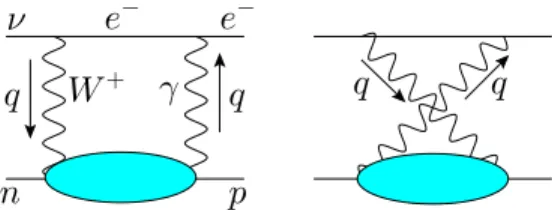
The γW-box correction is shown in Fig. 1, and is defined as TγW =− √ 2e2GFVud (12) × Z d4q (2π)4 ¯ ueγµ(/k−q/+me)γν(1−γ5)vνTµνγW q2[(k−q)2−m2 e][1−q2/MW2 ] ,
wherekis the outgoing momentum of the electron. The forward generalized Compton tensor for the β− decay process W+n → γp (W−p → γn for the β+ process relevant for nuclei) represented by the lower blob in Fig. 1 is given by
TγWµν = 1 2
Z
FIG. 1: TheγW-box diagram relevant for the neutron decay. The blob represents the generalized forward Compton tensor.
with the following definitions of the electromagnetic and charged weak current:
Jemµ = 2 3uγ¯ µu −1 3 ¯ dγµd JWµ = ¯uγµ(1−γ5)d. (14) Notice that the definition of TγWµν above follows that in the seminal paper by Sirlin [3]. The apparent extra factor of 1/2 is due to the difference in the normalization of the charged weak current: Sirlin definedJµ
w= ¯uLγµdL (in theVud = 1 limit) whereas our definition is two times larger, as the later is a more common definition in modern theory and experimental papers.
As the box diagram contains only one heavy bo-son propagator, it receives contribution from the loop momentum q at all scales, ranging from infrared (i.e.
q ∼ me) to ultraviolet. The infrared-singular piece in TγW, together with the electron and proton wave-function renormalization, as well as the real-photon bremsstrahlung diagrams, give rise to the Fermi function
F(β) and the outer-correction ¯g(Em) which are known analytically. In the meantime, most parts of the inner corrections from TγW to gV are either exactly known due to current algebra, or depend only on physics at high scale and are calculable perturbatively. The only piece that depends on the physics at the hadron scale involves the vector-axial vector correlator inTγWµν . Following a no-tation similar to that in Ref. [4], we define its correction to the tree-levelW exchange Fermi amplitude as
TW +TγWV A=− √ 2GFVud 1 +V AγW ¯ uep/(1−γ5)vν, (15) so that it is straightforwardly connected to the universal radiative correction ∆V R via V AγW = 1 2 ∆ V R V A γW. (16)
The explicit expression ofV AγW is given by:
V AγW = 4παRe Z d4q (2π)4 M2 W M2 W +Q2 Q2+ν2 Q4 T3(ν, Q2) M ν (17)
whereQ2=−q2,ν =p·q/MwithM the average nucleon mass, andT3(ν, Q2) the parity-odd spindependent in-variant amplitude of the forward Compton tensor TγWµν
14
W
γ
γ
W
q
q
q
q
p
p
p
p
Optical theorem:
Dis
(
,
)
4
(0)(
,
2)
3 2 ) 0 ( 3Q
F
Q
T
ν
=
π
ν
( )
(
,
)
2
)
(
)
2
(
4
1
(0) 2 3 0 , 4 4F
Q
m
q
p
i
n
J
X
X
J
p
p
q
p
N A W EM X Xν
ν
ε
δ
π
π
β α µναβ ν µ=
−
+
∑
ν
wrt
odd
is
since
n term
subtractio
constant
No
(0) 3T
Dispersive Approach: Formalism
FIG. 2: The contour in the complexνplane.
defined through: TγWµν = −gµν+q µqν q2 T1+ ˆ pµpˆν (p·q)T2+ iµναβpαqβ 2(p·q) T3, (18) with ˆpµ = pµ−qµ(p·q)/q2. Notice that since
V A
γW is insensitive to physics at the scale q ∼ me, we have set
me, k →0 as well as mn =mp =M to arrive Eq. (17). Furthermore, the fact that the electromagnetic current comes as a mixture of an isoscalar and isovector permits a decomposition of the forward amplitude in two isospin channels, T3=T (0) 3 +T (3) 3 . (19)
We apply Cauchy’s theorem to the definite isospin am-plitudesT3(I)(ν, Q2) (I= 0,3) accounting for their singu-larities in the complex ν plane. These lie on the real axis: poles due to a single nucleon intermediate state in the s−and u-channels atν =±νB = ±Q
2
2M, respec-tively, and unitarity cuts atν ≥νπ and ν ≤ −νπ where
νπ= (2M mπ+m2π+Q2)/(2M),mπbeing the pion mass. The contour is constructed such as to go around all these singularities, and is closed at infinity, see Fig. 2. The discontinuity of the forward amplitude in the physical region (i.e. ν > 0) is given by the generalization of the DIS structure functions to the γW-interference in the standard normalization,
DisT3(I)(ν, Q2) = T3(I)(ν+i, Q2)−T3(I)(ν−i, Q2) = 4πF3(I)(ν, Q2) (20) where
WγW(I)µν= 1 8π X X (2π)4δ4(p+q−pX)hp|Jem(I)µ|Xi hX|J ν W |ni= −gµν+q µqν q2 F1(I)+ pˆ µpˆν (p·q)F (I) 2 + iµναβpαqβ 2(p·q) F (I) 3 , (21)
(we define WγWµν with a coefficient of (8π)−1 instead of the more common (4π)−1 to keep in sync with our def-inition of TγWµν that contains a factor 1/2) and for the sake of a unified description, within Fi(I) we keep both the δ-functions at the nucleon poles, and the disconti-nuities along the multi-particle cuts. The full function
T3(I)(ν, Q2) is reconstructed from a fixed-Q2 dispersion relation T3(I)(ν, Q2) = 2 i ∞ Z 0 dν0 1 ν0−ν + ξI ν0+ν F3(I)(ν0, Q2), (22) modulo possible subtractions which are needed to make the dispersion integral convergent. The form of the dis-persion relation depends on the crossing behavior, the relative signξI between the contributions along the pos-itive and negative real ν axis. It can be shown that the isoscalar amplitude is an odd function of ν, hence
ξ0 = −1, while the isovector amplitude is even (see Appendix A). Correspondingly, the isoscalar requires no subtractions, while the isovector one may have to be sub-tracted one time.
Putting together Eqs. (17,22) and performing the loop integral via Wick rotation we arrive at
V AγW(0) = α πM ∞ Z 0 dQ2MW2 M2 W +Q2 ∞ Z 0 dν (ν+ 2q) ν(ν+q)2F (0) 3 (ν, Q 2), V AγW(3) = 0, (23)
where we introduced the virtual photon three-momentum
q = pν2+Q2. The vanishing of the isovector con-tribution is the consequence of the crossing symmetry, as has already been noticed by Sirlin [13]. Thus from now onward we shall representV A,γW(0) simply by V AγW without causing any confusion. Changing the variables
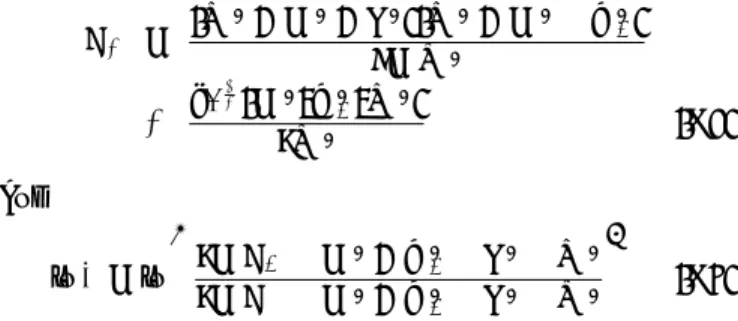
ν → Q2/(2M x) we notice that thex integral is, up to a factor, precisely the first Nachtmann moment of the structure functionF3(0), ∞ Z 0 dν (ν+ 2q) M ν(ν+q)2F (0) 3 (ν, Q 2) = 3 2Q2M (0) 3 (1, Q 2). (24)
The definition of the Nachtmann moments of F3 reads
[15, 16] M3(0)(N, Q2) =N+ 1 N+ 2 1 Z 0 dxξN x2 2x− N ξ N+ 1 F3(0), (25) where we introduced the Nachtmann variableξ= 2x/(1+
p
1 + 4M2x2/Q2). This gives our master formula
V AγW = 3α 2π Z ∞ 0 dQ2MW2 Q2[M2 W +Q2] M3(0)(1, Q2). (26) In the old result by MS this connection was not written explicitly, V AγW = α 8π Z ∞ 0 dQ2M2 W M2 W +Q2 F(Q2), (27) and we simply note the correspondence,
F(Q2) = 12
Q2M (0) 3 (1, Q
2). (28)
This is the first essentially new result of our work.
2
W
2Q
(
)
2 π m M+ 2 MBo
rn
Parton + pQCD
N
π
Res. +B.G Regge+VMD 2 GeV 2 ~ 2 GeV 5 ~FIG. 3: TheW2−Q2diagram showing approximate kinemat-ical regions which are dominated by various physkinemat-ical mecha-nisms, as indicated on the plot.
We let the data guide us to evaluate the integral in Eq. (23): for a fixed value ofQ2one has to integrate over the full spectrum in energy, and then sample all values of
Q2 from 0 to ∞. The strength is distributed differently among different energy regimes depending on Q2. For lowQ2 the spectrum is heavily weighted towards lower part (elastic peak and resonances). AsQ2 grows, these
contributions are however suppressed by the respective form factors. High-energy spectrum for slightly virtual and high-energy photons extends to asymptotically high energies and is well-represented by Regge exchanges. Al-ready at moderate Q2 ∼ 1.5−2.5 GeV2 this picture fades away and smoothly joins onto the partonic descrip-tion which dominates the DIS regime. The regions cor-responding to various physics pictures are displayed on a plane{W2, Q2} withW2=M2+ 2M ν−Q2 in Fig. 3. Accordingly, our parameterization ofF3(0) is as follows:
F3(0)=F3(0),Born+ F3(0),pQCD, Q2 &2 GeV2 F3(0), πN+F3(0),res+F3(0),R, Q2.2 GeV2, (29) where each component supplies the dominant con-tribution to F3(0) in various regions (elastic or Born; pQCD at highQ2;πN, resonance and Regge at lowQ2, respectively). In the following two Sections we report the procedure of relating data on inclusive charged current neutrino and neutral current electron scattering to the
γ − W interference needed to evaluate the γW-box correction, and collect available information on the entire{W2, Q2} plane.
Our approach can be compared with that of MS where the energy dependence is integrated over, and only re-gions inQ2are considered to identifyF(Q2) with a cer-tain contribution assumed to be dominant in that partic-ular region, F(Q2) = FBorn(Q2), Q2≤(0.823 GeV)2,
FINT(Q2), (0.823 GeV)2≤Q2≤(1.5 GeV)2,
FDIS(Q2), Q2≥(1.5 GeV)2.
The Born contribution FBorn depends on the isovector axial and isoscalar magnetic nucleon form factors, and is assumed to exhaust all contributions at lowQ2; upon inserting it in Eq. (27) it gives the term∼CBin Eq. (11). The DIS contributionFDIS dominates at highQ2 and contains the parton model expectation and perturbative QCD corrections thereto, FDIS(Q2) = 1 Q2 " 1− 3 X i=1 Ci α¯ s(Q2) π i# , (30)
with ¯αs the strong coupling constant evaluated in the MS scheme at the scale Q2. Further details to this contribution are discussed in the following two Sections. When inserted in the integral in Eq. (27) and integrated from Λ2 to ∞, this contribution gives rise to the terms ∼ ln(MZ/Λ) +Ag in Eq. (11). Note that the mass of theZ-boson appears in that formula upon combining the
γW- andZW-boxes together.
The phenomenological interpolating function FINT
connects the two regions. Ref. [4] proposed to take it
in a vector dominance model (VDM)-motivated form,
FINT(Q2) =− 1.490 Q2+m2 ρ + 6.855 Q2+m2 A − 4.414 Q2+m2 ρ0 ,(31)
with mρ = 0.776 GeV, mA = 1.230 GeV and mρ0 = 1.465 GeV, and numerical coefficients were obtained by imposing three constraints:
I ∞ Z Λ2 dQ2MW2 M2 W +Q2 FINT(Q2)−FDISQ2)= 0 II Q2FINT(Q2)− lim Q2→∞ Q 2FINT(Q2) =O 1 Q4 III FINT(0) = 0. (32)
Finally, the matching pointQ= 0.823 GeV is determined by requiring thatFBorn(Q2) = FINT(Q2) at that point. Upon integratingFINT over the respective range in Q2 in Eq. (27) it gives the term∼CINT in Eq. (11).
Among the three conditions in Eq. (32), the condition III requires that the following superconvergence relation is satisfied exactly,
Z ∞
νπ
(dν/ν2)F3(0)(ν, Q2= 0) = 0. (33)
To the validity of this conjecture, Ref. [4] asserts that this is required by chiral perturbation theory (ChPT), and a more detailed proof will be reported in an upcom-ing work. Unfortunately, this proof has never been pub-lished. In Appendix C we perform an explicit calculation in relativistic ChPT and demonstrate that the integral in Eq. (33) does not vanish.
IV. PHYSICS INPUT TOF3(0) ANDFW W 3
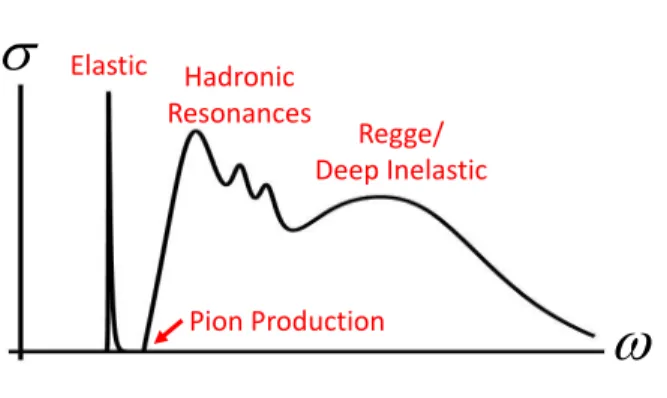
It is informative to take a look at the general struc-ture of the virtual photoabsorption spectrum displayed in Fig. 4. For a fixed value ofQ2 one clearly sees three major structures as one goes from low to high energyν: elastic peak atQ2/(2M) (broadened by radiative correc-tions); nucleon resonances and non-resonant pion pro-duction starting from the pion threshold [Q2 + (M +
mπ)2−M2]/(2M) and up to roughly 2.5 GeV above the threshold; high-energy continuum corresponding to multi-particle production that, depending on the value ofQ2, can be economically described byt-channel Regge exchanges (lowQ2) or quasi-free quark knock-out in the deep-inelastic regime (highQ2). Exactly the same struc-ture is expected in neutrino scattering associated with the absorption of a virtualW-boson.
While F3(0)(ν, Q2) itself is not observable, its weak isospin partnerF3W W(ν, Q2) is directly accessible in neu-trino and antineuneu-trino deep inelastic scattering. The two-fold differential cross section at fixedQ2 as function of
Elastic Pion Production Hadronic Resonances Regge/ Deep InelasticFIG. 4: Idealized structure of virtual photoabsorption on the nucleon.
x = Q2/(2M ν) and y = ν/E, with E the initial neu-trino energy andν the virtualW laboratory frame en-ergy, reads [17] d2σν(¯ν) dxdy = G2 FM E π(1 +Q2/M2 W) 2 (34) × xy2F1+ 1−y−M xy 2E F2±x y−y 2 2 F3 .
The P-odd structure functionsF3νp(¯νp)of our interest fol-low standard definitions:
1 4π X X (2π)4δ4(p+q−pX)hp|(JWµ) † |Xi hX|JWν |pi = i µναβp αqβ 2(p·q) F νp 3 +... 1 4π X X (2π)4δ4(p+q−pX)hp|JWµ |Xi hX|(J ν W) † |pi = i µναβp αqβ 2(p·q) F ¯ νp 3 +... (35)
and their average, F3νp+¯νp = 12[F3νp+F3¯νp] can be ob-tained from the difference of the neutrino and antineu-trino cross sections.
We follow the general structure of the parametriza-tion of F3(0) specified in Eq. (29), and describe F3νp+¯νp
at Q2 ≤ 2 GeV2 as a sum of elastic (Born) contribu-tion, non-resonant πN continuum, several low-lying ∆ andN∗-resonances, and the high-energy Regge contribu-tion, F3νp,low+¯νp−Q2 =F νp+¯νp 3,Born+F νp+¯νp 3, πN +F νp+¯νp 3,res +F νp+¯νp 3,R . (36) Details to the elastic, πN and resonance contributions are given in the Appendix. Since the Regge contribu-tion plays a central role in our model, we give its ex-plicit form here. We assume that it completely dom-inates at high energies, for W ≥ 2.5 GeV. At lower energies, we assume that above the two-pion produc-tion thresholdW2
th= (M + 2mπ)2 the Regge amplitude with an appropriate smooth threshold factor fth(W) = Θ(W2−W2 th) 1−expnWth2−W 2 Λ2 th o represents on aver-age the contribution of multi-pion and higher energy channels, F3νp,+¯νp R (ν, Q 2) = C(Q2)fth(W) 1 +Q2/m2 ρ 1 +Q2/m2a1 ν ν0 α0 (37)
The Reggeizedω-exchange is well described by the Regge intercept α0 ≈ 0.477 [18], and we choose the parame-ters ν0 = Λth = 1 GeV. To continue the Regge ampli-tude to finiteQ2 we assume vector (axial) meson domi-nance which is reflected in the usual VDM form factors above. We found however, that the pure VDM does not describe the data, so we added a phenomenologicalQ2 -dependent functionC(Q2) which is obtained from a fit. That the pure VDM drops short of the virtual photoab-sorption data is well-known. This fact has motivated various generalizations of the VDM which also feature phenomenological ingredients that are needed to account for this missing strength. Given the quality of the data, a simple linear form of C(Q2) was enough to describe the combined BEBC and Gargamelle data n the range
Q2∈(0.15,2.0) GeV2[19],
C(Q2) =A(1 +BQ2), (38) withA= 5.2±1.5 andB = 1.08+0−0..4828. The two parame-ters are strongly anti-correlated.
Above Q2 = 2 GeV2 we use the pQCD result for the Mellin moment with N3LO corrections calculated in Ref. [20]. M3νp+¯νp(1, Q2) = 3 " 1− 3 X i=1 Ci α¯s π i # , (39)
with C1 = 1, C2= 4.583−0.333Nf and C3 = 41.440− 8.020NF+ 0.177NF2,Nf = 3 standing for the number of effective quark flavors, and ¯αs(Q2) denotes the running strong coupling constant in the modified minimal sub-traction scheme with ΛQCD = 0.2 GeV. Note that for
Q2≥2 GeV2the difference between the Nachtmann and Mellin moments is negligible.
0.1 1 10 100 Q² (GeV²) 0 0.5 1 1.5 2 2.5 3 3.5 WA25 CCFR BEBC/GGM-PS Regge + Born + Δ pQCD M 3 𝝂 p+ 𝝂 p (1 ,Q 2 ) −
FIG. 5: Data on the first Nachtmann moment ofF3νp+¯νpfrom
CCFR [21, 22], BEBC/Gargamelle [19] and WA25 [23] vs. theory. Figure adopted from Ref. [12]
In Fig. 5 we display the world data on the Nachtmann moment ofF3νp+¯νpforQ2∈(0.01,600) GeV2. The solid red curve shows the pQCD result of Ref. [20] which can be seen to nicely agree with the CCFR data [21, 22] at
Q2≥2 GeV2. The solid blue curve at lowerQ2shows the result of our low-Q2model as described in Eq. (36), and the uncertainty is represented by the dashed blue curves around it. We do not use the three left-most data points in the fit because we expect M3νp+¯νp(1, Q2) to be satu-rated atQ2<0.1 GeV2 by the elastic and ∆-resonance contribution [19] which are determined using more pre-cise lower energy modern data. In our formalism, the theoretical uncertainty in the intermediate-Q2 region is determined by that of the νp/νp¯ -scattering data which can be systematically improved when future, more pre-cise data become available. This represents an advantage over the MS formalism where the physics at intermediate distances had to be assigned a 100% uncertainty.
We note here that while our use of a Regge-VDM parametrization of the contributions at lowQ2and high energy is model-dependent, no other model describes in-clusive electron scattering data in that kinematical range. Moreover, our parametrization of F3νp+¯νp can be tested explicitly by confronting it to high-energy electron spec-tra in inclusive CC neutrino scattering, rather than to the Nachtmann moment as we do here. Also the key in-gredient of our parametrization, the effective a1−ρ−ω vertex can be tested in exclusive neutrinoproduction ofω
mesons, and in exclusive a1-electroproduction. We will
address the exact formulation of these tests with the ex-isting and future data in an upcoming work.
V. RELATING NACHTMANN MOMENTS OF
F3νp+¯νp ANDF3(0) BY ISOSPIN SYMMETRY
After having modeled the pure CC structure function
F3νp+¯νpas a sum of elastic, resonances, non-resonantπN
and Regge, we proceed to obtain F3(0) via isospin rota-tion. This is done for each contribution separately. For the elastic contribution, since the intermediate is fixed at
I= 1/2 the correspondence between the two processes is simple: F3νp,Born+¯νp = −GA(Q2)GVM(Q 2)δ(1 −x), F3(0),Born = −1 4GA(Q 2 )GSM(Q 2 )δ(1−x), (40) with the axial form factor normalized as GA(0) = −1.2715, and magnetic isovector and isoscalar form fac-torsGV,SM (0) =µp±µn, with the proton (netron) mag-netic momentµp = 2.792847356 (µn=−1.9130427). So the difference is simply between the isoscalar and the isovector component of the electromagnetic matrix ele-ment and an extra constant factor.
For resonance contributions, a correspondence simi-lar to Eq. (40) may also be stated, but with a caveat. The purely isovector structure functionF3νp+¯νp receives contributions from both I = 1/2 and I = 3/2 reso-nances, with the contributions of the latter, most no-tably the ∆(1232), dominating over the contributions of the I = 1/2 resonances. Instead, only I = 1/2 reso-nances contribute toF3(0). The details of the calculation are given in Appendix D.
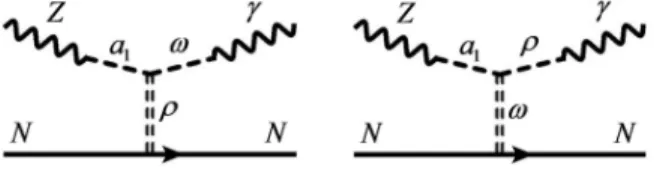
The Regge contribution is depicted in Fig. 6. It is seen that the central ingredient in this picture, the effec-tive vertex a1−ρ−ω is the same in both cases. Since the parameters of the ρ and ω Regge trajectories and VDM propagators are nearly exactly the same, the only change would regard the respective coupling constants. As we discuss in detail in Appendix E, this entails relat-ing theγ−ω andρN N couplings entering theγW inter-ference toW−ρandωN N couplings entering the purely charge current structure function. Taking into account the correct normalization of various pieces, the isospin symmetry implies a rescaling of the Regge contribution toF3 by a factor 1/36 at lowQ2, F3νp,+¯νp R = C(Q2)f th(W) 1 +Q2/m2 ρ 1 +Q2/m2a1 ν ν0 α0 , (41) ↓ F3(0),R = 1 36 CγW(Q2)fth(W) 1 +Q2/m2 ρ 1 +Q2/m2a1 ν ν0 α0 ,
and this rescaling straightforwardly translates in the re-spective change of the Nachtmann moment. Above,
FIG. 6: Regge-model description ofF3(0)andF νp+¯νp 3 .
we explicitly indicate that the phenomenological Q2 -dependent functionsCW W andCγW do not have to be the same. Since we introducedC(Q2) to correct for short-comings (or incompleteness) of the minimal vector dom-inance model, it is not guaranteed thatC and CγW are related anywhere except for the point Q2 = 0. To ad-dress the shape of CγW(Q2), we consider the relation between the Nachtmann moments of the two structure functions at the upper limit of the applicability of our Regge parametrization,Q2 = 2 GeV2 where we can use the information from the DIS regime.
In the parton model the relative normalization ofF3(0)
with respect to F3νp+¯νp turns out to be 1/36, as well. However, the running of the respective first moment has to be taken into account to extend the DIS description to
Q2= 2 GeV2. One of the central findings of Ref. [4] was that while the running of the first moment of F3νp+¯νp is fixed by the running of the GLS sum rule, that of the first moment of F3(0) is fixed by the running of the Bjorken sum rule. Both sum rules were studied in Ref. [20] in perturbative QCD at N3LO, and we use their results,
M3νp+¯νp(1, Q2) = 3 " 1− 3 X i=1 Ci α¯s π i # , ↓ M3(0)(1, Q2) = 1 12 " 1− 3 X i=1 ˜ Ci α¯s π i # . (42)
The first two coefficients in the GLS and Bjorken sum rules are the same ˜C1,2 = C1,2, and only at N3LO the difference appears: ˜C3= 41.440−7.607Nf+ 0.177NF2 as compared toC3= 41.440−8.020Nf+ 0.177NF2. Numer-ically, the change due to a 6% shift in the value of the
coefficient at ( ¯αs/π)3 is very small, and to a very good approximation the rescaling 1/36 is thus valid for the full DIS contribution.
Since at Q2 = 2 GeV2 our Regge contribution is matched onto the DIS one, the observed agreement of the 1/36 rescaling rule at low and highQ2 implies that
CγW(Q2) = C(Q2) and no additional phenomenologi-cal ingredients are necessary. We refer the reader to Appendix E for a more detailed demonstration of this equality.
We emphasize here that relating F3νp+¯νp and F3(0)
by means of isospin symmetry introduces no additional uncertainty, up to isospin breaking corrections . 2%. This is so because the axial vector charge current is a pure isovector, and the electromagnetic current is a pure isoscalar. This situation is quite different from the calcu-lation of the energy-dependentγZ-box correction to PV electron scattering. There, the isospin rotation was em-ployed to obtain the NCγZ interference structure func-tions from purely electromagnetic data [24]: the elec-tromagnetic probe is the sum of the isoscalar and the isovector channels, and the weak NC probe additionally contains the contribution of the strange flavor channel. As a result, the isospin decomposition of the inclusive electromagnetic data together with the flavor rotation to obtain the NCγZ interference structure functions is the main source of the uncertainty and has been subject to an active research recently [24–36].
VI. RESULTS FORV AγW,∆R AND∆VR We are now in the position to combine the results for theγW-box and ∆R. We follow the definition
V AγW =
α
2π[CDIS+CB+C
Regge+CπN+CRes],(43)
and give the new results for the C’s. The DIS part changes only slightly due to lowering the lowQ2 cut off from (1.5 GeV)2 to 2 GeV2,
CDISM S = 1.84 → CDISnew= 1.87 (44) The Born is increased because it is integrated up to infinity, rather than to the matching point Q2 = (0.823 GeV)2, but due to accounting for more recent data (see Appendix B) the uncertainty is reduced,
CBM S= 0.829(83) → CBnew= 0.91(5). (45) The biggest change affects the interpolating function introduced by MS. It is replaced by the sum ofπN, res-onance and Regge contributions. The central value in-creases considerably, yet the uncertainty is reduced,
CIN TM S = 0.14(14) → CRegge+CπN+CRes= 0.48(7).
Putting the numbers together, the result for theγW -box increases with a significantly smaller uncertainty,
V AγW M S = 2.81(16)α 2π = 3.26(19)×10 −3 V AγW new = 3.26(9) α 2π = 3.79(10)×10 −3 (47) Finally, when translating everything into ∆Rone should also take into account the uncertainty due to all neglected higher order effects; MS quotes a value of±0.0001 as its contribution to the ∆R uncertainty, and we have done no improvement beyond that so this number should be retained. Thereby, the shift of the radiative correction ∆R to the neutron decay rate reads [37]:
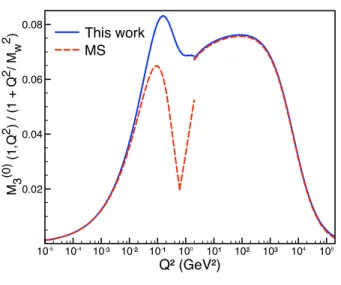
∆oldR = 0.03886(38) → ∆newR = 0.03992(22), (48) or, in terms of the nucleus-independent radiative correc-tion ∆VR [5, 12], ∆V,Rold= 0.02361(38) → ∆V,Rnew = 0.02467(22). (49) 10⁻⁵ 10⁻⁴ 10⁻³ 10⁻² 10⁻¹ 10⁰ 10¹ 10² 10³ 10⁴ 10⁵ Q² (GeV²) 0.02 0.04 0.06 0.08 This work MS M3 (0 ) (1 ,Q 2 ) / (1 + Q 2 / M w 2 )
FIG. 7: Our prediction of MW2
M2
W+Q2
M3(0)(1, Q 2
) vs the MS’s prediction. Notice that the peak aroundQ2 = 0.1 GeV2 is due to the Born contribution. Figure adopted from Ref. [12]
The comparison between our new result and the MS result is most easily visualized through a plot of
M2
W/(MW2 +Q2)
M3(0)(1, Q2) versus Q2 in log scale, as shown in Fig. 7. Since dQ2/Q2 = dlnQ2 in Eq. (26), the area under the curve provides a direct measure of V A
γW. While mutually agreeing at large Q
2, we find three main differences between our approach and MS: (1) MS assume no physics other than Born at low Q2, which is not consistent with theW2−Q2diagram in Fig. 3. In fact, our result shows that inelastic channels start contributing significantly already from Q2 ≈ 0.1 GeV2 onwards; (2) MS require their interpolating function to vanish whenQ2→0 (which turns out not to be true by explicit ChPT calculation), which causes the function to
drop too fast with decreasing Q2 and meet Fel(Q2) at relatively large matching point Q2 = (0.823GeV)2; (3) MS require the integral of their interpolating function, instead of the function itself, to match pQCD result in the asymptotic region. This causes a discontinuity of their F(Q2) at the UV-matching point. All in all, the MS treatment of the interpolating function results in an underestimation of ∆V
R.
Our study leads to a new, more precise extraction of
Vud from superallowed decays, as reported in Ref. [12], |Vudold|= 0.97420(18)RC(10)Ft
→ |Vudnew|= 0.97370(10)RC(10)Ft. (50) It is worth noting that the uncertainty inVud associated with ∆VR is now comparable to that due toFt. This new result reflects in the first row CKM unitarity constraint, |Vud|2+|Vus|2+|Vub|2= 0.9984±0.0004, (51) where 2018 PDG averages [2] |Vus| = 0.2243(5) and |Vub| = 0.00394(36) were used. The previous PDG con-straint on the first row unitarity was |Vud|2+|Vus|2 + |Vub|2 = 0.9994±0.0005, roughly consistent with uni-tarity. Our new result suggests that, if all other SM corrections are correct, first row unitarity is violated by (1.6±0.4)×10−3, at the level of 4σ; the deviation reaches 5σif the updated determination ofVusfrom theKl3 de-cay in Ref. [42] is adopted.
One may also extractVudfrom free neutron beta decay: |Vudold|free n= 0.9763(16) → |Vudnew|free n= 0.9758(16),
(52) where we have takenτn= 879.3(9)s andλ=−1.2723(23) as quoted in Section 79 of PDG 2018 [2]. Our new evalua-tion of ∆V
Rdoes not impact the total uncertainty because the latter is dominated by the experimental uncertainties due toλandτn. Note however that recently, the uncer-tainty ofλwas significantly reduced by the PERKEO– III experiment [38], delivering λ = −1.27641(56), with the statistical and systematical uncertainties added in quadrature. That reference provides an updated extrac-tion from the free neutron decay, |Vud| = 0.97351(60) which used an average of the three most recent lifetime measurements [39–41]τn= 879.7(8)s in place of the PDG average and the old evaluation of the RC. Applying our analysis of ∆R to these new measurements we obtain
|Vudnew|PERKEO−III
free n = 0.97302(57), (53) in good agreement with the extraction from superallowed nuclear decays, and with the uncertainty that is now only four times larger than in the latter. This uncertainty is currently dominated by that in the lifetime, and future lifetime measurements aim at further reducing it by a factor 3-4 (see Ref. [1] for a comprehensive review of ex-perimental activities), closing the gap between the two methods. Importantly, the free neutron decay is free from nuclear uncertainties.
As mentioned already in the Introduction, the value of
Vud extracted from the superallowed nuclear decays re-lies on the nuclear structure corrections δN S which are purely theoretical. There persists a discussion on the un-certainty and model dependence of those calculations, see e.g. the recent Ref. [43] and references therein. The shell model approach with the Wood-Saxon potential advo-cated by Hardy and Towner is at variance with Hartree-Fock evaluations which may signal a systematic effect that has not yet been fully understood. In view of this we plan reassessing the nuclear corrections from the disper-sion relation perspective in detail in the upcoming work. In the next Section we demonstrate the potential of the dispersion treatment on the example of the quasielastic contribution to theγW-box calculation on nuclei.
VII. NUCLEAR CONTRIBUTIONS TO THE
V AγW FOR NUCLEAR DECAYS
When extractingVud from superallowed Fermi transi-tions, one must consider modifications of the free nucleon matrix elements due the presence of the nuclear environ-ment. The standard approach to organizing the radiative corrections to nuclearβ decay followed in Refs. [4, 5, 44] is summarized in Eq. (1). The quantity appearing in the denominator is universal, nucleus-independent, and related to the measuredf t values as
Ft(1 + ∆VR) =f t(1 +δ0R)(1−δC+δN S)(1 + ∆VR) . (54) Here, δR0 is the nuclear charge-dependent outer correc-tion; δC corrects the matrix element of the Fermi oper-ator for the nucleus-dependent isospin symmetry break-ing effects; ∆VR stands for the universal part that stems from the γW-box on a free nucleon; and δN S accounts for nuclear structure corrections within theγW-box. The latter two corrections combined together should be un-derstood as theγW-box evaluated on a nucleus, with the inclusive nuclear and hadronic intermediate states taken into account.
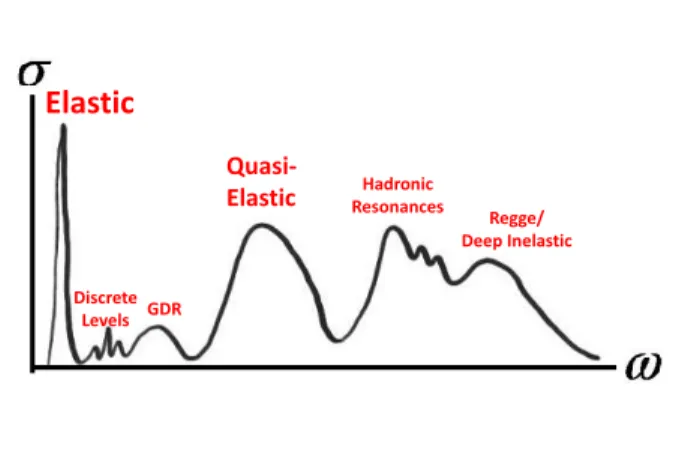
In the context of dispersion relations, it is useful to visualize these contributions in terms of the nuclear re-sponse to an external lepton in a manner analogous to what is shown in Fig. 4. To that end, we show in Fig. 8 an idealized structure of the nuclear electroabsorption spectrum. While the shape in the hadronic regime is similar to that for a free nucleon in Fig. 4, the lower part of the nuclear spectrum contains nuclear resonances and the quasielastic (QE) peak. The latter includes the one-nucleon knock-out as well as the knock-out of two or more nucleons in a single scattering process. The nuclear structure correctionδN Sthus accounts for the additional features of the electroabsportion spectrum on nuclei as compared to that on a free nucleon.
The γW-box on a nucleus should in principle be cal-culated in using the full nuclear Greens function. Do-ing so is challengDo-ing, however, since the latter should be
Elastic
Discrete Levels
Quasi-
Elastic Resonances Hadronic Regge/
Deep Inelastic
GDR
FIG. 8: Idealized structure of virtual photoabsorption on a nucleus.
known in the full kinematical range to describe all the ef-fects from lowest-lying nuclear excitations to shadowing at high energies. In practice, the nuclear modifications of the γW-box have been calculated using the nuclear shell model with a semi-empirical Woods-Saxon poten-tial (WSSH) [5] and nuclear density functional theory[45]. Attempts to address the calculation ofδC in nuclear ap-proaches other than WSSH suggest that the understand-ing of the nuclear structure corrections may not be at the level needed to warrant the current∼2×10⁻⁴ relative precision of theFtvalues [46, 47]. We refer the reader to a detailed discussion in Ref. [5] which contains the list of relevant calculations, and the critique to those from the standpoint of semiempirical Woods-Saxon potential shell model advocated by the authors of that reference.
In what follows, we focus on the modification of the free nucleon Born correction (α/2π)CB due to the presence of the QE response. We defer a treatment of the other features of the low-lying nuclear spectrum to future work. To proceed, we recall that the procedure for dividing the full γW-box on a nucleus into a universal and nucleus-dependent corresponds to rewriting identically,
VAγW,Nucl.= VA,free n γW + h VAγW,Nucl.− VA,free n γW i .(55) The first term is then absorbed in ∆V
R, while the second term makes part ofδN S:
α 2πC free n B ⊂ VA,free n γW ⊂∆ V R , 2hVAγW,Nucl.−γWVA,free ni≡δN S . (56) Note that no approximation has been made at this step. As a matter of self-consistency, one should compute the two terms enteringδN S in a common framework. In practice, different approaches have been utilized to date. The free nucleon term has been evaluated using phe-nomenological input from intermediate and high-energy
data as described in the previous sections. The second (nuclear) term is at present calculated in non-relativistic nuclear models. The procedure of subtracting the former from the latter may introduce additional model depen-dence, raising concerns about additional as of yet un-quantified theoretical uncertainty. We observe that such uncertainty would have to be primarily of a systematic, nucleus-independent nature so as not to spoil the present agreement with the CVC property of the charged current weak interaction. In this Section we argue that with the use of dispersion relations one may evaluate both the free nucleon term and the nuclearγW-box correction on an equal footing. In doing so, we will show that the previous treatment of the latter has, indeed, omitted an important, universal nuclear correction.
Working with the nucleons as the relevant degrees of freedom for describing the nuclear structure, the γW -box calculation has two generic contributions: one arising from the one-body current operator and a second involv-ing two-body currents. For a given nuclear model, the latter are required for consistency with the nuclear con-tinuity equation (current conservation). Considering now the one-body current contribution, we write the nuclear
γW Compton amplitude schematically as
TµνγWnuc∼ hf|JµWGnucJνEM|ii (57) where|iiand|fiare the intitial and final nuclear states;
JW
µ andJνEM are the weak charged current and electro-magnetic current, respectively; and
Gnuc= X n |nihn| En−E0 (58) is the nuclear Green’s function (we have omitted space-time arguments for simplicity). Considering first fully relativistic nucleons described by Dirac spinors N, the one-body weak current in momentum space is
JµW = X k ¯ Nk gA(Q2)τ3(k)γµ+· · · Nk ≡ X k JµW(k) (59)
where the “+· · ·” indicate contributions from the weak magnetism and induced pseudoscalar terms and where the sum is over all nucleonsk= 1, . . . , A. A correspond-ing expression involvcorrespond-ing the charge and magnetic form factors applies toJEM
ν .
In the treatment of Ref. [5], the one-body contribu-tion to the matrix element in Eq. (57) is decomposed into two terms: (A) a contribution singling out the same nucleon in JW
µ and JνEM; (B) a contribution involving distinct nucleons in these two operators. For purposes of the following discussion, it is useful to identify these two contributions using Eqs. (57 - 59):
TµνγWnuc ∼ X k,` hf|JµW(k)GnucJνEM(`)|ii (60) = TµνA +TµνB where TµνA = X k hf|JµW(k)GnucJνEM(k)|ii (61) TµνB = X k6=` hf|W µ (k)GnucJνEM(`)|ii (62)
Here, TµνA and TµνB correspond, respectively, to contri-butions (A) and (B) mentioned above. The authors of Ref. [5] refer to a part of contribution (A) as the nu-clear Born term, while contribution (B) is included as a separate part ofδN S.
As first articulated in the earlier work of Ref. [44], the nuclear Born term is evaluated by replacing the free nucleon isovector axial form factorgA(Q2) and isoscalar magnetic form factor GM(Q2) by “quenched” values. This procedure is motivated by the observation that use of the free nucleon form factors in the one-body cur-rents over-predicts the strength of nuclear Gamow-Teller transitions and nuclear magnetic moments[48, 49]. The corresponding isoscalar magnetic moment and isovector axial coupling quenching parameters, qS(0) and qA, re-spectively, then describe the reduction of the spin-flip interaction strengths in the nuclear environment, with
qS(0), qA≤1. In evaluating the nuclear Born contribution toVAγW, the authors of Ref. [5] then evaluate the contri-bution (A) as described above but with these quenching factors applied: TµνA →X k hf|gJµW(k)GnucJgνEM(k)|ii (63) →X k hf|gJµW(k) h SF⊗GA 00 nuc i g JEM ν (k)|ii
where Jfµ denotes a current operator containing the quenching factor and where, in the last step, the nuclear Green’s function has been replaced by the direct product of the free nucleon propagator,SF, and the Green’s func-tion for an intermediate “spectator nucleus”, A00. The loop integral used in obtainingCB for the free nucleon, which containsSF, is then evaluated without further ref-erence to the spectator nucleus but with the quenched form factors included. One then writes,
CBfree n → CBNucl.=CBfree n+ [qS(0)qA−1]CBfree n, (64) and includes the second term on the RHS of Eq. (64) in
δN S.
Note that this treatment relies on several assumptions: (i) the impact of the nuclear environment is dominated by the transitions to the low-lying states |ni; (ii) the nucleon form factors entering the γW box graph for a single nucleon should inherit the impact of this appar-ent modification of the one-body currappar-ents in low-lying nuclear transitions; (iii) the quenching observed for pure Gamow-Teller and for magnetic moments and pure mag-netic transitions translates directly into a mixed Gamow-Teller ⊗magnetic response via the product of the
cor-responding quenching factors q(0)S qA; and (iv) the Q2 -weighting inside the nucleon and nuclear box is the same. In effect, the foregoing assumptions amount to trans-lating the effective quenching of the one-body operator strengths relevant to transitions involving the low-lying nuclear states|niinto a virtual free nucleon computation applicable to theω= 0 and 0≤Q2≤(0.823 GeV)2part of the nucleon electroabsorption spectrum (see Fig. 3). To our knowledge, no explicit computation of the low-lying nuclear contributions to TµνA has been performed. With these assumptions and using CB = 0.89, Refs. [44, 50] obtain that the quenched Born contribution for nuclei of interest monotonically decreases from −0.189 for 10C to −0.306 for 74Rb. These results have propa-gated in all further evaluations of δN S. Refs. [44, 50] assigned a generic 10% uncertainty to this contribution. We now argue that the assumptions underlying the ap-proach of Ref. [44] are not well-justified. To that end, it is useful to refer to the generic electroabsoprtion spec-trum shown in Fig. 8. We then observe:
• The strength of the nuclear response in the QE regime is significantly larger than that due to low-lying nuclear excitations, and covers a broader range of excitation energy than the latter. Thus, one might expect that the QE region generally has a more significant impact on the dispersion integral, as well. To address the nuclear modification of the free nucleon contribution in a controlled manner, the QE knock-out contribution has to be explicitly included.
• The dynamics in which the same nucleon partici-pates in the transition to a state involving a quasi-free nucleon and spectator nucleus are those of the QE response, whose peak at ω ∼ Q2/2M can lie significantly above the low-lying nuclear excitation spectrum. In the γW-box this contribution cor-responds to (i) the virtual W+ knocking out one neutron from the initial nucleus, converting it to a proton and a spectator nucleus, corresponding to a subset of intermediate states |ni in the nu-clear Green’s function and (ii) reabsorbtion of the quasifree proton into the final nucleus by emitting a virtual photon.
• The significant store of data for QE electron-nucleus scattering implies that, to a first approxi-mation, one may obtain an adequate description of the QE response using the free-nucleon form factors without any quenching factors applied. Inclusion of subdominant effects arising from nuclear correla-tions and two-body currents may yieldO(10−30%) corrections [51].
• Finally, the QE contribution to γW-box requires a quasi-free active nucleon between the γ and W
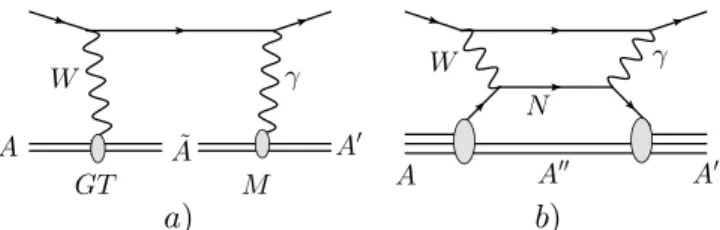
couplings rather than a bound nucleon inside an excited nuclear state; compare Fig. 9b) and a), re-spectively. The Q2-dependence under the integral
in the box with the low-lying excited nuclear state as in Fig. 9a), on the other hand, depends on nu-clear form factors which are known to drop much faster than the free nucleon form factors, so the as-sumption that the integral over form factors should simply rescale as the charges is not justified.
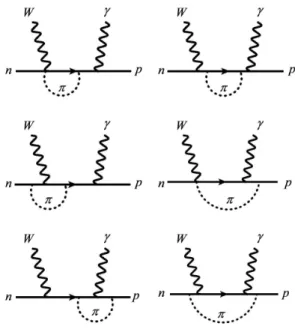
FIG. 9: Diagrammatic representation of the quenching mech-anism of the Born contribution in the approach of Refs. [44, 50] , diagram a) with the initial (final) nucleusA (A0), and an excited nuclear state ˜Aaccessed via a Gamow-Teller transition from the initial nucleus and via a magnetic transi-tion from the final nucleus. Panel b) shows the quasielastic picture with a single-nucleon knockout.
With these observations in mind, we propose an alter-native method of addressing the modification of the free nucleon Born contribution by explicitly accounting for the QE contribution shown in Fig. 9b). This approach entails (1) employing the dispersion relation framework to evaluate the contribution from the QE component of
TA
µν to δN S, and (2) replacing the Towner and Hardy computation of the same-nucleon contribution toδN Sby our computation of the QE contribution. We defer a treatment of the contributions from low-lying nuclear ex-citations to a future, state-of-the-art many-body compu-tation. We expect that such a computation will take into account the underlying many-body dynamics responsi-ble for the quenching of spin-flip transition strengths in low-lying nuclear transitions.
We now turn to the dispersion representation of the
γW-box correction in Eq. (23) with the nuclear structure functionF3(0), γW,Nucl., defined per active nucleon,
V A, N ucl.γW = α N πM ∞ Z 0 dQ2M2 W M2 W +Q2 ∞ Z 0 dν (ν+ 2q) ν(ν+q)2 ×F3(0), γW,Nucl.(ν, Q2), (65) withN the number of neutrons (protons) in theβ−(β+) decay process, respectively. and concentrate on the quasielastic part only. Instead of defining the quench-ing via a simple rescalquench-ing of the Born we will directly calculateCQE from a dispersion representation,
CQE = 2 ∞ Z 0 dQ2 νπ Z νmin dν(ν+ 2q) M ν(ν+q)2F (0), QE 3, γW (ν, Q 2), (66)
with the limits of the ν-integration being νmin, the threshold for the quasielastic breakup specified in Eq. (70) below and νπ = (Q2+ (M +mπ)2−M2)/2M the threshold for pion production. Then, we estimate the modification of the Born contribution discussed above, as
CBNucl.=C free n
B + [CQE−CBfree n]. (67) For purposes of this exploratory calculation, we de-scribe the quasielastic peak in the γW box contribution to a superallowed β+ decay process A→A0e+ν
e in the plane-wave impulse approximation (PWIA). In this pic-ture, a nucleus first splits into an on-shell spectator nu-cleus A00 and an active off-shell nucleon, and the latter interacts with the gauge bosons. The effective scatter-ing process proceeds as AW− → nA00 → A0γ, see Fig. 9b). The active nucleon carries an off-shell momentum
k before interacting with the gauge boson. To describe its distribution in the nucleus we adopt the Fermi gas model, which assumes a uniform distribution of nucleon momenta within the Fermi sphere with the Fermi
mo-mentumkF.
We compute the quasielastic contribution to the struc-ture function F3(0) per proton in a nucleus. Details of the calculation are reported in Appendix G, and here we simply show the final result,
1 ZF (0),QE 3, γW (ν, Q 2) =−G AGSM 3Q2 32qFP (˜k+)2−(˜k−)2 k3 F , (68) where the 1/Z is the normalization specific for β+ pro-cess and should be replaced by 1/N for β− decay. The quantity FP(|~q|, kF) is a function describing the Pauli blocking effect during the interaction between the active nucleon and the gauge bosons, while ˜k± = min(kF, k±)
where k± denote the upper and lower limits of the
ac-tive nucleon three-momentumk. These arise due to the on-shell condition for the intermediate nucleon and are given by k±= q 2 MA−1+ν−νmin MA 2 +ν−νmin ±MA+ν 2 p (ν−νmin)(2M MA−1/MA+ν−νmin) MA 2 +ν−νmin , (69)
where we introduced the threshold energy for the quasielastic breakup,
νmin=Q2/(2MA) +, (70) with=MA−1+M −MA the nucleon removal energy. This nucleon removal energy is another scale that is rel-evant for QE scattering. Because of a mismatch between the initial and final nucleus masses for each decay (usu-ally referred to as theQ-valueof the decay), every initial-final nucleus pair involves not one, but two removal en-ergies. Specifically, forβ+decay these are given by
1 = MA00+Mn−MA0,
2 = MA00+Mn−MA< 1, (71) with A00 = A−p= A0 −n the spectator nucleus. For
β− decay the proton and neutron masses should be
ex-changed in this definition. We only account for bulk properties of nuclear structure at this step, and define an average removal energy for each pair,
= √12 (72)
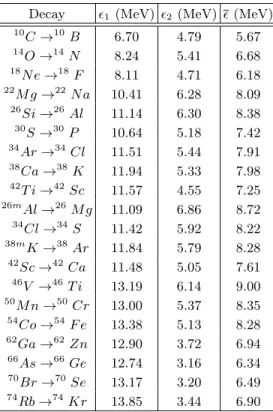
We consider 20 decay modes collected in the 2015 re-view by Hardy and Towner [5], use the knownQ-values of the decays and calculate relevant nucleon removal en-ergies and summarize the results in Table I. We no-tice that while individual breakup thresholds vary sig-nificantly from isotope to isotope, the average removal
energies all fall in a narrow range, = 7.5±1.5 MeV. The Fermi momentum also varies in a small range, from 228 MeV to 245 MeV, from lightest to heaviest nucleus. We use the model with the average vaues of Fermi mo-mentum and breakup threshold for calculating the bulk quasielastic contributionV A,γW QEuniversal for all nuclei, and do not attempt to address the nuclear-specific cor-rections at this time. The numerical evaluation of the QE contribution in Fermi gas model gives
CQE= 0.44±0.04±0.13. (73) The first uncertainty is obtained by varying the average removal energy and the Fermi momentum within their respective range. The second uncertainty is the uncer-tainty of the model which we assume to be∼ 30% for the free Fermi gas model. This way we obtain a new es-timate of the “quenching of the Born contribution” (note that Refs. [44, 50] adopted an older result CB = 0.89, whereas our evaluation suggests a slightly higher value
CB = 0.91(5))
CQE−CB =−0.47±0.14. (74) We observe that the nuclear environment reduces the size of the elastic box correction by about a half. This effect can be qualitatively understood by noticing the ∼1/ν2 weighting under the integral in Eq. (66). In the free nucleon case, theQ2-integration starts at zero, and
Decay 1(MeV) 2 (MeV) (MeV) 10 C→10 B 6.70 4.79 5.67 14 O→14 N 8.24 5.41 6.68 18 N e→18 F 8.11 4.71 6.18 22M g→22N a 10.41 6.28 8.09 26Si→26Al 11.14 6.30 8.38 30 S→30 P 10.64 5.18 7.42 34 Ar→34 Cl 11.51 5.44 7.91 38 Ca→38 K 11.94 5.33 7.98 42T i→42Sc 11.57 4.55 7.25 26mAl→26M g 11.09 6.86 8.72 34 Cl→34 S 11.42 5.92 8.22 38m K→38 Ar 11.84 5.79 8.28 42 Sc→42 Ca 11.48 5.05 7.61 46 V →46 T i 13.19 6.14 9.00 50M n→50Cr 13.00 5.37 8.35 54Co→54F e 13.38 5.13 8.28 62 Ga→62 Zn 12.90 3.72 6.94 66 As→66 Ge 12.74 3.16 6.34 70 Br→70 Se 13.17 3.20 6.49 74Rb→74Kr 13.85 3.44 6.90
TABLE I: Effective removal energy as calculated from the initial and final nucleus removal energies2,1 for all
superal-lowedβ decays listed in Ref. [5].
so does the ν integration since ν = Q2/(2M). In nu-clei, binding effects shift that threshold to a finite value
ν=Q2/(2MA)+. Pauli blocking provides an additional source of reduction. Indeed, Ref. [30] observed the anal-ogous effect of Pauli blocking upon theγZ-box contribu-tion to parity violacontribu-tion in heavy atoms. We checked that in the limit, kF →0 we recover the Born contribution on a free nucleon.
For a meaningful comparison with Refs. [44, 50], we extract the average of their estimates for 20 decays, [q(0)S qA −1]CB = −0.25(6) and notice a significantly larger magnitude of the nuclear modification in our ap-proach. This means that retaining all other nuclear cor-rections in Ref. [5], the universal Ft value should be corrected by α π(CQE−q (0) S qACB) =−(5.1±3.2)×10 −4, (75) leading to a new estimate
Ft= 3072.07(63)s→[Ft]new = 3070.50(63)(98)s,(76) with the second uncertainty stemming from that of the QE contribution.
This shift in the Ft value partially cancels the large shift in the value of Vud that followed from the new
dis-persion evaluation of ∆VR in the previous Section, |Vudnew|= 0.97370(14)→ |Vudnew,QE|= 0.97395(14)(16).
(77) The corresponding change in the test of first-row CKM unitarity reads
|Vud|2+|Vus|2+|Vub|2= 0.9984±0.0004 (78) → |Vud|2+|Vus|2+|Vub|2= 0.9989±0.0005. The result in Eq. (78) is 2.2 standard deviation away from exact unitarity and within one standard deviation from the current PDG value, |Vud|2+|Vus|2+|Vub|2 = 0.9994±0.0005.
We can relate this new result for theFtvalue with the observation made in Ref. [37] for the free neutron decay. While the lifetime and the axial charge individually are not very precisely known at present, a combination of themτn(1 + 3λ2) forms a constant which is independent of the uncertainty in ∆R,∆VR:
τn(1 + 3λ2)≈1.70865 1 + ∆VR 1 + ∆R
Ft= constant. (79) The constant depends on nuclear-structure effects via the Ft value: while Ref. [37] obtains constant = 5172.0(1.1)sbased on the analysis of Ref. [5], our evalu-ation of the QE contribution shifts this value to a lower value 5169.7(2.0)s.
As mentioned above, we consider this new dispersion relation-based estimate of the quasielastic nuclear cor-rection as exploratory since it is based on a simple free Fermi gas model and is not yet directly validated by ex-perimental data. This motivated us to assign a generous 30% model uncertainty to the quasielastic result. A fu-ture evaluation that will use a more sophisticated model of quasielastic nuclear response will certainly decrease this uncertainty while also being able to address the de-pendence of this correction on the final nucleus charge
Z. We postpone this calculation to a future work. With these reservations, we believe that our new evaluation of the “quenched Born contribution” is much better justi-fied, as compared to the earlier approach of Ref. [44] used in computingδN S. The dispersion relation approach also provides the basis for a unification of the universal correc-tion ∆VR and the nuclear structure-dependent correction
δN S within the same framework. To further advance the evaluation of these corrections, the following steps will be necessary: i) more advanced calculations of the QE single-nucleon knock-out contribution using up-to-date nuclear theory and validated by experimental QE data; ii) advanced calculations of the QE two-nucleon knock-out that is the main contribution toδN S, which should also be confronted with the experimental data; iii) new computations of the contributions toδN S from low-lying nuclear states that directly incorporate the dynamics re-sponsible for the observed quenching of spin-flip transi-tions; iv) computations that include nuclear shadowing
![FIG. 5: Data on the first Nachtmann moment of F 3 νp+¯ νp from CCFR [21, 22], BEBC/Gargamelle [19] and WA25 [23] vs.](https://thumb-us.123doks.com/thumbv2/123dok_us/9547008.2439309/8.918.95.433.216.486/fig-data-nachtmann-moment-νp-ccfr-bebc-gargamelle.webp)