L
O G I S T I C S A N D
T
R A N S P O R T A T I O N
O
C C U P A T I O N S
San Francisco Bay & Central Valley Regions
D E C E M B E R 2 0 1 0
An Initiative of
www.coeccc.net www.atlas-training.org
C
ENTER OF
E
XCELLENCE
San Francisco Bay Area
John Carrese, Director
City College of San Francisco
50 Phelan Avenue
Cloud Hall, Rm 233
San Francisco, CA 94112
A
LAMEDA
T
RANSPORTATION
&
L
OGISTICS
A
CADEMIC
S
UPPORT
I
NITIATIVE
(ATLAS)
Lorraine Giordano, Ph.D.
Director, ATLAS Program
College of Alameda
544 Water Street
Oakland, CA 94607
The Logistics and Transportation Occupations environmental scan is a joint project of:
Mission: The Centers of Excellence, in partnership with business and industry, deliver regional workforce research customized for community college decision making and resource development.
Vision: We aspire to be the premier source of regional economic and workforce information and insight for community colleges.
This workforce solution was funded by a grant awarded by the U.S. Department of Labor’s Employment and Training Administration. The solution was created by the grantee and does not necessarily reflect the official position of the U.S. Department of Labor. The Department of Labor makes no guarantees, warranties, or assurances of any kind, express or implied, with respect to such information, including any information on linked sites and including, but not limited to, accuracy of the information or its completeness, timeliness, usefulness, adequacy, continued availability, or ownership. This solution is copyrighted by the institution that created it. Internal use, by an
organization and/or personal use by an individual for non-commercial purposes, is permissible. All other uses require the prior authorization of the copyright owner.
Contents
Acknowledgements
... 4
Executive Summary
... 5
Introduction
... 6
Industry Overview
... 6
Logistics and Transportation Sectors
... 6
Current Forces Influencing Logistics and Transportation
... 8
The Use of 3PLs and Outsourcing
... 8
Regional Examples
... 8
Primary Research with Regional Employers
... 8
Occupational Overview
... 11
Occupational Growth
... 12
Analysis of Occupational Data
... 12
Employer Needs and Challenges
... 13
Difficulty Hiring Qualified Applicants
... 13
Workforce Challenges and Employee Development Practices
... 13
Employer Interest in Community College Programs
... 14
Education and Experience Preferences
... 15
Skills and Knowledge Requirements for Logistics and Supply Chain Managers
... 16
College Response and Issues
... 16
College Issues and Challenges
... 18
Conclusion and Recommendations
... 19
References
... 20
Acknowledgements
The San Francisco Bay Center of Excellence would like to thank our research partners: Josh Williams and Jaime Barrah with BW Research Partnership and Michelle Marquez, Director of the Central California Region Center of Excellence, who provided exemplary primary and secondary research services for this study.
The Center would also like to acknowledge the ATLAS Industry Advisory Committee, ATLAS staff members Dr. Lorraine Giordano and Graciela Phelps, and Dr. Christopher Clott, California Maritime Academy for assisting with the employer survey and reviewing the report.
The Center thanks the individuals who took the time to complete the workforce survey, which provided critical information about the labor needs and requirements of employers. This information will be vital for community colleges that are developing and strengthening training and education programs.
And finally, this report would not have been possible without the data analysis and report formatting expertise of Laura Coleman from the Northern California Center of Excellence, hosted at the Los Rios Community College District.
Transportation and Logistics employers in the San Francisco Bay and Central Valley regions expect
to increase hiring in five key occupations by an average of 7% over the next twelve months.
— Centers of Excellence Employer Survey
Executive Summary
The San Francisco Bay Center of Excellence in collaboration with the Alameda Transportation and Logistics Academic Support Initiative (ATLAS) at the College of Alameda conducted primary research with logistics and transportation firms in seven counties in the San Francisco Bay and Central Valley regions. The logistics and transportation sector is one of the largest industry sectors in the region, employing over 114,000 individuals in a wide range of occupations. This report provides an industry overview and reviews trends driving the growth of the sector.
A workforce survey was conducted with employers to better understand their workforce needs and challenges. The research objectives of the study were to:
• Project future job growth and replacement workers needed over the next 12 months for key logistics and transportation occupations
• Identify employer needs and challenges for hiring and training employees
• Identify skills and knowledge areas needed for key occupations
• Identify industry interest in accessing community college education and training programs Over 200 employers responded to the survey, which yielded a rich set of data that is highlighted in this report. Seven occupations that are key to the success of firms in the sector and that are most relevant to ATLAS at College of Alameda were selected as the focus of the survey:
• Freight Handlers or Warehouse Workers
• Shipping, Receiving, and Traffic Clerks
• Truck Drivers
• Forklift Drivers
• Maintenance or Repair Technicians for Transportation Vehicles
• Transportation Security Officers and/or Security Specialists
• Air Cargo Package Handlers or Other Package Handlers
The research finds that Bay Area firms are projecting job growth over the next 12 months for all five of the occupations for which there was sufficient survey responses. When combined with the projected
“replacement rate” or need to replace workers for each of the occupations, the prospects for qualified job seekers in this sector appear promising. Two occupations in particular — Truck Drivers and Freight
Handlers or Warehouse Workers — will generate the highest number of new and replacement jobs over the next year.
In order to identify the community college training and education programs that are aligned with the seven occupations, all 22 of the community colleges in the study region were surveyed.
There appears to be an opportunity for ATLAS to expand programs and even create new programs for employers to meet the workforce needs documented in the survey results, including employers’ hiring needs, training needs for skill and knowledge areas and specific preferences for training methods.
Introduction
The recession that began in California in 2008 has dramatically impacted the labor market with unemployment at 12.4% in California. 1
The logistics and transportation sector is one of the largest cluster of industries in the San Francisco Bay and Central Valley regions, employing over 114,000 workers in the seven counties studied.
Though certainly not immune from its impacts, the logistics and transportation sector has fared relatively well in this economy, as the manufacturing and trade sectors have begun to recover sooner than most other sectors.
2
This Environmental Scan includes an overview of the Logistics and Transportation sector in the San Francisco Bay and Central Valley Region, primary and secondary employment projections for high-demand
occupations aligned with community college programs, an employer needs analysis, community college training program information, analysis of occupational supply and demand, and recommendations to the ATLAS program regarding areas for program development.
The growth of the logistics and transportation industry creates new jobs from entry-level workers to supervisory workers to high-level managers. There is an opportunity for the ATLAS program at the College of Alameda to create or adapt training and education programs to give workers the skills needed for entry-level positions and to advance in their careers.
Industry Overview
California’s goods movement industry has become one of the biggest economic engines in California. According to a recent study by the California Business, Transportation, and Housing Agency, logistics and transportation supports one out of seven jobs and contributes to more than $16 billion in tax revenues to state and local governments. 3
According to the Council of Supply Chain Management Professionals, the demand for logistics and transportation workers at all levels is excellent. The Collegiate Employment Research Institute reports that logistics is a field with more positions than graduates each year. The Wall Street Journal reports that senior logistics management talent is also in short supply.4
Logistics, in basic terms, is the efficient flow and storage of goods from their point of origin to the point of consumption.
Logistics and Transportation Sectors
According to the Council of Logistics Management, logistics is the process of planning, implementing, and controlling the flow and storage of materials, inventory, goods, services, and related information from the point of origin to the point of consumption for the purpose of conforming to customer requirements. Logistics and transportation represents an industry sector that is enormously varied and has significant potential for growth.
Logistics and transportation is not a single industry or defined set of procedures. It is a dynamic interaction of many industries focused on producing and distributing goods. Within the sector, there are five main segments: Railroads, Trucking, Water (ports), Air, and Warehousing. 5
1 U.S. Department of Labor, Bureau of Labor Statistics,
Trucking is the most dominant
2 The seven counties in the study are San Francisco, Alameda, Contra Costa, Santa Clara, San Mateo, San Joaquin, and Stanislaus. 3Goods Movement Action Plan 2005, co-authored by the California Business, Transportation and Housing Agency (Cal/BTH)and the
California Environmental Protection Agency (Cal/EPA), online a 4Careers in Logistics, Council of Supply Chain Management Professionals (CSCMP), available online a 5U.S. Freight: Economy in Motion 1998, U.S. Department of Transportation, Federal Highway Administration, online at:
industry within the logistics and transportation sector nationwide, with 79% of activity in the sector occurring in the trucking industry.
Trucking: Trucking is the nation’s dominant form of transportation in the logistics and transportation sector. The trucking industry has greatly increased market share over the last two decades by creating customized transportation services to meet specific commercial needs.
Warehousing: Warehousing is the storage of goods within the logistics and transportation supply chain. Warehouses are owned by shippers, carriers, receivers, intermediaries, and independent third parties, and serve as stop-off points as inventory makes the journey from raw materials to distributed goods. Warehousing represents 25% of the costs within the logistics and transportation sector.
Water (Ports): Ownership of the port system in the United States is complicated. There are publicly and privately owned ports. Within the public ports, there are publicly and privately owned terminals. The port system accounts for transportation of 16% of the nation’s goods. Some of the nation’s top international ports are located in California – Long Beach, Los Angeles, and Oakland. In addition, Northern California has smaller but important ports located in Sacramento and Stockton that are key to the movement of goods in the region.
Railroads: Railroads concentrate on hauling bulk commodities and large quantity shipments over long distances. Based on volume, railroads transport 12.7% of the nation’s goods. Regionally, the Port of Oakland has two intermodal rail facilities (Union Pacific and BNSF) located adjacent to the marine
terminal that provide reliable and efficient movement of cargo between the marine terminal and the BNSF rail terminal in Richmond. Intermodal rail reduces truck trips and congestion on local roads and freeways.
Air: Like ports, air cargo carriers must have access to terminals and links to deliver their cargo. Trucks are air cargo’s most common connection to the final destination. Typically, air cargo is valuable or time sensitive. The air cargo industry represents 2.4% of the logistics and transportation sector.
As the movement of goods and services worldwide has expanded in recent years, the number and types of jobs available in the logistics and transportation sector have fluctuated with the economy. During the period of 2005-2008, the logistics industry added over 4,000 jobs in the Bay and Central regions. However, between 2008-2010, the industry contracted and more than 10,000 jobs were lost. 6
Figure 1: Logistics Employment Growth, 2005-2015
As the economy begins to stabilize, industry projections indicate the logistics and transportation sector will grow by nearly 6,000 jobs by 2015, bringing industry employment back to 2005 levels.
6 Data source: Economic Modeling Specialists, Inc. (EMSI), 2010 Complete Employment. -10% -5% 0% 5% 10% 2005 2006 2007 2008 2009 2010 2011 2012 2013 2014 2015 Regional Growth Rate State Growth Rate National Growth Rate
Current Forces Influencing Logistics and Transportation
There are several trends and challenges influencing the logistics and transportation industry, including ongoing fuel price volatility, the growing role of politics (e.g., infrastructure, taxes, free trade, Employee Free Choice Act), and ‘green’ initiatives (e.g., 2010 engine regulations, SmartWay, and cap-and-trade).
The Use of 3PLs and Outsourcing
The logistics and transportation sector is an established set of industries that has been around for decades. However, supply chains are becoming more complex and global and transportation services have become increasingly efficient and cost effective. As a result, and new specialization within the logistics and trans-portation sector has emerged — the third party logistics provider (3PL). In the United States, total revenue for 3PL services in 2003 was $76.9 billion. 7
While many U.S. companies manage all or part of their supply chains and distribution networks in-house, an increasing number of these companies rely on outsourcing logistics services as an important strategy. A 2009 study of the logistics industry revealed that North American shippers devote on average 47% of their total logistics expenditures to outsourcing (3PL companies) and anticipate that over the next five years this percentage will increase.
A well-known example of a 3PL provider is UPS or FedEx.
8
• Outsourced services are more cost-effective
In general, larger companies rely more heavily on outsourcing to 3PL companies. The top reasons for logistics and transportation companies outsourcing services to 3PL
companies include:
• Companies want to focus on developing their core services and so non-core services are outsourced
• Companies are not able to hire employees with expertise necessary to manage increasingly complex supply systems, especially as customers become more global
Regional Examples
In February 2010, the Port of Stockton received an $18.6 million Federal grant to support the creation of a marine highway system between Oakland and ports in Stockton and Sacramento to off-set shipping freight by truck. According to Port of Stockton Director Richard Aschieris, construction of the system will create 276 direct and 690 in-direct jobs, while the permanent installation should add 25 direct jobs and 63 secondary jobs. Construction of the system is expected to take about a year. 9
Primary Research with Regional Employers
The San Francisco Bay Center of Excellence was engaged by the ATLAS program at the College of Alameda to conduct a workforce study with employers to better understand the projected demand for logistics and transportation occupations and the workforce needs of employers.
Primary research conducted for this study includes seven counties and 22 community colleges in the San Francisco Bay and Central Valley regions. Figure 2 shows the seven-county study area and community colleges included in the study.
7Restoration 3PL Market Analysis and 2010 Predictions, Armstrong & Associates, available online at
8 The State of Logistics Outsourcing: 2009 third-party logistics, C. John Langley, Jr., Ph.D., and Capgemini U.S. LLC., online at
9 “$18.6 million grant for Port of Stockton,” The Stockton Record (02/18/10),
Figure 2: Study Area and Community College Locations
Research was conducted with 202 logistics and transportation firms in the San Francisco Bay and Central Valley regions. The type of firms in the survey sample is representative of the regional distribution of employers in the sector as is illustrated in Figure 3.
Figure 3: Profile of Surveyed Firms
Figure 4 shows that the majority of transportation and logistics employers in the region are relatively small businesses – 66% employ less than 25 employees – with a significant portion (46%) employing ten or fewer employees.
Figure 4: Size of Firm Air 9% Ground 54% Maritime 7% Warehousing & Other 27% Rail 3% 10 or fewer employees 46% 11 to 24 employees 20% 25 to 49 employees 14% 50 to 249 employees 17% 250 or more employees 3%
At the company level, these employers are projected to increase employment by 5% in the next 12 months. Of the companies surveyed, 41% indicate the use of temporary employees in the past 12 months. This percentage indicates that temporary and short-term employees are common in these industries. Of the 41% of employers, a majority (61%) employ between one and five temporary or independent workers, as shown in the breakout pie chart.
Figure 5: Employment of Temporary or Independent Workers
Firms categorized as Warehousing and Other or Ground were the most likely to have employed temporary or independent workers in the last 12 months (44% and 43%, respectively), followed by Air (37%) and Maritime (36%).
Figure 6: Employment of Temporary or Independent Workers by Type of Firm
Survey responses indicate that firms expect 3.4% of the workforce to retire over the next 12 months. This is a moderate retirement rate, but with an estimated total employment of approximately 114,000 among the region’s logistics and transportation firms, the absolute number of workers that will need to be replaced is significant — as many as 3,000 in the next year.
Logistics and Transportation employers surveyed reported that they expect 3.4% of their workforce to retire in the next 12 months. — Centers of Excellence Employer Survey
36% 37% 43% 44% 0% 25% 50% Maritime Air Ground Warehousing & Other 41.1% 56.4% 2.5% 41.1% = Employ temporary or independent workers 56.4% = No temporary employees 2.5% = Do not know/declined to state
1 to 5, 61% 6 to 10, 17% 11 to 24, 10% 25 or more, 12%
Number of Temporary or Independent Workers Employed at Firms
Occupational Overview
The San Francisco Bay Region Center of Excellence, in conjunction with ATLAS, conducted a preliminary assessment of the occupations most appropriate for in-depth study. This assessment included a literature review and analysis of secondary data on logistics and transportation occupations. A final list of occupations was selected based on the following criteria:
• ATLAS Advisory Committee members indicated the occupation was an important occupation for the sector and that the employment requirements are relevant for community college instruction.
• Secondary data and literature suggest the occupation has potential for employment growth over the near term.
• The occupation pays a living wage for the region.
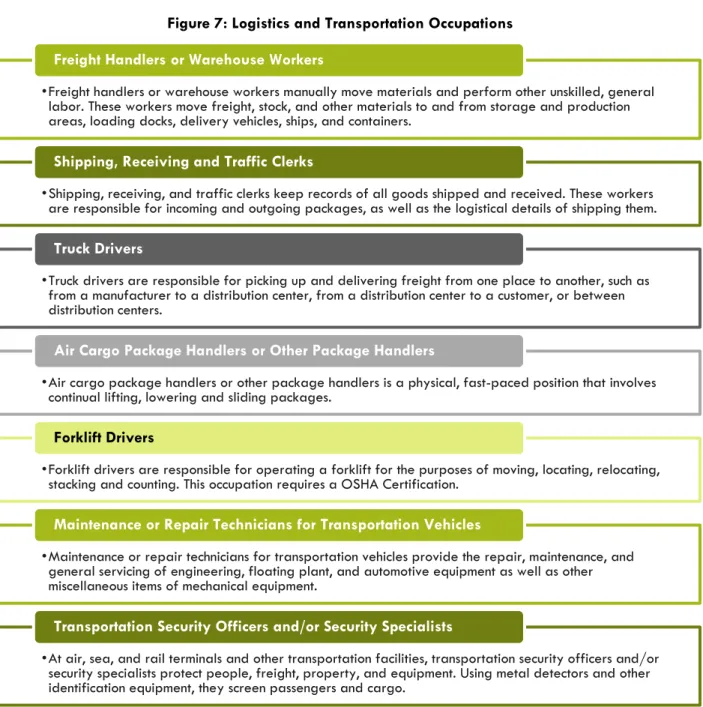
Based on these criteria, the following seven occupations were included in the primary research conducted with regional employers in the sector. Appendix C includes profiles of the seven selected occupations, including a brief description, educational, licensure and/or registration requirements and wage data.
Figure 7: Logistics and Transportation Occupations
•Freight handlers or warehouse workers manually move materials and perform other unskilled, general labor. These workers move freight, stock, and other materials to and from storage and production areas, loading docks, delivery vehicles, ships, and containers.
Freight Handlers or Warehouse Workers
•Shipping, receiving, and traffic clerks keep records of all goods shipped and received. These workers are responsible for incoming and outgoing packages, as well as the logistical details of shipping them.
Shipping, Receiving and Traffic Clerks
•Truck drivers are responsible for picking up and delivering freight from one place to another, such as from a manufacturer to a distribution center, from a distribution center to a customer, or between distribution centers.
Truck Drivers
•Air cargo package handlers or other package handlers is a physical, fast-paced position that involves continual lifting, lowering and sliding packages.
Air Cargo Package Handlers or Other Package Handlers
•Forklift drivers are responsible for operating a forklift for the purposes of moving, locating, relocating, stacking and counting. This occupation requires a OSHA Certification.
Forklift Drivers
•Maintenance or repair technicians for transportation vehicles provide the repair, maintenance, and general servicing of engineering, floating plant, and automotive equipment as well as other miscellaneous items of mechanical equipment.
Maintenance or Repair Technicians for Transportation Vehicles
•At air, sea, and rail terminals and other transportation facilities, transportation security officers and/or security specialists protect people, freight, property, and equipment. Using metal detectors and other identification equipment, they screen passengers and cargo.
Occupational Growth
Figure 8 displays data from the employers’ survey responses related to occupational employment and projections for growth and replacement over the next 12 months for five of the seven occupations studied. Two occupations — Transportation Security Officers and/or Security Specialists and Air Cargo Package Handlers or Other Package Handlers — were not included in the chart due to insufficient survey responses.
Figure 8: Employment Projections (next 12 months)
Logistics and Transportation
Occupations Employment Sample
Projected Growth
Rate
Projected
New Jobs Replacement Rate
Projected Replacement Jobs New & Replacement Jobs
Freight handlers or warehouse
workers 763 7.1 54 7.9 60 114
Shipping, receiving and traffic
clerks 459 3.6 17 6.1 28 45
Forklift drivers 328 9.3 30 7.3 24 54
Maintenance or repair technicians
for transportation vehicles 423 6.6 28 7.1 30 58
Truck drivers (both heavy/tractor-trailer and light or delivery
services) 1,678 8.2 138 5.3 90 228
Total 3,651 267 232 499
Analysis of Occupational Data
Based on the survey responses from 202 logistics and transportation employers:
• Forklift drivers are the fastest growing occupation with a growth rate of 9.3%
• Truck drivers are expected to add the most new positions over the next 12 months with 228 projected new and replacement jobs.
• Truck drivers and freight handlers or warehouse workers are the top two demand occupations when adding expected replacement needs to projected job growth. These occupations represent two out of every three new and replacement jobs that employers will need over the next 12 months. Despite the recent economic turmoil, it is encouraging that none of the occupations studied reports declining employment. In fact, the occupational growth rate reported by employers — ranging from 3.6% for shipping, receiving and traffic clerks to 9.3% for forklift drivers — compares very favorably to other sectors, perhaps due to the industry growth trends discussed earlier in this report.
Not only is new job growth for the five occupations strong, but the “replacement rate” is more than 5% for all five occupations. These kinds of job openings result from retirement and turnover (among other factors), and have been sharply down across industries over the last two years, reflecting the general uncertainty felt in this economy.
When considering the replacement of existing workers, it is important to consider the difference between turnover and retirement. Turnover within the industry and region tends to not as greatly impact the overall labor pool because workers may be merely transferring between employers. While this may present challenges for individual employers, it has little impact on the number of trained workers in the region. Retirements (and other separations), however, result in net losses to the labor pool, and because new workers are required to fill the positions, retirement tends to have a greater impact on workforce needs. As noted previously, employers reported an expected 3.4% retirement rate at their firms over the next 12 months across all workers.
Employer Needs and Challenges
Difficulty Hiring Qualified Applicants
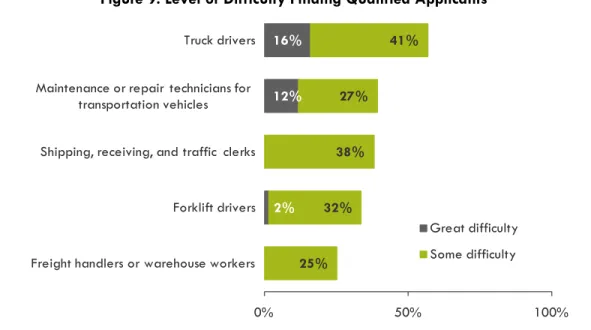
Generally speaking, employers do not report tremendous difficulty finding qualified applicants during periods of high unemployment. This generally held true in the survey results. There was only one occupation for which more than 50% of surveyed employers reported some or great difficulty in finding qualified applicants — truck drivers, as evidenced in Figure 9.
Figure 9: Level of Difficulty Finding Qualified Applicants
Workforce Challenges and Employee Development Practices
In addition to reporting their difficulty recruiting for specific occupations, employers also provided their feedback on several general workforce issues or challenges they are facing at their company. Perhaps due to the retirement of existing workers throughout the region, 60% of employers reported difficulty in hiring qualified workers from outside their organization. Employers are not reporting tremendous difficulty in keeping current workers properly trained on new technologies and industry requirements or in providing training opportunities so employees can advance. The complete survey results are illustrated in Figure 10.
Figure 10: Workforce Challenges
2% 12% 16% 25% 32% 38% 27% 41% 0% 50% 100%
Freight handlers or warehouse workers Forklift drivers Shipping, receiving, and traffic clerks Maintenance or repair technicians for
transportation vehicles Truck drivers Great difficulty Some difficulty 3% 2% 10% 14% 22% 27% 31% 46% 68% 69% 51% 36% 7% 1% 7% 4% 0% 100%
Providing training opportunities so current employees are able to advance within the
organization
Keeping current workers properly trained on new technologies and industry
requirements
Replacing workers with qualified employees within the organization Replacing workers with qualified candidates from outside the organization
Great difficulty Some difficulty No difficulty DK/NA
Figure 11 displays the employee development practices in use by regional employers. As seen below, formal on-the-job training is by far the most common practice in the region, while providing flexible work hours for employees enrolled at a college or university is the second most commonly used method of providing training opportunities for workers.
Figure 11: Employee Development Practices
Employer Interest in Community College Programs
Employers were also surveyed regarding their possible interest in training and education programs that could be developed by the ATLAS program and the College of Alameda or other regional community colleges. Employers expressed very little interest in the four logistics and transportation related programs that they were asked about, as is illustrated in Figure 12 below.
Figure 12: Employer Interest in Community College Programs
20% 51% 57% 87% 78% 47% 36% 11% 2% 1% 6% 1% 0% 100%
Tuition assistance or reimbursement at a college or university
Employer paid outside training Flexible work hours for employees enrolled at a
college or university
Formal on-the-job training
Yes No Do not know
2% 4% 5% 4% 16% 22% 26% 34% 0% 25% 50%
A training program for entry-level warehouse workers
A training program for freight handlers and other warehouse workers to become supervisors and
managers
A certificate program in supply chain management for logistics employees Customized training for your current logistics and
transportation employees
Great Interest Some Interest
Education and Experience Preferences
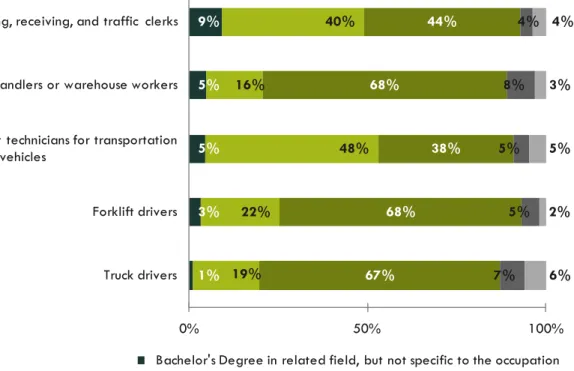
When asked about their preferences for hiring candidates with different educational or experience backgrounds, employers indicated different preferences, depending on the occupation. Employers did clearly indicate that either a community college Associate Degree or industry certificate specific to the occupation or more hands on experience with no post high school degree were sufficient preparation for the five occupations studied. In particular:
• Employers were most comfortable with a community college Associate Degree or industry certificate specific to the occupation for Maintenance or Repair Technicians for Transportation Vehicles, with nearly 50% indicating a preference for this educational preparation over the other two choices.
• Two out of three employers surveyed prefer that freight handlers or warehouse workers; truck drivers; and forklift drivers have more hands on experience with no post high school degree compared to the other two choices.
• Employers were more evenly split on Shipping, Receiving and Traffic Clerks with 44% of employers preferring more hands on experience with no post high school degree compared to 40% preferring an Associate Degree or industry certificate specific to the occupation.
Figure 13: Applicant Preference by Occupation
1% 3% 5% 5% 9% 19% 22% 48% 16% 40% 67% 68% 38% 68% 44% 7% 5% 5% 8% 4% 6% 2% 5% 3% 4% 0% 50% 100% Truck drivers Forklift drivers Maintenance or repair technicians for transportation
vehicles
Freight handlers or warehouse workers Shipping, receiving, and traffic clerks
Bachelor's Degree in related field, but not specific to the occupation Associate Degree or industry certificate specific to the position No post high school degree but more hands on experience It depends
Skills and Knowledge Requirements for Logistics and Supply Chain Managers
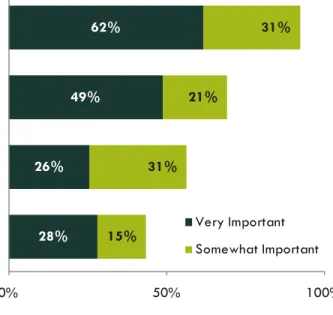
Employers were asked if they had ever hired or planned to hire employees specifically to manage logistics and supply chain coordination at their business. Employers who answered “yes,” were asked to indicate if these employees require certain skills or knowledge. Figure 14 illustrates the survey results.
Figure 14: Skill or Knowledge Requirements
College Response and Issues
One of the objectives of this environmental scan was to determine if a gap exists between the projected number of jobs openings in the next 12 months in seven logistics and transportation occupations, and the adequate supply of training and education programs available from the 22 community colleges located within the seven counties of San Francisco Bay and Central Valley region focused on in this report. The following section details education and training programs offered by community colleges in the Bay and Central Valley regions, which could prepare logistics and transportation workers. Challenges and issues related to logistics and transportation program development were also analyzed.
College Program Selection Criteria10
The task of identifying logistics and transportation-related programs offered through community colleges was not easy, since potential courses, certificates and degrees are buried within a host of programs with differing titles. In order to obtain an accurate picture of programs which may provide training for logistics and
transportation occupations, information was collected via survey of regional colleges and a review of the California Community College Chancellor’s Office (CCCCO) Inventory of Approved Programs.11
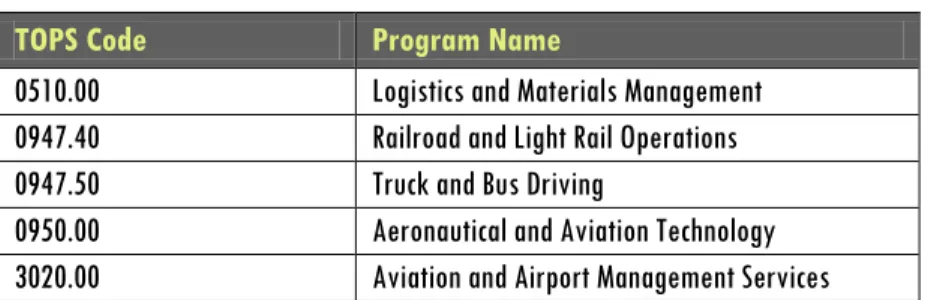
The five programs areas shown in Figure 14 are the programs most likely related to the seven occupations studied, based on the Taxonomy of Programs (TOP) and their related codes. These programs could serve as a core program of study for logistics and transportation training programs.
The response rate for the college survey was 55% (12 out of 22 colleges responding) and did not reveal much information about logistics and transportation program development. The CCCCO’s Inventory of Approved Programs contained information on several existing programs in the region related to logistics and transportation.
12
10 Only college programs or courses related to the seven occupations are included in this section.
11 Available online at:
12 To further identify college programs, an online survey was disseminated to colleges. Follow up phone interviews were also conducted.
28% 26% 49% 62% 15% 31% 21% 31% 0% 50% 100%
Understanding of the principles of international business as it relates to import/export industries
Expertise in the use of Geographic Information Systems or GIS
Knowledge and understanding of security issues related to the movement of goods Expertise in the use of computer information systems for logistics and supply chain management
Very Important Somewhat Important
Figure 14: Related Community College Programs
TOPS Code
Program Name
0510.00
Logistics and Materials Management
0947.40
Railroad and Light Rail Operations
0947.50
Truck and Bus Driving
0950.00
Aeronautical and Aviation Technology
3020.00
Aviation and Airport Management Services
Current College Programs, Certificates, or Courses Related Logistics and Transportation Occupations
Figure 15 illustrates colleges in the San Francisco Bay and Central Valley regions offering courses, certificates and degree programs approved by the California Community College Chancellor’s Office, relating to the seven occupations studied.
Figure 15: Current Regional Community College Program Offerings
College
Logistics and Transportation Occupations
Freight Handlers or Warehouse Workers Shipping, receiving, and traffic clerks Forklift drivers Maintenance or repair technicians for transportation vehicles Truck drivers Air cargo handlers or other package handlers Transportation security officers &/or security specialists
Programs related to each occupation X = Course only D = Degree C = Certificate
DeAnza
So m e tr ai ni ng s of fe re d thr oug h educ at io nal par tne rs hi ps (C ol leg e of A la m ed a & C C SF ) C ur re nt ly n o appr ov ed pr og ram s C ur re nt ly n o appr ov ed pr og ram sFoothill
C DSan Jose City
Evergreen
C DCanada
College of San Mateo
Skyline
C DMission
West Valley
Chabot
Las Positas
Contra Costa
Diablo Valley
Los Medanos
Ohlone
Berkeley
College of Alameda
X C X DLaney
Merritt
City College of San
Francisco
C DModesto Junior
X X X C DAbout one in three (seven of 22) community colleges in the study region offer at least one educational program related to the logistics and transportation occupations studied. However, based on 2008-09 certificate and degree program completion data tracked by the California Community College
Chancellor’s Office very few students received a degree or certificate for educational programs related to the seven occupations that were studied.
College of Alameda and Modesto Jr. College both offer courses or programs for four of the seven
occupations studied, the most among the regional colleges. College of Alameda offers truck driver training through the Northern California Teamsters Apprenticeship Training Fund and City College of San Francisco also offers truck driver training through a partnership with Goodwill Industries. No college offers education or training programs for air cargo handlers or other package handlers; or transportation security officers and/or security specialists.
The College of Alameda is in the process of developing a number of new certificates and degrees as part of their ATLAS program. They are listed below:
• Materials and Warehouse Management Certificate
• Transportation Distribution Logistics Certificate
• Supply Chain Operations Certificate
• Supply Chain Operations Certificate
• Supply Chain Operations Degree
• Cargo Security Certificate
• Sustainability Certificate for Managers
Some of the 22 colleges may offer other customized training or specialized grant-funded training courses related to the occupations studied, however the surveys completed by colleges did not indicate such training. Also, there may be some training or education programs related to the occupations studied at one or more of the ten colleges that did not respond to the college survey.
College Issues and Challenges
Survey responses from community colleges provided information about the current issues and challenges in hiring qualified faculty and developing clinical affiliates.
Difficulty Finding Faculty
The majority of colleges indicate they do not experience difficulty finding qualified faculty to teach at least one course in their current logistics and transportation programs. Most cite good connections with employers as the reason why the colleges are able to hire qualified faculty.
Internships, Industry Partnerships and Advisory Boards
Few colleges surveyed offer internships for their students. Several colleges cited difficulty in finding companies to host students as interns as a significant challenge in developing an internship program. Nearly all colleges have an active advisory board consisting of representatives from industry and unions. Approximately half the colleges experience difficulty with developing industry partnerships with logistics and transportation employers. Reasons for this difficulty include challenges with defining the industry and occupations.
Conclusion and Recommendations
Based on primary research conducted with employers for this report, there is good reason to be optimistic about the growth of the Logistics and Transportation sector in the San Francisco Bay and Central Valley regions.
Over the next 12 months, employers anticipate solid employment growth for their firms — 5% overall — and project an average of 7% job growth for five logistics and transportation occupations. Specifically,
Truck drivers and freight handlers or warehouse workers are the top two demand occupations, when adding expected replacement needs to overall growth. These two occupations represent two out of every three new and replacement jobs that employers will need over the next 12 months. In addition, 57% of employers indicated that they had difficulty finding qualified candidates for truck driver positions — the highest level of difficulty in hiring for any of the occupations studied.
The good news is that ATLAS currently provides training related to both occupations and for each occupation, only one other college in the region besides College of Alameda offers related training. Because very few colleges overall are offering training and education for the occupations studied, ATLAS should consider expanding their offerings based on the data gathered from employers.
Beyond the need for additional workers, employers who hire employees specifically to manage logistics and supply chain coordination at their businesses indicated the importance of specific skills or knowledge. 93% of employers said that expertise in the use of computer information systems for logistics and supply chain management was an important skill and 70% of employers indicated that knowledge and
understanding of security issues related to the movement of goods was an important area of knowledge. In light of this, ATLAS should consider offering courses or training modules that address these skill and
knowledge areas as part of their program offerings.
A high percentage of employers (87%) indicated that they prefer formal on the job training as a method for training their current workforce, followed by 57% of employers who provide flexible work hours for employees enrolled at a college or university. These results may provide an opportunity for the ATLAS program to explore partnerships with local employers to provide assistance with either on the job training for employees or to take advantage of employers’ willingness to give employees enrolled at a college a more flexible work schedule.
ATLAS should continue to work with local employers and its Advisory Committee to fine tune the training options available through its program, to address employers’ hiring needs, training needs for skill and knowledge areas and specific preferences for training methods.
References
“$18.6 million grant for Port of Stockton,” The Stockton Record (02/18/10),
California Employment Development Department (EDD), Labor Market Information Division (LMID),
Careers in Logistics
, Council of Supply Chain Management Professionals (CSCMP), available online
at
Economic Modeling Specialists, Inc. (EMSI), EMSI Complete Employment – 1st Quarter 2010
Goods Movement Action Plan 2005
, co-authored by the California Business, Transportation and
Housing Agency (Cal/BTH)and the California Environmental Protection Agency (Cal/EPA),
online at
Occupational Outlook Handbook (OOH), U.S. Department of Labor, Employment Training
Administration (ETA)
Restoration 3PL Market Analysis and 2010 Predictions
, Armstrong & Associates, available online at
The State of Logistics Outsourcing: 2009 third-party logistics
, C. John Langley, Jr., Ph.D., and
Capgemini U.S. LLC., online at
U.S. Department of Labor, Bureau of Labor Statistics,
U.S. Freight: Economy in Motion 1998
, U.S. Department of Transportation, Federal Highway
Appendices
A: How to Utilize this Report
... 22
B: Survey Methodology
... 23
C: Occupational Profiles
... 25
Occupation: Freight Handlers or Warehouse Workers
... 25
Occupation: Shipping, Receiving and Traffic Clerks
... 25
Occupation: Forklift Drivers
... 26
Occupation: Maintenance or Repair Technicians for Transportation Vehicles
... 26
Occupation: Truck Drivers
... 27
Occupation: Air Cargo Package Handlers or Other Package Handlers
... 27
Occupation: Transportation Security Officers and/or Security Specialists
... 28
D: GIS Maps
... 29
Logistics and Transportation Businesses: Employment Size
... 29
A: How to Utilize this Report
This report is designed to provide current industry data to:
• Define potential strategic opportunities relative to an industry’s emerging trends and workforce needs; • Influence and inform local college program planning and resource development;
• Promote a future-oriented and market responsive way of thinking among stakeholders; and, • Assist faculty, Economic Development and CTE administrators, and Community and Contract
Education programs in connecting with industry partners.
The information in this report has been validated by employers and also includes a listing of what
programs are already being offered by colleges to address those workforce needs. In some instances, the labor market information and industry validation will suggest that colleges might not want to begin or add programs, thereby avoiding needless replication and low enrollments.
About the Centers of Excellence
The Centers of Excellence (COE), in partnership with business and industry, deliver regional workforce research customized for community college decision making and resource development. This information has proven valuable to colleges in beginning, revising, or updating economic development and Career Technical Education (CTE) programs, strengthening grant applications, assisting in the accreditation process, and in supporting strategic planning efforts.
The Centers of Excellence Initiative is funded in part by the Chancellor’s Office, California Community Colleges, Economic and Workforce Development Program. The Centers aspire to be the premier source of regional economic and workforce information and insight for California’s community colleges.
More information about the Centers of Excellence is available at About the ATLAS Program at College of Alameda
The Alameda Transportation and Logistics Academic Support Initiative (ATLAS) is a regional initiative led by the Peralta Community College District that will create an integrated training and business services infrastructure targeting labor force needs in the transportation, distribution and logistics sectors. Logistics has become a major locus of job creation and economic activity for the San Francisco Bay Area and Central Valley Region. This sector includes transportation, freight, warehousing, delivery, and support firms specializing in moving goods from producers to consumers, including other producers and end users. Important Disclaimer
All representations included in this report have been produced from primary research and/or secondary review of publicly and/or privately available data and/or research reports. Efforts have been made to qualify and validate the accuracy of the data and the reported findings; however, neither the Centers of Excellence, COE host District, MPICT, nor California Community Colleges Chancellor’s Office are
responsible for applications or decisions made by recipient community colleges or their representatives, or others, based upon components or recommendations contained in this study.
Alameda, 24% Contra Costa, 14% San Francisco, 10% San Joaquin, 17% San Mateo, 12% Santa Clara, 15% Stanislaus, 7% Bay Area, 75% Central Valley, 25%
B: Survey Methodology
The table below provides a brief overview of the methodology utilized for the project. Overview of Project Methodology
Method Telephone survey of logistics employers in the Bay Area and Central Valley Number of Participants 202 Firms Completed a Survey (152 Bay Area and 50 Central Valley)
Field Dates June 9 – June 22, 2010
Survey Universe 3,286 logistics firms in the Bay Area and Central Valley Margin of Error +/- 6.68% (for questions answered by all 202 respondents)
Research Objectives
Prior to beginning the project, BW Research met with the Centers of Excellence and ATLAS to determine the research objectives for the study. Viewed broadly, the main research objectives of the study were to:
• Project future job growth and replacement workers needed over the next 12 months for key logistics and transportation occupations
• Identify employer needs and challenges for hiring and training employees • Identify skills and knowledge areas needed for key occupations
• Identify industry interest in accessing community college education and training programs
Questionnaire Design
Through an iterative process, BW Research worked closely with the Centers of Excellence to develop a survey instrument that met all the research objectives of the study. In developing the instrument, BW Research utilized techniques to overcome known biases in survey research and minimize potential sources of measurement error within the survey.
Sampling Method
The Questionnaire was utilized to interview a representative sample of businesses from the study region with at least five employees. A database of all known firms matching the study parameters was provided by the Centers of Excellence.
Region
The seven-county study region included two sub-groups, the Bay Area (San Francisco, Alameda, Contra Costa, Santa Clara, and San Mateo) and the Central Valley (San Joaquin, and Stanislaus). A geographical break out of the responses to the employer survey is included below.
Industry
Each employer was categorized into one of five general industry classifications based on their NAICS code. The five general industry classifications are:
• Air (n=19) • Ground (n=109) • Maritime (n=14)
• Warehousing & Other (n=55) • Rail (n=5)
NAICS
Code NAICS Title
425120 Wholesale Trade Agents and Brokers 481112 Scheduled Freight Air Transportation 481212 Nonscheduled Chartered Freight Air Transportation 481219 Other Nonscheduled Air Transportation 482110 Rail transportation
483111 Deep Sea Freight Transportation 483113 Coastal and Great Lakes Freight
Transportation
483211 Inland Water Freight Transportation 484110 General Freight Trucking, Local
484121 General Freight Trucking, Long-Distance, Truckload 484122 General Freight Trucking, Long-Distance, Less Than Truckload 484210 Used Household and Office Goods Moving 484220 Specialized Freight (except Used Goods) Trucking, Local 484230 Specialized Freight (except Used Goods) Trucking, Long-Distance 486110 Pipeline Transportation of Crude Oil 486210 Pipeline Transportation of Natural Gas 486910 Pipeline Transportation of Refined Petroleum Products 486990 All Other Pipeline Transportation 488111 Air Traffic Control
488119 Other Airport Operations
NAICS
Code NAICS Title
488190 Other Support Activities for Air Transportation
488210 Support Activities for Rail Transportation 488310 Port and Harbor Operations
488320 Marine Cargo Handling
488330 Navigational Services to Shipping 488390 Other Support Activities for Water
Transportation 488410 Motor Vehicle Towing
488490 Other Support Activities for Road Transportation 488510 Freight Transportation Arrangement 488991 Packing and Crating
488999 All Other Support Activities for Transportation 492110 Couriers and Express Delivery Services 492210 Local Messengers and Local Delivery 493110 General Warehousing and Storage 493120 Refrigerated Warehousing and Storage 493130 Farm Product Warehousing and Storage 493190 Other Warehousing and Storage 532411 Commercial Air, Rail, and Water Transportation Equipment Rental and
Leasing
541614 Process, Physical Distribution, and Logistics Consulting Services 561910 Packaging and Labeling Services
Data Collection
Prior to beginning telephone data collection, BW Research conducted interviewer training and also pre-tested the survey instrument to ensure that all the words and questions were easily understood by respondents. Telephone interviews were generally conducted from 9:00 am to 4:30 pm Monday through Friday. Callbacks were also scheduled at respondents’ convenience.
The data collection period was June 9 through June 22, 2010.
C: Occupational Profiles
Occupation: Freight Handlers or Warehouse Workers
Freight handlers or warehouse workers manually move materials and perform other unskilled, general la-bor. These workers move freight, stock, and other materials to and from storage and production areas, loading docks, delivery vehicles, ships, and containers. The following list describes in more detail some of the tasks that may be required of freight handlers or warehouse workers:
• Loading/Unloading Trucks
• Sort Merchandise to proper areas
• May be required to drive a forklift
Occupational Outlook: Despite a nationwide projected employment decline, a relatively high number of job openings will be created by the need to replace workers who transfer to other occupations, retire, or leave for other reasons—characteristic of occupations requiring little prior or formal training. Many industries where freight handlers or warehouse workers are employed are sensitive to changes in economic conditions, so the number of job openings fluctuates with the economy.
Entry-Level Wages Median Wages Experienced-Level Wages
Freight Handlers or
Warehouse Workers $9.10 $13.48 $22.08
Occupation: Shipping, Receiving and Traffic Clerks
Shipping, receiving, and traffic clerks keep records of all goods shipped and received. These workers are responsible for incoming and outgoing packages, as well as the logistical details of shipping them. The following list describes in more detail some of the tasks that may be required of shipping, receiving, and traffic clerks:
• Prepare shipping documents and mailing labels and make sure that orders have been filled correctly
• Record items taken from inventory and note when orders were filled
• Control all receiving platform operations, such as the scheduling of trucks, recording of shipments, and handling of damaged goods
Occupational Outlook: Employment is expected to decline moderately as a result of increasing automation. However, job openings will result from the need to replace shipping, receiving, and traffic clerks who leave the occupation.This is a large entry-level occupation, and many vacancies are created as workers leave as part of their normal career progression. Because smaller warehouses, distribution centers, and trucking terminals will continue to rely on sorting and moving goods by hand, job opportunities at those facilities may be better than at larger, more automated centers.
Entry-Level Wages Median Wages Experienced-Level Wages
Shipping, Receiving and
Occupation: Forklift Drivers
Forklift drivers are responsible for operating a forklift for the purposes of moving, locating, relocating, stacking and counting. This occupation requires a OSHA Certification. The following list describes in more detail some of the tasks that may be required of forklift drivers:
• Unload product correctly using the appropriate handling techniques
• Count freight with the driver and ensures all customer requirements are followed
• Ability to drive the shortest distance to the product locations and then back to the staging lanes
• Perform required serial number scans on all products that require serial numbers be taken
Occupational Outlook: Job growth for forklift drivers depends on the growth or decline of employing industries and the type of equipment the workers operate or the materials they handle. Employment should grow in the warehousing and storage industry as more firms contract out their warehousing functions to this industry.
Entry-Level Wages Median Wages Experienced-Level Wages
Forklift Drivers $10.07 $15.42 $23.97
Occupation: Maintenance or Repair Technicians for Transportation Vehicles
Maintenance or repair technicians for transportation vehicles provide the repair, maintenance, and general servicing of engineering, floating plant, and automotive equipment as well as other miscellaneous items of mechanical equipment. Job responsibility is concerned with the maintenance, overhaul, and repair of various types of cranes, passenger vehicles, trucks, gas-and diesel-powered tractors, draglines, compressors, etc. The following list describes in more detail some of the tasks that may be required of maintenance or repair technicians for transportation vehicles:
• Perform maintenance and repair work on gasoline-and diesel-powered vehicles or equipment of a construction, industrial, or general commercial nature.
• Perform maintenance and repairs that can be accomplished by cleaning, reinstalling, or replacing worn or defective parts of components and systems.
• Using a basic variety of hand-tools and test equipment, locates worn, dirty, or poorly adjusted parts and completes repairs by cleaning, reinstalling, or replacing worn or defective items.
Occupational Outlook: Average employment growth is expected for this occupation. Job growth and the need to replace those who leave this occupation should result in excellent job opportunities, especially for those with experience in maintenance and related fields.
Entry-Level Wages Median Wages Experienced-Level Wages
Maintenance or Repair Technicians for
Occupation: Truck Drivers
Truck drivers are responsible for picking up and delivering freight from one place to another. This may be from a manufacturer to a distribution center, from a distribution center to a customer, or between
distribution centers. Depending on the type of truck, the driver may be required to have a specialized driver’s license. The following list describes in more detail some of the tasks that may be required of truck drivers:
• Maintain logs of their activities
• Ensure sure that their equipment is in good working condition
• Load and unload freight
• Knowledge of Department of Transportation regulations and State regulations
Occupational Outlook: Overall job opportunities should be favorable for truck drivers, especially for long-haul drivers. However, opportunities may vary greatly in terms of earnings, weekly work hours, number of nights spent on the road, and quality of equipment. Competition is expected for jobs offering the highest earnings or most favorable work schedules. Average employment growth is expected.
Entry-Level Wages Median Wages Experienced-Level Wages
Truck Drivers $11.88 $18.74 $31.71
Occupation: Air Cargo Package Handlers or Other Package Handlers
Air cargo package handlers or other package handlers is a physical, fast-paced position that involves continual lifting, lowering and sliding packages that typically weigh 25 - 35 lbs. and may weigh up to 70 lbs. The following list describes in more detail some of the tasks that may be required of air cargo package handlers or other package handlers:
• Receives items for shipment, inspects visually for identity, quantity, and condition
• Checks for obvious damage and segregates items requiring special handling
• Completes receiving and shipping documents
• Identifies all shipments by proper marking and labeling, including special handling instructions.
Occupational Outlook: Nationally, employment is expected to grow much faster than average; and job prospects are expected to be good. As the overall economy improves, more package handlers will be needed to handle the growing number of shipments resulting from increases in cargo traffic. Additionally, as shipments require multiple modes of transportation to reach their final destinations, such as freight trucking and air, a greater number of handlers will be needed to manage the process. The growing popularity of online shopping and same day delivery may also spur employment growth.
Entry-Level Wages Median Wages Experienced-Level Wages
Air Cargo Package Handlers or Other
Occupation: Transportation Security Officers and/or Security Specialists
At air, sea, and rail terminals and other transportation facilities, transportation security officers and/or security specialists protect people, freight, property, and equipment. Using metal detectors and other identification equipment, they may screen passengers and cargo for weapons and explosives, ensure that nothing is stolen while cargo is being loaded or unloaded, and watch for fires and criminals. The following list describes in more detail some of the tasks that may be required of transportation security officers and/or security specialists:
• Discover and stop emerging transportation security threats, using advanced technology
• Screen passengers and cargo
• Gather intelligence
• Coordinate security involving aviation, rail, and other surface and maritime transportation
Occupational Outlook: Opportunities transportation security officers and/or security specialists should be favorable, although competition is expected for some higher paying jobs. Numerous job openings will stem from faster than average employment growth—driven by the demand for increased security—and from the need to replace those who leave this large occupation each year.
Entry-Level Wages Median Wages Experienced-Level Wages
Transportation Security Officers and/or Security
¯
0
5
10
20
30
40
Miles
Legendn
m
Community College (n=23) Selected Counties by Zip Codes Logistic and Transportation Business by Employment Size (n=57,069) 3,001 or higher 1,201 - 3,000 501 - 1,200 151- 500 36 - 150 College of Alameda Canada College Chabot CollegeLas Positas College City College of San Francisco
Skyline College Ohlone College MIssion College DeAnza College Merritt College Laney College Vista College
Diablo Valley College Contra Costa College
Foothill College
West Valley College Evergreen Valley College
Gavilan College
Modesto Junior College Los Medanos College
San Joaquin Delta College
College of San Mateo
¯
0
5
10
20
30
40
Miles
Legendn
m
Community College (n=23) Logistic and Transportation Business by Sales Revenue ($,000s) 2,000,001 or higher 700,001 - 2,000,000 300,001 - 700,000 75,001 - 300,000 5,000 - 75,000Selected Counties by Zip Codes
College of Alameda
Canada College
Chabot College
Las Positas College City College of San Francisco
Skyline College Ohlone College MIssion College DeAnza College Merritt College Laney College Vista College
Diablo Valley College Contra Costa College
Foothill College
West Valley College Evergreen Valley College
Gavilan College
Modesto Junior College Los Medanos College
San Joaquin Delta College
College of San Mateo