PROJECT MANAGEMENT
TRAINING PROGRAM
Revision History
Table of Contents
SECTION 1 - PROJECT MANAGEMENT TRAINING PROGRAM... 5
1.1 POLICY STATEMENT... 5
1.2 PURPOSE AND OBJECTIVES...5
1.3 SCOPE...5
1.4 TRAINING GOALS... 5
1.5 TRAINING PROGRAM PLAN OVERVIEW... 6
1.5.1 SECTION1 - TRAININGPROGRAMSTRATEGY...6
1.5.2 SECTION2 – PROJECTMANAGEMENTCOMPETENCYDEVELOPMENT...7
1.5.3 SECTION3 - TRAININGPROGRAMCOURSEDIRECTORY...7
1.5.4 SECTION4 – TRAININGCOURSESYNOPSIS...7
1.6 ASSOCIATED PROJECT MANAGEMENT DOCUMENTS... 7
1.7 ORGANIZATION STRUCTURE... 7
1.8 ORGANIZATION STRUCTURE TRAINING PROGRAM RESPONSIBILITIES... 8
1.8.1 PROJECTMANAGEMENTTRAININGPROGRAM...8
1.8.2 INDIVIDUALTRAININGPLANS FORNEWEMPLOYEES...8
1.8.3 INDIVIDUALTRAININGPLANS FORESTABLISHEDEMPLOYEES...8
1.8.4 MAINTAININGTRAININGRECORDS. ... 9
1.8.5 TRAININGMETHODS...9
1.9 TRAINING COURSE DEVELOPMENT...9
1.10 TRAINING COURSE SCHEDULING / REGISTRATION PROCESS... 10
SECTION 2 – PROJECT MANAGEMENT COMPETENCY DEVELOPMENT... 11
2.1 PURPOSE OF PROJECT MANAGEMENT COMPETENCY DEVELOPMENT... 11
2.2 WHAT IS COMPETENCE?... 11
2.3 HOW WILL<ORGANIZATION NAME>DEFINE ITS PROJECT MANAGEMENT COMPETENCIES?... 12
2.4<ORGANIZATION NAME>PROJECT MANAGEMENT COMPETENCY MODEL... 12
SECTION3 - TRAINING PROGRAM COURSE DIRECTORY... 13
3.1 TRAINING PROGRAM COURSE DIRECTORY... 13
3.2 REFERENCES... 13
3.3 TRAINING PROGRAM COURSE DIRECTORY... 13
SECTION 4 – TRAINING COURSE SYNOPSIS... 17
CORE COMPETENCY TRAINING COURSES... 17
3.1.1 Introduction to Project Management ...17
3.1.2 Introduction ...17
3.1.3 Tech Lead Workshop (Project Management Methodology Overview) ...18
3.1.4 Project Initiation Process Group Processes ...18
3.1.5 Project Planning Process Group Processes ...19
3.1.6 Project Execution Process Group Processes...20
3.1.7 Project Monitoring & Controlling Process Group Processes ...20
3.1.9 Integration Change Management ...21
PROCESS TRAINING COURSES... 22
3.2.1 Project Management Integration ...22
3.2.2 Project Scope Management ...22
3.2.3 Project Introduction to Project Schedule Development...22
3.2.4 Project Cost Management ...23
3.2.5 Project Quality Management...23
3.2.6 Project Human Resource Management ...24
3.2.7 Project Communications Management ...24
3.2.8 Project Risk Management ... 25
3.2.9 Project Procurement Management ...25
3.2.10 Project Earned Value Management ...25
3.2.11 Baseline Change Management Process Training ...25
SKILLS TRAINING COURSES... 27
3.3.1 Program and Project Leadership ...27
3.3.2 Project Communications and Security...27
3.3.3 Project Requirements Development ...28
3.3.4 Project Negotiation Skills ... 28
3.3.5 Project Estimating ...29
TOOLS TRAINING COURSES... 29
3.4.1 MS Project ...29
3.4.2 MS Excel ...29
3.4.5 MS Access ...29
ORGANIZATIONAL TRAINING COURSES... 30
3.5.1 Program and Portfolio Management ...30
3.5.2 Strategic Planning ...30
3.5. 3 Data Security ...31
3.5.4 PMP® Certification Exam Preparation ...31
3.5.5 Program Management Office ...31
PROJECT ORIENTATION TRAINING COURSES... 32
3.6.1 Project Product Orientation ...32
3.6.2 Project Customer Orientation ...32
3.6.3 Project Team Building and Chartering ...33
3.6.4 Project History Orientation ...33
3.6.5 Project Lessons Learned Orientation ... 34
SECTION 1 – EDUCATION AND TRAINING PLAN
1.1 POLICY STATEMENT
This plan implements the policy of the <
Organization Name
> that “each operating function is
responsible for identifying employee training and development needs within its operation to ensure
that employees possess or maintain the needed skills to perform their assignments.”
1.2 PURPOSE AND OBJECTIVES
The purpose of this document is to describe the project management training program (PMTP) for
<
Organization Name
>. The objective of this plan is to ensure that all project personnel are properly
trained in the use of project management best practices.
1.3 SCOPE
This training plan applies to all personnel of <
Organization Name
>. The training plan applies to
project management training only and does not include general, non-specialist training. The PMTP
also assumes that the minimal requirements identified by the enterprise-wide project management
office (EPMO) for each job title are satisfied.
1.4 TRAINING GOALS
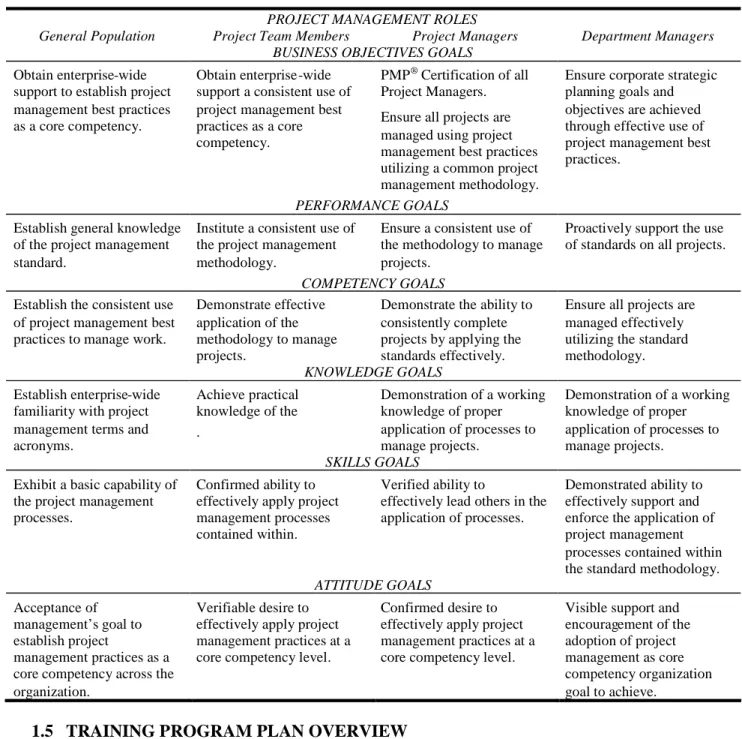
The organizational education and training goals for the PMTP are defined in Table 1. Table 1
provides some guidelines for developing project management training courses that address
objectives for four audience categories of personnel: general population, project team members,
project managers, and department managers.
Business objectives
training outcomes that influence institutionalized project management best
practices enterprise-wide.
Performance goals
training outcomes that can improve organizational performance.
Competency goals
training outcomes that can improve individual performance.
Knowledge goals
training outcomes that quantifiably improve individual knowledge of the
subject.
Skill goals
training outcomes that increase individual proficiency in using a process or tool.
Attitude Goals
training outcomes that support project management best practices as a core
competency.
Table 1-1 – Education and Training Goals
PROJECT MANAGEMENT ROLES
General Population Project Team Members Project Managers Department Managers BUSINESS OBJECTIVES GOALS
Obtain enterprise-wide support to establish project management best practices as a core competency.
Obtain enterprise-wide support a consistent use of project management best practices as a core competency.
PMP®Certification of all Project Managers. Ensure all projects are managed using project management best practices utilizing a common project management methodology.
Ensure corporate strategic planning goals and objectives are achieved through effective use of project management best practices.
PERFORMANCE GOALS
Establish general knowledge of the project management standard.
Institute a consistent use of the project management methodology.
Ensure a consistent use of the methodology to manage projects.
Proactively support the use of standards on all projects.
COMPETENCY GOALS
Establish the consistent use of project management best practices to manage work.
Demonstrate effective application of the methodology to manage projects.
Demonstrate the ability to consistently complete projects by applying the standards effectively.
Ensure all projects are managed effectively utilizing the standard methodology.
KNOWLEDGE GOALS
Establish enterprise-wide familiarity with project management terms and acronyms. Achieve practical knowledge of the . Demonstration of a working knowledge of proper application of processes to manage projects. Demonstration of a working knowledge of proper application of processes to manage projects. SKILLS GOALS
Exhibit a basic capability of the project management processes.
Confirmed ability to effectively apply project management processes contained within.
Verified ability to
effectively lead others in the application of processes.
Demonstrated ability to effectively support and enforce the application of project management processes contained within the standard methodology.
ATTITUDE GOALS
Acceptance of management’s goal to establish project
management practices as a core competency across the organization.
Verifiable desire to effectively apply project management practices at a core competency level.
Confirmed desire to effectively apply project management practices at a core competency level.
Visible support and encouragement of the adoption of project management as core competency organization goal to achieve.
1.5 TRAINING PROGRAM PLAN OVERVIEW
The
PMTPis defined and detailed in this document in four sections with the courses listed in
Section 2, Table 2-4.
1.5.1
Section 1 - Training Program Strategy
The PMTP plan identifies the strategy for creating the training courses that are required by
project personnel. The plan describes the process for identifying training needs and skills for
those individuals, and the responsibilities for executing this training plan. The objective of this
1.5.2
Section 2 – Project Management Competency Development
This section provides a model that defines the project management competency requirements for
the various project management roles within <Organization Name>. Establishing competency
requirements provides the foundation for developing the courses required in an effective training
program. Use Template number TMP-16 and 17 found on the authors website at
www.dlballc.com
.
1.5.3
Section 3 - Training Program Course Directory
The PMTP course directory contains an itemized list in of the courses that satisfy the education
and training goals defined in Table 3-1. The courses are categorized into six groupings:
Core competency training
Process training
Skills training
Tools training
Organization training
Project orientation training
1.5.4
Section 4 – Training Course Synopsis
A synopsis of each training course is contained in this section with the following content:
Purpose
Knowledge objectives
Learning objectives
Assessment method
Prerequisites
Topics covered
Course length
References
Logistics
Class size
Facilities & equipment
Course materials
1.6 Associated Project Management Documents
The project management training program is intended to support and expand on the knowledge
contained in the project management handbooks listed in the project management standard
methodology. Individual departments are responsible for the use of the process handbooks that
apply to their skill-area. The department manager in each skill-area shall coordinate training and
orientation of handbooks with their subordinates.
1.7 Organization Structure
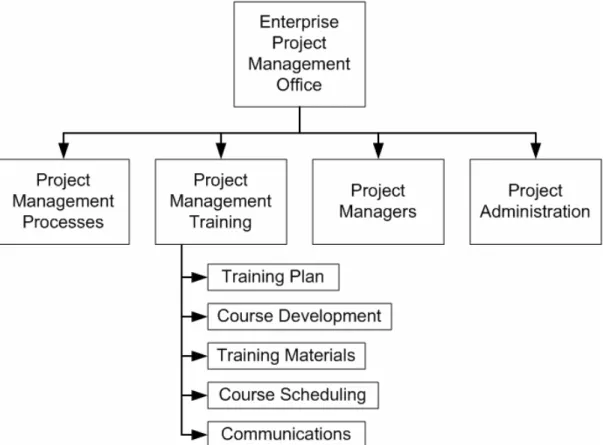
The enterprise-wide project management office (EPMO) provides the organization structure for
managing all aspects of project management development and implementation within <Organization
Name> including the PMTP as shown in Figure 1-1.
Figure 1-1 – Project Management Training Program Organizational Structur
e
1.8 Organization Structure Training Program Responsibilities
1.8.1 Project Management Training Program
The <
Organization Name
> management team has review and approval responsibility for the
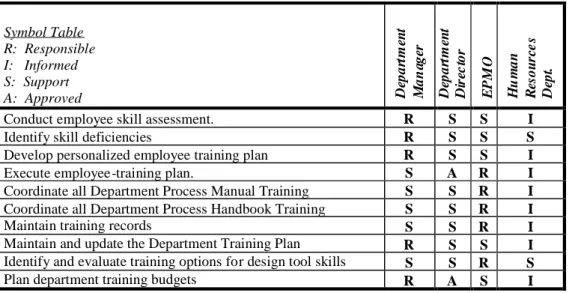
PMTP Plan. Table 3 - Responsibility Matrix contains a list of additional roles with additional
responsibilities assigned. The EPMO has responsibility for developing and managing the
executing of the PMTP.
1.8.2 Individual Training Plans for New Employees
Department managers are responsible to assess skills of all new employees against requirements of
the PMTP and to prepare and implement an individual training plan for each employee for the first
year of employment.
1.8.3 Individual Training Plans for Established Employees
a.
The process for identifying skill deficiencies and establishing a training plan for established
employees is usually accomplished using the annual performance appraisal process. This
process solicits input regarding employee performance from project development teams on
which the employee participated. It also takes into account the perceptions of the employee
regarding skill deficiencies.
b.
Changes in technology or introduction of new or updated design tools may necessitate
training for individuals that is done outside the annual appraisal process. This training is the
responsibility of the department manager with input from the employees.
c.
The department manager is responsible to identify in the employee’s training plan the
specific training method that best meets the needs of the employee. This can vary between
individuals based on their background and experience.
1.8.4 Maintaining Training Records.
The EPMO maintains records of training received by each training attendee. Each department
manager is responsible to communicate with the EPMO the details of all training conducted in
their respective department for each individual. Table 1-2 contains a list of other training related
responsibilities as they are applied to specific roles.
Table 1-2: Responsibility Matrix
Symbol Table R: Responsible I: Informed S: Support A: Approved D ep a rt m en t M a n ag er D ep a rt m en t D ir ec to r E P M O H u m a n R es o u rc e s D ep t.
Conduct employee skill assessment. R S S I
Identify skill deficiencies R S S S
Develop personalized employee training plan R S S I
Execute employee-training plan. S A R I
Coordinate all Department Process Manual Training S S R I
Coordinate all Department Process Handbook Training S S R I
Maintain training records S S R I
Maintain and update the Department Training Plan R S S I
Identify and evaluate training options for design tool skills S S R S
Plan department training budgets R A S I
1.8.5 Training Methods
The logistics utilized to deliver the various training programs may vary from course to course.
Training can be obtained by a number of different ways. Some of the same information may be
contained in part or whole in more that one course. The following is a list of the various ways the
training will be provided:
Internal classes presented by <
Organization Name
> personnel or contract consultants
External classes provided by PMI Chapters, PMI Registered Education Providers (REP),
or local training providers
Distance Learning class provided on the Internet by PMI REP’s
Guest speaker workshops
1.9 Training Course Development
Development training begins with reviewing the synopsis of the training course to determine if it is
still relevant. The course training plan will provide the details required to create the training course
if it is to be internal or provide the guidelines for selecting external options. The process steps for
developing the courses are as follows:
Step 1: Decide if the course will be offered internally or externally.
a)Internal course: select course developer
<Organization Name
> personnel or contract
developer
1. Develop and approve course presentation materials
2. Develop course workbook / handout materials, if required
b)External course: select PMI
®registered education provider (REP) and determine the
desired delivery method
1. E-learning – Internet based self learning
2. Off-site – delivered by REP at prescheduled locations
3. In-house – delivered by REP at
<Organization Name
>
Step 2: Implement schedule and registration process.
1.10 Training Course Scheduling / Registration Process
The training course scheduling and registration involves the following steps:
Step 1: Establish a list of the intended participants for the course if it is to be developed for a
specific group of personnel.
Step 2: Determine the number of training session required and reserve a training room for the
date(s) the course will be delivered.
Step 3: Enter the course information into the EPMO training database.
Step 4: Send a email message to the intended participants providing information about the
course and instructions on how to register.
Step 5: Send a email message two-days prior to the class to remind the participants.
Step 6: Print a class sign-in sheet and have the participant’s initial it when entering the room.
The completed list must be turned in to EPMO for their audit files records.
Step 7: Have participants complete the course evaluation sheet and compile the responses into
a summary report. File the report and provide a copy to EPMO for their records.
Step 8: Complete course completion certificates and email them to the class participants.
SECTION 2 – PROJECT MANAGEMENT COMPETENCY
DEVELOPMENT
2.1 Purpose of Project Management Competency Development
<Organization Name>
is shifting its corporate strategy from selling products or services to selling
integrated solutions. Ensuring a successful strategic move to becoming a solutions provider will add
a great deal of complexity to the company's projects. In some cases, this shift in strategy will
drastically change the nature of work people perform and greatly increased the need for expert
project management knowledge and skills. Effective employment of project management best
practices is a key element in achieving and maintaining a competitive advantage in the global
aerospace market.
Projects are only as successful as the people who manage them are. Evaluating project management
personnel competencies will enable
<Organization Name
> to identify individuals who are, or have
the potential to become superior project managers, and determine what is needed in the way of
training and development to raise performance levels. With project management personnel having
superior competency levels, projects are managed more effectively, increasing the probability of
success and a higher return on project investment.
Effective employment of project management principles is a key element to achieve, maintain, and
improve an organizations maturity. Improving
<Organization Name>
maturity requires the policies,
practices and measures are in place that result in quality integrated into its development. The
development of project management skills will enable
<Organization Name>
to build a team of
experienced and trained project managers capable of taking on multiple projects and helping our
customers achieve their goals.
Measuring
<Organization Name>
project management competencies and benchmarking them
against recognized project management best practices is the first step in developing an effective
Project Management Training Program to achieve the highest level of competency in all areas. This
section contains the
<Organization Name>
competency standard. These guidelines will help to
direct
<Organization Name>
project management personnel in the goal to meet competency
standard requirements in all areas.
2.2 What is Competence?
In
A GLOBAL APPROACH TO PROJECT MANAGEMENT COMPETENCE, (AIPM, 1997),Lynn Crawford
states:
… Competence is a term which is widely used but which has come to mean different
things to different people.
It is generally accepted, however, as encompassing
knowledge, skills, attitudes and behaviors that are causally related to superior job
performance (Boyatzis, 1982). This understanding of competence has been described
as
attribute-based inference of competence
(Heywood, Gonczi et al, 1992). To this
can be added what is referred to as the
performance-based
approach to competence,
which assumes that competence can be inferred from demonstrated performance at
pre-defined acceptable standards in the workplace (Gonczi, Hager et al, 1993). The
performance-based approach is the basis for what has become known as the
Competency
Standards
Movement
that
underpins
the
National
Vocation
Qualifications in the United Kingdom, the Australian National Competency
Standards Framework [linked to the Australian Qualifications Framework] and the
National Qualifications Framework of the New Zealand Qualifications Authority
(NZQA).
<Organization Name>
project management competency model is based on a combination of the
requirements found in the Project Management Institute’s (PMI®) Project Manager Competency
Development (PMCD) Framework standard that was published in 2002. The working definition the
PMCD used for development of its standard is based on Scott Parry’s (1998) definition; a
competency
is a cluster of related
knowledge
,
attitudes
,
skills
, and other
personal characteristics
:
That affects a major part of one’s job (i.e., one or more key roles or responsibilities);
That correlates with performance on the job;
That can be measured against well-accepted standards;
That can be improved via training and development; and
That can be broken down into dimensions of competence.
2.3 How will
<Organization Name
>
define its project management competencies?
<Organization Name>
project management methodology is based on. PMI’s
A Guide to the Project
Management Body of Knowledge (PMBOK® Guide)
, which has become the de facto Standard for
managing individual projects. Therefore, it is logical that
<Organization Name>
project
management competency model should also be based on another PMI Standard,
Project
Management Competency Development (PMCD) Framework
.
The first step in developing a training program that will apply project management best practice
principles at the organizational level is to assess the organizations project management competency
in order to establish a baseline against which to measure progress. PMI developed the OPM3
(Organizational Project Management Maturity Model) Standard in 2003 to enable organizations like
<Organization Name>
to reexamine their pursuit of strategic objectives via Best Practices in
organizational project management. OPM3 is comprised of three general elements:
Knowledge
,
presenting the contents of the Standard;
Assessment
, providing a method for comparison with the
Standard; and
Improvement
, setting the stage for possible organizational changes. OPM3 is not
prescriptive in that it does not tell
<Organization Name>
what improvements to make or how to
make them. Rather, the intent is simply to offer
<Organization Name>
a basis that will enable the
organization to develop its PMTP to achieve the competency levels it identifies in
<Organization
Name>
project management competency model.
2.4
<Organization Name>
Project Management Competency Model
SECTION 3 - TRAINING PROGRAM COURSE DIRECTORY
3.1 TRAINING PROGRAM COURSE DIRECTORY
The PMTP course directory identifies recommended training classes for the target audience
identified in Section 1 Table 1-1. The courses identified in this directory are those, which are given
or are planned to be given on a recurring basis. All courses are provided on an "on-demand" basis.
That is, none of the courses in this directory are presented on a scheduled basis. Further, there may
be additional applicable courses sponsored by the EPMO, which are listed separately.
This Course Directory is to be used by the EPMO, department managers and others in
identifying training needs and communicating standard courses. This course directory does not
address courses provided on a "one-time", unique basis. However, it does identify training, which
may be delivered by alternatives to standard classroom "presentations.” Such alternative delivery
methods include on-the-job training, formal mentoring, videotapes, computer-based training, and
similar approaches.
The directory includes both currently available courses and planned courses. Near term needs
include the following categories:
Leadership
Operating in an project core team
Introductory avionics concepts and subsystems
Process training
PMBOK
®Guide
terminology and processes
PMP
®certification examination preparation
3.2 REFERENCES
Documents:
PMI
®Project Management Body of Knowledge (
PMBOK
®Guide
) Third Edition
Project Management Process Manual
<Organization Name>
Intranet URLs:
EPMO training:
enter URL here
General training information:
enter URL here
PMI Internet URL:
Project Management Institute (PMI
®): http://www.pmi.org/
3.3 TRAINING PROGRAM COURSE DIRECTORY
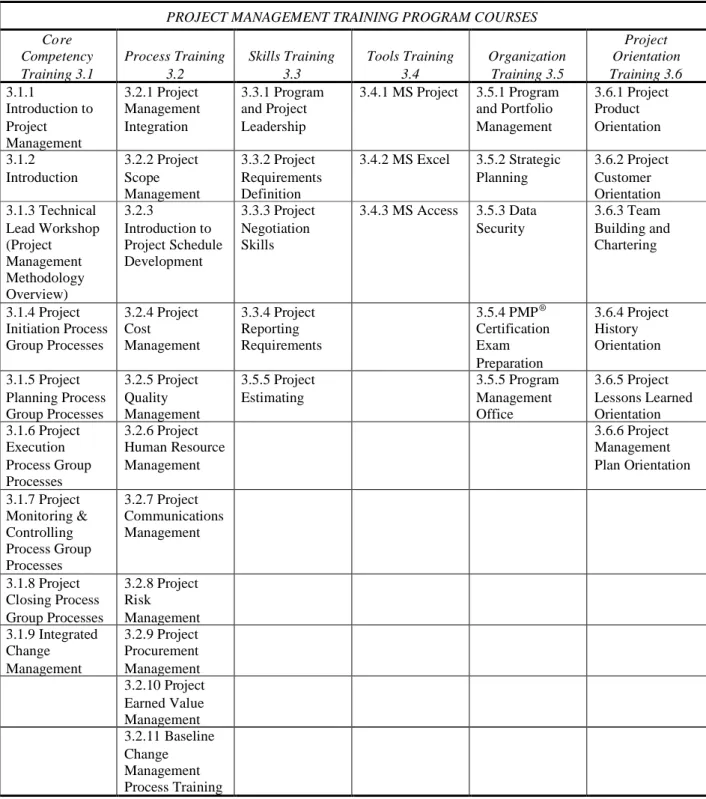
Table 3-1 contains the list of the training courses that comprise the
<Organization Name>
PMPT.
The numbering of the courses corresponds to the course summary overviews in Section 4 that
follows.
Table 3-1 – Project Management Training Program Course Directory
PROJECT MANAGEMENT TRAINING PROGRAM COURSES Core Competency Training 3.1 Process Training 3.2 Skills Training 3.3 Tools Training 3.4 Organization Training 3.5 Project Orientation Training 3.6 3.1.1 Introduction to Project Management 3.2.1 Project Management Integration 3.3.1 Program and Project Leadership 3.4.1 MS Project 3.5.1 Program and Portfolio Management 3.6.1 Project Product Orientation 3.1.2 Introduction 3.2.2 Project Scope Management 3.3.2 Project Requirements Definition 3.4.2 MS Excel 3.5.2 Strategic Planning 3.6.2 Project Customer Orientation 3.1.3 Technical Lead Workshop (Project Management Methodology Overview) 3.2.3 Introduction to Project Schedule Development 3.3.3 Project Negotiation Skills 3.4.3 MS Access 3.5.3 Data Security 3.6.3 Team Building and Chartering 3.1.4 Project Initiation Process Group Processes 3.2.4 Project Cost Management 3.3.4 Project Reporting Requirements 3.5.4 PMP® Certification Exam Preparation 3.6.4 Project History Orientation 3.1.5 Project Planning Process Group Processes 3.2.5 Project Quality Management 3.5.5 Project Estimating 3.5.5 Program Management Office 3.6.5 Project Lessons Learned Orientation 3.1.6 Project Execution Process Group Processes 3.2.6 Project Human Resource Management 3.6.6 Project Management Plan Orientation 3.1.7 Project Monitoring & Controlling Process Group Processes 3.2.7 Project Communications Management 3.1.8 Project Closing Process Group Processes 3.2.8 Project Risk Management 3.1.9 Integrated Change Management 3.2.9 Project Procurement Management 3.2.10 Project Earned Value Management 3.2.11 Baseline Change Management Process Training
Table 3-2 - Courses Recommended by Job Categories AUDIENCE C o ur se N u m b er . Symbol Key: X = required course
Blank = optional; could be required depending on job assignment and project phase
Course Codes:
A = currently available via internal source E = available via external source
P = planned course
M = available via mentoring Course Name C o u rs e C o d e G e n er a l P o p u la ti o n P ro je c t A d m in is tr a to r s P r o je c t T e a m M e m b e r s E n g . P ro je c t M a n a g e rs P r o g ra m M a n a g e rs T e c h n ic a l L e a d er s D e p a rt m e n t M a n a g e rs E x e c u ti v e M a n a g e m e n t
CORE COMPETENCY TRAINING COURSES
3.1.1 Introduction to Project Management A X X
3.1.2 Introduction P X X X X X X
3.1.3 Tech Lead Workshop A X X X X X X
3.1.4 Project Initiation Process Group Processes P X X X X X 3.1.5 Project Planning Process Group Processes P X X X X X 3.1.6 Project Execution Process Group Processes P X X X X X 3.1.7 Project Monitoring & Controlling Process Group Processes P X X X X X 3.1.8 Project Closing Process Group Processes P X X X X X 3.1.9 Integrated Change Management P X X X X X X
PROCESS TRAINING COURSES
3.2.1 Project Management Integration P X X X X X
3.2.2 Project Scope Management P X X X X X
3.2.3 Introduction to Project Schedule Development A X X X X X
3.2.4 Project Cost Management P X X X X X
3.2.5 Project Quality Management P X X X X X 3.2.6 Project Human Resource Management P X X X X X 3.2.7 Project Communications Management P X X X X X
3.2.8 Project Risk Management P X X X X X
3.2.9 Project Procurement Management P X X X X X 3.2.10 Project Earned Value Management P X X X X X X 3.2.11 Baseline Change Management Process P X X X X X X
SKILLS TRAINING COURSES
3.3.1 Program and Project Leadership[ P X X X X X X 3.3.2 Project Requirements Development P X X X X X X
3.3.3 Project Negotiation P X X X X X
3.3.4 Project Reporting Requirements P X X X X X X
3.3.5 Project Estimating P X X X X X X
TOOLS TRAINING COURSES
3.4
.1 MS Project A X X X X X X X X3.4.2
MS Excel A X X X X X X X X3.4.3
MS Access A X X X X X X X XORGANIZATION TRAINING COURSES
3.5.1
Program and Portfolio Management P X X X3.5.2
Strategic Planning P X X X3.5.3
Data Security P X X X X X X X X3.5.4
PMP®Certification Exam Preparation A X X3.5.5
Program Management Office P X X X X XAUDIENCE C o ur se N u m b er . Symbol Key: X = required course
Blank = optional; could be required depending on job assignment and project phase
Course Codes:
A = currently available via internal source E = available via external source
P = planned course
M = available via mentoring Course Name C o u rs e C o d e G e n er a l P o p u la ti o n P ro je c t A d m in is tr a to r s P r o je c t T e a m M e m b e r s E n g . P ro je c t M a n a g e rs P r o g ra m M a n a g e rs T e c h n ic a l L e a d er s D e p a rt m e n t M a n a g e rs E x e c u ti v e M a n a g e m e n t
3.6.1
Project Product Orientation P X X X X X3.6.2
Project Customer Orientation P X X X X X3.6.3
Team Building and Chartering P X X X X X3.6.4
Project History Orientation P X X X X X3.6.5
Project Lessons Learned Orientation P X X X X X3.6.6
Project Management Plan Orientation P X X X X XMISCELLANEOUS COURSES
Development Work Flow P
SECTION 4 – TRAINING COURSE SYNOPSIS
The course synopsis numbering in this section corresponds to the number scheme in Table 3-1 in Section
3.
CORE COMPETENCY TRAINING COURSES
3.1.1 Introduction to Project Management
Purpose Provide an overview of project management and it’s the benefits.
Knowledge Objectives Establish enterprise-wide familiarity with the Project Management Institute. Learning Objectives Establish enterprise-wide familiarity with project management as a profession. Assessment Method General awareness of PMI and the benefits of project management.
Prerequisite None
Topics Covered Introduction to PMI and project management benefits Course Length N/A
Logistics <Organization Name> containing PMI presentation
Class Size N/A
Facilities & Equipment N/A
Course Materials 2004 PMI Corporate Presentation
Reference N/A
Facilitator Self-Learning
3.1.2 Introduction
Purpose Describe the project management process standard. This course is intended to answer the question “What are the project management process standards?”
Knowledge Objectives Obtain enterprise-wide support to establish the use of project management best practices as a core competency.
Learning Objectives Institute a consistent use of the project management methodology Assessment Method Demonstrate effective application of the methodology to manage projects. Prerequisite PMP® Certification
The PM will gain an appreciation for and how it aids the project manager throughout the project lifecycle. Topics covered include:
Topics Covered
How reflects the basic phases of a project
Identification modules describing project planning and execution
How reflects the iterative nature and interconnectivity of project activities
How interpret summary diagrams and task descriptions
Where to find on the intranet
Identification and location of associated handbooks
How to use handbooks in conjunction with
Course Length One day
Logistics Held quarterly or when deemed appropriate
Class Size 10 Minimum
Facilities & Equipment Class room lecture set-up with laptop and LCD projector Course Materials Manual
Reference PMBOK®Guide
3.1.3 Tech Lead Workshop (Project Management Methodology Overview)
Purpose Provide basic project management knowledge training for<Organization Name>project personnel, especially technical leads.
Knowledge Objectives The learning strategy of this training is for the participants to:
Become familiar with Project Management Institute (PMI®)PMBOK®Guide
terminology and processes,
Become familiar with and other project management process handbooks,
Increased understanding of the roles and responsibilities of project team members and department managers, and
Appreciate<Organization Name>growing role as a project provider. Learning Objectives Achieve practical knowledge of thePMBOK®Guideand processes. Assessment Method Demonstrate effective application of the methodology to manage projects. Prerequisite Basic knowledge of project management
Topics Covered Day One:
Introduction of the Project Management Institute (PMI) processes contained in the
PMBOKGuide –Third Edition.
Day Two:
Review of
<Organization Name>
processes
that emphasize the following topics:Earned value
Schedule basics
Integrated change control
Change control process
Risk management
Scope management
Communications management Review the issues related to solution provider roles
Course Length Two Days
Logistics Held quarterly or when deemed appropriate
Class Size 12-24 maximum
Facilities & Equipment Class room lecture set-up with laptop and LCD projector Course Materials Course workbook contain presentation and handouts Reference PMBOK®Guideand training slides
Facilitator Qualified project management trainer
3.1.4 Project Initiation Process Group Processes
Purpose Provide a broad overview of the initiating process for new project manager or candidate project manager.
Knowledge Objectives The objective of this training is to provide the project manager with an understanding of how to:
Obtain organizational commitment for the project
Set up funding for planning and initial start-up activities
Learning Objectives The learning objective of this training is to provide the project manager with an understanding of how to: Identify core team members and prepare and open a start-up statement of work.
Assessment Method Consistent development of project core teams and properly completed start-up statement of work.
Prerequisite 3.1.2 Introduction
Topics Covered The goal of this training is to provide the project manager with an understanding of how
management processes
The start-up statement of work is intended to cover initial start-up tasks and the final scope statement is issued when the project management plan is approved
The start-up statement of work shall include funding for the following: a. Program planning, including the project management plan b. Preparation of the final scope statement
c. Funding for project tasks that are required to start prior to the final scope statement release (e.g. ordering long lead parts, special test equipment, starting the requirements definition process)
Identify participants for the core project team
The core project team is responsible for the planning and managing of the execution of the project
Course Length 4 Hours
Logistics Held quarterly or when deemed appropriate
Class Size 12-24 maximum
Facilities & Equipment Class room lecture set-up with laptop and LCD projector Course Materials Presentation copies
Reference PMBOK®Guide: Chapter 3, Section 3.3.1 : Initiating Processes
Facilitator Qualified project management trainer
3.1.5 Project Planning Process Group Processes
Purpose Project management process training course to provide a broad overview of the project planning process
Knowledge Objectives The objective of this training is to provide the project manager with an understanding of how to define:
Project scope
Project activities
Resources
Constraints
Learning Objectives The planning activity of project management involves leading the core project team in the planning of all phases of the project while recognizing that each core team member contributes a unique perspective to the team
Assessment Method Consistent development of effective project management plans Prerequisite 3.1.2 Introduction
The goal of this training is to provide the project manager with an understanding of how to manage the following major planning processes:
Topics Covered
Plan preliminary baseline
Define project work breakdown structure
Plan communication and technical coordination
Plan project schedule baseline
Develop resource plan
Plan risk management
Metrics planning
Plan baseline change management
Plan problem report system
Plan subcontracts
Plan cost baseline
Write project management plan
Course Length One day
Logistics Held quarterly or when deemed appropriate
Class Size 12-24 maximum
Facilities & Equipment Class room lecture set-up with laptop and LCD projector Course Materials Presentation copies
Reference PMBOK®Guide- Chapter 3, Section 3.3.2 : Planning Processes
3.1.6 Project Execution Process Group Processes
Purpose Project management process training course to provide a broad overview of the executing processes.
Knowledge Objectives The objective of this training is to provide the project manager with an understanding of how to: Execute the approved final scope statement
Learning Objectives The project management executing process defines the project manager role with the project core team in executing all phases of the project. It also describes the core team members’ work as a cohesive team in executing the project in accordance with the approved project management plan.
Assessment Method Consistent and effective implementation of the final scope statement and its deliverables. Prerequisite 3.1.2 Introduction
The goal of this training is to provide the project manager with an understanding of how to manage the following major executing processes:
Topics Covered
Prepare/maintain project statement of work
Manage customer and internal communication
Manage technical coordination
Manage schedule and cost
Manage project resources
Manage risk
Manage metrics
Manage subcontracts
Revise project management plan
Course Length One days
Logistics Held quarterly or when deemed appropriate
Class Size 12-24 maximum
Facilities & Equipment Class room lecture set-up with laptop and LCD projector Course Materials Presentation copies
Reference PMBOK®Guide- Chapter 3, Section 3.3.3 & 3.3.4 : Executing and Controlling Processes
Facilitator Qualified project management trainer
3.1.7 Project Monitoring & Controlling Process Group Processes
Purpose Project management process training course to provide a broad overview of the monitoring & controlling processes.
Knowledge Objectives The objective of this training is to provide the project manager with an understanding of how to:
Monitor performance vs. the approved plan
Take corrective action to realign performance with the approved plan
Learning Objectives The project management monitoring and controlling process defines the project manager role with the project core team in executing all phases of the project. It also describes the team member’s work as a cohesive team in executing the project in accordance with the approved project management plan.
Assessment Method Consistent and effective implementation of the project monitoring and controlling processes.
Prerequisite 3.1.2 Introduction
Topics Covered The goal of this training is to provide the project manager with an understanding of how to manage the following major monitoring and controlling processes:
Integrated change management (problem reports, action itmes, baseline change requests)
Revised project management plan
Process improvement recommendations and lessons learned. Course Length One day
Logistics Held quarterly or when deemed appropriate
Reference PMBOK®Guide- Chapter 3, Section 3.3.3 & 3.3.4 : Executing and Controlling Processes
Facilitator Qualified project management trainer
3.1.8 Project Closing Process Group Processes
Purpose Project management processes training course to provide a broad overview of the closing processes.
Knowledge Objectives The objective of this training is to provide the project manager with an understanding of how to document project results to formalize acceptance of the product of the project by the sponsor or customer.
Learning Objectives The project management closedown process defines the project manager role with the project core team in closing all phases of the project. It also describes the team members’ work as a cohesive team in collecting project records to ensure that they reflect final specifications, analyzing project success, effectiveness, and lessons learned, and archiving such information for future use.
Assessment Method Consistent and effective implementation of the project closing processes. Prerequisite 3.1.2 Introduction
The goal of this training is to provide the project manager with an understanding of how to manage the following major closedown processes:
Topics Covered
Performance reviews
Variance analysis
Trend analysis
Earned value analysis
Information distribution
Project reports
Project presentations
Course Length One day
Logistics Held quarterly or when deemed appropriate
Class Size 12-24 maximum
Facilities & Equipment Class room lecture set-up with laptop and LCD projector Course Materials Presentation copies
Reference PMBOK®Guide- Chapter 10, Section 10.4 : Close Down Project Processes
Facilitator Qualified project management trainer
3.1.9 Integration Change Management
Purpose Knowledge Objectives Learning Objectives Assessment Method Prerequisite 3.1.2 Introduction Topics Covered Course Length Logistics Class Size
Facilities & Equipment Course Materials Reference
PROCESS TRAINING COURSES
3.2.1 Project Management Integration
Purpose Knowledge Objectives Learning Objectives Assessment Method Prerequisite 3.1.2 Introduction Topics Covered Course Length Logistics Class Size
Facilities & Equipment Course Materials Reference
Facilitator Qualified project management trainer
3.2.2 Project Scope Management
Purpose Knowledge Objectives Learning Objectives Assessment Method Prerequisite 3.1.2 Introduction Topics Covered Course Length Logistics Class Size
Facilities & Equipment Course Materials Reference
Facilitator Qualified project management trainer
3.2.3 Project Introduction to Project Schedule Development
Purpose
One of
<Organization Name>
business goals is to establish a best-practice process
for project schedule development as a core competency..
Knowledge Objectives Developing effective project schedules is a critical factor in completing projects on time and within budget that not only meet our customers objectives but exceed their
expectations
Learning Objectives The learning objectives for the class is to:
Improve the project management knowledge and skill level of<Organization Name>
engineering personnel in the development of project schedules
Improve the development of effective project schedules that result in more successful and profitable projects.
Establish a consistent use of a common process that facilitates improved metrics tracking that facilitates process improvements.
Improve the organization’s project management maturity level in all areas.
Topics Covered The class information includes:
Project requirements gathering to prepare for schedule development
Project schedule development roles and responsibilities
Using the<Organization Name>standard WBS and WBS dictio nary to develop project schedules
<Organization Name>standard seven step schedule development process
Guidelines establishing activity duration limits
Guidelines establishing rolling wave planning cycle periods
Schedule control using the Integrated Change Management System
Hands-on exercises using the<Organization Name>WBS template
Discussions regarding the use of project management tools Course Length One day
Logistics Held quarterly or when deemed appropriate Class Size 3 minimum and 10 maximum
Facilities & Equipment Computer training room
Course Materials Class room lecture set-up with laptop and LCD projector Reference PMBOK®Guide- Chapter 6
Facilitator Qualified project management trainer
3.2.4 Project Cost Management
Purpose Introductory project management course to provide a broad overview of project cost Management
Knowledge Objectives The objective of this training is to provide the project manager with an understanding of how<Organization Name>manages a project to ensure completion within the approved budget
Learning Objectives Assessment Method
Prerequisite 3.1.2 Introduction
Topics Covered The goal of this training is to provide the project manager with an understanding of how
<Organization Name>manages the following major cost processes:
Resource Planning - determining what resources and what quantities of each should be used to perform project activities
Cost Estimating– developing an estimate of the cost of the resources needed to complete the project activities
Cost Budgeting– allocating the overall cost estimate to individual work items
Cost Control– controlling changes to the project budget Course Length One day
Logistics Class Size
Facilities & Equipment Course Materials
Reference PMBOK®Guide- Chapter 7
Facilitator Qualified project management trainer
3.2.5 Project Quality Management
Purpose Introductory project management course to provide a broad overview of project quality management
Knowledge Objectives The objective of this training is to provide the project manager with an understanding of how<Organization Name>manages a project to ensure that the development is compliant with the quality policy objectives and responsibilities, and how to implements these policies within the<Organization Name>quality system
Assessment Method
Attendees Any new project manager and project manager candidate Prerequisite Basic knowledge of product development life cycle
Topics Covered The goal of this training is to provide the project manager with an understanding of how
<Organization Name>manages the following major quality processes:
Quality Planning - identifying which quality standards are relevant to the project and determining how to satisfy them
Perform Quality Assurance– evaluating the overall project performance regularly to provide confidence that the project will satisfy the relevant quality standards
Perform Quality Control– monitoring specific project results to determine if they comply with relevant quality standards and identifying ways to eliminate causes of unsatisfactory performance
Course Length 4 Hours
Logistics Class Size
Facilities & Equipment Course Materials
Reference PMBOK®Guide- Chapter 8
Facilitator Qualified project management trainer
3.2.6 Project Human Resource Management
Purpose Knowledge Objectives Learning Objectives Assessment Method Prerequisite Topics Covered Course Length Logistics Class Size
Facilities & Equipment Course Materials Reference
Facilitator Qualified project management trainer
3.2.7 Project Communications Management Purpose Knowledge Objectives Learning Objectives Assessment Method Prerequisite Topics Covered Course Length Logistics Class Size
Facilities & Equipment Course Materials Reference
3.2.8 Project Risk Management
Purpose Knowledge Objectives Learning Objectives Assessment Method Prerequisite Topics Covered Course Length Logistics Class SizeFacilities & Equipment Course Materials Reference
Facilitator Qualified project management trainer
3.2.9 Project Procurement Management
Purpose Knowledge Objectives Learning Objectives Assessment Method Prerequisite Topics Covered Course Length Logistics Class Size
Facilities & Equipment Course Materials Reference
Facilitator Qualified project management trainer
3.2.10 Project Earned Value Management
Purpose Knowledge Objectives Learning Objectives Assessment Method Prerequisite Topics Covered Course Length Logistics Class Size
Facilities & Equipment Course Materials Reference
Facilitator Qualified project management trainer
3.2.11 Baseline Change Management Process Training
Purpose
Knowledge Objectives Learning Objectives Assessment Method Prerequisite
Topics Covered Course Length Logistics Class Size
Facilities & Equipment Course Materials Reference
SKILLS TRAINING COURSES
3.3.1 Program and Project Leadership
Purpose A workshop for<Organization Name>project manager’s and department managers to discuss/refine/define the organization’s goals and approach for achieving project management process discipline. A key issue in the workshop will be the presentation of the project manager process improvement goals. These goals and policy have provided the foundation for defining the process improvement approach. The purpose of the workshop is to achieve consensus among the<Organization Name>project
management leadership regarding improvement goals, the approach that will be taken to achieve them, and particularly the roles and responsibilities of the managers to ensure success of this initiative. The workshop is geared toward ensuring a common understanding of the process improvement initiatives.
Knowledge Objectives Achieve consensus on<Organization Name>project management and executive management goals
Achieve consensus on the<Organization Name>project management policy
Identify (a) general approach for implementing the policy and achieving the goals
Identify the necessary infrastructure (roles and responsibilities) for successfully managing the initiative
Identify the management functions that are critical in supporting and monitoring Learning Objectives
Assessment Method
Prerequisite None
Topics Covered <Organization Name>project management goals
<Organization Name>project management policy
Project management standards approaches
Improvement infrastructure
Management functions Course Length 1 hour
Logistics Class Size
Facilities & Equipment Course Materials Reference
Facilitator Qualified project management trainer
3.3.2 Project Communications and Security
Purpose Knowledge Objectives Learning Objectives Assessment Method Prerequisite Topics Covered Course Length Logistics Class Size
Facilities & Equipment
Course Materials Qualified project management trainer Reference
3.3.3 Project Requirements Development
Purpose Introductory project management course to providing a broad overview of project reporting
Knowledge Objectives The objective of this training is to provide the EPM with an understanding of how
<Organization Name>collects and disseminates performance information including status reporting, progress measurements and forecasting.
Learning Objectives Assessment Method
Prerequisite Basic knowledge communication management
Topics Covered The goal of this training is to provide the project manager with an understanding of the processes<Organization Name>uses to prepare and report on project performance including C/SCS:
Management Reviews- Monthly program reviews by senior management. Chaired by Project Management VP and supported by line management.
Program Reviews– Weekly or bi-weekly, chaired by program director with the participation of and program manager contracts, department management, project manager
Project Reviews– Weekly, chaired by program manager with the participation of project manager, project administration, technical leads and QA
Course Length Logistics Class Size
Facilities & Equipment Course Materials Reference
Facilitator Qualified project management trainer
3.3.4 Project Negotiation Skills
Purpose To provide project managers with skills to negotiate effectively in order to achieve a desired agreement.
Knowledge Objectives Build project manager skill in negotiating by teaching strategies, tactics, techniques, and psychological insights that provide people the tools to make better win-win agreements. Learning Objectives All project managers
Assessment Method Prerequisite
Topics Covered Sticking to your game plan
You have more power than you think
Better agreements right now
You can’t hit target you never set
Using your strengths
Some tips from the competition
Traps and tactics
Countermeasures
Dealing with deadlocks – you win
Guarding against tricks
Subtleties
Your helpful concessions: why they can hurt you
Gaining successful agreements and keeping them
Course Length 2 days Logistics
Class Size
Facilities & Equipment Course Materials Reference
3.3.5 Project Estimating Purpose Knowledge Objectives Learning Objectives Assessment Method Prerequisite Topics Covered Course Length Logistics Class Size
Facilities & Equipment Course Materials Reference
Facilitator Qualified project management trainer
TOOLS TRAINING COURSES
3.4.1 MS Project
Purpose Knowledge Objectives Learning Objectives Assessment Method Prerequisite Topics Covered Course Length Logistics Class SizeFacilities & Equipment Course Materials Reference
Facilitator Qualified project management trainer
3.4.2 MS Excel
Purpose Knowledge Objectives Learning Objectives Assessment Method Prerequisite Topics Covered Course Length Logistics Class SizeFacilities & Equipment Course Materials Reference
Facilitator Qualified project management trainer
3.4.5 MS Access
Purpose
Learning Objectives Assessment Method Prerequisite Topics Covered Course Length Logistics Class Size
Facilities & Equipment Course Materials Reference
Facilitator Qualified project management trainer
ORGANIZATIONAL TRAINING COURSES
3.5.1 Program and Portfolio Management
Purpose Become familiar with program management processes. This course is intended to answer the questions “How does a program differ from a project?” and “How is program portfolio management accomplished at<Organization Name>?”
Knowledge Objectives The student will gain a familiarization with project portfolio management concepts and how to relate specifically to<Organization Name>program management processes. Learning Objectives All program managers, department manager, group managers, and other stakeholders outside sources who contribute to the project management process or receive project products.
Assessment Method None
Prerequisite The student will gain familiarity with project portfolio management concepts including:
The differences between programs and projects
Alignment of programs and projects with<Organization Name>strategic objectives
Appreciation of<Organization Name>growing roll as a Tier-one Solution Provider
Program management role and responsibilities
Where to find out more about the program management process
Expectations that a project has of various department activities Topics Covered 2 hours
Course Length Logistics Class Size
Facilities & Equipment Course Materials Reference
Facilitator Qualified project management trainer
3.5.2 Strategic Planning
Purpose Knowledge Objectives Learning Objectives Assessment Method Prerequisite Topics Covered Course Length LogisticsCourse Materials Reference
Facilitator Qualified project management trainer
3.5. 3 Data Security
Purpose Knowledge Objectives Learning Objectives Assessment Method Prerequisite Topics Covered Course Length Logistics Class SizeFacilities & Equipment Course Materials Reference Facilitator
3.5.4 PMP® Certification Exam Preparation
Purpose Knowledge Objectives Learning Objectives Assessment Method Prerequisite Topics Covered Course Length Logistics Class Size
Facilities & Equipment Course Materials Reference
Facilitator Qualified project management trainer
3.5.5 Program Management Office
Purpose Become familiar with program management processes. This course is intended to answer the questions “How does a program differ from a project?” an “How is program portfolio management accomplished at<Organization Name>?”
Knowledge Objectives The student will gain a familiarization with project portfolio management concepts and how to relate specifically to<Organization Name>program management processes. Learning Objectives
Assessment Method
Prerequisite None
Topics Covered The student will gain familiarity with project portfolio management concepts including:
The differences between programs and projects
Alignment of programs and projects with<Organization Name>strategic objectives
Appreciation of<Organization Name>growing roll as a Tier-one Solution Provider
Program management role and responsibilities
Where to find out more about the Program Management process
Expectations that a project has of various department activities Course Length 2 hours
Logistics Class Size
Facilities & Equipment Course Materials Reference
Facilitator Qualified project management trainer
PROJECT ORIENTATION TRAINING COURSES
3.6.1 Project Product Orientation
Purpose To introduce and familiarize the project manager with the product or system.
Knowledge Objectives The objective is to provide a technical overview of the products use, performance requirements, design characteristics and cost estimate basis.
Learning Objectives Assessment Method Prerequisite
Topics Covered The goal is to provide the project manager a good top level understanding of the product and how is was proposed and should include the following:
A review of the product specification and SOW
A review of all proposal volumes
Documentation map Course Length 2 Hours
Logistics Class Size
Facilities & Equipment Course Materials Reference
Facilitator Technical proposal author and product cost estimating manager
3.6.2 Project Customer Orientation
Purpose Provide a newly assigned project manager an overview of the customer
Knowledge Objectives The objective of the training is to familiarize the project manager with customer expectations, culture and organization.
Learning Objectives Assessment Method
Prerequisite The topics to be cover are to provide the project manager detailed familiarity of the customer and should include the following:
Topics Covered Customer expectations
Customer program organization
Customer organizational culture
Map to customer correspondence Course Length 2 Hours
Logistics Class Size
Facilities & Equipment Course Materials
Facilitator Program manager and/or marketing manager/ contracts manager
3.6.3 Project Team Building and Chartering
Purpose To provide a new project team with the basic skills and concepts required for effective team start-up and initial operations.
Knowledge Objectives Participants will have an opportunity to clarify the roles and responsibilities of the team members, establish procedures to meet communication needs identify team boundaries, generate team norms and establish decision-making responsibilities and processes. Learning Objectives
Assessment Method Prerequisite
Topics Covered Roles and responsibilities of team members
Procedures to meet communication needs
Identifying team boundaries
Generating team norms
Decision-making responsibilities and processes
Course Length 4 hours Logistics
Class Size
Facilities & Equipment Course Materials Reference
Facilitator Senior project manager
3.6.4 Project History Orientation
Purpose A newly assigned project manager to an ongoing project requires a historically overview of the project to assure project continuity.
Knowledge Objectives A good understanding of the projects history
Learning Objectives Newly assigned project manager to an ongoing project Assessment Method None
Prerequisite
Topics Covered Review of project reports
Review of scope statement and amendments
Review of project constraints and issues
Review project performance against the project management plan
Change history Course Length 4 Hours
Logistics
Class Size Program manager Facilities & Equipment
Course Materials Reference Facilitator
3.6.5 Project Lessons Learned Orientation
Purpose To provide feedback to the project manager for improved planning and execution of subsequent projects
Knowledge Objectives Build project manage skill in project planning and execution by analyzing completed projects and determining what could have be done differently to achieve a better outcome. Learning Objectives
Assessment Method None Prerequisite
Each project should be analyzed for area that could apply lessons learned to future programs and should consider the followings:
Topics Covered Planning Execution Technical Schedule Cost Change management Course Length Logistics Class Size
Facilities & Equipment Course Materials
Reference Closing Report Facilitator Senior project manager
3.6.6 Project Management Plan Orientation
Purpose Describe the project management plan. This course is intended to answer the question “How can I make the project management plan work for me?”
Knowledge Objectives The student will gain a familiarity with the project management plan requirements including the stage gate checklist and related handbooks.
Learning Objectives Assessment Method
Prerequisite Project management introduction training Topics Covered Topics covered include:
Learning the location of the project management plan and stage gate checklist, plan template and handbooks
Tailoring the project planning process using the project management plan and stage gate checklist
Understanding the project management plan approval process
Understanding the relationship between the project management plan and the core team detailed work plans
Understanding how to engage the full core team in the project management plan development
Understanding how to identify and communicate risks in the project management plan appropriately
Understanding the relationship of the project management plan to project scope statement
Understanding the relationship of the project management plan to the standard WBS
Reviewing actual project management plan examples Course Length 4 hours
Class Size
Facilities & Equipment Course Materials Reference