MorphoSys AG Lena-Christ-Str. 48 82152 Martinsried / Planegg Germany Phone: +49-89-89927- 0 Fax: +49-89-89927-222 www.morphosys.com
March 1, 2012 Publication of 2011 Year End Results May 4, 2012 Publication of 2012 Three Months’ Report May 31, 2012 2012 Annual Shareholders’ Meeting in Munich August 2, 2012 Publication of 2012 Six Months’ Report November 7, 2012 Publication of 2012 Nine Months’ Report
Financial Calendar
A nn ua l R ep or t 20 11 M or ph oS ys A GKey Figures (IFRS)*
MoRphoSyS GRoup (in € million, if not stated otherwise)
12/31/11 12/31/10 12/31/09 12/31/08 12/31/07 12/31/06 12/31/05 12/31/04 12/31/03
Results
Revenues 100.8 87.0 81.0 71.6 62.0 53.0 33.5 22.0 15.3
Cost of Goods Sold 7.0 7.3 6.7 7.1 7.9 8.0 2.5 0.91)
-R&D Expenses 57.5 46.9 39.0 27.6 22.2 17.5 14.0 11.41) 9.01)
S, G&A Expenses 24.6 23.2 23.9 20.5 24.8 21.4 10.8 7.51) 7.21)
Personnel Expenses
(Excluding Stock-based Compensation) 35.3 29.6 26.1 21.5 18.8 18.1 10.8 9,1 7.5
Capital Expenditure 3.6 13.8 3.8 3.8 12.0 4.0 0.7 1,7 0.7
Depreciation 2.4 2.1 1.6 1.5 1.5 1.5 0.9 0,7 0.5
Amortization of Intangible Assets 4.3 4.0 3.8 4.8 3.7 3.4 2.7 2,0 1.5
Profit/(Loss) from Operations 12.2 9.8 11.4 16.4 7.0 6.2 6.2 0,6 (3.1)
EBITDA 18.0 19.2 18.1 21.9 13.3 10.3 8.6 3,2 (0.4)
EBIT 11.1 13.1 12.8 16.5 8.3 5.4 5.3 0,5 (2.5)
Net Profit/(Loss) 8.2 9.2 9.0 13.2 11.5 6.0 4.7 0,3 (3.1)
Bal ance sheet
Total Assets 228.42) 209.82) 206.1 203.3 184.7 127.8 80.1 55.8 42.9
Cash, Cash Equivalents and
Available-for-sale Financial Assets 134.4 108.4 135.1 137.9 106.9 66.0 53.6 37.2 23.2
Intangible Assets 66.0 69.2 17.4 19.7 22.3 14.8 12.4 12.8 14.5
Total Liabilities 31.32) 23.92) 32.2 41.3 39.2 27.8 16.1 16.4 15.6
Stockholders' Equity 197.1 185.9 173.9 162.0 145.5 100.1 64.0 39.4 27.3
Equity Ratio (in%) 86% 89% 84% 80% 79% 78% 80% 71% 64%
MoRphosys shaRe
Number of Shares Issued 23,112,167 22,890,252 22,660,557 22,478,787 22,160,259 20,145,966 18,077,589 16,316,556 14,703,996
Earnings/(Loss) per Share, Diluted (in €) 0.36 0.40 0.40 0.59 0.53 0.31 0.28 0.02 (0.24)
Dividend (in €) - - -
-Share Price (in €) 17.53 18.53 17.04 18.75 16.10 18.12 13.77 12.70 3.71
peRsonnel Data
Total Group Employees (Number) 446 464 404 334 295 279 172 132 95
Germany (Number) 352 370 301 236 192 183 145 132 95
Other Countries (Number) 94 94 103 98 103 96 27 -
-* MorphoSys is publishing its consolidated financial statements in accordance with IFRS since 2003. In earlier periods, the Company reported according to US GAAP.
1) Excluding stock-based compensation
2) In 2011, a deferred tax asset in the amount of € 2.3 million has been offset with a deferred tax liability for better transparency. Both deferred tax asset and deferred tax liability
relate to income taxes levied by the same tax authority on the same taxable entity. To provide comparative information, prior year’s deferred tax asset and deferred tax liability (€ 2.8 million) – and thus total assets as well as total liabilities and stockholders’ equity – have been adjusted accordingly.
Product Pipeline
MoRphoSyS’S pRoduc t pipeline AS of deceMbeR 31, 2011
program / partner indication discovery preclinic phase 1 phase 2 phase 3 Market
MOR103 Rheumatoid arthritis
Multiple sclerosis
MOR202 Multiple myeloma
MOR208 Chronic lymphocytic
leukemia
Early-stage Programs
MorphoSys/Novartis
CNTO888/Janssen Biotech Cancer
Idiopathic pulmonary fibrosis CNTO1959/Janssen Biotech Psoriasis
Novartis not. discl.
BHQ880/Novartis Cancer
BYM338/Novartis Musculoskeletal Gantenerumab/Roche Alzheimer’s disease
BAY94-9343/Bayer Cancer
Boehringer Ingelheim not. discl. CNTO3157/Janssen Biotech Asthma
Janssen Biotech Inflammation
Novartis Ophthalmology Novartis Inflammation OMP-18R5/Oncomed Cancer OMP-59R5/Oncomed Cancer Pfizer Cancer 24 Partnered Programs 28 Partnered Programs 6 proprietary programs 2 pre-development programs 68 partnered programs
MorphoSys AG Lena-Christ-Str. 48 82152 Martinsried / Planegg Germany Phone: +49-89-89927- 0 Fax: +49-89-89927-222 www.morphosys.com
March 1, 2012 Publication of 2011 Year End Results May 4, 2012 Publication of 2012 Three Months’ Report May 31, 2012 2012 Annual Shareholders’ Meeting in Munich August 2, 2012 Publication of 2012 Six Months’ Report November 7, 2012 Publication of 2012 Nine Months’ Report
Financial Calendar
A nn ua l R ep or t 20 11 M or ph oS ys A GKey Figures (IFRS)*
MoRphoSyS GRoup (in € million, if not stated otherwise)
12/31/11 12/31/10 12/31/09 12/31/08 12/31/07 12/31/06 12/31/05 12/31/04 12/31/03
Results
Revenues 100.8 87.0 81.0 71.6 62.0 53.0 33.5 22.0 15.3
Cost of Goods Sold 7.0 7.3 6.7 7.1 7.9 8.0 2.5 0.91)
-R&D Expenses 57.5 46.9 39.0 27.6 22.2 17.5 14.0 11.41) 9.01)
S, G&A Expenses 24.6 23.2 23.9 20.5 24.8 21.4 10.8 7.51) 7.21)
Personnel Expenses
(Excluding Stock-based Compensation) 35.3 29.6 26.1 21.5 18.8 18.1 10.8 9,1 7.5
Capital Expenditure 3.6 13.8 3.8 3.8 12.0 4.0 0.7 1,7 0.7
Depreciation 2.4 2.1 1.6 1.5 1.5 1.5 0.9 0,7 0.5
Amortization of Intangible Assets 4.3 4.0 3.8 4.8 3.7 3.4 2.7 2,0 1.5
Profit/(Loss) from Operations 12.2 9.8 11.4 16.4 7.0 6.2 6.2 0,6 (3.1)
EBITDA 18.0 19.2 18.1 21.9 13.3 10.3 8.6 3,2 (0.4)
EBIT 11.1 13.1 12.8 16.5 8.3 5.4 5.3 0,5 (2.5)
Net Profit/(Loss) 8.2 9.2 9.0 13.2 11.5 6.0 4.7 0,3 (3.1)
Bal ance sheet
Total Assets 228.42) 209.82) 206.1 203.3 184.7 127.8 80.1 55.8 42.9
Cash, Cash Equivalents and
Available-for-sale Financial Assets 134.4 108.4 135.1 137.9 106.9 66.0 53.6 37.2 23.2
Intangible Assets 66.0 69.2 17.4 19.7 22.3 14.8 12.4 12.8 14.5
Total Liabilities 31.32) 23.92) 32.2 41.3 39.2 27.8 16.1 16.4 15.6
Stockholders' Equity 197.1 185.9 173.9 162.0 145.5 100.1 64.0 39.4 27.3
Equity Ratio (in%) 86% 89% 84% 80% 79% 78% 80% 71% 64%
MoRphosys shaRe
Number of Shares Issued 23,112,167 22,890,252 22,660,557 22,478,787 22,160,259 20,145,966 18,077,589 16,316,556 14,703,996
Earnings/(Loss) per Share, Diluted (in €) 0.36 0.40 0.40 0.59 0.53 0.31 0.28 0.02 (0.24)
Dividend (in €) - - -
-Share Price (in €) 17.53 18.53 17.04 18.75 16.10 18.12 13.77 12.70 3.71
peRsonnel Data
Total Group Employees (Number) 446 464 404 334 295 279 172 132 95
Germany (Number) 352 370 301 236 192 183 145 132 95
Other Countries (Number) 94 94 103 98 103 96 27 -
-* MorphoSys is publishing its consolidated financial statements in accordance with IFRS since 2003. In earlier periods, the Company reported according to US GAAP.
1) Excluding stock-based compensation
2) In 2011, a deferred tax asset in the amount of € 2.3 million has been offset with a deferred tax liability for better transparency. Both deferred tax asset and deferred tax liability
relate to income taxes levied by the same tax authority on the same taxable entity. To provide comparative information, prior year’s deferred tax asset and deferred tax liability (€ 2.8 million) – and thus total assets as well as total liabilities and stockholders’ equity – have been adjusted accordingly.
Product Pipeline
MoRphoSyS’S pRoduc t pipeline AS of deceMbeR 31, 2011
program / partner indication discovery preclinic phase 1 phase 2 phase 3 Market
MOR103 Rheumatoid arthritis
Multiple sclerosis
MOR202 Multiple myeloma
MOR208 Chronic lymphocytic
leukemia
Early-stage Programs
MorphoSys/Novartis
CNTO888/Janssen Biotech Cancer
Idiopathic pulmonary fibrosis CNTO1959/Janssen Biotech Psoriasis
Novartis not. discl.
BHQ880/Novartis Cancer
BYM338/Novartis Musculoskeletal Gantenerumab/Roche Alzheimer’s disease
BAY94-9343/Bayer Cancer
Boehringer Ingelheim not. discl. CNTO3157/Janssen Biotech Asthma
Janssen Biotech Inflammation
Novartis Ophthalmology Novartis Inflammation OMP-18R5/Oncomed Cancer OMP-59R5/Oncomed Cancer Pfizer Cancer 24 Partnered Programs 28 Partnered Programs 6 proprietary programs 2 pre-development programs 68 partnered programs
As a biopharmaceutical company, MorphoSys is constantly exploring new
therapeu-tic concepts to fight severe diseases, together with partners and on its own
ac-count. The way we do this is by developing superior technological solutions to
gener-ate antibodies, a central component of the human immune system. This approach
has enabled us to build one of the broadest antibody drug pipelines in our industry,
with some 70 ongoing programs and 20 candidates in clinical development.
Exploring the possibilities of antibodies beyond their therapeutic use is the key task
of our AbD Serotec business unit. AbD Serotec is working with some 20 diagnostic
customers to establish novel diagnostic tests based on HuCAL antibodies. In 2011, the
first HuCAL-based diagnostic product entered the market and MorphoSys expects
this trend to continue in the coming years.
Driven by pioneers, both scientists and entrepreneurs, with a remarkable exploratory
spirit, antibodies have developed from unknown territory to a rich, flourishing hub
in the pharmaceutical landscape. MorphoSys is committed to continue discovering
new and better ways to generate these molecules and to turn them into successful
products. Our Company has introduced a series of innovative antibody technologies,
most recently Slonomics, arYla and our novel Ylanthia library. The latter will, we
be-lieve, set new standards for antibody generation in our industry over the next decade
and beyond.
And the exploration continues…
ExplorE...
M a n a g E M E n t r E p o r t f in a n c ia l s t a t E M E n t s
Contents
04 m a n ag em en t b oa r d o f m o r p h o sys ag 0 5 l e t t er to t h e s h a r eh o l d ers 0 8 t h e m o r p h o sys s h a r e
g ro up Mana g EMEn t rEp o r t
an t ib o d y Ma g a z inE 3 7 c o n t en t s g ro u p m a n ag em en t r ep o rt 3 9 o p er at i o n s a n d b u s i n es s en v i ro n m en t 5 9 r es u lt s o f o p er at i o n s , f i n a n c i a l s i t uat i o n a n d b a l a n c e s h ee t 6 6 s u s ta i n a b i l i t y r ep o rt 7 2 r i s ks a n d o p p o rt u n i t i es 7 7 s u b s e q u en t e v en t s 7 7 o u t lo o k a n d f o r e ca s t 8 1 c o r p o r at e g ov er n a n c e r ep o rt 13 c h o o s e t h e ta rg e t 1 9 s el e c t t h e a n t i b o dy 2 2 b u i l d r es e a rc h n e t wo r ks 2 7 e va luat e t h e c o n c ep t 3 1 d e v elo p t h e c o m p o u n d 3 4 f o rg e a l l i a n c es t hE c o Mp an y
02
l E g End cross-rEfErEncEs e e pag e 8 0 addi t ional inf orMat ionw w w. m o r p h o sy s .c o m sEE gl ossarys e e pag e 15 2
f inan c ial s tat EMEn t s
9 5 c o n t en t s c o n s o l i dat ed f i n a n c i a l s tat em en t s 9 6 c o n s o l i dat ed i n c o m e s tat em en t (i f rs) 97 c o n s o l i dat ed s tat em en t o f c o m p r eh en s i v e i n c o m e (i f rs) 9 8 c o n s o l i dat ed b a l a n c e s h ee t (i f rs) 1 0 0 c o n s o l i dat ed s tat em en t o f c h a n g es i n s to c k h o l d ers ’ e q u i t y (i f rs)
1 0 2 c o n s o l i dat ed s tat em en t o f ca s h f low s (i f rs) 1 04 n ot es 14 2 r es p o n s i b i l i t y s tat em en t 14 4 au d i to r ’s r ep o rt 145 s u p erv i s o ry b oa r d r ep o rt 14 8 s u p erv i s o ry b oa r d o f m o r p h o sys ag 1 5 0 s en i o r m a n ag em en t g ro u p o f m o r p h o sys ag 1 5 2 g lo s s a ry 1 5 4 i n d e x 1 5 5 l i s t o f f i g u r es a n d ta b l es 1 5 6 i m p r i n t
ad di t io nal inf o rMat io n
03
ContentsM a n a g E M E n t r E p o r t f in a n c ia l s t a t E M E n t s
Management Board of MorphoSys AG
JEns hol s tEin Chief Financial Officer
dr. Marl iEs sproll Chief Scientific Officer
dr. siMon E. MoronEy Chief Executive Officer
dr. arnd t scho t tEl ius Chief Development Officer
t h E c o M p a n y
04
In 2011, MorphoSys made exceptional progress in its key business activities. Our pipeline of therapeutic
antibodies matured significantly into one of the richest and deepest in the industry. We have made major
additions to our technology platform, and introduced a novel and superior antibody library called Ylanthia.
Our solid financial performance once again illustrates the advantages of our business model.
Three programs,
MOR
103,
MOR
202 and
MOR
208, are currently the key assets in our Proprietary
Develop-ment segDevelop-ment. InvestDevelop-ment in these programs is our top priority, as they provide our best opportunity to
generate substantial value for the Company. Across the three programs, we now have five clinical trials
ongoing; a considerable expansion from the two studies at the beginning of 2011.
We continued the active phase 1b/2a trial with our lead candidate
MOR
103 in rheumatoid arthritis and are on
track to report final data this year. The results will form the basis for partnering discussions to secure the
subsequent development of the program. Multiple sclerosis became the second indication for the clinical
devel-opment of
MOR
103 when we initiated a phase 1b study in December 2011. We also started a clinical trial
evaluating the subcutaneous administration of
MOR
103. Both studies, the new indication and the
subcutane-ous administration option, could substantially increase the program’s value for pharmaceutical partners.
MOR
208, our most advanced proprietary cancer program, is on track to report data from the ongoing phase 1
study in patients with
CLL
in the second half of the year. And
MOR
202, our Hu
CAL
antibody for multiple
myeloma, entered a phase 1/2a trial in 2011 and thus became our third fully owned antibody in the clinic.
Our Partnered Discovery segment continues to mature as more and more programs advance. Two new
pro-grams entered the clinic during 2011 and two partnered propro-grams advanced from phase 1 into phase 2 trials.
As the pipeline matures, the amount of data from individual programs that is publicly available increases.
Letter to the Shareholders
Management Board of MorphoSys AG / Letter to the Shareholders
05
M a n a g E M E n t r E p o r t f in a n c ia l s t a t E M E n t s
As a result, investors have more visibility on our pipeline’s prospects and its inherent value than ever before.
By way of example, our partner Roche published data from the phase 1 trials of the Hu
CAL
antibody
gan-tenerumab. The data clearly illustrates the promise of this novel treatment for the huge unmet medical need
that is Alzheimer’s disease.
With regard to technology, 2011 was a truly remarkable year for MorphoSys. Our success today is based on
the company’s Hu
CAL
antibody platform and our ability to build productive relationships around it. The full
installation of Hu
CAL
at the premises of Novartis in Basel in early 2011 was another significant milestone
in the life cycle of this technology. With 19 programs in the clinic at the time of writing, Hu
CAL
is the most
successful antibody library technology in the industry.
Technology development, however, does not stand still. We believe that with new technology, even better
anti-body drugs can be developed. This is why we initiated an internal technology program with a dedicated
team in 2008 to develop a next-generation antibody platform. The acquisition of Sloning BioTechnology in
December 2010 catalyzed this process and paved the way for our novel technology platform, Ylanthia. We
expect Ylanthia to set new standards for therapeutic antibody generation over the next decade and beyond.
Commercial application will commence in 2012.
The transformation of our third segment, AbD Serotec, into a business unit increasingly focused on the
diag-nostic market is ongoing. The first Hu
CAL
-based diagnostic tests entered the market in 2011, with more to
come. Additionally, new deals based on our Slonomics platform for protein engineering, such as the agreement
with Novozymes in industrial biotechnology, provide an attractive new revenue component in AbD Serotec’s
sales mix. In 2011, these positive developments compensated somewhat for a difficult market on the research
reagent side of AbD’s business, where the effects of a challenging economic environment were felt. In 2012,
we expect AbD Serotec to increase its penetration of the diagnostic market, and the rollout of a new
e-com-merce platform to bring improvements in the research reagent business.
t h E c o M p a n y
06
The MorphoSys Group’s financial performance was substantially influenced in 2011 by the technology
mile-stone we reached in the Novartis alliance, resulting in a record level of success-based payments of € 32.7
mil-lion. Total revenues of € 100.8 million represented a strong double-digit growth rate compared to the previous
year. Despite a 36 % increase in proprietary R&D investment to approximately € 37 million, we recorded an
operating profit of € 12.2 million. Our balance sheet – our cash position increased to € 134.4 million – is one
of the Company’s greatest strengths, especially in the current poor financing environment. This strong cash
position makes additional strategic transactions possible, such as the 2010 Sloning acquisition, which has
already generated a significant return on investment through four new license agreements.
All in all, 2011 was a successful year for MorphoSys and 2012 promises to be even more exciting. We are
eagerly awaiting clinical data from our lead program,
MOR
103. Positive data could provide the basis for a
lucrative out-licensing deal. In addition, we await clinical proof of concept data for up to five partnered
pro-grams during the course of the year.
Our progress would not be possible without the hard work, dedication and creativity of our employees, to
whom I am extremely grateful. Thanks also to you, our shareholders, for your continued support. I am sure
you will join me in wishing the Company a successful 2012.
Dr. Simon E. Moroney
Chief Executive Officer
“Investors have more visibility on our pipeline’s prospects
and its inherent value than ever before.”
Letter to the Shareholders
07
M a n a g E M E n t r E p o r t f in a n c ia l s t a t E M E n t s
The MorphoSys Share
During the 2011 fiscal year, MorphoSys’s stock price showed a 5 %
de-crease, while the German TecDAX index decreased by 19 %. The NASDAQ
biotechnology index rose by 11 % in 2011.
KEy data for thE Morphosys sharE (as of December 31 of each year)
in € million (if not stated otherwise) 2011 2010 2009 2008 2007
Total Stockholders’ Equity 197.1 185.9 173.9 162.0 145.5
Number of Shares Issued (Total) 23,112,167 22,890,252 22,660,557 22,478,787 22,160,259
Market Capitalization 405 424 386 421 357
Closing Price (Xetra) in € 17.53 18.53 17.04 18.75 16.10
Average Daily Trading Volume 1.8 1.1 1.3 1.9 2.5
130 120 110 100 90 80 70
Jan Feb Mar Apr May Jun Jul Aug Sep Oct Nov Dec
thE Morphosys sharE (January 1, 2011 = 100 %)
m o r p h o sys n a s daq b i ot e c h n o lo gy i n d e x t e c da x t h E c o M p a n y
08
its position based on market capitalization to 14 th place (year-end 2010: rank 16) and its position based on trading volume to 20 th place (year-end 2010: rank 23).
stocKholdEr basE
The free float according to Deutsche Börse AG, which is generally taken into account in the weighting of MorphoSys’s stock in stock indices, was 88 % of the share capital at year-end 2011. Please visit our website for the most recent information on investor relations.
The economic turbulence on the European market put pressure on the share price development of most companies. The per-formance of MorphoSys’s stock was also influenced by the ex-tremely volatile market situation.
liQuidity and indEx MEMbErship
The average daily trading volume of MorphoSys’s stock increased to € 1.8 million per day, compared to an average trading vol-ume of € 1.1 million per day in the previous year. MorphoSys further strengthened its position in the TecDAX index, which includes the 30 largest technology stocks on the Frankfurt Stock Exchange. At the end of 2011, the Company was able to improve
addi t ional inf orMat ion w w w. m o r p h o sy s .c o m sharEholdEr struc turE
Shareholdings by Investor Type (in %) Geographic Split of Institutional Holdings (in %)
UK 11 Scandinavia 10 Switzerland 7 Benelux 6 Germany 4 France 4 Other Countries 2 USA 57 Institutional Investors 46.0 Retail Investors 22.0 Novartis 6.4 Management and Supervisory Boards 1.9 Treasury Stock 0.7 Unidentified Investors 23.0 sEE gl ossary s e e pag e 15 2 sEE gl ossary s e e pag e 15 2
09
The MorphoSys ShareM a n a g E M E n t r E p o r t f in a n c ia l s t a t E M E n t s
of
Antibodies
A n t i b o d y M A g A z i n e
10
Succe SSf ul drug devel opmen t t oday iS a compl ex under tak ing
in-volving different organizat ionS and companieS. i t requireS
Sub-S tan t ial f inanc ial inve Sub-S t men t. bu t even more Sub-So, i t require Sub-S t he
creat ivi t y, perSiStence and long-term commi tment of people ready
to explore new avenueS in Science and medicine. morphoSyS’S lead
an t ib od y program mor103, which iS in cl inical devel opmen t f or
rheumat oid ar t hri t iS and mult ipl e Scl ero SiS, iS a prime exampl e
of t hiS devel opmen t pro ce SS.
exploring
the
evAluAt e t he concep t
Validate the concept in preclinical studiessel ec t t he An t ibod y
Screen for antibody candidateschoose the tArget
Understand the target biologydevel op t he coMp ound
Advance the compound into the clinic
buil d reseArch ne t work s
Strengthen the scientific and commercial basis11
f in A n c iA l s t A t e M e n t s M A n A g e M e n t r e p o r t
f orge Al l iAnces
Build partnerships to bring the drug to marketA n t i b o d y M A g A z i n e
12
MorphoSys employees from different depart-ments analyze the target biology of GM-CSF, the basis of the Company’s MOR103 program.
step 1
13
Choose the targetchoose
the tArget
an t ibod y drug devel opmen t StartS wi t h queSt ionS which Sound
fairly Simpl e , bu t which are cri t ical f or t he l at er Succe SS of
a d r u g p r o g r am : w h ic h m o l e c ul e i n t he h uman b o d y S h o ul d b e
tar g e t e d w i t h an an t i b o d y ? an d , h o w w i l l t h i S c han g e t he
courSe of a given diSeaSe for the be t ter?
f in A n c iA l s t A t e M e n t s M A n A g e M e n t r e p o r t
MOR103 is a fully human HuCAL antibody directed against
the target molecule granulocyte macrophage colony-stimulating factor, or GM-CSF for short. GM-CSF acts as a messenger be-tween different parts of the human immune system. MorphoSys initiated the MOR103 program based on internal target scout-ing work and the scientific data generated by researchers around the world. GM-CSF was initially described as a growth factor for white blood cells. Professor John Hamilton from the Univer-sity of Melbourne was the first to suggest that GM-CSF may promote inflammation as it acted on macrophages, a key cell type in chronic inflammation, to produce an enzyme which can damage tissues.
14
A n t i b o d y M A g A z i n e“My rather new hypothesis was that GM-CSF could indeed
be important in inflammation in an additional way,” Professor Hamilton recalls. “Macrophages are almost certainly a key producer of inflammatory cytokines such as IL-1 or TNF-alpha. These cytokines in turn seem to stimulate other cells in
in-flamed tissues to produce GM-CSF, which again acts on
macro-phages as a survival and activating factor. In the end, what you get is a sort of positive feedback loop worsening the inflam-matory condition. We felt that blocking GM-CSF with an anti-body could interrupt this vicious cycle, if you like, and lead to
a new treatment option for inflammatory diseases.” The sub-sequent research led by Professor Hamilton and Professor Gary Anderson provided direct evidence, using this approach in
animal models, that GM-CSF was a central mediator of
inflam-matory diseases. Consequently, in 2000 the University of Melbourne filed a US patent application covering the use of GM-CSF inhibitors for the treatment of inflammatory disorders. “Interestingly, this new interpretation of the molecule’s biology has been rather overlooked by the industry,” Hamilton con-cludes. The background information offered a significant devel-opment opportunity for MorphoSys, and only a few other com-panies are pursuing projects against the same target.
“we felt that blocking gm-cSf with an antibody
could lead to a new treatment option for
inflam-matory diseases.”
Professor John Hamilton, University of Melbourne
15
Choose the target“It is our prime goal to explore and develop innovative and effective treatment regimes for patients. As a biotech company, you sometimes have to strike a balance between choosing a pathway and target that are validated to some degree, because you can’t spend your limited resources on things that represent entirely unknown territory, but where the competitive landscape is still attractive, still manageable,” says Dr. Arndt Schottelius, Chief Development Officer of MorphoSys AG. Schottelius joined MorphoSys as Chief Development Officer from Genentech in
December 2008, when MOR103 was already moving towards the
clinic in rheumatoid arthritis, or RA for short. One of his first tasks at MorphoSys was to carry out a full proprietary portfolio review in order to further strengthen the Company’s develop-ment focus. “When I first looked at the MOR103 program, I was intrigued by the target biology and sound scientific rationale
for GM-CSF as a novel and promising approach to tackling
in-flammation and autoimmune disorders,” Schottelius recalls.
“when i first looked at the mor103 program, i was
intrigued by the target biology and sound
scien-tific rationale for gm-cSf as a novel and promising
approach to tackling inflammation and
autoim-mune disorders.”
Dr. Arndt Schottelius, Chief Development Officer of MorphoSys AG
f in A n c iA l s t A t e M e n t s M A n A g e M e n t r e p o r t
16
1 t cells
Support the activation of macro-phages by producing cytokines includ-ing GM-CSF.
2 gM-csf
Pro-inflammatory cytokine, which supports the recruitment of immune cells from the bone marrow, including neutrophils and macrophages, acti-vates them and acts as a survival fac-tor for these cell types.
3 Macrophages
GM-CSF activates macrophages and leads to proliferation of this cell type. Since macrophages produce other pro-inflammatory cytokines, an inflam-matory cascade begins.
4 osteoclasts
Osteoclasts are specialized cells that resorb bone material. In RA, these cells are overly activate, resulting in lesions and holes in the bone, which is subsequently infiltrated by cell layers resulting from the aggressive proliferation of synovial fibroblasts.
5 synovial fibroblasts The synovial membrane in RA patients is inflamed and consists of multiple layers of synovial fibroblasts, as well as macrophages, which multiply at an abnormal rate. The resulting tissue, called pannus, infiltrates bone and cartilage tissue. As the disease prog-resses, the aggressive expansion of the pannus is a main reason for the joint becoming deformed.
6 neutrophils
Being a part of the innate immune system, neutrophils’ main function is to internalize and destroy microorgan-isms. In RA, they produce and release substances that attack cartilage tis-sue in the diseased joints.
7 chondrocytes
Under the influence of certain cyto-kines, chondrocytes switch to degrad-ing the cartilage matrix.
8 Mor103
The MorphoSys antibody MOR103 binds its target molecule GM-CSF, and thus inhibits the activation and proliferation of inflammatory macro-phages and neutrophils in the dis-eased joint. Using this approach sev-eral pathogenic processes could be prevented early on.
how mor103 iS Supp oSed
t o in t erf ere wi t h t he
pro-infl ammatory cy tokine
ne t work in ra
A n t i b o d y M A g A z i n egM-csf-receptor Mor103 gM-csf 1 2 3 4 5 6 7 8 2
17
Joint cartilage
synovial Membrane Swollen due to influx of inflammatory cells
synovial fibroblasts These form the inflammatory pannus, which sprawls into the joint, covers the cartilage and infiltrates bone lesions resulting from osteoclasts’ bone absorbing activity
Many types of immune cells accumulate in a diseased joint. The cell types which are activated by the cytokine GM-CSF play a key role in the development of the disease. Along with disease progression, bone and cartilage tissue is increasingly affected.
Choose the target
f in A n c iA l s t A t e M e n t s M A n A g e M e n t r e p o r t
A n t i b o d y M A g A z i n e
18
“when used as a drug, the high affinity of mor103
is expected to lead to a beneficial dosing regimen
and cost of goods advantage.”
Dr. Stefan Steidl, Director Pharmacology at MorphoSys
step 2
19
Select the Antibodyselect the
Antibody
af t er t he dec iSion waS made t o ini t iat e a t herap eu t ic projec t
againSt gm-cSf, the next challenge for morphoSyS’S Scient iStS
waS to ident if y the beSt ant ibody candidate from i tS proprie tary
ant ibody l ibrary.
f in A n c iA l s t A t e M e n t s M A n A g e M e n t r e p o r t
A n t i b o d y M A g A z i n e
20
The MOR103 antibody, like almost all of MorphoSys’s pipeline
projects today, was sourced from the Company’s HuCAL
anti-body platform. HuCAL, which stands for Human Combinatorial
Antibody Library, uses a unique concept to isolate a target-specific antibody from the entire human antibody repertoire and optimize the molecule for therapeutic applications, if needed. “Using our unique optimization routine, we were able to achieve a 5,000-fold increase in binding strength and a 2,000-fold increase in potency compared to the first selected
21
antibody we got out of the library,” says Dr. Stefan Steidl, Director Pharmacology at MorphoSys and one of the Company’s
scientists who worked on the MOR103 program from the very
beginning. “This antibody is still one of the best candidates in terms of binding strength we have ever isolated from our li-brary and it represents, to the best of our knowledge, the first anti-GM-CSF agent with a subpicomolar affinity for its target,” Steidl comments. “When used as a drug, the high affinity of
MOR103 is expected to lead to a beneficial dosing regimen and
cost of goods advantage.”
Mor103 The MOR103 antibody was isolated from the HuCAL antibody library according to different criteria such as binding strength, specificity, stability and solubility.
Select the Antibody
MorphoSys scientists isolate and characterize drug candidates from the Company’s antibody library for both its proprietary as well as for partnered programs.
f in A n c iA l s t A t e M e n t s M A n A g e M e n t r e p o r t
step 3
A n t i b o d y M A g A z i n e22
build
reseArch
networks
reSearcherS at the univerSi t y of melbourne have pl ayed a leading
role in charac terizing the f unc t ion of gm-cSf aS a central
media-tor of infl ammamedia-tory diSeaSeS. in 2007, morphoSyS Signed an
agree-ment with the univerSit y, providing the company with an excluSive
l icenSe for a key patent family.
“While we initiated the project completely on our own, ideas to forge a scientific partnership with the University of Melbourne existed quite early on,” says Dr. Marlies Sproll, Chief Scientific Officer of MorphoSys. A key reason for this consideration was a US patent application covering the use of inhibitors of GM-CSF
which the University of Melbourne had filed in 2000. This pat-ent offered the prospect of market exclusivity in the USA for a
company with an anti-GM-CSF therapeutic antibody for the
treatment of diseases such as rheumatoid arthritis.
23
Build research networks“the uS market is currently by far the largest for
ra drugs, with an estimated patient population of
more than one million.”
Dr. Marlies Sproll, Chief Scientific Officer of MorphoSys AG
f in A n c iA l s t A t e M e n t s M A n A g e M e n t r e p o r t
A N T I# 0 % : . " ( " ; * / &
24
4DJFOUJGJDBOEEFWFMPQNFOUUFBNTJOUFSBDU BUFWFSZMFWFMPGUIFEFWFMPQNFOUQSPDFTT
25
Build research networks“The US market is currently by far the largest for RA drugs, with an estimated patient population of more than one million. We felt that gaining access to such a patent could be a very
attractive addition to the MOR103 package, bearing in mind
that we would most likely partner it at some stage further down the road,” adds Sproll, who also supervises the intellec-tual property department of the Company.
In 2006, when this patent application was yet to be granted by the US patent office, MorphoSys approached the University of Melbourne seeking to exclusively license it. A face-to-face mee-ting was organized in late 2006 between MorphoSys execu-tives and the University’s inventors. MorphoSys’s plans for the
GM-CSF program, the very potent fully human anti-GM-CSF
antibody with high affinity for its target and the Company’s financial strength were key assets in these discussions. Finally, a license agreement was announced in January 2008. Signing the license was, however, just the start of this fruitful relation-ship. Both parties continued to work together closely and the University’s patent was successfully granted by the US patent office in late 2008, a significant milestone for the relationship. In July 2009, the parties further expanded their relationship to investigate new therapeutic applications for MorphoSys’s
MOR103 program.
MorphoSys scientists use various in vitro as-says to validate drug candidates for subsequent development steps.
f in A n c iA l s t A t e M e n t s M A n A g e M e n t r e p o r t
A n t i b o d y M A g A z i n e
26
MorphoSys is able to produce antibody mate-rial sufficient for initial studies at its premises in Martinsried near Munich.
step 4
27
Evaluate the conceptevAluAte
the concept
before a drug candidate can be teSted in healthy volunteerS and
pat ientS, the underlying hypotheSiS haS to be evaluated in
pre-cl inic al S t udie S, which meanS in l ab orat or y aSSay S and,
SubSe-quently, in animal model S.
MorphoSys used an established arthritis model in rats to
gen-erate the preclinical data for MOR103, which was presented at
a scientific conference in late 2008. The antibody was admin-istered in a range of concentrations and brought about signifi-cant reduction of knee joint swelling and improvement in joint histopathology in a dose-dependent manner. In addition, signifi-cantly reduced cytokine levels and white blood cell influx, both typical for RA, were observed in the tissue surrounding the joints.
f in A n c iA l s t A t e M e n t s M A n A g e M e n t r e p o r t
A n t i b o d y M A g A z i n e
28
“These findings supported our understanding of the target
biol-ogy of GM-CSF,” comments Dr. Ulrich Moebius, Head of
Pre-clinical Development and Project Management at MorphoSys, who joined the Company in 2008. “When a program has ad-vanced into clinical trials, preclinical development usually continues, and that was no different with MOR103.” In the meantime, MorphoSys has generated additional preclinical data in rheumatoid arthritis as well as in multiple sclerosis, which became the second indication the drug is now pursued in. “Given the target biology of GM-CSF, it was pretty clear to us that the compound has therapeutic potential in other indi-cations within the inflammatory disease spectrum,” Moebius adds.
“given the target biology of gm-cSf, it was pretty
clear to us that the compound has therapeutic
potential in other indications within the
inflam-matory disease spectrum.”
Dr. Ulrich Moebius, Head of Preclinical Development and Project Management
The cytokine GM-CSF plays a central role in the inflammatory immune response cascade. Abnormal functioning of this cascade, and increased GM-CSF levels in particular, have been associated with a number of autoimmune and inflam-matory diseases, including severe asthma, chronic obstructive pulmonary dis-ease (COPD), rheumatoid arthritis, multiple sclerosis and others. This breadth of activity makes GM-CSF an attractive therapeutic target to treat a variety of inflammatory diseases.
29
Evaluate the conceptf in A n c iA l s t A t e M e n t s M A n A g e M e n t r e p o r t pain Neuronal damage Myelin Asthma normal asthmatic gM-csf osteoarthritis rheumatoid Arthritis copd Multiple sclerosis
A n t i b o d y M A g A z i n e
30
MorphoSys has established a strong network of clinical research organizations and clinical in-vestigators to evaluate the MOR103 antibody in patients.
step 5
31
Develop the compounddevelop the
coMpound
following precl inical val idat ion, a new drug candidate haS to
paSS through three StageS of cl inical development before marke t
approval can be gained. Signif icant inveStment and Several yearS
of devel opmen t are nece SSar y t o bring a drug t o marke t.
The clinical development of the compound commenced in 2008 with the start of a phase 1 clinical study in healthy vol-unteers in the Netherlands. Evaluating a new compound in healthy volunteers first is a common practice in the pharma-ceutical industry for anti-inflammatory compounds. Having established a solid safety profile, the program was cleared by regulatory bodies and ethic committees to be evaluated in a subsequent Phase 1b/2a clinical trial in several European countries and in January 2010, the first RA-patient received
the MOR103 antibody. While the primary goal is to evaluate
the safety of MOR103 in patients, the Company hopes to
de-tect first hints of efficacy as well.
“With incorporating magnetic resonance imaging, or MRI
for short, we are using the most sensitive imaging technique to detect inflammatory changes in the joints,” explains Dr. Schottelius. “We know that the natural progression of the dis-ease starts with inflammation and swelling of the soft tissue and then spreads to bone and cartilage. Synovitis, the inflam-mation and swelling of the tissues lining the joints and bone edema, which basically represents an influx of cells and water into the bone, are what we call erosive lesions. These pre-cursors to the actual bone erosions that, typically, occur later at the same locations, can only be seen using MRI and are not detected by X-ray. Another important goal in our development
program is to explore accompanying biomarkers for MOR103,
f in A n c iA l s t A t e M e n t s M A n A g e M e n t r e p o r t
A n t i b o d y M A g A z i n e
32
Rheumatoid arthritis can affect any joint in the human body. Wrists, fingers, knees, feet and ankles are the most commonly affected.
33
Develop the compoundwhich should help before the initiation of therapy to identify those patients, who will benefit most from a treatment with the antibody. Enabling a more personalized therapeutic inter-vention through the discovery and development of such bio-markers is increasingly important for the pharmaceutical in-dustry.“
During 2011, the trial was advanced significantly, which will enable MorphoSys to present data in 2012 and form the basis for partnering discussions.
“we know that the natural progression of the
dis-ease starts with inflammation and swelling of the
soft tissue and then spreads to bone and cartilage.”
Dr. Arndt Schottelius, Chief Development Officer of MorphoSys AGf in A n c iA l s t A t e M e n t s M A n A g e M e n t r e p o r t
MorphoSys applies magnetic resonance imaging (MRI) in its ongoing RA-trial, an imaging tech-nique that is more sensitive than X-ray analysis.
step 6
A n t i b o d y M A g A z i n e
34
forge
AlliAnces
morphoSyS iS developing a proprie tary portfol io of innovat ive
therapeut ic ant ibodieS to treat cancer and infl ammatory
diS-eaSeS. the company pl anS to develop theSe compoundS to cl inical
proof of concep t before partnering.
Late-stage clinical development is very cost-intensive, especially in large indications such as rheumatoid arthritis. A study pro-tocol for a phase 3 trial in this indication could easily involve more than a thousand patients to achieve statistical relevance.
Thus, MorphoSys intends to partner the MOR103 program based
on positive clinical results before entering the later stages of clinical development. Licensing deals today are a common prac-tice in the pharmaceutical arena, since big pharma’s need to
replenish their pipelines is often met by the strengths of biophar-maceutical companies to provide innovative new drug candi-dates. The search for new alliances is handled by MorphoSys’s Business Development unit. “Through our multiple drug discov-ery alliances, MorphoSys has gained many years of deal making and alliance management expertise,“ comments Dr. Barbara Krebs-Pohl, Head of Business Development at MorphoSys. ”We can tap this established network of pharma relationships to
create awareness for our proprietary compounds. Our MOR103
program is already on the radar screens of several potential partners, which is not unusual as such but clearly represents significant interest in our program. There is strong interest in our industry for anti-inflammatory compounds with a novel mechanism of action”.
unmet
need
35
Forge alliancesWith its scientific foundations initially explored in the early
90’s, the MOR103 program has already come a long way. The
compound is now well on its way to be further developed as a novel and promising therapy for the treatment of different in-flammatory diseases.
“our mor103 program is already on the radar screens
of several potential partners. there is strong
in-terest in our industry for anti-inflammatory
com-pounds with a novel mechanism of action.”
Dr. Barbara Krebs-Pohl, Head of Business Development at MorphoSys
growing Market
f in A n c iA l s t A t e M e n t s M A n A g e M e n t r e p o r t
rheumatoid arthritiS affec tS about 1 % of the world’S population.
St ill , many pat ientS do not receive adequate treatment.
2010 2011 2012 2013 2014 2015
11.3 13.1 14.3 15.0 15.7 16.0
In 2010, biological treatments against rheuma-toid arthritis achieved sales of $11bn in the seven major markets. Market growth is esti-mated to reach $16bn by 2015, with a com-pound annual growth rate (CAGR) of 7 %, and the need for innovative therapies remains high. sales of biological rA treatments (in billion uSd)
Group
ManaGe-Ment
report
36
g r o u p M a n a g E M E n t r E p o r t3 9 o per atio ns and b usiness en v iro nment 5 9 resu lts o f o per atio ns , finan cial sit uatio n
a n d b a l a n c e s h ee t 6 6 sustainab ilit y rep o rt 7 2 risks and o pp o rt u nities 7 7 su b sequ ent e v ents 7 7 o u tlo o k and fo recast 8 1 co rp o r ate gov ernan ce rep o rt
37
M a n a g E M E n t r E p o r t f in a n c ia l s t a t E M E n t sGroup Management Report
2011 was a year of solid progress for MorphoSys. The product pipeline, the
Company’s main long-term value driver, advanced well and comprised 20
clini-cal programs and 76 programs in total at year-end. Despite external
head-winds caused by the European sovereign debt crisis combined with a global
economic instability, the Company was able to sustain strong investment
in technology and product development, and achieved a solid financial profit.
The Proprietary Development segment made outstanding progress and three
new clinical trials were initiated. MorphoSys’s Partnered Discovery segment
recorded significant milestone payments throughout the year, and with the
publication of first clinical data, the success of its programs became
increas-ingly visible. The performance of this segment, together with the results of
the research and diagnostic antibodies segment AbD Serotec, created a stable
financial foundation for MorphoSys. The Company’s ability to invest in
pro-prietary research and development while remaining profitable continues to be
an important component of its business model.
g r o u p M a n a g E M E n t r E p o r t
38
is to develop innovative therapeutic antibodies and to take these proprietary drug candidates to clinical proof of concept before partnering. MorphoSys’s third operating segment, AbD Serotec, maintains successful business relations with the research and diagnostics market, supplying public and industrial research in-stitutions with premium antibodies.
The MorphoSys Group has five locations worldwide and is repre-sented in the important international biotechnology markets of Europe and the USA. MorphoSys AG, as the holding company of the MorphoSys Group, oversees central group functions including accounting, controlling, human resources, legal, intellectual prop-erty, corporate communications and investor relations. The man-agement of these corporate functions is centralized at MorphoSys’s headquarters in Martinsried near Munich, Germany. The Com-pany’s own R&D facilities are located there too, as well as at sites in Puchheim near Munich and Kidlington near Oxford, United Kingdom. MorphoSys’s international sales are handled by its offices in Germany, the United Kingdom and in Raleigh, North Carolina, United States.
Operations and Business
Environment
Organizational Structure
organization and global prEsEncE of thE Morphosys group
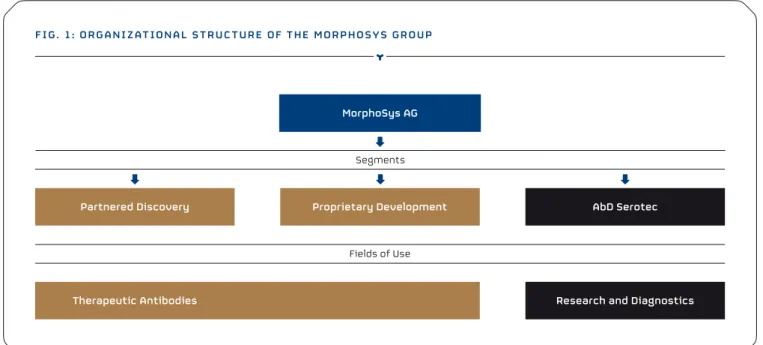
MorphoSys AG and its subsidiaries develop and commercialize high-quality antibodies for therapeutic as well as for research and diagnostic applications based on the Company’s industry-lead-ing proprietary technologies. MorphoSys operates in three busi-ness segments. Partnered Discovery generates significant value for the Company by developing drug candidates for commercial partners. This segment handles various therapeutic development programs in alliances with renowned biotechnology and pharma-ceutical companies. The second segment, Proprietary Development, also operates in the therapeutic market. The goal of this segment
fig. 1: organizat ional struc turE of thE Morphosys group
therapeutic antibodies
partnered discovery proprietary development
Morphosys ag
Segments
Fields of Use
research and diagnostics abd serotec
39
Operations and Business Environmentf in a n c ia l s t a t E M E n t s
MorphoSys carefully considers locational advantages such as good infrastructure, a qualified workforce, political support for biotech-nology and life sciences, synergies resulting from cooperation with regional research institutes, and a broadly based environment of suppliers in order to support its future growth objectives. lEgal structurE of thE Morphosys group
GROUP MANAGEMENT AND SUPERVISION
MorphoSys AG, a German stock corporation listed in the Prime Standard segment on the Frankfurt Stock Exchange, heads the MorphoSys Group. In accordance with the German Stock Corpora-tion Act, MorphoSys AG has a dual-board structure. The Company
is managed by a Management Board whose four members are ap-pointed and directed by the Supervisory Board. For more infor-mation regarding management and supervision as well as corpo-rate governance in general, please see the Corporate Governance Report on page 81. The Senior Management Group, composed of 13 people, represents the different MorphoSys departments and completes the MorphoSys management team. In the year under review, there have been no changes to the legal structure of the MorphoSys Group or its entities compared to the year before. oxford
Martinsried raleigh
düsseldorf
puchheim fig. 2: WorldWidE locat ions of thE Morphosys group
r&d g&a WarEhousE salEs Manufac t uring sEE gl ossary
s e e pag e 15 2 cross-rEfErEncEs e e pag e 8 1
g r o u p M a n a g E M E n t r E p o r t
40
NEW MEMBER OF THE MANAGEMENT BOARD
In the first quarter of 2011, MorphoSys announced a change to its Management Board, with Jens Holstein joining the Company from Fresenius Kabi. He succeeded Dave Lemus both as Chief Financial Officer of MorphoSys AG and as a member of the Management Board (Vorstand). Jens Holstein took up his position on May 1, 2011. businEss actiVitiEs
MORPHOSYS TECHNOLOGIES
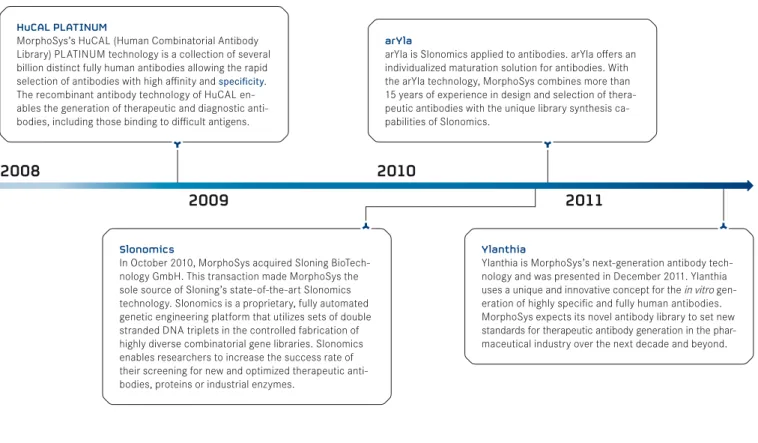
MorphoSys’s protein engineering capabilities are the foundation of its success. The Company’s most successful technology to date is the HuCAL platform, a collection of several billion distinct, fully human antibodies for the in vitro generation of highly specific antibodies. This recombinant antibody technology has enabled the generation of therapeutic and diagnostic antibodies, including those binding to difficult antigens, for over ten years now. The re-sulting product pipeline is one of the industry’s broadest and is continuously progressing. Currently, 76 therapeutic HuCAL-derived programs are in development, with several antibodies thereof be-ing studied in multiple indications.
Through the acquisition of Sloning BioTechnology GmbH in Octo-ber 2010, MorphoSys has become the sole source of Slonomics, a technology which dramatically improves the assembly and quality of protein libraries. The fully automated genetic engineering plat-form utilizes sets of double-stranded DNA triplets for the controlled fabrication of highly diverse combinatorial gene libraries. This combinatorial technology enables researchers to increase the suc-cess rate of their screening for new and optimized therapeutic anti-bodies, proteins or industrial enzymes.
In December 2011, MorphoSys unveiled the next-generation body technology, Ylanthia. Being one of the industry’s largest anti-body libraries to date, it uses a novel concept for the in vitro gen-eration of highly specific and fully human antibodies. The unique Ylanthia technology was specifically conceived and designed to overcome current limitations in therapeutic antibody development, such as poor biophysical properties or limited diversity. If required, antibodies from the Ylanthia library can be additionally optimized using Slonomics technology. This feature distinguishes Ylanthia
from the HuCAL platform, which relies on a modular gene design
and preformed cassettes for antibody optimization.
MORPHOSYS IN THE THER APEUTIC MARKET
MorphoSys is a leading provider of superior antibody technologies in the therapeutic market, above all through HuCAL, one of the most successful antibody libraries in the industry. The Company addresses the market through alliances with pharmaceutical and biotechnology companies, as well as through proprietary develop-ment activities. As a biopharmaceutical company, MorphoSys has an outstanding profile as it is able to finance all proprietary R&D activities through its own cash flows while recording solid operat-ing profits.
COMPETITIVE L ANDSCAPE
The market for therapeutic antibodies is still one of the most valu-able and fastest-growing in human healthcare. Driven by acqui-sitions, there has been a rising concentration on a small number of key technology providers over the past few years. Pharmaceutical and biotechnology companies are striving to gain access to new pipeline opportunities through M&A and in-licensing activities. This need for innovative product replenishment offers great pros-pects for companies like MorphoSys which are able to develop progressive antibody technology platforms. A major challenge how-ever, especially for smaller biotechnology developers in this field, are the limited financial capacities.
According to research company Datamonitor, more than 300 mono-clonal antibody candidates are in clinical development, with an equal number of programs (around 140 each) in phase 1 and phase 2 clinical development, 37 candidates in late-stage (phase 3) clini-cal development, and 3 candidates in preregistration. Oncology accounts for the highest number of programs in clinical develop-ment, with around half of all programs of the development process. After oncology, the second-largest therapy area includes autoim-mune and inflammatory diseases, with a total of 70 monoclonal antibodies in clinical development. The third-best represented therapy area is infectious diseases with a total of 26 programs in phase 1 clinical trials.
sEE gl ossary
s e e pag e 15 2 sEE gl ossarys e e pag e 15 2
41
Operations and Business Environmenttrifunctional antibodies, domain antibodies, nanobodies and Fc-en-gineered antibodies will foster diversity in the antibody market. Broken down into the most active companies in terms of clinical programs worldwide, Roche and its subsidiary Genentech are lead-ing the monoclonal antibody sector today. However, companies such as Amgen, Bristol-Myers Squibb or Novartis are expected to play an equally important role in the mid to long term. In the markets addressed, the need for improved therapies and innovative treatments for patients not responding to traditional methods is high and still growing. Companies like MorphoSys have realized this trend and consequently focus their R&D activities on highly innovative technologies and programs promising to generate better and safer drugs.
From a commercial point of view, the market for monoclonal anti-body drugs is extremely lucrative, amounting to US$ 41 billion in 2010 for 30 marketed antibody drugs, with the top five products alone generating revenues of around US$ 31 billion and a projected compound annual growth rate of 8.2 % until 2016.
The dominant position of the five leading products is likely to be weakened over the next few years by promising new therapies such as Amgen’s Prolia®/Xgeva® (denosumab) franchise, Bristol-Myers
Squibb’s Yervoy® (ipilimumab), and Human Genome Sciences’s and
GlaxoSmithKline’s Benlysta® (belimumab), which are expected
to account for additional market sales growth. Also, emerging tech-nologies such as antibody-drug conjugates (ADCs), bispecific and
tab. 1: t op 5 Monoclonal ant ibody drugs
generic name brand® company indications (FDA/EMA approved) revenues in us$ billion (2010)
Infliximab Remicade J&J, Merck, Mitsubishi Tanabe
Rheumatoid Arthritis, Ulcerative Colitis, Crohn’s Disease, Psoriasis, Psoriatic Arthritis, Ankylosing Spondylitis
6.6
Rituximab Rituxan Roche Non-Hodgkin Lymphoma, Chronic
Lymphocytic Leukemia, Rheumatoid Arthritis
6.6
Bevacizumab Avastin Roche Colon Cancer, Non-small Cell Lung
Cancer, Renal Cell Carcinoma
6.2 Adalimumab Humira Abbott Rheumatoid Arthritis, Psoriasis, Juvenile
Idiopathic Arthritis, Crohn’s Disease, Psoriatic Arthritis, Ankylosing Spondylitis
6.1
Trastuzumab Herceptin Roche Breast Cancer, Gastric Cancer 5.2
Source: Datamonitor sEE gl ossary s e e pag e 15 2 sEE gl ossary s e e pag e 15 2 g r o u p M a n a g E M E n t r E p o r t
42
PROPRIETARY DEVELOPMENT
MorphoSys is committed to generating value above and beyond its Partnered Discovery segment by developing innovative proprie-tary antibody products. The focus is on indications such as inflam-matory and autoimmune diseases, as well as infectious diseases and oncology. The first clinical trial data supports the great poten-tial of MorphoSys’s proprietary drugs. A solid patent position around the programs and technologies adds to the Company’s standing in the biotechnology market.
INFL AMMATORY AND AUTOIMMUNE DISE ASES
Chronic inflammatory and autoimmune disorders are a substantial social and economic burden, affecting millions of people worldwide.
According to BCC Research, the global market for autoimmune
treatments reached a total size of around US$ 38 billion by the end of 2011 and is expected to grow even further. MorphoSys’s most
advanced program, MOR103, targets GM-CSF, a key player in the
pathophysiology of inflammatory diseases. The drug is currently undergoing a clinical phase 1b/2a trial for rheumatoid arthritis (RA), and a second trial for multiple sclerosis (MS) was started in 2011. The RA market bears great commercial opportunities; more than 80 % of the arthritis drug market already consists of biologic thera-pies and the overall market is constantly growing, with a total value of around US$ 12 billion in 2010. A large number of patients are still not receiving adequate treatment, however, and the unmet medical need is high.
PARTNERED DISCOVERY
MorphoSys’s Partnered Discovery segment applies the Compa-ny’s proprietary technologies for the research, development and optimization of therapeutic antibody drug candidates in exten-sive partnerships with pharmaceutical and biotechnology compa-nies. While the development costs are borne by the respective partner, MorphoSys profits from successful programs in the form of milestone payments and potential royalties on product sales. The Company’s largest alliance is the one forged with Novartis in 2007, a pharmaceutical partner with a steadily growing biologics pipeline. This cooperation alone has safeguarded MorphoSys reve-nues through funded research and license fees totaling more than € 40 million per year until 2017, plus potential milestone payments and royalties on marketed products.
MorphoSys’s partnered programs target major indications with huge market potential. The partnered pipeline is continuously advancing and promising data from clinical trials is strengthening confidence in the Company’s technologies and scientific abilities.
sEE gl ossary s e e pag e 15 2 sEE gl ossary
s e e pag e 15 2
tab. 2: partnErEd discoVEry sEgMEnt’s sharE of t o tal rEVEnuEs*
in € million 2011 2010 2009 2008 2007
Revenues Partnered Discovery 79.3 66.3 61.7 54.3 –
% of total revenues 79 % 76 % 76 % 76 % –
* The Partnered Discovery and Proprietary Development segments were introduced in 2009.
43
Operations and Business Environmentf in a n c ia l s t a t E M E n t s
company AstraZeneca, and Micromet’s MT203 is already partnered with Takeda. Clinical data generated with mavrilimumab, which was published in 2011, provided clinical validation of the targeted pathway. Several transactions in the RA area in recent years un-derline the interest of pharmaceutical companies in novel biological treatments.
MOR103 has the potential to be first in class among anti-GM-CSF
antibodies. Other advanced programs in development are
MedIm-mune’s mavrilimumab (CAM-3001), a human monoclonal antibody
targeting the GM-CSF receptor, which is currently being evaluated in a phase 2 clinical trial, and Micromet’s MT203, another human
antibody against GM-CSF. MedImmune is part of pharmaceutical
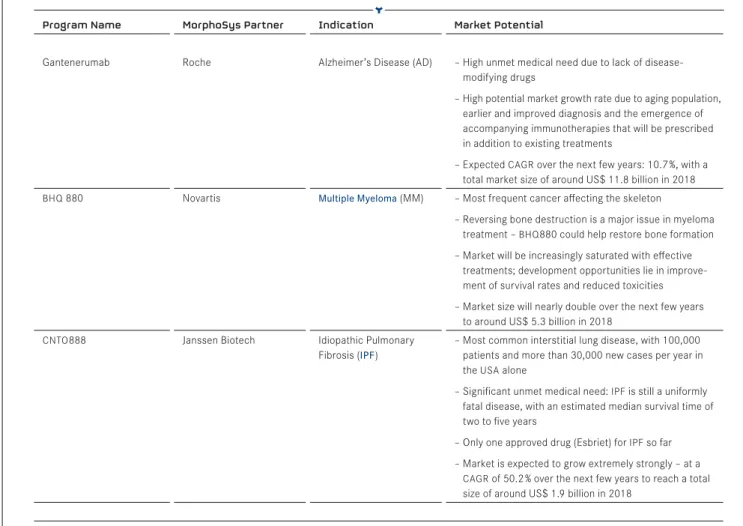
tab. 3: MarKEt data on sElEc tEd partnErEd prograMs in clinical phasE 2
program name Morphosys partner indication Market potential
Gantenerumab Roche Alzheimer’s Disease (AD) – High unmet medical need due to lack of disease- modifying drugs
– High potential market growth rate due to aging population, earlier and improved diagnosis and the emergence of accompanying immunotherapies that will be prescribed in addition to existing treatments
– Expected CAGR over the next few years: 10.7 %, with a total market size of around US$ 11.8 billion in 2018 BHQ 880 Novartis Multiple Myeloma (MM) – Most frequent cancer affecting the skeleton
– Reversing bone destruction is a major issue in myeloma treatment – BHQ880 could help restore bone formation – Market will be increasingly saturated with effective
treatments; development opportunities lie in improve-ment of survival rates and reduced toxicities – Market size will nearly double over the next few years
to around US$ 5.3 billion in 2018 CNTO888 Janssen Biotech Idiopathic Pulmonary
Fibrosis (IPF)
– Most common interstitial lung disease, with 100,000 patients and more than 30,000 new cases per year in the USA alone
– Significant unmet medical need: IPF is still a uniformly fatal disease, with an estimated median survival time of two to five years
– Only one approved drug (Esbriet) for IPF so far – Market is expected to grow extremely strongly – at a
CAGR of 50.2 % over the next few years to reach a total size of around US$ 1.9 billion in 2018
Source: Datamonitor, GlobalData, The Pharma Letter
sEE gl ossary s e e pag e 15 2
g r o u p M a n a g E M E n t r E p o r t
44
Regarding the MS market, many disease-modifying treatments are quite cost-intensive. Biologics already represent the largest class of disease-modifying therapies, both by sales and by number of approved therapies. The current top-selling MS drugs generate combined annual sales of about US$ 11 billion and the market is expected to grow. Following a period in which biologics trans-formed the MS market, the small molecules segment, which cur-rently makes up more than 30 % of the market, is expected to see a renaissance in the next three to four years. However, differences in course and severity of MS result in a large segmentation with various subtypes, i.e. relapsing/remitting forms, primary and sec-ondary progressive forms, etc., which offers different entry routes for new therapeutic agents.
Over the next couple of years, a new class of oral drugs, known as JAK inhibitors, is expected to contribute significantly to the anti-inflammatory market. JAK inhibitors block the action of proteins called Janus-associated kinases which are involved in cell-signal-ing. The first JAK inhibitor for rheumatoid arthritis, Pfizer’s tofaci-tinib, is expected to gain approval by the FDA in 2012.
INFECTIOUS DISE ASES
MorphoSys initiated an early infectious disease program against drug-resistant MRSA (methicillin-resistant S. aureus) infections in 2010. As part of this initiative, MorphoSys signed a license and collaboration agreement with UK-based Absynth Biologics, provid-ing access to novel target molecules associated with Staphylococ
cus aureus infections, including MRSA. MorphoSys generated
anti-bodies using its proprietary HuCALPLATINUMantibody library.
These antibodies are currently being further validated. MorphoSys will be solely responsible for the development and partnering of the resulting compounds.
Hospital-acquired or nosocomial infections are a growing public health concern and are associated with increasing levels of mortal-ity. The Centers for Disease Control and Prevention estimates that, in the United States alone, about 1.7 million nosocomial infections and 99,000 associated deaths occur each year. These infections
are caused by microorganisms including drug-resistant MRSA. In
the United Kingdom, S. aureus accounts for almost half of all hos-pital-acquired infections.
ONCOLOGY
The ability of monoclonal antibodies to bind to specific antigens has led to their dominant position in the area of targeted cancer therapies, and the global market for innovative biological therapies in cancer treatment is constantly growing at a very high speed. More precisely, the biotherapy segment is forecast to almost double in size by 2014, eventually exceeding US$ 50 billion in the next five to ten years, according to BCC Research.
MorphoSys has advanced two proprietary cancer programs, namely
MOR202 and MOR208, into clinical development in the last two
years. MorphoSys’s antibody MOR208 is currently undergoing a
clinical phase 1 study against chronic lymphocytic leukemia (CLL). Its immunotherapeutic target, CD19, is of particular interest for many B-cell-derived cancers. The therapeutic market for B-cell malignancies is about US$ 4 – 5 billion according to research firm Decision Resources. Existing biologics therapies against B-cell malignancies, including the blockbuster product Rituxan®, target
the cell marker CD20. Due to the target molecule being expressed on a broader range of B-cell subsets – compared to CD20 – anti-CD19 antibodies are considered to be potentially more effective. In addition, MOR208 is also improved by a modification of the con-stant Fc-part of the antibody, leading to increased cellular cyto-toxicity (ADCC).
From a commercial perspective, the market for B-cell cancer therapies is promising due to the need for alternative and more effective treatment options. The current competitive landscape in this area is marked by efforts towards technological improve-ments, and better efficacy and safety profiles. The most advanced competitive anti-CD19 antibody is Micromet’s BiTE antibody blina-tumomab (MT103), which is currently being evaluated in phase 2 studies in acute lymphoblastic leukemia (ALL). Other clinical pro-grams against the same target are pursued by, among others, AstraZeneca/MedImmune and Sanofi/Immunogen.
sEE gl ossary s e e pag e 15 2 sEE gl ossary
s e e pag e 15 2