Biomedical Research-Backed Obligations
Richard D. MacMinn
Katie School of Insurance, College of Business, Illinois State University 100 N University Street; Normal, IL 61790; USA
Email: [email protected]
Nan Zhu
∗Department of Mathematics, Illinois State University 100 N University Street; Normal, IL 61790; USA
Email: [email protected]
February 2015
Abstract
In the life settlement market mortality risk is transferred from life insurance policyholders to third party life settlement firms. This risk transfer occurs in conjunction with an information transfer that is relevant not only for pricing but also for risk management. In this analysis we compare the efficiency of two different hedging instruments in managing the mortality risk of the life settlement firm. First we claim and then demonstrate that conventional longevity-linked securities do not perform as effectively in the secondary life market, i.e., life settlement market, as in the annuity and pension markets due to the basis risk that exists between the general population and the settled subgroup. Second, we claim and then show that the life settlement firm’s risk exposure can be more effectively managed using a new instrument—the Biomedical Research-Backed Obligations. Our finding connects two seemingly independent markets and can promote the healthy development of both.
Keywords:Life Settlement; Longevity Risk; Longevity Hedging; Biomedical Research-Backed Obligations; Ambiguity Aversion
∗Corresponding author. Phone: +1-(309)-438-7838; Fax: +1-(404)-413-7499.
Biomedical Research-Backed Obligations
February 2015
Abstract
In the life settlement market mortality risk is transferred from life insurance policyholders to third party life settlement firms. This risk transfer occurs in conjunction with an information transfer that is relevant not only for pricing but also for risk management. In this analysis we compare the efficiency of two different hedging instruments in managing the mortality risk of the life settlement firm. First we claim and then demonstrate that conventional longevity-linked securities do not perform as effectively in the secondary life market, i.e., life settlement market, as in the annuity and pension markets due to the basis risk that exists between the general population and the settled subgroup. Second, we claim and then show that the life settlement firm’s risk exposure can be more effectively managed using a new instrument—the Biomedical Research-Backed Obligations. Our finding connects two seemingly independent markets and can promote the healthy development of both.
Keywords:Life Settlement; Longevity Risk; Longevity Hedging; Biomedical Research-Backed Obligations; Ambiguity Aversion
1
Introduction
Life settlements are transactions in a secondary life insurance market. In a life settlement the owner of a life insurance policy transfers the stream of future premium payments and, upon the death of the original insured, the death benefit to the life settlement firm in exchange for a lump sum payment from the life settlement firm. The lump sum payment is larger than the policy’s surrender value and this creates the incentive for life policyholders to participate in this secondary market. The life settlement market is the successor of the viatical settlement market that grew in the late 1980s due to the AIDS epidemic.
The profitability and sustainability of the life settlement market depend on the ability of market participants, i.e., life settlement companies, to generate accurate forecasts of the insureds’ life expectancies. While mortality forecasts can be improved with the employment of state-of-the-art stochastic mortality forecasting models (Hunt and Blake, 2014), not all of them allow for longevity jumps. The possibility of a biomedical breakthrough that dramatically changes life expectancy is crucial to the cash flows and solvency of life settlement firms; this is a risk that must be managed. The failure of the viatical settlement market has been attributed to the medical research that yielded the drug/therapy for AIDS patients; that drug and therapy prolonged the lives of AIDS patients and resulted in losses and bankruptcies in the viatical settlement market (Stone and Zissu, 2006). Successful invention of new drugs and treatments for other (chronic) diseases will also increase the life expectancies of the impacted patients and so impose an (adverse)longevity shock on the life settlement market.
The current life settlement market deals with this issue by hiring professional life expectancy (LE) companies to provide tailored assessment for each individual transaction. In particular, the LE companies employ physicians and medical experts when furnishing an estimation to make sure that the estimation not only covers best estimate from the individual’s current medical profile, but also contains professional insights on how the forecast would be impacted by potential advancements that are disease-specific. In a recent contribution, Brockett et al. (2013) also illustrate how to price life settlements by generating a mortality table that reflects the underwriter’s medical information
and using a double exponential jump diffusion mortality model first developed by Deng et al. (2012). While this can be used to price contracts for unhedged life settlement firms, the question on how a life settlement company can effectively manage its longevity risk remains open, interesting and important.
The capital market solutions for longevity risk have steadily evolved over the years (we refer to Blake et al. 2014 and Tan et al. 2015 for a recent update).1 While existing longevity-linked securities differ among each other in their explicit forms, they are in general designed with pay-ments dependent upon the longevity prospect of certain underlying populations (or equivalently large demographic cohorts). This reduces asymmetric information and promotes such securities in the capital market and is overall well received by market participants such as insurance com-panies and pension funds as their tools to reduce longevity exposures. However, we argue that these conventional products might not be equally effective as hedging tools in the life settlement market, due to the considerable basis risk materializing between the general population and the much smaller group of settled insureds. In particular, it is highly unlikely that the longevity shock specifically impacting the life settlement market—the potential biomedical breakthrough in some certain disease—will be systematically picked up in a population longevity index.
In a recent article, Fagnan et al. (2013) designed a new business model to finance research in the biotechnology/pharmaceutical industry. They propose a solution to the current problem of under-funding in biomedical research by combining a large number of similar drug-development projects into a single portfolio, i.e., a so-called megafund or biomedical research-backed obligations or biomedical RBOs, and further securitizing the portfolio with different tranches. While the core value of such a business model simply lies in effective diversification and risk reduction, the authors also claim that with successful securitization, the senior tranche may be rated and thus can be accessed by interested institutional investors with sufficient capitals to solve the under-funding issue. One topic left to be further explored is the attractiveness of the riskiest tranche, i.e., the
1In what follows we will use the termslongevity riskandmortality riskinterchangeably to denoteuncertaintyin
future mortality experience, although frequently researchers separate the concepts with respect to the direction of the shock.
equity tranche. The open question is: Is there any investor that would rationally prefer the equity tranche of the biomedical RBO?
In this analysis, we connect the two strands of seemingly unrelated literature, and show that life settlement firms can use biomedical RBOs to effectively manage their longevity risk. We show that the returns of such RBO, especially of the equity tranche, provide an effective instrument in hedging the longevity shock due to medical advancements. In fact, the equity tranche of the RBO alone provides a better match to the risk faced by the settlement firm than hedging the risk with other longevity-linked instruments such as a longevity bond or a q-forward.2 Hence life settlement companies are natural buyers for the equity tranche of the RBO and the RBO, in turn, promotes the healthy development of the biomedical megafund that would further promote research and development in the biotechnology/pharceutical industry.
The analysis here is conducted in two stages. First, we use a stylized three-period model to illustrate the benefit of biomedical RBOs to the life settlement industry and to compare the hedging effectiveness of the RBO with the cases of no hedging and hedging with conventional longevity products. Second, we perform in-depth numerical analysis on the optimal hedging performance coupled with robustness tests, using cancer as an example. Our goal here is not only to provide quantitative implications but also to raise awareness of the longevity hedging effects to the life settlement industry.
The remaining part of the paper is structured as follows: Section 2 investigates a represen-tative ambiguity-averse life settlement company’s longevity exposure using a simple model and compares different hedging solutions. Section 3 extends the findings by looking at more complex scenarios. Section 4 concludes.
2
The Model
Consider a three-period model. Assume that the life settlement market is competitive and com-posed of companies run by homogeneous managers; we focus on a representative life settlement firm. At date t = 0, the life settlement company purchases a whole-life insurance policy with nominal face value of1from a policyholder with a certain type of disease (denoted as disease A). Assume that based on the current medical technology, the underlying policyholder has a single-period survival probabilityp0for the first period,p1for the second period, and that the policyholder dies by the end of the third period. Further, assume that a biomedical research project on disease A is currently being conducted, has probability πA of being successful at time 1 and 1−πA of
failing. When the research succeeds, the estimated survival probability of the policyholder in the second period will be increased fromp1 top1+ ∆A. For simplicity, assume that all premiums of
the policy have been paid in full, and that the interest rate is a constantrfor each period.
In the following subsections, we first determine the benchmark price of the policy, i.e., when no hedging tool is set to be used for a risk-neutral yet ambiguity-averse life settlement company. We further explore how the company can improve its value by using different hedging tools, more specifically, with the use of conventional longevity-linked securities or medical RBOs.
2.1
A Benchmark Price
In the three-period model without the longevity shock theintrinsic valueof the policy at the time of purchase,Vn, is present value of the expected death benefits (we assume all benefits are paid at
the end of each period):
Vn = 1−p0 1 +r + p0(1−p1) (1 +r)2 + p0p1 (1 +r)3. (1)
If the longevity shock is realized, i.e., the biomedical research is successful, the intrinsic value of the policy at the time of purchase,Vs, is as follows:
Vs = 1−p0 1 +r + p0(1−p1−∆A) (1 +r)2 + p0(p1+ ∆A) (1 +r)3
= Vn− rp0∆A
(1 +r)3. (2)
The ex-anteexpected intrinsic valueof the policy is thereforeπA×Vs+ (1−πA)×Vnwhen
re-flecting the success probability of the research,πA. This is sometimes referred to as theactuarially
fair priceunder the competitive market assumption, and is denoted here asPa.
In the ideal setup, when all survival probabilities are fixed and known to the life settlement company, the idiosyncratic times of death of individuals can be treated as unsystematic risk and so can be diversified, or equivalently, reduced under the law of large numbers when grouping a large number of identical policies. In such a setting the life settlement company may be assumed to be
risk neutralwith respect to the random event of the individual’s survival. While it is common to assume risk neutrality with respect to unsystematic mortality risk on life market participants in the life insurance and actuarial literature due to effective diversification, we note that one key factor is neglected: The market participants are still affected by systematic mortality risk that cannot be diversified and should seek positive risk premiums for that, even under a competitive market assumption. This is the case we model here. In the secondary market for life insurance, the set-tlement company faces different sets of survival probabilities contingent on the outcome of the biomedical research, an event that is unobservable when the policy is purchased, and the research outcome will impact all individuals with the same disease simultaneously. Hence, research out-comes represent a non-diversifiable systematic risk for the life settlement company. The ways and means of managing this systematic risk are considered here.
In the seminal research, Ellsberg (1961) proposes to distinguish attitudes toward ambiguous probabilities from unambiguous probabilities by calling the prior ambiguity aversion(also called uncertainty aversion) and the latter risk aversion, and suggests that the two should not be treated as the same using his famous urn paradoxes. Similarly here, the life settlement company faces
ambiguoussurvival probabilities of the individual, and should exhibit aversion towards such am-biguous probabilities.
Nau (2006) based on the life settlement company’s datet = 0profit. Given an offer price P, the firm has an expected value of
EUU(P) = πA×u (1−p0)v(δ−P) +p0(1−p1−∆A)v(δ2−P) +p0(p1+ ∆A)v(δ3−P)
+(1−πA)×u (1−p0)v(δ−P) +p0(1−p1)v(δ2−P) +p0p1v(δ3 −P)
,(3)
where δ = 1+1r, v(·) is a strictly increasing first-order Bernoulli utility function reflecting the degree of risk aversion, and u(·) is a strictly increasing second-order Bernoulli utility function reflecting the degree of uncertainty aversion. Applying the additional assumption of risk neutrality (sou(x) = x), Equation (3) can be reduced to
EUU(P) = πA×u (1−p0)(δ−P) +p0(1−p1−∆A)(δ2−P) +p0(p1+ ∆A)(δ3−P) +(1−πA)×u (1−p0)(δ−P) +p0(1−p1)(δ2−P) +p0p1(δ3 −P) = πA×u (1−p0)δ+p0(1−p1−∆A)δ2+p0(p1+ ∆A)δ3−P +(1−πA)×u (1−p0)δ+p0(1−p1)δ2+p0p1δ3−P by (1) and (2) = πA×u(Vs−P) + (1−πA)×u(Vn−P), (4)
so that only uncertainty aversion remains. This model framework will be used throughout the paper.
We first show that in this model, the actuarially fair price will not be the equilibrium price as it violates theindividually rational (IR) constraintfor the life settlement company. Specifically, with any concave functionu(·), it is easy to verify that
EUU(Pa) = πA×u(Vs−Pa) + (1−πA)×u(Vn−Pa)
= πA×u(−rp0∆A(1−πA)δ3) + (1−πA)×u(rp0∆AπAδ3)
< u(−rp0∆A(1−πA)δ3×πA+rp0∆AπAδ3×(1−πA))
with the inequality a simple application of Jensen’s inequality for concave functions. Therefore, an uncertainty-averse life settlement company would rather stay out of the business—and receive a utility of u(0)—than paying the actuarially fair price that results in a smaller value due to the ambiguous survival probabilities.
For uncertainty-averse life settlement companies, the equilibrium offer pricein a competitive market, P∗, is the price such that the company isindifferentbetween remaining in the market or leaving it.3 If the market price was greater then firms would exit the market while if it was less then firms would enter the market. This implies thatP∗ satisfies
πA×u(Vs−P∗) + (1−πA)×u(Vn−P∗) =u(0). (5)
Again, for continuous and strictly increasing Bernoulli functionu(·), it is trivial to show that the solution above is unique, and thatVs< P∗ < Pa< Vn. The equilibrium priceP∗will be further used as the benchmark price in the following analyses.
2.2
Hedging Longevity Risk with Longevity Forwards
Equation (5) shows the impact that longevity risk has on the equilibrium price in the life settlement market. A number of hedging instruments exist in the nascent mortality-linked securities market, e.g., see Blake et al. (2014), including longevity bonds, swaps and forwards. While the structure of the instruments varies, most of them are designed to hedge longevity or mortality risk by generating payoffs that are based on the realization of a population mortality index. The instruments can therefore effectively hedge longevity risk in pension and annuity markets subject to some basis risk. The claim here, however, is that the current instruments are not as effective in the life settlement market. To set the stage for considering this claim, we allow the life settlement firm to hedge its longevity risk with a longevity forward contract. We will suppose the hedge is for the possible cash
3In this research, we leave out discussions on the policyholder’s decision-making, and simply assume that the
equilibrium price will always be accepted. We argue that this should not be an issue since in our model framework the policyholder possesses no hidden information with respect to her health state, and is therefore unable to extract any additional information rent from the life settlement transaction.
flows at datet = 2when the information about the success or failure of the biomedical research project is realized.
Consider a forward contract with a datet= 2payoff. Since the forward contracts are structured using a population index we modify the model as follows: Assume that the population is equally composed of two groups j = A, B: Groupj is subject to disease j and biomedical research is being conducted for each group. Similarly as group A, successful completion of research for group
Bwould change its second period survival probability fromp1top1+∆Bwith probabilityπB. The
expected population survival probability in the second period is thereforep1+12(πA∆A+πB∆B).
Now if we letM2 be the random death rate in the second period for the population then
M2 = m21 =p0 1− p1+ 12∆A+12∆B , πAπB m22 =p0 1− p1+ 12∆A , πA(1−πB) m23 =p0 1− p1+ 12∆B , (1−πA)πB m24 =p0(1−p1). (1−πA)(1−πB)
The forward contract payoff would beEM2−m2j,j = 1, 2, 3, 4.
If the realized mortalitiesm2j matched those of the firm then we would have a full hedge that
eliminated the ambiguity. A firm in a pension or annuity market would not generally be able to match the realized population mortalities due to adverse selection as well as possibly not having books of business equally representing groups A and B. This leaves such firms with some basis risk. In the case of a life settlement firm specializing in group A, the basis risk can be even more of a concern. We consider its value.
Recall the equilibrium price P∗ in (5) is set in a competitive market. Now consider a par-tial equilibrium result by allowing the life settlement firm to hedge its longevity risk with above-described forward contract. Suppose the manager selects an optimal position in forwards. Let
firm is EUF = max n πAπBu Vs−P∗+δ2n(EM2−m21) +πA(1−πB)u Vs−P∗+δ2n(EM2−m22) +(1−πA)πBu Vn−P∗+δ2n(EM2−m23) +(1−πA)(1−πB)u Vn−P∗+δ2n(EM2−m24) .
Since it can be shown that
EM2 =p0 1−p1 − 1 2πA∆A− 1 2πB∆B ,
it follows that the optimal ambiguity value of the settlement firm is the solution to the following problem: EUF = max n πAπBu Vs−P∗+δ2np0 1 2∆A(1−πA) + 1 2∆B(1−πB)) +πA(1−πB)u Vs−P∗+δ2np0 1 2∆A(1−πA)− 1 2∆BπB) +(1−πA)πBu Vn−P∗+δ2np0 1 2∆B(1−πB)− 1 2∆AπA) +(1−πA)(1−πB)u Vn−P∗+δ2np0 −1 2∆AπA− 1 2∆BπB) .
While analytically solving for the optimal position n∗ is difficult, Appendix A shows that the derivative ofEUF evaluated atn= 0is positive, i.e.
dEUF dn |n=0= 1 2πA(1−πA)∆Aδ 2p 0[u0(Vs−P∗)−u0(Vn−P∗)]>0.
Therefore the life settlement firm will choose a positive hedging in the forward market despite the basis risk that is introduced.
2.3
Hedging Longevity Risk with Biomedical RBOs
As we have noted the conventional longevity-linked securities such as q-forwards, swaps and longevity bonds could alleviate the longevity risk exposure faced by the life settlement firm. The firm, however, specializes in a particular disease and this limits the effectiveness of the conven-tional instruments. The risk analyzed here stems directly from potential medical improvement in the treatment of disease A; the most effective hedging tool with a minimal basis risk would come from an investment in a security with payments directly linked to the research and subsequent pay-off from the specific disease A. Investment in biomedical research is, however, rather exclusive. Aside from pharmaceutical firms, certain venture capitals and hedge funds there is little access to such investment opportunities.
In recent years, there has been considerable under-funding of bio-researches (Pisano, 2006). To address this issue, a recent work by Fagnan et al. (2013) proposes an alternative funding solu-tion: By constructing a megafund that targets the general investors so that more resources would be available to fund medical research. The megafund is composed of numerous research that are being conducted simultaneously on the same disease, so that the risk is controlled with effective diversification. While in Fagnan et al. (2013) the megafund was designed to attract general in-stitutional investors, we argue as follows that it provides as an excellent opportunity to the life settlement company to hedge the specific disease-related risk.
Consider a biomedical RBO here in its simplest form. Specifically, for one unit of initial investment, let the present value of the payoff streams when the research is successful be 1 +R
(with probabilityπA), and1−RπA/(1−πA)when the research fails (with probability1−πA).4
Similarly, the company will choose the optimal amount of capital K∗ invested in the biomedical
4This implies the risk premium of the investment is0, as the expected present value of the payoff is one unit, same
as the initial investment. With positive risk premiums, it can be easily verified that the life settlement company can even attain higher value, as the expected prevent value will have to be greater than one. We therefore use the zero risk premium case as the base case here. The numerical analysis in the following section considers the case of positive risk premium of the RBO investment.
RBO in order to maximize its expected ambiguity value: EUR= max K πAu(Vs−P∗+KR) + (1−πA)u Vn−P∗−K RπA 1−πA .
It follows by direct calculation that the optimum is achieved when K∗ = δ3rp0(1−πA)∆A
R . In this
case, the company receives the same payoff,Vs−P∗+δ3rp
0(1−πA)∆A=Pa−P∗, independent
of the research outcome. The following proposition compares the three alternatives to the company for dealing with the longevity risk.
Proposition 2.1. The life settlement company achieves highest expected ambiguity value when using biomedical RBOs to hedge longevity risk compared to no hedge and forward hedge cases.
Proof. WithK∗ = δ3rp0(1−πA)∆A
R ,
EUR=u(Pa−P∗)> u(0) =πA×u(Vs−P∗) + (1−πA)×u(Vn−P∗),
so using biomedical RBOs should be preferred over no hedge. On the other hand, it can be easily shown that for anyn,
πAπB(Vs−P∗+δ2np0[ 1 2∆A(1−πA) + 1 2∆B(1−πB)]) +πA(1−πB)(Vs−P∗+δ2np0[ 1 2∆A(1−πA)− 1 2∆BπB]) +πB(1−πA)(Vn−P∗+δ2np0[ 1 2∆B(1−πB)− 1 2∆AπA]) +(1−πA)(1−πB)(Vn−P∗+δ2np0[− 1 2∆AπA− 1 2∆BπB]) = πAπBVs+πA(1−πB)Vs+πB(1−πA)Vn+ (1−πA)(1−πB)Vn−P∗ = Pa−P∗.
Therefore, we have EUR > EUF again from Jensen’s inequality, i.e., using medical RBOs also improves the expected value from using longevity forwards.
longevity shock, i.e., without basis risk, the company is completely protected from the adverse shock, and can therefore achieve the highest ambiguity value compared with the other two cases. While in reality basis risk inevitably exists in biomedical RBOs, its magnitude should still be smaller when compared with conventional longevity products. Therefore, for life settlement com-panies, using biomedical RBOs should still be preferable to the other mechanisms for managing longevity risk. This is further studied in the following numerical analyses section.
3
Numerical Analyses
In this section, we conduct numerical tests on our ambiguity-averse life settlement company re-garding hedges of its longevity exposure. Using cancer as an example, we first derive the equi-librium life settlement price of a whole-life insurance policy currently owned by a cancer patient. We then show how the firm can subsequently increase its expected ambiguity value by using ei-ther longevity forwards or biomedical RBOs. Last, we compare the hedging results, followed by robustness checks.
3.1
Assumptions and Equilibrium Price
Consider the case in which a life settlement company is acquiring a whole-life insurance policy from a 75 year-old female policyholder with general cancer in year 2004.5 The policy was initially purchased when the policyholder was 40 year-old and with no disease in year 1969, with a face amount of $500,000 and level annual premiums payable at the beginning of each year, contingent on the survival of the policyholder. Using a constant 4% annual interest rate and U.S. mortality data as available from theHuman Mortality Database,6we first derive the annual premium at $5,774.13
from standard generation life table at year 1969.7
5We use year 2004 since this is the latest year with age-specific mortality rates available for cancer patients. 6Human Mortality Database. University of California, Berkeley (USA), and Max Planck Institute for Demographic
Research (Germany). Available atwww.mortality.orgorwww.humanmortality.de.
7We use the equivalence principle in deriving the annual premium at year 1969, and for simplicity disregard
ex-penses and profit margins. Generation life tables for the female population are derived using the Lee and Carter (1992) methodology and historical data from 1939 to 1968. We refer to Zhu and Bauer (2013) for a detailed explanation.
In order to furnish an unbiased price for the life settlement transaction, the life settlement company has to first consider impacts of cancer on the standard mortality table, that is, other things being equal, how will the mortality rates alter—or more precisely, increase—for a 75 year-old female with cancer compared with someone without. As specific mortality tables for cancer patients are generally unavailable in public, we rely on statistics from the National Cancer Institute to obtain approximated mortality prospects for cancer patients.8 In particular, for our representative 75 year-old policyholder, the average annual mortality rate increase caused by cancer is estimated at 0.75% in year 2004. This value is further used to scale the standard mortality rates for all ages.9 We further introduce the longevity shock by assuming that there are 150 independent cancer-related medical research currently underway, with each having a 2% chance of being successful before the respective research cycle ends. The impact of cancer on mortality rates (e.g. 0.75% additional one-year mortality rate for age 75) would be reduced by 10%, 15%, and 20%; with one, two to three, or more than three successful research outcomes, respectively.
With a 6% hurdle rate,10Table 1 shows the intrinsic values for the transaction to the life settle-ment company under various scenarios of longevity shocks, as well as the probability of occurrence for each case. Similarly as in Section 2.1, the actuarially fair offer price under competitive market is the weighted average of intrinsic values:Pa = $223,888.
To further obtain the equilibrium offer price for the uncertainty-averse life settlement company, we use a second-order Bernoulli functionu(x) = 1−exp(−ax)based on the firm’s time-0profit
x, with a = 0.002.11 The equilibrium offer price hitting the IR constraint is then calculated at
P∗ = $223,339—$549lower than the actuarially fair price. This equilibrium price will be further used as the benchmark price in the subsequent discussions.
8Cancer mortality maps available athttp://ratecalc.cancer.gov.
9We note that the National Cancer Institute interprets the 0.75% as theextrarate of mortality in addition to the
standard one-year mortality rate for a 75 year-old female.
10Here the hurdle rate is defined as the rate required by the firm to undertake such investment.
11Here, we use constant absolute risk (uncertainty) preference over constant relative risk (uncertainty) preference
since our value function is defined based on both positive and negative time-0 profit. Simple CRRA assumptions such as power functions are hence not directly applicable in our model framework.
Probability Intrinsic value # of research success 0 4.83% $227,087 1 14.78% $225,010 2-3 45.11% $223,956 >3 35.28% $222,892
Table 1: Intrinsic values of the life settlement contract. The intrinsic value is defined as the present value of the expected death benefits minus the present value of future contingent premiums, and varies based on the number of successful cancer research. The table also provides probability to each longevity shock scenario.
3.2
Longevity Hedging
After obtaining the benchmark price P∗, we further study whether and to what extent the life settlement company can improve upon its expected ambiguity value with various longevity hedging tools. We first evaluate the use of longevity forwards as an example of conventional longevity products, followed by the analyses on the newly-proposed biomedical RBOs.
Longevity Forwards
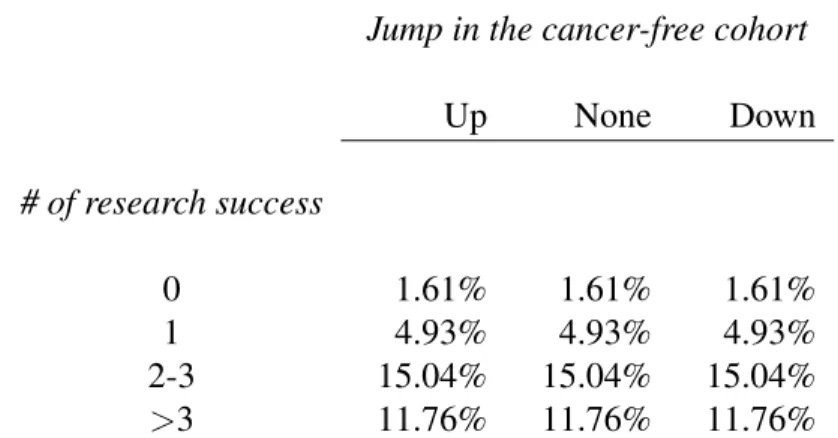
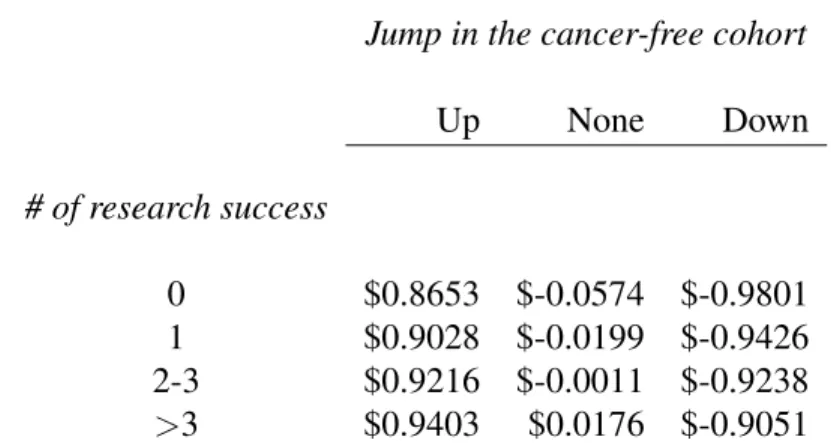
Assume a longevity forward with payments dependent on the future one-year mortality rate of the 75 year-old female general population. Naturally, further assumptions on the cancer cohort, the remaining population, and their relations are necessary to determine the exact payout structure of such longevity forward. For simplicity, we assume that cancer patients take 5% of the entire population, and that the remaining 95% individuals are in the homogeneous cancer-free cohort with mortality rate movements independent of related medical research. For the cancer-free cohort, their one-year survival rate can either move up by 0.1%, remain unchanged, or move down by 0.1%. Therefore, for the longevity forward there are in total 12 different payoff scenarios. Table 2 shows the probability of the realization of each scenario, while Table 3 shows the payoff from the longevity forward, with payment in each scenario as the difference between expected
Jump in the cancer-free cohort Up None Down # of research success 0 1.61% 1.61% 1.61% 1 4.93% 4.93% 4.93% 2-3 15.04% 15.04% 15.04% >3 11.76% 11.76% 11.76%
Table 2: Probability of each scenario of population-level mortality realization. The rows are for the cancer cohort with mortality shock represented by the number of successful cancer research. The columns are for the remaining cancer-free cohort with mortality shock denoted by a random jump.
population-level one-year mortality rate and realized population-level one-year mortality rate, scaled by $1,000. This is further defined as one position in the longevity forward.
From Tables 2 and 3, we can further calculate that for the life settlement company, the optimal position in the longevity forwards,n∗, is 13.18. This corresponds to our previous claim, namely, the life settlement company generally benefits from conventional longevity securities, despite of the considerable basis risk. The optimal expected ambiguity value of the life settlement company, EUF, is further calculated at 1.97× 10⁻⁴—a marginal improvement from the benchmark (no hedging) case where the expected value is exact 0.
Biomedical RBOs
Without loss of generality, we assume that each of the aforementioned 150 medical research projects requires an upfront investment of $1,000,000, and once successful, generates a stream of payoffs with present value at $60,000,000.12 We follow the idea in Fernandez et al. (2012) to construct a megafund funding all 150 research, which is further securitized with different tranches
12The expected present value of each investment return is$60,000,000×0.02 = $1,200,000 > $1,000,000,
i.e., the investment has positive risk premium. While this is practically necessary in order to construct different securitization tranches of the pooled megafund, we study the case of zero risk premium in the following robustness tests.
Jump in the cancer-free cohort Up None Down # of research success 0 $0.8653 $-0.0574 $-0.9801 1 $0.9028 $-0.0199 $-0.9426 2-3 $0.9216 $-0.0011 $-0.9238 >3 $0.9403 $0.0176 $-0.9051
Table 3: Payoff from the longevity forward for each corresponding scenario in Table 2. The payoff is defined as the difference between the expected and realized population-level one-year mortality rate, further scaled by $1,000.
into the general investment market. For simplicity, here we use only two instead of the typically assumed three tranches, namely the debt tranche and the equity tranche.13 We assume that out of
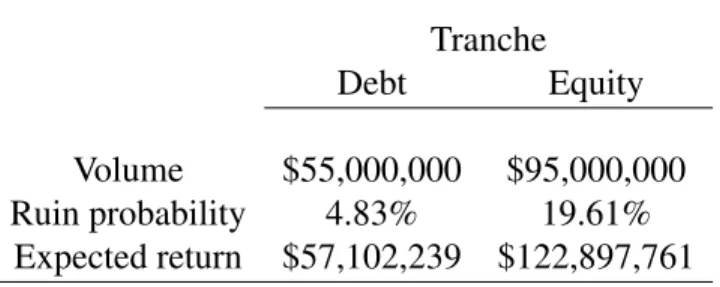
the total $150,000,000 initial investment raised in the megafund, $55,000,000 is funded through the debt tranche, with the remaining through the equity tranche. In the unlucky event of zero suc-cess out of 150, both tranches return no payment streams. Otherwise, the revenue from the first successful research goes to the debt holder, and any additional revenues that are generated from the second successful research and beyond will go to the equity holder. Table 4 provides a brief summary of the two tranches.
We assume that the life settlement company is free to invest in both debt and equity tranches, and chooses the optimal allocation to maximize its ambiguity value. Using Table 4, we calculate the optimal amount of investmentKDebt∗ = $2,133 in the debt tranche andKEquity∗ = $1,006 in the equity tranche. The realized expected ambiguity value of the life settlement company is further calculated atEUR = 0.8287.
13The debt tranche represents a relatively safe investment, while investment in the equity tranche is much more
Tranche
Debt Equity
Volume $55,000,000 $95,000,000 Ruin probability 4.83% 19.61%
Expected return $57,102,239 $122,897,761
Table 4: Summary of the biomedical RBO tranches. The volume indicates the initial investment allocated in each of the two tranches. Ruin probability gives the probability that the return does not exceed initial investment, i.e., no success for the debt tranche or less than two successes for the equity tranche. Expected return is the expected present value of payoff streams.
3.3
Comparisons and Robustness Tests
In what follows, we first compare the two hedging instruments as discussed above. Of course, our numerical finding depends on the specific parameter assumptions. We further conduct several robustness tests to check how the results change when the assumptions vary in the base case.
Comparing Hedging Tools
While the expected ambiguity value is only slightly improved when using longevity forwards (0to 1.97×10⁻⁴), it is considerably increased with the use of biomedical RBOs (0to0.8287). Again, this can be attributed to the existence of basis risk: Since conventional longevity products such as longevity forwards are based on the mortality movements of the entire population, it cannot accu-rately capture the shift of mortality for a certain subgroup, and the use of these products in longevity hedging such subgroup will inevitably bring in additional basis risk. Indeed, as suggested in Table 2, the majority of the variations in the forward payment does not come from success in cancer research, but from the random shock to the remaining population. On the other hand, biomedical RBOs are specifically correlated with the underlying disease, hence the longevity shock. Even if in our numerical analysis the mortality improvements and the investment returns are not completely correlated, the deviation is still well under control, and hedging with biomedical RBOs produces much better results.
The difference in the hedging effectiveness can be further shown using the concept ofcertainty equivalent (CE). Here we define the certainty equivalent as a hypothetical offer pricePCE from
the life settlement firm in conjunction with no hedging (cf. Equation (3)), yet gives the same positive expected ambiguity value as when hedging instruments are utilized, i.e.,EUU(PF orwardCE ) = 1.97×10⁻⁴ in the longevity forward case and EUU(PRBOCE ) = 0.8287 in the biomedical RBO case. The difference between P∗ and PCE can thus be seen as the saving from longevity risk management and serves as a more direct metric compared with expected ambiguity values. For longevity forwards and biomedical RBOs, the certainty equivalents are calculated at PCE
F orward =
$223,339andPCE
RBO = $222,604, respectively. Therefore, while longevity forwards basically lift
no burden for the life settlement firm, we do observe a significant “saving” of$735 from the use of biomedical RBOs.
Demographic Composition
For robustness tests, we first revisit the payment structure of longevity forwards under different demographic compositions. Similar to the base case, here we assume that the entire population is composed of both cancer patients and cancer-free cohort, and that the behavior of longevity shock within each subgroup remains the same. We then adjust the assumption on the percentage of cancer patients in the entire population. Table 5 shows the optimal position in longevity forwards,n∗, the expected ambiguity value, EUF, as well as the associated certainty equivalent,PCE
F orward, for the
cancer ratio varying between 5 to 95 percent. From the table, it is apparent that the longevity hedging becomes more effective as the cancer ratio increases, i.e., when the residual basis risk becomes less pronounced. However, we also observe that longevity forwards still perform inferior to biomedical RBOs, even in the extreme case where the cancer patients take 95% of the entire population.
Percentage of cancer patients in the population
5% 25% 50% 75% 95%
n∗ 13.18 105.42 471.02 2,129.20 2,907.11 EUF 1.97×10⁻⁴ 0.0078 0.0670 0.3802 0.6546 PF orwardCE $223,339 $223,335 $223,305 $223,100 $222,808
Table 5: Robustness test on the percentage of cancer patients in the entire population varying from 5 to 95 percent. Here, n∗ denotes the optimal position in the longevity forwards, EUF is
the associated expected ambiguity value of the life settlement firm, and PF orwardCE is the certainty equivalent.
Restriction on Biomedical RBOs Investment
It is possible that the life settlement company does not have full access to both debt and equity tranches simultaneously, but can only choose to invest in one. To analyse the sensitivity to such restriction on investment, we modify the associated optimization problem by restricting the life settlement firm to only invest in either the debt or equity tranche. The results are summarized in Table 6. From the table we observe that while investing in either tranche can still improve the firm’s ambiguity value considerably, the riskier equity tranche outperforms the debt tranche in terms of hedging effectiveness. This should not be surprising, since the equity tranche provides compensation when the longevity risk is excessive, whereas the debt tranche provides much less protection to the longevity shock. The life settlement firm therefore serves as a natural buyer of the equity tranche in the market.
Zero Risk Premium for Biomedical RBOs
One extreme case that is worth testing is when we assume zero risk premium for the biomedical RBOs, i.e., when the present value of the payoff streams equates initial investment within each tranche, regardless of the risk level of the investment. While this is highly unlikely in practice, it can be seen as the bottom line of the hedging effectiveness of using biomedical RBOs, similarly as the assumptions in Section 2.
Restriction on RBOs investment Debt Only Equity Only
K∗ $3,726 $1,085 EUR 0.4459 0.7701 PRBOCE $223,044 $222,604
Table 6: Robustness test on the restriction to biomedical RBOs investment. Here,K∗denotes the optimal investment in either tranche, EUR is the associated expected ambiguity value of the life
settlement firm, andPCE
RBO is the certainty equivalent.
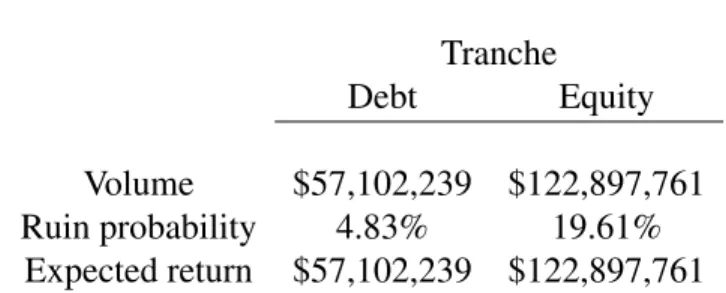
For the same 150 independent medical research projects, the upfront cost of each project needs to increase to $1,200,000 under the zero risk premium assumption.14 From the total $180,000,000 raised in the megafund, we can further reallocate the fair share of the debt tranche and the equity tranche based on the associated ruin probabilities. The updated summary of the biomedical RBO is displayed in Table 7. Table 8 further shows the results from the optimization as well as the associated certainty equivalent in different cases regarding restrictions on biomedical RBO invest-ment. From the table we observe similar results as in the positive risk premium case. In particular, biomedical RBOs still perform rather well in terms of longevity hedging, and the majority of the improvement in the expected ambiguity value stems from the risky equity tranche.
4
Conclusion
In this paper we investigate longevity risk management of an ambiguity-averse life settlement company by comparing two hedging instruments: Conventional longevity forwards and biomedical RBOs. We show that the prior perform rather poorly in terms of hedging due to the non-negligible basis risk between the general population and the settled subgroup, whereas the latter overcome this issue by providing returns that are strongly positively correlated with the specific longevity shock. The life settlement industry therefore becomes the natural buyer of this novel security and
14The expected present value of the investment return is $60,000,000×0.02 = $1,200,000, the same as the
Tranche
Debt Equity
Volume $57,102,239 $122,897,761 Ruin probability 4.83% 19.61%
Expected return $57,102,239 $122,897,761
Table 7: Summary of the modified biomedical RBO tranches. The volume indicates the initial investment allocated in each of the two tranches. Ruin probability gives the probability that the return does not exceed initial investment, i.e., no success for the debt tranche or less than two success for the equity tranche. Expected return is the expected present value of payoff streams. Here in both tranches the volume is the same as the expected return to meet the zero risk premium assumption.
Zero risk premium for biomedical RBOs Debt Only Equity Only Both
KDebt∗ $3,591 $2,180
KEquity∗ $1,092 $1,030 EUR 0.2702 0.5958 0.6588 PCE
RBO $223,182 $222,886 $222,802
Table 8: Robustness test on the case of zero risk premium for biomedical RBOs. Here,Ki∗denotes the optimal investment in each tranche, i = Debt or Equity, EUR is the associated expected ambiguity value of the life settlement firm, andPRBOCE is the certainty equivalent.
this would in turn promote the healthy development of both markets.
In the analysis we assume that the life settlement firm only focuses on patients with a certain disease and the rest are hence treated as basis risk to the firm. In reality life settlement companies deal with different types of clients and it shall be of interest to test whether traditional longevity products fare better when the firm buys policies from a spectre of policyholders. While this calls for future studies, we leave a short note here that conventional longevity securities can only work effectively if there exists no considerable basis risk between the general population and the settled subgroup. On the other hand, the firm can always invest in different biomedical RBOs for differ-ent diseases and solve the optimization problems separately, not to mdiffer-ention the gaining of extra positive risk premiums from such investment.
As biomedical RBOs provide a direct route for the life settlement industry to receive returns that are positively related with medical research, another topic that might be interesting in practice is what other alternatives are available in generating similar patterns of return. One candidate would be to purchase stocks of biomedical firms. However, we argue that this too might not work as effectively as biomedical RBOs: The stock prices are usually confounded by many other factors uncorrelated with the medical research and so with any longevity shock. Further, front line research projects are often conducted by labs and firms that are not publicly traded and so are not available as potential hedging instruments.
References
Blake, D., R.D. MacMinn, J.S.H. Li, M. Hardy (2014). “Longevity Risk and Capital Markets: The 2012-2013 Update.” North American Actuarial Journal, 18: 1-13.
Brockett, P.L., S. Chuang, Y. Deng, R.D. MacMinn (2013). “Incorporating Longevity Risk and Medical Information into Life Settlement Pricing.”Journal of Risk and Insurance, 80: 799-825. Deng, Y., P.L. Brockett, R.D. MacMinn (2012). “Longevity/Mortality Risk Modeling and
Ellsberg, D. (1961). “Risk, Ambiguity, and the Savage Axioms.” The Quarterly Journal of Eco-nomics, 75: 643-669.
Fagnan, D.E., J.M. Fernandez, A.W. Lo, R.M. Stein (2013). “Can Financial Engineering Cure Cancer?” American Economic Review, 103: 406-411.
Fernandez, J.M., R.M. Stein, A.W. Lo (2012). “Commercializing biomedical research through securitization techniques.” Nature Biotechnology, 30: 964-975.
Hunt, A., D. Blake (2014). “A General Procedure for Constructing Mortality Models.” North American Actuarial Journal, 18: 116-138.
Lee, R.D., L.R. Carter (1992). “Modeling and Forecasting U.S. Mortality”. Journal of the Ameri-can Statistical Association, 87: 659-671.
Nau, R.F. (2006). ”Uncertainty Aversion with Second-Order Utilities and Probabilities.” Manage-ment Science, 52: 136-145.
Pisano,G.P. (2006). “Science Business: The Promise, the Reality, and the Future of Biotech.”
Harvard Business School Press, Boston, Massachusetts, 2006.
Stone, C.A., A. Zissu (2006). “Securitization of Senior Life Settlements: Managing Extension Risk.” Journal of Derivatives, 13: 66-72.
Tan, K.S., D. Blake, R.D. MacMinn (2015). “Longevity Risk and Capital Markets: The 2013-14 Update.” Insurance: Mathematics and Economics, forthcoming.
Zhu, N, D. Bauer (2013). “Coherent Pricing of Life Settlements Under Asymmetric Information.”
Appendix
A
Derivative of
E
U
FFromEUF, we immediately have
dEUF dn = πAπBu 0 Vs−P∗+δ2n(EM2−m21) δ2(EM2−m21) +πA(1−πB)u0 Vs−P∗ +δ2n(EM2−m22) δ2(EM2−m22) +(1−πA)πBu0 Vn−P∗+δ2n(EM2−m23) δ2(EM2−m23) +(1−πA)(1−πB)u0 Vn−P∗+δ2n(EM2−m24) δ2(EM2−m24), so that dEUF dn |n=0 = πAπBu 0(Vs−P∗)δ2( EM2−m21) +πA(1−πB)u0(Vs−P∗)δ2(EM2−m22) +(1−πA)πBu0(Vn−P∗))δ2(EM2−m23) +(1−πA)(1−πB)u0(Vn−P∗)δ2(EM2−m24) = u0(Vs−P∗)δ2p0 πAπB 1 2∆A(1−πA) + 1 2∆B(1−πB)) +πA(1−πB) 1 2∆A(1−πA)− 1 2∆BπB) +u0(Vn−P∗)δ2p0 (1−πA)πB 1 2∆B(1−πB)− 1 2∆AπA)) +(1−πA)(1−πB) −1 2∆AπA− 1 2∆BπB) = u0(Vs−P∗)δ2p0× 1 2πA(1−πA)∆A−u 0 (Vn−P∗)δ2p0× 1 2πA(1−πA)∆A = 1 2πA(1−πA)∆Aδ 2p 0[u0(Vs−P∗)−u0(Vn−P∗)].
Sinceu0 >0,u00<0, andVs < Vn, it immediately follows that dEUF