FIRE PROTECTION SYSTEMS
SECTION 901 GENERAL
901.1 Scope.The provisions of this chapter shall specify where fire protection systems are required and shall apply to the de-sign, installation, inspection, operation, testing and mainte-nance of all fire protection systems.
901.2 Construction documents.The fire code official shall have the authority to require construction documents and cal-culations for all fire protection systems and to require permits be issued for the installation, rehabilitation or modification of any fire protection system. Construction documents for fire protection systems shall be submitted for review and approval prior to system installation. See Section 105.2.8.
901.2.1 Statement of compliance.Before requesting final approval of the installation, where required by the fire code official, the installing contractor shall furnish a written statement to the fire code official that the subject fire protec-tion system has been installed in accordance with approved plans and has been tested in accordance with the manufac-turer’s specifications and the appropriate installation stan-dard. Any deviations from the design standards shall be noted and copies of the approvals for such deviations shall be attached to the written statement.
901.3 Permits.Permits shall be required as set forth in Section 105.6 and 105.7.
901.4 Installation.Fire protection systems shall be installed and maintained in accordance with the original installation standards for that system. Required systems shall be extended, altered, or augmented as necessary to maintain and continue protection whenever the building is altered, remodeled or added to. Alterations to fire protection systems shall be done in accordance with applicable standards.
901.4.1 Required fire protection systems.Fire protection systems required by this code or theInternational Building Codeshall be installed, repaired, operated, tested and main-tained in accordance with this code.
901.4.2 Nonrequired fire protection systems. Any fire protection system or portion thereof not required by this code or theInternational Building Codeshall be allowed to be furnished for partial or complete protection provided such installed system meets the requirements of this code and theInternational Building Code.
901.4.3 Additional fire protection systems.In occupan-cies of a hazardous nature, where special hazards exist in ad-dition to the normal hazards of the occupancy, or where the fire code official determines that access for fire apparatus or fire personnel is unduly difficult, the fire code official shall have the authority to require additional safeguards. Such safeguards include, but shall not be limited to, the follow-ing: automatic fire detection systems, fire alarm systems, automatic fire-extinguishing systems, standpipe systems, or
portable or fixed extinguishers. Fire protection equipment required under this section shall be installed in accordance with this code and the applicable referenced standards. 901.4.4 Appearance of equipment.Any device that has the physical appearance of life safety or fire protection equip-ment but that does not perform that life safety or fire protec-tion funcprotec-tion, shall be prohibited.
901.5 Installation acceptance testing. Fire detection and alarm systems, fire-extinguishing systems, fire hydrant sys-tems, fire standpipe syssys-tems, fire pump syssys-tems, private fire service mains and all other fire protection systems and appurte-nances thereto shall be subject to acceptance tests as contained in the installation standards and as approved by the fire code of-ficial. The fire code official shall be notified before any re-quired acceptance testing.
901.5.1 Occupancy.It shall be unlawful to occupy any por-tion of a building or structure until the required fire protec-tion systems have been tested and approved.
901.6 Inspection, testing and maintenance.Fire detection, alarm and extinguishing systems shall be maintained in an op-erative condition at all times, and shall be replaced or repaired where defective. It shall be the responsibility of the owner to ensure that these requirements are met. Nonrequired fire pro-tection systems and equipment shall be inspected, tested and maintained or removed.
Prior to the removal of any fire protection system, a permit shall be obtained from the fire code official.
901.6.1 Standards. Fire protection systems shall be in-spected, tested and maintained in accordance with the stan-dards referenced in Chapter 45 of this code.
901.6.2 Records.Records of all system inspections, tests, and maintenance required by the referenced standards shall be maintained on the premises for a minimum of 3 years and made available to the fire code official upon request. 901.6.3 Inspections and tests.At a minimum, all fire pro-tection systems shall be inspected and tested annually by a contractor licensed by the State of Arizona who has a cur-rent Business Certificate issued by the Phoenix Fire Depart-ment to work on the particular fire protection system being inspected or tested. See Section 105.6.
Kitchen hood and extinguishing systems shall be in-spected and tested every six months by a contractor who has a current Business Certificate issued by the Phoenix Fire Department.
Exception: In R-3 occupancies the owner shall be re-sponsible for inspecting and testing all fire protection and detection systems.
901.6.4 Inspection forms.Inspection and test records shall be documented on forms that comply with the appropriate inspection standard. The forms shall clearly identify type
and quantities of all components inspected or tested and identify all deficiencies found. Deficiencies shall be identi-fied by the appropriate code or standard reference.
Inspection and test reports and records shall include the name of the company performing the inspection or test, the Phoenix Fire Department business certificate number, and the printed name and signature of the company representa-tive performing the inspection and tests.
901.6.5 Inspection and testing tags.Upon completion of the inspection and testing of fire protection systems, a tag shall be attached to the system in a conspicuous location. The tag shall document the date of inspection or test, the name and business certificate number of the fire protection company, the name of the individual performing the inspec-tion and tests, and a statement of compliance or noncompli-ance with code requirements. When a deficiency report is issued a copy shall be sent to the Division of Fire Preven-tion. Copy shall be signed by the building representative. 901.7 Systems out of service.Where a required fire protection system is out of service, the Phoenix Fire Department Alarm Room, 602-495-5555, and the fire code official shall be noti-fied immediately. Where required by the fire code official, the building shall either be evacuated or an approved fire watch shall be provided for all occupants left unprotected by the shut down until the fire protection system has been returned to ser-vice. Fire watch shall be in accordance with Section 115.
Exception:R-3 occupancies.
901.7.1 Impairment coordinator. The building owner shall assign an impairment coordinator to comply with the requirements of this section. In the absence of a specific designee, the owner shall be the impairment coordinator. 901.7.2 Impairment tag required.A tag shall be used to indicate that a system, or portion thereof, has been removed from service.
901.7.3 Placement of tag.The tag shall be posted at each fire department connection, system control valve, fire alarm control unit, fire alarm annunciator and fire command cen-ter, indicating which system, or part thereof, has been re-moved from service.
901.7.4 Preplanned impairment programs. Preplanned impairments shall be authorized by the impairment nator. Before authorization is given, the impairment coordi-nator shall be responsible for verifying that all of the following procedures have been implemented:
1. The extent and expected duration of the impairment have been determined.
2. The areas or buildings involved have been inspected and the increased risks determined.
3. Recommendations have been submitted to manage-ment or building owner/manager.
4. The Phoenix Fire Department Alarm Room has been notified at 602-495-5555.
5. The insurance carrier, the alarm company, building owner/manager, and other authorities having jurisdic-tion have been notified.
6. The occupants in the areas to be affected have been notified.
7. A tag impairment system has been implemented. 8. Additional procedures as determined by the
impair-ment coordinator.
901.7.5 Emergency impairments.When unplanned im-pairments occur, appropriate emergency action shall be taken to minimize potential injury and damage. The impair-ment coordinator shall impleimpair-ment the steps outlined in Sec-tion 901.7.4.
901.7.6 Restoring systems to service. When impaired equipment is restored to normal working order, the impair-ment coordinator shall verify that all of the following proce-dures have been implemented:
1. Necessary inspections and tests have been conducted to verify that affected systems are operational. 2. Occupants in the affected area have been advised that
protection is restored.
3. The Phoenix Fire Department Alarm Room has been a d v i s e d t h a t p r o t e c t i o n i s r e s t o r e d . C a l l 602-495-5555.
4. The building owner/manager, insurance carrier, alarm company, and other involved parties have been ad-vised that protection is restored.
5. The impairment tag has been removed.
901.8 Removal of or tampering with equipment.It shall be unlawful for any person to remove, tamper with or otherwise disturb any fire hydrant, fire detection and alarm system, fire suppression system, or other fire appliance required by this code except for the purpose of extinguishing fire, training pur-poses, recharging or making necessary repairs, or when ap-proved by the fire code official.
901.8.1 Removal of or tampering with appurtenances. Locks, gates, key boxes, key switches, preemption devices, doors, barricades, chains, enclosures, signs, tags or seals which have been installed by or at the direction of the fire code official shall not be removed, unlocked, destroyed, tampered with or otherwise vandalized in any manner. 901.9 Clearance around fire-protection systems and equip-ment.A minimum 3-foot clear space shall be maintained for access to fire protection equipment, including control valves and control panels.
Exception:Sprinkler control valves above ceilings.
SECTION 902 DEFINITIONS
902.1 Definitions.The following words and terms shall, for the purposes of this chapter and as used elsewhere in this code, have the meanings shown herein.
ALARM NOTIFICATION APPLIANCE.A fire alarm sys-tem component such as a bell, horn, speaker, light, or text dis-play that provides audible, tactile, or visible outputs, or any combination thereof.
ALARM SIGNAL.A signal indicating an emergency requir-ing immediate action, such as a signal indicative of fire. ALARM VERIFICATION FEATURE. A feature of auto-matic fire detection and alarm systems to reduce unwanted alarms wherein smoke detectors report alarm conditions for a minimum period of time, or confirm alarm conditions within a given time period, after being automatically reset, in order to be accepted as a valid alarm-initiation signal.
ANNUNCIATOR. A unit containing one or more indicator lamps, alphanumeric displays, or other equivalent means in which each indication provides status information about a cir-cuit, condition or location.
AUDIBLE ALARM NOTIFICATION APPLIANCE. A notification appliance that alerts by the sense of hearing. AUTOMATIC.As applied to fire protection devices, is a de-vice or system providing an emergency function without the necessity for human intervention and activated as a result of a predetermined temperature rise, rate of temperature rise, or combustion products.
AUTOMATIC FIRE-EXTINGUISHING SYSTEM. An approved system of devices and equipment which automati-cally detects a fire and discharges an approved fire-extinguish-ing agent onto or in the area of a fire.
AUTOMATIC SPRINKLER SYSTEM.A sprinkler system, for fire protection purposes, is an integrated system of under-ground and overhead piping designed in accordance with fire protection engineering standards. The system includes a suit-able water supply. The portion of the system above the ground is a network of specially sized or hydraulically designed piping installed in a structure or area, generally overhead, and to which automatic sprinklers are connected in a systematic pat-tern. The system is usually activated by heat from a fire and dis-charges water over the fire area.
AVERAGE AMBIENT SOUND LEVEL. The root mean square, A-weighted sound pressure level measured over a 24-hour period.
CARBON DIOXIDE EXTINGUISHING SYSTEM.A sys-tem supplying carbon dioxide (CO2) from a pressurized vessel through fixed pipes and nozzles. The system includes a man-ual- or automatic-actuating mechanism.
CLEAN AGENT.Electrically nonconducting, volatile or gas-eous fire extinguishing agent that does not leave a residue upon evaporation.
COMMON AREA.For the purposes of ADA compliance for visual notification, a common area shall be a room, space or el-ement made available for the use of a restricted group of people (for example, occupants of a homeless shelter; the occupants of an office building, or the guests of such occupants). Common areas shall include restrooms, hallways, lobbies, meeting and conference rooms, classrooms, cafeterias, filing and photo-copy rooms, employee break rooms, open office areas exceed-ing 300 square feet, examination and treatment rooms, and similar areas that are not used solely as employee work areas in accordance with the U.S. Access Board Technical Bulletin on Visual Alarms. Mechanical, electrical and telephone closets, janitor’s closets, and similar nonoccupiable spaces that are not
common areas or assigned work areas are not required to have visual alarms.
CONSTANTLY ATTENDED LOCATION. A designated location at a facility staffed by trained personnel on a continu-ous basis where alarm or supervisory signals are monitored and facilities are provided for notification of the fire department or other emergency services.
DELUGE SYSTEM. A sprinkler system employing open sprinklers attached to a piping system connected to a water sup-ply through a valve that is opened by the operation of a detec-tion system installed in the same area as the sprinklers. When this valve opens, water flows into the piping system and dis-charges from all sprinklers attached thereto.
DETECTOR, HEAT. A fire detector that senses heat pro-duced by burning substances. Heat is the energy propro-duced by combustion that causes substances to rise in temperature. DRY-CHEMICAL EXTINGUISHING AGENT.A powder composed of small particles, usually of sodium bicarbonate, potassium bicarbonate, urea-potassium-based bicarbonate, potassium chloride or monoammonium phosphate, with added particulate material supplemented by special treatment to pro-vide resistance to packing, resistance to moisture absorption (caking) and the proper flow capabilities.
EMERGENCY ALARM SYSTEM.A system to provide in-dication and warning of emergency situations involving haz-ardous materials.
EMERGENCY VOICE/ALARM COMMUNICATIONS. Dedicated manual or automatic facilities for originating and distributing voice instructions, as well as alert and evacuation signals pertaining to a fire emergency, to the occupants of a building.
FIRE ALARM BOX, MANUAL. See “Manual fire alarm box.”
FIRE ALARM CONTROL PANEL.See “Fire Alarm Con-trol Unit”.
FIRE ALARM CONTROL UNIT.A system component that receives inputs from automatic and manual fire alarm devices and is capable of supplying power to detection devices and transponder(s) of off-premises transmitter(s). The control unit is capable of providing a transfer of power to the notification appliances and transfer of condition to relays of devices. FIRE ALARM SIGNAL. A signal initiated by a fire alarm-initiating device such as a manual fire alarm box, auto-matic fire detector, water-flow switch, or other device whose activation is indicative of the presence of a fire or fire signature. FIRE ALARM SYSTEM.A system or portion of a combina-tion system consisting of components and circuits arranged to monitor and annunciate the status of fire alarm or supervisory signal-initiating devices and to initiate the appropriate re-sponse to those signals.
FIRE AREA.The aggregate floor area enclosed and bounded by fire walls, fire barriers, exterior walls, or fire-resis-tance-rated horizontal assemblies of a building.
FIRE DETECTOR, AUTOMATIC. A device designed to detect the presence of a fire signature and to initiate action.
FIRE PROTECTION SYSTEM.Approved devices, equip-ment and systems or combinations of systems used to detect a fire, activate an alarm, extinguish or control a fire, control or manage smoke and products of a fire or any combination thereof.
FIRE SAFETY FUNCTIONS. Building and fire control functions that are intended to increase the level of life safety for occupants or to control the spread of the harmful effects of fire. FOAM-EXTINGUISHING SYSTEM.A special system dis-charging a foam made from concentrates, either mechanically or chemically, over the area to be protected.
HALOGENATED EXTINGUISHING SYSTEM. A
fire-extinguishing system using one or more atoms of an ele-ment from the halogen chemical series: fluorine, chlorine, bro-mine and iodine.
IMPAIRMENT COORDINATOR.The person responsible for the maintenance of a particular fire protection system. INITIATING DEVICE.A system component that originates transmission of a change-of-state condition, such as in a smoke detector, manual fire alarm box, or supervisory switch. MANUAL FIRE ALARM BOX.A manually operated device used to initiate an alarm signal.
MULTIPLE-STATION ALARM DEVICE. Two or more single-station alarm devices that can be interconnected such that actuation of one causes all integral or separate audible alarms to operate. It also can consist of one single-station alarm device having connections to other detectors or to a manual fire alarm box.
MULTIPLE-STATION SMOKE ALARM. Two or more single-station alarm devices that are capable of interconnection such that actuation of one causes all integral or separate audible alarms to operate.
NUISANCE ALARM.An alarm caused by mechanical fail-ure, malfunction, improper installation, or lack of proper main-tenance, or an alarm activated by a cause that cannot be determined.
PRIMARY STRUCTURAL SYSTEM.A system that con-sists of beams, columns, slabs (floors) and load bearing walls incorporated by design to support gravity loads and resist lat-eral forces.
RECORD DRAWINGS.Drawings (“as builts”) that docu-ment the location of all devices, appliances, wiring, sequences, wiring methods, and connections of the components of a fire alarm system as installed.
SINGLE-STATION SMOKE ALARM.An assembly incor-porating the detector, the control equipment, and the alarm-sounding device in one unit, operated from a power sup-ply either in the unit or obtained at the point of installation. [B] SLEEPING UNIT. A room or space in which people sleep, which can also include permanent provisions for living, eating, and either sanitation or kitchen facilities but not both. Such rooms and spaces that are also part of a dwelling unit are not sleeping units.
SMOKE ALARM. A single- or multiple-station alarm re-sponsive to smoke and not connected to a system.
SMOKE DETECTOR.A listed device that senses visible or invisible particles of combustion.
STANDPIPE SYSTEM, CLASSES OF. Standpipe classes are as follows:
Class I system.A system providing 2.5-inch (64 mm) hose connections to supply water for use by fire departments and those trained in handling heavy fire streams.
Class II system.A system providing 1.5-inch (38 mm) hose stations to supply water for use primarily by the building oc-cupants or by the fire department during initial response. Class III system.A system providing 1.5-inch (38 mm) hose stations to supply water for use by building occupants and 2.5-inch (64 mm) hose connections to supply a larger volume of water for use by fire departments and those trained in handling heavy fire streams.
STANDPIPE, TYPES OF.Standpipe types are as follows: Automatic dry.A dry standpipe system, normally filled with pressurized air, that is arranged through the use of a de-vice, such as a dry pipe valve, to admit water into the system piping automatically upon the opening of a hose valve. The water supply for an automatic dry standpipe system shall be capable of supplying the system demand.
Automatic wet.A wet standpipe system that has a water supply that is capable of supplying the system demand auto-matically.
Manual dry.A dry standpipe system that does not have a permanent water supply attached to the system. Manual dry standpipe systems require water from a fire department pumper to be pumped into the system through the fire de-partment connection in order to supply the system demand. Manual wet.A wet standpipe system connected to a water supply for the purpose of maintaining water within the sys-tem but which does not have a water supply capable of deliv-ering the system demand attached to the system. Manual wet standpipe systems require water from a fire department pumper (or the like) to be pumped into the system in order to supply the system demand.
Semiautomatic dry. A dry standpipe system that is ar-ranged through the use of a device, such as a deluge valve, to admit water into the system piping upon activation of a re-mote control device located at a hose connection. A rere-mote control activation device shall be provided at each hose con-nection. The water supply for a semiautomatic dry standpipe system shall be capable of supplying the system demand.
SUPERVISING STATION.A facility that receives signals and at which personnel are in attendance at all times to respond to these signals.
SUPERVISORY SERVICE.The service required to monitor performance of guard tours and the operative condition of fixed suppression systems or other systems for the protection of life and property.
SUPERVISORY SIGNAL.A signal indicating the need of action in connection with the supervision of guard tours, the fire suppression systems or equipment, or the maintenance fea-tures of related systems.
SUPERVISORY SIGNAL-INITIATING DEVICE.An ini-tiating device such as a valve supervisory switch, water level indicator, or low-air pressure switch on a dry-pipe sprinkler system whose change of state signals an off-normal condition and its restoration to normal of a fire protection or life safety system; or a need for action in connection with guard tours, fire suppression systems or equipment, or maintenance features of related systems.
TROUBLE SIGNAL.A signal initiated by the fire alarm sys-tem or device indicative of a fault in a monitored circuit or com-ponent.
VISIBLE ALARM NOTIFICATION APPLIANCE.A no-tification appliance that alerts by the sense of sight.
WET-CHEMICAL EXTINGUISHING AGENT. A solu-tion of water and potassium-carbonate-based chemical, potas-sium-acetate-based chemical or a combination thereof, forming an extinguishing agent.
WIRELESS PROTECTION SYSTEM.A system or a part of a system that can transmit and receive signals without the aid of wire.
ZONE.A defined area within the protected premises. A zone can define an area from which a signal can be received, an area to which a signal can be sent, or an area in which a form of con-trol can be executed.
SECTION 903
AUTOMATIC SPRINKLER SYSTEMS
903.1 General. Automatic sprinkler systems shall comply with this section.
903.1.1 Design Documents.For fire sprinkler systems, the following are considered to be professional registrant activi-ties in accordance with the requirements of the Arizona Board of Technical Registration:
1. Consider the range of hazards of the project; 2. Prepare hazard analysis; identify the hazard
classifi-cation of the intended occupancy, including any spe-cial hazards;
3. Determine the applicable codes and standards and ap-propriate engineering practices;
4. Ascertain the availability and adequacy of the water supply for the project;
5. Determine the appropriate design density and area of operation for each hazard area.
These activities need to be completed prior to development of construction documents to be submitted for permit.
Exception: Automatic Sprinkler Systems installed in ac-cordance with NFPA 13D.
903.1.1.1 Owner responsibilities.The owner of a build-ing or structure where the fire sprinkler system is gobuild-ing to be installed, or their authorized agent, shall provide the design professional with the following information prior to preparation of design documents.
1. Intended use of the building.
2. A description of the materials to be used or stored within the building.
3. A description of how the materials are to be used in the building.
4. A description of the commodity stored and proposed storage configuration including the maximum height. 5. A preliminary plan of the building or structure along with the design concepts necessary to prepare the de-sign documents listed in Section 903.1.1.
Exception:Automatic Sprinkler Systems installed in accordance with NFPA 13D.
Speculative buildings shall be in accordance with Chapter 23.
903.1.2 Construction documents. Construction docu-ments shall be in accordance with NFPA 13.
903.1.3 Alternative protection. Alternative automatic fire-extinguishing systems complying with Section 904 shall be permitted in lieu of automatic sprinkler protection where recognized by the applicable standard and approved by the fire code official.
903.2 Bret Tarver Sprinkler Ordinance. Approved auto-matic sprinkler systems in new buildings and structures shall be provided in the locations described in this section.
An automatic sprinkler system shall be installed throughout all levels of all new Group A, B, E, F, H, I, M, R-1, R-2, R-4 and S occupancies of more than zero square feet and throughout all R-3 occupancies of more than 5,000 square feet.
The calculated area of R-3 occupancies shall include all liv-able space and the area of any attached garage and carports or areas located under living spaces.
Automatic sprinkler protection shall be installed in aircraft hangars greater than 5,000 square feet accessory to R-3 occu-pancies.
Automatic sprinkler protection shall be installed in agricul-ture buildings, barns, greenhouses and private garages greater than 5,000 square feet and classified as Group U occupancies.
Automatic sprinkler systems shall be installed in accordance with NFPA 13 for Group A, B, E, F, H, I, M, R-1, R-2, R-4 and S occupancies. NFPA 13R for residential occupancies up to and including four stories in height, in groups R-1, R-2, R-4 oc-cupancies and NFPA 13D for one- and two-family dwellings and mobile homes in group R-3 and R-4 occupancies with 6-10 licensed beds. Exceptions to or reductions in code require-ments are not allowed for the installation of residential sprin-kler systems installed in accordance with NFPA 13R and NFPA 13D unless specifically allowed by the International Building Code.
Exceptions:
1. Detached gazebos, temporary tents and ramadas for residential and public use.
2. Independent buildings such as restrooms or snack shops 600 square feet or less that are of noncombusti-ble construction associated with golf courses, parks and similar uses.
3. Detached noncombustible carports or shade canopies.
4. Guardhouses that are less than 300 square feet in size used to control access to or within residential and/or commercial developments of combustible construc-tion or 600 square feet or less that are of noncombusti-ble construction.
5. Detached equipment or storage buildings for com-mercial use not exceeding 300 square feet.
6. Detached noncombustible canopies used exclusively for automotive, motor fuel-dispensing stations not ex-ceeding 5,000 square feet.
7. Manufactured (mobile) homes built on a permanent chassis designed, built and occupied as a dwelling unit, and recreational vehicles that were not site built and are portable in nature.
8. Factory-built buildings utilized as temporary office buildings similar to real estate leasing offices and construction offices.
903.2.1 Retrofit.Existing buildings are required to comply with the provisions of Section 903.2 when any of the follow-ing apply:
903.2.1.2 Retrofit in R-3 occupancies.One or more ad-ditions within any 3 year period are made to an R-3 occu-pancy and comply with all of the following:
1. The aggregate of the additions exceeds 50% of the square footage of the house as of June 17, 2002. 2. The new total area of the building is greater than
5,000 square feet.
903.2.1.3 Retrofit in all other occupancies.
1. Building additions other than R-3 that equal 50% or more of the existing building floor area, or ex-ceed 10,000 square feet; whichever is less. 2. Two or more building permits related to increased
square footage are issued over any three consecu-tive years where:
2.1 The aggregate of the additions exceeds 50% of the square footage of the building as of June 17, 2002.
2.2 The new total area of the building is greater than 10,000 square feet.
3. Building remodels are made that require structural changes affecting the primary structural system of the existing building including removal of existing fire rated assemblies or increases of the original basic allowable area.
4. A building that undergoes a change of occupancy to a higher hazard level, or changes occupancy within hazard level 1 as defined by Table 903.2.1, regardless of the building area.
5. A building that undergoes a change of occupancy to a lower hazard level, or changes occupancy
within hazard level 2 or 3 as defined by Table 903.2.1. Table 903.2.1 Hazard Level 1997 UBC Occupancy Type 2003 IFC Occupancy Type 1 (highest) H, I, A, R-1, R-2 H, I, A, R-1, R-2, R-4, S-3 2 S-1, S-5, F-1 S-1, F-1 3 E, F-2, S-2, S-3, S-4 E, F-2, S-2 4 (lowest) B, M, U, R-3 B, M, U, R-3
903.2.2 Sprinkler systems—partially sprinklered buildings.When existing nonsprinklered buildings of mixed occupancy are required to install sprinklers based on a change of occupancy classification, sprinklers shall be installed throughout the fire area that includes the new occupancy. The fire resistance rating of fire barriers or horizontal assemblies separating sprinklered and nonsprinklered fire areas shall be a minimum of 2 hours.
Fire Department connection signage shall be in accor-dance with Section 912.
903.2.2.3 Group H-5 occupancies. An automatic sprinkler system shall be installed throughout build-ings containing Group H-5 occupancies. The design of the sprinkler system shall not be less than that re-quired under theInternational Building Codefor the occupancy hazard classifications in accordance with Table 903.2.3.
Where the design area of the sprinkler system con-sists of a corridor protected by one row of sprinklers, the maximum number of sprinklers required to be cal-culated is 13.
TABLE 903.2.2.3
GROUP H-5 SPRINKLER DESIGN CRITERIA LOCATION
OCCUPANCY HAZARD CLASSIFICATION
Fabrication areas Ordinary Hazard Group 2 Service corridors Ordinary Hazard Group 2 Storage rooms without
dispensing Ordinary Hazard Group 2
Storage rooms with dispensing Extra Hazard Group 2
Corridors Ordinary Hazard Group 2
903.2.4 During construction.Automatic sprinkler systems required during construction, alteration and demolition op-erations shall be provided in accordance with Chapter 14. 903.2.5 Ducts conveying hazardous exhausts.Where re-quired by theInternational Mechanical Code, automatic sprinklers shall be provided in ducts conveying hazardous exhaust, flammable or combustible materials.
Exception:Ducts where the largest cross-sectional diameter of the duct is less than 10 inches (254 mm).
903.2.6 Commercial cooking operations.See Section 904.11.4.
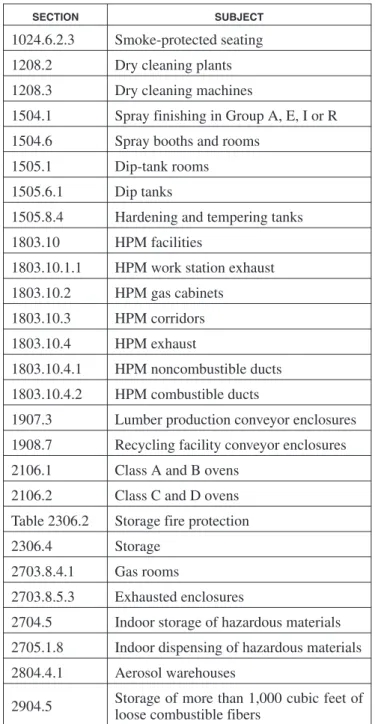
903.2.7 Other required suppression systems.In addition to the requirements of Section 903.2, the provisions indi-cated in Table 903.2.8 also require the installation of a sup-pression system for certain buildings and areas.
TABLE 903.2.7
ADDITIONAL REQUIRED FIRE-EXTINGUISHING SYSTEMS
SECTION SUBJECT
1024.6.2.3 Smoke-protected seating 1208.2 Dry cleaning plants 1208.3 Dry cleaning machines
1504.1 Spray finishing in Group A, E, I or R 1504.6 Spray booths and rooms
1505.1 Dip-tank rooms 1505.6.1 Dip tanks
1505.8.4 Hardening and tempering tanks 1803.10 HPM facilities
1803.10.1.1 HPM work station exhaust 1803.10.2 HPM gas cabinets
1803.10.3 HPM corridors 1803.10.4 HPM exhaust
1803.10.4.1 HPM noncombustible ducts 1803.10.4.2 HPM combustible ducts
1907.3 Lumber production conveyor enclosures 1908.7 Recycling facility conveyor enclosures 2106.1 Class A and B ovens
2106.2 Class C and D ovens Table 2306.2 Storage fire protection
2306.4 Storage
2703.8.4.1 Gas rooms
2703.8.5.3 Exhausted enclosures
2704.5 Indoor storage of hazardous materials 2705.1.8 Indoor dispensing of hazardous materials 2804.4.1 Aerosol warehouses
2904.5 Storage of more than 1,000 cubic feet of loose combustible fibers
(continued)
TABLE 903.2.7—continued
ADDITIONAL REQUIRED FIRE-EXTINGUISHING SYSTEMS
3306.5.2.1 Storage of smokeless propellant 3306.5.2.3 Storage of small arms primers
3404.3.7.5.1 Flammable and combustible liquid storage rooms
3404.3.8.4 Flammable and combustible liquid storage warehouses
3405.3.7.3 Flammable and combustible liquid Group H-2 or H-3 areas
3704.1.2 Gas cabinets for highly toxic and toxic gas
3704.1.3 Exhausted enclosures for highly toxic and toxic gas
3704.2.2.6 Gas rooms for highly toxic and toxic gas
3704.3.3 Outdoor storage for highly toxic and toxic gas
4106.2.2 Exhausted enclosures or gas cabinets for silane gas
4204.1.1 Pyroxylin plastic storage cabinets 4204.1.3 Pyroxylin plastic storage vaults
4204.2 Pyroxylin plastic storage and manufactur-ing
International B u i l d i n g Code
Sprinkler requirements as set forth in Sec-tion 903.2.13 of theInternational Building Code
For SI: 1 cubic foot = 0.023 m3.
903.3 Installation requirements. Automatic sprinkler sys-tems shall be designed and installed in accordance with Sec-tions 903.3.1 through 903.3.7.
903.3.1 Standards. Sprinkler systems shall be designed and installed in accordance with Sections 903.3.1.1, 903.3.1.2 or 903.3.1.3.
903.3.1.1 NFPA 13 sprinkler systems.Where the pro-visions of this code require that a building or portion thereof be equipped throughout with an automatic sprin-kler system in accordance with this section, sprinsprin-klers shall be installed throughout in accordance with NFPA 13 except as provided in Section 903.3.1.1.1.
903.3.1.1.1 Exempt locations.Automatic sprinklers shall not be required in the following rooms or areas:
1. Any room where the application of water, or flame and water, constitutes a serious life or fire hazard when determined by a technical opinion and report prepared in accordance with Section104.7.2.
2. Sprinklers may be omitted from electrical vaults where access to the vault is under control of the electrical utility company and the vaults are separated from the rest of the building by
fire resistive construction in accordance with theNational Electrical Code.
3. Linen closets or pantries that have multiple level shelving and cannot be walked into shall be considered cabinetry and shall not require sprinkler protection.
4. Dedicated pedestrian walkways meeting the criteria of NFPA 13.
Sprinklers shall not be omitted from any room merely because it is damp, of fire-resistance rated construction or contains electrical equipment. 903.3.1.1.1 Balconies.Sprinkler protection shall be provided for exterior balconies and ground floor pa-tios of dwelling units. Sidewall sprinklers that are used to protect such areas shall be permitted to be lo-cated such that their deflectors are within 1 inch (25 mm) to 6 inches (152 mm) below the structural mem-bers, and a maximum distance of 14 inches (356 mm) below the deck of the exterior balconies that are con-structed of open wood joist construction.
903.3.1.2 NFPA 13R sprinkler systems. Where al-lowed in buildings of Group R, up to and including four stories in height, automatic sprinkler systems shall be in-stalled throughout in accordance with NFPA 13R.
903.3.1.2.2 Exterior storage closets.Sprinkler pro-tection shall be extended into attached exterior stor-age closets in R-1 and R-2 occupancies protected by sprinkler systems installed according to NFPA 13R. 903.3.1.2.3 Attached garages, carports and balco-nies.Attached garages, carports and open patio or balcony spaces with living space directly above or ad-jacent to shall be provided with sprinkler protection. 903.3.1.2.4 Residential combination services.With Water Services Department approval a single combi-nation water supply shall be permitted provided that the domestic demand is added to the sprinkler de-mand as required by NFPA 13R.
903.3.1.3 NFPA 13D sprinkler systems. Where al-lowed, automatic sprinkler systems installed in one- and two-family dwellings shall be installed throughout in ac-cordance with NFPA 13D. Attached garages, carports and open patio or balcony spaces with living space di-rectly above shall be provided with sprinkler protection.
903.3.1.3.1 Attached garages, carports and balco-nies.Attached garages, carports and open patio or balcony spaces with living space directly above shall be provided with sprinkler protection.
903.3.1.3.2 Domestic services.Where the domestic service provides the water supply for the automatic sprinkler system, the supply shall be in accordance with this section.
903.3.1.3.3 Residential combination services. A single combination water supply shall be permitted provided that the domestic demand is added to the sprinkler demand as required by NFPA 13D.
903.3.1.3.4 Sizing of residential water meters for combined fire sprinkler and domestic sprinkler systems.When a water meter is installed in a NFPA 13D sprinkler system, the meter shall be sized to meet the greater domestic or fire flow demand.
FPN: One- and two-family homes equipped with a sprinkler system installed in accordance with NFPA 13D utilizing a combined fire/domestic supply line are required by the City Water Services Department to be provided with a water meter. The flow allowed by the meter shall be adequate to supply the system de-mand (see NFPA 13D, 2002 ed., Section 8.4.4). The meter shall be sized to provide for the required sprin-kler flow according to the manufacturer’s listing for the “Maximum Continuous Operation” given in gal-lons per minute and shall be a minimum of3/
4”-inch.
The meter is also required to be sized in a different manner for the domestic water flow demand (see DSD Technical Guideline – Water Meter Sizing, February 19, 2002). The meter shall be sized to meet the great-est flow demand (domgreat-estic or fire).
The City of Phoenix currently uses the Record All Cold Water Bronze Disk Meter manufactured by Badger Meter, Inc. Each of these meters is acceptable for sprinkler waterflow demand as follows:
a. 5/
8x3/4-inch meter is acceptable for flows up to 24 gpm, and
b. A3/4-inch meter is acceptable for flows up to 35 gpm, and
c. A 1-inch meter is acceptable for flows up to 50 gpm, and
d. A 11/2-inch meter is acceptable for flows of 51 – 70 gpm.
Note that these flow capacities are subject to change if the type and/or manufacturer of the meters is changed.
903.3.1.3.5 Sprinkler design requirements. Sprin-kler design shall be based on the hazard classification of the building or area in accordance with NFPA 13. Automatic sprinkler designs for high-piled storage shall be in accordance with Chapter 23.
903.3.1.4 Changes in commodity hazard.Changes of commodity to a higher hazard classification or storage configuration that exceeds the capabilities of the existing sprinkler system design shall require the sprinkler sys-tem to be modified. The sprinkler syssys-tem shall be modi-fied to provide an approved design in accordance with NFPA 13, or other applicable design standard, for the commodity present in the building or area.
903.3.1.5 Quick-response and residential sprinklers. Where automatic sprinkler systems are required by this code, quick-response or residential automatic sprinklers shall be installed in the following areas in accordance with Section 903.3.1 and their listings:
1. Throughout all spaces within a smoke compart-ment containing patient sleeping units in Group I-2
in accordance with the International Building Code.
2. Dwelling units and sleeping units in Group R and I-1 occupancies.
3. Light-hazard occupancies as defined in NFPA 13. 903.3.1.5.1 Installation of quick response sprin-klers in existing light hazard occupancy sprinkler systems being modified.When existing occupancies and sprinkler systems are being remodeled or reno-vated, existing standard response sprinklers shall be replaced with quick response sprinklers as follows:
1. Existing standard response sprinklers shall be replaced with quick response sprinklers when all sprinklers are being replaced in an area seg-regated by construction and openings have a minimum 8-inch lintel, and
2. When an existing system with standard re-sponse sprinklers is being modified, the stan-dard response sprinklers shall be replaced with quick-response sprinklers throughout the ten-ant space, floor or suite when more than 50% of the sprinklers in the space, floor or suite are be-ing added or relocated.
903.3.1.6 Obstructed locations.Automatic sprinklers shall be installed with due regard to obstructions that will delay activation or obstruct the water distribution pat-tern. Automatic sprinklers shall be installed in or under covered kiosks, displays, booths, concession stands, or equipment that exceeds 4 feet (1219 mm) in width. Not less than a 3-foot (914 mm) clearance shall be main-tained between automatic sprinklers and the top of piles of combustible fibers.
Exception:Kitchen equipment under exhaust hoods protected with a fire-extinguishing system in accor-dance with Section 904.
903.3.1.7 Actuation. Sprinkler systems shall be auto-matically actuated unless specifically provided for in this code.
903.3.1.8 Water supplies.Water supplies for automatic sprinkler systems shall comply with this section and the standards referenced in Section 903.3.1.
903.3.1.8.1 Water supply tests.Hydrant flow tests used to design sprinkler systems, standpipe systems and fire supply mains shall be performed on public hydrants by the City of Phoenix Water Services De-partment within 90 days prior to the date that con-struction documents are submitted for review, and again within 90 days of fire plans submittal. A copy of both the City’s hydrant flow test report shall be sub-mitted with the construction documents and calculations.
903.3.1.8.2 Water supply tests on private hydrants. Hydrant flow tests performed on private hydrants by the property owner or his representative to be used in the design of fire protection systems shall be
wit-nessed by the Phoenix Fire Department or a registered design professional.
903.3.1.8.3 Sprinkler design safety factor. Sprin-kler systems for NFPA 13, 13R and 13D systems shall be designed with a minimum safety factor as follows:
1. When the static pressure exceeds 90 psi, the maximum design static pressure shall be 80 psi regardless of actual test pressure. The slope of the original water supply curve shall be used even though the design pressure is reduced to 80 psi.
The actual flow test pressures shall be used to determine the need for sizing fire pumps, pres-sure reducing valves and hangar requirements in accordance with NFPA 13.
2. When the static pressure is less than 90 psi, a minimum 10 psi safety factor shall be provided between the available water supply and the sys-tem flow and pressure demand and shall in-clude hose stream allowances required by NFPA 13.
903.3.1.9 Protection of exterior exposed sprinkler system components. Protection for exterior exposed sprinkler system components shall be as follows:
1. Sprinkler pipe and components located on the ex-terior of a building shall be either galvanized or painted to protect from corrosion.
2. Sprinkler pipe smaller than 2 inches in diameter and installed in unheated areas shall be insulated to protect from freezing.
3. Hydraulic design information signs shall be metal with the information maintained clearly and per-manently stamped onto the sign.
903.3.1.10 Limited area sprinkler systems.Limited area sprinkler systems serving fewer than 20 sprin-klers on any single connection are permitted to be connected to the domestic service where a wet auto-matic standpipe is not available. Limited area sprin-kler systems connected to domestic water supplies shall comply with each of the following require-ments:
1. Valves shall not be installed between the do-mestic water riser control valve and the sprin-klers.
Exception: An approved indicating control valve supervised in the open position in accor-dance with Section 903.4.
2. The domestic service shall be capable of sup-plying the simultaneous domestic demand and the sprinkler demand required to be hydrauli-cally calculated by NFPA 13, NFPA 13R or NFPA 13D.
903.3.2 Fire department connections. Fire department connections shall be installed according to NFPA 13 and Section 912 of this code.
903.3 Sprinkler system monitoring and alarms.Sprinkler control valves and water flow alarm initiating devices in Group H and I occupancies of any size and all other occupancies with a total area of 10,000 square feet or more shall be electrically supervised.
Exceptions:Sprinkler control valves in buildings less than 10,000 square feet other than Group H or I occupancies, or located remote from the building, including but not limited to backflow-preventer or post indicator valves, shall be su-pervised by one of the following methods:
1. A local signaling service that will initiate an audible signal at a constantly attended location.
2. Valves locked in the open position and inspected monthly in accordance with an approved procedure shall be electrically supervised.
Exceptions:
1. Automatic sprinkler systems protecting R-3 occupancies.
2. Limited area systems serving fewer than 20 sprinklers.
3. Automatic sprinkler systems installed in accordance with NFPA 13R where a common supply main is used to supply both domestic water and the automatic sprinkler system, and a separate shutoff valve for the automatic sprinkler system is not provided.
4. Jockey pump control valves that are sealed or locked in the open position.
5. Control valves to commercial kitchen hoods, paint spray booths or dip tanks that are sealed or locked in the open position.
6. Valves controlling the fuel supply to fire pump en-gines that are sealed or locked in the open position. 7. Trim valves to pressure switches in dry, preaction and
deluge sprinkler systems that are sealed or locked in the open position.
903.3.3.1 Signals.Alarm, supervisory and trouble sig-nals shall be distinctly different and shall be automatically transmitted to an approved central station, remote supervising station or proprietary supervising station as defined in NFPA 72 or, when approved by the fire code official, shall sound an audible signal at a con-stantly attended location.
Exception:Underground key or hub valves in roadway boxes.
903.3.3.1.1 Monitoring at a constantly attended lo-cation.When monitoring of sprinkler system is re-quired per Section 903.3.1, the facilities owner may request to monitor the system(s) at the facility site us-ing facility personnel. Where the alarm monitorus-ing station does not strictly comply with the NFPA 72 re-quirements for a proprietary supervising station, the following minimum provisions shall be met and ap-proved by the fire code official.
1. The policies and procedures for monitoring the sprinkler system shall be written and submitted to
the fire code official for approval prior to occupancy or terminating central station service or remote service. A copy of the approved fire alarm policies and procedures shall be maintained at the constantly attended location.
2. The alarm monitoring station shall be constantly attended by competent trained personnel. At least one person shall monitor the fire alarm panel at all times. Provisions shall be made to relieve the alarm monitor prior to shift changes, during breaks, or performance of other assigned duties outside of the alarm monitoring room.
3. A list of trained personnel qualified to monitor the sprinkler system shall be maintained at the alarm monitoring station. Documentation of the alarm monitoring training shall be approved by the fire code official and maintained at the alarm monitor-ing station and made available to the fire code offi-cial on request.
4. The policies and procedures shall address the dis-pensation of the various fire alarm signals. The fire department shall be immediately notified upon the activation of a fire alarm signal (smoke or heat de-tector, sprinkler water flow, manual pull station, special extinguishing system, etc.). Any investiga-tion by the facility staff shall occur after or concur-rent to notification of the fire department. If the investigation by facility staff determines that there is no emergency condition at the facility, the fire department shall be immediately notified to allow them to modify their response.
5. The fire department shall not be summoned for emergency response upon receipt of a supervisory or trouble signal, but procedures shall address dis-pensation of those signals by facility personnel. 6. A log shall be maintained at the monitoring station
that note all of the signals received and the dispen-sation of those signals. The log sheet shall be made available to the Phoenix Fire Department on re-quest.
903.3.1.2 Multitenant buildings with different ad-dresses.The alarm monitoring station shall identify all addresses of buildings or suites protected by the same sprinkler system and provide this information to the Phoenix Fire Department alarm room center.
903.3.2 Alarms.Approved audible devices shall be con-nected to every automatic sprinkler system. Such sprinkler water-flow alarm devices shall be activated by water flow equivalent to the flow of a single sprinkler of the smallest or-ifice size installed in the system. Alarm devices shall be pro-vided on the exterior of the building in an approved location. Where a fire alarm system is installed, actuation of the auto-matic sprinkler system shall actuate the building fire alarm system.
903.3.3 Floor control valves.Approved supervised indi-cating control valves shall be provided at the point of con-nection to the riser on each floor in high-rise buildings.
903.4 Testing and maintenance.Sprinkler systems shall be tested and maintained in accordance with Section 901. 903.5 Existing buildings.The provisions of this section are in-tended to provide a reasonable degree of safety in existing structures not complying with the minimum requirements of theInternational Building Codeby requiring installation of an automatic fire-extinguishing system.
903.6 Pyroxylin plastics.All structures occupied for the man-ufacture or storage of articles of cellulose nitrate (pyroxylin) plastic shall be equipped with an approved automatic fire-ex-tinguishing system. Vaults located within buildings for the storage of raw pyroxylin shall be protected with an approved automatic sprinkler system capable of discharging 1.66 gallons per minute per square foot (68 L/min/m2) over the area of the vault.
SECTION 904
ALTERNATIVE AUTOMATIC FIRE-EXTINGUISHING SYSTEMS
904.1 General.Automatic fire-extinguishing systems, other than automatic sprinkler systems, shall be designed, installed, inspected, tested and maintained in accordance with the provi-sions of this section and the applicable referenced standards. 904.2 Where required.Automatic fire-extinguishing systems installed as an alternative to the required automatic sprinkler systems of Section 903 shall be approved by the fire code offi-cial. Automatic fire-extinguishing systems shall not be consid-ered alternatives for the purposes of exceptions or reductions permitted by other requirements of this code.
904.2.1 Commercial hood and duct systems. Each re-quired commercial kitchen exhaust hood and duct system required by Section 610 to have a Type I hood shall be pro-tected with an approved automatic fire-extinguishing sys-tem installed in accordance with this code.
904.3 Installation.Automatic fire-extinguishing systems shall be installed in accordance with this section.
904.3.1 Electrical wiring.Electrical wiring shall be in ac-cordance with theNational Electrical Code.
904.3.2 Actuation.Automatic fire-extinguishing systems shall be automatically actuated and provided with a manual means of actuation in accordance with Section 904.11.1. 904.3.3 System interlocking.Automatic equipment inter-locks with fuel shutoffs, ventilation controls, door closers, window shutters, conveyor openings, smoke and heat vents, and other features necessary for proper operation of the fire-extinguishing system shall be provided as required by the design and installation standard utilized for the hazard. 904.3.4 Alarms and warning signs.Where alarms are re-quired to warn of pending agent discharge, distinctive audi-ble, visible alarms and warning signs shall be provided. Where exposure to automatic-extinguishing agents poses a hazard to persons and a delay is required to ensure the evac-uation of occupants before agent discharge, a separate warn-ing signal shall be provided to alert occupants once agent discharge has begun. Audible signals shall be in accordance with Section 907.10.2.
904.3.4.1 Kitchen hood systems. When kitchen hood systems are installed in buildings equipped with a fire alarm system designed to notify the building occupants, actuation of the hood system shall initiate the fire alarm system.
904.3.5 Supervision.Where a building fire alarm system is installed, automatic fire-extinguishing systems shall be su-pervised by the building fire alarm system in accordance with NFPA 72.
904.4 Inspection and testing. Automatic fire-extinguishing systems shall be inspected and tested in accordance with the provisions of this section prior to acceptance.
904.4.1 Inspection. Prior to conducting final acceptance tests, the following items shall be inspected:
1. Hazard specification for consistency with design haz-ard.
2. Type, location and spacing of automatic- and man-ual-initiating devices.
3. Size, placement and position of nozzles or discharge orifices.
4. Location and identification of audible and visible alarm devices.
5. Identification of devices with proper designations. 6. Operating instructions.
904.4.2 Alarm testing. Notification appliances, connec-tions to fire alarm systems, and connecconnec-tions to approved su-pervising stations shall be tested in accordance with this section and Section 907 to verify proper operation.
904.4.2.1 Audible and visible signals. The audibility and visibility of notification appliances signaling agent discharge or system operation, where required, shall be verified.
904.4.3 Monitor testing. Connections to protected pre-mises and supervising station fire alarm systems shall be tested to verify proper identification and retransmission of alarms from automatic fire-extinguishing systems. 904.5 Wet-chemical systems. Wet-chemical extinguishing systems shall be installed, maintained, periodically inspected and tested in accordance with NFPA 17A and their listing.
904.5.1 System test.Systems shall be inspected and tested for proper operation at 6-month intervals in accordance with manufacturer’s inspection, testing and maintenance manual and NFPA 17A. Tests shall include a check of the detection system, alarms and releasing devices, including manual stations and other associated equipment. Extin-guishing system units shall be weighed and the required amount of agent verified. Stored pressure-type units shall be checked for the required pressure. The cartridge of car-tridge-operated units shall be weighed and replaced at inter-vals indicated by the manufacturer.
904.5.2 Fusible link maintenance. Fixed tempera-ture-sensing elements shall be maintained to ensure proper operation of the system.
904.6 Dry-chemical systems. Dry-chemical extinguishing systems shall be installed, maintained, periodically inspected and tested in accordance with NFPA 17 and their listing.
904.6.1 System test.Systems shall be inspected and tested for proper operation at 6-month intervals. Tests shall in-clude a check of the detection system, alarms and releasing devices, including manual stations and other associated equipment. Extinguishing system units shall be weighed, and the required amount of agent verified. Stored pres-sure-type units shall be checked for the required pressure. The cartridge of cartridge-operated units shall be weighed and replaced at intervals indicated by the manufacturer. 904.6.2 Fusible link maintenance. Fixed tempera-ture-sensing elements shall be maintained to ensure proper operation of the system.
904.7 Foam systems.Foam-extinguishing systems shall be in-stalled, maintained, periodically inspected and tested in accor-dance with NFPA 11, NFPA 11A and NFPA 16 and their listing.
904.7.1 System test.Foam-extinguishing systems shall be inspected and tested at intervals in accordance with NFPA 25.
904.8 Carbon dioxide systems.Carbon dioxide extinguishing systems shall be installed, maintained, periodically inspected and tested in accordance with NFPA 12 and their listing.
904.8.1 System test.Systems shall be inspected and tested for proper operation at 12-month intervals.
904.8.2 High-pressure cylinders.High-pressure cylinders shall be weighed and the date of the last hydrostatic test shall be verified at 6-month intervals. Where a container shows a loss in original content of more than 10 percent, the cylinder shall be refilled or replaced.
904.8.3 Low-pressure containers.The liquid-level gauges of low-pressure containers shall be observed at one-week intervals. Where a container shows a content loss of more than 10 percent, the container shall be refilled to maintain the minimum gas requirements.
904.8.4 System hoses.System hoses shall be examined at 12-month intervals for damage. Damaged hoses shall be re-placed or tested. At five-year intervals, all hoses shall be tested.
904.8.4.1 Test procedure.Hoses shall be tested at not less than 2,500 pounds per square inch (psi) (17 238 kPa) for high-pressure systems and at not less than 900 psi (6206 kPa) for low-pressure systems.
904.8.5 Auxiliary equipment.Auxiliary and supplemen-tary components, such as switches, door and window re-leases, interconnected valves, damper releases and supplementary alarms, shall be manually operated at 12-month intervals to ensure that such components are in proper operating condition.
904.9 Halon systems. Halogenated extinguishing systems shall be installed, maintained, periodically inspected and tested in accordance with NFPA 12A and their listing.
904.9.1 System test.Systems shall be inspected and tested for proper operation at 12-month intervals.
904.9.2 Containers.The extinguishing agent quantity and pressure of containers shall be checked at 6-month intervals. Where a container shows a loss in original weight of more than 5 percent or a loss in original pressure (adjusted for temperature) of more than 10 percent, the container shall be refilled or replaced. The weight and pressure of the con-tainer shall be recorded on a tag attached to the concon-tainer. 904.9.3 System hoses.System hoses shall be examined at 12-month intervals for damage. Damaged hoses shall be re-placed or tested. At 5-year intervals, all hoses shall be tested. 904.9.3.1 Test procedure. For Halon 1301 systems, hoses shall be tested at not less than 1,500 psi (10 343 kPa) for 600 psi (4137 kPa) charging pressure systems and not less than 900 psi (6206 kPa) for 360 psi (2482 kPa) charging pressure systems. For Halon 1211 hand-hose line systems, hoses shall be tested at 2,500 psi (17 238 kPa) for high-pressure systems and 900 psi (6206 kPa) for low-pressure systems.
904.9.4 Auxiliary equipment.Auxiliary and supplemen-tary components, such as switches, door and window re-leases, interconnected valves, damper releases and supplementary alarms, shall be manually operated at 12-month intervals to ensure such components are in proper operating condition.
904.10 Clean-agent systems.Clean-agent fire-extinguishing systems shall be installed, maintained, periodically inspected and tested in accordance with NFPA 2001 and their listing.
904.10.1 System test.Systems shall be inspected and tested for proper operation at 12-month intervals.
904.10.2 Containers.The extinguishing agent quantity and pressure of the containers shall be checked at 6-month inter-vals. Where a container shows a loss in original weight of more than 5 percent or a loss in original pressure, adjusted for temperature, of more than 10 percent, the container shall be refilled or replaced. The weight and pressure of the con-tainer shall be recorded on a tag attached to the concon-tainer. 904.10.3 System hoses.System hoses shall be examined at 12-month intervals for damage. Damaged hoses shall be re-placed or tested. All hoses shall be tested at 5-year intervals. 904.11 Commercial cooking systems.The automatic fire-ex-tinguishing system for commercial cooking systems shall be of a type recognized for protection of commercial cooking equip-ment and exhaust systems of the type and arrangeequip-ment pro-tected. Preengineered automatic dry- and wet-chemical extinguishing systems shall be tested in accordance with UL 300 and listed and labeled for the intended application. Other types of automatic fire-extinguishing systems shall be listed and labeled for specific use as protection for commercial cook-ing operations. The system shall be installed in accordance with this code, its listing and the manufacturer’s installation in-structions. Automatic fire-extinguishing systems of the follow-ing types shall be installed in accordance with the referenced standard indicated, as follows:
1. Carbon dioxide extinguishing systems, NFPA 12. 2. Automatic sprinkler systems, NFPA 13.
3. Foam-water sprinkler system or foam-water spray sys-tems, NFPA 16.
4. Dry-chemical extinguishing systems, NFPA 17. 5. Wet-chemical extinguishing systems, NFPA 17A. Exception:Factory-built commercial cooking recirculating systems that are tested in accordance with UL 197 and listed, labeled and installed in accordance with Section 304.1 of theNational Mechanical Code.
904.11.1 Manual system operation.A manual actuation device shall be located at or near a means of egress from the cooking area, a minimum of 10 feet (3048 mm) and a maxi-mum of 20 feet (6096 mm) from the kitchen exhaust system. The manual actuation device shall be located a minimum of 4 feet (1219 mm) and a maximum of 5 feet (1524 mm) above the floor. The manual actuation shall require a maxi-mum force of 40 pounds (178 N) and a maximaxi-mum move-ment of 14 inches (356 mm) to actuate the fire suppression system.
Exception:Automatic sprinkler systems shall not be re-quired to be equipped with manual actuation means. 904.11.2 System interconnection.The actuation of the fire extinguishing system shall automatically shut down the fuel or electrical power supply to the cooking equipment. The fuel and electrical supply reset shall be manual.
904.11.3 Carbon dioxide systems.When carbon dioxide systems are used, there shall be a nozzle at the top of the ven-tilating duct. Additional nozzles that are symmetrically ar-ranged to give uniform distribution shall be installed within vertical ducts exceeding 20 feet (6096 mm) and horizontal ducts exceeding 50 feet (15 240 mm). Dampers shall be in-stalled at either the top or the bottom of the duct and shall be arranged to operate automatically upon activation of the fire-extinguishing system. When the damper is installed at the top of the duct, the top nozzle shall be immediately be-low the damper. Automatic carbon dioxide fire-extinguish-ing systems shall be sufficiently sized to protect all hazards venting through a common duct simultaneously.
904.11.3.1 Ventilation system.Commercial-type cook-ing equipment protected by an automatic carbon dioxide extinguishing system shall be arranged to shut off the ventilation system upon activation.
904.11.4 Special provisions for automatic sprinkler sys-tems. Automatic sprinkler systems protecting commer-cial-type cooking equipment shall be supplied from a separate, readily accessible, indicating-type control valve that is identified.
904.11.4.1 Listed sprinklers.Sprinklers used for the protection of fryers shall be listed for that application and installed in accordance with their listing.
904.11.5 Portable fire extinguishers for commercial cooking equipment. Portable fire extinguishers shall be provided within a 30-foot (9144 mm) travel distance of commercial-type cooking equipment. Cooking equipment involving vegetable or animal oils and fats shall be protected by a Class K rated portable extinguisher.
904.11.6 Operations and maintenance. Commercial cooking systems shall be operated and maintained in accor-dance with this section.
904.11.6.1 Ventilation system.The ventilation system in connection with hoods shall be operated at the re-quired rate of air movement, and classified grease filters shall be in place when equipment under a kitchen grease hood is used.
904.11.6.2 Grease extractors.Where grease extractors are installed, they shall be operated when the commer-cial-type cooking equipment is used.
904.11.6.3 Cleaning. Hoods, grease-removal devices, fans, ducts and other appurtenances shall be cleaned at intervals necessary to prevent the accumulation of grease. Cleanings shall be recorded, and records shall state the extent, time and date of cleaning. Such records shall be maintained on the premises.
904.11.6.4 Extinguishing system service. Automatic fire-extinguishing systems shall be serviced at least ev-ery 6 months and after activation of the system. Inspec-tion shall be by qualified individuals, and a certificate of inspection shall be forwarded to the fire code official upon completion.
904.11.6.5 Fusible link and sprinkler head replace-ment.Fusible links and automatic sprinkler heads shall be replaced at least annually, and other protection de-vices shall be serviced or replaced in accordance with the manufacturer’s instructions.
Exception:Frangible bulbs are not required to be re-placed annually.
SECTION 905 STANDPIPE SYSTEMS
905.1 General. Standpipe systems shall be provided in new buildings and structures in accordance with this section. Fire hose threads used in connection with standpipe systems shall be approved and shall be Phoenix threads. The location of fire department hose connections shall be in accordance with Sec-tion 912. In buildings used for high-piled combustible storage, fire protection shall be in accordance with Chapter 23. Tempo-rary standpipes installed during construction shall be in accor-dance with Chapter 14.
905.2 Installation standards.Standpipe systems shall be in-stalled in accordance with this section and NFPA 14.
905.3 Required installations.Standpipe systems shall be in-stalled where required by Sections 905.3.1 through 905.3.6 and in the locations indicated in Sections 905.4, 905.5 and 905.6. Standpipe systems are permitted to be combined with automatic sprinkler systems.
Exception: Standpipe systems are not required in Group R-3 occupancies.
905.3.1 Building height. Class I wet standpipe systems shall be installed in buildings where the floor level of the highest story is located more than 30 feet (9144 mm) above the lowest level of the fire department apparatus access, or