Template-Based Privacy Preservation in Classification Problems
∗Ke Wang
Simon Fraser University
BC, Canada V5A 1S6
[email protected]
Benjamin C. M. Fung
Simon Fraser University
BC, Canada V5A 1S6
[email protected]
Philip S. Yu
IBM T. J. Watson Research Center
Hawthorne, NY 10532
[email protected]
Abstract
In this paper, we present a template-based privacy preservation to protect against the threats caused by data mining abilities. The problem has dual goals: preserve the information for a wanted classification analysis and limit the usefulness of unwanted sensitive inferences that may be derived from the data. Sensitive inferences are specified by a set of “privacy templates”. Each template specifies the sensitive information to be protected, a set of identifying at-tributes, and the maximum association between the two. We show that suppressing the domain values is an effective way to eliminate sensitive inferences. For a large data set, find-ing an optimal suppression is hard, since it requires opti-mization over all suppressions. We present an approximate but scalable solution. We demonstrate the effectiveness of this approach on real life data sets.
1. Introduction
Knowledge Discovery in Databases (KDD) or data min-ing aims at findmin-ing out new knowledge about an applica-tion domain using collected data on the domain, typically data on individual entities like persons, companies, trans-actions. Naturally, the general concerns over data security and individual privacy are relevant for data mining. The first concern relates to the input of data mining methods due to data access. Many techniques have been proposed [4, 6, 8, 10, 12, 15, 18] to address this problem while pre-serving the benefits of data mining. The second concern is related to theoutputof data mining methods. Although the output of data mining methods are aggregate patterns, not intended to identify single individuals, they can be used to infer sensitive information about individuals. In this paper, we consider the privacy threats caused by such “data mining abilities”. Let us first consider an example.
∗Research was supported in part by a research grant from Emerging Opportunity Fund of IRIS, and a research grant from the Natural Sciences and Engineering Research Council of Canada.
Job Country Child Bankruptcy Rating #Rec
Cook US No Current 0G/4B 4
Artist France No Current 1G/3B 4
Doctor US Yes Never 4G/2B 6
Trader UK No Discharged 4G/0B 4
Trader UK No Never 1G/0B 1
Trader Canada No Never 1G/0B 1
Clerk Canada No Never 3G/0B 3
Clerk Canada No Discharged 1G/0B 1
Total: 24 Table 1. The initial table
Job Country Child Bankruptcy Rating #Rec
Cook US No Current 0G/4B 4
Artist France No Current 1G/3B 4
Doctor US Yes Never 4G/2B 6
⊥Job ⊥Country No Never 5G/0B 5
⊥Job ⊥Country No Discharged 5G/0B 5
Total: 24 Table 2. The suppressed table
Example 1 (Running Example). Table 1 contains records about bank customers. After removing irrelevant attributes, each row represents the duplicate records and the count. The class attribute Ratingcontains the class frequency of credit rating. For example, 0G/4B represents 0 Good and 4 Bad. Suppose that the bank (the data owner) wants to release the data to a data mining firm for classification anal-ysis onRating, but does not want the data mining firm to infer the bankruptcy stateDischargedusing the attributes
Job and Country. For example, out of the 5 individu-als with Job = T rader andCountry = U K, 4 has the Dischargedstatus. Therefore, the rule{T rader, U K} →
Dischargedhas support 5 and confidence 80%. If the data
owner tolerates no more than 75% confidence for this infer-ence, the data is not safe for release. In general, currently bankrupted customers have a bad rating and simply remov-ing theBankruptcycolumn loses too much information for the classification analysis.
The private information illustrated in this example has the form “ifxtheny”, wherexidentifies a group of
indi-viduals andy is a sensitive value. We consider this
infer-ence “private” if its confidinfer-ence is high, in which case an individual in the group identified byxtends to be linked
toy. The higher the confidence, the stronger the linking.
In the context of data mining, association or classification rules [1, 14] are used to capturegeneral patterns of large populationsfor summarization and prediction, where a low support means the lack of statistical significance. In the context of privacy protection, however, inference rules are used to infersensitive information about the existing indi-viduals, and it is important to eliminate sensitive inferences of any support, large or small. In fact, a sensitive inference in a small group could present even more threats than in a large group because individuals in a small group are more identifiable [16].
The problem considered in this paper can be described as follow. The data owner wants to release a version of data in the format
T(M1,· · · , Mm,Π1,· · · ,Πn,Θ)
to achieve two goals. Theclassification goalis to preserve as much information as possible for modeling theclass at-tributeΘ. The privacy goalis to limit the ability of data mining tools to derive inferences aboutsensitive attributes Π1, . . . ,Πn. This requirement is specified using one or
more templates of the form, hIC → π, hi, whereπ is a
value from some Πi,inference channel IC is a set of
at-tributes not containingΠi, andhis a threshold on
confi-dence. The data satisfieshIC →π, hiif every matching in-ference has a confidence no more thanh. The privacy goal can be achieved by suppressing some values onmasking at-tributesM1, . . . , Mm. We are interested in a suppression of
values forM1, . . . , Mmthat achieves both goals.
In Example 1, the inference {T rader, U K} →
Dischargedviolates the template
h{Job,Country} →Discharged,75%i.
To eliminate this inference, we can suppress Trader and Clerkto a special value⊥Job, and suppressUKandCanada
to a special value⊥Country, see Table 2. Now, the new
in-ference {⊥Job,⊥Country} → Discharged has confidence
50%, less than the specified 75%. No information is lost sinceRatingdoes not depend on the distinction of the sup-pressed values.
The use of templates provides several flexibilities for specifying the notion of privacy: selectively protecting cer-tain valuesπwhile not protecting other values; specifying a
different thresholdhfor a different templateIC →π;
spec-ifying multiple inference channels IC (even for the same π); specifying templates for multiple sensitive attributesΠ.
These flexibilities provide not only a powerful representa-tion of privacy requirements, but also a way to focus on the
problem area in the data to minimize unnecessary informa-tion loss.
Given that the classification task is known in advance, one may ask why not releasing a classifier, which likely contains less information, instead of the data. This could be an option if the data owner knows exactly how the data re-cipient may analyze the data. Often, this information is un-known. For example, in visual data mining, the data miner has to visualize data records in a certain way to guide the search, and in this case releasing data records is essential. Some classifiers such as the k-nearest neighbor are actually the data itself, and some are better in accuracy whereas oth-ers are better in interpretability. The data owner may not have the expertise to make such decisions because sophisti-cated data analysis is not part of its normal business.
The contributions of this work can be summarized as fol-lows. First, we formulate a template-based privacy preser-vation problem. Second, we show that suppression is an effective way to eliminate sensitive inferences. However, finding an optimal suppression is a hard problem since it requires optimization over all possible suppressions. For a table with a total ofqdistinct values on masking attributes,
there are2q possible suppressed tables. We present an
ap-proximate solution based on a search that iteratively im-proves the solution and prunes the search whenever no bet-ter solution is possible. We evaluate this method on real life data sets.
2. Related Work
Most works on privacy preservation address the concern related to the input of data mining tools where private infor-mation is revealed directly by inspection of the data without sophisticated analysis [4, 6, 8, 10, 12, 15, 18]. Our work is more related to the concern over the output of data mining methods, where the threats are caused by what data mining tools can discover. We focus on this group of works.
Kloesgen [13] pointed out the problem of group discrim-ination where the discovered group behavior is attached to all members in a group, which is a form of inferences. Clifton [3] suggested to eliminate sensitive inferences by limiting the data size. Recently, Kantarcioglu et al. [11] defined an evaluation method to measure the loss of pri-vacy due to releasing data mining results. However, they did not propose a solution to prevent the adversary from getting data mining results that violate privacy.
Verykios et al. [17] proposed several algorithms for hid-ing association rules in a transaction database with minimal modification to the data. The general idea is to hide one rule at a time by either decreasing its support or its confidence; this is achieved by removing items from transactions. They need to assume that frequent itemsets of rules are disjoint in order to avoid high time complexity. We consider the
use of the data for classification analysis. Instead of min-imizing pure syntax changes to the data, we minimize the information lose for this analysis and eliminate all sensi-tive inferences including those with a low support. We can efficiently handle overlapping inference rules.
Suppression of domain values was employed in [2, 10, 15] for achievingk-anonymity. Thek-anonymity
require-ment states that no identifying attributes identify a group of size smaller thank. Therefore, if such identifying attributes
are used to link the data to an external table, all the records in each group (at leastk) will behave in the same way and
are difficult to be distinguished. However, this notion does not address sensitive inference on the identified groups.
In database security, Farkas et al. [7] conducted a sur-vey on inference control. In multilevel secure databases, the focus is detecting and removing inference channels by combining meta-data with data. For example, it is possible for a user to use a series of unsuspicious queries to infer sen-sitive data in the database. [19] proposed a method to detect such queries using functional dependencies. This type of inferences is different from ours.
In statistical databases, the focus is limiting the ability of inferring confidential information by correlating differ-ent statistics. For example, Cox [5] proposed thek%- dom-inance rule which suppresses a sensitive cell if the attribute values of two or three entities in the cell contribute more than k% of the corresponding SUM statistic. Such “cell suppression” suppresses the count or other statistics stored in a cell of a statistical table, which is very different from the “value suppression” considered in our work.
3. The Problem
Consider a tableT(M1, . . . , Mm,Π1, . . . ,Πn,Θ). Mj
are called masking attributes. Πi are called sensitive
at-tributes.Θis called theclass attribute. All attributes have a categorical domain. For eachMj, we add the special value
⊥jto its domain. For a domain valuev,att(v)denotes the
attribute ofv.MjandΠiare disjoint.
The data owner specifies sensitive inferences using tem-plates. Atemplatehas the formhIC → π, hi. πis sensi-tive valuefrom someΠi. IC, called aninference channel,
is some set of attributes not containing Πi. his a
confi-dence threshold. An inferencefor hIC → π, hihas the formic→π, whereiccontains values from the attributes
inIC. Theconfidenceofic→ π, writtenconf(ic→ π),
is the percentage of the records that containπamong those
that contain the values inic, that is,s(ic, π)/s(ic), where s(V)denotes the number of records containing the values in
V. Conf(IC →π)denotes the maximumconf(ic→π) for allicoverIC.
Definition 3.1 (Privacy Templates). T satisfiesa template
hIC →π, hiifConf(IC →π)≤h. T satisfiesa set of
templates ifT satisfies every template in the set.
Some template may be “redundant” once we have some other template. The next lemma considers one such case, which can be used to remove “redundant” templates.
Lemma 3.1. Consider two templates hIC → π, hi and hIC0 →π0, h0i. Ifπ = π0,h≥h0, andIC ⊆ IC0, then (1) Conf(IC0 → π0) ≥ Conf(IC → π), and (2) if T satisfieshIC0→π0, h0i,T satisfieshIC →π, hi.
To see (1), consider the partition {P1,· · ·, Pk} of the
records matchingicaccording to the valuesx1,· · · , xk on
X = IC0 −IC. If the partitioning decreases the confi-dence of ic → π in somePi, it must increase the
confi-dence in some other Pj. Therefore, the partitioning does
not decrease the maximum confidence inPi’s. We omit the
detailed proof. (2) follows immediately from (1).
If T violates a set of templates, (under certain
condi-tions) we can suppress some values on masking attributes
Mj to make it satisfy the templates. Thesuppressionof a
value onMj means replacing alloccurrences of the value
with the special value⊥j. Thus, all suppressed values on
Mj are represented by the same⊥j. One question is what
makes us believe that suppression can reduce the confidence of sensitive inference. Indeed, if suppression actually in-creases the confidence, we are not getting any closer to the privacy goal but losing information for the classifica-tion goal. Below, we show that suppressionneverincreases
Conf(IC →π).
Consider suppressing a valuev inMj to⊥j. The
sup-pression affects only the records that containvor⊥jbefore
the suppression. Let⊥jand⊥0jdenote⊥jbefore and after
the suppression. The difference is that⊥0
j coversvbut⊥j
does not. After the suppression, two inferences{ic, v} →π
and{ic,⊥j} → πbecome one inference{ic,⊥0j} → π.
We have the next lemma, which has a similar proof as that of Lemma 3.1.
Lemma 3.2. max{conf(ic, v → π), conf(ic,⊥j →π)}
≥conf(ic,⊥0
j→π).
The lemma says that, by suppressing a value,
Conf(IC →π)does not go up. This property provides the basis for employing suppression to reduceConf(IC →π). Corollary 3.1. Conf(IC →π)is non-increasing with re-spect to suppression.
From Corollary 3.1, the most suppressed T, where all
values forMj are suppressed to⊥j for everyMjin∪IC,
has the minimumConf(IC →π). Therefore, if this table
does not satisfy the templates, no suppressedT does. Lemma 3.3. Given a set of templates, there exists a sup-pressed tableT that satisfies the templates if and only if the most suppressedT satisfies the templates.
Definition 3.2 (Inference Problem). Given a tableT and
a set of templates, the inference problemis to (1) decide whether there exists a suppressedT that satisfies the set of
templates, and if yes, (2) produce a satisfying suppressedT
that preserves as much information as possible for modeling the class attribute.
4. The Algorithm
Given a tableT and a set of templates{hIC →π, hi}, our algorithm iteratively “discloses” the domain values starting from the most suppressed T in which each
mask-ing attributeMj in∪IC contains only⊥j, i.e., the set of
suppressed values,Supj, contains all domain values inMj.
At any time, we have a set ofsuppressed records, with du-plicates being collapsed into a single record with a count. In each iteration, we disclose one value from someSupj. To
disclosea valuev fromSupj, we do exactly the opposite
of suppressingv, i.e., replace⊥j withvin all suppressed
records thatcurrentlycontain⊥j andoriginallycontainv
before suppression. This process repeats until no disclo-sure is possible without violating the set of templates. From Corollary 3.1, any further disclosure leads to no solution.
Algorithm 1Progressive Disclosure Algorithm (PDA) 1: suppress every value ofMjto⊥jwhereMj ∈ ∪IC;
2: everySupjcontains all domain values ofMj ∈ ∪IC;
3: whilethere is a valid/beneficial candidate in∪Supjdo
4: find the winnerwof highestScore(w)from∪Supj;
5: disclosewonTand removewfrom∪Supj;
6: updateScore(x)and the valid/beneficial status forx
in∪Supj;
7: end while
8: output the suppressedTand∪Supj;
The above algorithm, calledProgressive Disclosure Al-gorithm (PDA), is presented in Algorithm 1. At each it-eration, if some Supj contains a “valid” and “beneficial”
candidate for disclosure, the algorithm chooses the win-ner candidatewthat maximizes the score function denoted Score. A disclosure isvalidif it leads to a table satisfying
the set of templates. A disclosure fromSupj isbeneficial
if more than one class is involved in the records contain-ing⊥j. Next, the algorithm disclosesw, and updates the
Scoreand status of every affected candidate. We focus on the three key steps (Lines 4 to 6) in the rest of this section.
Example 2. Consider the templates: h{Job,Country} →Discharged,50%i, h{Job,Child} →Discharged,50%i.
Initially, the values ofJob,CountryandChildin Table 1 are suppressed to ⊥Job,⊥Country and⊥Child, and∪Supj
con-tains all domain values inJob,Country, andChild. This is
the most suppressed, or the least disclosed, state.
4.1. Find the Winner (Line 4)
This step finds the winnerw, i.e., the valid and beneficial
candidate from∪Supj that has the highestScore. Since
disclosing a value v gains information and loses privacy,
Score(v)measures the information gain[14] per unit of privacy loss, defined as
Score(v) = Inf oGain(v)
P rivLoss(v) + 1. (1) Consider the set of suppressed records that currently con-tain ⊥j, denoted T[⊥j]. Disclosing v fromSupj means
replacing⊥j withv in all records inT[⊥j]that originally
containv. LetTvdenote the set of such records, and letT[v]
denoteTvafter replacing⊥jwithv. The disclosure ofvis
to replaceT[⊥j]withT[v]andT[⊥j]−Tv.Inf oGain(v)
is the information gain of this replacement. Inf oGain(v) depends only on the class frequency and count statistics on the single attributeatt(v)inT[⊥j],T[v]andT[⊥j]−Tv.
P rivLoss(v)measures the privacy loss, defined as the average increase of Conf(IC → π) over all affected
IC → π, i.e., those IC such that att(v) is contained in
IC,
avg{Confv(IC →π)−Conf(IC→π)
|att(v)∈IC},
where Conf and Confv represent the confidence before
and after disclosingv.
ComputingConfvefficiently is a challenge since it may
involve count statistics on a combination of several at-tributes. It is inefficient to perform the disclosure of v in
order to computeConfv. The key to the scalability of our
algorithm is incrementally updatingScore(v)in each iter-ation for valid/benefical candidates v in∪Supj. We will
present this update algorithm in Section 4.3.
4.2. Disclose the Winner (Line 5)
This step discloses the winnerwand replaces⊥j with
win the suppressed records inT[⊥j]that originally contain
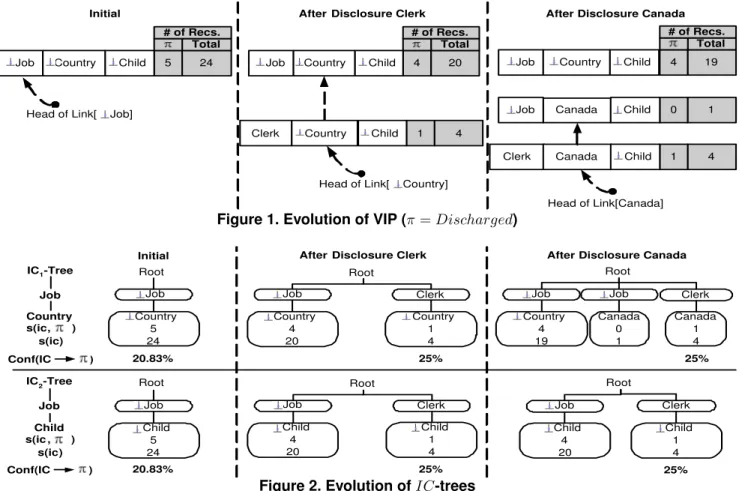
w. It requires accessing the raw records of these suppressed records. The following data structure facilitates the direct access to such raw records. The idea is to partition raw records according to their suppressed records on∪IC. Definition 4.1 (VIP). Value Indexed Partitions (VIP) con-tains the set of suppressed records over ∪IC. Each
sup-pressed record represents the set of raw records from which it comes, called apartition. Each raw record is in exactly one partition. For each disclosed valuex(including⊥) on an attribute in ∪IC, P[x] denotes a partition represented by a suppressed record containingx. Link[x]links up all
Head of Link[Canada] Canada Clerk Canada 4 20 Total # of Recs. 5 24 Total # of Recs. 4 19 Total # of Recs. 0 1 1 4 Job Country Child
Clerk 1 4
Initial
Head of Link[ Country] Head of Link[ Job]
Job Country Child
Child Country
Job Country Child
Job Child
Child
After Disclosure Clerk After Disclosure Canada
Figure 1. Evolution of VIP (π=Discharged)
Job Country
Initial Job Root
IC1-Tree Root Root
Canada 1 4 s(ic) s(ic, ) Canada0 1 20.83% 25% 25% Job Child Root IC2-Tree Root Clerk s(ic) s(ic , ) 20.83% 25% Clerk Root 25% Clerk Clerk Conf(IC ) Conf(IC ) Job Job Job Country 5 24 Country 4 20 Child 5 24 Child 4 20 Child 1 4 Child 1 4 Child 4 20 Country 1 4 Country 4 19 Job Job Job
After Disclosure Clerk After Disclosure Canada
Figure 2. Evolution ofIC-trees
To disclose the winnerw, we follow the linkLink[⊥w]
and find all suppressed records that contain ⊥w, and
through these suppressed records, access the represented raw records. Let ⊥w denote the special ⊥ value for the
attribute ofw. The following example illustrates the
proce-dure of disclosingwin VIP.
Example 3. Consider the templates in Example 2. In Figure 1, the left-most VIP has the most suppressed recordh⊥Job,⊥Country,⊥Childion three links: Link[⊥Job], Link[⊥Country], Link[⊥Child]. The shaded fields “Total”
and “π” contain the number of raw records suppressed
(i.e., |P|) and the number of those records containing
Discharged.
Suppose the winner is Clerk. We create a new sup-pressed record hClerk, ⊥Country, ⊥Childi, as shown in the
middle VIP, to represent 4 raw records. We add this new suppressed record toLink[⊥Country],Link[⊥Child], and to
the newLink[Clerk]. Finally, we removeClerkfromSupj.
The next winner, Canada, refines the two partitions on
Link[⊥Country], resulting in the right-most VIP. The
over-head of maintaining these links is proportional to the length ofLink[⊥w]and is negligible.
For the purpose of updating Score(x) efficiently, we
also maintain the followingcount statisticsfor each parti-tionP in the VIP: for every classθand sensitive valueπ,
(1) |P|,s(θ)ands(π), (2) for each masking attribute Mj
on whichP has the value⊥j, for every value v inSupj,
s(v),s({v, θ})ands({v, π}). Alls()refer to the partition
P. These count statistics are stored together with the par-titionP and, on disclosingw, are updated as we scan the partitions onLink[⊥w].
We should mention that this step (Line 5) is the only time that raw records are accessed in our algorithm.
4.3. Update Score and Status (Line 6)
This step updatesScore(x)and the valid/beneficial sta-tus forxin∪Supj.Inf oGain(x)is affected only ifxand
w are from the same attribute. Inf oGain(x)can be up-dated using the count statistics stored at the partitions on
Link[⊥w], in the same scan as maintaining the count
statis-tics in the previous step. Mark xas beneficial if there is more than one class in these partitions.
To update P rivLoss(x), for every IC → π, we first
update Conf(IC → π) using Confw(IC → π) that
was computed in the previous iteration. Next, we update
is not in IC, Confx(IC → π) = Conf(IC → π);
if att(w) is not inIC, Confx(IC → π) is not affected
by the disclosure of w. Therefore, we need to update Confx(IC →π)only if bothatt(x)andatt(w)are
con-tained inIC. We propose the followingIC-tree structure
to maintainConf(IC →π).
Definition 4.2 (IC-trees). For eachIC ={A1, . . . , Au},
theIC-tree is a tree ofulevels, where leveli >0represents the values forAj. A root-to-leaf path represents an existing
iconICin the suppressedT, withs(ic)ands(ic, π)stored at the leaf node.
Recall that conf(ic → π) = s(ic, π)/s(ic). Conf(IC → π) is given by max{conf(ic → π)} for allicin theIC-tree. All templateshIC → π, hiwith the sameICcan share a singleIC-tree by keepings(ic, π) sep-arately for differentπ. We updateIC-trees on disclosingw.
Here is an example.
Example 4. Figure 2 shows the initialIC1-tree andIC2
-tree on the left, whereIC1 ={Job,Country}andIC2 =
{Job,Child}. On disclosingClerk,{Clerk,⊥Country}and
{Clerk,⊥Child}are created inIC1-tree andIC2-tree. Next,
on disclosing Canada, {Clerk,⊥Country} is refined into
{Clerk,Canada}inIC1-tree, and a new{⊥Job, Canada}
is split from {⊥Job,⊥Country}. To compute s(ic) and s(ic, π)for theseic’s, we access all partitionsP[Canada] in one scan ofLink[Canada]in the VIP:
s(⊥Job, Canada)= 1,
s(⊥Job, Canada, π)= 0,
s(⊥Job,⊥Country) = 20−1 = 19,
s(⊥Job,⊥Country, π) = 4−0 = 4.
As discussed above, forx∈ ∪Supj, if bothatt(x)and
att(w)are in IC, we need to updateConfx(IC → π).
Recall thatConfx(IC → π)is the maximumconf(ic→
π)afterdisclosingx. Therefore, we can treatxas ifitwere disclosed, and computings(ic, x),s(ic, x, π),s(ic,⊥x)and
s(ic,⊥x, π)as we did forw. The only difference is that we
perform these computations on a copybecause we do not actually update the VIP andIC-trees forx.Confx(IC →
π)is the new maximumconf(ic →π)in theIC-tree. If Confx(IC→π)≤h, markxas valid.
4.4. The Cost Analysis
The cost at each iteration can be summarized as two operations. The first operation scans the partitions on
Link[⊥w] for disclosing the winnerw in VIP and
main-taining some count statistics. The second operation simply makes use of the count statistics to update the score and status of every affected candidate without accessing data records. Thus, each iteration accesses only the records sup-pressed to⊥w. The number of iterations is bounded by the
number of distinct values in the masking attributes.
5. Experimental Evaluation
We evaluated how well the proposed method can pserve the usefulness for classification for some highly re-strictive limiting requirements. We also evaluated the effi-ciency of this method. We adopted two widely used bench-marks from the UCI repository [9]:Japanese Credit Screen-ingandAdult. We removed all continuous attributes since our method focuses on only categorical attributes. We used the C4.5 classifier [14] for classification modeling. All ex-periments were conducted on an Intel Pentium IV 3GHz PC with 1GB RAM.
Templates. We chose the bestN attributes for the
clas-sification analysis, denotedTopN, as the sensitive attributes Π1, . . . ,ΠN. Simply removing such sensitive attributes will
compromise the classification goal. The top most attribute is the attribute at the top of the C4.5 decision tree. Then we removed this attribute and repeated this process to deter-mine the rank of other attributes. The remaining attributes were chosen as the masking attributes M1, . . . , Mm. For
each Πi, we choose the 50% least frequent values as
sen-sitive values. The rationale is that less frequent values are more vulnerable to inference attacks. Let{π1, . . . , πk}
de-note the union of such values for allΠi. The template is
hIC → {π1, . . . , πk}, hi, whereIC contains all masking
attributes. From Lemma 3.1, this template is more restric-tive than a set of multiple templates with each being a subset ofIC (for the same thresholdh).
Errors to measure. Thebase error(BE) refers to the error for the original data without suppression. The sup-pression error (SE) refers to the error for the data sup-pressed by our method. The suppression was performed before splitting the data into the training set and the testing set.SE−BEmeasures the quality loss due to suppression,
the smaller the better. We also compared with the error caused by simply removing all sensitive attributes, which is denoted by removal error (RE). RE −SE measures
the benefit of suppression over this simple method, and the larger the better. Finally,RE −BEmeasures the
impor-tance of sensitive attributes on classification. All errors are collected on the testing set.
5.1. Japanese Credit Screening
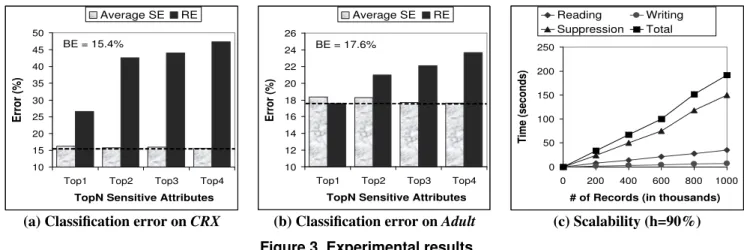
TheJapanese Credit Screening data set, also known as CRX, is based on credit card application. There are 9 cat-egorical attributes and a binary class attribute representing the application statussucceededorfailed. After removing records with missing values, there are 465 and 188 records for the pre-split training and testing respectively. In the UCI repository, all values and attribute names inCRXhave been changed to meaningless symbols, e.g.,A1. . . A15. We con-sider the four template requirements: Top1, Top2, Top3
10 15 20 25 30 35 40 45 50
Top1 Top2 Top3 Top4 TopN Sensitive Attributes
Er ro r ( % ) Average SE RE BE = 15.4% 10 12 14 16 18 20 22 24 26
Top1 Top2 Top3 Top4 TopN Sensitive Attributes
Er ro r ( % ) Average SE RE BE = 17.6% 0 50 100 150 200 250 0 200 400 600 800 1000 # of Records (in thousands)
Ti m e (s ec on ds ) Reading Writing Suppression Total
(a) Classification error onCRX (b) Classification error onAdult (c) Scalability (h=90%) Figure 3. Experimental results
andTop4. BE = 15.4%. Table 3 shows the number of
inferences above different confidence thresholds hin the original data. For example, the number of inferences that have a confidence larger than 90% is 6 inCRXforTop4.
Thresholdh 10% 30% 50% 70% 90%
CRX (Top4) 40 27 15 8 6
Adult (Top4) 1333 786 365 324 318
Table 3. Number of inferences aboveh
Figure 3a depictsSEandRE forTopNaveraged over h=50%, 70%, 90%. The dashed line representsBE. We
summarize the results as follows:
1. SEspans narrowly between 15.4% and 16.5% across
differentTopN.SE−BEis less than 1.1% for all sets
of templates considered. These results support that in-ference limiting and accurate classification can coexist. For example, from Table 3, 15 inferences with a confi-dence higher than 50% were eliminated forTop4. Of-ten, different ic’s share some common values, and sup-pressing a few common values simultaneously elimi-nates multiple inferences.
2. The minimumRE −SEis10.1%forTop1, and the maximumRE−SEis31.3%forTop4. These large gaps show a significant benefit of suppression over the removal of sensitive attributes.
3. For all templates tested, the variance ofSEis less than
0.6%, suggesting that suppression is robust. It also suggests that protecting more sensitive attributes (i.e., a largerNinTopN) or having a lower thresholdhdoes
not necessarily compromise the classification quality. In fact, asN increases, more sensitive attributes can help the classification.
4. Having more sensitive attributes (i.e., a larger N in TopN) implies that the removal of these attributes has a larger impact to classification. This is reflected by the increasingREin Figure 3a.
5. The algorithm took less than 2 seconds, including disk I/O operations, for all the above experiments.
Let us take a closer look at the suppressed data forTop4 withh = 70%. Some values of attributesA4 andA5are
suppressed, and the entireA13is suppressed. Despite such vigorous suppression, SE = 15.4% is equal to BE. In fact, there exist multiple classification structures in the data. When suppression eliminates some of them, other structures emerge to take over the classification. Our method makes use of such “rooms” to eliminate sensitive inferences while preserving the quality of classification.
5.2. Adult
The Adult data set is a census data previously used in [2, 8, 10, 18]. There are 8 categorical attributes and a bi-nary class attribute representing the income levels≤50K or
>50K. There are 30,162 and 15,060 records without
miss-ing values for the pre-split trainmiss-ing and testmiss-ing respectively. Table 4 describes each categorical attribute.Top4attributes areM, Re, E, Sin that order.BE= 17.6%.
Attribute # of Attribute # of
Values Values
Education (E) 16 Marital-status (M) 7 Occupation (O) 14 Native-country (N) 40 Race (Ra) 5 Relationship (Re) 6
Sex (S) 2 Work-class (W) 8
Figure 3b shows the errors forTopN, averaged overh= 10%, 30%, 50%, 70%, 90%. We summarize the results as follows:(1)SE−BEis less than 0.8% in all cases. This is
amazing considering that hundreds of inferences were elim-inated according to Table 3.(2)The largestRE−SEis
ap-proximately 6% forTop4.(3)The difference between max-imum and minmax-imumSEis less than 1%.(4)ForTop1,RE
is slightly lower thanSE, implying that removing the top attribute does not affect the classification. However, as more sensitive attributes were removed (i.e.,Top2,Top3,Top4),
REpicked up. (5)The algorithm spent at most 14 seconds for all experiments on Adult, of which approximately 10 seconds were spent on suppressing the 45,222 data records.
5.3. Scalability
The purpose of this experiment is to see how scalable our method is for large data sets. We evaluated the scalabil-ity on an expanded version ofAdult. We first combined the training and testing sets, giving 45,222 records. Then for each original recordrin the combined set, we createdα−1 “variations” ofr, whereα >1is theexpansion scale. For each variation ofr, we randomly and uniformly selectedy
attributes from∪IC, selected some random values for these y attributes, and inherited the values ofr on the
remain-ing attributes, includremain-ing the class and sensitive attributes. Together with original records, the expanded data set has
α×45,222records.
Figure 3c depicts the runtime of our suppression method for 200K to 1M data records based on the templateshIC→ {π1
, . . . , πk},90%i, where{π1
, . . . , πk}is the set of 50%
least frequent values in theTop1attributeM, andIC con-tains the other 7 attributes. This is one of the most time consuming settings because of the largest number of disclo-sure candidates to consider at each iteration, and a larger
hrequires more iterations to reach a solution. Our method
spent 192 seconds to suppress 1M records, of which 150 seconds were spent on suppression, and the rest was spent on disk I/O operations.
6. Conclusions
We studied the problem of eliminating the sensitive in-ferences that are made possible by data mining tools, while preserving the classification value of the data. A sensitive inference has a high confidence in linking a group of indi-viduals to sensitive values. We eliminated sensitive infer-ences by letting the user specify the templates and max-imum confidence for such inferences. We used suppres-sion of domain values as a way to achieve this goal. We presented a progressive disclosure algorithm that iteratively searches for a better suppression and prunes the search whenever no better alternative is possible. Experiments on
real life data sets showed that the proposed approach pre-serves the information for classification modeling even for very restrictive privacy requirements.
References
[1] R. Agrawal, T. Imielinski, and A. N. Swami. Mining associ-ation rules between sets of items in large datasets. InProc. of the 1993 ACM SIGMOD, pages 207–216, 1993.
[2] R. J. Bayardo and R. Agrawal. Data privacy through optimal k-anonymization. InProc. of the 21st IEEE ICDE, pages 217–228, 2005.
[3] C. Clifton. Using sample size to limit exposure to data min-ing.Journal of Computer Security, 8(4):281–307, 2000. [4] C. Clifton, M. Kantarcioglu, J. Vaidya, X. Lin, and M. Y.
Zhu. Tools for privacy preserving data mining. SIGKDD Explorations, 4(2), 2002.
[5] L. H. Cox. Suppression methodology and statistical disclo-sure control.Journal of the American Statistics Association, Theory and Method Section, 75:377–385, 1980.
[6] A. Evfimievski, R. Srikant, R. Agrawal, and J. Gehrke. Pri-vacy preserving mining of association rules. InProc. of the 8th ACM SIGKDD, pages 217–228, 2002.
[7] C. Farkas and S. Jajodia. The inference problem: A survey. SIGKDD Explorations, 4(2):6–11, 2003.
[8] B. C. M. Fung, K. Wang, and P. S. Yu. Top-down special-ization for information and privacy preservation. InProc. of the 21st IEEE ICDE, pages 205–216, Tokyo, Japan, 2005. [9] S. Hettich and S. D. Bay. The UCI KDD Archive, 1999.
http://kdd.ics.uci.edu.
[10] V. S. Iyengar. Transforming data to satisfy privacy con-straints. InProc. of the 8th ACM SIGKDD, 2002.
[11] M. Kantarcioglu, J. Jin, and C. Clifton. When do data min-ing results violate privacy? In Proc. of the 2004 ACM SIGKDD, pages 599–604, 2004.
[12] J. Kim and W. Winkler. Masking microdata files. InASA Proc. of the Section on Survey Research Methods, 1995. [13] W. Kloesgen. Knowledge discovery in databases and data
privacy. InIEEE Expert Symposium: Knowledge Discovery in Databases, 1995.
[14] J. R. Quinlan.C4.5: Programs for Machine Learning. Mor-gan Kaufmann, 1993.
[15] L. Sweeney. Datafly: A system for providing anonymity in medical data. InProc. of the 11th International Conference on Database Security, pages 356–381, 1998.
[16] L. Sweeney. Achieving k-anonymity privacy protection us-ing generalization and suppression. International Journal on Uncertainty, Fuzziness, and Knowledge-based Systems, 10(5):571–588, 2002.
[17] V. S. Verykios, A. K. Elmagarmid, E. Bertino, Y. Saygin, and E. Dasseni. Association rule hiding. IEEE TKDE, 16(4):434–447, 2004.
[18] K. Wang, P. S. Yu, and S. Chakraborty. Bottom-up gener-alization: a data mining solution to privacy protection. In Proc. of the 4th IEEE ICDM, 2004.
[19] R. W. Yip and K. N. Levitt. The design and implementation of a data level database inference detection system. InProc. of the 12th International Working Conference on Database Security XII, pages 253–266, 1999.