Contract No.: 500-95-0047 (09) MPR Reference No.: 8756-310
The Early Experience
of the Healthy Quality
Partners Case
Management Program
Final Report
August 18, 2003 Nancy Archibald Jennifer Schore Submitted to:Centers for Medicare & Medicaid Services Office of Strategic Planning
C3-20-17 7500 Security Boulevard Baltimore, MD 21244 Project Officer: Carol Magee Submitted by:
Mathematica Policy Research, Inc. P.O. Box 2393 Princeton, NJ 08543-2393 Telephone: (609) 799-3535 Facsimile: (609) 799-0005 Project Director: Randall Brown
ACKNOWLEDGEMENTS
Many individuals contributed to the preparation of this report. We would like to thank Health Quality Partners’ program staff including Dr. Kenneth Coburn, Sherry Marcantonio, Pamela Johnson, Pat Vida, and Bob Lazansky for the information they provided on the operation of their program and the time they contributed to interviews and review of the draft report. Carol Magee and Cindy Mason of the Centers for Medicare & Medicaid Services and Randall Brown of Mathematica Policy Research, Inc. contributed critical reviews of the draft report. Laura Berenson edited and Jane Nelson produced this report. Any remaining errors or omissions are the responsibility of the authors.
EXECUTIVE SUMMARY
In January 2001, the Centers for Medicare & Medicaid Services (CMS) selected Health Quality Partners to operate a demonstration care coordination program as part of CMS’s Medicare Coordinated Care Demonstration. Mathematica Policy Research, Inc. (MPR) is evaluating the 15 programs in this demonstration, as well as 1 program that is participating in CMS’s Medicare Case Management Demonstration for Congestive Heart Failure and Diabetes Mellitus. The evaluation uses a randomized design to test the impact of care coordination on care quality, health service use, and health services costs. This case study documents Health Quality Partners’ early experiences in the demonstration; the documentation is based on telephone interviews conducted three months after the program began enrolling patients. A report containing preliminary program impacts and a detailed description of program implementation is planned for fall 2003.
Experience with Care Coordination. Health Quality Partners, located in Plumsteadville, Pennsylvania, is a nonprofit provider of wellness and care management services. Health Quality Partners formerly was the medical management team of PennCARE, an 11 hospital integrated delivery system in eastern Pennsylvania that included a network of more than 3,000 physicians. PennCARE, which developed the prototype intervention for the demonstration for Aetna U.S. Healthcare’s commercial and Medicare+Choice health plans, spun off its medical management team to become Health Quality Partners in July 2001. The prototype program provided disease and care management services to approximately 500 patients between 1999 and 2001. Health Quality Partners modified the prototype program for the demonstration primarily by changing the processes it uses to identify and recruit patients.
Goals and Eligibility Criteria. Health Quality Partners’ program goals include (1) improving beneficiary education and adherence to medical regimens, (2) improving physicians’ practice patterns, (3) improving communication and coordination among patients and physicians, and (4) increasing access to non-Medicare services. The program targets patients in eastern Pennsylvania who have asthma, diabetes, heart failure, coronary artery disease, hypertension, or hyperlipidemia. Patients must be at least 65 years of age, have Medicare Parts A and B, must have Medicare as their primary payer, and must not be in managed care. Waiver cost estimates anticipate that the program will save Medicare $1,179,333 over the four-year study period, assuming a 20 percent reduction in Medicare costs.
Outreach and Enrollment. Physicians are the primary source of patient referrals. Health Quality Partners works with the physicians’ office staff to help to identify eligible patients and to generate lists of eligible patients. The physicians review their lists and exclude patients they judge to be unsuitable for the program. The program then sends a letter to each patient identified as a potential participant; the letter is signed from the physician practice and written on the practice’s letterhead. Patients who respond to the letter are invited to an information session at which Health Quality Partners’ care managers explain the demonstration and ask those who are interested in participating to sign enrollment and consent forms. After obtaining consent, the care managers administer the Sutter Health Questionnaire to determine patients’ level of risk for future use of high-intensity health care. In addition, lower-risk patients are given a basic disease-specific assessment. The patients are then randomized within three risk strata: (1) high risk, (2)
moderate risk, and (3) low risk. The program began enrolling patients in April 2002. After three months, it had enrolled only 43 patients (22 treatment group and 21 control group patients). The rate of enrollment increased in subsequent months but has remained slower than expected.
Key Program Staff Members. Key program staff members are the medical director, enrollment coordinator, project manager, care management supervisor, and care managers. The program medical director is the president and chief executive officer of Health Quality Partners. The enrollment coordinator, Health Quality Partners’ director of operations and special projects, is responsible for recruiting physicians to participate in the demonstration, securing referrals, and managing relationships with external program contacts. The project manager is Health Quality Partners’ vice president of health design services and is responsible overall for program design and implementation. The care management supervisor is responsible for recruiting, training and supervising the care management staff; monitoring patient care; and managing day-to-day program operations. All four care managers employed at the time of the interview were registered nurses with significant community nursing experience.
Care Coordination Components. The Health Quality Partners demonstration program intervention includes assessment, care planning, and monitoring; patient education; arrangement for services and resources; and facilitation of communication across providers. Patients will remain in the program until the four-year study has ended. Health Quality Partners offers different interventions to each risk group. High-risk patients receive a comprehensive, in-home geriatric assessment, which determines their immediate needs. Moderate-risk patients receive a comprehensive, in-person, disease-specific assessment that usually is conducted in their physicians’ offices. Low-risk patients receive only the basic disease-specific assessment that the program conducts prior to randomization.
The intensity of care coordination varies by risk level. The care managers develop comprehensive, written, problem-focused plans of care for all moderate- and high-risk patients. Plans of care are developed collaboratively by the care manager, patient, and, sometimes, the caregiver/family. Patients who have been assessed as low risk do not have a care plan. Instead, the care managers refer them for disease-specific patient education, which is presented in a group setting. All patients are monitored at least monthly and more frequently as necessary. Patients in the early phase of active management and those at high and moderate risk are often contacted at a higher frequency based on the nurses’ clinical judgment. The care managers document assessments, plans of care, and monitoring contacts on paper forms. In addition, an electronic database enables the care managers to manage and schedule their patient contacts, track all care manager activities, interventions and patient status.
Patient Education and Coordination Across Providers. Care managers identify patient education needs during the geriatric and disease-specific assessments. They provide education to moderate- and high-risk patients during routine follow-up calls, using educational materials and interactive educational learning tools that the program has developed and gives to the patients. Teaching is documented on a disease-specific patient education flowsheet. Low-risk patients are referred to classes focusing on cardiovascular diseases or diabetes. Both types of education focus on understanding disease processes, the correct way to take medications, improving self-care and self-monitoring skills, behavioral and lifestyle changes, and understanding what community resources are available. Care managers are responsible for communicating with each patient’s providers (particularly the primary care physician) about the program’s plan of care and
the patient’s progress toward his or her goals. They also track unexpected hospitalizations and trips to the emergency room. The care managers try to ensure that events (such as diagnostic testing) occur at the appropriate time and in the proper order, and that needed information (such as the results of the tests) is available at the time of the visits.
Arranging Services. The program arranges for or refers patients to a wide variety of services and resources, but it does not pay for any services or supply patients with monitoring devices. The program most frequently refers patients to home-delivered meal programs, transportation services, and home health care.
Physicians’ Expected Role. The care managers worked with many of the participating physicians during the prototype program, which has fostered trusting and cooperative relationships between the care managers and the physicians. Even though the current relationships with physicians are positive ones, program staff still take great care to prevent the program from becoming a burden to physicians, as well as to tailor program communications to each physician’s needs and preferences. They expect that physicians will identify patients for the program and will act as partners in care management by responding to the care managers’ requests to discuss specific patients. However, they do not anticipate that physicians will have the time to actively encourage their patients to participate.
Data Systems. Although much of the program’s documentation of patient encounters is maintained on paper forms, the program uses a Microsoft Access database to record some care management data. This database was developed as a medical management tool by PennCARE, and it has been adapted for the demonstration. It contains patient demographic information, eligibility status and checks, patient activities and interventions contact logs, patient tracking tools, the Sutter Health Questionnaire, and the data submitted to the evaluator.
Early Implementation Experience. Health service delivery demonstration programs such as the ones in this evaluation typically encounter barriers to early implementation. These barriers can include lower-than-expected enrollment; opposition from physicians; difficulty hiring qualified staff or obtaining space and equipment (including higher-than-expected labor, rent, or equipment costs); and difficulty developing a data collection system that can monitor patients and program activities efficiently. The biggest problem that Health Quality Partners encountered during its first three months of operation was a lower-than-anticipated enrollment. Program staff attributed the early shortfall in patient referrals to a loss of momentum resulting from delays in program startup. Although referrals increased as staff renewed contacts with physicians, patient enrollment is still below the expected level. Two factors appear to account for the continuing enrollment problems: (1) a lack of staffing resources for recruitment activities, and (2) a high rate of patient refusal to participate. To address these issues, the program plans to dedicate staff to patient outreach, ask physicians to take a more active role in encouraging their patients to participate, and track the reasons for patients’ refusal to participate. It also has had some early successes. In particular, physicians have not opposed the program, it has had little difficulty hiring care management staff, and it has successfully used a computerized information system to support its operations.
Problems Related to Evaluation Activities. Demonstration programs commonly encounter early problems related to contamination of the control group or to difficulty providing program data required for the evaluation. Health Quality Partners’ program staff are not aware
of any other care coordination or disease management programs operating in the program’s area. Thus, it does not seem likely that control group patients could receive these services from another source. The program is concerned that physicians who care for both treatment group and control group patients may unknowingly adopt a higher standard of care for all their patients as a result of their involvement in the program. However, the program does not broadly focus on changing physicians practice patterns, and the expected level of physician interaction with care managers with respect to individual patients is quite modest. Thus, the chance of this type of contamination is minimal.
Early Successes. The Health Quality Partners demonstration program contains many features associated with successful care coordination interventions. For example, it assigns care managers to particular patients and physician offices. A computerized care management information system is used to track patient contacts. The care management process itself includes important elements, such as organized initial patient assessments, ongoing care planning, frequent and structured followup with patients and physicians, and patient education. All the care managers have significant community nursing experience. These features, along with the care managers’ previous care management experience, should enable the program staff to address any difficulties they encounter. The program continues to nurture its relationships with community physicians, thus facilitating interactions between care managers and physicians and encouraging patient-physician communication. During its first three months of operation, Health Quality Partners has resolved most of the problems it encountered. It has shown that it has the potential to be successful if it can reach its enrollment goal.
HEALTH QUALITY PARTNERS
Health Quality Partners is 1 of 15 demonstration care coordination programs participating in the Medicare Coordinated Care Demonstration sponsored by the Centers for Medicare & Medicaid Services (CMS). The demonstration, mandated by the Balanced Budget Act of 1997, tests a wide range of care coordination models for Medicare fee-for-service beneficiaries. Mathematica Policy Research, Inc. (MPR) is evaluating these 15 demonstration programs and another program that is participating in CMS’s Medicare Case Management Demonstration for Congestive Heart Failure and Diabetes Mellitus. The evaluation of all 16 programs uses a randomized design to test the impact of care coordination on the quality of care and on the use and costs of health services. It includes an implementation analysis to assess which features appear to lead to the success or failure of each program.
This brief case study report describes the early experiences of the Health Quality Partners demonstration, which calls its program the “Medicare Coordinated Care Study.” The Health Quality Partners demonstration began enrolling patients for evaluation in April 2002. This report is based on telephone interviews, using semistructured interview protocols, that MPR conducted in July 2002 with Health Quality Partners staff members. The report describes the history of the demonstration program, discusses how the program relates to its host organization, and provides an overview of the key features of the intervention. It concludes by highlighting some early program successes and potential areas of concern to the evaluation team.
Subsequent reports will describe program implementation in greater detail, using information collected during in-depth, in-person interviews and a second set of telephone interviews with program staff. Ultimately, the findings from the implementation analysis will be synthesized with the findings from the impact analysis to assess each program’s strengths and
weaknesses, as well as the features that appear to be associated with the success or failure of each program. This report does not make such an assessment, as it would be premature to do so.
Program Context
Health Quality Partners, located in Plumsteadville, Pennsylvania, is a nonprofit quality service organization providing disease and care management, wellness programs, quality and process improvement consulting, and clinical performance monitoring. Health Quality Partners formerly was the medical management team of PennCARE, a for-profit managed care risk contractor formed by 11 hospitals in eastern Pennsylvania with a network of more than 3,000 physicians. PennCARE spun-off Health Quality Partners as an independent nonprofit organization in July 2001. Health Quality Partners remains closely affiliated with PennCARE, which has two representatives on its board of directors. Health Quality Partners provides wellness services for Doylestown Hospital’s Health and Wellness Centers, care management and wellness services for two self-funded employers, and disease management services for PennCARE’s managed care contracts.
Intervention History. The prototype intervention for the Health Quality Partners demonstration was developed by PennCARE, under contract to Aetna Inc., which was known at the time as Aetna U.S. Healthcare (Table 1). From 1999 through 2001, PennCARE’s medical management team provided disease management and care coordination services to 533 patients who were enrolled in Aetna’s commercial and Medicare+Choice programs. That prototype program targeted a similar group of patients and offered an intervention similar to the one currently being implemented under the demonstration. When implementing the prototype program, PennCARE’s medical management team established relationships with a number of
TABLE 1 PROGRAM HISTORY
Intervention Developer
• PennCARE
Original Intervention Context and Target Population
• Care coordination intervention developed under a risk contract with Aetna U.S. Healthcare
• Targeted commercial and Medicare+Choice patients with asthma, coronary artery disease, chronic obstructive pulmonary disease, diabetes, congestive heart failure, hypertension, or hyperlipidemia
• Enrolled 533 patients between 1999 and 2001
Original Intervention and Adaptations for Demonstration
• Disease management and care coordination features
• Nurse care coordinators conducted patient assessment, developed care plans, conducted patient education, and monitored patient progress
• No changes made to the intervention for the demonstration, but process for identifying and recruiting patients modified for fee-for-service environment
Effectiveness of Original Intervention
• Community physicians became familiar with Health Quality Partners administrative staff and some care managers through the prototype program
• Pre-post analysis of costs showed overall savings of nine percent
SOURCE: Telephone interviews with Health Quality Partners program staff conducted in July 2002 and review of program documents.
physician group practices in eastern Pennsylvania. The PennCARE staff who developed these relationships (the medical director, director of operations, and vice president of health design services) and some of the care managers have maintained these relationships during the transition to Health Quality Partners. These physician groups are the source of referrals for the demonstration program. The pre-post analysis of costs for patients managed under the prototype program that Health Quality Partners conducted showed overall savings of 9 percent.
Health Quality Partners did not modify the program intervention for the CMS demonstration, but it did adopt a different method to identify and recruit patients. Unlike the prototype conducted under managed care, Health Quality Partners does not have access to administrative data to identify patients. Rather, it works with physicians to identify patients for the demonstration program. In addition, the targeting criteria no longer include patients with chronic obstructive pulmonary disease (COPD).1
Health Quality Partners decided to participate in the CMS demonstration primarily to provide evidence that care management improves health and reduces health care costs for chronically ill fee-for-service Medicare beneficiaries. It sees the demonstration as an opportunity to use the skills and experience it has developed in its Medicare managed care risk contract to develop an effective care coordination intervention for people in fee-for-service Medicare.
Relationship Among Program, Host Organization, and Providers. Health Quality Partners is the host for the demonstration. The program receives patient referrals from physicians associated with PennCARE’s hospital network in eastern Pennsylvania, beginning
1
Because the nurse care manager who specialized in managing patients with COPD in the PennCARE program was not able to work on the demonstration, the program did not feel that it could offer patients with this diagnosis the expert care they needed.
with those closest to the program office in Plumsteadville. Network physicians are familiar with the Health Quality Partners program and with many program staff. The program will conduct outreach efforts to physicians who are located farther away, as necessary. The program does not intend to seek referrals from physicians outside the PennCARE system.
The program staff consists of the president/chief executive officer of Health Quality Partners, who also is the demonstration project’s medical director; the director of operations and special projects, who serves as the enrollment coordinator and administrative liaison; the vice president of health design services who serves as the project manager, the senior clinical team leader, who supervises care management; and the senior vice president for strategic development, who oversee the program’s finances. The care coordinators (called “care managers” in this program) report to the senior clinical team leader who, in turn, reports to the vice president for health design services.
The program has two offices, one located in a wellness center owned by Doylestown Hospital, and the other in an office building in Plumsteadville. The enrollment coordinator and the financial staff are located in the Plumsteadville office, while the other staff divide their time between the two locations. In addition to their responsibilities for the demonstration program, all of the demonstration staff work on Health Quality Partners’ other care management and wellness contracts.
The care managers routinely communicate with physicians about the physicians’ patients who are program participants. Each care manager contact with a patient generates a report that is forwarded to the patient’s physician. In addition, care managers routinely conduct follow-up contact visits with patients in their physicians’ offices, which gives the care managers the opportunity to have face-to-face interactions with physicians. Care managers also may telephone physicians to discuss patients. This frequent contact between the care management staff and
physicians has the potential to foster effective communication, even though care managers and physicians are not co-located.
Service Environment. According to program staff, the program’s service environment was not expected to have a major effect on operations. At the start of the demonstration, one of the two major Medicare managed care plans had withdrawn from the area, but the staff were unsure whether this situation would affect program enrollment. At the time of this case study, some managed care plans had begun to reenter the market. Staff believe that some patients who receive program recruitment letters decline to participate because they are under the mistaken impression that the program is trying to enroll them in a managed care plan because the words “care management” are so similar to “managed care.” Although area hospitals were having difficulty hiring nurses, the staff reported that they had no difficulty hiring care managers for the program. Finally, high malpractice insurance rates in Pennsylvania appear to be driving some physicians, particularly those in obstetrics and orthopedics, to close their practices. Anxiety about malpractice insurance costs has become a preoccupation for some physicians.
At the time of the case study, no other disease management programs were operating in the Health Quality Partners catchment area. The nearby North Penn Hospital had planned to open a diabetes disease management program, which had the potential of becoming a source of control group contamination. However, it appears that this project has not moved forward.
Key Program Features
Program Goals and Expected Savings. The goals of the Health Quality Partners demonstration program are to (1) improve beneficiary education and adherence, (2) improve physician practice, (3) improve communication and coordination among patients and physicians, and (4) arrange non-Medicare services (Table 2). The primary focus is on educating patients so
TABLE 2
PROGRAM GOALS AND DESIRED OUTCOMES
Program Goals
• Improve beneficiary education and adherence
• Improve physician practice patterns
• Improve communication and coordination among patients and physicians
• Arrange non-Medicare services Outcomes for Patients
• Improve clinical health measures and outcomes
• Improve quality of life and satisfaction with health care
• Improve self-care skills and behaviors
• Improve coordination of care
• Reduce hospitalizations and emergency room visits Outcome for Health Service Delivery System
• Provide evidence that care management is effective for chronically ill Medicare fee-for-service beneficiaries
Outcomes for Providers
• Demonstrate that care management is a flexible, collaborative process that does not have to be burdensome or intrusive, but that benefits both physicians and patients
Program Payment and Net Savings for Medicare
• Program fee of $130 per patient per month for high-risk patients; $110 per patient per month for moderate-risk patients; and $50 per patient per month for low-risk patients
• Average net savings of $52 per patient per month, or $1,179,333 net savings to Medicare over the life of four-year study, assuming a 20 percent reduction in Medicare costs and 1,070 treatment group enrolleesa
SOURCE: Telephone interviews with Health Quality Partners program staff conducted in July 2002 and review of program documents.
a
The target of 1,070 treatment group patients assumes that enrollment would continue over the four-year demonstration period with replacements for patients who leave the program.
that patients will change their self-care behavior while prompting physicians to revise treatment regimens so as to follow clinical guidelines. Overall, the program would like to prove that care management is beneficial to chronically ill Medicare beneficiaries. Specific desired outcomes for patients include improved clinical outcomes (such as, glycemic control, blood pressure and lipid levels, and weight loss), improved quality of life, greater satisfaction with care, improved self-care, and better care coordination. The program also would like to show physicians that care management can be a flexible, collaborative process that does not have to be burdensome or intrusive, and that benefits both physicians and patients.
CMS is paying the program a monthly care coordination fee for each patient that is based on the patient’s level of risk. The program will receive $130 per patient per month for high-risk patients, $110 per patient per month for moderate-risk patients, and $50 per patient per month for low-risk patients. Waiver cost calculations for all the demonstration programs assume a 20 percent reduction in Medicare costs, mostly through reductions in hospitalizations (Table 2). According to these calculations, the program will save Medicare an average of $52 per patient per month or approximately $1,179,333 over the four-year life of the demonstration net of the demonstration’s costs (other than startup and evaluation costs). These calculations assume that 1,070 beneficiaries will be randomly assigned to the treatment group over the four-year demonstration period with replacements for patients who leave the program.
Target Population and Outreach. The Health Quality Partners demonstration program targets patients who have asthma, diabetes, heart failure, coronary artery disease (CAD), hypertension, or hyperlipidemia and who live in eastern Pennsylvania (Table 3). Patients must have Medicare Parts A and B, must have Medicare as their primary payer, and must not be in managed care, as is true for all the Medicare Care Coordination Demonstration Programs. The Health Quality Partners program excludes patients who have mild forms of the target conditions,
TABLE 3
TARGET POPULATION AND OUTREACH
Eligibility Inclusion Criteria
Disease-Specific Inclusion Criteria
Resides in southeastern Pennsylvania Medicare as the primary payer Medicare (Parts A and B)
Diagnosis of asthma, heart failure; CAD, diabetes, hyperlipidemia, or hypertension
Eligibility Exclusion Criteria Less than age 65
Mild form of the target conditions
Current or previous Health Quality Partners patient Current participant in another research program
Diagnosis of ALS, Alzheimer’s disease, dementia, end-stage renal disease, HIV/AIDS, Huntington’s disease, psychoses or schizophrenia
Diagnosis of cancer (except skin cancer) within last five years
Candidate for organ transplant
Life expectancy of less than 6 months
Resides or intends to reside in a long-term-care facility Resides out of the area for more than four weeks per year Outreach and Referral
Procedures
Started with referrals from physicians associated with Doylestown Hospital
Other physician groups will be approached later in the recruitment phase
Newspaper advertisements market the program directly to patients
Enrollment Goal
Number enrolled after three months
332 treatment group and 332 control group members (664 patients total) enrolled by April 2003
22 treatment group and 21 control group members (43 patients total) enrolled by July 14, 2002
Table 3 (continued)
Eligibility Criteria or Enrollment Problems
Enrollment slower than anticipated
Conflicting pressures on care managers’ time prevents these staff from contacting prospective patients quickly and results in a backlog
Many patients decline the invitation to participate
SOURCE: Telephone interviews with Health Quality Partners program staff conducted in July 2002 and review of program documents.
are current or previous patients of other Health Quality Partners programs, are current participants in other research programs, have or had certain comorbid conditions, reside in a long-term-care facility, or reside out of the area for more than four weeks per year.
Health Quality Partners chose its target population because of its experience managing similar patients under their contract with Aetna U.S. Healthcare. Its experience suggested that care coordination could reduce the costs of care for people in the target group while improving their quality of life.
Physicians are the primary source of referrals to the program. The program decided to concentrate its initial outreach efforts on the physicians with whom it has the closest relationships and whose offices are near the program’s Plumsteadville office. These physicians are affiliated with Doylestown Hospital, and most use the hospital’s medical management information system. The program will expand outreach beyond this group of physicians as needed to maintain the pace of patient referrals.
Health Quality Partners uses one of two methods to help participating physicians to identify patients: (1) if a physician’s office has a searchable information system, Health Quality Partners program staff will help the physician’s office staff to generate a list of patients with appropriate diagnoses; or (2) if the physician’s office does not have an information system, or if its information system cannot be programmed to generate a list, Health Quality Partners staff will suggest strategies that the office staff can use to compile the list. The physicians review the lists and inform Health Quality Partners which of the potentially eligible patients are suitable candidates for the intervention. The program then mails invitations signed by the practice and written on the practice’s letterhead.
The program also allows patients to self-refer. Early in the demonstration, it marketed the program directly to patients by advertising in local newspapers. Although the advertisements
have generated little response to date, Health Quality Partners plans to continue running them as a way of reminding people about the program.
Patients who respond to the letter are invited to an information session at which program staff explain the demonstration and then ask those who are interested in participating to sign demonstration enrollment and consent forms.2 After determining that a patient has met all the eligibility criteria and after obtaining the patient’s informed consent, the care manger administers the Sutter Health Questionnaire to identify the patient’s level of risk.3 Figure 1 shows the process used for patient risk stratification. Patients identified as being at higher risk (Sutter level 3 or 4) are randomized to Health Quality Partners’ Level 4—High Risk Disease Management with Geriatric Frailty—which we refer to in this report as the “high-risk group.” Patients identified as being at lower risk (Sutter level 1 or 2) are given a basic disease-specific health risk assessment by their care manager. Lower-risk patients who receive a score on the basic assessment indicative of relatively high risk are randomized to Health Quality Partners’ Level 3 (High Risk Disease Management), which we refer to as the “moderate-risk group.” Lower-risk patients whose score suggests that they are at relatively low risk are randomized to Health Quality Partners’ Level 2 (Moderate Risk Disease Management), which we refer to as the “low-risk group.” Patients whose assessment score places them in Health Quality Partners lowest-“low-risk group (Level 1) are excluded from the demonstration. Within each of the three risk groups, or strata, MPR randomly assigns patients to either the treatment group, in which patients receive
2
If a patient cannot attend a group information session, a nurse care manager will visit the patient in his or her home.
3
The Sutter Health Questionnaire is a 17-item validated geriatric assessment instrument which predicts a patient’s risk for hospitalization, emergency room use, falls, and other adverse
FIGURE 1
PROCESS OF PATIENT RISK STRATIFICATION AND LEVEL OF CARE ASSESSMENT
Patient meets eligibility criteria and provides
informed consent
Sutter Health Questionnaire
Sutter
Level 1 Level 2Sutter
Sutter Level 3
Sutter Level 4
Basic disease-specific assessment Health Quality
Partners’ high-risk (Level 4)
Comprehensive geriatric assessment Health Quality Partners’ lowest-risk (Level 1) Health Quality Partners’ low-risk (Level 2) Health Quality Partners’ moderate -risk (Level 3) Excluded from demonstration No additional assessment conducted Comprehensive disease-specific assessment
care coordination services in addition to the usual Medicare-covered services, or the control group, in which they continue receiving the standard Medicare-covered services.
The enrollment rate was lower than expected at the time of our interviews with Health Quality Partners staff, but it picked up during the following weeks. The program’s enrollment target for the first year of the study is a combined total 664 treatment and control group members. To reach this goal, the program would have to enroll roughly 55 patients per month. However, it had enrolled only 43 patients by the end of the first three months of operation (an average of 14 patients per month), and 202 patients by the end of six months (an average of 34 patients per month). At the current rate of enrollment, the program will need nearly 20 months to enroll its target of 664 patients.
The delay in starting the demonstration had a negative impact on early enrollment. Soon after Health Quality Partners was selected as a demonstration site, the staff began contacting physician offices to inform them about the study. With the delay of the demonstration for several months, however, they subsequently had to ask the physicians to wait to identify potential patients. This loss of momentum took some time to overcome. Program staff believe that enrollment should pick up after they convince more physicians to provide patient lists.
Key Program Staff Members and Their Responsibilities. As mentioned, the key program staff members are the director of operations and special projects, who acts as the enrollment coordinator; the vice president of health design services, who acts as the project manager; a senior clinical team leader who supervises care management; and the care managers. The president and chief executive officer of Health Quality Partners also serves as the medical director. He is actively involved in the day-to-day operation of the program such as fielding calls from physicians, leading a biweekly staff meeting to discuss clinical guidelines, checking program data, and visiting physicians’ offices. In particular:
• The enrollment coordinator has a master’s degree in education and more than 10 years of experience in patient education, care coordination, and health care management. She is responsible for recruiting physicians and managing relationships with external program contacts including physician practices.
• The project manager has a master’s degree in social work; is a licensed social worker; and has 20 years of experience in social work, discharge planning, and care management. She is responsible for overall program design and implementation. • The care management supervisor is a registered nurse with 10 years of experience in
home health and hospice nursing, and 3 years of experience in geriatric care management. She is responsible for recruiting, training, and supervising the care managers. She also is responsible for managing day-to-day program operations. She reports to the project manager, who supervises all care management activities.
• The four care managers are registered nurses with significant community nursing experience. They are responsible for implementing the program intervention (which is discussed in more detail in the following section).
The care management supervisor trains the care managers by reviewing policies and procedures with them; explaining and demonstrating the use of tools, forms, and software; and observing the care managers as they perform care management activities. She completes a training checklist for each care manager that documents the dates on which skills were reviewed and competence in each skill area was achieved. (Care managers must demonstrate competence in all training areas by the end of an introductory review period lasting between 90 and 180 days.) The care management supervisor meets with the care managers weekly. The care management supervisor and care managers meet with the project manager and the medical director on a biweekly basis.
The program has four care managers, and it plans to hire a fifth one during the summer of 2003. Its goal is to have a ratio at full enrollment (332 treatment group patients) of about 1 care manager for every 70 high-risk patients. The program chose this ratio on the basis of its experience with its ongoing care management program. With 4 care managers and an enrollment of 22 treatment group patients three months after the start of the demonstration, the ratio was 1 to
5.4 Despite this low initial caseload, the care managers remained fully occupied by working on other tasks such as patient recruitment and risk evaluation. The program does not have a care manager with social work training, but the project manager is a licensed social worker and is available to consult with the care managers on issues relating to social work for patients.
Care Coordination Components. The Health Quality Partners intervention includes core care management functions (assessment, care planning, and monitoring), patient education, arrangement of services and resources, and communications with providers (Table 4). Each of these components has been associated with effective care coordination efforts (see, for example, Chen et al. 2000). Patients will remain in the program until the end of the four-year study; no patients will be enrolled during its last six months. Thus, patients will receive care management for 6 to 48 months, depending on the date of their enrollment.
As noted, Health Quality Partners stratifies its patients into three levels of care and offers different interventions to each group. Figure 1 shows the process used to assign a patient to a level of care. The high-risk group includes patients who have multiple medical, social, or functional problems. These patients have chronic diseases that place significant demands on caregivers and on other social supports. They are at high risk for hospital admission, are at high risk for functional decline (and/or death), or require care planning and clinical management to prevent further decline. Patients in the moderate-risk group have one or more chronic conditions that are not medically well-controlled, need extensive self-management education, or may have complicating psychosocial needs. Patients in the low-risk group are medically well-managed, at or near target goals according to best practice standards, and require primarily education on
4
TABLE 4
MAJOR PROGRAM COMPONENTS
Componenta Provided? Description
Assessment High-risk patients Moderate-risk patients Low-risk patients Care Planning High-risk patients Yes Yes No Yes
Sutter Health Questionnaire prior to randomization and a complete geriatric assessment after randomization conducted in person, in the patient’s home. Results documented on paper
No formal full reassessment; care managers reassess a few key areas during each patient contact
Sutter Health Questionnaire and a basic disease-specific assessment conducted prior to randomization.
Comprehensive disease-specific assessment after randomization, conducted in physician’s office or in care management program office. Results documented on paper
No formal full reassessment; care managers reassess a few key areas during each patient contact
Sutter Health Questionnaire and a basic disease-specific assessment conducted prior to randomization. No postrandomization assessment conducted
Plan of care based on the Sutter Health Questionnaire and other assessments
Individualized, written, and focused on the patient’s acute and chronic medical needs, documented on paper
Moderate-risk patients Low-risk patients Yes No
Care managers, patients, and families/caregivers collaborate to develop plan of care
Plan of care based on the Sutter Health Questionnaire and other assessments.
Individualized, written, and focused on the patient’s chronic medical needs, documented on paper
Care manager, patients, and physicians collaborate to develop plan of care
Education needs identified from Sutter Health Questionnaire and disease-specific assessment; no plan of care developed
Ongoing Monitoring and Evaluation
Yes High-risk patients—minimum of once a month, more frequently if necessary
Moderate-risk patients—minimum of once a month, more frequently if necessary
Table 4 (continued)
Componenta Provided? Description
Low-risk patients—minimum of once a month after completion of patient education classes
Monthly monitoring after goals achieved
Care managers usually contact patients by telephone
During contacts with patients, care managers provide education, assess progress, identify new issues that must be addressed
Technology (such as in-home response devices, recording scales or glucose meters, and electronic reminders) not used for monitoring
Patient Education Yes Moderate- and high-risk patients receive education from care managers during monitoring contacts
Low-risk patients attend group education classes with reinforcement during monitoring contacts
Patients receive a large number of disease-specific education materials
Provider Education No Providers receive information only about care coordination program
Service and Resource Arrangement or Provision
Yes Care managers arrange and refer moderate- and high-risk patients to a wide variety of services and resources
Assistance with applications for medication assistance programs or other public programs
Facilitating Communication Across Providers
Yes Case managers communicate with providers as necessary but encourage patients who are able to communicate with their providers to do so
SOURCE: Telephone interviews with Health Quality Partners program staff conducted in July 2002 and review of
program documents.
management and self-monitoring. The following sections describe the assessment, care planning, monitoring, and patient education components of the intervention for each of the three groups.
Assessment. Before randomization, all patients complete the Sutter Health Questionnaire for risk assessment and stratification; patients assigned to the moderate- and low-risk groups receive a basic disease-specific assessment. Care managers use the assessment information to develop the patients’ plan of care.
Following random assignment, care management for high-risk patients begins with a comprehensive geriatric assessment to establish each patient’s condition, and to determine his or her immediate needs (Table 4).5 The care manager conducts the comprehensive geriatric assessment in person, in the patient’s home, and with a caregiver or significant family member present, if possible. The results of the assessment are documented on paper. The intervention has no formal full reassessment process, although care managers do reassess patients on a few focused dimensions at each follow-up contact.
After randomization, moderate-risk patients receive a comprehensive disease-specific initial assessment that expands on the basic disease-specific assessment. The comprehensive assessment is conducted in person, usually in the office of the patient’s physician; assessments also may be conducted in the patient’s home or in the program’s offices. The results of the assessment are documented on paper, and the patients are reassessed on a few focused dimensions during follow-up contacts. Low-risk patients receive only the Sutter Health Questionnaire and the basic disease-specific assessment conducted prior to randomization.
5
Appendix A lists the areas covered by the geriatric assessment and the basic and comprehensive disease-specific assessments.
According to data that the program prepared for the evaluation in November 2002, by the end of September, care managers had assessed 84.8 percent of the treatment group patients who were enrolled between July and September of 2002 (Table 5). This percentage accounts for nearly all the patients assigned to the program’s high- and moderate-risk groups.6 The program’s policy is to complete a patient’s initial assessment within two weeks of random assignment. According to the program data, the care managers conducted 29.9 percent of these assessments within one week of random assignment, 31.3 percent between one and two weeks after random assignment, and 38.8 percent more than two weeks after random assignment. The difference between the actual and expected time to completion of the assessments may reflect the number of patients waiting to be assessed during the program’s initial months.
Care Planning. Care planning is based on the patient’s level of risk. For high-risk patients, care managers develop individualized, written, problem-focused care plans. The care manager, the patient, and the patient’s family (or caregiver) collaborate in developing the plan of care. The plan outlines the patient’s acute and chronic medical needs and educational needs; specifies interventions to be undertaken by the care manager and interventions to be undertaken by the physician; and sets goals for patient self-care and behavioral change. The plan of care is constantly evolving based on each patient encounter. A summary of the patient’s assessment with recommendations and a copy of the care plan are sent to the physician for inclusion in the patient’s medical record. The patient receives a written list of goals and instructions as appropriate.
6
TABLE 5
CARE COORDINATOR CONTACTS WITH PATIENTS BETWEEN JULY AND SEPTEMBER 2002
Number of Patients Enrolleda 79
Number of Patients with at Least One Care Manager Contact 79
Total Number of Contacts for All Patients 485
Number of Care Managers Contacting Patientsb 5
Number of Patients in Contact with More than One Care Manager 0 Among Those Patients with at Least One Contact:
Percentage of contacts care manager initiated 94.0 Percentage of contacts:
At patient’s residence 12.4
By telephone 65.8
In person, elsewhere 21.9
Of all Patients Enrolled, Percentage with Assessment
Contactafter Randomization 84.8
Among Those Patients with an Assessment, Percentage of Patients Whose First Assessment Contact Was:
Within a week of random assignment 29.9
Between one and two weeks of random assignment 31.3
More than two weeks after random assignment 38.8
Of All Patients Enrolled, Percentage of Patients with Contacts for:
Identify need for non-Medicare service 3.8
Identify need for Medicare service 6.3
Provide disease-specific or self-care education 88.6
Explain tests or procedures 59.5
Explain medications 81.0
Perform routine patient monitoring 60.8
Monitor services 13.9
Monitor abnormal results 36.7
Provide emotional support 39.2
Average Number of Patients Contacted per Care Manager 15.8 Average Number of Patient Contacts per Care Manager 97.0
SOURCE: Health Quality Partners program data received November 2002, and covering services delivered through
September 30, 2002.
aNumber of patients enrolled in the treatment group as of September 30, 2002.
For moderate-risk patients, the care manager develops an individualized care and action plan in collaboration with the patient. The physician receives a written summary of the patient’s assessment with recommendations and a copy of the care plan. The patient receives a written list of the mutually agreed-on goals and instructions.
Patients in the lowest level of care do not have a written plan of care. Instead, the intervention focuses on addressing the knowledge deficits identified during the initial assessment by referring patients to group education classes. Because these patients are not in need of community-based or Medicare-covered services at the time of enrollment, the care managers initially do not arrange for or refer patients to these services. Thus, a plan of care that focuses on obtaining services is not required. However, low-risk patients may need these services over time. If so, the care managers will intensify patient contact and arrange services as needed.
Monitoring. The care managers monitor the progress that patients make toward meeting their goals. Most monitoring is performed over the telephone. High-risk patients are monitored at a minimum of every four weeks (or more frequently, if necessary) until their medical problems have stabilized and their care needs have been addressed. The care managers make adjustments to the care plans as the needs of these patients change or in response to any new problems that arise. Care managers follow up with moderate-risk patients at a minimum of every four weeks until medical problems have been stabilized and problem areas have been addressed. As with high-risk patients, the care manager will make adjustments to the care plans as the patients’ needs change. Care managers contact low-risk patients approximately four weeks after the completion of the patient education class. They reassess the patients’ knowledge and self-care skills and reinforce key principles of self-management. They follow up with low-risk patients monthly until the patients have achieved their knowledge goals, or until they have attained the highest level of knowledge that the care manager believes is possible.
Patients who have reached the goals specified in their care plans move into longitudinal management. Care managers follow up with all patients in longitudinal management by telephone at monthly intervals. In longitudinal management, the care managers reassess the patients’ care needs and reinforce education and self-monitoring goals. If new issues are identified, the care managers intensify the intervention they provide until the patient has stabilized.
Patient Education. Depending on the patient’s risk level, care managers use the comprehensive geriatric assessment, comprehensive disease-specific assessment, or basic disease-specific assessment to identify education needs. Care managers provide the education to moderate- and high-risk patients during the routine follow-up calls and through a variety of educational materials given to the patients. Patient education is documented on a disease-specific patient-education flowsheet. Low-risk patients receive education in group classes given either by Health Quality Partners staff (for cardiovascular diseases) or by Doylestown Hospital staff (for diabetes). These classes focus on improving patients’ understanding of the disease processes, methods of taking medications correctly, and improving self-care and self-monitoring skills, and on providing the patients with clearly understandable information about available community resources. Participation in the classes is voluntary, but the care manager follows up with the patient after the scheduled completion date of the classes to determine if the patient actually did attend. As of the time of this case study, Doylestown Hospital has not charged Health Quality Partners a fee for allowing demonstration patients to attend its diabetes education classes.
Provider Practice. The program also wants to improve provider practices, but it makes the effort on a case-by-case, issue-by-issue basis, rather than through a formal educational program. Although Health Quality Partners’ prototype care coordination program provided a significant
amount of feedback to physicians about the physicians’ practice patterns, the program staff decided to eliminate this component from the demonstration because they were concerned that it could have led physicians to change the way they cared for their control group patients. Although the program would like to improve clinical practice, the staff believes that the care most area physicians provide already conforms to the recommendations of clinical practice guidelines. However, the program staff does work with physicians on a case-by-case basis to optimize each patient’s medical management according to evidence-based clinical guidelines.
Arranging Services. The program arranges for or refers patients to a wide variety of services and resources. The most frequently used services at the time of our interviews were home-delivered meals programs, transportation services, and home health.7 The program does not directly pay for services, nor does it supply patients with monitoring devices, such as blood pressure monitors, glucose meters, or scales.
Communication. Care managers are responsible for communicating with the patient’s providers (particularly the primary care physician) about the care plan and about the progress the patient has made toward achieving his or her goals. They also track unexpected hospitalizations and emergency room visits. In addition, they try to ensure that events (such as diagnostic testing) occur at the appropriate time and in the proper order, and that necessary information (such as the results of a diagnostic test) is available when patients visit their primary care physicians. They do this primarily by encouraging patients to have the necessary tests performed, rather than by making the appointments for the patients. However, the care managers will intervene directly with physicians if patients are unable or unwilling to take on this role. They also follow up with patients to make sure that necessary care has been provided. Again,
7
they do so by encouraging the patients to make the necessary appointments with their providers. If patients do not make these appointments, the care managers continue encouraging them to do so and help them identify and eliminate barriers to following up on their care.
Other Care Manager Responsibilities. To date, care managers have had limited interactions with hospitalized patients, hospital discharge planners, or hospital-based providers. Because care managers usually do not know that a patient has been hospitalized until after the fact, they usually are unable to interact with patients in that setting. The care managers usually resume their interactions with the patient after discharge. If a patient needs home health care after a hospitalization, the hospital’s discharge planner arranges for the service. Care managers do not provide any direct, hands-on care, but they do interact with patients in many settings, including the patients’ homes, their physicians’ offices, assisted-living centers, group homes, and skilled nursing facilities (for patients expected to have short-term stays).
Early Implementation Data. According to program data generated for the evaluation, all 79 treatment group patients enrolled through the end of September 2002 had had at least one contact with a care manager between July and September (Table 5). Of these contacts 94.0 percent were initiated by the care managers, rather than by the patients. Most (65.8 percent) were telephone contacts, although a substantial portion (21.9 percent) took place in a physician’s office. Among all enrolled patients, 88.6 percent had contacts relating to self-care or disease-specific patient education, 81.0 percent had contacts relating to the explanation of medications, and 60.8 percent had contacts relating to routine monitoring.
Involvement of Physicians. Program staff expect that physicians will play a small but important role in the program (Table 6). Physicians are the primary source of patient referrals, but the program has not expected physicians to encourage patients to participate or even to
TABLE 6
PLANNED PHYSICIAN INVOLVEMENT
Brief Description
Promotion of Program to Physicians
Program staff made presentations to physician groups and met individually with interested physicians.
The program has focused on physicians affiliated with one area hospital and will expand to other physician groups, as needed.
Physicians as Referral Sources Physicians are the primary source of patient referrals. Physicians’ Role in
Encouraging and Maintaining Patient Participation
Letters inviting patients to participate in the demonstration are sent on the physicians’ letterhead.
Physicians are not otherwise involved in promoting the program to patients.
Physicians’ Role in Care Coordination
Physicians play a small but important role in the care management process.
Physicians receive information on patients’ progress toward goals, but they are not expected to respond unless their intervention is needed (for example, because a change in medication is needed).
SOURCE: Telephone interviews with Health Quality Partners program staff conducted in July 2002 and review of program documents.
discuss the program with their patients.8 Program staff believe that physicians are too busy to assist with this task during a short office visit. The program does expect physicians to respond to care managers’ requests for information, to heed care managers’ recommendations on changes in patients’ treatment regimens, and to participate in the care planning process. If space is available in a physician’s offices the program asks the physician to allow care managers to see patients there. The program sees this arrangement as having three benefits. First, it allows the care manager and physician to integrate the care they provide. Second, it provides a time and place for the care manager to bring questions or concerns to the physician. Third, it allows the care manager to access the patient’s medical records. Program staff are very concerned that the program not become too burdensome to physicians.
Building trust between care managers and physicians is an ongoing process, as illustrated by an anecdote that the program’s medical director told us. On multiple occasions, a care manager had recommended a change in medication to a patient’s physician, but the physician resisted following the advice. When the medical director intervened, the physician admitted that he was unfamiliar with the medication. The physician changed the medication and the patient’s condition improved. As a result, the physician now respects the care manager highly. This story also highlights the critical role that the program’s medical director plays in care manager-physician interactions.
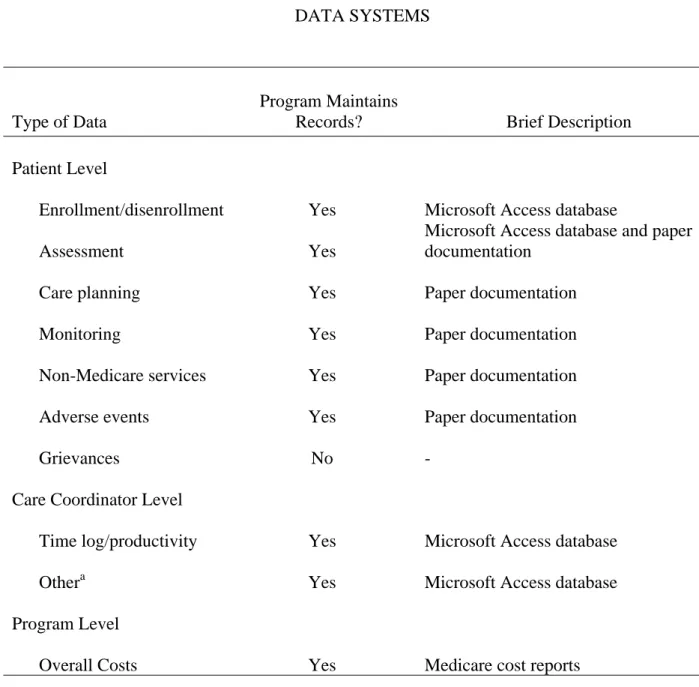
Data Systems. Although much of the program’s documentation, such as assessments, care plans, and monitoring encounter forms, is maintained on paper forms, Health Quality Partners uses a Microsoft Access database to record some care management data (Table 7). PennCARE
8
TABLE 7 DATA SYSTEMS
Type of Data
Program Maintains
Records? Brief Description
Patient Level
Enrollment/disenrollment Yes Microsoft Access database
Assessment Yes
Microsoft Access database and paper documentation
Care planning Yes Paper documentation
Monitoring Yes Paper documentation
Non-Medicare services Yes Paper documentation
Adverse events Yes Paper documentation
Grievances No -
Care Coordinator Level
Time log/productivity Yes Microsoft Access database
Othera Yes Microsoft Access database
Program Level
Overall Costs Yes Medicare cost reports
SOURCE: Telephone interviews with Health Quality Partners program staff conducted in July 2002 and review of program documents.
a
The Microsoft Access database contains tools to help the care coordinators to manage their patient caseloads and prioritize their work.
developed the database as a medical management tool, and it has been adapted to meet the needs of the demonstration. It contains patient demographic information, contains patient activities and a contact log, and has patient tracking tools that allow any staff member to quickly determine where each patient is in the recruitment, screening, and randomization process. The database also includes the Sutter Health Questionnaire tool, which is scored automatically on completion. The database tracks the date of each patient’s scheduled follow-up contact by the care manager and provides the care manager with a prioritized daily task list. Care managers use the database to record the data that are submitted to the demonstration evaluator. Health Quality Partners uses it to track care managers’ productivity. For example, the system records the amount of time spent and the number of contacts required to convince each patient to participate in the program.
Financial Monitoring and Incentives. Health Quality Partners implemented a new accounting system on July 1, 2002. The system tracks the number of staff hours, by task, and the cost of various tasks, such as patient recruitment. It also monitors different categories of direct costs, such as salaries and supplies. In addition, Health Quality Partners pays a fee to Doylestown Hospital in return for human resources, marketing, and payroll support services. The program’s office space at Doylestown Hospital’s health and wellness center is provided as part of Health Quality Partners’ contract to provide patient-wellness services for the hospital’s patients. The program directly leases its Plumsteadville office space from a property management company.
The program has negotiated a three-tiered payment system with CMS, under which it receives $50 per patient per month for low-risk patients, $110 per patient per month for moderate-risk patients, and $130 per patient per month for high-risk patients. The program does not pay physicians a care-coordination fee, nor does it provide financial incentives to its own
staff to promote desired patient or program goals. At the time of our interviews, Health Quality Partners had submitted cost reports to CMS but had not been reimbursed for its services.9
Early Implementation Experience
Operations. Health service delivery demonstration programs such as the ones participating in this evaluation typically encounter barriers to early implementation. Barriers may include lower-than-expected enrollment; opposition from physicians; difficulty hiring qualified staff or obtaining space and equipment (due to higher-than-expected labor, rent, or equipment costs, for example); and difficulty developing a data collection system that can efficiently monitor patients and program activities. Problems in these areas during the early months of implementation could lead to changes to a program’s original design.
The biggest problem that Health Quality Partners encountered during its first few months of implementation was a lower-than-anticipated enrollment level. The program originally had planned to use PennCARE’s network of 3,000 physicians to identify patients for the program, but it subsequently realized that the network was too geographically broad. Instead, it decided to concentrate initially on the approximately 300 physicians affiliated with Doylestown Hospital, because it had the closest relationship with them, and to expand its physician pool later, as necessary. Use of this smaller physician pool yielded the program an enrollment during the first 10 months of implementation of roughly 35 patients per month, on average, a figure well below the 55 patients per month that the program would have needed to meet its initial first-year enrollment target of 664 patients.
9
The program subsequently reported that it began to receive monthly reimbursements from CMS in August 2002.
Program staff attributed the early enrollment shortfall primarily to a loss of momentum resulting from delays in program startup. The program expected to receive more patient referrals as staff renewed contacts with physician offices that they had contacted during the early months of program implementation. Indeed, patient referrals increased during the months after our telephone interviews.
Despite the increase in patient referrals, program enrollment has fallen short of expectations. Two factors—a lack of staff resources for recruiting activities and a high refusal rate among eligible patients—appear to account for the continuing shortfall. At the start of the demonstration, the care managers were responsible for making recruiting calls to potential patients and for conducting informational sessions while conducting care management for their newly enrolled patients. As their caseloads grew, the care managers found it increasingly difficult to devote themselves fully to all three activities. However, the program was reluctant to add new care management staff to relieve the burden because it was unclear whether the new staff would be fully occupied, or whether they would generate enough revenue to cover the cost of their salaries. To address the issue of timely patient outreach, the program plans to reassign some staff responsibilities. The enrollment coordinator will assume most of the duties related to patient outreach and screening, thus enabling the nurse care managers to devote more time to their patients.
The high refusal rate among eligible patients also affected the enrollment level. About half of all patients who receive a letter from their physician inviting them to participate decline to do so. The vast majority of these patients decline the invitation to attend the information session (or decline to have a nurse care manager visit their home to explain the program). Most patients who are willing to learn more about the program subsequently agree to participate. The program plans to address the high refusal rate by asking physicians to take a more active role in
encouraging their patients to participate. It hopes that more people will attend the information sessions if their physicians first discuss the program’s benefits with them. Program staff also plan to ask patients during the initial telephone contact, the reasons why they are not interested in participating in the program. By collecting this information, the program staff may find ways to improve the enrollment rate.
In some care management programs, physicians believe that the care managers threaten their autonomy, or they consider program procedures or paperwork burdensome. However, Health Quality Partners has not experienced any opposition from physicians. The program staff feel that the physicians have been enthusiastic and cooperative, probably because of their experiences with the prototype program and its staff. Although Health Quality Partners does not pay physicians to participate, it consciously tries to minimize the burden on participating physicians by tailoring the mode and frequency of communication between physicians and care managers to suit the physicians’ preferences and needs.
The program has not had difficulty hiring nurse care managers or obtaining office space or equipment, although some costs have been higher than expected. It hired two nurse care managers soon after the award of the demonstration contract but had to assign them to other projects due to the delay in patient enrollment. The lack of revenue resulting from the enrollment delay forced Health Quality Partners to seek financial assistance from PennCARE, its parent organization. In addition, the program found the process of patient recruitment (particularly the number of contacts it had to make or attempt to make) to be much more time-consuming and costly than anticipated. Program staff have started tracking the number of contacts with patients and the number of minutes spent with patients prior to randomization in order to estimate the magnitude of this problem.