Design of Horizontal Axis Micro Wind Turbine for
Low Wind Speed Areas
Deibanehbok Nongdhar
1, Bikramjit Goswami
2, Pallav Gogoi
3, Sidharth Borkataky
4 1,2Department of Electrical and Electronics Engineering, Assam Don Bosco University, School of TechnologyAirport Road, Azara, Guwahati-781017, Assam, INDIA 1
[email protected]*, [email protected] 3,4
Department of Mechanical Engineering, Assam Don Bosco University, School of Technology Airport Road, Azara, Guwahati-781017, Assam, INDIA
3
[email protected], [email protected]
Abstract: Micro wind turbines play an important role in becoming the alternative technology in the generation of electricity because of the increase in fossil fuel prices and the increase in demand for renewable energy sources. Similarly, Wind energy is becoming one of the best renewable sources of energy for generation of electricity because of the fact that wind is a clean and unbounded source of renewable energy. This paper presents the ideas of designing a horizontal axis small-sized wind turbine or horizontal axis micro wind turbine for low wind speed areas to produce electricity. A small-sized wind turbine or micro wind turbine is a type of turbine that converts the kinetic energy of wind into electrical energy and it is used to generate power for small power needs. It can also be used in many applications like homes, villages, and so on, requiring a very low cost for installation and maintenance.
Keywords: Micro Wind Turbine, Renewable Energy, HAWT, VAWT.
1.
Introduction
One of the major challenges in this new century is the production of energy as well as its efficient use from renewable sources. Researchers around the world have shown that global warming has been caused in part by the greenhouse effect which is largely due to the use of fossil fuels for transportation and electricity. So, the use of renewable energy sources such as geothermal, solar, wind and hydroelectric power needs to be increased to protect the environment. As a renewable energy, wind energy has taken an increasingly important place in energy policies at the national and international level as a response to climate change. Wind power usage in India is growing and research in the field of wind energy will further improve the current situation.
In recent years, the importance of renewable sources of energy in power generation has been growing day by day around the world. Also, due to the lack of fossil fuel resources, utilization of renewable sources of energy has become even more important. Large wind farms, either in the countryside, offshore, in the mountains or at the seaside have already been invested by many countries around the world. Since wind speed and direction are well known and there are only a few factors that will influence them, the energy gathered from these wind farms can easily be predicted and calculated. However, in cities, where
there are a crowded population and the land being used to a maximum extent, the availability of such huge area for setting up a wind farm is difficult. Also in the urban environment, the wind speed required for harnessing higher power is less. For these reasons, small wind turbines which can be installed on rooftops are suitable for use in urban areas, as well as rural areas that are not connected to any electricity network. Apart from all the renewable energy resources, cleaner energy systems such as micro wind turbines played a key role in the renewable electricity generation. In wind turbines, some mechanical and electrical aspects of the turbines are necessary to study in details so that the turbine can achieve its electrical output efficiency [1, 2].
Wind turbines convert wind energy into electricity via mechanical energy. There are two primary types of wind turbines, namely horizontal axis (HAWT) and vertical axis (VAWT) wind turbines, and the efficiency of each wind turbine type varies by its design and fabrication.Similarly, these two main group of a wind turbine is classified depending on their axis in which the turbine rotates. Because the horizontal axis has the ability to collect the maximum amount of wind energy for the time of the day and can adjust their blades pitch angle to avoid high windstorms, they are considered more familiar and more common than the vertical axis. HAWTs are most commonly used in wind farms.
Fig. 1: Vertical and Horizontal Axis Wind Turbine [1, 5].
Micro wind turbines can be designed using PVC blades as it can give better power capacity and less costly. It can be used in areas where the velocity of wind is low, that is, as low as 2 m/s, like a plateau or hilly region or in places where large wind turbine does not give a good result. Because of low cost and being of economical, it can be installed in residential areas over the houses for power generation. Moreover, utilization of small wind turbines for the household would result in fewer burdens on the grid and also plays a vital role in reducing utilization of conventional energy and mobility to utilize the power. These micro wind turbines can be used where wind velocity is low like hilly regions or especially rooftops of building and they are less costly, easier to install and can power electrical devices like the LED sign, Cell phones, lighting a lamp, etc. [17, 20].
2.
Design
and
Construction
of
Horizontal
Axis
Micro
Wind
Turbine
Some of the components of the wind turbine and electrical parts associated with it are DC Motors: 12 V, 3 Inch diameter PVC PIPE and 10 Inch in Length, Round base: 2.5 Inch Diameter, Hand Cutter, Drill and Cycle Screw.
A wind turbine blade converts wind energy into rotational mechanical energy. It is the most important part of a wind turbine. Before the design of turbine blade, two important points should be taken into consideration, i.e., (1) the weight of each blade should be equal. (2) Each blade should be positioned on the plate at equal distances. Following are the steps and the materials required for the construction of the turbine blades. In this case, the turbine blades are constructed of thermoplastic material (PVC PIPE) which is of 10 inches in length and 3 inches in diameter. Firstly, the pipe is cut into blades in three equal parts and every three parts are cut into two. Then, from six identical blades, three blades are taken into consideration and at one end of the pieces, holes have been made with the help of a drill. Moreover,
Fig. 2: Construction Stages of Wind Turbine Blades
3.
Mechanical
Aspects
of
the
Horizontal
Axis
Micro
Wind
Turbine
The aerodynamics of flow around the wind turbine blades plays an important role in comparing all the factors responsible for efficient energy production. In order to better treat the wind turbine aerodynamics, one of the approaches is by application of computational fluid dynamics (CFD). It can be also be observed that CFD can be used as a potential tool to study the detailed flow field around wind turbine rotor. To better understand the aerodynamics of wind turbines one of the alternative methods is the use of dedicated experiments to increase knowledge and physical understanding of the phenomena and the validation of models. The simulations have been carried out in commercial CFD code FLUENT. The results from CFD simulations aid in better understanding of the flow structure around the turbine.
3.1 Mechanical Design of the Turbine Blade Following are the dimensions of the wind turbine blade which are designed by a software known as AutoCAD Software. The blade of the wind turbine was designed accordingly to the given dimensions.
Fig. 4: Horizontal Axis Micro wind turbine blade under study
Following are the AutoCAD Designs of the wind turbine blade which have been designed according to the given dimension.
Fig. 5: Isometric view of the full blade model design
Fig. 6: Top view of the full blade design
Fig. 7: Isometric view of the single blade design
Fig. 8: Top view of the single blade design
3.1.1 Mechanical Simulation of the Turbine Blade
A 3-D computational model of the rotor system has been created and CFD simulations or mechanical simulation of the turbine blade have been carried out using commercial CFD code FLUENT or Ansys Fluent Software. The inputs given in this analysis includes Chord length =0.254m (10 inches), radius of the turbine blade=0.254m (10 Inches), blade RPM= 300, Wind Velocity= 2.5m/s, 3.1 m/s, and 3.5m/s and blade material=Thermoplastic material (PVC blade). In this Simulation, Pressure Distribution on the Turbine Blade has been determined.The analysis has been carried out for a constant blade RPM of 300 RPM at various Wind Speed, viz., 2.5 m/s, 3.1 m/s and 3.5 m/s. As a result, the pressure distribution on the turbine blade shows good results that it can withstand at any wind speed.
Fig. 9: Pressure for Wind velocity=2.5m/sec, RPM=300
Fig. 10: Pressure for Wind velocity=3.1m/sec, RPM=300
The figures given above show the pressure distribution on all the parts of the turbine blade. It can be identified or determined by different colors such that the red color on the tip of the turbine blade indicates the maximum pressure whereas the blue color on the turbine blade indicates the minimum pressure.
4.
Electrical Simulation of the Wind
Turbine Generator using
Matlab-Simulink
Since wind is a source of energy which is clean, easy access and sustainable source of energy. Therefore, Wind energy utilization for power generation purpose isbecoming high interest in electrical power production. However, understanding of wind properties is very importantfor wind energy exploitation. The speed of wind is highly variable depending on the season and in hourly means and both geometrically from place to place and temporally. Moreover, the output of micro wind turbine mostly depends on the wind. Therefore, the more is the wind speed, the greater is the amount of power the wind turbine generates. Different regions have different wind speeds. As a result, determination of the value of the wind speed for a particular region is necessary.In thepresent study, a mathematical model and its simulation technique has beenstudied that affect the electrical output power generated by the wind turbine. Therefore, these modeling and electrical simulation techniques will play a great role in thedesign and analysis of these wind turbines.
5.1 Electrical Simulation of Wind turbine A wind power plant has been designed by using Matlab-Simulink as shown in figure 12. The designed system consists of a 1.5 MW (can be changed to any value) wind turbine connected to a load 400 KVA and electric power source 25 KV through a three-phase transformer, the active and reactive power is measured for different wind speed and a different pitch angle of the blade. The values or parameters of the designed system can be changed by changing the system blocks parameters very easily and this is the advantage of using Matlab-Simulink.The model in this study has been used for higher power output which is of 1.5 MW
Fig. 12: 1.5 MW wind turbine power plant [32]
Fig. 13: Output Power curve at wind speed 12m/s [32]
4.1.1 Output Power for different Wind Speed
Following are the output power graph for different wind speed which is obtained by simulated the designed model with respect to the different wind speed. From the figures given below, it is shown that the output power curve increases with the increase of wind speed and decrease with the decrease of wind speed. Therefore, the output power of the wind turbine depends on wind speed, that is, the output power varies when the wind speed is also varying.
Fig. 14: Output Power curve at wind speed 16m/s
Fig. 15: Output Power curve at wind speed 14m/s
Fig. 16: Output Power curve at wind speed 8 m/s
Fig. 17: Output Power curve at wind speed 6 m/s
5.
Electrical
Power
Output
Measurement with respect to Wind
Speed
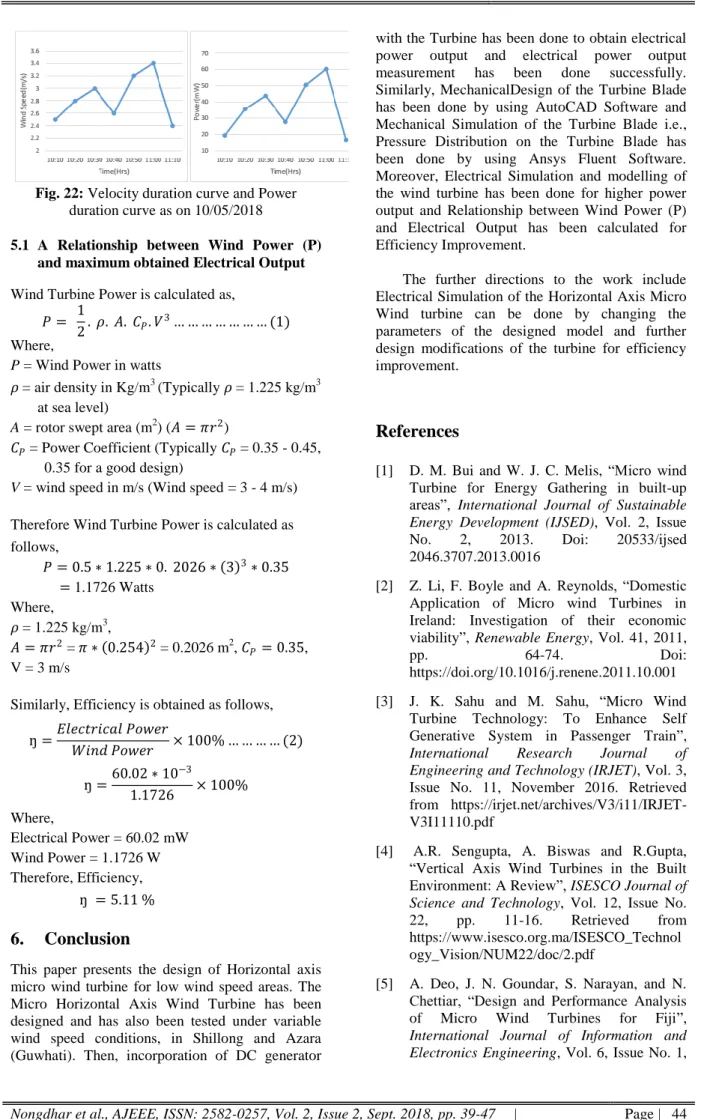
A designed micro horizontal axis wind turbine is taken to the rooftop for measuring the electrical power output of the Wind Turbine coupled with a DC Generator can generate, with respect to the available wind speed. This experiment was done in Azara (Guwahati) and Mawlynrei (Shillong) and the tools used are Anemometer, Multimeter, Resistors, LED strips and connecting wires.
Fig. 18: Snapshots of the Experimental Set-up Therefore, the electrical power output that was obtained with respect to wind speed taken both in Azara (Guwahati) and Mawlynrei (Shillong) are represented in graphical form as follows:
Fig. 19: Velocity duration curve and Power duration curve as on 28/09/2017
Fig. 20: Velocity duration curve and Power duration curve as on 03/10/2017
Fig. 21: Velocity duration curve and Power duration curve as on 17/10/2017
Fig. 22: Velocity duration curve and Power duration curve as on 10/05/2018
5.1 A Relationship between Wind Power (P) and maximum obtained Electrical Output Wind Turbine Power is calculated as,
𝑃 = 1
2. 𝜌. 𝐴. 𝐶𝑃. 𝑉3… … … (1) Where,
P = Wind Power in watts
𝜌 = air density in Kg/m3 (Typically 𝜌 = 1.225 kg/m3 at sea level)
A = rotor swept area (m2) (𝐴 = 𝜋𝑟2)
𝐶𝑃= Power Coefficient (Typically 𝐶𝑃= 0.35 - 0.45, 0.35 for a good design)
V = wind speed in m/s (Wind speed = 3 - 4 m/s) Therefore Wind Turbine Power is calculated as follows, 𝑃 = 0.5 ∗ 1.225 ∗ 0. 2026 ∗ 3 3∗ 0.35 = 1.1726 Watts Where, 𝜌 = 1.225 kg/m3, 𝐴 = 𝜋𝑟2= 𝜋 ∗ 0.254 2= 0.2026 m2, 𝐶 𝑃 = 0.35, V = 3 m/s
Similarly, Efficiency is obtained as follows,
ŋ =𝐸𝑙𝑒𝑐𝑡𝑟𝑖𝑐𝑎𝑙 𝑃𝑜𝑤𝑒𝑟 𝑊𝑖𝑛𝑑 𝑃𝑜𝑤𝑒𝑟 × 100% … … … … (2) ŋ =60.02 ∗ 10 −3 1.1726 × 100% Where, Electrical Power = 60.02 mW Wind Power = 1.1726 W Therefore, Efficiency, ŋ = 5.11 %
6.
Conclusion
This paper presents the design of Horizontal axis micro wind turbine for low wind speed areas. The Micro Horizontal Axis Wind Turbine has been designed and has also been tested under variable wind speed conditions, in Shillong and Azara (Guwhati). Then, incorporation of DC generator
the wind turbine has been done for higher power output and Relationship between Wind Power (P) and Electrical Output has been calculated for Efficiency Improvement.
The further directions to the work include Electrical Simulation of the Horizontal Axis Micro Wind turbine can be done by changing the parameters of the designed model and further design modifications of the turbine for efficiency improvement.
References
[1] D. M. Bui and W. J. C. Melis, “Micro wind Turbine for Energy Gathering in built-up areas”, International Journal of Sustainable Energy Development (IJSED), Vol. 2, Issue No. 2, 2013. Doi: 20533/ijsed 2046.3707.2013.0016
[2] Z. Li, F. Boyle and A. Reynolds, “Domestic Application of Micro wind Turbines in Ireland: Investigation of their economic viability”, Renewable Energy, Vol. 41, 2011,
pp. 64-74. Doi:
https://doi.org/10.1016/j.renene.2011.10.001 [3] J. K. Sahu and M. Sahu, “Micro Wind
Turbine Technology: To Enhance Self Generative System in Passenger Train”,
International Research Journal of Engineering and Technology (IRJET), Vol. 3, Issue No. 11, November 2016. Retrieved from https://irjet.net/archives/V3/i11/IRJET-V3I11110.pdf
[4] A.R. Sengupta, A. Biswas and R.Gupta, “Vertical Axis Wind Turbines in the Built Environment: A Review”, ISESCO Journal of Science and Technology, Vol. 12, Issue No. 22, pp. 11-16. Retrieved from https://www.isesco.org.ma/ISESCO_Technol ogy_Vision/NUM22/doc/2.pdf
[5] A. Deo, J. N. Goundar, S. Narayan, and N. Chettiar, “Design and Performance Analysis of Micro Wind Turbines for Fiji”,
International Journal of Information and Electronics Engineering, Vol. 6, Issue No. 1,
January 2016. Retrieved from http://www.ijiee.org/vol6/590-SE307.pdf [6] N. N. Sorte and S. M. Shiekh, “Design and
Development of Micro Vertical Axis wind turbine for Rural Application”, International Journal of Engineering and Computer Science, Vol. 03, Issue No. 07, July 2014, pp.
7035-7040. Retrieved from
https://dokumen.tips/documents/design-and- development-of-micro-vertical-axis-wind-turbine-ijecspdf1pg-student.html
[7] J. Zhang, Z. Zhou and Y. Lei, “Design and research of high- performance low-speed wind turbines blades”, 2009 World Non-Grid-Connected Wind Power and Energy Conference, Nanjing, 2009, pp. 1-5. Doi: 10.1109/WNWEC.2009.5335818 [8] M. Mohammadi, A. Mohammadi, M.
Mohammadi and H. N. Minaei, “Optimization of small-scale wind turbine blades for low-speed conditions”, Journal of Clean Energy Technologies, Vol. 4, Issue No. 2, March 2016, pp. 140-143. Retrieved from http://www.jocet.org/vol4/268-H1007.pdf [9] N. Prasad E., Janakiram S., Prabu T. and
Sivasubramaniam S., “Design and development of Horizontal small turbine blade for low wind speed”, International Journal of Engineering Science & Advanced Technology (IJESAT), Vol. 4, Issue No.1,
2014. Retrieved from
http://ijesat.org/Volumes/2014_Vol_04_Iss_0 1/IJESAT_2014_01_01_14.pdf
[10] N. Korprasertsak and T. Leephakpreeda, “Analysis and optimal design of wind boosters for Vertical Axis Wind Turbines (VAWTs) at low wind speed”, Journal of Wind Engineering and Industrial Aerodynamics, Vol. 159, 2016, pp. 9-18. Doi: https://doi.org/10.1016/j.jweia.2016.10.007 [11] Y. Vidal, L. Acho, N. Luo, M. Zapateiro and
F. Pozo, “Power control design for variable speed wind turbines,” Energies, Vol. 5, Issue No. 8, 2012, pp. 3033-3050; https://doi.org/10.3390/en5083033
[12] S. Rajendran and D. Jena, “Control of
variable speed variable pitch wind turbine at above and below rated wind speed”, Journal of Wind Energy, Vol. 2014, Article ID 709128.
Doi: http://dx.doi.org/10.1155/2014/709128 [13] A. Mclever, D. G. Holmes, P. Freeze,
“Optimal control of a variable speed wind turbine under dynamic wind conditions”,
IAS'96: Conference Record of the 1996 IEEE Industry Applications Conference, Thirty-First IAS Annual Meeting, San Diego, CA, USA, 1996, Vol. 3, pp. 1692-1698. Doi: 10.1109/IAS.1996.559297
[14] M. Izadbakhsh, A. Rezvani, M. Gandomkar and S. Mirsaeidi, “Dynamic analysis of PMSG wind turbine under variable wind speeds and load conditions in the grid connected mode”, Indian Journal of Science and Technology, Volume 8, Issue No. 14,
July 2015. Doi:
10.17485/ijst/2015/v8i14/51864
[15] L. Wu and D. Enfield, “Investigation on the interaction between inertial response and droop control from variable speed wind turbines under changing wind conditions”,
2012 47th International Universities Power Engineering Conference (UPEC), London,
2012, pp. 1-6. Doi:
10.1109/UPEC.2012.6398429
[16] Abubakkar A, T. Ravisankar and M. Makeshkumar, “Design and fabrication of micro wind turbine”, International Journal of Science, Engineering and Technology Research (IJSETR), Vol. 5, Issue No. 5, May 2016, pp. 1785-1787. Retrieved from
http://ijsetr.org/wp- content/uploads/2016/05/IJSETR-VOL-5-ISSUE-5-1785-1787.pdf
[17] V. K. Rathod and S. Y. Kamdi, “Design and Fabrication of PVC bladed inexpensive wind turbine”, IOSR Journal of Mechanical and Civil Engineering (IOSR-JMCE), Vol. 11, Issue No. 4, Ver. II, Jul- Aug. 2014, pp.
114-119. Retrieved from
http://iosrjournals.org/iosr- jmce/papers/vol11-issue4/Version-2/O01142114119.pdf
[18] A. Dhote and V. Bankar, “Design, analysis and fabrication of Savanius Vertical axis wind turbine”, International Research Journal of Engineering and Technology (IRJET), Vol. 02, Issue No. 03, June 2015.
Retrieved from
https://www.irjet.net/archives/V2/i3/Irjet-v2i3331.pdf
[19] M. Kumari, H. K. Singh, “Small Scale Wind Turbines: As alternative Energy system”,
International Journal of Science and Research (IJSR), Vol. 3, Issue No. 6, 2014, pp. 1607-1609. Retrieved from https://www.ijsr.net/archive/v3i6/MDIwMTQ 1MTc=.pdf
[21] A. Suresh and S. Rajakumar, “Design and experimental investigation of a micro wind turbine”, International Journal of Advances in Engineering Research (IJAER), 2015, Vol. No. 10, Issue No. VI, December. Retrieved from
http://www.ijaer.com/images/short_pdf/1451 677792_A_Suresh_22.pdf
[22] M. M. M. Saad and N. Asmuin, “Comparison of Horizontal Axis Wind Turbines and Vertical Axis Wind Turbines”, IOSR Journal of Engineering (IOSRJEN), Vol. 04, Issue No. 08, August 2014, pp. 27-30. Retrieved from
http://www.iosrjen.org/Papers/vol4_issue8%2 0(part-2)/E04822730.pdf
[23] A. Sarkar and D. K. Behera, “Wind Turbine Blade Efficiency and Power Calculationwith Electrical Analogy”, International Journal of Scientific and Research Publications, Vol. 2, Issue No. 2, February 2012. Retrieved from http://www.ijsrp.org/research_paper_feb2012 /ijsrp-feb-2012-06.pdf
[24] M. Keerthana, M. Sriramkrishnan, T. Velayutham, A. Abraham, S. S. Rajan and K. M. Parammasivam, “Aerodynamic Analysis of a small horizontal axis wind turbine using CFD”, Journal of Wind and Engineering, Vol. 9, Issue No. 2, July 2012, pp 14-28.
Retrieved from
https://www.researchgate.net/publication/263 567112
[25] T. Miloş, A. Bej, E. Dobândä, A. Manea, R. Bädäräu and D. Stroiƫä, “Blade design using CAD technique for small power wind turbine”, 2010 International Joint Conference on Computational Cybernetics and Technical Informatics, Timisoara, 2010, pp. 571-575. Doi: 10.1109/ICCCYB.2010.5491209 [26] R. Lanzafame, S. Mauro and M. Messina,
“Numerical and experimental analysis of micro HAWTs designed for wind tunnel applications”, International Journal of Energy and Environmental Engineering, Vol. 7, Issue No. 2, 2016, pp. 199-210. Doi: https://doi.org/10.1007/s40095-016-0202-8
[28] U. E. Y. Gomez, Z. J. A. Lopez., R. A. Jimenez, Victor Lopez G., J. Jesus Villalon L., “Design and Manufacturing of Wind Turbine Blades of Low Capacity using CAD/CAM Techniques and Composite Materials”, 2013 ISES Solar Congress, Energy Procedia, Vol. 57, 2014, pp. 682-690
,
doi: 10.1016/j.egypro.2014.10.223 [29] P. Pathike, T. Katpradit, P. Terdtoon and P.Sakulchangsatjatai, “Small Horizontal-Axis Wind Turbine Blade for Low Wind Speed Operation”, Journal of Applied Science and Engineering, Vol. 16, Issue No. 4, 2013, pp.
345-351. Retrieved from
http://www2.tku.edu.tw/~tkjse/16-4/02-ME10121_875.pdf
[30] H. Mamur , “Design, application, and power performance analyses of a micro wind turbine”, Turkish Journal of Electrical Engineering & Computer Sciences, Vol. 23 Issue No. 6, 2015, pp. 1619-1637. Doi: 10.3906/elk-1401-174
[31] P. K. Nigam, N. Tenguria and M. K. Pradhan, “Analysis of horizontal axis wind turbine blade using CFD”, International Journal of Engineering, Science and Technology, Vol. 9, Issue No. 2, 2017, pp. 46-60. Doi: http://dx.doi.org/10.4314/ijest.v9i2.5
[32] R. T. Ahmad and M. A. Abdul-Hussein, “Modelling and Simulation of Wind Turbine Generator Using Matlab-Simulink”, Journal of Al Rafidain University College, Issue No. 40, 2017, pp. 282-300. Retrieved from https://www.researchgate.net/publication/319 136680
[33] P. Pathike, T. Katpradit, P. Terdtoon and P. Sakulchangsatjatai, “A New Design of Blade for Small Horizontal-Axis Wind Turbine with Low Wind Speed Operation”, Energy Research Journal, Vol. 4, Issue No. 1, 2013, pp. 1-7. Doi: 10.3844/erjsp.2013.1.7
Authors’ Profile
Deibanehbok Nongdhar is a student of M.Tech. 4th semester in the Department of Electrical and Electronics Engineering, School of Technology, Assam Don Bosco University, India.
Bikramjit Goswami is working as an Assistant Professor in the Department of Electrical and Electronics Engineering, School of Technology, Assam Don Bosco
University, India. He is also a Ph.D. Research Scholar in Assam Don Bosco University currently. His research interests are Reconfigurable Antenna, Microwave Remote Sensing, Artificial Neural Networks, renewable Energy, Disaster Forecasting.
Pallav Gogoi is working as an Assistant Professor in the Department of Mechanical Engineering, School of Technology, Assam Don Bosco University, India.
Sidharth Borkataky is working as an Assistant Professor in the Department of Mechanical Engineering, School of Technology, Assam Don Bosco University, India.
![Fig. 1: Vertical and Horizontal Axis Wind Turbine [1, 5].](https://thumb-us.123doks.com/thumbv2/123dok_us/535417.2563171/2.893.111.422.124.284/fig-vertical-horizontal-axis-wind-turbine.webp)
![Fig. 13: Output Power curve at wind speed 12m/s [32]](https://thumb-us.123doks.com/thumbv2/123dok_us/535417.2563171/4.893.479.826.240.732/fig-output-power-curve-wind-speed-m-s.webp)