HAL Id: hal-02249921
https://hal.archives-ouvertes.fr/hal-02249921
Submitted on 1 Aug 2019
HAL
is a multi-disciplinary open access
archive for the deposit and dissemination of
sci-entific research documents, whether they are
pub-lished or not. The documents may come from
teaching and research institutions in France or
abroad, or from public or private research centers.
L’archive ouverte pluridisciplinaire
HAL, est
destinée au dépôt et à la diffusion de documents
scientifiques de niveau recherche, publiés ou non,
émanant des établissements d’enseignement et de
recherche français ou étrangers, des laboratoires
publics ou privés.
A Case Study on 21 st Century Skills Development
Through a Computer Based Maths Game
Nour El Mawas, Michael Bradford, Josephine Andrews, Pramod Pathak,
Cristina Muntean
To cite this version:
Nour El Mawas, Michael Bradford, Josephine Andrews, Pramod Pathak, Cristina Muntean. A Case
Study on 21 st Century Skills Development Through a Computer Based Maths Game. EdMedia:
World Conference on Educational Media and Technology, Jun 2018, Amsterdam, Netherlands.
�hal-02249921�
A Case Study on 21
stCentury Skills Development Through a Computer Based
Maths Game
Nour El Mawas Michael Bradford Josephine Andrews Pramod Pathak Cristina Hava MunteanNational College of Ireland Ireland [email protected] [email protected] [email protected] [email protected] [email protected]
Abstract: The new technology developments that are emerging on the market demand re-skilling and updating competencies thus enabling people to adapt to new expectations in the 21st century workplace and life. Therefore, the education system should also prepare learners for lifelong learning through development of 21st century skills. Recent research on mathematics education also shows that for many students, math is not considered an easy subject and students are facing difficulties in developing logical thinking and problem solving skills. This paper introduces “Count With Me!”, a novel educational computer based video game that teaches maths concepts. An investigation on how the game supports the development of learners’ 21st century skills such as problem solving, self-directed learning, knowledge building and digital literacy is presented. The results of a case study in a 3rd level educational institution show that the large majority of students that took part in the case study acquired 21st century skills. 96.97% of students believed that the Count With Me! game helped them to develop their problem solving skills. 82.82% of students liked self-pacing themselves through the game based educational material. 78.78% of students agreed that the maths game has improved their knowledge and 81.81% of students were satisfied with their achievements in the game.
Keywords: maths education,21st century skills, game based learning
Introduction
The overwhelming number of children who play video games almost every day is driving the growth of game-based learning market. This is due to the fact that educational games can engage children in the classroom and encourage them to get involved in live projects or real-time activities so that they can learn by experimenting (Ravipati 2017). The game-based learning pedagogy also boosts learners’ confidence in STEM subjects, increases their interest in complex topics and helps teachers to deal with disengagement of young people from STEM. Currently increasing number of students are exposed to game-based learning (El Mawas 2014) in their formal, non-formal and in-formal education and this trend is expected to continue. It is expected that K–12 game-based learning market to grow at a compound annual growth rate of nearly 28 percent during the period 2017-2021 (TechNavio 2017).
Recent research on mathematics education shows that for many students, math is not considered an easy subject and students are facing difficulties in developing logical thinking and problem solving skills. But research has also proved that mixing up technology in the learning and teaching process can be beneficial. From engaging students to assisting them with the visualization of complex problems, game-based learning is a good fit for math students (Cortez 2017). Results have shown that students develop more positive attitudes toward learning maths through computer math gaming (Kim and Chang 2010), cognitive skills (Oei and Patterson 2013), problem-solving and algebra skills (Abramovich 2010), strategic and reasoning (Bottino et al. 2007) and geometry skills (Yang et al. 2010). The vast majority of the research on mathematics education focuses on how to transfer the best the maths concepts to the learners and to develop the learner’s capability to apply the concepts in a given context. However, to
our knowledge, no studies have investigated how educational math video games support the development of the 21st
century skills such as digital literacy, communication, collaboration, critical thinking, problem solving, decision making and creativity. The new technology developments that are emerging on the market at a growing speed demand re-skilling and updating competencies thus enabling people of all ages to adapt to new expectations in the 21st century
workplace and life. Therefore, the education process should also prepare learners for lifelong learning (El Mawas et al. 2017) through development of 21st century skills.
This paper presents the recent development of the Count With Me!, a 3D immersive computer-based video game that introduces learners to basic counting concepts including: addition, multiplication, factorials, permutations and combinations. Count With Me!, involves real world, easy to understand, practical examples with feedback from a teacher avatar. A research study on 1st year undergraduate students enrolled into a computing degree at National
College of Ireland was carried out, evaluating the learner experience when interacting with the game. In particular, how the game supported the development of the 21st century skills such as problem solving, self-directed learning,
knowledge building and digital literacy have been analysed through a survey. Learner engagement and satisfaction have also been analysed.
Among the most important findings include the fact that the large majority of students that took part in the case study acquired 21st century skills. 96.97% of students believed that the Count With Me! game helped them to develop their problem solving skills. And 78.78% of students have agreed that the maths game has improved their knowledge and.
Another positive outcome was that the students found the game enjoyable and would like to have access to such educational games more often as part of the other modules they are studying.
The paper is organized as follows. Next section introduces the theoretical background of the study and describes current research work on educational games developed for maths. The following section gives an overview of the Count With Me! maths game design methodology, followed by a description of the case study methodology and results analysis. Last section concludes the paper, and presents future perspectives.
Background
The maths subject plays a significant role within the field of Computer Science and Information Technology (IT) and it continues to be a challenging subject for many students. Therefore, new pedagogical strategies are required to be designed and implemented when teaching Mathematics. The use of technology in the formal and informal education can improve the learning experience and performance. Flipped classroom (Bradford, Muntean, and Pathak 2014), 3D interactive educational games (El Mawas et al. 2018), (Bogusevschi el al. 2018), EEG sensor-based personalisation (Ghergulescu et al. 2014) Learning Management Systems (Loiseau et. al., 2015) (El Mawas et al. 2015) virtual labs (August et al. 2016), enhanced learning experiences through augmented and virtual reality (Cai et al. 2017), learner Quality of Experience based adaptation ( Muntean et al. 2006), (Muntean et al. 2007), adaptive and personalised educational multimedia (Moldovan et al, 2011), are some of the technology enhanced teaching methodologies that have been applied in STEM education.
As this research introduces a 3D immersive computer-based video game for teaching maths, some recent research papers in this domain are discussed next.
Computer based educational games have been proposed for teaching maths concepts at all levels from primary schools to college level. Monkey Tales (Derboven et al. 2016) is an educational math game designed for primary school level to be used in the school and at home that stimulates children to practice math in a fun way. The effectiveness of the game was analysed though a study that involved 88 second grade pupils divided into three groups. One group played the game for a period of three weeks, the second group solved similar math exercises on paper and a third group received no assignment. When results were compared, the children who played the game provided significantly more correct answers and were able to solve the test faster than the group without assignment.
Knowledge Battle (Hieftje et al. 2017) is a tablet-based educational math video game designed for first grade
students. Knowledge Battle extends beyond most conventional math video games as it encourages the player to exercise and master skills built upon core standards for mathematics through practice and repetitive play. Once a particular mathematics skill has been mastered, a new level is unlocked for the player. A case study that involved 134
first grade students was run to determine the impact of the game through standardised assessments. The results have shown that Knowledge Battle did improve math skills, in particular among those with lower pre-game math skills.
Math Quest (Shafie and Fatimah 2011) is an educational math video game that aimed to introduce
supplementary Maths material to 9-12 years old primary school children. A story based approach is used to give a task to be solved that depends highly on the ability to perform mathematics. A usability evaluation was carried out on 20
students that provided feedback on the game. The special features highlighted by the respondents are: the lesson is easy to learn because of the step by step workings, the language is easy to understand, and the flexibility of the module.
Math-City (Polycarpou et al. 2010) provides an engaging city-simulation environment in which students can
build and maintain a city with residential, commercial, and industrial buildings, as well as renewable and non-renewable power sources. A small amount of money is given to the player to start to build the city. The players can answer different mathematics questions on fractions’ addition and subtraction, multiplication and division, and problem solving in order to earn additional money. Ten mathematics teachers tested the game and answered a questionnaire in a pilot study. The feedback from the teachers was encouraging and motivated researchers for further improvement of the educational game in the future.
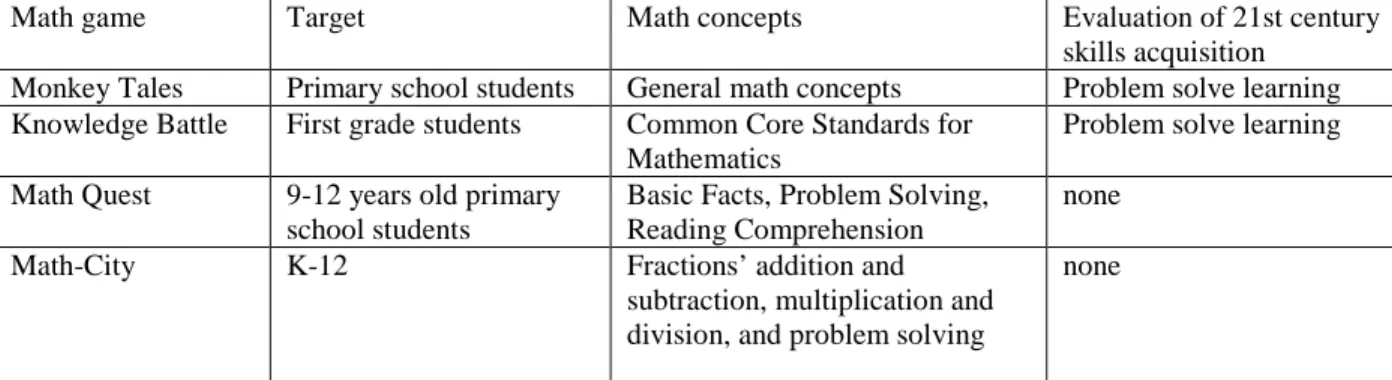
An analysis of these games show that the game aim is to teach certain mathematics concepts and develop mainly problem solving skills (see Table 1). However, a larger set of 21st century skills (not just problem solving)
such as digital literacy, communication, collaboration, critical thinking, decision making and creativity are expected to be mastered by the new generation of youth. To our knowledge, no studies have investigated how educational math video games support the development of the 21st century skills. This paper seeks to investigate the support provided by the proposed Counts With Me! game in terms of both learning and 21st century skills.
Math game Target Math concepts Evaluation of 21st century skills acquisition
Monkey Tales Primary school students General math concepts Problem solve learning Knowledge Battle First grade students Common Core Standards for
Mathematics
Problem solve learning
Math Quest 9-12 years old primary school students
Basic Facts, Problem Solving, Reading Comprehension
none
Math-City K-12 Fractions’ addition and subtraction, multiplication and division, and problem solving
none
Table 1.Analysis of the investigated Maths games.
Count With Me! Game Description and Design Methodology
Count With Me!, is a 3D immersive interactive computer-based video game developed with the aid of two
math lecturers based on both the syllabus of the Irish leaving certification curriculum for Maths (K-12 level) and the Introduction to Mathematics module descriptor part of the first year of the BSc in Computing undergraduate degree at National College of Ireland. The game teaches the counting principles in particular addition, multiplication, factorials, permutations and combinations. The reason for these choice of topics covered is the fact that students find it difficult to grasp the concept and it would be very easy to explain these concepts in a “game” environment. The game style chosen was a “visual novel” style, that mostly consists of static graphics, minimal gameplay and an interactive story. It would also suit the objective of teaching the math syllabus as it involves giving a lot of information, explaining concepts without interrupting the flow of the game. During the gameplay the player takes a role of a student in a class and a teacher avatar brings the player to different real life scenarios and talks to the student describing the tasks to be solved but also introducing the math concepts.
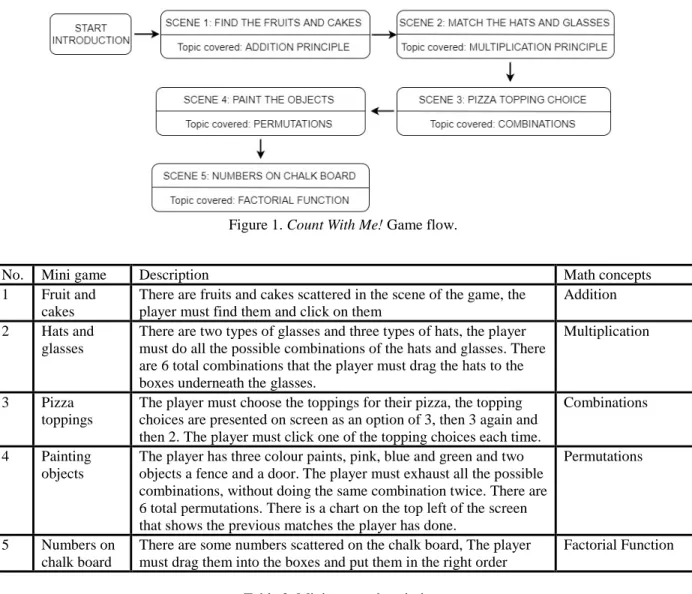
The flow of the game is illustrated in Figure 1. First, the player is brought to a scene that presents a real life scenario and asked to do a mini game that involves a task linked into the mathematical concept to be covered. For example, Scene 1, the player is placed in a classroom where some fruits and cakes are hidden. The task is to collect all the fruits and cakes. Once the player completes the mini game they are prompted with a multi choice question that is related to the task they just completed. If the question is answered correct the avatar teacher explains the mathematical concept (e.g. addition). Next, one more question on the same mathematical concept is presented to the player that aims to check information recall. Once the player answers correct this question too, the game progresses to the next scene and the next mini game covering another mathematical concept (e.g. Scene 2 Match the hats and glasses, covering the multiplication principle). This cycle is repeated until all the mathematical concepts have been covered. Feedback is also provided to the student for each question answered correct through a brief explanation of the answer. Otherwise, if incorrect answer was chosen, the player is allowed to try again to answer the question.
Table 2 briefly presents the mini-games and the associated math concepts. These types of mini games have been chosen as they help the player to understand the basic of a math concept through a real-world example.
Figure 1. Count With Me! Game flow.
No. Mini game Description Math concepts 1 Fruit and
cakes
There are fruits and cakes scattered in the scene of the game, the player must find them and click on them
Addition
2 Hats and glasses
There are two types of glasses and three types of hats, the player must do all the possible combinations of the hats and glasses. There are 6 total combinations that the player must drag the hats to the boxes underneath the glasses.
Multiplication
3 Pizza toppings
The player must choose the toppings for their pizza, the topping choices are presented on screen as an option of 3, then 3 again and then 2. The player must click one of the topping choices each time.
Combinations
4 Painting objects
The player has three colour paints, pink, blue and green and two objects a fence and a door. The player must exhaust all the possible combinations, without doing the same combination twice. There are 6 total permutations. There is a chart on the top left of the screen that shows the previous matches the player has done.
Permutations
5 Numbers on chalk board
There are some numbers scattered on the chalk board, The player must drag them into the boxes and put them in the right order
Factorial Function
Table 2.Mini-games description.
For clarification purpose, the hats and glasses mini-game related to the multiplication concept is illustrated next. Figure 2 shows the mini game activity the player has to complete: mix and match hats and glasses. If a correct hat-glasses combination is created, the hat will stay in the box. If the match is incorrect the hat will return to its original position.
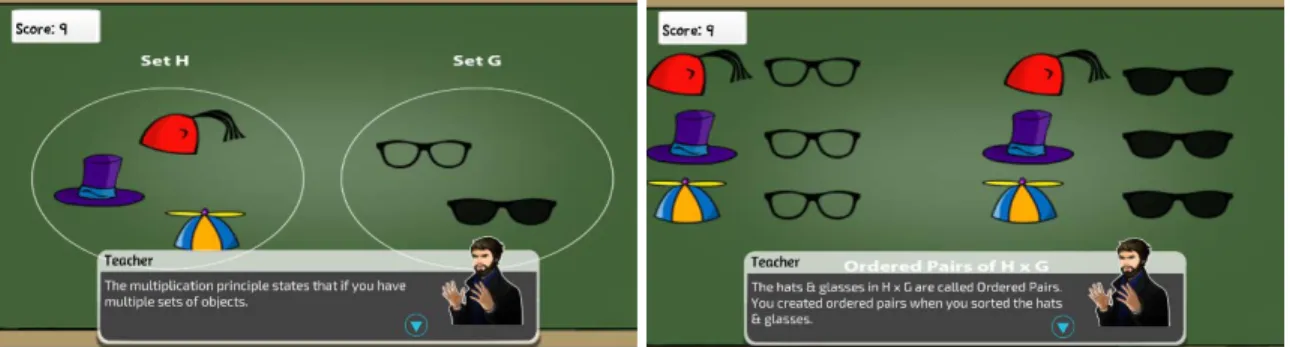
Once the hat and glasses mini game was completed, the multiplication principle is explained by the avatar teacher using the hats and glasses as exemplification purpose (see Figure 3). Then, the player has to answer one more question (recall question) related to the multiplication concept before having the avatar teacher explanation of the correct answer (Figure 4). The aim of this question is to reinforce the player understanding of the presented concept.
Figure 3. Explanation of Multiplication principle in thehats and glasses mini-game.
Figure 4. The recall question in thehats and glasses mini-game.
Case Study
The goal of the research study was to investigate the 21st century skills development through the Count With
Me! game used to teach counting principles to 1st year undergraduate students enrolled into a computing degree at
National College of Ireland. This section presents the evaluation methodology applied, case study set-up and results analysis of the collected data.
Research Methodology
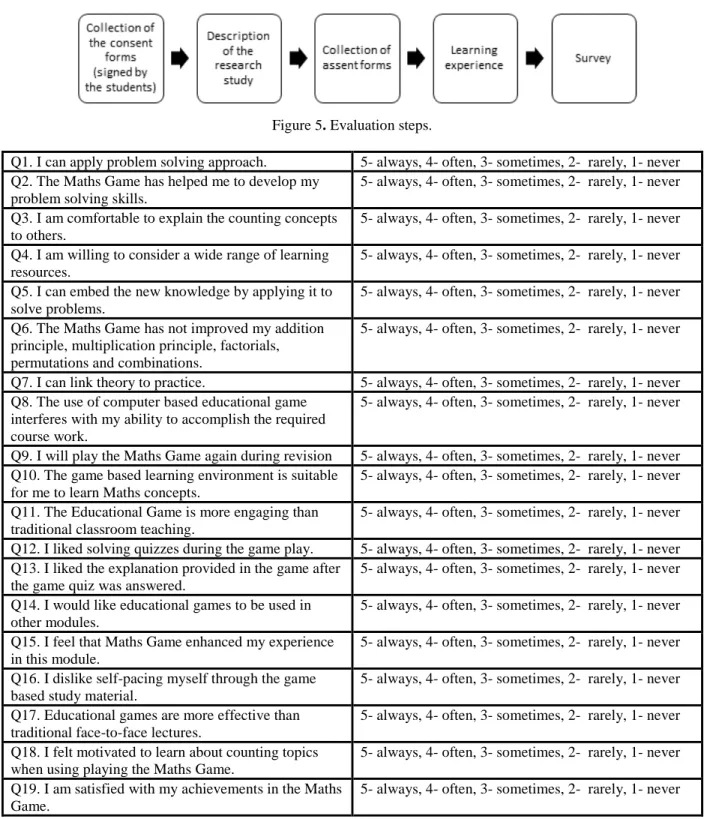
The evaluation included a group of undergraduate students that were asked to play the Count With Me! game at home, before the in class teaching sessions that covered the counting principles. A total of 33 students of age 18-21 years from the National College of Ireland (NCI) located in Dublin, Ireland took part in the case study. 82% of students were male and 18% female. Researchers from the National College of Ireland prepared the availability of the game to students and helped to perform the case study. Prior to running the case study, the ethics approval was obtained from the NCI Ethics Committee and all required forms were provided to the students, including informed consent form, informed assent form, plain language statement and data management plan. These documents include a detailed description of the case study scenario, as well as information on study purpose, data processing and analysis, participant identity protection, etc. The flow of the evaluation is illustrated in Figure 5 that presents in details the steps followed by the researchers. It can be seen that prior to beginning the evaluation, the consent forms signed by students were collected. Then, the students were introduced to the research case study and asked to review and sign the assent form. The students played the game at home. In the next class session, they were asked to answer a survey assessing their experience with the game.
Figure 5. Evaluation steps.
Q1. I can apply problem solving approach. 5- always, 4- often, 3- sometimes, 2- rarely, 1- never Q2. The Maths Game has helped me to develop my
problem solving skills.
5- always, 4- often, 3- sometimes, 2- rarely, 1- never
Q3. I am comfortable to explain the counting concepts to others.
5- always, 4- often, 3- sometimes, 2- rarely, 1- never
Q4. I am willing to consider a wide range of learning resources.
5- always, 4- often, 3- sometimes, 2- rarely, 1- never
Q5. I can embed the new knowledge by applying it to solve problems.
5- always, 4- often, 3- sometimes, 2- rarely, 1- never
Q6. The Maths Game has not improved my addition principle, multiplication principle, factorials, permutations and combinations.
5- always, 4- often, 3- sometimes, 2- rarely, 1- never
Q7. I can link theory to practice. 5- always, 4- often, 3- sometimes, 2- rarely, 1- never Q8. The use of computer based educational game
interferes with my ability to accomplish the required course work.
5- always, 4- often, 3- sometimes, 2- rarely, 1- never
Q9. I will play the Maths Game again during revision 5- always, 4- often, 3- sometimes, 2- rarely, 1- never Q10. The game based learning environment is suitable
for me to learn Maths concepts.
5- always, 4- often, 3- sometimes, 2- rarely, 1- never
Q11. The Educational Game is more engaging than traditional classroom teaching.
5- always, 4- often, 3- sometimes, 2- rarely, 1- never
Q12. I liked solving quizzes during the game play. 5- always, 4- often, 3- sometimes, 2- rarely, 1- never Q13. I liked the explanation provided in the game after
the game quiz was answered.
5- always, 4- often, 3- sometimes, 2- rarely, 1- never
Q14. I would like educational games to be used in other modules.
5- always, 4- often, 3- sometimes, 2- rarely, 1- never
Q15. I feel that Maths Game enhanced my experience in this module.
5- always, 4- often, 3- sometimes, 2- rarely, 1- never
Q16. I dislike self-pacing myself through the game based study material.
5- always, 4- often, 3- sometimes, 2- rarely, 1- never
Q17. Educational games are more effective than traditional face-to-face lectures.
5- always, 4- often, 3- sometimes, 2- rarely, 1- never
Q18. I felt motivated to learn about counting topics when using playing the Maths Game.
5- always, 4- often, 3- sometimes, 2- rarely, 1- never
Q19. I am satisfied with my achievements in the Maths Game.
5- always, 4- often, 3- sometimes, 2- rarely, 1- never
Table 3. Survey questions.
The case study investigated through a survey consisting of 19 questions, how the game supports the development of the learner 21st skills, in particular, problem solving, self-directed learning, knowledge building,
digital literacy. Learner satisfaction with the game, and their engagement were also investigated. Table 3 presents the questions answered by the students.
Results Analysis
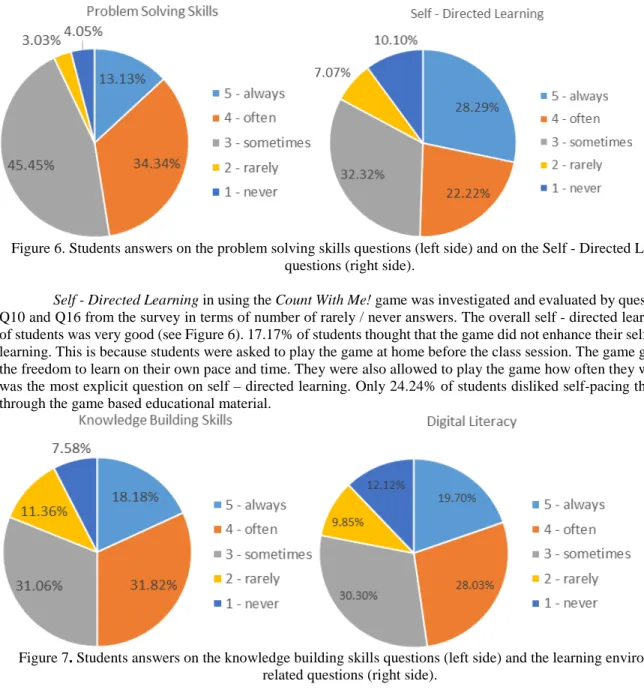
Problem Solving Skills in using the Count With Me! game was investigated and evaluated by questions Q1,
Q2 and Q5 from the survey. The "problem solving skills" were analysed in terms of number of Rarely / Never answers. The overall students’ perception on their "problem solving skills" was great (see Figure 6). Only 7.08% of students thought that the game rarely or never helped them to improve their problem solve skills. This is because the game required students to solve a number of real problems in the mini-games associated mathematical concepts. Q2 was the most explicit question regarding the problem solving skills. 96.97% of students believed that the Count With Me!
game helped them to develop their problem solving skills.
Figure 6.Students answers on the problem solving skills questions (left side) and on the Self - Directed Learning questions (right side).
Self - Directed Learning in using the Count With Me! game was investigated and evaluated by questions Q4,
Q10 and Q16 from the survey in terms of number of rarely / never answers. The overall self - directed learning skill of students was very good (see Figure 6). 17.17% of students thought that the game did not enhance their self-directed learning. This is because students were asked to play the game at home before the class session. The game gave them the freedom to learn on their own pace and time. They were also allowed to play the game how often they want. Q16 was the most explicit question on self – directed learning. Only 24.24% of students disliked self-pacing themselves through the game based educational material.
Figure 7. Students answers on the knowledge building skills questions (left side) and the learning environment related questions (right side).
Knowledge Building Skills in using the Count With Me! game was investigated and evaluated by questions
Q3, Q6, Q7 and Q12 from the survey. The knowledge acquisition skills were analysed in terms of number of Rarely / Never answers. The overall knowledge building skills of students was good (see Figure 7). 18.94% of students did not consider that the game has improved their knowledge building skills. Q6 was the most explicit question about the
knowledge building skills. 21.21% of students agreed that the maths game has not improved their addition principle, multiplication principle, factorials, permutations and combinations.
Digital Literacy in using the Count With Me! game was investigated and evaluated by questions Q8, Q9, Q11
and Q13 in the survey. The learning environment was analysed in terms of number of Rarely / Never answers. The overall learning environment of students was good (see Figure 7). Q11 was the most explicit question about the digital literacy. 66.66% of students were confident with the game and thought that it is more engaging than traditional classroom teaching.
Learner’s Satisfaction in using the Count With Me! game was investigated and evaluated in terms of support
of information acquisition and how the game was perceived by students. Questions Q14, Q15 and Q19 from the survey were analysed. The analysis investigated if the game enhances their learning experience, their motivation to use computer game-based learning for other math topics or other subjects. The perception and satisfaction was analysed in terms of number of rarely / never answers. The overall perception and satisfaction of students was great (see Figure 8). Only 18.18% of students were not positive regarding their experience with the game.
Figure 8.Students answers on the perception and satisfaction questions (left side) and the engagement questions (right side).
Q19 was the most explicit question about the game’s perception and satisfaction. 81.81% of students expressed that they were satisfied with their learning achievements though the use of the game.
Engagement in using the Count With Me! game was investigated and evaluated by questions Q17 and Q18
from the survey. The overall engagement of students was good (see Figure 8). Q17 was the most explicit question about the game’s engagement. 69.69% of students considered that educational games are more effective than traditional face-to-face lectures.
Conclusions
This research study addresses the problem of motivating, engaging, and improving learning experience of students in the Maths topics. A novel interactive 3D educational video game (Count With Me!) was designed and tested with first year undergraduate students from the National College of Ireland. The game supports knowledge acquisition on counting principles such as addition, multiplication, combinations, permutations, and factorial function through direct experience, active recall, real life exercises and fun. The game design methodology of the proposed educational game was described in this paper. An analysis of the results collected through a survey in a preliminary case study conducted on a group of 33 students was also presented. An investigation on the development of learners’ 21st century skills such as problem solving, self-directed learning, knowledge building and digital literacy through the
use of the proposed game was done. The analysis of the survey results shows that a large majority of students acquired 21st century skills. 96.97% of students believed that the Count With Me! game helped them to develop their problem
solving skills. 75.76% of students liked self-pacing themselves through the game based educational material. 78.79% of students agreed that the maths game has improved their knowledge on addition principle, multiplication principle, factorials, permutations and combinations. 81.82% of students were satisfied with their achievements in the game. 69.69% of students considered that the educational game is more effective than traditional face-to-face lectures. In addition to the survey presented in this paper, a pre-test and a post-test was run in order to evaluate the learning impact
of the games on the students. Pre/Post test results analysis will be the subject of a future publication. Future work will aim to expand the research study on the Count With Me! game and apply it in different cohorts that have the same Math courses in the National College of Ireland in order to assess the game benefits as well as to do a gender analysis.
Acknowledgements
This research is supported by the NEWTON project (http://www.newtonproject.eu/) funded under the European Union’s Horizon 2020 Research and Innovation programme, Grant Agreement no. 688503.
References
Abramovich Sergei. (2010). Topics in Mathematics for Elementary Teachers: A Technology Enhanced Experiential
Approach. IAP.
August, Stephanie E, Michele L Hammers, Don Brian Murphy, Allison Neyer, Penda Gueye, and Robert Q Thames. (2016). “Virtual Engineering Sciences Learning Lab: Giving Stem Education a Second Life.” IEEE Transactions on
Learning Technologies 9 (1): 18–30.
Bogusevschi Diana, Tal Irina, Bratu, Marilena, Gornea, Bogdan, Caraman Diana, Ghergulescu, Ioana, Muntean Hava, Cristina, and Muntean, Gabriel-Miro. (2018). “Water Cycle in Nature: Small-scale STEM Education Pilot,” in
Proceedings of World Conference on Educational Media and Technology (EDMEDIA 2018).
Bottino, Rosa Maria, Lucia Ferlino, Michela Ott, and Mauro Tavella. (2007). “Developing Strategic and Reasoning Abilities with Computer Games at Primary School Level.” Computers & Education 49 (4): 1272–1286.
Bradford, Michael, Cristina Muntean, and Pramod Pathak. (2014). “An Analysis of Flip-Classroom Pedagogy in First Year Undergraduate Mathematics for Computing.” In IEEE Frontiers in Education Conference (FIE), 1–5.
Cai, Su, Feng-Kuang Chiang, Yuchen Sun, Chenglong Lin, and Joey J Lee. (2017). “Applications of Augmented Reality-Based Natural Interactive Learning in Magnetic Field Instruction.” Interactive Learning Environments 25 (6): 778–791.
Cortez, Meghan Bogardus. (2017). “3 Ways Game-Based Learning Can Boost Math Skills.” EdTech Magazine (blog). July 31, 2017. https://edtechmagazine.com/k12/article/2017/07/3-ways-game-based-learning-can-boost-math-skills. Derboven, Jan, Bieke Zaman, David Geerts, and Dirk De Grooff. 2016. “Playing Educational Math Games at Home: The Monkey Tales Case.” Entertainment Computing 16: 1–14.
El Mawas, Nour. (2014). “Designing Learning Scenarios for Serious Games with ARGILE.” Knowledge Management & E-Learning 6 (3): 227.
El Mawas, Nour, Jean-Marie Gilliot, Serge Garlatti, Patricia Serrano Alvarado, Hala Skaf-Molli, Jérôme Eneau, Geneviève Lameul, Jacques-François Marchandise, and Hugues Pentecouteau. (2017). “Towards a Self-Regulated Learning in a Lifelong Learning Perspective.” In CSEDU 2017: 9th International Conference on Computer Supported
Education-Special Session Lifelong Learning, 1:661–670.
El Mawas, Nour, Lahcen Oubahssi, and Pierre Laforcade. (2015). “A Meta-Model Based Approach for Identifying and Formalizing LMS Instructional Design Languages.” In Collaboration Technologies and Systems (CTS), 2015
International Conference On, 159–166. IEEE.
El Mawas, Nour, Irina Tal, Diana Bogusevschi, Josephine Andrews, Gabriel-Miro Muntean, and Cristina Muntean. (2018). “Final Frontier Game: A Case Study on Learner Experience.” In Proceedings of the 10th International
Conference on Computer Supported Education (CSEDU), Accepted. Madeira, Portugal.
Ghergulescu, Ioana, Muntean Hava Cristina. (2014). "A Novel Sensor-based Methodology for Learner’s Motivation Analysis in Game based Learning”. Interacting with Computers Journal, Special Issue on Sensor/Recognition-based
Learning in Contextual Surroundings. 26 (4): 303–304
Hieftje, Kimberly, Tyra Pendergrass, Tassos C Kyriakides, Walter Gilliam, and Lynn Fiellin. (2017). “An Evaluation of an Educational Video Game on Mathematics Achievement in First Grade Students.” Technologies 5 (2): 30. Kim, Sunha, and Mido Chang. (2010). “Computer Games for the Math Achievement of Diverse Students.” Journal
Moldovan, Nicolae Arghir and Muntean Hava, Cristina. (2011). “Towards Personalised and Adaptive Multimedia in M-learning Systems.,” in Proceedings of World Conference on E-Learning in Corporate, Government, Healthcare,
and Higher Education. Association for the Advancement of Computing in Education (AACE), Chesapeake, VA, 782-
791
Muntean Hava, Cristina and McManis, Jeniffer. (2006). “The Value of QoE-based Adaptation Approach in Educational Hypermedia: Empirical Evaluation”. in Proceedings of the 4th International Conference on Adaptive
Hypermedia and Adaptive Web-Based Systems (AH2006), Springer-Verlag Berlin, Lecture Notes in Computer Science
(LNCS) 4018: 121-130
Muntean Hava, Cristina and McManis, Jennifer, Cristea, Alexandra. (2007). "Quality of Experience - LAOS: Create Once, Use Many, Use Anywhere". In International Journal of Learning Technology (IJLT), Special Issue on
"Authoring Adaptive and Adaptable Hypermedia", 3 (3): 209-229
Oei, Adam C, and Michael D Patterson. (2013). “Enhancing Cognition with Video Games: A Multiple Game Training Study.” PLoS One 8 (3): e58546.
Polycarpou, Irene, Julie Krausea, Cyndi Rader, Chad Kembel, Christopher Poupore, and Eric Chiu. (2010). “Math-City: An Educational Game for K-12 Mathematics.” Procedia-Social and Behavioral Sciences 9: 845–850.
Ravipati, Sri. (2017). “Trends: STEM Game-Based Learning to See Surge in Immersive Tech,” August. https://thejournal.com/articles/2017/08/29/trends-game-based-learning-market-to-see-surge-in-immersive-tech.aspx. Shafie, Afza, and W Fatimah. (2011). “Design of the Learning Module for Math Quest: A Role Playing Game for Learning Numbers.” In International Conference on Communication Engineering and Networks IPCSIT, 19:107–113. TechNavio. (2017). Global K-12 Game-Based Learning Market 2017-2021. https://www.researchandmarkets.com/research/h6m4wj/global_k12.
Yang, Jie Chi, and Sherry Y Chen. (2010). “Effects of Gender Differences and Spatial Abilities within a Digital Pentominoes Game.” Computers & Education 55 (3): 1220–1233.