Processing
Increasing the Value of Forest Resources
through the Development of Advanced
Engineered Wood Products
Project number: PNB407-1516 April 2020
Level 11, 10-16 Queen Street Melbourne VIC 3000, Australia
T +61 (0)3 9927 3200 E [email protected] W www.fwpa.com.au
Increasing the Value of Forest Resources through
the Development of Advanced Engineered Wood
Products
Compiled for
Forest & Wood Products Australia
by
Forest & Wood Products Australia Limited
Level 11, 10-16 Queen St, Melbourne, Victoria, 3000 T +61 3 9927 3200 F +61 3 9927 3288
E [email protected] W www.fwpa.com.au
Publication:
Increasing the Value of Forest Resources through the
Development of Advanced Engineered Wood Products.
Project No: PNB407-1516
This work is supported by funding provided to FWPA by the Department of Agriculture and Water Resources (DAWR).
Funding was also provided by the Queensland Department of Agriculture and Fisheries and the Big River Group.
© 2020 Forest & Wood Products Australia Limited. All rights reserved.
Whilst all care has been taken to ensure the accuracy of the information contained in this publication, Forest and Wood Products Australia Limited and all persons associated with them (FWPA) as well as any other contributors make no representations or give any warranty regarding the use, suitability, validity, accuracy, completeness, currency or reliability of the information, including any opinion or advice, contained in this publication. To the maximum extent permitted by law, FWPA disclaims all warranties of any kind, whether express or implied, including but not limited to any warranty that the information is up-to-date, complete, true, legally compliant, accurate, non-misleading or suitable.
To the maximum extent permitted by law, FWPA excludes all liability in contract, tort (including negligence), or otherwise for any injury, loss or damage whatsoever (whether direct, indirect, special or consequential) arising out of or in connection with use or reliance on this publication (and any information, opinions or advice therein) and whether caused by any errors, defects, omissions or misrepresentations in this publication. Individual requirements may vary from those discussed in this publication and you are advised to check with State authorities to ensure building compliance as well as make your own professional assessment of the relevant applicable laws and Standards.
The work is copyright and protected under the terms of the Copyright Act 1968 (Cwth). All material may be reproduced in whole or in part, provided that it is not sold or used for commercial benefit and its source (Forest & Wood Products Australia Limited) is acknowledged and the above disclaimer is included. Reproduction or copying for other purposes, which is strictly reserved only for the owner or licensee of copyright under the Copyright Act, is prohibited without the prior written consent of FWPA.
ISBN: 978-1-921763-68-7
Robert McGavin, William Leggate and Jack Dorries
Queensland Department of Agriculture and Fisheries, Agri-science Queensland, Forest Products Innovation Team, Salisbury Research Facility, 4107, Australia
1
Executive Summary
The principal objective of this project was to deliver and validate technologies to transform low-value forest resources and sub-optimum quality logs into high-value construction and appearance products suitable for Australian and international markets. The project was
designed to achieve this objective through a methodology that focused on forest resource, new technologies, market and economic aspects. Critical to the project design was direct
participation and guidance by forest industry stakeholders.
The resource assessment study indicated that a substantial volume of forest resource within Australia’s native forest and hardwood plantations is potentially suitable for rotary veneer processing using spindleless lathe technology. However, access to and utilization of, these logs will depend on many factors including: accommodating Government policies and log supply agreements; potential alterations in the code of practice for native forest harvesting; silviculture; tree marking and sales practices; diversion of logs from other uses; and
development of appropriate log specifications. The resource assessment study also identified that the creation of a new market for currently under-utilised small diameter logs may assist in supporting improved silvicultural management in both native forests and plantations.
Processing small diameter spotted gum (Corymbia citriodora) and white cypress pine (Callitris glaucophylla) logs into rotary veneer using new spindleless veneering technology was demonstrated to yield more acceptable recoveries compared to traditional sawing approaches. The resulting veneer and especially the spotted gum veneer contained visual qualities and mechanical properties well suited to the manufacture of veneer-based engineered wood products (EWPs).
A comprehensive product and market assessment revealed that the new ‘mid-rise timber’ construction sector provides significant market opportunities for a wide range of structural (and appearance) timber products, both sawn and engineered. More specifically, opportunities for higher structural performing EWPs may provide attractive opportunities for many of Australia’s high strength hardwood species, due to the resulting higher structural loads with the increased building heights involved. In addition, a reflection on traditional markets occupied by Australia’s native forest species identified further opportunities for veneer-based EWPs in electricity network cross-arms, road and rail bridge components and large dimension post and beams. The project steering committee identified a number of potential ‘best bet’ products taking into account the strengths and weaknesses of the available timber feedstocks, outcomes of the forest assessments, results of the project processing studies and an
understanding of potential products and markets. The ‘best bet’ product groups included laminated veneer lumber (LVL) based products and mass-panels (e.g. veneer-based mass panel or mass plywood panels (MPP)). The LVL product group was prioritised by the committee for further product development during the project. Opportunities for resource blending within LVL products was also prioritised.
The project demonstrated the technical feasibility of manufacturing LVL products from blending veneers from species such as spotted gum, hoop pine (Araucaria cunninghamii) and white cypress pine using a variety of different construction strategies. The pure spotted gum and the blended spotted gum and hoop pine LVL products were shown to be superior in structural properties, compared to many currently commercially available LVL products in the market.An LVL construction type comprising either 100% cypress pine or 100% spotted gum was found to be resistant to subterranean termite attack. However, having a durable species (white cypress pine or spotted gum) as a face and back veneer in the LVL construction type did not provide protection for the inner hoop pine veneers in a blended product.The project did show however, that plywood made with hoop pine core veneers and white cypress pine face and back veneers offered some termite resistance if the hoop pine
2
veneer thickness is kept thin. Alternating white cypress pine and hoop pine veneers further improved the termite resistance.
The economic assessment of veneer and LVL production from hardwood logs in the subtropics of eastern Australia revealed that, in decreasing order of impact on profitability, the strategic and tactical investment decisions are: (1) the product manufactured (level of value-adding); (2) processing scale; (3) log procurement strategy (log types processed); and (4) facility location (proximity to the forest). There are strong returns to value-adding, with the manufacture of two-stage LVL products generally projected to be highly profitable. In contrast, the production of green and dry veneer for market was not financially viable, assuming market prices achieved in Australia for commodity veneer, such as radiata pine. Profitable sale of veneer would require market prices in the order of $371/m3 and $545/m3 for green and dry veneer, respectively. Such prices may be achieved if veneer markets develop that value the positive attributes of these resources, such as the superior mechanical properties and natural durability of subtropical Australian hardwoods.
Log geometry was found to substantially affect recovery of marketable veneer from log volume, the volume of marketable veneer produced per hour of operation, and the financial performance of rotary veneer and LVL manufacture. Because of their relatively low stumpage price and relatively large log diameter, optional (B-grade) sawlogs (35 cm SEDUB) were identified as the optimal log type for veneer and LVL production. However, maximising the net present value of an investment in LVL manufacture from subtropical eastern Australian native forest hardwood logs was found to require large proportions of log volume in small, non-traditional log types. Therefore, establishment of hardwood LVL manufacturing facilities does represent an opportunity to develop new markets for small logs, and could help facilitate the silvicultural treatments necessary to increase the productivity of private native forests in the region.
Consistent with expectations, mean mill-delivered log costs per cubic metre were found to rise with increasing processing scale and distance of the resource from the processing plant. If the veneering facility was located at least 50 km from any log resource, mean mill-delivered log costs can be up to $30/m3 of log higher than for a facility located proximate to the resource. A single integrated facility processing logs into veneer and then LVL was found to be most profitable, with much stronger returns being earned when the facility is located closer to the log resource. However, if technical or logistical constraints prevented a single
integrated facility being located close to the log resource, then the financial analysis
highlighted opportunities for profitable distributed production of LVL, with veneer produced close to the forest and then manufactured into LVL at an alternative location.
The project has provided a wealth of new knowledge for the Australian industry and
identified many technical and economic opportunities for industry to consider that can utilize forest resources that are currently under-valued and underutilized, for the manufacture of high-performing value-added engineered wood products. Active participation of key industry stakeholders through the duration of the project and the commercial investigations that have occurred in parallel with the project demonstrates strong industry interest in the subject. Further collaborative effort is required to advance the definition of target markets, allowing further product development focus that optimizes species selection, lay-up strategies, manufacturing protocols and final product performance criteria. This effort would have the best chances of success, demonstrated by product commercialization, by close partnership with industries ready to adopt and develop the necessary practices required to produce the new product(s). Specialist marketing expertise would add significant value to further efforts
3
to better enable genuine ‘new’ markets (markets not currently occupied by a wood product) to be identified and developed as well as ‘substitute’ markets (markets historically or currently occupied by wood products of some description) to be targeted. Continued economic
4
Table of Contents
Executive Summary ... 1 Chapter 1: Introduction ... 12 Forest Resource ... 12 New Technologies ... 13Economic and market aspects ... 13
Report aims and structure ... 13
References: ... 16
Chapter 2: The availability of small-diameter peeler logs from Queensland’s native forests . 17 Introduction ... 17
Methodology ... 19
Desktop analysis ... 20
Field work ... 20
Results ... 27
General overview of Queensland’s native forests ... 27
Policy and regulation of Queensland’s forests ... 29
Current and forecasted log supplies from Queensland’s native forests ... 30
Private forests ... 34
Estimated peeler log supplies from Queensland’s native forests ... 35
Additional supply of peeler logs from Queensland’s hardwood plantations ... 50
Conclusions ... 51
References: ... 52
Chapter 3: The potential for Australia’s native forest and plantation hardwood resources to supply small-diameter logs for rotary veneer processing ... 54
Introduction ... 54
Methodology ... 57
Desktop analysis ... 57
Field assessments ... 58
Results and discussion ... 59
Overview on spindleless lathes ... 59
Log specifications for spindleless lathes ... 62
Australia’s native forests ... 63
Australia’s hardwood plantations ... 70
Current utilisation of Australian native forest and plantation hardwood resources for engineered wood products and new opportunities ... 73
Estimates of small peeler log availability from Australian native forest and plantation hardwood resources: assessments for each state and territory ... 79
Conclusions ... 99
References: ... 99
Chapter 4: Comparison of processing methods for small-diameter logs: sawing versus rotary peeling ... 103
Introduction ... 103
Experimental ... 104
Log sampling ... 104
Log assessment and allocation ... 105
Sawmill processing ... 106
Rotary veneer processing ... 107
Veneer density ... 109
Veneer dynamic modulus of elasticity ... 109
Results and discussion ... 110
5
References: ... 119
Chapter 5: Structural engineered wood product types and potential markets for high performance engineered wood products (EWPs) ... 120
Introduction ... 120
Summary of engineered wood products ... 122
Framing, beam & column type products ... 122
Massive floor & wall products ... 143
Panel & bracing type products ... 155
Mid-rise construction market assessment ... 170
Fire and acoustic performance requirements ... 171
Increased design dead and live load requirements ... 175
Timber crushing and movement ... 179
Potential new EWP opportunity assessment ... 180
Hardwood laminated veneer lumber (HLVL) ... 181
Cross-banded hardwood laminated veneer lumber (X-HLVL) ... 184
High density-faced LVL for fire performance improvement ... 185
Appearance-faced laminated veneer lumber ... 185
Heavy HLVL timber beams and columns ... 186
Mass plywood panels (MPP)... 186
Hardwood oriented strand board (OSB) ... 187
References: ... 187
Chapter 6: A preliminary assessment of mixed species plywood to provide protection against subterranean termites ... 189
Introduction ... 189
Experimental ... 189
Plywood – veneer configurations ... 189
Sample preparation ... 190
Test sample configuration in exposure box ... 190
Field exposure ... 190
Results and discussion ... 191
Conclusions ... 198
References: ... 198
Chapter 7: Product prioritisation and selection of ‘best bet’ products to guide project product development activities ... 199
Forest resources ... 199
General findings ... 199
Processing approaches ... 202
Market assessment ... 205
‘Best bet’ products selection ... 207
References: ... 209
Chapter 8: A comparative study on the mechanical properties of laminated veneer lumber (LVL) produced from blending various wood veneers ... 210
Introduction ... 210
Methodology ... 211
Rotary veneers ... 211
Veneer properties ... 211
Veneer grading ... 212
Target LVL construction strategies ... 212
Veneer selection and allocation ... 213
LVL panel manufacturing ... 213
Test samples and mechanical properties test method ... 213
6
Veneer properties and selection ... 216
Mechanical properties testing ... 217
Flatwise bending tests ... 218
Edgewise bending tests ... 219
Tensile strength perpendicular to grain ... 221
Bearing strength perpendicular to grain ... 221
Longitudinal-tangential shear strength ... 222
Conclusions ... 223
References: ... 224
Chapter 9: Market assessment for laminated veneer lumber (LVL) products ... 226
Introduction ... 226
New potential mid-rise timber building advanced LVL product opportunities ... 231
Advanced LVL lightweight framing elements for mid-rise timber buildings ... 237
Advanced LVL floor framing opportunities for mid-rise timber buildings ... 240
Summary of mid-rise floor framing systems design considerations ... 240
Mid-rise timber framed floor system approaches and design depth considerations ... 240
Mid-rise floor system span targets and layout design considerations ... 243
Identification of critical floor system design criteria ... 245
Effect of improved stiffness (E and I) on floor design spans ... 247
Effect of improved E grade on reducing the required material cross section ... 249
Effect on design spans of increasing the chord member dimensions to improve stiffness (I) ... 250
Improved nail plate holding capacity in LVL floor truss chords at 90° ... 251
Floor truss chords: product dimensioning ... 251
Floor truss chords: conclusions ... 252
Advanced LVL wall framing opportunities for mid-rise timber buildings ... 252
Summary of mid-rise wall framing systems design considerations ... 252
Mid-rise timber framed wall system approaches and design considerations ... 253
Mid-rise timber building wall stud requirement assessment ... 257
Identification of critical wall system design criteria – wall stud capacity ... 259
Identification of critical wall system design criteria – wall member crushing ... 260
Advanced LVL framing grade recommendations for mid-rise timber buildings ... 262
Advanced LVL ‘heavy timber’ elements for mid-rise timber buildings ... 264
LVL rib-slab floor cassette ... 264
LVL support beams and columns ... 267
LVL support beams ... 267
LVL support columns ... 268
Structural beams – fire exposed ... 269
Market demand for exposed structural timber in buildings ... 269
Fire design of exposed timber elements ... 270
Opportunities for improved fire performance from advanced LVL products ... 271
Other fire related considerations – glue types ... 272
Recommendations and suggestions for product manufacture investigation ... 272
Advanced LVL ‘massive timber’ elements for mid-rise timber buildings ... 273
LVL mass floor panels ... 274
LVL mass wall panels ... 276
LVL mass shaft panels ... 277
Opportunities for exposed LVL stair elements ... 278
Mid-rise timber buildings - market potential ... 279
Building assessment process and assumptions to determine volumes ... 280
Calculation and comparison of volumes of timber used in different products ... 281
7
Estimate of potential market sizes for different products ... 283
Estimate of potential volumes of new advanced LVL applications (equivalent to F27 or F34) ... 283
References: ... 286
Chapter 10: Key mechanical properties of cross-banded laminated veneer lumbers manufactured from blending spotted gum and hoop pine veneers ... 287
Introduction ... 287
Methodology ... 288
Timber used ... 288
Veneer grading ... 288
Construction strategies and LVL manufacturing ... 289
Panel manufacturing ... 290
Test samples and test set-up for mechanical properties ... 290
Edgewise and flatwise bending strength and static MOE ... 291
Tensile strength perpendicular to the grain ... 292
Compression strength perpendicular to the grain ... 292
Longitudinal-tangential shear strength ... 293
Commercial LVL-C used for comparison ... 293
Results and discussion ... 294
Veneer grading ... 294
Panel thickness and moisture content ... 295
Edgewise and flatwise bending test results ... 295
Tensile strength perpendicular to the grain ... 297
Compression strength perpendicular to the grain ... 297
Longitudinal-tangential shear strength ... 297
Conclusions ... 297
References: ... 298
Chapter 11: Blended species laminated veneer lumber (LVL) resistance to subterranean termites ... 301
Introduction ... 301
Materials and methods ... 302
LVL – construction types ... 302
Sample preparation ... 302
Test block configuration in exposure box ... 303
Field exposure ... 304
Results and discussion ... 305
Conclusions ... 317
References: ... 317
Chapter 12: Effect of veneer thickness on susceptibility to attack by the subterranean termite Coptotermes acinaciformis ... 318
Introduction ... 318
Materials and methods ... 319
Veneer source and test sample matrix ... 319
Sample preparation ... 320
Test block arrangement ... 321
Field exposure ... 322
Post exposure assessment ... 323
Statistical analysis ... 324
Results and discussion ... 324
Conclusions ... 329
References ... 330 Chapter 13: Analysis of the fire performance of laminated veneer lumber (LVL) products . 332
8
Introduction ... 332
Scope of the report ... 332
Fire safety of timber structures ... 332
Standard test methods within the current AS framework ... 334
Experimental methodology ... 336
Materials ... 336
Test method ... 337
Results ... 338
Standard classification ... 338
Preliminary performance assessment ... 338
Discussion and conclusions ... 341
References ... 341
Chapter 14: Opportunities for laminated veneer lumber (LVL) in the cross-arm market ... 343
Scope of work ... 343 Background ... 343 Investigation ... 344 Cross-arm market ... 344 Product types ... 345 Solid timber ... 345 Steel ... 345 Fibre composite ... 346
Cross-arm size comparison ... 346
Timber cross-arm characteristics ... 346
Solid timber ... 346
Laminated veneer lumber (LVL) ... 347
Grades and properties ... 347
Cross-arm opportunity ... 348
Market and value ... 348
Fire and durability ... 349
Cost ... 349 Cross-arm challenges ... 349 Fires ... 349 Weight ... 349 Durability ... 350 LVL cross-arms ... 350 Norply LVL ... 350
Network distribution experience ... 351
Conclusions ... 351
References: ... 352
Appendices ... 353
Appendix 14.1: Non-mid-rise timber products ... 353
Appendix 14.2: Cross-arms ... 355
Appendix 14.3: Railway track timber ... 356
Appendix 14.4: Summary of Australian wood products supply chain, including new advanced LVL ... 357
Appendix 14.5: Technical specification for hardwood cross-arms-acceptable species . 359 Chapter 15 Reflection on market opportunities and examples of commercial progress ... 361
Introduction ... 361
Competitive advantages of native timber species ... 362
Opportunities in the emerging mid-rise construction ... 363
Substitution into traditional timber markets ... 364
9
Conclusions ... 371
References ... 371
Appendices: ... 372
Appendix 15.1: Big River Group’s veneer-based bridge components advertised in the Roadbuilder and Construction Equipment Journal ... 372
Appendix 15.2: Article promoting Big River Group’s veneer-based bridge components ... 373
Chapter 16: Impact of log geometry on gross margins from rotary veneer production ... 374
Introduction ... 374
Research objective and analysis assumptions ... 375
Research method ... 375
Determine net recovery of marketable veneer by log geometry ... 375
Develop regression models to predict total veneering time by rounded log diameter ... 378
Predict the value of marketable veneer produced per hour by rounded log diameter .... 379
Calculate the maximum mill-delivered log cost for logs of alternative geometries to achieve a target gross margin ... 380
Results ... 381
Net recovery of marketable veneer by log geometry ... 381
Total veneering time by rounded log diameter ... 382
Volume and value of marketable veneer produced per hour by rounded log diameter . 382 Maximum mill-delivered log cost for logs of alternative geometries to achieve a target gross margin ... 383
Gross margins and the maximum mill-delivered log cost for 2.6 m cylindrical logs .... 383
Sensitivity of maximum mill-delivered log cost to utilisation rate, the proportion of peelable log volume recovered as marketable veneer (MVRPLV) and veneer market price ... 386
Impact of log taper on maximum mill-delivered log cost ... 388
Impact of sweep on maximum mill-delivered log cost ... 388
Impact of ovality on maximum mill-delivered log cost ... 391
Impact of log length on maximum mill-delivered log cost ... 392
Discussion and conclusions ... 395
References: ... 397
Chapter 17: Mill-delivered log cost and gross margins ... 398
Introduction ... 398
Research objective ... 398
Research method ... 399
Case Study Area, Veneer Processing Scale Scenarios and Log Type Scenarios ... 399
Case study area ... 401
Distribution of the commercial and harvestable native forest resource ... 402
Maximum haul distance, harvest return interval and total harvestable area for the case study ... 402
Forest resource distribution in the case study ... 403
Competition for the native forest resource and annual harvestable area available to the veneer processor ... 403
Annual harvestable volume available to the mill ... 404
Stumpage, harvest and haul costs ... 406
Volume and value of marketable veneer produced by log type ... 407
Calculate the mean mill-delivered log cost, marketable veneer revenue and gross margin by resource distribution, log type and veneer processing scale scenarios ... 409
Results ... 410
Technically viable veneer processing scales ... 410
10
Volume and value of marketable veneer ... 414
Mean gross margins ... 416
Technical and financial feasibility of reliance on small peeler logs ... 420
Conclusions ... 422
References: ... 423
Appendices: ... 425
Appendix 17.1: Study areas for published private native forest inventories relative to the case study area adopted in this report ... 425
Appendix 17.2: Justification of case study levels of volume per hectare and commercial and harvestable forest area ... 426
Appendix 17.3: Justification for the case study volumes per hectare for small peeler logs and top logs ... 428
Chapter 18: Financial performance of veneer and laminated veneer lumber (LVL) production using sub-optimum quality log resources ... 429
Introduction ... 429
Research objective and the manufacturing process evaluated ... 429
Research method ... 431
Case study scenarios evaluated ... 431
Case study data ... 432
Mean mill-delivered log costs ... 432
Recovery of marketable product from log volume ... 433
Equipment utilisation rates and productivity ... 434
Capital and fixed costs ... 436
Labour costs ... 439
Non-labour operating costs ... 441
Market prices ... 443
Analysis methods to estimate financial performance of veneer and EWP manufacture ... 444
Mixed LVL production ... 447
Financial performance of veneer and EWP production ... 448
Annual production and hours of operation ... 448
Capital costs of production ... 450
Annual costs of production ... 450
Annual revenues ... 453
After tax net present value, internal rate of return and payback period ... 454
Costs and after tax gross profit per cubic metre of product ... 454
Mixed LVL production ... 461
Limitations of the analysis ... 461
Conclusions ... 464
References: ... 465
Chapter 19: Financial performance of integrated and distributed veneer and laminated veneer lumber (LVL) manufacturing opportunities in sub-tropical eastern Australia ... 467
Introduction ... 467
Methods ... 468
Distributed production ... 468
Results ... 470
Financial performance of integrated processing facilities ... 471
Financial performance of distributed processing facilities ... 481
Discussion ... 484
Conclusions ... 487
References ... 487
Appendix 19.1: Sensitivity of net present value of product manufacture to changes in levels of several important model parameters ... 489
11
Chapter 20: Summary and recommendations ... 497
Summary of key findings ... 497
Australia’s forest resource availability and suitability for spindleless lathe processing 497 Comparison of processing methods for small-diameter native forest logs ... 497
The marketability of engineered wood products using low-grade or residual feedstock ... 498
Mechanical properties of laminated veneer lumber ... 498
Termite durability of plywood and laminated veneer lumber products ... 499
Fire performance of laminated veneer lumber products ... 499
Economic feasibility of veneer and laminated veneer lumber production using sub-optimum quality log resources ... 499
Recommendations ... 500
Future research ... 500
Additional publications ... 503
Acknowledgements ... 504
12
Chapter 1: Introduction
The key research question that this project sought to address was:
How can the productivity and profitability of the Australian forest and forest product sector be enhanced through the adoption of engineered wood technologies
that target the efficient use of low-value, under-utilised forest resources?
The forest industry in Australia is still predominantly based on traditional sawing production systems and traditional products. Additionally, apart from a relatively small quantity of mostly plywood and glulam, the existing engineered wood products (EWPs) industry in Australia is mainly centred on softwood resources.
Opportunities for EWPs have not yet been fully explored for all resource types and forest qualities. Advantages of EWPs compared to traditional sawn products include increased value-adding, efficient resource utilisation, ability to use low-grade wood and small piece sizes, greater selection of product dimensions, as well as compatibility with modern day building systems. EWPs exhibit uniform and predictable mechanical properties that are analogous to steel and concrete, particularly in non-residential construction markets; however, they also have far superior and increasingly well recognised sustainability credentials. The principal objective of this project was to deliver and validate technologies to transform low-value forest resources and sub-optimum quality logs into high value construction and appearance products suitable for Australian and international markets. The project was
designed to achieve this objective through a methodology that focused on forest resource, new technologies, market and economic aspects.
Forest Resource
Increasing levels of conservation Australia-wide, have led to a reduction in the area of native forest available for commercial timber production. This in turn has led to a decrease in the availability of large diameter, high quality sawlogs used for traditional solid wood products. As a result, there is a growing interest in EWPs as a practical alternative (Forestry Tasmania, 2014).
The Australian forest industry also produces substantial volumes of wood (log and processed) that does not meet target product requirements and therefore could be suited to alternative EWPs. For example, in the native forest sector in Australia, most sawmills recover less than 40% of the input log volume as saleable product, and in all native forests there are significant proportions of non-sawlog trees (residual or pulp wood) whose traditional markets are low-value and provide minimal opportunities for low-value-adding. Additional to this are the large quantities of wood that because of unsuitability for conventional products remain unprocessed or are sold in marginal recovery outlets.
In regards to plantation hardwoods, ABARES (2016) report that in the period 2025-2029, plantation hardwood sawlog supply is expected to increase to an average of 715,000 cubic meters a year. A significant proportion (probably around 50% or 358,000 cubic meters a year) is expected to be of low quality and not suitable for conventional sawn board markets.
The Australian hardwood sector is however largely constrained because of its relatively small and dispersed production volumes resulting in insufficient critical mass to fully exploit market opportunities. This is one of the clear benefits of this collaborative project which brought interested industry stakeholders together to clearly understand the opportunities of their resource in these emerging EWP product markets. Whilst the desirable properties of
hardwoods are well known (appearance, strength, durability, hardness, etc.) there are some ill-informed perceptions and scepticism about the ability to manufacture hardwood engineered
13
wood products (e.g. gluing, jointing, product grade, size and weight). These issues were examined, addressed and defined in this project in order to clarify the exact manufacturing requirements and opportunities. The development of new technologies will help remove barriers allowing industry to prosper and grow in this new market opportunity.
In softwood mills, up to 35% of the sawn production typically is categorised as fall-down grade with limited market opportunities. Using ABARES (2016) forecasts for plantation softwood log production, by 2025 an estimated 1.8 million cubic metres of low quality, non-structural plantation softwood sawn timber will be produced annually, valued at around $180 million a year, resulting in a loss for that proportion of production. Available volumes of plantation hoop pine are increasing due to a lack of commercial interest and capacity, despite unique and commercially attractive wood qualities. Also despite having some unique
qualities, white cypress pine struggles in its traditional market due to displacement by exotic pine, which can be more efficiently produced.
New Technologies
Optimised combinations of different forest resources using new technologies to produce innovative EWPs (mixed grades, composite hardwood/softwood products, etc.) will maximise the economic and market potential of the Australian forest and forest product industries by allowing greater and more profitable utilisation of the available but variable forest resources. Currently such products are only being produced to a very small extent in Australia, although internationally they have been commercially adopted.
Prior to this project, the Queensland Department of Agriculture and Fisheries (DAF) Forest Product Innovations had trialled alternative methods such as spindleless lathes for processing small logs, improving recovery rates by six times compared to traditional sawing (McGavin et. al 2014a and 2014 b, McGavin et. al 2015). These methods have not been previously trialled across the range of available forest resources and could assist industry in maximising recovery and market potential.
Economic and market aspects
This project also investigated the profitability of the new technologies through an economic analysis and market feasibility study. This included scenarios for varying production
capacities, processing methods, product and resource types. The economic analysis was expanded across the value chain to demonstrate the enhanced profitability for forest growers, processors/manufacturers and end-users.
Report aims and structure
There were five broad aims of this project:
1. To undertake a resource analysis to identify the spatial extent, resource condition, productive capacity and availability of small peeler logs in Australian native forests and hardwood plantations.
2. To determine the appropriate processing methodologies for small diameter logs. 3. To conduct a product development analysis to determine the market feasibility of
various engineered wood products (EWPs) and the identification of the ‘best bet’ products to guide project product development activities.
4. To identify the mechanical, durability and fire-resistance properties of the selected EWPs.
14
5. Provide an extensive economic analysis of the financial feasibility of veneer and EWP production using sub-optimum quality log resources.
The report is presented as a series of chapters based on key project milestones. Detailed aims, methodology and results are reported in each of these chapters enabling each chapter to be read independently.
Chapter 2 provides details of a forest resource assessment undertaken to determine the quantities, qualities and locations of logs potentially suited for rotary-peeling using
spindleless lathe technologies. This assessment had a particular focus on: (1) native hardwood and cypress from both crown and private native forests in Queensland; (2) small-diameter sub-optimal quality logs not suited for compulsory sawlogs, poles or girders; and (3) current and forecasted future supplies.
Chapter 3 expands on the forest resource assessment reported in the Chapter 2 and reviews at a national level, the underutilised, small-diameter native forest and plantation hardwood resources potentially available for rotary-peeling using spindleless lathe technologies. Chapter 4 reports on a study which investigated the suitability of rotary veneer processing of small-diameter native forest logs and compared the product recovery to traditional sawmill processing. Also included in the chapter is an analysis of wood properties (i.e. density and modulus of elasticity) measured on the recovered rotary veneer to guide potential engineered wood product (EWP) selection.
Chapter 5 details different structural EWPs currently being produced globally and their use in Australia, along with a preliminary market assessment to identify potential market
opportunities for high performance EWPs in the emerging non-residential construction market.
Chapter 6 reports on a preliminary investigation exploring the opportunity to blend durable white cypress pine and non-durable hoop pine veneers in a plywood construction to produce a product which offers termite resistance.
Chapter 7 summarises the decision making process undertaken by the Project Steering Committee whereby a number of identified ‘best bet’ products were considered and prioritised, setting the direction for further investigations by the project.
Chapter 8 presents the mechanical properties of laminated veneer lumber (LVL) produced from blending spotted gum or white cypress pine with hoop pine veneers. Six different LVL lay-up strategies were implemented to manufacture 12-ply LVL from the three species to demonstrate the influence of construction strategy and species contribution to manufactured product mechanical properties.
Chapter 9 extends the market assessment reported in Chapter 5 with a specific focus on LVL based products (e.g. hardwood LVL, blended hardwood and softwood LVL, mass LVL panels) and the potential market that may exist for these product types when made from veneers recovered from small-diameter sub-optimal quality logs, particularly in mid-rise timber construction sector.
Chapter 10 details the key mechanical properties of cross-banded LVL manufactured from blending spotted gum and hoop pine veneers. Such properties tested included density, edgewise and flatwise bending, static Modulus of Elasticity (MoE) and Modulus of Rupture (MoR), tension and compression strength perpendicular to the grain, and longitudinal-tangential shear strength.
Chapter 11 investigated the termite resistance of six different LVL lay-ups produced from blending spotted gum or white cypress pine with non-durable hoop pine veneers.
15
Chapter 12 extends the preliminary termite resistance investigations reported in Chapter 6 and reports the findings from an extensive study trialling the termite resistance of LVL
manufactured from various construction strategies using white cypress pine and non-durable hoop pine of varying veneer thicknesses.
Chapter 13 presents a preliminary analysis of the fire performance of six different LVL lay ups produced from blending spotted gum or white cypress pine with hoop pine veneers. The fire performance analysis focused on using standard test methods defined by the Australian Standards framework to provide a reference fire performance of different LVL constructions. Chapter 14 provides an overview of the electrical network cross-arm market and the potential for LVL cross-arm products.
Chapter 15 provides reflections on market opportunities and the commercialisation status of various products developed during the project.
Chapter 16 quantitatively and systematically investigates the impact of log geometry on gross margins from rotary veneer production. Varying levels of sweep, taper, ovality and log diameter were analysed to determine a given log’s veneer recovery. The volume of veneer that can be produced per hour from rounded logs with alternative diameters was also assessed. The chapter introduced a metric to support log procurement decisions, the maximum that can be paid for mill-delivered logs (MDLCmax) with alternative log geometry, while achieving a
specified target gross margin.
Chapter 17 presents a model to estimate mean mill-delivered log costs to a spindleless rotary veneering facility and how this affects gross margins from the sale of veneer. Several veneer processing scales, log type and forest resource distribution scenarios are analysed.
Chapter 18 describes the development of a discounted cash flow financial model to evaluate the financial performance of manufacturing green veneer, dry veneer, short-length LVL beams (a one-stage LVL product), and LVL cross-arms (a two-stage LVL product) from subtropical Australian native forest hardwoods over 30 years. This analysis determined the costs, revenues, and profits and net present value of producing veneers and LVL products for a range of log diameter sizes and veneer processing scales.
Chapter 19 extends the financial analysis in Chapter 18 by investigating the financial performance of veneer and LVL manufacture for four facility locations (i.e. forest resource distribution) and three log procurement (log type) scenarios. Opportunities for distributed production were also examined, where dry veneer would be produced at one location and then transformed into LVL at an alternative location. The analysis provided a comparison of the level of impact of the following four strategic and tactical investment decisions on NPV:
1. Where should the facility be located (proximity to the forest)? 2. Which types of logs should be procured?
3. What scale of production?
4. Which product should be manufactured?
Chapter 20 provides a project summary of each of the major project areas and recommendations for future work.
16
References:
ABARES (Australian Bureau of Agricultural and Resource Economics) (2016). Australia’s plantation log supply 2015 – 2059.
Forestry Tasmania (2014). Forestry Tasmania website. Accessed September, 2014.
McGavin, R. L., Bailleres, H., Lane, F., Blackburn, D., Vega, M., and Ozarska, B. (2014a). “Veneer recovery analysis of plantation eucalypt species using spindleless lathe technology,” BioResources 9(1), 613-627. DOI: 10.15376/biores.9.1.613–627.
McGavin, R. L., Bailleres, H., Lane, F., Fehrmann, J. and Ozarska, B. (2014b). “Veneer grade analysis of early to mid-rotation plantation Eucalyptus species in Australia,”
BioResources 9(4), 6565–6581. DOI: 10.15376/biores.9.4.6565-6581.
McGavin, R. L., Bailleres, H., Hamilton, M., Blackburn, D., Vega, M., and Ozarska, B. (2015a). “Variation in rotary veneer recovery from Australian plantation Eucalyptus globulus and Eucalyptus nitens,” BioResources 10(1), 313-329. DOI:
17
Chapter 2: The availability of small-diameter peeler logs from
Queensland’s native forests
William Leggate, John Huth and Robert McGavin
Forest Products Innovation Team, Queensland Department of Agriculture and Fisheries
Introduction
Veneer-based EWPs present an opportunity to successfully use native forest resources for higher value appearance and structural market applications. One of the major benefits of EWPs is that lower grade and variable materials can be used to produce stable, high
performing structural and appearance products. EWPs can also more efficiently use feedstock of small dimension to produce larger dimension products.
Knowledge currently exists on the processing of larger logs from native hardwood forests into EWPs such as plywood. However, for smaller native forest hardwood and cypress pine logs, the potential to produce EWPs via processes such as rotary peeling has not been possible due to processing limitations in existing facilities. Recent research by Queensland Department of Agriculture and Fisheries (DAF) has demonstrated the potential to use emerging spindleless veneering technologies (Figures 2.1, 2.2 and 2.3) to process hardwood plantation logs with sizes and qualities previously considered unable to be efficiently processed.
18
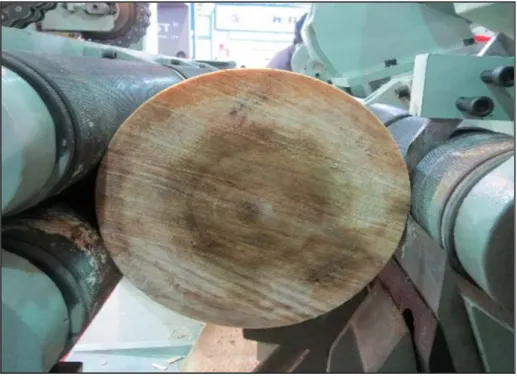
Figure 2.2. A small-diameter hardwood log being peeled with a spindleless lathe.
Figure 2.3. Spindleless lathe principles
This research revealed the possibilities for much higher recoveries using this method
compared to traditional sawing methods to process plantation hardwood logs (McGavin et al. 2014a and b; McGavin et al. 2015a and b). However, very little is known about the suitability of this processing approach to convert small-diameter native forest logs into EWPs, and how much suitable forest resource might be available.
This chapter discusses a resource assessment relevant to Queensland forests; however, outcomes may be transferrable to other forest areas of Australia.
The main objectives of this work were to:
• Determine the quantities, qualities and locations of logs potentially suited for rotary-peeled veneer product manufacture using spindleless lathe technologies, with particular focus on:
o native hardwood and cypress from both crown and private native forest;
o small sub-optimal quality logs not suited for compulsory sawlogs, poles or girders; and
o current and forecasted future supplies.
• Assist the decision making process regarding target EWP choices, market options, equipment requirements and investment in EWP processing and manufacturing facilities (Chapter7).
19
• Assist in determining appropriate locations for establishment of processing and manufacturing facilities.
• To contribute key data to future economic analyses (Chapters 16 to 19).
• To assist the tree and log selection processes for future processing studies (Chapter 4). Queensland native forests encompass both hardwood and cypress forests on crown and privately owned land. Queensland has the largest forested area of any Australian state or territory with around 52 million hectares of native forest, of which around 80% is owned by the state (DAF, 2016). Of these 52 million hectares, there are approximately 20 million hectares of state-owned native forest available for commercial timber production (DAF, 2016). These forests occur on a range of land tenures, including state forests, timber reserves, extensive areas of leasehold land and some areas of freehold land where the state has retained ownership of the forest products (DAF, 2016). State forests comprise approximately three million hectares of Queensland’s state-owned native forests and these are generally more productive than native forests on other state-owned tenures (DAF, 2016).
DAF Forest Products sells logs to regionally based processing companies in line with the Queensland Government’s timber supply commitments. There is no certainty of crown log supply beyond these agreements.
Private native forests in Queensland are extensive, covering more than 10 million hectares across the state but generally are relatively low yielding. Of all the states, Queensland has the largest area of private native forest harvested for timber production (Ryan et al. 2006). The largest concentration of commercially important native forests located on privately owned land is in South-East Queensland where over one million hectares of native forests contain commercial timber species (DAF, 2016).
Within the various tenure categories in which log harvest is permitted, harvesting can be restricted by legislation, codes of practice and management plans. Reasons for these
restrictions include conservation and management of biodiversity and heritage, and protection of the water supply. (ABARES, 2013).
Assessments of the quantities of native forest logs potentially available and suitable for rotary peeling using spindleless lathe technology needs to consider many factors including:
• grade quality and size requirements;
• government policies and regulations, codes of practice requirements restricting supply; • alternative uses of logs of the same size and quality;
• commercial and non-commercial species and suitability for peeling;
• economic and market conditionse.g. increased or decreased harvesting of private forests during economic downturns or upturns in the agricultural industry; • resource locations and distance to processing facilities and markets; and • volumes required for achieving profitable scale.
This chapter discusses these factors and presents the results from the desktop analysis and field assessments.
Methodology
The methodology included the following two components: • desktop analysis
20
Desktop analysis
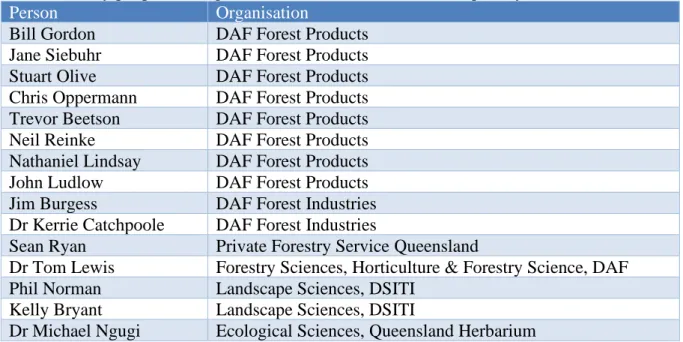
The desktop analysis involved obtaining and assessing existing reports, data and information on relevant forest resource availability in Queensland in terms of species, volumes, qualities, locations, dimensions, current uses and potential suitability for veneer based EWPs. The analysis was undertaken in consultation with key organisations and experts (Table 2.1). Table 2.1. Key people and organisations consulted for the desktop analysis.
Person Organisation
Bill Gordon DAF Forest Products
Jane Siebuhr DAF Forest Products Stuart Olive DAF Forest Products Chris Oppermann DAF Forest Products Trevor Beetson DAF Forest Products
Neil Reinke DAF Forest Products
Nathaniel Lindsay DAF Forest Products
John Ludlow DAF Forest Products
Jim Burgess DAF Forest Industries Dr Kerrie Catchpoole DAF Forest Industries
Sean Ryan Private Forestry Service Queensland
Dr Tom Lewis Forestry Sciences, Horticulture & Forestry Science, DAF Phil Norman Landscape Sciences, DSITI
Kelly Bryant Landscape Sciences, DSITI
Dr Michael Ngugi Ecological Sciences, Queensland Herbarium
Field work
In order to address gaps in knowledge identified by the desktop analysis, field work was undertaken in selected native forests and processing facilities in Queensland. This field work focused on estimates of volumes of smaller logs suitable and potentially available for rotary peeling using spindleless lathe technology. The field work was undertaken in both hardwood and cypress forests and processing facilities.
Native hardwood fieldwork
Forest assessments
Crown forests
Plots were established in Gurulmundi State Forest (40 km north-west of Miles) and Allies Creek State Forest (50 km south of Mundubbera) in Queensland (Figure 2.4). Relevant background information was obtained from DAF Forest Products on the forests’ history, silviculture, inventory and log timber sales.
In the Gurulmundi State Forest, plots were established in Management Unit Identifier (MUID) Y-MCFER01. DAF Forest Products advised that this forest MUID was
representative of typical hardwood forest in this south-western Queensland region. The forest was dominated by spotted gum. The forest had previously received silviculture treatment; although no detailed records of the silviculture type was available. Harvesting had
commenced in this MUID in 2013 and was ongoing at the time of plot establishment. DAF Forest Products advised that typical product harvesting rates for this MUID were as follows:
• Girders – 0.47 lm3/ha • Poles – 6.21 lm3/ha • Sawlogs – 10.71 m³/ha
21 • Salvage – minimal quantities.
In the Gurulmundi State Forest, 10 plots were set up in a pre-harvest area and tree measurements were recorded. As well, three plots were set up in an area that had been recently harvested and measurements were taken only on residual harvest material.
In the Allies Creek State Forest, plots were established in MUID G-MMMU143. Eight plots were established in a forest that had been recently harvested and in this case, measurements were taken only on residual harvest material. DAF Forest Products advised that this MUID was representative of typical higher production hardwood state forest in this south-western Queensland region. The forest was dominated by spotted gum. The forest had previously received silviculture treatment in the 1960’s and 1970’s. Harvesting had commenced in this MUID and was ongoing at the time of plot establishment. DAF Forest Products advised that typical product harvesting rates for this MUID were as follows:
• Girders – 1.01 lm3/ha • Poles – 9.96 lm3/ha • Sawlogs – 10.90 m³/ha
• Salvage – minimal quantities.
Figure 2.4. Map showing the location of study plots (red boxed).
With the exception of one plot that was 0.3 ha, all plots were 0.25 ha strip plots.
For the plots established in pre-harvest forest, all trees in the plot greater than 10 cm diameter at breast height over bark (DBHOB) were assessed for:
• diameter at breast height over bark (DBHOB) (converted to diameter at breast height under bark (DBHUB));
• classification – according to DAF Forest Products tree marking guidelines—sawlog, pole, girder, salvage, retained, habitat trees;
• merchantable log length and volume – sawlog, poles, peeler logs (Table 2.2), girders; • dimensions and number of merchantable logs within each stem; and
22
The specifications for peeler logs were similar to those currently used by a commercial peeler operation in Australia and are designed specifically for spindleless lathe processing of small hardwood logs. The specification used targeted logs that were of diameters less than that of logs typically used in a traditional sawmill operation. The log grading criteria used in the project are shown in Table 2.2.
Table 2.2. ‘Small’ peeler log specifications used for this study.
Grade criteria Hardwood Cypress
Minimum length 2.7 m and 1.5 m (with overcut allowance)
2.7 m and 1.5 m (with overcut allowance)
Minimum SEDUB 18 cm 16 cm
Maximum SEDUB 30 cm 30 cm
Core Defective core should not exceed 6 cm
Defective core should not exceed 6 cm
External defect No green knots > 6 cm; no dry knots > 3 cm. No more than one bump (i.e. occluded limbs) on visible half of the log within each 50 cm length; no more than one overgrowth (i.e. insect or logging damage) on visible half of the log within each 50 cm length; fluting acceptable where the hollows do not extend into the centre log diameter
No green knots > 9 cm; no dry knots > 4.5 cm. No more than two bumps (i.e. occluded limbs) on visible half of the log within each 50 cm length; no more than one overgrowth (i.e. insect or logging damage) on visible half of the log within each 50 cm length; fluting acceptable where the hollows do not extend into the centre log diameter
Maximum sweep 1/7 (14%) of SEDUB 1/7 (14%) of SEDUB
Ovality/taper Log diameter 18–32 cm: maximum difference between longest and shortest axis (cm) ranging from 2.2– 3.8 cm
Log diameter 16–32 cm: maximum difference between longest and shortest axis (cm) ranging from 2.2–3.8 cm Spiral grain/grain No spiral grain, no excessive free
grain
No spiral grain, no excessive free grain
While the project focused on the use of small diameter logs,a size considered suitable for peeling using spindleless lathes currently in use in Australia,spindleless lathes can potentially peel logs up to 80 cm SEDUB. Therefore the resource availability estimates in the project are constrained by the log size specification adopted. The specifications were intentionally adopted to focus on log sizes not typically used and/or less favourable for other mainstream products such as sawlogs, larger poles and girders.
DAF Forest Products specifications were used for the other log categories.
Figures 2.5, 2.6 and 2.7 illustrate the Gurulmundi State Forest and plot assessments being undertaken.
23
Figure 2.5. Field assessments in Gurulmundi State Forest.
24
Figure 2.7. Field assessments in Gurulmundi State Forest.
For the plots established in post-harvest forests, all residual post-harvest log material that remained was assessed to determine if it could provide logs that met the peeler log specifications described in Table 2.2 (Figure 2.8).
Figure 2.8. Post-harvest residual log assessments. Private forests
Four strip plots (0.2 ha) were established in a private native forest at the Northcott property at Ironpot, about 60 km south-west of Kingaroy (Figures 2.4 and 2.9). This forest was again considered representative of typical private native forests in this region. Key features included:
25
• harvested extensively over the last 60 years for sawlogs, poles and sleepers; • harvesting more intense during periodic downturns in the agricultural industry; • dominated by spotted gum with an understorey of wattle and other miscellaneous
non-commercial species;
• very little sawlog stems remain due to previous harvesting; however, the forest; remains overstocked with smaller diameter stems and would greatly benefit from silvicultural treatment to increase productivity; and
• property also used for cattle grazing.
All trees in the plot greater than 10 cm DBHOB were assessed for: • DBHOB (converted to DBHUB);
• merchantable log length and volume – peelers; and
• dimensions and number of small peeler logs within each stem. The specifications for peeler logs were those described in Table 2.2.
Figure 2.9. Field assessments in private hardwood native forest.
Log assessments at mills
In order to collect data on logs in mill yards that met the small peeler log specifications, assessments were undertaken at Parkside’s mill at Wandoan (Figures 2.10 and 2.11). These assessments included recording the dimensions and numbers of logs meeting the small peeler log specifications (Table 2.2).
26 Figure 2.10. Log assessments at Wandoan mill.
Figure 2.11. Log assessments at Wandoan mill.
Cypress pine fieldwork
Mill assessments
According to DAF Forest Products, all available cypress pine potentially suitable as peeler logs from crown forests in Queensland are already being sent to sawmills in the region, therefore field work for the cypress pine component focused only on the logs available at these sawmills. DAF Forest products advised that peeler logs would have to be sourced from the existing crown sawlog allocations or from private forests. In order to collect data on logs in mill yards that meet the peeler specifications, assessments were undertaken at two cypress mills in Queensland—Hurfords at Chinchilla and Gersekowski sawmill at Cecil Plains
27
(Figure 2.12). Assessments were taken on random selections of logs in the log yard. These assessments included recording the dimensions and numbers of logs meeting the small peeler log specifications given in Table 2.2.
Figure 2.12. Log assessments at a cypress sawmill.
Results
General overview of Queensland’s native forests
Queensland’s native forests are extensive and diverse. They range from wet forests such as rainforest and wet eucalypt forest to dry eucalypt, cypress and acacia forests (Ryan et al. 2006). Of the commercial types used for timber production, by far the largest area is occupied by dry eucalypt forests (dry sclerophyll), that contains species such as spotted gum, ironbark, bloodwood, white mahogany, grey gum, forest red gum and gum topped box (Ryan et al. 2006). While wet eucalypt forests (wet sclerophyll forests) are more productive, they are less extensive and include species such as blackbutt, rose gum, tallowwood and brush box (Ryan et al. 2006).
Many of these forests are composed of mixed species. Most forest types are uneven aged, displaying a range of sizes or age classes within species (Ryan et al. 2006).
State forests comprise approximately three million hectares of Queensland’s state-owned native forests and these are generally more productive than native forests on other state-owned tenures (DAF, 2016). According to ABARES (2013), the net harvestable area of public native forest in Queensland is around two million hectares. The net harvestable area represents the net area of available and suitable forest on multiple-use public native forest land after allowing for local and/or operational constraints on harvesting (ABARES, 2013). ABARES (2013) also advises that in 2010–2011 the forest area harvested annually from multiple-use public native forest in Queensland was 28, 200 hectares and the five-year mean, 2006–07 to 2010–011 was 36, 220 hectares.
Inventories undertaken by MBAC Consulting in 2003 concluded that the net available forest area for harvesting from private native forests in Queensland (South-East Queensland and Western Hardwood Regions) was around 2,137,717 hectares (MBAC, 2003a,b). This was the last comprehensive inventory undertaken; however a more recent project is currently being
28
managed by DAF that will provide updated private native forestry inventory information for Queensland (FWPA, 2016).
Private native forests make a significant contribution to Queensland’s forest and timber industry, supplying an estimated 60% of the domestically produced hardwood resource and less than 10% of the domestically produced white cypress pine resource (DAF, 2016). Many regional sawmills are reliant, or at least partially reliant, on the timber produced from these forests (DAF, 2016). Many productive private native forests are located on large properties where cattle grazing is the major focus of the enterprise (DAF, 2016). However, well
managed private native forests can generate additional income for landholders and beneficial land management and environmental outcomes in conjunction with productive grazing systems (DAF, 2016). Selective harvesting practices are universally applied in private native forests in Queensland; however, a history of crop tree harvesting without follow up
silvicultural treatment has tended to leave the majority of these forests in a relatively low productivity state (DAF, 2016). Excessive regrowth has caused huge competition between trees causing many stands to become essentially dormant. One reason that these forests are not being silviculturally treated is due to a lack of demonstrated markets for the thinned stems. Harvesting these logs to supply spindleless lathe peeling operations could offer a viable financial solution. Spindleless lathe peeling operations could also be beneficial in facilitating the silvicultural treatment of crown hardwood forest.
The most productive forests (both crown and private) are generally located in the southern part of the State and east of the Great Dividing Range, where rainfall and soil conditions are more favourable than the conditions in the western region of Queensland (DAF, 2016). Queensland’s native forests are generally slower growing and less productive when compared to southern temperate forests (DAF, 2016). Native forests supply about 18% of Queensland’s domestically sourced timber, of which approximately one third is cypress pine and two-thirds is native hardwood (DAF, 2016). The remaining 82% of Queensland’s domestically sourced timber is obtained from plantations (DAF, 2016).
29
Figure 2.13. Major forest areas in Queensland (from DAF Forest Products, 2016).
Policy and regulation of Queensland’s forests
Crown native forests
Management of Queensland’s crown / State-owned native forests is divided between a number of agencies. The Forest Products business unit of DAF manages activities related to the supply of native forest timber products from State forests, timber reserves and other State-owned lands, as well as other tenures where native forest timber products have been reserved to or are owned by the State (DAF, 2017). Forest Products does this across Queensland under the authority of the Forestry Act 1959 (DAF, 2017). Harvest plans are developed by Forest Products operational staff for native forest harvesting sites (DAF, 2017). As part of the harvest planning process, the impact of harvesting on all forest values including threatened species, soil, water and cultural heritage are assessed (DAF, 2017). Control measures to mitigate impacts are prescribed in accordance with the Department of National Parks, Sport and Racing‘s Code of Practice for Native forest Timber Production on the QPWS Forest Estate 2014 (DAF, 2017). Forest Products regularly monitor compliance with and review
30
efficiency and effectiveness against legislation, policies, codes of practice and the Australian Standard for Sustainable Forest Management (DAF, 2017). As the custodians of the forest estate, Queensland Parks and Wildlife Service (QPWS) audit timber harvesting activities for compliance with the Code of Practice for native forest timber production on the QPWS forest estate 2014 (DAF, 2017). To maintain certification to the Australian Standard for Sustainable Forest Management, DAF Forest Products must regularly pass independent audits of their management system (DAF, 2017).
QPWS manages reservation and other non-commercial aspects of forest management in Queensland’s State forests and timber reserves as the custodian (DAF, 2017).
Private native forests
Private native forests in Queensland are generally mapped as 'remnant regional ecosystems' or 'regrowth regional ecosystems' under the Vegetation Management Act 1999. There are also significant 'non remnant' areas of private native forest in Queensland (DAF, 2017).
Private native forest management and timber harvesting (forest practices) on mapped remnant or regrowth regional ecosystems areas are subject to the Code applying to native forest
practice on freehold land and the Vegetation Management Act 1999 (DAF, 2017). The Department of Natural Resources and Mines provides information about conducting 'forest practices' in private native forests in accordance with the Code applying to a native forest practice on freehold land and the Vegetation Management Act 1999 (DAF, 2017).
Current and forecasted log supplies from Queensland’s native forests
On an international perspective, many of Queensland’s native forest timbers exhibit unique qualities such as strength, durability and feature. To date, the single biggest industry based on native forests in Queensland has been sawmilling (Ryan et al. 2006). Pole production,
fencing, girders and landscaping have also utilised significant volumes of timber sourced from native forests (Ryan et al. 2006).
Crown forests
The Forest Products unit within the Department of Agriculture and Fisheries sells logs to regionally based processing companies in line with the Queensland Government’s timber supply commitments. Queensland’s native hardwood timbers, such as spotted gum are strong, dense and durable in exposed use. Therefore, they are well suited to a variety of uses
including building construction, bridge girders, electricity poles, landscape applications and furniture (DAF, 2016). Logs supplied include native forest hardwood sawlogs, poles, girders, landscape and fencing timbers, other hardwood round timber and miscellaneous products. Cypress pine is another key commercial species for DAF Forest Products and they supply around 95% of Queensland’s cypress log timber (DAF, 2016). Cypress pine is a moderately strong and durable timber with a light-brown, knotty appearance. It is used in house
construction, including flooring and exposed uses such as decking, cladding and fencing. Table 2.3 summarises the quantity of log timber removals from crown forest in 2015 and 2016 for each forest region shown in Figure 2.14. It also shows long-term estimates from DAF Forest Products to the end of the supply agreements.
31
Figure 2.14. Major crown forest sale regions in Queensland (from DAF Forest Products, 2017).
32
Table 2.3. Crown forest log removals (DAF Forest Products, 2017).
Region Product Quantity (m³) by calendar year
2015 2016 Long-term estimate
South-East hardwood sawlog 38,705 36,530 36,000 to 2024
cypress sawlog – – 0
pole/girder 7340 5755 7500 to 2024
landscape and fencing timber
4450 4690
5000 to 2024 other hardwood round
timber
210 250
other log timber 2535 8435
South-West hardwood sawlog 41,770 45,760 45,000 to at least 2031 cypress sawlog 122,455 120,865 125,000 to 2037
pole/girder 7955 2480 5000 to 2031
landscape and fencing timber
15,355 16,195
10,000 to 2031 other hardwood round
timber
3735 3450
other log timber 105 –
North hardwood sawlog 2540 8930 5000 to 20,000*
cypress sawlog – – 0
pole/girder – 650 0
landscape and fencing timber
85 335
500 other hardwood round
timber
25 70
other log timber 260 50
Central hardwood sawlog 1110 1535 1500
cypress sawlog – – 0
pole/girder – – 0
landscape and fencing timber
3745 6905
2500 other hardwood round
timber
120 345
other log timber – –
Far-West hardwood sawlog – – 0
cypress sawlog – – 0
pole/girder – – 0
landscape and fencing timber
– – 0
other hardwood round timber
– – 0
other log timber – – 0
* Depending on Cape York bauxite mining related salvage.
Table 2.3 shows that hardwood and cypress sawlogs are by far the most important product sold from crown forests in Queensland representing 81% of the total crown forest removals in 2016. The South-West region dominates crown forest log supply with 72% of the sales, followed by the South-East region with 21% of the sales.
33
The hardwood sawlog volumes are separated below in Table 2.4 into compulsory and optional log qualities.
Table 2.4 Crown forest compulsory and optional hardwood sawlog removals (DAF, 2017)
Hardwood sawlog volume (m³) by calendar year, region and log type Calendar
year
South-East South-West Central North
compulsory optional compulsory optional compulsory optional compulsory optional
2005 27 230 16 475 57 745 16 675 810 270 2 805 185 2006 44 905 20 955 70 240 15 865 1 385 410 4 535 115 2007 49