TR
OP
E
R
HC
RA
ES
E
R
PAI
D
I
PROBABILISTIC LEXICAL MODELING AND
GRAPHEME-BASED AUTOMATIC SPEECH
RECOGNITION
Ramya Rasipuram Mathew Magimai.-Doss
Idiap-RR-15-2013
APRIL 2013
Probabilistic Lexical Modeling and Grapheme-based
Automatic Speech Recognition
Ramya Rasipurama,b, Mathew Magimai.-Dossa
[email protected], [email protected]
a
Idiap Research Institute, Martigny, Switzerland
b
Ecole Polytechnique F´ed´erale de Lausanne (EPFL), Lausanne, Switzerland
Abstract
Standard hidden Markov model (HMM) based automatic speech recogni-tion (ASR) systems use phonemes as subword units. Thus, development of ASR system for a new language or domain depends upon the availability of a phoneme lexicon in the target language. In this paper, we introduce the notion of probabilistic lexical modeling and present an ASR approach where a) first, the relationship between acoustics and phonemes is learned on available acoustic and lexical resources (not necessarily from the target language or domain), and then b) probabilistic grapheme-to-phoneme rela-tionship is learned using the acoustic data of targeted language or domain. The resulting system is a grapheme-based ASR system. This brings in two potential advantages. First, development of lexicon for target language or domain becomes easy i.e., creation of a grapheme lexicon where each word is transcribed by its orthography. Second, the ASR system can exploit both acoustic and lexical resources of multiple languages and domains. We evaluate and show the potential of the proposed approach through a) an in-domain study, where acoustic and lexical resources of target language or domain are used to build an ASR system, b) a monolingual cross-domain study, where acoustic and lexical resources of another domain are used to build an ASR system for a new domain, and c) a multilingual cross-domain study, where acoustic and lexical resources of multiple languages are used to build multi-accent non-native speech recognition system.
Keywords:
Automatic speech recognition, Kullback-Leibler divergence based hidden Markov model, grapheme, phoneme, lexical modeling, lexicon, non-native speech recognition.
1. Introduction
Standard hidden Markov Model (HMM) based automatic speech recog-nition (ASR) systems generally model words in terms of subword units. ASR systems largely use linguistically motivated subword units, typically
phonemes/phones1. A lexicon is used to map the orthographic transcrip-tion of a word to sequence of phonemes. Thus, lexicon is one of the prior resources that is needed to build an ASR system. Generally, lexicon is de-veloped by applying grapheme-to-phoneme conversion rules obtained from the linguistic studies and later manually verfied. Therefore, development of lexicon using phonemes as subword units not only requires linguistic re-sources but also minimum phonetic expertise. In other words, phoneme lexicon development is a semi-automatic process.
An alternative to phoneme subword units is graphemes2, which makes
lexicon development easy [2, 3, 4], [5, Chapter 4], [6, 7, 8, 9, 10, 11, 12, 13, 14]. However, modeling the relationship between graphemes and standard spectral-based feature observations, such as PLP cepstral coefficients which capture phoneme related information (from envelop of short-term spectrum), is not always trivial. The reason being grapheme-to-phoneme (G2P) rela-tionship depends upon the language. For language such as Spanish the relationship is regular, while for language such as English the relationship is irregular. To overcome the problem of irregular relationship, in literature modeling of context-dependent graphemes has been explored [2, 3, 4], [5, Chapter 4], [6, 7]. The implicit assumption here being that relationship be-tween context-independent graphemes and context-independent phonemes can be irregular, but relationship between context-dependent graphemes and context-independent phonemes could be regular. However, in case of languages like English, context-dependent grapheme-based ASR systems have been still found to yield considerably lower performance compared to context-dependent phoneme-based ASR systems [2, 3, 4, 6, 7].
In practice, to build ASR systems for new languages and domains, typ-ically, a two stage approach is taken. More precisely, first, a G2P con-verter [15, 16, 17, 18, 19] is used to build a phoneme lexicon for the words in the new domain, and then an ASR system is trained. The G2P con-vertor is typically trained independent of the ASR system on “existing”
1A phoneme is the smallest contrastive unit in the phonology of a language, while
phone is the acoustic realization of phoneme [1]. For sake of clarity, we will use the term phoneme.
lexical resources. Thus, this process assumes a minimal availability of lexi-cal resources for the language of interest. Furthermore, the output of G2P converter may have to be manually verified to avoid ASR performance degra-dation due to pronunciation errors [20].
This paper introduces the notion of probabilistic lexical modeling and presents an ASR approach, where unlike the two stage approach men-tioned above, first, acoustic-to-phoneme relationship is modeled with avail-able acoustic and lexical resources (not necessarily from the language or do-main of interest), and then probabilistic G2P relationship is learned given the acoustic information. In doing so, the proposed approach results in a grapheme-based ASR system that a) provides the advantages of grapheme lexicon, b) has the capability to handle pronunciation errors and pronun-ciation variation, and c) can exploit both acoustic and lexical resources of multiple languages and domains. Finally, the proposed approach could po-tentially remove the necessity for training an explicit G2P converter.
In Section 2, we provide a brief background on HMM-based ASR to elu-cidate that a) in HMM-based there are two kind of states, namely, acoustic states and lexical states, and b) in standard HMM-based ASR systems the relationship between the acoustic states and the lexical states is determin-istic. In Section 3, we reformulate HMM-based ASR in terms of acoustic states and lexical states for both likelihood-based approach and posterior-based approach, and introduce the framework for probabilistic lexical mod-eling. In Section 4, we show that a) standard HMM-based ASR system, b) recently proposed KL-HMM system which uses phoneme class conditional probabilities as feature observation [21], c) tied posterior approach [22], d) probabilistic classification of HMM states (PCHMM) approach [23] to name a few are special cases of the probabilistic lexical modeling framework.
Section 5 motivates and presents an overview of the experimental stud-ies. In Section 6, probabilistic lexical modeling approaches are evaluated on in-domain ASR task where acoustic and lexical resources of the tar-get domain are used to build an ASR system. ASR studies indeed show that the proposed grapheme-based ASR system can learn the probabilis-tic grapheme-to-phoneme relationship and yields a competitive system. In Section 7, cross domain acoustic and lexical resources are used to build a grapheme-based ASR system for a new domain. In this case, the proposed grapheme-based system is compared with conventional approach where first, grapheme-to-phoneme conversion is performed and then a phoneme-based system is trained. Finally, in Section 8, we investigate the potential of the proposed ASR approach to exploit cross-domain multilingual acoustic and lexical resources for a multi-accent non-native speech recognition task.
Sec-tion 9 presents an analysis to show how probabilistic lexical modeling cap-tures the relationship between grapheme lexical states and phoneme acoustic states. Finally, in Section 10 we present discussion and conclude.
2. HMM-based ASR
In statistical ASR approach, the goal is to find the best matching (most likely) word sequence W∗ given the acoustic observation sequence
X = {x1,· · · ,xt,· · ·,xT}, where t denotes the frame number and T the
total number of frames. Formally,
W∗ = arg max W∈W P(W|X,Θ) (1) ≃ arg max W∈W P(X|W,ΘA)·P(W|ΘL) P(X|Θ) (2) ≃ arg max W∈W P(X|W,ΘA)·P(W|ΘL) (3)
whereW denotes the set of all possible word sequences, W denotes a word sequence, Θ = {ΘA,ΘL} denotes the set of parameters, more specifically,
acoustic model and lexical parameters set ΘAand language model parameter
set ΘL.
HMM-based ASR is a statistical ASR approach, where, given acoustic model, lexicon and language model, finding the most likely word sequence
W∗ is achieved by finding the most likely state sequenceQ∗ Q∗ = arg max Q∈Q P(Q, X|Θ) (4) ≃arg max Q∈Q T Y t=1 p(xt|qt,ΘA)·P(qt|qt−1,Θ) (5) ≃arg max Q∈Q T X t=1 [logp(xt|qt,ΘA) + logP(qt|qt−1,Θ)] (6)
where Q denotes a set of possible HMM state sequences and Q =
{q1,· · ·, qt,· · · , qT} denotes a sequence of HMM states. Eqn. (5) results
after i.i.d and first order Markov assumptions. Usually, logp(xt|qt,ΘA) is
referred to as local emission score and logP(qt|qt−1,Θ) is referred to as
transition score.
The HMM-based ASR literature is mainly dominated by the approach of modeling state emission likelihood. However, in theory, HMMs can be also
trained and decoded using a posteriori probabilitiesP(qt|xt,ΘA) as emission
probabilities [24, 25]. We differentiate between these two approaches by referring them as likelihood-based approach and posterior-based approach, respectively.
Irrespective of the approach taken, in practice, in HMM-based ASR sys-tem there are two kinds of states, namely acoustic states denoted as qtaco
corresponding to acoustic model and lexical states denoted as qlex t
corre-sponding to lexical model. For instance,
• in tied state context-dependent HMM/GMM system or HMM/context-dependent neural network system [26], the acous-tic states are the clustered states (also known as physical states) and the lexical states are the states of context-dependent subword models (also known as logical states), e.g. /k/-/ae/+/t/, /b/-/ae/+/t/.
• in context-independent subword unit based hybrid HMM/ANN sys-tem, typically during the training phase the ANN is trained to classify
D context-independent phonemes, and during the decoding phase a minimum duration constraint is applied for each phoneme [25]. In this case, there areDacoustic states and n·D lexical states.
The parameter set ΘA = {θa, θpr, θl} can be partitioned as acoustic
model parameters θa, prior lexical knowledge parameters θpr, and lexical
model parameters θl. The acoustic model parameters θa consists of set of acoustic states {1,· · · , D} and its corresponding parameters. In the case of HMM/Gaussian mixture model (HMM/GMM) system, it includes the means, the variances and the mixture weights of Gaussians for each acoustic state, and in the case of hybrid HMM/artificial neural network (HMM/ANN) system it includes ANN weights and biases [25]. The param-eter set θpr consists of set of subword units, pronunciation models of the words (i.e., lexicon) and set of lexical states{1,· · · , I} whereI denotes the number of lexical states. The lexical model parameter set θl consists of a
set parameters{yi}Ii=1that capture the relationship between acoustic states
and lexical states.
Having defined the parameter set ΘA, the search for most likely sequence
of states
1. in the case of likelihood-based approach can be rewritten as
Q∗lex= arg max
Qlex∈Ql T X
t=1
[logp(xt|qlext =i,ΘA)+logP(qtlex=i|qtlex−1 =h,Θ)]
2. in the case of posterior-based approach can be rewritten as
Q∗lex= arg max
Qlex∈Ql T X
t=1
[logP(qtlex=i|xt,ΘA)+logP(qlext =i|qtlex−1=h,Θ)]
(8) where Qlex denotes a sequence of lexical states {q1lex,· · ·, qtlex,· · ·, qlexT }, i, h∈ {1,· · ·, I},Ql is a set of all possible lexical state sequences.
In HMM-based ASR system, in practice, the relationship between lexical state qtlex and acoustic observation xt is not always modeled directly. As
indicated earlier, the relationship is typically modeled through intermediate acoustic states qtaco and using lexical model parameters θl. The acoustic
states can be more abstract and data-driven such as, clustered states of context-dependent subword unit based ASR system, or they can be same as lexical states i.e., lexical knowledge-driven, like in the case of context-independent subword unit based ASR system. In standard HMM-based ASR systems the lexical model is typically deterministic, i.e., θl is a table
that maps a lexical state onto an acoustic state. So, if lexical state i is mapped to acoustic statej, according to the table, thenp(xt|qtlex=i,ΘA) = p(xt|qtaco = j, θa) and P(qlext = i|xt,ΘA) = P(qacot = j|xt, θa) in Eqn. (7)
and Eqn. (8), respectively, where j∈ {1,· · · , D}. This aspect is implicit in many ASR systems.
In the following section, we present a reformulation of HMM-based ASR in terms of lexical states and acoustic states and introduce the notion of probabilistic lexical modeling where the relationship between the lexical states and the acoustic states is probabilistic.
3. Reformulation of HMM-based ASR in terms of Acoustic States and Lexical States
In Section 3.1, we formulate estimation of lexical state emission like-lihood (in the case of likelike-lihood-based approach) or emission probability (in the case of posterior-based approach) using acoustic and lexical in-formation. In Section 3.2, we elucidate that in the log-likelihood space, HMM-based ASR approach can be seen as a template matching approach, where a sequence corresponding to lexical evidence is compared with a se-quence corresponding to acoustic evidence. Central to both these formu-lations is an underlying idea that lexical model parameter yi of each
lex-ical state i is a conditional probability vector [yi1,· · · , yd
i,· · · , yiD]T, where ydi =P(qacot =d|qlext =i, θa, θpr), 0≤ydi ≤1 and P
3.1. Estimation of lexical state likelihood or a posteriori probability
In likelihood-based approach, likelihood of a lexical state ican be esti-mated as, p(xt|qtlex=i,ΘA) = D X d=1 p(xt, qtaco=d|qtlex=i,ΘA) = D X d=1
P(qtaco=d|qtlex=i, θa, θpr)·p(xt|qtaco =d, qtlex=i,ΘA)
≈
D X
d=1
P(qtaco=d|qtlex=i, θa, θpr)·p(xt|qtaco =d, θa)
(9) where, p(xt|qtaco = d) denotes likelihood of acoustic state d, P(qtaco = d|qtlex = i, θa, θpr) denotes the probability of acoustic state d given
lexi-cal statei,Dis the number of acoustic states and I is the number of lexical states. Eqn. (9) assumes that xt is independent of lexical state qlext given
the acoustic stateqtaco.
Along similar lines, in the posterior-based approach, a posteriori proba-bility of a lexical stateicould be estimated as,
P(qtlex=i|xt,ΘA) = D X
d=1
P(qtaco=d|qtlex=i, θa, θpr) ·P(qtaco =d|xt, θa)
(10) whereP(qacot =d|xt) is the posterior probability of acoustic statedgiven
the acoustic observation xt.
In case of deterministic lexical modeling yi is a Kronecker delta
distri-bution, i.e., if lexical state iis mapped onto acoustic statej then,
ydi =P(qtaco=d|qtlex=i, θa, θpr) =
1 if d=j
0 if d6=j (11)
Applying Eqn. (11) in Eqn. (9) and Eqn. (10), we can see that lexical state likelihood isp(xt|qtaco =j, θa) and lexical state posterior probability is P(qtaco=j|xt, θa), respectively.
3.2. HMM-based ASR: a template matching approach
The HMM-based ASR theory though has been developed in likelihood space, in practice, ASR systems operate in log-likelihood space. One of
the main reason for this is to handle numerical problems. In this section, we will see that, with the reformulation presented in the previous section, log-likelihood space leads to better understanding of HMM-based ASR ap-proach. More specifically, we will see that HMM-based ASR can be seen as a template matching approach, where the reference template or sequence is based on lexical information and the test template or sequence is based on acoustic information.
Briefly, in template matching, given a reference template A =
{a1,· · ·, am,· · ·, aM}and a test templateB ={b1,· · ·, bn,· · · , bN}, a global
score G(A, B) is obtained by matching the templates using dynamic pro-gramming (with local constraints and boundary constraints) in the following manner:
1. initial condition: C(1,1) =S(a1, b1)
2. for each pair of matching point (m, n) in the reference template and the test template, applying the recurrence equation
C(m, n) =S(am, bn) + max tc(m−1, n) +C(m−1, n) tc(m−1, n−1) +C(m−1, n−1) tc(m, n−1) +C(m, n−1) (12) 3. final condition: G(A, B) =C(M, N)
where C(m, n) is the cumulative score and S(am, bn) is the local score at matching point (m, n), andtc(m−1, n−1) is the cost to transit from match-ing point (m−1, n−1) to matching point (m, n). It is to be noted that the second part in the above equation is based on the local constraints applied. In HMM-based ASR, the local constraints are defined by the topology of HMM. Furthermore, whether to maximize or minimize the cumulative score depends upon how the local score or transition costs are computed.
Finding the optimal state sequence Q∗3, see Eqn. (7) or Eqn. (8), involves dynamic programming. Comparing Eqn. (12) with Eqn. (7) and Eqn. (8), it can be seen that the local scoreS(,) in likelihood-based approach is logp(xt|qtlex = i,ΘA) and in posterior-based approach is logP(qtlex = i|xt,ΘA), respectively and the transition score tc(,) is logP(qtlex=i|qlext−1 = h,Θ).
3The problem of finding the optimal state sequence is also used during training of
Based on the formulation presented in the previous section, we can see that the estimation of local score for both likelihood-based approach and posterior-based approach is matching of lexical evidence and acoustic evi-dence. More precisely, in
• likelihood-based approach
logp(xt|qlext =i,ΘA) = log(yiTvt) =S(yi,vt) (13)
wherevt = [p(xt|qacot = 1, θa),· · · , p(xt|qtaco = d, θa),· · · , p(xt|qacot =
D, θa)]T or simply denoted as [vt1,· · · , vdt,· · · , vDt ]T.
• posterior-based approach
logP(qlext =i|xt,ΘA) = log(yTi zt) =S(yi,zt) (14)
where zt = [P(qtaco = 1|xt, θa),· · · , P(qtaco = d|xt, θa),· · · , P(qtaco = D|xt, θa)]T or simply denoted as [z1t,· · ·, ztd,· · · , ztD]T.
In other words, HMM-based ASR approach can be seen as a template matching approach where,
1. the reference template is a sequence of lexical state parameter vec-torsU ={u1,· · ·,um,· · · ,uM}corresponding to a word sequence
ob-tained by using lexical information. M denotes the number of states in the sequence and um ∈ {y1,· · · ,yI}.
2. the test template is sequenceV ={v1,· · · ,vt,· · ·,vT} (in the case of
likelihood-based approach) orZ ={z1,· · · ,zt,· · · ,zT}(in the case of
posterior-based approach).
3. the cost function S(,) to estimate local score is scalar product. Viewing HMM-based ASR as template matching approach provides venues for exploring new ways to match lexical evidence and acoustic ev-idence. In the likelihood-based approach, it can be observed that we are matching a conditional probability vector yi with a likelihood vector vt,
i.e., two statistical quantities that have different properties. For instance,
PD
d=1yid = 1 but PD
d=1vDt R 1. Thus, it is difficult to visualize a cost
function other than scalar product.
Unlike likelihood-based approach, in the case of posterior-based approach it can be observed that both reference vector yi and the test vector zt are
conditional probability vectors, i.e., the reference vector and test vector lie in the same acoustic state posterior probability space, but conditioned on different information. In the reference vector, the acoustic state posterior
probability is conditioned on prior lexical information, while in the test vec-tor, acoustic state posterior probability is conditioned on the feature obser-vation xt. As a consequence, in posterior-based approach two sequences of
conditional probability vectors are matched similar to the recently proposed template-based ASR approach using “posterior features” [28, 29].
In the template-based ASR approach using posterior features, it has been observed that there are different cost functions that can be used to locally match lexical evidence and acoustic evidence. For instance, Kullback-Leibler (KL) divergence, Bhattacharya distance, cosine distance, scalar product, cross entropy [29, 30]. Furthermore, it has been observed that local score based on KL-divergence or Bhattacharya distance tend to yield better sys-tem than scalar product. This indicates that posterior-based approach could also benefit from the use of alternate cost functions. Indeed, we will see this aspect in this paper.
As per the framework presented in both Sections 3.1 and 3.2, to perform ASR we need to estimateyi, andvtorztdepending upon the approach. The
acoustic model i.e.,vt estimator or zt estimator can be based on GMMs or
ANNs, irrespective of what is estimated. ANNs can directly estimate a pos-teriori probabilities [25]. In other words, the output of ANNs is a pospos-teriori probability of acoustic states. So, in the likelihood-based approach, when using ANNs, the likelihood of acoustic states is replaced by scaled-likelihood
psl(xt|qacot =d, θa) = p(xt|qacot =d, θa) p(xt|θa) = P(q aco t =d|xt, θa) P(qaco t =d|θa) (15) Similarly GMMs estimate likelihood of acoustic states. So, in the case of posterior-based approach, when using GMMs, the a posteriori probability of acoustic states can be estimated using Bayes rule. In short, likelihood-based approach and posterior-based approach is equally applicable to HMM/GMM system and hybrid HMM/ANN system. The only difference is that the acoustic model in one case is generative and in another case is discriminative, respectively. In the following section, we present approaches to estimate the lexical model parameter set θl ={yi}Ii=1.
4. Probabilistic Lexical Modeling: KL-HMM and Related Ap-proaches
In standard HMM-based ASR systems, most often the relationship be-tween lexical states and acoustic states is one-to-one, i.e.,yi is a Kronecker
delta distribution. This can happen a) in context-dependent subword unit based ASR system while decision tree state tying, b) in context-independent subword unit based ASR system when prior knowledge such as, minimum duration constraint is applied, and c) even when the relationship between the lexical states and acoustic observations is directly modeled. In this case, lexical states and acoustic states are same entities and D=I. The output of ANNs or GMMs can be seen as acoustic evidence matched with determin-istic lexical evidence. In this section, we present ASR approaches where yi
is no more deterministic, rather, yi is learned from the acoustic data given
the acoustic model, i.e., estimator of vt orzt. We refer to such approaches
asprobabilistic lexical modeling approaches. In that regard, we first present and show that KL-HMM approach is a posterior-based probabilistic lexi-cal modeling approach. We then present a few other related probabilistic modeling approaches.
4.1. Kullback-Leibler divergence based HMM
Kullback-Leibler divergence based HMM (KL-HMM) is a recently pro-posed approach wherezt= [zt1,· · · , ztd,· · ·, ztD]T, the phoneme class
condi-tional probability vector or the acoustic state probability vector (originally it was referred to asposterior feature) estimated by an ANN is used directly as feature observation for a second HMM whose states are parameterized by categorical distributions yi = [y1i,· · ·yid,· · ·, yiD]T [21, 31]. Figure 1
il-lustrates the KL-HMM approach.
The local scoreS(yi,zt) at each HMM stateiis S(yi,zt) = D X d=1 ydi log(y d i zd t ) (16)
The above equation represents the case where yi is the reference
distribu-tion and the local score is denoted as KL. However, KL-divergence is an asymmetric measure. Thus, there are other possible ways to estimate KL-divergence, namely,
1. Reverse KL-divergence (RKL): acoustic state probability vector zt is
the reference distribution
S(yi,zt) = D X d=1 ztdlog(z d t yd i ) (17) 2. Symmetric KL-divergence (SKL): S(yi,zt) = 1 2·[KL+RKL] (18)
..
.
..
.
..
.
..
.
..
.
..
.
observation outputs / Phonemes state distributions Acoustic sequence (PLP) probability estimator sequence posterior Phoneme D − Number of ANN Categorical KL−HMM Acoustic Model Acoustic statey
21y
D 2y
13y
D3y
2(
x
t−4,
· · ·
,
x
t,
· · ·
,
x
t+4)
x
1,
· · ·
,
x
t,
· · ·
,
x
T. . .
. . .
. . .
y
3y
1a
34a
23a
12a
01a
11a
22a
33y
11y
D 1z
11z
1Dz
t1z
tDz
T1z
TD pD 2 1 p1 p2 D ANN(
θ
a)
Figure 1: Illustration of KL-HMM acoustic model
It is clear from the formulation presented in Section 3, especially Sec-tion 3.2, that KL-HMM is a posterior-based ASR system, where the lexical model is probabilistic and instead of scalar product, a cost function based on KL-divergence is used. In theory, KL-divergence can be linked to hypothesis testing [32, 33]. More precisely, KL-divergence between two distributions is an estimate of expected log-likelihood ratio. As a consequence, irrespective of how zt is estimated i.e., using a generative model (GMM) or
discrimi-native model (ANN), locally (in time) KL-HMM is a discrimidiscrimi-native model. More precisely, lexical evidence and acoustic evidence are discriminatively matched locally. However, globally KL-HMM is still a generative model in the acoustic state probability vector space, i.e.,zt.
KL-HMM approach can also be interpreted in information theoretic sense. For instance, local score KL is the expected number of extra bits needed ifyiis the true distribution and the acoustic state symbols are coded
by distributionzt. Similarly, local scoreRKLis the expected number of
ex-tra bits needed ifzt is the true distribution and the acoustic state symbols
that a) local score KL gives emphasis to the lexical model. This is good when lexical information is reliable; b) local score RKLgives emphasis to the acoustic model. This is good when lexical information or model is less reliable. Indeed, later in Section 6 we will see that for context-independent graphemes local score RKL is better; and c) local score SKL gives equal emphasis to the lexical model and the acoustic model. Dealing these aspects in more detail is out-of-the-scope of the present paper.
4.1.1. Training
KL-HMM is fully parameterized by Θkull = {{yi}i=1I ,{aij}Ii,j=1} =
{θl,{aij}Ii,j=1} where I is the total number of states and state i is
rep-resented by categorical distribution yi, aij is the transition probability
from state i to state j. Given a training set of N utterances, where each training utterance n is a sequence of acoustic state probability vec-torsZ(n) ={z1(n),· · ·,zt(n),· · · ,zT(n)(n)}of lengthT(n), the parameters
Θkull are estimated by Viterbi expectation maximization algorithm which
minimizes the cost function,
min Q∈Q N X n=1 T(n) X t=1 [S(yqt,zt(n))−logaqt−1qt] (19)
where qt ∈ {1,· · · , I}, Q denotes set of all possible HMM state
se-quences,Q={q1,· · ·qt,· · ·, qT(n)} denotes a sequence of HMM states and zt(n) = [zt1(n),· · ·, ztd(n),· · ·, ztD(n)]T. More precisely, the training process
involves iteration over the segmentation and the optimization steps until convergence. Given an estimate of Θkull, the segmentation step yields an
optimal state sequence for each training utterance using Viterbi algorithm. The optimization step then estimates new set of model parameters given the optimal state sequences, i.e., alignment and zt belonging to each of these
states. As mentioned earlier, there are different possible local scores based on KL-divergence. Each of these local scores lead to a different optimal state categorical distribution [34],
1. For local scoreKL(Equation (16)), the optimal lexical state distribu-tion is the normalized geometric mean of the training acoustic state probability vectors assigned to the state. More precisely,
yid= y¯ d i PD d=1y¯id where ¯ydi = Y zt(n)∈Z(i) zdt(n) 1 M(i) ∀n, t (20)
where ¯ydi represents the geometric mean of state i for dimension d,
Z(i) denotes the set of acoustic state probability vectors assigned to statei(by the segmentation step) andM(i) is the cardinality ofZ(i). 2. For local score RKL(Equation (17)), the optimal lexical state distri-bution is the arithmetic mean of the training acoustic state probability vectors assigned to the state, i.e.,
ydi = 1
M(i)
X
zt(n)∈Z(i)
ztd(n) ∀n, t (21)
where Z(i) denotes the set of acoustic state probability vectors as-signed to stateiand M(i) is the cardinality of Z(i).
3. For local scoreSKL (Equation (18)), there is no closed form solution to find the optimal lexical state distribution. The optimal lexical state distribution can be computed iteratively using the arithmetic and the normalized geometric mean of the acoustic state probability vectors assigned to the state [35].
4.1.2. Decoding
The decoding is performed using standard Viterbi decoder. Given a se-quence of acoustic state probability vectorsZ ={z1,· · ·,zt,· · ·,zT}and the
trained parameters Θkull={{yi}Ii=1,{aij}Ii,j=1}, decoding involves
recogni-tion of the underlying hypothesis ˆm: ˆ m= arg min Q∈Q T X t=1 [S(yqt,zt)−logaqt−1qt] (22)
whereQdenotes the set of possible state sequences allowed by the hypothesis
m.
4.2. Related Approaches
Probabilistic classification of HMM states [23] is a probabilistic lexical modeling approach in framework of HMM/GMM system. In this approach, first, decision tree clustering of context-dependent phonemes is performed and the resulting leaf nodes are chosen as HMM states. Later, state-to-class probabilities are estimated using EM algorithm along with GMM param-eters. The approach can be seen as likelihood-based probabilistic lexical modeling in the framework of HMM/GMM system, where lexical states are context-dependent phonemes, acoustic states are decision tree clustered HMM states, and the emission likelihood is computed using Eqn. (9). In [36],
this approach was applied to model pronunciation variability in spontaneous speech.
Hidden sequence modeling [37] is an approach where each phoneme is represented by a mixture of HMM state sequences corresponding to different variants. State level probabilistic modeling and hidden model sequences compensate for substitution, insertion or deletion errors resulting because of pronunciation variation.
Tied posterior [22] is an approach that was proposed in the framework of hybrid HMM/ANN to build context-dependent subword unit based ASR system using an ANN trained to classify context-independent phoneme. In this approach, the emission likelihood at each context-dependent stateqtcd=
iis estimated as p(xt|qtcd=i) = D X d=1 wid·psl(xt|qtci=d) (23)
where psl(xt|qtci = d) is the scale-likelihood (see Eqn. 15) given
context-independent phonemed,Dis the number of context-independent phonemes, 0≤wd
i ≤1 is the weight given to scaled-likelihood of context-independent
phonemedat statei∈ {1,· · ·I}andP
dwid= 1. The weights are estimated
by maximizing log-likelihood. Comparing Eqn. (23) with Eqn. (9), it can be seen that tied posterior approach is a likelihood based probabilistic lexical modeling approach, where qtcd is the lexical state, qcit is the acoustic state and widis the lexical model parameteryid.
In KL-HMM system, the local score is based on KL-divergence. However, as observed in Section 3.2, different cost functions can be used in the case of posterior based approach. So, it is possible to train a posterior-based system along similar lines of HMM by replacing the local score based on KL-divergence by the local score based on scalar product (see Eqn. (14)). The resulting ASR system is consistent with the posterior-based ASR approach presented in Section 3.1. We refer to this system as scalar product HMM (SP-HMM). SP-HMM could be also seen as a special case of tied posterior approach where the priors of the acoustic states are dropped or assumed to be equal.
5. Overview of Grapheme-based ASR Studies
The present paper investigates the potential of probabilistic lexical mod-eling to build grapheme-based ASR system. In that regard, we study an approach where the lexical states are graphemes and the acoustic states
are phonemes. We hypothesize that with probabilistic lexical modeling it is possible to build ASR system which uses grapheme lexicon and achieves performance as good as ASR systems, where first grapheme-to-phoneme conversion is performed to build a lexicon and then an ASR system (with probabilistic lexical modeling capabilities) is trained. Towards that goal, we present different studies which compare ASR system using grapheme lexicon with ASR system using phoneme lexicon, namely,
1. in-domain ASR study (Section 6), where both the acoustic model pa-rameters θa and the lexical model parameters θl are trained using
acoustic and lexical resources of in-domain data.
2. cross-domain ASR study (Section 7), where the goal is to build an ASR system for a new domain using cross-domain acoustic and lexical resources. In this study, the acoustic model parametersθa are trained
using acoustic and lexical resources (phoneme lexicon) of cross-domain, and the lexical model parameters θl are trained on in-domain data.
In this case, the phoneme-based ASR system is built using phoneme lexicon developed by training a grapheme-to-phoneme converter on the cross-domain lexicon.
3. multi-accent non-native ASR study (Section 8), where there is limited availability of both acoustic and lexical resources. Towards that we show the potential of probabilistic lexical modeling to exploit acoustic and lexical resources of multiple languages. We investigate two cases, (a) in the first case, both acoustic model parameters θa and lexical
model parametersθl are trained on out-of-domain data.
(b) in the second case, the acoustic model parametersθa are trained using out-of-domain acoustic and lexical resources, and the lexical model parametersθlare trained with in-domain resources. Again,
like the cross-domain study, here the phoneme-based ASR system is built by using a lexicon developed by training a grapheme-to-phoneme converter on the cross domain lexicon.
Finally, in Section 9 we analyze the lexical model parameters of grapheme-based system of in-domain study to elucidate the influence of cost function and subword context on the captured grapheme-to-phoneme relationship.
As discussed earlier in Section 3, irrespective of the approach used, i.e. likelihood-based or posterior-based, the acoustic observations can be mod-eled by either GMMs or ANNs. In this work, we use ANNs to model the acoustic observations. The main reasons being [25] a) ANNs can directly es-timate a posteriori probabilities, b) ANNs can exploit acoustic context, and c) ANN is discriminatively trained and thus, has the capability to handle
undesirable variabilities such as, speaker, environment. Furthermore, in our studies ANN is always trained to classify context-independent phonemes.
We build and compare following systems a) hybrid HMM/ANN system (denoted as Hybrid); b) tied-posterior based system (denoted as Tied); c) KL-HMM system (denoted as KL-HMM); and d) Scalar product HMM (de-noted as SP-HMM). It could be observed that all these systems use context-independent subword unit based acoustic model. We also build standard cross word context-dependent subword unit based HMM/GMM system with decision tree based state tying using HTK [38] and use it as a reference point for studies reported in Sections 6 and 7. Input to all the ANNs used in this paper is 39 dimensional perceptual linear prediction (PLP) cepstral coeffi-cients (c0−c12+∆+∆∆) with four frame preceding and four frame following
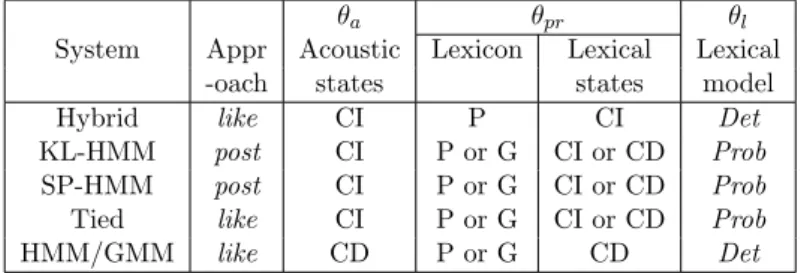
context. The 39 dimensional PLP features used to train the ANN are also used to train the HMM/GMM systems. Table 1 summarizes the different systems and their capabilities.
Table 1: Overview of different systems. postdenotes posterior-based ASR approach and like denotes likelihood-based ASR approach. CI denotes context-independent subword units and CD denotes context-dependent subword units. P and G denote phoneme lexicon and grapheme lexicon, respectively. Detdenotes lexical model is deterministic and Prob denotes lexical model is probabilistic.
System
θa θpr θl
Appr Acoustic Lexicon Lexical Lexical
-oach states states model
Hybrid like CI P CI Det
KL-HMM post CI P or G CI or CD Prob
SP-HMM post CI P or G CI or CD Prob
Tied like CI P or G CI or CD Prob
HMM/GMM like CD P or G CD Det
We present ASR studies on English. In English, grapheme-to-phoneme relationship in English is highly irregular. Thus, presents a difficult case. As a result, learning the relationship between grapheme and phoneme is relatively difficult.
6. In-Domain ASR Study
We present in-domain ASR studies on medium vocabulary continuous speech recognition using DARPA Resource Management task. A part of this study is presented in [12]. The setup is exactly same as reported in [6]. The training set and development set consists of 2,880 utterances and 1,100
utterances, respectively, spoken by 109 speakers corresponding to approx-imately 3.8 hours of speech data. The test set contains 1,200 utterances amounting to 1.1 hours in total and is formed by combining Feb’89, Oct’89, Feb’91 and Sep’92 test sets. The test set is completely covered by a word pair grammar (perplexity 60) included in the task specification. In this work, the training set of 2,880 utterances is used to train the ASR systems as opposed to 3,990 utterances (formed by combining training and devel-opment set) usually reported in literature [37]. The develdevel-opment set 1110 utterances are used only to tune the word insertion penalty.
The lexicon consists of 991 words. The phoneme lexicon was obtained from UNISYN dictionary [39]. There are 42 context-independent phonemes including silence. The grapheme lexicon was transcribed using 29 context-independent graphemes (which includes silence, symbol hyphen and symbol single quotation mark).
We use anoff-the-shelf ANN, more precisely multilayer perceptron, (re-ported in previous study [6]) trained on RM corpus to classify 45 context-independent phonemes as acoustic model. System Hybrid does not include any trainable lexical model parameters. The training phase of System KL-HMM, System SP-HMM and System Tied involves estimation of lexical parameters θl. Three different KL-HMM systems are built where the
pa-rametersyi are estimated by minimizing cost function based on local scores KL,RKLand SKL, respectively.
In probabilistic lexical modeling framework, we model subword contexts
mono (context-independent subword units), tri (context-dependent sub-word units with single preceding and following context) andquint (context-dependent subword units with two preceding and following contexts). For context-dependent studies, we train word internal context models. Each subword unit is modeled by a 3 state left-to-right HMM.
Phoneme-based HMM/GMM system uses phonetic question set for state tying, where as grapheme-based HMM/GMM system uses singleton question set. Decision tree based state tying resulted in 1220 clustered states for phoneme system and 1109 clustered states for grapheme system.
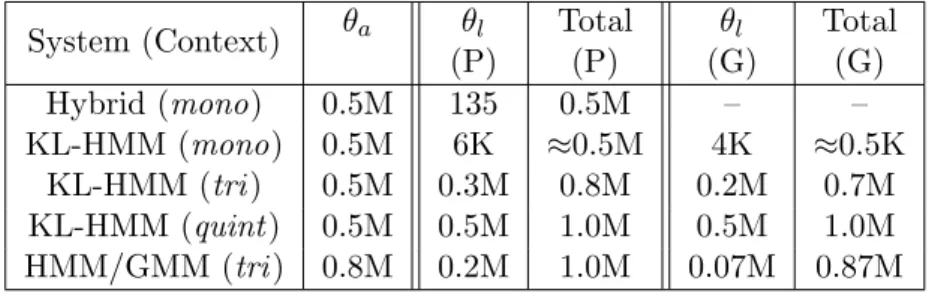
Table 2 compares the total number of parameters in different systems (Hybrid, KL-HMM and HMM/GMM) for phoneme and grapheme subword units. Lexical model parameter θl in the case of System HMM/GMM is deterministic, i.e. a table which maps each possible triphone or trigraph to a clustered state. Similarly, for System Hybrid the lexical model is deter-ministic, i.e., it is a table of 45x3 entries, where 3 is the minimum duration constraint. System SP-HMM and System Tied have same number of pa-rameters as System KL-HMM . It can be noted that probabilistic lexical
modeling does not increase the acoustic model complexity across systems modeling lexical contexts mono, tri and quint. It only changes the lexical model complexity. Furthermore, it can be observed that System KL-HMM has fewer acoustic model parameters and more lexical model parameters compared to System HMM/GMM.
Table 2: Number of parameters for each system. θa denotes acoustic model parameters, θl denotes lexical model parameters. P, and G denote phoneme and grapheme subword
unit based systems, respectively.
System (Context) θa θl Total θl Total
(P) (P) (G) (G) Hybrid (mono) 0.5M 135 0.5M – – KL-HMM (mono) 0.5M 6K ≈0.5M 4K ≈0.5K KL-HMM (tri) 0.5M 0.3M 0.8M 0.2M 0.7M KL-HMM (quint) 0.5M 0.5M 1.0M 0.5M 1.0M HMM/GMM (tri) 0.8M 0.2M 1.0M 0.07M 0.87M
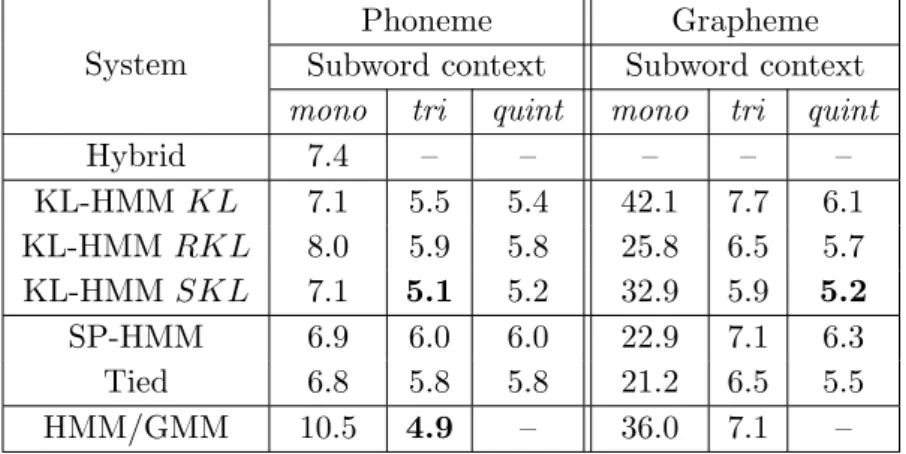
Table 3 presents the word error rate (WER) on the test set of RM corpus for various systems. ASR studies using System KL-HMM were first reported in [12]. It is to be noted that the hybrid HMM/ANN approach requires a one-to-one map between acoustic and lexical states, therefore, in order to model contextstri andquint, context-dependent ANN needs to be trained. In this work, as we limit our studies to context-independent phoneme ANN, WER of hybrid HMM/ANN phoneme lexicon systems with contexttri and
quint, and WER of hybrid HMM/ANN grapheme lexicon systems for all contexts is not applicable.
The key observations are as follows,
• For phoneme lexicon with contextmono, System Hybrid yields slightly poor performance compared to System KL-HMM SKL, System KL-HMMKL, System SP-HMM and System Tied which have probabilis-tic lexical modeling capabilities. The performance of phoneme-based KL-HMM systems modeling tri context increases compared tomono
context for all local scores. However, modelingquint context does not always improve overtri.
• The grapheme-based systems in the framework of probabilistic lexical modeling yield significantly poor performance compared to their re-spective phoneme-based systems for context mono. However, as the
Table 3: Word error rate expressed in % on the test set of RM corpus for various systems with phonemes and graphemes as subword units. Boldface indicates the best performance obtained for each of the subword units.
System
Phoneme Grapheme
Subword context Subword context
mono tri quint mono tri quint
Hybrid 7.4 – – – – – KL-HMMKL 7.1 5.5 5.4 42.1 7.7 6.1 KL-HMMRKL 8.0 5.9 5.8 25.8 6.5 5.7 KL-HMMSKL 7.1 5.1 5.2 32.9 5.9 5.2 SP-HMM 6.9 6.0 6.0 22.9 7.1 6.3 Tied 6.8 5.8 5.8 21.2 6.5 5.5 HMM/GMM 10.5 4.9 – 36.0 7.1 –
context of grapheme units is increased, performance of the systems improve. Grapheme-based System KL-HMM SKL modeling quint
context yields the best peformance, which is comparable to the per-formance of phoneme-based System KL-HMMSKLmodelingtri con-text. This indicates that in the framework of probabilistic lexical mod-eling grapheme-based system could yield performance comparable to phoneme-based system.
• KL-HMM system based on local scoreSKL, except for contextmono, performs better than System SP-HMM and System Tied. It can be observed that for contextmonoSystem Tied yields better performance compared to System SP-HMM and KL-HMM systems. This could be attributed to the scaling of ANN output by priors.
• It is interesting to note that System KL-HMM SKL, which uses context-independent phoneme acoustic states and probabilistic lexical model, performs close to System HMM/GMM, which uses context-dependent phoneme acoustic states and deterministic lexical model.
• Probabilistic lexical modeling approaches using grapheme lexicon out-perform System HMM/GMM using grapheme lexicon.
7. Cross Domain ASR Study
In this section, we present cross-domain ASR study where cross-domain or task-independent acoustic and lexical resources are used to build ASR
system for a new task. In that regard, we present an experimental study where, Wall Street Journal 1 (WSJ1) corpus, which contains approximately 80 hours of speech data and 10K word lexicon (total 13K lexical entries), is used to build ASR system for RM task (presented in Section 6).
We use an off-the-shelf ANN [31] trained on WSJ1 (to classify 45 context-independent phonemes) as the acoustic model to estimate acoustic state probabilities of RM data. The phoneme lexicon was built by training a joint n-gram based G2P convertor on the WSJ lexicon. We used sequitur G2P toolkit [17] for this purpose. We compare systems based on four dif-ferent lexicons,
1. GRAPH - same grapheme lexicon that was used in in-domain study presented in Section 6.
2. WSJ-G2P- phoneme lexicon obtained by G2P conversion
3. Mixed-WSJ-G2P - RM corpus and WSJ corpus share 568 common words. So, we created another phoneme lexicon where the pronunci-ation for common words is obtained from WSJ lexicon and the rest using G2P converter.
4. BASE-RM - same well developed phoneme lexicon that was used in in-domain study presented in Section 6. G2P converter can introduce pronunciation errors, so this lexicon serves as the optimistic case. The systems investigated are System Hybrid, System KL-HMM SKL, System SP-HMM, System Tied and System HMM/GMM. For the sake of clarity, we present KL-HMM studies using only local score SKL. The reader may refer to [12] for results on the other local scores. Training of HMM/GMM system using lexicon WSJ-G2P resulted in 1250 clustered states and using lexiconMixed-WSJ-G2P lexiconresulted in 1261 clustered states. For lexicon BASE-RM, we used System HMM/GMM from the in-domain study reported in Section 6. Adaptation of HMM/GMM system trained on WSJ1 was not considered as RM has sufficient speech data (3.8 hours) for full model re-estimation [40].
When compared to the number of parameters presented in Table 2, it is to be noted that by using an ANN trained on cross-domain corpus with more speech data, only the acoustic model complexity changes. The number of lexical model parameters remain the same. The ANN trained on WSJ corpus had 1.5M parameters. Complexity of System HMM/GMM does not change much.
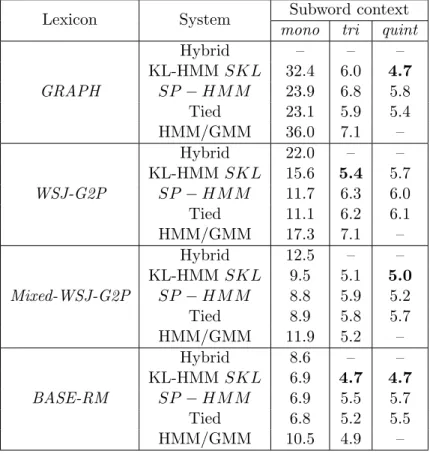
Table 4 reports the performances on the test set of RM corpus for con-textsmono,tri andquint using the above four lexicons and different systems.
ASR studies using System KL-HMM (for grapheme and phoneme lexicon) were first reported in [12].
Table 4: Word error rate expressed in % on the test set of RM corpus. Boldface indicates best system for each lexicon.
Lexicon System Subword context
mono tri quint
GRAPH Hybrid – – – KL-HMMSKL 32.4 6.0 4.7 SP −HM M 23.9 6.8 5.8 Tied 23.1 5.9 5.4 HMM/GMM 36.0 7.1 – WSJ-G2P Hybrid 22.0 – – KL-HMMSKL 15.6 5.4 5.7 SP −HM M 11.7 6.3 6.0 Tied 11.1 6.2 6.1 HMM/GMM 17.3 7.1 – Mixed-WSJ-G2P Hybrid 12.5 – – KL-HMMSKL 9.5 5.1 5.0 SP −HM M 8.8 5.9 5.2 Tied 8.9 5.8 5.7 HMM/GMM 11.9 5.2 – BASE-RM Hybrid 8.6 – – KL-HMMSKL 6.9 4.7 4.7 SP −HM M 6.9 5.5 5.7 Tied 6.8 5.2 5.5 HMM/GMM 10.5 4.9 –
The main observations are as follows,
• Our original hypothesis was that the proposed grapheme-based sys-tem can yield performance as good as phoneme-based syssys-tem which uses lexicon developed by G2P conversion. Comparing the best perfor-mances across lexicons, it can be observed that System KL-HMMSKL
with lexicon GRAPH yields (a) better performance than phoneme-based systems using lexiconWSJ-G2Por lexiconMixed-WSJ-G2P, (b) performance comparable to the optimistic case where the phoneme-based system uses well developed phoneme lexicon, and (c) better performance than System HMM/GMM across all lexicons.
poor performance compared to system using BASE-RM lexicon. This is mainly due to the pronunciation errors of G2P converter. However, it can be observed that with probabilistic lexical modeling (comparison acrossmono) the degradation in performance is comparatively low. The impact of pronunciation errors can also be observed on the per-formance of System HMM/GMM. Especially, in the case of lexicon
WSJ-G2P it can be observed that the performance is significantly lower than the optimistic case, i.e., when lexicon BASE-RM is used. Furthermore, on the same lexicon i.e., WSJ-G2P, System KL-HMM
SKL, System SP-HMM and System Tied with context-independent acoustic states and same context-dependent lexical states (contexttri) outperform System HMM/GMM. This difference in performance is result of mainly two factors, first, System KL-HMM SKL, System SP-HMM and System Tied use an acoustic model that is trained on more data and on well developed cross domain lexicon. Second, as observed earlier probabilistic lexical modeling tends to compensate for pronunciation errors.
• among the systems using probabilistic lexical modeling, similar to in-domain study, System KL-HMMSKL yields the best system.
• Comparing with Table 3, it is interesting to note that performance of System KL-HMM SKL, System SP-HMM and System Tied with context modeling is slightly better despite the ANN being trained on cross-domain data. This indicates that these systems could benefit from larger acoustic training data.
8. Multi-Accent Non-Native ASR Study
In this section, we investigate the probabilistic lexical modeling ap-proaches for multi-accent non-native speech recognition. Two main chal-lenges faced while building ASR systems for non-native tasks are pronunci-ation variability and lack of proper lexical and acoustic resources. Spoken words in non-native speech are pronounced differently from native pronun-ciations. Furthermore, when multiple accents are involved, pronunciations may also differ across different accents. The lack of proper acoustic resources makes it difficult to train conventional ASR systems for individual accents. The probabilistic lexical modeling approach can provide two potential ad-vantages this scenario: (1) with graphemes as subword it can eliminate the
need to build exclusive phoneme lexical resources for the task, (2) can ex-ploit the existing acoustic-phonetic resources available in other domains and languages.
The work presented here is an extension of our previous work on HI-WIRE multi-accent non-native speech recognition task [13] where using out-of-domain data from SpeechDat(II) corpus we showed that a) the proposed grapheme-based system can yield same performance as phoneme-based sys-tem (that has access to well developed lexicon), b) using out-of-domain acoustic-phonetic resources from multiple languages is more advantageous compared to using resources from a language, and c) the system can be rapidly developed using less amount of acoustic data.
In this section, we compare probabilistic lexical modeling using KL-HMM and tied posterior approaches for phoneme, grapheme, and G2P lex-icon based ASR systems. Furthermore, we investigate two cases where (1) both acoustic state posterior estimator and lexical model parameters are trained on cross-domain data and (2) acoustic state posterior estimator is trained on domain data and lexical model parameters trained on cross-domain data are adapted using in-cross-domain data.
8.1. Setup
HIWIRE is a non-native English speech corpus that contains utterances spoken by natives of France (31 speakers), Greece (20 speakers), Italy (20 speakers) and Spain (10 speakers) [41]. The speech is sampled at 16kHz. The utterances contain spoken pilot orders made up of 133 words. The database provides a grammar with a perplexity of 14.9.
The HIWIRE task does not have training data. It only includes adap-tation data (50 utterances per speaker) and test data (50 utterances per speaker). This experimental protocol was originally defined in [41] and was used in the previous study [13].
We use the two ANNs, more precisely MLPs, from the previous study [13], namely, monolingual MLP and multilingual MLP as monolin-gual (MLP-MONO) acoustic model and multilinmonolin-gual (MLP-MULTI) acous-tic model, respectively. The monolingual MLP was trained on Speech-Dat(II) British English to classify 45 phonemes. The multilingual MLP was trained by pooling acoustic and lexical resources from five different lan-guages of SpeechDat(II) corpus, namely British English, Italian, Spanish, Swiss French and Swiss German to classify 117 phonemes. All the Speech-Dat(II) lexicons use SAMPA symbols, therefore output of the multilingual MLP is formed by merging phonemes that share the same symbol across
languages to build a SAMPA multilingual phoneme set. Table 8.1 gives an overview of the acoustic models MLP-MONO and MLP-MULTI.
Table 5: Overview of the acoustic models. The the MLP output dimension (D) and the
total amount of training data (in hours) and are given.
Acoustic Model Phoneme set D Data MLP-MONO SAMPA English 45 12.4 hrs MLP-MULTI SAMPA multilingual 117 63.0 hrs
SpeechDat(II) is telephone speech corpus, hence, the HIWIRE speech was down sampled to 8kHZ before extracting PLP cepstral features, and then forward passed through MLP-MONO and MLP-MULTI. For more de-tails the reader is referred to [13, 42].
We build ASR systems using KL-HMM with local score SKL (denoted as System KL-HMM) and tied posterior (System Tied) approaches model-ing smodel-ingle precedmodel-ing and smodel-ingle followmodel-ing subword context. Unseen context-dependent models were backed-off to a seen model, i.e., the context of unseen context-dependent subword unit encountered is decreased gradually until we encounter an observed subword model. In the worst case scenario, the back-off will lead to context-independent subword models. We compare the use of following four lexicons:
1. GRAPH: grapheme lexicon for both SpeechDat(II) English and HI-WIRE contains 29 context-independent graphemes including silence and symbols (hyphen and single quotation mark).
2. SD-EN-G2P: phoneme lexicon where pronunciations of all the 133 words in the HIWIRE corpus are obtained using G2P convertor. The G2P system was trained on SpeechDat(II) British English lexicon us-ing sequitur toolkit [17].
3. Mixed-SD-EN-G2P: phoneme lexicon where the pronunciations of 102 words of HIWIRE task that are in common with SpeechDat(II) are borrowed from SpeechDat(II) lexicon, and the pronunciations for re-maining 31 words are obtained using G2P convertor.
4. BASE-HIWIRE: well developed phoneme lexicon based on SAMPA phone set. The original lexicon supplied with the HIWIRE corpus con-tains pronunciations based on ARPABET (US English), while Speech-Dat(II) lexicon is based on SAMPA phone set. So, we created a HI-WIRE lexicon based on SAMPA phone set by borrowing pronuncia-tions of 102 words that are in common from the SpeechDat(II) lexicon. For the remaining 31 words, we obtained pronunciations by using the mapping between ARPABET and SAMPA phone sets.
We build systems using one of the above lexicons and acoustic models MLP-MONO or MLP-MULTI.
8.2. Experiments and Results
No adaptation: in this study, both acoustic model parameters θa and lexical model parametersθlare estimated using SpeechDat(II) English data.
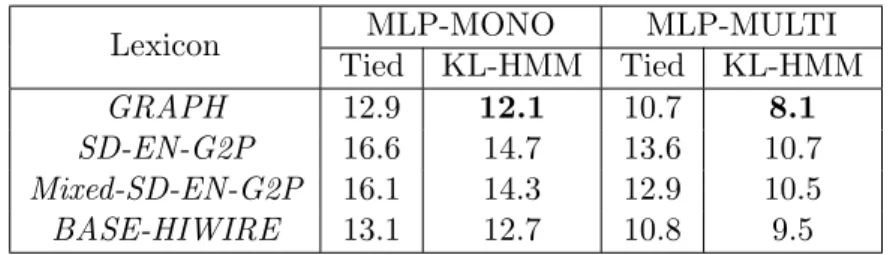
Table 6 presents the performance for various systems using different lex-icons and acoustic models (MLP-MONO and MLP-MULTI). Results show that KL-HMM approach consistently outperforms tied posterior approach. It can be observed that the system usingGRAPH lexicon outperforms the systems using SD-EN-G2P, Mixed-SD-EN-G2P and BASE-HIWIRE lexi-cons. For all the lexicons, acoustic model MLP-MULTI performs better than acoustic model MLP-MONO. The system usingGRAPHlexicon yields the best performance of 8.1% WER.
Table 6: Word error rates in percentage on the test set of HIWIRE corpus for KL-HMM and tied posterior systems using various lexicons. Models trained on SpeechDat(II) En-glish data are used to decode HIWIRE utterances without any adaptation. Boldface indicates the best system for each acoustic model
Lexicon MLP-MONO MLP-MULTI
Tied KL-HMM Tied KL-HMM
GRAPH 12.9 12.1 10.7 8.1
SD-EN-G2P 16.6 14.7 13.6 10.7
Mixed-SD-EN-G2P 16.1 14.3 12.9 10.5
BASE-HIWIRE 13.1 12.7 10.8 9.5
Lexical model adaptation: In this study, only the lexical model parame-ters θl are re-estimated on the adaptation data of HIWIRE task using the
parameters estimated on SpeechDat(II) as initial parameters.
Table 7 presents the performance for various systems using different lex-icons, acoustic models and lexical models. It can be observed that by just adapting the lexical model there is large improvement in performance for all the systems. The system using GRAPH lexicon achieves the best per-formance of 1.8% WER which is significantly4 better than systems using
lexicons SD-EN-G2P, Mixed-SD-EN-G2P and BASE-HIWIRE. Again, we observe that KL-HMM system outperforms tied-posterior system.
Table 7: Word error rates in percentage on the test set of HIWIRE corpus for systems KL-HMM and Tied using various lexicons. Models trained on SpeechDat(II) English data and adapted on HIWIRE adaptation data are used to decode HIWIRE utterances. Boldface indicates the best system for each acoustic model
Lexicon MLP-MONO MLP-MULTI
Tied KL-HMM Tied KL-HMM
GRAPH 4.3 2.6 4.1 1.8
SD-EN-G2P 7.2 3.2 5.5 2.2
Mixed-SD-EN-G2P 7.3 3.2 5.3 2.2
BASE-HIWIRE 6.2 3.5 4.4 2.6
It can be noted that the performance of KL-HMM system with BASE-HIWIRElexicon (2.6% WER) is different than the performance of KL-HMM system with baseline phoneme lexicon (1.9% WER) reported in [13]. The performance difference is because of the different phoneme lexicons used in the two studies. BASE-HIWIRE is based on SAMPA phone set and is obtained from British English lexicon of SpeechDat(II) corpus, while, the lexicon in [13] is based on ARPABET and is obtained from U.S English lexicon CMUDict. This difference in ASR performance precisely highlights the extra care that needs to be taken when developing phoneme lexicon. This is not an issue with grapheme lexicon in the present approach.
On the same HIWIRE task, in the literature it has been found that TIMIT trained HMM/GMM system without adaptation achieves a perfor-mance of 8.6% WER and with MLLR adaptation achieves the best per-formance of 2.75% WER [41]. In [44], linear hidden network (LHN) based speaker adaptation in hybrid HMM/ANN framework was investigated. ANN trained on data from TIMIT, WSJ0, WSJ1 and Vehiclus-ch0 was adapted to each speaker using LHN. The system achieved a WER of 1.8% on HIWIRE task. The systems presented in this section were trained on grapheme lexi-con, multilingual data and 8kHz sampling where as in [44] LHN is trained on phoneme lexicon, English data, but more in quantity, and 16kHz sampling. Furthermore, we did not perform any speaker adaptation or acoustic model adaptation.
Experimental studies presented in this section show that the proposed grapheme-based ASR approach can handle pronunciation variability of non-native speech by exploiting existing acoustic-phonetic resources available in other languages and domains, and can yield performance comparable or
better than phoneme-based ASR system.
9. Analysis of Lexical Model
The experimental studies presented in the previous sections validated the proposed grapheme-based ASR approach. In this section, we elucidate that indeed in the proposed approach grapheme-to-phoneme relationship is captured by the lexical model. We show this while explaining the effect of the cost function and the grapheme context on the grapheme-to-phoneme relationship being learned by the lexical model. For the sake of clarity, we restrict the analysis to KL-HMM systems and in-domain models. Also, we will see that the update step in KL-HMM system is easy to interpret in terms of combination of probabilities.
9.1. Effect of Different Local Scores
In grapheme-based KL-HMM system where the lexical states represent graphemes and the acoustic states represent phonemes, the lexical model parameters yi model the probabilistic relationship between graphemes and
phonemes. In English, the relationship between graphemes and phonemes can be one-to-one or one-to-many. The accuracy of the captured proba-bilistic relationship is governed by the local score used during KL-HMM parameter estimation. It can be observed that,
• local scoreKLyields an update step (see Equation (20)) that estimates normalized geometric mean of the acoustic state probability vectors that belong to the state. In classifier fusion literature [45, 46, 47], it is shown that such combination of probabilities (referred to as product combination or logarithmic opinion pool) leads to a less dispersive distribution, i.e., it captures the dominant decision.
In the case of graphemes that have more one-to-one relationship with phonemes, ANN decisions across frames belonging to a state can be more homogeneous, i.e., decisions belong to the same phoneme class. While, in the case of graphemes that have one-to-many relationship with phonemes, ANN decisions can be more heterogeneous, i.e., the decisions of ANN differ. Given this, it can be hypothesized that the system using local scoreKL has the capability to capture one-to-one G2P relationship better than one-to-many G2P relationship.
• local scoreRKL yields an update step (see Equation (21)) that esti-mates arithmetic mean of the acoustic state probability vectors that
belong to the state. In classifier fusion literature [45, 46, 47], it is shown that such combination of probabilities (referred to as sum combination or linear opinion pool) leads to a dispersive distribution compared to product combination. This is particularly beneficial when there are more heterogeneous decisions to combine, like in the case of one-to-many G2P relationship.
• local scoreSKL employs both KL and RKL update steps. Thus, it can be hypothesized that the system based on SKL will retain the strengths of the two local scoresKLand RKL.
In order to analyze and visualize the effect of local scores better, 1. we trained grapheme-based KL-HMM systems using three local scores
(KL, RKL and SKL), where lexical states are context-independent graphemes, acoustic states are context-independent phonemes, and each lexical state is modeled by a single state HMM, and
2. the categorical distribution of each grapheme model is sorted according to the probability value, and the dimensions with probability value greater than or equal to 0.1 are picked.
Table 8 presents the G2P relationship captured by different grapheme-based KL-HMM systems. From the table the effect of local scores on the captured G2P relationship can be observed as the following:
1. the system using local scoreKLcaptures one-to-one G2P relationship (e.g., see [B], [L], [M], [P]) better than one-to-many G2P relationship (e.g., see vowel graphemes, [C], [H], [X]).
2. local scoreRKLin addition to appropriate one-to-many G2P relation-ship (e.g., see vowel graphemes, [C], [G], [H]) also captures additional confusable and spurious relations. This can be particularly seen in the case of one-to-one G2P correspondence (e.g., see [B], [M]).
3. local scoreSKLtends to capture one-to-one G2P relationship similar to local scoreKL. It is able to capture one-to-many G2P relationship better than local scoreKL but not to the same extent as local score
RKL(e.g., see [G], [H], [N]).
The analysis shows that local scoresKLandRKLcan model better one-to-one and one-to-many lexical-to-acoustic state relationships, respectively where as, the local scoreSKL can model both one-to-one and one-to-many lexical-to-acoustic state relationships.
Table 8: Grapheme-to-phoneme relationship (sorted according to the maximum probabil-ity value and with a probabilprobabil-ity value greater than or equal to 0.1) learned by KL-HMM states
Grap Phonemes
-pheme KL RKL SKL
A ae(0.7) eh(0.2) ae(0.3) ey(0.3) eh(0.1) ae(0.5) eh(0.2) ey(0.1) ey(0.1) ax(0.1) ax(0.1)
B b(1.0) b(0.5) ah(0.2) b(0.9)
C k(1.0) k(0.5) ch(0.2) s(0.1) k(0.6) t(0.2) ch(0.1) t(0.1) s(0.1)
D d(0.9) t(0.1) d(0.5) t(0.2) sil(0.1) d(0.7) t(0.1) E ax(0.4) ih(0.3) iy(0.3) eh(0.1) ax(0.1) iy(0.3) ax(0.2) ih(0.2)
eh(0.1) iy(0.1) ih(0.1) ey(0.1) eh(0.1) ey(0.1) F f(1.0) f(0.7) v(0.1) sil(0.1) f(0.9)
G g(0.9) g(0.4) jh(0.2) sil(0.1) g(0.7) d(0.1) k(0.1) k(0.1) d(0.1)
H t(0.7) d(0.1) sh(0.3) dh(0.2) hh(0.1) dh(0.2) sil(0.2) t(0.2) sil(0.1) th(0.1) th(0.1) d(0.1) hh(0.1) I ih(0.8) ax(0.1) ih(0.4) ay(0.2) ax(0.1) ih(0.5) ax(0.2) eh(0.1)
iy(0.1) ay(0.1) J jh(1.0) jh(0.7) ch(0.1) d(0.1) jh(0.9) t(0.1) K k(1.0) k(0.7) sil(0.1) t(0.1) k(0.9) L l(1.0) l(0.5) el(0.1) ao(0.1) l(0.8) ow(0.1) M m(1.0) m(0.7) n(0.1) m(0.9) n(0.1) N n(0.9) n(0.5) en(0.1) ng(0.1) n(0.8) en(0.1) O ao(0.4) aa(0.3) ao(0.2) aa(0.2) ow(0.2) ao(0.2) aa(0.2) ow(0.2)
ow(0.1) ah(0.1) sh(0.1) ah(0.1) ax(0.1) ah(0.1) ax(0.1) P p(1.0) p(0.8) p(0.9) Q k(1.0) k(0.5) w(0.2) uw(0.1) k(0.9)
y(0.1)
R r(0.8) axr(0.2) r(0.4) axr(0.3) aa(0.1) r(0.6) axr(0.3) er(0.1) er(0.1)
S s(0.9) z(0.1) s(0.6) z(0.2) s(0.8) z(0.2) T t(0.9) t(0.5) sil(0.1) d(0.1) t(0.8)
k(0.1)
U ax(0.4) uw(0.3) uw(0.3) y(0.2) ax(0.1) uw(0.3) ax(0.3) ih(0.1) ih(0.1) ah(0.1) ah(0.1)
V ay(0.9) v(0.5) ay(0.3) v(0.9) W w(1.0) w(0.6) aw(0.1) uw(0.1) w(0.9)
X k(0.9) t(0.1) s(0.4) k(0.4) k(0.5) s(0.3) t(0.1) Y iy(0.8) ey(0.1) iy(0.4) ay(0.1) ey(0.1) iy(0.5) ey(0.3) ih(0.1)
oy(0.1)
Z z(0.9) ay(0.4) z(0.3) s(0.1) z(0.8) s(0.1) sil sil(1.0) sil(1.0) sil(1.0)
9.2. Effect of Increasing Grapheme Subword Unit Context
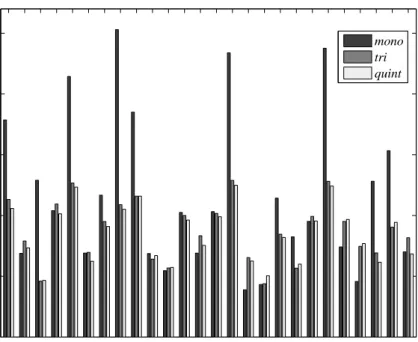
In [12], we analyzed the models of consonant grapheme [C] and vowel grapheme [A] (which have varying degree of irregular mapping to phoneme) to gain insight into the effect of contextual modeling. It was observed that vowel grapheme [A] needed longer context to dominantly capture the rela-tion to appropriate phoneme compared to consonant grapheme [C]. Also, as the context of grapheme subword units is increased, KL-HMM parameters start to capture phoneme contextual information. In order to get a global picture on the effect of context, we trained single state grapheme models for three contexts (mono, tri and quint) using local score SKL, and then computed the entropy of the grapheme models. In the case oftri andquint, average entropy of all the grapheme models with same center grapheme was computed. Figure 2 shows the entropy of the grapheme models with
increasing context. It can be observed that, A B C D E F G H I J K L M N O P Q R S T U V W X Y Z 0 0.5 1 1.5 2 2.5 Graphemes Average entropy mono tri quint
Figure 2: Entropy of grapheme models with increasing context. For contextstriandquint, average entropy of all the grapheme models with same center grapheme is displayed.
• Vowel graphemes ([A], [E], [I], [O], [U]) and some consonant graphemes ([C], [H], [R], [X] ) have high entropy for context mono signifying the fact that the models capture one-to-many G2P relationship. As the context increases, entropy decreases i.e., models tend to capture one-to-one G2P relationship.
• Few consonant graphemes like [B], [K], [P], [V] have low entropy for context mono which suggests that context-independent grapheme it-self models one-to-one G2P relationship. However, the entropy slightly increases as the context increases. A closer look at the models revealed that this was due to the context information captured by the models. In other words, similar to G2P conversion systems [15, 16, 17, 18, 19], one-to-many G2P relationship tends to become more regular or close to
one-to-one as longer grapheme context is modeled.
10. Discussion and Conclusion
The present paper presented a reformulation of HMM-based ASR in terms of acoustic states and lexical states. Under this reformulation, we elucidated that HMM-based ASR is a template matching approach, where a sequence corresponding to lexical evidence is matched with a sequence corresponding to acoustic evidence. Furthermore, in addition to explaining deterministic lexical modeling aspect implicit in standard ASR system, the reformulation unifies approaches developed with different perspectives into a single probabilistic lexical modeling framework. For instance, PCHMM is a soft state tying approach; tied posterior approach was developed more from the perspective of semi-continuous HMM [48]; and KL-HMM was mainly de-veloped from the perspective of posterior features, as an alternate technique to Tandem features [49], where the ANN output is not post processed. In the context of posterior-based probabilistic lexical modeling approach, we also introduced SP-HMM. Finally, the paper also explained that both likelihood-based ASR approach and posterior-likelihood-based ASR approach are independent of the approach taken to model the acoustics, i.e., to use GMMs or ANNs.
There are several potential advantages of modeling the probabilistic re-lationship between lexical states and acoustic states, namely,
1. flexibility to model graphemes as subword units and learning the G2P relationship using both acoustic and lexical data. We found this ap-proach to be particularly beneficial in comparison to the apap-proach, where ASR system is built with a phoneme lexicon that was devel-oped by learning G2P relationship independent of the acoustic data. Furthermore, the approach was also found to be advantageous for non-native ASR, where developing a phoneme lexicon containing pronun-ciations that matches well with non-native pronunpronun-ciations is a chal-lenging task.
2. it could handle the short comings in the lexicon development. The short comings can be due to reasons such as, pronunciation errors (as in the case of G2P conversion), pronunciation mismatch (as in the case of non-native speech). In that respect, the cross-domain ASR study and the multi-accent non-native ASR study demonstrated the effectiveness of probabilistic lexical modeling.
3. it naturally leads to parameter sharing, irrespective of whether the acoustic model originally shares the parameters across all the acous-tic states or not. For instance, in ANNs all the parameters (weights
and biases) are shared across all the acoustic states, while in the case GMMs the parameters are not always shared across all the acous-tic states. The advantage of such natural parameter sharing is that the complexity could be effectively distributed across acoustic model and lexical model. To some extent, we observed that in our stud-ies. More precisely, by using ANNs that classify context-independent phonemes (or acoustic states), we observed that grapheme-based and phoneme-based systems with probabilistic lexical modeling capabili-ties were able to achieve performance comparable to standard context-dependent subword unit HMM/GMM system by modeling the lexical state context.
4. as shown in this paper as well as in other studies using KL-HMM, such as [50], probabilistic lexical modeling framework can be effectively used to exploit acoustic and lexical resources of multiple languages and do-mains. This together with the advantage of using grapheme lexicon is interesting for development of ASR systems for under-resourced lan-guages or domains [14].
In our studies, we found KL-HMM consistently yields a better system compared to tied posterior and SP-HMM. In Section 4.1, through the link between KL-divergence and hypothesis testing, we observed that KL-HMM leads to a system which is locally discriminative and globally generative in the acoustic state probability space. The generative aspect can be exploited for acoustic data-driven grapheme-to-phoneme conversion [51, 52].
In this work, we used ANNs that classified context-independent phonemes. However, it is possible to model context-dependent phonemes as acoustic states and yield similar gains in performance using probabilis-tic lexical modeling. This has been observed for both phoneme-based ASR [23, 36, 53] and grapheme-based ASR systems [54].
The grapheme-based approach presented in this paper needs a phoneme-based acoustic model. In other words, the approach depends upon the avail-ability of phoneme lexicon. In a recent study, we have found that “phoneme-like” acoustic states could be derived directly from the acoustic data and used to build grapheme-based ASR systems that yield competing perfor-mance [54].
One salient aspect that stands out in the present work as well as in other related works on KL-HMM e.g., [50, 14] is that the acoustic model can be trained on data from different domai