University of Cape Town
1
Stakeholder Perceptions of the Efficacy of a Capstone Course Introduced to Assist Accounting Students in Developing Pervasive Skills
Paul Maughan MGHPAU001
A minor dissertation submitted in partial fulfillment of the requirements for the award of the degree of Master of Philosophy in Higher Education Studies.
Faculty of the Humanities University of Cape Town
2016
COMPULSORY DECLARATION
This work has not been previously submitted in whole, or in part, for the award of any degree. It is my own work. Each significant contribution to, and quotation in, this dissertation from the work, or works, of other people has been attributed, and has been cited and referenced.
quotation from it or information derived from it is to be
published without full acknowledgement of the source.
The thesis is to be used for private study or
non-commercial research purposes only.
Published by the University of Cape Town (UCT) in terms
of the non-exclusive license granted to UCT by the author.
2
Table of Contents
Chapter Title Page
Table of Contents List of figures List of tables
Glossary of acronyms and key terms Abstract Acknowledgements 2 6 6 7 8 10 1. Introduction 1.1 Background
1.1.1 Introduction of the BAG capstone course at UCT 1.1.2 A description of the BAG capstone course 1.1.3 The structure of the BAG capstone course 1.2 Rationale
1.3 Positionality and the researcher
1.4 Background to the development of research questions 1.5 Dissertation Outline 11 11 11 12 14 14 16 16 17
2. Review of related literature
2.1 The critical theory theoretical framework 2.2 Action research
2.2.1 A description of action research
2.2.2 Why action research was considered appropriate for this study
2.2.3 Criticism of action research
2.2.4 A response to the criticism of action research 2.3 Pervasive skills 18 18 20 21 23 24 25
3 2.4 Capstone courses 27 3. Research questions 3.1 Research problem 3.2 Research questions 30 30 32 4. Research methodology 4.1 Research design 4.2 Research method
4.2.1 Selection of students, tutors and academic staff and methods of data collection
4.2.2 Data analysis
4.2.3 The follow-up survey of the BAG 2012 class
4.2.4 Participation by the professional body and the university 4.2.5 Validity concerns and limitations of the study
33 33 33 37 38 40 40 5. Analysis of findings
5.1 Pervasive skills development
5.1.1 Findings from student questionnaires 5.1.2 Findings from the tutor focus groups
5.1.3 Findings from the academic staff focus groups 5.1.4 Findings from the professional body
5.1.5 Findings from the University of Cape Town 5.2 Interventions within the capstone course that were beneficial to student learning
5.2.1 The M&A project findings 5.2.2 The M&A project discussion
5.2.2.1 The 2012 action research cycle for the M&A project 5.2.2.2 The 2013 action research cycle for the M&A project 5.2.2.3 The 2014 action research cycle for the M&A project 5.2.3 The research area question findings
5.2.4 The research area question discussion
42 42 42 45 45 46 48 49 50 51 51 53 55 58 59
4
5.2.4.1 The 2012 action research cycle for the research area question
5.2.4.2 The action research cycle for the research area question in subsequent years
5.2.5 The company analysis question findings 5.2.6 The company analysis question discussion
5.2.6.1 The 2012 action research cycle for the company analysis question
5.2.6.2 The 2013 action research cycle for the company analysis question
5.2.6.3 The 2014 action research cycle for the company analysis question
5.2.7 Discussion of the findings from the 2015 follow-up questionnaire 60 61 61 62 63 64 66 67 6. Conclusions
6.1 Revisiting the original plan of action for the capstone course
6.2 Revisiting the research questions 6.3 Research significance 6.4 Recommendations 6.5 Closing remarks 70 70 71 73 75 76 Bibliography 77
Appendix 1 – Questionnaire completed by participating students 83 Appendix 2 –Ethical clearance document signed by participating
tutors
Appendix 3 – Ethical clearance document signed by participating academic staff
93
5
Appendix 4 – Questionnaire completed by BAG 2012 students who wrote the APC in 2015
Appendix 5 – M&A project for 2015
Appendix 6 – M&A project companies for 2015 Appendix 7 – Research area questions for 2015 Appendix 8 – Company analysis questions for 2015
95
98 111 113 117
6
List of figures
Figure 1: Action research Protocol after Kemmis and McTaggert (2000) 21
List of tables
Table 1: A summary of the observations made in 2011, and subsequent
interventions actioned in 2012, which resulted in the development of the BAG capstone course
30
Table 2: Student participation in online questionnaire 33
Table 3: Tutor and academic participation in focus groups 34
Table 4: Calculation of the average for multiple-choice questionnaire results 37 Table 5: Mapping of the questions posed in both the 2012 and 2015
questionnaires to the same cohort of students
39
Table 6: Student participation in both the 2012 and 2015 questionnaires 39
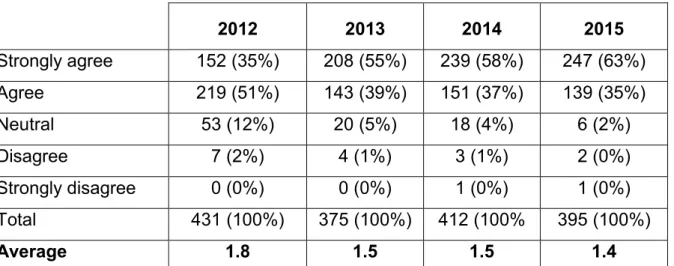
Table 7: Summary of responses to “The course has helped to develop my pervasive skills as defined by SAICA” (question 15)
43
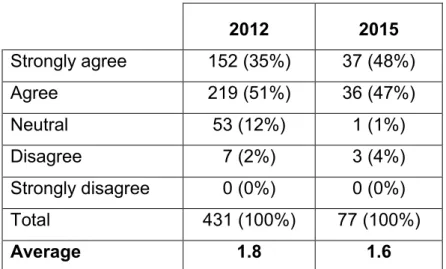
Table 8: Summary of responses to “The course has helped to develop my
pervasive skills as defined by SAICA” for the BAG 2012 class (question 15) compared to the 2015 follow-up questionnaire (question 3)
44
Table 9: Summary of the BAG capstone course student marks 44
Table 10: Summary of responses to “The M&A project has contributed to my learning” (question 20)
50
Table 11: Summary of responses to “The M&A project has contributed to my learning” for the BAG 2012 class (question 20) compared to the 2015 follow-up questionnaire (question 3)
51
Table 12: Summary of observations and interventions for the M&A project after the action research cycle of 2012
52
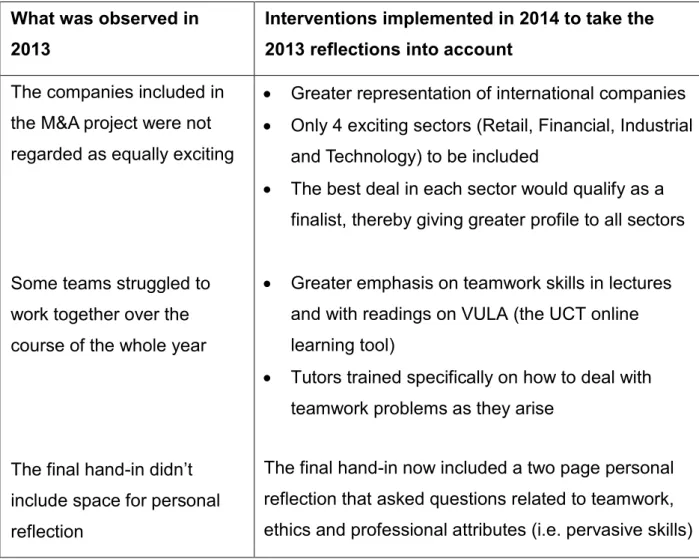
Table 13: Summary of observations and interventions for the M&A project after the action research cycle of 2013
55
Table 14: Summary of observations and interventions for the M&A project after the action research cycle of 2014
58
Table 15: Summary of responses to “The research area in every test contributed to my learning” (question 21)
7
Table 16: Summary of responses to “The research area in every test contributed to my learning” for the BAG 2012 class (question 21) compared to the 2015 follow-up questionnaire (question 4)
59
Table 17: Summary of observations and interventions for the research area question after the action research cycle of 2012
61
Table 18: Summary of responses to “The company analysis in every test has contributed to my learning” (question 22)
62
Table 19: Summary of responses to “The company analysis in every test has contributed to my learning” for the BAG 2012 class (question 23) compared to the 2015 follow-up questionnaire (question 5)
63
Table 20: Summary of observations and interventions for the company analysis question after the action research cycle of 2012
65
Table 21: Summary of observations and interventions for the company analysis question after the action research cycle of 2013
66
Table 22: Summary of responses from the 2012 BAG class as well as the subsequent response from the same class in 2015
67
Glossary of acronyms and key terms
APC The Assessment of Professional Competence is the final qualifying exam for the South African Institute of Chartered Accountants (SAICA)
BAG Business Analysis and Governance - the capstone course introduced for
students studying towards becoming chartered accountants at UCT Capstone course A final year undergraduate course that seeks to integrate student
knowledge and develop pervasive skills
M&A Mergers and Acquisitions
PGDA The Postgraduate Diploma in Accounting is the qualification required after undergraduate studies in order to write the SAICA qualifying exams
SAICA The South African Institute of Chartered Accountants is the professional accounting body in South Africa for chartered accountants
8
Abstract
A capstone course, Business Analysis and Governance (BAG), compulsory for all students studying towards becoming chartered accountants, was introduced at the University of Cape Town (UCT) in 2012. It was designed to develop pervasive skills in response to the
competency framework that was developed in 2008 by the South African Institute of Chartered Accountants (SAICA), the professional accounting body.
This study explored whether or not the capstone course has assisted in developing the
pervasive skills of students. The effectiveness of specific interventions namely a Mergers and Acquisitions (M&A) project, the inclusion of current business research area questions in
assessments as well as company analysis was also investigated.
Research was conducted in the critical theory tradition, in particular following the work done by the prominent psychologist, Kurt Lewin who is considered as one of the founders of social psychology. He is also often credited as being pivotal to the emergence of Action Research which was used in this research project. Action Research required an annual cycle of observation, action, reflection and planning over the initial four year period of the capstone course. The views of 1613 capstone course students from 2012 to 2015 were obtained from a questionnaire that comprised both multiple choice as well as discursive questions. The tutors for the course were also included in an annual focus group discussion which gathered their views. The academic members of staff who participated in teaching the course were also included in an additional annual focus group discussion. A follow up questionnaire was completed in 2015 by 77 students who completed the BAG course in 2012 and had recently written their final professional accounting exam.
All participants were asked to reflect on their perceptions of the development of pervasive skills. They were also asked to suggest ideas to improve the capstone course in subsequent years. The majority of the changes made in the capstone course were in the M&A project, current business research area questions and the company analysis interventions.
The findings from the analysis of the quantitative and qualitative data from the questionnaire as well as the focus group discussions showed that students believed that the capstone course had developed their pervasive skills. The majority of the interventions also had a positive impact on the perceived development of pervasive skills. The M&A project, in particular, was regarded as a catalyst for the development of a large range of pervasive skills. The findings
9
from the student questionnaires are supported by data gathered from SAICA, the UCT
academic community, as well as from the tutors in the BAG course. Action Research was found to be an effective methodology to guide the refinement of the capstone course as well as
developing new knowledge.
Based on the analysis of the data collected, the introduction of a capstone course such as Business Analysis and Governance is deemed to be an effective means of developing
10
Acknowledgements
I would like to thank all the students, tutors and academics in the UCT College of Accounting who have helped to shape the BAG capstone course over the years.
I am also indebted to my supervisor Associate Professor Bette Davidowitz who has guided my research and been particularly motivating through her boundless energy and prompt responses. I am also acutely aware of how blessed I am to have a family that loves and supports me.
Thank you Lee-Ann, Patrick and Joanna. To God be the glory.
11
CHAPTER 1 – INTRODUCTION 1 Introduction to the study
The purpose of this chapter is to give a brief overview of the study. It introduces the study by exploring the background, rationale and theory that frame the development of the capstone course studied. The research question and positionality of the researcher is also introduced. 1.1 Background
This study explores the development of a capstone course, Business Analysis and Governance (BAG), that was introduced at the University of Cape Town (UCT), in 2012. This course is compulsory for both Bachelor of Commerce (B.Com) and Bachelor of Business Science (B.BusSc) students studying towards becoming chartered accountants (CAs). In order to register for the Post Graduate Diploma in Accounting (PGDA) students require 60% for BAG. I teach undergraduate and postgraduate accounting at UCT and have been the course convenor for BAG since its inception until 2015.
1.1.1 Introduction of the BAG capstone course at UCT
The introduction of a new competency-based framework by the South African Institute of Chartered Accountants (SAICA) resulted in academics in the Commerce Faculty at UCT conducting an extensive mapping exercise to determine the extent to which the College of Accounting was meeting the new requirements (SAICA, 2010). There were two significant issues that needed to be addressed.
The first issue was the need to enhance the pervasive skills of the students. SAICA has defined pervasive skills as those relating to ethics and professionalism, personal attributes and
professional skills. These pervasive skills have been identified as being important by SAICA and are included in the new competency based framework (SAICA, 2010). Additionally, since assessment often drives student behaviour, SAICA changed the nature of the final qualifying exam to be implemented from 2014 to an Assessment of Professional Competence (APC) (SAICA, 2011). The APC consists of a case study and the assessment is focussed, in
particular, on students’ ability to demonstrate professional competence as opposed to technical competence (SAICA, 2014). Some of the pervasive skills required for the APC are the ability to research an industry, analyse complex business scenarios as well as clear communication skills (SAICA, 2010).
12
The second issue identified by UCT was the need to cover more management accounting and finance material at an undergraduate level. This was especially important for the Bachelor of Commerce (B.Com) students who are in their 3rd year of study as opposed to the Bachelor of Business Science students (B.BusSc) who are in their 4th year. The B.BusSc students take an additional year to qualify as CAs but they have the advantage of completing additional finance courses as well as a final-year strategy course. It was therefore felt that the B.Com students, in particular, required an additional course to highlight complex finance topics such as valuations, capital structure as well as mergers and acquisitions.
1.1.2 A description of the BAG capstone course
Given the need to enhance the pervasive skills of students as well as the desire to cover more management accounting and finance material, the decision was taken to introduce a new course at the final year undergraduate level. The decision had the support of the UCT College of Accounting across the different disciplines and a working group was tasked with designing the course. It is important to acknowledge that the UCT College of Accounting agreed with van Acker and Bailey (2011, p. 71) when they noted that “generic skills are too multi-layered and complex to simply be taught in one or even a few courses.” The onus for developing all the pervasive skills could not be placed on the capstone course only but needed to be carried by all the courses in a particular degree.
The design of the BAG capstone course was, however, not overtly informed by existing
academic literature but was shaped by the ideas generated by the working group. The working group had a list of management accounting and finance content which needed to be reinforced as had been identified by the mapping exercise. It was the feeling of the team that the course did not need to introduce a lot of new content but rather should require students to apply
knowledge already acquired to practical business scenarios. Governance topics were therefore added as it was felt that these were best tested in an integrated manner.
The focus of the working group then shifted to designing the assessment tasks that would test pervasive skills and that would not be too onerous to grade from a resource perspective given the large class expected (over 450 students). The focus on assessment was agreed as the next step in the design process for several reasons. The first reason was that there was a fear of an additional course placing too great an assessment burden on the students during their important final year of studies. The second reason was that students would be especially anxious about assessment and would need to receive clarity on assessment because there
13
were no prior assessment practices which could be referred to. As Ramsden (1992, p. 187) points out “From our students’ point of view, assessment always defines the actual curriculum.”, thus the design thereof was a crucial element that the group needed to address. The teaching model was then aligned to prepare students for these assessments. That meant that tutorials would be of an appropriate standard to prepare students for assessment tasks and that the lecture material would need to be geared towards greater integration and inclusion of business issues faced by South African companies. Additionally, ideas to enhance pervasive skills, a mergers and acquisitions project, current business research area questions and company analysis were added to the course design.
The course is described as follows in the UCT student handbook for the commerce faculty (UCT, 2016, p. 101):
Objective: To enable students to integrate and contextualise the technical knowledge gained in their accounting courses within the South African business environment.
Course outline: This is a capstone course which reflects on and integrates the technical subject matter included in the four core disciplines included in the Chartered Accountant Finance & Accounting B.Com and B.BusSc programmes (Financial Reporting,
Managerial Accounting & Finance, Auditing and Taxation) in a highly contextualised and integrative manner. Inter-related aspects of these disciplines are traced through the Annual Financial Statements of several listed South African Companies, focussing on the analysis and interpretation of the results and disclosures; financial management and corporate governance of the selected companies, in the context of their business environments. Topic areas covered include the analysis and interpretation of company results, reports and disclosures in the context of the entity’s economic, industry,
operating and business environment; preparation of financial forecasts and analysis thereof; valuations including consideration of relevant risks and assurance procedures; financial management, corporate financial distress; capital structure, dividend policy, financing and cash management, risk management, corporate governance, internal control, disclosures and sustainability reporting of the industries such as banking, mining, pension funds; report writing for a designated audience or from an appropriate role in relation to any of the broad areas covered in the course.
14
A short video (4.30min) introducing the BAG course can be viewed at: http://uctboardcourse.co.za/business-analysis-and-governance-bag/ 1.1.3 The structure of the BAG capstone course
The BAG capstone course is worth 18 NQF credits at level 8. It is a full year course with two 45 minute lectures a week. Tutorials lasting 90 minutes each are presented every second week. Two hour tests are conducted in April and June and the final exam takes place in September to avoid the final exam timetable being too crowded at the end of the year. The final assessment task is a teamwork M&A project that needs to be completed throughout the year. The
development of the M&A project is discussed in detail in Chapter 5.
Having provided some important context for the capstone course, the rationale for the study is explored.
1.2 Rationale
The capstone course was new and although it was designed by a team with the best of intentions, there were areas for development. The majority of the courses taught on the undergraduate chartered accountant programme have been developed over decades through much trial and error. It would therefore be expected that this new course would also need to be refined. During my studies in the Masters in Higher Education programme, I encountered work conducted by those using action research. The principles of action research seemed ideally suited for practitioner reflection and as a process that would help to develop the capstone course.
A major personal reason for conducting this study was my position as the course convenor and I wanted to improve the course every year. SAICA had also shown a great interest in the course and there was the potential for other universities to implement the course or a modified version of it. The University of Zululand and Walter Sisulu University for instance both
implemented a version of the course from 2015 onwards and it was hoped that this current research would help ensure that they do not have to repeat the same mistakes that were made during the early years of implementation at UCT.
A further motivation was that all the universities that are accredited by SAICA to train chartered accountants are mandated to develop pervasive skills among their students. There is therefore
15
a great need to share knowledge in this area among all universities. It was hoped that
researching the capstone course and making information available would allow academics at other institutions to engage with our efforts and offer additional insights or questions that would result in further improvement to the course.
Another reason for the study was that students were initially very resistant to the addition of another course to their final year of undergraduate studies. Paying attention to the concerns of the students and redesigning the course would hopefully decrease this resistance over time. It was important that the capstone course had a positive overall impact on the students so that they were able to complete their chartered accounting studies successfully.
Finally, there was the desire to understand whether or not the capstone course met its original intention of filling the gaps found during the College of Accounting exercise of mapping
curriculum to SAICA’s competency framework. The BAG course was intended to help to develop pervasive skills as directed by SAICA. This study evaluated whether or not this has been the case and where possible improvements could have helped to ensure greater success in meeting these goals. Ultimately the capstone course was designed with achieving these objectives in mind and there was a need to evaluate whether or not that was the case.
Furthermore, it is hoped that as problems were identified, ideas that lead to greater alignment with SAICA’s objectives were generated and implemented.
I identify with van Acker and Baily (2011, p. 74) when they said:
“Staff are at times confused and unsure about their role in producing graduates with professional skills. However, capstone courses are a key strategy for embedding
graduate skills in the undergraduate business curriculum. Thus close attention needs to be paid – sector-wide, institutionally, at program level and course level – in order to
heighten awareness of such courses, and of their key role in embedding graduate skills.” This study was therefore an attempt to pay close attention to this capstone course and make this process transparent and widely available so that interested parties can engage with our process of action and reflection.
16
1.3 Positionality and the researcher
I studied at UCT before becoming a chartered accountant, CA(SA), registered with SAICA. I returned as a lecturer and taught Financial Reporting for four years before becoming involved in the development and implementation of the BAG course.
At the same time as the development of BAG, I enrolled for a Master of Philosophy in Higher Education Studies at UCT. This involved coursework in the introductory years followed by a dissertation. During the coursework phase I became increasingly interested in implementing the ideas that I was exploring as a student in my field of practice. The idea therefore grew to apply action research to the development of the BAG course.
The collaborative nature of the development of BAG meant that there was a group of fellow academics who were prepared to form part of the focus groups. One colleague was also
prepared to moderate the tutors’ focus group, where it was felt that my position as the convenor might hinder the discussion among the tutors.
Being the course convenor meant that I had a vested interest in the success of the course as I had devoted a large amount of time and effort to its development. It would also form the basis for a programme to prepare our students for the SAICA qualifying exams and therefore it would hopefully not only be of interest to students but would also be beneficial to their professional development.
Starting an entirely new course, involving over 450 students at the final year undergraduate level, was enormously challenging. In addition, conducting a study to complete the Master of Philosophy in Higher Education Studies at the same time, made it even more so. The use of action research has, however, helped to provide the methodology to guide the development of the course.
1.4 Background to the development of research questions
As the course convenor, I was interested in many aspects related to BAG and a large
opportunity for research existed in this area. The literature reviewed revealed that not many studies had been conducted into accounting capstone courses. This became the main area of focus of this study; and in particular the degree to which the course would lead to the
17
The study therefore responds to the following first research question:
Did the introduction of the capstone course lead to the development of students’ pervasive skills?
The second research question which follows from the first was:
Which particular interventions in the BAG course were beneficial for student learning?
In an earlier paper published in Accounting Perspectives, Maughan (2013) looked at the assessment practices included in the BAG course in greater detail. The research questions above will focus on the broader areas of the development of pervasive skills and which interventions were the most beneficial for student learning.
1.5 Dissertation Outline
This dissertation consists of six chapters. In this first chapter I have provided context for the dissertation by describing the development of the capstone course as well as the research questions. In Chapter 2 I review the literature that helped to inform the study. Chapter 3 outlines both the research problem and the research questions. Chapter 4 provides a
description of the research methodology which was followed to develop the course as well as to assess the development of pervasive skills. Chapter 5 looks at the findings from the action research cycles and includes a discussion of the research findings. The final chapter concludes the study and provides a discussion of the implications of this study. A list of references and appendices is included at the end of the dissertation. All raw data collected are available on a CD-ROM.
18
CHAPTER 2 – REVIEW OF RELATED LITERATURE 2 Introduction to the review of related literature
The literature review consists of three areas of focus. The first area focuses on critical theory as a theoretical framework and the action research methodology. The definition of action research and its appropriateness for this research study is then explored.
The second focus area examines the literature related to pervasive skills or graduate attributes. The development of pervasive skills was a major driver behind the development of the capstone course and therefore an understanding of this area is vital.
The third and final focus area consists of the literature related to capstone courses. It focuses on definitions of a capstone course and then the objectives of a capstone course. This allows for an understanding of the degree to which a capstone course can develop pervasive skills in students.
2.1 The critical theory theoretical framework
Studies in education have been conducted using a large number of different theoretical frameworks. These frameworks have been classified as empiricist, interpretive, critical and deconstructive although it should be noted that the definitions of many of these terms are contested. It is therefore important to establish the theoretical framework that will be adopted for this study at the onset of the literature review (Boote & Beile, 2005).
Critical theory has its roots in the 1930s with the work of Max Horkheimer, Theodor Adorno, Erich Fromm, and Herbert Marcuse. This group believed that the prevailing traditional framework of empiricism was insufficient. Horkheimer (1937) in particular critiqued the
traditional empiricist framework which he associated with an orientation towards preserving the status quo and denying the existence of contradicting evidence. He rejected the notion that all research that is meaningful needs to be clearly defined, empirically proven and therefore practical in its application. In contrast, the critical theory that he articulated, would regard all knowledge creation as an act of social criticism, which translates itself into social action. As noted by Nielsen (1992, p. 265), critical theory “aims to give knowledge of society: its structures and its dynamics and its lifeworld…[thus] enabling us to determine what our true interests are.” Critical theory for instance would therefore encourage a broader approach towards open systems of analysis and the participation of many stakeholders in the process of knowledge
19
creation. Horkheimer and his collaborators have become known as the Frankfurt School and they would be instrumental in the development of critical theory (Held, 1980). This development of critical theory would eventually lead to some key differences in approach compared with those of the traditional empiricist framework.
In broad terms, whilst the traditional/empiricist framework would advocate an approach
modelled on the classical investigation of the physical sciences, critical theory would advocate studies that focus on the insights and judgements of the subjects. The belief within the
empiricist tradition is explained by the belief that reality is unitary and can only be understood by empirical inquiry. A critical approach is, however, based on the belief that there are multiple realities arising from the perspectives of the participants, and that these different views of reality can be hard to understand through a lack of clear communication among participants. These differences would necessitate the development of new research methodologies that were aligned to the beliefs of critical theorists.
The work of prominent psychologist Kurt Lewin was conducted in the critical theory tradition. Lewin is considered to be one of the founders of social, organisational and applied psychology in the United States. His three-stage model of change, which involves unfreezing, change and freezing, is still widely used in organisational psychology. Lewin is also often credited as being pivotal to the emergence of action research (Carr & Kemmis, 2003) which was developed out of a desire to see research produce theory as well as make a difference in society (Lewin, 1948). It was Lewin who would coin the phrase action research and he would make use of this
research methodology in numerous studies. (Rogers, 1994)
Cohen, Mannion and Morrison (2007) argue that critical theory attempts to unearth the underlying interests that are maintaining the status quo in certain situations. Critical theory does more than just identify interests; its intention is to transform both individuals and society. These authors note that critical educational research is practical and desires to bring about a more democratic society where individual and collective freedoms are exercised. At the heart of critical theory therefore is a desire to remove illegitimate power and to open the arena to more participants to identify and define what would be considered worthwhile knowledge.
The later work conducted by Habermas (1971), who is regarded as continuing the work of the Frankfurt School, provides a framework for understanding the methodologies that are adopted by action researchers, particularly the emphasis on emancipation (Young, 1990). Building on this foundation, many proponents of critical theory have embraced the principles of action
20
research as a means to emancipate themselves from the artificial divide between theory and practice. This has in particular been demonstrated by Schön (1990) who developed a model of reflection-in-action that supplements action research.
The action research methodology will now be explored in greater detail. After a brief description, its suitability for this research study will be assessed. Then some criticisms of action research, as well as arguments rebutting these criticisms, will be presented.
2.2 Action research
2.2.1 A description of action research
Action research is described by McNiff and Whitehead (2006, p. 7)) as “a form of enquiry that enables practitioners everywhere to investigate and evaluate their work”. What makes action research distinctive is that it is undertaken by the practitioner rather than by a professional researcher (McKay & Marshall, 2001). McNiff and Whitehead (2006, p. 46) point out that
“Practitioners should be regarded as competent professionals whose practical knowledge is key to developing human capabilities, their own and other people’s”. Action research involves the production of knowledge through the seeking of interventions that improve real-life practical problems (Elden & Chisholm, 1993).
Action research is an attractive approach precisely because I am a practitioner who is
attempting to reflect on and improve the capstone course that I am convening. Action research has the potential to bring together the dual benefits of improving teaching practice and student learning. As van der Westhuizen (2008, p. 1301)) stated “The personal significance of this research is that I have learnt to improve my practice and student learning simultaneously”. According to McNiff and Whitehead (2006, p. 65) “most books on professional education simply do not mention the idea of theory generation, or that practitioners should get involved in it. The subject rarely exists as a subject for discussion” and so there could appear to be a dividing wall between practitioner and researcher. Proponents of action research however point out that such a dividing wall does not need to exist. Action research is commonly employed in classroom research as a process for practitioners to explore the efficacy of teaching and learning (Arhar, Holly & Kasten, 2001).
21
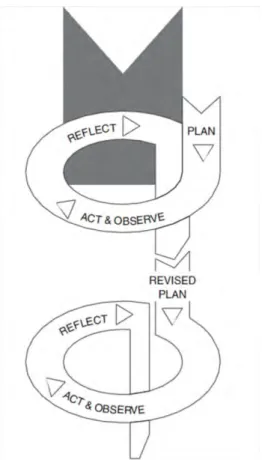
The action research cycle spiral is depicted as Figure 1, and it is used to present the findings of the study in Chapter 5. It starts with a plan which is a set of interventions designed to improve on what is already happening. These interventions are then acted upon and the effects are observed. Reflection then takes place and forms the basis for further planning. The spiral shape indicates that action research is intended to be a succession of cycles as opposed to a once-off event (Kemmis & Mc Taggert, 1988). There are slight variations on this process. Stringer (2013) advocates a Look, Think and Act approach. This involves building an idea of what is occurring in a particular context and gathering information (Look) and then interpreting and explaining (Think) and then resolving issues and problems that were observed (Act).
Figure 1: Action research Protocol after Kemmis and McTaggert (2000) 2.2.2 Why action research was considered appropriate for this study
Recently Kiener, Ahuna and Gray Tinnesz (2014) made use of action research to document the development of critical thinking in a capstone course in the field of human services. The study focussed on a capstone course that was implemented for the first time at a small private Midwestern university in the United States of America. The course was a required
undergraduate professional programme capstone course, while the class comprised of six students and therefore is materially different to the large class size of the capstone course at
22
UCT. An aspect of the study was that the process of action research enabled the researchers not only to study the development of the students but it also created a lens to review their entire curriculum. Kiener et al. (2014, p. 119) note that:
“Action research provides an excellent means to study curriculum in the context in which it is occurring. It also allows for immediate reflection and modifications to the teaching process to maximize learning. Systematically studying the capstone course provided information on student development but equally importantly it provided information on the entire program.”
The experience of Kiener et al. (2014) would suggest that action research is an approach that enhances both student development and reflection on the entire program. Given the cohesion that is required between the subject disciplines in order to meet the SAICA competency
framework, a tool that enhanced reflection on programme development was ideal.
Coetsee (2011, p. 97) writing in the South African Journal of Accounting Research made the point that “Many accounting academics are calling for a move away from mainstream
accounting research to other research frameworks to develop a greater pool of accounting knowledge.” Action research is a methodology that should be considered by accounting researchers in South Africa. It appears to be used widely in education (Davidowitz, Rollnick & Fakudze, 2003; Downhower, Melvin & Sizemore, 1990; Nihlen, 1992), among health
professionals (Kember, 2001; Mubuuke & Leibowitz, 2013) as well as among information systems researchers (McKay & Marshall, 2001) and there is no reason to think that it could not equally well be applied by accounting practitioners and researchers. McNiff, Lomax and
Whitehead (2003) have also pointed out that the scope of action research has expanded to include many different professions.
What is beneficial about action research is the emphasis that it places on the iterative process of planning, acting, observing and then reviewing before starting the cycle again. This means that evaluation is not regarded as an event but rather a process. The researcher is therefore always reflecting on what is happening and trying to improve on practice which was the aim of my research into this capstone course.
Action research also encourages the use of multiple perspectives. Jacobs, Brandt and Kruger (2006, p. 228) point out that a “A community of practice is the bedrock of powerful learning environments in which action and learning, improvisation and experimentation, tacit and explicit
23
knowledge feed on each other”. When trying to evaluate the effectiveness of a capstone course it is important to consider not only the views of the students in a particular course. Likewise it would be unwise to only listen to tutors or the academic staff involved. The collaborative
process encouraged by action research helps to expose multiple perspectives that can be used to improve the capstone course. This is especially important given that in this instance the researcher is also the primary lecturer on the capstone course and might be prone to leaving his thoughts unexamined if they were not communicated within a wider group.
It is a challenging undertaking to evaluate the effectiveness of a capstone course no matter which tools are used to accomplish the task. What is appealing about action research is that the process is well-documented and transparent. The action research process can be quickly understood and the documentation of each step allows others to read about the problems identified, see which interventions have been attempted and then read what has been said by participants.
That does not mean that everyone will have the same views but the transparent nature of action research allows for great scrutiny. If practitioners want to be regarded as competent at
evaluating their impact in the classroom, they need to be open to scrutiny. As McNiff and Whitehead (2006, p. 70) state “Practitioners have to make their evaluation processes visible, show that these are rigorous and robust, and produce strong evidence to show that they as practitioner-researchers are competent and capable.”
2.2.3 Criticism of action research
Gronhaug and Olson (1999, p. 13), in exploring the merits and challenges of action research, stated that “in order to legitimate action research, detailed recording of observations and events to allow for detailed re-examination of reported findings is needed”. This is a view supported by other researchers who are concerned that action research methodologies are at times
haphazard (McKay & Marshall, 2001).
The work of Hunter (2007) includes a summary of the main criticisms levelled at action
research. This included the work of Gustavsen (1993) who believes that action research often focusses on the action and its impact rather than upon the development of research practices and procedures that would be considered sound. Hunter (2007, p. 159) focusses on the crux of the issue when he states that critics often view “action research projects as merely an
24
application to solve educational problems – at best generating formative improvements and methodologies, rather than valid research knowledge obtained in a rigorous way.”
Orlikowski and Baroudi (1991) articulated three possible weaknesses that may be the major causes for why positivist researchers doubt that valid research knowledge can be obtained through action research. The first weakness is that action researchers cannot control the environment in which the research is conducted. There are often many interventions occurring at the same time and to isolate cause and effect is not possible. The second weakness relates to the generalisability of action research. Orlikowski and Baroudi believe that it is hard to develop models that have high external validity using action research. Finally there is the weakness of personal bias caused by action researchers becoming too attached as
participants. Action research therefore requires the researcher to be aware of their personal biases and Orlikowski and Baroudi believe that this is not an easy undertaking.
At the core of these criticisms is the truth that action research fails the critical tests of validity as prescribed by positivist science (Susman & Evered, 1978). Many studies that criticise action research do so because of an inherent assumption that the positivist theoretical framework is the most appropriate for educational research. That assumption has been challenged by those who contend that the positivist theoretical framework is not always appropriate and that a critical theory perspective, and the use of action research, can be a more appropriate means of
knowledge creation in the context of research into educational practices and issues (Carr & Kemmis, 2003).
2.2.4 A response to the criticism of action research
Susman and Evered (1978) specifically compared and contrasted what they term the “positivist science” and “action research” models and in so doing made the case that it is not appropriate to test the validity of the knowledge generated by action research according to the principles of positivist science.
Returning to the three possible weaknesses articulated by Orlikowski and Baroudi (1991), the first weakness related to the inability of action research to isolate cause and effect relationships is challenged by Susman and Evered (1978) on the basis that it is never truly possible to isolate events to the extent assumed by positivism. They further contend that all attempts to generalise research findings should be handled with care due to the complex nature of human
25
consistent practical impact is a weakness for both the positivist science and action research frameworks. As Susman and Evered (1978, p. 593) state; “any system as complex as a social system has a unique configuration of parameters which was not measured” and therefore the generalisability of any study is never as clear as positivists would suggest.
Finally there is the weakness of personal bias caused by action researchers becoming too attached as participants. Both action research and critical theory suggest that studies are enhanced when all stakeholders are included (Young, 1990). The belief that researcher detachment is the most appropriate means of knowledge creation makes the assumption that engagement with the context is illegitimate whereas others suggest this need not be the case (Cohen et al, 2007; Susman & Evered, 1978).
Action research does have its critics as well as its supporters with the fundamental difference between these parties often being in relation to the theoretical framework adopted. When a positivist framework is adopted, the criticism levelled by Orlikowski and Baroudi (1991) is consistent within that framework but this is not the case if the assumptions underpinning critical theory are accepted, as is the case with Susman and Evered (1978).
In this study, the theoretical framework adopted is critical theory, with action research as the methodology flowing out from it. This is consistent with the belief that participants can be researchers and vice versa and that knowledge can be created as practical problems are solved. Torbert (1972, p. 4) captures this process with the phrase "Inquiry in action can lead to learning from experience."
A major reason for the introduction of the BAG capstone was to develop the pervasive skills as required by SAICA, the accounting professional body. This review of the related literature will now focus on these pervasive skills and the body of research that has explored their
development.
2.3 Pervasive skills
There is considerable literature that covers pervasive skills. This literature expands when terms, like “soft skills” and “graduate attributes”, are included. Albrecht and Sack (2000) noted the rise in the importance of soft skills with respect to the accounting profession in particular. They concluded that the workplace was in the process of being radically changed by
technological developments as well as by globalisation and that the American accounting profession needed to emphasise soft skills to a greater extent. This has been a theme
26
investigated by many other researchers in places like Australia (Kavanagh & Drennan, 2008), New Zealand (De Villiers, 2010; Low, Liu & Samkin, 2013), and the United Kingdom (Gammie, Gammie & Cargill, 2002) as well as in South Africa (Barac & Du Plessis, 2014; Smit &
Steenkamp, 2015).
Smit and Steenkamp (2015) highlighted the changes made by SAICA to the competency framework in order to include pervasive skills. SAICA are not alone in placing an emphasis on the pervasive skills. The Canadian Institute of Chartered Accountants (CICA) pioneered the inclusion of pervasive skills as part of its competency framework (CICA, 2013, p. 21).
According to their guidelines:
“Pervasive qualities and skills enable a CA to function as a competent professional in an increasingly complex and demanding environment. The pervasive qualities and skills allow CAs to develop competence that can be transferred across different operating environments, different issues, and different roles.”
There are many possible causes for this emphasis on the need to develop pervasive skills in accountants. These include the increase in non-routine tasks as well as the difficulty of information overload due to greater technological connectivity (Perman, 2014). The SAICA (2009, p. 4) guidelines state explicitly that “we had to develop a training programme that took the following environmental factors into account: … The impact of information and
communication technologies on the work performed by CA(SA)s.” These guidelines stated explicitly that the development of training programmes should take environmental factors into account.
Perman (2014, p. 38) points out that “many in highly specialised vocations [like accountants]… are taught in great detail how to do the activities of their job itself, but they aren’t taught much about the process for managing their work, managing others, and leading others.” It is exactly this “process for managing their work” that has been explicitly stated in the SAICA competency framework (SAICA, 2010). It involves obtaining relevant information, exploring alternative courses of action and then making a decision and communicating that decision. These are the additional skills that universities need to address, along with the technical disciplines already included in the curriculum.
Interventions that would lead to the development of pervasive skills are therefore required for South African universities (Smit & Steenkamp, 2015). The International Federation of
27
Accountants (IFAC) commissioned an academic study that investigated various educational interventions that would help to develop pervasive skills, with a particular focus on assessment practices (Gammie & Lines, 2004). These interventions, along with others, were mapped to the SAICA pervasive skills by Strauss-Keevy (2012) which highlighted a variety of options available to South African academics. These options included case studies, interactive lectures, guest speakers and presentations by students (Strauss-Keevy, 2012) as well as the incorporation of technology and research to a greater extent (Ehoff, 2010). These interventions were all considered by the UCT College of Accounting and it was decided to bring these elements together in a capstone course for final year undergraduate students. The nature and
effectiveness of capstone courses has been extensively researched and this forms the final area of focus of this summary of the relevant literature.
2.4 Capstone courses
There are many definitions of a capstone course that have been proposed. Durel (1993, p. 223) states that “the capstone course typically is defined as a crowning course or experience coming at the end of a sequence of courses with the specific objective of integrating a body of relatively fragmented knowledge.” Holdsworth, Watty and Davies (2009, p. 2) also offer a definition:
“The term ‘capstone’ is widely used to describe a course or experience that provides opportunities for a student to apply the knowledge gained throughout their undergraduate degree. This involves integrating graduate capabilities and employability skills, and
occurs usually in the final year of an undergraduate degree.”
As pointed out by Bailey, van Acker and Fyffe (2012, p. 4),”in practice, our research found varied notions of what capstones are, and considerable variation in the extent to which these subjects reflect their intended purposes as defined in the literature.” The approach taken by these researchers was to focus on defining the features of a capstone course in terms of the opportunities that a capstone course provides for students. The first opportunity is to integrate the knowledge students have gained during the previous years of their studies and to see how all their subjects fit together. Secondly, there is an opportunity to consolidate key skills that they will require in their professional lives. These would be the pervasive skills like collaboration, communication and the ability to think critically. Bailey et al. (2012) suggested a third idea, that a capstone course should include an opportunity for a student to apply their knowledge to solving an authentic problem that simulates professional practice. Fourthly an opportunity to reflect and evaluate the experience should be incorporated, to encourage students to develop
28
as reflective practitioners. Finally the capstone course should allow for a student to develop their professional identity and grow in confidence.
When reviewing these defining features, a capstone course clearly has an important role to play in preparing students for their future. As a convenor of a capstone course it is therefore
important to regularly reflect on the extent to which the capstone course is giving students these opportunities and operating as intended.
Jervis and Hartley (2005) published one of the few studies focused on an accounting capstone course. The reason for introducing the capstone course was very similar to the reason behind this study in that it was in response to an American accounting body advocating the
development of lifelong learning skills. In their review of the literature they found no previous studies which had focussed on an accounting capstone course.
The major difference between the Jervis and Hartley course and the capstone course described in this study is the difference in class size. The BAG capstone course described in this study had an average of 497 students over the four year period studied whereas the enrolment in the Jervis and Hartley course had student numbers between 15 and 20 annually. The approach taken in the Jervis and Hartley study was seminar based where students are encouraged to participate; this is not easily replicable in the large lecture venues required by the BAG course. As Holdsworth et al. (2009, p. 9) point out:
“The conclusions that Jervis and Hartley (2005) arrive at do not presume that their model of capstone course development is a perfect solution, as each university has its own constraints and curriculum foci. It is however a reasoned starting point for new capstone development.”
Since the study by Jervis and Hartley was designed for a small cohort of students it was not used as a point of reference when the capstone course at UCT was developed and it can therefore be expected that some of their design considerations were not taken into account. The need to reflect on the capstone course is also made more acute when reflecting on the literature that describes the challenges of presenting a capstone course. A problem that is particularly relevant is that large class sizes limit opportunities for discussion as well as engagement with tasks and pervasive skills development (Jervis & Hartley, 2005). The large class size also poses a further challenge which is the considerable workload for academics
29
facilitating a capstone course. The additional tasks can include case study and research question development, both of which are included in the BAG capstone course. Jervis and Hartley also point out that the marking load is considerable with several or frequent oral
presentations and project assignments in addition to the usual assessments. This was also the case with the BAG capstone course.
Subsequent to the Jervis and Hartley study, Johnson and Halabi (2011) conducted a study of capstone courses at 24 academic institutions in the United States of America. Four of these capstone courses were related to accounting and all of them highlighted the involvement of the accounting profession and how this helped the academics to present their course.
Along with including the profession to a greater extent, there are a number of educational practices that seek to develop pervasive skills. A capstone course, which incorporates many of these educational practices, could thus be an effective intervention. There are, however, not many examples relating to the development of an accounting capstone course for a large class (Burns, 2006; Marsden & Stanley, 2013). This study therefore has the potential to add
significantly to the literature by focussing on the implementation of an accounting capstone course for a large class.
The key question arises however; did the introduction of a capstone course result in the development of pervasive skills? If it is the case that pervasive skills were developed, which particular interventions in the capstone course helped student learning the most?
These are questions that this study is looking to answer. In order to do so, critical theory provides the theoretical framework and action research will be the research methodology adopted.
30
CHAPTER 3 – RESEARCH QUESTIONS
3 Introduction
This chapter explored the research problem which resulted in the development of the capstone course, as well as the research questions which sought to better understand the impact of the capstone course on student learning.
3.1 Research Problem
Implementing a capstone course at the final year level in any degree is a high stakes
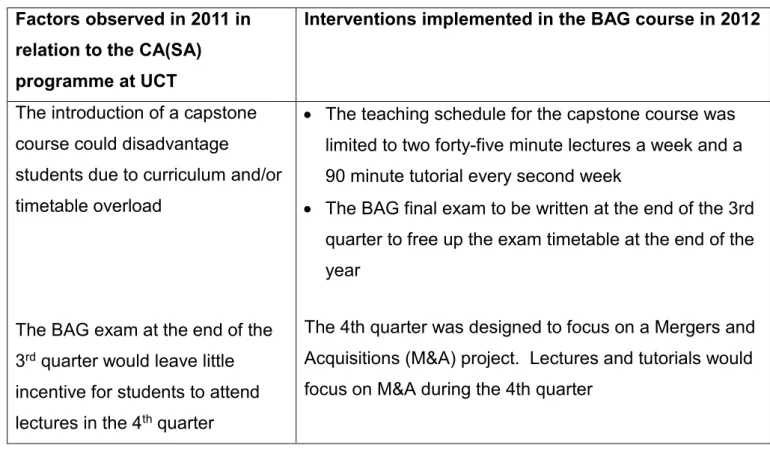
intervention. In this particular context, it took place due to the need to address concerns that were identified in 2011 by the UCT College of Accounting at UCT. These observations, as well as the planned interventions for 2012, are outlined in Table 1 below:
Factors observed in 2011 in relation to the CA(SA) programme at UCT
Interventions implemented in the BAG course in 2012
There was a lack of development of pervasive skills especially in preparation for the new APC
There was a need to cover more finance topics for B.Com students
Subject disciplines were often taught and understood by
students to be in situated in silos
The BAG capstone course was introduced to
specifically develop pervasive skills whilst all courses encouraged to place emphasis on pervasive skills Company analysis to be included in every
assessment, with students given the company to be discussed 24 hours beforehand in order for them to work in teams and to carry out research
Research area question to comprise of 25% of every test to develop research skills
Topics like Valuations, Dividends and Capital structure (among others) were included in the BAG syllabus
BAG lecturers and tutors were drawn from all four of the major disciplines namely Financial Reporting, Taxation, Corporate Governance and Management Accounting and Financial Management
Assessments were designed to require integrated thinking
31
Factors observed in 2011 in relation to the CA(SA) programme at UCT
Interventions implemented in the BAG course in 2012
The introduction of a capstone course could disadvantage
students due to curriculum and/or timetable overload
The BAG exam at the end of the 3rd quarter would leave little
incentive for students to attend lectures in the 4th quarter
The teaching schedule for the capstone course was limited to two forty-five minute lectures a week and a 90 minute tutorial every second week
The BAG final exam to be written at the end of the 3rd quarter to free up the exam timetable at the end of the year
The 4th quarter was designed to focus on a Mergers and Acquisitions (M&A) project. Lectures and tutorials would focus on M&A during the 4th quarter
Table 1: A summary of the observations made in 2011, and subsequent interventions actioned in 2012, which resulted in the development of the BAG capstone course
In a personal communication with Prof Mark Graham, the Head of the UCT College of Accounting, in which he reflected on the development of the capstone course, Prof Graham said, “We know we will need to change 40% next year, we just don’t know which 40% it will be” (personal communication, 3 December 2011). This quotation sums up the research problem succinctly since there were bound to be areas for development after the first cycle of
implementation of the new BAG course but identifying these in advance was not going to be easy.
It was not only the academic staff who knew that the course would need to be evaluated. During the first lecture of 2012 the course was introduced and described in detail and students were made aware that their comments would be welcomed to improve the course for the current and future years. It was therefore anticipated that the students would be prepared to negotiate strongly with the BAG capstone course convenor in comparison to the other course convenors in their final year and this proved to be the case. A high level of student participation could be seen in light of the high stakes nature of final year studies as well as the knowledge that the BAG capstone course was new and had not been established.
32
3.2 Research Questions
The need to develop pervasive skills was identified as a priority by the UCT College of
Accounting and the BAG capstone course was developed in response to meet this need. This high stakes intervention required a considerable investment of resources by both academic staff and students. Its overall effectiveness could be roughly estimated or a systematic study could be undertaken in order to assess the impact of BAG.
This study sought to replace guesswork with a systematic approach to assessing the impact of BAG. In particular it focuses on understanding the extent to which the capstone course has met its primary goal of developing pervasive skills. The first research question therefore was:
Did the introduction of the capstone course lead to the development of students’ pervasive skills?
It was also of interest to the team the extent to which various interventions had played a role in student learning. The second research question therefore was:
Which particular interventions in the BAG course were beneficial for student learning?
The interventions for 2012 were planned and actioned with the goal of helping to develop the pervasive skills of the students. This was the first action research cycle undertaken by the author. Throughout the year data was gathered after which an exercise in reflection would take place. Based on this reflection exercise, which would include students, tutors and academic staff, a new set of interventions would be planned and actioned in the following year in order to improve the capstone course and with the goal of developing pervasive skills to a greater extent. This cycle would be repeated annually and the systematic on-going collection of data from a variety of stakeholders would help to create knowledge for others interested in the development of pervasive skills, capstone courses and action research. As Hunter (2007, p.162) noted “When is action research successful? Precisely when all the stakeholders say it is.” The research methodology used for the study, which will include a variety of the
33
CHAPTER 4 – RESEARCH METHODOLOGY
4 Introduction
The research questions were presented in chapter 3; the research design is explained in greater detail in this chapter. The sources and nature of data collected are described. The limitations of the study are also presented.
4.1 Research Design
The action research process, as discussed in the literature review, was adopted. The research method therefore consisted of collecting data from stakeholders who were asked to reflect on the capstone course and to offer suggestions for improvement. The new interventions decided upon were then implemented and observed in the following year. This action research cycle was repeated three times, namely in 2012, 2013 and 2014.
4.2 Research Method
4.2.1. Selection of students, tutors and academic staff and methods of data collection All the students registered for the capstone course in 2012, 2013, 2014 and 2015 were invited to participate in the study. The students were asked to complete an online questionnaire (see Appendix 1). The participation rates are shown in Table 2 below.
2012 2013 2014 2015
Total number of students 522 466 489 510
Completed questionnaire 465 412 443 430
Permission to use responses for this study granted 431 375 412 395
Study participation rate 83% 80% 84% 77%
Table 2: Student participation in online questionnaire
Students who granted permission for their response to be included in this study were then each assigned a unique number. This allocation resulted in numbers 1-431 (2012), 432-806 (2013), 807-1218 (2014) and 1219-1613 (2015).
Question 1 in the questionnaire asked for ethical clearance from the students requesting permission to use their responses in the research paper and as can be seen in Table 2, the majority of students agreed to participate in the study.
34
The tutors of the course for each year were also invited to reflect on the course once the academic year had been concluded. Their participation took the form of a focus group discussion and all the tutors who participated agreed to have their responses included in this study (see Appendix 2 for the consent form which they signed).
Academic staff members who had either played a role in teaching and/or designing the course were then invited to participate in a further focus group discussion. The inclusion of academic staff is regarded as particularly important given that unintended consequences of the
introduction of the capstone course might have had an impact on the other final year subjects. All the academics who participated agreed to have their responses included in this study (see Appendix 3 for the consent form which they signed).
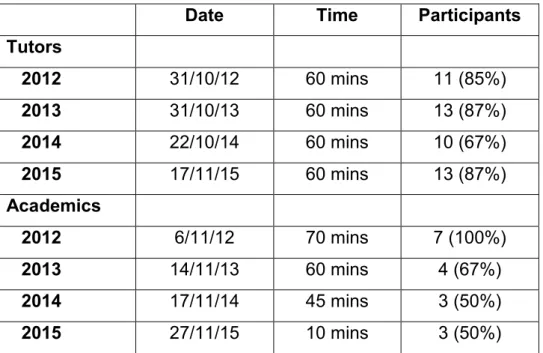
The following focus groups were conducted over the course of the project and the author can be contacted in order to obtain complete audio recordings:
Date Time Participants
Tutors 2012 31/10/12 60 mins 11 (85%) 2013 31/10/13 60 mins 13 (87%) 2014 22/10/14 60 mins 10 (67%) 2015 17/11/15 60 mins 13 (87%) Academics 2012 6/11/12 70 mins 7 (100%) 2013 14/11/13 60 mins 4 (67%) 2014 17/11/14 45 mins 3 (50%) 2015 27/11/15 10 mins 3 (50%)
Table 3: Tutor and academic participation in focus groups
All tutors and academics who participated in the focus groups granted permission for their response to be included in this study and were then each assigned a unique number. This allocation resulted in the unique tutor numbers being allocated as follows: numbers 1-11 (2012), 12-24 (2013), 25-34 (2014) and 35-47 (2015). The allocation for academics was done on a different basis because unlike the students and tutors, many of the academics were involved in multiple years. The total number of academics involved over the four years was eight and each academic was given a number that would remain the same for the entire project. The focus
35
group interviews with tutors and academics were conducted after the completion of the student questionnaires. The views of the students therefore were considered by these groups, along with their own thoughts for each year.
There were specific questions included in the student questionnaire which were designed to obtain evidence for the first research question related to the development of pervasive skills. Additionally students were asked about the benefit of particular interventions. Finally students were explicitly asked to reflect on their experience of the capstone course and to provide ideas to improve the course. Students were therefore vital stakeholders in every action research cycle. The particular questions included in the student questionnaire to gather evidence to answer the research questions will now be discussed. The full set of questions can be found in Appendix 1.
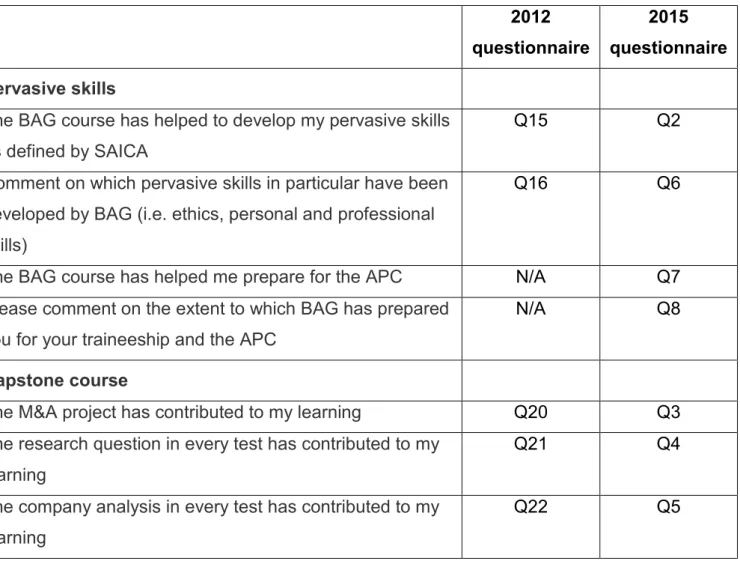
Questions related to the development of students pervasive skills
Question 15: The course has helped to develop my pervasive skills as defined by SAICA Question 16. Comment on which pervasive skills in particular have been developed by
BAG (i.e. ethics, personal and professional skills)
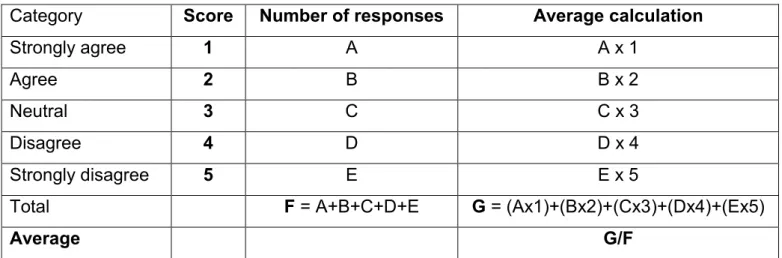
Question 15 was specifically designed to gather student perception on the level to which the capstone course had developed their pervasive skills. This was a multiple choice question so that the results could be quantified.
Question 16 was designed to gather qualitative data from students by giving them an opportunity to comment on the pervasive skills that were developed.
Questions related to the interventions that were beneficial to student learning
Question 20: The M&A project has contributed to my learning
Question 21 The research area question in every test contributed to my learning Question 22 The company analysis in every test has contributed to my learning
Questions 20-22 probed students’ perceptions of specific innovations in the capstone course which would have been new to them. The innovations were also the subject of many of the interventions in the subsequent years and students’ responses therefore give insight into