R E S E A R C H
State and Local Pension Plans
Number 16, April 2011
A ROLE FOR DEFINED CONTRIBUTION
PLANS IN THE PUBLIC SECTOR
By Alicia H. Munnell, Jean-Pierre Aubry, Josh Hurwitz, and Laura Quinby*
* Alicia H. Munnell is director of the Center for Retirement Research at Boston College (CRR) and the Peter F. Drucker Professor of Management Sciences at Boston College’s Carroll School of Management. Jean-Pierre Aubry, Josh Hurwitz, and Laura Quinby are research associates at the CRR. The authors would like to thank Beth Almeida, David Blitzstein, Ian Lanoff, David Powell, and Nathan Scovronick for helpful comments. The authors would also like to thank the members of the Special Commission to Study the Massachusetts Contributory Retire-ment Systems, especially Peter Diamond, for inspiring the idea of a “stacked” hybrid pension plan.
Introduction
In the wake of the financial crisis, policymakers have been talking about shifting from defined benefit plans to defined contribution plans in the public sector. Three states – Georgia, Michigan, and Utah – have taken action, joining the 10 states that had introduced some form of defined contribution plans before 2008. Interestingly, these new plans are “hybrids” that com-bine elements of both defined benefit plans and de-fined contribution plans. Such an approach spreads the risks associated with the provision of retirement income between the employer and the employee. This brief provides an update on defined contribution initiatives in the public sector and then discusses whether the hybrids that have been introduced are the best way to combine the two plan types.
The brief proceeds as follows. The first section discusses the issues involved with moving from a defined benefit plan to a defined contribution arrangement. The second section recaps the role that defined contribution plans played in the public sector before the financial crisis. The third section describes the new hybrid plans recently adopted in Georgia, Michigan, and Utah. And the fourth section sug-gests that a better type of hybrid might be one where defined contribution plans are “stacked” on the state’s defined benefit plan rather than placed alongside of it. The fifth section concludes that defined contribution plans have a role in the public sector, but that role is supplementing, not replacing, defined benefit plans.
Defined Benefit vs. Defined
Contribution
A defined benefit plan provides employees with lifetime retirement income based on a formula that accounts for service and final average salary. Most
LEARN MORE
Search for other publications on this topic at:
defined benefit plans in the public sector adjust ben-efits, at least partially, for inflation after retirement. Both employees and employers generally contribute to public sector plans. Defined benefit plan assets are held in trust and managed by professional investors.
In contrast, defined contribution plans are like savings accounts. The employee and employer both contribute money to the account, and the employee selects the investments from a list of options provided by the plan. The benefit at retirement depends on the value in the account and how employees elect to take receipt of the money – lump sum, periodic payments, or an annuity.
Evaluating whether to shift from a defined benefit to a defined contribution plan involves consideration of risks, costs, and human resource goals.
Risks
The defining characteristic of defined contribution plans is that they shift all the responsibilities and all the risk from the employer to the employee. In terms of responsibilities, the employee must decide whether to join the plan, how much to contribute, how to allocate those contributions among different invest-ment options, how to change those allocations over time, and how to withdraw the accumulated funds at retirement. Under a defined benefit plan, the sponsor retains these responsibilities. The plan requires par-ticipation, sets contribution rates, invests the assets, and pays an annuity at retirement.
Leaving the responsibilities in the hands of em-ployees means that they are exposed to the risks of saving too little, losing funds when financial markets fluctuate, seeing the value of their retirement income eroded by inflation, and outliving their resources since payment is generally not in the form of an annuity.
In a defined benefit plan, the sponsor bears the investment risk during the accumulation phase and then absorbs longevity risk and much of inflation risk after retirement. This arrangement means that if financial markets collapse, the sponsor – in the public sector, taxpayers – must come up with additional funds to cover promised benefits.1 Public plan
spon-sors also face the “moral hazard” that benefit prom-ises will not be funded. Participants, who believe that they will be paid regardless of funding, may not push for government contributions. And politicians are all too happy to address short-term priorities rather than put money aside for long-term funding needs. Simi-larly, legislatures sometimes make unfunded benefit
improvements in good times that further aggravate the funding shortfall. As a result, future taxpayers and employees will be required to contribute not only to cover the accruing cost of benefits for current work-ers but also to cover benefits for retirees for whom insufficient funds have been put aside. A defined contribution plan avoids this type of “moral hazard,” as the plans are fully funded by design.
Costs
For any given level of benefits, defined contribu-tion plans, which maintain individual accounts and typically update these accounts daily, have higher administrative expenses than defined benefit plans. In addition, most defined contribution plans use mutual funds or similar instruments as investment options – with an average expense ratio payable to the fund manager of about 0.60 percent for bond funds and about 0.67 percent for stock funds.2 In contrast,
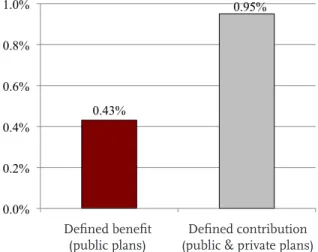
defined benefit plans involve professionally-managed large investment pools with no individual account reporting. As a result, the annual cost of a defined contribution plan generally exceeds that of a defined benefit plan (see Figure 1).
Figure 1. Administrative and Investment
Expenses as a Percent of Assets, by Plan Type, 2009
0.43% 0.95% 0.0% 0.2% 0.4% 0.6% 0.8% 1.0%
Defined Benefit (public
plans) (public and private plans) Defined Contribution
Defined benefit (public plans)
Defined contribution (public & private plans)
Sources: U.S. Census Bureau (2008); and HR Investment Consultants (2009).
Human Resource Issues
Defined benefit plans are designed to attract and retain qualified employees. As such, these plans become more valuable the closer the employee gets to the full retirement age, because accrual rates often increase with age, and the salary base is usually an average of the last three to five years of earnings. Vested employees who leave early forfeit significant retirement income because their accumulated credits are applied to their salary at termination rather than their salary at retirement.3
With a few exceptions, defined contribution plans were not initially created as retirement vehicles but rather as supplementary savings accounts.4 Since the
value of these plans increases more evenly over an employee’s worklife, they provide no incentive to stay on the job. Similarly, they do not penalize employees who leave early. Mobile employees can take the funds in their account with them when they leave employ-ment and roll them over into a new defined contribu-tion plan or individual account.
Other Arguments and Counterarguments
Risk, cost, and human resource considerations are the real issues relevant to deciding whether to shift from a defined benefit to a defined contribution plan. But other assertions also arise in the debate. Some supporters highlight the magnitude of the unfunded liabilities in public sector defined benefit plans as justification for switching to a defined contribution plan. The reality is that even with a new defined con-tribution plan, states and localities are still left to deal with past underfunding. A new plan only addresses pension costs going forward; it does not help close the current gap between pension assets and liabilities.5
Similarly, some contend that switching to a defined contribution plan would save money in the future.6 But, as noted above, for any given level of
benefits, defined contribution plans cost more. Advocates may think that even if total costs increased, taxpayers could gain by shifting contribu-tions from the government to the employee. Trans-ferring the burden to the employee provided a major economic incentive in the private sector to move from defined benefit plans (where employees make no contributions) to 401(k) plans (where employees make the bulk of the contributions). But, in the pub-lic sector, many employees already make substantial contributions to their defined benefit pensions. In states where employees are covered by Social Security,
the median contribution rate is 5 percent of earn-ings. In states without Social Security, the median employee contribution rate is 9 percent (see Figure 2). Therefore, state and local governments might meet significant resistance from public employees if they attempted to shift more of the cost to participants. Of course, moving to a defined contribution plan could be used as a mechanism to cut retirement benefits and thereby lower total employee compensation. Figure 2. State and Local Employer and Employee Median Contribution Rates, 2009
9.6% 12.2% 5.3% 8.9% 0% 2% 4% 6% 8% 10% 12% 14%
With Social Security Without Social Security Employer Employee
With Social Security Without Social Security Employer Employee
Source: Public Plans Database (2009).
The main issue appears to be one of risk. From the perspective of sponsoring governments, shifting to a defined contribution plan would eliminate invest-ment, inflation, and longevity risk from these entities and, thereby, taxpayers. These plans would be funded by definition and, when things go wrong in financial markets, the taxpayer would not be responsible for covering the shortfall. The other side of alleviating risks for taxpayers is that public employees must face the risk of saving too little, the risk of poor investment returns, the risk that inflation will erode the value of their income, and the risk that they might outlive their assets.7
Pre-2008 Defined Contribution
Activity
The fact that defined contribution plans put employ-ees at such risk may help explain why before the financial crisis only a smattering of states had introduced these plans on a mandatory basis.8
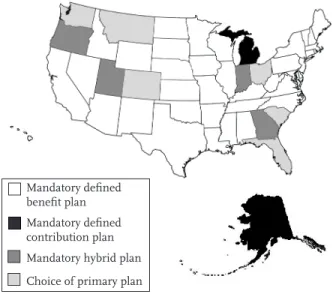
Im-portantly, only two states – Michigan and Alaska – required all new hires to participate solely in a defined contribution plan (see Figure 3).9 The mandate
applied only to new hires, because most states are constrained by their constitution or case law from reducing benefits for current employees. Two states – Oregon and Indiana – adopted “hybrid” plans, where employees are required to participate in both a defined benefit and a defined contribution plan. Another six states retained their defined benefit plan and simply offered the defined contribution plan as an option to their employees.10
Figure 3. Defined Contribution Plans, by State, 2011
Mandatory defined benefit plan Mandatory defined contribution plan Mandatory hybrid plan Choice of primary plan
Note: For specific definitions of the classifications used in this figure, see footnote 11.
Sources: Various retirement systems’ annual reports and websites of state legislatures.
The time line of the introduction of these defined contribution plans is interesting (see Figure 4). Some of the changes may have been a response to econom-ics or politeconom-ics, but much of the activity occurred in the wake of the fantastic performance of the stock market during the 1990s.12
Since the plans are relatively new, the compulsory plans apply only to new hires, and the others are optional, the number of participants and amount of assets in defined contribution plans are modest (see
Figure 4. Introduction of State Defined Contribution Plans, by Year
0 1 2 3
1990 1992 1994 1996 1998 2000 2002 2004 2006 2008 2010
Mandatory defined contribution plan Mandatory hybrid plan
Choice of primary plan
OH MT, WA MIINWA FL, SC ORCOAK GA UT, MI N umber of states
Note: For specific definitions of the classifications used in this figure, see footnote 11.
Sources: Various retirement systems’ annual reports and websites of state legislatures.
Appendix).13 To date, participants account for less
than 5 percent of all state and local workers, and as-sets amount to less than 1 percent of total state and local pension assets.14 (“Fact Sheets” on each of the
mandatory defined contribution plans discussed in this brief are available on our website.)
Post-Crisis Developments
In the wake of the financial crisis, three states (Michi-gan, Georgia, and Utah) have introduced mandatory “hybrid” plans for new employees. Interestingly, none of the three has followed the Alaska-Michigan (SERS) model of relying solely on a defined contribu-tion plan. Rather, each has adopted a plan where new employees accumulate retirement income under both a defined benefit and a defined contribution plan. An additional nine states are discussing defined contribu-tion opcontribu-tions.15
Georgia
General state employees covered under Georgia’s Em-ployee Retirement System (ERS) hired after January 1, 2009 are covered under the new hybrid plan; existing ERS members had the option to join the new plan.
New hires are automatically enrolled in the 401(k) plan (unless they affirmatively elect not to participate) and contribute 1 percent of salary with additional contributions up to 5 percent eligible for an employer match.16 The match is 100 percent of the automatic
contribution and 50 percent of optional contributions, for a maximum match of 3 percent of salary. Employ-ees can contribute up to the Internal Revenue Service (IRS) limit, but will receive no further employer match.
The defined benefit plan will pay 1 percent for each year of service on the annual average of the high-est 24 months of earnings.17 Members contribute
1.25 percent of salary to the defined benefit plan, and the state contributes an actuarially-determined rate, which was 6.54 percent of
payroll in 2009.
System communiqués indicate that the change was driven primarily by the preference of young
workers, who constitute 62 percent of the state’s workforce, for wages over benefits. In response, the State raised wages and introduced the smaller hybrid plan, with a 401(k) component so that young mobile workers would have something to take with them when they left state employment.
Michigan
As discussed above, since 1997 all new Michigan gen-eral state employees have been enrolled in a 401(k) plan. But when the time came to revamp the system for public school employees, the State decided to adopt a hybrid. Employees hired after July 1, 2010 au-tomatically contribute 2 percent of salary to the 401(k) (unless they affirmatively elect not to participate), with optional contributions up to the IRS limit. The sponsor matches 50 percent of the employee’s first 2 percent of contributions.18
The defined benefit plan for new hires will pay 1.5 percent for each year of service on the annual average of the highest 60 months of earnings. Employees will contribute 6.4 percent of salary to the plan. Whereas the accrual rate is the same as it was under the two existing defined benefit plans for school employees, the age and service requirements for this plan have been increased and the cost-of-living adjustment eliminated.
Press reports suggest that future employer costs (including required contributions for retiree health insurance) were a major motivation for the new
plan.19 Essentially, the new plan reduces the benefits
compared to the existing defined benefit plan, and the defined contribution plan involves an extremely mod-est contribution from the employer.
Utah
State and local government employees hired after July 1, 2011 will have the option to participate in either a defined contribution plan or in a hybrid. In the case of the defined contribution plan, the employer will automatically contribute 10 percent for most public employees and 12 percent for public safety and fire-fighter members.20 Employees can contribute up to
the IRS limit. Employee contributions vest imme-diately, and employer contributions vest after four years. Members can direct the invest-ment of their
contribu-tions immediately, and those of the employer after four years.
Under the hybrid plan, the employer will pay up to 10 percent of an employee’s compensation toward the defined benefit component; employees will contribute any additional amount to make the required contribu-tion. The defined benefit plan for new employees is less generous than the former plan: the accrual rate is reduced from 2.0 percent per year to 1.5 percent; the period for calculating final average salary was increased from high three years to high five; and the employee contribution increased from zero to the cost above 10 percent. For the defined contribution com-ponent of the hybrid plan, employers will contribute 10 percentage points minus the amount contributed to the defined benefit plan. For example, if they contribute 10 percent to the defined benefit plan, they will contribute nothing to the defined contribution plan.
Table 1 on the next page summarizes the provi-sions of the new hybrid plans. The pattern is quite similar in several respects. First, the combined cost of the new plan is significantly less than the pre-existing defined benefit plan. Second, the commit-ment to the defined contribution plan is minimal. Experience with 401(k)s in the private sector suggests that participants tend to stay where they are put.21
So if automatic contributions are set at 1 percent or 2 percent of earnings, participants are likely to keep their contributions at that level. Low saving in the de-fined contribution component means that employees will be forced to rely primarily on the now-reduced defined benefit plan in retirement.
Today’s hybrid plan model
could be redesigned to work better.
Table 1. Provisions of New Hybrid Plans
Provision
Defined benefit plan
Accrual rate 1.0% 1.5% 1.5% COLA Ad-hoc None CPI up to 2.5% Contributions
Employer 6.54% (2009) TBD 10% cap Employee 1.25% 6.4% DB cost > 10%
Defined contribution plan
Automatic contribution
1% 2% 10% – DB cost Employer
match 100% on first 1%, 50% on next 4% 50% on first 2% None Georgia Michigan Utah
Note: Michigan Public Schools’ 2010 Actuarial Valuation Report has not yet been released.
Sources: Various retirement systems’ annual reports, legislation,
and websites of state legislatures.
A Better Mousetrap?
The emergence of hybrid plans reflects an attempt to balance employee and taxpayer risk. But, to date, states are achieving this goal by reducing the govern-ment’s contribution across the board rather than considering how best to use each plan type.
Defined benefit plans provide the most secure income for long-service employees. While some pub-lic sector employees leave in the first 10 years, many tend to remain for a full career.22 Therefore, defined
benefit plans are an effective mechanism for public sector employers to attract and retain employees. De-fined benefit plans, however, put the taxpayer at risk if financial markets drop, inflation takes off, or retirees live longer than expected.
A fair question is how much risk should taxpay-ers bear? Utah answered that question by capping employer contributions at 10 percent of payroll. Such a cap, however, places lower paid and higher paid participants at equal risk of having to increase contri-butions. A better approach to limiting taxpayer risk is to cap the income covered by the defined benefit plan. Such a cap would prevent the situation where the typi-cal taxpayer, earning $50,000, is forced to pay higher taxes when the stock market plummets to cover benefits for highly-paid public employees, such as university presidents. Therefore, the proposal would be to limit coverage under the defined benefit plan to earnings below, say, $50,000 (indexed for inflation).23
Many public sector workers would still be covered in full under the defined benefit plan.
Earnings above $50,000 would be covered by a defined contribution plan. Thus, someone earning $100,000 would receive benefits based on the first $50,000 from the defined benefit plan and benefits on the second $50,000 from the defined contribu-tion plan. That is, instead of “parallel” plans where employees contribute to both a 401(k) and a de-fined benefit plan from the first dollar of earnings, “stacked” plans would maintain the defined benefit plan as a base and provide defined contribution cover-age for earnings above some cutoff (see Figure 5). The stacked approach is a suggestion for a “better plan design” and could be wed with any desired size of the plan.
Figure 5. “Stacked” Hybrid Plan versus “Parallel” Hybrid Plan “Stacked” hybrid plan “Parallel” hybrid plan DB DB DC DC Earnings of typical taxpayer
Source: Authors’ illustration.
The advantage of the “stacked” approach is that it allows employees with modest earnings to receive the full protection of a defined benefit plan. This group would be the most vulnerable if required to rely on a 401(k) for a portion of their core retirement benefit. Indeed, the private sector experience with 401(k)s illustrates the concern. The typical private sector taxpayer approaching retirement (ages 55-64) had accumulated only $78,000 in 401(k) assets before the financial crisis.24 So maintaining a full defined benefit plan for public employees such as elementary school teachers would be preferable. More highly-paid public employees would still have the protection of a defined benefit plan as a base and would then rely on the 401(k) for earnings replacement that exceeded
the earnings of a typical private sector worker.25 This overall arrangement offers a reasonable balance by providing adequate and secure benefits targeted to public employees who need them most while limit-ing the risk to taxpayers of coverlimit-ing large pension shortfalls.
One question is whether such a stacked approach would violate IRS non-discrimination rules. The legal answer is that tax-qualified governmental plans are generally not subject to non-discrimination provi-sions.26 On a substantive level, the government contribution for the defined contribution plan could be less than for the defined benefit plan, so that the two plans taken as a whole do not favor higher-paid workers.
Conclusion
Defined contribution plans may well have a role in the public sector, but in combination with, not as an alternative to, defined benefit plans. The hybrids in-troduced in Georgia, Michigan, and Utah reflect spon-sors’ recognition of the need to balance the risks to employees and the risks to taxpayers. These hybrids consist of slimmed-down defined benefit plans and defined contribution plans operating in “parallel.” A preferable approach may be a “stacked” arrangement. Meaningful defined benefit plans could remain as a secure base for the typical public employee, and de-fined contribution plans could be “stacked” on top to provide additional retirement income for those at the higher end of the pay scale. Such an approach would ensure a more equitable sharing of risks and would also prevent headlines generated by the occasional inflated public pension benefit.
Endnotes
1 Although, in theory, taxpayers bear the risk, in the wake of the recent financial collapse employers and employees have shared the burden. From 2008 to 2011, 20 states increased pension contributions for either new or existing employees, while five states reduced benefits for current employees and an ad-ditional three eliminated or reduced the cost-of-living adjustment for current retirees. In several instances – Colorado, Minnesota, and South Dakota are widely-publicized examples – the state’s actions have been taken to court. See National Conference of State Legislatures (2008-2011) for more details.
2 The estimates of investment management expenses are from Lipper (2008).
3 Under many state plans, vesting does not occur for 10 years, and employees who leave receive only their contributions and some minimal amount of credited interest.
4 TIAA-CREF is a notable exception.
5 In many cases, closing an existing defined benefit plan to new hires and switching to a defined contri-bution plan increases short-term costs. The Govern-mental Accounting Standards Board (GASB) State-ment Number 25 states that closed plans using the level percent of payroll method for calculating the an-nual required contribution (ARC) must acknowledge that covered payroll is decreasing. This recognition frontloads costs. As a result, most closed plans use the level dollar method of amortizing the unfunded liability. However, the ARC under the closed plan is still frontloaded relative to the ARC under the ongo-ing plan. Moreover, market gains from future new hire contributions that would have been used to offset the unfunded liability are now sequestered in the new defined contribution plan. See California Public Employees’ Retirement System (2005); Michigan House Fiscal Agency (2009); Retirement Systems of Minnesota (2011); and The Segal Company (2010) for more information.
6 For a more detailed discussion of the cost efficien-cies of defined benefit pension plans, see Almeida and Fornia (2008).
7 The defined contribution aspects described – indi-vidual investment direction, high expense compared to defined benefit plans, flexibility over payout, and lack of annuitization – reflect how most defined contribution plans are currently designed. A defined contribution plan could be designed to address many of the current downsides. For example, MyFRS in Florida is a low-fee defined contribution fund, while the Texas Municipal Retirement System is a cash bal-ance plan that annuitizes the balbal-ances of individual member accounts.
8 Public sector workers often have optional 403(b) and/or 457 defined contribution plans that allow them to put aside a portion of their pay on a tax-deferred basis to augment their public pension. These supplementary plans are not the topic of this brief. Rather, the focus is on states where the nature of the primary plan has changed. For a discussion of early defined contribution activity, see Munnell et al. (2008).
9 In Nebraska, the primary Public Employee Retire-ment System was a defined contribution plan from 1967 to 2002. It was closed to new employees and replaced with a cash balance plan on January 1, 2003 over concerns that the defined contribution plan was producing lower returns than the defined benefit plans (see Nebraska Public Employees’ Retirement Systems, 2002, for more details). A cash balance plan is a defined benefit plan that maintains notional indi-vidual accounts throughout the asset accrual phase. Similarly, the West Virginia Teachers plan, which became a primary defined contribution plan in 1991, switched back to a primary defined benefit plan in 2005. The Texas Municipal Retirement System main-tains a cash balance plan. The District of Columbia requires its general government employees to join a primary defined contribution plan, but our analysis is limited to states.
10 These states were Colorado, Florida, Montana, Ohio, South Carolina, and Washington. Except in Washington and Ohio, the options are either a tradi-tional defined benefit plan or a defined contribution plan. Washington offers a choice of a defined benefit plan or a hybrid plan. Ohio employees can choose from a defined benefit plan, a defined contribution
plan, or a hybrid plan. In all cases, the defined ben-efit plan is the default for those who do not actively make a selection.
11 Mandatory defined benefit plans are primary plans that require employees to join. Mandatory defined contribution plans are primary plans that require employees to join. Mandatory hybrid plans require employees to join a plan with both a defined benefit and a defined contribution component. “Choice” plans typically allow employees to pick either a pri-mary defined contribution plan or a pripri-mary defined benefit plan.
12 For example, from January 1, 1995 to December 31, 1999, the S&P 500 had an average annual return of nearly 30 percent. For a discussion of early defined contribution activity, see Munnell et al. (2008). This study looked at the effect of economic and political factors on the probability of introducing a defined contribution plan for public employees. It found that Republican leadership – with its emphasis on indi-vidual control over investments and plan portability – was the leading predictor of plan changes.
13 In the private sector, when a new plan is adopted, the existing defined benefit plan is generally frozen. Existing employees can retain the benefits earned but are not permitted to accrue any further service credits. In the public sector, when a new plan is adopted, existing employees generally have a legal right to continue to participate in the previous plan and only employees hired after the date the plan is adopted are required to participate in the new plan.
14 Authors’ calculations from the U.S. Census Bu-reau (2008) and Public Plans Database (2009). 15 The issue is under discussion in Alabama, Connecticut, Nevada, North Carolina, Tennessee, and Wisconsin. Legislation to introduce a defined contribution plan for new hires recently passed the Kentucky Senate, but has not yet been acted on by the House of Representatives. Similar proposals are currently under consideration in Illinois and Okla-homa, while a defined contribution bill was defeated in North Dakota. See Frazier (2010); Fehr (2010); Na-tional Conference of State Legislatures (2011); Steyer (2010); and Preston and McNichol (2010).
16 In the public sector, the only 401(k)s are grandfa-thered plans that were established 5/6/86 or before, so Georgia had originally established a 401(k) plan before 1986 as an optional supplement to its primary defined benefit plan. See PlanMember Financial Corporation (2010).
17 The Board of Trustees can increase the benefit fac-tor in the future up to 2 percent if funds are available. 18 Michigan House Fiscal Agency (2010).
19 Governor of Michigan (2010) and Michigan Association of School Boards (2010).
20 Liljenquist (2010).
21 Madrian and Shea (2001); Choi et al. (2004); and Gale, Iwry, and Orszag (2005).
22 Authors’ estimates from the Actuarial Valuations of the 14 largest plans.
23 The Internal Revenue Code contains a maximum compensation limit for defined contribution plans. This limit is $245,000 in 2011. It is indexed for infla-tion and increased in $5,000 increments. A similar procedure could be used for stacked plans.
24 This figure, which comes from the Federal Re-serve’s 2007 Survey of Consumer Finances, also in-cludes IRA assets as they typically come from 401(k) rollovers during a job switch.
25 A well-designed defined contribution plan would set the combined employee-employer contribution at a level to achieve, in combination with a defined benefit plan, a targeted replacement rate. It would also have the default payment at retirement be an annuity, with the ability of participants to opt out if such an arrangement did not meet their needs. One reviewer also suggested that the plan might guarantee the employee’s contribution regardless of investment performance to encourage participation.
26 Most of the public sector defined contribution plans are 401(a) money purchase plans with man-datory employee contributions. As noted earlier, governments generally cannot have 401(k) plans, and since 457(b) plans are subject to contribution limits, sponsors may be reluctant to crowd out supplemen-tal saving. See Powell (2011) for a more thorough discussion of the nondiscrimination tax rules for governmental plans.
References
Almeida, Beth, and William B. Fornia. 2008. “A Better Bang for the Buck: The Economic Efficiencies of Defined Benefit Pension Plans.” Washington, DC: National Institute on Retirement Security.
California Public Employees’ Retirement System. 2005. “The Myths and Realities of Defined Benefit and Defined Contribution Plans.” Research Brief. Available at: http://www.calpers.ca.gov/eip-docs/ member/retirement/info-sources/defined-bene-facts.pdf.
Choi, James J., David Laibson, Brigitte C. Madrian, and Andrew Metrick. 2004. “For Better or for Worse: Default Effects and 401(k) Savings Be-havior.” In Perspectives on the Economics of Aging, edited by David A. Wise, 81-125. Chicago, IL: University of Chicago Press.
Frazier, Trish. 2010. “Pension Issues Heat Up.” Okla-homa Public Employees Association. Available at: http://opea.org/pension-issues-heat-up.
Fehr, Stephen C. 2010. “Election Adds Pressure to Change Public Pensions.” Stateline (November 4). Gale, William G., J. Mark Iwry, and Peter R. Orszag.
2005. “The Automatic 401(k): A Simple Way to Strengthen Retirement Saving.” Tax Analysts. Washington, DC: Urban Institute.
Governmental Accounting Standards Board. 1994 (November). Statement No. 25: “Financial Report-ing for Defined Benefit Pension Plans and Note Disclosures for Defined Contribution Plans.” Governor of Michigan. 2010. “Michigan to Reform
State Employee and Public School Retirement Systems.” GovMonitor (March 12). Lansing, MI. HR Investment Consultants. 2009. 401k Averages
Book, 8th Edition. Baltimore, MD.
Liljenquist, Daniel R. 2010. “New Public Employees’ Tier II Contributory Retirement Act.” S.B. 63 Utah State Legislature. Salt Lake City, UT.
Lipper, Inc. Custom Report: “Boston College Mutual Fund Expense Report.” Obtained through personal communication.
Madrian, Brigitte C. and Dennis F. Shea. 2001. “The Power Of Suggestion: Inertia in 401(k) Participa-tion and Savings Behavior.” Quarterly Journal of Economics 116(4): 1149-1187.
Michigan Association of School Boards. 2010. “Re-tirement Reform: An Analysis of Public Act 75 – MPSERS Reform. Lansing, MI.
Michigan House Fiscal Agency. 2009. “Memorandum: Converting MPSERS from a Defined Benefit (DB) to a Defined Contribution (DC) System.” Lansing, MI. Available at: http://house.michigan.gov/hfa/ PDFs/MPSERS.pdf.
Michigan House Fiscal Agency. 2010. “A Summary of Senate Bill 1227 as Enacted.” Lansing, MI.
Munnell, Alicia H., Alex Golub-Sass, Kelly Haverstick, Mauricio Soto, and Gregory Wiles. 2008. “Why Have Some States Introduced Defined Contribu-tion Plans?” State and Local Pension Plans 3. Chest-nut Hill, MA: Center for Retirement Research at Boston College.
National Conference of State Legislatures. 2008-2011. “State Pensions and Retirement Legisla-tion 2008-2010.” Washington, DC. Available at: http://www.ncsl.org/Default.aspx?TabID=756&ta bs=951,69,140#140.
Nebraska Public Employees’ Retirement Systems. 2002. “Retirement Roundup.” Volume 17, No. 5. Lincoln, NE. Available at: http://www.npers. ne.gov/public/newsletter/newsletter-stsum-mer%202002.pdf.
PlanMember Financial Corporation. 2010. “Employer Retirement Plan Comparison Chart: 403(b), 401(k) and 457(b) Plans.” Available at: https://pdfs.plan- member.com/PDFs/PMPARTNERSREGREPS- GLOBALFORMS/SalesandMarketing/Employer-Plans_ComparisonChart_11012010.pdf.
Powell, David. 2011. “Church and Governmental Plans.” Tax Management Portfolio 372. Arlington, VA: BNA Tax and Accounting.
Preston, Darrell and Dunstan McNichol. 2010. “Ne-vada Switch to 401(k)-Style Pension Adds $1.2 Billion Cost, Study Says.” Bloomberg News (Decem-ber 16).
Public Plans Database. 2008-2009. Center for Retire-ment Research at Boston College and Center for State and Local Government Excellence.
Retirement Systems of Minnesota. 2011. “Retirement Plan Design Study: Minnesota Public Retirement Systems.” Available at: http://www.mnpera.org/ vertical/Sites/%7BCB6D4845-437C-4F52-969E- 51305385F40B%7D/uploads/%7BD16C3235-5CC9-4519-97C0-E66263986866%7D.PDF. Steyer, Robert. 2010. “New DC Plan Among
Connecti-cut Governor’s Ideas.” Pensions and Investments (September 8).
The Segal Company. 2010. “Public Employees’ Retire-ment System of the State of Nevada: Analysis and Comparison of Defined Benefit and Defined Con-tribution Retirement Plans.” Available at: http:// www.nvpers.org/public/documentation/2010-DB-DC%20Study%20By%20Segal.pdf.
U.S. Board of Governors of the Federal Reserve System. Survey of Consumer Finances, 2007. Washington, DC.
U.S. Census Bureau. 1957-2008. Employee-Retirement Systems of State and Local Governments. Washing-ton, DC. Available at: http://www.census.gov/ govs/retire.
Appendix – Primary Defined Contribution Plans
Characteristics of Primary Defined Contribution Plans, 2009
Plan name Legislative date Participants Assets ($ in millions)
2007 2009 2007 2009
Mandatory defined contribution plans
Alaska PERS 2005 2,862 7,516 9 41
Alaska TRS 2005 646 1,997 6 27
Michigan SERS 1996 24,043 26,044 2,547 2,207
Mandatory hybrid plans
Georgia – GSEPS 2008 0 2,105 0 311
Indiana PERF – ASA 1997 213,984 223,561 2,707 2,669
Indiana TRF – ASA 1997 122,107 164,590 4,605 3,901
Michigan – MPSERS 2010 0 11,617 0 0
Oregon PERS – IAP 2003 43,541 59,073 1,877 2,109
Utah – Tier II Contributory Hybrid
2010 0 0 0 0
Choice of primary plan Colorado PERA – PERA-Choice
2004 489 3,039 3 37
Florida RS – PEORP 2000 98,070 121,522 3,687 4,075
Montana PERS – DCRP 1999 1,913 2,345 41 44
Ohio PERS – Combined Plan
2002 6,905 7,354 157 223
Ohio PERS – Member Directed Plan
2002 8,579 9,824 124 201
Ohio STRS – Member Directed and Combined Plans
2001 11,863 12,829 283 297
South Carolina – ORP 2000 26,873 31,968 502 561
Utah – Tier II Defined Contribution 2010 0 0 0 0 Washington PERS – 3 1999 27,605 31,123 1,348 1,188 Washington SERS – 3 1998 37,854 38,585 1,052 918 Washington TRS – 3 1998 57,667 60,146 3,971 3,419 Total 685,001 815,238 22,916 22,230
Note: Michigan SERS 2009 assets reflect 2008 levels. MPSERS has not yet reported 2009 asset levels. Ohio STRS does not separate assets for the Member Directed and Combined Plans in its financial reports.
About the Center
The Center for Retirement Research at Boston Col-lege was established in 1998 through a grant from the Social Security Administration. The Center’s mission is to produce first-class research and forge a strong link between the academic community and decision-makers in the public and private sectors around an issue of critical importance to the nation’s future. To achieve this mission, the Center sponsors a wide variety of research projects, transmits new findings to a broad audience, trains new scholars, and broadens access to valuable data sources. Since its inception, the Center has established a reputation as an authori-tative source of information on all major aspects of the retirement income debate.
Affiliated Institutions
American Enterprise Institute The Brookings Institution
Massachusetts Institute of Technology Syracuse University
Urban Institute
Contact Information
Center for Retirement Research Boston College Hovey House 140 Commonwealth Avenue Chestnut Hill, MA 02467-3808 Phone: (617) 552-1762 Fax: (617) 552-0191 E-mail: [email protected] Website: http://crr.bc.edu
© 2011, by Trustees of Boston College, Center for Retirement Research. All rights reserved. Short sections of text, not to exceed two paragraphs, may be quoted without explicit permission provided that the authors are identified and full credit, including copyright notice, is given to Trustees of Boston College, Center for Retirement Research.
The CRR gratefully acknowledges the Center for State and Local Government Excellence (CSLGE) for its support of this research. The CSLGE (http://www.slge.org) is a proud partner in seeking retirement security for public sector employees, part of its mission to attract and retain talented individuals to public service. The opinions and conclusions expressed in this brief are solely those of the authors and do not represent the opinions or policy of the CRR or the CSLGE.