C.D. Howe Institute
COMMENTARY
A Pension in Every Pot:
Better Pensions for More Canadians
James Pierlot
In this issue...
With its Byzantine complexity and jurisdictional overlap, Canadian
pension regulation makes it difficult for many workers to save enough
for retirement. Access to retirement saving room is inequitably
distributed between public and private sector workers. This paper
offers some practical approaches to making Canada's private retirement
saving system work – for everyone.
NO. 275, NOVEMBER2008
Canada’s private retirement saving system serves some workers well and others not so well, depending on whether they have a career in the public sector or in the private sector. Public sector retirees enjoy indexed pensions, payable early and replacing a large percentage of pre-retirement earnings. Most private sector workers don’t have a pension plan and their retirement incomes are often a fraction of what public sector workers receive.
The unfairness of Canada’s private retirement saving system rests in rules that limit annual contributions to retirement savings vehicles; unnecessarily tie pension saving to employment and employment income; restrict the kinds of income that can be used for retirement saving; and inhibit creation of the kind of large, pooled pension arrangements in the private sector that work well for public sector workers. This paper shows how these rules prejudice private sector workers’ ability to save for retirement and how they can be fixed.
Canadian tax rules purport to offer equal access to deferred-income retirement saving. In practice, they do not. Uniform, target retirement savings limits must be adopted so that all Canadians will have the same opportunity to save for retirement. The author recommends replacing current contribution limits with a more equitable lump-sum accumulation target of $1 million – or more – as a preferred option.
ABOUT THEINSTITUTE
The C.D. Howe Instituteis a leading independent, economic and social policy research institution. The Institute promotes sound policies in these fields for all Canadians through its research and communications. Its nationwide activities include regular policy roundtables and presentations by policy staff in major regional centres, as well as before parliamentary committees. The Institute’s individual and corporate members are drawn from business, universities and the professions across the country.
INDEPENDENT• REASONED• RELEVANT
T
HEA
UTHOR OFT
HISI
SSUEJAMESPIERLOTis
a pension lawyer in Toronto.
Rigorous external review of every major policy study, undertaken by academics and outside experts, helps ensure the quality, integrity and objectivity of the Institute’s research.
$12.00; ISBN 0-88806-770-4 ISSN 0824-8001 (print); ISSN 1703-0765 (online)
W
ith its Byzantine complexity
and jurisdictional overlap,
Canadian pension regulation
makes it difficult for many workers to
save enough for retirement. Access to
retirement saving room is inequitably
distributed between public and private
sector workers.
Private sector workers cannot join the kind of multi-employer pension arrangements that, in the public sector, deliver good pensions to large numbers of workers with low administrative and agency costs. This paper offers some practical approaches to making Canada’s private retirement saving system work – for everyone.
This paper does not suggest that public sector pension benefits should be reduced. Rather, it argues
for uniform retirement saving limits that apply to everyone equally. Along with increased flexibility to establish multi-sponsor and self-funded arrange-ments, this will do much to address the unfairness of Canada’s current rules for private retirement saving, resulting in better pensions for more Canadians.
Consider how Canada’s private retirement savings system works for two couples:
• Angie and Brad have public sector careers.
• Courtney and Dave work in the private sector.
• Each person’s age is the same.
Angie and Brad work four years less and get five times more retirement income than Courtney and Dave. Does this really happen?
Yes, it does. In the public sector, the median retirement age is 58. In the private sector, it is 62. After a 30-year career, the lump-sum value of a middle-income public sector retiree’s pension is
Independent • Reasoned • Relevant C.D. Howe Institute
Thanks to Anne Mackay, ASA, and Faisal Siddiqi, FSA, FCIA for providing actuarial expertise to determine assumptions and perform calcu-lations for numerical examples presented in this paper. I also thank Robin Banerjee, Robert D. Brown, Malcolm Hamilton, Ian Markham, Bill Robson and members of the C.D. Howe Institute Pension Papers Advisory Panel for providing comments. Responsibility for any errors or omissions is mine.
1 Calculations for Angie and Brad are based on pension provisions typical of a public sector pension plan. The Courtney and Dave savings are what Statistics Canada reports is the median pension and RRSP accumulation for Canadian families in which the major earner is age 55 to 64 (including the public sector).
The example raises a question as to whether greater accumulation of retirement income in public sector pension plans may compensate for lower wages than would be paid in the private sector for comparable work. This does not seem to be the case, at least in the federal public sector. A recent Treasury Board of Canada study suggests that in 2003, federal public sector workers enjoyed a small wage premium over private sector workers and that beginning in the early 2000s, salaries for federal public sector workers have increased at a higher rate than for private sector workers (Treasury Board of Canada 2006).
2 Public sector workers with less than 30 years of service will have lower pensions than the example suggests, but it appears reasonable to assume that a large proportion of public sector workers will have 30 years of service at retirement: in fiscal year 2006/2007, federal public sector workers retired with an average of 29.2 years of service. Pre-babyboomers retired with an average 26.7 years of service; babyboomers with an average 30.5 years (Statistics Canada 2008).
Angie and Brad (Public Sector)
• Angie and Brad start work at age 28 and retire at age 58 after 30-year careers.
• Each earns $50,000 at retirement.
• The total value of their retirement savings is $1,205,572: $602,786 each.1
• From age 58 to age 65, their pension income is $74,806, indexed.2
• From age 65, their total pension income is $50,622, indexed and excluding government pensions.
• Brad and Angie collect their retirement income for 27 years.
Courtney and Dave (Private Sector) • Courtney and Dave start work at age 28 and
retire at age 62 after 34-year careers.
• Each earns $50,000 at retirement.
• The total value of their retirement savings is $244,800: $122,400 each.
• They use their retirement savings to buy indexed pension annuities.
• Their total retirement income is $11,652, indexed and excluding government pensions.
• Dave and Courtney collect their retirement income for 23 years.
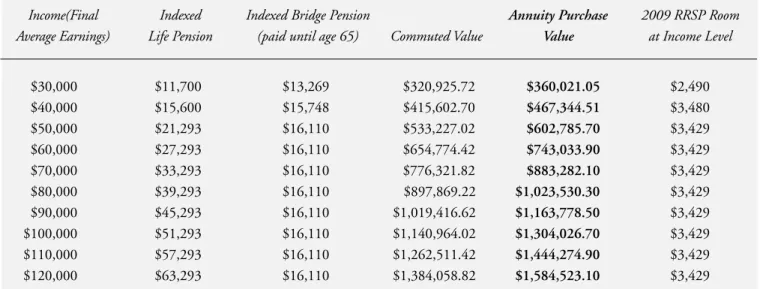
routinely in a range between $600,000 and 1,300,000.3Multiply this by two for a family with two public sector incomes; compare it to the median retirement savings for Canadian families in which the major income recipient is age 55 to 64: $244,800 (Statistics Canada, 2008).4
Private sector occupational or employer-sponsored pension plan participation by Canadian workers is at an all-time low of 23 percent. The remaining 77 percent with no pension coverage must rely on accu-mulations in registered retirement savings plans (RRSPs), home equity and non-sheltered savings to supplement public pension benefits. In the public sector, 80 percent of workers participate in defined-benefit (DB) pension plans paying indexed pensions typically replacing 60-70 percent of pre-retirement earnings5(integrated with Canada/Quebec Pension Plan benefits) and providing early-retirement and bridging benefits to tide retirees over until public pension benefits commence.
Most Canadians would agree that Courtney and Dave’s pension of less than $1,000 per month isn’t enough, even though that’s what many Canadians will get. Courtney and Dave would need to save more than twice as much to get half of Brad and Angie’s pension income. We are delighted that public-sector Angie and Brad have good pensions. But we wonder why private-sector Courtney and Dave don’t. What can be done to give them a better chance of enjoying the same pleasant retirement as Brad and Angie?
This paper answers that question; it identifies the key challenges to retirement income security for private sector workers, and provides solutions:
• Most private sector workers can’t participate in the kinds of large, pooled pension arrangements that serve public sector workers well. Legislation governing pension plans must be amended to facilitate participation by private sector workers in pension plans similar to public sector plans. This will allow private sector workers to access the benefits of pension plan membership that
public sector workers enjoy: risk pooling, economies of scale, and robust governance oversight.
• No worker can participate in a pension plan that isn’t sponsored by his or her employer. This makes pension plan participation a practical impossibility for self-employed workers and employees of small and medium-sized businesses, which often can’t afford to set up pension plans. Canada’s income tax and pension standards rules need to be changed to de-link pension plan participation from employment so that workers don’t have to depend on their employers for pension saving and to allow them to join pooled pension arrangements offered by professional and trade associations, employer associations and private sector service providers.
• Legislation requiring employers to provide similar pension benefits to employees of a particular “class” and requiring employers to fund at least half the cost of defined-benefit pensions must be repealed to facilitate the creation of new, more flexible pension arrangements for workers who have no coverage.
• Tax rules need to become less restrictive to allow more kinds of taxable income to be contributed to a pension plan and to make the tax treatment of administration expenses uniform for all retirement savings vehicles.
• Tax limits on retirement saving make it difficult for many private sector workers to save enough for retirement and impossible in most cases to achieve the same pension incomes as public sector workers. To ensure all Canadians have equal and equitable access to retirement saving room, Canada should adopt a target accu-mulation approach to retirement saving, with a target of $1 million or more.
The paper proceeds in six parts: i) it provides an overview of the Canadian retirement saving system; ii) compares pension coverage for public and private sector workers in Canada; iii) describes how
3 For pre-retirement salaries between $50,000 and $100,000 (see Table 8 on page 23). These figures do not include RRSP savings. 4 This median includes all Canadian families. It would be lower than $244,800 if public sector workers were excluded.
5 The target benefit of a typical public sector pension plan is 70 percent of final average earnings after a 35-year career, offset at age 65 by CPP/QPP benefits. See, for example Statistics Canada 2008 (Federal Public Service Retirements) at page 5 and Ontario Teachers Pension Plan 2006 at page 11. (Pretty much all public sector plans provide the same pension: 2 percent x final average earnings reduced at age 65 by 0.7 percent of final average earnings (because unreduced CPP/QPP benefits commence at age 65).
Independent • Reasoned • Relevant C.D. Howe Institute
Canadian pension regulations pose a barrier to equitable access; iv) proposes a new approach to pension risk; v) proposes a number of legislative reforms that will give every Canadian worker the opportunity to save for retirement; and vi) draws conclusions for action by policymakers.
The Canadian Retirement Saving System
Retirement income in Canada is provided by three “Pillars”:
• Pillar 1: the federal Old Age Security (OAS) and Guaranteed Income Supplement (GIS) programs.
• Pillar 2: the Canada/Quebec Pension Plans (C/QPP).
• Pillar 3: private saving in registered pension plans and RRSPs.6
Pillars 1 & 2: Public Pensions
Paid from general tax revenue, OAS and GIS deliver an indexed maximum benefit of about $14,000 annually at age 65. The second pillar programs, the Canada and Quebec pension plans, are partially funded by the invested contributions of employers and employees, and currently pay an indexed maximum benefit at age 65 of about $11,000. This doesn’t mean Canadians can each count on getting a $25,000 indexed pension from government sources. The income-tested GIS benefit is quickly reduced by other income (including C/QPP) and the OAS benefit gradually reduces when retirement income exceeds a threshold of about $65,000. The average benefit paid by C/QPP is about half the maximum. As a result, a typical retiree born in Canada with no other sources of income won’t receive more than $1,200 – $1,300 per month from government sources. For recent immigrants, this amount will be significantly lower for two reasons: residency requirements to qualify for full OAS benefits; and short C/QPP contribution periods.
To enjoy the same standard of living they had before retirement, most Canadian families will need sufficient pension income to replace between 45 and 70 percent of their pre-retirement earnings, depen-ding on their family circumstances (Hamilton 2000). Benefits from Pillar 1 (OAS/GIS) and Pillar 2 (C/QPP) won’t provide sufficient income to achieve replacement ratios in this range for most Canadian families. They will need to accumulate private retirement savings.
Pillar 3: Private Retirement Saving
Most private retirement saving happens in registered pension plans and RRSPs. Pension plans come in two types:
• Defined-benefit (DB) plans promise a benefit at retirement, typically based on earnings and years of service.7
• Defined-contribution (DC) plans and RRSPs deliver a retirement income based on accu-mulated contributions and investment income. Pension plans are heavily regulated. Federal and provincial pension legislation sets standards for funding, plan administration, vesting of benefits and protection of pension assets from creditors. The federal Income Tax Act (ITA) and Income Tax Regulations (ITR)8limit benefits that can be provided by DB pension plans and tax sheltering of contributions to DC pension plans and RRSPs.
The Factor of 9
For to everyone who has, more shall be given, and he will have an abundance; but from the one who does not have, even what he does have shall be taken away. (Matthew 25:29.) The Canadian Pillar 3 story has always been one of winners and losers. In 1991, the federal gov-ernment introduced “Pension Reform,” a com-prehensive overhaul of tax rules that was supposed to level the playing field for pension plan
6 Deferred-profit-sharing plans are also used for retirement saving. They are functionally equivalent to DC pension plans and RRSPs.
7 There are a variety of DB plan designs. For purposes of simplicity, this paper considers only DB plans that provide pensions based on a percentage of pre-retirement earnings multiplied by years of employment service. As an example, a “2%” DB plan would deliver an annual pension of $30,000 after 30 years of service if pre-retirement earnings are $50,000 (2 % x $50,000 x 30 = $30,000).
members and RRSP savers by means of the “nine” conversion factor and the Pension Adjustment (PA) system, which reduces pension plan members’ RRSP room. For a DC plan member, a PA is the sum of all contributions made to the plan on his or her behalf. For a DB plan member, the PA is a calculated amount equal to nine multiplied by every dollar of retirement pension notionally accrued during the year, less $600.
In theory, Pension Reform set annual limits on retirement saving at the lesser of 18 percent of “earned income” and the “money purchase limit” for the year, irrespective of whether saving happens in a DB pension plan, a DC pension plan or an RRSP. DC and RRSP contributions are subject to hard limits, but there is no cap on contributions to a DB pension plan.9Pension Reform gives members of DB pension plans – especially plans that provide “ancillary”10benefits – much more savings room because the “nine” factor used to equalize saving room among different retirement savings vehicles understates the real cost of benefits in many DB pension plans – costs that substantially exceed DC/RRSP contribution limits. Tax rules permit all of these extra costs to be paid to a DB pension plan as additional contributions on behalf of members.
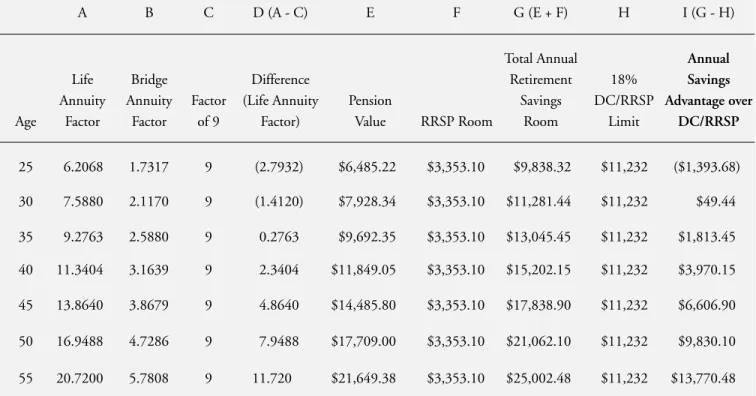
The “nine” factor allows much larger pension con-tributions for public sector pension plan members than would be possible in a DC plan or RRSP, even while giving them significant RRSP contribution room! How much more retirement saving room do public sector workers have? A lot more: as Table 1 shows, a 55-year-old public sector worker earning $60,000 has annual retirement saving room totalling $25,002 in a typical public sector plan – more than twice as much as the $11,235 of a private sector worker who doesn’t have a pension plan.
Determined in accordance with actuarial
standards, a number of conversion factors are used to convert pension income to a lump sum, or a lump-sum DC/RRSP account balance into a pension income. Conversion factors vary considerably depending on a number of variables, including a plan member’s age, interest (discount) rates, whether post-retirement indexing and other ancillary benefits
are provided, the age of pension commencement, and the form in which a pension will be paid.
Pension Reform made tax rules for pension plans remarkably complex and largely incomprehensible to everyone except pension experts. Most Canadians still don’t know much about how our retirement saving system works, which is probably why it has endured for almost 18 years without significant challenge. In terms of equity of access to tax-deferred retirement saving, the core failure of Pension Reform is the “nine” conversion factor and other prescribed factors that often impose immediate tax on a portion of pension savings transferred from a pension plan on termination of employment (Pierlot and Bonnar 2007). Conversion factors prescribed by tax rules don’t accurately reflect the value of participation in a DB pension plan; they are punitive to DB plan members who transfer their benefits on termination of employment; and they prevent the majority of workers who don’t participate in generous DB pension plans from accumulating the same pension incomes as the minority of those who do.
Table 1 shows the value of tax-deferred annual retirement saving room in a typical public sector plan, in 2008, for workers aged 25 to 55 who have final-average earnings of $60,000. It also compares that value to the annual retirement saving room available with a DC pension plan or RRSP at the same salary. The numbers demonstrate that tax rules allow public sector DB pension plan members to accumulate much more retirement savings than would be possible in a DC Plan or RRSP:
• During most of a public sector career, the Factor of 9 considerably understates the value of public sector pension plan participation.
• DC/RRSP savers can’t save more than 18 percent of effective earnings, but public sector workers can save much more. For public sector workers age 30 or over, annual retirement savings room exceeds 18 percent of earnings and reaches 40 percent of earnings in late career – more than double the 18-percent limit that applies to DC/RRSP savers.
9 Contributions to a DB plan are limited only indirectly: Provided that benefits are within the limits provided by tax rules and the plan’s actuarial surplus does not exceed a legislated ceiling, every employer contribution to a DB pension plan is an “eligible contribution.” See
Income Tax Act (ITA) s. 147.2.
Independent • Reasoned • Relevant C.D. Howe Institute
Presumably, Pillar 3 arrangements should allow everyone to accumulate retirement savings that, combined with Pillars 1 and 2 income, will be suf-ficient to provide an adequate post-work standard of living. But except for a fortunate minority partic-ipating in generous DB pension plans, Pillar 3 schemes often fail to achieve this purpose because tax rules prevent equitable access to retirement saving room.
II. Pension Coverage in Canada
Public Sector Employees
The vast majority – about 80 percent – of Canada’s 3.2 million federal and provincial public sector workers participate in DB pension plans. These
plans are remarkably consistent in terms of their design and the benefits they provide. Though employers pay most of the cost, public sector plans are usually “jointly sponsored,” which means that both employer and employee contributions can fluctuate with a plan’s funded ratio – the ratio of plan assets to plan liabilities. Availability of benefits such as early-retirement eligibility and indexing may also change if contribution adjustments are not sufficient to maintain a target funded ratio.
Public Sector pension plans typically provide target income replacement of 70 percent of final earnings integrated with C/QPP benefits after a 35-year career. These rates are slightly less than the maximum permitted under tax rules. With 30 years
Table 1: Public Sector Pension Plan – Tax-Deferred Retirement Savings Room, 2008
Note: Retirement at age 58 with no early-retirement reduction. Pension is 1.3% < YMPE; 2% > YMPE (three-year average). Maximum per-missible bridge. All benefits indexed at 2.5%. 60% J&S form of life pension with 5 year guarantee. CIA basis as at January 2008. To simplify the example, the $11,232 limit is determined as 18% of estimated final-year earnings of $62,400 (4% higher than FAE); it applies to DC pension plan contributions made in 2008 and to RRSP contributions made in 2009 (see ITA subsections 146.1(1) and 147.1(8)). Source: Actuarial calculations completed for this study.
A B C D (A - C) E F G (E + F) H I (G - H) Age Life Annuity Factor Bridge Annuity Factor Factor of 9 Difference (Life Annuity Factor) Pension Value RRSP Room Total Annual Retirement Savings Room 18% DC/RRSP Limit Annual Savings Advantage over DC/RRSP 25 6.2068 1.7317 9 (2.7932) $6,485.22 $3,353.10 $9,838.32 $11,232 ($1,393.68) 30 7.5880 2.1170 9 (1.4120) $7,928.34 $3,353.10 $11,281.44 $11,232 $49.44 35 9.2763 2.5880 9 0.2763 $9,692.35 $3,353.10 $13,045.45 $11,232 $1,813.45 40 11.3404 3.1639 9 2.3404 $11,849.05 $3,353.10 $15,202.15 $11,232 $3,970.15 45 13.8640 3.8679 9 4.8640 $14,485.80 $3,353.10 $17,838.90 $11,232 $6,606.90 50 16.9488 4.7286 9 7.9488 $17,709.00 $3,353.10 $21,062.10 $11,232 $9,830.10 55 20.7200 5.7808 9 11.720 $21,649.38 $3,353.10 $25,002.48 $11,232 $13,770.48
of service or with 80 or 85 “points”11a public sector worker can expect to receive an immediate, actu-arially unreduced lifetime pension, a temporary “bridge” pension to replace OAS and C/QPP benefits until age 65 and inflation indexing. For workers in public safety occupations, unreduced benefits are payable earlier.
Not surprisingly, public sector workers retire early, at a median age of 58 – almost five years earlier than they did in 1987 (Statistics Canada 2004). Assuming an average lifespan of 85 years, public sector
pensions will often be paid out during a retirement that is almost as long as working life. The dis-counted present value of a public sector pension can, and often does, exceed $1 million.
Public sector plans are generally well managed. With large pools of invested capital, public sector plans have proven very good at leveraging
economies of scale to deliver pensions with very low agency and unit administration costs. The annual cost of managing a typical large public sector plan is about 40 basis points12– less than one-fifth of the typical annual management fee charged to small investor holding a balanced mutual fund in an RRSP. Although administrative costs are low, benefits are generous. This means public sector pensions come with a high price tag (mostly paid by the employer) that can vary between 18 and 33 percent of total payroll, depending on how it is
measured (Office of the Superintendent of Financial Institutions 2005). Few private sector employers offer pensions this costly.
Private Sector Employees
Less than 30 percent of Canada’s private sector employed workers have a pension plan. Private sector DB plans typically offer less generous benefits than in the public sector. Qualification periods for early-retirement benefits are longer. If provided at all, indexing is typically ad hoc and at rates below inflation. Unsurprisingly, employed private sector workers retire later than in the public sector, at a median age of about 62 (Statistics Canada 2004).
Private sector employers are becoming
increasingly reluctant to sponsor DB pension plans because of funding risk, accounting treatment of pension obligations and uncertainty about ownership of actuarial surpluses. Seeking greater predictability of compensation costs, many employers are terminating DB pension plans, closing them to new entrants, converting them to DC and/or replacing them with group RRSPs. A long-term trend toward DC pension plans has resulted in the percentage of private sector DC plan members increasing from about 10 percent of total pension plan membership in 1974 to more than 25 percent today (Tamagno 2006).
11 The sum of age and years of employment service. 12 One basis point is equal to 1/100th of 1 percent.
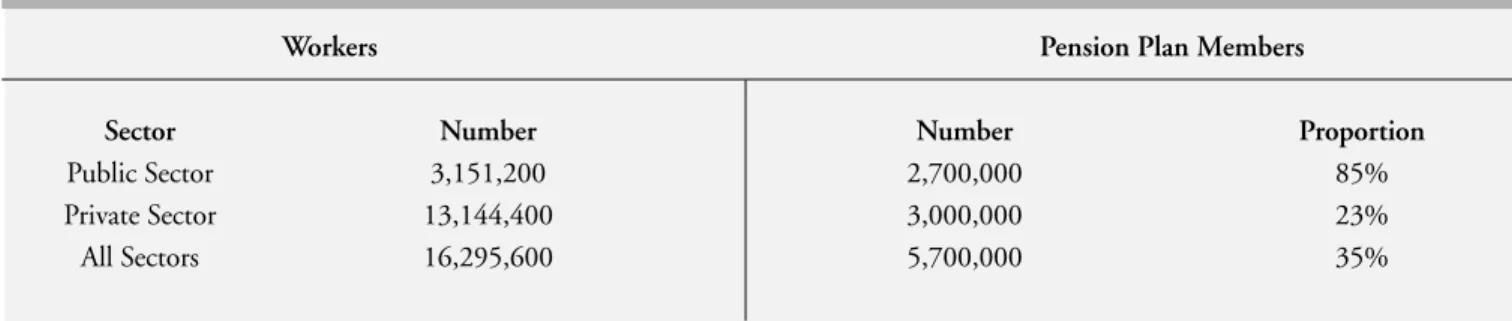
Workers Pension Plan Members
Sector Number Number Proportion
Public Sector 3,151,200 2,700,000 85%
Private Sector 13,144,400 3,000,000 23%
All Sectors 16,295,600 5,700,000 35%
Table 2: Canadian Pension Plan Participation, 2005
Source: Statistics Canada, The Daily: "Pension Plans in Canada," June 21, 2007; Labour Force Survey, January 6, 2006. Private sector total includes approximately 2.5 million self-employed workers.
Independent • Reasoned • Relevant C.D. Howe Institute
Employers typically contribute to DC plans at lower rates. Administrative costs are usually paid by plan participants. Because of liability risk, most employers require DC plan members to select their own investments from a stable of fund offerings with management expense ratios (MERs) ranging from 95 to 125 basis points, in a large DC pension plan. MERs are even higher in smaller plans. Members typically do a poor job of selecting investments (Broadbent, Palumbo and Woodman 2006). The majority do not take advantage of employer-provided education programs, do not understand the basics of investment diversification and do not review their portfolios regularly. Their investment behaviour is generally characterized by procrastination, inertia and overconfidence. The unsurprising result is that member-selected investments perform poorly (Tapia and Yermo 2007).
In late career, DC plan members with capital market exposure face significant investment volatility risk. If a desired retirement date
coincides with a market correction, a DC plan member delays
retirement or accepts a lower standard of living. At the cost of giving up potentially higher returns from exposure to the capital
markets, immunization against investment risk is possible by investing in high-quality fixed-income securities of appropriate duration. Members seldom choose this option. In fact, many make no choice at all, preferring instead to allow contributions to be deposited in whatever investment product the sponsoring employer has identified as the “default” option and putting off decisions about how they will manage their savings until retirement.
Retiring DC plan members must somehow manage the risk that they will outlive their savings. They can do this by purchasing annuities but typically do not from fear they will not get full value from the annuity if they die sooner than expected and because retail annuity purchase rates are often not favourable. Instead, they self-insure against investment volatility and the possibility they may
outlive their savings by continuing to save during retirement, potentially at the expense of not living the post-work life they had hoped for.
The Self-Employed
Canada has 2.6 million self-employed workers (Statistics Canada 2008). They can’t join pension plans because tax rules effectively limit pension plan participation to workers whose employers sponsor pension plans, either voluntarily or by collective agreement. Pension benefit accrual is limited to a percentage of “compensation,” which generally means income from “an individual’s employment or office.”13This makes many kinds of income ineligible for pension saving, including self-employment income, partnership income, business
income and investment income. Some workarounds are possible, but these come with high admin-istrative costs and are typically used only by high-income indi-viduals. The vast majority of the self-employed must therefore rely on RRSPs.
The risks and drawbacks of RRSPs are similar to DC pension plans’: poorly selected investments, investment volatility and limited options for insuring against longevity risk. RRSP owners seem as hapless as DC plan members – only 14 percent have a retirement plan and less than 31 percent have attempted to calculate the savings they’ll need in retirement (Brown 2008). The MERs that RRSP owners pay for their mutual fund holdings are not deductible, whereas administration fees for a DC pension plan are when paid by an employer. Finally, most provincial jurisdictions provide creditor pro-tection for pension plans, but not for RRSPs. This means that private sector business owners, who often have fluctuating incomes and significantly greater risk of financial loss than employees, have the additional worry of seeing their retirement savings seized by a creditor in the event of insolvency.
13 Income Tax Act (ITA) s.147.1
The risks and
drawbacks of RRSPs
are similar to DC
pension plans’
New Canadians
Immigrant Canadians deserve special mention. Often having shorter Canadian working careers, immigrants receive less public pension benefits and have less time to save for retirement. Tax rules are especially prejudicial to new Canadians’ retirement income security: with no RRSP contribution room for years worked before coming to Canada, it is par-ticularly hard for mid-career immigrants to
accumulate enough retirement savings. Predictably, immigrant Canadians feel considerably less well-prepared for retirement than the Canadian-born and are less likely to expect their retirement incomes to be adequate (Statistics Canada 2008).
Non-Pension Saving
Other sources of personal wealth on which Canadians draw in retirement include residential equity, small business equity and non-sheltered savings (Horner 2007). The Canadian tax regime double-taxes savings because investment income generated by after-tax income is itself taxed, subject to limited exceptions.14This means that non-sheltered retirement saving is usually less effective than tax-sheltered saving, leaving RRSPs as the best retirement savings vehicle for those who cannot par-ticipate in a pension plan because they do not receive salary or wages.
III. Canadian Pension Regulation: The Barrier to Equitable Access
Multi-Sponsor Pension Plans
As a retirement saving vehicle, pension plans are superior to RRSPs in every practical way. Pension plans allow “autopilot” saving – this makes saving
happen.15Pooling funds in a pension plan reduces unit administrative costs. Pension funds are protected from creditors. Tax rules allow pension accrual during periods of low/no income such as disability, parental leave, and educational leave. In a DB pension plan, members do not have to manage their own funds, tax-deferral room is significantly greater for older members, and longevity risk can be pooled cost-effectively. None of these advantages are currently available to members of
employer-sponsored DC pension plans and RRSP savers. Certainly, employers who wish to do so should be able to sponsor and contribute to pension plans for their employees. But this does not mean that Canadians should be forced to rely on their
employers’ munificence for their retirement income security. They should have the opportunity to par-ticipate in any pooled pension saving arrangement that meets reasonable fiduciary and governance standards. This means having the option of joining a multi-sponsor pension arrangement of their choice that offers the same economies of scale and benefits as are now enjoyed by members of public sector DB pension plans.
But they can’t. Why not? No single rule in Canadian tax and pension standards legislation prevents Canadian workers from joining a multi-sponsor pension plan (MSPP). Rather, a confluence of rules makes participation in an MSPP a practical impossibility for most.16
Barriers to Establishing an MSPP
MSPPs are subject to governance requirements that make them difficult to establish and risky for those charged with their administration. Canada’s 10 pension standards jurisdictions typically require that an MSPP be established and administered by a
14 Some deferral (and a lower tax rate) is available for capital gains generated by saving. In addition, the 2008 federal budget’s introduction of Tax-Free Savings Accounts affords a new opportunity to accumulate a limited amount of savings without tax on investment earnings. 15 As noted in a previous paper of this series, a considerable body of “behavioural finance” research suggests that automatic enrolment with an
option to opt out results in higher rates of pension plan participation and better retirement savings outcomes (Ambachtsheer 2008).
16 In pension nomenclature, “sponsor” means the person who funds pension benefits where “fund” means to take on risk. In a DB pension plan, this entails an obligation to underwrite a future benefit promise. In a DC pension plan, risk rests mostly with members, even though employers are referred to as “sponsors” because they make contributions. Most pension plans are sponsored by one or more employers; some are jointly sponsored by employers and employees; a few are sponsored by members through their trade unions. Throughout this paper, and in support of the policy position that individuals should be able to sponsor their own pensions (with or without the assistance of an employer), we use the terms “sponsor” and “multi-sponsor” in preference to “employer” and “multi-employer” unless the context requires otherwise. The acronym “MSPP” should be taken to mean “multi-employer pension plan” or “multi-sponsor pension plan” as the context requires.
board of trustees or pension committee, usually with member representation. As an example, Ontario pension standards legislation requires that a pension plan sponsored by unrelated employers must be administered by a board of trustees, at least half of whom are pension plan members.17Tax rules are much less restrictive, requiring only that an administrator be “a person or body of persons” a majority of whom reside in Canada.18
Committee or board members who administer an MSPP are generally subject to a statutorily imposed, fiduciary standard of care that cannot be limited by contract. For example, Ontario legislation requires a pension plan administrator to “exercise the care, diligence and skill” in the investment of a pension fund and to use “all relevant knowledge and skill that the administrator possesses or, by reason of the administrator’s profession, business or calling, ought to possess.”19 Pension plan administration, reg-ulatory compliance and investment management demand a variety of specialized skills and training well beyond the competencies of the average person. The various tasks associated with operating a
pension plan can be outsourced to service providers and usually are, but this does not absolve members of a board or committee from the responsibility to oversee and monitor the administration of an MSPP.
Fiduciary responsibility is a significant disin-centive for anyone to participate on a board or committee of administration. Pension plan adminis-trators can and do get sued and since pension plan assets and liabilities are usually quite substantial, it can be difficult to obtain liability insurance. Even when board and committee members who don’t have the expertise to administer a pension plan do their best to select competent third-party service providers, they continue to have an oversight obligation. If something goes wrong, they will have little recourse against service providers, who usually limit their liability to the amount of fees paid under a service agreement. This is not to suggest that all Canadian pension plan administrators are stuck in a
quagmire of ruinous litigation. But pension plan members are becoming increasingly litigious and in disputes about pensions, breach of fiduciary duty is routinely alleged.20Whether or not such allegations can be proven, pension plan administrators must defend themselves.
With limited exceptions, current governance requirements effectively prevent MSPPs from being established and administered on a purely contractual basis in a variety of more flexible legal arrangements that would not necessarily involve governance by a board or committee. This makes it difficult for asso-ciations of workers or professionals to set up an MSPP to which members can subscribe, and it prevents private sector service providers from offering MSPPs on a subscription basis. Some juris-dictions do allow financial institutions to offer “simplified” pension plans that provide DC-only benefits. Adapted to the needs of small businesses, simplified pension plans shift administrative and fiduciary responsibilities from the sponsoring employer to the financial institution that manages the plan (RRQ 2006).
No Job? No Pension Plan
On the Canadian retirement landscape, a mouldy feudalism lingers. To participate in a pension plan, tax rules require that you work for an employer who sponsors one, either individually or with other employers.21This is a throwback to an earlier time when pension plans were a tool employers used primarily to reward long service. Today, it’s hard to think of a good reason why pension plan parti-cipation should be restricted to employees or indeed, forcibly linked to employment in any way. Private sector employers don’t have to sponsor pension plans and most do not. This leaves RRSPs – with their limited saving room and lack of creditor pro-tection – as the only option for most individuals.
The unnecessary linkage between income from employment and pension plan participation makes
Independent • Reasoned • Relevant C.D. Howe Institute
17 Pension Benefits Act (PBA) (Ontario). Section 8.
18 ITA s 147.1(6).
19 PBA. Section 22. Emphasis added.
20 See, for example Slater Steel Inc (Re),2008 ONCA 196 (CanLII). 21 ITA s.147.1; ITR s. 8502(1)
the benefits of pension plans practically unavailable to employees of small and medium-sized enterprises that typically do not sponsor pension plans, and to non-employees such as self-employed tradespersons, professionals and partners of professional part-nerships. More than 25 years ago, United States policymakers realized this didn’t make sense and amended the tax code to allow self-employed indi-viduals the same kinds of pension arrangements hitherto available only to employees. Canada still hasn’t seen the light.
To participate in a pension plan, it’s not enough just to have employment income. Tax rules require that the employer you work for must sponsor the pension plan to which you belong. Otherwise, a plan’s registration may be denied or revoked, with severe tax consequences. Tax authorities have demonstrated considerable zeal in deregistering pension plans where they take the view that no bona fide employment relationship exists (Steele 2007). This means that even with employment income, many Canadians – typically those employed by small and medium-sized businesses – have no pension coverage because their employers cannot afford the expense of establishing pension plans. This leaves a majority of Canadian workers with no pension coverage entirely reliant on RRSPs and other forms of saving. Arbitrary links between income from employment with a particular
employer and pension plan participation need to be eliminated. This would allow Canadian workers to join any bona fide pension arrangement.
You Can’t Buy Your Own Pension
Tax and pension standards rules generally require that at least 50 percent of the cost of a DB pension be paid by a plan member’s employer. Except in multi-employer plans and certain union plans, members are prohibited from contributing extra to pay off funding deficiencies. For DC pension plans, tax rules require that each participating employer contribute a minimum of 1 percent of the remu-neration of participating members.
Fewer and fewer employers are willing to take on the accounting and financial risks associated with underwriting a DB-benefit promise. Others avoid establishing DC pension plans because they entail an ongoing obligation to contribute a percentage of payroll irrespective of financial results, as well as a fiduciary obligation to make appropriate investment choices available and to inform members regularly about those choices.22As a result, rules restricting individuals from paying for their own pensions and joining any bona fide pension arrangement may be the greatest obstacles to increased pension coverage for Canadians.
Many employers would likely be more willing to establish pension plans to help employees save for retirement if they could choose if and when they make contributions and how much
funding/fiduciary risk they will take on. Perhaps Canada’s most innovative pension watchdog, the
Régie des rentes du Quebec,has recognized employers’ reticence toward funding/fiduciary risk and, in 2007, introduced a new type of DB pension plan funded by variable member contributions and a fixed employer contribution.23Quebec has also amended its pension legislation to allow pension committees responsible for plan administration to delegate administrative tasks and fiduciary responsi-bilities to service providers. So far, no other
regulator has followed suit.
The requirement that an employer fund at least part of the cost of a pension is a major impediment to the establishment of multi-sponsor arrangements. Because an employer must be involved, individuals cannot practically set up their own pension plans or work together to co-sponsor “co-op” pension arrangements funded with their own money. Similarly, private sector service providers cannot offer pooled pension savings arrangements to individuals on a for-profit, subscription basis.
Class Struggle
Most pension standards legislation requires that the same benefits be provided to employees within the
22 For a discussion of the fiduciary risks of DC pension plan sponsorship and how they might be addressed, see Robson 2007.
23 Somewhat perversely, Quebec passed Bill 68 in 2008 to restrict benefit reductions in multi-employer DB pension plans that are not established as “member-funded” plans and even where the terms of a negotiated multi-employer plan may make the provision of benefits contingent upon available funding.
C.D. Howe Institute
same “class,” with class distinctions based on factors such as an employee’s position, work location, or date of hire. Although different benefits can be provided to different classes, an individual member generally cannot be treated as a class. This effectively prohibits pension plan members and sponsoring employers from negotiating individual com-pensation “deals” that provide for individualized rates of pension contribution or accrual tailored to each particular member’s life situation and financial needs. Given the increasing popularity of flexible benefits arrangements that allow employees to choose how a fixed amount or percentage of salary will be allocated to non-cash benefits such as medical/dental insurance, RRSP saving, or life insurance, Canada’s provincial rules requiring similar benefits to be provided to employees within a class are an anachronism. In the UK, where pension legislation is much more flexible, some employers are rejecting a “we know best” approach in favour of letting employees decide how much of their pay they will allocate to the company pension plan (Coles 2008).
Rigid Tax Rules
Tax rules also don’t allow individuals to choose how much of their total annual compensation they will allocate to retirement saving, and when. Two key impediments prevent individuals from funding toward a target pension benefit when they can afford to. First, as noted above, individuals cannot fund their own DB pensions. Second, by restricting the amount of pension an individual can accrue in a particular year to the lesser of 2 percent of an individual’s compensation and an indexed dollar limit ($2,333 in 2008), tax rules set limits on annual DB contributions and accruals. Catch-up funding toward a target benefit is practically unavailable even for many DB plan members, because past-service DB funding must relate to employment service with an employer who sponsors a DB pension plan and who will permit the past-service benefits to be provided. DC catch-up funding is not possible because tax rules prohibit “past service” DC contributions.
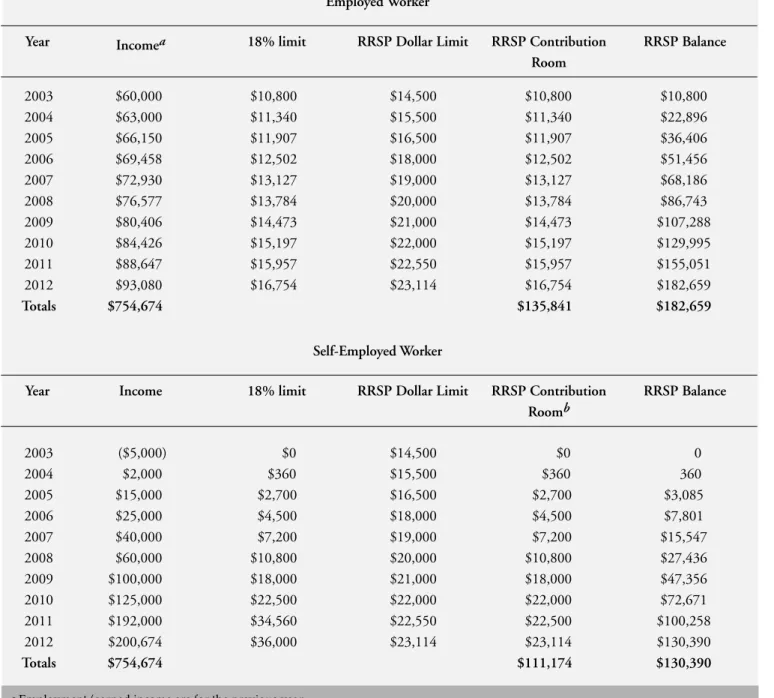
It is true that carry-forward of unused accu-mulated RRSP contribution room does allow for some catch-up saving. But only partially: inflation erodes the value of accumulated RRSP contribution room. In addition, since RRSP contribution limits are determined annually as a percentage of income capped by a dollar limit, two individuals with similar lifetime incomes will have different con-tribution limits if one’s income fluctuates substantially but the other’s does not, as Table 3 demonstrates.
Table 3 shows two workers who earn approx-imately $755,000 over 10 years. The employee’s salary increases 5 percent per year. The
self-employed worker has negative/low income initially that increases as the enterprise succeeds – the typical “J” curve of a business venture. Each worker con-tributes the maximum permitted by tax rules and earns a compound return of 7 percent. After 10 years, the employed worker is ahead by $24,667 in RRSP contribution room and $52,269 in accu-mulated savings, enough to buy $3,555 more annual pension.24
Same income; different RRSP savings room: what gives? This happens because RRSP contributions are subject to an annual limit as a percentage of income, not an annual or lifetime nominal limit. In addition to having less RRSP room, the self-employed worker will pay more tax because his/her income will be disproportionately taxed at higher marginal rates, though this discrepancy may be offset to some degree by opportunities to deduct expenses that the employed taxpayer does not have.
The example in Table 3 would apply similarly in a situation where a worker leaves the workforce to retrain and ceases to earn. During the retraining period, the worker will not accumulate RRSP con-tribution room, but if fortunate enough to be a member of a pension plan sponsored by an employer who grants a leave of absence, tax rules allow continued pension contributions based on “prescribed compensation” – earnings the worker is deemed to receive while receiving no earnings at all. This is just one example of differing tax treatment for pension plan members and RRSP owners.
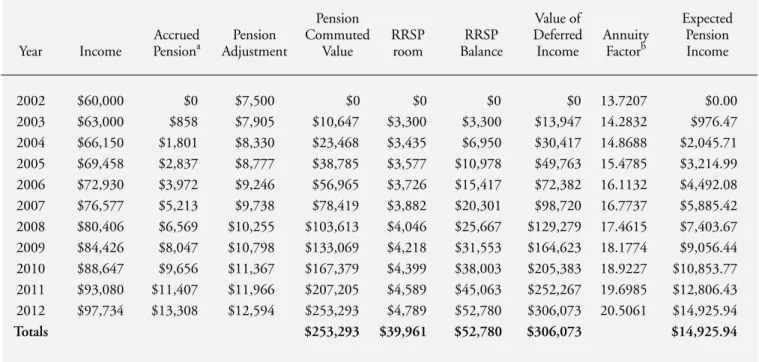
Tables 4 and 5 below provide another example demonstrating how tax rules disadvantage the
2003 $60,000 $10,800 $14,500 $10,800 $10,800 2004 $63,000 $11,340 $15,500 $11,340 $22,896 2005 $66,150 $11,907 $16,500 $11,907 $36,406 2006 $69,458 $12,502 $18,000 $12,502 $51,456 2007 $72,930 $13,127 $19,000 $13,127 $68,186 2008 $76,577 $13,784 $20,000 $13,784 $86,743 2009 $80,406 $14,473 $21,000 $14,473 $107,288 2010 $84,426 $15,197 $22,000 $15,197 $129,995 2011 $88,647 $15,957 $22,550 $15,957 $155,051 2012 $93,080 $16,754 $23,114 $16,754 $182,659 Totals $754,674 $135,841 $182,659 2003 ($5,000) $0 $14,500 $0 0 2004 $2,000 $360 $15,500 $360 360 2005 $15,000 $2,700 $16,500 $2,700 $3,085 2006 $25,000 $4,500 $18,000 $4,500 $7,801 2007 $40,000 $7,200 $19,000 $7,200 $15,547 2008 $60,000 $10,800 $20,000 $10,800 $27,436 2009 $100,000 $18,000 $21,000 $18,000 $47,356 2010 $125,000 $22,500 $22,000 $22,000 $72,671 2011 $192,000 $34,560 $22,550 $22,500 $100,258 2012 $200,674 $36,000 $23,114 $23,114 $130,390 Totals $754,674 $111,174 $130,390
Table 3: Effect of Fluctuating Income on RRSP Contribution Room
aEmployment/earned income are for the previous year.
bAfter 2010 (the last year of fixed limits), the RRSP dollar limit is assumed to increase at 2.5 percent/year.
Employed Worker
Year Incomea 18% limit RRSP Dollar Limit RRSP Contribution
Room
RRSP Balance
Self-Employed Worker
Year Income 18% limit RRSP Dollar Limit RRSP Contribution
Roomb
Independent • Reasoned • Relevant C.D. Howe Institute 2002 $60,000 $0 $0 13.7207 $0 2003 $63,000 $10,800 $10,800 14.2832 $756 2004 $66,150 $11,340 $22,842 14.8688 $1,536 2005 $69,458 $11,907 $36,234 15.4785 $2,341 2006 $72,930 $12,502 $51,091 16.1132 $3,171 2007 $76,577 $13,127 $67,540 16.7737 $4,027 2008 $80,406 $13,784 $85,714 17.4615 $4,909 2009 $84,426 $14,473 $105,758 18.1774 $5,818 2010 $88,647 $15,197 $127,829 18.9227 $6,755 2011 $93,080 $15,957 $152,094 19.6985 $7,721 2012 $97,734 $16,754 $178,735 20.5061 $8,716 Totals $135,841 $178,735 $8,716
Table 4: Joe – RRSP Only
aCIA annuity purchase basis as at January 2008 (unisex). Life form of pension payable at age 60 with 10-year guarantee. Not indexed.
Year Income RRSP room RRSP Balance Annuity Factora Expected Pension
Income
Pension Value of Expected
Accrued Pension Commuted RRSP RRSP Deferred Annuity Pension
Year Income Pensiona Adjustment Value room Balance Income Factorb Income
2002 $60,000 $0 $7,500 $0 $0 $0 $0 13.7207 $0.00 2003 $63,000 $858 $7,905 $10,647 $3,300 $3,300 $13,947 14.2832 $976.47 2004 $66,150 $1,801 $8,330 $23,468 $3,435 $6,950 $30,417 14.8688 $2,045.71 2005 $69,458 $2,837 $8,777 $38,785 $3,577 $10,978 $49,763 15.4785 $3,214.99 2006 $72,930 $3,972 $9,246 $56,965 $3,726 $15,417 $72,382 16.1132 $4,492.08 2007 $76,577 $5,213 $9,738 $78,419 $3,882 $20,301 $98,720 16.7737 $5,885.42 2008 $80,406 $6,569 $10,255 $103,613 $4,046 $25,667 $129,279 17.4615 $7,403.67 2009 $84,426 $8,047 $10,798 $133,069 $4,218 $31,553 $164,623 18.1774 $9,056.44 2010 $88,647 $9,656 $11,367 $167,379 $4,399 $38,003 $205,383 18.9227 $10,853.77 2011 $93,080 $11,407 $11,966 $207,205 $4,589 $45,063 $252,267 19.6985 $12,806.43 2012 $97,734 $13,308 $12,594 $253,293 $4,789 $52,780 $306,073 20.5061 $14,925.94 Totals $253,293 $39,961 $52,780 $306,073 $14,925.94
Table 5: Bob – Defined Benefit Plan with RRSP
Notes: a Pension is 1.5% FAE (3 years); Normal form: 60% survivor benefit; 2% fixed-rate indexing; no bridge; unreduced. b
majority of those who save in an RRSP as compared to the minority who are members of DB pension plans. Joe and Bob are 50 years old, have identical incomes and save for retirement at the maximum levels permitted by the rules. Joe relies on an RRSP; Bob is a member of a DB pension plan. Each retires at age 60. Joe uses his RRSP savings to buy a pension annuity. Bob buys an annuity with his RRSP savings and the commuted lump-sum value of his pension income. Result? The value of Bob’s savings is $127,338 more than Joe’s savings, which equates to $6,209 more in annual lifetime pension income.25
When a Buck Is Not a Buck
First proffered by Kenneth Carter in the 1966 Report of the Royal Commission on Taxation, the simple principle that “a buck is a buck is a buck” is an ideal to which Canada’s retirement saving system has never pretended to aspire. Carter believed that since all forms of income increase wealth equally, they should all be
taxed equally. It’s not too much of a stretch to suggest that the same principle should apply to retirement saving by allowing pension contributions to be made from any kind of taxable income. But many kinds of income cannot be contributed to a pension plan, including income from business, self-employment, property, and investments.
There is no sound policy basis for restricting pension saving to employment income or RRSP saving to “earned income.” This is not to suggest that policymakers should not set limits on how much income can be temporarily sheltered from tax in a pension plan. Consumption tax advocates might argue that unlimited deferral should be permitted in a retirement savings vehicle because eventually, all deferred income is withdrawn and taxed with no net loss to the treasury. But notwith-standing the advantages of a consumption tax regime, unlimited pension saving would seem dis-proportionately to benefit those who are already well-prepared for retirement – high-income earners.
It could also create cash-flow problems for finance ministers and compliance challenges for taxing authorities seeking to forestall creative schemes to entirely avoid tax on large amounts of deferred income.
Reasonable limits on income deferral have been a cornerstone principle on which Canada’s Pillar 3 retirement savings system is based. This should not change. What should change is how those limits are determined and applied so that all Canadians, no matter how they earn their living, can practically access the same saving limits. Eliminating arbitrary distinctions between types of income eligible for pension saving will help make this happen.
Gradual and Uniform, or Neither?
The Canadian retirement savings regulatory paradigm is founded on a fiction; namely, that workers can and should save for
retirement in a regular, pre-dictable manner from the moment they begin working until they retire. Financial insti-tutions promote early, regular retirement saving in television, newspaper and even public transit advertisements, the latter often targeted toward youth.
Early, regular saving for retirement certainly is good for fund managers, but does it serve the interests of Canadian workers? In most cases, probably not. The notion that retirement saving is the best way to allocate limited financial
resources in early career is seriously flawed, failing as it does to acknowledge that the ability and inclination to save for retirement vary con-siderably as a function of age, income and non-discretionary expenses.
For most people, it is sensible to defer deferred-income saving until the later years of working life. As it happens, this is exactly how traditional DB pension plans work. As Figure 1 demon-strates, the pattern of retirement income accrual in a typical final-pay DB pension plan dovetails naturally with the lifetime earning and
con-25 Idem.
Early, regular saving for
retirement certainly is
good for fund managers,
but does it serve the
interests of Canadian
C.D. Howe Institute
sumption pattern of a typical worker, whose income is much more likely to exceed non-discre-tionary spending in late career.
However rational and appropriate the DB funding paradigm may be, the vast majority of Canadian private sector workers cannot and do not benefit from it. By comparison, most public sector workers do and it is not an overstatement to say that in Canada, public sector, multi-employer DB pension plans are the gold standard for delivery of secure, pre-dictable and adequate post-work income replacement with remarkably low administration costs.
This does not mean that public sector pension plans do not face challenges. All DB plan adminis-trators struggle to manage the volatility of funded ratios – the degree to which the value of plan assets exceeds, or is less than, estimated liabilities. This makes it difficult to predict contribution obligations and sometimes requires adjustments to benefits. This volatility arises from the fact that DB plan sponsors typically seek to lower the normal cost of pension funding by investing in public and private capital markets. Experience to date suggests that this strategy may work, but that it comes at the price of having to try to match assets invested in illiquid and/or volatile instruments with bond-like pension
obligations that have a predictable, long-term payment horizon.
If the public sector DB model works so well, why can’t it work in the private sector? In a public sector pension plan, the risk of making good on DB pension promises is underwritten by public sector employers who, with access to tax revenue, have practically bottomless pockets. The pockets of private sector employers do have a bottom, so it’s not surprising they are unwilling to take on the same level of risk.
In suspending, closing, and converting their DB pension plans to DC, private sector employers have voted with their feet. They are choosing not to take on pension funding risk and have shifted that risk to employees – a risk that individuals without occu-pational pension plans have always had. Thus, the essential condition for making something akin to a public sector DB plan viable in the private sector is to allow workers to join pension plans in which they take on DB funding and investment risk indi-vidually and personally, just as they now do in their DC pension plans and RRSPs.
This would mean that, as in a DC plan or RRSP, the account balance of a member of a private sector pension plan adapted from the public sector model $0 $2,000 $4,000 $6,000 $8,000 $10,000 $12,000 $14,000 $16,000 $18,000 $20,000 30 35 40 45 50 55 60 Age Pe n sio n C os t
Figure 1: Retirement Income Accrual in a Typical Defined-Benefit Plan
Source: Data from Table 7. Section 11 of the Ontario Pension Benefits Actprovides that a pension plan cannot be registered unless "it provides for the accrual of pension benefits in a gradual and uniform manner." As Figure 1 shows, benefit accrual in a final-pay DB plan cannot be "gradual and uniform."
would be equal to aggregate contributions, plus investment returns. But unlike a DC plan or RRSP, the member would have the opportunity to con-tribute whatever amounts were required to fund the same level of pension benefits that a public sector employee at the same salary level could expect to receive at retirement. Alternatively, private sector workers could negotiate compensation packages whereby fixed employer contributions would pay for some or most of the cost of funding a DB pension, much as is now done by unions who sponsor multi-employer pension plans and negotiate fixed employer contributions on behalf of their members.
IV. A New Approach to Pension Risk
The Two Solitudes: DB and DC
Much current discussion about pension benefit coverage, benefit adequacy and benefit security is mired in an unhelpful DB-DC debate: Are DB pension plans sustainable? Can DC pension plans deliver adequate retirement income?
The right question is “What can we do so everyone can have a pension?” because it shifts the focus from a debate about plan design to a dis-cussion about what strategies could work to achieve broad-based, sufficient pension coverage – precisely the mandate of the Alberta/British Columbia Pension Standards Review launched in 2007. That enquiry will lead to a discussion of pension risks, who bears them and how we could design flexible retirement income accumulation arrangements that combine the best of what current DB and DC pension plans have to offer.
Despite the obvious superiority of large, DB pension plans in terms of their ability to pool risk and deliver predictable benefits at low administration unit costs, many employers are turning away from them. Why? The answer, which is not particularly complicated, is found in a regulatory regime that
imposes benefit funding restrictions that make DB pension plans unsustainable for many employers from a risk-management point of view, mask the true cost of funding benefits for particular plan members and result in intergenerational subsidies among members.
Risk Profile by Plan Type
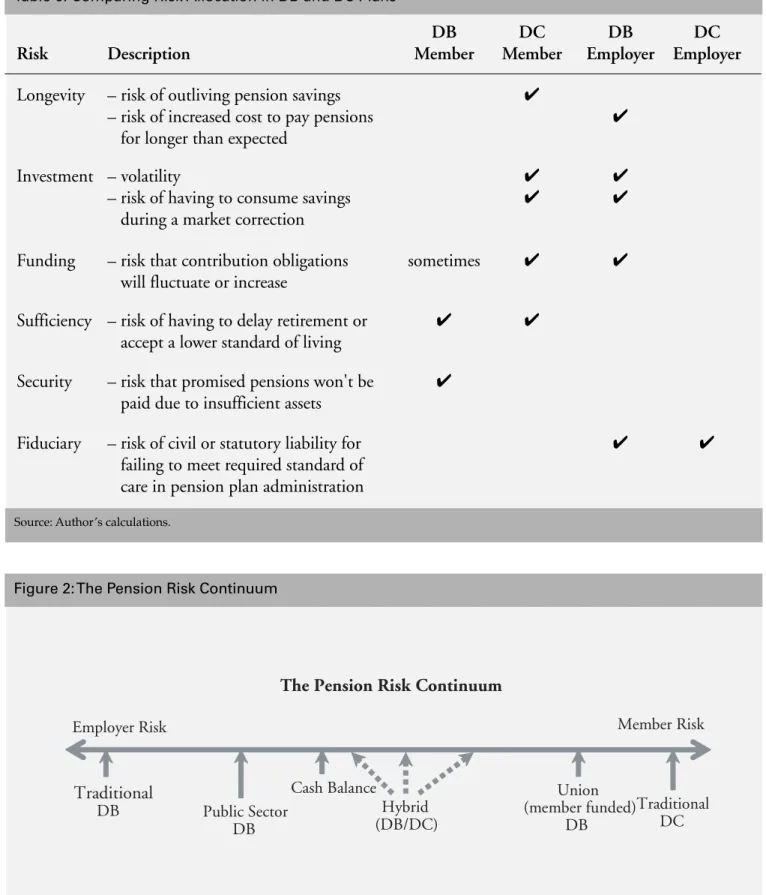
Table 6 identifies some key pension risks and who is thought to bear them in traditional DB and DC occupational pension plans. Table 6 shows that the most important factor in determining who bears pension risk is plan design and that in traditional occupational pension plans, DB employers and DC members have similar risks. But Table 6 doesn’t tell the whole story about who bears longevity, funding, sufficiency and security risk because some plans providing DB benefits shift most risk to members; others providing DC-style benefits involve con-siderable risk for employers. In simple terms, risk sharing in different plan designs can be mapped on a continuum (see Figure 2).
EMPLOYER-SPONSORED DB:A “traditional” DB
pension plan promises a benefit and the employer funds it according to estimates provided by the plan actuary. Most traditional DB pension plans don’t require employee contributions because employee contributions determined as a percentage of salary have little effect on the volatility of an employer’s contribution obligations, which may vary con-siderably due to factors such as fluctuations in interest rates, equity market returns, inflation, changes in life expectancy and member demo-graphics. However, members have risk too. If the employer’s pension funding cost increases, they are at risk of layoff, of not receiving a salary increase, or of receiving a reduced benefit if the employer becomes bankrupt when a pension plan is not fully funded.26
26 As discussed in a previous paper in this series, the cost of funding an employer-sponsored DB pension plan may be considered to fall upon employees because where an employer pays more to fund a pension plan, it can be expected that in a competitive labour market, concessions will (sooner or later) be extracted from employees’ other compensation. Because reductions to other forms of compensation don’t always happen immediately, employer-sponsored DB pension plans allow for risk pooling among cohorts of pension plan members, which in turn implies that intergenerational wealth transfers occur within DB plans (Pesando 2008). However, even though the cost of funding a DB pension plan may ultimately be passed on to employees, many employers avoid DB pension plans because of the risks and difficulties of managing contribution volatility associated with asset-liability mismatch and because of uncertainty of title to actuarial surpluses.
Independent • Reasoned • Relevant C.D. Howe Institute
Table 6: Comparing Risk Allocation in DB and DC Plans
Source: Author’s calculations. Risk Description DB Member DC Member DB Employer DC Employer
Longevity – risk of outliving pension savings – risk of increased cost to pay pensions
for longer than expected
✔
✔ Investment – volatility
– risk of having to consume savings during a market correction
✔
✔ ✔✔
Funding – risk that contribution obligations will fluctuate or increase
sometimes ✔ ✔
Sufficiency – risk of having to delay retirement or accept a lower standard of living
✔ ✔
Security – risk that promised pensions won't be paid due to insufficient assets
✔ Fiduciary – risk of civil or statutory liability for
failing to meet required standard of care in pension plan administration
✔ ✔
The Pension Risk Continuum
Employer Risk Member Risk
Traditional DB Traditional DC Public Sector DB Union (member funded) DB Cash Balance Hybrid (DB/DC) Figure 2: The Pension Risk Continuum
PUBLIC SECTOR DB:Most public sector DB plans are
“jointly-sponsored.” The members may have more risk than in a traditional DB plan because the per-centage of salary they have to contribute can vary with the funded status of the plan. In addition, benefits may be reduced or increased as a function of the plan’s funded position. However, the majority of risk is still borne by the employer. As with a tra-ditional DB pension plan, assets and liabilities are pooled among members and retirees.
CASH BALANCE:A popular design in the United
States, a “cash balance” pension plan operates like a DC plan in that assets are allocated to members individually, but members are immunized to some extent from investment volatility because the employer takes on risk in the form of an obligation to fund the plan as necessary to credit member accounts with a promised rate of return. Tax rules do not permit cash balance plans to be registered in Canada.
HYBRID:Hybrid pension plans come in a variety of
designs that provide DB or DC benefits, or both. Allocation of risk depends on the design.
MEMBER-FUNDED DB:Member-funded DB pension
plans are typically managed by unions and have multiple participating employers, who contribute fixed amounts as negotiated in a collective agreement. For employers, the risk is similar to sponsoring a traditional DC pension plan because they have no obligation to pay more if the plan doesn’t have enough funds to pay promised benefits – until a contribution increase is negotiated at the next round of bargaining. Thus, the risk of funding deficiencies is largely (but not entirely) borne by the members.
TRADITIONAL DC:Employer and member
contri-butions are invested in each member’s account, and retirement income will be whatever the contributions and investment accumulated in the account will
buy. Since the employer’s only obligation is to con-tribute fixed amounts, the member bears the risk of not having enough to retire and of losses due to investment volatility. However, the employer has fiduciary risk arising from an ongoing obligation to make appropriate investment choices and information available to members.
DB and DC: Getting the Best of Both
What is the difference between traditional occupational DC and DB plans that is largely responsible for the increasing shift to DC arrangements, as well as for the continuing and largely futile debate as to how the DC trend can be reversed? In a DC pension plan, assets and liabilities for a particular member are always knowable and equal. In a DB pension plan, assets and liabilities for a particular member are always unknowable and unequal, except when benefits are settled in a lump-sum on pre-retirement termination of employment.27
What if a DB plan could operate like a DC plan? This would mean allocating assets and liabilities of a DB pension plan to members individually, rather than pooling them. Pension plan members and employers (if any) could then negotiate with pretty good information on how much a DB pension benefit will cost, who will fund it, and when. As with a DC pension plan, employers could limit their funding risk and know exactly their total com-pensation obligation to each employee. Able to access the funding flexibility of a DB pension plan, members would be able to ensure more adequate and predictable benefit payments in retirement.
Table 7 provides a snapshot of how assets and lia-bilities might look for an employed worker in a self-funded DB plan during a 30-year career. The plan provides a 1.5 percent final-pay pension. The employer contributes 7 percent of salary. The member contributes the additional amounts required to fully fund the pension on a going-concern basis.
27 There are two reasons for this: First, the current tax and regulatory regime requires DB pension plans to pool assets and liabilities, even though it is possible – and arguably more equitable – to track assets and liabilities in every pension plan on a member-by-member basis as is the norm in a DC plan. Second, although actuaries can provide estimates, the exact quantum of a liability for a pension benefit payable at some point in the future can never be known with certainty.
C.D. Howe Institute
As with all final-pay DB plans, the cost of funding a pension rises dramatically as the worker ages. In this example, the 7 percent employer con-tribution covers most of the cost of accruing benefits in early career, but much less in late career. What happens if the member contributes less than required to fully fund accrued benefits? The answer is obvious: the member will receive a lower benefit – equivalent to what a DC pension plan with a 7 percent employer contribution rate would provide along with whatever contributions the member chooses to make. But for the member, the self-funded DB arrangement will be far preferable to a DC plan because it offers what no DC plan can: the opportunity to fund to a predictable target benefit and the flexibility to decide when to fund it.
A self-funded DB model fits much better with the real world than do current DC models that exhort individuals to save as much as they can, as soon as they can. When workers don’t have much disposable income in early- to mid-career, employer contributions will pay for a greater share of the cost of pension accrual. In late career when workers are more likely to have extra cash, they can contribute more, perhaps from lump-sum amounts from incentive pay or severance. The availability of a self-funded pension model would improve pension coverage in two ways:
• The model would encourage more employers to establish DB pension plans by making it
possible to establish a DB pension plan without taking on funding risk.
• By allowing for individual tracking of assets and liabilities, the model would make it possible for workers (with or without their employers) to participate in multi-sponsor arrangements in which funds are pooled to lower unit adminis-tration and investment costs through economies of scale, but risks are not. Moreover, when members of a multi-sponsor arrangement change jobs, they would not need to change pension plans.
A key advantage of a self-funded pension model is that it eliminates costly disputes about surplus ownership. Each member would own his or her surplus (assets exceeding amounts required to buy the pension that can be provided by the plan). Each would individually bear the risk of deficits. However, and as current tax rules permit, there is no reason why employers should not have option of taking on part or all of funding risk, such as guar-anteeing a minimum rate of return on employee contributions, providing supplementary funding at termination or retirement to ensure a minimum benefit, or underwriting pensions in pay.
2008 Going Concern Going Concern
Age/ Pension Annuity Accrued Normal Accrued Accrued
Service Salary Accrual Factor Pension Cost Employer Member Liability Assets
30/0 $30,000 $450 2.3448 $0 $3,046 $2,100 $946 $0 $0 35/5 $36,500 $548 3.2112 $6,498 $4,173 $2,555 $1,618 $20,865 $20,865 40/10 $44,400 $666 4.3995 $12,993 $5,716 $3,108 $2,608 $57,163 $57,163 45/15 $54,000 $810 6.0278 $19,482 $7,829 $3,780 $4,049 $117,436 $117,436 50/20 $65,700 $986 8.2586 $25,977 $10,727 $4,599 $6,128 $214,533 $214,533 55/25 $79,900 $1,199 11.3150 $32,457 $14,690 $5,593 $9,097 $367,254 $367,254 59/29 $93,500 $1,403 14.5562 $37,662 $18,903 $6,545 $12,359 $548,214 $548,214 60/30 $97,200 $1,458 15.5025 $38,945 $0 $0 $0 $603,738 $603,738
Table 7: Career Overview – Self-Funded DB Pension
Note: Salary/service as at Jan. 1/08. 60% joint-and-survivor pension payable at age 60. No bridge benefit. Post-retirement indexing 2.0%. Discount rate: 6.5%. EROA 6.5% Salary increases: 4%/year. Projected Unit Credit Method; earnings projected to age 60. Assets/liabilities at beginning of year.