INTRODUCTION
The truck dispatch problem occurs in several practical situations in the real-world, both in the mining industry and outside it, especially in any industry that needs to manage a vehicle fl eet, for example, in the shipping and package delivery industries (Alarie and Gamache, 2002), delivery of petroleum products and industrial gases, emergency services (Gendreau et al, 2006), raw material transportation (Rego and Roucariol, 1995), and so on. The fi rst mention of this problem is credited to Dantzig and Ramser (1959) who studied the problem in the context of determining the optimum routes of a fl eet of gasoline delivery trucks between bulk terminals and a large number of service stations supplied from these terminals.
The dispatching problem is now referenced in the literature as the vehicle routing problem (VRP) and since that initial case, several researchers have presented extensions to this problem. In Bertsimas and Ryzin (1991) the dynamic and stochastic vehicle routing problem is presented, where emergency service demands are raised randomly in time and vehicle dispatch is a continuous and dynamic process including collection demands, circuit design and vehicle dispatch times. Another problem raised from the original VRP consists of the vehicle capacity routing problem (CVRP) (Ralphs et al, 2003), where a fl eet of delivery vehicles of uniform capacity must service known customer demands for a single commodity from a common depot at minimum transit costs. Yet another extension of the VRP problem consists of the vehicle routing problem with time windows (VRPTW) (Kallehauge,
1. Product Specialist, Devex SA, 3130 Afonso Pena Avenue, 7o Andar, Belo Horizonte MG 30130-009, Brazil. Email: [email protected]
2. Product Specialist, Devex SA, 3130 Afonso Pena Avenue, 7o Andar, Belo Horizonte MG 30130-009, Brazil. Email: [email protected]
3. Innovation and Vertical Products Director, Devex SA, 3130 Afonso Pena Avenue, 7o Andar, Belo Horizonte MG 30130-009, Brazil. Email: [email protected]
A Practical Approach to Truck Dispatch for Open Pit
Mines
R F Subtil
1, D M Silva
2and J C Alves
3ABSTRACT
According to the literature, material transportation represents 50 per cent of the operating costs for an open pit mine. In this context, this paper proposes a multistage approach for dynamic truck dispatching in real open pit mine environments, implemented in the commercial package SmartMine®,
marketed by Devex SA. The fi rst stage of this approach defi nes the optimal number of trucks that maximises the tonnage production by means of a robust linear programming model, which considers the operational constraints of a real mining process. The second stage uses a dynamic dispatching heuristic joining computational simulation and multicriterion optimisation techniques for decision making for truck dispatching. Another relevant contribution of this work is the publication of realistic instances collected from a dispatching system managing an iron mine, containing information about the hauling and loading fl eet, the equipment situation when the working shift starts, cycle times, the time line of special occurrences (such as equipment stoppages and loading equipment reallocation in order to satisfy the mine planning) and the tonnage produced. These instances were generated with the purpose of submitting the method to the test of a real situation that considers the uncertainties existing in the process studied. The proposed approach was validated by means of a discrete event simulation model applied to the previously designated instances. Using this multistage approach as a mechanism for dispatch decision making, it is shown that the haulage fl eet productivity increased when compared with the real values reported from the instances. These results are important because they show that the proposed approach generates effi cient dispatch decisions for trucks operating in a real environment, reducing operating costs, increasing production and making the mine more competitive.
2006), which is a generalisation of the VRP where the service to any customer starts within a given time interval, called a time window. If the vehicle arrives too early at a customer’s plant, it must wait until the time window opens, and it is not allowed to arrive late.
In several of these extensions to the routing problem it is considered intractable from a computational point of view, where exact models are not able to fi nd optimum solutions with a reasonable computational effort (see Garey and Johnson (1979) for complexity theory). Because of this fact and also because some of these problems are dynamic and must be adjusted to environment variations (for example, changing the hauling fl eet availability, or demand variability), heuristics have been employed to fi nd good quality solutions in dispatching systems that require response to the dispatch requests in real-time. For more detail relating to metaheuristics in the vehicle routing problem literature, see Gendreau et al (2008) dealing with bibliography of metaheuristics applying to this problem and extensions. Leclerc and Potvin (1997) solved the problem of modelling the VRP as a multiattribute choice problem, where genetic algorithms were used to fi nd weighting schemes for the attributes in a form representing the specialist’s decision process. Rego and Roucariol (1995) used Tabu Search to solve an extension of the VRP problem called the dynamic multiterminal truck dispatching problem, in a real-life case for transportation of raw material through Europe. Bräysy and Gendreau (2005) used local search algorithms for the reconstruction of routes to the VRP with a time window, and suggested how the heuristic methods should be evaluated, as well as the Pareto-optimality concept in the comparison of these heuristics.
In the specifi c context of the mining industry, the truck dispatch problem in open pit mining is dynamic and consists in answering the following question: ‘Where should this truck go when it leaves this place?’. The dispatcher has to decide where is the best destination to send a truck in order to satisfy the production requirements (Alarie and Gamache, 2002). In the next sections of this text different dispatch criteria used in other approaches in the literature are presented. As each one prioritises a given aspect of a mining operation, it becomes necessary to address the problem through a multiobjective point of view without bias and therefore more robust with respect to the effects that each approach will have.
This paper presents a practical approach to solving the truck dispatch problem in open pit mining considering the real-world situations that occur in the mining operation by means of a dispatch algorithm implemented in the commercial package SmartMine®, marketed by Devex SA. This algorithm uses recent techniques of multiobjective optimisation embedded with discrete event simulation to decide what is the best dispatch notifi cation to send to the requester truck . Experiments done in real world scenarios obtained from an iron ore open pit mine shows the effi ciency of the proposed method to make production gains and reduction in operational delays.
The paper is organised as follows: the discrete event simulation section presents a brief outline of the simulation concept, more specifi cally about discrete event simulation, used by the algorithm proposed in this work. The multi-criteria optimisation section introduces the concept of multiobjective optimisation. Then the truck dispatch problem in open pit mining is presented in more detail, as well as a review of the approaches, strategies and dispatch criteria found in the literature relating to this problem. The methodology section presents a proposed approach to deal with the problem by means of the algorithm presented in this paper. Finally, the experimental results obtained from running of this algorithm using data taken from real-world instances in an open pit iron ore mine are presented.
DISCRETE EVENT SIMULATION
According to Banks et al (2000), simulation is the imitation of the operation of a real-world process or system over the time. The behaviour of a system as it evolves in the time can be studied by developing a simulation model. Data are collected as if the real world process was being observed; the data resulting from simulation are used to estimate measures of performance of the system. One advantage of simulation, according to Banks et al (2000) in a more general context consists in verifying new policies, operational procedures, decision making, information fl ow, organisation procedures, etc, which can result in successful choices without disrupting ongoing operations. This applies in the mining industry context, where simulation can be used to validate and evaluate the benefi ts of using different truck dispatch policies without interference in how the mine works now. Several applications of simulations are presented in Banks (1998), some in logistics and transportation
systems. An example of the simulation of truck/shovel systems in open pit mining can be found in Blouin, Guay and Rudie (2007).
In this work, discrete event simulation was embedded into the dispatch algorithm. Discrete event simulation consists of a simulation technique where the state variables that represent the simulated system only change in discrete time intervals, always as a result of an event occurrence (Banks et al, 2000). It is the most popular simulation technique, and raised by 1950 (Robinson, 2005) in the early days of computational simulation. Systems that are simulated according to this approach implement the simulated process in terms of entities, attributes, system variables, events and lists (Schriber and Brunner, 1997).
MULTI-CRITERIA OPTIMISATION
According to Subtil et al (2010), the multiobjective optimisation problem can be stated as X * = arg minx [f1(x) ... fm(x)]’ subject to: x d Fx 1 X, where x d X is the decision vector, X is the optimisation parameter space, Fx is the feasible set, [f1(x) … fm(x)]’ is the vector of objective functions for the problem and X* is the set of effi cient points, also known as Pareto-optimal set. This set contains all decision vectors in which the corresponding objective vector cannot be improved in any dimension without degrading in another one. A Pareto-optimal solution is a vector x that it is not dominated by any other vector of the feasible set Fx; therefore the Pareto-optimal set consists of all Pareto-optimal solutions. The image Y* corresponding to the Pareto-optimal set X* in the objective function space is called Pareto-frontier. To meet the multiobjective nature of the problem treated on this work, this concept is included in the optimisational approach presented, and it is described in detail in the methodology section.
THE TRUCK DISPATCH PROBLEM IN OPEN PIT MINES
According to Alarie and Gamache (2002), two goals were targeted in solving dispatching problems: increase productivity and reduce operating costs. Lizotte, Bonates and Leclerc (1987) claim that truck/shovel operations are undoubtedly the major form of material handling system used in open pit mine operations throughout the world. Considering that the movement of material in an open pit mine corresponds to about 50 per cent of operating costs (see Alarie and Gamachi, 2002; and Ercelebi and Bascetin, 2009), to perform such transportation using a fl eet effi ciently and without waste implies a considerable saving of resources.
According to Beaulieu and Gamache (2006), fl eet management systems in open pit mines consist essentially in systems that can dispatch trucks to shovels, crushers, waste dumps or stockpiles and when these trucks reach the service point for loading or dumping, making decisions based on both the state of the equipment and the state of the haulage network in the mine. Munirathinam and Yingling (1994) report that it is in this context that the ‘automatic truck dispatching systems’ become important, as they can increase the production of the current hauling fl eet or achieve the production target using a smaller number of trucks. This may be achieved through a careful analysis of the shovel and truck scheduling in real time and the consequent choice of the optimum assignment of the trucks allowing increased hauling fl eet utilisation and reduced operational delays.
Alarie and Gamache (2002) highlight some peculiarities in the nature of the problem of routing vehicles in mines that are not found in other routing problems, such as the fact that the pickup and delivery points stay the same during a long period of time such as shift duration, which varies between eight and 12 hours, travelling distances are short compared to the length of the shift (cycle times of a few minutes) and the frequency of demand by the pickup points is large (eg at every loading and dumping done). Thus, the effi ciency of the transport fl eet depends on its size and the haulage distances where an insuffi cient number of trucks (under-trucked scenario) will result in unproductive periods, and too many trucks (over-trucked scenario) will increase the length of queues at the shovels.
Also according to Alarie and Gamache (2002), there are two main approaches to truck dispatching known as single stage and multistage. In the single stage approach the trucks are dispatched without taking into account any constraint or production target, usually following some ‘rule of thumb’. In the multistage approach, the truck dispatch problem is divided into stages, typically two, where the fi rst stage sets production targets for each shovel through a linear or nonlinear programming formulation, while the second stage assigns trucks to shovels following the plan defi ned in the
previous stage to reduce production deviations, usually by means of heuristics that can allow faster computing of solutions faster, making it possible to answer requests for dispatch in real time. These authors also comment that the literature of truck dispatching in the mining industry includes three types of strategies used to assign dispatch to trucks, described below.
The fi rst strategy, called 1-truck-for-n-shovels, is used when the truck operator requests a dispatch and the system evaluates for which shovel the truck can be dispatched to provide lowest cost or greatest benefi t according to a given dispatch criterion. This strategy does not consider the impact of the dispatch decision made in the next truck dispatching request.
Alarie and Gamache (2002) refer to Munirathinam and Yingling (1994) for a description of some dispatch criteria (also called heuristic rules) used in dispatch systems, typically employing a single stage approach, as described below. The measures ‘shovel-ready-time’ and ‘truck-ready-time’ respectively correspond to the time needed to load all the trucks that have already been assigned to the shovel and the arrival time of the trucks at the shovel. The ‘cycle time’ measure refers to the sum of mean times to move from dump points to a shovel, waiting time when the truck arrives at the shovel, the mean time of loading, and the mean time to move from the shovel toward a dump point. A brief description of these rules, obtained from Munirathinam and Yingling (1994) is presented below:
• Fixed truck assignment (FTA): the trucks are assigned to shovels and dump points according to the performance variables of the shovel, desired production levels, and expected travel and waiting time for the trucks, keeping them fi xed in this assignment. Due to the randomness of equipment breakdown and the stochastic nature of the haulage process, it is common for long queues to form at the shovels. Despite this weakness, it can be used to validate simulation models and serve as a ‘baseline’ to compare the effectiveness of other heuristics.
• Minimising truck waiting time (MTWT): this consists of assigning an empty truck to a shovel resulting in the least waiting time for the truck that is being dispatched. This can be obtained by minimising the difference between ‘shovel-ready-time’ and ‘truck-ready-time’. This criterion attempts to improve the use of trucks and shovels and, therefore, can create short-circuits amongst the closer shovels, leading to the under-servicing of the shovels located farther from the dump points.
• Maximise trucks: this involves assigning the empty truck to a shovel where it is expected to be loaded in the shortest time. This is done by minimising across all shovels the maximum of two quantities: ‘truck-ready-time’ for loading the truck to be loaded at shovel j, and ‘shovel-ready-time’ for loading the truck to be dispatched. According to the authors, this strategy tends to reduce truck idle time and long waiting lines, but might also lead to unbalanced production among shovels by encouraging trucks be dispatched to closer shovels.
• Minimising shovel waiting time (MSWT): this consists of assigning a truck to the shovel that has been waiting longest, or to the shovel that expects to become available soonest. The algorithm does this by maximising the difference between ‘truck-ready-time’ and ‘shovel-ready-time’, leading to an even utilisation of all the shovels; however it can also lead to decreased production because some trucks will be subjected to longer travel times even when there is an idle shovel located closer.
• Maximising truck momentary productivity: this consists of making dispatch choices that maximise the truck momentary productivity, given by the ratio between truck capacity and the cycle time of the truck in tonnes/minute. For smaller values of cycle times, we have high levels of momentary productivity, with the undesired effect of build-up of trucks at nearby shovels. A special case occurs when the hauling fl eet is homogeneous – in this case, the problem reduces to minimising the cycle time of the trucks.
• Minimising shovel saturation (MSC): this strategy dispatches the truck to the shovel that has the lowest degree of saturation, that is the ratio between the number of trucks that have been assigned and the desired number of trucks that should have been assigned to the shovel under consideration, where the desired (or saturation) number is computed as the ratio between the average travel time for the truck from the dispatching point to the shovel and the average shovel loading time for the truck. This strategy attempts to dispatch trucks to shovels at equal time intervals, consistent with the loading capacity of the shovel, such that the truck requesting assignment will be dispatched to the shovel that is farthest from the desired number.
The second strategy described by Alarie and Gamache (2002) is called m-trucks-for-1-shovel, where dispatch decisions take into account the m trucks that will request dispatch in the near future, but considering 1 shovel at a time. Shovels are sorted according to a measure that indicates how they are delayed in their production. Taking the shovels in that order, the strategy is to assign to the current shovel the truck that reduces this measure.
Finally, Alarie and Gamache (2002) present the concept of the strategy ‘m-trucks-for-n-shovels’ in which the algorithm considers the allocation of the m next trucks to request dispatch in the near future for the n shovels, allowing a more global view of the problem. According to the authors, the dispatch problem using this strategy is formulated as an ‘assignment problem’ (see Bazaraa, Jarvis and Sherali, 2004) or as a ‘transportation problem’ (see Ahuja, Magnanti and Orlin, 1993; and Bertsimas and Tsitsiklis, 1997). The assignment formulation defi nes that each shovel can receive a single truck and each truck can be dispatched to at most one shovel, where m > n. The transport formulation, instead, assumes that a group of supply centres (ie the m trucks) which has a given capacity must ship units of a particular commodity (in this case, trucks) to another group of receiving centres (ie the n shovels) that demands that commodity, at the lowest shipping costs. In the context of truck dispatch, each supply centre offers one unit of commodity, while each receiving centre demands a number of units such that the total number of units demanded by the reception centres is equal to m. Because of the combinatorial nature of this problem the values of m and n may not to be too large, otherwise the solution cannot be computed in a reasonable time.
METHODOLOGY
The proposed algorithm for the problem of the dynamic dispatch of trucks in open-pit mining is a multistage algorithm, with a multicriterion approach that makes use of linear programming, discrete event simulation and specifi c heuristics for allocation.
It has two main phases: allocation planning and dynamic allocation. In the fi rst phase is found the maximum production capacity of the mine in the current scenario and the optimal size of the fl eet of trucks needed to meet this production. This is accomplished through a robust linear programming model that considers the operational constraints present in the actual mine operation and proper settings for the specifi c needs of each mine. In the second phase, dynamic allocation, the algorithm fi nds the best allocation schedule for a dispatch requisition to comply with the allocation planning, using a dynamic dispatch heuristic that makes use of discrete simulation and multicriteria optimisation techniques.
The subsections below detail the phases of the algorithm.
Allocation planning
The allocation planning uses a linear programming model, close to the actual situation of the mine. The variables considered were raised through several years of fi eld experience, which it has allowed the authors to defi ne any constraints necessary for a realistic solution.
The model takes into account several key aspects of the problem, such as the allocation of shovels in multiple loading points, the availability of the transport fl eet and its optimum sizing, compliance with grade constraints and the online calculation of hourly load rate of shovels (Equation 1). Furthermore, in the model’s execution, the times used are the historic times for trucks, truck model, shovel, loading point and dump point.
Hourly load rate of shovels:
Rs = (LC . Ct) (1)
where:
LC = 60 / (Tlm + Tl)
Tlm time of loading manoeuvre Tl time of loading
LC number of loadings in one hour Ct capacity of the trucks
Rs hourly load rate of shovels Dump point’s capacity:
Cdp = (DC . Ct) (2)
where:
DC = SDp . 60 / (Tdm + Td)
Sp number of simultaneous dumping on the dump point Tlm time of dumping manoeuvre
Tl time of dumping
DC number of dumping in one hour Ct fi xed capacity of the trucks Cdp dump point’s capacity
The idea of the model is presented below. The objective function of the model is to maximise the mine’s productivity. The implementation of this phase of the algorithm determines the fl ows for shovel /loading point/dump point for optimal operation, ie it generates a strategy that, if accomplished, obtains the maximum production for the mine.
max Mine’s productivity
s.t. Loading rate of the shovels (Equation 1) Grade specifi cations
Transport fl eet’s availability
Dump point’s capacity (Equation 2) Stripping ratio (waste/ore ratio)
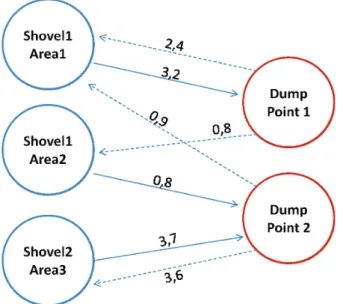
The linear programming model uses the Simplex algorithm with Branch and Bound techniques. The result is given by a set of graphs (by truck model), where each node represents a pair of shovel /loading point or dump point and each edge corresponds to a truck stretch (full or empty). Every graph’s edge fi xes the number of trucks that should be kept on the corresponding stretch in order to achieve the maximum production of each shovel, considering all of the operational constraints already mentioned (Figure 1).
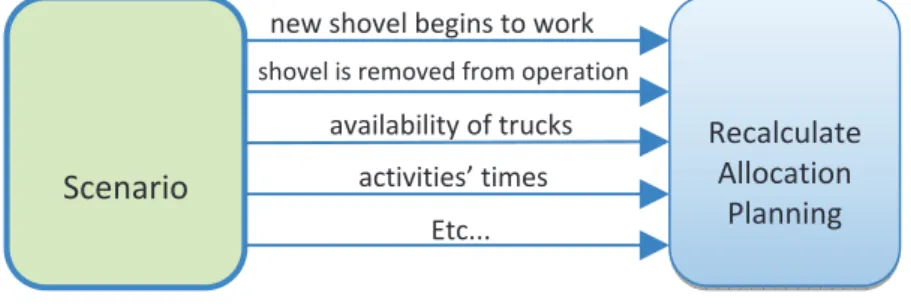
This phase of the algorithm runs every time that the mine’s scenario has been changed; it happens, for example, when a new shovel begins to work, a shovel is removed from operation, the availability
FIG 1 - Example of a graph resulting from the allocation planning. The blue circles represent the pairs of shovel/loading points and the red ones represent the dump points. The full lines are the truck full stretches and the dotted lines are the truck empty stretches. The label of each stretch is the number of trucks that
of trucks has been modifi ed considerably, the activities’ times have been modifi ed, the loading points used have been changed to comply with the mining plan, etc (Figure 2). Thus we have assurance that the results remain realistic.
Dynamic allocation
The dynamic allocation heuristics used in the algorithm described in this paper have two advantages over the techniques described in the literature for the truck dispatch problem. The fi rst is the use of simulations to predict the performance of the mine before taking a decision for the next requester trucks. This eliminates the aspect described by Alarie and Gamache (2002) as ‘myopic’ or short sited decision making, where the dispatch of the current truck does not consider its effect on the next requests. Another advantage of the method is to use multiobjective optimisation techniques to determine the best combination without a single criterion for prioritising dispatch thus avoiding the side effects reported in some of the criteria described by Munirathinan and Yingling (1994).
This phase of the algorithm runs every time a truck requests an allocation, ie when one fi nishes a dump, when a truck begins to work, or when the shovel and/or the loading point which the truck was servicing has been become unavailable.
It aims to fi nd an allocation for the truck that best meets the allocation planning, ie, it fi nds the allocation that achieves these goals: to maximise the productivity of the transport fl eet, to minimise the queue times at the shovels and to minimise the idle times of the shovels; all these goals are treated considering all operational constraints at the mine. It is noteworthy that in this context, an allocation is the indication of shovel, loading point and dump point to which the truck must proceed.
The proposed heuristic follows the m-trucks-for-n-shovels strategy, and the following input parameters are considered: the truck that is requesting the allocation, the current mine’s operating scenario, the current allocation planning, the operational constraints for allocation and the prioritisation of objectives to be considered when choosing the best solution. Regarding operational constraints for allocation, they refer to: which machines load which trucks (or truck models), the permission or not for a truck be allocated to another pit and the capacity of simultaneous dumps on each dump points.
Given the input parameters, the algorithm then runs the steps presented on Figure 3. The following subsections describe these phases.
Scenario
Recalculate Allocation Planningnewshovelbeginstowork
shovelisremovedfromoperation
availabilityoftrucks activities’times
Etc...
FIG 2 - Changes on mine’s scenario that recalculate the allocation planning.
Thepossible solutionsare generated Eachsolutionis simulatedThebestsolutions
arefoundusinga
multiͲcriteria approach Onesolutionis chosenby prioritiesdefined bytheuser Thesolutionis validatedusinga fuzzyexpert Theallocationis returnedtothe truck
Generation of possible solutions
In this phase, the algorithm builds all possible combinations of allocation for the dispatch request and for the n next requests for allocation (where n is a parameter of the algorithm), taking into account all operational constraints for the allocations. This is important because if the algorithm uses only the requested allocation, it could have a myopic view of the reality, which means that at the next phase the simulation would not take into account situations that could actually occur, and consequently, the fi nal solution would be of lesser quality. Thus, we chose to use multiple requests, and the next requests are obtained based on the forecast of time when the trucks will fi nish their next dumping activity.
Each combination of allocations is treated as a possible solution for the problem and the set of all the solutions generated is passed to the next phase.
Simulation of the possible solutions
This phase is crucial for the quality of the results obtained from the algorithm.
The algorithm runs a discrete event simulation of the operating cycle of the trucks, using the historical times of operation of each item of equipment as the time value of the activities of the simulation.
The simulation considers all the necessary variables of the mine’s current operating scenario. It runs until all of the trucks combined have completed their next cycle. Then the following information is returned for each simulated solution: production of ore and waste, the productivity of the shovels, the adherence to the allocation planning, the idle times of the shovels and queue times of the trucks.
Defi ning the solution to be used
In this phase the algorithm selects the best solutions among all of the generated solutions using multicriteria optimisation techniques, considering all the competing objectives previously mentioned (productivity, queues, and idle times).
As it is not mathematically possible to defi ne which is the best solution in the best solutions set, the algorithm considers the prioritisation of objectives given by the user (given as an input parameter of the algorithm) to allow choice of one solution among the best solutions.
Validating the solution
As the dynamic allocation strategy is a heuristic, it is possible that it generates, in some situations, undesired solutions. Therefore, this post-optimisation phase runs a fuzzy logic that avoids solutions where a shovel is very crowded while another shovel has very high availability. If this happens, the allocation of the truck is modifi ed.
Such action shall take as little time as possible and the frequency of occurrence is a quality index of the allocation heuristic.
Returning the allocation
At the end of all these phases the allocation of the requesting truck is then returned by the algorithm. Moreover, during the execution of the algorithm it is possible that other trucks have fi nished the dumping process and are requesting an allocation. If this happens, the allocations of the trucks already present in the chosen solution is returned to them without need to rerun the algorithm.
Over-trucked scenario
There are actual situations in mines where there are more trucks than the number determined by the optimum sizing found by the allocation planning algorithm. This means that there is some restriction on the operating scenario (such as loading rate of the shovels, the availability of loading/ dump points, moving time on a route, etc) preventing the use of the entire fl eet, ie if all the trucks were used the obtained result would not a greater production, but a worsening of the queue’s indices.
The allocation heuristic handles these situations by suggesting that the excess trucks be stopped. In that case, whenever an allocation is requested it checks the data in the mine’s current scenario and decides if it is over-trucked compared with the allocation plan. If the excess of trucks be greater than a threshold given as an input parameter, then the truck must be stopped.
Such treatment is a major benefi t to the mine because it reduces the cost of operation necessary to achieve the maximum possible production.
EXPERIMENTAL RESULTS
To ensure that the proposed approach is applicable in actual operational environments instances have been set up based on historical data from an open pit mine operated with the SmartMine® dispatching system. These instances represent the actual behaviour of two operation shifts that work with the SmartMine® Optimisation Module disabled, ie the allocations in these shifts were defi ned manually using the fi xed truck assignment (FTA) rule. Because they are real instances, these data include various unexpected situations, intrinsic to the mining process, that have occurred during such periods. Thus, this work has an important contribution in publishing the fi rst real instances for this problem with a high level of detail.
The test approach adopted is to simulate the actual instances calling for optimisation when an allocation is requested. The simulation uses a stochastic model and distributions data representing durations of activities. The rates of production and operational delays are compared at the end of the simulation with that obtained by the manual FTA, contained in the instances. Note that the comparison made in this paper considers a manual FTA that is aided by a dispatching system, and that even without the optimisation module enabled, contributes with positioning information and status of the equipment in the mine, minimising the diffi culty of defi ning an allocation manually. A comparison with the manual FTA without the aid of such system should take into consideration other criteria and methodologies that are not part of this study and that the proposed optimisation method would show even greater gains
Because of the large volume of data, the various instances are not presented in this text, but can be accessed at the web site http://devexmining.com/smartmine/research/optimisation/benchmarks/ The contents of the fi les are organised as follows:
• Pits: a set of pits that compose the simulated open pit mine.
• Pits_groups: defi nes if the trucks can haul between different pits. Because of operational issues, some mines do not allow their trucks to travel from one pit to another during the operational cycles, but also there are other cases where this is permitted.
• Workplaces: a set of loading and dumping points. For each dumping point the number of trucks that can unload at the same time is reported. This is necessary to differentiate, for example, crushers that have only one silo and other points that allow the simultaneous dumping of more than one truck.
• Truck_models: models of the transport fl eet. For each model the transport capacity by type of material, for example, ore and waste are reported.
• Trucks: set of trucks that have operated for the shift. For each truck its situation at the beginning of the period, reporting their operational state is informed. If the equipment started the shift in the shovel’s queue or on some other part of the operating cycle state is also reported the remaining time for the activity, as well as its points of departure and arrival, which are related to workplaces previously reported. The states that compose the operating cycle are moving empty, loading manoeuvre, loading, moving full, dumping manoeuvre and dumping.
• Loaders: set of shovels. For each shovel its situation at the beginning of the shift is informed, indicating their operational state. Some equipment may be prohibited from loading certain models of trucks because of physical or operational constraints, and this section also contains this information.
• Tasks: set of relations between loading and dumping points that defi nes the features of the material movement between different parts of the mine, ie where the material is loaded and where it goes. In the instance this parameter represents specifi cally the existing tasks at the beginning of the shift, and over the time this set is modifi ed according to the events taking place.
• Loaders_allocations: this contains the shovels’ allocations at the beginning of the shift. A shovel can be allocated to more than one task, and as well a task can be assigned to more than one shovel. This feature enhances the reality level of the instances and enhances the fl exibility of the proposed optimisation model and demonstrates its adherence to the real context of a mine’s operation.
• Truck_allocations: the transport fl eet’s allocations at beginning of the shift. In instances where the trucks are allocated to shovels and this only applies to trucks that were standing in awaiting loading and dumping or in some part of the operating cycle at the beginning of the shift.
• Occurrences: a set of occurrences that changed the operating scenario of the mine during the shift. For each event the moment it occurs and to what event it refers is informed. Because it is real-world modelling, some simplifi cations are needed to defi ne the set of possible occurrences, so this set is acceptable to represent all the situations of changed scenarios. For occurrences like reallocation and return to work, also the new allocation of shovels is informed, ie, which loading point will work and for which dumping points will the material loaded be hauled.
• Graph_by_workplace: graphs separated by truck models representing the transportation network of the mine. The vertices of the graphs are the loading points with their shovels or the dumping points and they also report loading manoeuvres, loading, dumping manoeuvre and dumping times. The edges represent the transportation network itself that report travel time between the work places. Each edge has a set of travel time that represent a data distribution used in stochastic simulation model applied in the computational experiments.
• Ore_Production: ore production done during the shift being studied.
• Waste_Production: waste production done during the shift.
• Waiting_time_on_loading: total time in the loading queue.
• Waiting_time_on_dumping: total time in the dumping queue.
• WasteOreRatio: this measure is a coeffi cient given by the ratio between the total waste tonnage and the total ore tonnage hauled by the trucks during a given time interval, eg a shift duration. To the computational experiments, the time spent in each activity is stochastic and due to stochastic nature of the simulation, was necessary run the same model several times in order to get a reliable comparison between the optimised method and the historical (manual) data. So, the experiment was repeated for 50 times on each one of the scenarios. At the end of the 50 independent runs a mean value for the counters: ore tonnes; waste tonnes; waste/ore; loading waiting time and shovels idle time were computed, and the independent results sampled of each instance were used to compute a confi dence interval for the output counters with 95 per cent of confi dence level. The mean of this confi dence interval were used as a reference to calculate the gains obtained using the approach presented in the paper over the results given by the manual fi xed truck assignments, which is present in the historical data.
The results that have been observed are discussed in the next sections.
Instance ‘open pit mine dispatch truck IO 01’
In this instance (also called scenario 01) are present 29 trucks with a capacity of 35 tonnes, six trucks with a capacity of 150 tonnes, fi ve small shovels and three large shovels, seven ore loading points, two waste loading points, four ore dumping points and two waste dumping points, with the fl eet and workplaces distributed in two pits. The duration of the work shift was six hours.
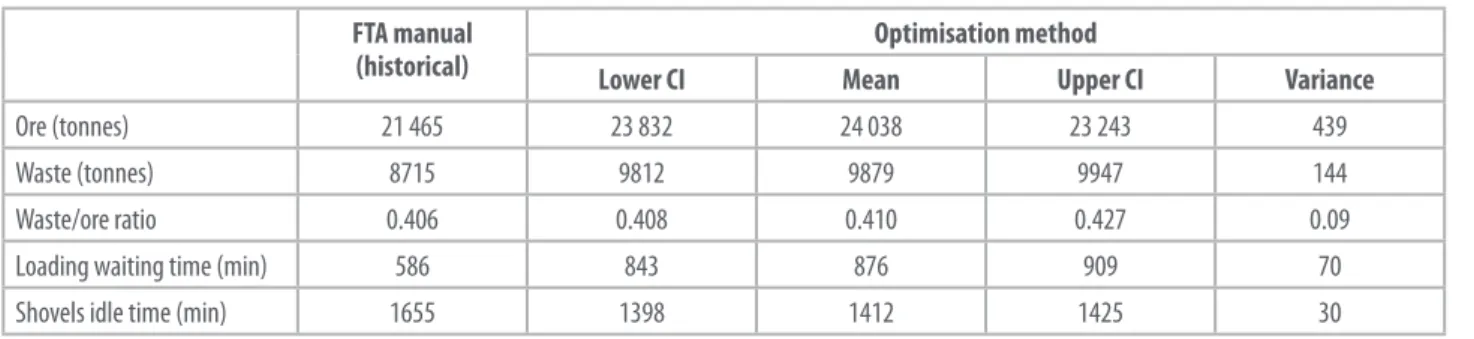
Table 1 presents the experimental results from the application of the optimisation method to the work shift considering 50 stochastic independent repetitions of the algorithm over the scenario 01. In this table, the rows present different output counters: tonnes hauled for ore and waste materials, the ‘stripping ratio’ (waste/ore ratio) achieved, the total ‘waiting time in loading queues’ and the total ‘shovel idle time’. The total waiting time on loading is the sum of the times that each truck remains in loading queue. Likewise, the total idle time of the shovels are given by the sum of the times that each shovel is idle during the operation. The total time on queue is a slice of the total time simulated for
FTA manual (historical)
Optimisation method
Lower CI Mean Upper CI Variance
Ore (tonnes) 21 465 23 832 24 038 23 243 439
Waste (tonnes) 8715 9812 9879 9947 144
Waste/ore ratio 0.406 0.408 0.410 0.427 0.09
Loading waiting time (min) 586 843 876 909 70
Shovels idle time (min) 1655 1398 1412 1425 30
TABLE 1
all trucks (ie the number of trucks times the work shift duration); the total idle time is a slice of the total time simulated for all shovels (ie, the number of shovels times the work shift duration).
In the columns are given these results in two blocks: the fi rst one presents the historical results given by the manual fi xed truck assignment (historical results) and the second block presents the results given by the application of the approach described in this paper over the scenario 01. The results presented in the second block are divided in the following sections: the lower limit for the confi dence interval at 95 per cent of confi dence level, mean value, upper limit for the confi dence interval at 95 per cent of confi dence level and the sample variance of the results of each independent repetition.
Considering the analysis with the mean and historical value of each performance measure, can be seen that the proposed method was able to increase the total production for this work shift by 3737 tonnes (ie the difference between the total tonnes in the historical and the simulated data, where total tonnes are the sum of ore and waste tonnes), that represents a gain of 12.38 per cent. The operational delay with the loading queue was increased by 49.49 per cent and a decrease of 14.68 per cent in the delay with the shovels idle time can be observed. The stripping ratios were closed to the historical result.
Another important detail given in Table 1 consists of the difference in shovel utilisation. The column named ‘shovel idle time’ shows that the shovels have been idle in the scenario that uses the FTA method as the dispatch rule for about 200 minutes more than in the scenario where the proposed algorithm was used. This directly implies greater production when the dynamic heuristic was employed, since the shovels worked for a longer time during the shift. However, the scenario where the proposed algorithm was used to make dispatch decisions results in trucks waiting for longer times in the queues for loading than they did for the scenario that uses FTA – in fact, it is expected that once the truck dispatch problems have a multiobjective nature it is impossible improve one dimension without deterioration of the other. Considering this trade-off, it is better to produce more tonnage with some loading waiting than avoiding queues but decreasing the production for the entire work shift.
Instance ‘open pit mine dispatch truck IO 02’
These scenario, named scenario 02, is composed by 29 trucks with a capacity of 35 tonnes, fi ve trucks with a capacity of 150 tonnes, fi ve small shovels and two large shovels, six ore loading points, two waste loading points, three ore dumping points and two waste dumping points, with the fl eet and workplaces distributed in two pits. The duration of the work shift was six hours.
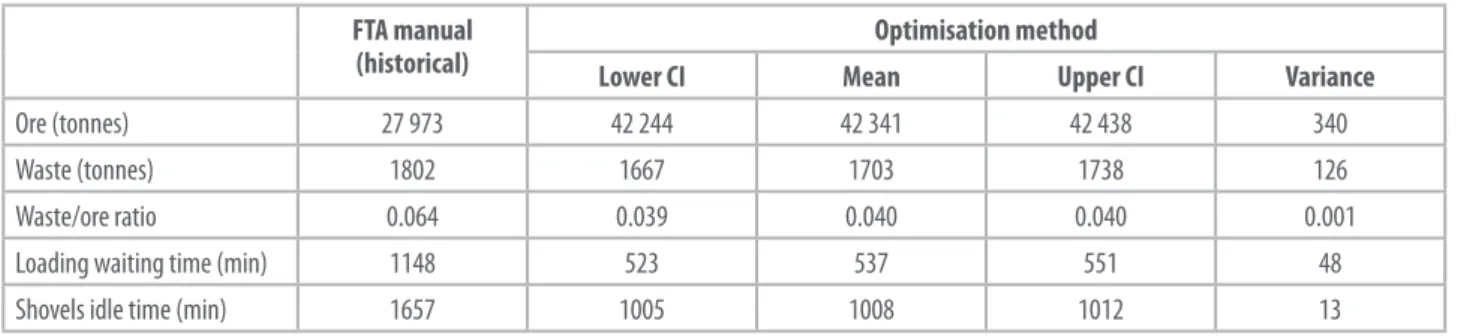
Table 2 presents the experimental results from the application of the optimisation method to the work shift considering 50 stochastic independent repetitions of the algorithm over the scenario 02. This table follows the same format given by the Table 1.
As in the previous experiment, the gain is computed considering the difference between the total tonnes of the historical and simulated result (fi eld named ‘mean value’ of the table), where the total tonnes are given by the sum of tonnes of ore and waste for the manual and optimised decision making. For this experiment can be seen that the proposed method was able to increase the production of this work shift by 14 269 tonnes, representing a gain of 47.92 per cent. Moreover, the operational delay with the loading queue was reduced by 53.22 per cent and a decrease of 39.17 per cent in the delay with the shovels idle time can be observed. The stripping ratio was closed for both methods.
FTA manual (historical)
Optimisation method
Lower CI Mean Upper CI Variance
Ore (tonnes) 27 973 42 244 42 341 42 438 340
Waste (tonnes) 1802 1667 1703 1738 126
Waste/ore ratio 0.064 0.039 0.040 0.040 0.001
Loading waiting time (min) 1148 523 537 551 48
Shovels idle time (min) 1657 1005 1008 1012 13
TABLE 2
CONCLUSIONS
This paper proposes a practical approach to the problem of truck dispatching in open pit mines. This approach is implemented by the SmartMine® dispatching system.
This paper also publishes instances with real data from two shifts where the allocations were defi ned manually using the fi xed truck assignment rule, with the aid of a dispatching system.
In simulations with these instances, the optimisation method was able to better defi ne the dispatching for the trucks in these two shifts, achieving gains of 12.38 per cent and 47.92 per cent in total material hauled at the mine. Moreover, it was able to reduce the levels of operational delays by 53.22 per cent. This proves that the successful use of multiobjective optimisation techniques united with simulation techniques in a multistage strategy to solve this problem.
Although the method is able to attend the goals of maintaining material quality, this study could not evaluate this criterion, because the instances did not have relevant parameters, allowing only the challenge to deal with the waste/ore ratio for the shifts.
Based on the results, is possible see clearly the advantages of using the proposed optimisation method as a tool for truck dispatching in open pit mines, given that this method was applied in the context of an actual mine operation and performed very effi ciently.
ACKNOWLEDGEMENTS
This work was supported by the Devex SA.
REFERENCES
Ahuja, R K, Magnanti, T L and Orlin, J B, 1993. Network Flows: Theory, Algorithms, and Applications
(Prentice Hall).
Alarie, S and Gamache, M, 2002. Overview of solution strategies used in truck dispatching systems for open pit mines, International Journal of Surface Mining, Reclamation and Environment, 16:59-76.
Banks, J, 1998. Handbook of Simulation: Principles, Methodology, Advances, Applications, and Practice
(Wiley-Interscience).
Banks, J, Carson, J S, Nelson, B L and Nicol, D M, 2000. Discrete-Event System Simulation, third edition (Prentice Hall).
Bazaraa, M S, Jarvis, J J and Sherali, H D, 2004. Linear Programming and Network Flows, third edition (Wiley-Interscience).
Beaulieu, M and Gamache, M, 2006. An enumeration algorithm for solving the fl eet management problem in underground mines, Computers and Operations Research, 33(6):1606-1624.
Bertsimas, D and Tsitsiklis, J N, 1997. Introduction to Linear Optimization (Athena Scientifi c).
Bertsimas, D J and van Ryzin, G J, 1991. A stochastic and dynamic vehicle routing problem in the Euclidean plane, Operations Research, 39:601-615.
Blouin, S, Guay, M and Rudie, K, 2007. An application of discrete-event theory to truck dispatching, Central European Journal of Operations Research, 15(4):369-391.
Bräysy, O and Gendreau, M, 2005. Vehicle routing problem with time windows part I: Route construction and local search algorithms, Transportation Science, 39:104-118.
Dantzig, G B and Ramser, J H, 1959. The truck dispatching problem, Management Science, 6(1):80-91.
Ercelebi, S G and Bascetin, A, 2009. Optimization of shovel-truck system for surface mining, Journal of The Southern African Institute of Mining and Metallurgy, 109:433-439.
Garey, M R and Johnson, D S, 1979. Computers and Intractability: A Guide to the Theory of NP-Completeness,
fi rst edition(W H Freeman).
Gendreau, M, Guertin, F, Potvin, J Y and Seguin, R, 2006. Neighborhood search heuristics for a dynamic vehicle dispatching problem with pick-ups and deliveries, in Transportation Research Part C: Emerging Technologies, 14(3):157-174.
Gendreau, M, Potvin, J Y, Bräysy, O, Hasle, G and Løkketangen, A, 2008. Metaheuristics for the vehicle routing problem and its extensions: A categorized bibliography, in The Vehicle Routing Problem – Latest Advances and New Challenges (eds: B Golden, S Raghavan and E Wasil), pp 143-169.
Kallehauge, B, 2006. Formulations and exact algorithms for the vehicle routing problem with time windows,
Computers and Operations Research, 35(7):2307-2330.
Leclerc, F and Potvin, J Y, 1997. Genetic algorithms for vehicle dispatching, International Transactions in Operational Research, 4(5-6):391-400.
Lizotte, Y, Bonates, E and Leclerc, A, 1987. A design and implementation of a semi-automated truck/shovel dispatching system, in APCOM 87: Proceedings of the 20th International Symposium on the Application of Computers and Mathematics in the Mineral Industries, vol I, pp377-387 (Southern African Institute of Mining and Metallurgy: Johannesburg).
Munirathinam, M and Yingling, J C, 1994. A review of computer-based truck dispatching strategies for surface mining operations, International Journal of Surface Mining, Reclamation and Environments,
8:1-15.
Ralphs, T K, Kopman, L, Pulleyblank, W R and Trotter, L E, 2003. On the capacitated vehicle routing problem,
Mathematical Programming Series B, 94:343-359.
Rego, C and Roucairol C, 1995. Using tabu search for solving a dynamic multi-terminal truck dispatching problem, European Journal of Operational Research, 83(2):411-429.
Robinson, S, 2005. Discrete-event simulation: from the pioneers to the present, what next?, Journal of the Operational Research Society, 56(6):619-629.
Schriber, T J and Brunner, D T, 1997. Inside discrete-event simulation software: how it works and why it matters, in Proceedings 29th Conference on Winter Simulation, pp 14-22 (ACM Press: New York).
Subtil, R F, Carrano, E G, Souza, M J F and Takahashi, R H C, 2010. Using an enhanced integer NSGA-II for solving the multiobjective generalized assignment problem, in Proceedings IEEE Congress on Evolutionary Computation (World Congress on Computational Intelligence – WCCI: Barcelona).