Planning Processes on Supply Chain Integration and Performance:
A Statistical Study
Dr. Kevin McCormack Teaching Professor College of Management North Carolina State University
Raleigh, NC
Dr. Archie Lockamy III Professor of Operations Management
School of Business Samford University,
Birmingham, AL
ABSTRACT
Supply chain management (SCM) is often described as a strategy focused on improved horizontal intra- and inter-organizational integration. It is theorized in the research literature that improved supply chain integration should result in enhanced supply chain processes, which should lead to superior supply chain performance. Sales and Operations Planning (S&OP) is a process that provides management with the ability to strategically direct its businesses to achieve competitive advantage on a continuous basis by integrating customer-focused marketing plans for new and existing products with the management of the supply chain. Horizontal mechanisms, although not labeled as such, are frequently deployed within the S&OP process. These mechanisms are defined as structural overlays (such as roles and groups) and non-structural devices (such as physical co-location) that are designed to facilitate intra- and inter-organizational collaboration and integration. Using survey data gathered from several earlier studies, this paper identifies the specific horizontal mechanisms deployed within the S&OP process and statistically examines their relationship to supply chain performance.
Introduction
Increasingly, firms are adopting supply-chain management (SCM) to reduce costs, increase market share and sales, and build solid customer relations (Ferguson, 2000). SCM can be viewed as a philosophy based on the belief that each firm in the supply chain directly and indirectly affects the performance of all the other supply chain members, as well as ultimately, overall supply-chain performance (Cooper et al. 1997). The effective use of this philosophy requires that functional and supply-chain partner activities are aligned with company strategy and harmonized with organizational structure, processes, culture, incentives and people (Abell, 1999). Additionally, the chain-wide deployment of SCM practices consistent with the above-mentioned philosophy is needed to provide maximum benefit to its members.
Sales and operations planning (S&OP) is a process that provides management with the ability to strategically direct its businesses to achieve a competitive advantage on a continuous basis by integrating customer-focused marketing plans for new and existing products with the management of the supply chain (APICS Dictionary, 2005, p. 103). The process brings together all the plans for the business (sales, marketing, development, manufacturing, sourcing, and financial) into one integrated set of plans. It is performed at least once a month and is reviewed by management at an aggregate (product family) level. The process must reconcile all supply, demand, and new-product plans at both the detail and aggregate levels, and tie to the business plan. It is the definitive statement of thecompany’splansforthenearto intermediateterm covering a horizon sufficient to plan for resources and to support the annual business planning process. Executed properly, the sales and operations planning process links the strategic plans for the business with its execution, and reviews performance measures for continuous
improvement. Thus, the S&OP process provides a means for firms to achieve improved intra-and inter-organizational integration.
A review of the supply-chain literature suggests that improved supply chain integration leads to enhanced overall supply chain performance. However, there is a lack of empirical research clearly linking specific mechanisms for achieving supply-chain integration to performance. In addition, although the literature provides numerous approaches for achieving integration within supply chains, the mechanisms necessary for facilitating these approaches are not clearly defined.
Purpose
The purpose of this study is to examine the specific horizontal mechanisms deployed within Sales and Operations Planning processes, and to statistically examine their relationship to supply chain performance. The study uses data gathered in an earlier exploratory study that investigated the relationship between supply-chain management planning practices and supply chain performance (Lockamy 2004). The participants of this earlier study were selected from the membership list of the Supply Chain Council and represent fifty-five companies across several industries. Contained in this paper is: (1) An introduction to supply chain management, sales and operations planning and supply chain integration; (2) A review of the supply chain integration literature; (3) S&OP and horizontal mechanisms construct development; (4) The research results; (5) Conclusions and implications; and (6) Directions for future research.
Review of The Supply-Chain Integration Literature
The supply-chain research literature provides significant insights on the benefits of intra-and inter-organizational integration. These benefits included supply-chain cost reductions (Daniels, 1999) and enhancements in supply-chain performance in such areas as: product and
market strategies (Narasimhan and Kim, 2002); operating performance (Armistead and Mapes, 1993); and cycle time performance (Jayaram et al, 2000). Segars et al (2001) documented the use of supply-chain integration to improve process and business relationships at the Bose Corporation. Additionally, Rivard-Royer et al (2002) cited the benefits of integration within a health care supply chain. Thus, the literature suggests that tangible benefits can be accrued via effective supply-chain integration, which included increased competitiveness (Howgego, 2002).
The supply-chain research literature also includes a wide variety of approaches for achieving supply-chain integration. These approaches include: intra- and inter-organizational coordination (Caputo and Mininno, 1996 and 1998); intra- and inter-organizational collaboration (Morash and Clinton, 1998; McLaren et al, 2000; Ellinger, 2000; Chandra and Kumar, 2001); total quality management (Levy et al, 1995); enterprise resource planning systems (Tarn et al, 2002a and 2002b); enterprise management (Exon-Taylor, 1996; Braganza, 2002); inter-organizational information systems (Shah et al, 2002); and the general application of information technology within supply chains (Levary, 2001; Nissen, 2001; Sharpiro, 2001; Narashimhan and Kim, 2001; Reyes et al, 2002). In addition, the use of the Internet has been suggested as a means to achieve supply-chain integration (van Hoek, 2001; Stefanson, 2002; Frohlich and Westbrook, 2002; Frohlich, 2002; Johnson and Whang, 2002). Finally, Rudberg et al (2002) suggests the use of electronic markets to facilitate collaborative supply-chain planning for achieving supply-chain integration. These approaches can be viewed as horizontal mechanism designed to improve overall supply-chain performance.
There are numerous supply chain models (Clark et al, 2001; Min and Zhou, 2002; Li et al, 2002), frameworks (Chui, 1995; Spens and Bask, 2002), and designs (Christopher and Towil, 2001) provided in the literature for achieving supply-chain integration. However, such factors as
the supply-chain power structure (Watson, 2001), intra- and inter-organizational relationships (Hingley, 2001), supply chain requirements (Anderson, 2000), risk sharing (Arcelus et al), and supply-chain strategy (Frohlich and Westbrook, 2001) can also influence the degree to which supply-chain integration can be achieved on both an intra- and inter-organizational level. Thus structural devices (such as well-defined roles and groups) as well as non-structural devices (such as physical co-location) may be required to address these factors for achieving effective supply-chain integration.
A review of this literature suggests the following conclusions. First, the importance and necessity of supply-chain integration is well established in the literature and warrants continued research. Second, although the literature provides a plethora of approaches for achieving integration within supply chains, the mechanisms necessary for facilitating these approaches are not clearly defined. Finally, there is a lack of empirical research clearly linking specific mechanisms for achieving supply-chain integration to performance. Thus, this study is an empirical investigation of the relationship between horizontal mechanisms used in the S&OP process to facilitate supply-chain integration and performance.
Construct Development
Horizontal Mechanisms within S&OP
Supply Chain Management and specifically the Sales and Operations Planning (S&OP) process, is about coordination horizontally, across functions, geographies, divisions and supply chain partners. The APICS dictionary (APICS, 2005, p. 103) defines S&OP as
“A process to develop tactical plans that provides management the ability to strategically direct its businesses to achieve competitive advantage on a continuous basis by integrating customer-focused marketing plans for new and
existing products with the management of the supply chain. The process brings together all the plans for the business (sales, marketing, development, manufacturing, sourcing, and financial) into one integrated set of plans. It is performed at least once a month and is reviewed by management at an aggregate (product family) level. The process must reconcile all supply, demand, and new-product plans at both the detail and aggregate levels and tie to the business plan. It is the definitive statement of the company’splansforthenearto intermediate term covering a horizon sufficient to plan for resources and support the annual business planning process. Executed properly, the sales and operation planning process links the strategic plans for the business with its execution and reviews
performancemeasuresforcontinuousimprovement.”
Since S&OP is a process focusing on horizontal coordination to improve supply chain performance, horizontal mechanisms are frequently deployed. These are defined as structural overlays (such as roles and groups) and non-structural devices (such as physical co-location) that are designed to facilitate cross-unit collaboration (Brown 1999). Galbraith (1994) defines these mechanisms as consisting of:
1. Integrator roles
2. Informal organizations 3. Formal groups
Integrator Roles
Integrator roles are the basic building blocks of SCM. Assigning “process” ownership
(authority and accountability) for the basic supply chain processes of Plan, Source, Make, Deliver, and Return sets the foundation for supply chain integration. The people that fill these roles generally come from functional departments and are given expanded responsibilities for the supply chain process. This causes them to manage outside of their functional boundaries. Often a senior supply chain process owner is given overall responsibility for the supply chain. Very often, this responsibility is given to either vice president of operations, procurement or marketing, depending upon the supply chain dynamics.
Informal Organizations
As the process owners are assigned, this defines an informal team with a common overall purpose of improving supply chain performance. The formation of this team is informal and can be done through periodic meetings (i.e., S&OP decision meetings), co-location and information technology (i.e., a common S&OP spreadsheet and database). All of these mechanisms stimulate informal, voluntary cooperation between the process owners. This can be within the supply chain as well as between the supply chains of a company.
Formal Groups
In order to realize a high level of integration, some level of formalization of the horizontal SCM organization must occur. The S&OP leadership team, lead by the senior process owner, is formally chartered and formed with specific goals, objectives, resources, performance measures and compensation plans. Authority for staffing the S&OP process teams is moved from the functional areas to the SCM team, with the advice and consent of the functions (but not veto power). Integrating information technology becomes a critical investment at this stage. SC
performance systems, analytical tools, network configuration tools all are key enablers of this
group’seffectiveness.
Network Building Practices
The building of the S&OP network is done through events designed to build relationships and communication channels. Formal arrangements often follow with the appointment of integrator roles (i.e., relationship managers or boundary spanners if internal) whose jobs are to connect and coordinate with each other. From an external perspective, strategic partners are often selected for key product supply areas, and deep connections are built such as supplier and employees participating in S&OP processes and meetings, shared information technology systems, and the two-way sharing of information. As the S&OP process matures, the network becomes the organization, and company boundaries blur and become very porous.
Measures
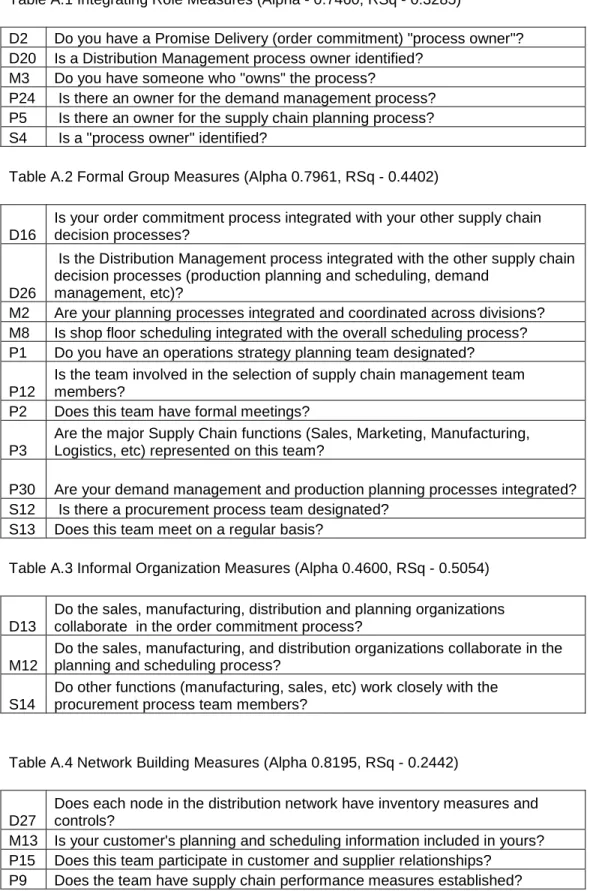
Measures for the four horizontal mechanism constructs identified as being deployed within S&OP were developed using the base survey from the earlier research. A literature review, along with discussions and interviews with supply chain experts and practitioners was used as the basis for developing survey questions used in this earlier research. The questions focused on seven key supply-chain management planning decision categories: operations strategy planning, demand management, production planning and scheduling, procurement, promise delivery, balancing change, and distribution management.
Thebase survey asked respondentsto providetheiropinion concerning “whatisdone,how often,who doesitand how itisdone”in theirsupply chain and used a5-item Likert scale
measuring the frequency of the practices consisting of: 1 –never or does not exist; 2 – sometimes; 3–frequently; 4–mostly; and 5–always or definitely exists.
In order to develop the final measures thought to represent the horizontal mechanism constructs within S&OP, questions were selected from the base survey and tested with SCM experts for face validity. Adjustments were made and a final list of measures for each construct was developed and is contained in Appendix A.
The measure of supply chain performance used in the earlier survey was a self-assessed
performancerating reflecting thesurvey respondent’sview oftheirsupply chain management
performance. The specific measure for supply chain performance used in the earlier survey was:
“Overall,thisdecision processareaperformsvery well.”Theparticipantswereasked to either
agree or disagree with the item statement using a five-point Likert scale (1=strongly disagree; 5=strongly agree). This question was asked for each area of the supply chain as defined by the Supply Chain Council. These are Plan, Source, Make and Deliver. The study was conducted prior to the inclusion of the Return area by the Supply Chain Council.
Research Results
In the earlier study that generated the data used in this research, the study participants who
wereasked to completethesurvey wereselected from the“user”orpractitionerportion ofthe
membership list of the Supply Chain Council. This represented members whose firms supplied a product, rather than a service, and were thought to be generally representative of supply chain practitioners rather than consultants. This list consisted of 523 individuals and 90 firms. In conducting the earlier research, the complete survey instrument was mailed to all individuals on the list. Of the 523 surveys distributed, 28 were returned due inaccurate addresses. Fifty-five
usable surveys were returned for a response rate of 10.5%. The sample profile of the final data set used in this research is provided in Tables 1, 2 and 3.
Table 1
Sample profile
Industry description Number of responses Response percentages Electronics 6 10.9 Transportation 2 3.6 Industrial Products 2 3.6
Food & Beverage/CPG 8 14.5
Aerospace & Defense 2 3.6
Chemicals 4 7.3 Apparel 1 1.8 Utilities 10 18.2 Pharmaceuticals/Medical 3 5.5 Mills 0 0.0 Semiconductors 1 1.8 Other 16 29.1 Total 55 100% Table 2
Respondent profile by position
Respondent position Number of responses Response percentages
Senior Leadership/Executive 19 38.0
Senior Manager 10 20.0
Manager 17 34.0
Individual Contributor 4 8.0
Table 3
Respondent profile by function
Respondent function Number of responses Response percentages
Sales 1 2.0
Information Systems 3 5.9
Planning and Scheduling 8 15.7
Marketing 0 0.0 Manufacturing 4 7.8 Engineering 0 0.0 Finance 0 0.0 Distribution 4 7.8 Purchasing 9 17.7 Other 22 43.1 Total 51 100%
In conducting this research study, the specific measures identified as relating to the horizontal mechanisms in S&OP were extracted from the overall data set. Construct variables were developed by summing the results for all questions related to that construct (see Appendix A for the individual measures within each construct). This became the independent variable to be used in the regression analysis. Coefficient alphas were run on each set of measures and are also contained in Appendix A. Coefficient alpha measures the internal consistency of a set of items and were partly used to assess the quality of the instrument. A low coefficient alpha indicates that the sample of items performs poorly in capturing the construct and a large alpha indicates that the test correlates well with true scores. A minimum acceptable criterion of 0.7 was used for this analysis (Churchill 1979). All were above 0.7 except the informal organization measures, which were 0.46. Attempts were made to improve this value but the measures used were the only measures in the data set that seemed to represent the construct and this was the largest coefficient that could be achieved. Since these measures had a strong face validity with supply chain experts, it was decided to use the measures identified. The dependent variable in each case
was the sum of the self-assessed performanceratingsreflecting thesurvey respondent’sview of their supply chain management performance.
Single variable linear regression analysis was used to test the hypothesized relationships between each horizontal mechanism construct identified as in use within S&OP and the self-assessed performance rating. The results of the regression analysis for each of the four horizontal mechanism types are illustrated in Figure 1 and contained in Appendix A. Since each regression model contains only one independent variable, these models are equivalent to bivariate correlations. INFORMAL 16 14 12 10 8 6 4 2 B A S IC P P 20 18 16 14 12 10 8 6 4 Rsq = 0.5054 INTROLE 40 30 20 10 0 B A S IC P P 20 18 16 14 12 10 8 6 4 Rsq = 0.3285 FORMAL 60 50 40 30 20 10 B A S IC P P 20 18 16 14 12 10 8 6 4 Rsq = 0.4402 NETWORK 50 40 30 20 10 B A S IC P P 20 18 16 14 12 10 8 6 4 Rsq = 0.2442
All regression results show a statistically significant relationship (95% confidence or greater) between the horizontal mechanism constructs and performance. Surprisingly, informal mechanisms had the largest regression coefficient (0.5054) followed by formal mechanisms (0.4402), then integrator roles (0.3285) and finally network mechanisms (0.2442).
Conclusions and Implications
From the literature review it is apparent that the implementation of a Sales and Operations Planning process can be accomplished in a variety of ways. The process and techniques themselves do not necessarily require horizontal (intra- and inter-organizational) integration. The joint plans and decision meetings required by the S&OP process can be developed without the cross-functional cooperation implied by the activity. However, the results of this study strongly suggest that organizations can enhance their S&OP processes by deploying horizontal mechanisms that are designed to facilitate intra- and inter-organizational collaboration and integration.
The horizontal mechanisms highlighted as significant in this study that were no surprise were the formation of integrating roles and a formal organization, both fundamental to implementing S&OP. What was a surprise though was the strong regression coefficient for the informal organization mechanism, essentially cross-functionalcollaboration.Thisindicatesthatthe“soft” aspects of implementing an S&OP process can make a big difference. Collaboration consists of attitudes as much as behaviors. How something is done is as important as what is done. The S&OP cross-functional meetings can occur, but without this collaboration, their effectiveness can be reduced.
The network building practices were also shown to improve performance. The suggestion here is that the more the S&OP process extends outward beyond company boundaries, the better
the performance. Thus, including, or even formally integrating, suppliers and customers into the S&OP process through the inclusion of their people and sharing of data and plans can improve
theperformanceofacompany’ssupply chain.
Future Research
This study introduced the concept of horizontal mechanisms as a method for improving supply chain performance through improved intra and inter-organizational integration. The set of measures constructed from the existing data may have limited their effectiveness at representing the constructs. Specifically, the informal organization measures, with the low coefficient alpha, can be improved. Collaboration, suggested here as representing the informal organization construct, is a complex concept. In order to expand the usefulness of this concept as applied to S&OP, new measures for the informal organization construct should be developed, validated and tested. A new data set should be constructed using these new measures and the results suggested by this research tested. This can provide a more prescriptive model that can assist practitioners in implementing an effective S&OP process.
References
Abell, D.F., 1999. Competing today while preparing for tomorrow. Sloan Management Review. 40 (3), 73-81.
Anderson, S. C., 2000. The globally competitive firm: functional integration, value chain logistics, global marketing, and business college strategic support. Competitiveness Review. 10 (2), 33-45.
Agarwal, A. and Shankar, R., 2002. Analyzing alternatives for improvements in supply chain performance, Work Study, 51 (1), 32-35.
Arcelus, F. J., Pakkala, T.P.M. and Srinivasan, G., 2002. A purchasing framework for b2b pricing decisions and risk-sharing in supply chains. Decision Sciences. 33 (4), 645-666. Armistead, C.G. and Mapes, J., 1993. The impact of supply chain integration on operating performance. Logistics Information Management. 6 (4), 9-15.
Blackstone, J. H. and Cox , J. F. (editors), 2005. APICS Dictionary, Eleventh Edition, APICS, Alexandria, VA.
Braganza, A., 2002. Enterprise integration: Creating competitive capabilities. Logistics Information Management. 13 (8), 562-572.
Brown, C.V., 1999. Horizontal mechanism under differing is organization contexts. MIS
Quarterly.23 (3), 421-454.
Caputo, M. and Mininno, V., 1996. Internal, vertical and horizontal logistics integration in Italian grocery distribution. International Journal of Physical Distribution & Logistics Management. 26 (9), 64-90.
Caputo, M. and Mininno, V., 1998. Configurations for logistics co-ordination: A survey of Italian grocery firms. International Journal of Physical Distribution & Logistics Management. 28 (5), 349-376.
Chandra, C. and Kumar, S., 2001. Enterprise architectural framework for supply-chain integration. Industrial Management and Data Systems. 101 (6), 290-303.
Chiu, H. N., 1995. The integrated logistics management system: A framework and case study. International Journal of Physical Distribution & Logistics Management. 25 (6),4-23.
Christopher, M. and Towil, D., 2001. An integrated model for the design of agile supply chains, International Journal of Physical Distribution and Logistics Management, 31 (4), 235-246.
Churchill, G.A., 1979. A paradigm for developing better measures of marketing constructs. Journal of Marketing. 16 (1), 64-73.
Clark, T.H., Corson, D.C., and Schiano, W.T., 2001. A hierarchical model of supply chain integration: information sharing and operational interdependence in the us grocery channel. Information Technology and Management. Vol. 2, 261-288,
Cooper, M.C., Lambert, D.M., and Pagh, J. D., 1997. Supply chain management: more than a new name for logistics. The International Journal of Logistics Management. 8 (1), 1-14. Daniels, B., 1999. Integration of the supply chain for total through-cost reduction. Total Quality Management. 10 (4/5), 481-490.
Ellram, L.M., 1991. Supply chain management: the industrial organisation perspective. International Journal of Physical Distribution & Logistics Management. 21 (1), 13-23.
Ellinger, A.E., 2000. Improving marketing/logistics cross-functional collaborations in the supply chain. Industrial Marketing Management. 29 (1), 85-96.
Exon-Taylor, M., 1996. Enterprise management- the logical integration of the supply chain. Logistics Information Management. 9 (2), 16-21.
Fawcett, S.E. and Magnan, G.M., 2002. The rhetoric and reality of supply chain integration. International Journal of Physical Distribution & Logistics Management. 32 (5), 339-361. Ferguson, B. R., 2000. Implementing supply chain management. Production and Inventory Management Journal. 2 (2), 64-67.
Frohlich, M.T. and Westbrook, R., 2001. Arcs of integration: An international study of supply chain strategies. Journal of Operations Management. 19 (2), 185-200.
Frohlich, M.T., 2002. E-integration in the supply chain: barriers and performance. Decisions Sciences. 33 (4), 537-556.
Frohlich, M.T. and Westbrook, R., 2002. Demand chain management in manufacturing and services: Web-based integration, drivers and performance. Journal of Operations Management. 20 (6), 729-745.
Galbraith, J.R., 1994. Competing with Flexible Lateral Organizations,Addison-Wesley, Reading, MA.
Halley, A. and Nollet, J., 2002. The supply chain: the weak link for some preferred suppliers? The Journal of Supply Chain Management, Summer, 39-47.
Hingley M., 2001. Relationship management in the supply chain. International Journal of Logistics Management. 12(2), 57-71.
Holmberg, S., 2000. A systems perspective on supply chain measurements. International Journal of Physical Distribution & Logistics Management. 30 (10), 847-868.
Howgego, C., 2002. Maximising competitiveness through the supply chain. International Journal of Retail & Distribution Management. 30 (11/12), 603-605.
Jayaram, J., Vickery, S.K., and Droge, C., 2000. The effects of information system infrastructure and process improvements on supply-chain time performance. International Journal of Physical Distribution & Logistics Management. 30 (3/4), 314-330.
Johnson, M. E. and Whang, S., 2002. E-business and supply chain management: an overview and framework. Production and Operations Management. 11 (4), 413-423.
Larson, P.D. and Rogers, D.S., 1998. Supply chain management: definition, growth, and approaches. Journal of Marketing Theory and Practice. 6 (4), 1-5.
Levary, R.R., 2001. Computer integrated supply chain. International Journal of Materials & Product Technology. 16 (6/7), 463-483.
Levy, P., Bessant, J., Sang, B., and Lamming, R., 1995. Developing integration through total quality supply chain management. Integrated Manufacturing Systems. 6 (3), 4-12.
Li, Z., Kumar, A., and Lim, Y. G., 2002. Supply chain modeling - a co-ordination approach. Integrated Manufacturing Systems. 13 (8), 551-561.
Lockamy, A. and McCormack, K.P., 2004. Linking SCOR planning practices to supply chain performance: an exploratory study. International Journal of Operations & Production
Management. 24 (12), not yet published.
McLaren, T., Head, M., and Yuan,Y., 2002. Supply chain collaboration alternatives: Understanding the expected costs and benefits. Internet Research. 12 (4) 348-364.
Min, H. and Zhou,G., 2002. Supply chain modeling: Past, present and future.Computers & Industrial Engineering. 43 (1/2), 231-249.
Morash, E. A. and Clinton, S.R., 1998. Supply chain integration: customer value through collaborative closeness versus operational excellence. Journal of Marketing Theory and Practice. 6 (4), 104-121.
Narashimhan, R. and Kim, S. W., 2001. Information system utilization strategy for supply chain integration. Journal of Business Logistics. 2 (2), 51-75.
Narashimhan, R. and Kim, S. W., 2002. Effect of supply chain integration on the relationship between diversification and performance: Evidence from Japanese and Korean firms.
Nissen, M.E., 2001. Agent-based supply chain integration. Information Technology and Management. Volume 2, 289-312.
Reyes, P., Raisinghani, M., Singh, M., 2002. Global supply chain management in the
telecommunications industry: the role of information technology in the integration of supply chain entities. Global Supply Chain Management. 5 (2), 48-68.
Rivard-Royer, H., Landry, S., and Beaulieu, M., 2002. Hybrid stockless: a case study. International Journal of Operations and Production Management, 22 (4), 412-424.
Rudberg, M., Klingenberg, N., and Kronhamn, K., 2002. Collaborative supply chain planning using electronic marketplaces. Integrated Manufacturing Systems. 13 (8), 596-610.
Sabath, R., 1995. Volatile demand calls for quick response: The integrated supply chain. Logistics Information Management. 8 (2), 49-53.
Segars, A.H., Harkness,W. J., Kettinger, W.J., 2001. Process management and supply-chain integration at the Bose Corporation. Interfaces. 31 (3), 102-114.
Shah, R., Goldstein, S.M., and Ward, P.T.,2002. Aligning supply chain management characteristics and interorganizational information system types: An exploratory study.
IEEE Transactions on Engineering Management. 49 (3), 282-292.
Sharpiro, J. F., 2001. Modeling and it perspectives on supply chain integration. Information Systems Frontiers. 3 (4), 455-464.
Spens, K.M. and Bask, A.H., 2002. Developing a framework for supply chain management. International Journal of Logistics Management. 13(1), 73-88.
Stefanson, G., 2002. Business-to-business data sharing: A source for integration of supply chains. International Journal of Production Economics. 75 (1/2), 135-146.
Stevens, Graham C., 1990. Successful supply-chain management. Management Decision. 28 (8), 25-31.
Tarn, J. M., Razi, M.A., Yen, D.C., and Xu, Z., 2002. Linking ERP and SCM systems.
International Journal of Manufacturing Technology and Management. 4 (5), 420-439. Tarn, J. M., Yen, D.C., and Beaumont, M., 2002. Exploring the rationales for ERP and SCM integration. Industrial Management and Data Systems. 102 (1), 26-34.
Van Hoek, R., 1998. Logistics and virtual integration Postponement, outsourcing and the flow of information. International Journal of Physical Distribution & Logistics Management. 28 (7), 508-523.
Van Hoek R., 2001. E-supply chains - virtually non-existing. Supply Chain Management . 6 (1), 21-28.
Watson, G., 2001. Subregimes of power and integrated supply chain management. Journal of Supply Chain Management. 37(2), 36-41.
Appendix A
Survey Questions Relating to Horizontal Mechanism Constructs Table A.1 Integrating Role Measures (Alpha - 0.7460, RSq - 0.3285)
D2 Do you have a Promise Delivery (order commitment) "process owner"? D20 Is a Distribution Management process owner identified?
M3 Do you have someone who "owns" the process?
P24 Is there an owner for the demand management process? P5 Is there an owner for the supply chain planning process? S4 Is a "process owner" identified?
Table A.2 Formal Group Measures (Alpha 0.7961, RSq - 0.4402)
D16
Is your order commitment process integrated with your other supply chain decision processes?
D26
Is the Distribution Management process integrated with the other supply chain decision processes (production planning and scheduling, demand
management, etc)?
M2 Are your planning processes integrated and coordinated across divisions? M8 Is shop floor scheduling integrated with the overall scheduling process? P1 Do you have an operations strategy planning team designated?
P12
Is the team involved in the selection of supply chain management team members?
P2 Does this team have formal meetings? P3
Are the major Supply Chain functions (Sales, Marketing, Manufacturing, Logistics, etc) represented on this team?
P30 Are your demand management and production planning processes integrated? S12 Is there a procurement process team designated?
S13 Does this team meet on a regular basis?
Table A.3 Informal Organization Measures (Alpha 0.4600, RSq - 0.5054)
D13
Do the sales, manufacturing, distribution and planning organizations collaborate in the order commitment process?
M12
Do the sales, manufacturing, and distribution organizations collaborate in the planning and scheduling process?
S14
Do other functions (manufacturing, sales, etc) work closely with the procurement process team members?
Table A.4 Network Building Measures (Alpha 0.8195, RSq - 0.2442)
D27
Does each node in the distribution network have inventory measures and controls?
M13 Is your customer's planning and scheduling information included in yours? P15 Does this team participate in customer and supplier relationships?
S10 Do you "collaborate" with your suppliers to develop a plan? S11 Do you measure and feedback supplier performance? S3
Are the supplier inter-relationships (variability, metrics) understood and documented?
S5 Do you have strategic suppliers for all products and services? S6 Do suppliers manage "your" inventory of supplies?
S7 Do you have electronic ordering capabilities with your suppliers? S8 Do you share planning and scheduling information with suppliers? S9 Do key suppliers have employees on your site(s)?