Introduction
In the Netherlands around 600 000 people suffer every year from traumatic injury of the ankle. Functional instability as a residual problem after acute injury has been reported in 10–60% of the patients (Eils and Rosenbaum 2001, Freeman 1965, Hoiness et al 2003, Moller-Larssen et al 1988, Van Dijk 1994, Van Moppes and Van den Hoogenband 1982). Symptoms of functional instability are a feeling of instability, recurrent sprains, or a feeling of apprehension (Karlsson et al 1996). Limitation of dorsiflexion range of motion is associated with pain and functional problems after ankle sprains (Balduini et al 1987), and with an increased risk of ankle sprains in healthy subjects (Pope et al 1998). Several reviews have been written about the effectiveness of different forms of interventions in acute ankle sprains (Handoll et al 2001, Kerkhoffs et al 2002a, Kerkhoffs et al 2002b, Kerkhoffs et al 2002c, Van der Windt et al 2002, Verhagen et al 2000). The effects of interventions commonly used by physiotherapists are partly described in those reviews. Van der Windt et al (2002) found no effects of ultrasound in acute ankle sprains. A review done by the Dutch Health Council (1999) shows no effects for the use of ultrasound, electrotherapy, and laser-therapy. Handoll et al (2001) found limited evidence for the effects of ankle disc training in reducing recurrent ankle sprains.
The use of tape and brace has been reviewed by Kerkhoffs et al (2002b and 2002c), Verhagen et al (2000) and Handoll et al (2001). The review by Kerkhoffs (2002b) shows that functional treatment, based on an early mobilisation programme using external ankle support (brace, tape or elastic bandage) and exercises, appears to be the favourable strategy for treating acute ankle sprains when compared with immobilisation in a plaster cast. External ankle support using tape or brace is effective in preventing ankle injuries, specifically in preventing recurrent sprains (Handoll et al 2001, Verhagen et al 2000). Verhagen (2000) concludes that braces seem to be more effective in preventing ankle sprains than tape. A narrative review by Zöch et al (2003) describes the effects of rehabilitation of ligamentous ankle injuries. He concludes that improvement in proprioception is important in ankle rehabilitation, and could be associated with better postural control. Van Os et al (2005) compared supervised rehabilitation for treatment of acute lateral ankle sprains to usual care. The authors found limited evidence that the addition of supervised exercises results in greater reduction of swelling and faster return to work. The effects of exercise therapy and manual mobilisation of the ankle joint as common physiotherapy interventions in acute ankle sprains and functional instability are not yet described in a meta-analysis. The objective of this study is to evaluate qualitatively and quantitatively the effectiveness of exercise therapy and manual mobilisation of the ankle joint in acute
Effectiveness of exercise therapy and manual
mobilisation in acute ankle sprain and functional
instability: A systematic review
Philip J van der Wees
1,2, Anton F Lenssen
3, Erik JM Hendriks
1,4, Derrick J Stomp
4, Joost Dekker
5and Rob A de Bie
11Department of Epidemiology, Maastricht University 2Royal Dutch Society for Physical Therapy (KNGF) 3University Medical Centre, Maastricht 4Dutch Institute of Allied Health Care (NPi) 5VU Medical Centre, Amsterdam
The Netherlands
This study critically reviews the effectiveness of exercise therapy and manual mobilisation in acute ankle sprains and functional instability by conducting a systematic review of randomised controlled trials. Trials were searched electronically and manually from 966 to March 2005. Randomised controlled trials that evaluated exercise therapy or manual mobilisation of the ankle joint with at least one clinically relevant outcome measure were included. Internal validity of the studies was independently assessed by two reviewers. When applicable, relative risk (RR) or standardised mean differences (SMD) were calculated for individual and pooled data. In total 7 studies were included. In thirteen studies the intervention included exercise therapy and in four studies the effects of manual mobilisation of the ankle joint was evaluated. Average internal validity score of the studies was . (range –7) on a 0-point scale. Exercise therapy was effective in reducing the risk of recurrent sprains after acute ankle sprain: RR 0.7 (95% CI 0.8 to 0.7), and with functional instability: RR 0.8 (95% CI 0.2 to 0.62). No effects of exercise therapy were found on postural sway in patients with functional instability: SMD: 0.8 (95% CI –0.5 to 0.9). Four studies demonstrated an initial positive effect of different modes of manual mobilisation on dorsiflexion range of motion. It is likely that exercise therapy, including the use of a wobble board, is effective in the prevention of recurrent ankle sprains. Manual mobilisation has an (initial) effect on dorsiflexion range of motion, but the clinical relevance of these findings for physiotherapy practice may be limited. [van der Wees PJ, Lenssen AF, Hendriks EJM, Stomp DJ, Dekker J and de Bie RA (2006): Effectiveness of exercise therapy and manual mobilisation in acute ankle sprain and functional instability: A systematic review. Australian Journal of Physiotherapy 52: 27-37]
ankle sprains and in patients with functional instability. This systematic review was performed to collect evidence to update the Clinical Practice Guideline Ankle Injury of the Royal Dutch Society for Physical Therapy (KNGF).
Method
Literature search Two reviewers (TL and PvdW) searched computerised databases independently. The following databases were searched: MEDLINE (1966 to March 2005), EMBASE (1988 to March 2005), CINAHL (1982 to March 2005). In addition the Cochrane Central Register of Controlled Trials (2005, Issue 1), the PEDro database (to March 2005) and the DocOnline database (to March 2005) of the Dutch Institute of Allied Health Professions were searched. Subject-specific search was based on combinations of ‘ankle’, ‘sprains’, ‘injuries’, ‘prevention’, ‘ligamentous’, ‘lateral’, ‘functional instability’, ‘rehabilitation’, ‘physiotherapy’, ‘physical therapy’. Finally, references from retrieved articles were screened.
Types of studies This review includes randomised controlled trials. Full text articles until March 2005, published in English, German or Dutch, were considered for this study. To determine whether a study should be included, the abstracts of all identified articles were assessed by both reviewers. If there was any doubt, the full text article was retrieved and read independently by both reviewers. Disagreement was resolved by consensus.
Types of participants Trials that include patients with acute ankle sprain, or with functional instability, or trials with a recognisable subgroup with a history of ankle injury were considered. In acute ankle sprain symptoms may be pain, swelling and functional disability. Functional instability includes residual problems after acute injury such as recurrent sprains, a feeling of giving way or a feeling of apprehension.
Types of interventions At least one of the interventions in the trial had to be an intervention aimed at exercise
therapy (including proprioceptive training, co-ordination training, strength training or functional exercises), or at manual mobilisation of the ankle joint. The intervention had to be compared with placebo, no treatment or other interventions.
Outcome measures At least one of the following outcome measures had to be used for inclusion in this study: recurrent sprains, functional disability, gait pattern, subjective instability, postural control, ankle joint range of motion, pain.
Quality assessment Two reviewers (PvdW and TL) assessed the methodological quality independently. A slightly modified version of the Amsterdam-Maastricht consensus list (Smidt et al 2002) was used to assess the quality of the internal validity of the studies. The list of criteria for assessment of the methodological quality is shown in Table 1. The reviewers scored each item with a ‘Yes’ (sufficient information is available and bias is considered to be unlikely), ‘No’ (bias was considered to be likely), or ‘Don’t know’ (insufficient information is given, the criterion is rated as inconclusive). Positive scores (Yes) were added. A study was considered high quality when it had a minimum score of 4. Disagreement was followed by discussion, followed if necessary by scrutiny from another reviewer (EH).
Data collection Two reviewers (PvdW and TL) extracted the data independently from the studies using a standard data-extraction form and cross checked for accuracy. Disagreement was resolved by a consensus procedure, followed if necessary by scrutiny from a third reviewer (EH). When appropriate and possible, additional data were obtained from authors of the studies.
Table 1. Criteria for assessment of methodological quality of studies.
Adequate randomisation: adequate procedure for generation of a random number sequence.
2 Baseline similarity: treatment and control group are comparable at entry.
Co-intervention: standardised or avoided.
Adherence: > 70% in intervention and control group(s), 5 Blinding of the therapist.
6 Blinding of the patient.
7 Withdrawals and drop outs: < 20% for short term follow up; and < 0% for intermediate and long term follow-up.
8 Identical timing of outcome measures for all groups. 9 Intention to treat analysis.
0 Blinding of the outcome assessors.
Based on the Amsterdam-Maastricht consensus list (Smidt et al 2002).
Table 2. Hierarchy of quality of individual studies and strength of evidence.
Hierarchy of evidence
A Systematic reviews, which include trials at quality level A2, and have consistent results
A2 Randomised controlled trials of good quality and sufficient power and consistency
B Randomised controlled trials of moderate quality or insufficient power, or other non-randomised controlled studies
C Non-controlled studies
D Expert opinion, such as working group members
Strength of evidence
Level systematic review (A) or 2 studies at level A2 Level 2 2 studies of level B
Level study of level A2 or B or C
Level Expert opinion, such as working group members
Formulation of recommendations
Level It has been shown that … Level 2 It is likely that …
Level There are indications that …
Level The opinion of the working group is … Source: CBO 2005
Data analysis For dichotomous outcomes we calculated Relative Risks (RR) and 95% confidence intervals (CI). For continuous outcomes, Standardised Mean Differences (SMD) were calculated. RR and SMD were calculated for three most common outcome measures (recurrent sprains, postural sway, range of motion) when sufficient data were available. A random effects model was used if the studies or subgroups of studies were considered clinically
heterogeneous; otherwise where appropriate a fixed effects model was used to pool the outcomes.
Best evidence synthesis Further analysis to weigh the quality of the evidence from the selected studies was done using a rating system with a hierarchy of four levels. The strength of the evidence of combined studies is also expressed in four levels. The levels of evidence are derived
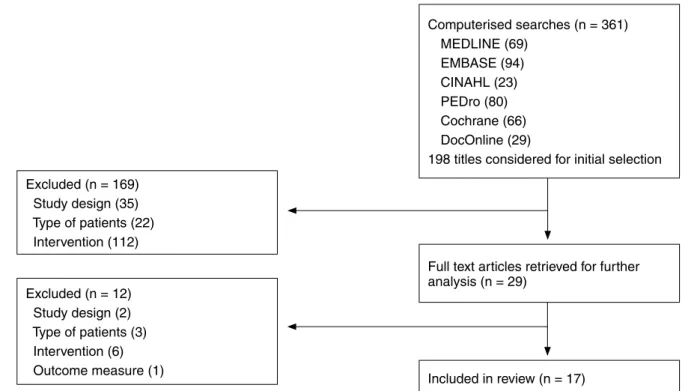
Figure 1. Selection of studies
Computerised searches (n = 6) MEDLINE (69) EMBASE (9) CINAHL (2) PEDro (80) Cochrane (66) DocOnline (29)
98 titles considered for initial selection Excluded (n = 69)
Study design (5) Type of patients (22) Intervention (2)
Full text articles retrieved for further analysis (n = 29) Excluded (n = 2) Study design (2) Type of patients () Intervention (6) Outcome measure () Included in review (n = 7)
Table 3. Quality of studies.
Study 2 5 6 7 8 9 0 Score Quality
Bernier 998 - - - + + + - - B Brooks 98 - - - + - - B Collins 200 - - - + - + + + - + 5 A2 Eils 200 - + - - - + - - 2 B Eisenhart 200 - + + + - - - + - - A2 Green 200 + - - + - - + + - + 5 A2 Hess 200 - - + - - - - + - - 2 B Hoiness 200 + + + + - - + + + - 7 A2 Holme 999 + - - - + - - 2 B Nilsson 98 - - - + + - - 2 B Oostendorp 987 - - - + + + + A2 Pellow 200 + - - - - + + + - - A2 Powers 200 - - - + - + 2 B Stasinopoulos 200 + - - - + - - 2 B Tropp 985 - - - * + - - B Verhagen 200 - + - - - + - + B Wester 996 + - - - + + - - B
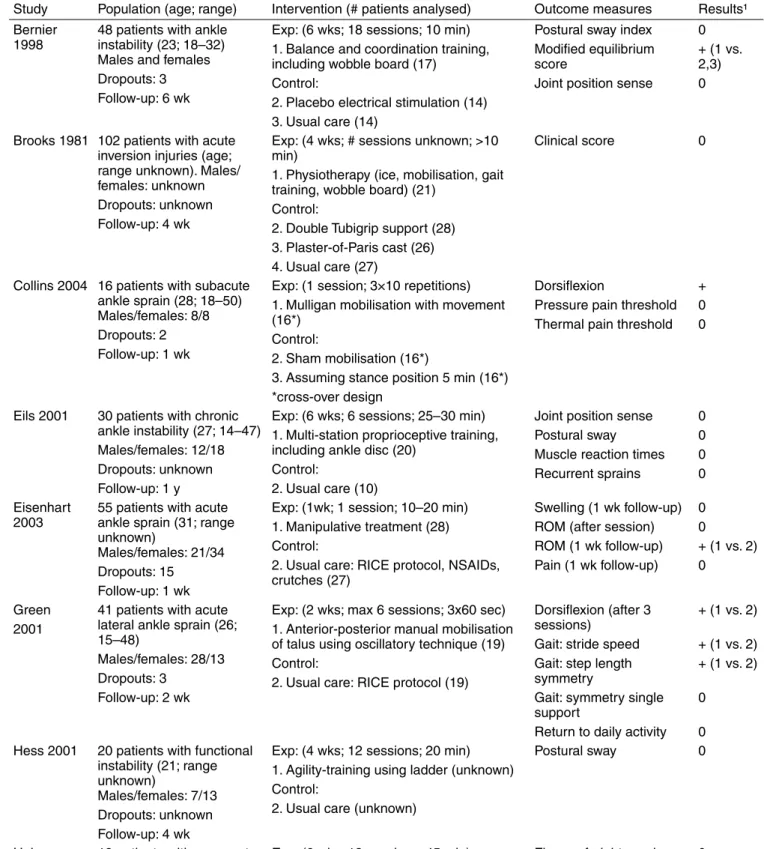
Table 4. Included studies.
Study Population (age; range) Intervention (# patients analysed) Outcome measures Results¹ Bernier
998 8 patients with ankle instability (2; 8–2) Males and females Dropouts: Follow-up: 6 wk
Exp: (6 wks; 8 sessions; 0 min) . Balance and coordination training, including wobble board (7)
Control:
2. Placebo electrical stimulation () . Usual care ()
Postural sway index Modified equilibrium score
Joint position sense
0 + ( vs. 2,) 0
Brooks 98 02 patients with acute inversion injuries (age; range unknown). Males/ females: unknown Dropouts: unknown Follow-up: wk
Exp: ( wks; # sessions unknown; >0 min)
. Physiotherapy (ice, mobilisation, gait training, wobble board) (2)
Control:
2. Double Tubigrip support (28) . Plaster-of-Paris cast (26) . Usual care (27)
Clinical score 0
Collins 200 6 patients with subacute ankle sprain (28; 8–50) Males/females: 8/8 Dropouts: 2 Follow-up: wk
Exp: ( session; ×0 repetitions) . Mulligan mobilisation with movement (6*)
Control:
2. Sham mobilisation (6*)
. Assuming stance position 5 min (6*) *cross-over design
Dorsiflexion
Pressure pain threshold Thermal pain threshold
+ 0 0
Eils 200 0 patients with chronic ankle instability (27; –7) Males/females: 2/8 Dropouts: unknown Follow-up: y
Exp: (6 wks; 6 sessions; 25–0 min) . Multi-station proprioceptive training, including ankle disc (20)
Control:
2. Usual care (0)
Joint position sense Postural sway Muscle reaction times Recurrent sprains 0 0 0 0 Eisenhart
200 55 patients with acute ankle sprain (; range unknown)
Males/females: 2/ Dropouts: 5 Follow-up: wk
Exp: (wk; session; 0–20 min) . Manipulative treatment (28) Control:
2. Usual care: RICE protocol, NSAIDs, crutches (27)
Swelling ( wk follow-up) ROM (after session) ROM ( wk follow-up) Pain ( wk follow-up) 0 0 + ( vs. 2) 0 Green 200
patients with acute lateral ankle sprain (26; 5–8)
Males/females: 28/ Dropouts:
Follow-up: 2 wk
Exp: (2 wks; max 6 sessions; x60 sec) . Anterior-posterior manual mobilisation of talus using oscillatory technique (9) Control:
2. Usual care: RICE protocol (9)
Dorsiflexion (after sessions)
Gait: stride speed Gait: step length symmetry
Gait: symmetry single support
Return to daily activity
+ ( vs. 2) + ( vs. 2) + ( vs. 2) 0
0 Hess 200 20 patients with functional
instability (2; range unknown)
Males/females: 7/ Dropouts: unknown Follow-up: wk
Exp: ( wks; 2 sessions; 20 min) . Agility-training using ladder (unknown) Control:
2. Usual care (unknown)
Postural sway 0
Hoiness
200 9 patients with recurrent ankle sprains (25; 20–) Males/females: 8/ Dropouts: 0
Follow-up: 6 wk
Exp: (6 wks; 8 sessions; 5 min)
. Bi-directional pedal bicycle training (0) Control: (6 wks, 8sessions; 5 min) 2. Uni-directional pedal bicycle training (9)
Figure-of-eight running Postural sway
Functional score Eversion peak torque
0 0 0 0 Holme 999 92 patients with acute
ankle injury (27; range unknown)
Males/females: /8 Dropouts: 2 Follow-up: y
Exp: (duration unknown; 2 sessions/wk; hr)
. Physical therapy rehabilitation (balance exercises, figure-of-eight running, balance board) (29)
Control:
2. Usual care (2)
Joint position sense Isometric strength Postural sway Recurrent sprains 0 0 0 + ( vs. 2)
Nilsson
98 78 patients with acute ankle sprain (; 5–66): (a) without ligament rupture (80); (b) with ruptures (95) Males/females: 05/7 Dropouts:
Follow-up: y
Exp: ( wks; maximum 0 sessions; 5 min)
. Physiotherapy (exercises (limbering, coordination, strength), ultrasound); coldpack, elastic wrapping (59) 2. Physiotherapy (exercises (limbering, co-ordination, strength), ultrasound); coldpack, elastic wrapping, steroid injection (57) Control: . Elastic wrapping (59) Pain Swelling Walking ability ROM
Mean sick leave
0 0 0 0 + (b,2b vs. b) 0 (a,2a vs. a) Oostendorp
987 2 patients with acute ankle injury (22; 5–0) Males/females: 6/8 Dropouts: 0
Follow-up: 2 wk
Exp: (6 wks; 8 sessions)
. Exercise program, including wobble board; and tape (2)
Control: 2. Tape (2)
Pain
Fear of ankle giving way Sick leave Return to training Return to competition 0 + ( vs. 2) 0 + ( vs. 2) + ( vs. 2) Pellow 200 6 patients with (sub)acute
or chronic ankle sprain (25; 5–50)
Males/females: 9/ Dropouts: 6
Follow-up: month
Exp: (max. wks; 8 sessions): . Mortise separation adjustment (5) Control:
2. Sham ultrasound (5)
ROM: dorsiflexion McGill pain questionnaire Numeric Pain Rating Scale
Pressure pain threshold Functional scoring scale
+ ( vs. 2) + ( vs. 2) 0 0 + ( vs. 2) Powers
200 8 patients with functional instability (22; range unknown)
Males/females: 22/6 Dropouts: unknown Follow-up: 6 wk
Exp: (6 wks; sessions/wk)
. Strength training (theraband) (unknown) 2. Proprioception training (theraband) (unknown)
. Strength and proprioception training (theraband) (unknown) Control: . Usual care Muscle fatigue Postural sway 0 0
Stasino-poulos 200 52 female volleyball players with history of ankle injury (2; range unknown) Dropouts: 0
Follow-up: 9 months
Exp: (single instruction at begin season) . Balance board (7)
Control: (single instruction at begin season):
2. Specific technical training (8) . Orthosis (7)
Recurrent sprains 0 ( vs. 2) 0 ( vs. ) 0 (2 vs. )
Tropp 985 50 male soccer players (age unknown). 220 players with previous injury.
Dropouts: 9 Follow-up: 6 months
Exp: (6 months: 0wks, 5 sessions/wk, 0 min; 6 wks, sessions/wk, 0 min) . Ankle disc, players with previous ankle problems (65)
Control:
2. No ankle disc, players in exp. group without previous ankle problems (7) . Orthosis (60)
. Orthosis offered but not used (6) 5. Usual care (7)
Recurrent sprains + ( vs. 5) + ( vs. 5) 0 ( vs. )
Verhagen
200 27 volleyball players (2; range unknown). 758 players with previous injury. Males/females: 8/6 Dropouts: 95
Follow-up: 6 wk
Exp: (6 wks; exercises/wk, 5 min/ exercise; educated by physiotherapist or sports physician; performed by coach) . Basic exercises on and off balance board (92)
Control:
2. Usual care (0)
Ankle sprains Primary ankle sprains Recurrent ankle sprains
+ ( vs. 2) 0
+ ( vs. 2)
Wester 996 8 patients with acute primary ankle sprains (25; range unknown).
Males/females: 29/9 Dropouts: unknown
Follow-up: 20 days (+/-6)
Exp: (2 wks; 5 min/day)
. Balance board + written instructions (2) Control: 2. Usual care (2) Recurrent sprains Subjective functional instability Oedema Pain + ( vs. 2) + ( vs. 2) 0 0 ¹statistically significant as reported by authors
from the methodology used in clinical practice guidelines and are shown in Table 2.
Results
Selection of studies is shown in Figure 1. After extraction of doubles and inclusion of manually retrieved articles 198 titles were considered for initial selection. Based on the abstracts 169 studies were excluded. Twenty-nine full text articles were retrieved for further analysis, resulting in exclusion of another twelve studies. Two studies did not meet the criteria for study design (Bahr et al 1997, Hart and Macintyre 2002); six studies did not meet the intervention criteria (Coetzer et al 2001, Freeman 1965, Karlsson et al 1996, Matsusaka et al 2001, Paris et al 1983, Ekstrand et al 1983), in three studies the patients did not meet the criteria (Fryer et al 2002, Soderman et al 2000, Wedderkopp et al 1999), and in one study the outcome measure led to exclusion (Kaminski et al 2003). As a result 17 studies were included in this systematic review.
Table 3 shows the methodological quality of the studies. The average score of the studies was 3.1 (range 1–7). Six studies were considered high quality (Collins et al 2004; Green et al 2001, Hoiness et al 2003, Oostendorp 1987, Pellow and Brantingham 2001, Eisenhart et al 2003) at the A2 level. Identical timing of outcome measures (V8) had a positive score in all studies, while eight studies had a positive score for loss to follow-up (V7). None of the studies scored positive on blinding of the therapist (V5).
An overview of the studies is shown in Table 4 which describes the population, intervention, outcome measures and results. Eight studies concerned patients with (sub)acute ankle sprain (Brooks et al 1981, Collins et al 2004; Green et al 2001, Holme et al 1999, Nilsson 1983; Oostendorp 1987, Wester et al 1996, Eisenhart et al 2003). Patients with functional instability were included in six studies (Bernier and Perrin 1998, Eils and Rosenbaum 2001, Hoiness et al 2003, Stasinopoulos 2004; Hess et al 2001, Powers et al 2004). One study included patients with both (sub)acute and chronic ankle injuries (Pellow and Brantingham 2001). Two studies included cohorts of sports players with a recognisable subgroup with history of ankle injury (Tropp et al 1985; Verhagen et al 2004).
Interventions In thirteen studies (Bernier and Perrin 1998, Brooks et al 1981, Eils and Rosenbaum 2001, Hoiness et al 2003, Holme et al 1999, Nilsson 1983, Oostendorp 1987, Stasinopoulos 2004, Tropp et al 1985, Verhagen et al 2004, Wester et al 1996, Hess et al 2001, Powers et al 2004) the intervention included exercise therapy. A wobble board, ankle disc or tilt board was used in nine studies (Bernier and Perrin 1998, Brooks et al 1981, Eils and Rosenbaum 2001, Holme et al 1999, Oostendorp 1987, Stasinopoulos 2004, Tropp et al 1985, Verhagen et al 2004, Wester et al 1996). In three studies (Brooks et al 1981, Nilsson 1983, Oostendorp 1987) exercise therapy was embedded in a multi-facetted intervention under supervision of a physiotherapist. Four studies (Collins et al 2004; Green et al 2001, Pellow and Brantingham 2001, Eisenhart et al 2003) studied the specific effects of manual mobilisation.
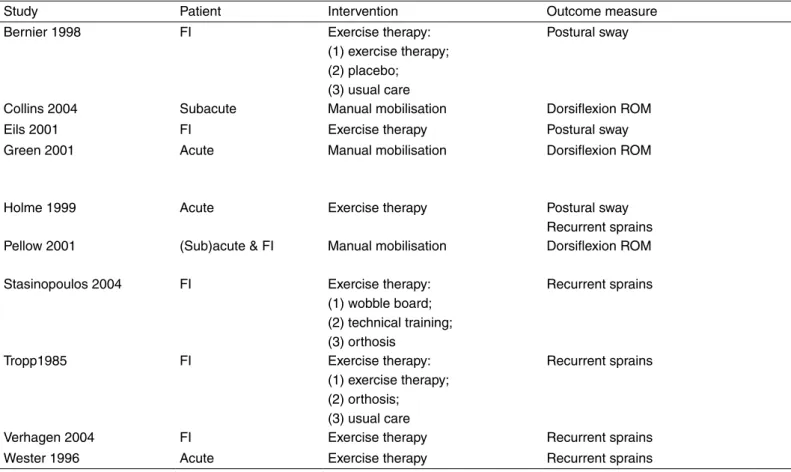
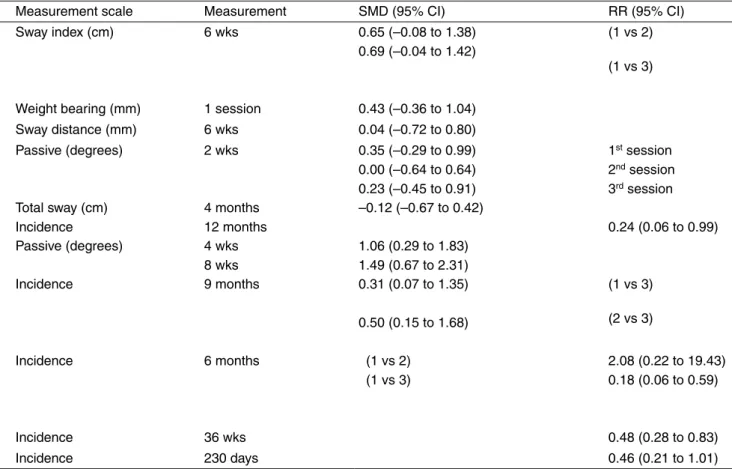
Table 5. Effect sizes.
Study Patient Intervention Outcome measure Measurement scale Measurement SMD (95% CI) RR (95% CI) Bernier 998 FI Exercise therapy:
() exercise therapy; (2) placebo;
() usual care
Postural sway Sway index (cm) 6 wks 0.65 (–0.08 to .8) 0.69 (–0.0 to .2)
( vs 2) ( vs ) Collins 200 Subacute Manual mobilisation Dorsiflexion ROM Weight bearing (mm) session 0. (–0.6 to .0)
Eils 200 FI Exercise therapy Postural sway Sway distance (mm) 6 wks 0.0 (–0.72 to 0.80) Green 200 Acute Manual mobilisation Dorsiflexion ROM Passive (degrees) 2 wks 0.5 (–0.29 to 0.99) 0.00 (–0.6 to 0.6) 0.2 (–0.5 to 0.9)
st session
2nd session
rd session
Holme 999 Acute Exercise therapy Postural sway Recurrent sprains Total sway (cm) Incidence months 2 months –0.2 (–0.67 to 0.2) 0.2 (0.06 to 0.99) Pellow 200 (Sub)acute & FI Manual mobilisation Dorsiflexion ROM Passive (degrees) wks
8 wks
.06 (0.29 to .8) .9 (0.67 to 2.) Stasinopoulos 200 FI Exercise therapy:
() wobble board; (2) technical training; () orthosis
Recurrent sprains Incidence 9 months 0. (0.07 to .5) 0.50 (0.5 to .68)
( vs ) (2 vs ) Tropp985 FI Exercise therapy:
() exercise therapy; (2) orthosis; () usual care
Recurrent sprains Incidence 6 months ( vs 2) ( vs )
2.08 (0.22 to 9.) 0.8 (0.06 to 0.59)
Verhagen 200 FI Exercise therapy Recurrent sprains Incidence 6 wks 0.8 (0.28 to 0.8) Wester 996 Acute Exercise therapy Recurrent sprains Incidence 20 days 0.6 (0.2 to .0) FI, functional instability. ROM, range of motion
Table 5. Effect sizes.
Study Patient Intervention Outcome measure Measurement scale Measurement SMD (95% CI) RR (95% CI) Bernier 998 FI Exercise therapy:
() exercise therapy; (2) placebo;
() usual care
Postural sway Sway index (cm) 6 wks 0.65 (–0.08 to .8) 0.69 (–0.0 to .2)
( vs 2) ( vs ) Collins 200 Subacute Manual mobilisation Dorsiflexion ROM Weight bearing (mm) session 0. (–0.6 to .0)
Eils 200 FI Exercise therapy Postural sway Sway distance (mm) 6 wks 0.0 (–0.72 to 0.80) Green 200 Acute Manual mobilisation Dorsiflexion ROM Passive (degrees) 2 wks 0.5 (–0.29 to 0.99) 0.00 (–0.6 to 0.6) 0.2 (–0.5 to 0.9)
st session
2nd session
rd session
Holme 999 Acute Exercise therapy Postural sway Recurrent sprains Total sway (cm) Incidence months 2 months –0.2 (–0.67 to 0.2) 0.2 (0.06 to 0.99) Pellow 200 (Sub)acute & FI Manual mobilisation Dorsiflexion ROM Passive (degrees) wks
8 wks
.06 (0.29 to .8) .9 (0.67 to 2.) Stasinopoulos 200 FI Exercise therapy:
() wobble board; (2) technical training; () orthosis
Recurrent sprains Incidence 9 months 0. (0.07 to .5) 0.50 (0.5 to .68)
( vs ) (2 vs ) Tropp985 FI Exercise therapy:
() exercise therapy; (2) orthosis; () usual care
Recurrent sprains Incidence 6 months ( vs 2) ( vs )
2.08 (0.22 to 9.) 0.8 (0.06 to 0.59)
Verhagen 200 FI Exercise therapy Recurrent sprains Incidence 6 wks 0.8 (0.28 to 0.8) Wester 996 Acute Exercise therapy Recurrent sprains Incidence 20 days 0.6 (0.2 to .0) FI, functional instability. ROM, range of motion
Effect sizes of the different interventions for three most common outcome measures (recurrent sprains, postural sway, range of motion) are listed in Table 5. Relative Risks (RR) are calculated for the incidence of recurrent injuries and Standardised Mean Differences (SMD) for postural sway and range of motion.
Exercise therapy
Exercise therapy versus usual care Eight studies compared exercise therapy with usual care (Brooks et al 1981, Eils and Rosenbaum 2001, Holme et al 1999, Tropp et al 1985, Verhagen et al 2004, Wester et al 1996, Hess et al 2001, Powers et al 2004). In five of these studies the effect of exercise therapy was related to the incidence of recurrent injuries: Holme et al (1999), Tropp et al (1985), Verhagen et al (2004) and Wester et al (1996) found less recurrent injuries in the experimental groups that received exercise therapy, while Eils and Rosenbaum (2001) described no differences between experimental and control groups.
Concerning patients with acute ankle sprains, pooling of the results was possible for two studies (Holme et al 1999, Wester et al 1996). The pooled results show a statistical significant RR of 0.37 (95% CI 0.18 to 0.74) in favour of exercise therapy (Table 6). Pooling was also possible in two studies for patients with functional instability (Tropp et al 1985, Verhagen et al 2004). These pooled results show a statistical significant RR of 0.38 (95% CI 0.23 to 0.62) in favour of exercise therapy (Table 6).
It is likely (Level 2) that exercise therapy is effective in the prevention of recurrent ankle sprains, both for patients with acute ankle sprain and with functional instability
The effect of exercise therapy on postural sway was investigated in six studies (Bernier and Perrin 1998, Eils and Rosenbaum 2001, Holme et al 1999, Hess et al 2001, Hoiness et al 2003, Powers et al 2004). The individual studies showed no effect on postural sway. Pooling of the results of two studies with patients with functional instability (Bernier and Perrin 1998, Eils and Rosenbaum 2001) resulted in a non-significant SMD of 0.38 (95% CI –0.15 to 0.91) (Table 6).
It is likely (Level 2) that exercise therapy for patients with functional instability has no effect on postural sway Brooks et al (1981) found no clinical effects of a physiotherapy program (including ice, mobilisation, gait training, wobble board) using a ‘clinical score’ (score of 0–3 points on pain, swelling and bruising) as outcome measure. Exercise therapy versus external support Five studies (Brooks et al 1981, Nilsson 1983, Oostendorp 1987, Stasinopoulos 2004, Tropp et al 1985) compared a physiotherapy program including exercise therapy versus external support only. Nilsson (1983) found a difference in mean sick leave in patients with ligament ruptures in favour of two experimental physiotherapy groups compared to elastic wrapping. Oostendorp (1987) found no differences in sick leave after 6, 12 and 24 weeks between physiotherapy
including tape, versus tape alone. Brooks et al (1981) found no difference between physiotherapy versus Tubigrip support using a clinical score. Oostendorp (1987) describes a positive effect in favour of physiotherapy intervention for fear of ankle giving way at 6 weeks and at 24 weeks follow-up, but not at 12 weeks. Oostendorp also found positive effects in favour of physiotherapy at 12 week follow-up on return to training and return to sports competition.
Tropp et al (1985) and Stasinopoulos (2004) found no differences between wobble board exercises versus external support using an orthosis on recurrent sprains in sports players with a history of ankle sprains. Statistical pooling (Table 6) of both studies resulted in a non-significant RR of 0.76 (95% CI 0.27 to 2.11).
Exercise therapy versus immobilisation Only Brooks et al (1981) examined the effect of physiotherapy versus immobilisation (plaster-of-Paris). No differences were found using a clinical score as outcome measure.
Comparison of different exercise therapy modes Hoiness et al (2003) compared two different modes of exercise therapy, using a bi-directional versus unidirectional pedal bicycle training program in patients with functional instability of the ankle. None of the outcome measures showed any difference. Stasinopoulos (2004) compared wobble board exercises with a specific technical training program and found no difference in the incidence of recurrent ankle sprains.
Manual mobilisation
Four studies investigated the effects of manual mobilisation versus placebo treatment (Collins et al 2004, Pellow and Brantingham 2001) or usual care (Green et al 2001, Eisenhart et al 2003). Green et al (2001) compared manual mobilisation on patients with acute ankle sprain. The intervention consisted of anterior-posterior mobilisation of the talus (3 sessions in total, follow-up of two weeks). The authors found a positive effect on dorsiflexion range of motion during the first three treatment sessions. The authors also found an increase in stride speed (first and third session). At the second session the intervention group showed greater
gains in step length symmetry. This difference had vanished at the third session. No differences were found for return to normal activity.
The effects of Mulligan’s mobilisation with movement technique was studied by Collins et al (2004). The initial effects of manual mobilisation with subacute ankle sprains on dorsiflexion range of motion (both pressure pain and thermal pain) were evaluated. Using a cross-over design an initial effect of Mulligan’s technique on dorsiflexion range of motion for pre- to post-application in one session was found, compared to placebo and control group.
Pellow and Brantingham (2001) studied the effect of a mortise separation adjustment, described by the authors as a chiropractic technique. A positive effect on dorsiflexion range of motion, pain and functional score until one month follow-up was found. Manual mobilisation using osteopathic manipulative technique was studied by Eisenhart et al (2003). A significant difference in delta-range of motion (difference between injured and contralateral ankle in range of motion from active plantarflexion to dorsiflexion) was found in favour of the experimental group one week after injury.
It is likely (Level 2) that manual mobilisation has an initial effect on dorsiflexion range of motion after ankle sprains
Discussion
Prevention of recurrent injuries The main finding of this review is that exercise therapy is effective in the prevention of recurrent ankle sprains. This finding is important for strategies which treat both acute ankle sprains and functional instability. Verhagen et al (2004) suggest that the effect of exercise therapy is not only relevant for prevention of injuries but may also have a rehabilitative effect in the treatment of acute ankle sprains. This is in accordance with the study by Tropp et al (1985), who found that ankle disk training reduced the incidence of ankle sprains among soccer players with a history of ankle problems to the same level as men without history of ankle problems. Their studies indicate that exercise therapy is an effective prophylactic for
Table 6. Pooled effect sizes.
Recurrent sprains
Intervention Patients Studies RR (95% CI) Pooled RR* (95% CI) Exercise therapy vs.
control Acute ankle sprain HolmeWester 0.2 (0.06 to 0.99)0.6 (0.2 to .0) 0.7 (0.8 to 0.7)** Exercise therapy vs.
control Functional instability TroppVerhagen 0.8 (0.06 to 0.59)0.8 (0.28 to 0.8) 0.8 (0.2 to 0.62)# Exercise therapy vs.
orthosis Functional instability StasinopoulosTropp 0.50 (0.5 to .68)2.08 (0.22 to 9.) 0.76 (0.27 to 2.)
Postural sway
Intervention Patients Studies SMD (95% CI) Pooled SMD* (95% CI) Exercise therapy vs.
control Acute ankle sprain BernierEils 0.69 (–0.0 to .2)0.0 (–0.72 to 0.80) 0.8 (–0.5 to 0.9) *Fixed effects model **statistically significant (p = 0.005) #statistically significant (p < 0.00)
people with acute ankle sprains and/or chronic functional instability, who are at risk for the incidence of recurrent injuries.
It is not clear from this review what mechanism underlies the effect of exercise therapy. Tropp et al (1985) suggested that functional factors such as postural control are important in the development of functional instability and a predisposition to recurrent sprains. However, this review shows no effects of exercise therapy on postural sway.
The effects of exercise therapy on other outcome measures are unclear. Two studies (Oostendorp 1987, Wester et al 1996) show effects of exercise therapy on the subjective feeling of giving way, but their findings are not consistent during follow-up.
Manual mobilisation This review shows that manual mobilisation has an (initial) effect on dorsiflexion range of motion. Two studies (Collins et al 2004, Eisenhart 2003) used a single session intervention to measure the effects with a follow-up of one week, while Green et al (2001) describe an intervention of three sessions with a follow-up of 2 weeks. The clinical relevance of these initial, effects may be limited, because the short-term follow-up does not give sufficient insight in functional consequences. Green et al (2001) found no effects on return to normal activity, while Collins et al (2004) assumed a wash-out of the effect after 24 hours in their cross-over design.
Methodological limitations Since only six studies were considered high quality, the results must be viewed in perspective of the poor methodological quality of the individual studies. However, the nature of the interventions does not allow a design that meets all methodology criteria. For example: blinding of therapist and blinding of patients is usually impossible in studies with physiotherapy interventions. Therefore we used a low cut-off point (4 points) for considering a study as ‘high quality’.
The best-evidence synthesis using a rating system based on the quality of the individual studies has its limitations. Rating is to some extent subjective, and since systematic reviews were not considered in this study, an A1 quality level was impossible to score. However, by ranking the evidence base of the conclusions some insight is gained in the strength of the conclusions.
Two studies (Tropp et al 1985, Verhagen et al 2004) included cohorts of sports players. These studies include a high number of participants (range: 180–1127) and therefore provide a lot of power. However, these studies used a method of cluster randomisation (randomisation of teams) which may influence the outcome of the study. Analysis of individual participants while not regarding their cluster can be a potential bias.
This review includes patients with (sub)acute ankle sprains and with functional instability. In order to make valid conclusions, different subgroups were considered in the analysis. However, no clear definition exists for the difference subgroups. Definitions of time-period after injury to distinguish between acute, subacute, and chronic problems vary. Also the definition of functional instability is the subject of debate. The conclusions of this review should be viewed in this perspective.
Outcome measures The studies in this review show a variety of outcome measures for evaluating the effects of the interventions. Recurrent sprains and postural sway were each used as outcome measures in six studies, while range of motion was used in five studies. The main outcome measures are quite different and may also be of different quality and clinical relevance. The incidence of recurrent sprains seems to be a reliable, valid and clinical relevant measure, although the definitions used for ‘recurrent sprains’ were not clearly described in all studies.
Postural sway was measured using a force plate or balance system, measuring the sway (distance) from the centre of gravity while standing on one leg. Reliability, validity and responsiveness of these systems are not described. Postural sway is a commonly used outcome measure to assess proprioceptive deficits. The relevance of postural sway to detect proprioceptive deficits in relation to functional ankle instability, as well as other outcome measures e.g. joint position sense, joint movement sense, and reflex response time, is subject to debate. Stefanini and Marks conducted a narrative review to evaluate the relationship between proprioception and recurrent ankle inversion injuries (Stefanini and Marks 2003). Their review shows that postural sway seems to be impaired in ankle sprain populations, but the review also shows that the relationship between ankle sprain, proprioceptive deficits and the assessment of ankle proprioception remains unclear.
Clinical relevance for physiotherapy practice Exercise therapy and manual mobilisation are common interventions in physiotherapy treatment. In twelve studies the intervention included exercise therapy, although only in five studies was the intervention carried out by a physiotherapist, while in two studies a physiotherapist gave only initial instructions for the exercise program. Therefore, not all interventions can be seen as a specific physiotherapy intervention, which may influence the clinical relevance of some studies for physiotherapy practice.
Two studies on manual mobilisation (Pellow and Brantingham 2001; Eisenhart et al 2003) concerned techniques which are not commonly used by physiotherapists or manual therapists. Therefore these studies have limited value for physiotherapy treatment, although the outcome may be used to increase the body of knowledge concerning manual mobilisation in physiotherapy.
These limitations for clinical practice must be considered in formulating recommendations in the Clinical Practice Guideline for Ankle Injury.
The conclusions of this study are that it is likely (Level 2) that exercise therapy, which includes the use of a wobble board, is effective for patients with functional instability in the prevention of recurrent ankle sprains. Other effects of exercise therapy are unclear. It is likely (Level 2) that manual mobilisation has an (initial) effect on dorsiflexion range of motion, but the clinical relevance of these findings may be limited. The results of this review must be viewed in perspective to the poor methodological quality and heterogeneity of the studies.
Correspondence Philip J Van der Wees, Department of Epidemiology, Maastricht University, The Netherlands. Email: [email protected]
References
Bahr R, Lian O and Bahr IA (997): A twofold reduction in the incidence of acute ankle sprains in volleyball after the introduction of an injury prevention program: A prospective cohort study. Scandinavian Journal of Medicine and Science in Sports 7: 72–77.
Balduini FC, Vegso JJ, Torg JS and Torg E (987): Management and rehabilitation of ligamentous injuries to the ankle. Ankle inversion injuries and hypermobility: Effect on hip and ankle muscle electromyography onset latency. Journal of Sports
Medicine : 6–80.
Bernier JN and Perrin DH (998): Effect of coordination training on proprioception of the functionally unstable ankle. Journal of Orthopaedic and Sports Physical Therapy 27: 26–275. Brooks SC, Potter BT and Rainey JB (98): Treatment for
partial tears of the lateral ligament of the ankle: a prospective trial. BMJ 282: 606–607.
CBO (2005): Evidence-based guideline development: Manual for guideline development groups (Evidence-based richtlijnontwikkeling: handleiding voor werkgroepleden). Dutch Institute for Health Care Improvement CBO, Utrecht.
Coetzer D, Brantinham J and Nook B (200): The relative effectiveness of piroxam compared to manipulation in the treatment of acute grades and 2 inversion ankle sprains.
Journal of Neuromusculoskeletal Systems 9: –2.
Collins N, Teys P and Vincenzino B (200): The initial effects of Mulligan’s mobilization with movement technique on dorsiflexion and pain in subacute ankle sprains. Manual Therapy 9: 77–82.
Eils E and Rosenbaum D (200): A multi-station proprioceptive exercise program in patients with ankle instability. Medicine
and Science in Sports Exercise : 99–998.
Eisenhart AW, Gaeta TJ and Yens DP (200): Osteopathic manipulative treatment in the emergency department for patients with acute ankle injuries. Journal of the American
Ostheopathic Association 0: 7–2.
Ekstrand J, Gillquist J and Liljehad SO (98): Prevention of soccer injuries. Supervision by doctor and physiotherapist.
American Journal of Sports Medicine : 6–20.
Freeman MA (965): Treatment of ruptures of the lateral ligament of the ankle. Journal of Bone and Joint Surgery (Britain) 7: 66–668.
Fryer GA, Mudge JM and McLaughlin PA (2002): The effect of talocrural joint manipulation on range of motion at the ankle.
Journal of Manipulative Physiological Therapy 25: 8–90. Gezondheidsraad (999): De effectiviteit van fysische therapie:
elektrotherapie, lasertherapie, ultrageluidbehandeling. (Dutch Health Council. The effectiveness of physical modalities: Electro-therapy, laser-therapy, ultrasound) Gezondheidsraad, The Hague
Green T, Refshauge K, Crosbie J and Adams R (200): A randomized controlled trial of a passive accessory joint mobilization on acute ankle inversion sprains. Physical
Therapy 8: 98–99.
Handoll HHG, Rowe BH, Quinn KM and De Bie R (200): Interventions for preventing ankle sprains. The Cochrane Database of Systematic Reviews, Issue 2. Chichester: Wiley. Hart LE and Macintyre J (2002): Passive joint mobilization
for acute ankle inversion sprains. Clinical Journal of Sports Medicine 2: 5.
Hess DM, Joyce CJ, Arnold BL and Gansneder BM (200): The effect of a -week agility-training program on postural sway in the functionally unstable ankle. Journal of Sport Rehabilitation
2: 7–2.
Hoiness P, Glott T and Ingjer F (200): High-intensity training with a bi-directional bicycle pedal improves performance in mechanically unstable ankles—a prospective randomized study of 9 subjects. Scandinavian Journal of Medicine and
Science in Sports : 266–27.
Holme E, Magnusson SP, Becher K, Bieler T, Aagaard P and Kjaer M (999): The effect of supervised rehabilitation on strength, postural sway, position sense and re-injury risk after acute ankle ligament sprain. Scandinavian Journal of
Medicine and Science in Sports 9: 0–09.
Kaminski TW, Buckley BD, Powers ME, Hubbard TJ and Ortiz C (200): Effect of strength and proprioception training on eversion to inversion strength ratios in subjects with unilateral functional ankle instability. British Journal of Sports Medicine
7: 0–5.
Karlsson J, Eriksson BI and Sward L (996): Early functional treatment for acute ligament injuries of the ankle joint.
Scandinavian Journal of Medicine and Science in Sports 6: –5.
Kerkhoffs GMMJ, Handoll HHG, de Bie R, Rowe BH and Struijs PAA (2002a): Surgical versus conservative treatment for acute injuries of the lateral ligament complex of the ankle in adults. The Cochrane Database of Systematic Reviews, Issue 2. Chichester: Wiley.
Kerkhoffs GMMJ, Rowe BH, Assendelft WJJ, Kelly K, Struijs PAA and Van Dijk CN (2002b): Immobilisation and functional treatment for acute lateral ankle ligament injuries in adults. The Cochrane Database of Systematic Reviews, Issue . Chichester: Wiley.
Kerkhoffs GMMJ, Struijs PAA, Marti RK, Assendelft WJJ, Blankevoort L and Van Dijk CN (2002c): Different functional treatment strategies for acute lateral ankle ligament injuries in adults. The Cochrane Database of Systematic Reviews, Issue . Chichester: Wiley.
Matsusaka N, Yokoyama S, Tsurusaki T, Inokuchi S and Okita M (200): Effect of ankle disk training combined with tactile stimulation to the leg and foot on functional instability of the ankle. American Journal of Sports Medicine 29: 25–0. Moller-Larssen F, Wethelund JO, Jurik AG, De Carvalho A and
Lucht U (988): Comparison of three different treatments for ruptured lateral ankle ligaments. Acta Orthopedica Scandinavica 59: 56–566.
Nilsson S (98): Sprains of the lateral ankle ligaments. Journal
of Oslo City Hospital : –6.
Oostendorp RAB (987): Functionele instabiliteit na het inversietrauma van de enkel en voet: een effectonderzoek van pleisterbandage versus pleisterbandage gecombineerd met fysiotherapie (Functional instability after ankle sprains: A trial of taping versus taping and exercise). Geneeskunde en Sport 20: 5–55.
Paris DL, Baynes F and Gucker B (98): Effects of the neuroprobe in the treatment of second degree ankle inversion sprains. Physical Therapy 6: 5–0.
Pellow JE and Brantingham JW (200): The efficacy of adjusting the ankle in the treatment of subacute and chronic Grade I and Grade II ankle inversion sprains. Journal of Manipulative and Physiological Therapeutics 2: 7–2.
Pope R, Herbert R and Kirwan J (998): Effects of ankle dorsiflexion range and pre-exercise calf muscle stretching on injury risk in Army recruits. Australian Journal of Physiotherapy
: 65–72.
Powers ME, Buckley BD, Kaminski TW, Hubbard TJ and Ortiz C (200): Six weeks of strength and proprioception training does not affect muscle fatigue and static balance in functional ankle instability. Journal of Sport Rehabilitation : 20–227. Smidt N, Assendelft WJ, Van der Windt DA, Hay EM, Buchbinder
R and Bouter LM (2002): Corticosteroid injections for lateral epicondylitis: A systematic review. Pain 96: 2–0.
Soderman K, Werner S, Pietila T, Engstrom B and Alfredson H (2000): Balance board training: Prevention of traumatic injuries of the lower extremities in female soccer players? A prospective randomized intervention study. Knee Surgery,
Sports Traumatology, Arthroscopy 8: 56–6.
Stasinopoulos D (200): Comparison of three preventive methods in order to reduce the incidence of ankle inversion
sprains among female volleyball players. British Journal of
Sports Medicine 8: 82–85.
Stefanini L and Marks R (200): Proprioception and recurrent ankle inversion injuries: A narrative review. New Zealand Journal of Physiotherapy : 25–9.
Tropp H, Askling C and Gillquist J (985): Prevention of ankle sprains. American Journal of Sports Medicine : 259–262. Van der Windt DAWM, van der Heijden GJGM, van den Berd
SGM, ter Riet G, de Winter AF, and Bouter LM (2002): Therapeutic ultrasound for acute ankle sprains. The Cochrane Database of Systematic Reviews, Issue . Chichester: Wiley. Van Dijk CN (99): On diagnostic strategies in patients with
severe ankle sprain (unpublished thesis). Amsterdam: University of Amsterdam.
Van Moppes FI and Van den Hoogenband CR (982): Diagnostic and therapeutic aspects of inversion trauma of the ankle joint (unpublished thesis). Maastricht: Maastricht University. Van Os AG, Bierma-Zeinstra SM, Verhagen AP, de Bie RA,
Luijsterburg PA and Koes BW (2005): Comparison of conventional treatment and supervised rehabilitation for treatment of acute lateral ankle sprains: A systematic review of the literature. Journal of Orthopaedic and Sports Physical
Therapy 5: 95–05.
Verhagen EALM, Van der Beek AJ, Twisk JWR, Bouter LM, Bahr R and Van Mechelen W (200): The effect of a proprioceptive balance board training programme for the prevention of ankle sprains. American Journal of Sports Medicine 2: 85– 9.
Verhagen EALM, van Mechelen W and de Vente W (2000): The effect of preventive measures on the incidence of ankle sprains. Clinical Journal of Sports Medicine 0: 29–296. Wedderkopp N, Kaltoft M, Lundgaard B, Rosendahl M and
Froberg K (999): Prevention of injuries in young female players in European team handball. A prospective intervention study. Scandinavian Journal of Medicine and Science in
Sports 9: –7.
Wester JU, Jespersen SM, Nielsen KD and Neumann L (996): Wobble board training after partial sprains of the lateral ligaments of the ankle: a prospective randomized study.
Journal of Orthopaedic and Sports Physical Therapy 2: 2–6.
Zoch C, Fialka-Moser V and Quittan M (200): Rehabilitation of ligamentous ankle injuries: a review of recent studies. British Journal of Sports Medicine 7: 29–295.