Economics Student Theses and Capstone Projects Economics
2019
The Impact of Foreign Assistance on Migration
Ivan LenoyrSkidmore College, [email protected]
Follow this and additional works at:https://creativematter.skidmore.edu/econ_studt_schol Part of theEconomics Commons
This Thesis is brought to you for free and open access by the Economics at Creative Matter. It has been accepted for inclusion in Economics Student Theses and Capstone Projects by an authorized administrator of Creative Matter. For more information, please [email protected]. Recommended Citation
Lenoyr, Ivan, "The Impact of Foreign Assistance on Migration" (2019).Economics Student Theses and Capstone Projects. 126. https://creativematter.skidmore.edu/econ_studt_schol/126
The Impact of Foreign Assistance on Migration
Ivan Lenoyr
Senior Seminar in Economics 2 May 2019
This Thesis is submitted in partial fulfillment of the requirements for the course Senior Seminar (EC375), during the Spring Semester of 2019
While writing this thesis, I have not witnessed any wrongdoing, nor have I personally violated any conditions of the Skidmore College Honor Code.
Name: _____Ivan Lenoyr______________ Signature: ___________Ivan Lenoyr_____
Abstract:
Historically, foreign assistance has been used to support and advance donor countries own interests upon recipient countries. Foreign assistance primary use is to influence and change the behavior of a recipient country. This is achieved by providing foreign assistance to countries in their efforts to maintain global peace, security, provide economic development and humanitarian relief. Germany is ranked as the third-largest donors within the development assistance committee (DAC). Primarily, Germany allocates its official development assistance (ODA) to recipient countries based on
emphasis on good governance and human rights. Currently, Germany’s ODA is at a record
high and increasing every year. The country has made countless efforts to reach its own target goals and send more essential aid to the neediest countries. Recently, Germany has shifted its ODA commitments to Middle Eastern and North Africa (MENA) countries due to the Arab Spring uprising events that occurred through 2011. The Arab Spring caused massive migration displacement across the MENA region. The displaced migrants have made the conscious effort to find better lives in Europe. However, migration is discussed with security narrative across countries within the European Union (EU), such as Germany. The EU countries have increased its efforts to prevent higher of influxes of internationally displaced persons from arriving at their border and claiming asylum. Therefore, ODA is now viewed as an essential tool to support potential migrants in their country of origin and prevent from immigrating to Europe. In my study, I select eleven MENA countries and examine whether German ODA effected migration inflows of the MENA into Germany. I found insignificant and negative results regarding ODA disbursement. But I conclude that migration inflows were positive and significant. This means that ODA made Germany as an attractive destination country. This means that Germany must reassess itself and determine whether ODA is right tool to prevent migration flows.
Introduction
Foreign assistance is one of the most influential policy tool that one country can possess to support other countries in their efforts to maintain global peace, security, and provide humanitarian relief. Countries invest in foreign assistance since it is an economic and strategic imperative policy tool as well as crucial to national security. Governments such as the United States invest in foreign assistance programs in more than 100 countries in order to further their foreign policy interest which include expanding free markets and addressing root causes of poverty. There are critics who argue that aid is ineffective and will not have an impact on development. Therefore, the critics argue that there should be massive reduction foreign assistance commitments or that it commitments should be completely suspended. But some advocates argue that foreign assistance is effective in the future with proper reforms, but the reforms act on moral and practical grounds. However, one of the most important debates revolving around foreign assistance is explaining the purposes of providing aid. Aid promotes growth and poverty reduction abroad, but we must look through a different lens. It is essential to interpret the relationships between states and examine the political motives of foreign assistance. Historically, donor countries have provided assistance to countries in order to promote their own interests, such as the United States being motivate by Cold War concerns and the French trying to maintain postcolonial sphere of influence in Africa (Lancester 2008). Foreign assistance is now being used to reduce migration flows. The main question arises: What is the impact of foreign assistance on migration flows?
In the past few years, the United States and other countries within the European Union have recently started to double their policy efforts in order to deter future immigration flows from poor countries. This response is due to the recent migrant and refugee crisis. Policymakers want to deter migration from poor countries through the use of foreign aid. These policies aim to promote economic growth and mitigate violence at home. The ultimate goal is make the individuals living in the recipient country less likely to move to donor countries. In the past years there have been different types of intervention to prevent migration. One example, is to physically keep refugees from entering a country is to pay the country of origin to keep those refugees within their borders. For example, in March 18, 2016 the European Union (EU) signed an agreement with Turkey to reduce the enormous influx of Syrian refugees (Welle 2018). Under the
agreement, the EU will pay the Turkish government six billion euros to finance projects in order to keep the 3.5 million refugees within Turkish borders and prevent them from entering the EU illegally. In addition, EU has established the European Union Trust Fund
for Africa is Europe’s response to high influx of asylum-seeking individuals from Africa and the Middle East (European Commission 2018). The EU Trust fund has four key policy areas which include: employment creation, basic local-level service provision, migration management, and border management. This is meant to manage migration. Policymakers want to reduce migration flows for numerous reason. The recent winning elections across Europe of right-winged parties has led to strict immigration policies. Foreign aid is speculated to reduce migration flows and as Prime Minister Poul Rasmussen of Denmark
stated, “if you don’t help the third world … then you will have these poor people in our
society” (Bermeo et. al 2015). There is a strong incentive for many individuals to keep
immigrants from entering their country and foreign aid is seen as a tool to keep them out. The European Union has increased its security and border control as a response to the arrivals of migrants on boats that have reached their shores. In addition, there is an
increase in maritime operations and surveillance through the EU’s FRONTEX border agency. To further restrict migrant movement across the EU, there were debates on whether to temporarily suspend the Schengen Treaty, which guarantees free movement within the EU (Koser 2012). Across the EU, many governments feared that the arrivals of these migrants meant that there will be higher influx of migrants in the future. According to Koser (2012), migrants who arrive in the EU and attain legal status will entitle them to be joined by their family members (Koser 2012). Due to the disdain of having more migrants arrive within the EU, I want to further explore if foreign aid provided to these countries was meant to deter future migration flows.
The Organization for Economic Co-operation and Development’s (OECD)
Development Assistance Committee (DAC) is a forum that discusses issues that revolve around assistance, development and poverty reduction in developing countries. There are 30 members within the DAC, which mostly include countries of the European Union. One the most active members of the DAC is Germany. In 2016, Germany was ranked as the third-largest donor country within the DAC. The country spent US $ 24.7 billion on net official development assistance (ODA) (Donor Tracker 2017). Furthermore, Germany increased its net ODA by 36 percent compared to 2015 due to the scaling up of its
development assistance program and in-country refugee costs, all of which totaled to US $ 7 billion (Donor Tracker 2017). Despite the increase, the nation has not cutback in funding for global development. Germany has also pledged to finance an additional US $ billion in ODA spending for 2016 through 2019. The nation has increases its ODA commitments due to challenges arising from humanitarian crises and climate change.
Germany has a strong preference for bilateral aid, since its strategic priorities are partially reflected in the top sectors of bilateral ODA. Bilateral aid is classified as assistance flows given from official government sources directly to official sources in the recipient country. A significant amount of German bilateral aid programs directly funds and encourages economic growth through monetary and professional assistance (DeMarco 2018). Most of German foreign assistance is processed through bilateral agreement in which the country provides the recipient country in the form of a soft loan. The soft loans are classified as loans with lenient terms and conditions as compared to other loans available in the market and these conditions might be in the form of lower interest rates, prolonged repayment duration (The Economic Times). Most importantly
Germany’s development policy follows a simple narrative of fighting and eradicating the
root causes of displacement, with a central focus on the Middle-East and North Africa.
Germany’s ODA commitments to Middle Eastern and North Africa (MENA) countries have increased, due to their support for development challenges and humanitarian crises after the events of the Arab Spring. The Arab Spring is known as a series of popular revolts, which began in Tunisia in the last weeks of 2010 and continue until the November of 2011. The Arab Spring caused massive migration and displacement across Northern Africa and the Middle East. Two million people have left their homes a year after the event occurred and at least thirty countries have been affected by these migration flows (Koser 2012). Furness (2018) argues that the main driving factor of the
ODA commitment increases is due to the German public’s reaction to the arrival of
refugees from the MENA regions. Germany has maintained diplomatic, economic and development relationships within the region for decades and has now pledged to send
more aid. Germany’s recent MENA affairs have defined policies that now advance
German and European security interests (Furness 2018). For example, migration is discussed with a security narrative and most view the current migration flows in terms of looming threats and necessary protection. Therefore, due to the Arab Spring, importance
has shifted to supporting migrants who have returned to their countries of origin. ODA is now flowing to the North African countries that are continuing to absorb the incoming migrant flows.
In order to show the effects and capture the impact of foreign assistance on migration, a difference-in-difference analysis must be implemented. I will examine the
effectiveness of Germany’s ODA commitments to MENA countries to observe how it will influence the foreign migrant inflows of the MENA countries into Germany. I hypothesize that as foreign aid increases; this will correspond and influence individuals to not make any attempts to invest in migrating from their country of origin to Germany. Although there are many determinants that influence migration flows, the Arab Spring has caused
massive displacement and I want to explore whether Germany’s ODA commitments
assisted in reducing migration inflows.
Literature Review
Policymakers create these intervention programs and direct foreign aid to immigrant origin countries in order to prevent an influx of immigrants from entering their country. Previous studies have shown that countries will provide more aid to an
immigrant’s country of origin if there is a higher influx of migrants entering the nation. Bermeo and Leblang (2015) find that each additional migrant that arrives is associated
with a $ 242 USD increase in the country of origin’s development aid receipts. In addition, these authors suggest that aid is not constant and that the preference of policymakers in
donor countries will change based on migration change and migrants’ incentive. Bermeo
and Leblang (2015) find that the impact of migration on aid commitments is stronger in the presence of more restrictive immigration policies, so the relationship between these aid and restrictive immigration policies is positive. Donor countries will increase their foreign aid if they find that there is a higher incoming influx of the recipient country migration population. This is showing that countries are willing to spend more to keep immigrants out of their countries
Czaika and Mayer (2011) find that donor countries will respond on how much aid
a country will receive depending on the immigrant’s legal status. For example, asylum
-seekers who arrived at the borders of Western donor countries, such as Norway, Austria, and the United States will have the greatest aid response. These western countries have a
strong migration-sensitive aid collection. The authors also conclude that cross-border movements will provoke larger aid responses. In addition, the authors find the when long-term development aid is distributed to address refugee populations, it will mainly be directed towards countries of origin, but there will no aid given to countries of first asylum. This in an important variable should must be considered and evaluated, since there are many countries of first asylum that refugee use a buffer zone before completing their final journey to reach their destination country. Currently, the prime countries of first asylum are Mexico, in which refugees escaping the violence of Central America reside before making their last effort to reach the United States. Turkey is also another country of first asylum, where it primarily houses Syrian refugees. If deterring refugees and
migrants are key to a country’s foreign policy, then they must also take into account these
countries of first asylum. Czaika and Mayer (2011) findings are interesting since they state that countries are able to distinguish between victims of natural disasters and those from violent conflicts. Donor countries allocate more official development assistance (ODA) in the aftermath of natural disasters and reduce ODA in times of violent conflict situations. The authors state that emergency assistance is different, but donor states will always respond by increasing emergency aids funds significantly. If either one of these two
emergencies occurs in a migrant’s country of origin they are more likely to leave the country; therefore, donor countries will send more aid to prevent a large influx of migrants from entering their country.
Moreover, there is some literature that states that aid project actually cause unwanted consequences. For example, if aid was meant to mitigate civil conflict that could have sparked emigration. Zurcher (2017) find that aid in conflict zones are will cause for violence to proliferate rather than dampen the violence. However, this is unfortunate since violence dampening in the primary goal before aid projects can be implemented and have a true effect in the country. Many development economists argue that aid should lower the risks of war. Most literature supports the belief that low levels of economic development and low growth rates tend to increase the risk for war. More countries are more likely send aid to highly insecure regions that have strong presence of anti-government forces. Zurcher (2017) finds that humanitarian aid is associated with more violence. He states that violence is not primarily caused by how much aid is given or what type of aid is given, but it will depend on the conflict environment. Therefore, aid injection
in insecure regions will increase violence. Aid will only work is proper conditions will allow it to work.
If aid is used as a primary instrument to deter migration, then is must not only target development outcomes that could shape migration, but aid must affect these outcomes. It is widely assumed that developmental aid is essential in a recipient country, but it aims to increase economic growth. In addition, the authors point out that there is increasing rate of emigration in poor countries until they reach between purchase power parity (PPP) of $8,000-$10,000 in GDP per capita. Once it reaches this threshold, emigration levels start to drop off. From this pattern that Clemens and Postel pointed out, it is assumed that most donor countries will want to donate more aid to countries, so that
they may reach this threshold and in effect have the poor countries’ emigration level drop.
However, this is unlikely to occur. Clemens and Postel (2018) state that even if the poorest countries were to receive enough aid to reach the desired PPP $8,000, they would achieve this goal in the year 2198, if these poor countries continue to grow at their historical rate of growth with the help of aid as well. Moreover, Clemens and Postel (2018) find that raising growth by one percentage point per year in the average recipient would require on the order of 10 percent of GDP in aid. This is much more than any given donor country is
willing to give to recipient country. Country’s such as the United States do not even
dedicate that much in order to stimulate a country’s economic growth. For example,
according the to the Washington Office on Latin America (2017), USAID’s central
American regional security initiative dedicated 0.2 percent of GDP to economic growth programming explicitly intended to reduce the violence driving migration in EL Salvador in 2015.
Economic development is also essential to provide employment for the youth. A young individual can provide income for their household. Since the young individual is providing income for their household, then there is less incentive for them to travel to another country. In addition, Clemens and Postel (2018) point out that there is negative relationship between emigration rates and youth employment. Countries that have youth employment that exceeds over 90 percent will see that their emigration is half when compared to countries that have youth employment about 70 percent. However, the authors also point out that this trend does not occur across poor countries. When youth
employment is below 70 percent, then these poor countries will not exhibit low emigration rates. Economic growth is to provide working prospect for younger people.
Economic development has also been positively associated with major asylum-seeker outflows over the medium and long term (Clemens et. al 2018). Additional disposable income causes many poor families to invest it in more migration. This suggests that in poor countries, development does more to encourage migration than to deter it. Countries with GDP per capita of US $5000-10,000 at have roughly triple the emigrant stock of countries below US $2000. Only countries above US $10000 there is a negative relationship between real GDP per capita and emigrant stocks. The tendency for
emigration to first rise and then fall with rising GDP per capita was termed the “mobility
transition” (Clemens et. al 2018). The most important of these factors appear to be rising education levels and international connections, which both inspire and facilitate emigration (Clemens et. al 2018). Economic development leads a surge in the number of young workers who have a high tendency t0 migrate. Greater disposable income means greater ability to pay the direct costs of migration. As poor countries have become rich, almost all have experienced large migration outflows. Rising real incomes at home have gone in with higher levels of emigration.
Berthelemy et. al (2009) argue that migrants do not simply move to some arbitrary country. Rather, migrants select their destination country based on their expected payoff.
If a migrant’s expected payoff is higher than any other alternative at their disposable, then they will most migrate. They will migrate since they view that migration is a valuable investment, especially in human capital. The authors find that there will be higher rates of emigration from countries that have a lower mean income, and immigration is higher in countries where there is a higher mean of income. It is assumed that migrants can only achieve international migration if the costs of migrating to host country are low. When migration costs are low then there will be higher immigration to hosts countries and this is prevalent in vice versa. However, the authors also mention that even if migration costs are high there will still be movements because the migrants see their payoff being higher than the total costs of migrating. Berthelemy et al. (2009) discuss the important push and pull factors for international migration.
Although there are significant migration costs attached to international migration, poor families will still tend to migrate since they view it as an investment. These
individuals view migration as an exchange of up-front for a stream of future costs (Clemens and Postel 2018). Migration will help these individuals to help diversify their income across their household and make their family less vulnerable to unwanted economic shocks, such as job loss. According to Clemens and Postel (2018), migrants consider migration based on the direct costs of moving, but also their earnings in their country of origin and they even take in consideration of missed interactions with their family. The typical benefits for a migrant entering a new country will include substantial, but delayaed increases in income. Clemens and Postel (2018) also conclude that other than economic growth providing liquidity for these individuals to migrant, they also find that economic opportunities at home and this might reduce the incentive for workers to migrate abroad. But as previously states, this will also increase their ability to make their migration investment. Other than poor families investing in migration, Clemens and Postel (2018) point out that emigrate rates in middle-income countries are higher than in poor countries. These high emigration rates from middle-income countries attribute to the rising education levels and international connections, which are able to inspire and facilitate emigration. Migrants will mostly move to a country that values higher education rather than stay in home country that does not.
Berthelemy et al. (2009) find that migration depend push and pull factors. The push factor for migrants include income per capita and the population of the origin country. While the pull factors are characterized by income and population as well. Income and population are both the push and pull factors because the authors observe that when there is a large income per capita in the host country, then there will be a higher probability of moving. Conversely, the authors also mention that when there is lower income per capita in the country of origin, then there will also be a higher probability of migrating. As for the population, the authors justify that population is a key variable for push and pull factors. They find that the higher population in the receiving country also reflects better working opportunities for work, and higher population in the sending country will reflect higher supply size.
Furthermore, Berthelemy et al. (2009) make a clear distinction that other than push and pull factors, foreign aid will exert significant and large positive influence on migration. For example, the authors state that when more aid is given to a recipient country, then this process will intensify the attractiveness of the donor country. This aid
can come in many different forms and the authors use the example of aid in the form of higher education. When a country provides scholarships to a developing country then there will be a higher inflow of migrants. In addition, the presence of a donor in a recipient country or any donor funded project will create a network effect. It will create more opportunities for contact between the local population and the donor country and this is expected to increase migration. But this migration will mainly consist of skilled individuals. They find that the coefficient of bilateral aid is significantly higher for skilled workers. Educated individuals will most likely migrate to countries that value educated labor as critical to their society. However, this creates an issue, since donor countries are
“pulling” in these skilled laborers, they are then essentially gutting the recipient country of their essential workers. The authors also find that bilateral aid enhance unskilled migration by relaxing budgetary constraints. The coefficient of bilateral aid varies from 0.273 to 0.31, implying that an increase in bilateral aid of 10 percent will increase bilateral migration stocks by about three percent. In addition, there will be an increase in total aid of 10 percent augments migration by a 1.5 percent on average.
Most literature suggest that aid and migration are positively related; however, Lanati and Thiele (2017) find no effect of bilateral aid on migration and a negative effect of aggregate aid on migration, and a negative effect aid on migration. The coefficient on bilateral aid is similar in absolute value but opposite in sign to the coefficient and aggregate aid, since an increase in bilateral aid also raises aggregate aid, this implies that the estimated effect of bilateral aid is indistinguishable from zero. Instead, Lanati and Theile (2017) find that the network effect of bilateral foreign aid is positive and significant. The size of migrant networks is likely to have a much larger influence on the information channel of the migration decision as compared to bilateral aid flows. However, when analyzing the results and Lanati and Thiele (2017), it becomes difficult to compare to Berthelemy et al. (2009) because Lanati and Thiele use different migration variables. They use annual migration flows from 1995-2014, rather than net migration stocks in 2000. In addition, they also used a different treatment variable, such as the net aid flows rather than gross aid. Instead of including the same amount of countries used by Berthelemy et al. (2009), Lanati and Thiele opted to include 28 destination countries
find a positive effect of aggregate aid on migration due to an omitted, time-invariant trait of the migrant origin country that causes is to receive more aid and have more emigration.
Kilby (2006) explores the influence of Japan and the United States over the geographic distribution of Asian Development Bank (ADB) funds. He uses panel data for less developed Asian countries from 1968 to 2002 and suggests that there is significant donor influence in his two-part model. The two-part model a selection equation and an allocation equation. In the selection equation the probability that a country will receive funds and the allocation equation examines the level in which funding among different countries that received any ADB funds. In the selection equation it indicates that poorer and more recently democratic countries are more likely to receive ADB finds. But the same equation shows that countries with higher populations are less likely to receive ADB funds and that eligibility for ADB funding does not mirror the distribution of bilateral aid from donors who are known for the relatively aid programs. In addition, Kilby finds that Japanese trade partners and countries favored by Japanese bilateral aid are more likely to receive ADB funds, suggesting Japanese influence. This also aligns with U.S. variables. Countries that are favored by U.S, bilateral aid are more likely to receive ADB funds, but countries favored by U.S. bilateral aid are more likely to receive ADB funds, but countries with countries with strong U.S. trade ties are less likely to receive ADB funds. To me this does not make any sense and I want to look back at the selection equation to see why this is occurring. Overall, the prime main determinants in the selection of which countries will receive ADB funds are Japanese and U.S. interest variables. These variables weight more than any humanitarian variables.
Kilby (2006) results demonstrate that democracy appears to play a role in earlier sample data. In addition, donor interest variables, particularly those intended to reflect strong geopolitics are prominent in the allocation equation in the latter half. His results show that during that period there is higher Japanese bilateral aid and high U.S. bilateral aid, which are both associated with more ADB funding. However, one odd thing about the allocation equation is that is shows that voting alignment with Japan in the UN is associated with less ADB funding in first half. One would think that alignment in the UN would result in higher ADB funding, but this is not the case. One explanatory factor might
be China and India’s growing influence. Overall, his results show that Japan and the U.S. have systematic influence over the distribution of ADB funds. These interests overshadow
humanitarian aspects of ADB lending. Therefore, from this case study it can be stated that multilateral organizations are comprised to some degree. But Rodrik (1995) states that these multilateral organizations are more independent than bilateral agencies, since they can provide more credible signals to private capital markets and impose less damage to sovereignty of these different countries. The argument for independence extends to the allocation of funds since loans are more the means by which signaling and conditionally take place. Also, the greater the independence of the multilateral, the greater the efficiency gain over bilateral agencies.
Kilby (2006) findings are also similar from Alesina and Dollar (2000). Alesina and Dollar study the pattern of foreign aid from various donors to receiving countries. They find substantial evidence that the flow of foreign aid is influenced by political and strategical considerations and by economic needs and policy performance of the recipient countries. Countries that have colonial past and political alliances are seen as that major determinants of foreign aid. For example, a country that is inefficient, economically closed, mismanaged non-democratic. But was a former colony more foreign aid than another country that did not have history being a colony, similar levels of poverty, and a superior policy stance will actually receive less aid. But this also various between donors
since Nordic countries have more “correct incentives.” These Nordic donor countries will
look at a recipient country’s income levels, see if the country has good institutions, and
their economic openness as determinants foreign aid. But other countries such as France will give aid to former colonies that are tied by political alliances, without giving much consideration to other factors, such as selecting aid based on poverty levels or choice of
economic regimes. In addition, the United States’ pattern of aid is primarily determined and influenced by the recipient country’s interest in the Middle East.
Although there are strong political determinants that will influence on who gets aid, foreign aid is also used to reward different countries. Alesina and Dollar (2000) find that foreign aid has been used to foster the process of democratization. They find that countries that have been democratized will see a surge on foreign aid. A country that has been democratized will typically experience a 50 percent increase in aid. In addition, they find evidence that once a country adopts more economic open policies, then the country will see that their foreign direct investments increasing. This is important since this is what an individual might expect what country might do once it receives aid. This finding
reveals that a receiving country can expect more aid once its political institutions and economic policies have been reformed. Alesina and Dollar (2000) find evidence that the main determinants of foreign aid is explained by political factors, such as colonial ties, alliances, strategic interests and will reward countries with aid once has democratized and adopted more open policies.
Therefore, developmental aid disbursement across different donor countries do
not follow and inherent “root cause” on where they should allocate their funds to different
recipient countries. It will vary depending on each state and more importantly, developmental aid cannot be used a main instrumental took to deter migration. Literature has shown that, increase foreign aid will attract migrants to calculate and invest in immigration to donor countries. There must be another tool has been used to deter migration.
Analytical Framework
I collected data from OECD Statistics, which provided data and metadata for OECD countries and selected non-member economies. I also managed to obtain data from the World Bank for my other control variables. Since the Arab Spring was a collective event of major uprisings in twenty-two member states of the Arab League which belonged to the MENA countries. I first aimed to gather data for all of these twenty-two countries, but the OECD and the World Bank did not provide sufficient data for all of these countries to be included in my empirical model. Therefore, I narrowed my results down to eleven countries. The countries that I selected included: Libya, Morocco, Tunisia, Iran, Iraq, Jordan, Lebanon, Syrian Arab Republic, Egypt, Algeria, and Yemen.
As for the donor country, I picked Germany as the primary donor country, since it prefers bilateral aid and the country has recently shifted its focus on the MENA region to fight and mitigate the cause of displacement. In addition, for my difference-in-difference regression I opted to include five years into my model. The years are 2010, 2011, 2012,
2013, and 2014. I will observe whether Germany’s ODA commitments to these countries increased and whether it had any significant impact in migrations inflows into the country.
𝑓𝑎𝑖𝑑𝑖𝑡 = ∝ +𝛽1𝑃𝑜𝑠𝑡𝑡+ 𝛽2𝑇𝑟𝑒𝑎𝑡𝑚𝑒𝑛𝑡𝑖 + 𝛽3𝑃𝑜𝑠𝑡𝑡∗ (𝑇𝑟𝑒𝑎𝑡𝑚𝑒𝑛𝑡𝑖) +∈𝑖𝑡 (1)
𝑖𝑛𝑓𝑙𝑜𝑤𝑠𝑖𝑡 = ∝ +𝛽1𝑃𝑜𝑠𝑡𝑡+ 𝛽2𝑇𝑟𝑒𝑎𝑡𝑚𝑒𝑛𝑡𝑖 + 𝛽3𝑃𝑜𝑠𝑡𝑡∗ (𝑇𝑟𝑒𝑎𝑡𝑚𝑒𝑛𝑡𝑖) +∈𝑖𝑡 (2)
𝑓𝑎𝑖𝑑𝑖𝑡captures the total amount of aid commitments of Germany to the eleven
MENA countries. This data was gathered from the OECD development database. The total commitments are bilateral commitments, which comprise of new commitments and earlier commitments, but does not include any commitments cancelled during the same year.
𝑖𝑛𝑓𝑙𝑜𝑤𝑠𝑖𝑡 is determined by the total amount of inflows of foreign population by
nationality. This data was obtained from the OECD’s online international migration
database. This is meant to capture the total number of foreigners entering Germany throughout the five years.
𝑃𝑜𝑠𝑡𝑡 is defined and equals 1 if the year is 2012, 2013, and 2014; otherwise it equals
0 if the year if the year is 2010 or 2011. I determined 2012 as my treatment year, since the Arab Spring primarily occurred throughout 2011 and I want to capture the effects if Germany tried to contain international displacement by providing foreign aid to the MENA countries. I assume that from 2012 through 2014 Germany increased its ODA commitments.
𝑇𝑟𝑒𝑎𝑡𝑚𝑒𝑛𝑡𝑖 is defined as equaling 1 if the countries are Tunisia, Egypt, Libya, and Yemen; otherwise it equals 0 if the countries are Morocco, Iran, Iraq, Jordan, Lebanon, Algeria, and Yemen. I decided to select these countries as my treatment group because these countries experienced a regime change. They had their ruling presidents and dictators ousted due to public outcry and through deadly battles of attrition. As previously stated, the Arab Spring caused migration and large displacement across the MENA region. From the MENA region, Syria and Libya were severely impacted the Arab Spring and experienced extremely large scale migration or displacement, in contrast to the rest of the eleven countries I selected. Therefore, I also included Syria into the treatment group even though it did not experience a regime change.
𝑃𝑜𝑠𝑡𝑡∗ (𝑇𝑟𝑒𝑎𝑡𝑚𝑒𝑛𝑡𝑖) is my interaction term, which is the point of interest, since it will determine if foreign aid from Germany increased after 2012 and onwards. It will also show whether migration inflows from my treatment countries into Germany increased or decreased after 2012.
In my empirical model I also included control variables such as:
𝑠𝑡𝑜𝑐𝑘𝑠𝑖 includes the stock of foreign population by nationality. This is also obtained
from the OECD’s online international migration database. Unlike 𝑖𝑛𝑓𝑙𝑜𝑤𝑠𝑖, this variable does not capture the movement and migration from the eleven countries into Germany, but it states the amount of foreigners from the eleven countries that are currently living in the state of Germany. This is inspired by the network effect, which states that if there is an ethnic group that is present in a destination country, then will incite future migrants from the same ethnic group to migrate to the same destination country (Smith et al. 2004).
𝐻𝑜𝑚𝑖𝑐𝑖𝑑𝑒𝑠𝑖 is based on the the number of intentional homicides in each of the eleven countries and measured per 100,000 people. This date come the World Bank database. Berthelemy et al. (2009) discuss that migration depends on push and pull
factors. 𝐻𝑜𝑚𝑖𝑐𝑖𝑑𝑒𝑠𝑖 is a push factor, since individuals are most likely to migrate out of a
dangerous area and find refuge in a safe haven where crime is low, such as finding safety in a region that has low homicide rates.
𝐺𝐷𝑃𝑅𝑖 is based on the GDP per capita of each of the eleven MENA countries and it
is benchmarked to current US dollar prices. I obtained this data from the World Bank database as well. I included this variable, since it is a pull factor and literature has shown that countries that have GDP per capita between US $5,000 - $10,000 have triple the emigrant stock than countries that have GDP per capita below US $5,000 (Clemens and Postel 2018). This means that not all individuals from poor countries can have the opportunity to migrate. But the individuals from countries that are not that wealthy, but neither improvised are most likely to emigrate.
𝐺𝐷𝑃𝐺𝑖 is the GDP per capita of Germany and it is measured to current US dollar
prices. This is also obtained from the World Bank. Clemens and Postel (2018) state that there is a negative relationship between GDP per capita and emigration stocks once a
country crosses the GDP per capita threshold of US $10,000. In addition, immigration is higher in countries that have a high GDP per capita (Berthelemy et al. 2009). Therefore, migrants are most likely to move to Germany since it has a higher GDP per capita when compared to their country of origin.
𝑟𝑒𝑚𝑖𝑡𝑖 is defined as the total amount of personal remittances of individuals that
sent money from Germany to the eleven MENA countries. It is measured by current US dollar prices. This data comes from the World Bank. I included this variable because literature has shown that along with foreign aid, remittances provide an invest opportunity for an individual to save up and occur the cost of migration (Clemens and Postel 2018).
Robust Check
To test for multicollinearity, Table 2 shows the VIF for my model and each value
was below 5. Once I tested for multicollinearity I conducted two Park’s test to check both
of my model for heteroscedasticity. In the Park’s test, I included the control variable
GDPR as the instrumental variable. For model (1) in the Park’s test, lnz was significant at
the 10 percent level. In model (2) of the Park’s test lnz was not significant. I also conducted
a robust check. In model (1) results came back even more significant except for the key interaction term. But for model (2) the results also came back more significant. Each
variable retained their coefficient, but it’s standard errors fluctuated.
Discussion of Results
Table 5 shows the results of my two models after a robust check. The results in model (1), which aimed to examine whether foreign assistance commitment of Germany increased or decreased to in the five MENA countries came back insignificant and negative. This is unexpected since Germany has increased its ODA commitments in the past decade. However, Furness (2018) argues that even though Germany has set out priorities for development and humanitarian goals in response to the Arab Spring, ODA
and other policy instruments reveal that Germany’s MENA aid programs lack any
not use ODA systematically due to incoherent approach of MENA affairs, this can explain why my results are not significant and negative.
Furness (2018) further argues that Germany has many actors in its development co-operation system; therefore, the nation has struggled to ensure a cohesive approach to its ODA commitments. This distinct feature is caused by the German constitution, which provides autonomy to cabinet ministers to manage their policy areas. Therefore, the German Federal Ministry for Economic Cooperation and Development (BMZ) has a difficult time in influencing the behavior of other ministries. Germany must have a
cohesive “whole-of government’ development co-operation program that reflects the
nation’s strategies. This can manifest itself in the form of stronger coordination, more
transparent access, and the more State Secretary committee meetings in order for there to be inter-ministerial discussions (Furness 2018). The BMZ has taken the first approach by finalizing country strategies for its 50 main partner countries by the first quarter of 2019. The strategies include an aim to enhance focus, better alignment to achieve an effective agenda, and improve divisions of labor with EU member states and multilateral development banks (Moreira de Silva 2018). Moreira de Silva (2018) also suggest that Germany development co-operation programs should ensure that it covers all of the country’s strategies.
In January 18, 2017, Germany announced its ambitious program for Africa, which
has been dubbed the “Marshall Plan with Africa” (Eckpunkte für einen Marshallplan mit
Afrika). The Marshall plan for Africa will primarily have the current objectives: concentrate on fair trade, increase private investment, bottom0up economic development, entrepreneurship, job creation and employment (Pham 2017). The BMZ plans to set aside an initial 300 million euros in order to fund the Marshall Plan for Africa. The hopes of the BMZ is that it is relying on fair trade between African and European countries, the increased flow of investment from Europe and this will create jobs as well as reduce poverty and preserve peace (Pham 2017). Germany now wants to focus on the newly growing African economies that present a valuable opportunity to German businesses with the new proposed initiative. Pham (2017) states that only 1,000 German companies did business with Africa, but this was out of the 400,000 companies that perform business internationally. Federal Minister for Economic Cooperation and Development Gerd Müller urged:
“We cannot leave Africa to the Chinese, Russians, and Turks…Public
funding can be used to directly boost private investment in Africa… Every euro of
tax revenue can leverage many more euros in private capital. And then investing becomes attractive even for large institutional investors such as insurance
companies or pension funds” (Pham 2017).
Now Africa is being viewed a fundamental asset to Germany and Müller hopes to provide and plans to shift development funding to leverage private capital. The Marshall plan with Africa is also being viewed as essential to reduce any future migration flows to Europe across the Mediterranean Sea. Müller also argued, “Africa’s fate is a challenge and an
opportunity for Europe. If we do not solve the problems together, they will come to us at
some point” (Pham 2017). Pham (2017) stated that in 2017, the number of unemployed
African increased by at least 1.2 million. There is a failure to provide work opportunities and this is an extra incentive to unemployed workers to leave the region and find work in Europe. Therefore, development is important to reduce migration. In addition, a new trend has appeared in which many countries are refusing to take back their own citizens after Germany has repatriated them (Pham 2017). Müller has suggested that those countries who refuse to cooperate see the aid to their countries be cut (Pham 2017).
As for model (2), the interaction term is positive and significant. But this is not what I expected. I expected for the interaction term to be negative, since Germany is sending more ODA countries in order to absorb the return of their emigrants. But this result is consistent with literature. Berthelemy et al. (2009) argue that state that when more aid is given to a recipient country, then the donor country will appear more attractive and incite individuals to migrate to the donor country. If the donor country also has a stronger presence and more contact with locals, then this is expected to have higher migration inflows from the recipient country to the donor country. Also, the R-squared was very low across the two models, but since this is quasi-experiment it is expect for the R-squared to be low. Therefore, most of my results were insignificant.
In my models I encountered some limitations when obtaining data. The main concern is that I could not obtain data from the 22 Arab countries that were affected by the Arab Spring. I selected my countries based on the available data provided by the
OECD. I mostly relied on the OECD database as a benchmark of which countries I should select because their database provided date aid disbursements from Germany to many different recipient countries. First, I selected countries from northern Africa and the Middle East that Germany may have donated in the years 2010 through 2014, but I only received 11 countries. Therefore, I could not capture the full effect of aid disbursement across the Middle East and Northern Africa before, during, and after the Arab Spring.
Also, the control variables also did not describe the picture of the interactions
between Germany and the eleven countries. For example, 𝑖𝑛𝑓𝑙𝑜𝑤𝑠𝑖𝑡 is determined by the
total amount of inflows of foreign population by nationality, but this variable could have included any legal entry into Germany. Since the Arab Spring relocated and displaced thousands of people, then I should have distinguished whether the individuals were any internationally displaced person, asylum seeker, or refugee. This would have more accurately captured the displacement effects of the Arab Spring.
I should have selected data from the United Nations High Commissioner for
Refugee’s (UNHCR) Population Statistics Database. This database is very interesting in
particular because these numbers capture the number of individuals who lodged asylum claims, by country of origin, for each year in the data. According to UNHCR, the data comes from a number of different sources, but it is based on annual reports asylum
countries’ governments or UNHCR’s own operational data when they are involved in
refugee status determination. The data includes everyone that have requested asylum upon entry or following entry to a country. But one problem that I see is that UNHCR works to present new asylum claims, but it is possible that there is some double counting. The double counting can result from asylum seekers making the journey multiple times since they have been repatriated to their country of origin. For example, Germany is seeking Northern African countries such as Morcocco, Algeria, and Tunisia as safe countries. Germany wants to expedite the asylum seekers from those countries and it wants to repatriate the people originating from there (Hanelt 2016). But these countries border the Mediterranean Sea and they can make the journey again to find refuge in Germany once again. Therefore, this can signify that the numbers may be higher than the real outflows.
However, now Germany is now increasing and reshaping its humanitarian admissions programs as part of its refugee policy (Prange 2019). Germany wants more orderly entry for migrants rather than high-risk journeys such as traveling across the Mediterranean Sea on little boats. The new current importance of Germany is to reduce the amount of illegal immigration into the country. The European Commission was notified by Germany that the country was willing to take in as many as 10,200 people between 2018 and 2019 (Prange 2019). In my empirical model I did not take this into account. I did not not take into account whether or not Germany purposely accepted migrants with no legal status into the country. I should have taken into account the resettlement programs that Germany participate in and alongside with the whole European Union. For example, between 2012 and 2014, 300 people arrived at Germany due to the previously stated resettlement programs (Prange 2019). Although this is low number, Brussels, which is the city that the European Parliament is located, order for Berlin in 2017 to relax its restrictive immigrant policy. Germany raised its admission quotas of internationally displaced persons from 1,600 between 2016 and 2017 to the current 10,200 between 2018 and 2019 (Prange 2019). Among those in the quota group were 6,000 Syrian refugees. This is particularly interesting because Syria was part of my treatment group. This could also explain why my results are positive. They could be positive due to the quota admission programs.
Germany accepted these refugees into the country, this specific agreement occurred after the five years that I selected to study. But this does not mean that Germany did not already have an initial admission quota from 2010 through 2014. According to the UNHCR (2018), Germany became involved in a refugee resettlement program between 2012 through 2014. This was based on the decision of the Conference of the Ministers of the Interior of the Federal States in December 2011. Through the years 2012 to 2014, Germany agreed to resettle 300 persons per year. So it seems that Germany did take in refugees during my treatment years. This further supports my findings and explains why my interaction term is positive.
But in my empirical model I also encountered other limitations. Primarily, it was difficult to obtain data from Syria and Libya. These two countries were of interest since they experienced the most migrant displacement out of the whole eleven countries. For example, there was no data available for any personal remittance received from Germany
to Libya and there was no data for Syrian GDP per capita from the World Bank from 2010 through 2014. Across my data, there were hole of missing data, but a patterned emerged. The countries that had the most missing data were the ones involved in my treatment group. These countries experience the most turmoil, since their rulers being ousted by force. This could explain why data was not properly recorded throughout the five years. While the countries that just experience major or minor protests such as Iraq, Morocco, and Jordan did not have any holes of missing data. Therefore, this could have skewed my results.
To further continue this study in the future it is fundamental to also study the routes that migrants take in order to reach their destination country. For example, most of the displaced persons from the Arab Spring did not directly migrate to Germany. The European Council on Foreign Relations (ECFR) states that migrants who have fled from the MENA region conflicts travelled to Europe through the eastern route which includes different stops in different countries. These countries include Turkey, Greece, and various countries in the Balkans. At its peak in 2015, this route allowed more than one million people to arrive in Europe (ECFR 2017). More recently, migrants have opted for the western Mediterranean route to Spain. Moreover, the Economic Community of West African States (ECOWAS) allows people to move freely across Western Africa up to Niger. But from then on migrants are branded as illegal and they have to rely on smugglers and traffickers to reach Libya and Algeria (ECFR 2017). Therefore, Germany should also place importance in these buffer zones in order to contain future migrant inflows into the count.
Bodvarsson and Van den Berg (2013) state that migrants are consumers. People migrate to take advantage of regional income differences. In addition, Tiebut (1956) argue that an important factor of why people more from one region to another is the differences in the quality of public goods, such as police protection, education, hospitals, courts, beaches parks, and roads. This is the idea that migrants vote with their feet and they select destinations that best fit their preference patterns for public goods. In the future I will include these variables. This should also be considered when continuing this study into the future. This is give incentives to migrate. But this is especially difficult because the final decision will be based on the actual migrant. No matter how much ODA commitments is transferred to a country of origin, the final decision on whether to migrate or not will be based on the actual individual, which is difficult to measure and
include into an empirical model. There are many determinants that influence immigration which makes it difficult to provide clear answer on why these individuals
have particular moved. Moreover, this study fails to include Germany’s migration policies.
The state has agreed to accept new migrants, but it does not capture the strict policies that the country has towards refugees and asylum seekers.
Also, in the future studies, foreign assistance must be examined more closely. Germany has pledged to provide foreign assistance to help economic and developmental growth. But this study fails to observed whether ODA commitments have proved effective in the recipient countries. This study did not take into account whether individuals from countries of origin saw their utility increase. The variables included that might have explained whether ODA proved to be effective was including the GDP per capita in the recipient countries. In the future, control variables that examine the well-being of recipient countries as a whole is important to analyze. In addition, it would have been interesting to see how Germany has benefited from its ODA commitments. This could include examining German companies that are operating in the MENA regions seeing if they are prospering or not and whether these companies provide jobs to the people living in the MENA regions.
Conclusion
In conclusion I could only partially answer my research question. I assumed that as Germany increased its ODA commitments throughout the five years, then this would directly affect migration inflows from the recipient countries. But my results for foreign aid disbursements proved to be insignificant and negative. This does not follow literature and current events, since Germany has pledged to provide more ODA commitments in
the future. Although this could be insignificant due to Germany’s incoherent approach for ODA disbursements across the MENA region (Furness 2018). From these results, it is safe to say that Germany must reevaluate itself to see what is going wrong in its disbursement actions. Furthermore, I also found the results from migration inflows into Germany of my treatment group were positive and significant. This result is coherent with past literature, that if a donor country continuously interacts with a recipient country, such as the form of ODA commitments, then individuals from the recipient country will see the donor country as more attractive and make the conscious efforts to migrate there.
However, what makes this study different from other cases is that Germany has volunteered to accept the internationally displaced migrants into its border and welcomed them with open arms. Throughout the past five years Germany has been involved in resettlement quota admissions that make the country take in refugees and other migrants. Therefore, the results do not fully capture this effect. If the primary goal is to send more ODA to the MENA regions in order to prevent future migration flows and Germany accepts more migrants, then this study did not take that into account. If the goal is to use ODA to prevent migrant flows, then Germany and other countries must find a different tool to achieve the desired effects.
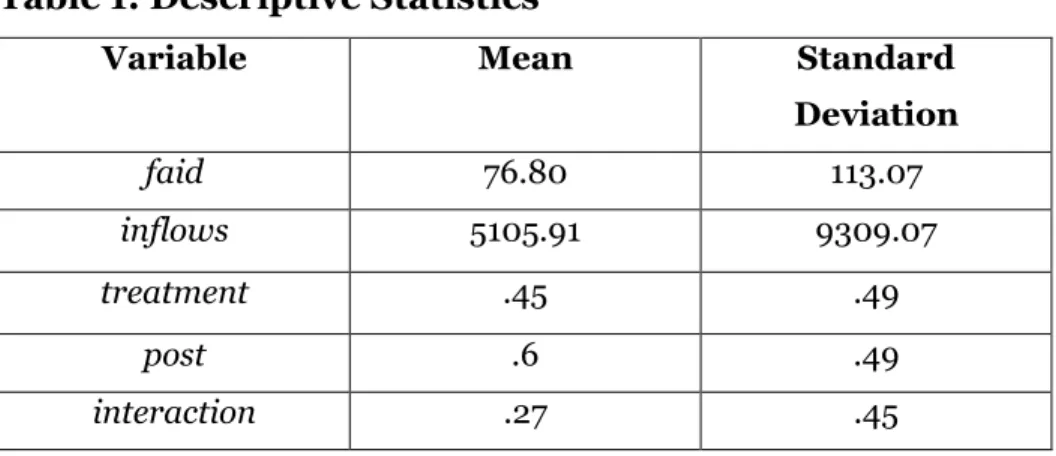
Table 1: Descriptive Statistics
Variable Mean Standard Deviation faid 76.80 113.07 inflows 5105.91 9309.07 treatment .45 .49 post .6 .49 interaction .27 .45 Table 2: VIF
Variable VIF 1/VIF
Interaction 3.33 0.30
Treatment 2.50 0.40
Post 1.83 .55
Mean VIF 2.56
Table 3: Difference in Difference Regression Analysis
(1) (2)
VARIABLES faid Inflows
treatment 37.14 -2,017 (27.65) (2,237) Post 48.85** 543.4 (24.06) (1,947) interaction -24.54 6,444** (35.69) (2,888) Constant 37.31** 3,939*** (18.64) (1,508) Observations 165 165 R-squared 0.039 0.072
Standard errors in parentheses *** p<0.01, ** p<0.05, * p<0.1
Table 4: Park’s Test
(1) (2)
VARIABLES Lne2 Lne2
Lnz 0.75* .24 (0.39) (.324) Constant 0.42** 13.24*** (3.32) (2.74) Observations 150 150 R-squared 0.024 0.0031
Standard errors in parentheses *** p<0.01, ** p<0.05, * p<0.1
Table 5: Robust Check
(1) (2)
VARIABLES faid Inflows
treatment 37.14** -2,017*** (16.17) (521.9) post 48.85** 543.4 (22.48) (589.9) interaction -24.54 6,444** (30.74) (2,593) Constant 37.31*** 3,939*** (3.504) (468.5) Observations 165 165 R-squared 0.039 0.072
Robust standard errors in parentheses *** p<0.01, ** p<0.05, * p<0.1
Reference List
Alesina, A., & Dollar, D. (2000). Who Gives Foreign Aid to Whom and Why? Journal of
Economic Growth,5(1), 33-63. Retrieved from http://www.jstor.org/stable/40216022
Bermeo, S., & Leblang, D. (2015). Migration and Foreign Aid. International Organization,69(3), 627-657. doi:10.1017/S0020818315000119
Berthélemy, J.-C., Beuran, M., & Maurel, M. (2009). Aid and Migration: Substitutes or
Complements? World Development, 37(10), 1589–1599.
https://doi.org/10.1016/j.worlddev.2009.02.002
Bodvarsson, Ö. B., & Van den Berg, H. (2013). The economics of immigration. New
York, NY: Springer New York.
Clemens, M. A., & Postel, H. M. (2018). Deterring Emigration with Foreign Aid: An
Overview of Evidence from Low‐Income Countries. Population & Development Review,
44(4), 667–693. https://doi.org/10.1111/padr.12184
Czaika, M., & Mayer, A. (2011). Refugee Movements and Aid Responsiveness of Bilateral
Donors. Journal of Development Studies, 47(3), 455–474.
https://doi.org/10.1080/00220388.2010.492855
DeMarco, M. (2018). Where does German Foreign Aid Go? Borgen Magazine.
https://www.borgenmagazine.com/german-foreign-aid/
Donor Tracker. (2017). Donor Tracker Profile Germany April 2017. Donor Tracker.
Retrieved April 30, 2019, from
https://donortracker.org/sites/default/files/donor_pdfs/Donor_Tracker_Profile_Ger many_April_2017.pdf
ECFR. (2017). Migration Through the Mediterranean: Mapping the EU Response.
European Council on Foreign Relations. Retrieved April 30, 2019, from
https://www.ecfr.eu/specials/mapping_migration
Furness, M. (2018). Strategic Policymaking and the German Aid Programme in the
MENA Region Since the Arab Uprisings. Deutsches Institut für Entwicklungspolitik
gGmbH.
Hanelt, C.P. (2016). The International Response to Crisis in the Middle East: A German
Approach. Bertelsmann Foundation. Retrieved April 30, 2019.
https://www.bfna.org/research/the-international-response-to-crisis-in-the-middle-east-a-german-approach/
Koser, K. (2012). Migration, Displacement and the Arab Spring: Lessons to Learn. Retrieved April 8, 2019, from https://www.brookings.edu/opinions/migration-displacement-and-the-arab-spring-lessons-to-learn/
Kilby, C. (2006). Donor influence in multilateral development banks: The case of the
Asian Development Bank. The Review of International Organizations. 1(173).
Lanati, M., & Thiele, R. (2017). The Impact of Foreign Aid on Migration Revisited.
World Development. 111 (November): 59–74.
https://search-ebscohost-com.libproxy01.skidmore.edu/login.aspx?direct=true&db=eoh&AN=1728883&site=eho st-live
Lancaster, C. (2008). Foreign aid: Diplomacy, development, domestic politics.
University of Chicago Press.
Moreira de Silva, J. (2018). Germany Mid-term Review, 7 November 2018, Berlin.
OECD. Retrieved from April 30, 2019, from http://www.oecd.org/dac/peer-reviews/Germany-2018-Mid-term-review.pdf
Pham, J.P. (2017) Germany’s ‘Marshall Plan’ for Africa. Atlantic Council. Retrieved
April 30, 2019, from
https://www.atlanticcouncil.org/blogs/new-atlanticist/germany-s-marshall-plan-for-africa
Prange, A. (2019). Refugees in Germany: Legal entry — without asylum. Duetsche Welle. Retrieved April 30, 2019, from https://www.dw.com/en/refugees-in-germany-legal-entry-without-asylum/a-48515382
Rodrik, D. (1995). Why is there multilateral lending? (No. w5160). National bureau of economic research.
Smith, N., Pytlikova, M., & Pedersen, P. J. (2004). Selection or Network Effects?
Migration Flows into OECD Countries, 1990-2000. IZA- Institute of Labor Economics.
Tiebout, C. M. (1956). A pure theory of local expenditures. Journal of political economy, 64(5), 416-424.
The Economic Times. Definition of ‘Soft Loan’. The Economic Times. Retrieved April
30, 2019, from https://economictimes.indiatimes.com/definition/soft-loans
UNHCR. (2018). Germany 2016 Resettlement Handbook Country Chapter
Aktualisierung 2018. United Nations Commissioner for Refugees. Retrieved April 30,
2019, from https://www.unhcr.org/5162b3bc9.pdf
Welle (2018). The EU-Turkey Refugee Agreement: A Review. DW.COM.
https://www.dw.com/en/the-eu-turkey-refugee-agreement-a-review/a-43028295 Zurcher, C. What Do We (Not) Know About Development Aid and Violence? A
Systematic Review. World Development. October 1, 2017. DOI: