E-Banking in Nigeria: Issues and Challenges
Article in Research Journal of Finance and Accounting · February 2017CITATIONS 0
READS 8,719
1 author:
Some of the authors of this publication are also working on these related projects:
Financial inclusion and poverty reduction in NigeriaView project Sunday OSEIWEH Ogbeide
Elizade University 20PUBLICATIONS 12CITATIONS
E- Banking in Nigeria: Issues and Challenges
Babatunde Ololade* Sunday Ogbeide
Department of Accounting & Finance, Elizade University, Ilara- Mokin, Ondo State, Nigeria
Abstract
The aim of this study was to assess issues and challenges of e-banking in Nigeria. The specific objectives were to ascertain the effect of e-banking on workers, job security in Nigeria banking industry, examine the relationship between e- banking and quality of service delivery of commercial banks in Nigeria, evaluate the relationship between e-banking and security of financial transactions and to find out if e-banking influences customers satisfaction in the Nigerian banking industry. The survey and descriptive research design were adopted in the methodology of the study. The population consists of all the customers and staff of three selected banks branches in the Benin metropolis. A sample of three hundred respondents was selected using the convenience random sampling techniques. The study employs primary data using questionnaires as the research instrument. The data analysis was carried out using summary statistics and ordinary least square regression analysis. The study findings indicate that employees’ job security has a positive relationship with E-banking and significantly influence E-banking in Nigeria; customers’ satisfaction was ascertained to have a positive relationship with e-banking and also influence e-banking penetration in Nigeria; security of financial transactions was found to have a positive relationship with e-banking, it however had inverse significant impact on e-banking; services delivery has a positive relationship with banking. It is therefore recommended that for effective e-banking penetration, investors education and marketing of e-e-banking products should be the key strategy banks should use to attract more customers towards embracing e-banking and increasing security for e-banking products, reduction of charges on e-banking products and increasing more ATM outlets in Nigeria as part of measures towards enhancing quality services delivery and promotion of e-banking as this will further enhance the recent need for financial inclusion as part of the monetary policy of the Central Bank of Nigeria.
Keywords: E-banking, job security, service delivery, customers’ satisfaction and security of e-banking financial transactions.
1. Introduction.
The increasingly competitive environment in the financial service market has resulted in pressure to develop and utilize alternative delivery channels. The most recently delivery channel introduced is online banking. Online banking is otherwise refers to as electronic banking; and electronic banking, similarly is term as e-banking. Online or electronic banking systems give everybody the opportunity for easy access to banking activities, thus promoting financial inclusion. These banking activities may include retrieving an account balance, electronic money transfers and retrieving an account history electronically. Electronic banking (E-banking) has gradually become an indispensable part of modern day banking services. All over the world, banking industry is one of the industries that have adopted technology which helped in rendering better and quality services to customers. The quality of services is enhanced using technological innovations. Technological innovations have continued to engender speed of transactions and prompt service delivery in banks, thus promoting customers’ convenience and satisfaction.
Dawson (1998) explicitly points out the merit of E-banking to encompass speed operation, better communication, timely management, improvement of product quality and gaining competitive advantage. According to Olusegun, Ishola and Hammed (2011), the transformation from the traditional banking to E-banking has been a ‘leap’ change, there is however a high level of job insecurity among employees in the modern-day banking industry. In other words, the modern-day banking services place more emphasis on technological innovations to improve service delivery and high level of customers’ satisfaction; and this however no doubt increases the level of employees’ job security by rendering some skills obsolete and demanding high level of skill in promoting e-banking occasioned by information technology evolution or development.
One of the major significance of e-banking products and services is improved efficiency and effectiveness of the operations so that transactions can be processed faster and most conveniently. Thus, it is expected to enhance customers’ services, effective distribution, improved operations, faster access to information and improved internal processes. This implies that customers’ benefit ranges from reduced frequency of going to the banking halls to handling of cash. However, despite this seemingly importance of e-banking, closer observation shows that there are still long queues seen in some banking halls even as customers still handle too much cash, problem of frequent network failure and inadequate awareness of available e-banking products and services, even as empirical evidence shows that level of understanding of a product and its commensurate benefits determines the reactions of customers to it and patronage (Balanchandler, 2011). Bank cashiers are often heard of complaining of poor network while collecting or paying cash at the counter from or to customers; and
customers are sometimes frustrated at ATM centers sometimes due to slow or non-dispensing of cash by the automated teller machine. Sometimes, the problem is even exacerbated by way of wrong debiting of account in the process of a bank customer attempting to assess his or her bank account balance. Even a lot of bank customers over the years have been defrauded because of the introduction of e-banking in the banking industry. These days, observations have shown that there is fewer bank staff compared to as before perhaps because of the advent of e-banking in Nigeria. At the onset of e-banking in Nigeria for example, some bank staffs were adversely affected because of their inability to cope with the application of e-banking in meeting bank customers’ demand and other transactions in the banks. Some members of the public have even consciously or unconsciously rescinded to the use of e- banking despite its attendant benefits. Therefore, there is no contradicting the fact that the world today experiences problematic and unresolved e-banking services (Imiefoh, 2012). This has seriously affected and is still affecting the process of e-banking worldwide, particularly in developing countries such as Nigeria; an indication that there are myriad of issues and challenges surrounding the application of e- banking. This has continued to elicit the reactions of many scholars with varying and often conflicting views on the fundamental issues at stake; how they can be resolved; and the importance of such resolution in the ever-changing banking system.
Against these existing problems, this paper examines e-banking in Nigeria: issues and challenges. Specifically, the focus of this study is to ascertain the level of effect e-banking have on workers’ job security in Nigerian banking industry; examine the relationship between e-banking and quality of service delivery of commercial banks in Nigeria; find out if e-banking influences customers’ satisfaction in Nigerian banking industry; and evaluate the relationship between e-banking and security of financial transactions in the Nigerian banking industry. The rest of this article is structured as follows: Section two contains the review of related literature, section three is the methodology, section four concerns with analysis and discussion of findings while section five is conclusion and recommendations.
2. Literature Review
2.1 E-Banking and Banks Employees’ Job Security
Modern companies, particularly, banks have resorted to the automation of processing capabilities and the substitution of labour intensive process by machine processed applications. Rifklin (1995) noted that new and more sophisticated software technologies are going to bring evaluation over closer to the new workerless world. He then concludes that information technology otherwise refers to as e-banking has been used to deskill, discipline and displace human labour in a global speed up of unprecedented proportions.
The modern banking service place more emphasis on technological innovations to improve service delivery and high level of customers’ satisfaction; and this however increases the level of employees’ job insecurity by rendering some skills obsolete and demanding high level of skill in information technology (Olusegun, Ishola & Hammed, 2011). They pointed out that adoption of e-banking leads to loss of jobs and early retirement of employees in Nigerian banking sector. Similarly, they asserted that adoption of automated teller machine and other e-payment system effect job stability and employment of teller officers in the Nigerian banking sector. Modern day banking services emphasize on the usage of technological innovations to improve service delivery and increase customers’ satisfaction. This explains why we experienced high level of job insecurity among employees in the modern-day banking industry.
2.2 E-Banking and Customers’Satisfaction
Agboola (2001) studied the impact of computer automation services and discovered that electronic banking (e-banking) has tremendously improved the services of some banks to their customers in terms of satisfaction in Lagos. He averred that e-banking provided customers with a wide range of financial benefits such as lower transaction handling fees, higher deposit rates, opportunities to win prizes and extra credit card bonus points. It allows customers to save time by conducting their transactions quickly without having to queue up and to use paper documents. E-banking offers customers the opportunities to interchange electronic data to communicate with bank staff with a view to enhancing customers’ satisfaction.
Customers’ complaints are part of the business life of any corporate entity. This is more so for banks because they are service organizations, customer service and satisfaction should be prime concerns of the banks. The banks believe that providing prompt and efficient service is essential not only to attract new customers but also to retain existing one. Adewuyi (2013) noted that customers’ complaints, grievances and dissatisfaction can be reduced by banks through proper service delivery and review mechanism. Prompt service delivery has been described to be one of key performance indicators of corporate organizations including banks. The extent to which customers of banks are satisfied with the service rendered has impact on the overall performance and must be seriously taken by players of the industry. Quality of services is a key determinant of customer satisfaction and customer loyalty. E-banking is expected to improve banks service delivery in a form of transactional convenience, saving of time, quick transaction alert and cost savings, ultimately customers’ satisfaction. Thus,
the extent to which e-banking is correlated with banks customers’ satisfaction is worth evaluating. This is what this present study seeks to achieve.
2.3 E-banking and Security of Financial Transactions.
Security of financial transactions being executed from some remote locations and transmission of financial information over the air are the most complicated challenges affecting e-banking in Nigeria. It is one of the needs that should be addressed jointly by mobile application developers, wireless network service providers and the banks’ information technology departments. Several banks in Nigeria have lunched the mobile banking services that enable customers to carry out simple transactions based on short message service technology with customers’ mobile phones serving as the terminals. Such transactions include account balance enquiries, funds transfers between customers’ own accounts and to other accounts within the same bank, transaction tracking and third party payments such as bills payments, cheque book request and balance confirmation. The security controls used are pin code and pass code identification (Adewuyi, 2013). Also, toenhance effective security measure, banks have since been upgrading their ATM cards from the magnetic stripe to the Euro-Visa-Master card standard, popularly known as Verve Card (www.businessdayonlinc.com). This latter technological device is more fraud resistant because all the data of the customer are recorded on the chip. The union of technology and finance haverecorded huge success and has impacted on financial transactions. E-banking system has become the main technology-driven revolution in conducting financial transactions. However, banks have made huge investments in telecommunication and electronic systems, users have also been validated to accept e-banking system as useful and easy to use (Adesina & Ayo, 2010)
2.4 Challenges of E-Banking
Banking organizations have been delivering electronic services to consumers and businesses remotely for years. Electronic funds transfer, including small payments and corporate cash management systems, as well as publicly accessible automated machines for currency withdrawal and retail account management, are global fixtures. However, the increased world-wide acceptance of the Internet as a delivery channel for banking products and services provides new business opportunities for banks as well as service benefits for their customers (BCBS, 2001). Notwithstanding the significant benefits of E-banking and its capabilities, it carries risks and challenges which must be recognized and managed by banking institutions in a prudent manner.
The speed of change relating to technological and customer service innovation in E-banking is unprecedented. Historically, new banking applications were implemented over relatively long periods of time and only after in-depth testing. Today, however, banks are experiencing competitive pressure to roll out new business applications in very compressed time frames, often only a few months from concept to production. This competition intensifies the management challenge to ensure that adequate strategic assessment, risk analysis and security reviews are conducted prior to implementing new e-banking applications (BCBS, 2001).
E-banking increases banks’ dependence on information technology, thereby increasing the technical complexity of many operational and security issues and furthering a trend towards more partnerships, alliances and outsourcing arrangements with third parties, many of whom are unregulated. This development has been leading to the creation of new business models involving banks and non -blank entities, such as Internet service providers, telecommunication companies and other technology firms (BCBS, 2001). The Internet is ubiquitous and global by nature. It is an open network accessible from anywhere in the world by unknown parties, with routing of messages through unknown locations and via fast evolving wireless devices. Therefore, it significantly magnifies the importance of security controls, customer authentication techniques, data protection, audit trail procedures, and customer privacy standards (BCBS, 2001). Other E-banking related problems are user error, bad internet connections, access problems and security issues. Most of these problems may or may not outweigh the benefits.
3. Methodology
The survey and descriptive research designs were used in this study. The employees of respective e -bank branches were surveyed. The customers who own accounts and are using e-banking services were also surveyed in the respective bank branches. Both the staff of the bank branches as well as the customers were administered questionnaire to elicit responses from them on the subject matter under investigation. The population of this study consists of the staff and customers of the three commercial bank branches, namely Zenith bank PLC, UBA PLC and GT bank PLC in the Benin metropolis. It is imperative to focus on these banks’ branches customers and staff in the locality in that they generally reflect technologies and operations by sister branches nationwide. The sample size of the study is one hundred and fifty (150) staff and customers of the bank’s branches visited. A total of fifty (50) is selected from each of the banks. In terms of sampling technique, the selection of the banks was done using purposive sampling technique while the bank staff and customers were selected randomly using simple random sampling technique.
The primary data are the data generated through first-hand information from respondents during a field work. A structured Likert-type questionnaire was used in this study as the main gathering instrument. The Likert-type questionnaire was divided into two sections. Section A captures basic biographic information of the respondents such as department/limits, designation, rank in the work place, period of banking and E-banking usage. Section B contained twenty (20) items where respondents were asked to indicate the extent to which they agree/disagree to the various statements regarding e-banking as well as the issues and challenges involve since the adoption of e-banking by the banks’ staff and customers.
3.1. Model Specification and Method of Data Analysis.
To ascertain the level of issues and challenges surrounding application of e-banking platform in the banking industry, the model below in its mathematical form is used:
eb = f(ejs, sd, cs, sft and caw)
The model is specified in its stochastic form as eb = β0 + β1ejs + β2sd + β3cs + β4sft + ut.
Where
eb indicate electronic banking (e-banking) and is the dependent variable. β1 – β4 are the coefficients of the independent variables; and
ejs = employees job security in banks
sd = service delivery of the banks via e-banking cs = customers’ satisfaction of e-banking sft = security of financial transactions
β0 is the intercept while ut is the stochastic error acting as surrogate in the construct
However, the apriori expectation of the variables employed in above model is β0, β2, β3, β4 > 0.
This suggests that the independent variables are expected to be positively associated with and also influence e-banking in Nigeria. The method of analysis used to analyze the data generated from primary source is the ordinary least squares regression analysis.
4.Data Analysis and Interpretation of Result.
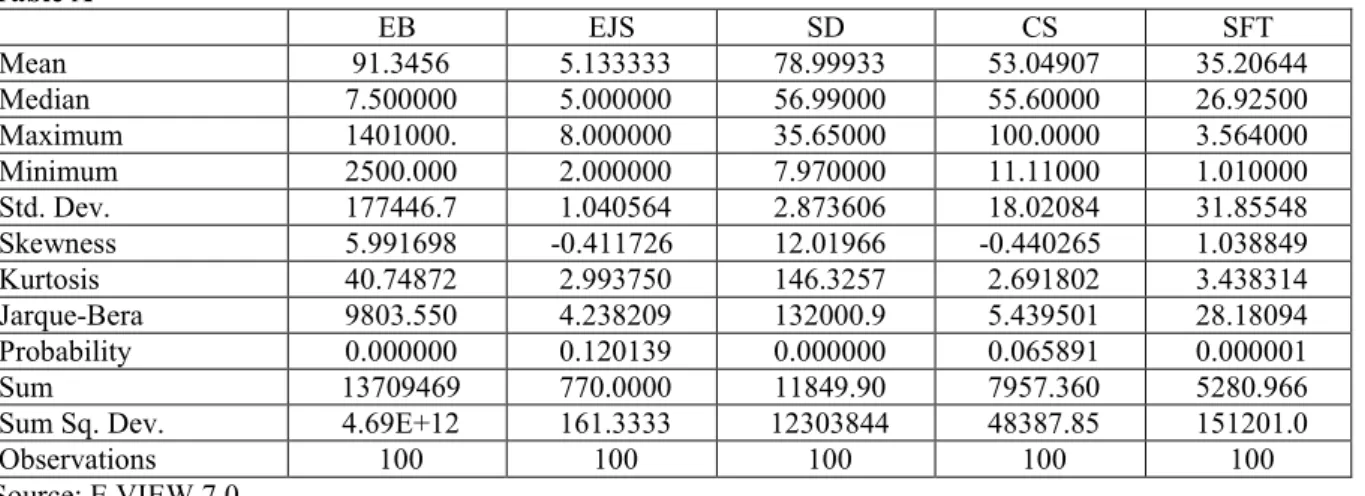
4.1 Descriptive Statistics. Table A EB EJS SD CS SFT Mean 91.3456 5.133333 78.99933 53.04907 35.20644 Median 7.500000 5.000000 56.99000 55.60000 26.92500 Maximum 1401000. 8.000000 35.65000 100.0000 3.564000 Minimum 2500.000 2.000000 7.970000 11.11000 1.010000 Std. Dev. 177446.7 1.040564 2.873606 18.02084 31.85548 Skewness 5.991698 -0.411726 12.01966 -0.440265 1.038849 Kurtosis 40.74872 2.993750 146.3257 2.691802 3.438314 Jarque-Bera 9803.550 4.238209 132000.9 5.439501 28.18094 Probability 0.000000 0.120139 0.000000 0.065891 0.000001 Sum 13709469 770.0000 11849.90 7957.360 5280.966 Sum Sq. Dev. 4.69E+12 161.3333 12303844 48387.85 151201.0 Observations 100 100 100 100 100 Source: E VIEW 7.0
Table A above presents the summary statistics of E-banking application and the independent variables which in the context of this study is presumed to influence e-banking in Nigeria. The explanatory variables are employees’ job security (EJS), service delivery (SD), customers’ satisfaction (CS) and security of financial transactions (SFT) of the selected banks as earlier harped on in the immediate preceding section. The descriptive statistics shows that the mean value (average value) of e-banking adoption (EB) is 91.3. That is about 91% level of adoption and application. This value is higher than the median value of 7.500000, an indication that there appears to be wide dissimilarities in e- banking adoption by the individual quoted banks in the Nigerian banking sector. The maximum and minimum value or rate of e- banking adoption in the banks visited is 1401000 and 2500.00 respectively. This wide obvious variation between the two values indicates the tendency for e-banking adoption and application of the sampled banks to nose-dive to extremely low values or reduce given the influence of the explanatory variables. The standard deviation value of 177446.7 is also extremely high and shows variability or rapid changes in the figures of e-banking adoption in the Nigerian banking industry. The skewness value of 5.991698 is quite very low. The Jarque-Bera value of 9803.550 for e-banking adoption is very high. It passes the significant test at 99% level and simply indicates that e-banking adoption across the selected
banks is normally distributed.
Moreover, employees’ job security (EJS) has a mean value of approximately 5.13. That is about 5.13% which is higher than the median value of 5.00 (5.00%) and clearly suggests that there appears to be wide differences in employees’ job security of the individual selected banks. The implication of this is that the rate at which the employees of the banks job security is affected or perhaps would be adversely affected is just about 5.13% and they are 94% secured in their jobs in the respective banks occasioned by the adoption and application of e-banking in the day to day banking operations or activities. The maximum and minimum value of employees’ job security (EJS) is approximately 8.00 and 2.00 respectively. The standard deviation of employees’ job security in the selected banks of 1.04 approximately is minimal suggesting that the deviation (risk) in the job security is very low. The Jarque-Bera value of 4.24 approximately for employees’ job security is quite low. It did not pass the significant test at 95% level; and shows that the employees’ job security of the banks chosen as our target in the study is very low and is not normally distributed
The mean of service delivery (SD) is 79% approximately which points out that on the average, there exists some high level of quality of service delivery via e-banking in respective banks. The maximum and minimum value of service delivery through e-banking across the selected banks is 35.65% and 7.97% respectively. The standard deviation of 2.8736% is indicative of the extent of deviation or differences in service delivery in the sampled banks. The Jarque-Bera value of 132000.9% for service delivery is very high. It passes the significant test and portends that the data of service delivery in the respective banks are normally distributed.
Customers’ satisfaction (CS) has a mean value of 53.05% approximately. It suggests that about 53% satisfaction is derived by the customers of banks because of adoption and application of e-banking in the delivery of efficient and quality services. However, it is lower than the median value of 55.60%, an indication that there seems to be dissimilarities in customers’ satisfaction in the respective banks. The maximum and minimum values of the customers’ satisfaction (CS) are 100% and 11.11% respectively. This very wide differences between the two values reported above indicates a tendency for the customers’ satisfaction of the selected banks to nose-dive given that the services are not efficiently delivered perhaps due to service failure occasioned by the e-banking adoption. The standard deviation of 18.02084 is indicative of the extent of deviation of satisfaction by the customers in the banks. The Jarque-Bera statistic value of 5.44% indicates that the variable does not satisfy normality.
In a similar manner, security of financial transactions (SFT) due to the adoption of e-banking has a mean value of 35.21 approximately which suggests that there is about 35.21% of security of financial transactions in the banks in this study where the field work was carried out. The maximum and minimum values are 3.564% and 1.01% respectively of the sampled banks. The Jarque-Bera value of 28.78 is a bit high; and it passes the significant test and indicative of the normality of the SFT data distribution. In a nutshell, the descriptive statistics show that the explanatory variables exhibit high variability, skewness and highly significant Jarque-Bera values across the selected banks.
4.2 Pearson Correlation Statistics.
In econometric analysis, it is essential that the independent variables in the model specification do not have excessive correlation patterns. Similarly, it is essential to examine in a preliminary manner, the associations among the variables in the study. Thus, the correlation analysis is employed to conduct this investigation. That is the correlation between e-banking and the explanatory variables employed in this study to assess how they influence e- banking in the Nigerian banking industry. The results of the correlation tests are reported in the table below: TABLE B: EB EJS SD CS SFT 1 -0.0076 0.0096 0.0603 -0.0424 -0.0076 1 0.1591 -0.2546 -0.1666 0.0096 0.1591 1 0.0022 0.0401 0.0603 -0.2546 0.0022 1 0.1821 -0.0424 -0.1666 0.0401 0.1821 1 Source: E VIEW 7.0
From table B above, the correlation coefficients of the variables are examined. However, of interest to the study is association between e-banking and the explanatory variables employed to checkmate how they influence the e- banking in the banks selected in this study. As observed, a positive association exists between e- banking and employees’ job security (r = 0.007), though the coefficient is weak, the direction of correlation suggests that increase in e-banking adoption and application may be associated with employees’ job security reduction when viewed intuitively. A positive association is observed between e-banking (EB) and service delivery (SD), (r = 0.009) in the individual banks. This implies that the level of e-banking adoption may be correlated with enhancement in service delivery of the banks in Nigerian banking sector.
Customers’ satisfaction (CS) is positively associated with e- banking adoption and application (r = 0.06) and this clearly suggests that the level of customers’ satisfaction may be associated with an increase in e-banking applications of the banks. Security of financial transactions (SFT) is observed to be positively associated with e-banking adoption and applications (0.04), suggesting that the extent of security of financial transactions may be correlated with improvement in e-banking. However, caution may be suggested in alluding strict causality using the correlation coefficients among the variables. This is because the correlation analysis does not necessarily imply the existence of functional relationship but a mere association. The analysis of the correlation coefficients among the independent variables is quite very low, and this suggests that the potential for multi-collinearity is reduced in the model. The overall implication of this is that all the variables tend to re-enforce each other in a positive mutual perspective towards enhancing the banks’ e-banking, though the coefficients appear to be very weak in their associations.
4.3 Ordinary Least Square (OLS) Results.
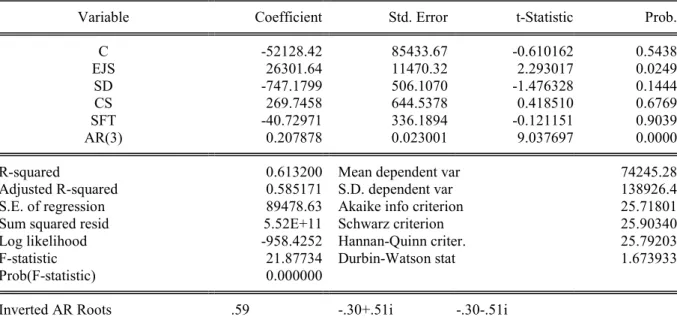
Under this section, we robustly present the results of the regression analysis conducted. Majorly, our interest is to determine the extent of responses of e-banking of the banks to each of the explanatory variables. We intend to ascertain the effect they have in enhancing e-banking in Nigeria. On this basis, we begin by presenting the ordinary least square estimation results. This will then assist us to provide a more robust perspective for the current study. The OLS estimation technique result is presented in the table below:
Table C: Ordinary Least Square Estimation Result
Dependent Variable: EB Method: Least Squares Date: 11/20/15 Time: 16:42 Observations:100
Convergence achieved after 5 iterations
Variable Coefficient Std. Error t-Statistic Prob. C -52128.42 85433.67 -0.610162 0.5438 EJS 26301.64 11470.32 2.293017 0.0249 SD -747.1799 506.1070 -1.476328 0.1444 CS 269.7458 644.5378 0.418510 0.6769 SFT -40.72971 336.1894 -0.121151 0.9039 AR(3) 0.207878 0.023001 9.037697 0.0000 R-squared 0.613200 Mean dependent var 74245.28 Adjusted R-squared 0.585171 S.D. dependent var 138926.4 S.E. of regression 89478.63 Akaike info criterion 25.71801 Sum squared resid 5.52E+11 Schwarz criterion 25.90340 Log likelihood -958.4252 Hannan-Quinn criter. 25.79203 F-statistic 21.87734 Durbin-Watson stat 1.673933 Prob(F-statistic) 0.000000
Inverted AR Roots .59 -.30+.51i -.30-.51i Source: E View 7.0
To correct for serial auto-correlation problem, an autoregressive method was employed which yielded the estimated equation after 5 iterations. The results above reveal that the goodness of fit for the model is quite impressive given their high coefficients of determination. The R-Square value of 0.61 is high enough. It shows that about 61% of the systematic variations in e-banking for the sampled banks were explained by the independent variables, employees’ job security (EJS), service delivery (SD), customers’ satisfaction (CS) and security of financial transactions (SFT) in the model. After adjusting for the degree of freedom, the adjusted R-squared value of 58.57 indicates that all the independent variables together could explain about 58.8% systematic variation in the dependent variable, e-banking. It leaves about 41. 2% unaccounted for due which can be handled by further studies.
A quick examination of the individual coefficients of the explanatory variables reveals that service delivery (SD) and security of financial transactions (SFT) have negative effects (signs) and are statistically not significant at 5% level. It suggests that customers of banks who at various time or the other jilted or have their financial transactions adversely affected via fraud or other related occurrence tend to fear e-banking applications. Similarly, if it is perceived by the customers of the banks the services render to them through e-banking is not
efficient, they may resort to declining from those transactions that involve e-banking at all. The other coefficients such as employees’ job security (EJS) and customers’ satisfaction (CS) were observed to be positively signed. It suggests that a unit change in employees’ job security for instance will result to 26301.64 unit increase in e-banking and it is statistically significant at 5% level. While a unit change in customers’ satisfaction (CS) will lead to 269.7458 unit increase in e-banking and is statistically not significant at 5% level.
On the overall, the F-statistic value of 21.87 is significant at 1% indicating that all the explanatory variables put together determine e-banking in Nigerian. Moreover, the Durbin-Watson statistic value is also quite impressive as its value of 1.67 shows that there tends to be no serial auto correlation in the estimates; thus, making the results reliable for predictive and policy perspectives. However, it is noted that other important variables may have been omitted that can be accommodated in further study.
5. Discussion of Findings
In this section of the study, the discussions arising from the analysis made in the above sub-section are made. Evaluation of the analysis above shows that Employees Job Security has a positive slope coefficient and is statistically significant at 5% level. There are no doubt banks have actually adopted the automation processing capabilities and the substitution of labour intensive process through E-banking applications. The finding above is inconsistent with that of Rifklin (1995) where it was revealed that information technology otherwise refers to as E-banking has been used to deskill, discipline and displace human labour in a global speed up of unprecedented proportion. The study finding runs contrary to Olusegun & Hammed (2011). In the study, they noted that the modern banking services place more emphasis on technological innovation to improve services delivery and high level of customer satisfaction and this however increase the level of employees’ job security by rendering some skills obsolete and demanding high level of skill in information technology. They also pointed out further that adoption of E- banking delivery leads to lose of jobs and early retirement of employees in Nigeria banking sector; and that adoption of automated teller machine and other E-banking system affect job stability and employment of teller officers in the Nigeria banking sector while the findings made in this regard differ significantly from prior researches, it can be deduced that enhance in job security of employees of the bank may be due to the training and re-training. The explanation may be that more and more employees are now abreast of ICT technicality and operation and have upgraded their skill in that regard to be relevant in the modern day working environment.
Service delivery indicates a negative relationship with e- banking; it does not improve the adoption and application in the Nigeria banking industry. Back in those days, rendering services by banks used to be arduous until the ardent application of e-banking. Casual empiricism indicates that services delivery has improved such as queue reduction, improvements are still required in access to service such as bank reconciliation statements.
The study finding shows that customers satisfaction has a positive relationship but weak with E-banking. Thus, customer satisfaction must be improved as it is a key to growth of the industry. Many electronic banking systems are used to effectuate services delivery in banks. These electronic banking systems are telephone banking, mobile banking, online E-banking, point of scale terminal, automated teller machine (ATM) smart card and others. These e-banking systems enhance services delivery in the banking industry. This finding though weak, is in consonant with Agboola (2001) who noted that the impact of computer automation services via E-banking has tremendously improved the services of some banks to their customer in terms of satisfaction in Lagos.
Security of financial transaction surprisingly has a negative and non -significant relationship with E-banking in Nigeria. Over the years, banks and the customers have expressed worries over incessant frauds that were occurring in the banking sector due to non- security of financial transactions, basically on the adoption of E-banking platforms and the fact that there have been records of hackers hacking into banks Website. These have not gone down well with the bankers and customers in terms of applying e-banking. This surprising result may either be due to poor banking education on the part of customers, or there may be need in further study to change with analytical tool from OLS to Logit (for dummy variables).
5.1. Conclusion and Recommendations.
This study has showed that there are some influencing factors for the adoption of e-banking in Nigeria. Some of the predominant influencing factors are customer satisfaction from the quality of services render through e- banking, employees’ job security, service delivery and security of financial transactions. The study shows that network failure from internet connection is the major challenge facing customer using E-banking products in Nigeria. Therefore, any bank that hopes to continually succeed in the application of e-banking should as a matter of concern give attention to the issues that have been evaluated.
Based on the finding made thus far in this study, the following recommendations are made; education and marketing of E-banking products should be encouraged by the banks to attract more customers, more ATM facilities should be placed at vantage locations within the city to reduce distance and access time and it is also
recommended that banks should reduce the charges that E-banking attracts.
References
Abor, B. (2004), “Use of E- Banking in 21st Century: The major Challenges”, Journal of Business and Finance,
4(3), 2-9.
Aladwani, A.M (2001), “Online Banking a Field Study of Drivers, Development Challenges and Expectations”,
International Journal of Information and Management, 2(1), 213-225.
Balachandher, K.G (2001), “Electronic Banking in Malaysia: A Note on Evolution of Services and Consumer Reaction, Retrieved from http://www.mmu.edu.my.
Cain, G. (2004), “An Empirical Investigation of the Level of Users. Acceptance of E-Banking in Nigeria”,
Journal of Internet Banking and Commerce, 15(1), 7-12.
Central Bank of Nigeria (2007), “Economic Report for the First Half of 2007”. A Publication of Central Bank of Nigeria, Abuja, Website, http//www.cenbank.org.
Claessens, J., Dem, V., De Cock, D., Preneel, B. & Vandewalle, J. (2002), “On the Security of Today’s Online Electronic Banking System”, Computers & Security 21, 257-269.
Dawson, T. (1998), “The Role of Security, Privacy, Usability and Reputation in the Development of Online Banking”, Online Information Review, 31(5) 583-602.
Henry, L. (2000), “The Adoption of Internet Banking in Nigeria: An Empirical Investigation, Journal of Internet Banking and Commerce. 11(3).
Idowu, P.A., Aliu, A.O. & Adagunodo, E.R. (2002), “The effect of Information Technology on the Growth of the Banking Industry in Nigeria”, The Electronic Journal on Information System in Development Countries, EJISDC, 10(2) 1-8.
Imiefoh, P. (2012), “Towards Effective Implementation of Electronic E-Banking in Nigeria”, An International Multi Disciplinary Journal, 6(2), 290-300.
Liao, Z. & Cheung, M.T. (1997), “The Adoption of Internet Banking Services”, Journal of Marketing Management, 13, 791-811.
Olusegun, A.S, Ishola,G.K. & Hammed, A.B. (2011), “Effect of Electronic Banking on Employees’ Job security in Nigeria”, European Journal of Humanities and Social Sciences, 4(2), 69-84.
Qureshi, T.M., Zafar, M.K. & Khan, M.B. (2008), “Customers Acceptance in Developing Economics”, Journal of Internet Banking and Commerce, 13(1), 6-8.
Shih, B. & Fang, K. (2004), “The Use of Decomposed Theory of Planned Behavior to Study Internet Banking in Taiwan”, Internet Research 3(14), 213-223.
Thulani, D, Tofara, C. & Lanton, R. (2009), “Adoption and Use of Internet Banking in Zimbabwe, An exploratory study”, Journal Internet Banking and Commerce. 14(1), 1-13.
24
Appendix. Questionnaire.
Please tick as appropriate in the column below:
Where SA = strongly agree, A = Agree, SD= strongly disagree, D=Disagree Items related to
S/N SA A SD D
E- Banking adoption and Application in Nigeria
1 Introduction of e- banking service products has increase the financial service patronage of the banking sector
2 The introduction of e-banking such as in-banking, ATM and others has increased the level of Economic activities.
3 Your bank adopts e-banking in its full operations.
4 All banks customers are yet to full embrace e-banking in bulky transactions.
E- banking and Employments job security
1 There is a significant relationship between job security and e-banking
2 There is a significant relationship between displacement of human labour and e-banking in e-banking operations.
3 There is a significant relationship between early retirement of employees and e-banking in the Nigerian e-banking sector.
4 There is a significant relationship between employment and application of e-banking in the Nigerian banking industry.
E- banking and customers’ satisfaction
1 There is a significant relationship between customers’ satisfaction and e- banking in Nigerian building industry.
2 There is a relationship between customers’ loyalty in the Nigerian banking sector and e-banking.
3 There is a significant relationship between e-banking and time savings on the queue in the banking hall.
4 Excessive cost/charges of e-banking facilities affect customers’ satisfaction
E – banking and service delivery
1 Adoption of ICT products facilities accurate Record 2 Adoption of ICT convenient Business Hour
3 Adoption of ICT Enhances prompt and Fair Attention 4 Adoption of ICT Enhances Faster Services
5 Adoption of ICT makes Enquiries on Account faster 6 Adoption of ICT hasten Funds transfer
7 Adoption of ICT makes International market accessible
E- Banking and security of financial transactions.
1 Insecurity of financial transaction of e-banking in the Nigerian banking industry. 2 Adoptions of technology to reduce fraud improve the level of e-banking in the
Nigerian banking industry.
3 Insecurity of financial transactions as a result of e-banking has affected banking profitability
4 E-banking will not be fully embraced in Nigerian banking sector except it is made safe and secure for the customer financial transaction.