Putra, Role Of Auditor ... 21
ROLE OF AUDITOR COMPETENCY AND INDEPENDENCY ON QUALITY OF AUDIT (CASE STUDY: CPA FIRM IN JAKARTA)
Dian Febriyanto Putra
Economic Faculty, Universitas Gunadarma [email protected]
Abstract
Public accountants are independent auditors that provide services to public, especially in the field of audit of financial statements made by his client. Certified Public Accountant (CPA) task is to examine and provide a fairness opinion on the financial statements of a business entity based on the standards set by the Ikatan Akuntan Publik Indonesia (IAI).Population in this study is the auditor who worked on the Certified Public Accountant (CPA) in Jakarta. The sample was taken from using purposive sampling technique as much as 120 auditors. The independent variable in this study was the competence and independence, while the dependent variable was the quality of the audit. Methods Data collection conducted using questionnaire. The conclusion of the research was that the competence and independence of auditors influence audit quality significantly.
Keywords: Competency, Independency, Audit Quality.
INTRODUCTION
Public accounting firm Arthur Andersen is a member of the Certified Public Accountant (CPA Firm) that are rated as "The Big Five". However, in 2001 Arthur Andersen was proved manipulating Enron Company’s financial statement (Media Accounting, 2014). Enron was the largest energy companies in the world. Arthur Andersen destruct documents relating to the result of the audit on the financial statements of Enron.
Public accounting profession is profession which trusted by public to support professionalism as a public accountant to implement the duties of the audit, the auditor should be guided by auditing standards established by the Institut Akuntan Publik Indonesia (IAPI), the general standards, out door working standards and report standards. The ge-neral standard is a reflection of the per-sonal qualities that should be possessed
by an auditor. The general standard required by auditor to have expertise and sufficient technical training in performing audit procedures. Out door working stan-dards and report stanstan-dards regulation auditors in terms of data collection and other activities carried out during the audit. This standard also required to auditors to auditing a whole financial statements (Elfarini, 2013).
Audit quality is determined by two factors. They are competence and inde-pendence. Auditor implement audit assignments should act as an expert in accounting and auditing. Attainment of skill or competence starts with formal education, which other hand through experience and practice of auditing (SPAP, 2001: section 210). Auditor have to do technical training includes technical aspects and general education (Christia-wan (2012: 83)).
The auditor must be independent. Independent auditor means perform the obligation must be honest not only to the
22 Jurnal Ekonomi Bisnis Volume 21 No.1, April 2016 management and owners of the company,
but also to the creditors and other parties who trust the audit financial statement. Factor affecting to the independence are long relationships with clients (audit tenure), pressure from clients, auditors examine peer (peer review) and non-audit services. Public accountant should be follow the developments of the business and professional world by studying and understanding the new provisions will apply to the audit engagement that audit quality can be maintained (Christiawan (2012: 84)).
RESEARCH METHOD Research Variables
Measurement of each variable using a Likert scale of 1 to 5 that have meaning,
namely (1) Strongly Disagree, (2) Disa-gree, (3) Neutral, (4) ADisa-gree, (5) Strongly Agree. In this study, the independent variable are the competence and inde-pendence.
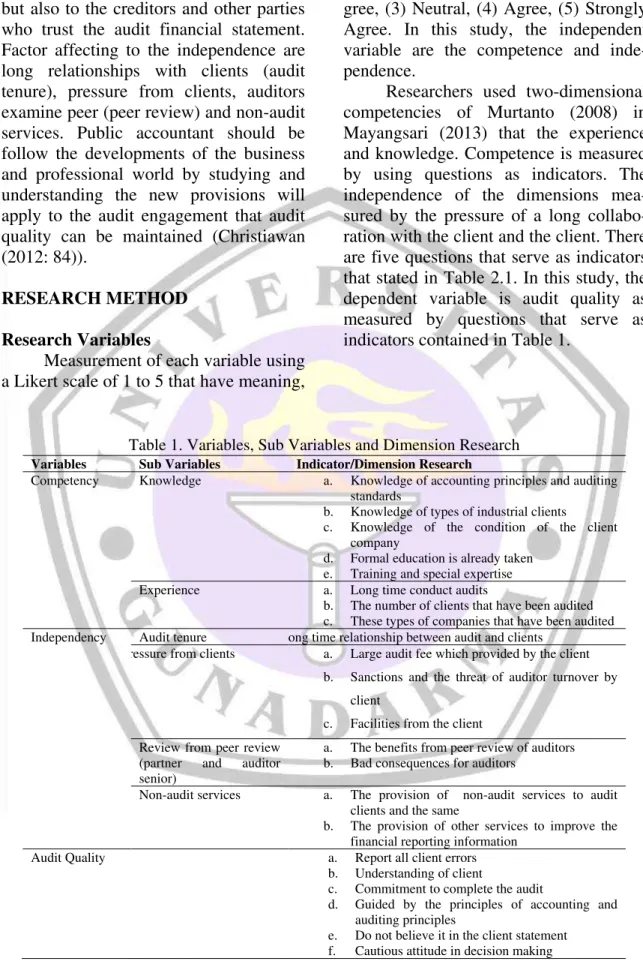
Researchers used two-dimensional competencies of Murtanto (2008) in Mayangsari (2013) that the experience and knowledge. Competence is measured by using questions as indicators. The independence of the dimensions mea-sured by the pressure of a long collabo-ration with the client and the client. There are five questions that serve as indicators that stated in Table 2.1. In this study, the dependent variable is audit quality as measured by questions that serve as indicators contained in Table 1.
Table 1. Variables, Sub Variables and Dimension Research Variables Sub Variables Indicator/Dimension Research
Competency Knowledge a. Knowledge of accounting principles and auditing standards
b. Knowledge of types of industrial clients
c. Knowledge of the condition of the client company
d. Formal education is already taken e. Training and special expertise Experience a. Long time conduct audits
b. The number of clients that have been audited c. These types of companies that have been audited Independency Audit tenure Long time relationship between audit and clients
Pressure from clients a. Large audit fee which provided by the client b. Sanctions and the threat of auditor turnover by
client
c. Facilities from the client Review from peer review
(partner and auditor senior)
a. The benefits from peer review of auditors b. Bad consequences for auditors
Non-audit services a. The provision of non-audit services to audit clients and the same
b. The provision of other services to improve the financial reporting information
Audit Quality a. Report all client errors b. Understanding of client
c. Commitment to complete the audit
d. Guided by the principles of accounting and auditing principles
e. Do not believe it in the client statement f. Cautious attitude in decision making
Putra, Role Of Auditor ... 23
Sampling Method
Sampling technique used purpo-sive sampling method. Based on data from the CPA firm of public accountants in 2012 known to many as the number of auditors in Jakarta, 665 people, from the number of 120 respondents chose from 15 CPA firm in Jakarta with the assumption that there is a minimum of 8 (eight) in each the firm for public accountants. RESULT AND DISCUSSION Validity and Reliability
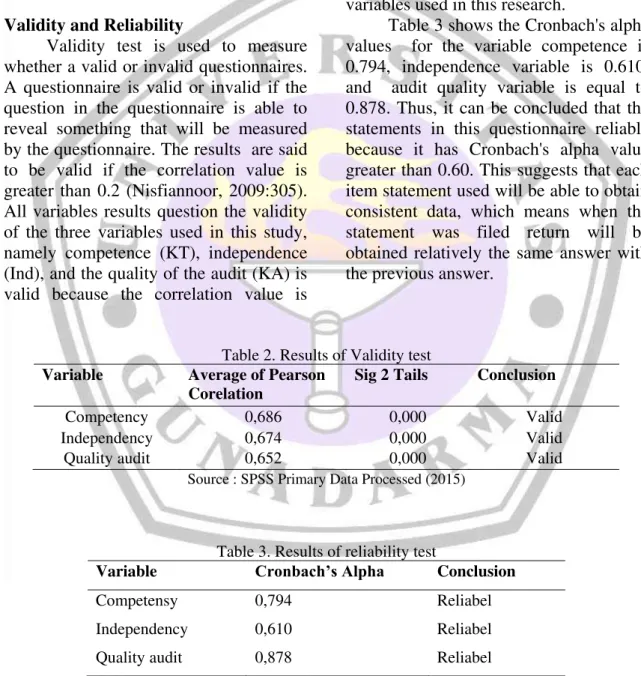
Validity test is used to measure whether a valid or invalid questionnaires. A questionnaire is valid or invalid if the question in the questionnaire is able to reveal something that will be measured by the questionnaire. The results are said to be valid if the correlation value is greater than 0.2 (Nisfiannoor, 2009:305). All variables results question the validity of the three variables used in this study, namely competence (KT), independence (Ind), and the quality of the audit (KA) is valid because the correlation value is
greater than 0.2. The results of these three variables can be seen in Table 2.
Reliability test is a test to measure a questionnaire which is an indicator of the variables or constructs. A questionnaire said reliable if the answer to someone question is consistent or stable over time. Variable or construct otherwise reliable if given the value of the Cronbach Alpha greater than 0.60 (Nunnally, 1967 in Ghozali, 2005). Table 3. shows the relia-bility test results for the three study variables used in this research.
Table 3 shows the Cronbach's alpha values for the variable competence is 0.794, independence variable is 0.610, and audit quality variable is equal to 0.878. Thus, it can be concluded that the statements in this questionnaire reliable because it has Cronbach's alpha value greater than 0.60. This suggests that each item statement used will be able to obtain consistent data, which means when the statement was filed return will be obtained relatively the same answer with the previous answer.
Table 2. Results of Validity test
Variable Average of Pearson
Corelation
Sig 2 Tails Conclusion
Competency 0,686 0,000 Valid
Independency 0,674 0,000 Valid
Quality audit 0,652 0,000 Valid
Source : SPSS Primary Data Processed (2015)
Table 3. Results of reliability test
Variable Cronbach’s Alpha Conclusion
Competensy 0,794 Reliabel
Independency 0,610 Reliabel
Quality audit 0,878 Reliabel
24 Jurnal Ekonomi Bisnis Volume 21 No.1, April 2016 Table 4. Regression Results
Variable Equation Constant Unstandardized
Constant 88,851
Competency 0,636
Independency 1,433
a Dependent Variable: KA
Source : SPSS Primary Data Processed (2015)
Hypothesis Test
a. Hypothesis Testing competence and independence to audit quality
Hypothesis testing is done using multiple regression analysis models. Hypothesis test results described in this research is
Based on Table 4, the regression equation is formed in this regression is:
Y = 88,851 + 0,636X1 + 1,433 X2 The equation shows that both the constants and coefficients of the independent variables have a positive value. This indicates that the multiple regression equation has a unidirec-tional relationship, which means the Audit Quality in Jakarta (Y) will increase by Auditor Competence (X1) and Auditor Independence (X2).
The value of X1 coefficient is 0.636 which means that if the value of X1 (Auditor Competence) increased by 1 point then Y (Quality Audit in Jakarta) will rise by 0.636 points assuming a fixed X2. X2 coefficient of 1.433, which means if the value of X2 (Auditor Inde-pendence) increased by 1 point then Y (Quality Audit in
Jakarta) will rise by 1.433 points assuming X1 fixed.
Constants of 88.851 means that the CPA firm can still have a quality audit of 88.851 although the indepen-dent variable is zero.
b. Statistical t Test Results
Statistical T test used to deter-mine whether or not the effect of each independent variable on the dependent variable individually tested at the 0.05 level. Statistical T test results can be seen in Table 5, t if the probability value less than 0.05 then reject H0 and Ha accepted, whereas if the probability value of t is greater than 0.05 then H0 is accepted and reject Ha.
Test Results Hypothesis 1: The effect of competence on audit qua-lity.
Hypothesis test results can be seen in Table 5. that the variable competence obtained t value of 3.336 with a significance level of 0.001. This means accepting Ha1 so it can be said that the competence signi-ficantly affect audit quality due to the significance level of competence variables is lower than 0,05.
Table 5. Result t-test
-Variable Equation t-value Significance
Constant 10,552 0,000
Competency 3,336 0,001
Independency 2,909 0,004
a. Dependent Variabel : Audit Quality Source : SPSS Primary Data Processed (2015)
Putra, Role Of Auditor ... 25 Test Results Hypothesis 2: The
effect of independence on audit quality.
Hypothesis test results can be seen in table 5, independence variable has a significance level of 0.004. This means accepting Ha2 so it can be said that significantly affect the inde-pendence of audit quality because of the level of significance independent variable is smaller than 0.05.
c. Coefficient of Determination Test
Coefficient of determination test is done to determine how much capa-bility of dependent variable can be explained by the independent varia-bles.
Table 6. shows the R value of 0.430 or 43%. This means that the relationship or correlation between factors affecting premature termination of the above procedure is quite strong because the audit is around 0.40 to 0.599 (Riduwan and Ahmad, 2007:62). the value of adjusted R square is 0.171 or 17.1% which means that the variable quality of the audit can be explained by the variable competence and independence is about 0.171 or 17.1%. While the remaining 0.829 or 82.9% (1-.171) is explained by other factors not included in this research. Effect of competence on audit quality
Hypothesis test results show that the significance level of competence
variable is equal to 0.001 <0.05 so that it can be concluded that the competence significantly affect audit quality. This means that audit quality can be achieved if the auditor has a good competence. Competence has two indicators that is knowledge and experience.
Auditor as a parties who are on the cutting edge of the audit assignment should increase knowledge through se-minars and professional training. Expe-rienced auditor has good accuracy and the ability to complete each task given by the client.
The results of application of such knowledge is increasing experience of the auditors which will result in a qualified audit. The results of this study could support the research conducted by Alim (2007) and Nurkholis (2003) who stated competence and experience significant effect on audit quality.
The results of this research same with research conducted by Senjani (2009) but in Senjani study (2009) that the dependent variable is the quality of the audit work papers. Senjani research results (2009) resulted in auditor quality as measured by the competence and independence of the effect on the quality of the audit work papers. This research was also supported by Harhinto (2004) which states that the experience and knowledge of auditors is positively related to audit quality.
Table 6. The Coefficient of Determinant Result Model Summary Model R R Square Adjusted R Square Std. Error of the Estimate 1 ,430(a) ,185 ,171 10,21791
a Predictors: (Constant), IND, KT a. Dependent Variabel : Audit Quality
Source : SPSS Primary Data Processed (2015)
26 Jurnal Ekonomi Bisnis Volume 21 No.1, April 2016 However does not agree with
Ariesanti (2001) who argues that the experience did not contribute to improve the skills of auditors. Arifilianto (1999) shows the education factor and the respondents perceived the audit period did not significantly affect the quality of the audit.
Effect of independence on audit quality Hypothesis test results showed that the level of independence of the variables of significance 0.004 <0.05 so that can be concluded that the independent varia-bles have a significant impact on audit quality. This means that the independence of the audit can be achieved if the auditor has a good independence. Auditor inde-pendence has four indicators, namely the relationship with clients (audit tenure), pressure from clients, review of peer auditors and non-audit services.
Auditors in the assignment should be maintain an independent attitude. The auditor should have the ability and knowledge in the collection of evidence which it should always be backed up by an independent attitude. The longer the auditor engaged by the client then the auditor will be biased and not reporting client errors. Pressure from clients means that the higher the pressure of the client, the more down audit quality level. Review of peer auditors can improve success in performing the audit. The provision of other services than audit services can be affect the independence of the public accountant is lost or damaged and therefore contributes to audit quality.
This means that audit tenure, pressure from clients, review of peer auditors and non-audit services become a benchmark for the independence of the effect on audit quality. This is a proof that the independence of an absolute require-ment for an auditor. Not easy to maintain independence in keeping with the supposedly, assignments that are too long can be affect the independence of an
auditor for with facility obtained an auditor for the assignment can be make the auditor can be controlled by the client because the auditor is in a position of dilemma. The results of this research support the research conducted by Alim (2007) and Nurkholis (2003) which states that the independence of the effect on audit quality.
However does not agree with Ariestanti (2001) which states that the old client relationships (audit tenure) had no effect on audit quality. The auditor can be cope with the pressure from the client so that the client does not have to affect the audit quality.
CONCLUSION AND
RECOMMENDATION Conclusion
Competence of auditors have a significant effect on audit quality CPA Firm which located in Jakarta. This suggests that audit quality can be achieved if the auditor has a good competency which composed of two factors: experience and knowledge. Expe-rience and knowledge has a positive effect to audit quality. The more expe-rienced an auditor, better the quality of audits will be conducted. The deeper and wider knowledge an auditor, has better quality of audit.
Auditor independence is reviewed of the relationship with the client, the pressure from the client, as well as the study of colleagues auditors and non-audit services, all have a significant effect on audit quality in the public accounting firm in Jakarta. Relation with clients, pressure from clients and non-audit services negatively affect audit quality, while the study of positive colleagues influence auditors. So the longer ongoing relationship between the auditor who the client auditors audit quality tends to be lower. The greater the perceived pressure from clients by auditors audit quality of
Putra, Role Of Auditor ... 27 the resulting lower. Study colleagues
auditors can ensure that the tests are accordance to applicable professional standards and quality so as to improve the quality of audit. The more non-audit services performed by an auditor, the auditor tends to be in favor of the client. This could lead to the independence of an auditor decreases the impact on the quality of audit results that tend to decline.
Implication
Improving the audit quality is necessary to increase the competency of the auditors that the provision of training and be given an opportunity for auditors to follow a course of education or improvement of the profession. If the auditors do that so the audit quality re-sulting will be better. Auditor is expected to independency because of factors can affect the quality of audit independency. Auditors were given the task of properly cultivated client independent, not under pressure from clients, do not hesitate to have the feeling that in implementing the auditing tasks objectively and produce a good quality of audit.
REFERENCE
Agoes, Sukrisno. 2003. Pengaruh Kode Etik, Standar Profesional Akuntan Publik dan Standar Pengendalian Mutu Terhadap Mutu Auditing dalam Praktik Auditing di Indonesia. Jurnal Akuntansi.
Alim, M. Nizarul, Trisni Hapsari dan Liliek Purwanti. 2007. Pengaruh Kompetensi dan Independensi terhadap Kualitas Audit dengan Etika Auditor sebagai Variabel Moderasi. Simposium Nasional Akuntansi X. Anis, Canyaning. 2008. Pengaruh
Kompetensi dan Independensi terhadap Kelangsungan Usaha Kantor Akuntan Publik (KAP) di Malang. Malang: FE UMM.
Arens, Alvin A., Randal K. Elder, Mark S. Beasley, dan Amir Abadi jusuf.
“Auditing and Assurance Services An
Integrated Approach: An Indonesian
Adaptation”. 13th edition, Salemba Empat, Jakarta, 2009.
Boynton, William C., dkk. 2007. Modern Auditing. Jakarta: Edisi Kedelapan, Penerbit Erlangga.
Choo, F. Dan K. T. Trotman. 1991. The Relationship Between Knowledge Structure and Judgement for Experienced and Inexperienced Auditors. The Accounting Review. Juli. p. 464 – 485.
Christiawan, Yulius Jogi. 2012. Kompetensi dan Independensi Akuntan Publik: Refleksi Hasil Penelitian Empiris. Jurnal Akuntansi & Keuangan Vol. 4 No. 2; 79 – 92
Cooper, Donald R. dan William Emory. 1997. Metode Penelitian Bisnis. Edisi Kelima, Jilid 1, penerjemah Ellen Gunawan dan Imam Nurmawan. Jakarta: Penerbit Erlangga
Darmoko, H. W. 2004. Profesionalisme Auditor KAP Dilihat dari Perbedaan Gender, Tipe KAP, dan Hirarki Jabatannya. Jurnal ”SOSIAL” Volume 4 Nomor 2; 128 – 140.
DeAngelo, L. E. 1981a. Auditor
Independence, ”Low Balling,” and
Disclose Regulation, dalam Journal of Accounting & Economics 3 (August): 113127.
DeAngelo, L.E. 1981b. “Auditor Size and
Audit Quality”. Journal of
Accountingand Economics. December.
pp. 183—199.
Deis, Donald R. dan Gary A. Giroux. 2012. Determinants of Audit Quality in the Public Sector. The Accounting Review. Juli. p. 462-479.
Elfarini, Eunike Christina. 2013.
Pengaruh kompetensi dan
Independensi Auditor terhadap Kualitas Audit.
Ghozali, Imam. 2005. Aplication Analisys Multivariative with SPSS Progam.
28 Jurnal Ekonomi Bisnis Volume 21 No.1, April 2016 Semarang: Badan Penerbit Universitas
Diponegoro.
Halim, Abdul. “Auditing Dasar-Dasar
Audit Laporan Keuangan”, Edisi 4, Unit Penerbit dan Percetakan (UPP) STIM YKPN, Yogyakarta, 2008. Ikatan Akuntan Indonesia, 2011. Standar
Profesionalisme Akuntan Publik per 1 Januari 2001., Jakarta: Salemba Empat Cet. Ke-1.
Ikatan Akuntan Publik Indonesia, 2009. Directory Kantor Akuntan Publik dan Akuntan Publik. Institut Akuntan Publik Indonesia dan Departemen Keuangan Sekretariat Jenderal Pusat Pembinaan Akuntan dan Jasa Penilai. Mayangsari, Sekar. 2014. Bukti Empiris
Pengaruh Spesialisasi Industri Auditor
terhadap Earnings Response
Coefficient. Jurnal Riset Akuntansi
Indonesia vol. 7 No. 2; 154-178.
Mukhlasin, 2104. Pengaruh Atribut
Kualitas Audit, Portfolio Jasa Audit, dan Reputasi Kantor Akuntan Publik terhadap Kepuasan Klien. BALANCE
FE Univ. Katolik Indonesia Atma Jaya ;
27 – 45.
Mulyadi dan Supriyono RA, 2008.
Faktor-faktor yang Mempengaruhi
Independensi Penampilan Akuntan
Publik. BPPS-UGM vol. 1 No. 1; 81-94.
Murtini, Sri. 2013. Persepsi Auditor
Tentang Faktor-faktor yang
Mempengaruhi Independensi Auditor.
JABPI vol. 9 No. 1; 1-7.
Nurkholis, 2013. Atribut Kualitas Audit: Persepsi Auditor, Manajer Akuntansi
dan Pemakai Laporan Keuangan.
Jurnal Ekonomi Bisnis Tahun 8 No. 3 ;