Copyright by Sooel Son
The Dissertation Committee for Sooel Son
certifies that this is the approved version of the following dissertation:
Toward Better Server-side Web Security
Committee:
Vitaly Shmatikov, Supervisor Kathryn S. McKinley, Supervisor Don Batory
Miryung Kim
Toward Better Server-side Web Security
by
Sooel Son, B.S., M.S.
DISSERTATION
Presented to the Faculty of the Graduate School of The University of Texas at Austin
in Partial Fulfillment of the Requirements
for the Degree of
DOCTOR OF PHILOSOPHY
THE UNIVERSITY OF TEXAS AT AUSTIN May 2014
Acknowledgments
I deeply appreciate Vitaly Shmatikov and Kathryn S. McKinley for their invaluable advice and support. Without their encouragement and sup-port, I cannot imagine myself writing this dissertation.
V.N. Venkatakrishnan has inspired our work and gave invaluable feed-back for us to improve the last piece of this dissertation. I am deeply grateful for help and personal support provided by Daehyeok Kim.
I thank my family for their love and personal support which they have provided throughout my doctoral studies. I also appreciate my wife, Kayoung Lee, for tolerating me. She not only motivated me to continue my research but encouraged me with kind words and love.
Toward Better Server-side Web Security
Publication No.
Sooel Son, Ph.D.
The University of Texas at Austin, 2014 Supervisors: Vitaly Shmatikov
Kathryn S. McKinley
Server-side Web applications are constantly exposed to new threats as new technologies emerge. For instance, forced browsing attacks exploit incom-plete access-control enforcement to perform security-sensitive operations (such as database writes without proper permission) by invoking unintended pro-gram entry points. SQL command injection attacks (SQLCIA) have evolved into NoSQL command injection attacks targeting the increasingly popular NoSQL databases. They may expose internal data, bypass authentication or violate security and privacy properties. Preventing such Web attacks demands defensive programming techniques that require repetitive and error-prone man-ual coding and auditing.
This dissertation presents three methods for improving the security of server-side Web applications against forced browsing and SQL/NoSQL com-mand injection attacks. The first method finds incomplete access-control en-forcement. It statically identifies access-control logic that mediates security-sensitive operations and finds missing access-control checks without ana priori
specification of an access-control policy. Second, we design, implement and evaluate a static analysis and program transformation tool that finds access-control errors of omission and produces candidate repairs. Our third method dynamically identifies SQL/NoSQL command injection attacks. It computes shadow values for tracking user-injected values and then parses a shadow value along with the original database query in tandem with its shadow value to identify whether user-injected parts serve as code.
Remediating Web vulnerabilities and blocking Web attacks are essen-tial for improving Web application security. Automated security tools help developers remediate Web vulnerabilities and block Web attacks while mini-mizing error-prone human factors. This dissertation describes automated tools implementing the proposed ideas and explores their applications to real-world server-side Web applications. Automated security tools are e↵ective for iden-tifying server-side Web application security holes and a promising direction toward better server-side Web security.
Table of Contents
Acknowledgments iv Abstract v List of Tables x List of Figures xi Chapter 1. Introduction 1 1.1 Web Threats . . . 11.2 Better Server-side Web Security . . . 6
1.3 Contributions and Impacts . . . 9
Chapter 2. Web Attacks 11 2.1 Server-side Web Applications . . . 11
2.1.1 PHP and JSP . . . 13
2.1.2 NoSQL and MongoDB . . . 14
2.2 Adversary Model . . . 15
2.3 Security Properties . . . 16
2.4 Access-control Policies . . . 17
2.5 Web Attack Classification . . . 20
2.5.1 Forced Browsing Attack . . . 22
2.5.2 SQL Injection Attack . . . 23
2.5.3 NoSQL Injection Attack . . . 24
2.6 Related Work . . . 26
2.6.1 Static Detection and Remediation of Access-control Bugs 28 2.6.2 Dynamic Detection and Remediation of Access-control Bugs . . . 31
2.6.4 Dynamic Detection and Remediation of Illegitimate Data
Flows . . . 32
2.6.5 Static Detection of Application Logic Bugs . . . 34
2.6.6 Dynamic Detection and Remediation of Application Logic Bugs . . . 35
Chapter 3. Automatically Finding Missing Access-control Checks in Web Applications 37 3.1 Access-control Logic in Web Applications . . . 41
3.1.1 Translating Web Applications into Java . . . 41
3.1.2 Application-specific Access-control Logic . . . 42
3.2 Implementation . . . 45
3.2.1 Phase I: Finding Security-sensitive Operations, Dominat-ing CallDominat-ing Contexts, and Critical Variables . . . 47
3.2.1.1 Security-sensitive Operations and Calling Contexts 48 3.2.1.2 Critical Branches and Critical Methods . . . 51
3.2.1.3 Critical Variables . . . 53
3.2.2 Phase II: Partitioning Into Roles . . . 54
3.2.3 Phase III: Finding Security-critical Variables . . . 60
3.2.4 Phase IV: Finding Missing Access-control Checks . . . . 61
3.3 Evaluation . . . 61
3.4 Conclusion . . . 69
Chapter 4. Repairing Access-Control Bugs in Web Applications 72 4.1 Specifying Access-control Policies . . . 75
4.2 Implementation . . . 76
4.2.1 Computing Access-control Templates . . . 76
4.2.1.1 Computing Access-control Slices . . . 78
4.2.1.2 Extracting Access-control Templates . . . 79
4.2.2 Finding and Repairing Access-control Vulnerabilities . . 81
4.2.2.1 Matching Templates . . . 84
4.2.2.2 Finding Access-control Vulnerabilities . . . 86
4.2.2.3 Applying The Template . . . 86
4.3 Limitations . . . 94
4.4 Evaluation . . . 98
4.5 Conclusion . . . 105
Chapter 5. Detecting Code Injection Attacks on Web Applications 107 5.1 Motivation . . . 112
5.1.1 Pitfalls of Detecting SQL Injection Attacks . . . 112
5.1.2 Syntax Mimicry Attacks . . . 115
5.1.3 Defining code . . . 117
5.2 Implementation . . . 118
5.2.1 Character Remapping . . . 121
5.2.2 Value Shadowing . . . 122
5.2.3 Detecting Injected Code . . . 126
5.3 Limitations . . . 132
5.4 Evaluation . . . 133
5.5 Conclusion . . . 139
Chapter 6. Conclusion 140
List of Tables
2.1 Web attack classification . . . 20 2.2 Related work classification . . . 27 3.1 Benchmarks and analysis characterization . . . 62 3.2 Accuracy (✓consistency= .5). Note the reduction in false positives
due to role partitioning. . . 64 3.3 Sensitivity of actual vulnerabilities (vl) and false positives (fp)
to✓asymm . . . 67 3.4 Sensitivity of actual vulnerabilities (vl) and false positives (fp)
to✓seed . . . 67 3.5 Sensitivity of actual vulnerabilities (vl) and false positives (fp)
to✓consistency . . . 68 4.1 Matching statements without dependences . . . 83 4.2 PHP benchmarks, analysis time in seconds, ACT
characteriza-tion, and repair characterization . . . 99 5.1 Canonical code injection attacks and non-attacks misclassified
by prior methods. Underlined terms are user input. . . 111 5.2 Benchmark PHP applications. . . 134
List of Figures
1.1 The attack model of forced browsing and SQL/NoSQL
com-mand injection attacks. . . 6
2.1 An overview of server-side Web applications . . . 12
2.2 Example of building a JSON type query . . . 15
2.3 minibloggie: Access-control check . . . 18
2.4 DNscript: Correct access-control check in AcceptBid.php and a missing check in DelCb.php . . . 19
2.5 SQL injection attack onminibill. . . 23
2.6 JSON injection vulnerability. . . 24
2.7 JavaScript injection vulnerability. . . 26
3.1 File structure of DNscript . . . 45
3.2 Architecture ofRoleCast. . . 46
3.3 Example of partitioning contexts . . . 58
3.4 Detected vulnerable files in DNscript . . . 66
3.5 Example of a false positive in phpnews 1.3.0 . . . 71
4.1 Newsscript: Slice and access-control template . . . 77
4.2 Computing an access-control template (ACT) . . . 81
4.3 Matching access-control templates . . . 84
4.4 Adapting ACT to a particular calling context . . . 87
4.5 Repairing vulnerable code and validating the repair . . . 88
4.6 Applying an access-control template . . . 90
4.7 Matching statements and renaming variables . . . 93
4.8 DNscript: Di↵erent access-control checks within the same user role . . . 101
4.9 minibloggie: Attempted repair . . . 102
4.11 YaPiG: Attempted repair . . . 104
5.1 JavaScript syntax mimicry attack. . . 115
5.2 SQL syntax mimicry attack onminibill. . . 116
5.3 SQL syntax mimicry attack onphpAddressBook. . . 117
5.4 Overview ofDiglossia. . . 119
5.5 An example of value shadowing. . . 125
5.6 Performance overhead of Diglossia with the database cache disabled. . . 135
5.7 Performance overhead of Diglossia with the database cache enabled. . . 136
Chapter 1
Introduction
1.1
Web Threats
Web applications continue to gain wide adoption. Over three-fourths of the population in North America surfs the Internet [24]. Web applications, such as e-commerce, blogging, and media software, typically consist of client-side programs running in a Web browser as well as aserver-side program that (1) converts clients’ requests into queries to a backend database and (2) returns HTML content after processing user input and retrieved database records. Thus, server-side Web applications work with user input from the untrusted public on the Internet. As Web applications become more prevalent, security of server-side Web applications is becoming a major concern for many service providers.
Unfortunately, Web applications have been targeted by many Web at-tacks such as cross-site scripting (XSS), cross-site request forgery (CSRF), forced browsing, server-side includes injection (SSI), SQL/NoSQL injection and execution after redirection (EAR) [8, 16, 20, 56, 57, 78]. Server-side Web attacks are often devastating. For example, SQL injection attacks on retail stores owned by TJX Companies compromised more than 45 million credit and
debit numbers in 2005–2007 [78]. In 2012, SQL injection attacks also exposed 450,000 Yahoo! passwords [57]. Furthermore, a hacker group who conducted SQL injection attacks on several banks stole 160 million credit card numbers, causing more than 200 million dollars in losses [56]. In 2010, a CSRF attack that exploited a known vulnerability in an open-source Web application com-promised Rackspace databases [16]. Client-side Web applications are also not free from Web attacks. In 2010, Twitter was overrun with spam posts due to client-side XSS attacks [60]. Thus, the presence of adversaries who exploit Web application vulnerabilities is inarguable.
This dissertation focuses on server-side Web threats under a common adversary model. We assume that the adversary is capable of (1) tampering with user input values and (2) examining code of a victim Web application. Re-cent research has confirmed such adversaries in the wild. Canali and Balzarotti showed that a honeypot Web site that contains known SSI and SQL injection vulnerabilities was attacked only 5 hours after its first deployment [8]. To pro-tect sites from such adversaries, the Open Web Application Security Project (OWASP) is equipping developers with defensive coding techniques [49]. How-ever, WhiteHat security reported that an average industry Web site has 79 vul-nerabilities with 231 exposure days on average [20]. These statistics manifest that today’s Web security is fragile.
This dissertation focuses on removing the causes of two attack vectors:
forced browsing and SQL/NoSQL command injection. Forced browsing at-tacks take advantage of incomplete access-control enforcement. For instance,
unauthorized users execute privileged database operations by exploiting an access-control vulnerability. It is a vulnerability ranked as the fourth most likely to appear in an average industry Web site [20]. Automatically find-ing omitted or incorrect access-control logic is challengfind-ing. What complicates an automated approach is the absence of either a universal standard pattern or a predefined syntactic template for access-control logic in server-side Web applications. Each Web application implements its own particular logic.
Therefore, many researchers have examined the following options: take advantage of an external annotation that indicates access-control logic [7, 74], extract benign access-control traces from dynamic program executions [12, 15, 19, 23, 82] or exploit characteristic syntax [17, 31, 55, 65, 71]. However, large legacy applications are often not accompanied by a specification, which motivates our research on the following question: How do we find an access-control bug when we do not know what the access-access-control logic is?
Remediating identified access-control bugs is also challenging. Dynamic remediation of access-control bugs only fixes the symptom by enforcing pre-defined security policies. However, it does not repair the bugs present in Web applications. Static repair of access-control bugs at the source-code level has several challenges such as identifying locations to update, conducting interpro-cedural program transformation, and validating repaired code. No previous approach has attempted to automatically repair identified access-control bugs at the source-code level.
untrusted user input is executed as code parts of a SQL query. Because suc-cessful SQL command injection attacks result in executing arbitrary queries, the adversary may steal, tamper with or remove sensitive data in backend databases. NoSQL injection attacks are a new class of emerging threats that aim to inject code into a NoSQL database. NoSQL and SQL injection attacks share a common factor—a vulnerable server-side Web application allows an adversary to inject malicious input which is interpreted by the database as code instead of string or numeric constants. Database queries generated by server-side Web applications are a classic target of code injection, as previously described. Since 2003, SQL injection attack has remained in the top 10 list of CVE vulnerabilities [13]. Furthermore, the 2012 WhiteHat security report states that SQL injection attacks are still the eighth most prevalent attack type [20].
Both static detection and dynamic prevention of code injection attacks are challenging. Static methods start by definingsanitization and sink meth-ods in their own domains. Sink methmeth-ods refer to certain methmeth-ods that output or send application-generated values to other domains. Database methods of invoking SQL queries and HTML output methods are classic sink methods. Sanitization methods change or remove from input values undesirable parts that may cause code injection attacks. Many static detection methods focus on finding unsanitized data flows from input to sensitive sinks [26, 34, 45, 67]. Since incorrectly sanitized input can still cause an injection attack, soundness depends on how precisely the sanitization logic is modeled. However, it is not
trivial to precisely model every operation that involves generating tainted data flows. The proposed static methods conduct coarse-grained taint analyses that decide whether an application-generated query is tainted or not [26, 34, 45, 67]. On the other hand, several dynamic methods identify which parts of a gen-erated query come from user input [22, 40, 45, 54, 81]. Identifying tainted parts of a generated query at the character level requires sophisticated and costly taint-tracking. Because of this, several studies have proposed di↵erent approaches, agnostic to the precision of a taint-tracking algorithm. Sekar et al. infer tainted parts by measuring the similarity between the generated query and user input [64]. Bandhakavi et al. perform mirror executions to build a benign candidate query and compare it with the actual query [3]. However, all these approaches are subject to false positives and negatives. No prior work directly considers NoSQL.
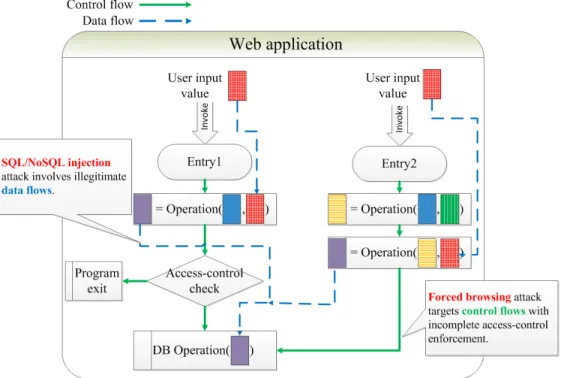
Figure 1.1 illustrates the di↵erent causes of SQL/NoSQL injection and forced browsing attacks. Forced browsing attacks take advantage of control-flow vulnerabilities that allow the adversary to bypass access-control logic. SQL/NoSQL injection attacks exploit data-flow vulnerabilities that cause il-legitimate data flows from user input to database operations. Identifying or repairing both vulnerabilities involves tedious auditing and coding that often brings error-prone human factors. Furthermore, individual proficiency in im-plementing secure Web applications varies with developers’ expertise as Web security becomes complicated. These problems motivate the creation of an automated tool that can ease developers’ burden and improve the robustness
Figure 1.1: The attack model of forced browsing and SQL/NoSQL command injection attacks.
of Web applications. Automated bug-finding and attack-blocking tools are promising ways for better server-side Web security.
1.2
Better Server-side Web Security
Forced browsing and SQL/NoSQL injection attacks stem from access-control bugs and illegitimate data flows in server-side Web applications, re-spectively. Client-side remediation of server-side application vulnerabilities is infeasible because in design clients in the Internet are incapable of changing server-side application code. Blocking suspicious requests at the client side
is also impracticable because it is hard to manage and enforce client-side de-fenses for many clients. This dissertation presents server-side security tools that directly remediate access-control bugs and identify illegitimate data flows for forced browsing and SQL/NoSQL injection attacks.
To identify access-control bugs, we present a static tool called Role-Cast, which finds missing access-control checks without a priori knowledge of which methods or variables implement access-control checks. Each Web application implements access-control checks in a di↵erent, often idiosyncratic way. Even within the application, access-control checks varies based on the users role, e.g., regular users versus administrators. RoleCast infers such application- and role-specific access-control checks by exploiting common soft-ware engineering patterns —the code that implements distinct user role func-tionality and its security logic typically resides in distinct methods and files. It then finds missing access-control checks before security-sensitive operations within a role. RoleCast partitions the set of file contexts (a coarsening of calling contexts) on which security-sensitive operations are control dependent into roles. For each role, RoleCast identifies critical variables that a↵ect the reachability of security-sensitive operations. It then applies role-specific variable consistency analysis to find missing access-control checks. RoleCast
found 13 access-control bugs with 3 false positives in 11 real-world Web appli-cations.
RoleCastonly notifies developers of its findings. It makes no attempt to repair source code. Unfortunately, fixing access-control bugs is a tedious
and repetitive task that involves replicating existing access-control policies. To help developers fix these bugs, we designed and implementedFixMeUp, a static program transformation tool that makes repairs at the source-code level.
FixMeUpstarts by obtaining role-specific access-control policy examples from manual or inferred annotations. From these annotations, FixMeUp then computes an access-control template (ACT). Next, it replicates a template in vulnerable contexts that implement incorrect access-control policies. Finally,
FixMeUp validates its repair and suggests the repaired code to developers. Our experiments show that FixMeUp correctly repaired 30 access-control bugs with one warning in 10 Web applications.
The final Web threat that this dissertation addresses is code injection. We present a dynamic SQL/NoSQL injection detection tool, Diglossia. A SQL/NoSQL injection attack occurs when user input is interpreted as code in a database query generated by a Web application. Diglossiadynamically blocks database queries that contains user-injected code.
The challenges in detecting injected code are (1) recognizing code in the generated query and (2) determining which parts of the query are tainted by user input. To identify tainted characters, Diglossia dynamically maps all application-generated characters to shadow characters that do not occur in user input and computes shadow values for all input-dependent strings. Any original characters in a shadow value are exactly the taint from user input. To detect injected code in a generated query,Diglossiaparses the query in tan-dem with its shadow and checks that (1) the two parse trees are syntactically
isomorphic and (2) all code in the shadow query is in shadow characters and, therefore, originated from the application itself, as opposed to user input. We evaluatedDiglossiaon 10 PHP Web applications. Diglossiaaccurately de-tected 25 SQL and NoSQL injection attacks while avoiding the false positives and false negatives of prior methods [3, 22, 45, 72, 81].
1.3
Contributions and Impacts
The dissertation presents three novel ideas to remediate forced browsing vulnerabilities and block SQL/NoSQL injection attacks. We believe that pro-grammers, server administrators, and bug-finding tool developers can benefit from our implementations as well as the ideas behind them.
For the first contribution, we demonstrate the e↵ectiveness of Role-Castin finding access-control vulnerabilities, the root cause of forced brows-ing attacks. RoleCastuses a heuristic algorithm that takes advantage of the software engineering patterns to precisely infer application- and role-specific access-control logic.
Furthermore, we demonstrate an automated static technique that gen-erates candidates that repair access-control vulnerabilities. Instead of inserting one- or two-line patches, our FixMeUp tool aggressively creates interproce-dural repairs and suggests them to developers. To the best of our knowledge,
FixMeUpis the first program repair tool that reuses pre-existing statements in a target context. FixMeUp helps programmers improve code productiv-ity as well as enforce consistent role-specific access-control logic. Because the
repair algorithms are agnostic to vulnerability types,FixMeUp is also appli-cable for repairing other access-control vulnerabilities such as cross-site request forgery [84].
The last technique, Diglossia, is based on new ideas for identifying user-injected code and avoids the flaws of prior detection methods that use syntactic structures and regular expression filters. Diglossia takes advan-tage of dual parsing and value shadowing to determine whether user-injected string values are interpreted as code in computed SQL/NoSQL queries. By consolidating dual parsing and value shadowing, we gain performance improve-ment and better precision while avoiding the false positives and false negatives of prior tools. Diglossiadoes not require any changes in either legacy appli-cations or database environment. It only requires installing a PHP plug-in.
Today’s Internet is a dangerous place, with serious and subtle Web attacks that demand security expertise from defenders. Many developers need help identifying application bugs and evaluating the security of their services as Web security becomes more complex and applications become larger. We demonstrate the e↵ectiveness of the automated tool-guided approaches for remediating causes of Web attacks.
Chapter 2
Web Attacks
This chapter presents the background on server-side Web applications and NoSQL databases, which are the major subjects of this thesis. It describes an adversary model and presents two security properties that prevent server-side Web application vulnerabilities. This chapter also explains access-control policies in server-side Web applications and characterizes various major Web attack vectors, including forced browsing and SQL/NoSQL injection attacks. Finally, in Section 2.6, it describes and compares previous work that addressed these vulnerabilities.
2.1
Server-side Web Applications
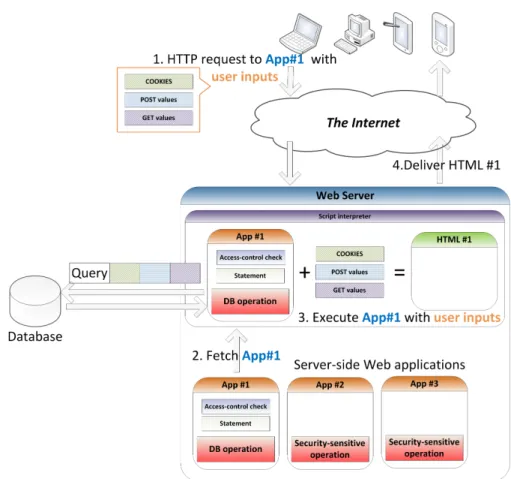
Web applications are classified by their deployment scenario as either server-side or client-side applications. A Web browser runs client-side Web applications fetched from Web servers. They are typically coded in JavaScript, ActionScript or Java. Server-side Web applications run at Web servers. As Figure 2.1 shows in detail, a script interpreter, a module of a Web server, accepts clients’ input values delivered by HTTP requests as well as cookies, and then invokes the user’s choice of Web application with the input values.
The invoked Web application transforms the input values into SQL/NoSQL queries to perform backend-database operations and builds an HTML page, which is returned to a client. Therefore, it is an intrinsic feature of server-side Web applications to interact with untrusted user input values. Among the many Web programming languages, our tools analyze Web applications implemented in the PHP and JSP programming languages.
2.1.1 PHP and JSP
The PHP (PHP: Hypertext Preprocessor) scripting language is de-signed for dynamically generating Web pages [52]. PHP is commonly used to implement Web applications with user-generated content or content stored in backend databases (as opposed to static HTML pages). A recent survey of 12 million domains found that 59% use PHP to generate HTML content [53].
PHP borrows syntax from Perl and C. In PHP programs, executable statements responsible for generating content are mixed with XML and HTML tags. PHP provides basic data types, a dynamic typing system, rich support for string operations, some object-oriented features, and automatic memory management with garbage collection. Instead of a module or class system, PHP programs use a flat file structure with a designated main entry point. Consequently, (1) a network user can directly invokeany PHP file by providing its name as part of the URL, and (2) if the file contains executable code outside of function definitions, this code will be executed. These two features of PHP require defensive programming of each entry point and are a source of forced-browsing attacks.
JSP (Java Server Pages) is a Java technology for dynamically gener-ating HTML pages [29]. It adds scripting support to Java and mixes Java statements with XML and HTML tags. Scripting features include libraries of page templates and an expression language. JSP supports dynamic types, but because it builds on Java, it has more object-oriented features than PHP. JSP executes in a Java Virtual Machine (JVM).
2.1.2 NoSQL and MongoDB
NoSQL is a new, more flexible approach for large data stores, and an alternative to relational DBMSs using Structured Query Language (SQL). NoSQL stores data in key and value pairs, and their implementations target for distribution and scalability [46]. Many NoSQL families including DynamoDB, MongoDB, CouchDB, Cassandra and others are growing in popularity.
Both SQL and NoSQL database vendors provide server-side Web appli-cation APIs for searching and managing stored data. Because the main objec-tive of server-side Web applications is to dynamically generate Web pages by retrieving persistent database data and user input, the interactions between an application and a database are carried out through such APIs
We chose to analyze MongoDB NoSQL database to demonstrate the e↵ectiveness of Diglossia. MongoDB is an open-source document-oriented NoSQL database [39]. MongoDB has been gaining wide adoption among cor-porations, including Foursquare and Craigslist [38]. MongoDB provides an API (MongoDB PHP driver) for a PHP application to interact with a Mon-goDB database. MonMon-goDB supports two query languages: JavaScript and JSON. JavaScript is a dynamic weakly-typed scripting language heavily used in many HTML Web pages. JSON is a data structure of consisting of one or more key-value pairs [28]. The MongoDB PHP driver uses a string or array type value in PHP to represent respectively a JavaScript or JSON query in MongoDB.
mongodbadmin.php
1 <?
2 . . .
3 i f ( !$document ) {
4 $document = findMongoDbDocument ($REQUEST ['s e a r c h'] , $REQUEST ['db'] ,
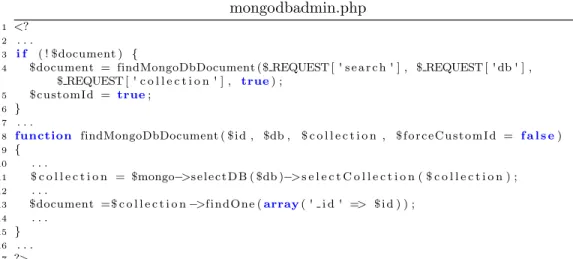
$REQUEST ['c o l l e c t i o n'] , true) ; 5 $customId = true; 6 } 7 . . . 8 function findMongoDbDocument ($id , $db , $c o l l e c t i o n , $f o r c e C u s t o m I d = f a l s e) 9 { 10 . . . 11 $c o l l e c t i o n = $mongo >s e l e c t D B ($db ) >s e l e c t C o l l e c t i o n ($c o l l e c t i o n ) ; 12 . . .
13 $document =$c o l l e c t i o n >findOne (array(' i d' => $i d ) ) ; 14 . . .
15 } 16 . . . 17 ?>
Figure 2.2: Example of building a JSON type query
Figure 2.2 shows a PHP code instance that sends a JSON query to a MongoDB database. The code in line 13 of mongodbadmin.php builds an array value where the key is “ id” and its corresponding value is user input obtained by referencing $ REQU EST[‘search’]. The MongoDB PHP driver then transforms the array value into a JSON query and sends it to a MongoDB.
2.2
Adversary Model
This section describes the adversary model that we assume throughout this dissertation. We make the standard assumption that the adversary has the following capabilities:
1. The adversary may examine server-side source code deployed at a victim server. However, the adversary cannot modify such code.
2. The adversary may send a victim server forged HTTP requests. The adversary can also entice or trick honest users into visiting a malicious site and send—via a spam message, advertising and so on—a forged HTTP request on the visitor’s behalf.
Both assumptions are realistic because many Web servers use open source Web applications. Common behaviors for Internet surfers include click-ing on advertisements and visitclick-ing untrusted Web pages. The adversary only takes advantages of application bugs by tampering with input parameters. The adversary does not have the capabilities to inspect logs or network data of a victim server.
2.3
Security Properties
Security-aware developers generally seek to establish the following two security properties:
1. Only authorized users should be able to access a security-sensitive oper-ation.
2. Any untrusted input should not serve as executable code.
A security-sensitive operation is a privileged procedure that the author of an application wants to protect from untrusted users. Security-sensitive operations include updating database records, deleting disk files or letting a Web server send emails. Therefore, server-side Web applications should vet with correct access-control logic whether an incoming request leading to the
execution of sensitive operations has the proper privilege. The first security property restricts reachable control flows for security-sensitive operations.
The violation of the second property directly leads to a code injection attack that destroys the intended purpose of an application. To enforce the second property, developers usually confine user input to serve as string and numeric constants in database queries. A code injection attack occurs when an adversary injects code into an application by exploiting incorrect confine-ment of user input. Generally, code injection attacks can be characterized as illegitimate data-flow attacks from user input to sensitive sink methods that execute application-generated commands.
2.4
Access-control Policies
By design, server-side Web applications interact with untrusted users and receive untrusted network inputs. Therefore, they must not perform security-sensitive operations, unless users hold the proper permissions. This mechanism is known assecurity mediation. In Web applications, security me-diation is typically implemented byaccess-control policies.
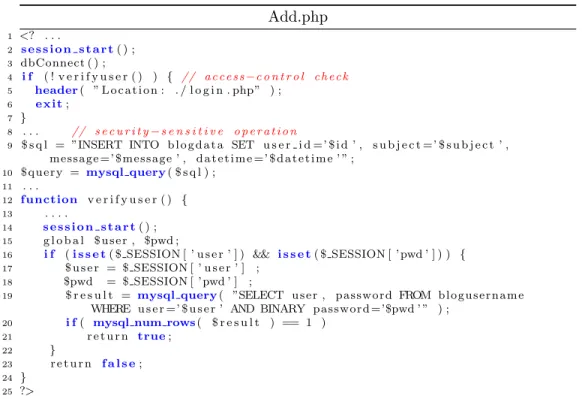
In general, an access-control policy requires some checks prior to ex-ecuting security-sensitive operations. These access-control checks vary with applications and user roles even within the same application. For example, an online store may have customers and administrators, while a blogging site may have blog owners, publishers, and commenters. Thus, di↵erent calling contexts associated with di↵erent user roles often require di↵erent checks.
Add.php 1 <? . . . 2 s e s s i o n s t a r t( ) ; 3 dbConnect ( ) ; 4 i f ( ! v e r i f y u s e r ( ) ) { // a c c e s s c o n t r o l c h e c k 5 header( ” L o c a t i o n : . / l o g i n . php” ) ; 6 e x i t; 7 } 8 . . . // s e c u r i t y s e n s i t i v e o p e r a t i o n
9 $s q l = ”INSERT INTO b l o g d a t a SET u s e r i d =’$i d ’ , s u b j e c t =’$s u b j e c t ’ , message =’$message ’ , d a t e t i m e =’$d a t e t i m e ’ ” ;
10 $qu ery = mysql query($s q l ) ;
11 . . .
12 function v e r i f y u s e r ( ) {
13 . . . .
14 s e s s i o n s t a r t( ) ;
15 g l o b a l $u s e r , $pwd ;
16 i f (i s s e t($ SESSION [ ’ u s e r ’ ] ) && i s s e t($ SESSION [ ’ pwd ’ ] ) ) { 17 $u s e r = $SESSION [ ’ u s e r ’ ] ;
18 $pwd = $SESSION [ ’ pwd ’ ] ;
19 $r e s u l t = mysql query( ”SELECT u s e r , password FROM b l o g u s e r n a m e WHERE u s e r =’$u s e r ’ AND BINARY password =’$pwd ’ ” ) ;
20 i f( mysql num rows( $r e s u l t ) == 1 )
21 r e t u r n true;
22 }
23 r e t u r n f a l s e;
24 } 25 ?>
Figure 2.3: minibloggie: Access-control check
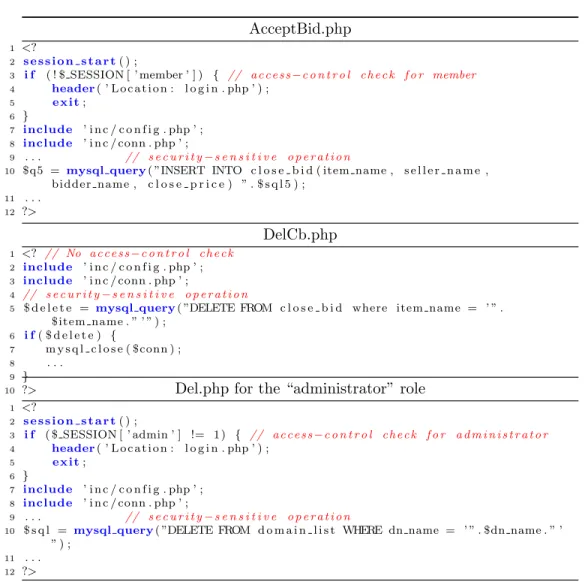
Figures 2.3 and 2.4 show examples of application-specific access-control checks in real-world PHP applications. Figure 2.3 shows a correct check (line 4) inAdd.php fromminibloggie. Add.php invokes a dedicatedverifyuser function that queries the user database with the username and password. If verification fails, the application returns the user to the login page. Figure 2.4 shows a di↵erent access-control check (line 3) performed by AcceptBid.php in the DNscript application. It reads the hash table containing the session state and checks the member flag. Both access-control policies protect the same operation—a mysql query call site that updates the backend database—but with very di↵erent logic.
AcceptBid.php
1 <?
2 s e s s i o n s t a r t( ) ;
3 i f ( !$SESSION [ ’ member ’ ] ) { // a c c e s s c o n t r o l c h e c k f o r member 4 header( ’ L o c a t i o n : l o g i n . php ’ ) ; 5 e x i t; 6 } 7 include ’ i n c / c o n f i g . php ’ ; 8 include ’ i n c / conn . php ’ ; 9 . . . // s e c u r i t y s e n s i t i v e o p e r a t i o n
10 $q5 = mysql query( ”INSERT INTO c l o s e b i d ( item name , s e l l e r n a m e , bidder name , c l o s e p r i c e ) ” .$s q l 5 ) ; 11 . . . 12 ?> DelCb.php 1 <? // No a c c e s s c o n t r o l c h e c k 2 include ’ i n c / c o n f i g . php ’ ; 3 include ’ i n c / conn . php ’ ; 4 // s e c u r i t y s e n s i t i v e o p e r a t i o n
5 $d e l e t e = mysql query( ”DELETE FROM c l o s e b i d where item name = ’ ” .
$item name . ” ’ ” ) ;
6 i f($d e l e t e ) {
7 m y s q l c l o s e ($conn ) ;
8 . . .
9 }
10 ?> Del.php for the “administrator” role
1 <? 2 s e s s i o n s t a r t( ) ; 3 i f ($ SESSION [ ’ admin ’ ] != 1 ) { // a c c e s s c o n t r o l c h e c k f o r a d m i n i s t r a t o r 4 header( ’ L o c a t i o n : l o g i n . php ’ ) ; 5 e x i t; 6 } 7 include ’ i n c / c o n f i g . php ’ ; 8 include ’ i n c / conn . php ’ ; 9 . . . // s e c u r i t y s e n s i t i v e o p e r a t i o n
10 $s q l = mysql query( ”DELETE FROM d o m a i n l i s t WHERE dn name = ’ ” .$dn name . ” ’ ” ) ;
11 . . . 12 ?>
Figure 2.4: DNscript: Correct access-control check in AcceptBid.php and a missing check in DelCb.php
The access-control checks are role-specific. For example, the DNscript application has two roles. AcceptBid.php in Figure 2.4 shows the check (line 3) for the “regular user” role and Line 3 ofDel.php shows the di↵erent check for the “administrator” role.
2.5
Web Attack Classification
The Open Web Application Security Project (OWASP) is warning de-velopers about various Web attacks, including site scripting (XSS), cross-site request forgery (CSRF), forced browsing, server-side include injection (SSI), SQL/NoSQL code injection and execution after redirection (EAR) [49]. This section examines forced browsing and SQL/NoSQL injection attacks in relation to other major Web attacks.
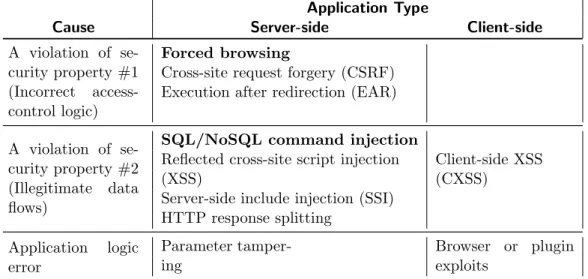
Application Type
Cause Server-side Client-side
A violation of se-curity property #1 (Incorrect access-control logic)
Forced browsing
Cross-site request forgery (CSRF) Execution after redirection (EAR)
A violation of se-curity property #2 (Illegitimate data flows)
SQL/NoSQL command injection
Reflected cross-site script injection Client-side XSS
(XSS) (CXSS)
Server-side include injection (SSI) HTTP response splitting Application logic error Parameter tamper-ing Browser or plugin exploits
Table 2.1: Web attack classification
Table 2.1 arranges Web attacks into groups based on the cause and the target application type. The cause of forced browsing, CSRF and EAR attacks lies in absent or incorrect access-control logic. However, they exploit di↵erent bugs in access-control logic. Forced browsing attacks take advantage of omitted or incorrect access-control logic. EAR harnesses a common mistake
when the programmer does not place a program termination call after a page redirection call. A CSRF attack exploits the absence of checks to validate origins of HTTP requests.
Reflected XSS, server-side includes injection (SSI), HTTP response splitting and SQL/NoSQL injections attacks share the same cause, illegiti-mate data flows, but target di↵erent method calls. The reflected XSS injects malicious input into HTML output methods. The HTTP response splitting attack injects forged HTTP headers into a header output method. The SSI and SQL/NoSQL injections attacks inject code into file inclusion and database operation functions, respectively.
Whereas reflected XSS causes a vulnerable server-side Web application to generate a Web page with malicious payloads, client-side XSS attacks take advantage of bugs in client-side JavaScript code. They inject forged script code into eval, setT imeout, postM essage or client-side JavaScript code that dynamically generates HTML Document Object Model(DOM) objects [63, 68]. Parameter-tampering attacks usually refer to a general attack that ex-ploits a server-side application logic bug with forged input parameters. For instance, Bisht et al. identify server-side application logic bugs that do not validate input parameters, but perform validations in client-side JavaScript code [5].
Among the Web attacks listed above, this dissertation focuses on forced browsing and SQL/NoSQL injection attacks. The following sections describe
in detail the two attacks as well as examples of vulnerabilities.
2.5.1 Forced Browsing Attack
Web applications typically perform access-control checks to protect
security-sensitive operations. Thus, the absence of such checks directly leads to successful forced browsing attacks that enable an adversary to gain unau-thorized access to security-sensitive operations. It is a clear violation of the first security property described in Section 2.3.
Since every file included in a PHP application can be used as an alter-native entry, developers must replicate access-control logic on every path that accesses security-sensitive operations. In particular, even if the code contained in some file is intended to be called only from other files, it must still be pro-grammed defensively because an attacker may invoke it directly via its URL. Thus, access-control bugs are control-flow vulnerabilities. They enable an at-tacker to execute a sensitive operation, which may or may not be accompanied by illegitimate data injection.
Figure 2.4 shows an instance of code that is vulnerable to forced brows-ing attacks. The check on $ SESSION at line 3 is present inAcceptBid.php, but missing inDelCb.php. The access-control check protects the sensitive oper-ation—amysql query call site that updates the backend database. A malicious user can directly invoke DelCb.php by supplying its URL to the Web server and execute a DELETE query because DelCb.php is missing a check on the $ SESSION variable.
Finding and repairing access-control vulnerabilities require manual, repetitive audits of source code. In complex applications, the number of un-intended entry points can be very large, which greatly complicates manual inspection and motivates the need for automated analysis. As Section 2.4 de-scribes, access-control logic has no standard pattern and di↵ers even within the same application. Therefore, enforcing a single access-control pattern across the entire program may subvert the intended semantics.
login.php in minibill
1 <?
2 $Q = ”SELECT ∗ FROM u s e r s
3 WHERE e m a i l = ‘{$REQUEST [ ‘ e m a i l ’ ]}’
4 AND password = ‘{$REQUEST [ ‘ password ’ ]}’
5 LIMIT 1 ” ;
6 $r e s = mysql query($Q) ; 7 ?>
Attack URL
http://victimHost/login.php?email=any’; OR 1=1 –‘&password=any Actual query
SELECT * FROM users WHERE email=‘any’ OR 1=1 - -‘’ AND password=‘any’ LIMIT 1
Figure 2.5: SQL injection attack onminibill.
2.5.2 SQL Injection Attack
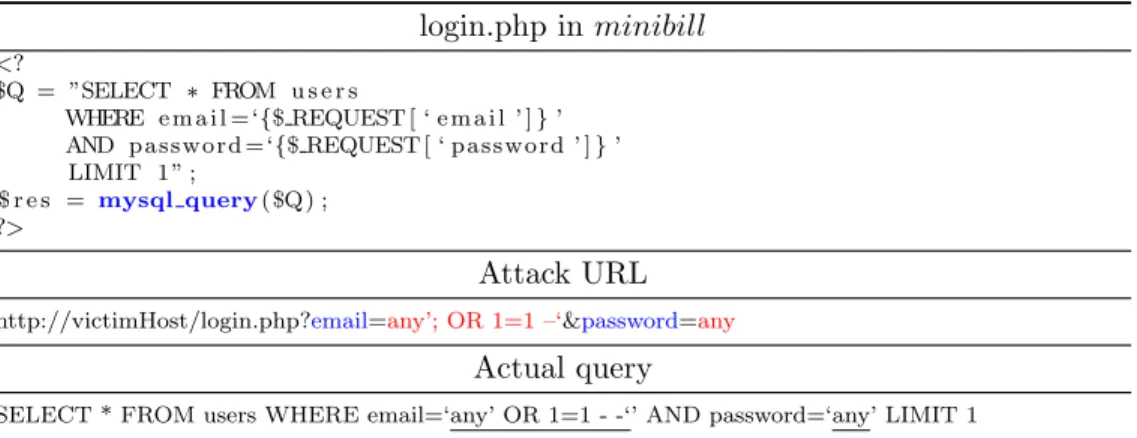
SQL injection attack exploits incorrect or absent sanitization logic on user input, which may lead to arbitrary code execution. For instance, Fig-ure 2.5 shows a PHP code instance that retrieves database records matching a given email and password. However, the application does not sanitize user input obtained from $REQU EST[‘email’] and $ REQU EST[‘password’]. This mistake allows the adversary to escape quotes that supposedly confine
user input to string literals. The injected“OR 1=1” string makes the resulting query to become the tautology and the following“–” string comments out the remaining query. Thus, the resulting query returns all stored records, which is a violation of the second security property.
2.5.3 NoSQL Injection Attack
NoSQL databases are as vulnerable to code injection attacks as SQL databases. For example, we found four PHP MongoDB-based applications in GitHub with injection vulnerabilities (see Table 5.2).
mongodbadmin.php
1 <?
2 . . .
3 i f ( !$document ) {
4 $document = findMongoDbDocument ($REQUEST ['s e a r c h'] , $REQUEST ['db'] ,
$REQUEST ['c o l l e c t i o n'] , true) ; 5 $customId = true; 6 } 7 . . . 8 function findMongoDbDocument ($id , $db , $c o l l e c t i o n , $f o r c e C u s t o m I d = f a l s e) 9 { 10 . . . 11 $c o l l e c t i o n = $mongo >s e l e c t D B ($db ) >s e l e c t C o l l e c t i o n ($c o l l e c t i o n ) ; 12 . . .
13 $document =$c o l l e c t i o n >findOne (array(' i d' => $i d ) ) ;
14 . . .
15 } 16 . . .
17 ?>
Attack URL
http://victimHost/mongodbadmin.php?search[$ne]=1&db=test&collection=test
Figure 2.6: JSON injection vulnerability.
Figure 2.6 shows a PHP application with a JSON injection vulnerabil-ity. Line 13 ofmongodbadmin.php in Figure 2.6 builds an array consisting of a
single key-value pair, where the key is “ id” and the value is equal to the user input obtained from $ REQU EST[‘search’]. The Mongo API transforms this array into a JSON query and sends it to MongoDB. The intention is to return all database items whose id field is equal to the user-supplied value.
A malicious user, however, can set the search variable to be an array value, array($ne => 1). In the resulting JSON query, line 13 of Figure 2.6 no longer compares id for equality with $id, but instead interprets the first element of $idas a function, ($ne), the second element, (1), as the argument to this function, and returns all database items whose idis not equal to 1. In this case, user input is supposed to be a string constant, but instead symbols $ne are interpreted as code in the query.
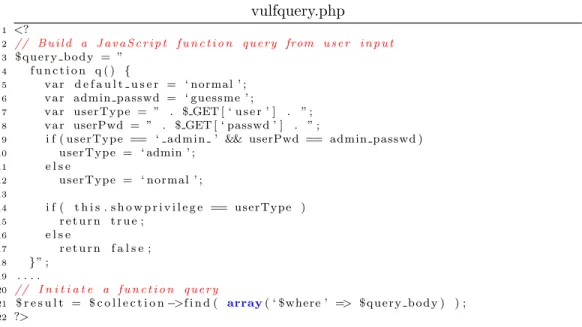
Figure 2.7 shows another vulnerable PHP application. Lines 3 to 18 build a query string from user input, Line 21 sends the resulting JavaScript program to MongoDB. MongoDB evaluates this program on every key-value pair in the database and returns the pairs on which the program evaluates to “true”. The query is supposed to retrieve data whose privilege keys are the same as userType. The malicious URL, however, tricks the application into generating a tautology query that always returns “true”. Note that user-injected symbols ;, return, }, and // are parsed into code in the JavaScript query:
f unction q(){var def ault user= ‘normal0; var admin passwd= ‘guessme0;
vulfquery.php 1 <? 2 // B u i l d a J a v a S c r i p t f u n c t i o n q u e r y from u s e r i n p u t 3 $q u e r y b o d y = ” 4 f u n c t i o n q ( ) { 5 v a r d e f a u l t u s e r = ‘ normal ’ ;
6 v a r admin passwd = ‘ guessme ’ ;
7 v a r userType = ” . $GET [ ‘ u s e r ’ ] . ” ;
8 v a r userPwd = ” . $GET [ ‘ passwd ’ ] . ” ;
9 i f ( userType == ‘ a d m i n ’ && userPwd == admin passwd )
10 userType = ‘ admin ’ ; 11 e l s e 12 userType = ‘ normal ’ ; 13 14 i f ( t h i s . s h o w p r i v i l e g e == userType ) 15 r e t u r n t r u e ; 16 e l s e 17 r e t u r n f a l s e ; 18 }” ; 19 . . . . 20 // I n i t i a t e a f u n c t i o n q u e r y 21 $r e s u l t = $c o l l e c t i o n >f i n d ( array( ‘$where ’ => $q u e r y b o d y ) ) ; 22 ?> Attack URL
http://victimHost/vulfquery.php?user=1;return true;}//
Figure 2.7: JavaScript injection vulnerability.
2.6
Related Work
Researchers have suggested many ideas to prevent an adversary from abusing Web application bugs. Against each Web threat described in Sec-tion 2.5, Table 2.2 groups the proposed studies according to two criteria: (1) client or server side where the defense is intended to be deployed and (2) the analysis type. Static methods find or repair vulnerabilities before Web appli-cations are deployed. Dynamic methods identify and then block Web attacks at runtime. Hybrid methods use both static and dynamic information.
S er ve r-sid es Client-sides C au se W eb at tac k s S tat ic D yn am ic H yb rid D yn am ic Ac ce ss-con trol bu gs For ce d br ow sin g [2, 66, 74] [7, 15, 23] [21] CS RF [21, 84] [4, 62] E AR [17] Ille gi tim at e dat a flo w s C lie nt -si de XS S [63] [27, 37] R efl ec te d XS S [26, 34, 67] [45, 54, 64] [27, 37, 81] SQ L com m an d in jec tion [26, 34, 67, 79] [22, 45, 54, 64, 81] SSI [64] HT T P re sp on se sp lit tin g [34] [64] Ap pli cat ion logi c er ror s P ar am et er tam pe rin g [5, 75] T able 2.2 : R ela te d w or k cla ss ific at io n 27
Table 2.2 positions our methods among related work. RoleCastand
FixMeUp are static methods for finding forced browsing vulnerabilities and repairing such vulnerabilities, respectively. Diglossia is a dynamic frame-work that protects a server-side Web application from SQL/NoSQL injection attacks.
The following sections explain other related static and dynamic ap-proaches. The advantages of static methods are two-fold. First, they find vulnerabilities before application deployment. They also require no runtime performance overhead. Unfortunately, static bug-finding tools often su↵er from false positives because they rely on over-approximations of dynamic pro-gram behavior. Their expensive interprocedural analyses are also a hindrance for wide deployment. However, static tools can find vulnerabilities with rea-sonable false positives with intentional coarse approximations.
In general, dynamic methods are precise in identifying application at-tacks due to their ability to track dynamic program behaviors. However, a dynamic analysis also has challenges, such as incomplete code coverage and runtime performance overhead.
2.6.1 Static Detection and Remediation of Access-control Bugs
Detection of access-control bugs requires a correct access-control policy that specifies access-control checks and security-sensitive operations. Some static detection methods require developers to specify access-control policies. Because of difficulties in analyzing and specifying access-control policies in
large legacy applications, other methods infer policies by using software engi-neering patterns or auxiliary information.
Using specified access-control policies. Several approaches employ
access-control specifications to identify forced-browsing vulnerabilities [2, 11, 74]. Sun et al. require programmers to specify the variable states used at the intended checks for each application role and then automatically find vulnerable execu-tion paths with unchecked access to the role’s privileged pages [74]. Balzarotti et al. propose a method for finding workflow violations caused by unintended entry points [2]. They derive the intended access-control checks from user specified variables. Both methods heavily rely on identifying link relations be-tween pages by statically approximating HTML outcome with link graphs or context free grammars. However, they are not robust because the difficulty of resolving dynamic values in generating HTML outcome varies greatly between applications. Chlipala finds security violations by statically verifying whether the application’s behavior is consistent with a policy specified as a database query [11]. However, his verification only works on Ur [10], a strictly typed functional programming language, which is not directly applicable to legacy Web applications.
No prior work conducts a source-level remediation on forced-browsing vulnerabilities. By contrast,FixMeUpbuilds source-level patches that repair access-control bugs. For automatic remediation of CSRF vulnerabilities, Zhou et al. suggest a hybrid method that statically inserts token validation checks and dynamically transforms an HTTP outcome page to initiate an HTTP
request along with CSRF tokens [84]. They identify valid locations for code changes with annotated token validation checks and sensitive operations.
Static inference of access-control policy. Without a programmer-provided
specification, several static methods (1) infer the application’s access-control policies and (2) find violations of such inferred policies. They define an access-control policy as a mapping of security-sensitive operations to access-access-control checks that must precede them. Tan et al. use interprocedural analysis to find missing access-control checks in SELinux [76]. However, they only check the presence of access-control checks, but overlook whether the preceding checks must or may protect sensitive operations. Pistoia et al. [31, 55] and Sistla et al. [65] propose techniques for finding missing security checks in Java library code. Doup´e et al. use a universal security policy—page redirection calls must be followed by program termination calls—to find EAR vulnerabilities. These papers assume that a certain policy must hold everywhere for events of a given type.
As described in Section 2.5.1, access-control logic in Web applications is more sophisticated than simple “this check must always precede that op-eration” patterns. They are role- and context-sensitive, with di↵erent poli-cies enforced on di↵erent execution paths. Simple pattern matching will not find violations of such policies. RoleCastinfers application and role-specific access-control checks without specification by exploiting software engineering conventions common in Web applications.
Inferring security policies using auxiliary information. Inference and verification of security policies implemented by a given program often benefit from auxiliary information and specifications. For example, Livshits et al. find errors by mining software revision histories [33]. Srivastava et al. use indepen-dent implementations of the same Java class library API to find discrepancies in security policies between implementations [71].
2.6.2 Dynamic Detection and Remediation of Access-control Bugs
Several dynamic security analyses find security violations or enforce a given security policy by tracking program execution. Hall´e et al. dynam-ically validate whether page navigation within a given application conforms to the state machine specified by a programmer [23]. GuardRails, Nemesis and RESIN require a developer to provide explicit access-control policies and enforce them dynamically [7, 15, 82].
Alternatives to explicit specification include learning the state machine by observing benign runs and then relying on anomaly detection to find vio-lations [12], or using static analysis of the client code to create a conservative model of legitimate request patterns and detecting deviations from these pat-terns at runtime [21]. Violations caused by missing access-control checks are an example of generic “execution omission” bugs. Zhang et al. presented a general dynamic approach to detect such bugs [83].
For CSRF attacks, Barth et al. dynamically attach to all HTTP re-quests origin headers that show what sites send HTTP rere-quests [4]. Ryck et
al. dynamically tag each HTTP request with a browsing context state and then check whether cross-origin requests should be rejected [62].
In addition to the usual challenges of dynamic analysis, such as incom-plete coverage, once dynamic enforcement of access-control policies detects a violation, it is limited in what it can do. Typically, the runtime enforce-ment mechanism terminates the application. After all, when an access-control check fails, the mechanism does not know what the programmer intended the application to do.
2.6.3 Static Detection of Illegitimate Data Flows
Many researchers have proposed static methods for identifying illegiti-mate data flows. They perform pointer and taint analyses to find unsanitized data flows from user input to sensitive sinks [26, 34, 67]. These methods can verify that a sanitization routine is always called on tainted inputs, but not whether sanitization is performed correctly. Since incorrectly sanitized input may still cause an injection attack, it is essential to precisely model the seman-tics of string operations performing sanitization. Wassermann and Su model string operations as transducers and check whether non-terminals in the query are tainted by user input [79].
2.6.4 Dynamic Detection and Remediation of Illegitimate Data
Flows
Most dynamic detection methods aim to precisely track the source of every byte and thus determine which parts of the application-generated code
come from tainted user input and which come from a trusted source [22, 45, 54, 81]. All of these tools use a simple, imprecise definition of “code” and consequently su↵er from false positives and false negatives when detecting SQL injection attacks (see Table 5.1).
To avoid the expense of byte-level taint tracking, several dynamic meth-ods modify and examine inputs and generated queries. For example, Su and Wassermann wrap user input with meta-characters, propagate meta-characters through string operations in the program, parse the resulting query, and verify that if a meta-character appears in the parse tree, then it is in a terminal node and has a parent non-terminal such that the meta-characters wrap the descen-dant terminal nodes in their entirety [72]. This approach su↵ers from false positives and false negatives because how to wrap input (e.g., the entire in-put string, each word, and/or each numeric value) depends on the application generating the query.
To infer the tainted parts of the query, Sekar proposes to measure similarity between the query and user input [64], while Liu et al. compare the query to previous queries generated from benign inputs [32]. In addition to being unsound, these heuristics do not use a precise definition of code and non-code and thus su↵er from false positives and false negatives.
CANDID performs a shadow execution of the program on a benign input “aaa. . . a”, compares the resulting query with the actual query, and reports a code injection attack if the queries di↵er syntactically [3]. As Ray and Ligatti point out, this analysis is insufficient to di↵erentiate code from
non-code [59]. CANDID cannot tell which parts of the query came from user input and which came from the application itself, and thus cannot detect injected identifiers (where user input injects a bound variable name that occurs elsewhere in the query), injected method invocations, and incorrect types of literals—see examples in Section 5.1.2.
Randomization and complementary encoding. To prevent the injection
of SQL commands, SQLrand remaps SQL keywords to secret, hard-to-guess values [6]. Applications must be modified to use the remapped keywords in the generated queries, and database middleware must be modified to decrypt them back to original keywords. The mapping must remain secret from all users. This approach requires pervasive changes to applications and database implementations and is thus difficult to deploy.
Mui et al. suggest using complementary encoding for user input [40]. The goal is to strictly separate the character set appearing in user input from the character set used by the system internally. This approach cannot be deployed without changing databases, Web browsers, and all other systems dealing with user input. By contrast, Diglossia is a simple PHP extension that does not require any modifications to applications or databases.
2.6.5 Static Detection of Application Logic Bugs
A popular bug-finding approach is to mine the program for patterns and look for bugs as deviations or anomalies. This approach typically finds frequently occurring local, intraprocedural patterns [18]. Sun et al. find
appli-cation logic bugs in E-commerce Web appliappli-cations [75]. For a given appliappli-cation along with annotations of which variables implement payment logic, they con-duct a symbolic execution to model work flows among payment participants. Then, they check with a static taint analysis whether payment invariants are forgeable.
Several tools learn from a developer-provided fix and help apply similar fixes elsewhere. They perform the same syntactic edit on two clones [42], or suggest changes for API migration [1], or do not perform the edit [44]. Meng et al. ask users where to apply the edit [35] or find locations to apply edits automatically [36]. These approaches only apply local edits and none of them consider the interprocedural edits that are required to repair access-control logic. In the more limited domain of access-control bugs,FixMeUpautomates both finding the missing logic and applying the fix.
2.6.6 Dynamic Detection and Remediation of Application Logic
Bugs
Bisht et al. propose NoTamper, which finds omitted input validation logic in server-side Web applications [5]. After identifying target input param-eters that have client-side validation checks, they check whether benign and tampered input parameters produce di↵erent server responses. If they produce similar responses, NoTamper reports that server-side applications do not have proper input validation logic.
enforc-ing given security policies in a client-side Web application instead of identi-fying illegitimate data flows [27, 37]. However, both methods involve heavy augmentation of server-side or client-side Web applications to specify security policies.
Dynamic program repair fixes the symptom, but not the cause of the error [9, 15, 23, 27, 37, 43, 61, 82]. For example, dynamic repair allocates a new object on a null-pointer exception, or ignores out-of-bounds references instead of terminating the program. The dynamic fixes, however, are not reflected in the source code and require a special runtime.
Chapter 3
Automatically Finding Missing Access-control
Checks in Web Applications
This chapter introduces a robust method for finding missing access-control checks in Web applications. The main challenge is that each applica-tion—and even di↵erent roles within the same application, such as administra-tors and regular users—implements checks in a di↵erent, often idiosyncratic way, using di↵erent variables to determine whether the user is authorized to perform a particular operation. Finding missing checks is easier if the pro-grammer formally specifies the application’s security policy, e.g., via annota-tions or data-flow asserannota-tions [15, 82], but the overwhelming majority of Web applications today are not accompanied by specifications of their intended authorization policies.
Previous techniques for finding missing access-control checks without a programmer-provided policy take the syntactic definition of checks as in-put. Therefore, they must know a priori the syntactic form of every check. For example, Java programs perform security mediation by calling predefined methods in theSecurityManager class from the Java libraries [31, 55, 65, 71]. This approach is suitable for verifying security mediation in library and system
code, for which there exists a standard protection paradigm, but it does not work for finding missing authorization checks in applications because there is no standard set of checks used by all applications or even within the same application.
This chapter presents RoleCast, a static tool that finds omission of access-control checks. Given a Web application, RoleCast automati-cally infers (1) the set of user roles in this application and (2) the access-control checks—specific to each role—that must be performed prior to execut-ing security-sensitive operations such as database updates. RoleCast then (3) finds missing access-control checks.
RoleCast does not rely on programmer annotations or an external specification that indicates the application’s intended authorization policy, nor does it assume a priori which methods or variables implement access-control checks. RoleCast exploits common software engineering patterns in Web applications. A typical Web application has only a small number of sources for authorization information (e.g., session state, cookies, results of reading the user database). Therefore, all authorization checks involve a conditional branch on variables holding authorization information. Furthermore, individ-ual Web pages function as program modules and each role within the appli-cation is implemented by its own set of modules (i.e., pages). Because each page is typically implemented by one or more program files in PHP and JSP applications, the sets of files associated with di↵erent user roles are largely disjoint.
Our static analysis that exploits the above properties has four phases. Phase I performs flow- and context-sensitive interprocedural analysis to collect calling contexts on which security-sensitive operations are control dependent. For each context, RoleCast analyzes interprocedural control dependencies to identifycritical variables, i.e., variables that control reachability of security-sensitive operations. It then uses branch asymmetry to eliminate conditional statements that are unlikely to implement access-control checks because they do not contain branches corresponding to abnormal exit in the event of a failed check. This step alone is insufficient, however, because many critical variables (e.g., those responsible for logging) are unrelated to security.
Phase II performs role inference. This step is the key analysis and is critical because di↵erent roles within the same application often require dif-ferent checks. For example, prior to removing an entry from the password database, a photo-sharing application may check the session variable to verify that the user performing the action is logged in with administrator privileges, but this check is not needed for updating the content database with users’ photos. RoleCastinfers application-specific roles by analyzing the modular structure of the application. As mentioned above, in PHP and JSP applica-tions this structure is represented by program files. Phase II partiapplica-tions file contexts that use critical variables into roles. A file context is simply a coars-ened representation of a calling context. The partitioning algorithm arranges file contexts into groups so as to minimize the number of files shared between groups. We call each group a role.
Phase III of RoleCastdetermines, within a role, which critical vari-ables are checkedconsistently and classifies this subset of the critical variables assecurity-critical variables. Phase IV then reports potential vulnerabilities in the following cases: (1) if a calling context reaches a security-sensitive opera-tion without a check; or (2) if the role contains a single context and thus there is no basis for consistency analysis; or (3) if a check is performed inconsistently (in the majority, but not all calling contexts of the role).
Because our approach infers the Web application’s authorization logic under the assumption that the application follows common code design pat-terns, it may su↵er from both false positives and false negatives. This im-precision is inevitable because there is no standard, well-defined protection paradigm for Web applications. Furthermore, no fixed set of operations is syntactically recognizable as access-control checks (in contrast to prior ap-proaches). Instead, RoleCast partitions the program into roles and infers, for each role, the access-control checks and security-relevant program vari-ables by recognizing how they are used consistently (or almost consistently) within the role to control access to security-sensitive operations. When eval-uated on 11 substantial, real-world PHP and JSP applications, RoleCast
discovered 13 previously unreported security vulnerabilities with only 3 false positives, demonstrating its usefulness for practical security analysis of Web applications.
RoleCast demonstrates that it is possible to accurately infer the se-curity logic of Web applications at the level of individual user roles by static
analysis, without using any programmer annotations or formally specified poli-cies, but relying instead on common software engineering patterns used by application developers.
3.1
Access-control Logic in Web Applications
This section starts by explaining static analysis tools that we used to implement RoleCast. It also describes the common design patterns for application- and role-specific access control logic.
3.1.1 Translating Web Applications into Java
Translating scripting languages into Java is becoming a popular ap-proach because it helps improve performance by taking advantage of mature JVM compilers and garbage collectors. We exploit this practice by (1) con-verting Web applications into Java class files, and (2) extending the Soot static analysis framework for Java programs [69] with new algorithms for static se-curity analysis of Web applications.
To translate JSP and PHP programs into Java class files we use, re-spectively, the Tomcat Web server [77] and Quercus compiler [58]. Tomcat produces well-formed Java; Quercus does not. PHP is a dynamically typed language and the target of every callsite is potentially bound at runtime. In-stead of analyzing calls in the PHP code, Quercus translates each PHP func-tion into a Java class that contains a main method and methods that initialize the global hash table and member variables. Every function call is translated
by Quercus into a reflective method call or a lookup in the hash table. This process obscures the call graph.
Because our security analysis requires a precise call graph, we must reverse-engineer this translation. We resolve the targets of indirect method calls produced by Quercus using a flow- and context-insensitive intraprocedural symbol propagation.
3.1.2 Application-specific Access-control Logic
Our security analysis targets interactive Web applications such as blogs, e-commerce programs, and user content management systems. Interactive applications of this type constitute the overwhelming majority of real-world Web applications. Since the main purpose of these applications is to display, manage, and/or update information stored in a backend database(s), access control on database operations is critical to their integrity.
Security-sensitive operations. We consider all operations that may a↵ect
theintegrity of database to besecurity-sensitive operations. These include all queries thatinsert,delete, orupdate the database. Web applications typically use SQL to interact with the backend database. Therefore,RoleCastmarks INSERT, DELETE, and UPDATE mysql query statements in PHP code as security-sensitive operations. Note that statically determining the type of a SQL query in a given statement requires program analysis. RoleCast con-servatively marks all statically unresolved SQL queries as sensitive. For JSP,
ex-ecuting INSERT, DELETE, or UPDATE SQL queries as security-sensitive operations.
We deliberately do not include SELECT and SHOW queries which retrieve information from the database in our definition of security-sensitive operations. Many Web applications intend certain SELECT operations to be reachable without any prior access-control checks. For example, during authentication, a SELECT statement may retrieve a stored password from the database in order to compare it with the password typed by the user. Without a programmer-provided annotation or specification, it is not possible to separate SELECT operations that need to be protected from those that may be legitimately accessed without any checks. To avoid generating a prohibitive number of false positives, we omit SELECT and SHOW operations from our analysis of Web applications’ access-control logic.
Access control logic as a software design pattern. To identify
application-and role-specific access-control logic, we take advantage of the software engi-neering patterns commonly used by the developers of Web applications. A Web application typically produces multiple HTML pages and generates each page by invoking code from several files. The following three observations guide our analysis.
Our first observation about access-control logic is thatwhen an access-control check fails, the program quickly terminates or restarts. Intuitively, when a user does not hold the appropriate permissions or his credentials do
not pass verification, the program exits quickly.
Our second observation about correct access-control logic is that every path leading to a security-sensitive operation from any program entry point must contain an access-control check. This observation alone, however, is not sufficient to identify checks in application code because di↵erent paths may involve di↵erent checks and di↵erent program variables.
Our third observation is that distinct application-specific roles usually involve di↵erent program files. Since the main purpose of interactive Web ap-plications is to manage user-specific content and to provide services to users, users’ privileges and semantic roles determine the services that are available to them. Therefore, the application’