INTERNATIONAL
DEVELOPMENT
Subject paper of the International
Development Working Group
SOCIAL IMPACT
INVESTMENT TASKFORCE
Established under the UK’s
Introduction: The Changing Landscape of Development
Finance 04
Challenges for the Impact Investing Market in
International Development 11
Working Group Recommendations 13
Conclusion 19
TABLE OF ACRONYMS
TABLE OF ACRONYMS
G7 The Group of Seven
G8 The Group of Eight
G20 The Group of Twenty
CGAP Consultative Group to Assist the Poor
DIB Development Impact Bond
DAC Development Assistance Committee (OECD)
DFIs Development Finance Institutions
BoP Base of Pyramid
IDB Inter American Development Bank
KfW KfW Bankengruppe
MiFA Microfinance Initiative for Asisa
DFID Department for International Development (United Kingdom)
USAID United States Agency for International Development
GIIN Global Impact Investing Network
SIB Social Impact Bond
UK United Kingdom
US United States
IFF Impact Finance Facility
GIZ German Federal Enterprise for International Cooperation
IDA International Development Association
IFC International Finance Corporation
MDG Millennium Development Goals
GRI Global Reporting Initiative
OPIC Overseas Private Investment Corporation
GIIRS Global Impact Investing Rating System
ILO International Labor Organization
IDC Industrial Development Corporation
FICA Flemish International Cooperation Agency
SOCAP Social Capital Markets
The International Development Working Group is one of four thematic Working Groups of the independent Social Impact Investment Taskforce established in June 2013 under the UK’s presidency of the G8. The International Development Working Group, composed of experts in international development and finance, was created to inform the Taskforce on the role of impact investment in international development, and contribute to the Taskforce’s objectives of reporting on and helping to catalyze the development of a global social impact investment market.
The International Development Working Group brought together development practitioners and investors to explore the ways in which the changing landscape of development is creating new opportunities for effective partnerships to drive improvement in social outcomes. The Working Group assessed how impact investment can help to further drive economic development and improvement
on social issues in developing countries. Working Group members agree that there is an opportunity for impact investment, in conjunction with public, private and philanthropic capital, to bring greater effectiveness, innovation, accountability and scale to address some of the world’s toughest challenges. The group presents in this report its key recommendations on some proposed joint initiatives to advance the impact investing market for the benefit of the world’s poor populations.
This report is the result of a collaborative process. Members of the International Development Working Group bring different practitioner perspectives and priorities to this effort. Working Group members have participated in their capacity as individuals, rather than representatives of their organizations. The Working Group members do not necessarily collectively endorse all of the recommendations and findings in the report but present them jointly as a way to advance some ideas on the topic.
THE SOCIAL IMPACT INVESTMENT TASKFORCE
INTERNATIONAL DEVELOPMENT WORKING GROUP
Sonal Shah Georgetown University (Group Chair)
Michael Anderson Children’s Investment Fund Foundation
Nancy Birdsall Center for Global Development
Sasha Dichter Acumen
Toby Eccles Social Finance UK
Tilman Ehrbeck Consultative Group to Assist the Poor
Roland Gross German Federal Enterprise for International Cooperation
Rene Karsenti International Capital Market Association
Julie Katzman Inter American Development Bank
Mike Kubzansky Omidyar Network
Elizabeth Littlefield Overseas Private Investment Corporation
Stewart Paperin Soros Economic Development Fund
Gerhard Pries Sarona Asset Management
Vineet Rai Aavishkaar Venture Management Service
Harold Rosen Grassroots Business Fund
Jean-Michel Severino Investisseurs et Partenaires
Geetha Tharmaratnam The Abraaj Group
Ingo Weber GIIN/Leapfrog
David Wilton International Finance Corporation
Contributors to this report
Matt Bannick Omidyar Network
Paula Goldman Omidyar Network
Nancy Lee Inter-American Development Bank
Michelle Viegas Inter-American Development Bank
Carol Piot Special Adviser to the IFFIm Board of Directors
Cliff Prior Unltd
Robynn Steffen formerly with the White House Office of Science and Technology Policy
Mitchell Strauss Overseas Private Investment Corporation
INTERNATIONAL DEVELOPMENT
WORKING GROUP MEMBERS
Special Note from the Working Group Chair
Over the course of the last several months, I have been privileged to chair the International Development Working Group of the Social Impact Investment Taskforce. I am grateful to the members of the Working Group who generously contributed their time and insights and offered concrete ideas on how impact investment can be more effectively used to advance international development goals. I am grateful also to the many additional contributors to this report who shared their feedback to improve its contents. Particular thanks go to Sir Ronald Cohen, who led the overall Taskforce and inspired this work. I have profound gratitude to the Center for Global Development and especially my co-author on this report
Rita Perakis for her hard work, diligent contributions, and invaluable support in getting this report to the finish line. I am also grateful to Innocent Obi from Georgetown
University for his hard work in providing background research, graphics, and preparing this report for publication. Finally, thank you to Ben Leo of the Center for Global Development for convening and moderating an event that brought together members of our Working Group and the United States National Advisory Board on Impact Investing. This report presents a summary of the Working group’s key findings and recommendations. It does not necessarily reflect the individual opinions of members or the official positions of the organisations and governments they represent.
SUMMARY
CATALYZING NEW
CAPITAL FOR RESULTS IN
INTERNATIONAL DEVELOPMENT
Over the past several decades, private and official financing for international development have helped improve economic and social conditions in the world’s poorest countries. Much progress has been made, but there is growing recognition that markets and the private sector must play a more significant role if we are to solve or at least make a dent in addressing some of the greatest challenges facing developing countries worldwide. Impact investments – which target social or other non-financial returns along with a financial return, and require measuring the achievement of both – provide an opportunity to bring new capital to developing economies, improve the effectiveness of international development interventions, and advance development using market principles.RECOMMENDATIONS
OF THE INTERNATIONAL
DEVELOPMENT WORKING GROUP
To help grow this market, the International Development Working Group makes four recommendations to governments and business and social sector leaders in G7, G20 anddeveloping countries:
1. Establish a new Impact Finance Facility which will help to cultivate and develop new and innovative companies and business models as well as innovative social sector organisations, building the pipeline of impact investments; 2. Create a Development Impact Bond (DIB)
Outcomes Fund to facilitate the rollout of Development Impact Bond pilots;
3. Improve metrics and increase transparency to support activities to advance the impact investing market; and
4. Provide additional resources for “ecosystem-building” to support the broader environment for impact investing.
SUMMARY
PRIVATE CAPITAL FOR SOCIAL OUTCOMES:
IDENTIFYING OPPORTUNITIES FOR IMPACT
INVESTMENT IN INTERNATIONAL DEVELOPMENT
In the last several decades,
there has been tremendous
economic growth in various
countries around the world,
as well as decreased levels
of poverty. There have been
great strides made toward the
Millennium Development Goals
and other indicators of poverty
and the world has come closer
to eliminating some diseases,
such as polio. External financing
from private investment,
development institutions –
bilateral and multilateral, using
grants and investments – and
philanthropy have all been part
of shaping this change.
However, detailed data shows that the growth has been uneven and unequal.1 Despite the progress,
global challenges remain daunting – including the need to ensure universal access to quality healthcare; affordable and quality education;
sustainable access to energy; and productive jobs for a fast-growing population. Public financing will never be adequate to meet these needs, and, on many challenges, is hard to deploy effectively in the absence of private initiative and private “skin in the game.” The next challenge to achieve more inclusive growth requires new finance and investment models that encourage better collaboration between the public and private sectors.
Indeed as economic and human development improve in countries across the world, at the same time that inequality grows and new challenges emerge, the landscape of financing for
development is changing radically. Contributing to the multiplicity of actors involved, there are new donors in addition to traditional ones, more private investment, a growing role for philanthropy and for remittances, and the poorest countries contributing more of their own budgets for development purposes. There is a growing recognition that traditional sources of development financing – official aid and philanthropic grants – are not enough to address the scale and complexity of today’s global development challenges. Various rounds of international conversations have recognized the importance of partnerships that are “broader and more inclusive than ever before” including governments of developing, emerging and developed economies; multilateral institutions; and representatives of private and civil society organizations.2 There is also a recognition that
the private sector needs to play a “central role in advancing innovation, creating wealth, income and jobs, mobilizing domestic resources, and in turn contributing to poverty reduction”.3
The good news is that it is already happening. In fact, the private sector has started to have a more significant role in promoting development – not only economic development in contributing to country-specific or regional economic growth but also social development through various services and co-financing programs, which traditionally have been seen as the domain of governments. This role for the private sector can lead to possible gains for both the private sector and government as the needs of underserved populations are met in potentially new and more innovative ways.
INTRODUCTION: THE
CHANGING LANDSCAPE OF
DEVELOPMENT FINANCE
1 For example, see International Monetary Fund. “An Uneven Global Recovery Continues”. http://www.imf.org/external/pubs/ft/weo/2014/update/02/ pdf/0714.pdf
2 From the Busan Partnership for Effective Development Cooperation (para.1), a document agreed by governments and private sector and civil society representatives at the Fourth High Level Forum on Aid Effectiveness in Busan, Korea in 2011, which was sponsored by the OECD and resulted in the creation of the Global Partnership for Effective Development Cooperation. http://effectivecooperation.org/files/OUTCOME_DOCUMENT_-_FINAL_ EN2.pdf; http://effectivecooperation.org/
3 Busan Partnership for Effective Development Cooperation (para.32). These ideas are underscored in the World Economic Forum report, Paying for Zero: Global Development Finance and the post-2015 Agenda.
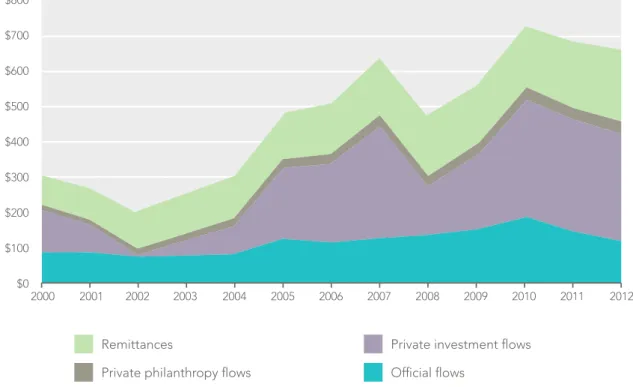
Today private investment makes up an increasing share of financial flows to developing countries. Since 2003, private capital flows – in the forms of private investment, remittances and philanthropy – have surpassed official government flows. In 2010, private flows totaled 82 percent of external financial flows to developing countries (Figure 1), while official aid has stagnated in recent years.4
Although these private flows can serve many purposes and there is no clear way to quantify what their development impact has been, these figures demonstrate that there is strong investor interest in emerging markets, and this interest can potentially be leveraged for social good. Foreign investment includes capital for infrastructure, industry and technology, for example to grow mobile networks, all which can have a development impact.
Additionally, many companies operating in
developing countries have instituted programs that directly support social good while contributing to their bottom lines. For example, some companies are funding healthcare programs that support
families and reduce employee absenteeism, technology upgrades that minimize environmental harm and job training programs that make national workforces more competitive.
There is also a growing movement for a specific type of investment capital that is directly focused on having social impact. Impact investments are those that intentionally target specific social and/or environmental objectives along with a financial return and measure the achievement of both.5 Impact investments largely comprise
efforts to provide socially beneficial goods and services, or engage key populations in supply and distribution chains.
This type of investment places social benefits into the decision-making frameworks of investors, thereby increasing the capital available to fund socially beneficial interventions and outcomes in developing countries. One recent report surveyed 125 institutional impact investors who are managing a total of $46 billion globally, including $10.6 billion invested in 2013 and respondents indicated they
$800 $700 $600 $500 $400 $300 $200 $100 $0 2000 2001 2002 2003 2004 2005 2006 2007 2008 2009 2010 2011 2012
Private philanthropy flows
Remittances Private investment flows Official flows
FIGURE 1. DEVELOPING COUNTRIES’ NET RESOURCE
RECEIPTS FROM DAC COUNTRIES AND MULTILATERAL
ORGANIZATIONS IN 2000-2012, CONSTANT 2011 USD BILLION
Source: OECD Post-2015 “Measuring and Monitoring External Development Finance”: (Organisation for Economic Co-operation and Development). http://www.oecd.org/dac/Monitoring%20and%20measuring%20external%20development%20finance.pdf
INTRODUCTION: THE CHANGING LANDSCAPE OF DEVELOPMENT FINANCE
4 http://www.whitehouse.gov/the-press-office/new-100-million-microfinance-growth-fund-western-hemisphere 5 This report uses a definition of impact investment provided in the Social Impact Investment Taskforce report.
plan to invest 20 percent more in 2014.6 There are
already some small funds largely funded with private capital – in addition to development finance institutions, foundations and larger financial
organizations - that have been making impact investments in developing country markets. These pioneers have demonstrated the need and demand for capital as well as new business models that can affect social change in developing economies, while being financially sustainable or providing a financial return.
Impact investing has the potential to be the force that empowers a range of capital flows in developing economies to work together to the greatest effect. International aid agencies are looking to new tools, including results-based financing, outcomes-based approaches, market-based solutions and different forms of public-private partnerships to increase their effectiveness and long-term development impact while working with the limitations of tighter budgets. Meanwhile, philanthropic organizations are increasingly interested in using investment models that complement their charitable grants to achieve a greater long-term impact.7 There is a real
opportunity for official aid agencies, development finance institutions, foundations and philanthropists to further leverage their resources to promote more private investment in developing countries that is oriented toward social objectives. To realize these opportunities, there is a need to use traditional financing tools in new ways, scale up financing models that work and develop new models to complement traditional systems and better align different sources of capital (public, philanthropic and private) in order to drive faster progress toward achieving these objectives.
IMPACT INVESTING FOR
INTERNATIONAL DEVELOPMENT
Investing for social impact is not new in international development. Internationaldevelopment agencies have always recognized that economic and social development must happen simultaneously for sustainable, long-term growth. Many bilateral and multilateral agencies have consistently leveraged debt and equity capital for development. Development Finance Institutions (DFIs) – these generally include the private sector investment arms of bilateral governments, but
for simplicity in this report, the term includes multilateral development banks, regional development banks and bilateral aid agencies that also provide finance – have a long track record of using private sector tools and funds to create impact in the emerging markets. They have historically created significant impact in terms of growth, job creation and helping to strengthen nascent private sectors in low-income countries. The Working Group recognizes DFIs’ intent to continue these efforts, and urges them to explore how they can crowd in more private money for socially beneficial investments. The traditional investment model, however, has targeted key elements of the economy such as infrastructure, equity and debt for local firms in sectors from mining to food processing to banking, and other industries which have yielded substantial growth. Investments have not fit a standard
definition of impact investing, which includes intentionality of targeting social and financial returns and regular measurement.
As the landscape of development financing
continues to evolve, impact investment is emerging as a type of investment strategy that more explicitly targets measurable social returns. Impact investors typically invest in firms that provide socially
beneficial goods and services and have financial returns. Examples further on in this report illustrate ways in which DFIs are experimenting with the use of investments that target Base of the Pyramid (BoP) consumers or suppliers, or focus on early stage entrepreneurs or new modalities to provide effective social services.
However, to date, a common definition has not been applied and measures of progress have not followed a consistent approach. As such, there has been a lack of clarity in the broad field of
development finance about what impact investing is and what the value could be of developing this market. There are efforts underway currently to align DFIs around a common definition and to establish harmonized metrics for measurement. A common perception is that profitability and social purpose are not aligned, and therefore investment and official aid are often seen as separate and not working together to achieve common outcomes. It is difficult to estimate the size of the impact investment market, particularly in the context of international development, due to the lack of
6 http://www.jpmorganchase.com/corporate/socialfinance/document/140502-Spotlight_on_the_market-FINAL.pdf
7 Impact Investing: An Introduction (pg.4) “Why does Impact Investing Matter to Donors?” http://www.rockpa.org/document.doc?id=239 8 J.P. Morgan Social Finance and GIIN (2014). http://www.thegiin.org/binary-data/2014MarketSpotlight.PDF.
common definitions and reporting. The recent J.P. Morgan-Global Impact Investing Network Impact Investor survey, however, reports that approximately 70 percent of the estimated $10.6 billion in impact investments committed in 2013 has been invested in emerging markets – and DFIs represent the largest investor segment, managing 42 percent of total assets.8 An earlier study
estimated that the BoP market across five key sectors represents potential for between $400 billion and $1 trillion in invested capital, and between $183 billion and $667 billion in profits over the next 10 years.9
The application of impact investing in
international development could make up one of the fastest-growing segments of the market. A review of the broader social impact investing sector cites major market trends which are all particularly relevant to impact investing in developing country markets, and which illustrate how impact investing could significantly influence the lives of the poor.10 These include:
1. Pent-up demand for products and services at the BoP;
2. The need for greater resources to develop new energy solutions and mitigate the effects of climate change;
3. New approaches to the provision of basic services;
4. New approaches to the provision of financial services for the poor; and
5. The need for support of early stage companies with high potential for growth and job creation, particularly for poor and vulnerable workers. Impact investment provides an opportunity to use new business models and a wider set of tools to address these gaps.
Indeed, a number of efforts are underway to create new investment models and partnerships among the public, private and non-profit sectors. There are a growing number of impact investment funds and vehicles often supported by development finance institutions and foundations – which are investing in local enterprises that are meeting the demand for products and services, generating employment opportunities and income for the BoP, funding carbon reduction projects, or otherwise focused on both a financial and social return.
These vehicles are beginning to demonstrate the social impacts of their investments from across a range of funding sources and risk profiles. They include the Acumen Fund (see box below), which
The Acumen Fund
The Acumen Fund, incorporated on April 1, 2001 and capitalized by the Rockefeller Foundation, Cisco Systems Foundation and individual philanthropists, has leveraged a global network of philanthropists as “partners” in investing in entrepreneurs who have the capability to bring sustainable solutions to problems of poverty. Acumen uses charitable donations to make patient long-term debt or equity investments in early-stage companies in a range of sectors including agriculture, education, energy, drinking water, and housing. The fund’s patient capital aims to bridge the gap between the
efficiency and scale of market-based approaches and the social impact of pure philanthropy. Capital is accompanied by management support intended to jump-start and nurture socially impactful enterprises.
Case
Asian Health Alliance: Provides high quality, accessible and affordable healthcare diagnostics in India Total Invested: $750,000 (since 2013)
The Challenge:
The majority of medical treatment decisions in India are made without any form of diagnosis. This leads to inflated treatment costs and the
spread of disease. Low-income and rural areas lack high-quality diagnostics; options are limited to low quality local clinics or high-end expensive diagnostic chains. Asian Health Alliance owns and operates affordable and high quality medical diagnostic services under the brand name Asian Health Meter – costs are 40% lower than larger diagnostic chains. Asian Health Meter provides diagnostic service in communities where 80 percent of the population earns less than Rs. 15,000 per month in family income. Acumen investment will enable the company to expand its services in the region.
CASE STUDY
Source: http://acumen.org/investment/asian-health-alliance/
INTRODUCTION: THE CHANGING LANDSCAPE OF DEVELOPMENT FINANCE
9 J.P. Morgan Social Finance, GIIN, Rockefeller Foundation (2010). http://www.rockefellerfoundation.org/uploads/files/2b053b2b-8feb-46ea-adbd-f89068d59785-impact.pdf The report uses the World Resources Institute of “base of the pyramid” as earning less than USD $3,000 per year. It assesses opportunities for potential invested capital in the housing, water, health, education, and financial services sectors.
10 Martin, Maximilian. “Status of the Social Impact Investing Market”, Prepared for the UK Cabinet Office. Impact Economy, 2013.
raises charitable donations and investment capital to make early stage investments in small businesses that serve the poor; the Grassroots Business Fund, which combines investment capital and business advisory services to support income-generating businesses in low-income communities; Aavishkaar, an early stage investment firm in India delivering commercial returns and bringing efficiencies and developmental impact to rural and underserved communities; and Accion, a non-profit started in Latin America and dedicated to financial inclusion, which invests in microfinance institutions and in new products and business models, and uses any financial return to support its investments.
Official development agencies have made efforts to support impact investing to drive better social outcomes. The interest of DFIs in impact investing and especially in blended finance approaches is growing. Although many DFIs have been making investments for development purposes for decades, some are now beginning to distinguish which of their investments fit a strict definition of “impact investing” that is intentional, sets social outcomes objectives and tracks their achievement, and to understand the impact of this kind of investing. For example, the U.S. Overseas Private Investment Corporation (OPIC) and Inter-American Development Bank (IDB) have undergone an exercise to tag investments “with partners whose very business models aim to address social or environmental problems while generating sustainable financial returns” (see more discussion under Recommendation 3 below).11
DFIs are also exploring new structures to increase social impact investment in developing countries. These can include unique windows within DFIs, (such as the Opportunities for the Majority and Multilateral Investment Fund windows at the IDB) or new fund structures. Both AFD Proparco, a subsidiary of the French Development Agency dedicated to financing the private sector, and KfW, the German Development Bank which has
established various structured funds, have also made impact investments. For example, KfW has provided investments to impact-driven funds including Aavishkaar’s India Impact Fund and the Microfinance Initiative for Asia (MiFA) Debt Fund, which focuses on mobilizing finance for the microfinance sector in Asia. Another example is
the UK Department for International Development (DFID) Impact Fund – a £75 million initiative of the UK government to direct early-stage investment capital to pro-poor businesses in Sub-Saharan Africa and South Asia.12 DFID and the US Agency
for International Development (USAID) have also contributed funding to launch a new innovation fund (modeled after USAID’s Development Innovation Ventures program), which will serve as an investment platform, created as a separate legal entity, to provide early stage support to social enterprises.13 It will aim to combine grant and
investment capital to help bring to scale
innovations that have a proven impact. All of these entities have been created to provide capital for new business models addressing social issues or serving the poor.
One way that impact investments can have greatest impact for development is by linking funding to outcomes. In addition to the increase in private investment in developing countries, there is a growing movement toward funding approaches that pay on the basis of outcomes or results.14 There are
many forms of results-based approaches in the aid world. Development agencies are beginning to experiment with approaches that contract directly on outcomes, a key benefit of which is that recipients of funding have the discretion to focus on the strategies that are needed to achieve results, rather than focusing on reporting on how donor-funded inputs are spent.15 This creates the space for innovation and
learning to take place and, through that process, for longer-term development impact. At the same time, because funding is linked to results, outcomes-based approaches create the incentives to get good data on the outcomes that matter, which is often sorely lacking in developing countries.
As with results-based contracting approaches, impact investment requires setting objectives and clear results metrics. Impact investment comes in many different forms and some models yield financial returns only when some social objective has been met. For example, the model of social impact bonds (SIBs) is that impact investors provide investment capital for providers and are paid back by public sector agencies (and/or possibly
foundations or corporations) if programs lead to the expected results, with returns commensurate to success (Figure 2). This approach thereby directly
11 http://www3.weforum.org/docs/WEF_II_SolutionsInsights_ImpactInvesting_Report_2013.pdf p.11 12 http://www.cdcgroup.com/dfid-impact-fund.aspx
13 http://www.usaid.gov/news-information/press-releases/usaid-and-dfid-announce-global-development-innovation-ventures
14 The Center for Global Development-Social Finance Development Impact Bond Working Group report reviews the landscape of results-based contracting for development (CGD 2013). The working paper Incentive Proliferation? Making Sense of a New Wave of Development Programs discusses in more detail the ways in which results-based funding programs for development can be classified (Savedoff, 2011).
FIGURE 2. WHAT IS A SOCIAL IMPACT BOND?
Impact investment
intermediary
1. Puts together arrangement 2. Funds service provider 3. Supports with expertisePositive outcomes, improved
lives and benefits for country
Set objectives, timelines, payment levels and pay only for verified positive outcomes
Government achieves net savings and increased
tax revenues
Government,
foundation or
corporation,
individually or
together
Social
sector service
provider
Provide capital Receive capital back and returns only according to positive outcomesachieved
Investors
Beneficiaries
links social impact with financial returns; public funding pays only for results and subsidizes the returns an investor could make, thereby making “investible” a social problem that otherwise would not be attractive to an investor. Experiments with social impact bonds are currently underway in the United Kingdom, United States and other developed countries. They are also being explored in the developing country context in places
including India, Uganda, Rwanda and Mozambique as Development Impact Bonds, a model in
which third-party donor agencies or DFIs provide some or all of the outcomes payments (see
Recommendation 2).16 Impact Bonds are one model
by which impact investment can be used to bring private sector funding and expertise to bear to achieve social objectives, particularly where enterprises or service providers do not have the working capital that a project requires.
There are many possible ways to link private returns with social outcomes and build incentive structures into impact investing models, including approaches in which fund managers’ profits are linked to the profit of businesses (see box above).
CATALYZING NEW
CAPITAL FOR IMPACT
Impact investment enables the power of markets to help scale solutions to some of our most urgent problems. It can complement grant financing to crowd-in funding for maximum impact. Government agencies are working under tighter budget constraints with stronger demands to demonstrate the effectiveness of public spending, and are thus often not well positioned to take on the risks associated with innovative approaches. With the appropriate structures, private investors can take delivery, operational, or start-up risks and DFIs and governments should explore the ways in which limited public resources can be used to catalyze other flows, including social impact investment. With broader awareness of the potential of this approach, and a stronger market infrastructure, governments, investors, philanthropists and enterprises in rich and poor countries can build upon current experiences of impact investing in international development and achieve much greater impact. Impact investing alone is not a solution, but in conjunction with public, private and philanthropic capital, as well as an improved business environment in countries, it can help make a considerable difference in addressing these challenges.
Impact-Based Incentive Structures: The Africa Health Fund
The Africa Health Fund, managed by the Abraaj Group, a private equity investor in global growth markets, was established in 2009 with backing from the African Development Bank, the Bill & Melinda Gates Foundation and the International Finance Corporation as anchors to help consumers at the base of the pyramid gain access to affordable, quality healthcare through targeted
investments in the healthcare industry in Africa. The Fund specifically aims to reach the BoP, which it defines as those who earn an average annual household income of less than $3,000 in purchasing power parity* (PPP) terms. Performance goals are integrated into the fund manager’s compensation structure; The Abraaj Group earns more the greater the percentage of BoP clients that its
partner companies serve, creating incentives to target the hardest to reach. An example investment is the Avenue Group, a healthcare provider which has grown from a 70 to 140 bed capacity between 2011 and 2013, with 57% of its customer base estimated to come from the BoP. The Africa Health Fund is funded for 10 years and as of mid-2014, has made 10 investments totaling $50.3 million across Africa.
CASE STUDY
Sources: The Abraaj Group and the Global Impact Investing Network, http://www.abraaj.com/images/uploads/newspdfs/Engagement_in_Africa_ Report_%2810Jun2013%29.pdf; http://www.thegiin.org/binary-data/RESOURCE/download_file/000/000/332-1.pdf
11
CHALLENGES FOR THE IMPACT INVESTING MARKET IN INTERNATIONAL DEVELOPMENT
Impact investing has the potential
to reach the world’s poor and
improve people’s lives but
this type of investment is not
being adequately used today.
There is a growing belief that
investments, along with grants,
have the potential to transform
the social sector. However, for
impact investing to reach massive
scale – bringing private capital to
bear on our greatest challenges –
requires a more intentional
and proactive partnership
between government and the
private sector.
This also applies to the multilateral and bilateral agencies. The International Development Working Group identified several factors that currently are keeping the impact investment market from reaching its potential in international development, many of which apply to the impact investing market more generally.
ASYMMETRY OF CAPITAL
DEMAND AND SUPPLY
First, there exists a market asymmetry between capital demand and supply: smaller enterprises cite lack of appropriate funding, and investors cite lack of quality scalable enterprises.17 The Working
Group identified a need to focus on the demand side, to make more businesses and social ventures in developing countries investment-ready and able to take on investment with a plan for how they expect to financially sustain themselves and yield measurable social and financial returns. Generally, at least in the early stages, this is largely done through family and friends; however, for many in the developing world this capital is not available, sufficient or sustainable. Grants and impact investment together offer drivers for boosting investment-readiness.
There is also a need for capital at the higher-risk early stage of business development (Figure 3). While these socially-oriented businesses have the potential to drive both economic and social progress in developing countries and emerging markets by increasing employment and
productivity and providing necessary products and
CHALLENGES FOR THE
IMPACT INVESTING MARKET IN
INTERNATIONAL DEVELOPMENT
Developing an
idea: blueprint market testingDoing it: first
Going full time: getting
sustainable
Going beyond just you: first growth,
angel investors
Market testing at scale: series
A finance
FIGURE 3. BUILDING THE “PIPELINE” FOR INVESTORS –
THE NEED TO SUPPORT MORE SOCIAL START-UPS
At each stage, there is a substantial drop out to the next stage. Global Entrepreneurship Monitor data suggests a 10:1 drop-out rate at each stage. Investors may be able to reduce this by strong filtering and market
knowledge. Even so, this means a country needs many start-ups to achieve any realistic chance of a strong pipeline of investable businesses. Local intermediary organizations are essential in generating the volume of start-ups to create the pipeline for angel stage and early venture capital investors. These organizations often combine small grants and technical support, which can include a range of approaches such as mentoring, coaching, business advisory support, and training for individual social entrepreneurs based on assessed needs. Many organizations, including (but not limited to) the Shell Foundation, Business Partners International, Echoing Green Foundation, Endeavor, the Aspen Network of Development Entrepreneurs, the Global Social
Entrepreneurship Network, and Sankalp are a few that are helping to develop the infrastructure of these organizations and building a community of practice around the globe.
17 See Blueprint to Scale, http://www.mim.monitor.com/blueprinttoscale.html; and Promise and Progress http://www.mim.monitor.com/downloads/ Promise_and_Progress/PromiseAndProgress-Full-screen.pdf for more evidence of the funding gap for pioneer firms trying new business models to engage with the BoP
services, they often do not have access to finance that can enable them to grow and reach their maximum social benefit. Too often, small, young social enterprises fail due to a lack of capital in the “pioneer stage”18 because investors are
hesitant to provide high-risk funding or because they lack understanding about the specific financial needs of early stage enterprises or the complexity of issues in sectors such as water or sanitation. The businesses themselves are often high risk enterprises, working with new, low-income customer and supplier bases with unproven business models. Additionally, impact investment fund managers also cite weak technical capacity in developing country markets, including weak governance rights, a lack of knowledge about different investment types and the need for support in developing business plans and long-term strategies.19 Despite growing interest in
investing in these economies, certain parts of the market remain under-served, particularly those that require early stage capital.
SHARING AND MANAGING RISK
Second, the Working Group identified a number of issues related to the management and sharing of risks associated with investing in emerging markets. Investment in the international development context is perceived to be riskier, because risk calculations include operational and performance risks at the political, market, and enterprise levels. Governments should explore ways in which they can help to attract investment in these “higher risk” settings – including ensuring that their DFIs have the incentives and tools to take on risks. The Group also encourages the sharing of best practices on how to assess risks and determine appropriate rates of return.
INADEQUATE METRICS
AND TRANSPARENCY
Echoing the messages of other working groups and advisory boards of the Social Impact Investment Taskforce, the Working Group highlighted as challenges for this market the lack of: (1) a common understanding of what impact investment is and a common vocabulary, (2) common and standardized systems of metrics and benchmarks, and (3) transparency around transactions and their results or impact. Several funds and groups active in impact investing have
made progress in developing valuable measures of social return alongside financial impacts, but they are not yet employing standardized measures. There is no agreement on common metrics – including what, when, and how impact investments should be reported – and there are often
disagreements about whether the intent and metrics of a particular investment qualify as an impact investment. In general, there is a need for better and more comparable measures of outcomes and impact, and transparency to ensure the sharing of knowledge and best practices that will accelerate the growth of this market.
A NEED FOR A MORE
ROBUST ECOSYSTEM
Finally, the Working Group recognizes that there is a need to encourage not only more impact investing transactions, but to also encourage investment in broader “ecosystem-building.” A robust ecosystem with a confluence of actors, institutions and mechanisms to support the
sourcing, facilitation, securitization, intermediation, structuring and promotion of the impact
investment market globally has yet to develop. For improved policy, there is a need for substantial amounts of capital available to train local
government officials to implement the changes, and more research and sharing of best practices. At this early stage, developing this ecosystem will require investments including grant capital to support social enterprises and local intermediaries, enable entrepreneurs to build new markets (for example, mobile health, banking and fair trade) and provide platforms for knowledge sharing and improved metrics.
It will also require policy actions to unleash the potential of DFIs to advance the impact investing market and to inspire a range of complementary activities that will promote a global market. For example, efforts to boost the social impact investment market in the UK included establishing Big Society Capital, the first social investment bank; introducing social investment tax relief; reviewing and removing regulations that inhibit social investment; and setting up a number of other facilities that address gaps in this market including the Social Incubator Fund and Social Outcomes Fund.20
Below are four recommendations that address the challenges of supply and demand asymmetry, risk management, metrics, and an underdeveloped ecosystem.
18 From Blueprint to Scale: The Case for Philanthropy in Impact Investing
19 Grassroots Business Fund Annual Report: http://dev.gbfund.org/sites/default/files/Annual%20Report_1.pdf The Abraaj Group “ Reflections on Africa Health Fund “
13
WORKING GROUP RECOMMENDATIONS
To grow this market, the
International Development
Working Group of practitioners
makes four recommendations
to governments and business
and social sector leaders in G7,
G20 and developing countries:
1. Create a new Impact Finance Facility to help to cultivate and develop new and innovative companies and business models as well as innovative social sector organisations, building the pipeline of impact investments;
2. Create a DIB Outcomes Fund to facilitate the rollout of Development Impact Bond pilots; 3. Improve metrics and increase transparency
to advance the impact investing market; and 4. Provide additional resources for
‘ecosystem-building’ to support the broader environment for impact investing.
RECOMMENDATION 1: CREATE A
NEW IMPACT FINANCE FACILITY
Development finance institutions of G7 and G20 governments should create an Impact Finance Facility that would proactively support the development of the impact investing market by encouraging testing of diverse investment models and instruments and stimulating an ongoing flow of potential impact investing transactions. Although the Social Impact Investment Taskforce is an initiative of G7 countries, an international development-focused Impact Finance Facility will be more likely to succeed if it has the support of the G20.Built upon the lessons of the G20 SME Challenge Fund21, this would be a wholesale facility, operating
as a fund of funds managed by a private fund manager. One example of a similar entity is the Microfinance Growth Fund22, which was launched
in 2009 at the Summit of the Americas by the Inter-American Development Bank (IDB), the Inter-American Investment Corporation (IIC), the Corporación Andine de Fomento (CAF) and other private investors to make finance available to micro and small enterprises during the global credit crisis.23
A proposed $500 million facility would aim to generate an ongoing flow of impact investing opportunities, and could be set up as a risk-sharing mechanism in which contributions from DFIs and local financial institutions could be used to leverage additional investment from the private sector (as in the DFID Impact Fund or U.S. Social Innovation Fund models). This is proposed as a $500 million facility to start – an amount that would be large enough to make a difference while being politically feasible, but is only meant to be illustrative as a starting point. The size of the fund will ultimately be determined by public support for it.
An Impact Finance Facility (IFF), which includes grant funding to boost capacity-building, will bolster the demand side of the market and better connect supply of investment with demand from impact-driven organisations. To address current shortcomings in the impact investing market, the IFF will help match needs for capital for early stage business development with technical assistance, and it will also share information and best practices publicly. This will accelerate the growth of the impact investment market and the impact it can have in developing countries.
Structure of the IFF
To make a long-term impact on this market, the IFF should be set up as a long-term or permanent facility, rather than as a challenge fund or one-off allocation of prizes. Recognizing that setting up a new facility will require significant resources, the Working Group recommends that the IFF build on the continued efforts of the international financial institutions, and focus on aligning different sources of capital and crowding in private capital. This multi-country effort would target barriers to the impact investing market at a larger scale than DFIs are currently able to do, and with greater ability to make the kind of risky investments that are
WORKING GROUP
RECOMMENDATIONS
21 http://www.changemakers.com/g20media/g20challenge
22 http://www.whitehouse.gov/the-press-office/new-100-million-microfinance-growth-fund-western-hemisphere 23 This fund was developed by the IDB Group and OPIC and is managed by Blue Orchard Finance.
needed. This would create a demonstration effect for impact investing and help to effect real transformational change.
The Working Group therefore recommends that the international financial institutions, including the African Development Bank, Asian Development Bank, Inter-American Development Bank and World Bank, with other private investors, jointly create the IFF as a G20 Facility. A private fund manager should run the facility, which should also include private investors.
Functions and Activities of the IFF
The Working Group recommends that a taskforce composed of International Development Working Group members and other impact investors from the G20 work with G7/G20 leaders in designing and overseeing a facility that will identify and support local investors, encourage innovations in fund structures (particularly those that support early stage firms), and support funds that offer layered capital facilities with innovative risk and guarantee facilities. The IFF would have the mandate to support the development of the global impact investing market by reducing the high fixed costs of
individual transactions; bolstering socially oriented businesses that demonstrate that it is possible to generate both social and financial returns; providing strong technical assistance and business development services for entrepreneurs; testing new instruments and business models; linking impact investors with investible propositions; and contributing to the evidence base for impact investing by sharing results, data and lessons learned publicly.
The Working Group envisions that the IFF’s offerings would include:
Flexible Capital: The Working Group
recommends that the facility create a structured fund of funds with the flexibility to make a full spectrum of investments into funds that re-invest for social impact and that focus on identifying innovative, high-impact business models. The facility should be able to make a full spectrum of investments, including equity, debt and SIBs and Development Impact Bonds (DIBs). It should focus on both early and mid-stage investment requirements, providing support for innovative ideas at the early stage and continued support for funds that invest in scale.
Technical Assistance: The Working Group also recommends that the facility create a separate fund with the ability to provide grant support for
technical assistance that complements the investment capital. This would include providing support for ongoing management inputs and strategic advice on how to build local talent. Private foundations and other sources of grant funding could contribute to this technical assistance fund to catalyze the market when needed.
Examples of technical assistance and business support services include Startup Wave and Artha Platform in India. Startup Wave is a virtual incubation platform, supported by GIZ and DFID, that provides mentoring support in areas such as marketing, human resources, business model planning, and financial planning. The Artha Platform is an online community and website dedicated to building relationships between impact investors and donors, and social entrepreneurs and capacity building support for organizations working on or in India. Some funds, such as Business Partners International, include mentoring and support as part of their business model.
Sharing of Best Practices: The Working Group recommends the creation of a public online platform that would list investee companies and the impact that the investments are having, based on clear and well-defined criteria. This platform will generate an impact investment pipeline and enable sharing of what works and what doesn’t across geographies and vehicles. The IFF should plan to be as transparent as possible about its investments and their impacts.
Funding for the IFF
The bilateral development agencies of the G7 and the G20 should commit grant funding to start up the facility. The Working Group recommends that an additional source of initial funding come from the annual IFC capital transfers to IDA, the World Bank’s soft loan window. Since the 2007 IDA replenishments, the IFC has been transferring a portion of its net income to IDA to provide more financing for the world’s poorest countries. While important to bolster the IDA contributions, it detracts from the ability of the IFC finance to mobilize other finance, and it effectively acts as a tax on entrepreneurs and companies in IFC countries.24 Using this transfer to invest in new
projects and business in IDA countries would reinvest IFC profits in a more transparent way and enhance IFC’s mission, while using investment to complement grant financing. The use of IFC-IDA transfers should be more fully explored as one source of initial funding for the Impact Finance Facility, and the Working Group recommends additional exploration of creative structures to finance the facility.
24 Lowery, Clay. “A Proposal for IDA-17: Instead of an Income Transfer, Direct the IFC to Invest its Time, Resources, and Expertise in IDA countries.” Center for Global Development Brief March 2013.
15
RECOMMENDATION 2:
CREATE A DIB OUTCOMES FUND
Development agencies, impact investors, philanthropic foundations, and other interested players in G7 countries should support the testing of DIBs and SIBs in emerging markets. SIBs and DIBs are a new model for public private partnerships that attract private investment and align incentives toward achieving social outcomes. G7 development agencies can accelerate experimentation and learning about DIBs by contributing to an independent DIB Outcomes Fund which would make funding available to pay for the results of successful DIB-financed programs, and stimulate the development of transactions. In addition to government funding, the Outcomes Fund could seek grant financing from foundations that want to catalyze the development of pilots to test the idea. SIBs and DIBs are outcomes-based financing models that can transform the way that social services are delivered. SIBs and DIBs bring the public and private sectors together with the aim to more efficiently deliver programs that solve specific social problems (see box above).25DIBs could link financing with the achievement of goals that are targeted in the post-2015 MDG framework. In the appropriate context, impact bonds could help countries to reach these goals because they require a rigorous focus on results that is lacking in traditional, input-based
development programs. Moreover, the more flexible working capital creates space for providers to innovate, and private investors and intermediaries can put in place systems, which use real-time data and necessary feedback loops to help all parties understand what’s working. This information can inform policy decisions about social services, and which interventions work and could be scaled. SIBs/ DIBs are a quintessential model for impact
investment, because they directly align financial returns with measurable social outcomes.
DFIs, bilateral aid donors, philanthropic foundations and other socially motivated investors should pilot DIBs, collect evidence about the model and monitor unintended consequences. To complement DIBs, DFIs also should support local ecosystems and local governments in developing SIBs and other pay-for-success models in developing countries, which would aim to increase the effectiveness of public funding by tying it outcomes. For instance, the Inter-American Development Bank through the Multilateral Investment Fund recently announced a Social Impact Bond Facility to support the SIB market in Latin America by directly investing in two to three SIB pilots and providing grant funding to support “ecosystem building” in Latin American countries.26 Additionally, the DFIs should support
research institutions, including universities and other research organizations to study and quantify the impact of DIBs and SIBs for further knowledge sharing.
Development Impact Bond for Sleeping Sickness
In April 2014, UK International Development Secretary Justine Greening announced that the Department for International Development (DFID) will launch a Development Impact Bond to prevent sleeping sickness in Uganda. An estimated 9 million Ugandans are at risk of Rhodesian sleeping sickness, a disease spreading because of the movement of cattle. Without a timely intervention, there is a risk of the convergence of two different strains of the disease in the next 10 years, which will have significant human
health and cost implications. Cost-effective preventative interventions have been proven, but not
implemented at scale. Getting in front of the disease will require mass treatment of 8 million cattle through injection and spraying across 50 districts in Uganda. A Development Impact Bond would provide the large upfront investment that is needed from private investors, as well as a platform to coordinate the public, private, and civil society partners who are all part of the solution to this imminent problem. Investors would
take on the operational and delivery risks associated with the project and DFID, perhaps in partnership with other outcome funders, would provide an outcomes payment to investors, including a return, on the basis of successful results. DFID has committed £1.5 million (about $2.5 million) in funding for a detailed inception project to research and design the intervention model and bond structure. Part of its objective is to test the capacity of DIBs to drive more investment into developing countries.
Sources: UK government press release: https://www.gov.uk/government/news/uk-development-bonds-will-combat-global-poverty; https://www.gov.uk/government/ case-studies/dfid-research-fighting-sleeping-sickness-in-uganda CGD-Social Finance DIB Working Group report Sleeping Sickness case study: http://international. cgdev.org/sites/default/files/investing-in-social-outcomes-development-impact-bonds.pdf
WORKING GROUP RECOMMENDATIONS
25 See the CGD-Social Finance DIB Working Group report for more details on the conceptual framework and design consideration for DIBs, and recommendations for all actors involved: http://international.cgdev.org/publication/investing-social-outcomes-development-impact-bonds 26 “MIF to test innovative Social Impact Bonds financing model in Latin America and the Caribbean”, http://www.fomin.org/PORTADA/Noticias/ Comunicadosdeprensa/TabId/511/ArtMID/3819/ArticleID/1097/MIF-to-test-innovative-Social-Impact-Bonds-financing-model-in-Latin-America-and-the-Caribbean-.aspx
To accelerate a flow of good DIB pilots, the Working Group recommends that G7 development agencies contribute to a proposed DIB Outcomes Fund with an initial $100 million. The Outcomes Fund would pool capital to pay for the outcomes of successful DIB-funded interventions, and would also pool risks for participating development agencies testing the instrument for the first time and more easily enable the sharing of lessons from experiences with DIB pilots in different sectors and countries. An Outcomes Fund can help catalyze the market by making it easier for development agencies to fund pilots and reduce the transaction costs of individual projects at this early stage of the market. To test DIB pilots in a range of sectors and collect evidence about whether and how this model works, commitments from outcome funders will be a first step to attract investor interest and ensure that there is a flow of opportunities. A significant commitment of outcome payments in the form of an Outcomes Fund would send a strong market signal to potential investors.
Although further work will be required on the structure of the DIB Outcomes Fund, the Working Group recommends that the Fund be managed by the World Bank, another multilateral development bank, or an independent entity. Governments and donors will commit and pool together the grant funding that will be used to pay for results. The DIB Outcomes Fund would have a limited life – perhaps five years from its inception – after which an
evidence base about DIBs would have accumulated and funders could determine whether they want to continue to channel funds to DIBs.
RECOMMENDATION 3: INCREASE
TRANSPARENCY AND IMPROVE METRICS
The International Development Working Group underscores the importance of clear definitions and comparable, accessible data for the growth of the impact investing market. DFIs can play their part by clearly identifying which investments in their portfolios count as impact investments (using a common definition), developing metrics formeasuring impact according to standard definitions, and making this information publicly available. DFIs have recently established a sub-working group within their metrics harmonization working group which includes discussion on impact investing. Also, the Social Impact Investment Taskforce’s Impact Measurement Working Group has offered specific recommendations on measurement in its report; the recommendations in this report are meant to complement those efforts.
The Working Group strongly supports global efforts to advance an impact measurement
agenda including the adoption of common guidelines which will encourage transparency and accountability of investors and investees, demonstrate more clearly the impact these investments are making, and ultimately mobilize more capital and expand the impact investing market. DFIs are currently the largest source of financing for impact investing in developing countries and can lead efforts to improve impact measurement in the international development space, with private investors,
philanthropic organizations, and local governments also participating and improving their own metrics. DFIs have collaborated through the DFI working group on impact investing, which has met alongside this Taskforce to identify impact objectives across their portfolios and more clearly and intentionally “tag” those projects or portfolios that constitute impact investments. For example, OPIC has undergone an exercise to tag investments “with partners whose very business models aim to address social or environmental problems while generating sustainable financial returns.”27 The Inter-American
Development Bank has also tagged its portfolio, distinguishing, within its overall portfolio of development finance investments, those that have specific intentionality for social and environmental impact. Transparency by the DFIs on the
intentionality of their investments, using international guidelines and common definitions for impact measurement as they are developed, is key to growing and developing this market.
DFIs should clearly distinguish between indicators that measure commercial performance and those measuring social outcomes, and should use harmonized standards for outcome and impact metrics, both social and financial, across different sectors as they are being developed (e.g. IRIS, GRI; see box on page 17). Improved metrics – possibly with regional benchmarks – will over time provide better insight as to where impact investments are being allocated, which populations are being served, and what kind of returns investors can expect. The Working Group recognizes that impact measurements should take into account the local context where possible.
As information about the objectives and results of impact investments is collected, it must be made publicly available to advance the development of an impact investment market. DFIs should publish information about which of their investments are “impact investments” and the social and financial metrics as they define them in order to facilitate learning within and outside of the organization.
The International Development Working Group recognizes that effective impact measurement is
17
not just choosing and reporting on the right metrics; it requires significant improvements in practices and more widespread experimentation and innovation around how to collect data. This is especially relevant in the impact investing context because the early-stage, start-up businesses that are at the core of receiving impact-oriented capital often lack the capacity, the systems and the funding to collect high-quality impact data. DFIs can also play a role in helping businesses and governments in developing countries to improve their data collection systems.
The Working Group also supports promoting the practice of measurement in a way that is friendly to both entrepreneurs and investors. This requires supporting widespread adoption of the best current tools and technologies available such as the Progress out of Poverty Index and multiple technological breakthroughs for entrepreneurs such as Echomobile, Esoko, Voto and Taroworks. It also means working to push this practice further; innovating to drive down the costs of this work and increase the value and accessibility of it; and promoting platforms such as GIIRS and IRIS that provide the transparency in sharing of data, so that with all these advances impact performance can be better understood, contrasted and improved.
RECOMMENDATION 4: SUPPORT
THE BROADER ENVIRONMENT FOR
IMPACT INVESTING
For impact investing to make a real contribution to meeting global challenges requires a greater focus on building the ecosystem and a market infrastructure to support impact enterprises and
allow them to flourish. Beyond the resources required to develop individual market transactions, the Working Group recommends that the G7, G20 and developing countries direct resources toward ecosystem-building activities. “Ecosystem
building” includes technical assistance to build the impact investment pipeline, support for common metrics, as well as investment in forums,
intermediaries and other organizations bringing together new ideas and an exchange for learning. The International Development Working Group strongly encourages G7 governments to take the lead in engaging other governments and sharing their learning on challenges and what works in impact investing. It recommends several actions that institutions in G7 and G20 countries can take to strengthen the impact investment ecosystem for development. • Build the pipeline. Ecosystem-building is part of
the mission of the Impact Finance Facility and DIB Outcomes Fund as they would each contribute, at different scales, to socialization of the concept of impact investing in developing countries, and would expedite the development of a pipeline of
transactions. Improved metrics and increased transparency across transactions will be critical to ecosystem-building as they will help spread learning, attract more players to the market as an understanding of impact investment deepens, and build cohesion and consistency across metrics that will facilitate the development of more transactions. Additionally, G7 and G20 governments, agencies and foundations should provide grants and offer technical assistance to support the early stage development of the market to build the pipeline. This would include supporting new or existing intermediaries and social enterprises, or funds
Examples of Impact Measurement Tools
PRISM – Portfolio Risk, Impact and Sustainability Measurement
An assessment and reporting platform developed with the goal of driving transparency and accountability in
measuring social impact and strengthening the impact investing industry. PRISM was designed in consultation with fund managers, limited partners, social enterprises, CSR programs, corporations and grant providers.
IRIS – Impact Reporting and Investment Standards
Catalogues metrics from across the industry in one place; provides a standard common language to talk about results and facilitates the comparison of investments and
aggregation of information across a portfolio; Allows investors to evaluate, communicate and manage their social
and environmental performance; and lastly, incorporates and aligns widely accepted third party standards.
GIIRS – Global Impact Investing Rating System
A comprehensive and transparent system for assessing the social and environmental impact of companies and funds with rating approaches comparable to Morningstar rankings and Capital IQ analytics.
GRI – Global Reporting Initiative
Has pioneered and developed a comprehensive sustainability reporting framework that is widely used around the world. Its mission is to make sustainability reporting standard practice for all companies and organizations.
based in developing countries and G20 countries. Currently many bilateral agencies provide capacity building for traditional enterprise development, and the Working Group recommends expanding this support for entrepreneurs, social entrepreneurs, and social ventures working to create impact. • Give DFIs the tools they need. As their DFIs
already comprise the largest impact investor base in the international development space, in order to grow the pipeline, governments must ensure that DFIs have the tools they need to make the kinds of investments that are needed, whether through a joint facility like the IFF or through their own transactions. For example, the U.S. National Advisory Board report calls on the U.S. Congress to loosen regulatory and legislative constraints on OPIC, such as the requirement that OPIC be reauthorized on an annual basis, the requirement that projects it supports are connected to US citizens or businesses, and OPIC’s lack of authority to make early-stage equity investments.28
• Strengthen local organizational capabilities. The Working Group recommends that grant and investment resources – from DFIs and foundations – be used to provide direct support to bolster the growth of local intermediaries and companies (not just international ones) that can help to make impact investing a more salient market in emerging economies. Additionally, grants should be used to provide training and support for local governments to build their own capacity to support impact investing. An example of supporting local intermediaries includes the Social Impact Bond facility created by the Multilateral Investment Fund of the Inter-American Development Bank.
The facility provides $3 million over 5 years of ‘ecosystem-building support’ to include training for intermediaries in Latin American countries who can help to develop the SIB market locally. • Support research and knowledge sharing to
help the market mature. There is a need to learn about “what works” and better understand effective models and policies to have the greatest impact. Hence, the Working Group recommends that G7, G20 and multilateral and bilateral institutions support high-quality research to expand the evidence base – for instance on what works in which sectors and countries, various business models, appropriate return expectations, and benchmarks and exits. A key part of the evidence base will also entail evaluations of new and existing funds or programs that experiment with impact investment, support the
development of improved (and evolving) metrics or knowledge-sharing platforms. This includes providing grant support for the sharing of knowledge and best practices amongst
governments, enterprises, and investors as well as strengthening platforms for dialogue. Some examples of these platforms include the SANKALP FORUM in Asia and Africa, SOCAP in USA, global and local Investor platforms such as GIIN and Indian Impact Investor Network. As impact investors, better data and transparency from the DFIs would also bolster the markets. Building the