Acknowledgements
With deepest gratitude, I give thanks to my advisor, Dr. Mitch Prinstein. Through his guidance and encouragement, I not only completed my dissertation but developed a life-changing passion for research. Dr. Prinstein tirelessly offered me opportunities to build my research skills. I know his wisdom will support and inform me for the rest of my career. I would also like to thank Dr. Patrick Harrison for his expertise and enthusiasm in teaching. Whether in a large class or an individual meeting, he made research and statistics exciting and available to me. I would also like to thank Matthew Clayton for his guidance with my thesis and in the Peer Relations Lab. From his leadership on my first GHS lab run to hearing him present his graduate research, Matt always served as an ideal role-model.
In addition to my thesis committee, I would like to thank the project coordinators, graduate students, and my fellow RAs in the Peer Relations Lab. This community fostered my passion for research while creating cherished friendships. I am especially thankful for Kelsey, Dan, and Megan, who were always there to laugh or cry with me on this journey.
Parental Expressed Emotion and Adolescent Self-Injurious Thoughts and Behaviors
Jillian Dodson
Abstract
Parental Expressed Emotion and Adolescent Self-Injurious Thoughts and Behaviors
Suicide is the leading cause of death among adolescents worldwide (Glenn et al., 2019). The thoughts and behaviors most closely related to and associated with suicide are categorized as self-injurious thoughts and behavior (SITB). SITB include suicidal ideation, suicide gestures, suicide attempts, and non-suicidal self-injury (Nock, Holmberg, Photos, & Michel, 2007). Non-suicidal self-injury (NSSI) refers to “the intentional, self-inflicted damage to the surface of the body without suicidal intent, which is not socially sanctioned” (Brown & Plener, 2017). In 2017, the CDC found that 17.2% of high schoolers seriously considered attempting suicide, 13.6% made a suicide plan, and 7.4% attempted suicide (Kann, et al., 2018). NSSI is similarly prevalent in adolescents with recent studies placing rates of NSSI between 18-42% with higher prevalence rates in adolescent clinical samples (Plener, Schumacher, Munz, & Groschwitz, 2015; Lloyd-Richardson et al. 2007; Nock, 2010). SITB are dangerous as isolated occurrences, but the
significant overlap between SITB and suicide in adolescents makes SITB far more severe (Nock, Joiner, Gordon, Lloyd-Richardson, & Prinstein, 2006; Nock, Holmberg, Photos, & Michel, 2007).
Despite the severity and prevalence of SITB, predictors of SITB are still widely
with SITB (Smith, Wang, Carter, Fox, & Hooley, 2020; Sarkisian, Van Hulle, Goldsmith, 2018; Plener, Schumacher, Munz, & Groschwitz, 2015). Though these factors may have some
connection to SITB, research has yet to determine any factor as a significant predictor of SITB (Fox et al., 2015).
There are some insights as to why some adolescents may engage in SITB. One theory, the integrated theoretical model of the development and maintenance of self-injury, suggests that distal risk factors, in combination with intrapersonal or interpersonal vulnerability factors, will prime an adolescent to injure when triggered by a stress response (Nock, 2010). This self-injury is then maintained by reinforcement through the decrease of stress or increase of pleasure or through receiving attention or a social response. This model may be more widely applied when examining the combination of distal risk factors with intrapersonal vulnerability factors in the development of self-injurious thoughts and behaviors.
Parental Expressed Emotion
Expressed Emotion has been used as a tool to study the impact of family members on a specific individual; it has been defined as the levels of criticism, hostility, and emotional over-involvement (EOI) directed towards a family member (Wedig & Nock, 2007). Though, in earlier research, expressed emotion has been used to study adult relationships, it is a strong predictor of outcomes in children and adolescents. This is likely because the parent-child relationship has more influence on a child’s life than an adult’s life due to the emotional-social-financial dependency a child has on their parents. Therefore, parental expressed emotion may act as a distal risk factor in the integrated theoretical model of the development and maintenance of self-injury. A highly critical or emotionally over-involved parent may predispose an adolescent to have problems regulating their response to stress. As a result, an adolescent might turn to engaging in SITB.
critical than adolescents without a history of SITB (Ammerman & Brown, 2016). Likewise, adolescents who perceived their parents as less emotionally supportive and more critical had higher levels of SITB than those who felt emotionally supported by their parents (Baetens et al., 2013).
Emotional Reactivity
The effect of parental expressed emotion on adolescent SITB may be moderated by levels of emotional reactivity in the individual. Emotional reactivity is defined as “the extent to which an individual experiences emotions (a) in response to a wide array of stimuli (i.e., emotion sensitivity), (b) strongly or intensely (i.e., emotion intensity), and (c) for a prolonged period of time before returning to baseline level of arousal (i.e., emotion persistence)” (Nock, Wedig, Holmberg & Hooley, 2008). Emotional Reactivity may act as an intrapersonal vulnerability factor within the integral theoretical model of the development and maintenance of self-injury. An adolescent with parents who exhibited high expressed emotion may prime an adolescent to have high emotional reactivity. The compounding factors of parental expressed emotion and high emotional reactivity may lead an adolescent to engage in SITB when presented with a stress response.
Emotional reactivity has been studied as a factor within family relationships and mental health outcomes. Emotional Reactivity has been found to moderate family cohesion and
adolescent well-being (Myerberg, Rabinowitz, Reynolds, & Drabick, 2019). Emotional
Current Study
Previous literature indicates the potential for high parental expressed emotion to act as a possible predictor for adolescent SITB. However, previous literature has failed to use consistent measures when studying SITB (Fox et al., 2015; Nock, Holmberg, Photos, & Michel, 2007). In the current study, the Self Injurious Thoughts and Behaviors Interview (SITBI) functions as a consistent measure among all participants. Further, this study uses a sample of adolescent girls with a history of engaging in some self-injurious behaviors or who reported prior suicidal ideation. This will result in higher levels of SITB within the study, thus increasing the statistical power when examining parental expressed emotion as a risk factor (Fox et al., 2015). The current study builds upon the previous literature of SITB and parental expressed emotion. The authors hypothesized that parental expressed emotion acts as a risk factor for SITB, specifically suicidal ideation and NSSI, in adolescent girls. Further, we hypothesized that emotional reactivity would moderate the relationship between parental expressed emotion and SITB, such that those with high levels emotional reactivity would be more likely to engage in SITB when coming from a home with high parental expressed emotion.
Methods Participants
Procedure
Participants were recruited to create a clinical sample (N = 230). Adolescent girls were recruited from local inpatient units, advertising in out-patient clinical practices, general media advertisements, and email to university employees.
Participants attended an on-site lab visit that lasted 5-6 hours. The participant and a parent or guardian attended the visit. Before beginning the visit, the parent and child were given an overview of the study and the tasks to be completed. Both parent and child were then given the opportunity to consent to participating in the visit. After the initial visit, the participant completed follow-up calls at five timepoints after the initial visit. The measures were analyzed from the initial timepoint. All tasks within the study were approved by the university human subjects committee.
Measures
Adolescent girls completed the SITBI and Emotional Reactivity Scale at the initial lab visit. Their parent or guardian completed the Five Minute Speech Sample at the initial lab visit.
Non-Suicidal Self-Injury. Data regarding non-suicidal self-injury was obtained using The Self-Injurious Thoughts and Behaviors Interview (SITBI). The SITBI is an interview that assesses the “presence, frequency, and characteristics” of self-injurious thoughts and behaviors, including NSSI (Nock, Holmberg, Photos, & Michel, 2007). The SITBI was administered by project coordinators during the lab visit. The SITBI consists of 169 items in five modules to assess suicidal ideation, suicide plans, suicide gestures, suicide attempts, and non-suicidal self-injury (Nock, Holmberg, Photos, & Michel, 2007). The interview begins with a screening
well as the frequency and severity of each type in the lifetime, past year, and past month (Nock, Holmberg, Photos, & Michel, 2007). The SITBI is a reliable measure for analyzing the presence of injurious behaviors specifically non-suicidal self-injury.
Five-Minute Speech Sample. Data regarding parental expressed emotion was obtained through the Five-Minute Speech Sample (FMSS) (Weston, Hawes, & Pasalich, 2016). The FMSS is an established measure to assess parent-child relationships (Weston, Hawes, &
Pasalich, 2016). To administer the interview, the researcher asks the parent to speak freely for 5 minutes about their child without any interruption. The interview is then coded according to the statements the parent makes about their child. Parents receive a rating of High Expressed Emotion if they meet the criteria for High Critical or High Emotional Over-Involvement (EOI) (Sher-Censor, 2015). High Critical is coded if the initial statement about the child is negative; if the description of parent-child relationship is negative, or if the parent expressed a negative remark (indicating dislike, resentment, or disapproval) about the child (Sher-Censor, 2015). Higher EOI is rated if the parent demonstrates self-sacrificing or overprotective behavior, presents an emotional display during the interview such as crying, or demonstrates two of the following: stating excessive detail from the past, statements of positive attitude regarding love or willingness do anything for their child, or at least five positive comments (Sher-Censor, 2015). The FMSS demonstrates the ability to act as a reliable measure when measuring expressed emotion namely from parents to child.
questionnaires were completed during the initial lab visit. The Emotional Reactivity Scale assesses the extent to which the participant experiences emotions (a) in response to a wide array of stimuli (b) strongly or intensely (c) for a prolonged period of time before returning to baseline level of arousal (Nock, Wedig, Holmberg, & Hooley, 2008). This provides quantitative values for emotion sensitivity, intensity and persistence. Internal consistency was .953.
Data Analyses
To begin analyses, the mean levels of expressed emotion: critical and emotional
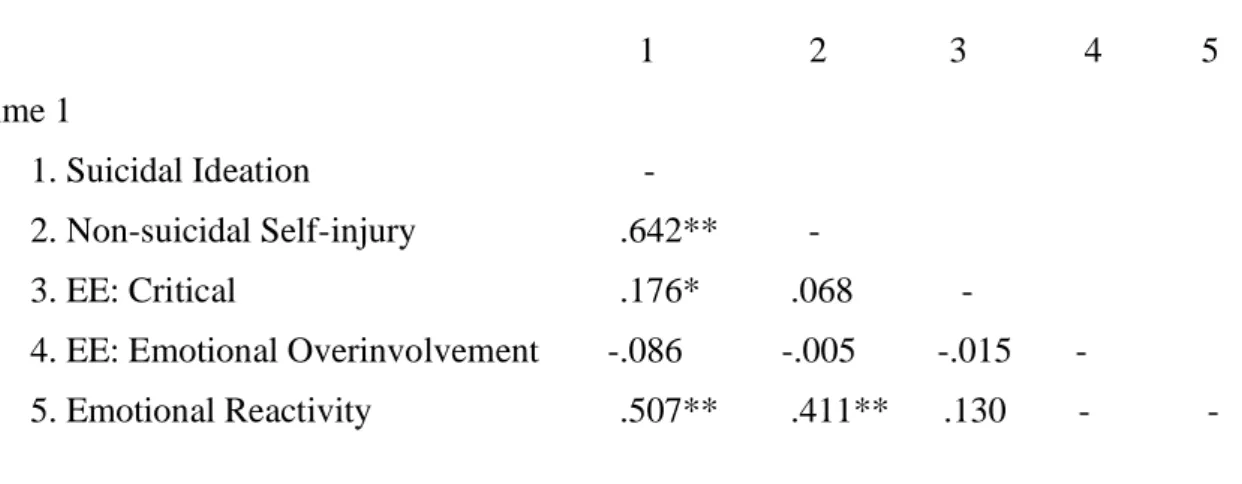
overinvolvement, emotional reactivity, suicidal ideation, and NSSI were calculated and reported. Correlations were calculated among these variables using Pearson’s correlation coefficients. A multiple regression model was used to assess expressed emotion (both critical and emotional overinvolvement) and emotional reactivity as predictors of suicidal ideation, a continuous dependent variable. Emotional reactivity was considered as a moderator to analyze its ability to strengthen or weaken the relationship between parental expressed emotion and suicidal ideation. A logistic regression model was used to assess expressed emotion (both critical and EOI) and emotional reactivity as predictors of NSSI, a discrete dependent variable. Emotional reactivity was again considered as a moderator to analyze its ability to strengthen or weaken the
relationship between parental expressed emotion and NSSI.
Results
suicidal ideation, and there was a significant positive correlation between emotional reactivity and suicidal ideation. Further, emotional reactivity was positively correlated with NSSI.
Expressed emotion (examining both critical and EOI) was not significantly correlated to NSSI.
Predictors of Suicidal Ideation
A second set of analyses was conducted to examine expressed emotion and emotional reactivity as predictors of suicidal ideation. Emotional reactivity was analyzed as a moderator to examine the combined effects of emotional reactivity and expressed emotion in predicting suicidal ideation.
A multiple regression was carried out to investigate whether expressed emotion measures and emotional reactivity could significantly predict participant’s suicidal ideation. Using suicidal ideation as a dependent variable, expressed emotion measures were entered on an initial step, followed by emotional reactivity on a second step. The interaction between expressed emotion measures and emotional reactivity was entered during the third and final step. All results are presented in Table 3. Results of the regression indicated that emotional reactivity was
Predictors of NSSI
A third set of analyses was conducted to examine expressed emotion and emotional reactivity as predictors of NSSI. Emotional reactivity was again analyzed as a moderator to examine the combined effects of emotional reactivity and expressed emotion in predicting NSSI.
A logistic regression was carried out to investigate whether expressed emotion measures and emotional reactivity could significantly predict participant’s suicidal ideation. Using NSSI as a discrete dependent variable, expressed emotion measures were entered on an initial step,
followed by emotional reactivity on a second step. The interaction between expressed emotion measures and emotional reactivity was entered during the third and final step. All results are presented in Table 4. Results of the regression indicated that emotional reactivity was significantly associated with NSSI (b = .849; Wald = 21.7, p < .01). There was no significant relationship between either measure of expressed emotion and NSSI. Further, the moderating role of emotional reactivity did not reveal a significant interaction effect.
Discussion
The current study examined the relationship between parental expressed emotion and adolescent SITB. We hypothesized that high levels parental expressed emotion would be predictive of SITB, specifically suicidal ideation and NSSI. The results of the study demonstrated the critical measure of expressed emotion acted as a significant predictor of suicidal ideation but did not act as a predictor for NSSI. The EOI measure of expressed emotion did not have any relationship with suicidal ideation or NSSI. These findings are limited due to some aspects of the study. The data was collected from one timepoint thus limiting the ability to examine changes of parental expressed emotion and its relationship with participant SITB. Further, data was collected from girls between the ages of 9 and 15. The relationship between parent and child is dynamic in this age range; thus, it may not be wholly assessed at one timepoint.
The current study further hypothesized that participant emotional reactivity would moderate the relationship between parental expressed emotion and participants’ SITB. The findings did not support this hypothesis. However, emotional reactivity did act as a significant predictor of both suicidal ideation and NSSI as a stand-alone variable. Again, these findings are limited due to some aspects of the study. The Emotional Reactivity Scale and the SITBI are both self-report measures and thus more likely to be associated due to consistency in self-perception. In addition, collecting data at one timepoint limits the ability to examine the effect of emotional reactivity on SITB overtime.
These findings indicate the importance of emotional reactivity when assessing SITB. Emotionally reactive thoughts and behaviors may be more apparent than self-injurious thoughts and behaviors. Therefore, it may benefit caregivers and health professionals to observe emotional reactivity in association with SITBs. Future research may reassess emotional reactivity as a moderator of parental expressed emotion and SITB within a longitudinal study. Examining the relationship between these variables at multiple timepoints would account for the change in the adolescent’s emotional reactivity and how their emotional reactivity interacts with the parent-child relationship as the participants ages.
Analysis of data from this future research could then control for age to determine differences in the impact of parental expressed emotion at different stages of adolescence. Second, the current study only collected data from participants assigned as female at birth. Only examining
individuals of one sex limits the understanding of the parent-child relationship on all adolescents. Future research could collect data from individuals from both sexes. Further, future studies could then control for sex as a variable in order to examine the impact of parent-child relationship on both male and female participants. Third, the current study only collected data on expressed emotion from one parent, usually the mother. By only analyzing the parental expressed emotion from one parent, the data does not reflect the holistic relationship between the participant and their caregivers. This becomes especially important when considering families with many different caregivers. Future research may collect this data from all guardian figures in a participant’s life. Fourth, the current study did not account for cultural differences when
examining the effect of expressed emotion. Different cultures encourage different relationships between parent and child. Emotional over-involvement or criticisms from parents may be perceived and internalized in different ways between adolescents from different cultures. In future studies, children and parents may be asked about their expectations of the parent-child relationship to account for cultural differences. Lastly, the data on SITB and emotional reactivity was collected using self-report measures. This limits the reliability of the data as participants may neglect to share certain information or may overestimate the levels of certain thoughts and behaviors. Future research may utilize data from additional behavioral or third-party reported data sources such as from hospital records or reports from healthcare providers.
emotion from multiple members of the family, such as siblings or grandparents. Further, the impact of other forms of interpersonal relationships on SITB could be studied, such as peer relationships or romantic relationships. Additionally, other intrapersonal moderators beyond emotional reactivity may also be studied in relation to SITBs and interpersonal relationships.
References
Ammerman, B. A., & Brown, S. (2016). The mediating role of self-criticism in the relationship between parental expressed emotion and nssi. Current Psychology: A Journal for Diverse Perspectives on Diverse Psychological Issues. https://doi.org/10.1007/s12144-016-9516-1
Baetens, I., Claes, L., Hasking, P., Smits, D., Grietens, H., Onghena, P., & Martin, G. (2015). The relationship between parental expressed emotions and non-suicidal self-injury: The mediating roles of self-criticism and depression. Journal of Child and Family Studies, 24(2), 491–498. https://doi.org/10.1007/s10826-013-9861-8
Brown, R. C., & Plener, P. L. (2017). Non-suicidal Self-Injury in Adolescence. Current psychiatry reports, 19(3), 20. doi:10.1007/s11920-017-0767-9
Butzlaff RL, Hooley JM. Expressed Emotion and Psychiatric Relapse: A Meta-analysis. Arch Gen Psychiatry.1998;55(6):547–552. doi:10.1001/archpsyc.55.6.547
Cha, C.B., Najmi, S., Park, J.M., Finn, C., & Nock, M.K. (2010). Attentional bias toward suicide-related stimuli predicts suicidal behavior. Journal of Abnormal Psychology, 119, 616-622.
Consoli, A., Peyre, H., Speranza, M., Hassler, C., Falissard, B., Touchette, E., Cohen, D., Moro, M.-R., & Révah-Lévy, A. (2013). Suicidal behaviors in depressed adolescents: Role of perceived relationships in the family. Child and Adolescent Psychiatry and Mental Health, 7. https://doi-org.libproxy.lib.unc.edu/10.1186/1753-2000-7-8
Ellis, A. J., Portnoff, L. C., Axelson, D. A., Kowatch, R. A., Walshaw, P., & Miklowitz, D. J. (2014). Parental expressed emotion and suicidal ideation in adolescents with bipolar disorder. Psychiatry Research, 216(2), 213–216. https://doi.org/10.1016/j.psychres.2014.02.013
Fox, K. R., Franklin, J. C., Ribeiro, J. D., Kleiman, E. M., Bentley, K. H., & Nock, M. K. (2015). Meta-analysis of risk factors for nonsuicidal self-injury. Clinical Psychology Review, 42, 156–167. doi: 10.1016/j.cpr.2015.09.002
Glenn, C. R., Kleiman, E. M., Kellerman, J., Pollak, O., Cha, C. B., Esposito, E. C., Porter, A. C., Wyman, P. A., & Boatman, A. E. (2019). Annual research review: A meta‐analytic review of worldwide suicide rates in adolescents. Journal of Child Psychology and Psychiatry. https://doi-org.libproxy.lib.unc.edu/10.1111/jcpp.13106
Heron, M. (2018). Death: Leading Causes for 2016. National Vital Statistics Reports, 67(6). Retrieved from https://www.cdc.gov/nchs/data/nvsr/nvsr67/nvsr67_06.pdf
James, K. M., Woody, M. L., Feurer, C., Kudinova, A. Y., & Gibb, B. E. (2017). Disrupted physiological reactivity among children with a history of suicidal ideation: Moderation by parental expressed emotion-criticism. Biological Psychology, 130, 22–29.
https://doi.org/10.1016/j.biopsycho.2017.10.003
Kaess M, Parzer P, Mattern M, Plener PL, Bifulco A, Resch F, et al. Adverse childhood experiences and their impact on frequency, severity, and the individual function of nonsuicidal self-injury in youth. Psychiatry Res. 2013;206(2-3):265–72.
Kann, L., Mcmanus, T., Harris, W. A., Shanklin, S. L., Flint, K. H., Queen, B., … Ethier, K. A. (2018). Youth Risk Behavior Surveillance — United States, 2017. MMWR. Surveillance
Kiekens, G., Hasking, P., Boyes, M., Claes, L., Mortier, P., Auerbach, R. P., … Bruffaerts, R. (2018). The associations between non-suicidal self-injury and first onset suicidal thoughts and behaviors. Journal of Affective Disorders, 239, 171–179. https://doi.org/10.1016/j.jad.2018.06.033
Lloyd-Richardson, E. E., Perrine, N., Dierker, L., & Kelley, M. L. (2007). Characteristics and functions of non-suicidal self-injury in a community sample of adolescents. Psychological medicine, 37(8), 1183–1192. doi:10.1017/S003329170700027X
McCleary, L., & Sanford, M. (2002). Parental expressed emotion in depressed adolescents: Prediction of clinical course and relationship to comorbid disorders and social functioning. Journal of Child Psychology and Psychiatry, 43(5), 587–595. https://doi.org/10.1111/1469-7610.00048
Nock, M.K., 2010. Self-injury. Annual Reviews of Clinical Psychology 6, 339–363.
Nock, M. K., Holmberg, E. B., Photos, V. I., & Michel, B. D. (2007). The Self-Injurious Thoughts and Behaviors Interview: Development, reliability, and validity in an adolescent sample.
Psychological Assessment, 19, 309-317.
Nock, M. K., Joiner, T. E., Jr., Gordon, K. H., Lloyd-Richardson, E., & Prinstein, M. J. (2006). Non-suicidal self-injury among adolescents: Diagnostic correlates and relation to suicide attempts. Psychiatry Research, 144(1), 65–72. https://doi.org/10.1016/j.psychres.2006.05.010
Nock, M. K., Wedig, M. M., Holmberg, E. B., & Hooley, J. M. (2008). The Emotion Reactivity Scale: Development, evaluation, and relation to self-injurious thoughts and behaviors. Behavior Therapy, 39(2), 107–116. https://doi.org/10.1016/j.beth.2007.05.005
Palmer, E., Welsh, P., & Tiffin, P. A. (2015). Perceptions of family functioning in adolescents who self-harm. Journal of Family Therapy, 38(2), 257–273. doi: 10.1111/1467-6427.12069
of Adolescence, 74, 83–90.
https://doi-org.libproxy.lib.unc.edu/10.1016/j.adolescence.2019.05.008
Plener, P. L., Schumacher, T. S., Munz, L. M., & Groschwitz, R. C. (2015). The longitudinal course of non-suicidal self-injury and deliberate self-harm: a systematic review of the literature. Borderline personality disorder and emotion dysregulation, 2, 2. doi:10.1186/s40479-014-0024-3
Rabinowitz, J. A., Osigwe, I., Drabick, D. A. G., & Reynolds, M. D. (2016). Negative emotional reactivity moderates the relations between family cohesion and internalizing and externalizing symptoms in adolescence. Journal of Adolescence, 53, 116–126.
https://doi-org.libproxy.lib.unc.edu/10.1016/j.adolescence.2016.09.007
Santos, J. C., Saraiva, C. B., & De Sousa, L. (2009). The role of expressed emotion, self-concept, coping, and depression in parasuicidal behavior: A follow-up study. Archives of Suicide Research, 13(4), 358–367. https://doi-org.libproxy.lib.unc.edu/10.1080/13811110903266590
Sarkisian, K. L., Hulle, C. A., & Goldsmith, H. H. (2019). Brooding, inattention, and impulsivity as predictors of adolescent suicidal ideation. Journal of Abnormal Child Psychology, 47(2), 333– 344. https://doi-org.libproxy.lib.unc.edu/10.1007/s10802-018-0435-5
Scott, L. N., Pilkonis, P. A., Hipwell, A. E., Keenan, K., & Stepp, S. D. (2014). Non-suicidal self-injury and suicidal ideation as predictors of suicide attempts in adolescent girls: A multi-wave
prospective study. Comprehensive psychiatry, 58, 1–10. doi:10.1016/j.comppsych.2014.12.011 Sher-Censor, E. (2015). Five Minute Speech Sample in developmental research: A
review. Developmental Review, 36, 127–155. doi: 10.1016/j.dr.2015.01.005
Abnormal Psychology, 129(1), 114–121. https://doi-org.libproxy.lib.unc.edu/10.1037/abn0000483.supp
Vander Stoep, A., Adrian, M., McCauley, E., Crowell, S. E., Stone, A., & Flynn, C. (2011). Risk for suicidal ideation and suicide attempts associated with co-occurring depression and conduct problems in early adolescence. Suicide and Life-Threatening Behavior, 41(3), 316–329. https://doi.org/10.1111/j.1943-278X.2011.00031.
Wedig, M. M., & Nock, M. K. (2007). Parental expressed emotion and adolescent self-injury. Journal of the American Academy of Child & Adolescent Psychiatry, 46(9), 1171–1178.
https://doi.org/10.1097/chi.0b013e3180ca9aaf
Table 1. Means (and standard deviations) for Primary Variables
________________________________________________________
EE: Critical .74 (.746)
EE: Emotional Overinvolvement .74 (.723) Nonsuicidal Self-injury 1.34 (.475) Suicidal Ideation 2.00 (1.238)
Table 2. Bivariate Associations Among Primary Variables
_______________________________________________________________________ 1 2 3 4 5 Time 1
1. Suicidal Ideation - 2. Non-suicidal Self-injury .642** -
3. EE: Critical .176* .068 -
4. EE: Emotional Overinvolvement -.086 -.005 -.015 -
5. Emotional Reactivity .507** .411** .130 - -
Table 3. Prediction of Suicidal Ideation from EE – Critical, EE – Emotional Overinvolvement,
and Emotional Reactivity.
Suicidal Ideation
___________________________________________
Step Statistics Final Statistics ________________________ ___________
Predictors R2 b (se b) b (se b)
___________________________________________________________________
Step 1 .038
Critical .285 (.122) .175* .442 (.185) .271*
EOI -.142 (.127) -.084 -.277 (.184) -.163
Step 2 .210
EMOR .563 (.081) .462** .610 (.129) .501**
Step 3 .019
EMOR x Critical -.196 (.109) -.250 -.196 (.109) -.250
EMOR x EOI .151 (.111) .170 .151 (.111) .170
Total R2 .553
_____________________________________________________________________
Table 4. Prediction of Non-Suicidal Self-injury from EE – Critical, EE – Emotional
Overinvolvement, and Emotional Reactivity.
Non-Suicidal Self-Injury
___________________________________________
Step Statistics Final Statistics ________________________ _______________
Predictors b (se b) Wald b (se b) Wald
__________________________________________________________________ Step 1
Critical .196 (.217) .809 .768 (.448) 2.934
EOI -.014 (.228) .004 -.130 (.463) .079
Step 2
EMOR .849 (.182) 21.713** 1.122 (.311) 12.988**
Step 3
EMOR x Critical -.454 (.247) 3.382 -.454 (.247) 3.382 EMOR x EOI .149 (.249) .358 .149 (.249) .358
_____________________________________________________________________