Research Article
A New Hybrid Algorithm for Bankruptcy Prediction
Using Switching Particle Swarm Optimization and Support
Vector Machines
Yang Lu,
1Nianyin Zeng,
2Xiaohui Liu,
3,4and Shujuan Yi
11College of Information Technology, Heilongjiang Bayi Agricultural University, Daqing 163319, China 2Department of Mechanical and Electrical Engineering, Xiamen University, Xiamen 361005, China 3Department of Computer Science, Brunel University, Uxbridge, Middlesex UB8 3PH, UK 4Faculty of Engineering, King Abdulaziz University, Jeddah 21589, Saudi Arabia
Correspondence should be addressed to Yang Lu; [email protected] Received 27 November 2014; Accepted 19 December 2014
Academic Editor: Zidong Wang
Copyright © 2015 Yang Lu et al. This is an open access article distributed under the Creative Commons Attribution License, which permits unrestricted use, distribution, and reproduction in any medium, provided the original work is properly cited.
Bankruptcy prediction has been extensively investigated by data mining techniques since it is a critical issue in the accounting and finance field. In this paper, a new hybrid algorithm combining switching particle swarm optimization (SPSO) and support vector machine (SVM) is proposed to solve the bankruptcy prediction problem. In particular, a recently developed SPSO algorithm is exploited to search the optimal parameter values of radial basis function (RBF) kernel of the SVM. The new algorithm can largely improve the explanatory power and the stability of the SVM. The proposed algorithm is successfully applied in the bankruptcy prediction problem, where experiment data sets are originally from the UCI Machine Learning Repository. The simulation results show the superiority of proposed algorithm over the traditional SVM-based methods combined with genetic algorithm (GA) or the particle swarm optimization (PSO) algorithm alone.
1. Introduction
In the past few years, bankruptcy prediction has been exten-sively investigated since it is a critical issue in the accounting
and finance field [1,2]. Bankruptcy prediction is very
impor-tant for banks, since they may lose billions of dollars each year due to the bankruptcy of companies. Therefore, banks need to make a decision on the amount and the interest rate of a loan which reflect the creditworthiness of the counter party. It is also of great importance to predict the risk for accounting and financial researchers, credit rating agencies, and other organizations when dealing with counter parties on the busi-ness transactions. Thus, there has been a growing research interest in applying statistical methods, expert systems, and artificial intelligence technologies in the bankruptcy early warning model so as to obtain higher prediction accuracy. The bankruptcy is a typical binary classification problem since there are only two results of prediction, bankruptcy and nonbankruptcy. Up to now, many researchers have proposed
some classical bankruptcy prediction models based on statis-tical methods such as Beaver’s univariate model and Altman’s
multivariate model (see, e.g., [1]). However, the validity of
these traditional statistical methods mainly depends on the subjective judgments of the human financial experts when applied in the selection of some parameters which, in turn, inevitably makes feature selection bias.
With the development of data mining techniques, machine learning methods have been exploited by many researchers for the bankruptcy prediction problem since these methods can provide an unbiased feature selection and decision making mechanism. Let us now provide a brief review of the latest literature on the issue of the bankruptcy prediction problem based on the intelligent methods. In
[3,4], artificial neural networks (ANNs) have been used for
the bankruptcy prediction problem. Genetic algorithm (GA)
has been applied for the feature selection in [5]. On the
other hand, a hybrid of ANNs and GA algorithm has been
proposed in [6] for the bankruptcy prediction. Recently, data
Volume 2015, Article ID 294930, 7 pages http://dx.doi.org/10.1155/2015/294930
mining methods [7] have been widely investigated for the bankruptcy prediction problem. As is well known, ANNs methods suffered from multiple local minima which signif-icantly limits their applications. In the context of bankruptcy prediction, the issue to be investigated is a typical binary classification problem, and there is a great need to seek a more appropriate approach that is capable of handling the pattern classification. In search of such a candidate, SVM appears to be an ideal one because of its advantages such as the fact that the solution to the SVM is global and unique and it has a sim-ple geometric interpretation and gives a sparse solution. SVM models, especially, have already been successfully applied to many financial problems including bankruptcy prediction
[8]. However, there is a limitation of the SVM approach which
lies in the selection of the parameter values of the kernel function. In order to cope with the limitation, intelligent optimization algorithms, such as GA and the PSO, have been exploited to optimize both the feature subset and the
param-eters of SVM; see, for example, [9].
Compared with GA, PSO does not have genetic operators such as crossover and mutation, so it is implemented easily with very few parameters to adjust. The PSO algorithm has been successfully applied in a variety of areas because of its advantages such as the effectiveness in performing difficult optimization tasks and the convenience for implementation
with fast convergence to a reasonably good solution [10,11].
PSO, especially, has been applied for optimizing the
param-eters of kernel functions in the SVM; see, for example, [9]
and the references therein. Up to now, several variants of PSO algorithms have been proposed in order to improve the search ability of the PSO algorithm. However, the PSO algorithm has some disadvantages such as easy falling into local minima, slow convergence speed, and poor accuracy. In order to over-come these drawbacks, a SPSO algorithm has been proposed
in [12]. The SPSO algorithm has been developed which
intro-duces a mode-dependent velocity updating equation with Markovian switching parameters in order to overcome the contradiction between the local search and global search. The proposed SPSO algorithm can not only avoid the local search stagnating in a local area and wasting more time on an invalid search but also lead the swarm move to a more potential area quickly. Therefore, the SPSO algorithm can greatly improve the ability of SVM. Because of its advantages, the SPSO has been successfully applied in the constrained optimization problem and parameters estimation problem; see, for
exam-ple, [11,12]. Unfortunately, up to now, little research has been
done on the integration of SPSO and the SVM method, also there has been a great potential application in bankruptcy prediction problem. Inspired by the above discussion, in this paper, we apply the SPSO algorithm to optimize the parameters of the kernel function in the SVM method for the bankruptcy prediction problem.
In this paper, we aim to develop a hybrid SPSO and SVM method for bankruptcy prediction problem. The proposed method integrates the merits of SPSO and the SVM, which can optimize the parameters of kernel functions in SVM
and the penalty parameter𝑐simultaneously. The experiment
data sets are originally from the UCI Machine Learning
Repository donated on February 9, 2014 [13]. The main
contribution of this paper is mainly twofold. (1) A new hybrid approach called switching particle swarm optimization-support vector machine (SPSO-SVM) is proposed to the issue of the bankruptcy prediction. Note that the proposed algo-rithm can correctly and effectively predict the bankruptcy. (2) Experiment results have shown that the proposed algorithm can not only largely improve the explanatory power and the stability of the SVM, but also obtain a higher prediction accuracy than other SVM models that are optimized by (1) standard PSO algorithm; (2) genetic algorithm (GA); or (3) SVM that all the parameters are randomly initialized.
The rest of this paper is organized as follows: The relevant
background is introduced in Section 2. In Section 3, the
SPSO algorithm for parameters optimization of the SVM model is described. The results of bankruptcy prediction by
the proposed method are discussed in Section 4 and the
overall performance is also demonstrated. Finally, concluding
remarks are given in Section5.
2. Research Background
2.1. Support Vector Machine. SVM, firstly developed by
Vap-nik in 1995 [14], is a supervised learning model with
asso-ciated learning algorithms that analyze data and recognize
patterns, used for classification and regression analysis [15]. It
was constructed on the basis of VC-dimensional theory and the structural risk minimization principle of statistical learn-ing theory. The main features of SVM are the use of kernels, the absence of local minima, the sparseness of the solution, and the capacity control obtained by optimizing the margin
[16]. Compared with other algorithms, SVM has many
unique advantages when applied in solving small sample, nonlinear, and high-dimensional pattern recognition prob-lem. In order to gain the best generalization ability, SVM will find the best compromise between model complexity and the learning ability.
The SVM has two kinds of models when applied for classification, which are the linear SVM and the nonlinear SVM. First of all, let us provide a brief introduction of the
linear SVM. Given a data set of𝑛points𝐷 = {(𝑥𝑖, 𝑦𝑖) | 𝑥𝑖 ∈
𝑅𝑝, 𝑦
𝑖 ∈ {−1,1}}𝑛𝑖=1where𝑦𝑖is either 1 or−1, indicating the
class to which the point𝑥𝑖belongs, each𝑥𝑖is a𝑝dimensional
real vector. We define a linear discriminated function,𝑔(𝑥) =
𝑤 ⋅ 𝑥 + 𝑏, that was produced by the linear combination of𝑥 individual components. The decision rule for the two classes
(𝐶1 and 𝐶2) problem is as follows: If 𝑔(𝑥) >= 0, then 𝑥
belongs to𝐶1. If𝑔(𝑥) <0, then𝑥belongs to𝐶2. Especially,
when the equation𝑔(𝑥) =0, that is called as the hyper plane.
This can be rewritten as
𝑦𝑖(𝑤 ⋅ 𝑥𝑖− 𝑏) ≥1, ∀1≤ 𝑖 ≤ 𝑛, (1)
where𝑏is offset in linear space.
Remark 1. 𝑤would be zero only when all points have the
same class. When points are linearly separable, length of𝑤
In the case that the sample is nonlinear separable essen-tially, we need to use the nonlinear SVM which is a hyper-plane in the high-dimensional feature space. The classifica-tion funcclassifica-tion is represented by
𝑓 (𝑥) =sgn{
𝑛
∑
𝑖=1
𝛼∗𝑖𝑦𝑖𝑘 (𝑥𝑖, 𝑥) + 𝑏∗} , (2)
where sgn stands for signal function and 𝑏∗ represents
optimal hyperplane offset in nonlinear space.
Remark 2. SVM maps the input vectors 𝑥 into a
high-dimensional feature space𝑍through some nonlinear
map-ping, chosen a priori. In this space, an optimal separating hyperplane is constructed. To be strict a so-called linear SVM is an optimal hyperplane.
The kernel function𝐾is defined as follows:
𝐾 (𝑥, 𝑦) = 𝜙 (𝑥) ⋅ 𝜙 (𝑦) ∀𝑥, 𝑦 ∈ 𝑋, (3)
where𝜙 : 𝑋 → 𝐹is mapping from the input space𝑋to the
feature space𝐹(Hilbert space). In this paper, Gaussian RBF
is selected as the kernel function of SVM due to the fact that only a single parameter needs to be tuned. The RBF can be expressed as follows:
𝑘 (𝑥, 𝑥𝑖) =exp(−𝛾 𝑥 − 𝑥𝑖2) , (4)
where exp stands for exponential function and𝛾 = 1/2𝜎2.
In this situation, the corresponding feature space is a Hilbert space of infinite dimensions.
However, the performance of SVM depends largely on the selection of parameters, so setting appropriate values for the kernel parameters is a key step in the SVM accurate predic-tion. How to find the best values is difficult and also a hot research interest of the SVM algorithm. In this paper, a novel switching particle swarm optimization algorithm is used for the parameter optimization of the SVM. The position of a
particle𝑥𝑖, especially, denotes an optimized parameter𝜎, and
the fitness of a particle𝑥𝑖is calculated by using a 10-fold cross
validation. Therefore, the data set is divided into 10 groups in this paper. One of the 10 groups is used as the test sample and the other 9 groups are exploited to train the SVM. The
fitness function fitness(𝑥)is described as follows:
fitness(𝑥) = 𝜇Δ (precision) +], (5)
where𝜇and]are weight values that are set as 0.8 and 0.2,
respectively.
2.2. Particle Swarm Optimization. PSO is an effective global optimization algorithm developed by Kennedy and Eberhart
in 1995 [10]. It is based on the movement of organisms in
a bird flock or fish school to optimize a problem by having a population of candidate solutions represented by particles and moving these particles around in the search space accord-ing to some kinds of mathematical equation over the particle’s position and velocity. Each particle’s movement is influenced by its local best known position and also guided toward
the best known position in the search space, which are updated as better positions are found by other particles. Therefore, the algorithm is expected to move the swarm toward the best solutions. Compared with other optimization algorithms, the PSO algorithm retains the global search strategy and avoids the complex genetic manipulation and the optimal solution can be found within a few iterations.
Assuming the particle swarm search in an𝑛-dimensional
space, the population 𝑍 = {𝑍1, 𝑍2, . . . , 𝑍𝑚} is composed
of 𝑚particles; the position of each particle in population
𝑍𝑖 = {𝑍𝑖1, 𝑍𝑖2, . . . , 𝑍𝑖𝑛}represents a solution to the problem.
Particles constantly adjust their positions 𝑍𝑖 to search for
a new solution. Each particle can remember their optimal
solution, denoted by𝑃𝑖𝑑, and the swarm experienced the best
position, that is, the currently optimal solution, denoted by
𝑃𝑔𝑑. The velocity of the𝑖th particle is represented by𝑉𝑖 =
{V𝑖1,V𝑖2, . . . ,V𝑖𝑛}. Therefore, the velocity and position of the
particles at(𝑡 +1)th iteration are updated according to the
following equations:
V𝑖𝑑(𝑡 +1) = 𝑤V𝑖𝑑(𝑡) + 𝜂1rand()(𝑝𝑖𝑑− 𝑧𝑖𝑑(𝑡))
+ 𝜂2rand()(𝑝𝑔𝑑− 𝑧𝑖𝑑(𝑡))
𝑧𝑖𝑑(𝑡 +1) = 𝑧𝑖𝑑(𝑡) +V𝑖𝑑(𝑡 +1) ,
(6)
whereV𝑖𝑑(𝑡 +1)represents the𝑖th particle velocity on the𝑑
-dimension at𝑡 +1 iteration,𝑤is the inertia weight,𝜂1and𝜂2
are constant acceleration coefficients, and rand()is a random
number between 0 and 1.
The original form of PSO algorithm described above has been successfully applied in a variety of fields because of its advantages such as the effectiveness in performing difficult optimization tasks and the convenience for implementation with fast convergence to a reasonably good solution. How-ever, PSO algorithm suffered from the premature conver-gence problem without consistently converging to the global optimum. Nevertheless, various methods have been exploited
to overcome this limitation; see, for example, [11,12,17] and
the references therein.
3. Switching Particle Swarm Optimization for
the Parameter Optimization of SVM
In this section, a modified version of the traditional PSO
algorithm, namely, SPSO algorithm [11, 12], is employed
to optimize the parameters of SVM for the bankruptcy prediction problem.
In the SPSO algorithm, a mode-dependent velocity updating equation with Markovian switching parameters is introduced to overcome the contradiction between the local search and global search. Generally speaking, in the early search stage, the particle in the swarm should keep its inde-pendence and the swarms diversity, which helps to enlarge the search scope and avoid premature convergence to a local optimal. In the latter stage of the search process, all the swarms may converge to the best particle for getting a more
(1) Parameter←SwarmParaInitialization() (2) While not satisfying the terminal condition do
(3) for𝑖 =1 to swarm numbers𝑆do
(4) evaluate Fitness(𝑥𝑖)
(5) update Particle Best()
(6) update Swarm Best()
(7) if Div(𝑘) <threshold then
(8) increase the𝑥ofΠ(𝑘)= ()
(9) end if
(10) if Div(𝑘) <threshold then
(11) increase the𝜒ofΠ(𝑘)= (𝜒 1− 𝜒
𝜒 1− 𝜒) (𝜒 ∈ [0.4,0.8])
(12) end if
(13) if𝑃best<threshold then
(14) Π(𝑘)= (] 1−]
] 1−]) (]∈ [0.04,0.3])
(15) end if
(16) Calculate new Velocity() of the Particle by(7)
(17) Calculate new Position() of the Particle by(7)
(18) end for (19) end while
Algorithm 1: Pseudocode of the SPSO.
accurate solution. The velocity and position of the particle are updated according to the following equations:
V𝑖(𝑘 +1) = 𝑤 (𝜉 (𝑘))V𝑖(𝑘)
+ 𝑐1(𝜉 (𝑘)) 𝛾1(𝑝1(𝑘) − 𝑥𝑖(𝑘)) + 𝑐2(𝜉 (𝑘)) 𝛾2(𝑝𝑔(𝑘) − 𝑥𝑖(𝑘)) 𝑥𝑖(𝑘 +1) = 𝑥𝑖(𝑘) +V𝑖(𝑘 +1) ,
(7)
where𝑤(𝜉(𝑘)), 𝑐1(𝜉(𝑘)), and𝑐2(𝜉(𝑘))are the inertia weight
and acceleration coefficients. All of them are
mode-dependent on a Markov chain. Let 𝜉(𝑘) be a Markov
chain taking values in a finite state space𝑆 = {1,2, . . . , 𝑁}
with probability transition matrixΠ𝑘 = (𝜋𝑖𝑗(𝑘))𝑁×𝑁. Π𝑘𝑖𝑗 ≥
0(𝑖, 𝑗 ∈ 𝑆)is the transition rate from𝑖to𝑗and∑𝑁𝑗=1Π𝑘𝑖𝑗 =
1.Π𝑘 can be adjusted by the current search information to
balance the global and local search abilities as the following equation: Div(𝑘) = 1 𝑆 ⋅ |𝐿| 𝑆 ∑ 𝑖=1 √∑𝐷 𝑑=1 (𝑥𝑖𝑑(𝑘) − 𝑥𝑑(𝑘))2, (8)
where 𝑆is the swarm size, |𝐿| is the length of the longest
diagonal in the search space,𝐷is the dimension of the object
problem,𝑥𝑖𝑑is the𝑑th value of the𝑖th particle, and𝑥𝑑is the
𝑑th value of the average point𝑥in the whole swarm that can
be computed by 𝑥𝑑= 1 𝑆 𝑆 ∑ 𝑖=1 𝑥𝑖𝑑(𝑘) . (9)
Based on the above discussion, the pseudocode of the
SPSO algorithm is illustrated in Algorithm1.
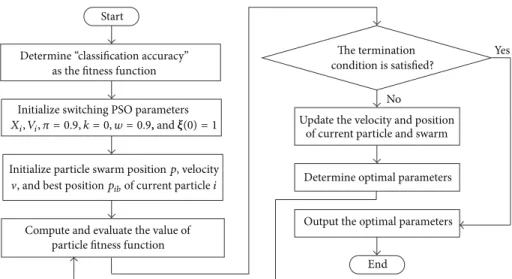
Finally, the flowchart of using the SPSO algorithm to
optimize the parameters of SVM is presented in Figure1.
4. An Illustrative Example
In this section, we apply the hybrid SPSO and SVM algorithm in the bankruptcy prediction problem. The experiment data sets are originally from the UCI Machine Learning
Repos-itory donated on February 9, 2014, with URLhttp://archive.ics
.uci.edu/ml/datasets.html. The data sets consist of 143 non-bankruptcy samples and 107 non-bankruptcy samples; that is, we totally have 250 sample data sets. Each sample data set, especially, includes 6 attributes corresponding to the qualitative parameters in the bankruptcy problem. Each
attribute contains three parameters, which are𝑃 =Positive,
𝐴 =Average, and𝑁 =Negative, respectively. There are only
two prediction results for the bankruptcy problem, which are
𝐵 =Bankruptcy and NB=Nonbankruptcy.
The SPSO algorithm is implemented in Matlab
environ-ment, and the LIBSVM [18] library is exploited for the SVM
classifier. Firstly, the parameters “𝑃,” “𝐴,” and “𝑁” are denoted
by 1, 0, and−1, respectively. Secondly, the parameters “NB”
and “𝐵” are denoted by 1 and 2, respectively, which represent
the prediction results of SVM belonging to the first class and the second class, respectively. At the same time, a uniformly distributed random noise was added to the sample data sets in order to represent the different weights when experts are predicting the bankruptcy. Finally, from 1 to 71 sample data sets of nonbankruptcy and from 144 to 196 sample data sets of bankruptcy are selected as training data sets for the SVM.
Start
The termination
End Initialize switching PSO parameters
condition is satisfied?
as the fitness function Determine “classification accuracy”
Initialize particle swarm positionp, velocity
Compute and evaluate the value of particle fitness function
Update the velocity and position of current particle and swarm
No
Output the optimal parameters Determine optimal parameters
Yes
, and best positionpibof current particlei
Xi, Vi, 𝜋 = 0.9, k = 0, w = 0.9,, and𝜉(0) = 1𝜉
Figure 1: The flowchart of optimizing the parameters of SVM by the SPSO algorithm.
0 20 40 60 80 100 120 140 1 1.1 1.2 1.3 1.4 1.5 1.6 1.7 1.8 1.9 2 Testing samples Classifica tio n la b el
The actual test set classification Predictive test set classification
Figure 2: The classification result of the SVM model.
We use the 10-fold cross validation, especially, to find out the optimal parameter values of the kernel function.
The classification results of the SVM model and the proposed hybrid SPSO and SVM model are shown in Figures
2and6, respectively. Therefore, for the 126 testing samples,
we can see from Figure2that the basic SVM model where
the parameters are set according to experience can only predict 72 testing samples; the average prediction accuracy
is 57.1429%. However, it can be seen from Figure6that the
optimized SVM model can predict 125 testing samples; the average prediction accuracy reached 99.2063%. On the other hand, the fitness curves of SVM models optimized by GA,
PSO, and the SPSO algorithm are shown in Figures 3–5,
respectively. It is observed from Figures3–5that the GA-SVM
algorithm has better prediction accuracy than the PSO-SVM method; however, the GA-SVM algorithm takes more time. In particular, we can also see from these figures that the
0 50 100 150 200 91 92 93 94 95 96 97 98 99 100 Evolution of iteration Fi tnes s Best fitness Average fitness
Figure 3: The fitness curve of searching for the best parameters by the GA method.
presented hybrid SPSO and SVM method outperformed the other three methods when the time and the prediction accuracy are considered simultaneously.
In order to further evaluate the performance of the proposed method in a quantitative way, let us calculate the prediction accuracy and the time of simulation for the above
4 different SVM models. The results are shown in Table 1.
Compared with SVM, GA-SVM, and PSO-SVM methods, the experimental results show the superiority of the proposed method, which can largely improve the explanatory power and the stability of the SVM.
5. Conclusions
In this paper, we have presented a hybrid SPSO and SVM algorithm for the bankruptcy prediction problem. Note that
0 50 100 150 200 92 93 94 95 96 97 98 99 100 Evolution of iteration Fi tnes s Best fitness Average fitness
Figure 4: The fitness curve of searching for the best parameters by the PSO method.
0 50 100 150 200 93 94 95 96 97 98 99 100 Evolution of iteration Fi tnes s Best fitness Average fitness
Figure 5: The fitness curve of searching for the best parameters by the SPSO method.
Table 1: Performance comparison.
Model name 𝑐 𝛾 Prediction
accuracy (%) Time (s)
SVM 2.0 1.0 57.1429 2.144917
GA-SVM 1.62601 0.348282 98.4127 220.315372
PSO-SVM 0.676155 0.430108 94.4127 85.521112
SPSO-SVM 1.85627 0.939559 99.2063 74.847488
the bankruptcy prediction problem is a critical issue in the accounting and finance field. In particular, a recently devel-oped SPSO algorithm is exploited to optimize the optimal
0 20 40 60 80 100 120 140 1 1.1 1.2 1.3 1.4 1.5 1.6 1.7 1.8 1.9 2 Testing samples Classifica tio n la b el
The actual test set classification Predictive test set classification
Figure 6: The classification result of the hybrid SPSO and SVM model.
parameter values of RBF kernel of the SVM. Compared with SVM, GA-SVM, and PSO-SVM methods, the experimental results show the superiority of the proposed method, which can largely improve the explanatory power and the stability of the SVM. Finally, the proposed algorithm is success-fully applied in the bankruptcy prediction model based on the data sets which are originally from the UCI Machine Learning Repository. This can provide a new method for the bankruptcy prediction. Future research directions would include the application of the developed hybrid SPSO and
SVM algorithm in the filtering and control problems [19–33].
Conflict of Interests
The authors declare that there is no conflict of interests regarding the publication of this paper.
Acknowledgments
This work was supported in part by the National Natu-ral Science Foundation of China under Grants 61422301, 61374127, and 61104041, the Natural Science Foundation of Heilongjiang Province of China under Grant F201428, the Scientific and Technology Research Foundation of Hei-longjiang Education Department under Grants 12541061 and 12541592, the 12th Five-Year-Plan in Key Science and Technology Research of agricultural bureau in Heilongjiang province of China under Grant HNK125B-04-03, the Doc-toral Scientific Research Foundation of Heilongjiang Bayi Agricultural University under Grant XDB2014-12, the Foun-dation for Studying Abroad of Heilongjiang Bayi Agricul-tural University, the NaAgricul-tural Science Foundation for Dis-tinguished Young Scholars of Heilongjiang Province under Grant JC2015016, Jiangsu Provincial Key Laboratory of E-business, Nanjing University of Finance and Economics,
under Grant JSEB201301, and the Major Program of Fujian under Grant 2012I01010428.
References
[1] E. I. Altman, “Financial ratios, discriminant analysis and the
prediction of corporate bankruptcy,”The Journal of Finance, vol.
23, no. 4, pp. 589–609, 1968.
[2] M. Zmijewski, “Methodological issues related to the estimation
of financial distress prediction models,”Journal of Accounting
Research, vol. 22, pp. 59–82, 1982.
[3] R. L. Wilson and R. Sharda, “Bankruptcy prediction using
neural networks,”Decision Support Systems, vol. 11, no. 5, pp.
545–557, 1994.
[4] C.-F. Tsai and J.-W. Wu, “Using neural network ensembles for
bankruptcy prediction and credit scoring,”Expert Systems with
Applications, vol. 34, no. 4, pp. 2639–2649, 2008.
[5] K.-S. Shin and Y.-J. Lee, “A genetic algorithm application in
bankruptcy prediction modeling,”Expert Systems with
Applica-tions, vol. 23, no. 3, pp. 321–328, 2002.
[6] B. Back, T. Laitinen, and K. Sere, “Neural networks and genetic
algorithms for bankruptcy predictions,”Expert Systems with
Applications, vol. 11, no. 4, pp. 407–413, 1996.
[7] D. L. Olson, D. Delen, and Y. Meng, “Comparative analysis
of data mining methods for bankruptcy prediction,”Decision
Support Systems, vol. 52, no. 2, pp. 464–473, 2012.
[8] J. H. Min and Y.-C. Lee, “Bankruptcy prediction using support vector machine with optimal choice of kernel function
param-eters,”Expert Systems with Applications, vol. 28, no. 4, pp. 603–
614, 2005.
[9] F. Melgani and Y. Bazi, “Classification of electrocardiogram signals with support vector machines and particle swarm
optimization,”IEEE Transactions on Information Technology in
Biomedicine, vol. 12, no. 5, pp. 667–677, 2008.
[10] J. Kennedy and R. Eberhart, “Particle swarm optimization,” inProceedings of the IEEE International Conference on Neural Network, pp. 1942–1948, Perth, Australia, 1995.
[11] N. Zeng, Z. Wang, Y. Li, M. Du, and X. Liu, “A hybrid EKF and switching PSO algorithm for joint state and parameter
estimation of lateral flow immunoassay models,” IEEE/ACM
Transactions on Computational Biology and Bioinformatics, vol. 9, no. 2, pp. 321–329, 2012.
[12] Y. Tang, Z. Wang, and J.-A. Fang, “Parameters identification of unknown delayed genetic regulatory networks by a switching
particle swarm optimization algorithm,”Expert Systems with
Applications, vol. 38, no. 3, pp. 2523–2535, 2011.
[13] A. Asuncion and D. Newman, “UCI machine learning reposi-tory [EB/OL],” 2014,http://archive.ics.uci.edu/ml/datasets.html.
[14] V. N. Vapnik,The Nature of Statistical Learning Theory, Springer,
New York, NY, USA, 1995.
[15] C. J. C. Burges, “A tutorial on support vector machines for
pat-tern recognition,”Data Mining and Knowledge Discovery, vol.
2, no. 2, pp. 121–167, 1998.
[16] J. Shawe-Taylor and N. Cristianini,Kernel Methods for Pattern
Analysis, Cambridge University Press, Cambridge, UK, 2004. [17] N. Zeng, Y. S. Hung, Y. Li, and M. Du, “A novel switching
local evolutionary PSO for quantitative analysis of lateral flow
immunoassay,”Expert Systems with Applications, vol. 41, no. 4,
pp. 1708–1715, 2014.
[18] C.-C. Chang and C.-J. Lin, “LIBSVM: a library for support
vector machines,”ACM Transactions on Intelligent Systems and
Technology, vol. 2, no. 3, article 27, 2011.
[19] Z. Wang, H. Dong, B. Shen, and H. Gao, “Finite-horizon𝐻∞
filtering with missing measurements and quantization effects,”
IEEE Transactions on Automatic Control, vol. 58, no. 7, pp. 1707– 1718, 2013.
[20] Z. Wang, D. Ding, H. Dong, and H. Shu, “𝐻∞consensus control
for multi-agent systems with missing measurements: the
finite-horizon case,”Systems & Control Letters, vol. 62, no. 10, pp. 827–
836, 2013.
[21] H. Dong, Z. Wang, S. X. Ding, and H. Gao, “Finite-horizon estimation of randomly occurring faults for a class of nonlinear
time-varying systems,”Automatica, vol. 50, no. 12, pp. 3182–
3189, 2014.
[22] X. He, Z. Wang, X. Wang, and D. H. Zhou, “Networked strong tracking filtering with multiple packet dropouts: algorithms and
applications,”IEEE Transactions on Industrial Electronics, vol.
61, no. 3, pp. 1454–1463, 2014.
[23] G. Wei, F. Han, L. Wang, and Y. Song, “Reliable𝐻∞ filtering
for discrete piecewise linear systems with infinite distributed
delays,”International Journal of General Systems, vol. 43, no. 3-4,
pp. 346–358, 2014.
[24] Q. Liu, Z. Wang, X. He, and D. H. Zhou, “A survey of
event-based strategies on control and estimation,”Systems Science and
Control Engineering, vol. 2, no. 1, pp. 90–97, 2014.
[25] H. Dong, Z. Wang, J. Lam, and H. Gao, “Distributed filtering in sensor networks with randomly occurring saturations and
successive packet dropouts,”International Journal of Robust and
Nonlinear Control, vol. 24, no. 12, pp. 1743–1759, 2014.
[26] L. Qin, X. He, and D. Zhou, “A survey of fault diagnosis for
swarm systems,”Systems Science & Control Engineering, vol. 2,
no. 1, pp. 13–23, 2014.
[27] H. Dong, S. X. Ding, and W. Ren, “Distributed filtering with randomly occurring uncertainties over sensor networks: the
channel fading case,”International Journal of General Systems,
vol. 43, no. 3-4, pp. 254–266, 2014.
[28] L. Wang, G. Wei, and W. Li, “Probability-dependent 𝐻∞
synchronization control for dynamical networks with randomly
varying nonlinearities,”Neurocomputing, vol. 133, pp. 369–376,
2014.
[29] S. Zhang, Z. Wang, D. Ding, and H. Shu, “Fuzzy filtering with randomly occurring parameter uncertainties, interval delays,
and channel fadings,”IEEE Transactions on Cybernetics, vol. 44,
no. 3, pp. 406–417, 2014.
[30] S. Zhang, Z. Wang, D. Ding, and H. Shu, “𝐻∞fuzzy control with
randomly occurring infinite distributed delays and channel
fadings,”IEEE Transactions on Fuzzy Systems, vol. 22, no. 1, pp.
189–200, 2014.
[31] G. L. Wei, L. C. Wang, and F. Han, “A gain-scheduled approach to fault-tolerant control for discrete-time stochastic delayed
systems with randomly occurring actuator faults,” Systems
Science & Control Engineering, vol. 1, no. 1, pp. 82–90, 2013. [32] J. Hu, Z. Wang, B. Shen, and H. Gao, “Quantised recursive
filtering for a class of nonlinear systems with multiplicative
noises and missing measurements,” International Journal of
Control, vol. 86, no. 4, pp. 650–663, 2013.
[33] J. Hu, D. Chen, and J. Du, “State estimation for a class of discrete nonlinear systems with randomly occurring uncertainties and
distributed sensor delays,” International Journal of General
Submit your manuscripts at
http://www.hindawi.com
Hindawi Publishing Corporation
http://www.hindawi.com Volume 2014
Mathematics
Journal ofHindawi Publishing Corporation
http://www.hindawi.com Volume 2014 Mathematical Problems in Engineering
Hindawi Publishing Corporation http://www.hindawi.com
Differential Equations
International Journal of
Volume 2014
Hindawi Publishing Corporation
http://www.hindawi.com Volume 2014 Hindawi Publishing Corporationhttp://www.hindawi.com Volume 2014
Hindawi Publishing Corporation
http://www.hindawi.com Volume 2014
Mathematical PhysicsAdvances in
Complex Analysis
Journal ofHindawi Publishing Corporation
http://www.hindawi.com Volume 2014
Optimization
Journal ofHindawi Publishing Corporation
http://www.hindawi.com Volume 2014
Combinatorics
Hindawi Publishing Corporation
http://www.hindawi.com Volume 2014 International Journal of Hindawi Publishing Corporation
http://www.hindawi.com Volume 2014
Journal of
Hindawi Publishing Corporation
http://www.hindawi.com Volume 2014
Function Spaces
Abstract and Applied Analysis Hindawi Publishing Corporation
http://www.hindawi.com Volume 2014 International Journal of Mathematics and Mathematical Sciences
Hindawi Publishing Corporation http://www.hindawi.com Volume 2014
The Scientific
World Journal
Hindawi Publishing Corporation
http://www.hindawi.com Volume 2014
Hindawi Publishing Corporation
http://www.hindawi.com Volume 2014
Discrete Dynamics in Nature and Society
Hindawi Publishing Corporation
http://www.hindawi.com Volume 2014
Hindawi Publishing Corporation
http://www.hindawi.com Volume 2014
Discrete Mathematics
Journal ofHindawi Publishing Corporation
http://www.hindawi.com Volume 2014 Hindawi Publishing Corporationhttp://www.hindawi.com Volume 2014