Efficient Implementation of Bi-directional Path Tracer on GPU
Bc. Vil´em Otte
∗Supervised by: RNDr. Marek Vinkler Ph.D.
†Faculty of Informatics
Masaryk University
Brno / Czech Republic
Abstract
Most of the implementations solving photo-realistic image rendering use standard unidirectional path tracing, hav-ing fast and accurate results for scenes without caustics or hard cases. These hard cases are usually solved by a bidirectional path tracing algorithm. However, due to the complexity of the bidirectional path tracing algorithms, its implementations almost exclusively target sequential CPUs. The following paper proposes a new parallel im-plementation of the bi-directional path tracing algorithm for the GPUs. Our approach is compared with existing so-lutions in terms of both performance and image quality. As the references we use the standard unidirectional GPU path tracer and commercial off-line bidirectional path trac-ers. We achieve interactive rendering rates for scenes of medium complexity.
Keywords: bidirectional path tracing, path tracing, phys-ically based rendering, ray tracing, CUDA
1
Introduction
Global illumination research recently focuses on unbiased methods. Unbiased method is such method, that under some assumptions, converges to the solution of the ren-dering equation.
One of the common techniques for rendering unbiased images is path tracing, respectively the extension of path tracing - bidirectional path tracing. These techniques are well known for high quality rendering output. Formerly, most of the path tracing and bidirectional path tracing implementations were done on the CPU. However, these techniques are well fit for massively parallel hardware, like the recent generations of graphics hardware.
Even though there are already present implementations of bidirectional path tracing on the graphics hardware, most of the implementations are either using the graphics hardware only for small part of the computation or they do not contain any surface shading at all.
The presented work focuses mainly on the implementa-tion of a full featured bidirecimplementa-tional path tracing renderer,
allowing for advanced materials, including textures and computing the entire image using the graphics hardware. The contributions of this paper are the following:
• Design and implementation of three variants of bidi-rectional pathtracing on the GPU.
• Comparison of their speed and quality to the ground truth path tracing solution.
• Comparison to other GPU based renderers.
2
Related Work
In this section we summarize literature most relevant to bidirectional path tracing - various approaches to global illumination focused on parallel GPU algorithms.
2.1
Ray Casting
The core of almost every global illumination technique is ray casting, which allows for finding closest ray-primitive intersection point along each ray and also to test visibility between two points. This visibility computation is the key to the evaluation of light transport. The focus of research on ray casting are following three issues: selection of ac-celeration structure, their construction and their traversal.
High performance and well established ray casting solu-tions are available for public, including NVidia OptiX [11] targeting NVidia hardware (which is actually full ray trac-ing engine), Intel Embree [15] targettrac-ing traditional SIMD-based CPU architectures. Our implementation is SIMD-based on the open source framework by Aila et al. [1, 2].
2.2
Early Global Illumination
Whitted [14] used ray-casting for generation of photo re-alistic images, allowing for recursive specular reflections and refractions. Later Cook extended ray tracing to dis-tributed ray tracing to allow for effects such as diffuse in-terreflection [3]. The rendering equation was introduced in 1986 by Immel et al. [5] and Kajiya [7].
The rendering equation describes light transport in the scene. Light transport describes the energy transfers in a given scene that affects visibility.
2.3
Path Tracing and Bidirectional Path
Trac-ing
Path tracing algorithm allows for computing the solution of the rendering equation. By computing the paths of light from the camera into the scene (eventually reaching light source), it closely resembles the behavior of light. The path starts with primary ray at the camera and is traced into the scene. Upon intersection, in continues in random direction.
For further efficiency, at each vertex of the path it is determined whether path should be terminated or not by Russian roulette, thus preventing infinite path lengths. It allows for physically based computation of lighting, and so the synthesis of photo realistic images. The algorithm is also unbiased, with theoretically absolute accuracy when using infinite number of samples.
Bidirectional path tracing is further extension of path tracing algorithm, introduced by Veach [12]. By gener-ating one sub path from a light source and one sub path from the camera, later joining them together, it is possible to handle indirect lighting computation more robustly (and efficiently) compared to ordinary path tracing. Further-more, this modification still keeps the resulting algorithm physically based and unbiased.
2.4
Other Global Illumination Methods
Lately a lot of fast algorithms for computation of global il-lumination were introduced. Most of the algorithms were, compared to path tracing, biased, providing a trade off be-tween rendering quality and speed.
Recent interactive global illumination methods are modifications of Virtual Point Lights, introduced by Keller et al. [9], allowing for real time smooth global illumina-tion [10]
One of the other popular global illumination techniques, used in real time rendering, are Cascaded Light Propaga-tion Volumes [8].
Photon mapping introduced by Jensen [6], is currently popular in production renderers, especially for interior rendering. The technique was further extended into pro-gressive photon mapping [4]. Compared to standard pho-ton mapping, which is a biased rendering algorithm, pro-gressive photon mapping is an unbiased one.
3
Bidirectional Path Tracing
This section presents some improvements when using bidirectional path tracing. For proper description of these features it is critical to define some terms.
Naive Path Tracing This designation is used for path
tracers that does not do any explicit steps, but wait for camera ray to actually hit light (or get terminated).
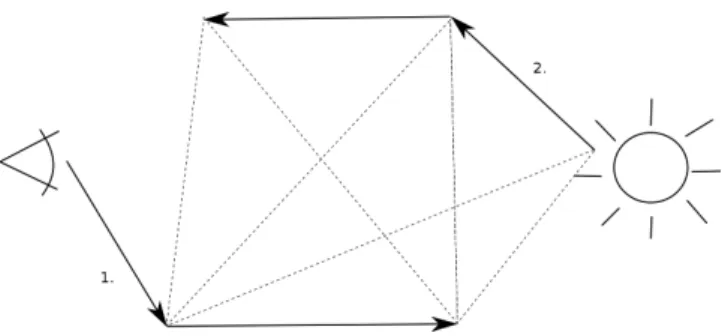
Figure 1: All possible connections between a light path and camera path. 1. Represents camera path, 2. Repre-sents light path, Dashed lines represent possible connec-tions between light path and camera path.
Standard (Explicit) Path Tracing Due to very bad
con-vergence ratio using naive path tracing, it is often under-stood that generic path tracing algorithm does single ex-plicit step towards light on each vertex of the path. These path tracers are to be designated as standard, or explicit, path tracers.
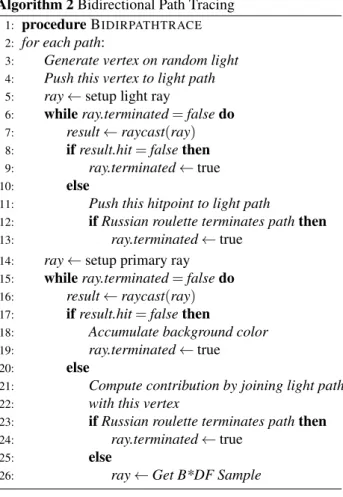
For the sake of completeness, pseudo algorithms for standard path tracing (see Algorithm 1) and bidirectional path tracing (see Algorithm 2) are provided.
Bidirectional path tracing, computes two paths, one from the light and another one from the camera. These paths are later connected (see Figure 1). These connec-tions attempt to solve several problems introduced by uni-directional path tracers:
Small light sources For naive path tracers, the probabil-ity of hitting a light source is proportional to its size. Hav-ing point lights (lights that are infinitely small) in naive path tracer often ends up with nothing visible in rendered image, as the probability of hitting the light source reaches zero.
This can be solved by sampling light in explicit man-ner each step in path computation, resulting in very fast convergence for directly lit scenes. While sometimes this technique is referred as explicit path tracing, it actually is a special case of bidirectional path tracing, where the light path contains only a single vertex.
The visibility function between each camera path vertex and light path vertex has to be computed, resulting in 2·N
cast rays for camera path length ofN.
For bidirectional path tracing, even more complex paths from the light can be easily evaluated, e.g. light hidden inside a lamp.
Interior scenes lit by exterior light Assuming we are
inside a room, where there is only a single window, stan-dard, or even explicit, path tracers are not going to con-verge very quickly because the probability of sampling the light is low. In fact, in case where no path vertex on cam-era path lies in direct light, the contribution of that path is
Figure 2: Difference between path tracer and bidirectional path tracer when computing caustics. On the left side, the fireflies generated by standard path tracer compared to more smooth caustics generated by the bidirectional path tracer on the right side.
zero. This is one of the so called ’pathological scenarios’ for path tracing, where the algorithm fails to provide result fast enough.
Using a bidirectional path tracer with light path of length M, it is enough that single point of the light path is directly visible from any of the camera path vertices. If this condition is true, that paths’ contribution will be non-zero, resulting in faster convergence.
Caustics convergence Using a unidirectional path
tracer often results in poor caustics and fireflies in the re-sulting image, as their convergence rate is by magnitudes worse to convergence rate of diffuse light. Computing caustics with bidirectional path tracer is faster (see Fig-ure 2), yet there are still difficulties with reflected caustics. Bidirectional path tracer can be, however, further extended with Metropolis Light Transport [13], improving the per-formance on reflected caustics.
Algorithm 1Path Tracing 1: procedurePATHTRACE 2: for each path:
3: ray←setup primary ray 4: whileray.terminated=falsedo 5: result←raycast(ray)
6: ifresult.hit=falsethen
7: Accumulate background color
8: ray.terminated←true 9: else
10: Compute and Accumulate surface emission
11: Compute contribution of random light
12: ifContribution is non zerothen 13: Accumulate contribution
14: ifRussian roulette terminates paththen 15: ray.terminated←true
16: else
17: ray←Get B*DF Sample
Algorithm 2Bidirectional Path Tracing 1: procedureBIDIRPATHTRACE 2: for each path:
3: Generate vertex on random light
4: Push this vertex to light path
5: ray←setup light ray
6: whileray.terminated=falsedo 7: result←raycast(ray)
8: ifresult.hit=falsethen 9: ray.terminated←true 10: else
11: Push this hitpoint to light path
12: ifRussian roulette terminates paththen 13: ray.terminated←true
14: ray←setup primary ray 15: whileray.terminated=falsedo 16: result←raycast(ray)
17: ifresult.hit=falsethen
18: Accumulate background color
19: ray.terminated←true 20: else
21: Compute contribution by joining light path
22: with this vertex
23: ifRussian roulette terminates paththen 24: ray.terminated←true
25: else
26: ray←Get B*DF Sample
3.1
Parallel Bidirectional Path Tracing using
GPU
Computation of different samples, (sub)paths in terms of path tracing, and different pixels is independent on each other. Path tracing and also bidirectional path tracing are therefore good candidates for massively parallel computa-tion.
The resulting parallel algorithm looks similar to sequen-tial version. The parallel run is performed over the pixels, with each sample is computed by a single thread in a single kernel launch.
4
Implementation
The bidirectional ray tracing kernels were implemented on top of open source framework by Aila. For this pur-pose, new rendering kernels for each variant of bidirec-tional path tracer were added.
To achieve high performance of the source code, the speculative while-while traversals were used. As oppos-ing to persistent threads they perform, in general, better on new hardware. Also, bounding volume hierarchy with spatial splits was used as acceleration structure for the ren-dering.
The Aila framework was further extended to support high resolution textures, reflective, refractive and
dielec-tric materials. Light sources are handled as geometry with emissive material, so in general any number of light sources is supported.
The bidirectional path tracer kernel always processes one pixel in single walk through, e.g. the light path gen-eration (storing required data), followed by computation of the camera path. During each step of the camera path computation the join for currently processed vertex is per-formed when necessary.
5
Optimizations and Limitations
The following section describes possible optimizations and limitations when implementing bidirectional path tracer on the GPU. For each optimization a brief summary is given.
5.1
Sub path join
Full join
Joining of the light sub path of lengthMand the camera sub path of lengthN is a non trivial task. There are mul-tiple ways to join these, the intuitive solution is joining each vertex from light sub path to each vertex in camera sub path. While this actually leads to faster convergence,
N·M rays have to be used to compute the visibility be-tween samples, which is slow. Moreover, the full light path has to be stored in the memory, and so larger memory space is required.
Single-step join
Performance wise, the most efficient idea is joining the last camera sub path vertex and the last light sub path ver-tex. Such approach has some advantages. Single path computation is of the same performance as naive path trac-ing, although improving the situations where naive path tracing has major problems. However, by combining only the ends of both paths contributions of these light paths are very small.
K-step join
It is also possible to select an approach using random-ized algorithm. For each of the N·M joining rays, the algorithm discards some of these joins. The actual join-ing ray rejection can be built upon multiple criteria - either fully random, or deterministic (removing less contributing joins and accordingly weighting the rest). This join is to be designated as K-step join. The join is performed by taking each vertex from camera againstkvertices from the light path. Thekvalue has to be smaller than the number of vertices in the light path.
When implemented properly, the different sub path joins do not break the unbiased property of the algorithm.
5.2
Path pre-generation
Given a static scene, all the light paths can actually be pre-computed. Later, during the execution of the algorithm, we only select one of the light paths from givenM pre-computed light paths.
While this approach is highly efficient, it often means that the resulting algorithm is biased. This can be over-come by re-generating these light paths on runtime. Once we start joining samples to random pre-generated paths, it is possible that some samples are to be joined with a single light path. This could lead to unnatural patterns in result-ing image, and of course breakresult-ing unbiased nature of the algorithm. By re-generating the paths after they have been used, it is possible to avoid this problem.
Unless largeMis selected, the quality of resulting im-age can be highly degraded. To keep the quality of the resulting image high enough, it was experimentally eval-uated that the number of light paths must be at least the same as the number of pixels in the resulting image.
5.3
Biasing
Biasing the algorithm does not have much sense for simu-lations. Although, for performance heavy applications, in case where we have limited time for calculating an image, for example in games, it is possible to trade off quality for speed.
During the implementation, two of the biasing tech-niques were considered.
Limiting maximum camera path length Generally, the
camera path length can be very long (assuming it doesn’t directly hit the light), until Russian Roulette finally termi-nates the path.
By limiting the length of camera path to some value it is possible to increase performance. First of all, longer paths generally tend to have smaller contribution, by end-ing them at some given maximum length we terminate them early, effectively reducing the number of computa-tions they need to do.
Also, from the GPU perspective, we are always waiting for the longest path to finish the computation, in the worst situation, whole warp is waiting for single thread to finish a very long path. By bounding the maximum length, we effectively reduce this issue and increase the computation performance.
On the other hand, the unbiased nature of the algo-rithm is lost, by limiting the maximum path length we are effectively limiting the maximum number of reflec-tions/refractions, which may cause visible problems in im-ages (for example, missing reflection).
Random Number Generation As each Monte-Carlo
technique, path tracing and bidirectional path tracing, heavily depend on random number generation. Having a
random number generator with large period means, that resulting image will converge closely to the ground truth.
Each Monte-Carlo technique spends some amount of time in random number generator. If the application tar-gets performance instead of precision, it is possible to pre-generate random numbers into an array and use those later. Doing so introduces a limit at which the image is not able to converge more towards the ground truth (as all the samples were already taken).
It is important to note that the results taken using the implementation were recorded with unbiased version of the algorithms. The biased version is between 2 and 3 times faster compared to unbiased version.
6
Results
6.1
Evaluation and Analysis
Results of the implementation were evaluated on low-end laptop GPU NVidia GeForce 720M, with 1.5 GB mem-ory. The system was running under Windows 8.1 OS, with CUDA 5.5 installed. Kernels were compiled with com-pute capability 2.0. The light paths were generated on the runtime.
A low end GPU was used to demonstrate, that even cur-rent generation laptop based GPUs are capable of interac-tive rendering of moderately complex scenes.
The rendered images were taken each 5 seconds, while the used algorithm was running progressively. Results pre-sented in this section show the difference in quality be-tween the specific implementations. The resulting images are also compared to ground truth using the root mean square error (further RMSE, lower is better).
The first set of comparisons is between path tracing and bidirectional path tracing. Followed by comparison against other GPU based Monte-Carlo rendering systems. The single-step join does need to keep just a single (last) vertex of the light path. K-step join needs to keep K ver-tices of the light path in the memory during the compu-tation, while full join needs to keep all the vertices in the light path. While single-step join and K-step join have constant memory footprint, the full join footprint grows with the length of the light path.
6.2
Bidirectional vs. Unidirectional
Cornell Box
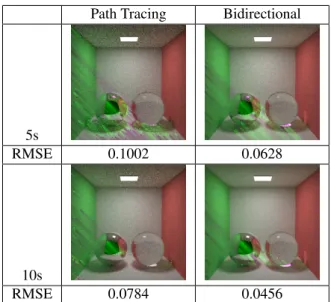
We ran two algorithms on the following scene, bidirec-tional path tracing (with full path join) and standard path tracing. Both of the resulting images are compared to the ground truth. The sample images were taken after 5 sec-onds and after 10 secsec-onds. (see Table 1)
From the given comparison, it can be stated that bidirec-tional path tracing with full path joining converges faster
Path Tracing Bidirectional
5s
RMSE 0.1002 0.0628
10s
RMSE 0.0784 0.0456
Table 1: comparison between Path Tracing and Bidirec-tional Path Tracing with full path join.
compared to standard path tracing. This is especially the case for caustics.
Crytek Sponza
The following scene shows complex materials, like tex-tured, alpha-tested, reflective and refractive surfaces, lit by an area light source.
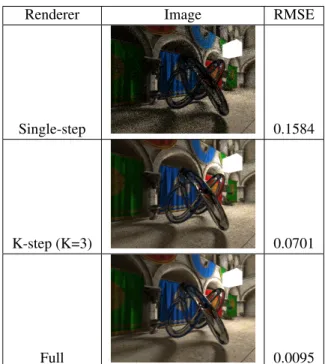
All three different bidirectional kernels were run on this scene, and the results show how the scene looked after 5 seconds of processing. All the results are compared to the ground truth in terms of RMSE (see Table 2).
We observed the same behavior in all of our measure-ments, full path join results in best image quality and fastest speed. This shows, that the algorithm is not bound by memory performance, in which case K-step join or sin-gle step join would result in higher performance and thus quality on a fixed budget.
Caustics Test
We also ran three different bidirectional kernels, as well as standard path tracing method, on a scene with a caus-tic. The results show how the scene looked after 5 and 10 seconds of processing (see Table 3).
The full path join also results in the highest quality caus-tics, that are almost perfectly smooth after ten seconds of computation.
6.3
Other GPU rendering packages
iRay
NVidia iRay is a physically based renderer highly scal-able in performance across GPUs and CPUs. We rendered the Crytek Sponza scene using our bidirectional path trac-ing renderer and the iRay from a similar viewpoint (see Table 4).
Renderer Image RMSE
Single-step 0.1584
K-step (K=3) 0.0701
Full 0.0095
Table 2: Equal-time comparison between three different implementations of bidirectional path tracing and their dis-tance to ground truth in terms of RMSE.
Renderer 5s 10s
Single-step
K-step (K=3)
Full
Table 3: Comparison of a caustic scene with three dif-ferent implementations of bidirectional path tracing. The contrast was intentionally enhanced so it is possible to see the difference in sampling inside caustics casted by a glass sphere. Single step join has very slow convergence and so the resulting image is darker compared to the others.
NVidia iRay Bidirectional
5s
10s
Table 4: Comparison between iRay and our bidirectional path tracing implementation. The brightness/contrast dif-ference is caused by different handling of output between both implementations.
Again we target images generated after 5 and 10 sec-onds, which shows the quality achievable using an inter-active preview on low end graphics card.
The resulting images are untextured, as there is not a full support for textured surfaces in iRay, and the scene was lit using single directional light. This setting also al-lows for an easier comparison of the quality of the global illumination without the masking effect of the textures.
The technique iRay uses is actually standard path trac-ing, in comparison it is clearly visible that our Bidirec-tional technique produces smoother results for a similar time budget.
LuxRender
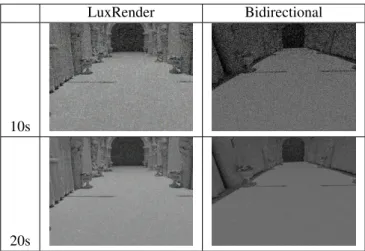
LuxRender is a physically based and unbiased render-ing engine. The LuxRender package was used through Blender software, possibly limiting some options leading to slightly decreased quality (see Table 5).
LuxRender uses a technique called LuxRays to produce the image, it is an unbiased technique similar to bidirec-tional path tracing. The implemented bidirecbidirec-tional solu-tion might seem to converge better, although it is important to state, that LuxRender is a very large package supporting complex material setup (along with subsurface scattering effects for example), while the implemented solution does not.
LuxRender Bidirectional
10s
20s
Table 5: Comparison between LuxRenderer and our bidirectional path tracing implementation. The bright-ness/contrast difference is caused by different handling of output between both implementations.
7
Summary
Path tracing, in general, excels in exterior scenes or when there are large light sources. Bidirectional path trac-ing is an extension that allows for faster computation of more complex situations, like interior scenes or small light sources.
The created GPU-based implementation showed, that bidirectional path tracing is also suitable for massively parallel implementation. The results confirmed, that con-vergence rates are in general better for bidirectional path tracer, which effectively reduces computation time.
Full path joining proved to lead to the highest quality global illumination, although keeping large memory foot-print. However, on modern GPU architectures, the mem-ory footprint required by full path joining is bearable.
K-path join proved to be an interesting alternative to full path join. Even though the full path join actually results in better convergence rates, it is possible to alter the number of joins for K-join on the fly. This can be used to achieve a constant refresh rate when running the algorithm in pro-gressive mode. Such approach can be interesting for inter-active preview of rendered scene.
References
[1] Timo Aila and Samuli Laine. Understanding the ef-ficiency of ray traversal on gpus. In Proceedings of the Conference on High Performance Graphics 2009, HPG ’09, pages 145–149, New York, NY, USA, 2009. ACM.
[2] Timo Aila, Samuli Laine, and Tero Karras. Under-standing the efficiency of ray traversal on GPUs – Kepler and Fermi addendum. NVIDIA Technical
Report NVR-2012-02, NVIDIA Corporation, June 2012.
[3] Robert L. Cook, Thomas Porter, and Loren Carpen-ter. Distributed ray tracing. InProceedings of the 11th Annual Conference on Computer Graphics and Interactive Techniques, SIGGRAPH ’84, pages 137– 145, New York, NY, USA, 1984. ACM.
[4] Toshiya Hachisuka, Shinji Ogaki, and Henrik Wann Jensen. Progressive photon mapping. ACM Trans. Graph., 27(5):130:1–130:8, December 2008.
[5] David S. Immel, Michael F. Cohen, and Donald P. Greenberg. A radiosity method for non-diffuse envi-ronments. SIGGRAPH Comput. Graph., 20(4):133– 142, August 1986.
[6] Henrik Wann Jensen. Global illumination using pho-ton maps. InProceedings of the Eurographics Work-shop on Rendering Techniques ’96, pages 21–30, London, UK, UK, 1996. Springer-Verlag.
[7] James T. Kajiya. The rendering equation. In Com-puter Graphics, pages 143–150, 1986.
[8] Anton Kaplanyan and Carsten Dachsbacher. Cas-caded light propagation volumes for real-time indi-rect illumination. InProceedings of the 2010 ACM SIGGRAPH Symposium on Interactive 3D Graphics and Games, I3D ’10, pages 99–107, New York, NY, USA, 2010. ACM.
[9] Alexander Keller. Instant radiosity. In Proceed-ings of the 24th Annual Conference on Computer Graphics and Interactive Techniques, SIGGRAPH ’97, pages 49–56, New York, NY, USA, 1997. ACM Press/Addison-Wesley Publishing Co.
[10] Jaroslav Kˇriv´anek, Iliyan Georgiev, Toshiya Hachisuka, Petr V´evoda, Martin ˇSik, Derek Nowrouzezahrai, and Wojciech Jarosz. Uni-fying points, beams, and paths in volumetric light transport simulation. ACM Trans. Graph., 33(4):103:1–103:13, July 2014.
[11] Steven G. Parker, James Bigler, Andreas Dietrich, Heiko Friedrich, Jared Hoberock, David Luebke, David McAllister, Morgan McGuire, Keith Morley, Austin Robison, and Martin Stich. Optix: A gen-eral purpose ray tracing engine.ACM Trans. Graph., 29(4):66:1–66:13, July 2010.
[12] Eric Veach. Robust Monte Carlo Methods for Light Transport Simulation. PhD thesis, Stanford, CA, USA, 1998. AAI9837162.
[13] Eric Veach and Leonidas J. Guibas. Metropolis light transport. InProceedings of the 24th Annual Con-ference on Computer Graphics and Interactive Tech-niques, SIGGRAPH ’97, pages 65–76, New York,
NY, USA, 1997. ACM Press/Addison-Wesley Pub-lishing Co.
[14] Turner Whitted. An improved illumination model for shaded display. Commun. ACM, 23(6):343–349, June 1980.
[15] Sven Woop, Louis Feng, Ingo Wald, and Carsten Benthin. Embree ray tracing kernels for cpus and the xeon phi architecture. InACM SIGGRAPH 2013 Talks, SIGGRAPH ’13, pages 44:1–44:1, New York, NY, USA, 2013. ACM.