A Survey on Virtualization Data Centers For
Green Cloud Computing
C. Saranya1
1
Research Scholar, Department of Computer Science, NGM College, Pollachi, India,
Dr. R. Manicka Chezian2
2
Associate Professor, Department of Computer Science, NGM College, Pollachi, India,
Abstract —Due to trends like Cloud Computing and Green cloud Computing, virtualization technologies are gaining increasing importance. Cloud is a atypical model for computing resources, which intent to computing framework to the network in order to cut down costs of software and hardware resources. Nowadays, power is one of big issue of IDC has huge impacts on society. Researchers are seeking to find solutions to make IDC reduce power consumption. These IDC (Internet Data Center) consume large amounts of energy to process the cloud services, high operational cost, and affecting the lifespan of hardware equipments. The field of Green computing is also becoming more and more important in a world with finite number of energy resources and rising demand. Virtual Machine (VM) mechanism has been broadly applied in data center, including flexibility, reliability, and manageability. The research survey presents about the virtualization IDC in green cloud it contains various key features of the Green cloud, cloud computing, data centers, virtualization, data center with virtualization, power – aware, thermal – aware, network-aware, resource-aware and migration techniques. In this paper the several methods that are utilze to achieve the virtualization in IDC in green cloud computing are discussed.
Key words: Green Cloud Computing, Virtualization, Cloud Computing, Data centers, quality of service, power – aware, thermal – aware, network-aware, resource-aware, migration.
I. INTRODUCTION
Recently, cloud computing Environment has its considerable attention. It is one of the most eye-catching future computing paradigms. It delivers powerful provisioning of various services and delivers the infrastructure, platform, and software as services available to customers in a pay per basis manner [3]. Such an essential commercial service providers are Amazon,
Google, and Microsoft.
Internet Data Center (IDC) is a emerged as a back-bone infrastructure, housing large number of IT equipments such as servers, storage, network, power and cooling devices etc. That expedite the evolvement of broad range of services[1] Presently, several service contributors such as Google, Yahoo, Amazon, Microsoft, IBM and Sun, have their own data centers to facilitate the scalable services to the consumers[2].With the fast development of IT industry and increasing demand, the data centers became large in size. The power consumptions increased by 10 times over the early history of ten years [1].
Green Cloud is an data center architecture which goal is to lower the power consumption in data centers, during at the same time guarantee the performance and leveraging virtual machine (VM) migration. A big issue in Green
Cloud is to consequently make the scheduling decision on
migrating / dynamically consolidating VMs.
Need of green computing in clouds is Modern IDC, under the computing standard m o d e l a r e h o s t i n g a w i d e r a n g e o f a p p l i c a t i o n s .
To address this problem, data center resources need to be managed in an energy efficient behavior [6] to drive Green computing. In particular, Cloud assets share not only to satisfy QoS requirements specified by users via Service Level Agreements (SLA), but also to cut down energy usage. Architecture of a green cloud computing
Fig: 1 presents the architecture helps for energy efficient service in Green Cloud infrastructure [7]. There are essentially four main entities involved:
Fig.1: Architecture of a green cloud computing environment Active Sleeping Green negotiator
……
……
Service analyzer Consumer profile pricing Energy monitor Service scheduler VM manager Accounting Consumer interface Cloud interface Green service allocator Virtual Machine Physical Machines Consumersa) Brokers /Customers: Cloud consumers/brokers submits the service application sends from anyplace in the world.
b) Resource Allocator Role: Acts as the mediator among the Cloud and consumers.
c) Accounting: Preserve the actual usage of resources to compute the costs.
d) VMs: Multiple Virtual Machines runs dynamically started /stopped on a single machine to meet requests.
e) Physical Machines: it provide s hardwar e infrastructure for creating virtualized resources.
The virtualization facilitates atypical model such as personalized virtual environments could be generated upon the physical infrastructure [8]. The use of virtualization techniques provides great flexibility [9].
II. GREEN CLOUD FRAMEWORK
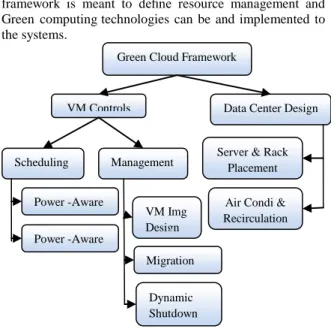
We exposed a typical framework applied to the Cloud c o m p u t i n g in order to reducing the power. This framework is meant to define resource management and Green computing technologies can be and implemented to the systems.
Fig 2: Green Cloud frame-work
Fig 2 illustrates a frame-work for improve the performance. There are two prominent areas, first, we can expand upon the baseline functioning of virtual machines and deriving a more efficient scheduling system for Virtual Machines. Due to the inherent disposability and mobility of VMs within a semi-homogeneous data center, we can leverage the ability to move and manage the VMs to additionally improve efficiency. The Virtual image management attempts to control and manipulate the size and location of VM
IJTET©2015
2.1Green Computing Techniques to Managing Power in Computing System
These techniques can be classified at different levels: 1) Firmware Level & Hardware and
2) Operating System Level 3) Virtualization Level 4) Data Center Level
Fig.3: Power Controlling Techniques in Green Computing
Firmware level & Hardware level techniques that are implemented at the manufacturing point of a machine. These techniques contain all the optimization methods that are applied at the logic, circuit, architecture and system levels. Operating System level techniques include programs at operator level. Virtualization level techniques used the approach of VM to manage power.
D. Data Center Level Techniques-
Data Centers contains a computer system and its telecommunication, data storage systems. It also requires backup power, cooling system and security. It has an efficient management and less power consumed environment. The approaches based on workload consolidation by entering requests for servers or applications, or virtual machines. The goal is to designate request of VM to turn off/sleep. The problem of the allocation is twofold: first its mandatory to allocate new requests; second one is, the performance of existing applications Data Center Level approaches further separated into two parts:-
Non-Virtualized Systems Virtualized Systems
E. Virtualization-
It is the abstraction of physical assets can be separated into a no of logical slices called Virtual Machines.
III. TAXONOMY ON VIRTUALIZED DATA CENTER FOR GREEN CLOUD COMPUTING In this section, we proposed the discussion of this survey paper in the field of virtualization data center and green Cloud.
18
Hardware Level & Firmware Level
Operating system Level
Virtualization Level Datacenter Level Power
Management
Data Center Design VM Controls
Green Cloud Framework
Scheduling Management
Power -Aware
Server & Rack Placement Air Condi & Recirculation Power -Aware VM Img Design Migration Dynamic Shutdown
3.1 Power based Management in IDC
We categorized these diagnostic solutions into four separation in accordance with their different features [20]. The first focus on management of power deals with the tradeoffs between performance and the energy, such as whether transient power budget is allowed/not, with/without additional constraints. The secondly its keep be opportunity and granularity. Some solutions are more effective at the rack or IDC level. The third one is described by the approaches utilized.
Such as distribution scheduling and the VM consolidation. The last type of the solutions is DVFS is turning On/Off/ sleep. it is one of the fundamental to controls server power states. Heo et al. [13] proposed coordinated the DVFS with server ON/OFF [12], In Barrsos et al[16] presented how to use Chip Multi-Processor (CMP) to accomplish the power management.
3.2 Power -Aware Resource Allocation
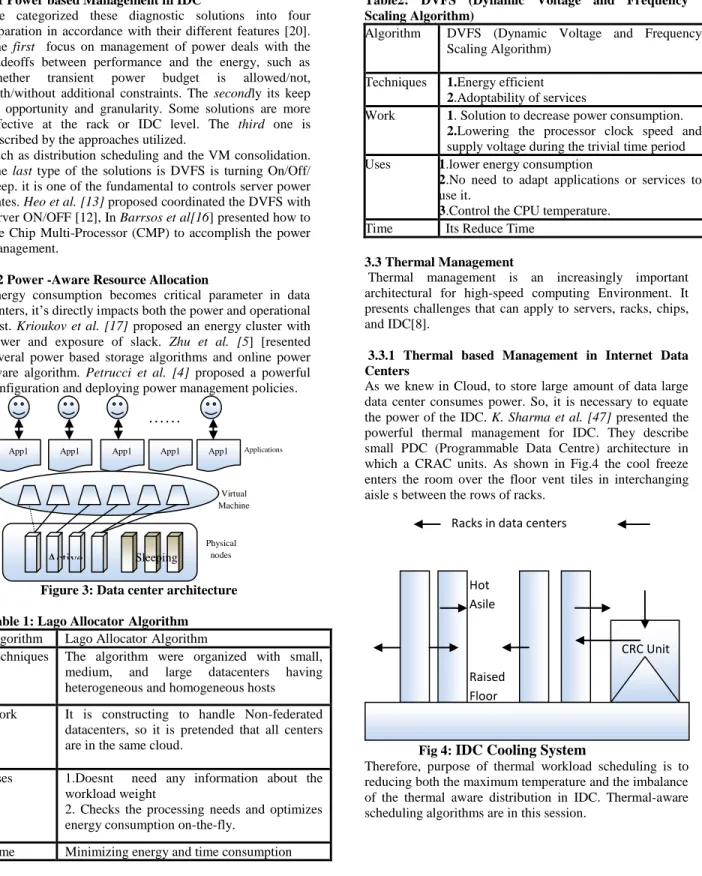
Energy consumption becomes critical parameter in data centers, it’s directly impacts both the power and operational cost. Krioukov et al. [17] proposed an energy cluster with power and exposure of slack. Zhu et al. [5] [resented several power based storage algorithms and online power aware algorithm. Petrucci et al. [4] proposed a powerful configuration and deploying power management policies.
Figure 3: Data center architecture
Table 1: Lago AllocatorAlgorithm Algorithm Lago AllocatorAlgorithm
Techniques The algorithm were organized with small, medium, and large datacenters having heterogeneous and homogeneous hosts
Work It is constructing to handle Non-federated datacenters, so it is pretended that all centers are in the same cloud.
Uses 1.Doesnt need any information about the workload weight
2. Checks the processing needs and optimizes energy consumption on-the-fly.
Time Minimizing energy and time consumption
Table2: DVFS (Dynamic Voltage and Frequency Scaling Algorithm)
Algorithm DVFS (Dynamic Voltage and Frequency Scaling Algorithm)
Techniques 1.Energy efficient 2.Adoptability of services
Work 1. Solution to decrease power consumption. 2.Lowering the processor clock speed and supply voltage during the trivial time period Uses 1.lower energy consumption
2.No need to adapt applications or services to use it.
3.Control the CPU temperature. Time Its Reduce Time
3.3 Thermal Management
Thermal management is an increasingly important architectural for high-speed computing Environment. It presents challenges that can apply to servers, racks, chips, and IDC[8].
3.3.1 Thermal based Management in Internet Data Centers
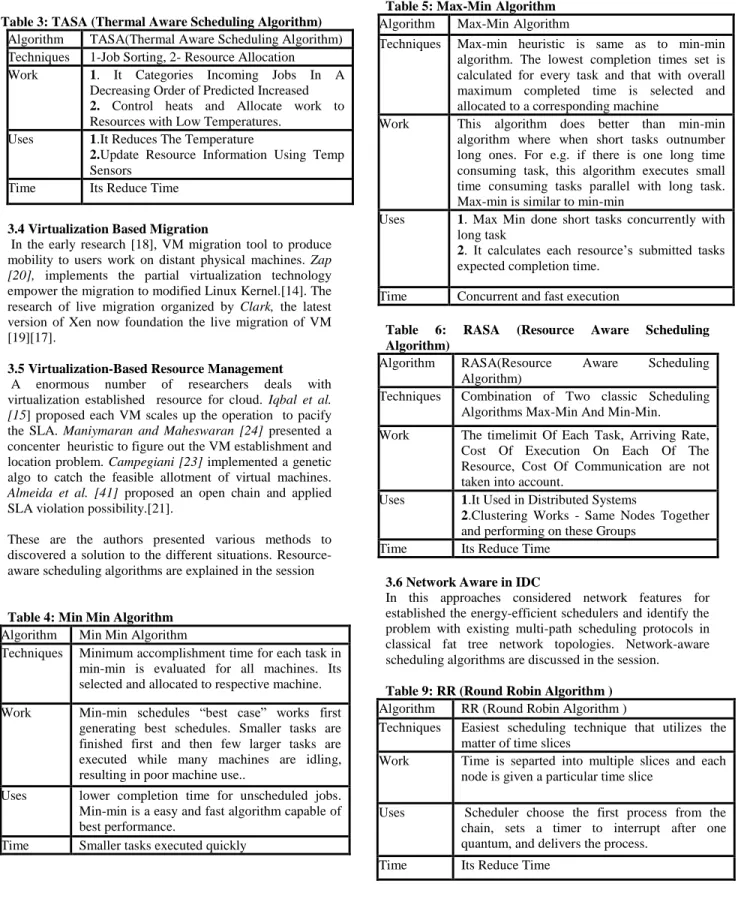
As we knew in Cloud, to store large amount of data large data center consumes power. So, it is necessary to equate the power of the IDC. K. Sharma et al. [47] presented the powerful thermal management for IDC. They describe small PDC (Programmable Data Centre) architecture in which a CRAC units. As shown in Fig.4 the cool freeze enters the room over the floor vent tiles in interchanging aisle s between the rows of racks.
Fig 4: IDC Cooling System
Therefore, purpose of thermal workload scheduling is to reducing both the maximum temperature and the imbalance of the thermal aware distribution in IDC. Thermal-aware scheduling algorithms are in this session.
App1 App1 App1 App1 App1
Virtual Machine Physical nodes Applications
……
……
Active SleepingRacks in data centers
Hot Asile
Raised Floor
Table 3: TASA (Thermal Aware Scheduling Algorithm) Algorithm TASA(Thermal Aware Scheduling Algorithm) Techniques 1-Job Sorting, 2- Resource Allocation Work 1. It Categories Incoming Jobs In A
Decreasing Order of Predicted Increased 2. Control heats and Allocate work to Resources with Low Temperatures.
Uses 1.It Reduces The Temperature
2.Update Resource Information Using Temp Sensors
Time Its Reduce Time
3.4 Virtualization Based Migration
In the early research [18], VM migration tool to produce mobility to users work on distant physical machines. Zap
[20], implements the partial virtualization technology
empower the migration to modified Linux Kernel.[14]. The research of live migration organized by Clark, the latest version of Xen now foundation the live migration of VM [19][17].
3.5 Virtualization-Based Resource Management A enormous number of researchers deals with virtualization established resource for cloud. Iqbal et al. [15] proposed each VM scales up the operation to pacify the SLA. Maniymaran and Maheswaran [24] presented a concenter heuristic to figure out the VM establishment and location problem. Campegiani [23] implemented a genetic algo to catch the feasible allotment of virtual machines.
Almeida et al. [41] proposed an open chain and applied SLA violation possibility.[21].
These are the authors presented various methods to discovered a solution to the different situations. Resource-aware scheduling algorithms are explained in the session
Table 4: Min Min Algorithm Algorithm Min Min Algorithm
Techniques Minimum accomplishment time for each task in min-min is evaluated for all machines. Its selected and allocated to respective machine.
Work Min-min schedules “best case” works first generating best schedules. Smaller tasks are finished first and then few larger tasks are executed while many machines are idling, resulting in poor machine use..
Uses lower completion time for unscheduled jobs. Min-min is a easy and fast algorithm capable of best performance.
Time Smaller tasks executed quickly
IJTET©2015
Table 5: Max-MinAlgorithm Algorithm Max-MinAlgorithm
Techniques Max-min heuristic is same as to min-min algorithm. The lowest completion times set is calculated for every task and that with overall maximum completed time is selected and allocated to a corresponding machine
Work This algorithm does better than min-min algorithm where when short tasks outnumber long ones. For e.g. if there is one long time consuming task, this algorithm executes small time consuming tasks parallel with long task. Max-min is similar to min-min
Uses 1. Max Min done short tasks concurrently with long task
2. It calculates each resource’s submitted tasks expected completion time.
Time Concurrent and fast execution
Table 6: RASA (Resource Aware Scheduling Algorithm)
Algorithm RASA(Resource Aware Scheduling Algorithm)
Techniques Combination of Two classic Scheduling Algorithms Max-Min And Min-Min. Work The timelimit Of Each Task, Arriving Rate,
Cost Of Execution On Each Of The Resource, Cost Of Communication are not taken into account.
Uses 1.It Used in Distributed Systems
2.Clustering Works - Same Nodes Together and performing on these Groups
Time Its Reduce Time
3.6 Network Aware in IDC
In this approaches considered network features for established the energy-efficient schedulers and identify the problem with existing multi-path scheduling protocols in classical fat tree network topologies. Network-aware scheduling algorithms are discussed in the session.
Table 9: RR (Round Robin Algorithm ) Algorithm RR (Round Robin Algorithm )
Techniques Easiest scheduling technique that utilizes the matter of time slices
Work Time is separted into multiple slices and each node is given a particular time slice
Uses Scheduler choose the first process from the chain, sets a timer to interrupt after one quantum, and delivers the process.
Time Its Reduce Time
Table 7: Green Scheduling Algorithm Algorithm Green Scheduling Algorithm
Techniques Server Load Balancing, Server four states-OFF, RESTARTING, ON, and SHUTTING.
Work Servers system should be switch off/on. It will switch on the server when the workload increases and vice versa. Server to come to full operation- turned on before it is needed.
Uses Efficient use of server.
Reduce the wasting time and power Time Its Reduce Time
Table 8: DENS (Data Center Energy-Efficient Network-Aware Scheduling)
Algorithm DENS(data center energy-efficient network-aware scheduling)
Techniques Data center scheduling methodology. Combines energy efficiency and network awareness. Work Goal is to achieve the balance between separate
job performances, job QoS requirements, traffic demands, and energy utilizes by the data center Uses 1. Low computational load.
2.designed to skip hotspots 3.minimizing the computing servers Time Its Reduce Time
IV. CONCLUSION
The cloud IDC are important infrastructure for facilitates of its services. The energy consumption has emerged a critical problem from both the economic and environmental standpoints. Though our research presented we proposed virtualization data center on Green Cloud, which can help to consolidate workload and accomplishenergy saving for cloud environment. We present the different techniques to optain the virtualization IDC and save energy.
V. REFERENCES
[1] R. Raghavendra, P. Ranganathan, V. Talwar, Z. Wang, X. Zhu. No Power Struggles: Coordinated multi-level power management for the data center. In Thirteenth International Conference on Architectural Support for Programming Languages and Operating Systems (ASPLOS ’08), Mar. 2008.
[2] Justin Moore et al.,―Weatherman: Automated, Online, and Predictive Thermal Mapping and Management for Data Centers‖, 1-4244-0175-5/06/$20.00 02006 IEEE.
[3] M. Armbrust, A. Fox, R. Griffith et al., “Above the clouds: a berkeley view of cloud computing,” Tech. Rep. UCB/EECS- 2009-28, EECS Department, University of California, Berkeley, 2009.
[4] V. Petrucci, O. Loques, B. Niteroi, and D. Moss´e, “Dynamic configuration support for power-aware virtualized server clusters,” in Proceedings of the WiP
Session of the 21th Euromicro Conference on
Real-Time Systems, Dublin, Ireland, 2009.
[5] Q. Zhu, F. M. David, C. F. Devaraj, Z. Li, Y. Zhou, and P. Cao, “Reducing energy consumption of disk storage using poweraware cache management,” in
Proceedings of the 10th International Symposium on
High Performance Computer Architecture, pp. 118–
129, February 2004.
[6] S.Albers, "Energy -Efficient Algorithms," Communications of the ACM, vo1.53, no.5, pp.86-96,May 2010.
[7] Anton Beloglazov, Jemal Abawajy, Rajkumar Buyya for “Energy-Aware Resource Allocation Heuristics for Effcient Management of Data Centers for Cloud Computing” preprint submitted to Future Generation Computer Science.
[8] M. Stillwell, D. Schanzenbach, F. Vivien, and H. Casanova, “Resource allocation using virtual cluster,”
in Proceedings of the 9th IEEE/ACM International
Symposium on Cluster Computing and the Grid
(CCGRID ’09), pp. 260–267, May 2009.
[9] X. Wang, D. Lan, G. Wang et al., “Appliance-based autonomic provisioning framework for virtualized outsourcing data center,” in Proceedings of the 4th
International Conference on Autonomic Computing
(ICAC ’07), p. 29, Fla, USA, June 2007.
[10]M. Rosenblum and T. Garfinkel, “Virtual machine monitors: current technology and future trends,”
Computer, vol. 38, no. 5, pp. 39–47, 2005.
[11]O. Abdul-Rahman, M. Munetomo, and K. Akama, “Live migration-based resource managers for virtualized environments: a survey,” in Proceedings of
the 1st International Conferenceon Cloud Computing,
GRIDs, and Virtualization (CLOUD COMPUTING
’10), pp. 32–40, 2010.
[12]X. Fan et al. Power provisioning for a warehouse-sized computer, In 34th ACM International Symposium on Computer Architecture, CA, June 2007.
[13]J. Heo, D. Henriksson, X. Liu, T. Abdelzaher, "Integrating Adaptive Components: An Emerging Challenge in Performance-Adaptive Systems and a Server Farm Case- Study," in Proceedings of the 28th IEEE Real-Time Systems Symposium (RTSS'07), Tucson, Arizona, 2007.
[14]H. Hartig, M. Hohmuth, J. Liedtke, S. Sch¨onberg. The performance of microkernel-based systems. In Proceedings of the sixteenth ACM Symposium on Operating System Principles, pages 66–77. ACM Press, 1997.
[15]W. Iqbal, M. Dailey, and D. Carrera, “SLA-driven adaptive resource management for Web applications on a heterogeneous compute cloud,” Lecture Notes in
Computer Science, vol. 5931, pp. 243–253, 2009.
[16]L. A.Barroso, U. Hölzle, The Case for Energy-Proportional Computing, IEEE Computer, vol 40, no. 12 (2007): 33-37.
[17]Krioukov, S. Alspaugh, P. Mohan, S. Dawson-Haggerty, D. E. Culler, and R. H. Katz, “Design and evaluation of an energy agile computing cluster,” Tech. Rep. UCB/EECS-2012-13, EECS Department, University of California, Berkeley, 2012.
[18]P. Sapuntzakis, R. Chandra, B. Pfaff, J. Chow, M. S. Lam, M.Rosenblum. Optimizing the migration of virtual computers. In Proc. of the 5th Symposium on Operating Systems Design and Implementation (OSDI-02), December 2002.
[19]Clark, K. Fraser, S. Hand, J. Hansen, E. Jul, C. Limpach, I. Pratt, and A. Warfield. Live migration of Virtual Machines. In USENIX NSDI, 2005.
[20]S. Osman, D. Subhraveti, G. Su, J. Nieh. The design and implementation of zap: A system for migrating computing environments. In Proc. 5th USENIX Symposium on Operating Systems Design and Implementation (OSDI-02), pages 361–376, December 2002.
[21]X.Wang, Z. Du, and Y. Chen, “An adaptive model-free resource and power management approach for multi-tier cloud environments,” Journal of Systems
and Software, vol. 85, no. 5, pp. 1135–1146, 2012.
[22]J. Almeida, V. Almeida, D. Ardagna, C. Francalanci, and M. Trubian, “Resource management in the autonomic service oriented architecture,” in
Proceedings of the 3rd International Conference on
Autonomic Computing (ICAC ’06), pp. 84–92, June
2006.
[23]P. Campegiani, “A genetic algorithm to solve the virtual machines resources allocation problem inmulti-tier distributed systems,” in Proceedings of the 2nd
International Workshop On Virtualization
Performances: Analysis, Characterization and Tools
(VPACT ’09), 2009.
IJTET©2015
[24]B. Maniymaran and M. Maheswaran, “Virtual clusters: a dynamic resource coallocation strategy for computing utilities,” in Proceedings of the 16th
IASTED International Conference on Parallel and
Distributed Computing and Systems, pp. 53–58,
November 2004.
C. Saranya Jaikumar (26/07/1987) received her B.Com (Computer Applications) from Vellalar College, Erode, India. She completed her Master of Computer Applications from Erode Sengunthar Engineering College, Erode, India. Presently, she is a Research Scholar at Department of Computer Science, NGM College, and Pollachi, India. . She presented a Research Paper on International Conference. Her area of interest includes Cloud computing, Mobile computing and big data and Hadoop.
Dr. R. Manicka chezian received his M.Sc Applied Science from PSG College of Technology, Coimbatore, India in 1987. He completed his M.S. degree in Software Systems from Birla Institute of Technology and Science, Pilani, Rajasthan, India and Ph.D degree in Computer Science from School of Computer Science and Engineering, Bharathiar University, Coimbatore. He has 25 years of Teaching experience and 17 years of Research Experience. He served as a Faculty of Maths and Computer Applications at P.S.G College of Technology, Coimbatore from 1987 to 1989. Presently, he is working as an Associate Professor of Computer Science in NGM College (Autonomous), Pollachi, India. He has published 75 papers in various International Journals and Conferences. He is a recipient of many awards like Desha Mithra Award and Best paper Award. He is a member of various Professional Bodies like Computer Society of India and Indian Science Congress Association. His research focuses on Network Databases, Data Mining, Data Compression, Mobile Computing and Real Time Systems, Network Security, Bio-Informatics and Distributed Computing.
![Fig: 1 presents the architecture helps for energy efficient service in Green Cloud infrastructure [7]](https://thumb-us.123doks.com/thumbv2/123dok_us/698358.2586155/1.918.549.827.705.974/presents-architecture-energy-efficient-service-green-cloud-infrastructure.webp)