econ
stor
www.econstor.eu
Der Open-Access-Publikationsserver der ZBW – Leibniz-Informationszentrum Wirtschaft
The Open Access Publication Server of the ZBW – Leibniz Information Centre for Economics
Nutzungsbedingungen:
Die ZBW räumt Ihnen als Nutzerin/Nutzer das unentgeltliche, räumlich unbeschränkte und zeitlich auf die Dauer des Schutzrechts beschränkte einfache Recht ein, das ausgewählte Werk im Rahmen der unter
→ http://www.econstor.eu/dspace/Nutzungsbedingungen nachzulesenden vollständigen Nutzungsbedingungen zu vervielfältigen, mit denen die Nutzerin/der Nutzer sich durch die erste Nutzung einverstanden erklärt.
Terms of use:
The ZBW grants you, the user, the non-exclusive right to use the selected work free of charge, territorially unrestricted and within the time limit of the term of the property rights according to the terms specified at
→ http://www.econstor.eu/dspace/Nutzungsbedingungen By the first use of the selected work the user agrees and declares to comply with these terms of use.
zbw
Leibniz-Informationszentrum WirtschaftLeibniz Information Centre for Economics
Seibel, Hans Dieter
Working Paper
SHG Banking in India: The evolution of
a rural financial innovation
Working paper / University of Cologne, Development Research Center, No. 2005,9 Provided in cooperation with:
Universität zu Köln
Suggested citation: Seibel, Hans Dieter (2005) : SHG Banking in India: The evolution of a rural financial innovation, Working paper / University of Cologne, Development Research Center, No. 2005,9, http://hdl.handle.net/10419/23653
University of Cologne
Development Research Center
Universität zu Köln
Arbeitsstelle für Entwicklungsländerforschung
SHG Banking in India:
The evolution of a rural financial innovation
1by
Hans Dieter Seibel
Table of contents
List of Abbreviations Executive summary Zusammenfassung: SHG-Banking in India:
Die Evolution einer Innovation im ländlichen Finanzwesen 1. Introduction
1.1 SHG banking in India:
the developing world’s largest and fastest-growing microfinance program 1.2 Results of the impact study phase I:
the contribution of SHG banking to the Millennium Development Goals 1.3 Objectives and conduct of the impact study phase II
2. A paradigm shift in rural finance in India and Germany 2.1 Prehistory
2.2 Searching for a new approach: from agricultural credit to rural finance 3. Linking banks and self-help groups: a rural finance innovation
4. The emergence of SHG banking in India
4.1 The APRACA workshop in Nanjing: a trigger event 4.2 A study of SHGs in India
4.3 Towards a pilot project
5. SHG banking in India: from pilot project to mainstreaming 5.1 The start-up phase
5.2 A mid-term evaluation, 1994 5.3 Mainstreaming SHG banking
6. GTZ’s role in the SHG-Bank Linkage Program in India
6.1 Planning for GTZ support to NABARD’s SHG-Bank Linkage program 6.2 The decision-making process
6.3 GTZ’s historical contribution to SHG banking in India
6.4 GTZ’s ongoing contribution to SHG banking and rural financial system development
Annex 1: Quantitative results of impact studies
iii iv viii 1 5 7 9 12 15 19 ii
List of Abbreviations
APRACA Asia-Pacific Rural and Agricultural Credit Association
ADB Asian Development Bank
AMPS Advanced Multi-Stakeholder Planning System
AP Andhra Pradesh
BAAC Bank for Agriculture and Agricultural Cooperatives, Thailand
BI Bank Indonesia
BIRD Bankers Institute of Rural Development
BKD Badan Kredit Desa, Indonesia
BMZ Bundesministerium für wirtschaftliche Zusammenarbeit und Entwicklung (Federal Ministry for Economic Cooperation and Development)
BPR Bank Perkreditan Rakyat, Indonesia
BRI Bank Rakyat Indonesia
CARE Cooperative for American Remittances to Europe CIDA Canadian International Development Agency (CIDA)
CRS Catholic Relief Services
DEAR Department of Economic Analysis and Research
DFID Department for International Development, UK
DGRV Deutscher Genossenschafts- und Raiffeisen Verband / German Cooperative and Raiffeisen Confederation
DPD-NFS Development Policy Department Non-Farm Sector
EU European Union
FA Financial Assistance
FAO Food and Agriculture Organization of the United Nations
GDP Gross Domestic Product
GTZ Deutsche Gesellschaft für Technische Zusammenarbeit (GTZ) GmbH (German Technical Cooperation)
IFAD International Fund for Agricultural Development
ILO International Labour Organization
KfW Kreditanstalt für Wiederaufbau
MACS Mutually Aided Cooperative Societies
MCIC MicroCredit Innovations Cell
MCID MicroCredit Innovations Department
MDG Millennium Development Goal
MFI Microfinance Institution
MIS Management Information System
MYRADA Mysore Resettlement and Development Agency NABARD National Bank for Agriculture and Rural Development
NGO Non-Governmental Organisation
NPA Non-performing assets
NRO Nichtregierungsorganisation
ODA Official Development Assistance
PACS Primary Agricultural Cooperative Societies PRADAN Professional Assistance for Development Action
RBI Reserve Bank of India
RRB Regional Rural Bank
Rs Rupee (Indian Currency Unit)
SDC Swiss Agency for Development and Cooperation
SEWA Self-Employed Women Association
SHG Self-help group / Selbsthilfegruppe SHPI Self-Help Promotion Institution
TC Technical Co-operation
UK United Kingdom
UN United Nations
UNDP United Nations Development Program
US United States of America
USAID United States Agency for International Development
ZOPP Ziel-orientierte Projekt Plannung / objective oriented project planning (GOPP)
Executive summary 1. Introduction
the developing world’s largest and fastest-growing microfinance program
Linking banks and self-help groups in India is the largest and fastest-growing microfinance program in the developing world. Implemented since 1996 on a national scale, it has reached 1.6 million savings-based groups credit-linked to 35,294 bank branches, with 23.96 million members covering over 120 million people from the lowest strata of the rural population (End of March 2005). Performance is excellent, and impact is deeply felt by the members, the vast majority of them women. Yet enormous challenges remain, particularly in terms of further expansion into underserved areas and sustainability.
Linking banks and self-help groups has been a major program of German development cooperation since the mid-1980s. Given the involvement of GTZ in SHG banking and the outreach of that program in India, the German Ministry of Economic Cooperation and Development (BMZ) has proposed to study the impact of SHG banking in India in the framework of the United Nations Millennium Development Goals 2015 on the basis of the existing literature; and subsequently to examine the contribution of GTZ on the evolution of the program in India. The results of the impact studies indicate that considerable socio-economic benefits have been accruing to small-scale farming households, rural micro entrepreneurs and the landless and have contributed to most impact aspects of MDGs 1 to 6. Most SHG members substantially increase their saving rates. A shift has been observed over time from consumption loans to loans for income generating purposes. Increased savings and capital formation improve the self-financing capacities and even out the household’s cash flow. This in turn has improved their risk absorption capacity and made them less vulnerable. Access to formal finance has substantially reduced dependency on money lenders and has diminished capital costs. The improved access to financial services has benefited SHG members and their households in maintaining, intensifying and diversifying their economic activities, with positive effects on income and employment generation, especially in the non-agricultural sector.
The unprecedented scale of SHG banking and its enormous potential for further growth, within India and without, raises the question as to the dynamics of its evolution, the forces behind it, and the contribution of external organizations. How did it evolve, what kept it growing, and what has been the role of GTZ? The study is mainly based an analysis of documents of APRACA, GTZ and NABARD in the archives of the Development Research Center (AEF) of the University of Cologne and on discussions in March 2005 with key personnel.
2. A paradigm shift in rural finance in India and Germany
In India, the lack of rural development has been attributed since the 1950s to a lack of production assets and credit. The nationalization of private banks in 1969, the expansion of their rural branch network, priority sector lending and the introduction of Regional Rural Banks in 1975, plus large amounts of donor funding, substantially increased outreach to better-off farmers. Yet, all this failed to reach the vast numbers of landless people,
agricultural laborers and illiterate women, as substantiated by a survey of RBI in 1981. When the German Government and other major donors reviewed their credit lines to development banks, they arrived at similar conclusions as RBI: that cheap credit had in fact undermined rural development. Germany’s experience during that period differed widely from that of India. The massive capital transfer through the Marshall Plan, channelled through KfW, led to Germany’s economic miracle. Well into the 1960s private commercial banks were absent from rural areas; but unlike in India, two informal self-help initiatives, dating back to the second half of the 18th and the middle of the 19th century, respectively, had evolved into a
wide network of self-reliant savings and cooperative banks with near-total outreach: a crucial element in Germany’s comparative advantage in development experience. 1983 was a turning year in both countries in their search for a new paradigm in development finance: iv
bringing together governmental and private agencies, adopting a savings-led approach, and searching for grassroots organizations as financial intermediaries such as SHGs.
3. Linking banks and self-help groups: a rural finance innovation
In this climate of a paradigm change in rural finance, NABARD experimented with NGOs by establishing credit management groups. GTZ developed the concept of linking banks and SHGs and supported feasibility studies in the African context, where financial SHG groups were found in abundance, but no banking partners.
4. The emergence of SHG banking in India
The decisive event which brought the linkage approach to the attention of policymakers and banks in Asia including India was the APRACA regional workshop in Nanjing, China, in May 1986. The linkage approach was subsequently adopted by APRACA as its priority program and supported by a GTZ regional project.
Key elements were:
building on the existing formal and nonformal financial infrastructure, including SHGs as informal financial intermediaries;
savings-based credit linkages with banks; NGOs (SHPIs) as facilitators;
flexible models of cooperation between SHGs, NGOs and banks as autonomous business partners, each with its own existing financial and institutional resources. In preparation of pilot linkage projects, India carried out a survey with its own funds and experts, while GTZ supported studies in a number of other APRACA member countries. These led to the first pilot project, namely in Indonesia in 1988, supported by GTZ and followed by other bilateral projects in the Philippines and Thailand. Its operational guidelines were reviewed and revised by NABARD and discussed at a joint workshop in Jakarta in February 1992.
5. SHG banking in India: from pilot project to mainstreaming
Inspired by the APRACA-GTZ regional project, NABARD carried out its own pilot project, 1992-96. At mid-term, March 1994, 637 SHGs promoted by NGOs had been credit-linked to 28 banks, with a positive impact. On that basis, NABARD initiated mainstreaming of SHG banking, setting up a Credit and Financial Services Fund in 1996 for extensive capacity-building and a Micro Credit Innovations Department (MCID) in 1998, with MCI cells in every state. The number of SHGs credit-linked to banks grew to 33,000 in 1999 and 115,000 in 2000 and during the following years surged to 1.6 million at the time of this study, March 2005, surpassing the goal originally set for 2008.
6. GTZ’s role in the SHG-Bank Linkage Program in India
Through the APRACA-GTZ regional project, communication on SHG banking among
member institutions and GTZ-supported bilateral projects was maintained; documentation of linkage experience in member countries was widely circulated. The initial success of its pilot project led NABARD to request technical assistance from GTZ for the mainstreaming of SHG banking. On 31 August to 2 September 1994, a ZOPP workshop was held in Bombay for the planning of a bilateral project. The main emphasis of the bilateral project was to be on capacity building, particularly through exposure training abroad, supported through a
financial contribution as the main component and short-term experts. Workshop participants agreed that the management of the SHG-Bank Linkage program rested with NABARD. The bulk of all resources was to be provided by NABARD and the banks. GTZ support was to be ancillary, both in financial and management terms. GTZ subsequently submitted to NABARD a proposal for a bilateral project with a long-term expert. This was not immediately accepted by the board, which had general objections against small experimental project and voiced doubts over the prospects of uncollateralized lending to informal groups. It was only after prolonged negotiations and living proof that SHG banking was no longer a small project of
doubtful value that a bilateral project was signed in 1998 and took off in 2000, with its base in Delhi.
The main contribution of GTZ to SHG banking in India is seen by NABARD’s management in the preparatory phase, mainly during the period 1986 and 1994, followed by specific inputs during the maturity phase of the program since 2000. Historically, there are four seminal inputs through which GTZ contributed to a self-sustaining evolutionary process of SHG banking in India, fully owned and managed by NABARD and its partner agencies in India:
Conceptual development of the linkage model by GTZ and its presentation at the APRACA workshop in Nanjing, with a trigger effect on NABARD’s own search for a new approach in rural finance
Providing a framework for a study of SHGs in India, carried out by a consortium of Indian institutions under the leadership of NABARD, preparatory of a pilot project Preparation and initial test of operational procedures of linkage banking through a bilateral project in Indonesia: a blueprint for the first phase of the pilot project in India Continual support for the APRACA-GTZ regional project Linking Banks and Self-Help Groups, providing a regional communication forum for the exchange of experience. Of particular value during the last four years has been GTZ’s support to intellectual dialogue, exposure abroad, and special studies. Initiatives commended by NABARD include:
Exposure visits to Germany and related studies have helped preparing the ground for cooperative sector reform and a bilateral project component.
Exposure visits to Uganda as well as Indonesia have opened new perspectives on how to supervise small institutions and institutions with small accounts.
Exposure visits to Indonesia have broadened views on microfinance.
An exposure visit to Bolivia has demonstrated the usefulness of smart cards as a device to reduce transaction costs and is now being pilot tested by NABARD. A study of demand-led savings products, including life, health and accident
insurance, is cited as particularly important. Once 10-15 million SHG members are covered by group health insurance, premiums will go down substantially.
The studies presented at the tenth anniversary of SHG-Bank Linkage program in India in October 2002, with support from GTZ, IFAD and SDC, have enabled
NABARD to subject the strengths and weaknesses of the program to external scrutiny and have provided a basis for the international dissemination of the approach.
Studies of bank and SHG transaction costs have provided indicative evidence of the profitability of SHG banking. This has contributed to a surge in SHG linkages. Various contributions have been made to NABARD’s MIS of SHG banking; its improvement at different levels is an ongoing concern.
Staff members of NABARD joined several international training events, eg, in
Thailand and Sri Lanka and the microbanking training of Bankakademie in Frankfurt. GTZ has supported the South-South dialogue between NABARD and other GTZ projects and programs included high-level delegations.
The vigor and diversity of the SHG-Bank Linkage program in India may precisely be due to the fact that NABARD, in cooperation with its Indian partners, took full command of the program and kept any donor assistance at an institutional distance. In the words of NABARD leaders, “GTZ has made a significant contribution, but (this is) difficult to attribute exactly.”What has been most important to NABARD is the flexibility of support where it would have had difficulty getting approval for the use of its own funds. Of particular value during the last four years has been GTZ’s support to intellectual dialogue, exposure abroad, and special studies. One of the most fruitful contributions in the eyes of NABARD is a spin-off of the ongoing bilateral project, a study of the German cooperative rural banking system in the context of
preparations for the reform of the cooperative banking sector in India; this has resulted in a second GTZ program component in India in addition to SHG banking.
SHG-Banking in Indien:
Die Evolution einer Innovation im ländlichen Finanzwesen und der Beitrag der GTZ Zusammenfassung
1. SHG-Banking, das weltgrößte ländliche Mikrofinanzprogramm
SHG-Banking, die Anbildung von Spar- und Kreditselbsthilfegruppen an Banken in Indien, ist das größte und wachstumsstärkste ländliche Mikrofinanzprogramm in Entwicklungsländern. Seit Beginn seiner landesweiten Umsetzung 1996 wurden 1,6 Millionen Gruppen mit 23,96 Millionen Mitgliedern von ca. 36,000 Bankzweigstellen refinanziert; das entspricht einer Gesamtbevölkerung von über 120 Millionen. Aus Sicht der Banken wie auch der Mitglieder, die weitaus meisten davon Frauen aus den untersten Schichten, hat sich das Programm als äußerst erfolgreich erwiesen. Dabei sieht sich die staatliche Agrarzentralbank NABARD, Programmträger und zugleich Durchführungsorganisation, weiterhin gewaltigen
Herausforderungen der Konsolidierung und Nachhaltigkeit gegenüber.
Die Anbindung von SHG an Banken wird von der Bundesrepublik seit Mitte der 1980er Jahre gefördert. Wegen des außerordentlichen Ausmaßes der Zielgruppenerreichung in Indien hat das BMZ eine Wirkungsstudie auf der Grundlage der vorhandenen Literatur als Beitrag zu den UN Millennium Development Goals 2015 sowie eine Untersuchung über den Beitrag der GTZ in Auftrag gegeben. Gemäss der Ergebnisse der drei Wirkungsstudien entsteht durch das weiterhin schnell wachsende Programm ein erheblicher sozio-ökonomischer Nutzen für kleinbäuerliche und -gewerbliche Unternehmer/innen und Landlose. Der verbesserte Zugang von SHG-Mitgliedern zu Mikrofinanzdienstleistungen sowie der Gruppenansatz und die damit zusammenhängenden Prozesse zur Stärkung des Humankapitals tragen mit vielfältigem Nutzen zu den meisten Wirkungsaspekten der MDGs 1 bis 6 bei. Die meisten
SHG-Mitglieder steigern in beträchtlichem Umfang ihre Sparraten. In der Kreditaufnahme werden verstärkt Darlehen für einkommensschaffende Aktivitäten statt für Konsumzwecke
nachgefragt. Erhöhte Spareinlagenmobilisierung und Kapitalbildung verbessern die
Kapazitäten zur Eigenfinanzierung kleinerer Investitionen. Weiterhin wird der Cash-flow der Haushalte stabilisiert und es kann generell von höheren Kapazitäten zur Absorption von Risiken ausgegangen werden. Der Zugang zu formalen Finanzdienstleistungen trägt auch zu einer starken Verringerung der Abhängigkeiten von informellen Geldverleihern bei, mit positiven Wirkungen auf die Reduzierung der Kapitalkosten. Die Finanzdienstleistungen mit ihren Einkommenswirkungen erhöhen auch die Kapazitäten der SHG-Mitglieder, zusätzliche Ausgaben für Grundbedürfnisse wie verbesserte Ernährung (MDG1), Bildung (MDG 2) und Gesundheit (MDGs 4 bis 6) zu tätigen. Als Ergebnis der Synopse wird empfohlen, die institutionelle Entwicklung existierender SHG und SHG-Verbandsstrukturen zu fördern; weiterhin zur Verbesserung effektiver Managementinformationssysteme (MIS) und damit zur Konsolidierung des Programms beizutragen; zur Kapazitätsverbesserung der
SHG-Mitglieder beizutragen; zum Abbau regionaler Unausgewogenheiten die Zentral- und
Ostregionen verstärkt zu berücksichtigen und dabei ggf. regionalspezifisch unterschiedliche Durchführungsmodelle zu entwickeln; die Entwicklungsrolle der SHG durch eine verbesserte Einbeziehung in örtliche Entwicklungsprogramme auszubauen.
Umfang und Wachstumspotential des Programms inner- und außerhalb Indiens werfen die Frage nach seiner Entstehungsgeschichte und Entwicklungsdynamik auf, insbesondere auch nach dem Beitrag der GTZ. Diese Studie beruht weitgehend auf der Analyse von Unterlagen beteiligter Organisationen, insbesondere APRACA, GTZ und NABARD, im Archiv der
Arbeitsstelle für Entwicklungsländerforschung, Universität zu Köln, und auf Gesprächen mit Entscheidungsträgern des Programms im März 2005.
2. Paradigmenwechsel im ländlichen Finanzwesen in Indien und Deutschland
Seit den 1950er Jahren wurde die ländliche Unterentwicklung in Indien weitgehend auf einen Mangel an Produktionsmitteln und Krediten zurückgeführt. Die Nationalisierung privater Banken 1969 und die Ausweitung ihres ländlichen Zweigstellennetzes, die Einführung eines vii
neuen Netzwerks ländlicher Regionalbanken (RRB) seit 1975 und die Durchleitung beträchtlicher Geberkredite führten für die größeren Bauern zu einer erheblichen
Verbesserung der Kreditversorgung, nach einer Untersuchung der Reserve Bank of India (1981) nicht aber für die 250-300 Millionen Menschen der untersten Schichten. Etwa gleichzeitig evaluierten die größeren Geber, darunter Deutschland, ihre
Entwicklungsbankenkredite, mit dem gleichen Ergebnis wie RBI: der subventionierte Agrarkredit untergräbt die ländliche Entwicklung. Deutschlands eigene Erfahrung in der Nachkriegszeit unterschied sich grundlegend von der Indiens: Einerseits trug der massive Kapitaltransfer aus Marshallplanmitteln über die KfW zum Wirtschaftswunder bei.
Andererseits waren zwar in Deutschland bis in die 60er keine privaten Geschäftsbanken in ländlichen Gebieten tätig; im Gegensatz zu Indien hatten sich aus den informellen
Selbsthilfeansätzen des 18. und 19. Jahrhundert aber umfangreiche Netzwerke selbsttragender Sparkassen und Genossenschaftsbanken entwickelt: ein wesentlicher komparativer Erfahrungsvorteil in der Entwicklungszusammenarbeit. 1983 war für beide Länder das Jahr des Durchbruchs zu einem neuen Paradigma der Entwicklungsfinanzierung. Diese war gekennzeichnet durch Zusammenarbeit zwischen privaten und staatliche
Organisationen, Ersparnisorientierung und Beginn der Ausrichtung auf SHG als lokale Finanzintermediäre.
3. SHG-Banking: eine Innovation im ländlichen Finanzwesen
In diesem Klima des Paradigmenwechselns experimentierte NABARD in Zusammenarbeit mit NRO mit sog. Kreditmanagementgruppen. Die GTZ entwickelte das Modell der
Verknüpfung von SHG und Banken. Durchführbarkeitsstudien im afrikanischen Raum förderten eine Fülle von SHG als informelle Finanzinstitutionen zu Tage, aber keine Bankpartner.
4. Anfänge des SHG-Banking in Indien
Bei der Regionalkonferenz des asiatischen Agrarbankenverbands APRACA in Nanjing (China) im Jahr Mai 1986 stellte die GTZ den SHG-Bankingansatz vor: ein Schüsselereignis für die Entscheidungsträger aus verschiedenen asiatischen Ländern, darunter Indien. Mit Unterstützung eines Sektorvorhabens der GTZ erklärte APRACA SHG-Banking zu seinem vorrangigen Förderprogramm, mit den folgenden Elementen:
Aufbau auf vorhandenen formellen und nichtformellen Finanzinfrastrukturen einschließlich SHG;
Anbindung von SHGs an Banken im Spar- und Kreditgeschäft; Einbeziehung von NRO als Fördereinrichtungen;
flexible Modelle der Zusammenarbeit zwischen SHG, NRO und Banken als autonomen Geschäftspartnern unter Nutzung ihrer jeweiligen finanziellen und institutionellen Mittel. Zur Vorbereitung von Pilotprojekten führte Indien mit eigenen finanziellen und personellen Mitteln eine Untersuchung über SHG durch, während ähnliche Untersuchungen in anderen asiatischen Ländern von der GTZ durchgeführt wurden. Das erste Pilotprojekt setzte 1988 mit Unterstützung durch die GTZ in Indonesien ein; weitere bilaterale Projekte folgten in den Philippinen und Thailand. Die Durchführungsbestimmungen des Projektes in Indonesien wurden von NABARD überarbeitet und bei einem gemeinsamen Arbeitstreffen in Jakarta im Februar 1992 vorgestellt.
5. SHG-Banking in Indien: vom Pilotprojekt zur nationalen Implementierung
Angeregt durch das APRACA-GTZ Regionalprojekt führte NABARD 1992-96 in Indien sein eigenes Pilotvorhaben durch. Zum Zeitpunkt der Zwischenevaluierung im März 1994 waren an dem Projekt 637 SHGs in Zusammenarbeit mit NRO als Fördereinrichtungen und 28 Banken als Kreditgebern beteiligt. Die Akzeptanz und positive Wirkung des Modells veranlasste NABARD, die nationale Implementierung in die Wege zu leiten. Dazu richtete NABARD 1996 einen eigenen Kredit- und Innovationsfonds und 1998 eine
Mikrokreditinnovationsabteilung (MCID) als Steuerungseinheit ein, mit MCI-Zellen in jedem Bundesstaat. Die Zahl der – jeweils auf eigener Ersparnisgrundlage – bankrefinanzierten viii
SHG wuchs 1999 auf 33,000 und 2000 auf 115,000, danach in gewaltigen Sprüngen bis auf 1,6 Million zum Zeitpunkt dieser Untersuchung im März 2005 – weit über das ursprünglich für 2008 angestrebte Ziel von einer Million Gruppen hinaus.
6. Die Rolle der GTZ im indischen SHG-Bankingprogramm
Durch das APRACA-GTZ Regionalprojekt wurde die Kommunikation mit den Mitgliedern und den bilateralen GTZ-Projekten aufrechterhalten. Die positive Piloterfahrung veranlasste NABARD, bei der GTZ um Unterstützung für die nationale Implementierung des Programms nachzusuchen. Am 31.8.-2.9.1994 wurde in Bombay eine ZOPP-Veranstaltung für die Planung eines bilateralen Projekts durchgeführt, mit dem Schwerpunkt auf Fortbildung, insbesondere durch Exposureaufenthalte im Ausland. Als Hauptkomponente der Förderung war ein Finanzierungsbeitrag vorgesehen, ergänzt durch Kurzzeitexperteneinsätze.
Kreditmittel zur Refinanzierung der Banken wurden von NABARD zur Verfügung gestellt. Die Teilnehmer waren sich einig, dass das Management des SHG-Bankingprogramms
ausschließlich bei NABARD liegen solle. Eine Entscheidung verzögerte sich, da im Aufsichtsrat von NABARD grundsätzliche Bedenken gegen kleinere TZ-Projekte sowie Zweifel an den Zukunftsaussichten ungesicherter Kredite an informelle Gruppen geäußert wurden. Erst als das Programm seine Akzeptanz bei Banken, NRO und SHG unter Beweis gestellt hatte, wurde nach langen Verhandlungen 1998 ein Übereinkommen über ein bilaterales Projekt erzielt, das 2000 in Kraft trat und in Delhi untergebracht wurde.
Den wesentlichen Beitrag der GTZ zum SHG-Banking in Indien sieht das Management von NABARD in der Vorbereitungs- und Gründungsphase, insbesondere 1986-1994, gefolgt von spezifischen Inputs in der Reifephase des Programms. In NABARDs voller Eigentümerschaft und Führung in Zusammenarbeit mit seinen indischen Partnern entwickelte sich
SHG-Banking dabei als ein selbsttragender evolutionärer Prozess in Indien. Dazu hat die GTZ vier wesentliche Beiträge geleistet:
Entwicklung des SHG-Bankingmodells und seine Präsentation in Nanjing (1986), ein Auslöser (trigger) bei NABARDs Suche nach einem breitenwirksamen Ansatz
Bereitstellung eines Forschungsrahmens für SHG-Studien, in Indien durch ein Konsortium unter NABARDs Leitung durchgeführt
Ausarbeitung und Test von Durchführungsbestimmungen in einem Pilotprojekt in Indonesien als Grundlage für die Pilotphase in Indien
Fortlaufende Unterstützung des SHG-Bankingprogramms durch das APRACA-GTZ Regionalprojekt als regionales Kommunikationsforum.
Von besonderer Bedeutung seit 2000 waren der Beitrag der GTZ zu einem
Erfahrungsaustausch im Ausland, hochrangige Dialogprogramme und spezielle Studien. Die folgenden Initiativen wurden von NABARD besonders hervorgehoben:
Informationsbesuche in Deutschland und nachfolgende Studien haben eine
Grundlage für die Reform des Genossenschaftssektors und für eine neue bilaterale Projektkomponente geschaffen.
Informationsbesuche in Uganda und Indonesien haben eine neue Sicht auf effektive Aufsicht von Finanzinstitutionen mit Kleinkunden vermittelt und das Spektrum von ländlichen Finanzinstitutionen erweitert.
Ein Informationsbesuch nach Bolivien hat den Beitrag von Smart Cards zur
Verringerung von Transaktionskosten demonstriert und zu einem Pilottest in Indien geführt.
Durch Teilnahme an regionalen Veranstaltungen wurde der Süd-Süddialog zwischen NABARD und anderen von der GTZ unterstützten Maßnahmen gefördert.
Einer Studie über Sparprodukte in Verbindung mit Lebens-, Kranken- und Unfallversicherung wird besondere Bedeutung beigemessen. NABARD sieht ein Potential für eine Gruppenkrankenversicherung für 10-15 Millionen SHG-Mitglieder, mit drastisch niedrigeren Beiträgen.
Wesentliche Beiträge wurden zur Verbesserung des MIS geleistet
Verschiedene, von GTZ, IFAD und SDC geförderte Studien anlässlich des 10. Jahrestags des Programms im Jahre 2002 haben eine internationale Analyse der Stärken und Schwächen des Programms ermöglicht.
Exemplarische Studien über Bank- und SHG-Transaktionskosten haben die Profitabilität des Programms für die Beteiligten nachgewiesen und wesentlich zur Expansion des Programms beigetragen.
NABARDmitarbeiter haben an internationalen Fortbildungsveranstaltungen teilgenommen, z.B. in Thailand, Sri Lanka und bei der Bankakademie Frankfurt. Die Dynamik und Vielfalt des Programms in Indien dürfte eng damit zusammenhängen, dass NABARD mit seinen indischen Partnern die volle Durchführungsverantwortung übernommen und Gebereinflüsse auf Distanz gehalten hat. Dazu stellten unsere Gesprächspartner fest: „Die GTZ hat einen wichtigen Beitrag geleistet; aber dieser lässt sich nur schwer genau zurechnen.“
Von größter Bedeutung ist für NABARD die Flexibilität der Unterstützung in Bereichen, für deren Finanzierung aus Eigenmitteln der Vorstand nur schwerlich seine Zustimmung hätte geben können. Als besonders wertvoll wurde immer wieder die Unterstützung des fachlichen Austauschs, der Fortbildung durch Exposureaufenthalte im Ausland und besonderer
Untersuchungen bezeichnet. Eines der fruchtbarsten Programme, das vom Projekt durch einen Exposurebesuch in Deutschland und die Organisation einer Untersuchung in Indien vorbereitet wurde, ist aus NABARDs Sicht ein Vorhaben zur Reform des
Genossenschaftsbankensektors.
1. Introduction 1.1 SHG banking in India:
the developing world’s largest and fastest-growing microfinance program
SHG banking, or linking banks and self-help groups, in India is the largest and fastest-growing microfinance program in the developing world. Implemented since 1996 on a national scale, it has reached 1.6 million groups2 with 23.96 million members, covering over
120 million people from the lowest strata of the rural population (as of March 2005). It is a flexible and non-mandatory approach adapted to local conditions by the participating agencies as autonomous business partners. The enormous growth in outreach has been made possible by drawing on a wide array of institutional resources as India’s social capital: the National Bank for Agriculture and Rural Development (NABARD) as the prime mover and refinancing agency; some 36,000 bank branches and primary cooperatives providing deposit services and credit; some 3,100 governmental and non-governmental agencies with
experience in group development as facilitators of previously existing or newly established SHGs; the National Reserve Bank of India which has adjusted the policy framework for banking relations with informal groups; and the political leadership at various state and union levels, prominently providing legitimacy, in the annual union budget statement as an
unequivocal expression of the political will.3
At the same time the program has drawn on India’s human capital: on the one hand the competence and enthusiasm of the staff in all participating agencies, many of which select their staff through competitive exams; and on the other hand the willingness and ability of people from the lowest classes to form a group, meet regularly, pool their miniscule savings, lend to members, and establish a documented track record of financial intermediation within the group. On that basis, the groups are then permitted as informal entities to open savings accounts and obtain bank loans, which they onlend to their members on terms and
conditions autonomously decided by each group. In India, as in some neighbouring
countries, small groups with financial activities attract predominantly women, even if no such bias is built into the program design: 90% of the group members are women.
Neither social nor human capital would suffice were it not for the financial capital created by the program: steadily increasing internal resources of the groups, generated through savings and profits from interest income; and high profitability of SHG banking as a financial product of the banks, due to high repayment rates and low transaction costs of both banks4 and
SHGs5. SHG banking is viable: for SHGs and banks.
There is strong indicative evidence from a variety of sources that impact is deeply felt by the women, the majority of them illiterate: they save, borrow, invest and repay; manage their own SHG affairs, albeit with assistance in bookkeeping; enter banks for financial transactions; contribute to the household economy and improve their standing in the family; send their
2 Half that number has been credit-linked during the period April 2003 to March 2005, which may serve
as an indicator of growth (see Annex 1, Figure 1).
3 E. Kropp & B.S. Suran, Linking Banks and Self Help Groups in India–An Assessment. NABARD
2002.
M. Harper, Promotion of Self Help Groups under the SHG Bank Linkage Programme in India–An Assessment. NABARD 2002
H.D. Seibel & S. Khadka, SHG Banking... in India. Savings and Development 26/2 (2002):132-149.
4 H. D. Seibel & H. R. Dave, Commercial Aspects of SHG-Bank Linkage in India. NABARD 2002. 5 S. Karduck & H.D. Seibel, Transaction Costs of Self-Help Groups in NABARD’s SHG-Bank Linkage
Programme: a Study in Karnataka State. NABARD/GTZ 2004
children to school (almost all reportedly do, previously only few did); and for the first time in their life take a positive view of the future.6
Impact at the institutional level includes the formation of SHG federations and associations in some states, some of them registered as Mutually Aided Cooperative Societies (MACS), a new legal status for financial cooperatives free from government dominance – “based on thrift, self-help and mutual aid and owned, managed and controlled by members for their economic and social betterment” 7. Impact at the policy level includes central bank
authorization of financial transactions by banks with informal groups of the lowest economic standing.
All this is just a beginning. Enormous challenges remain: reaching out to the remaining 200 million rural poor in India; expanding into states where coverage is still minimal; assuring adequate financial accounting, reporting and control at SHG level as an indispensable basis of financial deepening; finding profitable microenterprise investment opportunities; and making access to financial services sustainable in the long run. In many states SHG banking still has a long way to go – compared to Andhra Pradesh, where government agencies and commercial banks have taken the lead in SHG banking and the rural penetration rate is 50%.8
Sustainability of SHG banking in the long run is an unresolved issue. Given the flexibility of SHG banking in India, there may be different routes to the sustainability of access to formal financial services. One is direct access of individuals to bank services through graduation, based on the growth of their microenterprise activities and the track record provided by their SHGs; for a transitional period, small-size loans from group funds and opportunities for graduation to larger-size individual bank loans may exist side by side. Another option, presently developing in Andrah Pradesh and neighboring states on a growing scale, is the formation of federations as legal financial intermediaries or business associations, indirectly giving legitimacy to the member-SHGs. A third option presently under discussion may lie in the full integration of credit NGOs and MFIs, with their SHG clientele, into the formal financial sector. The least promising option of sustainability in the long run is the continued existence of informal groups (limited by law to 20 members) with full access to bank services – unless the lawmaker, impressed by their social cohesion and determination to stay together, decides on a new legal status for such groups.
1.2 Results of impact studies:
the contribution of SHG banking to the Millennium Development Goals (MDGs)
Linking banks and self-help groups has been a major program of German development cooperation since the mid-1980s. In India, within the first 10 years since SHG banking started on a national scale, it has reached about one-third of the rural poor with financial services. It is likely that by the year 2015 it might have reached two-thirds or more of India’s rural poor. Given the involvement of GTZ in SHG banking and the unprecedented growth of outreach of that program in India, the German Ministry of Economic Cooperation and Development (BMZ) has proposed to study the impact of SHG banking in India in the framework of the United Nations Millennium Development Goals 2015 on the basis of the
6 V. Puhazhendi & K.C. Badatya, Self Help Group Bank Linkage Programme for Rural Poor in India–
An Assessment. NABARD 2002
7 Andhra Pradesh, Mutually Aided Cooperative Societies (MACS) Act, 1995. From Andhra Pradesh,
the act has been spreading to other states.
8 Out of 12 million rural families, 7 million are reportedly in the fold of SHGs; 6 million SHGs are
credit-linked to banks. In AP SHG banking is close to saturation; repeat loans now amount to 75%. SHGs are rated by the banks as very good clients. In addition, 7 million farmers are covered by individual credit. A total of 1800 training programs have been conducted under NABARD in AP since 1997, currently about 3-400 programs per year.
existing literature; and subsequently to examine the contribution of GTZ on the evolution of the program in India.
At the international level numerous studies have shown that microfinance, while no panacea, has contributed to the achievement of several impact aspects of the Millennium Development Goals (MDG). Despite the existence of a relatively deep and diversified infrastructure of financial institutions the majority of the poorer households and women in rural India did not have access to banks before the start of the SHG banking program. This had led to a low utilization of the potential for income and employment generating activities, with negative consequences on economic growth and the reduction of poverty. Banking with the poor was considered risky and costly. The SHG banking experience has changed all this fundamentally.
The review of impact studies by Hannover9 is based on three major sources. Two studies
were carried out by the Department of Economic Analysis and Research (DEAR) of NABARD in the years 2000 and 2002, with a focus on impact in terms of income, poverty reduction and several aspects of living conditions of SHG member households. The third impact study was carried out in 2002 by MYRADA, a longstanding NGO partner of NABARD, with a focus on women’s empowerment. Overall 865 members of nearly 300 SHGs located in thirteen states participated in the three studies. The results of the impact studies indicate that considerable socio-economic benefits have been accruing to small-scale farming households, rural micro entrepreneurs and the landless. The improved access of SHG members to microfinance services as well as the group approach and related human capacity building processes contribute in several direct and indirect ways to most impact aspects of MDGs 1 to 6. In groups effectively linked to banks at least one basic saving and lending product is generally being offered to SHG members. Most SHG members substantially increase their saving rates. In borrowing patterns a shift has been observed over time from consumption loans to loans for income generating purposes. Increased savings and capital formation improve the self-financing capacities and even out the household’s cash flow. This in turn has improved their risk absorption capacity and made them less vulnerable. Access to formal finance has substantially reduced dependency on informal money lenders and has diminished capital costs.
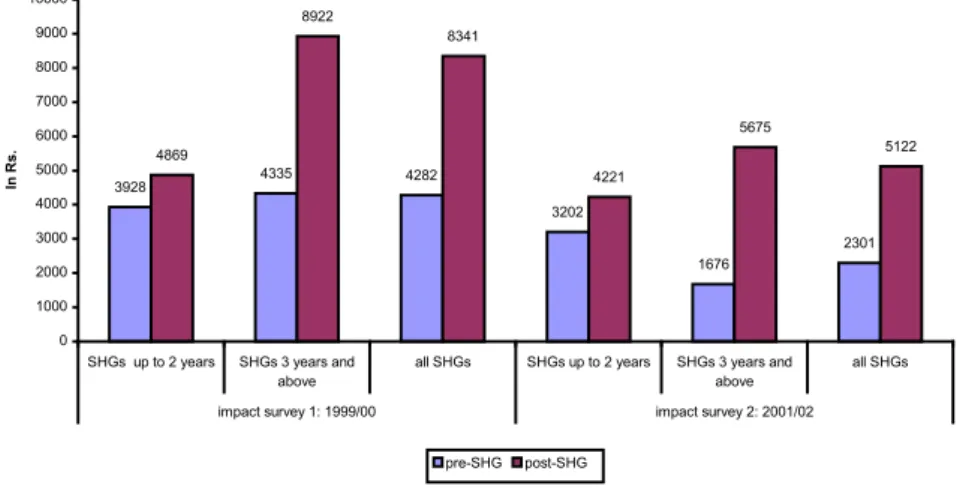
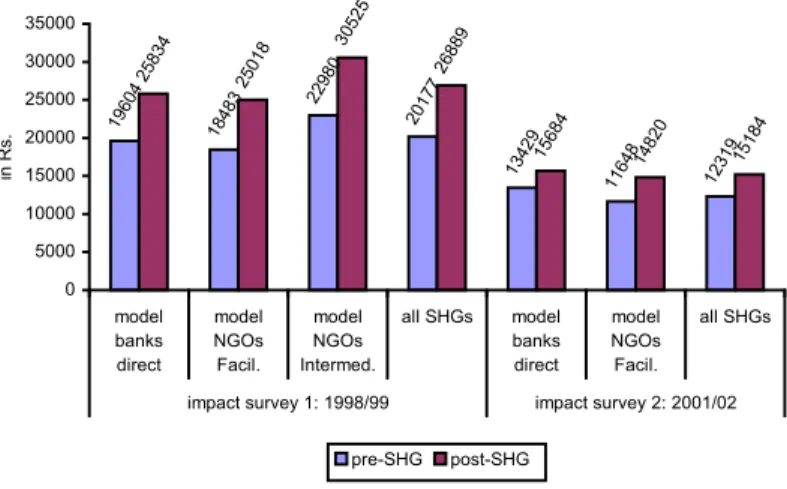
The improved access to financial services has benefited SHG members and their households in maintaining, intensifying and diversifying their economic activities, with positive effects on income and employment generation, especially in the non-agricultural sector. According to the overall study results average net income per household has increased within an average period of about three years by more than Rs. 6,000 or 32% to nearly Rs. 25,000. The share of households living below the poverty line has been reduced from about 50% in the pre-SHG situation to about 31% in the post-SHG situation. Thus, within an average three-year period, nearly 20% of all sample SHG members have raised their income levels above the poverty line (MDG 1). The financial services and their impact on incomes also raise the capacities of SHG members to increase their household expenditure for basic needs such as better nutrition (MDG 1) as well as for education (MDG 2) and health (MDGs 4 to 6).
With about 90% a very high share of microfinance clients of the LBP are women. Membership in SHGs credit-linked to banks contributes substantially to human capacity building and women’s empowerment. The women members have become more competent and more self-confident; they also participate more in family decision-making. By creating opportunities for communication and co-operation among group members, SHG membership and active participation in group affairs has improved capacities for problem solving.
9 Wolfgang Hannover, Summary of Major Results from Existing Studie on the Impact of the
Microfinance Linkage Banking Program in India on the Millennium Development Goals. GTZ, Rural Financial System Development Project, India, Jan. 2005
However, involvement of women, who are mostly illiterate, in local politics is still rudimentary (MDG 3).
Sustainability, or resilience, of the linkage banking approach was found to be well established in many SHGs and can be verified through the better performance of older groups compared to younger ones in the different impact aspects investigated in the studies. There are clear indications that with increasing age of the SHGs performance in terms of poverty reduction continues to improve.
Five major recommendations have resulted from the synopsis of the impact studies:10
(1) More efforts need to be geared towards institution building including the strengthening of group functioning in existing SHGs as well as the promotion of federal structures of SHGs. (2) There is a need for the development of more effective management information systems to promote the further consolidation of sustainable financial service delivery through well performing SHGs.
(3) The future strategy should also focus more on training and capacity building of SHG members as it would improve the productivity of financial service delivery.
(4) For reducing apparent regional imbalances in linkage banking more emphasis should be put in future strategies on widening the outreach of the programme on the Central and Eastern Regions of the country. To increase the effectiveness such outreach strategies may have to include different delivery models.
(5) SHGs role in development could be further enhanced through an increased involvement in development programmes in the area.
All five recommendations have been reiterated and confirmed in the discussions held in the mission during March 2005.
1.3 Objectives and conduct of the impact study phase II
The unprecedented scale of SHG banking and its enormous potential for further growth, within India and without, raises the question as to the dynamics of its evolution, of the forces within India behind it, and of the contribution of external organizations. It would be a major historical project to fully investigate the evolution of linkage banking in rural India. In this study we focus on the interaction between NABARD as the driving force in India; APRACA as a regional communication forum and disseminator during an early but crucial phase; and GTZ as a technical assistance agency which first helped develop the concept of linkage banking, then supported pilot-testing and communication on a regional basis, and finally entered into a bilateral assistance project with NABARD.
This is not the story of a development agency with a brilliant idea, planning a project, setting up a project structure from donated resources (or a loan) and, in due course, turning over “the project” to the partner – together with an evaluation report which raises the question of sustainability. Sustainability, development agencies have learned the hard way, will not come unless built into the process from the beginning. The case of SHG banking in India is special: except during the recent phase of rapid expansion, there was no separate donor-financed project; yet, without GTZ’s investment into the linkage approach, the SHG Banking program in India might not have taken off in this form, with such speed and with such outreach. So,
10 Wolfgang Hannover, Summary of Major Results from Existing Studie on the Impact of the
Microfinance Linkage Banking Program in India on the Millennium Development Goals. GTZ, Rural Financial System Development Project, India, Jan. 2005
how did it start, how did it evolve, and what kept it growing? What has been GTZ’s role in the various phases of the evolution of the program? And, with a view to the future: what should be the role of donors and the shape of donor support in an advanced developing country, or Ankerland (anchor country), like India?
This study is mainly based on discussions during 11-25 March 2005 with management personnel predominantly of NABARD involved in SHG banking, held in Mumbai, Chennai, Hyderabad and Delhi;11 and documents of GTZ, APRACA and NABARD on the prehistory, concept and evolution of SHG banking.12 Invaluable insights into the origins, pilot testing and
mainstreaming of SHG banking in India were gained from in-depth discussions with Mr. Y.C. Nanda and Dr. Prakash Bakshi, the original architect and master builder, respectively, of SHG banking in India. A view of future perspectives of SHG banking in India and of the scope of future collaboration with GTZ was gained from discussions with Madam Rajana Kumar, Chairperson of NABARD, Mr. Y.S.P. Thorat, Managing Director, and Dr. K.G. Karmakar, Executive Director. The author is particularly thankful to Mr. Sukhbir Singh, Chief General Manager, K. Muralidhara Rao, General Manager, Krishan Jindal, Deputy General Manager,Dr. B. S. Suran, Deputy General Manager, and the staff of the Micro Credit Innovations Department (MCID), the management unit at NABARD established for the management and development of the program. Substantive discussions on the design and the results of the study were held with Marie Luise Haberberger, team leader, Jan Meissner, junior expert, and R.V. Ramakrishna, project manager seconded by NABARD, of the GTZ Rural Financial System Development Program, in Delhi.13 Numerous discussions were held
during this mission, also with senior managers from Andhra Bank and Indian Bank.
2. A paradigm shift in rural finance in India and Germany 2.1 Prehistory
The roots of the SHG-Bank Linkage program expand far into the past. An appreciation of the interaction between the Indian and German development partners and the resulting financial innovations would not be complete without a historical perspective. Moreover, the
contribution of GTZ can only be assessed within the overall framework of NABARD’s own initiatives.
In India, the lack of rural development has been attributed since the 1950s to a lack of production assets among the rural masses and to a lack of access to credit to finance such assets. Private banks that should have provided such credit were absent from rural areas; and informal finance, through moneylenders and rotating chit funds, was wholly inadequate. 80% of the population lived in rural areas; 40% of GDP was contributed by agriculture; but only 2.2% of total credit went to agriculture – almost exclusively to medium and big farmers. To remedy the situation, the Union Government of India took three related measures in 1969: the nationalization of 14 private banks (followed by another six in 1980); the requirement to open two rural branches for every urban branch; and a mandatory system of priority sector lending.
11 This included the two persons with the longest and strongest involvement in the preparation,
introduction and mainstreaming of SHG banking in India: Prakash Bakshi, the former managing director of MCID and now in Chennai, who has been involved since 1980; and Yogesh C. Nanda, the former chairman of NABARD, who has been involved since 1990 and took personal responsibility for the adoption of SHG banking in India.
12 The documents are kept in the archives of the Development Research Center (AEF) of the
University of Cologne. The author has been personally involved in the process of developing and pilot-testing the linkage model since the early 1980s.
13 This program was preceded by the GTZ Linkage Banking Project (team leader: Brigitte Klein),
implemented since January 2000. The current program has two components: (i) Linkage banking and (ii) Revitalizing of the Cooperative Credit Structure.
A stocktaking in India in 1975 revealed that as a result of the institutional expansion policy, 10,882 rural and semi-urban branches had been opened; yet the poor still lacked access to credit. It was concluded that rural branches of large commercial banks, be they private or public, are thus not the right answer. Hence, the government introduced a new network of Regional Rural Banks (RRBs), regulated and supervised banking institutions with a low capital base of around $250,000, each covering with its branches a designated service area of 1-3 districts. Each RRB is owned by government and by a government-owned commercial bank, acting as a sponsor bank and providing the top management, while branch staff, with local knowledge and language skills, comes from the local area. By 2005 there were 196 RRBs with a rural branch network of 14,000, including 12,084 rural and 1,875 semi-urban branches. Yet the problem persisted: RRBs and cooperative banks catered for farmers, not the vast numbers of landless, migrant laborers and illiterate women.
Germany’s experience during that period differed widely from that of India. The massive capital transfer through the Marshall Plan led to Germany’s economic miracle and its ascendance to the rank of the world’s third-largest economy. A government-owned development bank, Kreditanstalt für Wiederaufbau (KfW), played a crucial role in the channelling of investment capital through the banking system. When Germany joined the donor community in the 1960s, KfW turned from recipient to provider of credit lines to an increasing number of government-owned development banks in developing countries. As in India, private commercial banks were absent in Germany from rural areas well into the 1960s. But unlike in India, two major informal self-help initiatives, one during the second half of the 18th and the other one during the middle of the 19th century, had evolved into a wide
network of local banking institutions which now dominate the German banking sector. Among them are the ubiquitous cooperatively-owned Raiffeisen banks, practically one in every but the smallest village, and the community-owned savings banks, both under the banking law since 1934. Through these institutions – self-reliant, viable, sustainable and with outreach of 40,000 branches to virtually the whole population –, German farmers and small and medium entrepreneurs had access to a full range of financial services, including savings and credit. Concerning impact, this has led to a fairly balanced development of urban and rural areas and an economic structure in which 80% of employment is provided by the small and medium enterprise sector.
2.2 Searching for a new approach: from agricultural credit to rural finance
In 1981 the Reserve Bank of India (RBI) carried out the All-India Debt and Investment Survey, published in 1983. After years of massive branch expansion, policies of directing credit to the rural areas, massive self-employment programs, and large numbers of donor credit lines – among them over $1 billion from the World Bank with the requirement that at least 60% went to small farmers –, a total of 14 million small loans had been provided by banks, yet some 250 million of the rural poor had no access to formal finance, and 39% of rural indebtedness stemmed from informal sources.
At the same time, the German Ministry of Economic Cooperation (BMZ) reviewed its policy of channelling subsidized directed credit through government-owned banks and arrived at comparable conclusions world-wide as RBI did for India. Similar evaluations were carried out by the World Bank, USAID and other agencies – all with results most concisely expressed in a publication by Adams et al. (1984): Undermining rural development with cheap credit.
Donor agencies and Indian authorities drew opposite conclusions: while BMZ and other donors decided to cut off their credit lines to agricultural development banks, RBI
transformed its agricultural credit department into a new apex bank in 1982: the National Bank for Agriculture and Rural Development (NABARD), with responsibility for close to 150,000 rural financial outlets. Yet, the diverging conclusions marked the beginning of a
converging search for a new approach; they also marked the rise of a new agricultural apex bank in search of financial innovations for rural India.
In 1983, the staff of the Economic Analysis and Publications Department (EAPD) of
NABARD analysed the data of the All-India Debt and Investment Survey and concluded that, while India had one of the most complex rural financial infrastructures of any developing country, that system had failed to reach its objectives. Thus resulted the focal question: What is wrong with the system? This became the starting point of NABARD’s own research,
funded from its own research and development fund and augmented by grant components of ODA and SDC support. Here are some of the findings of the study:
Procedures of rural banks were complicated and costly. Eg, a loan application form was a 14-page document, requiring the help of informal scribes at the bank’s doorsteps.
The sole emphasis on production loans was ill-guided. Not only is money fungible; the dividing line between production and consumption expenses (eg, for health, education, food) is often purely theoretical.
Tiny savings exist; but the poor have no opportunity to deposit them. Transaction costs were prohibitive, both for the poor and the banks.
The standardized savings and credit products offered by the banks and their collateral requirements did not meet the needs of the poor. Eg, to lower transaction costs, banks gave loans which were too large for the poor to handle, and frequently timed to the convenience of the bank and not the borrower.
NABARD realized that programs with the poor have to be savings-led and not credit-driven; and that the poor have to have a say in their design. In the years to come they looked for new partners, new delivery systems and new financial products. One of these new partners was MYRADA, an NGO in south India, whose action research into credit management groups during 1985-88 was funded by NABARD jointly with CIDA. The study was based on a new paradigm: savings first – seen by NABARD as a departure from the microcredit world! Three options were discussed, all hinging on prior savings mobilization by the groups: matching grants, matching interest-free loans, or loans with interest. In search for a sustainable solution, NABARD opted for the latter.
3. Linking banks and self-help groups: a rural finance innovation
Around the middle of the 1980s, in both India and Germany, as in the international
development community14, there were thus notable beginnings of a paradigm change in rural
finance. The emerging paradigm had two major aspects: financially, bringing together savings and credit as the two sides of any dynamic financial intermediation process;
organizationally, bringing together government agencies, including government banks, with the private sector, particularly NGOs as facilitators and SHGs as grassroots organizations. In that way, the ground was prepared for a major rural finance innovation in which self-help groups would first mobilize their own resources through equity contributions and savings, transform these funds into loans to their members at self-determined terms and conditions and then, on the basis of their track record, get access to banks or other financial institutions, particularly for credit but also for other financial services including deposits.
In actual fact, the linkage model evolved initially in India and Germany in parallel. In India it evolved out of the action research project of NABARD and NGOs with what was called at the tie credit management groups, but lackedan analytical concept and an eye-catching term. In
14 Eg, the emphasis on savings mobilization and on “the links between the institutional sector and the
non-institutional sector” were also at the center of attention in the United Nations Symposium on Savings for Development, Yaoundé, Cameroon, December 1984 (published in 1986).
Germany, the actual development of the linkage model, which subsequently became a brand name, resulted from different inputs by researchers and German bilateral technical
assistance. The researchers, building on a wide variety of earlier studies of SHGs and
informal finance, suggested programs of upgrading SHGs as an indigenous basis of financial sector development, with the objective of improving their operations, adopting an appropriate legal status, forming networks and federations with services for their member organizations, and integrating them into the national financial system.15 GTZ however, as a governmental organization, found itself unable to work directly and exclusively with private institutions and suggested public banks, such as agricultural development banks and central banks, as partners, which in turn may link up with other financial institutions including private and rural banks. It was this compromise between researchers and bilateral TA which led to linking banks and self-help groups as a hybrid model.16 While linkage banking (a term introduced in
1989) was designated as a linkage model, it was meant to also incorporate aspects of two other approaches: upgrading self-help groups as informal financial institutions and
downgrading banks17, the latterterm adopted from the debate on appropriate technology in
the late 1970s.
In Germany 1983 marks the reorientation of financial sector development policy. A newly unit in the ministry, ES31, brought together three worlds of development: government agencies including GTZ and KfW, a wide variety of NGOs, and research institutions. The new
communication forum was backed by a parliamentary development policy commission favorably inclined to the emerging new concept of rural finance, encompassing savings and credit of both farmers and microentrepreneurs (variously called the informal sector or the crafts and small trade sector) instead of agricultural credit; and the inclusion of a variety of institutions, both governmental and non-governmental. 18 While KfW and GTZ had hitherto
only worked with government agencies in the developing countries, they now met with new partners: NGOs and SHGs19. One of the immediate results of this new coming together was
a ministry-financed research program mobilizing the intellectual resources of research
institutes: on such topics as savings mobilization, SHGs and informal finance, including basic research on formal and nonformal finance.20 It was found that SHGs acting as financial
15 H. D. Seibel: Indigenous Economic Cooperation and its Developmental Function in Liberia.
Cooperative Information (ILO, Geneva) 3/1970:7-53;
H. D. Seibel & U. Damachi: Self-Help Organizations: Guidelines and Case Studies for Development Planners and Field Workers, a Participative Approach. Friedrich-Ebert-Stiftung, Bonn 1982
16 H. D. Seibel & M. T. Marx: Linking Formal and Informal Financial Institutions: Indigenous Savings
and Credit Associations as Credit Groups. In: United Nations, Third International Symposium on the Mobilization of Personal Savings in Developing Countries 1984, Yaounde, Kamerun.
H. D. Seibel: Saving for Development. A Linkage Model for Informal and Formal Financial Markets. Quarterly Journal of International Agriculture, Vol. 24, No. 4, Oct. - Dec. 1985, pp. 390-398.
17 The term has now been largely replaced by downscaling, which is not quite appropriate as it
emphases the quantitative aspect only and ignores the qualitative aspect (in the sense of simpler and more down-to-earth financial technologies and delivery systems).
18 While mentioning names does injustice to those unnamed, there are three whose interaction turned
out to be seminal: Karl Osner at the ministry, Erhard Kropp at GTZ and Winfried Pinger at the Development Policy Commission of the parliament.
19 The concept of self-help groups (Selbsthilfegruppen) was not new in Germany. In fact it dates back
at least to the origins of the savings and credit groups (Darlehnskassenvereine) of the emerging cooperative movement around 1850. What was new was their recognition as an important instrument of either self-organization or the mobilization of large numbers of people hitherto out of reach of government organizations. It was not always clear to the NGO community whether this should be welcomed or regarded as an intrusion on NGO turf.
20 Kirsch, Armbruster & Kochendörfer-Lucius, Selbsthilfereinrichtungen in der Dritten Welt (Self-help
institutions in the Third World). Forschungsberichte des Bundesministeriums für Wirtschaftliche Zusammenarbeit 49, Weltforum Verlag, Köln 1983.
H. D. Seibel: Ansatzmöglichkeiten für die Mobilisierung von Sparkapital zur Entwicklungsfinanzierung: Genossenschaften und autochthone Spar- und Kreditvereine in Nigeria (Savings mobilization for development: cooperatives and indigenous savings and credit associations in Nigeria).
intermediaries were widespread throughout the developing world, though there were large differences in form, density and outreach. They were either of indigenous origin or introduced by governmental or nongovernmental organizations. Those SHGs which were of indigenous origin typically were self-reliant in terms resource mobilization and management, viable and, as a socialeconomic institution embedded into local law and culture, sustainable. In some countries, the institution in the form of rotating savings and credit associations had been in existence for centuries.21
In 1985 GTZ decided to carry out feasibility studies of linkages between banks and self-help groups. The first set of studies was carried out in Africa22, where financial self-help groups
were found in abundance, but no banking partners23. This was communicated to both FAO
and APRACA and led to a proposal for feasibility studies of SHG-bank linkages in Asia presented by APRACA24 at the SACRED III Consultation held by FAO in Rome during 17-22
September 1985 and submitted by H.J. Mittendorf of FAO to Karl Osner of BMZ for financial support.25
4. The emergence of SHG banking in India
4.1 The APRACA workshop in Nanjing: a trigger event
The decisive event which brought the linkage approach to the attention of policymakers and banks in Asia was the APRACA regional workshop26 in Nanjing, China, in May 1986,27 on
“Strengthening Institutional Credit Services to Low-income Groups”. At this workshop GTZ, through Dr. Erhard Kropp, presented the linkage model, building on the existing formal and nonformal financial infrastructure, with the following elements: SHGs as informal financial intermediaries; savings-based credit linkages with banks; informal groups holding savings and credit accounts in banks; NGOs (SHPIs) as social, and initially also financial,
intermediaries; flexible models of cooperation between SHGs, NGOs and banks as autonomous business partners, each with its own existing financial and institutional
Forschungsberichte des Bundesministeriums für Wirtschaftliche Zusammenarbeit 63, Weltforum Verlag, Köln 1984.
H. D. Seibel & M. T. Marx: Dual Financial Markets in Africa: Case Studies of Linkages between Informal and Formal Financial Institutions. Verlag Breitenbach, Saarbrücken 1987.
21 Eg, in China (hui), India (chit), Korea (kye) and Nigeria (esusu) (Seibel 1982)
22H. D. Seibel: Ländliche Selbsthilfeorganisationen in der Volksrepublik Kongo unter besonderer
Berücksichtigung der Ansatzmöglichkeiten für eine Verknüpfung informeller und formeller Selbsthilfeorganisationen mit der Entwicklungsbank CNCA (Rural self-help organizations in the People's Republic of Congo: linking informal and formal self-help organizations with CNCA (Caisse Nationale du Crédit Agricole). GTZ, Eschborn 1986
H. D. Seibel: Einheimische Selbsthilfeorganisationen im ländlichen Raum in der Republik
Elfenbeinküste unter besonderer Berücksichtigung der Ansatzmöglichkeiten für eine Verknüpfung informeller und formeller Finanzinstitutionen (Indigenous self-help organizations in rural areas: linking informal and formal financial institutions in Ivory Coast). GTZ, Eschborn 1986.
Seibel et al. 1986.
23 In Congo-Brazzaville, the newly established CNCA had a repayment rate of 4%. In Ivory Coast, a
project proposal had been prepared with BNDA, but the bank collapsed shortly thereafter as a result of a major fraud.
24 The project proposal, A Study on Transaction Costs in Linking Formal and Informal Rural Financial
Institutions, refers to an earlier study based on south-south academic cooperation and the involvement of a German NGO: H.D. Seibel & Ukandi G. Damachi, Self-Help Organizations: Guidelines and Case Studies for Development Planners and Field Workers. Friedrich-Ebert-Stiftung, Bonn 1982
25 Ref. PR 16/2 Germany IL 32/201, Oct. 8, 1985.
26 In cooperation with the Asian NGO Coalition, FAO/RAPA, UN-ESCAP and the Agricultural Bank of
China.
27 Report on the TCDC Workshop on Strengthening Institutional Credit Services to Low-Income
Groups. Nanjing, China 26-30 May 1986. Apraca Report No. 18.