Agile software development process
improvement in large organizations
Bart Leusink
August 20, 2012
Supervisor:
Marko van Eekelen Second assessor:Theo Schouten
Abstract
This thesis deals with software development process improvement in large organizations. CMMI is combined with agile practices and concepts from literature to obtain an agile CMMI framework. This framework is consequently tested in a case study at a large energy supplier in the Netherlands. The framework proved helpful in determining problems and opportunities for improvement in an existing software development process. This shows that an agile CMMI framework can help a large organization improve their software devel-opment process.
Contents
1 Problem Statement 3 1.1 Research methodology . . . 4 1.1.1 Literature Review . . . 4 1.1.2 Case Study . . . 4 2 Theoretical Framework 6 2.1 Software Engineering . . . 6 2.1.1 Waterfall . . . 7 2.1.2 Agile . . . 73 Challenges to Agile improvement 9 3.1 Team size . . . 9 3.2 Geographical distribution . . . 9 3.3 Entrenched culture . . . 10 3.4 System complexity . . . 10 3.5 Legacy systems . . . 11 3.6 Regulatory compliance . . . 11 3.7 Organizational distribution . . . 11 3.8 Degree of governance . . . 11 3.9 Enterprise focus . . . 12 4 Hybrid Agile 13 4.1 Adapted Base . . . 13 4.2 Risk based . . . 13 4.3 Cost/Benefit analysis . . . 14
5 Agile improvement models 15 5.1 4-Dimensional Analytical Tool . . . 16
5.2 Agile Adoption and Improvement Model . . . 17
5.3 The Agile Maturity Map . . . 19
5.4 Agile Adoption Framework . . . 20
6 Agile and CMMI 26 6.1 Causal analysis and resolution . . . 28
6.2 Configuration management . . . 28
6.3 Decision analysis and resolution . . . 28
6.4 Integrated project management . . . 29
6.6 Organizational process definition . . . 29
6.7 Organizational process focus . . . 30
6.8 Organizational performance management . . . 30
6.9 Organizational process performance . . . 31
6.10 Organizational training . . . 31
6.11 Product integration . . . 31
6.12 Project monitoring and control . . . 32
6.13 Project planning . . . 32
6.14 Process and product quality assurance . . . 33
6.15 Quantitative project management . . . 33
6.16 Requirements development . . . 34
6.17 Requirements management . . . 34
6.18 Risk management . . . 35
6.19 Supplier agreement management . . . 35
6.20 Technical solution . . . 35
6.21 Validation . . . 36
6.22 Verification . . . 36
7 Applying the Agile CMMI Framework at a large energy company 38 7.1 Results of the interviews on agile principle level . . . 39
7.1.1 Results . . . 39
7.1.2 Level of agility . . . 45
7.1.3 Suggestions for improvements . . . 45
7.2 Results of the interviews on CMMI process area level . . . 47
7.2.1 Results . . . 47
7.2.2 Suggestions for improvements . . . 51
7.3 Validation of the suggestions at a large energy company . . . 52
8 Reflection 53 9 Conclusion 54 10 References 55 10.1 Academic peer-reviewed papers . . . 55
10.2 Other . . . 58 A Interview questions 59 B Interviews 62 B.1 Interview 1 . . . 62 B.2 Interview 2 . . . 74 B.3 Interview 3 . . . 82 B.4 Interview 4 . . . 86 B.5 Interview 5 . . . 95 B.6 Interview 6 . . . 102 B.7 Interview 7 . . . 106 B.8 Interview 8 . . . 110 B.9 Interview 9 . . . 115
Chapter 1
Problem Statement
In software development, waterfall and agile are both trade-offs between speed and risk [27]. Where waterfall provides the more risk averse option at the cost of speed, agile is less disciplined and consequently a faster and more dynamic way to develop software. Agile software development in large organisations is an area of continuing research. In “Lots Done, More to Do: The Current State of Agile Systems Development Research” [1], Abrahamsson et al. state that more research is needed about the adaptability and extension of agile methods in large organizations.
In an effort to produce more, faster and at lower cost, an increasing number of large orga-nizations is switching to agile software development methods [52] because they seek an alternative to more traditional methodologies such as waterfall, which they find too cum-bersome, bureaucratic and inflexible [24]. There is common consensus that agile method-ology implementations need to be tailored to a specific organization while at the same time organizations need to adapt to an agile way of working. Many large organizations opt for an agile–waterfall hybrid approach, obtaining a balance between risk and speed that fits their situation [6].
It is, however, easy to create an agile–waterfall hybrid which is far from efficient or even problematic [9].
The use of process improvement frameworks such as CMMI [51] can help organizations continually improve their software development processes. There have been many articles about combining CMMI with Agile development [18, 40, 19, 15, 3, 47] but none of them go into detail about specific agile-waterfall hybrid implementations of the various CMMI process areas.
In this paper, I will combine CMMI with an agility improvement model to measure and im-prove agile processes. This provides large organizations implementing a hybrid method-ology a framework to improve their agility while at the same time maintaining or improving their process maturity.
My research question is: Can an agile CMMI framework help a large organization improve their software development processes?
1.1 Research methodology
1.1.1 Literature Review
I will start by reading up on existing literature regarding the adoption, successes and failures of agile software development methodologies in large organisations, as well as currently widely used and well-cited models for assessing the maturity of agile software development processes and improving them.
Based on this analysis I will then combine the agile principles behind these improvement models with CMMI to create a version of CMMI which can be used by large organizations to measure their current efficiency of agile-waterfall hybrid software processes as well as provide them with suggestions for process improvement. This requires I investigate the various dimensions in which a hybrid software development methodology can be tailored, what the specific choices between waterfall and agile approach entail and the correspond-ing consequences for the organization.
For example, the choice to not provide elaborate requirements up front has implications for the amount of customer involvement to arrive at the intended product. The same goes for documentation; not sharing knowledge explicitly through documentation puts more em-phasis on tacit knowledge sharing, which requires the organization to provide opportunities to do so.
Which choice is best for the organization is dependent on multiple factors as each choice has its advantages and disadvantages.
1.1.2 Case Study
To test the aforementioned agile CMMI framework I will use it to perform a case study at a large electricity corporation in the Netherlands. I’ve chosen to focus my study on the B2C department because it’s agile implementation is the furthest along and as such can provide a more interesting proving ground for my proposed model.
To assess the current agility of agile software development at the company I will use the indicators of the Agile Measurement Index [38] (see section 5.4 on page 20) to interview several stakeholders at different stages of the agile software development process. I’ve chosen to use this framework because it’s well-cited and has a very comprehensive list of indicators [50] I have reduced the 300 indicators from [50] to the 45 interview questions in appendix 10 on page 58. These questions are meant to detect the presence of the various agile practices and concepts discussed in section 5.4 on page 20.
Before and after I ask the stakeholders about the state of the various agile principles in the software development process in the organization, I will ask them whether they can name problems or things that can be improved in their current software development pro-cess. This way, I hope to get a fairly extensive list of problems that exist with the software development process.
I will annotate the interview answers with whether they provide evidence for a full implemen-tation of the agile practice or concept (+), a partly implemented agile concept or practice (+/-) or lack of an implementation (-). I will email the interviewees a copy of their annotated interview answers to assess whether they agree with my interpretation of their answers.
I will then use this information and the proposed agile CMMI framework to assess the agility of the software development process using the scoring method described in the indicators document of the agile adoption framework [50] and list opportunities for improvement in the software development processes of the B2C department. Every (+) annotation is worth 1 point for that specific agile concept or practice, every (+/-) is worth half a point and every (-) is worth no points. I will divide the amount of points for a specific agile practice or concept by the amount of annotations for that specific concept or practice to get a final score. If that score is higher or equal to 0.75 I will count the agile practice or concept as implemented.
Since the ultimate goal of both CMMI and Agile is maximizing value for the organization, the improvements proposed by an agile-CMMI hybrid model should contribute to the organi-zational goals. To determine whether my framework actually provides these improvements in practice, I will ask an agile expert to assess the applicability and value of the suggested improvements.
Chapter 2
Theoretical Framework
In this chapter I will discuss some of the important concepts which should be known when discussing agile software development process improvement. In section 2.1.1, the water-fall model is described. This is a traditional plan-based approach to software development process management. Agile software development is introduced in section 2.1.2. Ag-ile software development differs from waterfall in the fact that it uses short iterations to incrementally create software with a minimum of planning upfront.
2.1 Software Engineering
A commonly used definition of Software Engineering is coined by Friedrich L. Bauer in 1968: [31]
..
“
The establishment and use of sound engineering principles to obtain econom-ically software that is reliable and works on real machines efficiently. ..”
While this definition clearly establishes the desired end result, there are several software engineering process models to achieve this result.
There are a few common tasks in the software engineering process: [49]
• Requirements gathering: the developers sit down with the customer to talk about his demands for the product and to find out the purpose of the software.
• Design: in this phase the customer’s requirements are analysed and based on this a design for the software product is made.
• Coding: during this step the software is actually programmed and subsequently integrated.
• Testing: the software is examined for errors and it is verified whether the delivered functionality matches the design and customer requirements.
• Operations: the product is put to use by the customer and is supported by the developers.
While these steps are present in most software engineering projects, the way of imple-menting them can vastly differ between various software engineering process models.
2.1.1 Waterfall
In many organizations the waterfall model or a variant thereof is used. This model was first described by Winston Royce [37]. Royce suggested implementing multiple levels of feedback to improve robustness of the software development process and increase the chance of a successful result. However, nowadays the waterfall model is often seen as a model in which all steps in the project are executed sequentially. In practice, a pure sequential order of the steps of the waterfall model is often not possible. It is often difficult for the customer to know and articulate all of the requirements in the beginning of the project and since he is only shown the end result after a long development process, there is considerable risk of there being a mismatch between the end result and the actual wishes of the customer [49].
2.1.2 Agile
Agile software development is based on the much older practice of iterative and incremen-tal software development [22]. Iterative and incremenincremen-tal software development is based on the Plan-Do-Check-Act cycle, an easily understood and widely used model from quality management, popularized by W. Edwards Deming.
In the context of iterative and incremental software development, the steps in the software development process can be represented by the following parts of the Plan-Do-Check-Act cycle:
• Plan: the requirements are gathered and a single iteration is planned • Do: the plan is implemented
• Check: the project team reflects on the plan and it’s results
• Act: based on the “Check” step, improvements in the process are implemented Compared to the waterfall process model, iterative and incremental software development has shorter cycles in which the previously mentioned software engineering process steps are carried out to deliver a working piece of software at the end of the cycle. This principle is essential for agile projects since relatively small iterations allow for frequent evaluation of customer value and continuous improvement [46].
The termagile software developmentwas coined in 2001 by a group of 17 software devel-opers discussing lightweight development methods. The end result of that meeting was
The Agile Manifesto[46], a document outlining the purpose and principles of agile software development.
The writers of the agile manifesto value [46]:
• Individuals and interactions over processes and tools.
The writers ofThe Agile Manifestopropose to build projects around motivated indi-viduals and to trust them to get the job done when they get the environment and support they need. They believe that the best architectures, requirements and de-signs emerge from self-organizing teams.
• Working software over comprehensive documentation.
In agile software development, working software is the primary measure of progress. Customers usually don’t care about design documents and diagrams, they care whether they are delivered software that works as expected. That’s why in an agile software development process, the highest priority of the project team is satisfying the customer through early and continuous delivery of valuable software. Due to the high volatility of today’s project demands, this customer value needs to be reevalu-ated frequently. In large organizations, work on the specifications can take a lot of time and the end results are often obsolete by the time they are finished [24]. • Customer collaboration over contract negotiation.
While the writers of The Agile Manifestoaccept that contracts are often necessary and can provide some useful boundaries to the project, they point out that continu-ous customer collaboration is needed to make sure the team delivers what the client wants. Consequently, agile software developers should not expect a detailed set of requirements to be signed off at the beginning of the project, rather, they should gather a number of high-level requirements that is subject to frequent change. Since this is obviously not enough to design and code, this gap can be closed by con-tinuous collaboration between business people and developers. The most efficient and effective method of conveying information with and within a development team is face-to-face conversation since a lot of the required information is tacit knowl-edge, which is not easily codified. Many large organizations face problems related to requirements, which can be a strong driver for a move to a more agile software development process [24]. For example, when deadlines require that software de-velopment is started when only partial or high-level requirements are available, orga-nizations need to manage projects with incomplete requirements and find a way to better understand the end user’s needs.
• Responding to change over following a plan.
In a highly dynamic, competitive environment, faithfully following a plan instead of allowing for changing requirements can easily lead to an end product that no longer corresponds with the customer’s wishes. Allowing changing requirements –even late in development– can be a competitive advantage. Rapid changes in the require-ments and other environmental factors drives large organizations to seek a flexible software development process which is capable of adapting to volatile requirements [24].
While the writers of The Agile Manifesto do think there is value in the latter part of the statements, they believe that the first segment of the bullet point is more important. This distinction lies at the heart of agile software development [46].
In practice, there are many different ways in which these principles can be implemented. Currently, the most popular agile software engineering methodology is Scrum [52].
Chapter 3
Challenges to Agile improvement
Various authors [9, 24, 2] have described specific challenges that can prevent large orga-nizations from achieving higher agility or maturity. InAgile Software Development at Scale
[2], Scott Ambler mentions a number of complexity factors that exist when applying Agile strategies in large organizations. While each project will face a different combination of these challenges, they can be divided in the following 9 categories:
3.1 Team size
Large teams will work differently from small teams and need to be organized differently as well [2]. Many Agile practices are based on the assumption that teams are relatively small [7, 24]. With much larger teams, paper- and whiteboard-based processes as well as face-to-face strategies start to fall apart.
Some organizations have experienced successes with dividing labor within projects into smaller subteams and organizing teams-of-teams (e.g. scrum-of-scrums) [24, 21, 41, 52], where each subteam selects one member to take place in an overarching team, coordinat-ing the efforts of the various subteams. However, critics [9] argue that multiple 15-minute daily meetings can quickly become untenable. Some organizations [24] believe that the solution to this problem lies in minimizing the need for cross-team communication.
3.2 Geographical distribution
In the ideal agile physical setup, the team is in the same room to facilitate easy communi-cation [38]. However, in large organizations it is not uncommon for team members to be on different floors or even in different buildings. Frequent face-to-face communication be-tween the developers and the customer is crucial to achieve a high level of agility [38]. Just like with large team sizes, effective collaboration and knowledge sharing becomes more challenging when the team is distributed since agile processes that require face-to-face interaction can no longer be used as effectively [2, 24, 7]. This creates the need for more formal communication, such as meetings and documentation [24].
One solution to facilitate cross-team communication is the creation of team-of-teams [24, 21]. These have described in section 3.1 and the same challenges apply here as well.
When the organization uses outsourcing for a part of the project, additional challenges such as timezone differences and cultural differences can appear [2].
Forrester [52] reports that some organizations have successfully been able to mitigate these concerns by adopting technologies and techniques that support distributed collaboration, such as wikis and web conferencing platforms.
3.3 Entrenched culture
Large organizations have often strived for years to achieve stability by using optimized and repeatable processes and producing large amounts of documentation [33]. This has created an entrenched culture in which people, processes and policies can not be easily changed to accommodate a more agile way of working [2].
Due to the agile concept of team empowerment, team members in an agile development process often have additional tasks next to their standard development position descrip-tions. These tasks may require significantly more skills and experience from the developers [9].
Agile project management requires the project manager to relinquish a lot of the authority he previously enjoyed in favor of a more facilitative role [33]. If an agile implementation does not have significant buy-in from middle management, it is much more likely to fail, since middle management is critical in driving change in large organizations [39].
The evolutionary or iterative process of agile software development creates a level of un-certainty and ambiguity in long-term estimates [9]. With a completely agile way of plan-ning software development, which specific functionality will be finished can only be known shortly in advance but in large organizations business processes and infrastructure require near-perfect predictions of difficult to estimate tasks [9]. For example, departments in an organization need to know when new features or changes are finished to be able to do their job.
Since an agile way of software development requires a fair amount of customer collabora-tion, other departments need to allocate time to facilitate this collaboration to ensure that the resulting software meets their needs.
When traditional processes overlap or conflict with agile practices this creates double work, which greatly reduces agility [24].
3.4 System complexity
Large organizations often require large, complex systems which create the need for a viable architectural strategy [2]. The standard Agile practice of starting development before the requirements are well defined can lead to forgotten or misunderstood features in large, complex projects. Likewise, resources and time can not be easily estimated without a detailed plan.
While these risks might be acceptable for small or medium-sized projects, Agile ment of large, complex systems requires a different trade-off between risk and develop-ment speed.
Boehm and Turner [7, 9] proposed creating an Agile-Waterfall hybrid methodology based on the amounts of potential- and acceptable risk. See section 4.2 on page 13 more a more detailed description of their risk-based method of creating a hybrid Agile-Waterfall software development methodology.
3.5 Legacy systems
Large organizations usually have a number of legacy systems that can’t be easily changed by using an agile methodology because these systems often don’t allow their replacements to be built in an incremental way [9].
Another issue is the quality of the legacy system, since some legacy systems may have code that is poorly written and documented or which has degraded over the years as multiple people worked on it [2].
3.6 Regulatory compliance
Large organizations often have a multitude of regulations they have to comply with. A number of these regulations are external, for example imposed by the customer or the government. A few examples of these external regulations are financial regulations such as Sarbanes-Oxley and Basel III for financial risks and technical regulations such as ISO 27002 for security risks.
There are usually also internal regulations, such as CMMI and ISO 900x for process im-provement. These regulations can increase the documentation and process burden on a project and complying with them while remaining agile can be a challenge [2, 9].
To address this issue, an Agile-Waterfall hybrid methodology can be tailored to the organi-zation, ensuring that the project complies with all regulations while still benefiting from the use of Agile practices where appropriate. In chapter 4 on page 13 I will describe various methods for creating an organization specific blend of Agile and Waterfall practices.
3.7 Organizational distribution
Large organizations often hire consultants or contractors to help out with software devel-opment projects. Managing Agile software develdevel-opment processes and achieving high levels of agility becomes more difficult when the team is made up of people working for different departments or different companies [2].
3.8 Degree of governance
IT governance is closely related to regulatory compliance since IT governance usually leads to internal regulations. IT governance frameworks such as ITIL, CMMI and COBIT ensure alignment of IT with business goals and provide structure to the IT development and man-agement processes. The structure established by these frameworks may hinder agility improvement [2, 9]. Traditional forms of governance, such as contracts, milestones and progress measurement techniques may be inadequate to support the rapid pace of agile processes [9].
A solution to this is a more agile approach to governance. In chapter 6 on page 26 I describe an implementation of CMMI with Agile practices.
3.9 Enterprise focus
Large organizations often want to leverage common infrastructure platforms to lower costs, reduce development time and improve consistency. This requires effective architecture, portfolio management, business modelling and reuse disciplines.
Chapter 4
Hybrid Agile
Hybrid methodologies are software development methodologies which combine waterfall processes with aspects of agile methodologies. Many organizations choosing to imple-ment agile methodologies opt for a hybrid approach [52], where instead of strictly sticking to a specific methodology, they cherry-pick practices from several agile and plan-based methodologies. There are various methods for composing an Agile-Waterfall hybrid soft-ware development methodology from individual Agile- or plan-based practices.
In this chapter I will discuss some of the ways specific practices can be selected which best match an organization. In section 4.1, I will discuss the adapted base methodol-ogy of creating a hybrid methodolmethodol-ogy. A risk-based approach to choosing the amount of agility in a software development process is described in section 4.2. A method based on cost/benefit analysis is discussed in section 4.3.
4.1 Adapted Base
When using the adapted base methodology [20], teams choose a specific methodology -such as Scrum- and then evaluate each practice of that methodology to determine whether its purpose is congruent with the goals of the organization and project. If not, the practice can be removed or replaced with a similar practice from e.g. waterfall or another agile methodology. Boehm and Turner [7] argue that it’s better to start with a relatively minimal set of practices and only adding extra ones when they can be clearly justified by a cost-benefit or risk analysis.
4.2 Risk based
Boehm and Turner [7, 8, 9] proposed a method for creating a hybrid Agile-Waterfall method-ology based on risk management. Organizations should rate a project’s risks to determine which aspects of the software development process are better suited for a plan-based approach and which aspects can benefit from an agile way of working. Method selection is based on 5 dimensions:
• Personnel: How knowledgeable and collaborative are the developers?
• Dynamism: How stable or dynamic is the environment? Will there be a lot of re-quirements changes?
• Culture: Does the organization have a culture where people feel comfortable and empowered by having a lot of freedom or would they rather have their roles defined by clear policies and procedures? The challenges that the entrenched culture poses to agile implementation and improvement are detailed in section 3.3 on page 10. • Size: How many developers are in a team and how big is the software product? The
risks related to team size are described in section 3.1 on page 9. The challenges that large software products provide to the team are described in section 3.4 on page 10.
• Criticality: Wat is the impact of defects? Will bugs in the software cause loss of large amounts of money or even lives?
Depending on these factors, organizations can choose between plan-based- and Agile practices to create their own hybrid methodology, fitted to their organization.
The risk-based method does not explicitly say which software development practice cor-responds to which score in a specific dimension and measures only a few of the many possible obstacles to agile improvement.
4.3 Cost/Benefit analysis
The cost/benefit analysis methodology of creating an agile-waterfall hybrid is similar to the risk-based method, using cost/benefit considerations instead of risk analysis. Austin and Devin [5] propose comparing the benefits and costs of specific agile practices with their equivalent practices in other agile methodologies and traditional methodologies such as waterfall to find the practice with the highest benefit relative to its costs.
Chapter 5
Agile improvement models
Large organizations need to be able to determine the agility of their hybrid methodology to find out what can be improved.
The goal of agile improvement- or maturity models is to describe evolutionary stages in the agile adoption process with which organizations cannot only assess their current maturity level, but also gain insight in what’s next in the journey to more agility and discipline. In these models and frameworks, increasing maturity means the progression towards more agile practices.
Thus, for a maturity model to be useful for agile improvement, organizations have to be able to do two things:
1. determine the current state of the organization’s software development processes in the model
2. identify actions that can be taken toimprovethe organization’s software development processes relative to the model
It’s important that the model not only measures the current state of the team, but also mea-sures the environment in which it has to operate. The lack of customer- or management buy-in can severely hamper the agility of a software development team.
In this chapter, I will discuss a few proposed agile maturity/improvement models with re-spect to these two requirements. I will begin by discussing the 4-dimensional analytical tool in section 5.1. The agile adoption and improvement model -which uses the 4-dimensional analytical tool for its measurements- is analysed in section 5.2. In section 5.3, the agile maturity map will be described. Finally, in section 5.4 I will discuss the Agile Adoption Framework, which combines ideas from some of the previously mentioned agile maturity models.
I will also determine the usefulness of these models for large organizations with a hybrid software development methodology.
5.1 4-Dimensional Analytical Tool
The 4-Dimensional Analytical Tool (4-DAT) [35] is an analytical tool to measure the agility and adoptability of agile software development methods in practice. It is meant to be used by organizations to make decisions about the selection or adoption of agile methods. 4-DAT facilitates the analysis and comparison of agile methods from four perspectives:
1. Method scope characterization: this first dimension provides a set of key scope items on which methods can be compared at a high level. These items pertain to var-ious environmental factors in which the methodology has to work, such as business culture, project- and team sizes, styles of development and coding, technology- and physical environments.
2. Agility characterization: the second dimension provides a set of agility features with an agility measurement approach. Combined, these can be used to check the agility of methods at both a process level and a method practices level. This is the only dimension in the 4-Dimensional Analytical Tool that is quantitative.
3. Agile values characterization: in the third dimension, methods are compared by their support for the Agile values described in the Agile Manifesto (see page 8). Ma-turity in this dimension is determined by looking for practices that support the values described in the Agile Manifesto, as well as practices to keep the process agile and cost effective. In practice, hybrid methodologies are usually not completely compati-ble with the values from the Agile Manifesto, since they incorporate several processes from a more plan-based approach.
4. Software process characterization: the last dimension examines the practices that support product engineering processes and process management processes. This dimension is basically a very simple version of CMMI (see page 26).
5.2 Agile Adoption and Improvement Model
The Agile Adoption and Improvement Model (AAIM) [36] is a model for the adoption, as-sessment and improvement of agile software development processes. It can be used as a gradual road map for the adoption of an agile approach so that the required agile level can be achieved and improved over a period of time. Contrary to the Agile Maturity Map (see page 19), in the Agile Adoption and Improvement Model each level contains specific agile practices that need to be implemented successfully to achieve that level.
The AAIM consists of 6 maturity levels, ordered in three agile blocks, from basic to ad-vanced. At each block the agility measurement modelling approach of the 4-Dimensional Analytical Tool (see section 5.1 on page 16) is used to measure the degree of agility of the agile processes.
Agile Block: Agile-Prompt
Agile-Prompt is a starting point for basic Agile process practices in an organization. 1. Agile Infancy: At this level, only the basic Agile properties (speed, flexibility and
responsiveness) in a software development process are established in practice. Im-provement is focused on implementing iterative and incremental development and preparing the team and environment for further changes in the software development processes.
Agile Block: Agile-Crux
The Agile-Crux block consists of the core of the AAIM levels and is focused on the estab-lishment of key agile practices and properties in a software process.
What’s immediately noticeable is that the levels of the Agile-Crux block can be easily mapped to the points from the Agile Manifesto (see page 8).
2. Agile Initial: At this level the organization should focus on enabling communication and collaboration with developers, stakeholders and customers. This corresponds with the ”Customer collaboration over contract negotiation“ value from the Agile Man-ifesto.
3. Agile Realization: This level emphasizes the production of software over compre-hensive documentation. This is almost literally the value ”Working software over com-prehensive documentation“ from the Agile Manifesto.
4. Agile Value: At this point, the practices are established and focused on develop-ers and customdevelop-ers without ignoring tools and processes. This level corresponds to the agile value ”Individuals and interactions over processes and tools“ of the Agile Manifesto.
Agile Block: Agile-Apex
In this block, the focus is on further reducing production costs while maintaining or improv-ing the production quality.
5. Agile Smart: This level focuses on the establishment of a learning environment. Various agile methodologies provide guidance on how to integrate learning with the
software development process. Scrum does suggest implementing Communities of Practice and some organizations have had a lot of success with that [21].
6. Agile Process: At this level, the practices are focused on the establishment of qual-ity production with minimal resources and within a minimum time frame.
5.3 The Agile Maturity Map
The Agile Maturity Map [34] is a way of thinking about Agile adoption in terms of goals for Agile software development teams to help them assess the current maturity of their Agile processes and to provide them with a clear roadmap for implementing and improving Agile practices.
The Agile Maturity Map consists of the following five maturity levels:
1. Awareness: the team understands the improvement goals and their value
2. Transformation: the team demonstrates commitment towards achieving the im-provement goals
3. Breakthrough: the team now consistently uses Agile practices that satisfy the goals 4. Optimizing: the team makes continuous improvements in the goal area
5. Mentoring: the team is mentoring other teams in the goal area
While the Agile Maturity Map does not explicitly name the Agile practices belonging to each maturity level, it does provide five categories in which the use of Agile practices can be improved:
• Acceptance Criteria: increasing the quantity and quality of information communi-cated to the developers just in time for them to use that information in development • Green-Bar Tests and Builds: automated development builds and tests
• Iterative Planning: continuous planning
• Learning and Adapting: focus on improving skills and learning from doing
• Engineering Excellence: implementing or improving practices that improve the quality of the software
Each Agile software development team in the organization is tasked with assessing their maturity level for each of these categories and creating user stories based on these cate-gories which each present an improvement in the use of Agile practices within the team. Letting the software development teams decide on the improvement goal user stories helps the teams overcome their resistance to change and lets them implement the Check-and Act parts of the Deming cycle for continuous improvement on which Agile software development is based. However, many improvements in Agile practices are dependent on environmental factors, management or customers. The implementation of these agile practices or concepts requires organizational changes which in large organizations are hard to implement from the bottom up. However, since agile is a collaboration-oriented approach to software development, grassroots level buy-in is very important [39]. The Agile Maturity Map could therefore be used as a way to introduce new agile practices and concepts to existing agile teams.
5.4 Agile Adoption Framework
The Agile Adoption Framework [38] combines various aspects of the previously discussed maturity models and is intended as a structured process to guide organizations in adopting agile practices. As a part of this framework, the Agile Measurement Index contains clear indicators [50] for determining the agility of a specific software development process. The other part of the Agile Adoption Framework is a four stage plan to adopt additional agile practices. This plan gives organizations a clearly defined method of introducing new agile practices to teams to improve agility.
The five agility levels in the Agile Measurement Index are inspired from the core agile values and beliefs as
1. Collaborative: This level focuses on making the software development process more collaborative through enhancing communication and cooperation between stake-holders. Communication and collaboration lies at the foundation of agile software development and as such is represented by the “Individuals and interactions over processes and tools” and the “Customer collaboration over contract negotiation” values of the Agile manifesto (see page 8) .
2. Evolutionary: Evolutionary software development deals with the early and continu-ous delivery of software. Delivering software early and often is an important aspect of all agile methodologies as it corresponds with the “Working software over com-prehensive documentation” value of the agile manifesto (see page 8).
3. Effective: This level improves the development of high-quality working software in an efficient and effective manner.
4. Adaptive: The objective of this level is to make the software development process more responsive to change through multiple levels of feedback. This is related to the agile value “Responding to change over following a plan” from the agile manifesto (see page 8).
5. Ambient: This agility level focuses on establishing the ideal agile environment, a vibrant environment needed to sustain and foster agility in an organization.
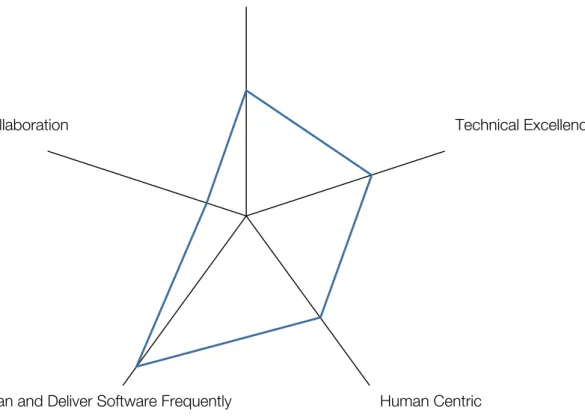
The following five dimensions are a distillation of the twelve principles from the agile man-ifesto (see page 8): Each dimension contains a number of agile concepts and practices, essential characteristics that must be included in the software development process before that process can be considered agile.
• Embrace change to deliver customer value: Agile methodologies measure the success of a software development effort on the extent to which it helps deliver customer value. Since some requirements that realize additional customer value can not be known beforehand, an attitude of embracing and welcoming change should be maintained throughout the software development process. This is reflected in the value of “Responding to change over following a plan” the agile manifesto (see page 8).
– Reflect and tune process: Reflecting about the process and tuning it are the check- and act steps of the Deming cycle and as such an important part of any agile methodology. This agile practice concerns whether management and
de-velopers are willing and able to reflect and tune the process after every iteration and release [50].
– Evolutionary requirements: Instead of gathering all requirements upfront and re-fusing changes when implementing them, agile teams try to decide on require-ments and features as late as possible. This agile concept deals with whether managers and developers can deal with the uncertainty associated with decid-ing on features and requirements as late as possible and whether managers and developers are willing to accept changes from the customer [50].
– Client driven iterations: Whether or not the customer has the power to dictate the scope of the iterations [50].
– Continuous customer satisfaction feedback: Whether the customer is encour-aged continually give feedback/criticism and rethink their requirements during the development process [50].
– Low process ceremony: Process ceremony is the level of paperwork involved with a process. It is important to keep the amount of process ceremony low to maintain agility. Large organizations may need to maintain a high process ceremony due to audits or regulations (see section 3.6 on page 11). This agile concept covers whether or not developers are trusted to make decisions on their own without explicit management approval [50].
• Plan and deliver software frequently: Delivering working software early and fre-quently is reflected in the agile value “Working software over comprehensive docu-mentation” from the agile manifesto (see page 8). This provides the customer with a functional piece of the product to review and provide feedback on, which in turn is essential for planning the scope and direction of upcoming iterations.
– Collaborative planning: Whether or not customers, developers and manage-ment plan together [11, 50].
– Continuous delivery: Incremental and iterative development [22] is an important part of any agile methodology. It means that the team has to deliver a working product after very iteration. This agile practice deals with whether or not man-agement and developers can handle and are willing to use an incremental and iterative development approach [50].
– Planning at different levels: Whether or not management is willing to commit to the process of continuously planning instead of developing a one-time plan upfront [50].
– Risk driven iterations: Whether the developers and managers agree to have risks drive the scope of each iteration [50].
– Plan features not tasks: In agile methodologies, planning implemented through the product backlog, a list of features that need to be implemented. This forces the agile team to think about the product at the feature level before separating the features in to tasks for the sprint backlog. This agile concept deals with whether the high-level agile planning is based on features instead of tasks.
– Maintain a list of features and their status (backlog): Whether or not manage-ment is willing to maintain an up-to-date list of all the remaining features for the
project and their status [50].
– Smaller and more frequent releases: Smaller and more frequent releases are an important part of any agile software development methodology since they give the customer quicker feedback, allowing him to intervene early in case require-ments are implemented incorrectly. This agile concept deals with whether the team delivers a fully functional release after every iteration [50].
– Adaptive planning: Adaptive planning is part of the act step from the Deming cycle and allows planning for the next iteration to be based on the customer’s feedback from the current iteration. This agile practice deals with whether or not management is willing to plan immediately before the iteration instead of earlier to allow the customer’s feedback to be incorporated into the planning [50].
– Agile project estimation: Whether or not developers are estimating the effort and duration of various user stories themselves [50].
• Human centric: The reliance on people and the interactions between them is a fundamental part of all agile methodologies [11].
– Collaborative teams: Whether or not people are willing to work in teams and help others [50].
– Empowered and motivated teams: This agile concept covers whether or not management has empowered teams with decision making authority and whether or not team members are motivated [50, 23].
– Self organizing teams: This agile concept is about whether management agrees to have organizing teams and employees feel comfortable working in self-organizing teams [50].
– Frequent face-to-face communication: Frequent face-to-face communication is one of the cornerstones of any agile methodology. This agile concept in-volves whether frequent face-to-face communication between team members is achievable [11, 50, 23].
– Ideal agile physical setup: Whether all the developers are in a common room, furnished to facilitate the agile process (i.e. whiteboards) [50, 23].
• Technical excellence: High-quality code is essential in an agile, fast-paced devel-opment environment.
– Coding standards: Whether or not coding standards exist and developers see the benefit and are willing to apply them [50].
– Knowledge sharing tools: Whether or not knowledge sharing tools, such as wikis are available and are used by the whole team [50].
– Task volunteering: Whether employees volunteer for tasks instead of being as-signed to them [50].
– Software configuration management: Whether or not the organization has tools for software configuration management [50].
– Tracking iteration progress: Whether or not a mechanism exists to monitor the iteration progress [50].
– No big design up front: Whether design is a continuous process or done once at the beginning of the development process [50].
– Continuous integration: Continuous integration [45] means that the product is automatically integrated and tested every time new code is added, which allows developers to find defects early. This agile practice is about whether or not the developers are willing and able to use continuous integration [50].
– Continuous improvement (refactoring): Refactoring is the discipline of improving the quality of code by modifying the internal structure of existing code without changing the external behavior. This agile practice deals with whether or not developers agree to adopt an approach of continuous software improvement and whether or not they are competent enough to refactor code without jeop-ardizing the quality of functionality of the code [50].
– Unit tests: Unit tests are tests of small individual parts of code. In agile software development, unit tests are very important, since they ensure that functional-ity doesn’t break when refactoring code. This agile practice is about whether developers are willing to write unit tests during development and have the com-petence and previous experience to do so [50].
– 30% of level 2 and level 3 people: Level 2 people are at the point of learning to break the rules, i.e. they have a level of software development method under-standing and use which enables them to tailor a method to fit a precedented new situation by using heuristics [7]. In addition, level 3 people are able to re-vise a method (i.e. break its rules) when they encounter an unprecedented new situation [7]. While level 2 people can function well when managing a small, precedented agile or disciplined project, they need the guidance from level 3 people on large, unprecedented projects [7].
– Daily progress tracking meetings: Whether or not management and developers are willing to meet daily to discuss the progress of the project [23, 50].
– Agile documentation: Since agile methodologies value “working software over comprehensive documentation” (see page 8), an agile approach to documen-tation entails writing minimal or “just enough” documendocumen-tation. In large organi-zations, this might not be possible due to regulatory requirements (see section 3.6 on page 11). This agile concept involves whether developers are willing and able to take an agile approach to documentation [50].
– User stories: User stories are an elicitation method/form for high level require-ments which in a few sentences capture thewho,what andwhy of a require-ment [9]. Regulatory requirerequire-ments for the elicitation of requirerequire-ments may pre-vent teams from using user stories. This agile practice is about whether man-agement and developers are willing and able to use user stories [50].
– Test-driven development: In test-driven development [13], a developer writes a failing automated test case that defines the requirement before implementing code to pass the test. This agile practice deals with whether or not the devel-opers are motivated and willing to apply test driven development and whether
or not management will encourage test-driven development and tolerate the learning curve [50].
– Pair programming: Pair programming [43, 14, 44] is a technique in which two programmers work on one workstation. This allows one programmer to review the code and design of the other programmer while the code is being typed in. Pair programming is an important element of extreme programming but can also be used within other software development methodologies. This agile practice deals with whether management can see the benefit of pair programming and whether or not developers are willing to try pair programming.
– No/minimal number of level -1 or 1b people on team: Level -1 people are un-able or unwilling to collaborate or follow shared methods [7]. Since collabora-tion and following shared methods are very important for the effectiveness of an agile team, level -1 people need to be identified to be able to get rid of this counterproductive mindset. Level 1 people are are still learning and need pro-cedures, heuristics or a set of rules to follow. Level 1b people can perform well in straightforward software development in a stable situation but are likely to slow down an agile team when dealing with rapid change [7]. This makes level 1b people ideal for work in a traditional software development environment but counterproductive in an agile team.
• Customer collaboration The agile manifesto value “Customer collaboration over contract negotiation” emphasizes the importance of significant and frequent inter-action between customers, developers and all other stakeholders of the project to ensure that the agile project satisfies the requirements of the customer.
– Customer commitment to work with developing team: Whether the customer is willing to dedicate time to take an active role in the project [50, 23].
– Customer contract reflective of evolutionary development: Whether or not the contract with the customer reflects that the system is developed in an iterative and incremental fashion [50].
– Customer immediately accessible: Whether a knowledgeable customer repre-sentative that is authorized to make decisions on the spot regarding the product is immediately accessible to the development team if needed [50].
– Customer contract revolves around commitment of collaboration: Whether in-stead of features, the customer contract revolves around commitment of inter-action and collaboration [50].
– Frequent face-to-face interaction between developers & users (collocated): Whether the frequent face-to-face interaction between developers and customer is achiev-able [50, 23].
The Agile Measurement Index contains indicators for every maturity level of a dimension [50]. This sets this maturity model apart from the previously mentioned models and gives organizations an easy way to objectively measure the agility of software development pro-cesses.
Agile Principles
Embrace Changeto Deliver Customer Value
Plan and Deliver Software Frequently
Human Centric Technical Excellence Customer Collaboration Level 1: Collaborative Enhancing communication and collaboration
Reflect and tune
process Collaborativeplanning Collaborativeteams Empowered and motivated teams Coding standards Knowledge sharing tools Task volunteering Customer commitment to work with developing team Level 2: Evolutionary Delivering software early and continuously Evolutionary
requirements Continuousdelivery Planning at different levels Software configuration management Tracking iteration progress No big design up front Customer contract reflective of evolutionary development Level 3: Effective Developing high quality, working software in an efficient and effective manner Risk driven iterations Plan features not tasks
Maintain a list of all features and their status (backlog) Self organizing teams Frequent face-to-face communication Continuous integration Continuous improvement (refactoring) Unit tests 30% of level 2 and level 3 people Level 4: Adaptive Responding to change through multiple levels of feedback Client driven iterations Continuous customer satisfaction feedback
Smaller and more frequent releases Adaptive planning Daily progress tracking meetings Agile documentation User stories Customer immediately accessible Customer contract revolves around commitment of collaboration Level 5: Ambient Establishing a vibrant environment to sustain agility Low process
ceremony Agile projectestimation Ideal agile physicalsetup Test-drivendevelopment Pair programming No/minimal number of level -1 or 1b people on team Frequent face-to-face interaction between
developers & users (collocated)
Chapter 6
Agile and CMMI
The Capability Maturity Model Integration (CMMI) for Development [51] is a model for soft-ware development process management. CMMI is comprised of a set of process areas, organized into maturity levels. Each process area consists of a number of goals An orga-nization has to implement practices to satisfy the goals of all process areas of a specific maturity level in order to claim its software development processes are at that maturity level. The CMMI document contains example practices for each goal but since these practices are based on traditional plan-based software development they are often in conflict with the values of agile software development.
Just like agile software development, the CMMI is based on the Plan-Do-Check-Act cycle popularized by Deming. Using this cycle, CMMI can be used as a model for continuous improvement of software development processes. However, CMMI is not intended to be used as a standard, and not all organizations will benefit from reaching the highest CMMI maturity level [47]. Instead, organizations should consider whether there is business value in satisfying the goals of a specific process area.
Since both Agile and CMMI are based on the Plan-Do-Check-Act cycle and CMMI and Agile share many of the same values [47], we can use this information to map agile practices to CMMI process areas [3].
Where CMMI describes whatshould be done, the various agile methodologies describe
how this could be achieved[47]. For each CMMI goal there are multiple possible imple-mentations from agile methodologies such as Extreme Programming and Scrum, but also from plan-based approaches such as waterfall. Since all these practices have their own advantages and trade-offs, organizations need to find a combination that fits their situation. To determine which approach is most suitable, organizations first need to determine their situation with respect to the obstacles to agile improvement [38, 7]. With that information they can choose a practice that matches each factor to fill in each CMMI goal. A few common approaches to choosing these practices can be found in chapter 4 on page 13. By mixing and matching CMMI goals with a combination of agile and waterfall practices, organizations can choose their own trade-off between agility and discipline.
To improve their methodology, they can try to eliminate roadblocks, which allows the or-ganization to implement more agile practices and work more efficiently. To help guide this improvement process, one of the agile improvement models (described in chapter 5 on
page 15) can be used.
The check- and act steps of the Deming cycle can be used to continuously improve the agile software development process by allowing experimentation with various possible im-plementations of the CMMI goals. This means we can use CMMI roadmaps to guide process improvement while using an Agile improvement roadmap to continually improve the agility of the software development practices implementing the CMMI roadmap. On the next few pages, I will describe an agile implementation of CMMI process areas, showing how agile principles relate to IT- and business processes. For each CMMI pro-cess area, relevant agile practices and concepts are emphasized. In order to meet the requirements of a CMMI process area, an organization must have practices implementing the goals of that process area. However, these practices do not need to be the ones de-scribed in the CMMI specification as the organization is free to propose alternative practices and appropriate evidence to meet a CMMI appraisal [3, 47].
6.1 Causal analysis and resolution
This process area deals with the identification of problematic or exceptional process per-formance and their consequences for process improvement. This corresponds strongly with the check and act steps from the Deming cycle.
The analysis of past performance to implement continual improvement is a crucial part of any Agile methodology [43]. CMMI mentions that everyone should be empowered to propose improvements, which is in line with the Agile way of thinking about optimizations. This is reflected in thereflect and tune processpractice from the agile adoption framework (see page 20). In Scrum for example, this is implemented as the Sprint retrospective. After each sprint, all team members reflect on the questions of what went well during the past sprint and what could be improved.
6.2 Configuration management
Software configuration management(see page 22) involves establishing and maintaining the integrity of work products. In agile projects, such configuration items are code, design, tests, requirements, drawing and specifications [14]. An example of a software configura-tion management tool is version control software such as Subversion or Git.
While configuration management is not specifically called out in any agile methodology, it is even more important in Agile than in more traditional software development methodologies due to the frequently changing environment.
To reduce the amount of work this process area takes for Agile teams, large parts of con-figuration management can be automated, especially when combining it withcontinuous integration(see page 23) [14].
6.3 Decision analysis and resolution
This process area involves the analysis of possible decisions using a formal evaluation process that evaluates identified alternatives against established criteria.
The focus on establishing specific processes for team functions in the practices of this process area is in conflict with the spirit of “Individuals and interactions over processes and tools” from the Agile Manifesto (see page 8). Decision making in agile projects is more complex than in traditional development environments since in agile projects decision making is a collaborative process.
Furthermore, agile projects should be able to adapt quickly to the situation rather than be bound to preconceived criteria, a strict evaluation of alternatives or decision analysis process [43].
In large organizations, having a formal process for taking difficult decisions can be very ben-eficial, especially if the issue being decided on can pose significant risks for the project or organization. The risk-based approach to establishing an Agile methodology (see section 4.2 on page 13) can help an organization decide whether a more traditional implementation of this process area’s goals is needed.
6.4 Integrated project management
The purpose of integrated project management is to establish and manage the project and the involvement of relevant stakeholders.
CMMI explicitly mentions the coordination and collaboration with relevant stakeholders. In an agile software development process, the continuing involvement of stakeholders and
customer commitment to work with the developing team(see page 24) is very important. This is why thecustomer contract should be reflective of evolutionary development (see page 24) andrevolve around commitment of collaboration (see page 24). The integrated project management process area deals with processes that make sure that the con-cerns of relevant stakeholders are addressed. Since Agile methodologies are focused on responding to change, it is easier to respond to stakeholders’ concerns than in more tra-ditional development methods. However this requires stakeholders to actively participate in the development process [33]. Frequent face-to-face interaction between developers & users(see page 24) -especially when collocated- ensures that the customer is imme-diately accessible(see page 24) to validate the product, clarify requirements and answer questions.
Agile software development methodologies embrace the empowerment of the software development team, which changes the role of the project manager from planning and controlling to facilitating the collaboration of team members [33].
6.5 Measurement and analysis
The purpose of this process area is to make sure that sufficient measurement capability is available to make informed management decisions. Measurement and analysis are the check part of the Deming cycle and as such well represented in both CMMI and Agile. Agile software methodologies continually measure both the product and the process used to create it to allow improvement.
Hartmann and Dymond [17] point out that traditional measuring methods such as used in the waterfall method can hamper performance in agile development. They propose that the key metric with which organizations measure agile performance is the amount of business value created for the organization.
Another useful and often used diagnostic is velocity, the amount of story points an agile team can process in a single iteration.
Another thing to measure is the agility and maturity of the software development process itself. This is described in more detail on page 15.
6.6 Organizational process definition
The purpose of the organizational process definition process area is to establish and main-tain organizational process assets, work environment standards, and rules and guidelines for teams.
Some people [43] consider an agile methodology as being essentially an informal process asset repository. For establishing an agile process asset repository, large organizations can use one of the approaches described in chapter 4 on page 13.
The work environment of agile teams needs to facilitate various agile processes. In theideal agile physical setup(see page 22) all the developers are in a common room, furnished with e.g. whiteboards to facilitate the agile process.
The rules and guidelines for agile teams differ significantly from those applicable to teams in more traditional software development environments. Self organizing teams (see page 22) can organize again and again in various configurations to meet challenges as they arise [11].
In a highly dynamic environment, team members in an agile team need to be able to re-spond to change quickly by being empowered to make some decisions without seeking explicit managerial approval. Therefore,empowered and motivated team members (see page 22 are important underlying concepts in the agile manifesto (see page 8.
The agile concept collaborative teams (see page 22) states that even more so than in traditional software development, agile practices require developers to work in teams and help each other.
6.7 Organizational process focus
This process area deals with planning, implementing and deploying organizational pro-cess improvements based on an analysis of the strengths, weaknesses, opportunities and threats of the organization’s processes and process assets. These process improvements improvements occur in the context of the organization’s needs and should be used to address organizational objectives.
The traditional infrastructure implied by the goals of this process area conflict with a more agile way of working [43]. Within a team or a project, Agile processes evolve under their own experience as part of the check- and act steps of the Deming cycle. An Agile example of soliciting input for this analysis is the sprint retrospective. However, in large organiza-tions it can become challenging to make sure these improvements are shared with all other projects. This problem can be solved by establishing organization-wide repositories con-taining best practices of previous projects [14] or creating communities of practice [21].
6.8 Organizational performance management
The organizational performance management process area is another manifestation of the check- and act steps from the Deming cycle, in this case specifically for the organization’s performance to meet its business objectives. To that end, organizations need to iteratively analyze performance data and implement improvements to close the performance gaps. Continually improving processes based on the performance to meet organizational goals is an important aspect of most Agile methodologies and the focus of thereflect and tune processagile concept (see page 20. For example, in Scrum the sprint retrospective pro-vides an opportunity for team members to identify practices that could be improved in the next sprint.
CMMI Level 5 advocates that the organization looks at where they are overdoing processes like documentation and then trim those back [27]. Examples of such agile software devel-opment process improvements arelowering the amount of process ceremony (see page
21) and taking a moreagile approach to documentation(see page 23), so that only “just enough” documentation is written.
6.9 Organizational process performance
Organizational process performance deals with establishing and maintaining process per-formance baselines and models needed for quantitative project management (see section 6.15 on page 33).
The idea of measuring a process and maintaining baselines and models conflicts with the spirit of “Individuals and interactions over processes and tools” from the Agile Manifesto (see page 8). However, Scrum has metrics which could be characterized as process met-rics [43] and can be used by large organizations to implement the goal of this process area.
6.10 Organizational training
The purpose of this process area is to develop the knowledge and skills of team members so they can perform their roles effectively and more efficiently.
Many authors agree that sufficiently training people is critical to agile project performance [27, 33, 6, 7]. The agile concepts of 30% level 2 and level 3 people (see page 23) and
no/minimal level 1 or 1b people on team(see page 24) ensure that the team members are sufficiently qualified and capable to work in an agile way.
Since Agile methodologies value individuals and interactions over processes and compre-hensive documentation, organizational knowledge sharing should reflect this. Therefore, an Agile implementation of organizational training should focus on training and mentoring [43]. Frequent face-to-face communication (see page 22) is essential for sharing knowl-edge between developers. This requires an ideal agile physical setup (see page 22) in which developers are located closely together in a common room.
Agile practices for sharing tacit knowledge are for example communities of practice [21] for organization-wide knowledge sharing andpair programming(see page 24) for sharing code-related knowledge.
Knowledge sharing tools (see page 22) such as wikis can help teams codify and share knowledge. By adopting these technologies organizations can overcome knowledge shar-ing challenges created by geographical distribution (see section 3.2 on page 9).
6.11 Product integration
Product integration is the assembly of the product from the product components and consequent delivery.
In software development projects following traditional software development methodolo-gies such as the waterfall model, the product is integrated and shipped at the end of development. This is in stark contrast with agile methodologies, which features smaller and more frequent releases (see page 22). In agile projects, product integration is a fre-quent -at least daily- activity and the agile concept ofcontinuous delivery (see page 21)
means that working software is shipped early and often. In extreme programming for ex-ample,continuous integration(see page 23) is an important practice to find defects early. Research [52] shows that while the agile discipline of always checking in working code to make sure the automated build doesn’t break is not easy to adopt, it will quickly pay off since it catches defects early and often. Since integration steps are performed very often, a thorough preparation of the continuous integration environment is critical [14].
To make sure interfaces between different components match, test-driven development
(see page 23) can be used. In this practice, tests are written before implementation to de-scribe how the interfaces should behave but without focussing on implementation details. When combining test-driven development with continuous integration, the continuously decreasing amount of failing tests can provide a powerful metric on the amount of imple-mentation work that remains to be done.
6.12 Project monitoring and control
This process area involves providing an understanding of project progress so that correc-tive actions can be taken when the project gets behind schedule.
While monitoring and taking corrective actions are crucial to the progress of any project, the practices CMMI suggests for doing so seem very oriented to traditional project man-agement [43]. However, agile methodologies provide excellent support for implementing this process area.
For example, Scrum uses burn-down or burn-up charts to show how much functionality is left to complete, while th
![Table 5.1: The 5 Levels of agility populated with agile practices and concepts (from [38])](https://thumb-us.123doks.com/thumbv2/123dok_us/28967.2503989/27.892.35.868.84.1059/table-levels-agility-populated-agile-practices-concepts.webp)
![Table 6.1: The 5 Levels of agility and relevant CMMI levels, populated with agile practices and concepts (from [38])](https://thumb-us.123doks.com/thumbv2/123dok_us/28967.2503989/39.892.22.851.50.1070/table-levels-agility-relevant-levels-populated-practices-concepts.webp)