The housing we’d choose
Renovating housing policy
Jane-Frances Kelly
Grattan Institute Support Grattan Institute Report No. 2013-12, October 2013
This report was written by Jane-Frances Kelly, Grattan Institute Cities Program Director. Jordana Hunter, Cameron Harrison and Paul Donegan provided extensive research assistance and made substantial contributions to the report. We would like to thank the members of Grattan Institute’s Cities Program Reference Group for their helpful comments, as well as numerous industry participants and officials for their input. In particular, we would like to thank Judy Yates, Owen Donald, Saul Eslake, Michelle Norris, Peter Verwer and Brenton Thomas.
The opinions in this report are those of the authors and do not necessarily represent the views of Grattan Institute’s founding members, affiliates, individual board members or reference group members. Any remaining errors or
omissions are the responsibility of the authors.
Grattan Institute is an independent think-tank focused on Australian public policy. Our work is independent, practical and rigorous. We aim to improve policy outcomes by engaging with both decision-makers and the community. For further information on the Institute’s programs, or to join our mailing list, please go to: http://www.grattan.edu.au/
This report may be cited as:
Kelly, J-F., Hunter, J., Harrison, C., Donegan, P., 2013, Renovating Housing Policy, Grattan Institute, Melbourne.
ISBN: 978-1-925015-46-1
All material published or otherwise created by Grattan Institute is licensed under a Creative Commons Attribution-NonCommercial-ShareAlike 3.0 Unported License
Founding members Program support Higher Education Program
Affiliate Partners Google
National Australia Bank Origin Foundation Senior Affiliates EY
GE Australia and New Zealand PwC Stockland Wesfarmers Affiliates Lend Lease Mercy Health Sinclair Knight Merz The Scanlon Foundation Urbis
Overview
Housing policy in Australia is overdue for a major renovation. Government tax and welfare policies, by favouring home owners and property investors over people who rent, are worsening the divide between Australians who own housing and those who do not. The divide is income-based and it is generational. While overall home ownership rates are stable or declining slightly, declines are much sharper among those with low-incomes or aged under 45.
This report looks at our complex housing system as a whole. By quantifying the major government outlays on the private housing system, it reveals the cumulative impact of housing policies both on individual choices of where and how to live, and on productivity and inequality in our cities.
Government subsidy of home ownership and property investment is skewed in favour of high-income households. They gain far more than others from tax concessions such as the land tax exemption on the family home, negative gearing and the capital gains tax discount. Much more government assistance is provided to buy investment properties than to buy a first home.
Current policies are not producing more home owners. Because supply has been constrained, first home buyer assistance has not only failed to increase ownership levels but may have pushed up prices, benefitting sellers and making it harder for many
households to own their first home. Policies that favour investors, such as negative gearing, increase demand for property and push up prices while doing little to increase supply.
Combined with rules that restrict development in established suburbs, higher prices force many households to buy on the city fringes, with poorer access to transport and jobs. This reduces opportunities for individuals and makes it harder for businesses to access skilled workers. It’s a rising form of inequality that
damages productivity and the fair go.
Winding back negative gearing and the capital gains discount would stop the artificial inflation of demand for investment properties and enable more people to buy their first home. Repealing stamp duty in favour of an annual property tax would greatly lower the cost of moving, making it easier to relocate for job opportunities, or to a more suitable home. It would also encourage the more productive use of land in our cities.
Meanwhile, more people – one in four households – are renting, and renting for longer periods of time. The lack of encouragement for longer leases in Australian residential tenancy rules
undermines stability for renters, many of whom have to move much more frequently than they would like. Renters don’t receive anywhere near the direct government support that home owners and investors enjoy. Greater security for renters, such as longer minimum lease periods and notice periods before a lease is terminated, would give this large and growing group a better deal, without materially reducing landlord returns.
At present, home owners profit from government outlays worth about $36 billion a year. Yet home ownership brings such benefits people would do it anyway. Reform won’t –and shouldn’t –
Table of contents
Overview ... 1
1.
Introduction ... 3
2.
Home ownership in Australia ... 7
3.
Renting in Australia ... 18
4.
Housing policies and their effects ... 22
5.
Conclusion and recommendations ... 35
1.
Introduction
1.1 Housing in Australia
Housing is of paramount importance to almost all Australians, for good reason. Housing fulfils many objectives, from basic shelter, to the emotional security of a refuge where a family can be nurtured, to an asset against which it is possible to borrow. As well as being important for individuals and households, housing is important in a broader economic sense. The return on the stock of residential dwellings accounts for eight per cent of GDP.1 Dwelling construction and housing finance are vital
indicators of economic performance. Land and transactions involving housing provide state and local governments with important tax bases. Housing is also central to monetary policy, with the effect of Reserve Bank (RBA) interest rate decisions flowing directly to mortgage holders.
However, along with transport and infrastructure, what gets built where and who lives where shapes the structure and functioning of our cities. It affects how far people are able to live from jobs, and the number of potential employees that firms have access to. It also affects how well we are able to match our current housing stock to people’s needs. In this way housing affects both the productivity and fairness of Australian cities.2
1 ABS (2012b) 2 Kelly, et al. (2013)
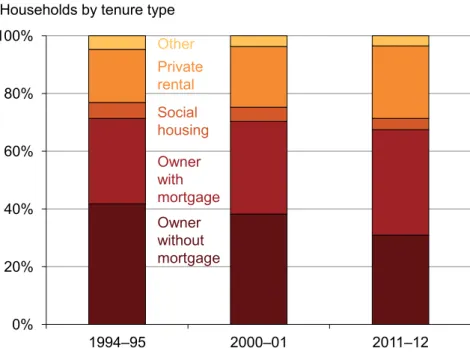
Figure 1.1: What kind of housing do people live in?
Source: ABS (2013d)
Despite housing’s critical role as economic infrastructure, which shapes the structure, productivity and fairness of our cities, no one part of government is tasked with understanding the complexity of the housing system. The Commonwealth is responsible for aspects of the tax and transfer system, such as capital gains tax exemptions and discounts, negative gearing
0% 20% 40% 60% 80% 100% 1994–95 2000–01 2011–12 Owner without mortgage
Households by tenure type
Private rental Owner with mortgage Social housing Other
rules and pension assets test rules. The states, meanwhile, charge land tax and also use stamp duty to raise revenue by taxing transfers of housing assets. Lastly, local governments collect municipal rates.
‘Housing ministers’, where they exist, generally look after housing – in particular social housing funding and management – as an arm of welfare policy. This role is undoubtedly important, but such housing comprises only a very small, and declining, part of overall tenure (see Figure 1.1).
1.2 What this report is about
The complex relationship between housing policy and other issues is a major theme of this report. Given the importance of Australian cities to future productivity growth and the maintenance of the fair go, as well as to individuals and households, it is
important to look beyond the noise of media coverage of housing and consider what is happening to housing as a whole. Our report asks:
What is happening to home ownership and private rentals?3
What do housing policies cost, counting both direct expenditure and tax breaks?
What effect do these policies have? Are there other side effects or unintended consequences?3 All references to home ‘owners’ include outright owners and those still paying
off a mortgage.
In making recommendations, we keep the following principles in mind:
All Australians should be able to enjoy a reasonable degree of housing security, irrespective of whether they own or rent.
Opportunities to own a home and build wealth should beexpanded, rather than entrenched (including between generations).
Incentives such as taxes and subsidies should not restrict or discourage new housing supply.
Individuals and the economy should benefit from the most productive use of land in our cities.Because so many Australians own their own home, debate about the future of housing policy matters to millions of people and can be very sensitive. Discussion of ‘housing affordability’ is a clear example. Politicians talk repeatedly of the need to improve affordability for younger households. Yet a fear of falling house prices makes the much larger number of people who already own their home wary of any change that might push prices down or slow their growth.
In any given year, roughly 120,000 people will become home owners for the first time. They would benefit from any policy that leads to lower house prices. But at the same time, over five million households (and eight million adults) already own at least one property.4 Policies that might result in lower house prices are not
in their interests. Former Prime Minister John Howard famously made this clear when he commented that he had never had anyone complain to him about the price of their house going up. In addition, for many people the family home is by far the
household’s most valuable financial asset. For many it also houses their most valuable emotional asset, their family. Unsurprisingly, then, philosophers have long thought about the importance of property ownership, and the role of the state in defending it (see Box 1.1).
The report does not take a view on an ideal level of home ownership in Australia, or whether people should own or rent. Nonetheless, home ownership rightly matters a great deal to many millions of people. Reform of housing policy settings is therefore a sensitive business, and it would be naïve to expect that change will be fast.
Nevertheless, it is important to understand the costs and consequences of current housing policy. Change over time – accompanied by careful and gradual transition arrangements – is possible. But to succeed it must be accompanied by public discussion and understanding of the issues, and what they mean for individuals and society, and for the next generation and the ones after that.
Box 1.1: Is property different? The political philosophy of home ownership
A strong philosophical tradition considers property rights – including home ownership – to be somehow different from other rights. Writing at a time when widespread property ownership did not exist, John Locke (1632-1704) contended that property is a natural right, since it is derived from labour: “the labour of his body and the work of his hand, we may say, are properly his." The right to life is inalienable (we own our own bodies), as is property (which we have obtained through the labour of our body). For many, this connection to the essence of our humanity gives property rights (such as home ownership) a moral force. Pitt the Elder expressed this inalienability in 1767: “The poorest man may in his cottage bid defiance to all the forces of the Crown. It may be frail – its roof may shake – the wind may blow through it – the storm may enter – the rain may enter – but the King cannot enter – all his forces dare not cross the threshold of the ruined tenement.”
The home is also a refuge to which we return from risk-taking forays into the outside world. When such entrepreneurial acts are productive, they create social benefits, and so property rights – in providing the security from which to act – are regarded as
fundamental to the functioning of a prosperous society.
Unlike his near contemporary Thomas Hobbes (1588-1679), who argued that government was required to prevent “a war of all against all,”Locke regarded the raison d’etre of government to be to protect individual property rights: the "great and chief end, therefore, of men’s uniting into commonwealths, and putting
themselves under government, is the preservation of their
property.”Locke’s arguments greatly influenced the American and French Revolutions, in both of which the right to vote was tied to the question of property.
Today many philosophers follow David Hume (1711-1776) in disputing the existence of natural rights, and consider that property rights exist because of (and to the extent that) the existing law, supported by social customs, secure them. 1.3 What this report is not about
The housing system is large and complex. This report therefore only focuses on some aspects of the system. Other parts of the system are important, but are not the focus of this report.
The report looks at how people’s experience of different kinds of housing tenure is influenced by Commonwealth and state
government policy settings, notably tax and expenditure settings, and residential tenancy legislation. It does not address policy settings that shape the market but with less obviously direct application to individual households, such as planning and zoning rules. Housing affordability and supply are strongly influenced by factors such as planning rules, construction costs and financing practices. These are all important issues, but they are largely beyond the scope of this report.5 Nor does the report look at
social housing, which represents a relatively small share of overall housing stock and is increasingly targeted at households with complex needs.
5 See Kelly
, et al. (2011) for an analysis of these barriers to housing supply.
Others have done much good work on these important issues, although more remains to be done.
1.4 How this report is structured
In Chapter 2 we look at home ownership in Australia. We consider its cost and benefits, look at how ownership rates are changing and at the main drivers of prices in the housing market.
Chapter 3 looks at the private rental sector: how big is it, who is living in it and why, and what circumstances do they face? Chapter 4 looks at government housing policies and their effects; we assess how much tax and transfer policies are worth and to whom, and look at other consequences of government policy for productivity and fairness.
Finally, Chapter 5 provides a conclusion and recommendations for an overdue renovation of housing policy in Australia.
2.
Home ownership in Australia
This chapter considers the benefits and costs of home ownership, and asks what is happening to home ownership rates. It then sets out the main reasons why house prices have increased so rapidly since the mid-1990s and how this has affected households’ ability to buy a home. Finally, it considers how preferences for owning or renting may be changing.
2.1 Why does home ownership matter?
Home ownership and security of tenure provide private benefits and costs that accrue directly to individual households. Home ownership can also create public benefits and costs that accrue to the broader community. The costs of home ownership, financial and non-financial, are less often recognised but they can be significant for some households.
Private and public benefits and costs often arise at the same time. Net private benefits encourage households to become home owners. Net public benefits are much more important in
determining what role, if any, government should play in housing. At a basic level, a home provides shelter, comfort and a sense of identity, a place to withdraw from the outside world. In theory, a home can provide these benefits whether it is rented or owned. In practice, home owners have more control over their surroundings and situation than do renters. In Australia, it is generally easier for owners than renters to personalise where they live in line with their needs and preferences – by renovating, putting up pictures,
gardening and owning pets, for example.
Owners may feel a sense of achievement and psychological reassurance because they are part of the Australian majority in a country where ownership is considered normal, and anything else seen as requiring explanation.6 For many, home ownership is a
touchstone of progress and prosperity. In this way, ownership can change the way a home is experienced.
Ownership can enable households to reduce their future housing costs considerably, once their mortgage is paid off. Building wealth through housing equity also helps households to prepare for retirement.7 The safety net that home ownership provides,
should people exhaust their retirement savings, benefits both retirees and the community.
Owning a home helps households build wealth in at least two ways beyond the tax concessions for home owners discussed in Chapter 4.
First, the owner-occupied family home can be used as collateral to borrow money at lower interest rates than those available to non-home owners. The ability of home owners to achieve higher returns from investments financed through debt helps build wealth. Second, taking on a mortgage is one way for households to commit to saving money and accumulating wealth, even though it is difficult to isolate whether taking on a mortgage changes
6 Senate Select Committee on Housing Affordability in Australia (2008) 7 Yates and Bradbury (2010)
behaviour, or merely represents households acting on a decision they have made to save and build wealth.8
While home ownership can be a source of personal wealth, it also exposes households to financial risk. Buying a home can require households to put most of their savings and considerable
leverage into one potentially volatile asset, reducing their ability to diversify risk. While returns to residential property as an asset class have been relatively stable in Australia, individual property values are more volatile.
Owner-occupiers, on average, move less often than renters. A 2010 survey found that 83 per cent of renters had moved at least once in the previous five years, compared to 28 per cent of owners.9 These greater levels of stability provide several benefits.
Stability reduces the need for children to move schools, enabling them to build long-term friendships and for schools to better understand and respond to their needs. However, existing research is equivocal on the contribution of home ownership – or security of tenure –to children’s development.10
Home owners are more likely than renters to be employed, though some research suggests that home owners’ relative lack of
mobility can, over time, lead to higher levels of unemployment.11
Australian research to date has only found evidence that home
8 Andrews and Caldera-Sánchez (2011); Productivity Commission (2004) 9 ABS (2010); ibid.
10 Boehm and Schlottmann (1999); Haurin
, et al. (2002); Leventhal and Newman (2010)
11 Blanchflower and Oswald (2013)
ownership increases the chances of unemployment for people in regional areas.12
Home owners appear to experience better health than renters.13
There is also some evidence that security of tenure reduces stress.14 Yet a recent Australian study found that home ownership
did not in itself improve mental health, only that happier and healthier people were more able to afford to purchase housing.15
Living in a home for a long time is likely to promote civic
participation because people want their community to be a good one to live in.16 Home owners are also likely to participate in their
communities to protect and increase the value of their asset.17 But
buyers seeking to buy into an area may be disadvantaged if existing home owners try to restrict new housing to increase the value of their assets.
2.2 So is home ownership good or bad?
While home ownership imposes some costs on households, the private benefits – especially the access to an effective form of savings and the ability to borrow against residential property for other investments – appear to be significant. Also important is the
12 Flatau P.
, et al. (2004)
13 AHURI (2002); Acevedo-Garcia
, et al. (2004)
14 AHURI (2005) .Note this study was of public housing tenants, who enjoy much
greater security of tenure than renters but whose economic circumstances typically differ from home owners.
15 Baker
, et al. (2012)
16 DiPasquale and Glaeser (1999) 17 Productivity Commission (2004)
stability and freedom ownership provides, compared to that experienced by renters under current rental settings.
Given the large private benefits of home ownership, it is not surprising that Australia and many other developed economies have such high rates of home ownership. Indeed, it is likely to be highly attractive regardless of the level of government support for it, as Chapter 4 discusses.
There is considerably less evidence regarding the net public benefits of high levels of home ownership. It may contribute to higher levels of public savings and the greater ability of
households to provide for retirement. This is a public benefit because it eases budgetary pressure on governments but it is only worth targeting if the government savings it produces are greater than the cost of providing support to home owners. Public benefits are also likely to arise from greater stability. Given current rental settings in Australia, high levels of stability are tied closely to home ownership.
2.3 What is happening to home ownership rates?
After World War Two, home ownership increased dramatically in Australia: from 53 per cent in 1947 to 72 per cent in 1961. For several decades afterward it remained at or close to this level.18 However, recent data puts the rate at 68 per cent, suggesting there has been a small decline (see Figure 2.1).19
18 Bourassa and Greig (1995); Yates (2011a) 19 Eslake (2013)
Figure 2.1: Historical home ownership rates
Source: Eslake (2013); Advisory Council for Intergovernment Relations (1982 ); Kryger (2009); ABS (2012a)
Australia’s aggregate home ownership rate hides large
differences for different types of households. Differences based on age (Figure 2.2) and income (Figure 2.3) appear to be growing. 50 60 70 80 1911 1931 1951 1971 1991 2011
Home ownership rate Home ownership rate (per cent)
Figure 2.2: Home ownership rates by age cohort
Source: Yates (2011a)
Ownership rates have always been lower for younger households. Historically, home ownership rates have increased amongst each cohort as people age. While this general trend has persisted, since the 1980 and 1990s ownership rates have started to fall for
all but the oldest households. The largest declines are among households in the 25-44 year bracket.20
It has been much debated whether this decline is simply due to younger households deferring home purchase (just as marriage and childbearing have increasingly been deferred), or whether other factors are at work. If it is simply due to deferral, ownership levels can be expected to bounce back over time as households age, although these households will still spend longer renting than their predecessors. But the decline in ownership rates among middle-aged households suggests deferral is not the only factor. It seems that not all households ‘catch up’ over time.21
Beyond the small fall observed recently, Australia’s overall home ownership rate has remained fairly stable. As older households are much more likely to own a home, the ageing population has propped up ownership rates. But as the Baby Boomer generation passes on, this effect may weaken if falls in home ownership among younger households persist. The result may be a greater decline in the home ownership rate in the future.22
Ownership rates also diverge based on household income. In the mid-1970s, rates across income groups were fairly similar. But there are now 25 per cent more home owners in the highest
20 In recent years, the proportion of households that own their homes outright
also declined from 42 per cent in 1994-95 to 31 per cent in 2011-12. ABS (2013d). Much of this decline is likely due to new mortgage finance arrangements, including redraw facilities. NHSC (2013) p 41.
21 Yates (2011a)
22 Flood and Baker (2010); NHSC (2013)
40 50 60 70 80 90 1981 1986 1991 1996 2001 2006 2011 25-34 35-44 45-54 65+ 55-64 Home ownership rate (per cent)
income quintile compared to the lowest income quintile (see Figure 2.3).23
Figure 2.3: Home ownership rates by income quintile
Source: Yates (2011a); additional data provided by Yates based on ABS 2011 census Finally, ownership rates vary depending on household
composition. Couple households (both with and without children) have much higher rates of ownership than other household types, which is not surprising given their higher earning potential.
23 Yates (2011a);additional data provided by Yates based on ABS 2011 census
Ownership rates for these households have remained fairly stable over the last 30 years. In contrast, the ownership rate for single parent households is much lower and has fallen significantly, from 60 per cent in 1981 to 49 per cent in 2011.24
2.4 Are houses harder to buy?
A common explanation for falling home ownership rates is that house prices are too high, especially in inner and middle ring suburbs in our capital cities. Indeed, discussion of housing policy is often driven by concerns about Australia’s ‘housing affordability crisis’.
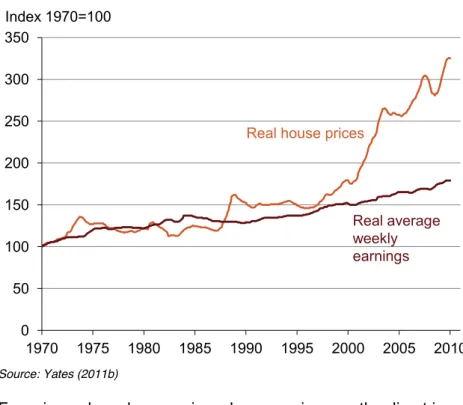
Between 1995 and 2012, real house prices grew on average by 4.3 per cent each year,25 significantly outstripping growth in household incomes. The RBA estimates that the average house price rose from 2.5 times the average disposable household income in 1985 to 4.5 times the average disposable household income in 2012.26 This delivered a large increase in wealth to the roughly 70 per cent of households fortunate enough to own at the start of this period.
24 ABS (2013b)
25 ABS (2013d). Based on median house prices. Between 1996 and 2003, real
house prices grew 8 per cent per annum on average. In contrast, between 1970 and 1996, real prices grew at an average rate of 0.8 per cent per annum. Fane and Richardson (2005) 26 Kent (2013) 50 60 70 80 1976 1981 1986 1991 1996 2001 2006 2011 Top equivalised income quintile Bottom equivalised income quintile Home ownership rate (per cent)
Figure 2.4: Real house prices vs. average weekly earnings
Source: Yates (2011b)
Focusing only on house prices, however, ignores the direct impact of falling interest rates on how much more households are willing to pay now than in the past.27In the 1970s and ‘80s, Australia was
a high inflation economy. But inflation dropped dramatically from the early 1990s, when the introduction of inflation targeting
allowed real interest rates to fall considerably. Greater competition among lenders lowered rates further. The RBA estimates that the
27 Tumbarello and Wang (2010)
decline in real rates allowed lenders to roughly double the size of loans relative to income without increasing the burden of
mortgage repayments on household budgets.28 This led to a
structural increase in house prices as buyers used their increased borrowing capacity to bid up prices over time.29
But this explanation for house price growth since the mid-1990s, while important, is not sufficient. House prices are a function of demand and supply. As Figure 2.5 shows, several factors, including population growth, smaller households, higher incomes and more attractive tax rules for property investors, have
increased housing demand. Supply has not responded as strongly, especially in established suburbs where development constraints are greatest.30 The mismatch between supply and
demand has further pushed up real house prices.
Australia has experienced more than two decades of economic growth. Unemployment has been low. Real wages and household income have grown strongly. The terms of trade boom, along with access to cheaper consumer goods, has freed up households to spend more on housing.31
28 Ellis (2013)
29 Ibid.; Productivity Commission (2004) 30 Kelly
, et al. (2011)
31 Tumbarello and Wang (2010); Minifie
, et al. (2013) 0 50 100 150 200 250 300 350 1970 1975 1980 1985 1990 1995 2000 2005 2010 Index 1970=100 Real average weekly earnings
Figure 2.5: Selected house price drivers
According to NATSEM’s 2013 Household Budget Report, over the last 25 years, household incomes grew 65 per cent more than the price of goods and services they consumed. As a result, the average household today is around $305 per week (almost $16,000 per year) better off than it was in 1988.32
As households get wealthier, they also tend to spend a greater proportion of their income on housing. This has meant households now can, and will, spend more to secure larger, better quality and better located homes.33
32 Phillips (2013)
33 Productivity Commission (2004)
Improving the size and quality of the housing stock pushes up prices. So does increased competition for houses that are closer to jobs, transport and amenities. Indeed, prices in inner and middle ring suburbs have grown much faster than in outer suburbs or on the fringe.34According to the RBA, in Australia’s
four largest capital cities house prices within five kilometres of the city centre have grown by about two per cent a year faster than prices on the fringe.35 This reflects the increased value of land
closer in.
Tax changes have also increased housing demand by making investment property more attractive. The combination of capital gains tax rule changes in 1999 and negative gearing has strongly increased the demand for investment properties.36 Investors
compete directly with potential homebuyers, particularly for established houses.37 This makes it harder for first home buyers
to secure a property.
34 Kelly
, et al. (2013)
35 Richards (2008)
36 In 1999, the indexation rules used to adjust capital gains for inflation were
replaced by a flat 50 per cent discount on capital gains. This made investments designed to produce medium-term capital gains, rather than a regular income stream, more attractive. Negative gearing allows investors to fully deduct costs associated with a rental property against their income, reducing their tax liability.
37 Note changes to superannuation rules since 2007 have also made investment
in commercial property in particular, but also residential property, more attractive to self-managed superannuation funds, further stimulating housing demand. RBA (2013) Long term interest rate environment Demand side factors Population and household size
Income and wealth
Tax rules
Residential investor demand and rental vacancy rates
Short term interest rate movements House prices Supply side factors Land availability and zoning Developer finance Construction costs
Short term interest rate movements
Why hasn’t supply responded to strong demand, thereby easing prices?
Housing supply tends to adjust slowly to changes in demand, due to the many steps and constraints involved in building new
housing stock. These include land release or rezoning, securing finance and approvals, construction and sales. Together, these contribute to a significant lag in the responsiveness of supply to increased demand. In some suburbs, the availability of land in which to build new stock is severely limited. As a result, increased demand for housing in these suburbs has a large impact on prices in those suburbs.
Grattan Institute’s 2011 report, The housing we’d choose, looked at barriers to supply.38 The only housing type that does not face
major disincentives on the supply side is detached housing in greenfield areas. But new supply on the fringe is an imperfect substitute for housing closer to the centre and may only have a limited impact on prices closer in.39
Governments’ role in increasing housing supply has also changed greatly since the post-war period. Between 1947 and 1976, Commonwealth and state governments contributed more than 20 per cent of the growth in housing stock. Then government contributions began to decline, both in proportional and absolute terms, and is now minimal. Policy has instead shifted to measures that inflate demand rather than increase supply. These include
38 Kelly
, et al. (2011)
39 Productivity Commission (2004)
assistance to first homebuyers and favourable tax treatment for investment properties (discussed in Chapter 4).40
2.5 Impact on households
For the 70 per cent of households that owned homes at the start of the price boom, the impact has been very positive. These households have enjoyed a significant, untaxed windfall gain from rising prices. They continue to benefit from house prices
remaining high.
On the whole, households that have bought more recently also seem to be coping reasonably well (see Box 2.1). To some extent, the fall in interest rates has moderated the impact of higher prices on household budgets. Indeed, as Figure 2.6 shows, mortgage repayments as a proportion of disposable income are relatively low compared to the last decade and are comparable to previous periods in the last 30 years.41 These averages inevitably mask
ongoing challenges for lower-income households.
40 Eslake (2013) 41 Kent (2013)
Figure 2.6: Loan repayments as a proportion of disposable income
Source: Kent (2013)
Note: Housing loan payments calculated as the required payment on a new 80 per cent LVR loan with full documentation for the nationwide median-price home; household disposable income is before interest payments.
Yet all this is little consolation to households that cannot raise the deposit needed to buy a first home or cannot secure a large enough mortgage based on their current income. As house prices have increased, so has the absolute size of the deposit required to obtain a mortgage. Yates (2011b) shows that for most of the 1980s, a home buyer needed to have saved around the
equivalent of a full year’s average income in order to secure a loan they could comfortably repay that was still large enough to purchase a median priced dwelling. By 2010, the median house price had gone up so much that the corresponding deposit size had increased to roughly four times average annual income.42
Prospective home owners clearly face more significant barriers than in the past. Government assistance to first homebuyers has largely failed to overcome the problem (see Box 4.3). Lower income households (and single income households) may find it particularly difficult to save a deposit without access to wealth from other sources, such as assistance from parents.43
42 Yates (2011b). Yates’ calculations are based on the difference between the
median house price and the amount a bank would be willing to lend a homebuyer based on a repayment rate of 30 per cent of the average annual income. Yates assumes a 25 year loan and standard bank variable rates.
43 Ibid. 10 15 20 25 30 35 40 1980 1984 1988 1992 1996 2000 2004 2008 2012 Per cent of household disposable income
Box 2.1: Housing affordability
A common indicator of affordability for home owners is ‘mortgage stress’, measured by the proportion of households that spend more than 30 per cent of their disposable income on repayments. Twenty-five per cent of households were under mortgage stress in 2010, up from 18 per cent in 2001.44
While some households clearly struggle with repayments, this measure ignores the fact that higher income households can choose to devote more of their income to repayments without cutting back on essentials.
A more useful indicator focuses on households in the lowest 40 per cent of the income distribution (the ‘30/40 rule’). In this group only 8 per cent of households with a mortgage were in stress in 2010, little changed from 7 per cent in 2001.45
Further, for many households, periods of mortgage stress are not persistent. One study found that less than half of all households that experienced mortgage stress between 2001 and 2005 were still in stress one year later, despite rising house prices and interest rates during this period.46
Yet these indicators provide only a partial view of affordability. They do not reflect other costs related to housing (such as transport) or the appropriateness of a house (such as size and proximity to schools and employment). More importantly, they
44 Rowley and Ong (2012) 45 Ibid.
46 Marks and Sedgewick (2008); Wood and Ong (2009)
only reflect the financial position of households that have already bought. They say nothing about those that want, but cannot afford, to buy.
2.6 Are preferences changing?
It is a long accepted view that Australians overwhelmingly prefer to own, rather than rent, their home. But for most households, the ideal outcome is not the same as the best possible outcome in the circumstances. Decisions always require trade-offs.47 Whether a
household buys a home depends not just on whether it can find one it can afford. It also depends on whether owning that home is preferable to renting elsewhere.
In light of these trade-offs, a growing proportion of households may prefer to rent rather than buy. This seems likely for households that value the better access to jobs, schools and amenities that established inner and middle ring suburbs offer, but that cannot afford to buy a house in these areas.48
It is difficult to identify the role that changing preferences might play in understanding the decline in home ownership rates.49 Yet
anecdotal evidence suggests that preferences in favour of owning are becoming somewhat weaker among younger households.50
47 NHSC (2013) 48 Ibid.; Kent (2013) 49 Yates (2011a)
Box 2.2: Unoccupied housing and foreign investment
Media commentary often questions the role of foreign investors in buying residential properties that may then remain unoccupied. Unoccupied dwellings include holiday homes, properties scheduled for redevelopment and homes that are between tenants. From 1996 to 2011, the proportion of unoccupied dwellings rose from 9.5 to 10.2 per cent (about 900,000
properties).51 In NSW, Victoria and Queensland, the majority of
unoccupied dwellings are outside capital cities.
Foreign investors can buy residential property in Australia, subject to approval from the Foreign Investment Review Board.
Temporary residents may only purchase one property as their place of residence. Foreign investors may only purchase
established properties for redevelopment. New dwellings may be rented out. These rules are designed to encourage investment in new housing supply and to limit property market speculation. According to the RBA, recent annual property turnover rates have averaged about 5 to 6 per cent of the stock – about 450,000 properties a year.52 In 2011, the foreign investment residential
review approved 9,665 applications to purchase residential property.53 Using this as a yardstick, foreign investors are only
responsible for around 1.5 to 2 per cent of the turnover in the housing market every year. In addition, they are only likely to own a small fraction of total unoccupied housing.
51 ABS (2012a) 52 Schwartz
, et al. (2006)
3.
Renting in Australia
More than 2.1 million Australian households – or one in four – rented privately in 2011-12.54 More than half (57 per cent) of all
households renting in 2007-08 had been renting for more than five years, and a third (33 per cent) for more than ten years.55
Portrayals of rental housing as a niche or transitional tenure before people pursue the ‘Australian dream’ of home ownership are therefore inaccurate. Renting is not just something that people do while saving for a deposit or studying.56
Some households choose to rent. It gives them flexibility to move more quickly in response to job opportunities, and a strong rental sector is therefore essential to an increasingly mobile modern economy. Renting avoids many of the transaction costs that buying a home involves. It also enables a more diverse
investment portfolio. Other households rent because they cannot afford to purchase a home. Social housing assists a small number of the most disadvantaged. But for many, rental is the only long-term option.
Whatever their motivations, renters miss out on many of the benefits of security of tenure that home owners enjoy. The difference in frequency of moving between owners and renters in
54 This section focuses on households in the private rental market, not in social
housing. Unless otherwise specified, in this section ‘renting’ refers to renting accommodation through the private market.
55 Stone
, et al. (2013)
56 For an example of changing norms, see Ferguson (2013)
Australia is the highest in the OECD.57 Renters often say they
would like to be able to personalise their housing to make it a longer term ‘home’, and to have more flexibility to have pets.58
Identifying ways to increase security of tenure for renters – as other countries have done – is sensible, especially when home owners receive considerable taxpayer subsidies, in part so that they can access this benefit.
Yet taxpayer support for investment in rental property through negative gearing and capital gains tax concessions has the opposite effect. By driving up prices and shaping a culture focused on capital gains, these measures hurt renters, while locking potential home owners out of the benefits of ownership. 3.1 Renting is increasingly common
Over recent years the proportion of households renting has steadily increased from around 18.4 per cent of households in 1994-95 to 25.1 per cent of households in 2011-12.59 An
increasing proportion of people in middle age and beyond continue to rent. Between 1981 and 2011, the median age of the
57 Caldera-Sánchez (2011) 58 rent.com.au (2011)
59 ABS (2013d). Close to half the households in Australia were renting in 1947.
head of renter households increased from 32 to 37 years (a much more dramatic increase than for the population as a whole).60
Couples (with and without children) comprised about 45 per cent of renters in 2011. The profile of other renters has diversified. Between 1981 and 2011, single person households declined from 40.4 to 25.0 per cent of all renters, while single parent households (6.3 to 16.0 per cent) and group households (4.2 to 10.5 per cent) increased.61
Rental housing is more diverse in terms of structure than owner occupied housing. About 54 per cent of rental households – but 85 per cent of owner occupiers – live in detached housing. About 37 per cent of rental households live in medium density housing such as units, terraces, and blocks of flats of three storeys or less.62
3.2 Renters face insecurity and instability
A 2010 survey found that 83 per cent of renters had moved at least once in the previous five years, compared to 28 per cent of owners.63 While renters move for a wide range of reasons, overall
they are moving much more frequently than they want to. In 2007-08, 11 per cent of renters indicated they wanted to move in the next year – much lower than the 60 per cent who had actually moved in the previous year.64 Of those renter households who
had moved home in the previous five years, 32 per cent
60 ABS (2013b)
61 Ibid. See discussion in Stone
, et al. (2013) for further analysis.
62 ABS (2012a) 63 ABS (2010) 64 Hulse
, et al. (2011)
characterised the move as forced or constrained, compared to 11.1 per cent of owners and public housing tenants.65
Renters want stability and security of tenure for the same reasons owners do. A stable location enables children to stay in the same schools, and households to stay connected with their family, friends and community. In contrast, moving frequently is
inconvenient and expensive. It inhibits planning for the future, as does the ongoing threat of having leases terminated or not renewed. Low-income renters are especially vulnerable. Rents have increased substantially in recent years. From 2002-2012, average nominal rents increased 76 per cent for houses and 92 per cent for other dwellings (mostly flats and apartments). Average nominal earnings increased 57 per cent and house prices 69 per cent over this period.66
Many lower income renters struggle to afford their rent. In 2009-10, 67 per cent of capital city renters in the bottom two income quintiles paid more than 30 per cent of their gross income in rent, and 31 per cent paid more than half their gross income in rent.67 Further exploration of this important issue is beyond the
scope of this paper.
Most rental tenancies are governed by a six or 12-month lease, or on a month-by-month basis following the expiry of the initial lease. Regulatory settings are specified in state legislation, and there are no legal restrictions on longer leases. Low vacancy rates –
65 Stone
, et al. (2013)
66 NHSC (2013) 67 Ibid.
exacerbated by the pressure on many tenants to reach agreement and get a roof over their head in a short time – typically give landlords much more bargaining power than prospective tenants. As a result the length of residential leases in Australia is usually the legal minimum, giving landlords maximum flexibility to increase rent or sell the property.
Even without a breach by the tenant, landlords can terminate leases on grounds such as moving in themselves or selling the property, generally with 30 to 60 days notice.68 In part this may reflect investors’ favouring of capital gains over rental yields. Capital gains can only be realised by selling the property, so investors benefit from having as few constraints on selling as possible.
In contrast, Australian commercial leases – even for small businesses and sole traders – typically involve longer terms and frequently include options to renew. Commercial property is also frequently sold to investors with a tenancy underway, whereas residential sales can be preceded by eviction of tenants.
Along these lines, a 2008 Senate inquiry found that ‘leases with longer and more secure tenure can help generate social benefits attributable to home ownership.69 Many other countries have such
settings in place. Figure 3.1 shows that in these countries longer lease terms, more narrowly defined reasons for eviction, and longer notice periods are common.
68 Hulse
, et al. (2011)
69 Senate Select Committee on Housing Affordability in Australia (2008)
Figure 3.1: Typical rental conditions in selected countries
Source: Scanlon and Kochan (2011); Hulse et al. (2011)
Moreover it appears that a shift to such arrangements can occur without undue disruption for landlords or the housing market. In 2004, Ireland moved from arrangements similar to Australia’s towards improving security of tenure for renters. The standard lease moved from 6-12 months to a legally prescribed four years, though landlords and tenants can terminate a lease in the first six months with 28 days’ notice. After that time, landlords can only terminate the lease on more narrowly prescribed grounds. Notice
Notice period for landlords Reasons lease can be terminated Typical lease term
Pet ownership
Minor alterations (putting up pictures, laying carpet, painting)
Permitted –considered normal use
Only with landlord’s consent
Tenant entitlement Only with landlord’s consent
Non-payment/misconduct only
Any reason with notice Landlord selling/moving in
3 months or more 2 months 30 days Indefinite 2-3 years 6-12 months
Germany Netherlands France Hong Kong UK Australia
Germany France UK Hong Kong Australia (generally)
Netherlands Germany
UK Australia
(generally)
Germany USA (some states, eg New Jersey) Australia
Germany Netherlands Australia
Subject to restrictions
USA (some states, eg New Jersey) France
periods increase in line with the length of the tenure.
It is not possible to disentangle any effects these changes may have had from the dramatic impact the global financial crisis had on the Irish housing market. But there does not appear to have been any adverse impact on the supply of private rental housing: since the reforms were introduced in 2004 the Irish private rental sector has grown substantially as a proportion of all housing.70 As
in Australia (and Germany), the Irish rental market is dominated by small individual investors.71
3.3 Policy also limits renters’ capacity to ‘make a home’ Renters do not enjoy the same capacity to ‘make a home’ as owners, and typically can only make minor alterations at the discretion of the landlord.72 There are few rewards for tenants who
improve their housing or devote time and money to keeping it in good condition.
Many renters express a desire to keep pets for companionship.73
But many landlords and property managers have blanket rules against pet ownership, even in circumstances where it presents little or no risk. Other countries do not so severely restrict tenants’ capacity to make a home. For instance, in Germany renters can ordinarily keep small animals and make small holes in the wall to hang pictures.74
70 Ireland Central Statistics Office (various years) 71 Ibid.; Hafner (2012) 72 Hulse , et al. (2011) 73 rent.com.au (2011) 74 Hulse , et al. (2011)
4.
Housing policies and their effects
The first part of this chapter calculates the budgetary impact of the major housing policies that affect home owners, investors and renters. It also looks at which households benefit the most and which benefit the least from this expenditure.
The report then turns from the private benefits created by government policies to the broader effects they have on productivity and inequality in our cities.
4.1 Who benefits the most?
Figure 4.1 shows how government expenditure – both direct expenditure and tax concessions – on housing policies is distributed among home owners, investors and renters. Expenditure on home owners, including tax expenditures (see Box 4.1), adds up to about $36 billion a year.75 Each household
that owns a home benefits by about $6,100 per year, on average. Support for residential property investors costs $6.8 billion a year, or about $4,500 per year for each investor household.76 Together,
home owners and investors receive more than 90 per cent of the benefits considered here.
75 Tax expenditures, where possible use the methodology outlined in Yates
(2009). Estimates of capital gains tax expenditures assume a 3 per cent per annum nominal growth rate in the value of residential property. Net imputed rent calculations use net imputed rent estimates supplied in the ABS (2013a)
76 Based on Grattan’s analysis of the ABS (2013a)
Figure 4.1: Annual government expenditure on housing policy
Source: Grattan Institute analysis of ABS (2013a) Survey of Income and Housing 2011-12 Note: The items in Figure 4.1 focus on annualised benefits. As the First Home Owners Grant is a one off payment, and is relatively small once annualised, it is not covered in this analysis. Estimates vary depending on assumptions and data sources. For consistency we use the Survey of Income and Housing 2011-12. See the Commonwealth Treasury Tax Expenditure Statement and individual state budget papers for alternative measures of tax expenditures. $-$5 $10 $15 $20 $25 $30 $35 $40
Homeowners Investors Renters
Negative gearing
C’wealth Rent Assistance Annual expenditure ($billion)
CGT exemption Net imputed rent exemption Pension asset test CGT discount Land tax exemption
Box 4.1: Measuring the value of tax concessions
Policies such as the capital gains tax exemption and negative gearing impose costs on government. These are often determined by calculating the ‘tax expenditure’ – the cost of exempting
particular types of taxpayers or activities from the normal tax rules. Tax expenditures (or ‘concessions’) are like a subsidy provided via the tax system.
Tax expenditures do not directly equate to the extra revenue that would be raised by removing a concession. Changing tax rules generally changes behaviour. As the Henry Reviewnoted, there is considerable evidence that tax differences can have a large effect on the buying decisions households make.77 For example,
reducing the capital gains tax discount on investment property might, in the first instance, increase tax revenue raised on capital gains but might also prompt investors to buy fewer properties and more shares instead. As a result, the impact of the policy change on total tax revenue is hard to predict. Nevertheless, tax
expenditures are a useful measure of the value of a concession or benefit provided to the recipient.
By far the two biggest winners from expenditure on housing policy are households that already own a home, followed by households that invest in residential property. Within both groups, the benefits flow more strongly to higher income households. This section looks in turn at the budgetary outlays that benefit these groups.78
77 Henry
, et al. (2009)
78 The treatment of owner-occupied housing and rental housing under the GST is
largely tenure-neutral and as such, is not covered in this report.
Benefits to home owners
Home owners benefit significantly from the exemption of capital gains on the family home, worth around $14 billion a year.79
They also benefit from the non-taxation of net imputed rents, worth around $9.6 billion per year (see Box 4.2 for details).
Should capital gains tax or a tax on imputed rents be introduced, it would be necessary to allow mortgage interest deductions for home owners as well. The figures presented in this report include the cost of providing this deduction as part of net imputed rent calculations.
Exempting the family home from the assets test used to assess eligibility for the age pension provides home owners with a benefit worth about $7 billion a year.80 The pension assets test heavily
favours owner-occupiers. For couples that own a home, the assets test caps financial assets (with the home exempted) at $279,000, after which the pension rate is reduced.81 Couples that
do not own a home may have an additional $142,500 in financial assets before the rate reduces. This is a small concession given the level of median house prices – around $600,000 in Sydney.82
79 Grattan analysis based on ABS (2013a) 80 Daley (2013)
81 Department of Human Services (2013) 82 ABS (2013c)
Box 4.2: Net imputed rent
Net imputed rent is the term used to describe the value of housing services a home owner receives from their own home.
Both owner occupiers and renters consume housing services. Renters pay for this service via rent to their landlord. Similarly, owner occupiers can be thought of as paying an implicit ‘rent’ to themselves as landlord (it is implicit since no money is actually transferred).
Landlords pay tax on the rental income they receive from rental properties. In contrast, owner occupiers in Australia are not required to pay tax on their imputed rental income. This is an inconsistency in the income tax system.83 If owner occupiers were
taxed on imputed rents, they would be able to deduct the interest costs of any mortgage on the property – that is, they would only be taxed on net imputed rents.
A few countries, including Switzerland and the Netherlands, do tax net imputed rents.84 The value of the net imputed rent
exemption in Australia is around $9.6 billion per year. The benefit to the average owner-occupied household is around $1,650 per year.
While landlords are currently liable for paying tax on rental income, they pass part of the tax burden on to renters. Indirectly, this makes make owning the home you live in more attractive as you can avoid this tax burden.
83 Andrews
, et al. (2011b)
84 Ibid.
Pensioners that are owner-occupiers also receive a concession on their municipal rates (not covered in our calculations). The Victorian Government, for example, provides a pensioner concession valued up to about $200 and received by about 420,000 individuals each year.85 Pensioners may also be eligible
for stamp duty concessions.
Land tax is levied by state governments on the unimproved value of land. The land tax exemption for the family home, the largest benefit for home owners provided by states, is worth a total of about $5 billion.86
Governments provide a range of assistance measures to first home buyers. In 2009-10, an estimated $1 billion was provided through the First Home Owners Grant.87 State Governments have
since targeted this assistance at new properties, significantly reducing total expenditure. We count this as a benefit for existing home owners, rather than households looking to buy. Due to lags in housing supply, the value of this assistance flows mostly to sellers, through higher house prices, rather than to buyers.88
Stamp duty concessions for first home buyers produce similar results. Box 4.3 further discusses the impact of first home buyer assistance.
85 Victorian Government (2012)
86 Grattan analysis based on ABS (2013a) 87 Yates (2012)
Box 4.3: Assistance to first home buyers
Over the last 50 years governments have put in place a range of measures aimed at improving affordability for first home buyers. Economist Saul Eslake estimates that these measures have cost over $22 billion since the 1960s. Despite this assistance, home ownership rates have declined since 1961.89
Evidence suggests assistance to first homebuyers largely bring forward spending decisions rather than lifting ownership rates in the long run.90 Assistance is generally too small to overcome the
deposit hurdle for many, and does little to help buyers meet regular mortgage repayments. States have begun to target these grants to new homes but untargeted Commonwealth grants remain.
Benefits to investors
Investors benefit primarily from two policies – negative gearing and the capital gains tax discount – which are worth around $6.8 billion each year.91
89 Eslake (2013). Estimated value of assistance between 1964 and 2011 in
2010-2011 dollars. State and Territory governments provided a further $3 billion in 2011-12 alone in the form of partial or total exemptions from stamp duty. Assistance measures have a variety of names, including grants, boosts, bonuses, tax concessions and savings accounts co-contributions.
90 Council of Australian Governments (2012)
91 Data from the ATO and the Commonwealth Treasury Tax Expenditure
Statement suggest that the Survey of Income and Housing (SIH) may underestimate the cost of negative gearing. However, we use the SIH for consistency with our other calculations.
Negative gearing allows investors to deduct losses made on rental properties from their other income, thereby reducing their overall annual tax liability. The discounted tax rate for capital gains means that an investor pays tax on only 50 per cent of any capital gains that are realised when an investment property is sold.
Landlords may pass on some of the benefits of these concessions to renters through lower rents. However, the tight rental market, and the tight time constraints renters are often subject to when finding a home, put bargaining power in landlords’ hands. As result, investors are likely to capture the majority of benefits from these policies.
Proponents of negative gearing assert that it promotes the supply of new homes and rental housing.92 Given the complexity of the
housing system and the multiple factors influencing housing supply, direct evidence supporting or refuting this assertion is scant. But in June 2013, only 5 per cent of the money loaned for investment in housing went toward constructing new dwellings.93
And vacancy rates are historically low,94 which the RBA has
observed are indicative of a shortage of rental properties.95 These
suggest there is very little justification for this government intervention that costs the budget around $2.4 billion per year.
92 See, e.g. Property Council of Australia (2006)
93 ABS (2013e) Encompasses lending for housing investment, not for purchase
by owner-occupiers.
94 Kearns (2012); NHSC (2013) drawing on Real Estate Institute of Australia and
SQM Research data.
It is also often argued that abolishing negative gearing would discourage investment in new rental properties and thereby drive up rental prices, citing as evidence a spike in rental prices
following the Hawke Government’s quarantining of negative gearing in 1986. However as economist Saul Eslake argues, this view is misguided. Figure 4.2 below shows what happened to rental prices and vacancy rates during this period. Only two cities, Sydney and Perth, experienced strong growth in rental prices. All other capital cities experienced no change, with Melbourne actually showing some slowing in rental price growth. Both Sydney and Perth experienced unusually low vacancy rates prior to the policy change, which is a more likely cause of the rent increases.96
Moreover, the changes were introduced in September 1985, and across the two years they were in place lending for housing investment increased by 41.5 per cent.97
96 Eslake (2013) 97 ABS (2013e)
Figure 4.2: Rental prices and vacancy rates, 1985-1989
Note: Shaded area denotes the period (from July 1985 until September 1987) in which negative gearing was not available for property investments. Sources: ABS, Real Estate Institute of Australia via Eslake (2013)
Which households benefits most?
As a group, existing home owners and investors are big winners from government expenditure on housing policy. But there are also large differences in how these benefits flow to different households within each group. Other than the pension assets test
0 1 2 3 4 5 6 85 86 87 88 89
% (moving annual median)
Sydney Melbourne Brisbane Adelaide 0 4 8 12 16 20 85 86 87 88 89
% ch from year earlier
Hobart Perth Canberra 0 4 8 12 16 20 85 86 87 88 89
% ch from year earlier Sydney Melbourne Brisbane Adelaide 0 1 2 3 4 5 6 85 86 87 88 89
% (moving annual median) Hobart Canberra
exemption for the family home, the benefits are strongly skewed in favour of higher income households.
As Figure 4.3 shows, the capital gains tax and land tax
exemptions on the family home as well as the non-taxation of net imputed rent delivers $8,000 per year to households in the top income quintile, compared to only $2,800 per year to those in the bottom quintile.
Tax concessions for residential property investors are worth $9,200 per year for households in the highest income quintile compared to $3,600 per week for the lowest income quintile.98
Favourable treatment of owner occupied housing under the pension assets test does not follow this trend. Fewer higher wealth households receive full or part pensions since these households are more likely to exceed the financial assets test, even with their family home exempted. However, as Figure 4.4 shows, around 40 per cent of expenditure on the age pension goes to households with more than $500,000 in net wealth.
98 Grattan Institute analysis based on ABS (2013a)
Figure 4.3: Annual benefits to home owners
Source: ABS (2013a)
$-$1,000 $2,000 $3,000 $4,000 $5,000 $6,000 $7,000 $8,000 $9,000 Lowest 2nd 3rd 4th Highest $ annual benefit
Disposable income quintiles CGT Net imputed rent
Land tax exemption
Figure 4.4: Age Pension expenditures by net wealth
Source: ABS (2012c)
Given the private benefits of home ownership discussed in Chapter 2, there are strong incentives to buy regardless of government support. Therefore, scaling back support, particularly to wealthy households, may have little impact on ownership rates. Well-targeted assistance may help households for whom home ownership is just out of reach but governments should only pursue this if the benefits of ownership outweigh the costs of the policy to taxpayers. If not, the funds would be better spent elsewhere (or not spent at all).
4.2 Who benefits the least?
Households that rent privately benefit least from the policies we costed. The main policy that benefits households in the private rental sector is Commonwealth Rent Assistance. It accounts for less than 6 per cent of the total housing benefits governments provide.99 It is only available to recipients of other welfare
payments, such as the Newstart Allowance or the age and
disability support pensions. On average, recipients receive around $2,900 each year. This payment is somewhat skewed in favour of lower income households.
Commonwealth and state governments also spend around $5 billion each year on social housing.100 Although social housing
is outside the scope of this report, we note that government additions to public rental stock are likely to benefit renters in the private rental sector by reducing rental demand.
Those who do not own their home are excluded from the tax concessions and benefits provided to owners and investors. Unlike owner-occupiers, renters cannot access a highly tax effective vehicle for wealth creation – the owner-occupied family home.
Perhaps the greatest disadvantage renters face comes from the pension asset test. Take, for example, two retired couples that seek the age pension. The first owns their home, which is valued at $800,000. They have $50,000 cash in the bank and no other
99 There are a range of other government programs designed to support private
renters. Due to the small size of these programs they have not been included in our calculations.
100 Grattan Analysis of 2012-13 Commonwealth and State Budget papers.
0 5 10 15 20 25 30 35 40 <$100K $100K -$200K $200K -$300K $300K -$500K $500K -$750K $750K -$1M $1M -$2M >$2M
$b of the Age Pension going to households with net wealth of…