HAL Id: hal-02064711
https://hal.archives-ouvertes.fr/hal-02064711v3
Submitted on 7 Sep 2019
HAL
is a multi-disciplinary open access
archive for the deposit and dissemination of
sci-entific research documents, whether they are
pub-lished or not. The documents may come from
teaching and research institutions in France or
abroad, or from public or private research centers.
L’archive ouverte pluridisciplinaire
HAL, est
destinée au dépôt et à la diffusion de documents
scientifiques de niveau recherche, publiés ou non,
émanant des établissements d’enseignement et de
recherche français ou étrangers, des laboratoires
publics ou privés.
A Decoupled 3D Facial Shape Model by Adversarial
Training
Victoria Fernández Abrevaya, Adnane Boukhayma, Stefanie Wuhrer, Edmond
Boyer
To cite this version:
Victoria Fernández Abrevaya, Adnane Boukhayma, Stefanie Wuhrer, Edmond Boyer. A Decoupled
3D Facial Shape Model by Adversarial Training. ICCV 2019 - International Conference on Computer
Vision, Oct 2019, Seoul, South Korea. pp.1-10. �hal-02064711v3�
A Decoupled 3D Facial Shape Model by Adversarial Training
Victoria Fern´andez Abrevaya
1, Adnane Boukhayma
2, Stefanie Wuhrer
1, Edmond Boyer
1 1Inria - Univ. Grenoble Alpes - CNRS - LJK, France
{victoria.fernandez-abrevaya, stefanie.wuhrer, edmond.boyer}@inria.fr 2
University of Oxford, UK
Abstract
Data-driven generative 3D face models are used to com-pactly encode facial shape data into meaningful paramet-ric representations. A desirable property of these models is their ability to effectively decouple natural sources of varia-tion, in particular identity and expression. While factorized representations have been proposed for that purpose, they are still limited in the variability they can capture and may present modeling artifacts when applied to tasks such as expression transfer. In this work, we explore a new direc-tion with Generative Adversarial Networks and show that they contribute to better face modeling performances, es-pecially in decoupling natural factors, while also achiev-ing more diverse samples. To train the model we introduce a novel architecture that combines a 3D generator with a 2D discriminator that leverages conventional CNNs, where the two components are bridged by a geometry mapping layer. We further present a training scheme, based on auxil-iary classifiers, to explicitly disentangle identity and expres-sion attributes. Through quantitative and qualitative results on standard face datasets, we illustrate the benefits of our model and demonstrate that it outperforms competing state of the art methods in terms of decoupling and diversity.
1. Introduction
Generative models of 3D shapes are widely used for their ability to provide compact representations that allow to syn-thesize realistic shapes and their variations according to nat-ural factors. This is particularly true with faces whose 3D shape spans a low dimensional space, and for which gen-erative models often serve as strong priors to solve under-constrained problems such as reconstruction from partial data. Given that the facial shape presents natural factors of variation (e.g. identity and expression), modeling these in adecoupledmanner is an important aspect, as it allows to incorporate semantic control when performing inference or synthesis tasks. Having interpretable representations in
terms of pre-defined factors of variation opens the door to several applications, such as 3D face animation [41, 21], accurate expression transfer [22,38], recognition [1] and artifical data synthesis [33].
Since the seminal work of Blanz and Vetter [4], numer-ous approaches have been proposed to build data-driven generative models of the 3D face. Most commonly, varia-tions among different identities are modeled by linear shape statistics such as PCA [4,5]. When expressions need to be considered the identity and expression subpaces are typi-cally modeled as two independent linear factors which are additively combined [1]. In practice this can produce ar-tifacts when transferring expressions among very different facial shapes, an issue that has to be explicitly accounted for,e.g. [38]. Multilinear models [40,8,13] present rela-tive improvements by considering a tensor decomposition combining the two spaces, but training requires a complete labeled data tensor which is very hard to get in practice, and transferring expressions by simply switching the latent coefficients can still present artifacts [17].
With the aim to relax the linear assumption in modeling 3D faces, deep generative models with autoencoder archi-tectures have recently been proposed. They demonstrate benefits in modeling geometric details [3], non-linear de-formations present in facial expressions [29], and increas-ing robustness to different types of capture noise [13]. Yet, none of these approaches decouple the factors of variation with the exception of [13], where an initialization with fully labeled data is required whose size increases exponentially in the number of considered factors.
In this work we investigate the use of Generative Adver-sarial Networks (GANs) [16] for 3D face modeling and pro-vide insights on their ability to learn decoupled representa-tions. In particular, our comparisons with recent approaches based on autoencoder architectures [13, 29] demonstrate that our proposed approach can better decouple identity and expression, and exhibit more variability in the generated data.
im-pressive results in the image domain, extending these to 3D data is not straightforward. We propose a novel 3D-2D ar-chitecture in which a multilayer perceptron generates a 3D face shape given a latent code, while a regular convolutional network is used as a 2D discriminator. This is allowed by an intermediategeometry mappinglayer that transforms a 3D surface mesh into a geometry image encoding the mesh vertex locations. To effectively decouple the factors of vari-ation we build on auxiliary classifiers [27] that aim to cor-rectly guess the label associated with each factor,e.g. iden-tity and expression, and introduce a loss on the classifier features for unlabeled samples.
To summarize, our contributions are:
1. A generative 3D face model that captures non-linear deformations due to expression, as well as the relation-ship between identity and expression subspaces. 2. A novel 3D-2D architecture that allows to generate 3D
meshes while leveraging the discriminative power of CNNs, by introducing ageometry mapping layerthat acts as bridge between the two domains.
3. A training scheme that enables to effectively decouple the factors of variation, leading to significant improve-ments with respect to the state of the art.
2. Related Work
Due to the importance of 3D face modeling for numerous applications, many works have been proposed to learn gen-erative models. We focus here on data-driven approaches, often called3D Morphable Models (3DMM) in the litera-ture. Blanz and Vetter [4] use principal component analy-sis (PCA) to learn the distribution of the facial shape and appearance across different identities scanned in a neutral expression. To handle other expressions, subsequent works model them by either adding linear factors [1] or by extend-ing PCA to a multilinear model [40]. Thanks to their sim-ple structure these models are still heavily used, and have recently been extended by training from large datasets [5], modeling geometric details [26,6,7], and including other variations such as skeletal rotations [25].
Autoencoders for 3D Faces Recent works leverage deep learning methods to overcome the limitations of (multi-)linear models. Ranjanet al. [29] proposed an autoencoder architecture that learns a single global model of the 3D face, and as such the different factors cannot be decoupled di-rectly. However, an extension called DeepFLAME is pro-posed that combines a linear model of identity [25] with the autoencoder trained on expression displacements. While expressions are modeled non-linearly, the relationship be-tween identity and expression is not addressed explicitly. Fern´andez Abrevayaet al. [13] developed a multilinear au-toencoder (MAE) in which the decoder is a multilinear
ten-sor structure. While the relationship between the two spaces is accounted for, transferring expressions still presents arti-facts. Furthermore, to achieve convergence the tensor needs to be initialized properly, which implies that the size of la-beled training data needed for initialization increases expo-nentially in the number of factors considered. We compare our proposed approach to DeepFLAME and MAE, as they achieve state-of-the-art results on decoupling identity and expression variations.
Bagautdinovet al. [3] propose a multiscale model of 3D faces at different levels of geometric detail. Two recent works [39,37] use autoencoders to learn a global or cor-rective morphable model of 3D faces and their appearance based on 2D training data. However, none of these methods allow to disentangle factors of variation in the latent space. Unlike the aforementioned works, we investigate the use of GANs to learn a decoupled model of 3D faces.
GANs for 3D faces Some recent works have proposed to combine a 3DMM with an appearancemodel obtained by adversarial learning. Slossberget al. [35] train a GAN on aligned facial textures and combine this with a linear 3DMM to generate realistic synthetic data. Geceret al. [15] train a similar model and show that GANs can be used as a texture prior for accurate fitting to 2D images. Deng et al. [10] fit a 3DMM to images and use a GAN to complete the missing parts of the resulting UV map. All of these methods rely on linear 3DMMs, and hence to shape spaces limited in expressiveness. While the focus is on improving the appearance, we follow a different objective with a gener-ative shape model that decouples identities and expressions. To the best of our knowledge, the only work that learns 3D facialshapevariations using a GAN is [33], which is an extension of [35]. The authors propose to learn identity variations by training a GAN on geometry images, but un-like our work they do not model the non-linear variations due to expression nor the correlation between identity and expression, since the main focus is on the appearance.
Two other methods learn to enhance an input 3D face ge-ometry with photometric information using a GAN. Given a texture map and a coarse mesh, Huynhet al. [20] augment the latter with fine scale details, and given an input image and a base mesh, Yamaguchi et al. [42] infer detailed ge-ometry and high quality reflectance. Both works require the conditioning of an input, and unlike us they do not build a generative 3D face model.
3. Background
Generative Adversarial Networks [16] are based on a minimax game, in which a discriminatorD and a genera-torGare optimized for competing goals. The discriminator is tasked with learning the difference between real and fake samples, while the generator is trained to maximize the
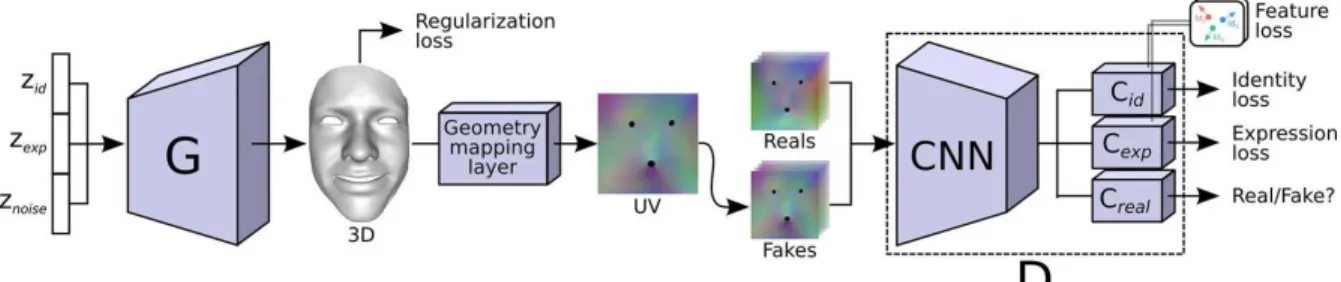
mis-Figure 1: Our proposed architecture. A MLP generates the 3D coordinates of the mesh, while the discrimination occurs in 2D space thanks to thegeometry mappinglayer. Identity and expression codeszid, zexpare used to control the generator, and classification losses are added to decouple between the two. A feature loss is introduced to ensure consistency over features with fixed identities or expressions.
takes of the discriminator. At convergence,Gapproximates the real data distribution. Training involves the optimization of the following:
min
G maxD LGAN =
Ex∼pdata[logD(x)]
+ Ez∼pz[log(1−D(G(z)))], (1)
wherepdatadenotes the distribution of the training set, and
pzdenotes the prior distribution for G, typicallyN(0, I). GANs have been shown to be very challenging to train with the original formulation and prone to low diversity in the generated samples. To address this, Arjovskyet al. [2] propose to minimize instead an approximation of the Earth Mover’s distance between generated and real data distribu-tions, which is the strategy we adopt in this work:
LGAN = Ex∼pdata[D(x)]−Ez∼pz[D(G(z))]. (2)
In particular we use the extension in [19] which uses a gra-dient penalty in order to enforce thatDis 1-Lipschitz.
When labels are available, using them has proven to be beneficial for GAN performance. Odena et al. [27] pro-posed Auxiliary Classifier GANs (AC-GAN), in whichD
is augmented so that it outputs the probability of an image belonging to a pre-defined class labelc ∼pc. In this case, the loss function for G and D is extended with:
Lreal
C =Ex∼pdata,c∼pc[logP(C=c|x)], (3)
Lf akeC =Ez∼pz,c∼pc[logP(C=c|G(z, c))]. (4)
In order to evaluate if a model is correctly decoupling, we need to be able to distinguish whether two identites or expressions sharing the same latent code are perceptually similar. Thus, our work builds on the idea of auxiliary clas-sifiers in order to learn a decoupling of the shape variations into factors, as will be explained in the next section.
4. Method
We consider as input a dataset of registered and rigidly aligned 3D facial meshes, where each mesh is defined by (V,F), the set of 3D verticesV ∈ R3×nv and the set of
triangular facesF ∈ N3×nf that connect the vertices. Our
goal is to build an expressive model that can decouple the representation based on known factors of variation. In con-trast to classical approaches in which a reconstruction error is optimized, we rely instead on the adversarial loss enabled by a convolutional discriminator. To this end, we introduce an architecture in which ageometry mapping layer serves as bridge between the generated 3D mesh and the 2D do-main, for which convolutional layers can be applied (Sec-tion4.1). To learn a decoupled parameterization, we build on the idea of Auxiliary Classifiers and introduce a feature loss to further improve the results (Section 4.3). We will consider here a model that decouples between identity and expression, however the principle can be easily extended to more factors.
(a) Geometry image (b) Original and reconstructed meshes
Figure 2: While a GAN could be used to generate geometry images, recovering the mesh from them is prone to artifacts, e.g. erroneous boundary interpolations (red) and precision loss (blue) in2b. In this work we generate instead the 3D mesh, while geometry images are used only for discrimina-tion.
4.1. Geometry Mapping Layer
While deep learning can be efficiently used on regularly sampled signals, such as 2D pixel grids, applying it to 3D surfaces is more challenging due to their irregular structure. In this work we propose to generate the 3D coordinates of the mesh using a multilayer perceptron, while the discrim-inative aspects are handled in the 2D image domain. This allows to benefit from efficient and well established archi-tectures that have been proven to behave adequately under adversarial training, while still generating the 3D shape in its natural domain.
In particular, a 2D representation of a mesh can be achieved through a UV parameterizationφ : V → Dthat associates each vertexvk ∈ V with a coordinate(u, v)k in
the unit square domainD. Continuous images can be ob-tained by interpolating the(x, y, z)vertex values according to the 2D barycentric coordinates, and storing them in the image channels. Borrowing the term from [18], we call this ageometry image(see Figure2a).
Note that although our method could generate geome-try images instead of 3D meshes, this would introduce an unnecessary additional reconstruction step that is likely to cause information loss and artifacts in the final meshes, as illustrated in Figure2b. This is due to the fact that a single planar unfolding of a mesh may create distortions such as triangle flipping [34], and a many-to-one mapping may be obtained even with a bijective parameterization due to the fi-nite size of images. In addition, as elaborated in [18], unless border vertices are preassigned to distinct pixels which can be challenging for large meshes, sampling these locations results in erroneous interpolations. Generating 3D point co-ordinates instead allows to avoid reconstruction artifacts, and to apply common mesh regularization techniques that simplify and improve the learning process. We use geome-try images only as the representation for the discriminative component that evaluates the 3D generator through CNNs.
The mapping layer operates as follows. Given a mesh made of verticesV ={vk/k= 1..nv}, a target image size
n×n, and a pre-computed UV parameterizationφ, we build two imagesIU
,IV
of dimensionn×n, and three images
Iv1
,Iv2
andIv3
of dimensionn×n×3each. For each pixel (i, j), we consider theφ-projected mesh triangle(ˆv1,vˆ2,ˆv3)
containing it. The barycentric abscissa and ordinate of pixel (i, j)in triangle(ˆv1,vˆ2,vˆ3)are then stored in imagesIU
andIV
respectively, and the original face vertex coordinates
v1,v2andv3 are stored in imagesIv1, Iv2 andIv3. The
mapping layer computes the output geometry imageIas:
I=IU ∗Iv1 +IV ∗Iv2 + (1−IU−IV)∗Iv3 , (5) where∗denotes element-wise multiplication and1∈Rn×n
is the matrix of ones. Since this layer simply performs in-dexing and linear combinations on the elements ofV
us-ing the predefined parameters inIU andIV
, all operations are differentiable and the gradients can be back-propagated from the discriminated image to the generated mesh.
4.2. Architecture
Figure1depicts our proposed architecture. The genera-tor consists of two fully connected layers that map the latent code z to a vector of size3nv containing the stacked 3D coordinates of displacements from a reference face mesh. The output vertex positions are passed through the mapping layer to generate a geometry image of sizen×n, which is then processed by the discriminator in order to classify whether the generated mesh is real or fake. We also con-sider auxiliary classifiers for the discriminator, denoted as
CidandCexp. The design of D shows two main differences with respect to the original AC-GAN. First, instead of clas-sifying only one type of labels, we use here classifiers for both identity and expression. This favors decoupling, since the classification of one factor is independent of the choice of the labels for the other factors. Second, we provide dis-tinct convolutional layers for the real/fake, identity and ex-pression blocks. This is motivated by the observation that the features required to classify identities and expressions are not necessarily the same.
4.3. Decoupled Model Learning
We rely on the discriminator not only to generate realis-tic faces, but also to decouple the factors of variation. For this, we optimize D such that it maximizes
LD=LGAN+λC(LID+LEXP). (6)
Here, LGAN denotes the standard adversarial loss (see
Equation2), andLID,LEXPthe classification losses
mea-sured against the labels provided with the dataset and weighted by scalarλC. These losses are defined similarly to Equation3as:
LID = Ex∼pdata,c∼pidc [logP(C=c|x)],
LEXP = Ex∼pdata,c∼pcexp[logP(C=c|x)], (7)
wherepid
c andpexpc denote the distribution of identity and
expression labels, respectively. We ignore the sample con-tribution in the classification loss if it is not labeled.
The generator G takes as input a random vector z =
{zid, zexp, znoise}, which is the concatenation of the iden-tity codezid ∼ pid, the expression code zexp ∼pexpand a random noiseznoise ∼ pnoise. It produces the location of nv displacement vectors from a reference mesh, and is trained by minimizing:
LG=λ1LGAN−λ2 LidCL+LexpCL
+λ3 LidF EAT+LexpF EAT
+λ4Lreg,
whereLGAN is the standard GAN loss (Equation2);LidCL
andLexpCL are classification losses;Lid
F EAT andL exp F EAT are
feature losses that aim to further increase the decoupling of the factors;Lreg is a regularizer; andλ1, λ2, λ3, λ4are
weights for the different loss terms. We explain each of these in the following.
Classification Loss In addition to the adversarial loss, the generator is trained to classify its samples with the correct labels by maximizing:
Lid
CL = Ez∼pz,c∼pcid[logP(C=c|G(z))]
LexpCL = Ez∼p
z,c∼pexpc [logP(C=c|G(z))]. (9)
In order to generate data belonging to a specific class, we sample one identity/expression codezid, zexpr for each la-bel and fix it throughout the training; this becomes the input for Geach time the classification loss must be evaluated. We denote the set of fixed codes for identity and expression asTidandTexprespectively.
Feature Loss The classification loss is limited to codes in
Tid/Texp, which have associated labels. We found that
bet-ter decoupling results can be obtained if we include a loss on the classifier features. We measure this by generating samples in pairs which share the same identity or expres-sion vector, and measuring the error as:
Lid F EAT = 2 N X zid (1−cos(f1,zid,f2,zid)), (10) LexpF EAT = 2 N X zexp
1−cos(f1,zexp,f2,zexp)
. (11)
Here, N is the batch size, and fi,z
id =
f(G(zid, zexp,i, znoise,i)) are feature vectors obtained
by inputting the sampleG(zid, zexp,i, znoise,i)through the classifierCidand extracting the features from the second to last layer. That is, given two inputs which were generated with the same identity vector, Lid
F EAT enforces that their
feature vectors in the identity classifier are also aligned. The definition is analogous forfi,z
exp withCexp.
To enable training with both classification and feature loss, for each batch iteration we alternate between the sam-pling of labeled identity codeszid ∈ Tid with unlabeled
expression codes zexp ∼ pexp, and the sampling of un-labeled identity codes zid ∼ pid with labeled expression codeszexp ∈ Texp. The classification is evaluated for the
labeled factor only, while the feature loss is used for unla-beled codes, and the alternation allows to better cover the identity and expression sub-spaces during training.
Regularization Generating a 3D mesh allows us to rea-son explicitly at the surface level and define high order
loss functions using the mesh connectivity. In particular, we enforce spatial consistency over the generated faces by minimizing the following term on the output displacements
v=G(z):
Lreg =||Lv||
2
2, (12)
whereLis the cotangent discretization of the Laplace-Beltrami operator.
5. Results
We provide in this section results obtained with the pro-posed framework, which demonstrate its benefits particu-larly in decoupling. We first clarify our set-up with imple-mentation details in Section5.1and the datasets used in5.2. We explain in Section5.3the proposed metrics for the eval-uation of a 3D face model, and introduce a new measure for analyzing the diversity of the generated samples. In Sec-tion 5.4we perform ablation studies to verify that all the components are necessary to effectively train an expressive model. Finally, in Section5.5 we compare our results to state-of-the-art 3D face models that can decouple the latent space, and show that our approach outperforms with respect to decoupling and diversity. Additional results can be found in the supplemental material.
5.1. Implementation Details
We set the weights to λC = 0.1 (Equation 6), λ1 =
λ2= 1,λ3= 0.5andλ4= 100(Equation8). The
classifi-cation losses are further weighted to account for unbalanced labels [23]. For the generator, we use two fully connected layers with an intermediate representation of size512and ReLU non-linearity. For the discriminator we use a variant of DC-GAN [28], with the first two convolutional blocks shared between Creal, Cid andCexpr, while the remain-ing are duplicated for each module (more details can be found in supplemental). The models were trained for200 epochs using ADAM optimizer [24] withβ1 = 0.9 and
β2= 0.999, a learning rate of0.0002and a batch size of64.
During training we add instance noise [36] withσ= 0.1to the input of D. The discriminator is trained for3iterations each time we train the generator. The models take around2 hours to train on a NVidia GeForce GTX 1080 GPU.
The template mesh contains 22129 vertices. We pre-compute the UV map φ using harmonic parameteriza-tion [12], setting the outer boundary face vertices to a unit square to ensure full usage of the image domain. We generate geometry images of size 64 × 64; we experi-mented with other image sizes but the best decoupling re-sults were obtained with this resolution. The dimensions for (zid, zexp, znoise)are set to(65,15,5)to facilitate compar-ison with [13], and the feature vectors used in Equations10 and11are of size2048.
5.2. Datasets
All models were trained using a combination of four publicly available 3D face datasets. In particular, we use two datasets containing static 3D scans of multiple sub-jects: BU-3DFE [44] and Bosphorus [31], and combine these with two datasets of 3D motion sequences of multi-ple subjects: BP4D-Spontaneous [45] and BU-4DFE [43]. The static datasets provide variability of identities, while the motion datasets provide variability of expressions and a larger number of training samples. We registered BU-3DFE and Bosphorus with a template fitting approach [30], and the motion datasets with a spatiotemporal approach [14].
The final dataset contains30559registered 3D faces and was obtained by subsampling the motion sequences. We provide identity labels for all meshes, while the expression labels are limited to the seven basic emotional expressions, which appear in both static datasets. For BU-4DFE, expres-sion labels are assigned to three frames per sequence: the neutral expression to the first and last frame, and the labeled expression of the sequence to the peak frame. For BP4D, one neutral frame is manually labeled per subject (this is a requirement for comparison to [29]). Overall, due to the use of motion data, only7%of it is assigned expression labels.
5.3. Evaluation Metrics
We evaluate the models in terms ofdiversityof the gener-ated samples,decouplingof identity and expression spaces, andspecificityto the 3D facial shape. We believe it is nec-essary to simultaneously consider all the metrics, as they provide complementary information on the model. For in-stance, a good decoupling value can be obtained when the diversity is poor, since small variations facilitate the classi-fication of samples as “same”. Conversely, a large diversity value can be obtained when decoupling is poor, since the identities/expressions sharing the same code can yield very different shapes. We detail these in the following.
Diversity We consider it important to measure the diver-sity of the 3D face shapes generated by a model, particu-larly with GANs that are known to be prone to mode col-lapse. To the best of our knowledge, this has not yet been considered in the context of 3D face models and we pro-pose therefore to evaluate as follows. We sample ppairs of randomly generated meshes and compute the mean ver-tex distance among the pairs; diversity is then defined as the mean of the distances over theppairs. We expect here to see higher values for more diverse models. We evalu-ate on three sets of sampled pairs: (1) among pairs chosen randomly (global diversity), (2) among pairs that share the same identity code (identity diversity) and (3) among pairs that share the same expression code (expression diversity). For all cases we evaluate on10000pairs. For comparison, the training set is also evaluated on these three metrics by
leveraging the labels.
Decoupling To evaluate decoupling in both identity and expression spaces we follow the protocol proposed in [11]. In particular, we first train two networks, one for identity and one for expression, that transform an image represen-tation of the mesh to ann-dimensional vector using triplet loss [32], wheren = 128in our experiments. The trained networks allow to measure whether two meshes share the same identity or expression by checking whether the dis-tance between their embeddings is below a thresholdτ.
To measure identity decoupling, we generatenrandom facesxi = G(zi
id, zexpi , znoisei ), and for each random face
we fix the identity code and sample m faces Y(xi) =
{G(zi
id, zexpj , z j
noise), j = 1..m}. We then use the
em-bedding networks to evaluate whether the original facesxi
and their corresponding samples inY(xi)correspond to the
same identity, and report the percentage of times the pairs were classified as “same”. We proceed analogously for ex-pression decoupling. We setn= 100,m= 100,τ = 0.14 for identity andτ = 0.226for expression; more implemen-tation details are given in the supplemental material.
Specificity Specificity is a metric commonly used for the evaluation of statistical shape models [9] and whose goal is to quantify whether all the generated samples belong to the original shape class, faces in our case. For this,nsamples are randomly drawn from the model and for each the mean vertex distance to each member of the training set is mea-sured, keeping the minimum value. The metric then reports the mean of thenvalues. We use heren= 1000.
5.4. Ablation Tests
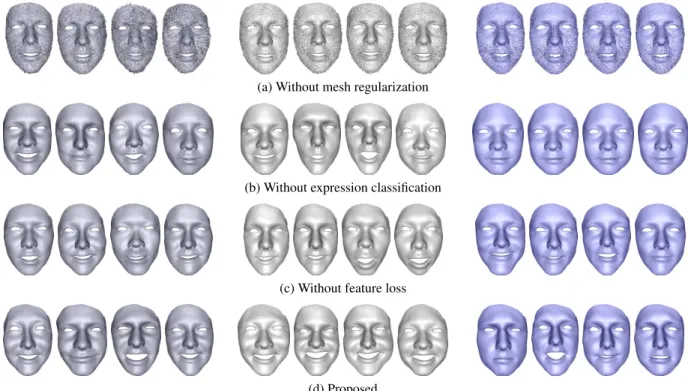
We start by demonstrating that each of the proposed components is necessary to obtain state-of-the-art results in the proposed metrics. To this end, we compare our approach against the following alternatives: (1) without mesh regular-ization (Equation12); (2) with identity classification only; (3) with expression classification only; and (4) without fea-ture loss (Equations10and11).
Table1gives the evaluation metrics for each of these op-tions, and Figure3provides qualitative examples. From the results we observe that: (1) The mesh regularization is cru-cial to generate samples that are realistic facru-cial shapes. This is reflected by a very large value in specificity as well as low diversity, due to the fact that the model never converged to realistic faces (see Figure3a). (2) Considering classification in only one factor significantly reduces the capacity of the model to preserve semantic properties in the other factor, as indicated by the very low decoupling values obtained in the corresponding rows. This justifies the use of classifiers for each of the factors. (3) Without the feature loss the model can still achieve good results, but both expression
decou-(a) Without mesh regularization
(b) Without expression classification
(c) Without feature loss
(d) Proposed
Figure 3: Qualitative results for alternative approaches. From left to right: randomly generated samples (dark gray), random samples with a same expression code (light gray), random samples with a same identity code (purple).
Dec-Id Dec-Exp Div Div-Id Div-Exp Sp. Training data − − 4.89 3.30 5.04 −
w/o mesh reg. 99.6 99.1 1.41 0.65 1.25 3.61 w/o exp. class. 100.0 42.8 4.81 0.11 4.87 2.01 w/o id. class. 7.8 98.9 5.28 4.87 2.05 2.22 w/o feat. loss 96.0 80.3 4.47 1.75 4.01 2.00 3DMM [1] 99.6 65.6 3.53 1.95 2.89 2.30 MAE [13] 99.5 53.3 3.89 0.92 3.76 2.00 CoMA [29] 97.5 65.5 3.38 1.71 2.90 2.47 Ours 98.6 89.7 4.74 1.94 4.22 2.01 Table 1: Quantitative evaluation with respect to decou-pling of identity and expression (Dec-, percentage), diver-sity (Div-, in mm) and specificity (Sp., in mm.). Higher is better, except for specificity.
pling and diversity are lower than with the full model and the inclusion of the feature loss improves expression clas-sification by almost10%. Note that decoupling the expres-sion space is significantly more challenging than identity, as the provided labels are very sparse. This effect is illustrated on Figure3c, where models with the same expression code can lead to faces with slightly different expressions. Our approach provides more coherent faces, as shown in Fig-ure3d.
Source Target CoMA MAE Ours
(a) Transferring expression to a target face
(b) Sampling novel identities from the transferred expression.
Figure 4: Comparison in terms of expression transfer. Top: expression codezexpr transferred to a target identity. Bot-tom: usingzexprfrom the source in the top row, we sample novel identities (left to right: CoMA, MAE, ours).
5.5. Comparisons
We compare the proposed approach against state-of-the-art generative 3D face models. Our goal is to build a
de-coupled latent space, and thus we focus the comparison to works that either enforce this explicitly [13], or combine a model trained on expressions with a linear space of identi-ties [29,1]. We train all models using the same dimensions (65for identity and20for expression).
The model proposed in [13], called MAE in the follow-ing, was trained with the same dataset and the same label information (Section5.2) for200epochs, with the default parameters given in the paper. We initialize the encoder and the decoder from the publicly available models.
The model proposed in [29], called CoMA in the fol-lowing, does not explicitly favor decoupling and thus we use the DeepFLAME alternative [25], which we also train with the same dataset. This results in a PCA model built from 299 identities and an autoencoder trained on 30330 displacements from the corresponding neutral face. For the identity space we manually selected one neutral frame for each sequence in BP4D-Spontaneous, as this dataset does not provide labels. The model was trained using the pub-licly available code for200epochs.
We also trained an additive linear model as described in [1] using our dataset, and the same neutral/expression separation selected for CoMA (see above). We refer to this model as 3DMM.
Model quality We show quantitative results with respect to decoupling, diversity and specificity in the bottom of Ta-ble1. Note that the proposed approach significantly outper-forms the others in terms ofexpression decoupling, which is more challenging than identity due to the sparse labeling. This is shown qualitatively in Figure 4, where we trans-ferred expressions by simply exchanging the latent code
zexp. We can see here that the expression is well preserved by our model.
With respect to identity decoupling the four methods perform similarly well, with 3DMM achieving the highest value. Note that, in the case of MAE, the large decoupling value is combined with the lowest diversity in identity (Div-Id), which suggests limited generative capabilities (see sup-plemental for a qualitative example).
We also outperform all methods in terms of diversity. Combined with a specificity value that is among the best, this implies that our model has learned to generate signifi-cant variations that remain valid facial shapes.
Reconstruction of Sparse Data We also tested the gen-eralization of the model with the reconstruction of partial face data given very sparse constraints. To this purpose, we use the dataset provided by [29], which contains12subjects performing 12 extreme expressions. We take the middle frame of each sequence and manually label85landmarks (see supplemental), resulting in a testing set of144subjects.
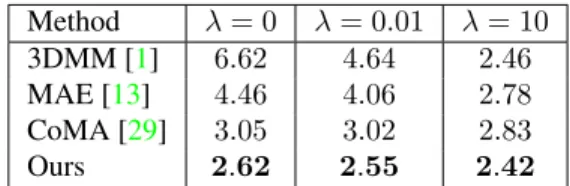
Method λ= 0 λ= 0.01 λ= 10 3DMM [1] 6.62 4.64 2.46 MAE [13] 4.46 4.06 2.78 CoMA [29] 3.05 3.02 2.83 Ours 2.62 2.55 2.42
Table 2: Reconstruction of sparse data under different reg-ularization weights (RMSE, in mm).
The face model is fitted by minimizing: arg min z p X i=1 ||˜vi(z)−vi||2 2+λ||z|| 2 2, (13)
where vi are the 3D locations of thepkey-points in the
testing set, v˜i(z)are the corresponding key-points in the
face model generated with codez, andλthe regularization weight. We optimize using a gradient descent approach [24] starting from a randomly sampled codez. Note that this is a challenging scenario since the training set does not contain such expressions, and the correspondences are very sparse. We compare our results with those obtained with 3DMM, MAE and CoMA, using the same optimization for all methods. We measure the reconstruction error against the ground-truth surface and report the RMSE. Quantitative results can be found in Table2for different regularization weightsλ. Our method outperforms in all cases, including without regularization (λ = 0). We found that our model can produce reasonable faces in most cases, while MAE and CoMA easily produce un-realistic faces when the regu-larization is not strong enough (qualitative examples can be found in the supplemental material).
5.6. Extension to other factors
The proposed framework can easily be extended to other factors of variation, such as identity/expression/viseme. We refer to the supplemental material for an example of such a model.
6. Conclusion
We explored in this work the use of adversarial train-ing for learntrain-ing decoupled 3D facial models and showed that we can achieve state-of-the-art performance in terms of decoupling and diversity of the generated samples. This was obtained through a novel 3D-2D architecture, as well as a training scheme that explicitly encourages decoupling through the use of classifiers. Although the expressiveness of the model remains limited by the diversity of the training data and the accuracy of its labels, we show that adversarial learning has the potential to make better use of the available data in building performant 3D facial models.
References
[1] Brian Amberg, Reinhard Knothe, and Thomas Vetter. Ex-pression invariant 3d face recognition with a morphable model. In Conference on Automatic Face and Gesture Recognition, pages 1–6, 2008.1,2,7,8
[2] Martin Arjovsky, Soumith Chintala, and L´eon Bottou. Wasserstein gan. arXiv preprint arXiv:1701.07875, 2017.
3
[3] Timur Bagautdinov, Chenglei Wu, Jason Saragih, Pascal Fua, and Yaser Sheikh. Modeling Facial Geometry using Compositional VAEs. In Conference on Computer Vision and Pattern Recognition, volume 1, page 1, 2018.1,2
[4] Volker Blanz and Thomas Vetter. A morphable model for the synthesis of 3d faces. InSIGGRAPH, pages 187–194, 1999.
1,2
[5] James Booth, Anastasias Roussos, Stefanos Zafeiriou, Allan Ponniah, and David Dunaway. A 3d morphable model learnt from 10,000 faces. InConference on Computer Vision and Pattern Recognition, 2016.1,2
[6] Alan Brunton, Timo Bolkart, and Stefanie Wuhrer. Multilin-ear wavelets: A statistical shape space for human faces. In
European Conference on Computer Vision, 2014.2
[7] Chen Cao, Derek Bradley, Kun Zhou, and Thabo Beeler. Real-time high-fidelity facial performance capture. Trans-actions on Graphics, 2015.2
[8] Chen Cao, Yanlin Weng, Shun Zhou, Yiying Tong, and Kun Zhou. Facewarehouse: a 3d facial expression database for visual computing. IEEE Transactions on Visualization and Computer Graphics, 3:413–425, 2014.1
[9] Rhodri Davies, Carole Twining, and Chris Taylor. Statisti-cal models of shape: Optimisation and evaluation. Springer Science & Business Media, 2008.6
[10] Jiankang Deng, Shiyang Cheng, Niannan Xue, Yuxiang Zhou, and Stefanos Zafeiriou. Uv-gan: Adversarial facial uv map completion for pose-invariant face recognition. In
CVPR, pages 7093–7102, 2018.2
[11] Chris Donahue, Zachary C Lipton, Akshay Balsubramani, Julian McAuley, Sepehr Rezvani, Nader Mokari, Moham-mad R Javan, Maria Henar Salas-Olmedo, Juan Carlos Garcia-Palomares, Javier Gutierrez, et al. Semantically de-composing the latent spaces of generative adversarial net-works. International Conference on Learning Representa-tions, 2018.6
[12] Matthias Eck, Tony DeRose, Tom Duchamp, Hugues Hoppe, Michael Lounsbery, and Werner Stuetzle. Multiresolution analysis of arbitrary meshes. InSIGGRAPH, 1995.5
[13] Victoria Fern´andez Abrevaya, Stefanie Wuhrer, and Edmond Boyer. Multilinear autoencoder for 3d face model learning. InWinter Conference on Applications of Computer Vision, pages 1–9, 2018.1,2,5,7,8
[14] Victoria Fern´andez Abrevaya, Stefanie Wuhrer, and Edmond Boyer. Spatiotemporal modeling for efficient registration of dynamic 3d faces. InInternational Conference on 3D Vision, pages 371–380, 2018.6
[15] Baris Gecer, Stylianos Ploumpis, Irene Kotsia, and Ste-fanos Zafeiriou. Ganfit: Generative adversarial network
fit-ting for high fidelity 3d face reconstruction. arXiv preprint arXiv:1902.05978, 2019.2
[16] Ian Goodfellow, Jean Pouget-Abadie, Mehdi Mirza, Bing Xu, David Warde-Farley, Sherjil Ozair, Aaron Courville, and Yoshua Bengio. Generative adversarial nets. InAdvances in Neural Information Processing Systems, pages 2672–2680, 2014.1,2
[17] Stella Graßhof, Hanno Ackermann, Sami S Brandt, and J¨orn Ostermann. Apathy is the root of all expressions. In2017 12th IEEE International Conference on Automatic Face & Gesture Recognition (FG 2017), pages 658–665. IEEE, 2017.1
[18] Xianfeng Gu, Steven J. Gortler, and Hugues Hoppe. Geom-etry images. InSIGGRAPH, 2002.4
[19] Ishaan Gulrajani, Faruk Ahmed, Martin Arjovsky, Vincent Dumoulin, and Aaron C Courville. Improved training of Wasserstein GANs. InAdvances in Neural Information Pro-cessing Systems, pages 5767–5777, 2017.3
[20] Loc Huynh, Weikai Chen, Shunsuke Saito, Jun Xing, Koki Nagano, Andrew Jones, Paul Debevec, and Hao Li. Meso-scopic facial geometry inference using deep neural networks. InConference on Computer Vision and Pattern Recognition, pages 8407–8416, 2018. 2
[21] Alexandru Eugen Ichim, Sofien Bouaziz, and Mark Pauly. Dynamic 3d avatar creation from hand-held video input.
ACM Transactions on Graphics (ToG), 34(4):45, 2015.1
[22] Hyeongwoo Kim, Pablo Garrido, Ayush Tewari, Weipeng Xu, Justus Thies, Matthias Niessner, Patrick P´erez, Chris-tian Richardt, Michael Zollh¨ofer, and ChrisChris-tian Theobalt. Deep video portraits.ACM Transactions on Graphics (TOG), 37(4):163, 2018.1
[23] Gary King and Langche Zeng. Logistic regression in rare events data.Political analysis, 9(2):137–163, 2001.5
[24] Diederik P Kingma and Jimmy Ba. Adam: A method for stochastic optimization. In International Conference for Learning Representations, 2015.5,8
[25] Tianye Li, Timo Bolkart, Michael Black, Hao Li, and Javier Romero. Learning a model of facial shape and ex-pression from 4d scans. ACM Transactions on Graphics, 36(6):194:1–17, 2017.2,8
[26] Thomas Neumann, Kiran Varanasi, Stephan Wenger, Markus Wacker, Marcus Magnor, and Christian Theobalt. Sparse localized deformation components. ACM Transactions on Graphics, 32:179:1–10, 2013.2
[27] Augustus Odena, Christopher Olah, and Jonathon Shlens. Conditional Image Synthesis with Auxiliary Classifier GANs. InInternational Conference on Machine Learning, 2017.2,3
[28] Alec Radford, Luke Metz, and Soumith Chintala. Unsuper-vised representation learning with deep convolutional gener-ative adversarial networks. InInternational Conference on Learning Representations, 2016.5
[29] Anurag Ranjan, Timo Bolkart, Soubhik Sanyal, and Michael J Black. Generating 3d faces using convolutional mesh autoencoders. InEuropean Conference on Computer Vision, 2018.1,2,6,7,8
[30] Augusto Salazar, Stefanie Wuhrer, Chang Shu, and Flavio Prieto. Fully automatic expression-invariant face correspon-dence. Machine Vision and Applications, 25(4):859–879, 2014.6
[31] Arman Savran, Nes¸e Aly¨uz, Hamdi Dibeklio˘glu, Oya C¸ eliktutan, Berk G¨okberk, B¨ulent Sankur, and Lale Akarun. Bosphorus database for 3d face analysis. InEuropean Work-shop on Biometrics and Identity Management, pages 47–56. Springer, 2008.6
[32] Florian Schroff, Dmitry Kalenichenko, and James Philbin. Facenet: A unified embedding for face recognition and clus-tering. InProceedings of the IEEE conference on computer vision and pattern recognition, pages 815–823, 2015.6
[33] Gil Shamai, Ron Slossberg, and Ron Kimmel. Syn-thesizing facial photometries and corresponding geome-tries using generative adversarial networks. arXiv preprint arXiv:1901.06551, 2019.1,2
[34] Alla Sheffer, Emil Praun, and Kenneth Rose. Mesh param-eterization methods and their applications. Found. Trends. Comput. Graph. Vis., 2(2):105–171, 2006.4
[35] Ron Slossberg, Gil Shamai, and Ron Kimmel. High quality facial surface and texture synthesis via generative adversar-ial networks. InEuropean Conference on Computer Vision, pages 498–513. Springer, 2018.2
[36] Casper Kaae Sønderby, Jose Caballero, Lucas Theis, Wen-zhe Shi, and Ferenc Husz´ar. Amortised map inference for image super-resolution. InICLR, 2017.5
[37] Ayush Tewari, Michael Zollh¨ofer, Pablo Garrido, Florian Bernard, and Hyeongwoo Kim. Self-supervised multi-level face model learning for monocular reconstruction at over 250 hz. InConference on Computer Vision and Pattern Recogni-tion, 2018.2
[38] Justus Thies, Michael Zollh¨ofer, Marc Stamminger, Chris-tian Theobalt, and Matthias Nießner. Face2face: Real-time face capture and reenactment of rgb videos. In Proceed-ings of the IEEE Conference on Computer Vision and Pattern Recognition, pages 2387–2395, 2016.1
[39] Luan Tran and Xiaoming Liu. Nonlinear 3d face morphable model. In Conference on Computer Vision and Pattern Recognition, 2018.2
[40] Daniel Vlasic, Matthew Brand, Hanspeter Pfister, and Jovan Popovi´c. Face transfer with multilinear models.ACM Trans-actions on Graphics, 24(3):426–433, 2005.1,2
[41] Thibaut Weise, Sofien Bouaziz, Hao Li, and Mark Pauly. Re-altime performance-based facial animation. InACM transac-tions on graphics (TOG), volume 30, page 77. ACM, 2011.
1
[42] Shuco Yamaguchi, Shunsuke Saito, Koki Nagano, Yajie Zhao, Weikai Chen, Kyle Olszewski, Shigeo Morishima, and Hao Li. High-fidelity facial reflectance and geometry infer-ence from an unconstrained image. ACM Transactions on Graphics, 37(4):162, 2018.2
[43] Lijun Yin, Xiaochen Chen, Yi Sun, Tony Worm, and Michael Reale. A high-resolution 3d dynamic facial expression database. InInternational Conference on Automatic Face & Gesture Recognition, pages 1–6. IEEE, 2008.6
[44] Lijun Yin, Xiaozhou Wei, Yi Sun, Jun Wang, and Matthew J Rosato. A 3d facial expression database for facial behavior
research. InInternational Conference on Automatic face and gesture recognition, pages 211–216. IEEE, 2006.6
[45] Xing Zhang, Lijun Yin, Jeffrey F Cohn, Shaun Canavan, Michael Reale, Andy Horowitz, Peng Liu, and Jeffrey M Gi-rard. Bp4d-spontaneous: a high-resolution spontaneous 3d dynamic facial expression database.Image and Vision Com-puting, 32(10):692–706, 2014.6