Software-defined Networking (SDN)
A New Technology for
Flexible Communication Networks
GI/ACM Groups Stuttgart/Böblingen May 4, 2015
Stuttgart, Germany
Frank Dürr
Universität Stuttgart IPVS
GI/ACM Groups Stuttgart/Böblingen © Frank Dürr
Overview
1.
Motivation of Software-defined Networking2.
Introduction to Software-Defined Networking (SDN)3.
Selected SDN Research Topics4.
SummaryThe Internet Protocol Stack: A Success Story
The basic architecture remained the same for 30+ years.
Application Transport Network Data Link Physical Network Data Link Physical Network Data Link Physical Application Transport Network Data Link Physical HTTP TCP IP MAC 802.* fibre, copper, wireless
End system End system
Routers & multi-layer switches MAC 802.* fibre, copper, wireless UDP SMTP IMAP …
GI/ACM Groups Stuttgart/Böblingen © Frank Dürr
Constant Evolution in Networking
•
Basic network architecture stayed the same•
However, there is a constant evolution going on New networked systems with new requirements appear constantly
Growing Number of Networking Scenarios (1)
•
Unicast, multicast, anycast, information-centric networking, …◦
Different addressing and routing concepts•
Heterogeneous Quality of Service (QoS)◦
Real-time and low-latency applications▪ Soft-real time requirements: Web search, shopping systems, social networks, instant messaging
▪ Strict real-time requirements: Networked control systems
◦
Delay-tolerant applications▪ Backups, email, file transfer
◦
High throughput applicationsGI/ACM Groups Stuttgart/Böblingen © Frank Dürr
Growing Number of Networking Scenarios (2)
•
Virtual networks (VLANs)◦
Isolation of communication flows (e.g., in a cloud data center)•
Connection of local networks via wide-area network◦
VPNs tunneling of flows between networks•
Mobility support◦
Transparent forwarding of flows to mobile device◦
Migration of virtual machines in or across data centers•
And more …Consequence: Constantly Increasing Number of
Network Protocols and Standards
GI/ACM Groups Stuttgart/Böblingen © Frank Dürr
Challenge and Problems
Challenge: Implement networking infrastructure supporting all of these functions, requirements, and protocols
Problems of today’s networking infrastructure:
•
Limited flexibility•
Separation of network and applicationProblem: Limited Flexibility (1)
•
Switches and routers are closed “black” boxes•
Support standard protocols and proprietary protocols of manufacturer•
No easy changes without support of manufacturerGI/ACM Groups Stuttgart/Böblingen © Frank Dürr
Problem: Limited Flexibility (2)
And even if the switch/router hardware and software is open: Adding new network protocols and functions is hard
•
Have you ever written a Linux kernel module?◦
Compare this to programming a user-space application•
Have you ever used VERILOG?◦
Compare this to C/C++, Java, Python, …•
Have you ever targeted an embedded device?◦
Compare this to writing code for a server10
NetFPGA(http://netfpga.org/) WRT54L
Problem: Increasing Switch/Router Complexity
Switches and router implement large set of complex protocols
•
Even redundant protocols like multiple routing protocols•
Even protocols that are not needed by the application / customer•
Customer pays for hardware resources and functionality that he might not need◦
… and still cannot easily implement hisGI/ACM Groups Stuttgart/Böblingen © Frank Dürr
Problem: Separation of Network and Application
•
Application view onto the network: byte pipe (black box)•
Network view onto the application: load generator (black box)•
Integrated system view would benefit application and network!◦
Higher performance of application◦
Higher efficiency and utilization of networkExample: VM Migration
•
Virtual Machine moved from Host A to B•
Switches reactively find new location of host using ARP protocol◦
High load through broadcasts, slow reaction•
Why not let management application “program” the networkproactively based on its knowledge of VM locations and network topology?
VM1
ToR Switch ToR Switch
Switch
GI/ACM Groups Stuttgart/Böblingen © Frank Dürr
Example: Publish/Subscribe
•
Classic approach: Overlay networks◦
Messages are transmitted multiple times◦
Increased path length•
Forwarding implemented in software◦
Reduces throughput, increases latency14 Publisher: Notification(stock value = $500) Subscriber: stock value > $450 Subscriber: stock value > $420 Duplicates!
B
𝐶
𝐶
𝑃
Example: Publish/Subscribe
With SDN
•
Reduced number of messages(less network load, better scalability)
•
Faster filtering in hardware (micro-seconds vs. milliseconds)•
Shorter paths (less load, lower latency)Publisher: Notification(stock value = $500) Subscriber: stock value > $450 Subscriber:
B
𝐶
𝐶
𝑃
Hardware Fitering!GI/ACM Groups Stuttgart/Böblingen © Frank Dürr
Example: Elastic Tandem Machines
based on SDNGoal: Energy-proportional machine for data centers
• Low-power consumption in idle mode and low load
• Scale-up to nominal
(maximum) resources of VM
Approach: Elastic Tandem Machines
• Integration of System-on-a-Chip (SoC) machine and classic VM
• Seamless and transparent handover in network through Software-defined Networking ETMI LPMI (Web-/Application Server) Backend Server (Database/File Server) HPI (Web-/Application Server) Clients Internet Core Switches (OpenFlow-enabled) OpenFlow
Aggregation, ToR, and Virtual Switches (Layer 2 Forwarding)
Data connection to public service IP address of ETMI
(switched to LPMI or HPI) Datacenter Gateways Load Monitor Connection Monitor Connection Blocker Load Monitor Connection Monitor Connection Blocker SDN Controller with ETMI Handover Logic
Control connections to individual IP addresses
of LPMI and HPI VM Manager
Frank Dürr:Improving the Efficiency of Cloud Infrastructures with Elastic Tandem Machines.
In Proceedings of the 6th IEEE International Conference on Cloud Computing (Cloud 2013), pp. 91–98, Santa Clara, CA, USA, June 2013
SDN in a Nutshell
SDN is a paradigm to program networks at a high-level
“Think of it as a general language or an instruction set that lets me write a control program for the network rather than having to
GI/ACM Groups Stuttgart/Böblingen © Frank Dürr
Benefits of SDN (1)
•
Easy modification of the network control logic◦
From “hard-coded” logic to exchangeable software•
API to “program” the network◦
Software (application) “defines” the network•
High-level programming languages◦
For implementation of logic◦
To benefit from powerful integrated developing environmentsBenefits of SDN (2)
•
Reduced switch complexity◦
Remove control logic from switch and host it on servers◦
Preserve same forwarding performance!▪ Switch still supports forwarding in hardware
•
Integrated system: application & network◦
Global view onto the system•
Reducing the complexity of implementing control logic◦
Distribution transparency “Intelligence” Network Compute ServerGI/ACM Groups Stuttgart/Böblingen © Frank Dürr
Tremendous Industrial Interest
•
> 100 members and many key players•
Manufacturer of switches, telecommunication operators•
Supporter and operator of data center20
Gaining scientific impact
#Publications in ACM Portal by keyword and year
0 100 200 300 400 500 600 700 800 2 000 2001 2002 2003 2004 2005 2006 0072 2008 2009 2010 2011 2012 2013 2014 P2P Publish/Subscribe SDN
GI/ACM Groups Stuttgart/Böblingen © Frank Dürr
Overview
1.
Motivation of Software-defined Networking2.
Introduction to Software-Defined Networking (SDN)◦
Principle 1: Flow-based forwarding◦
Principle 2: Control plane / data plane separation◦
Principle 3: Logical centralization (physical distribution)◦
SDN system architecture◦
Southbound interface: OpenFlow◦
Northbound interfaces of OpenDaylight3.
Selected SDN Research Topics4.
SummaryFlow-based Forwarding
Forwarding defined on flows rather than only IP or MAC addresses
•
Theoretically: any information of a packet that identifies acommunication relation
•
Practically: combinations of selected layer 2 to 4 header fields◦ Example: IP + Ports + protocol ids
•
Fine-grained forwarding of selected flows or coarse-grainedaggregation Elephant flow of backup service Latency-sensitive traffic H1
GI/ACM Groups Stuttgart/Böblingen © Frank Dürr
Control Plane and Data Plane Separation
•
Control plane: defines routes, manages network graph•
Data plane: forwarding of packetsControl Plane Data Plane Data Plane Data Plane Data Plane Data Plane Control Logic Control Logic Control Logic
Control Plane
Logically Centralized Controller
Data Plane Data Plane Data Plane Data Plane Data Plane Control Logic Control Logic Control Logic physically distributed logically centralized
GI/ACM Groups Stuttgart/Böblingen © Frank Dürr
Why Logical Centralization?
•
Greatly simplifies implementation of control logic◦
Consistent global view onto network•
Global view can increase performance of control◦
E.g., faster convergence Example: Distributed vs. centralized routing (see next slides)
Distributed Routing (1)
Distributed routing protocols
•
Need time to converge to optimum lower resource utilization•
Complex protocol and algorithm20 5 5 10 10 10 10
GI/ACM Groups Stuttgart/Böblingen © Frank Dürr
Distributed Routing (2)
Distributed routing protocols
•
Need time to converge to optimum lower resource utilization•
Complex protocol and algorithm28 5 5 10 10 2.5 2.5 Switches S1 & S2 decide to use the same paths
S2 S1
Distributed Routing (3)
Distributed routing protocols
•
Need time to converge to optimum lower resource utilization•
Complex protocol and algorithm5 5 10 10 5 Converged to optimum after 2 steps S2 S1 5
GI/ACM Groups Stuttgart/Böblingen © Frank Dürr
Logically Centralized Routing
Centralized optimization
•
Faster convergence higher resource utilization•
Simpler routing algorithm on global view30 5 5 10 10 5 Converged to optimum in 1 step S2 S1 5
Logically Centralized Routing
•
Significant performance increase in practice•
Example: Google backbone optimization◦
Nearly 100 % network utilization◦
http://goo.gl/DN6RYvUrs Hölzle
GI/ACM Groups Stuttgart/Böblingen © Frank Dürr
Architecture of an SDN System
Controller Control Logic Northbound Interface Southbound Interface Control Logic Control LogicComponents (1)
Switches/Routers
• Implement data plane: packet forwarding ◦ Manages forwarding information base
• Typically multi-layer switches
◦ Forwarding based on layer 2-4 headers
• Hardware switches
◦ Hardware support for fast matching
▪ Ternary content-addressable memory (TCAM)
• Software switches
◦ Connect multiple virtual machines to physical interface of host ◦ Example: Open vSwitch [http://openvswitch.org/]
GI/ACM Groups Stuttgart/Böblingen © Frank Dürr
Components (2)
SDN Controller
• Server process executed on host
• Implements control plane
• Implements southbound interface to switches
◦ Configuration of forwarding tables
◦ Injecting packets
◦ Events from switch (packet-in)
◦ Collection of traffic statistics
◦ Discovery of topology
• Interfaces with control logic (control “application”) via northbound interface(s)
34
Controller
Northbound Interface
Components (3)
Control Logic
•
Defines routes of “flows”◦
Proactive and reactive routing•
Might interface with other information sources◦
Example: Virtual machine manager knowing locations of VMs on hosts Control Logic Control Logic Control LogicGI/ACM Groups Stuttgart/Böblingen © Frank Dürr
Control Plane Distribution
•
Controller can be physically distributed in various ways◦
No standard way of distribution defined•
Objectives:◦
Increase robustnessControl Plane Distribution: Replication
Primary (Master) Secondary (Slave, on standby) OpenFlow standard allows for connections from switch to multiple controllersGI/ACM Groups Stuttgart/Böblingen © Frank Dürr
Control Plane Distribution: Partitioning
Part 1 Part 2
Southbound Interface: The OpenFlow Protocol
Controller Control Logic Northbound Interface Southbound Interface Control Logic Control Logic OpenFlowGI/ACM Groups Stuttgart/Böblingen © Frank Dürr
The OpenFlow Protocol: Overview
•
OpenFlow de facto standard for southboundinterface
•
Defined by Open Networking Foundation◦
Major vendors (Cisco, IBM, NEC, HP, Alcatel-Lucent, VMWare, …)•
Interface to a single switch◦
No aspects of control plane distribution defined•
Basic functionality◦
Modification of flow tables (adding, removing, modifying entries)◦
Injecting packets◦
Events for receiving packets (reactive routing)◦
Querying traffic statistics (counters)Architecture of an OpenFlow System
OpenFlow Switch Channel Controller Group Table Flow Table Flow Table … Southbound Interface Channel OpenFlow Protocol pipeline TCP optional: TLS/SSL for authentication &encryption
Switch connects to standard port:
• Previously: 6633 • Now: 6653 (IANA)
GI/ACM Groups Stuttgart/Böblingen © Frank Dürr
Flow Tables & Flow Entries
• Flow tables consist of a list of flow entries• Flow entry (slightly simplified):
◦
Match field: Defines matching packets◦
Priority: Precedence if multiple entries match◦
Counters: Counts matches◦
Instructions:▪ Modification and forwarding of packet
◦
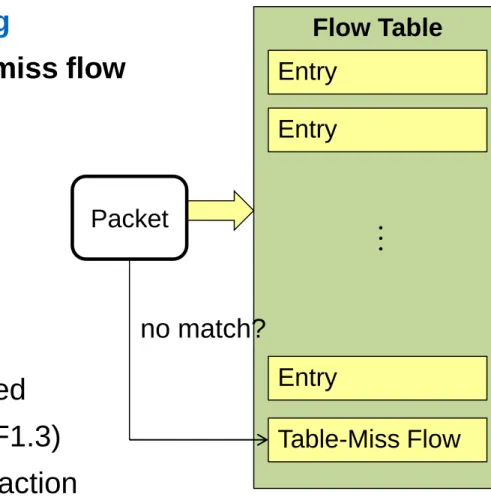
Timeouts: Removes entry after a certain (idle) time 43 Flow Table Entry Entry Entry …Table Misses
Important for dynamic routing
•
Each table supports a table-miss flow entry◦
Lowest priority◦
Matches all packets•
Possible actions (at least):◦
Drop◦
Send to controller•
If no table-miss entry is defined◦
Drop packet (default in OF1.3)◦
Or define another default actionFlow Table Entry Entry Entry … no match? Table-Miss Flow Packet
GI/ACM Groups Stuttgart/Böblingen © Frank Dürr
Match Fields
Subset of L2-4 header fields
•
10 tuple (must be supported)◦
For more (optional) fields please see OF standard•
Note: hardware switches might only support hardware-accelerated matching on some combinations!◦
Rest goes the “slow path“45
Ingress Port
Ether Src Ether Dst VLAN ID Ether Type
IP SRC IP DST IP PROTO TCP/UDP SRC PORT TCP/UDP SRC PORT • Specifies layer 3 protocol • E.g, 0x0800 = IPv4
• Specifies layer 4 protocol • E.g, 6 = TCP, 17 = UDP
Wildcard Matching (1)
•
Not all fields need to be specified: Wildcard *◦
Matches any value•
For IP addresses, bitmasks can be specified (CIDR)◦
Example: Subnet mask of IPv4 address 192.168.1.1/24(netmask 255.255.255.0) In Port Eth Src Eth Dst Eth Type VLAN ID IP SRC IP DST IP Proto Src Port Dst Port * * * 0x0800 (IPv4) * * 10.2.3.4 6 (TCP) * 80 2 * * * 42 * * * * * * * * 0x0800 (IPv4) * * 10.1.2.3 * * *
Traffic of a certain VLAN from a certain port
GI/ACM Groups Stuttgart/Böblingen © Frank Dürr
Wildcard Matching (2)
•
Hardware switches can perform very fast matching using Content Addressable Memory (CAM)◦
Parallel matching of all entries in one clock cycle (micro-seconds)•
Two types of CAM◦
Binary CAM (BCAM): ordinary bits 0, 1▪ Good for exact match
◦
Ternary CAM (TCAM): ordinary bits + wildcard (don‘t care) 0,1, *▪ Implementation of longest prefix match on IP addresses
•
Drawbacks: Consumes significant energy, silicon space◦
Limited memory size in switches(hundreds to hundred thousand entries)
◦
Remember the day of the 512k problem!A Thought about Flexibility
•
OpenFlow specification tailored to specific protocols◦
IP, TCP, UDP, ICMP, ARP, …◦
Did not support IPv6 in version 1.0!•
Again: Stuck with standard protocols◦
Practical trade-off: existing hardware switches can be easilymodified to support OpenFlow
•
Theoretically, we could just assume a big bit field and bit mask◦
Fields could be freely definedbit 0
GI/ACM Groups Stuttgart/Böblingen © Frank Dürr
Actions
•
Output: output packet on the specified port•
TTL modifications◦
Decrement TTL, copy TTL outwards/inwards•
Push and pop tags◦
Add or remove VLAN/MPLS/PBB (MAC-in-MAC) tags to/from thepacket
•
Set header fields◦
Example: IP- or MAC-address re-writing•
Group actions◦
Example: MulticastOrder of execution of actions is well-defined by action type 49
Instructions
•
Write actions◦
Adds given actions to the action set◦
Overwrites actions of the same type•
Go to table with given id◦
Hybrid switches can also go to the “normal“ table•
Apply specific actions immediately◦
Modify packet before going to next table•
Clear action setGI/ACM Groups Stuttgart/Böblingen © Frank Dürr
Proactive vs Reactive Routing
•
Routes defined by a set of flow table entries◦
Along the path of packets•
So far, we know what a flow table entry contains•
Question now: When to set up flow table entries?•
Two options:◦
Proactively: before the flow starts◦
Reactively: as soon as the flow starts51
Controller
Proactive Routing
•
Controller proactively “pushes“ flow table entries onto switches•
Advantage: Reduces controller load◦
No reactive handling of packets•
Disadvantage: Occupies space in flow table of switch◦
Even without traffic◦
Remember:Size of flow table is limited!
Controller
add entry add entry
add entry
Control Logic
GI/ACM Groups Stuttgart/Böblingen © Frank Dürr
Reactive Routing (1)
•
Switch receives a packet without matching flow table entry◦
Switch redirects packet to controller▪ Open flow packet_in event at controller ▪ Forwarded to control logic
•
Control logic calculates route•
Controller installs flow table entries along path◦
Further packets of flowdon‘t involve controller again 53 Controller packet-in event packet Control Logic
Reactive Routing (1)
•
Switch receives a packet without matching flow table entry◦
Switch redirects packet to controller▪ Open flow packet_in event at controller ▪ Forwarded to control logic
•
Control logic calculates route•
Controller installs flow table entries along path◦
Further packets of flowdon‘t involve controller again
Controller
add entry add entry
add entry
Control Logic
GI/ACM Groups Stuttgart/Böblingen © Frank Dürr
Reactive Routing (1)
•
Switch receives a packet without matching flow table entry◦
Switch redirects packet to controller▪ Open flow packet_in event at controller ▪ Forwarded to control logic
•
Control logic calculates route•
Controller installs flow table entries along path◦
Further packets of flowdon‘t involve controller again 55 Controller packet packet packet packet No packet-in events of this flow anymore until timeout of flow table entries
Reactive Routing (2)
•
Advantage: Saves flow table space•
Disadvantage: Puts load onto controller and control network◦
Not such a big problem for TCP▪ Sender blocked until connection setup is done
◦
Beware: Connection-less UDP can send at full rate immediately (without warning)!GI/ACM Groups Stuttgart/Böblingen © Frank Dürr
Required Information for Routing
Dynamic routing requires knowledge of network status
•
Network topology (nodes and links):◦
Switches and hosts◦
Links between switches (from switch port to switch port)◦
Links between hosts and switches (connection host to switch port)◦
Bandwidth of links•
Traffic statistics◦
Number of packets or bytes◦
Number of dropped packets, receive/transmit errors, etc.◦
Per flow (entry), link/port, group, etc.Network Topology
•
Discovery of network topology not covered by OpenFlow•
Controller implements standard protocols◦
Logical Link Layer Discovery Protocol (LLDP)◦
ARP handling for host discovery•
Controller exposes discovered information to control logicGI/ACM Groups Stuttgart/Böblingen © Frank Dürr
Traffic Statistics
•
OpenFlow switches implement counters•
Controller can query counters using OpenFlow messages:◦
Flow Statistics (OFPMP_FLOW, OFPMP_AGGREGATE)◦
Port Statistics (OFPMP_PORT_STATS)◦
Table Statistics (OFPMP_TABLE)◦
Queue Statistics (OFPMP_QUEUE)◦
Group Statistics (OFPMP_GROUP)◦
Meter Statistics (OFPMT_METER)GI/ACM Groups Stuttgart/Böblingen © Frank Dürr
Northbound Interface
61 Controller Control Logic Northbound Interface Southbound Interface Control Logic Control Logic OpenFlowNo Single Standard Interface
•
No standard for the northbound interface from the ONF•
Every controller can define its own interfaces•
We focus on two specific interfaces of the most popular open SDN controller: OpenDaylight◦
REST Interface◦
Java/OSGi interfaceGI/ACM Groups Stuttgart/Böblingen © Frank Dürr
REST Interfaces
•
REST interfaces are popular for web services◦
Many programmers already know web technologies◦
Can expose network configuration as a web service•
Based on common web technologies◦
HTTP▪ No problems with firewalls
◦
XML, JSON▪ Simple and intuitive markup languages
•
Drawback: events not supported◦
HTTP based on request/response paradigm◦
Restricted to proactive routing!RE
presentational
S
tate
T
ransfer (REST)
REST is resource-oriented
•
In contrast to service-oriented architectures (XML-RPC, WS-*)•
Unique identifiers to identify resources (URI)◦
Employees of a company: http://foo.bar/employees/One employee: http://foo.bar/employees/170974d
◦
Relevant SDN resources: flows, topology, hosts, etc.•
Client/Server architecture◦
Server manages resources ( controller implements server)◦
Client manipulates resources ( control logic/applications)•
Uniform interface: well-defined methods to manipulate resourcesGI/ACM Groups Stuttgart/Böblingen © Frank Dürr
RE
presentational
S
tate
T
ransfer (REST)
HTTP methods to manipulate resources:
•
GET: retrieve a resource•
POST: create resource•
PUT: update resource•
DELETE: remove resource•
HEAD: retrieve meta data on resource•
OPTIONS: methods that can be executed on resourceRE
presentational
S
tate
T
ransfer (REST)
Stateless protocol between client and server
•
Exchange of resource representations between client and server◦
XML,◦
JSON,◦
binary format,GI/ACM Groups Stuttgart/Böblingen © Frank Dürr
REST interface(s) of OpenDaylight
GI/ACM Groups Stuttgart/Böblingen © Frank Dürr
REST Interface: Adding a Flow
•
PUT request to URIhttp://<controller_ip>:8080/controller/nb/v2/
flowprogrammer/default/node/OF/00:00:00:00:00:00:00:02/ staticFlow/flow1
•
JSON (or XML) payload:71 { "name":"flow1", "installInHw":"true", "priority":"65535" "node": {"id":"00:00:00:00:00:00:00:02","type":"OF"}, "ingressPort":"2", "etherType": "0x800", "protocol": "6", "tpDst": "80", "actions":["DROP"] }
Type and ID of data path element (switch) Type and ID of data path element (switch)
REST Interface: Deleting a Flow
•
DELETE request to URIhttp://<controller_ip>:8080/controller/nb/v2/
flowprogrammer/default/node/OF/00:00:00:00:00:00:00:02/ staticFlow/flow1
•
No payloadGI/ACM Groups Stuttgart/Böblingen © Frank Dürr
REST Interface: Getting Flows
•
GET requests to different URIs return configured flows:◦
All Flows:http://<controller_ip>:8080/controller/nb/v2/ flowprogrammer/default
◦
Flows of a node (switch):http://<controller_ip>:8080/controller/nb/v2/ flowprogrammer/default/node/{nodeType}/{nodeId}
◦
Specific flow: http://<controller_ip>:8080/controller/nb/v2/ flowprogrammer/default/node/{nodeType}/{nodeId}/ staticFlow/{name} 75Querying Topology Information
•
GET request to URIhttp://localhost:8080/controller/nb/v2/topology /default
•
Returns JSON (or XML) document:{"edgeProperties ... "edge":{ "tailNodeConnector":{ "node":{"id":"00:00:00:00:00:00:00:01","type":"OF"}, "id":"2","type": "OF" }, "headNodeConnector":{ "node":{"id":"00:00:00:00:00:00:00:02","type":"OF"}, "id":"2","type":"OF" } } #2 #2
GI/ACM Groups Stuttgart/Böblingen © Frank Dürr
Finding an End Systems
•
GET request to URIhttp://localhost:8080/controller/nb/v2/ hosttracker/default/address/10.0.0.1
•
Returns JSON (or XML) document:77 { "dataLayerAddress":"ba:17:35:47:98:7f", "nodeType":"OF", "nodeId":"00:00:00:00:00:00:00:01", "nodeConnectorType":"OF", "nodeConnectorId":"1","vlan":"0", "staticHost":false, "networkAddress":"10.0.0.1" } #1
Getting all Active End Systems
•
GET request to URIhttp://localhost:8080/controller/nb/v2/ hosttracker/default/hosts/active
•
Without manual configuration, only hosts that have already communicated can be found!•
Manual host configuration possible with PUT/DELETE requests to URIhttp://localhost/nb/v2/hosttracker/default/ address/10.0.0.1
GI/ACM Groups Stuttgart/Böblingen © Frank Dürr
Recommended Reading
•
OpenDaylight:Programming Flows with the REST Interface and cURL:
http://www.frank-durr.de/?p=68
Java/OSGi Interface of OpenDaylight
•
Why another interface besides REST?◦
REST interfaces are request/response▪ Client: control application (implementing control logic) ▪ Server: SDN controller
◦
Reactive flow programming requires event interface betweencontroller and control application
▪ Packet-in events sent from controller to control application
◦
No REST interface for sending packets•
Java/OSGi provides …◦
… event interface (callback functions)GI/ACM Groups Stuttgart/Böblingen © Frank Dürr
OpenDaylight OSGi Interface
82 82 OSGi Framework (Apache Equinox) OSGi Bundle Interface of exported service SAL IDataPacketService IListenDataPacket OpenDaylight
Service Abstraction Layer Binding to service
Implementing a Bundle
•
One bundle can implement several components•
Implement an Activator that …◦
… returns implementations (classes) of each implementedcomponent
◦
… configures each component instance▪ Declare exported services ▪ Declare used services
•
Implement each component◦
Bind to used services at initialization◦
Implement control logic▪ Implement callback for packet-in events
GI/ACM Groups Stuttgart/Böblingen © Frank Dürr
Activators (1)
Example: An Activator returning one component called PacketHandler (implementing our control logic)
public class Activator extends ComponentActivatorAbstractBase {
public Object[] getImplementations() {
Object[] res = { PacketHandler.class }; return res;
} }
Activators (2)
public class Activator extends ComponentActivatorAbstractBase {
public void configureInstance(Component c, Object imp, String containerName) {
if (imp.equals(PacketHandler.class)) {
// Export IListenDataPacket service
Dictionary<String, Object> props = new Hashtable<String, Object>(); props.put("salListenerName", "mypackethandler");
c.setInterface(new String[] {IListenDataPacket.class.getName()}, props);
// Register for IDataPacketService
c.add(createContainerServiceDependency(containerName). setService(IDataPacketService.class).setCallbacks(
"setDataPacketService",
"unsetDataPacketService").setRequired(true)); }
GI/ACM Groups Stuttgart/Böblingen © Frank Dürr
Binding to Services / Unbinding from Services
public class PacketHandler implements IListenDataPacket {
private IDataPacketService dataPacketService;
private IFlowProgrammerService flowProgrammerService;
// Bind to service
public void setDataPacketService(IDataPacketService s) { dataPacketService = s;
}
// Unbind from service
public void unsetDataPacketService(IDataPacketService s) {
if (dataPacketService == s) { dataPacketService = null; }
}
OSGi Interface: Callback for Packet-in Events
@Overridepublic PacketResult receiveDataPacket(RawPacket inPkt) {
// The connector, the packet came from ("port")
NodeConnector ingressConnector =inPkt.getIncomingNodeConnector();
// The node that received the packet ("switch")
Node node = ingressConnector.getNode();
// Here you might want to decode the packet, // program flows, forward the packet, etc.
// Alternative return values:
// PacketResult.CONSUME, PacketResult.IGNORED
return PacketResult.KEEP_PROCESSING; }
GI/ACM Groups Stuttgart/Böblingen © Frank Dürr
Decoding Packets
// Use DataPacketService to decode the raw packet (inPkt).
Packet l2pkt = dataPacketService.decodeDataPacket(inPkt);
// Repeated type checking and type casting
if (l2pkt instanceof Ethernet) {
Object l3Pkt = l2pkt.getPayload();
if (l3Pkt instanceof IPv4) { IPv4 ipv4Pkt = (IPv4) l3Pkt;
int dstAddr = ipv4Pkt.getDestinationAddress(); InetAddress addr = intToInetAddress(dstAddr);
System.out.println("Pkt. to " + addr.toString() + " received by node " + node.getNodeIDString() + " on connector " +
ingressConnector.getNodeConnectorIDString()); }
Programming Flows: Defining Match Rule
Match match = new Match();
// Match IPv4 ethertype
match.setField(MatchType.DL_TYPE, (short) 0x0800);
// Match TCP protocol id
match.setField(MatchType.NW_PROTO, (byte) 6);
// Match on IP destination address
match.setField(MatchType.NW_DST, sourceAddr);
// Match on destination port number
GI/ACM Groups Stuttgart/Böblingen © Frank Dürr
Programming Flows: Setting Actions
// List of actions applied to the packet
List actions = new LinkedList();
// Output packet on certain port
actions.add(new Output(egressConnector));
Creating and Programming the Flow
// Create the flow
Flow flow = new Flow(match, actions);
// Use Flow Programmer Service to program flow.
Status status = flowProgrammerService.addFlow(node, flow);
if (!status.isSuccess()) {
log.error("Could not program flow: " + status.getDescription()); }
GI/ACM Groups Stuttgart/Böblingen © Frank Dürr
Forwarding Packets
// Maybe you want to modify some fields of the packet using // the methods from classes Ethernet, IPv4, TCP
// (typecast RawPacket to corresponding type; // see decoding packet).
// Define, over which port to forward packet
pkt.setOutgoingNodeConnector(egressConnector);
// Use Data Packet Service to forward packet
dataPacketService.transmitDataPacket(pkt);
Creating and Deploying the Bundle
•
Compile Activator and component implementation•
Package into OSGi bundle (JAR) Maven helps to automate these steps
GI/ACM Groups Stuttgart/Böblingen © Frank Dürr
Essential Commands (1)
•
Listing all bundles:osgi> ss id State Bundle 0 ACTIVE org.eclipse.osgi_3.8.1.v20120830-144521 1 ACTIVE org.apache.felix.fileinstall_3.1.6 2 ACTIVE org.eclipse.jdt.core.compiler. batch_3.8.0.I20120518-2145
•
Listing a bundle matching a given name: osgi> ss | grep simple171 ACTIVE org.opendaylight.controller.samples. simpleforwarding_0.4.1.SNAPSHOT
Essential Commands (2)
•
Installing and starting a bundle:osgi> install file:/home/user/myctrlapp/target/ myctrlapp-0.1.jar
Bundle id is 256
osgi> start 256
•
Updating a bundle:osgi> update file:/home/user/myctrlapp/target/ myctrlapp-0.1.jar
GI/ACM Groups Stuttgart/Böblingen © Frank Dürr
Essential Commands (3)
•
Stopping and uninstalling a bundle:osgi> ss | grep simple
171 ACTIVE org.opendaylight.controller.samples. simpleforwarding_0.4.1.SNAPSHOT
true
osgi> stop 171
osgi> uninstall 171
•
Showing information about a bundle (e.g., used and exported services):osgi> bundle 171
Further Details
•
Developing OSGi Components for OpenDaylight:http://www.frank-durr.de/?p=84
•
Reactive Flow Programming with OpenDaylight:GI/ACM Groups Stuttgart/Böblingen © Frank Dürr
Overview
1.
Motivation of Software-defined Networking2.
Introduction to Software-Defined Networking (SDN)3.
Selected SDN Research Topics◦
Control plane distribution and consistency◦
Real-time SDN◦
SDN-based networked control systems◦
SDN-based high-performance communication middleware4.
SummaryControl Plane Distribution and Consistency
Horizontal scalability No single point of failure
Distributed SDN-Controller
OpenFlow Protocol
Challenge:
Control Plane Consistency
Challenge: Consistent routes: • No black holes • No micro-loops • No duplicates • …
GI/ACM Groups Stuttgart/Böblingen © Frank Dürr
SDN’s CAP Problem
•
Logically centralization makes implementation …◦
… of control logic (e.g., routing algorithm) simpler◦
… implementation of controller hard•
Well-known CAP problem also applies to a distributed SDN controller◦
Only two out of the three CAP properties possible:Consistency, availability, partitioning tolerance
•
Control plane distributionis subject to current research
101
C
A P
Distributed
Data Plane Consistency
•
Reitblatt et al. proposed concept of packet level consistency ◦ Each packet sees consistent network configuration during routetransition
◦ Either old or new route; no mixture
•
Can show: each invariant that holds before and after update also holds during updates◦ Assuming routing is correct (no black-holes, loops, duplicates), these properties also hold during transition
102 102 pkt 2 pkt 1 source destination old route new route
GI/ACM Groups Stuttgart/Böblingen © Frank Dürr
Packet-level Consistency
•
Approach:◦ Packet tagging on end systems ▪ Using VLAN id header field
◦ Keeping both routes in network during transition
•
Drawback: memory overhead◦ Requires 2x TCAM space in worst-case
◦ Motivates research for more light-weight update strategies update ordering
103 103 103 pkt 2: VLAN 1 pkt 1: VLAN 2 source destination old route new route
Data Plane Consistency with Update Ordering
•
Question: Can we find an update sequence that ensures givenproperties?
•
Example: Avoiding black-holes during unicast route updates ◦ Update flows in reverse order from destination to source•
Can be further optimized, e.g.:◦ Considering update speed of switches [Jin et al.]
◦ Avoid network congestion during updates [Liu et al.]
•
Can be extended,e.g., to Multicast (@IPVS)
p2
p1
1st update 2nd update
source destination
Xin Jin, Hongqiang Harry Liu, Rohan Gandhi, Srikanth Kandula, Ratul Mahajan, Ming Zhang, Jennifer Rexford, Roger Wattenhofer: Dionysus: Dynamic Scheduling of Network Updates. Proceedings of the ACM SIGCOMM 2014
GI/ACM Groups Stuttgart/Böblingen © Frank Dürr
Real-time SDN for Manufacturing Systems
•
Motivation◦ Improve re-configurability of manufacturing systems
◦ Network follows manufacturing system changes
•
Challenges◦ Real-time requirements for control systems in manufacturing
•
Approach◦ Software-defined environment for improving flexibility
◦ Coordinated TDMA traffic scheduling in time-triggered local area network
105 Remote Controller LAN sensing action decision
GI/ACM Groups Stuttgart/Böblingen © Frank Dürr
SDN-based Networked Control Systems
Motivation:
• Cyber-physical Systems (CPS) based on geo-distributed sensors & actuators
◦ Smart grid: ~ 50 Mio. smart meters in 43 % of US households in 2014 [IEI]
◦ Smart homes: > 500 smart devices per household by 2022 [Gartner]
◦ Tele-robotics & manufacturing (Industry 4.0)
• Networked Control Systems (NCS) required to control these CPS
◦ Close control loop over network
Problem:
• IP networks offer insufficient quality of service for NCS
◦ Uncontrolled packet delay & jitter
106
IP Network sensing
GI/ACM Groups Stuttgart/Böblingen © Frank Dürr
NCS-specific Routing Algorithm
[Carabelli et al.]• SDN controller has global view onto packet loss & delay distribution of links
• Routing algorithm searches optimal feasible paths: ◦ Fulfilling end-to-end delay distribution (QoS)
◦ Minimizing network load defined by sampling rate and transit time
Sensor
NCS-controller
Arrival probability P() Delay distribution L()
Ben Carabelli, Frank Dürr, Boris Koldehofe, Kurt Rothermel: A Network Abstraction for Control Systems. Technical Report 2014/01, University of Stuttgart, 2014
High Performance Communication Middleware
•
Modern applications have demanding requirements◦ Low latency, high throughput, efficient bandwidth utilization, ...
◦ High frequency trading: 1ms less delay $100 million/year
◦ Online shopping: 100ms delay penalty 1% loss in sales
◦ Internet gaming: delay > 50ms hurt user experience
•
Communication middleware so far:◦ Overlay network of brokers
▪ Duplicate messages, increase path length ◦ Forwarding implemented in software
▪ Reduce throughput, increase delay
•
Can achieve sub-micro second latency and line-rate throughput with SDNDuplicates! B P S1 S2 InformationWeek, 2007 Amazon, 2008 HotNets, 2014
GI/ACM Groups Stuttgart/Böblingen © Frank Dürr
Overview
1.
Motivation of Software-defined Networking2.
Introduction to Software-Defined Networking (SDN)3.
Selected SDN Research Topics4.
SummarySummary
•
SDN new networking standard◦
SDN increases flexibility and efficiency significantly◦
Strong support from industry and academia•
SDN concepts:◦
Flow-based forwarding◦
Logical centralization◦
Control plane / data plane separation•
SDN controller interfaces:◦
Southbound to network◦
Northbound to control applicationGI/ACM Groups Stuttgart/Böblingen © Frank Dürr
Discussion