R E S E A R C H
Open Access
Fast basis search for adaptive Fourier
decomposition
Ze Wang
1, Feng Wan
1*, Chi Man Wong
1and Tao Qian
2Abstract
The adaptive Fourier decomposition (AFD) uses an adaptive basis instead of a fixed basis in the rational analytic function and thus achieves a fast energy convergence rate. At each decomposition level, an important step is to determine a new basis element from a dictionary to maximize the extracted energy. The existing basis searching method, however, is only the exhaustive searching method that is rather inefficient. This paper proposes four methods to accelerate the AFD algorithm based on four typical optimization techniques including the unscented Kalman filter (UKF) method, the Nelder-Mead (NM) algorithm, the genetic algorithm (GA), and the particle swarm optimization (PSO) algorithm. In the simulation of decomposing four representative signals and real ECG signals, compared with the existing exhaustive search method, the proposed schemes can achieve much higher computation speed with a fast energy convergence, that is, in particular, to make the AFD possible for real-time applications.
Keywords: Adaptive Fourier decomposition, Unscented Kalman filter, Nelder-Mead algorithm, Genetic algorithm, Particle swarm optimization algorithm
1 Introduction
The adaptive Fourier decomposition (AFD), introduced by Qian et. al., is a type of positive frequency expansion algorithm based on a given basis search dictionary [1–3]. It offers fast energy decomposition via the adaptive basis, which is different from the conventional Fourier decom-position that is based on the Fourier basis. All the tra-ditional methods, including the wavelet one, are of the same nature. Accordingly, the AFD has been success-fully applied to the system identification, modeling, signal compression and denoising [4–9].
The AFD is based on the rational orthogonal system,
{Bn}∞n=1where
Bn(ejt)=
1− |an|2 1−anejt
n−1
k=1
ejt−ak 1−akejt
, (1)
an∈D(n=1, 2,· · ·),D= {z∈C:|z|<1}, andCis the complex plane [1]. For a given signalG(ejt)inH2space,
*Correspondence:[email protected]
1Department of Electrical and Computer Engineering, Faculty of Science and Technology, University of Macau, Avenida da Universidade, Taipa, Macau, China Full list of author information is available at the end of the article
the core AFD, as basis of the other AFD methods and itself is often abbreviated as AFD, expressesG(ejt)as
G(ejt)= N
n=1
Gn
ejt,e{an}
Bn
ejt+RN(ejt) (2)
where RN
ejt denotes the standard remainder at the decomposition levelN, andGn
ejtdenotes the reduced remainder at the decomposition levelnthat is defined as
Gn(ejt)=Rn−1(ejt)· n−1
l=1
1−alejt ejt−a
l
, (3)
e{an}is the evaluator atanthat is
e{an}=
1− |an|2 1−anejt
, (4)
andGn(ejt),e{an}
denotes the inner product of Gnejt ande{an} inL2 space. The most important step at each
decomposition level is to determine a suitable an to achieve a fast energy convergence rate. In the AFD, the maximal selection principle (MSP) is applied to identify suchanby solving the following optimization problem:
maximizeA2G MSP is called maximal sifting [1]. The convergence, convergence rate, and robustness of the AFD have been theoretically proved in [1, 10, 11]. For convenience,
Bn
There are several versions of the AFD, including the core AFD, the unwinding AFD, and the cyclic AFD, proposed in literature to determine the suitableanarray [2,12,13]. The key decomposition strategy of the unwinding AFD coincides with the study of the nonlinear phase unwind-ing of functions by Coifman et al. [14, 15]. Although they adopt different decomposition processes or basis representations to improve the computation efficiency, these versions of the AFD all require to implement the MSP. Until now, the most common implementation for the MSP in the AFD is the exhaustive search method [1,3,4,7–9,12,13]. In the exhaustive search, the param-eters a1,· · ·,an, as indices of the selected dictionary ele-ments, are selected according to the MSP in the one by one manner.
To make sure that the searched result closely gives rise to the global optimum, the density of the search dictionary should be sufficiently high. Since the objec-tive function in (5) is highly nonlinear and complicated, this exhaustive and inefficient search strategy would be usually time consuming, which seriously limits the prac-ticability of the AFD. It turns out to be a crucial prob-lem of the impprob-lementation of the AFD. Besides the above mentioned versions of the AFD, Plonka et. al. pro-posed a sparse approximation of the exponential summa-tions for the adaptive Fourier series which can estimate the almost optimal basis, and thus can provide signif-icantly good convergence behavior [16]. However, this paper will not focus on proposing a new algorithm for the decomposition based on the Takenaka-Malmquist system but focus on improving the computation effi-ciency of the AFD by improving the searching strategy in the MS.
Normally, the objective function in (5) is highly non-linear and contains an uncertain term Gn that varies for different input signals at different decomposition lev-els. Therefore, calculating the gradient information and objective function values of (5) is complicated and time consuming. In our previous work shown in [6], a prelim-inary study of applying the NM method to improve the computation efficiency of the AFD shows that the NM method can reduce the computation time of the AFD to the half of that based on the conventional exhaus-tive search method. However, in [6], the performance of the NM method is only verified by one kind of special
signals, i.e., the ECG signals, with non-optimal parameter selection, and is only compared with that of the exhaustive search. Besides our previous work, Kirkbas et. al propose the Jaya-based AFD method for reducing the computation time [17]. Thanks to the advanced searching strategy and remarkable convergence speed of the Jaya method that is one kind of the novel population-based heuristic optimization methods, the Jaya-based AFD method can provide faster computation speed comparing to the con-ventional method with the accurate signal representation. Similarly with our previous work, the performance of the Jaya-based AFD method is only verified by one cosine sig-nal and one kind of specific sigsig-nals, i.e. speech sigsig-nals, and only compared with the conventional method. In this paper, four typical optimization algorithms that require neither the gradient information nor too many function evaluations are reviewed and adopted to determine each successiveanin the AFD, including the unscented Kalman filter (UKF) method which is based on the deterministic sampling, the NM algorithm which is a simplex method, and the genetic algorithm (GA) as well as the particle swarm optimization (PSO) algorithm which belong to the stochastic search. In order to apply these methods, the optimization problem in (5) is reformulated from a maximization problem with one complex-valued variable to a minimization problem with two real-valued vari-ables. The performances of these proposed methods in the sifting of the AFD are compared with the conven-tional exhaustive search method in the decomposition of four representative signals, including the heavisine signal, the doppler signal, the block signal, and the bump signal. These signals are chosen because they caricature spatially variable functions arising in imaging, spectroscopy, and other scientific signal processing [18]. In addition, to ver-ify the performance of the proposed methods for real signals, simulations are also carried out for real ECG sig-nals from the MIT-BIH Arrhythmia Database [19, 20]. Simulation results show that, compared with the exist-ing exhaustive search method, all these proposed four optimization methods can provide higher computation speed with a fast energy convergence rate. In addition, the UKF method performs best among all the tested algorithms.
2 Proposed implementation method and simulation settings
2.1 Efficient implementation of basis search for AFD
2.1.1 Maximal sifting problem reformulation
The optimization problem of the MSP in (5) is a maximum problem with complex-valued variables. How-ever, the selected optimization methods, including the NM algorithm, the UKF method, the GA, and the PSO algorithm, are all designed for the minimization prob-lem with real-valued variables. Therefore, the original optimization problem shown in (5) needs to be further adjusted.
For the NM algorithm, the GA, and the PSO algorithm, since the objective functionA2Gn(an) only contains non-negative function values, finding the global maximum of
A2Gnis equivalent to finding the global minimum of−A2Gn. Moreover,A2G
n(an) is mainly determined by the
magni-tudeρnand the phaseαnofan, and thus the correspond-ing equivalent minimization problem with real-valued variables can be expressed as
minimize Y1(ρn,αn)= −
For the UKF method, since it requires that the objective function values are non-negative, the reformulated opti-mization problem shown in (6) is not further suitable. According to the orthogonal property of {Bn}∞n=1, (5) is
which can be applied for the UKF method.
2.1.2 Determination of initial points
For the selected optimization methods, initial points are important for the optimization performance. In the NM algorithm and the UKF method, to determine suitable ini-tial points, a coarse search step is applied. First, a set of (ρn,k,αn,k) in the search range 0 ≤ ρn,k < 1 are selected randomly with the uniform distribution where
k = 1, 2, 3,· · ·,NrandandNranddenote the total number of points in the dictionary of determining suitable initial points. Then, the objective function values at these points
Y(ρn,k,αn,k) are evaluated. Finally, points at which the objective function contains small values are selected as the initial points. Since the initial points are only required to approximate to the point at which the objective function
achieves the global optimum, the number of points to be evaluated can be much smaller compared to that in the conventional exhaustive search method. In the GA and the PSO algorithm, such kind of the coarse initial point searching has already been included in their stochastic searching process. Therefore, the dictionary of determin-ing suitable initial points in the GA and the PSO algorithm is equivalent to that of individuals, i.e., a set of(ρn,k,αn,k) where k = 1, 2, 3,· · ·,Nind, andNind denotes the total
number of individuals.
In addition, for some specific types of signals, such as electrocardiography (ECG) signals, the distributions of
an have already been recognized, which can be consid-ered as the pre-knowledge for searching suitablean[6,7]. Accordingly, the number of points in the coarse search process for initial points can be further reduced [7]. More specifically, suppose the distribution range ofanis known, which is that the phase search range ofan is limited into [αmin,αmax), and the magnitude search range ofanis lim-ited into [ρmin,ρmax), thekth point in the dictionary for
searching initial points can be computed as
The distributions of uk and vk follow the distributions ofan. Suppose only the searching range ofan is known, uk and vk can be assumed as the uniform distribution to achieve the maximum entropy and thus cover most points in the searching range [21]. Since the following simulations are carried out mainly for comparing per-formances of optimization methods, this strategy is not applied. However, for real applications, the distribution ofancan be recognized first to further reduce the com-putation time of searching the initial points. Moreover, since the evaluations of the objective function at dif-ferent points are not interrupted with each other, the parallel computing can be adopted to enhance the com-puting speed of the searching the initial points. However, this paper is mainly to verify the effects of parameters and the performances of following optimization methods for the computation efficiency of the AFD. Therefore, in the following simulations, the parallel computing is not adopted.
Algorithm 1AFD based on the NM algorithm, the UKF method, the GA, or the PSO algorithm.
Input:
y(t): testing signal;
Ndecom: maximum decomposition level;
Parameters required by optimization algorithms. 1: Initializationa1=0,N=1,e{a1}=1,B1=1; 2: Transfery(t)to its analytic representation inH2space
asG1
3: ifNM algorithm or UKF method is appliedthen
4: Use (8) to generate the dictionaryDfor searching initial points;
5: else ifGA or PSO algorithmthen
6: Use (8) to generate the dictionary of individuals; 7: end if
10: ifNM algorithm or UKF method is appliedthen 11: Search initial points at which the objective
function values in (6) are small fromD;
12: end if
13: ifNM algorithm, GA, or PSO algorithmthen
14: Search the result(ρopt,αopt)of (6);
15: else ifUKF methodthen
16: Search the result(ρopt,αopt)of (7);
Fn: decomposition component at n decomposition level wheren=1, 2, 3,· · ·,Ndecom.
2.2 Adopted optimization algorithms
2.2.1 Nelder-Mead algorithm
The NM algorithm is known as one of the best simplex methods for finding the local minimum of a function [22]. For two variables, this method performs a pattern search based on three vertices of a triangle [23]. At each stage, among three initial vertices, the worst vertex at which the objective function achieves the largest value is replaced by a new vertex which is generated by reflection, expansion, contraction, or shrink and leads to smallest objective function value compared to the previous vertices [22]. This process is iterated until converging to a local
minimum. The searching strategy is shown in Algorithm 2 [22,24].
Algorithm 2Searching strategy of the NM algorithm.
Input:
Y1(ρ,α): objective function shown in (6); {(ρk,αk)}|k=1,···,Nrand: set of initial points; Niter: maximum iteration number.
1: repeat
2: foreach pointdo
3: Denote this point and its closest two points as
B,GandWwhereY1(B)≤Y1(G)≤Y1(W);
12: until the convergence is finished or the iteration number has reachedNiter.
Output:
B: approximated minimum point.
The NM algorithm requires the differences of the objec-tive function values rather than directly calculating the gradients of the objective function. Owing to such a bet-ter search strategy, the NM algorithm needs much fewer function evaluations in most cases compared with the exhaustive search method.
2.2.2 Unscented Kalman filter method
The UKF is a type of extended Kalman filters which has good performance for highly non-linear state transition and observation models [25]. Based on the deterministic
Algorithm 3Searching strategy of the UKF method.
Input:
Y2(ρ,α): objective function shown in (7); {(ρk,αk)}|k=1,···,Nrand: set of initial points; Niter: maximum iteration number;
β: spread of sigma points; κ: secondary scaling parameter.
1: L ← 2, which is the dimension of the independent variable ofY2(ρ,α);
where1Nrandis the row vector ofNrandones;
5: PX← Nrand1 XHXT
andPXcontains the absolute values of elements inPX ;
8: Set weights of sigma points
W=L+λλ,2(L1+λ),· · ·,2(L1+λ);
9: X ←XWT;
10: PX ←XHWWdiagHTWXT
whereHW = I−WT1Nrand andWdiag denotes the square matrix with the elements ofW on the main diagonal;
18: until the convergence is finished or the iteration number has reachedNiter.
Output:
X: approximated minimum point.
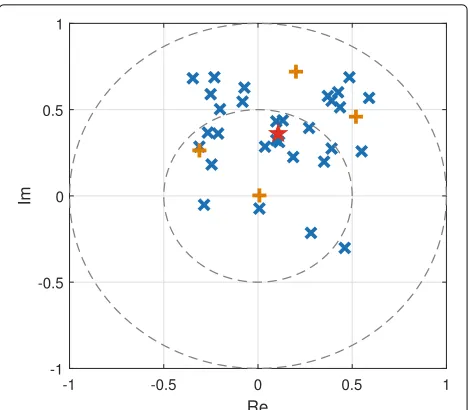
Fig. 2Examples of sigma points in the UKF method forβ=0.001 andκ=0. The blue crosses denote the initial pointsX. The red star and yellow plus signs denote the sigma pointsX
sampling technique called unscented transform, the UKF minimizes the absolute error between the estimated observation and the true measurement. In the optimiza-tion problem, by setting the true measurement as 0 and the estimated observation as the objective function, the UKF can be considered as a numerical optimization method to minimize the absolute value of the objective function. The searching strategy is shown in Algorithm 3 [26, 27]. In the following simulations, the parameters of the UKF method are set following the suggestions in [25], i.e.,β=0.001 andκ =0.
Based on the unscented transform technique, the UKF does not require the gradient information and normally does not need too many function evaluations.
2.2.3 Evolutionary algorithms
Evolutionary algorithms belong to stochastic search methods [28]. They mimic the metaphor of the natural biological evolution and the social behavior of species [29]. In this paper, the GA and the PSO algorithm are studied.
Table 1Suggested selection ranges of parameters in NM, UKF, GA, and PSO algorithms
Algorithm Nrand Niter
NM [600,1000] [10,200]
UKF [200,1000] [1,8]
Ngen Nind
GA [5,200] [10,50]
PSO [10,40] [10,40]
objective function and selected to evolve the population if they could provide better solutions than weak popula-tion members do [34]. In the crossover process, selected chromosomes containing better solutions exchange parts of their information to produce offspring chromosomes [35]. As opposed to the crossover process, the mutation process changes a piece of genes in one offspring chro-mosome randomly, which generates new genetic mate-rial to avoid the genetic algorithm converging to local minimum [32].
The PSO algorithm is a population-based search algo-rithm, inspired by the social behavior of a flock of
migrating birds trying to reach an unknown destination [32, 36]. The optimization procedure initializes with a random generation of points in the search space, usu-ally called particles [37]. As opposed to the GA, the PSO algorithm does not create new generations. The particles in the population only evolve their movement speed and position to achieve the desired position based on their own experience and also the experience of others [38]. In every search step, the position of the best particle who achieves the minimum objective function value is deter-mined as the best fitness of all particles. Based on this position and its own previous best position, each particle updates its velocity to catch up with the best particle [39]. As evolutionary algorithms in general are based on stochastic search, they do not require the gradient infor-mation as well as sifting initial points in the compu-tation. In addition, comparing to the exhaustive search method, less number of function evaluations is needed, normally.
2.3 Evaluation indices
In the following simulation studies, three indices are con-sidered to evaluate the performances of different opti-mization algorithms:
a
c
d
b
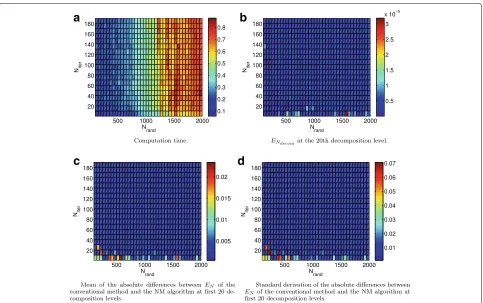
Fig. 3Effects ofNrandandNiterin the NM algorithm for the complex-valued signalG(z). Four figures show the computation time andENdecomat the
1. The reconstruction energy error at the maximum decomposition levelNdecom, denoted asENdecom, is
defined as
ENdecom = s
ori2−sNdecom
2
sori2
×100% (9)
wheresoriandsNdecomdenote the original signal and
the reconstructed signal at the maximum
decomposition level, respectively.ENdecomis assessed
to verify whether the AFD based on the optimization algorithm converges or not;
2. The absolute difference between the reconstruction error in sense of energy at theN th decomposition level,EN, of the conventional exhaustive search method and the other optimization method at each decomposition level whereEN is defined in (10), which is used to verify whether the energy
convergence rate remains satisfactory by considering the search results of the conventional exhaustive search method as the standard results.
EN =
sori2− sN2 sori2
×100% (10)
wheresNdenote the reconstructed signal at theN th decomposition level.
3. The computation time that is applied to evaluate the computation efficiency of the AFD. The units of time for the following simulation results are the second.
All following simulations are conducted in MATLAB R2014a at a PC equipped with Intel(R) Core(TM) i7-4770 CPU @ 3.40 GHz and 12 GB RAM. Moreover, in the following simulations, all numerical integrations in algo-rithm 1 are implemented based on the 6 order Newton-Cotes formula. The lengths of the processed signals in the following simulations are all set as 2500 sample points.
3 Simulation results
3.1 Effects of optimization parameters
To reveal the effects of optimization algorithm parame-ters, a complex-valued signal given by (11), which is also studied in [1], is taken as an example. In this part, only effects of parameters for the complex-valued signalG(z)is
a
c
d
b
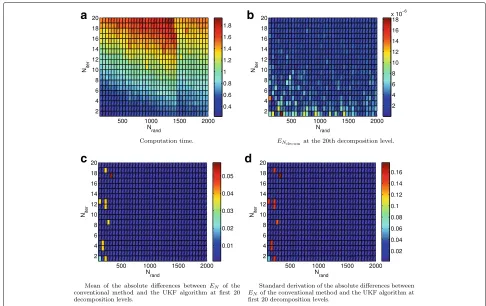
Fig. 4Effects ofNrandandNiterin the UKF method for the complex-valued signalG(z). Four figures show the computation time andENdecomat the
shown in detail. For real-valued signals in Section3.2and real ECG signals in Section3.3, effects of parameters are similar to the case forG(z).
G(z)= 0.0247z
4+0.0355z3
(1−0.9048z)(1−0.3679z) (11)
The total number of points that need to be evaluated in the MS process affects the optimization accuracy and the workload very much. The more points evaluated, the bet-ter computation result but the longer computation time. Therefore, there exists a trade-off between the computa-tion accuracy and the fast speed. Such control parameters for the NM algorithm and the UKF method are the num-ber of pointsNrandin the dictionary for searching initial
points and the maximum iteration numberNiter, respec-tively. The control parameters for the GA and the PSO algorithm are the number of individualsNindand the max-imum number of generationsNgen, respectively. For the
UKF method, to get the best searching speed,Landλare set as 2 and 0.001, respectively.
Effects of these parameters are determined based on simulation results. The maximum decomposition level
Ndecom is set to 20 for the complex-valued signal G(z)
since the first 20 decomposition components are enough to approximate G(z) according to Ref. [1]. According to the following simulation results, the suggested ranges of the parameters for the optimization algorithms are shown in Table 1, which can lead to relative low computation time and high optimization accuracy at the same time.
For the NM algorithm,NrandandNiterare selected from
[100, 2000] and [1, 200] for evaluations, respectively. Sim-ulation results of theG(z)signal are illustrated in Fig.3. It can be seen that all values ofENdecom are small no mat-ter which values of paramemat-ters are selected as shown in Fig. 3b, which means that the NM algorithm can keep the convergence of the AFD. In addition, the simulation result shown in Fig. 3a indicates that the effect of Niter
in the given range for the computation speed is not very large. However, the absolute differences of EN between the conventional method and the NM method are large and unstable when Niter is smaller than 10 andNrandis
smaller than 600. A major reason is that, when the eval-uated points are not enough, the NM algorithm would not lead to the global optimum, which may deteriorate the convergence rate of the remainder energy. Although increasingNrandandNitercould increase the computation
accuracy, the computation time would also be increased.
a
c
d
b
Fig. 5Effects ofNgenandNindin GA for the complex-valued signalG(z). Four figures show the computation time andENdecomat the 20th
In summary, for the NM algorithm, the suggested ranges ofNrand andNiter are [ 600, 1000] and [ 10, 200],
respec-tively.
For the UKF method,NrandandNiterare selected from
[ 100, 2000] and [ 1, 20] respectively for evaluations. Sim-ulation results are illustrated in Fig. 4. It can be seen that values ofENdecom are small. However, for someNiter values whenNrand is smaller than 200, the absolute
dif-ferences of EN between the conventional method and the UKF method cannot keep small and stable, or con-sequently, the convergence rate of the remainder energy can not keep high. In addition, the computation time will be increased very much as Nrand and Niter increase as shown in Fig.4a. Moreover, based on simulation results, the effect of Niter is larger than that of Nrand. In
sum-mary, the suggested ranges ofNrandandNiterfor the UKF
method are [ 200, 1000] and [ 1, 8], respectively.
For the GA,Ngen, andNind are all selected in [ 5, 200]
for evaluations. Simulation results are illustrated in Fig.5. Although all values of ENdecom are small, differences between EN of the conventional method and the GA become large and unstable when Nind is smaller than
20. Therefore, to achieve the fast energy convergence rate, Nind is required to be larger than 20. Moreover,
Nind will affect the computation speed significantly. As Nind increases, the computation time increases
dras-tically. In summary, the ranges of Ngen and Nind for
the GA method are suggested as [ 5, 200] and [ 10, 50], respectively.
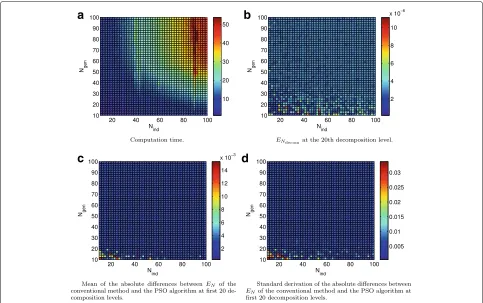
For the PSO algorithm,Nind andNgen are all selected
in [ 10, 100] for evaluations. Simulation results are shown in Fig. 6. It can be seen that all values of ENdecom are small. Although the absolute differences of EN between the conventional method and the PSO algorithm are rel-atively large and unstable whenNindandNgen are small, they are still acceptable in comparison with the simula-tion results of the NM algorithm, the UKF method and the GA. Moreover, since all individual states need to be updated one by one, computation time will be increased considerably asNind andNgenincrease. In summary, the
suggested ranges ofNgenandNindfor the PSO algorithm
are all [ 10, 40].
3.2 Optimization performance comparison for typical signals
In this part, four typical real-valued signals defined in Ref. [18] are considered to compare decomposition per-formances of the AFD based on the NM algorithm, the
a
c
d
b
Fig. 6Effects ofNgenandNindin PSO algorithm for the complex-valued signalG(z). Four figures show the computation time andENdecomat the 20th
UKF method, the GA and the PSO algorithm. Accord-ing to the suggested selection ranges shown in Table1, the selected parameters for the optimization algorithms are shown in Table2. The maximum decomposition levels
Ndecomof the AFD for these four signals are set as 100 to
make sure that the AFD can extract most energy from the original signal.
Table 3 lists the computation times in all situations where STD denotes the standard deviation of the com-putation time for these different signals. The AFD based on the UKF uses the least computational time for all four types of signals. In addition, the computation time of the AFD based on the PSO method is close to or higher than that of the AFD based on the conventional exhaustive search.
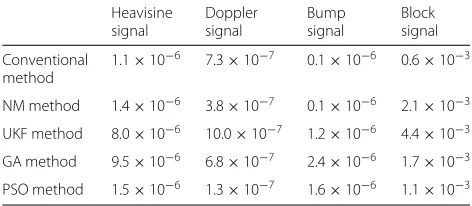
The corresponding reconstructed energy error is shown in Table 4. It can be seen that, compared to the relative energy error in [1, 40] for evaluating whether the AFD is converged, all reconstructed signals can approximate the original signals respectively with very small recon-struction error. Therefore, these optimization algorithms do not affect the convergence of the AFD. Compara-tively, the reconstructions for the block signal are worse than these for other signals since the block signal, as a combination of several different square waves, contains many high-frequency components and thus requires more decomposition levels to obtain a more accurate recon-struction.
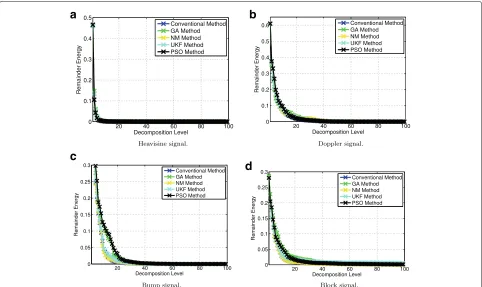
To verify the convergence rate, the remainder energy errors at the first 100 decomposition levels are illustrated in Fig. 7. The UKF and the NM methods have energy decay rates almost the same as the conventional method but larger than the GA and the PSO methods, especially for the bump signal. The reason is that the GA and the PSO methods fail to reach the global minimum in some decomposition levels due to small number of initial points and iteration loops. However, increasing the number of generations and individuals would increase the computa-tion time as shown in Figs.5a and6a. Therefore, for these four typical real-valued signals, the GA and the PSO algo-rithm cannot make the AFD achieve a fast computation speed with a high energy convergence rate at the same time.
Table 2Selected parameters of NM, UKF, GA, and PSO algorithms for simulations
Algorithm Nrand Niter
NM 700 10
UKF 700 8
Ngen Nind
GA 100 20
PSO 10 10
Table 3Computation time for five optimization algorithms in four typical real-valued signals
Heavisine Doppler Bump Block Mean STD
signal signal signal signal
Conventional method
5.496 5.451 5.647 5.501 5.524 0.085
NM method 1.286 1.172 1.316 1.331 1.276 0.072
UKF method 1.135 1.052 1.208 1.161 1.139 0.065
GA method 1.607 1.447 1.934 2.424 1.853 0.431
PSO method 5.094 8.047 5.031 4.953 5.781 1.512
Fonts in italics denote that there are all significant differences between the UKF method and any one of other methods by pairedt-tests (p<0.01)
3.3 Optimization performance comparison for real ECG signals
Results in Section3.3show that the proposed AFD imple-mentation methods can provide the better performance for four representative signals compared with the con-ventional exhaustive search. To verify the performance of these proposed methods for real signals, simulations of real ECG signals are carried out. Table 5 illustrates the comparisons of computation time between optimization methods. For all records, the computations based on the proposed methods are faster than that based on the con-ventional exhaustive search. In these proposed methods, the UKF-based AFD method uses least computation time for most records. The PSO-based AFD method performs worst compared to other proposed methods.
4 Discussions
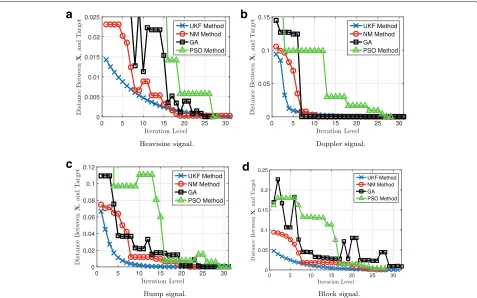
According to results in Section3, the UKF method based AFD can provide the best performance for all four rep-resentative and real ECG signals. It is reasonable that the UKF can achieve the good performance. The UKF method can produce the optimization results within a small num-ber of iterations, and therefore, not too many points need to be evaluated. Figure 8 illustrates the comparisons of the convergence of proposed optimization methods. The UKF method has the highest convergence rate and most accurate searching result at the beginning iteration level,
a
c
d
b
Fig. 7Reconstruction energy error at first 100 decomposition levels for 5 optimization algorithms in 4 different typical real-valued signals. Four figures compare the reconstruction energy error at first 100 decomposition levels for the conventional search method, the NM algorithm, the UKF method, the GA, and the PSO algorithm in the heavisine signal, the doppler signal, the bump signal, and the block signal
Table 5Computation time of optimization algorithms for real ECG signals
Real ECG Conventional NM UKF GA PSO
records method method method method method
100 2.895 0.722 0.539 1.156 2.211
101 2.982 0.618 0.526 1.019 2.015
102 2.871 0.594 0.541 1.022 2.071
103 2.798 0.554 0.519 1.002 2.010
104 2.793 0.547 0.578 0.928 1.994
105 2.824 0.546 0.545 0.966 1.986
106 3.172 0.543 0.989 1.348 2.148
107 3.293 0.595 0.495 1.122 2.046
108 3.294 0.577 0.533 1.013 2.059
109 2.863 0.563 0.543 0.959 2.067
119 2.775 0.518 0.546 0.945 1.994
201 3.029 0.557 0.565 0.996 2.520
202 3.059 0.585 0.563 0.981 2.049
203 2.942 0.831 0.654 0.999 2.117
205 3.011 0.903 0.714 1.113 2.366
207 2.907 0.607 0.528 1.025 2.117
208 2.958 0.560 0.606 1.033 2.067
209 2.888 0.573 0.533 1.271 2.093
213 2.847 0.620 0.588 0.961 2.077
Mean 2.958 0.611 0.584 1.045 2.106
STD 0.155 0.101 0.110 0.111 0.134
Fonts in italics denote that there are all significant differences between the UKF method and any one of other methods by pairedt-tests (p<0.001)
which means that the UKF method can achieve the pre-set threshold of the optimization error within a small iteration number. Therefore, the UKF does not need to evaluate large number of function values in the opti-mization process. Figure 9 shows the total number of evaluated objective function values in the AFD based on proposed optimization methods. It can be seen that the UKF requires the smallest number of points to search the suitableansequence. Such small number of iterations and small number of objective function evaluations will lead the UKF-based AFD achieve the short computation time.
In the UKF, besides the parametersNrandandNiter
men-tioned in the Section3.1, there are other two parameters, i.e., the spread of sigma pointsβand the secondary scaling parameterκ, as shown in Algorithm 3. These two param-eters determine the scaling parameterλdefined as [25]
λ=β2(L+κ)−L. (12)
a
c
d
b
Fig. 8Differences of the searching resultsXiin theith iteration of four proposed optimization methods and final optimization results of the conventional exhaustive search method. Four figures compare the convergences of the optimization results for the NM algorithm, the UKF method, the GA, and the PSO algorithm in the heavisine signal, the doppler signal, the bump signal, and the block signal
theith iteration, as well asPiXandPfinalX denote the covari-ances of sample pointsXin theith and the final iterations that can be considered as the updated descent steps obtained from theith iteration and the final iteration. It can be seen that the error betweenXiand the optimum is small at the beginning iteration level whenβ is small. In addition,XandPX achieve the small values faster when βis smaller. Except the parameterβ, Fig.10c and d show the effects of κ for the convergence ofXandPX. It can be seen that, whenκis close to 0,XandPXcan converge to the small values faster though the differences between
PiXandPfinalX are not smallest at the beginning iteration level whenκ = 0. Based on these simulation results, the suggested selections of κ andβ in [25] are also suitable for the AFD.
5 Conclusion
In order to improve the computation efficiency of the AFD, four typical optimization algorithms, including the UKF method, the NM algorithm, the GA, and the PSO algorithm, are adopted in basis search and com-pared to the conventional exhaustive search method. The
a
c
d
b
Fig. 10Effects of parameters for the convergence of estimated observationXand covariancePXin the UKF. Four figures compare the effects of
parametersβandκfor the estimated observationxiand covariancePXin the UKF method
maximization problem with one complex-valued variable in the basis search of the AFD is reformulated as the equivalent minimization problem with two real-valued variables. Simulations are conducted to four typical sig-nals, including the heavisine signal, the doppler signal, the bump signal, and the block signal, which can repre-sent spatially variable functions appearing in the signal processing. To verify the performance for real signals, simulations are also carried out for real ECG signals. Comparative results show that the UKF method can achieve the highest computation speed with a fast energy convergence rate for these signals.
Abbreviations
AFD: Adaptive fourier decomposition; GA: Genetic algorithm; MS: Maximal sifting; NM: Nelder-Mead; MSP: Maximal selection principle; PSO: Particle swarm optimization; STD: Standard deviation; UKF: Unscented Kalman filter
Availability of data and materials
Please contact author for data requests.
Funding
This work is supported in part by the Macau Science and Technology Development Fund (FDCT) under projects 036/2009/A, 142/2014/SB, 055/2015/A2 and 079/2016/A2, the University of Macau Research Committee under MYRG projects 069(Y1-L2)-FST13-WF, 2014-00174-FST, 2016-00240-FST, 2016-00053-FST and 2017-00207-FST.
Authors’ contributions
All the authors have participated in writing the manuscript. All authors read and approved the manuscript.
Ethics approval and consent to participate
Not applicable.
Consent for publication
Not applicable.
Competing interests
The authors declare that they have no competing interests.
Publisher’s Note
Springer Nature remains neutral with regard to jurisdictional claims in published maps and institutional affiliations.
Author details
1Department of Electrical and Computer Engineering, Faculty of Science and
Technology, University of Macau, Avenida da Universidade, Taipa, Macau, China.2Department of Mathematics, Faculty of Science and Technology, University of Macau, Avenida da Universidade, Taipa, Macau, China.
Received: 26 June 2018 Accepted: 2 November 2018
References
2. T. Qian, Adaptive Fourier decompositions and rational approximations, part I: Theory. Int. J. Wavelets Multiresolut. Inf. Process.12(5), 1461008 (2014).https://doi.org/10.1142/S0219691314610086
3. L. Zhang, W. Hong, W. Mai, T. Qian, Adaptive Fourier decomposition and rational approximation – part II: Software system design and
development. Int. J. Wavelets Multiresolut. Inf. Process.12(05), 1461009 (2014).https://doi.org/10.1142/S0219691314610098
4. W. Mi, T. Qian, F. Wan, A fast adaptive model reduction method based on Takenaka–Malmquist systems. Syst. Control Lett.61(1), 223–230 (2012). https://doi.org/10.1016/j.sysconle.2011.10.016
5. Z. Wang, F. Wan, C. M. Wong, L. Zhang, Adaptive Fourier decomposition based ECG denoising. Comput. Biol. Med.77, 195–205 (2016).https://doi. org/10.1016/j.compbiomed.2016.08.013
6. Z. Wang, L. Yang, C. M. Wong, F. Wan, in12th Int. Symp. Neural Networks. Fast basis searching method of adaptive Fourier decomposition based on Nelder-Mead algorithm for ECG signals (Springer, Jeju, South Korea, 2015), pp. 305–314.https://doi.org/10.1007/978-3-319-25393-0_34 7. J. Ma, T. Zhang, M. Dong, A novel ECG data compression method using
adaptive Fourier decomposition with security guarantee in e-health applications. IEEE J. Biomed. Heal. Informatics.19(3), 986–994 (2015). https://doi.org/10.1109/JBHI.2014.2357841
8. Q. Chen, T. Qian, Y. Li, W. Mai, X. Zhang, Adaptive Fourier tester for statistical estimation. Math. Method. Appl. Sci.39(12), 3478–3495 (2016). https://doi.org/10.1002/mma.3795
9. C. Tan, L. Zhang, H. T. Wu, A novel Blaschke unwinding adaptive Fourier decomposition based signal compression algorithm with application on ECG Signals. IEEE J. Biomed. Heal. Inform., 1–11 (2018).https://doi.org/10. 1109/JBHI.2018.2817192
10. T. Qian, Y.-B. Wang, Adaptive Fourier series—a variation of greedy algorithm. Adv. Comput. Math.34(3), 279–293 (2011).https://doi.org/10. 1007/s10444-010-9153-4
11. T. Qian, Y. Wang, Remarks on adaptive Fourier decomposition. Int. J. Wavelets Multiresolut. Inf. Process.11(1), 1350007 (2013).https://doi.org/ 10.1142/S0219691313500070
12. T. Qian, Intrinsic mono-component decomposition of functions: an advance of Fourier theory. Math. Methods Appl. Sci.33(7), 880–891 (2010).https://doi.org/10.1002/mma.1214
13. T. Qian, Cyclic AFD algorithm for the best rational approximation. Math. Methods Appl. Sci.37(6), 846–859 (2014).https://doi.org/10.1002/mma. 2843
14. R. R. Coifman, S. Steinerberger, H.-t. Wu, Carrier frequencies, holomorphy, and unwinding. SIAM J. Math. Anal.49(6), 4838–4864 (2017).https://doi. org/10.1137/16M1081087
15. R. R. Coifman, S. Steinerberger, Nonlinear phase unwinding of functions. J. Fourier Anal. Appl.23(4), 778–809 (2017). https://doi.org/10.1007/s00041-016-9489-3
16. G. Plonka, V. Pototskaia, Computation of adaptive Fourier series by sparse approximation of exponential sums. J. Fourier Anal. Appl., 1–29 (2018). https://doi.org/10.1007/s00041-018-9635-1
17. A. Kirkbas, A. Kizilkaya, E. Bogar, in2017 40th International Conference on Telecommunications and Signal Processing (TSP). Optimal basis pursuit based on jaya optimization for adaptive fourier decomposition (IEEE, Barcelona, Spain, 2017), pp. 538–543.https://doi.org/10.1109/TSP.2017. 8076045
18. D. L. Donoho, I. M. Johnstone, Ideal spatial adaptation by wavelet shrinkage. Biometrika.81(3), 425–455 (1994).https://doi.org/10.1093/ biomet/81.3.425
19. A. L. Goldberger, L. A. N. Amaral, L. Glass, J. M. Hausdorff, P. C. Ivanov, R. G. Mark, J. E. Mietus, G. B. Moody, C.-K. Peng, H. E. Stanley, PhysioBank, PhysioToolkit, and PhysioNet: components of a new research resource for complex physiologic signals. Circulation.101(23), 215–220 (2000).https:// doi.org/10.1161/01.CIR.101.23.e215
20. G. B. Moody, R. G. Mark, The impact of the MIT-BIH arrhythmia database. IEEE Eng. Med. Biol. Mag.20(3), 45–50 (2001).https://doi.org/10.1109/51. 932724
21. S. Y. Park, A. K. Bera, Maximum entropy autoregressive conditional heteroskedasticity model. J. Econom.150(2), 219–230 (2009).https://doi. org/10.1016/j.jeconom.2008.12.014
22. K. Klein, J. Neira, Nelder-Mead simplex optimization routine for large-scale problems: A distributed memory implementation. Comput. Econ.43(4), 447–461 (2013).https://doi.org/10.1007/s10614-013-9377-8
23. J. Nocedal, S. J. Wright,Numer. Optim. (Springer, New York, USA, 1999) 24. J. A. Nelder, R. Mead, A simplex method for function minimization.
Comput. J.7(4), 308–313 (1965).https://doi.org/10.1093/comjnl/7.4.308 25. E. A. Wan, R. Van Der Merwe, inAdapt. Syst. Signal Process. Commun.
Control Symp. 2000. AS-SPCC. IEEE 2000. The unscented Kalman filter for nonlinear estimation (IEEE, Albert, Canada, 2002), pp. 153–158.https:// doi.org/10.1109/ASSPCC.2000.882463
26. S. J. Julier, J. K. Uhlmann, inSPIE 3068, Signal Process. Sens. Fusion, Target Recognit. VI. New extension of the Kalman filter to nonlinear systems (SPIE, Orlando, FI, USA, 1997), pp. 182–193.https://doi.org/10.1117/12.280797 27. S. Lienhard, J. G. Malcolm, C.-F. Westin, Y. Rathi, A full bi-tensor neural
tractography algorithm using the unscented kalman filter. EURASIP J. Adv. Signal Process.2011(1), 77 (2011). https://doi.org/10.1186/1687-6180-2011-77
28. M. S. White, S. J. Flockton, A comparison of evolutionary algorithms for tracking time-varying recursive systems. EURASIP J. Adv. Signal Process.
2003(8), 396340 (2003).https://doi.org/10.1155/S1110865703303117 29. R. Salvador, F. Moreno, T. Riesgo, L. Sekanina, Evolutionary approach to
improve wavelet transforms for image compression in embedded systems. EURASIP J. Adv. Signal Process.2011(1), 973806 (2011).https:// doi.org/10.1155/2011/973806
30. J. Riionheimo, V. Välimäki, Parameter estimation of a plucked string synthesis model using a genetic algorithm with perceptual fitness calculation. EURASIP J. Adv. Signal Process.2003(8), 758284 (2003). https://doi.org/10.1155/S1110865703302100
31. G. Pignalberi, R. Cucchiara, L. Cinque, S. Levialdi, Tuning range image segmentation by genetic algorithm. EURASIP J. Adv. Signal Process.
2003(8), 683043 (2003).https://doi.org/10.1155/S1110865703303087 32. E. Elbeltagi, T. Hegazy, D. Grierson, Comparison among five
evolutionary-based optimization algorithms. Adv. Eng. Informatics.19(1), 43–53 (2005).https://doi.org/10.1016/j.aei.2005.01.004
33. L. M. Schmitt, Theory of genetic algorithms. Theor. Comput. Sci.259(1-2), 1–61 (2001).https://doi.org/10.1016/S0304-3975(00)00406-0
34. S. Panda, N. P. Padhy, Comparison of particle swarm optimization and genetic algorithm for FACTS-based controller design. Appl. Soft Comput.
8(4), 1418–1427 (2008).https://doi.org/10.1016/j.asoc.2007.10.009 35. L. M. Schmitt, Theory of genetic algorithms II: Models for genetic
operators over the string-tensor representation of populations and convergence to global optima for arbitrary fitness function under scaling. Theor. Comput. Sci.310(1-3), 181–231 (2004).https://doi.org/10.1016/ S0304-3975(03)00393-1
36. B. Li, Z. Zhou, W. Zou, W. Gao, Particle swarm optimization based noncoherent detector for ultra-wideband radio in intensive multipath environments. EURASIP J. Adv. Signal Process.2011(1), 341836 (2011). https://doi.org/10.1155/2011/341836
37. R. He, K. Wang, Q. Li, Y. Yuan, N. Zhao, Y. Liu, H. Zhang, A novel method for the detection of R-peaks in ECG based on K-nearest neighbors and particle swarm optimization. EURASIP J. Adv. Signal Process.2017(1), 82 (2017).https://doi.org/10.1186/s13634-017-0519-3
38. M. Clerc, J. Kennedy, The particle swarm – explosion, stability, and convergence in a multidimensional complex space. IEEE Trans. Evol. Comput.6(1), 58–73 (2002).https://doi.org/10.1109/4235.985692 39. IC. Trelea, The particle swarm optimization algorithm: convergence
analysis and parameter selection. Inf. Process. Lett.85(6), 317–325 (2003). https://doi.org/10.1016/S0020-0190(02)00447-7