NET Institute*
www.NETinst.org
Working Paper #09-08
September 2009
Algorithmic Trading and Information
Terrence Hendershott
University of California at Berkeley
Ryan Riordan
Karlsruhe Institute of Technology
* The Networks, Electronic Commerce, and Telecommunications (“NET”) Institute,
http://www.NETinst.org
, is a non-profit institution devoted to research on network
industries, electronic commerce, telecommunications, the Internet, “virtual networks”
comprised of computers that share the same technical standard or operating system, and
on network issues in general.
Algorithmic Trading and Information
∗Terrence Hendershott Haas School of Business University of California at Berkeley
Ryan Riordan
Department of Economics and Business Engineering Karlsruhe Institute of Technology
August 18, 2009
Abstract
We examine algorithmic trades (AT) and their role in the price discovery process in the 30 DAX stocks on the Deutsche Boerse. AT liquidity demand represents 52% of volume and AT supplies liquidity on 50% of volume. AT act strategically by monitoring the market for liquidity and deviations of price from fundamental value. AT consume liquidity when it is cheap and supply liquidity when it is expensive. AT contribute more to the efficient price by placing more efficient quotes and AT demanding liquidity to move the prices towards the efficient price.
∗
We thank Bruno Biais and conference participants at the IDEI-R Conference on Investment Banking and Financial Markets for helpful comments. Hendershott gratefully acknowledges support from the Net Institute, the Ewing Marion Kauffman Foundation, and the Lester Center for Entrepreneurship and Innovation at the Haas School at UC Berkeley. Riordan gratefully acknowledges support for the Deutsche Forschungs Gemeinschaft - graduate school Information and Market Engineering at the Karlsruhe Institute of Technology.
1
Introduction
Technology has revolutionized the way financial markets function and the way financial assets
are traded. Two significant interrelated technological changes are investors using computers to
automate their trading processes and markets reorganizing themselves so virtually all markets are
now electronic limit order books (Jain (2005)). The speed and quality of access to such markets
encourages the use of algorithmic trading (AT; AT denotes algorithmic traders as well), commonly
defined as the use of computer algorithms to automatically make trading decisions, submit orders, and manage those orders after submission. Because the trading process is central to efficient risk
sharing and price efficiency it is important to understand how AT is used and its role in the price
formation process. We examine these issues for DAX stocks (the 30 largest market capitalization
stocks) traded on the Deutsche Boerse (DB) with data identifying whether or not each trade’s
buyer and seller generated their order with an algorithm. Directly identifying AT is not possible
in most markets, so relatively little is known.1
Liquidity demanders use algorithms to try to identify when a security’s price deviates from the
efficient price by quickly processing information contained in order flow and price movements in
that security and other securities across markets. Liquidity suppliers must follow a similar strategy to avoid being picked off. Institutional investors also utilize AT to trade large quantities gradually
over time, thereby minimizing market impact and implementation costs.
Most markets offer volume discounts to attract high-frequency traders. The development costs
of AT typically lead to it being adopted first by high-volume users who automatically qualify for the
quantity discounts. The German competition authority did not allow for generic volume discounts,
rather requires that such discounts have a cost sensitive component. The DB successfully asserted
that algorithm generated trading is lower cost and highly sensitive to fee reductions and therefore,
could receive quantity discounts. In December of 2007, the DB introduced its fee rebate program for automated traders. The DB provided data on AT orders in the DAX stocks for the first three
weeks of January 2008.
1
Biais and Weill (2008) theoretically examine the relation between AT, market monitoring, and liquidity dynamics. Chaboud et al. (2009) study AT in the foreign exchange market. Hendershott, Jones, and Menkveld (2008) use a proxy for AT to examine AT’s effect on liquidity in the equity market.
AT initiate 52% of trading volume via marketable orders. AT initiate smaller trades with AT
initiating 68% of volume for trades of less than 500 shares and 23% of volume for trades of greater
than 10,000 shares. AT initiate trades quickly when spreads are small and cluster their trades
together. AT are more sensitive to human trading activity than humans are to AT trading activity.
These are all consistent with AT closely monitoring the market for trading opportunities. If an
algorithmic trader is constantly monitoring the market, the trader can break up their order into small pieces to disguise their intentions and quickly react to changes in market conditions. AT
could also be trying to exploit small deviations of price from fundamentals.
Moving beyond unconditional measures of AT activity we estimate probit models of AT using
market condition variables incorporating the state of the limit order book and past volatility and
trading volume. We find that AT are more likely to initiate trades when liquidity is high in terms
of narrow bid-ask spreads and higher depth. AT liquidity demanding trades are not related to
volatility in the prior 15 minutes, but AT initiated trading is negatively related to volume in the
prior 15 minutes.
Just as algorithms are used to monitor liquidity in the market, algorithms may also be used to
identify and capitalize on short-run price predictability. We use a standard vector auto-regression
framework (Hasbrouck (1991a) and Hasbrouck (1991b)) to examine the return-order flow dynamics
for both AT and human trades. AT liquidity demanding trades play a more significant role in
discovering the efficient price than human trades. AT initiated trades have a more than 20% larger
permanent price impact than human trades. In terms of the total contribution to price discovery—
decomposing the variance of the efficient price into its trade-correlated and non trade-correlated
components—AT liquidity demanding trades help impound 40% more information than human
trades. The larger percentage difference between AT and humans for the variance decomposition as compared to the impulse response functions implies that the innovations in AT order flow are
greater than the innovations in human order flow. This is consistent with AT being able to better
disguise their trading intentions.
We also examine when AT supply liquidity via non-marketable orders. The nature of our data
when AT supply liquidity in transactions (see Section 3 for details). Therefore, we focus our analysis
on quoted prices associated with AT and humans. While AT supply liquidity for exactly 50% of
trading volume, AT are at the best price (inside quote) more often than humans. This AT-human
difference is more pronounced when liquidity is lower, demonstrating that AT supply liquidity more
when liquidity is expensive.
We also examine the role of AT quotes in the price formation process. We calculate the in-formation shares (Hasbrouck (1995)) for AT and human quotes. AT quotes play a larger role in
the price formation process than their 50% of trading volume. The information shares decompose
the changes in the efficient price into components that occur first in AT quotes, human quotes,
and appear contemporaneously in AT and human quotes with the corresponding breakdown being
roughly 50%, 40%, and 10%, respectively. The ability of AT to update quotes quickly based on
changing market conditions could allow AT to better provide liquidity during challenging market
conditions.
The results on AT liquidity supply and demand suggest that AT monitor liquidity and informa-tion in the market. AT consume liquidity when it is cheap and supply liquidity when it is expensive,
smoothing out liquidity over time. AT also contribute more to the efficient price by having more
efficient quotes and AT demanding liquidity so as to move the prices towards the efficient price.
Casual observers often blame the recent increase in market volatility on AT.2 AT demanding liq-uidity during times when liqliq-uidity is low could result in AT exacerbating volatility, but we find no
evidence of this. AT could also exacerbate volatility by not supplying liquidity when the liquidity
dries up. However, we find the opposite.
Section 2 relates our work to existing literature. Section 3 describes the algorithmic trading on
the Deutsche Boerse. Section 4 describes our data. Section 5 analyzes when and how AT demands liquidity. Section 6 examines how AT demand liquidity relates to discovering the efficient price.
Section 7 studies when AT supply liquidity and its relation to discovering the efficient price. Section
8 concludes.
2
2
Related Literature
Due to the difficulty in identifying AT, most existing research directly addressing AT has used data
from brokers who sell AT products to institutional clients. Engle, Russell, and Ferstenberg (2007)
use execution data from Morgan Stanley algorithms to study the tradeoffs between algorithm
aggressiveness and the mean and dispersion of execution cost. Domowitz and Yegerman (2005)
study execution costs of ITG buy-side clients, comparing results from different algorithm providers.
Several recent studies use comprehensive data on AT. Chaboud et al. (2009) study the devel-opment of AT in the foreign exchange market on the electronic broking system (EBS) in three
currency pairs euro-dollar, dollar-yen, and euro-yen. They find little relation between AT and
volatility, as do we. In contrast to our results, Chaboud et al. (2009) find that non-algorithmic
order flow accounts for most of the variance in FX returns. There are several possible explanations
for this surprising result: (i) EBS’ origins as an interdealer market where algorithms were closely
monitored; (ii) humans in an interdealer market being more sophisticated than humans in equity
markets; or (iii) there is relatively little private information in FX. Chaboud et al. (2009) find
that AT seem to follow correlated strategies, which is consistent with our results of AT clustering
together in time. Hendershott, Jones, and Menkveld (2008) use a proxy for AT, message traffic, which is the sum of order submissions, order cancelations, and trades. Unfortunately, such a proxy
makes it difficult to closely examine when and how AT behave and their precise role in the price
formation process. Hendershott, Jones, and Menkveld (2008) are able to use an instrumental
vari-able to show that AT improves liquidity and makes quotes more informative. Our results on AT
liquidity supply and demand being more informed are the natural mechanism by which AT would
lead to more informationally efficient prices.
Any analysis of AT relates to models of liquidity supply and demand.3 Liquidity supply involves posting firm commitments to trade. These standing orders provide free-trading options to other traders. Using standard option pricing techniques, Copeland and Galai (1983) value the cost of the
option granted by liquidity suppliers. The arrival of public information can make existing orders
stale and can move the trading option into the money. Foucault, Ro¨ell, and Sandas (2003) study
3
the equilibrium level of effort that liquidity suppliers should expend in monitoring the market to
avoid this risk. AT enables this kind of monitoring and adjustment of limit orders in response to
public information,4 but AT can also be used by liquidity demanders to pick off liquidity suppliers who are not fast enough in adjusting their limit orders with public information. The monitoring
of the state of liquidity in the market and taking it when cheap and making it when expensive is
consistent with AT playing an important role in the make/take liquidity cycle modeled by Foucault, Kadan, and Kandel (2008).
Algorithms are also used by traders who are trying to passively accumulate or liquidate a large
position. Bertsimas and Lo (1998) find that the optimal dynamic execution strategies for such
traders involves optimally braking orders into pieces so as to minimize cost.5 While such execution strategies pre-dated wide-spread adoption of AT (cf. Keim and Madhavan (1995)), brokers now
automate the process with AT products.
For each component of the larger transaction, a trader (or algorithm) must choose the type
and aggressiveness of the order. Cohen et al. (1981) and Harris (1998) focus on the simplest static choice: market order versus limit order. If a trader chooses a non-marketable limit order,
the aggressiveness of the order is determined by its limit price (Griffiths et al. (2000) and Ranaldo
(2004)). Lo, MacKinlay, and Zhang (2002) find that execution times are very sensitive to the choice
of limit price. If limit orders do not execute, traders can cancel them and resubmit them with more
aggressive prices. A short time between submission and cancelation suggests the presence of AT,
and in fact Hasbrouck and Saar (2008) find that a large number of limit orders are canceled within
two seconds on the INET trading platform (which is now Nasdaq’s trading mechanism).
3
Deutsche Boerse’s Automated Trading Program
The Deutsche Boerse’s order-driven electronic limit order book system is called Xetra (see Hau
(2001) for details).6 Orders are matched using price-time-display priority. Quantities available at
4Rosu (2006) implicitly incorporates AT by assuming limit orders can be constantly adjusted. 5
Almgren and Chriss (2000) extend this by considering the risk that arises from breaking up orders and slowly executing them.
6
the 10 best bid and ask prices as well as numbers of participants at each level are disseminated
continuously. See the Appendix for further details on Xetra.
During our sample period Xetra had a 97% market share of German equities trading. With
such a dominant position the competition authorities (Bundeskartellamt) required approval of all fee
changes prior to implementation. Fee changes must meet the following criteria: (i) all participants
are treated equally; (ii) changes must have a cost-related justification; and (iii) fee changes are transparent and accessible to all participants. Criterion (i) and (iii) ensure a level playing field for
all members and is comparable to regulation in the rest of Europe and North America. The second
criteria is the most important for this paper. AT are viewed as satisfying the cost justification for
the change, so DB could offer lower trading fees for AT.
In December of 2007 the DB introduced its Automated Trading Program (ATP) to increase the
volume of automated trading on Xetra. To qualify for the ATP an electronic system must
deter-mine the price, quantity, and submission time for orders. In addition, the Deutsche Boerse ATP
agreement requires that: (i) the electronic system must generate buy and sell orders independently using a specific program and data; (ii) the generated orders must be channeled directly into the
Xetra system; and (iii) the exchange fees or the fees charged by the ATP member to its clients
must be directly considered by the electronic system when determining the order parameters.
Before being admitted to the ATP, participants must submit an high-level overview of the
electronic trading strategies they plan to employ. The level of disclosure required here is intended
to be low enough to not require ATP participants to reveal important details of their trading
strategies. Following admission to the ATP, the orders generated by each participant are audited
monthly for plausibility. If the order patterns generated do not match those suggested by the
strategy plan submitted by a participant or are considered likely to have been generated manually, the participant will be terminated from the ATP and may also be suspended from trading on
Xetra. Conversations with the DB revealed that a small portion of AT orders may not be included
in the data set. The suspicion on the part of the DB is due to the uncommonly high number of
orders (message traffic) to executions of certain participants which is typical of AT. However, these
The ATP agreement and the auditing process ensure that most, if not all, of the orders submitted by
an ATP participant are electronically generated and that most, if not all, electronically generated
orders are included in our data.
The DB only charges fees for executed trades and not for submitted orders. The rebate for ATP
participants can be significant. The rebates are designed to increase with the total trade volume
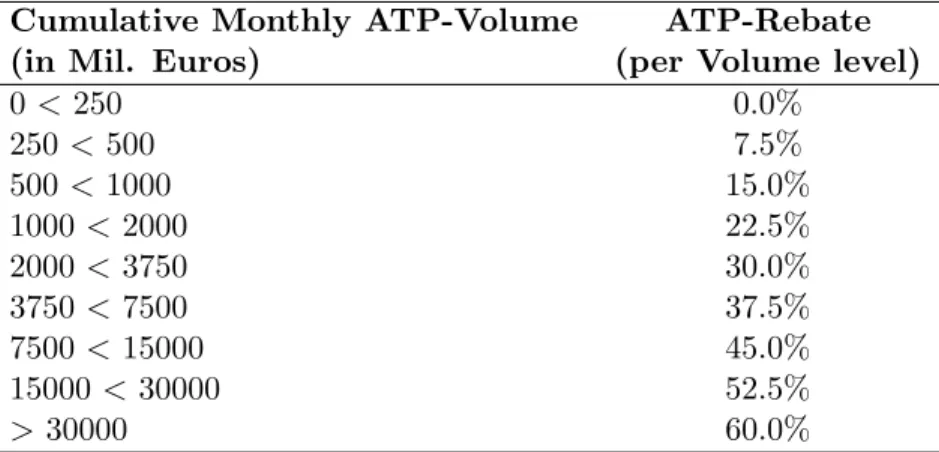
per month. Rebates are up to a maximum of 60% for euro monthly volume above 30 billion. The first Euro volume rebate level begins at a 250 million Euro volume and is 7.5%. Table 1 provides
an overview of the rebate per volume level.
[Insert Table 1 Here]
For an ATP participant with 1.9 billion euros in eligible volume, the percentage rebate would be (volumes are in millions of euros):
(250∗0% + 250∗7.5% + 500∗15.0% + 900∗22.5%)/1,900 = 15.6% (1)
In the example above, an ATP participant would receive a rebate of 15.6%. This translates
into roughly 14,000 euros in trading cost savings on 91,200 in total, and an additional 5,323 euros
savings on 61,500 in total in clearing and settlement costs. This rebate (14,000 + 5,323) translates
into a 0.1 basis point saving on the 1.9 billion in turnover. For high-frequency trading firms, whose
turnover is much higher than the amount of capital invested, the savings are significant.
The fee rebate for ATP participants is the sole difference in how orders are treated. AT orders
are displayed equivalently in the publicly disseminated Xetra limit order book. The Xetra matching
engine does not distinguish between AT and human orders. Therefore, there are no drawbacks for an AT firm to become an ATP participant. Thus, we expect all AT to take advantage of the
lower fees by becoming ATP participants. From this point on we equate ATP participants with
algorithmic traders and use AT for both. We will refer to non-ATP trades and orders as human or
4
Data and Descriptive Statistics
The DB provided data contain all AT orders submitted in DAX stocks, the leading German stock
market index composed of the 30 largest and most liquid stocks, between January 1st and January
18th, 2008, a total of 13 trading days. This is combined with Reuters DataScope Tick History data
provided by SIRCA. The SIRCA data contains two separate databases, one for transactions and
another for order book updates. Firms’ market capitalization on December 31, 2007 is gathered
from the Deutsche Boerse website and cross-checked against data posted directly on each company’s website.
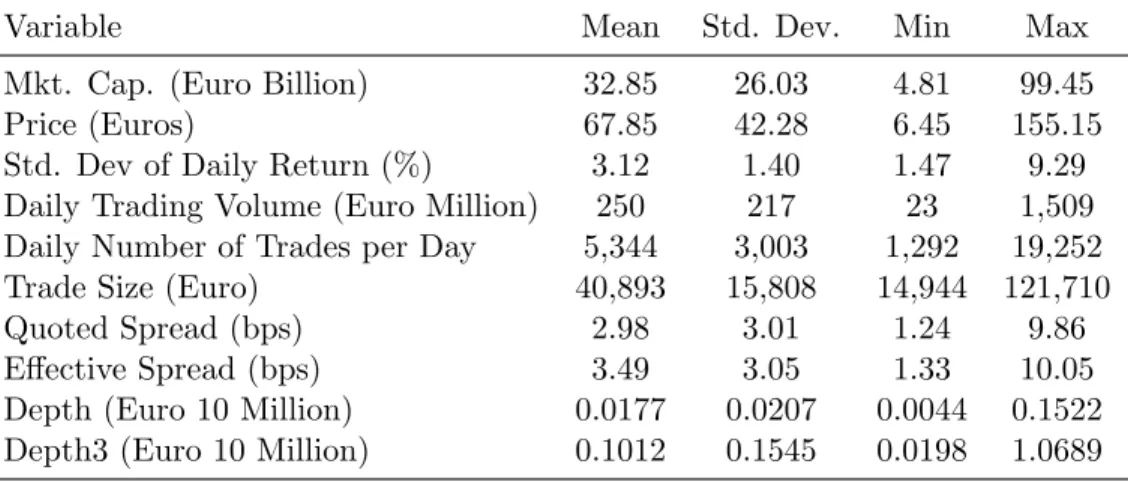
Table 2 describes the 30 stocks in the DAX index. Market capitalization is as of December
31st, 2007, in billions of Euros. The smallest firm (TUI AG) is large at 4.81 billion Euros but
is more than 20 times smaller than the largest stock in the sample, Siemens AG. The standard
deviation of daily returns is calculated for each stock during the sample period. All other variables
are calculated daily during the sample period for each stock (30 stocks for 13 trading days for a
total of 390 observations). Means and standard deviations along with the minimum and maximum
values are reported across the 390 stock-day observations.
[Insert Table 2 Here]
DAX stocks are quite liquid. The average trading volume is 250 million euros per day with
5,344 trades per day on average. The number of trades per day implies that our data set contains
roughly 2 million transactions (5,344*390). Quoted half-spreads are calculated when trades occur.
The average quoted half-spread of 2.98 basis points is comparable to large and liquid stocks in other markets. The effective spread is the absolute value of the difference between the transaction price
and the mid quote price (the average of the bid and ask quotes). Average effective spreads are only
slightly larger than quoted spreads, evidence that market participant seldom submit marketable
orders for depth at greater than the best bid or ask.
We measure depth in two ways. The first is the standard measure of the depth at the inside
depth is measured at the time of transactions. More depth allows traders to execute larger trades
without impacting the price, which corresponds to higher liquidity. However, if the width of the
spread varies over time, then comparisons of depth at the inside do not clearly correspond to levels
of liquidity, e.g., 50,000 euros at an inside spread of 10 basis points need not represent more liquidity
than 5,000 euros at an inside spread of 5 basis points if in the latter case there is sufficient additional
depth between 5 and 10 basis points. To account for time variation in the spread we calculate a second depth measure using the limit order book. For each stock we aggregate the depth at bid and
ask prices that have a distance of less than three times that stock’s average quoted half-spread from
the midquote at the time of transaction. We refer to this measure of depth that does not depend
on the spread at the time of the transaction as depth3. A similar measure is used in Foucault and
Menkveld (2008) to capture depth away from the best prices.
5
AT Liquidity Demand
To measure AT liquidity demand we create an AT trade-initiation variableAT and human
trade-initiation variable Hum. The AT variable takes the value 1 when a trade is initiated by an AT,
and is 0 otherwise. The Hum variable takes the value 1 when a trade is initiated by a human
and 0 otherwise. Panel A of Table 3 reports the fraction of euro trading volume for AT trades
by trade size and overall.7 Overall AT initiates 52% of euro volume and more than 60% of all trades. AT initiation declines as trade size increases. AT is greater than 68% and 57% in the two smallest trade-size categories (0-499 shares and 500-999 shares) and decreases to 23% in the largest
trade-size category (10,000+ shares). AT’s decline with trade size is consistent with AT being used
to breakup large orders into smaller trades as suggested by Bertsimas and Lo (1998).
[Insert Table 3 Here]
To better understand the nature of AT and human liquidity demand we perform a series of analyses similar to those found in Biais, Hillion, and Spatt (1995). We report the results of two
7
For simplicity and comparability we use the U.S. SEC Rule 605 trade-size categories based on the number of shares traded.
separate and related analyses in Table 4. The first column of Panel A of Table 4, labeled
uncondi-tional, provides what fraction of trades sequences, i.e., AT followed by AT, AT followed by human,
etc., we expect if AT and human trades are randomly ordered. The other columns in Panel A are
essentially a contingency table documenting the probability of observing a trade of a specific type
after observing a previous trade with a given type. All rows sum up to 100% and can be interpreted
as probability vectors.
[Insert Table 4 Here]
The first column and row of Panel A in Table 4 shows that if AT and human trades were
randomly ordered 37.03% of the transactions would be AT followed by AT while in the data this
occurs 40.73% of the time. The result show that AT trades are more likely to follow AT trades than we would expect unconditionally and that AT trades are more likely to be repeated on the
same side of the market. The same is true for human trades. This suggests that human and AT
liquidity demanding trading strategies differ.
Panel B extends the analysis of AT and humans trade sequence to include trade-size categories.
As in Biais, Hillion, and Spatt (1995) we highlight in bold the three largest values in a column. The
results are similar to the diagonal results reported in Biais, Hillion, and Spatt (1995) and predicted
theoretically in Parlour (1998). The diagonal finding implies that trades of the same type—AT or
human trades in the same trade-size category—follow other similar trades. This leads to a diagonal effect where the highest probabilities lie on the diagonal. The largest probability by far is for small
AT trades: theATt1−1ATt1 probability of 48.70% is much higher than the unconditional probability of 31.62%. This suggests that: (i) AT repeatedly use small trades to hide their information; (ii)
AT limit their transitory price impact; or (iii) that different AT are following related strategies.
Panel B also shows that AT seem to be sensitive to human order flow but humans are relatively
insensitive to AT order flow.
Table 4 provides evidence on the clustering of AT trades in trade sequences, but is not
in-formative on how closely together in time those trades cluster. Table 5 reports the average time
spreads are calculated for each stock and categories, e.g., large spread, are determined relative to
averages/percentiles for that stock. For example, large spread represents trades in a stock that
occur when spreads are in their widest quartile for that stock.
[Insert Table 5 Here]
The most interesting results in Table 5 are in Panel C. When spreads narrow the time until
the next AT trade shrinks significantly from 9.03 seconds for large spread to 4.67 seconds for small
spreads. While humans also respond more quickly to smaller spreads, the difference between large
spread (11.43 seconds) and small spreads (9.09 seconds) is 2.34 seconds for humans versus 4.36
seconds for AT. The difference-in-difference of 2.02 seconds between AT large-spread minus AT
small-spread and human large-spread minus human small-spread is statistically significant. This is further evidence that AT actively monitor the market for liquidity.
Thus far we have studied AT and human sensitivity to past trades and spreads. Next we
inspect AT and human trading taking into account contemporaneous and lagged liquidity measures.
Following Barclay, Hendershott, and McCormick (2003) we use the liquidity variables summarized
in Table 2 and past return volatility and trading volume. Lagged volatility is the absolute value of
the stock return over the 15 minutes prior to the transaction. Lagged volume is the euro trading
volume in the 15 minutes prior to the transaction.
Table 6 reports coefficients estimates from probit regressions for AT initiated trades along with their corresponding linear probability slopes and chi-square statistics. To control for stock effects
and time of day effects, we include, but do not report, firm dummy variables (30) and time of day
dummy variables (17 for each half-hour period). The only significant time of day effects are that
AT becomes less likely at the end of the trading day, primarily in the last half hour of continuous
trading. All 2,085,233 observations (each trade in our data set) are used. A chi-square statistic of
more than 3.84 represents statistical significant at the 5% level.
The probit results generally show thatAT is more likely to trade when spreads are narrow and
when trading volume over the prior 15 minutes is low. As in Panel A of Table 3 larger trades
are less likely to be initiated by AT. Volatility over the prior 15 minutes is unrelated to AT.
Once market conditions are controlled for, depth at the inside (depth) is unrelated to AT. Depth
measured independently of the inside spread (depth3) is positively related to AT. The positive
relation between AT initiation and liquidity and the zero relation between AT initiation and lagged volatility provide no evidence to support the hypothesis that AT exacerbates volatility.
As with the spread results in the time until the next transaction analysis in Table 5, the depth
and spread results establish that AT are more likely to initiate trades when liquidity is high. AT
closely monitoring the book could bring about this result for two reasons. First AT could time their
liquidity demand for times when liquidity is cheap, as in the Foucault, Kadan, and Kandel (2008)
make/take liquidity cycle. When liquidity is expensive algorithms simply wait to trade when more
liquidity is available. A variant on this is that when liquidity is expensive AT attempt to capture
rather than pay the spread by switching from demanding liquidity to supplying liquidity, which we explore in Section 7.
The results suggest that AT monitor the market for liquidity and consume liquidity when it
is cheap. This suggests that AT helps smooth out liquidity over time. When humans are more
willing to supply liquidity AT increase their liquidity demand. This together with AT having no
relationship to past volatility suggests that AT are more likely to dampen volatility than increase
volatility.
6
AT Liquidity Demand and Price Discovery
Having established that AT liquidity demand relates to liquidity dynamics we next examine the
dynamics between AT and returns. Just as AT monitors the market for variation in liquidity, AT
may be able to process and act on information before humans can. We examine this by estimating
the information content of AT and human trades using Hasbrouck (1991a) and Hasbrouck (1991b)
6.1 Information Content of AT - Impulse Response Function Results
To measure the information content of AT and human trades we first calculate the permanent price impact of AT and human trades. Several papers have addressed related questions in multi-market
settings, e.g., for example, Huang (2002) and Barclay, Hendershott, and McCormick (2003) for
quoting and trading on electronic communications networks and Nasdaq. In settings with multiple
markets, variation in time stamps across markets make it difficult to ensure the proper ordering of
trades across different markets. In addition if time stamps are only reported in seconds, trades and
quote changes may occur contemporaneously. Our data avoid these potential issues because trading
is all within the DB Xetra system and time stamps are reported to the millisecond. Therefore, we
estimate the model on a trade-by-trade basis using 10 lags for AT and human trades. We estimate the model for each stock for each day. We then conduct statistical inference using the 30 stocks *
13 days = 390 observations.
As in Barclay, Hendershott, and McCormick (2003) we estimate three equations, a midpoint
quote return equation, an AT equation, and a human trade equation. We use t, an event that is
a trade or quote change as our time scale and defineqat as the signed (+1 for a buy, -1 for a sell)
AT trades and qhuman as the signed human trades. We define rt as the quote midpoint to quote
midpoint return between trades or quote changes. The VAR using 10 lags is as follows:
rt= 10 X i=1 αirt−i+ 10 X i=0 βiqtat−i+ 10 X i=0 γiqthuman−i +1,t, (2) qtat = 10 X i=1 δirt−i+ 10 X i=1 ρiqatt−i+ 10 X i=1 ζiqhumant−i +2,t, (3) qhumant = 10 X i=1 πirt−i+ 10 X i=1 υiqtat−i+ 10 X i=1 ψiqthuman−i +3,t, (4)
Each day the trading process restarts and all lagged values are set to zero. By estimating a
transaction by transaction VAR we ensure that there is no correlation between qatt and qhumant .
the VAR to get the vector moving average (VMA) model: rt qtat qhumant = a(L)b(L)c(L) d(L)e(L)f(L) g(L)h(L)i(L) 1,t 2,t 3,t ,
where a(L) −i(L) are lagged polynomial operators. Following Hasbrouck (1991a), the impulse response function for AT isP10
t=0b(L) and can be interpreted as the private information content of
an innovation in AT. Similarly, the impulse response function for humans isP10
t=0c(L). The impulse
response functions provide an estimate of the permanent price impact of a trade innovation (the unexpected portion of a trade).
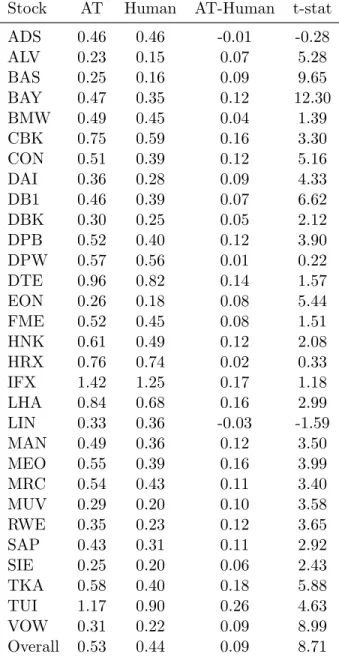
Table 7 reports the results of the impulse response function for 10 events into the future. We
also estimate the VAR out to 100 events and find no qualitatively different results. Table 7 reports
impulse response functions for each of the 30 stocks and the average impulse response function
across all 30 stocks. For each stock we estimate the statistical significance of the difference of the
impulse response function for AT and for human trading for the 13 trading days using Newey-West
standard errors. AT has a greater permanent price impact for 28 of the 30 stocks and for 23 of
those the AT-human difference is statistically significant at the 5% level. The average permanent price impact for AT is 0.53 basis points versus 0.44 basis points for human trades. We estimate
the statistical significance of this 0.09 overall difference between AT and human trades by double
clustering standard errors on stock and trading day (Thompson (2006) and Petersen (2009)). In
summary, an innovation in AT trading leads to a more than 20% greater permanent price change
than an innovation in human trading.
[Insert Table 7 Here]
Figure 1 graphs the overall average (across stock days) of the cumulative impulse response
function of a positive (buy order) one standard deviation shock to AT and human order flow from
greater than for humans and the impact of AT versus humans trades increases over the subsequent
10 events. We also see that the impulse response functions are becoming flat by the tenth event.
Figure 1 shows that the price response to AT order flow is immediately greater than the response
to human order flow.
[Insert Figure 1 Here]
The 95% confidence intervals in Figure 1 show that the larger immediate impact of AT is
statistically significant. Following Chaboud et al. (2009) to analyze whether the immediate reaction
to AT is due to overreaction we report the difference between the long-run (LR; 10 event forecast
horizon) and short-run (SR; immediate) impulse response functions in Table 8. As in Table 7 we
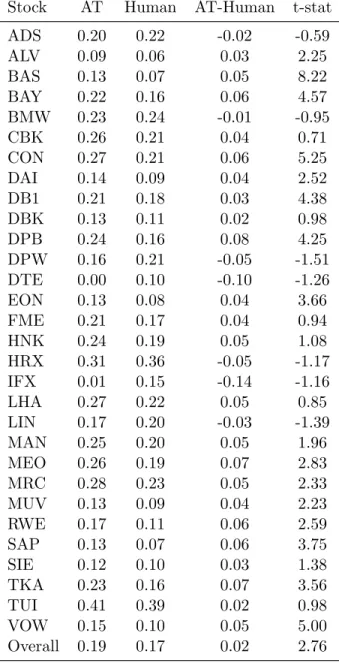
report estimates for AT, humans, and the AT-human difference for each stock and overall. The lagged adjustment (LR-SR) is smaller than the immediate response to trading for both AT and
human trades. The LR-SR impulse response is greater for AT than humans in 24 stocks. 17 of the
AT estimates are statistically significantly greater than humans and in no stock is there statistically
significant evidence that human trading has a larger impulse response function than AT.
[Insert Table 8 Here]
The impulse response results provide evidence that individual innovations in AT have more
private information than human trades. This difference is persistent and increases beyond the
immediate impact of the trade. If AT contributed to transitory volatility the long-run impulse
response function should be lower than the short-run impulse response function. Our evidence is
more consistent with AT playing an important role in the efficient price formation process.
6.2 Aggregate Amount of Information in AT - Variance Decomposition
The impulse response functions reported above provide evidence that innovations in AT have a
sig-nificant impact on prices, but do not characterize how important the role of AT and human trading
the variance of the efficient price into the portion of total price discovery that is correlated with AT
and human trades. Doing this first requires decomposing the midpoint return rt into its random
walk component mt and stationary componentst:
rt=mt+st (5)
We refer to mt as the efficient price where mt = mt−1 +wt and Ewt = 0; st is the transitory component. Using the previous VMA notation and defining σ21 = E21,t, σ22 = E22,t, and σ23 =
E23,t, we decompose the variance of the efficient price into trade-correlated and trade-uncorrelated changes: σ2w = 10 X i=0 ai !2 σ21+ 10 X i=0 bi !2 σ22 + 10 X i=0 ci !2 σ23 (6)
The second and third terms represent the proportion of the efficient price variance attributable
to AT and humans respectively. The first term is the public information (non-trade correlated)
portion of price discovery.8
Table 9 reports the variance decompositions results. As in the previous analyses, we report the average by stock and overall. In 27 of the 30 stocks AT has a greater contribution to price
discovery and in 21 of those stocks the AT-human difference is statistically significant. In no stock
is the human contribution to price discovery statistically significantly greater than that of AT.
On average AT contributes 39% more to price discovery than do humans. The larger percentage
difference between AT and humans for the variance decomposition as compared to the impulse
response functions implies that the innovations in AT order flow are greater than the innovations
in human order flow. This is consistent with AT being able to disguise their trading intentions.
[Insert Table 9 Here]
We also calculate, but do not report for brevity, the short-run (immediate) variance
decompo-8
Because each trade is initiated either by AT or by humans the correlation in the trade equation residuals,2,t
and3,t, is zero. Because the contemporaneous trade variables are included in the return equation the correlation of
the residuals from the trade equations are uncorrelated with the residuals from the return equation. Therefore, we do not include the residual covariance terms in the variance decomposition.
sition for AT and human trades. The results for the short-run variance decomposition are similar
to the results for the short-run impulse response functions in the previous section. Roughly half of
the variance explained by AT and human trades is reflected immediately.
7
AT Liquidity Supply and Price Discovery
Similar to the previous sections’ analysis of AT demanding liquidity and the role they plays in
the price discovery process, we would like to analyze how AT supply liquidity. By comparing the
volume of executed non-marketable AT orders with the total trading volume we can show that AT
supply liquidity on 50% of trading volume. Unfortunately, while our data from DB contains all
transactions where AT liquidity supply, we are only able to unambiguously identify 90% of these
in the public transaction record.9 This is due to the frequency of trading, the time stamps from the different data sources are not perfectly synchronized, and because knowing the size of a
non-marketable AT order does not uniquely identify the size of the total transaction. For example, if
a non-marketable AT order of 100 shares is executed the total trade size could be anything above
100 shares. Therefore, there are often several possible trades that occur at time stamps within
plausible differences between the public transaction record and our AT transaction record.10 This limits the types of analysis we can perform.
While we are unable to exactly match AT liquidity supplying trades with trades in the SIRCA
public order book, we are able to build an AT order book and match this with the public order book. To understand how AT supply liquidity we build two order books (see the Appendix for further
details). We build one AT order book that contains the best prices and sizes of AT orders and
compare this order book with the SIRCA full order book. The depth in the full SICRA order book
that is not found in the AT order book is the human order book. We then keep the best/inside bid
and ask quotes for the AT and humans. If there is any doubt, each step in the matching procedure
9
Analysis on the transactions that we can unambiguously identify as AT liquidity supplying supports the main findings in this section that AT supply liquidity when it is expensive and AT are less likely to trade against private information.
10
Multiple feasible matches for AT transactions also occur for liquidity demanding trades. However, when AT initiates a trade size is uniquely identified, this only occurs on 0.1% of the AT liquidity demanding trades as opposed to 10% of the AT liquidity supplying trades.
assumes humans quote updates occur before AT quote updates.
We first examine whether or not AT are more likely to supply liquidity at the best quotes.
This provides initial evidence on whether or not AT are competitive in quoting the best prices for
marketable orders to trade with. Table 10 examines the amount of time AT and humans are at
the inside bid and ask. This combines the times when AT and humans are alone at the inside and
when they are both at the inside together. A positive number indicates that an AT is at the best alone for longer than humans and the reverse is true if the value is negative.
[Insert Table 10 Here]
Table 10 shows that AT are at the inside more often in 24 of the 30 DAX stocks with the difference
being statistically significant in 21 of the stocks. On average for each stock-day AT are at the inside almost 1 hour more per day than humans and the difference is statistically significant. Table 10
also examines whether or not AT are more likely to be present at the inside when spreads are wide
or narrow. As in Table 5 for each stock we identify times when spreads are wider and narrower
than average for that stock. We then calculate the amount of time, during the high- and low-spread
times, AT and humans are on the inside. Table 10 shows that AT are at the inside more often during
both high- and low-spread periods, but the AT-human difference is significantly higher during the
high-spread periods. This shows that AT are more likely to provide liquidity when it is expensive.
This is consistent with AT attempting to capture liquidity supply profits in the Foucault, Kadan, and Kandel (2008) make/take liquidity cycle.
For AT to be on the inside more often yet only provide liquidity for for 50% of volume, AT orders
must be smaller or times when humans are alone at the inside are more likely to have transactions.
One natural explanation for trades occurring more often when humans are alone at the inside quote
is that the human quotes are stale and are adversely picked off. Examining how much the AT and
human quotes contribute to the price discover process will show if when AT and human quotes
are different the AT quotes better reflect the efficient price. If AT quotes contribute more to the
price discovery process then when human quotes differ from AT quotes the human quotes appear
7.1 Hasbrouck Information Shares
To examine AT and human quotes in the price discovery process we use the Information Shares (IS) approach pioneered by Hasbrouck (1995). Typically this approach is used to determine which of
several markets contributes more to price discovery. This approach has been used in the literature
to compare spot and derivatives markets (e.g., Tse (1999) and Chan, Chung, and Fong (2002)) and
multiple stocks market (Hasbrouck (1995), Huang (2002), Barclay, Hendershott, and McCormick
(2003), and others). Because the information share has been widely used we briefly describe it. The
econometric approach assumes that AT and human quotes form a common efficient price process.
The information share attributable to AT and human quotes is the relative contribution of the
innovations of each to the innovation in the common efficient price. The general convention is to equate the proportional information share to price discovery.
Because AT and human quotes are for the same stock arbitrage requires that the two price
series be co-integrated. We calculate the AT midpoint asM PtAT = (BestBidATt +BestAsktAT)/2
and the midpoint for humans is calculated in the same manner. The midpoints are assumed
covariance stationary. The information share of a participant is measured as that participants
contribution to the total variance of the common (random-walk) component. To formalize, denote
a price vector pt that represents the prevailing mid-quote for AT aspATt =mt+ATt and humans
aspHumt =mt+Humt . mt, the common efficient price, is assumed to follow a random walk:
mt=mt−1+ut, (7)
where E(ut) = 0, E(u2t) = σu2, and E(utus) = 0 for t 6= s. The price vector can be represented using a VMA model:
∆pt=t+ψ1t−1+ψ2t−2..., (8)
Where is a 2 X 1 vector of innovations with a zero mean and a variance matrix of Ω; t =
hu-mans. The variance of the random walk component is then:
σu2 = ΨΩΨ0 (9)
where Ω = V ar(t) and Ψ is a polynomial in the lag operator. Writing out the above equation
yields: σu2 = [ΨAT,ΨHum] σ2at σat,hum σat,hum σhum2 ΨAT ΨHum .
If the covariance matrix is diagonal the random-walk variance attributable to AT and humans can
be perfectly identified. If our record of the public limit order book was updated every time an order
arrived, there should be no contemporaneous correlation between AT and human quote changes.
However, it appears that at times the public order book dissemination contains multiple updates. Therefore, the off-diagonal terms are not zero so we follow Hasbrouck (1995) to construct upper
and lower bounds for the information shares of AT and human quotes. The upper bound for AT
corresponds to the assumption that all of the contemporaneous correlation between AT and human
quote changes is attributable to AT; whereas the lower bound for AT assumes the contemporaneous
correlation between AT and human quote changes is attributable to humans.
Table 11 present the information share estimates using AT and human midpoint prices at 250
millisecond intervals. As with the impulse response and variance decompositions for AT liquidity
demand we calculate the information shares each day. We then conduct statistical significance based
on the 13 days for each stock. For the overall estimates we pool the 390 stock day information share estimates and calculate standard errors controlling for correlation within each stock’s estimate and
controlling for correlation across stocks on the same day. It is worth recalling that our construction
of the AT and human quotes ensured that whenever there was uncertainty as to whether or not an
AT quote change preceded or followed a close by human quote change we assume the human quote
change occurred first. Therefore, the lower bound for the AT information share is truly a lower
bound, but the upper bound for AT information share is a lower bound for the true upper bound.
Panel A reports the upper bound estimate for AT information shares and the lower bound for
human information shares. Panel B reverses the ordering to provide the lower bound estimate for
AT information shares and the upper bound for human information shares. The results in Panel
A of Table 11 show that in 18 of 30 stocks AT have statistically significantly higher information
shares. For the entire panel AT have an information share 21% higher with a t-statistic of 9.61. In no stocks do humans have statistically significantly higher information shares than AT. We use the
same statistical framework as in the previous sections. In Panel B we see that the lower bound for
AT information shares is statistically significantly higher than the upper bound for humans in 11
stocks while the upper bound for humans is statistically significantly higher than the lower bound
for AT in 8 stocks. Overall, the lower bound on AT information shares is greater than the upper
bound for human, but the difference is not statistically significant.
Comparing the upper and lower bounds on AT and human information shares in Panels A and
B of Table 11 shows that 51% of price discovery comes from AT quotes, 39% of price discovery comes from human quotes, and 10% occurs contemporaneously in AT and human quotes. Given
that we have ordered the quote changes to favor humans role in price discovery, we find evidence
to support AT playing a larger role in price discovery, but no evidence to suggest that humans play
a larger role.
8
Conclusion
We study algorithmic trading and its role in the price formation process. We find that AT consume
liquidity when it is cheap and provide liquidity when it is expensive. AT contributes more to the
discovery of the efficient price than human trading. These results demonstrate that AT closely
monitor the market in terms of liquidity and information and react quickly to changes in market
conditions. Contrary to conventional wisdom we find no evidence of AT behavior that would
contribute to volatility beyond making prices more efficient.
Our results have important implications for academics, regulators, and market operators.
monitor the market. These traders could prevent prices from deviating significantly from
funda-mentals and prevent spreads from widening beyond a certain point; both of these features would
reduce the dimensionality of the state space (cf. Goettler, Parlour, and Rajan (2008)). The ATP
approved by the German competition authority appears to have led to behavior that should improve
References
Almgren, R., and N. Chriss. 2000. “Optimal execution of portfolio transactions.” Journal of Risk
3:5–40.
Barclay, M.J., T. Hendershott, and D.T. McCormick. 2003. “Competition among Trading Venues: Information and Trading on Electronic Communications Networks.” The Journal of Finance
58:2637–2666.
Bertsimas, D., and A.W. Lo. 1998. “Optimal Control of Execution Costs.” Journal of Financial Markets 1:1–50.
Bessembinder, H. 2003. “Issues in assessing trade execution costs.” Journal of Financial Markets
6:233–257.
Biais, B., P. Hillion, and C. Spatt. 1995. “An Empirical Analysis of the Limit Order Book and the Order Flow in the Paris Bourse.” Journal of Finance 50:1655–1690.
Biais, B., and P-O Weill. 2008. “Algorithmic Trading and the Dynamics of the Order Book.” Manuscript, Toulouse University, IDEI.
Chaboud, A., B. Chiquoine, E. Hjalmarsson, and C. Vega. 2009. “Rise of the Machines: Algo-rithmic Trading in the Foreign Exchange Market.”
Chan, K., Y.P. Chung, and W.M. Fong. 2002. “The informational role of stock and option volume.” Review of Financial Studies 15:1049–1075.
Cohen, K., S. Maier, R. Schwartz, and D. Whitcomb. 1981. “Transaction Costs, Order Placement Strategy and Existence of the Bid-Ask Spread.” Journal of Political Economy 89:287–305. Copeland, T.E., and D. Galai. 1983. “Information effects on the bid-ask spread.” Journal of
Finance, pp. 1457–1469.
Domowitz, I., and H. Yegerman. 2005. “The Cost of Algorithmic Trading: A First Look at Com-parative Performance.” Edited by Brian R. Bruce, Algorithmic Trading: Precision, Control, Execution. Institutional Investor.
Engle, R.F., J.R. Russell, and R. Ferstenberg. 2007. “Measuring and Modeling Execution Cost and Risk.” Manuscript, NYU Stern.
Foucault, T., O. Kadan, and E. Kandel. 2008. “Liquidity Cycles and Make/Take Fees in Electronic Markets.”
Foucault, T., and A.J. Menkveld. 2008. “Competition for order flow and smart order routing systems.” Journal of Finance 63:119–158.
Foucault, T., A. Ro¨ell, and P. Sandas. 2003. “Market Making with Costly Monitoring: An Analysis of the SOES Controversy.” Review of Financial Studies 16:345–384.
Goettler, R., C. Parlour, and U. Rajan. 2008. “Informed Traders and Limit Order Markets.” Griffiths, M., B. Smith, D.A. Turnbull, and R. White. 2000. “The Costs and Determinants of
Order Aggressiveness.” Journal of Financial Economics 56:65–88.
Harris, L. 1998. “Optimal Dynamic Order Submission Strategies in Some Stylized Trading Prob-lems.” Financial Markets, Institutions, and Instruments 7:1–76.
Hasbrouck, J. 1991a. “Measuring the information content of stock trades.” Journal of Finance
46:179–207.
. 1991b. “The summary informativeness of stock trades: An econometric analysis.” Review of Financial Studies 4:571–595.
. 1995. “One security, many markets: Determining the contributions to price discovery.”
Journal of Finance 50:1175–1199.
Hasbrouck, J., and G. Saar. 2008. “Technology and liquidity provision: The blurring of traditional definitions.” Journal of Financial Markets.
Hau, H. 2001. “Location Matters: An Examination of Trading Profits.” The Journal of Finance
56:1959–1983.
Hendershott, T., C. M. Jones, and A. J. Menkveld. 2008. “Does Algorithmic Trading Improve Liquidity?”
Huang, R.D. 2002. “The quality of ECN and Nasdaq market maker quotes.” Journal of Finance, pp. 1285–1319.
Jain, P.K. 2005. “Financial Market Design and the Equity Premium: Electronic versus Floor Trading.” Journal of Finance 60:2955–2985.
Keim, D., and A. Madhavan. 1995. “Anatomy of the Trading Process: Empirical Evidence on the Behavior of Institutional Traders.” Journal of Financial Economics 37:371–398.
Lee, C., and M. Ready. 1991. “Inferring trade direction from intraday data.” Journal of Finance
46:733–746.
Lo, W.A., A.C. MacKinlay, and J. Zhang. 2002. “Econometric Models of Limit-Order Executions.”
Journal of Financial Economics 65:31–71.
Parlour, C., and D. Seppi. 2008. “Limit Order Markets: A Survey.”
Parlour, C.A. 1998. “Price dynamics in limit order markets.” Review of Financial Studies 11:789– 816.
Petersen, M.A. 2009. “Estimating standard errors in finance panel data sets: Comparing ap-proaches.” Review of Financial Studies 22:435.
Ranaldo, A. 2004. “Order Aggressiveness in Limit Order Book Markets.” Journal of Financial Markets 7:53–74.
Rosu, I. 2006. “A Dynamic Model of the Limit Order Book.” Manuscript, University of Chicago. Thompson, S. B. 2006. “Simple Formulas for Standard Errors that Cluster by Both Firm and
Time.”
Tse, Y. 1999. “Price discovery and volatility spillovers in the DJIA index and futures markets.”
Journal of Futures Markets 19:911–930.
Venkataraman, K. 2001. “Automated Versus Floor Trading: An Analysis of Execution Costs on the Paris and New York Exchanges.” The Journal of Finance 56 (4): 1445–1485.
A
Appendix - Xetra and AT Matching Details
The Xetra trading system is the electronic trading system operated by the Deutsche Boerse and handles more than 98% of German equities trading by euro volume in DAX stocks (2007 Deutsche Boerse Factbook). The DB is a publicly traded company that also operates the Eurex deriva-tives trading platform and the Clearstream European clearing and settlement system. DB admits participants that want to trade on Xetra based on regulations set and monitored by German and European financial regulators. After being admitted participants can only connect electronically to Xetra, floor trading is operated separately with no interaction between the two trading segments.
Xetra is implemented as an electronic limit order book with trading split into phases as fol-lows:
• Opening call auction with a random ending that opens trading at 9:00
• A continuous trading period
• A two-minute intra-day call auction at 1:00 with a random ending
• A second continuous trading period
• A closing call auction beginning at 5:30 with a random ending after 5:35
We focus our analysis on trade occurring during the two continuous trading periods. Liquidity in DAX stocks is provided by public limit orders displayed in the order book of each stock. Orders execute automatically when an incoming market, or marketable limit order crosses with an out-standing limit order. Order execution preference is determined using price-time priorities. Three types of orders are permitted, limit, market and iceberg orders. Iceberg orders are orders that display only a portion of the total size of an order. Iceberg orders sacrifice time priority on the non-displayed portion. Pre-trade transparency includes the 10 best bids and ask prices and quan-tities but not the ID of the submitting participant (as on the Paris Bourse (Venkataraman (2001)). Trade price and size are disseminated immediately to all participants. The tick size for most stocks is 1 euro cent with the exception of two stocks that trade in tenths of a cent.11
A.1 Trade Matching
For trades we match two separate types of data. AT trades are matched with trades in the SIRCA public data record. We also match the best (highest bid and lowest ask) AT orders with the SIRCA public order book. Using the AT order data we identify AT liquidity demanding trades in the public data. We match these AT trades to the SICRA data using the following criteria:
• Symbol
• Price
• Size
• Trade Direction
• Time stamp (milliseconds)
Matches between the data sources identify liquidity demanding trades (AT). Liquidity demand-ing trades match exactly with trade size and price in the public data. We identify the trade initiator
11
Both stocks, Deutsche Telekom AG and Infineon AG have trade prices below 15 euros. Our sample period overlaps a Deutsche Boerse tick-size test that was subsequently extended to other stocks
in the SIRCA public data using the Lee and Ready trade direction algorithm Lee and Ready (1991) with the Bessembinder (2003) modifications to determine the trade direction in the public data and use the modification and execution time stamp in the AT data.
Adjustments are made for an additional lag in the time stamp between the AT and SIRCA data sets. The publicly available data is time-stamped to the millisecond but, due to transmission and additional system processing, it lags the system order data. We allow for a time window of up to 250 ms in the public data when looking for a match of the remaining criteria. The below table A-1 summarizes the lags needed to match trades by type.
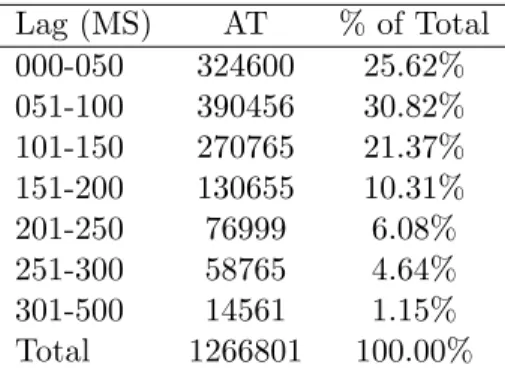
Table A-1: Trade Matching by Type and Lag. This table reports distributions of lags between the time stamps in the Deutsche Boerse System Order data and SIRCA public data used for matching. Lag (MS) AT % of Total 000-050 324600 25.62% 051-100 390456 30.82% 101-150 270765 21.37% 151-200 130655 10.31% 201-250 76999 6.08% 251-300 58765 4.64% 301-500 14561 1.15% Total 1266801 100.00%
A.2 Quote Matching
We also match the quotes from non-marketable orders submitted by algorithms and humans. To do so we create two order books. For the AT we re-create an AT order book based on the system order data. To create a human order book we take the SIRCA publicly disseminated order book and ’subtract’ the AT order book. The SIRCA order book is disseminated with a lag, in this case, of not more than 250 ms. The 250 ms maximum lag was discovered by manual inspection of a large number of AT orders and SIRCA order books, especially around periods of high activity. After the AT order book is created we match the best AT price and quantity with the next order book update after the 250 ms lag. If there were no updates within 500 ms, we take the last update before 250 ms. If we find a match and the AT price is ’better’ than the posted price we delete the AT record. This phenomena is likely related to fleeting orders described in Hasbrouck and Saar (2008). If an AT submits an order that only lives for a small of number of MS and is therefore fleeting, we will be unlikely to find it in the SIRCA public order data. Another case is when an AT submit a non-marketable limit order which is hit by an incoming marketable limit order directly after submission but before the 250 ms mark. This only occurs when AT orders live less than 250 ms and the true lag is also less than 250 ms. If the quantity match isn’t exact we adjust the AT quantity to the lowest possible AT quantity. By performing these corrections we are essentially handicapping AT and giving the benefit of the doubt to humans in general.
Table 1: ATP-Rebate Program. Fee rebate schedule for ATP participants by volume levels.
Cumulative Monthly ATP-Volume ATP-Rebate
(in Mil. Euros) (per Volume level)
0 <250 0.0% 250< 500 7.5% 500< 1000 15.0% 1000 <2000 22.5% 2000 <3750 30.0% 3750 <7500 37.5% 7500 <15000 45.0% 15000 <30000 52.5% > 30000 60.0%
Table 2: Summary Statistics. This table presents descriptive statistics for the 30 constituents of the DAX index between January 1, 2008 and January 18, 2008. The data set combines Deutsche Boerse Automated Trading Program System Order data and SIRCA trade, quote, and order data. Market Capitalization data is gathered from the Deutsche Boerse website and cross-checked against data posted directly on the company’s website and is the closing market capitalization on December 31, 2007. Other variables are averaged per stock and day (390 observations) and the mean, std. dev., maximum and minimum of these stock-day averages are reported.
Variable Mean Std. Dev. Min Max Mkt. Cap. (Euro Billion) 32.85 26.03 4.81 99.45 Price (Euros) 67.85 42.28 6.45 155.15 Std. Dev of Daily Return (%) 3.12 1.40 1.47 9.29 Daily Trading Volume (Euro Million) 250 217 23 1,509 Daily Number of Trades per Day 5,344 3,003 1,292 19,252 Trade Size (Euro) 40,893 15,808 14,944 121,710 Quoted Spread (bps) 2.98 3.01 1.24 9.86 Effective Spread (bps) 3.49 3.05 1.33 10.05 Depth (Euro 10 Million) 0.0177 0.0207 0.0044 0.1522 Depth3 (Euro 10 Million) 0.1012 0.1545 0.0198 1.0689
Table 3: AT Volume by Trade-size Category. This table reports volume-weighted participation by AT and humans in 5 trade size categories.
Trade-size Categories AT HUM All
0 - 499 68% 32% 21% 500 -999 57% 43% 43% 1,000 - 4,999 42% 58% 21% 5,000 - 9,999 30% 70% 7% 10,000 + 23% 77% 8% All 52% 48% 100%
T able 4: T rade F requency C ondit ional on Previous T rade . P anel A rep orts the conditional frequency of observing A T and h uman trades after observing trades of other participan ts. In column and ro w headings t indexes trades. AT represen ts A T trades and H um represen ts h uman trades. P anel B pr o vides cond itional probabilities based on the previous trade’s size and participan t with the three highest v alues p er column highligh ted in b old. P anel A B uy t − 1 S el lt− 1 Ordering Uncond. F req. Buy Sell S el lt B uy t AT t − 1 AT t 37.03% 40.73% 13.73% 10.96% 7.84% 8.20% AT t − 1 H U M t 23.82% 20.12% 5.53% 5.05% 5.44% 4.11% H U M t − 1 AT t 23.82% 20.12% 6.45% 5.64% 3.89% 4.15% H U M t − 1 H U M t 15.33% 19.02% 5.48% 5.35% 3.75% 4.45% 100.00% 31.18% 27.00% 20.91% 20.91% P anel B AT 5 t AT 4 t AT 3 t AT 2 t AT 1 t H um 5 t H um 4 t H um 3 t H um 2 t H um 1 t AT 5 t− 1 8.38% 9.46% 18.13% 16.78% 7.81% 8.16% 6.03% 6.74% 7. 96% 10.54% AT 4 t− 1 3.82% 7.87% 15.97% 23.33% 11.71% 4.51% 4.61% 7.36% 9.90% 10.94% AT 3 t− 1 1.35% 2.73% 12.00% 28.95% 20.69% 2.22% 2.70% 6.23% 11.11% 12.03% AT 2 t− 1 0.22% 0.70% 4.69% 27.10% 33.88% 0.60% 1.12% 4.07% 11.89% 15.72% AT 1 t− 1 0.05% 0.18% 1.75% 16.67% 48.70% 0.17% 0.45% 2.19% 9.89% 19.94% H um 5 t− 1 5.46% 6.51% 13.72% 17.50% 8.30% 10.26% 7.15% 8.66% 10.35% 12. 09% H um 4 t− 1 1.80% 3.36% 10.40% 22.56% 14.42% 4.24% 6.40% 9.77% 13.46% 13. 58% H um 3 t− 1 0.56% 1.39% 6.78% 23.53% 21.17% 1. 70% 2.75% 10.16% 16.36% 15.60% H um 2 t− 1 0.20% 0.54% 3.43% 19.21% 28.37% 0.69% 1.31% 4.95% 19.83% 21.47% H um 1 t− 1 0.15% 0.34% 2.20% 14.98% 33.10% 0.56% 0.88% 3.36% 13.92% 30.50% Uncond. 0. 39% 0.73% 3.39% 17.10% 31.62% 1.03% 1.03% 3.88% 15.08% 26.18%
T able 5: Av erage Time Bet w een T rades . P anel A rep orts the a v erage amoun t of time b et w een tw o trades, tw o A T trades, an d tw o h uman trades. P anel B pro vides the a v erage amoun t of time b et w een for differen t trade orderings and trade-size categories (0-499, 500-999, and greater than 1,000 shares). P anel C rep orts th e a v erage time b et w een trades conditional on the spread at the time of th e previous trade. The Small -Large ro w rep or ts the difference in w aiting time b et w een trades follo wing a small spread and trades foll o wing a large spread. The A T -Hum column rep orts the difference in time b et w een trades for A T and h uman trades. The Diff Small -Large ro w represen ts the Small Spread min us Large Spread for eac h column. T-statistics acc ou n t for b oth time-series an d cross-sectional correlation. Spread categories are calculated using the time-series spread quartiles for eac h sto ck. P anel A All T rades A T A T HumHum Unconditional 5.49 6.78 9.27 P anel B T rade Ordering T rade Size/Ordering T rade → A T A T → T rade T rade → HUM Hum → T rade All T rades 4.86 5.48 6.49 5.52 Large T rades 5.11 4.85 6.83 4.46 Medium T rades 5.04 5.17 6.34 4.89 Small T rades 4.73 5.72 6.49 6.19 P anel C Conditional on Spread Unconditional A T Hum A T -Hum t-stat Large Spread 6.89 9.03 11.43 -2.40 -15.46 Large medium spread 6.33 8.29 11.31 -3.01 -22.81 Small medium spread 5.05 6.72 9.96 -3.24 -35.57 Small spread 3.72 4.67 9.09 -4.42 -39.59 Diff Small -Large -3.17 -4.36 -2.34 -2.02 -77.97 t-stat -38.73 -15.53
Table 6: AT Probit Regression. The dependent variable is equal to one if the trade is initiated by an AT and zero otherwise. Trade size is the euro volume of a trade divided by 100,000. Depth is the depth at the best bid + the depth at the best ask. Depth3 is the depth at three times the average quoted spread on the bid side + depth at three times the average spread on the ask side. The units for both depth measures are 10 million euros. Lagged volatility is the absolute value of the stock return over the 15-minutes prior to the trade. Lagged volume is the sum of the volume over the 15-minutes prior to the trade. Firm fixed effects and time of day dummies for each half-hour of the trading day are not reported.
Variable Model A Model A1 Quoted Spread -0.016 -0.016 – Probability Slope -0.006 -0.006 – Chi-square 5324 5420 Trade Size -0.20 -0.20 – Probability Slope -0.08 -0.08 – Chi-square 19645 19275 Depth - -0.04 – Probability Slope - -0.01 –Chi-square - 1.14 Depth3 0.10 -– Probability Slope 0.04 -–Chi-square 69 -Lagged Volatility -0.648 0.161 – Probability Slope -0.250 0.062 – Chi-square 0.07 0.00 Lagged Volume -0.040 -0.030 – Probability Slope -0.016 -0.012 – Chi-square 30.18 17.03 Observations 2,085,233 2,085,233
Table 7: AT and Human Long-Run Impulse Response Functions. This table reports the average long-run (10 events in the future) impulse response function for AT, human trades, and the AT-Human difference. T-statistics for the AT-Human difference for individual securities account for time-series correlation and for the overall average account for both time-series and cross-sectional correlation.
Stock AT Human AT-Human t-stat ADS 0.46 0.46 -0.01 -0.28 ALV 0.23 0.15 0.07 5.28 BAS 0.25 0.16 0.09 9.65 BAY 0.47 0.35 0.12 12.30 BMW 0.49 0.45 0.04 1.39 CBK 0.75 0.59 0.16 3.30 CON 0.51 0.39 0.12 5.16 DAI 0.36 0.28 0.09 4.33 DB1 0.46 0.39 0.07 6.62 DBK 0.30 0.25 0.05 2.12 DPB 0.52 0.40 0.12 3.90 DPW 0.57 0.56 0.01 0.22 DTE 0.96 0.82 0.14 1.57 EON 0.26 0.18 0.08 5.44 FME 0.52 0.45 0.08 1.51 HNK 0.61 0.49 0.12 2.08 HRX 0.76 0.74 0.02 0.33 IFX 1.42 1.25 0.17 1.18 LHA 0.84 0.68 0.16 2.99 LIN 0.33 0.36 -0.03 -1.59 MAN 0.49 0.36 0.12 3.50 MEO 0.55 0.39 0.16 3.99 MRC 0.54 0.43 0.11 3.40 MUV 0.29 0.20 0.10 3.58 RWE 0.35 0.23 0.12 3.65 SAP 0.43 0.31 0.11 2.92 SIE 0.25 0.20 0.06 2.43 TKA 0.58 0.40 0.18 5.88 TUI 1.17 0.90 0.26 4.63 VOW 0.31 0.22 0.09 8.99 Overall 0.53 0.44 0.09 8.71
Table 8: Long Run - Short Run Impulse Response. This table reports the long-run impulse response (10 events in the future) minus the short-run impulse response (immediate) for AT, human trades, and the AT-Human difference. T-statistics for the AT-Human difference for individual securities account for series correlation and for the overall average account for both time-series and cross-sectional correlation.
Stock AT Human AT-Human t-stat ADS 0.20 0.22 -0.02 -0.59 ALV 0.09 0.06 0.03 2.25 BAS 0.13 0.07 0.05 8.22 BAY 0.22 0.16 0.06 4.57 BMW 0.23 0.24 -0.01 -0.95 CBK 0.26 0.21 0.04 0.71 CON 0.27 0.21 0.06 5.25 DAI 0.14 0.09 0.04 2.52 DB1 0.21 0.18 0.03 4.38 DBK 0.13 0.11 0.02 0.98 DPB 0.24 0.16 0.08 4.25 DPW 0.16 0.21 -0.05 -1.51 DTE 0.00 0.10 -0.10 -1.26 EON 0.13 0.08 0.04 3.66 FME 0.21 0.17 0.04 0.94 HNK 0.24 0.19 0.05 1.08 HRX 0.31 0.36 -0.05 -1.17 IFX 0.01 0.15 -0.14 -1.16 LHA 0.27 0.22 0.05 0.85 LIN 0.17 0.20 -0.03 -1.39 MAN 0.25 0.20 0.05 1.96 MEO 0.26 0.19 0.07 2.83 MRC 0.28 0.23 0.05 2.33 MUV 0.13 0.09 0.04 2.23 RWE 0.17 0.11 0.06 2.59 SAP 0.13 0.07 0.06 3.75 SIE 0.12 0.10 0.03 1.38 TKA 0.23 0.16 0.07 3.56 TUI 0.41 0.39 0.02 0.98 VOW 0.15 0.10 0.05 5.00 Overall 0.19 0.17 0.02 2.76
Table 9: AT-Human Variance Decomposition. This table reports the percentage of the vari-ance of the efficient price correlated with AT and human trades. The remainder is in the Return column and is unrelated to trading. AT-Human is the average difference in efficient price variance explained by AT and humans. T-statistics for the AT-Human difference for individual securities account for time-series correlation and for the overall average account for both time-series and cross-sectional correlation.
Stock AT Human Return AT-Human t-stat ADS 4.01% 4.50% 91.49% -0.49% -1.3 ALV 3.81% 2.01% 94.18% 1.80% 4.85 BAS 4.18% 1.81% 94.01% 2.37% 9.66 BAY 6.08% 3.69% 90.23% 2.39% 8.98 BMW 4.05% 3.95% 92.01% 0.10% 0.20 CBK 6.24% 4.06% 89.70% 2.18% 2.83 CON 5.23% 3.32% 91.45% 1.92% 4.88 DAI 4.23% 2.76% 93.01% 1.47% 3.15 DB1 6.05% 4.83% 89.12% 1.21% 4.45 DBK 4.29% 3.25% 92.46% 1.04% 1.93 DPB 4.10% 2.68% 93.23% 1.42% 2.56 DPW 4.54% 4.64% 90.82% -0.0% -0.15 DTE 12.71% 10.15% 77.13% 2.56% 1.03 EON 4.73% 2.51% 92.77% 2.22% 4.98 FME 5.06% 3.83% 91.11% 1.22% 1.35 HNKp 5.60% 4.70% 89.70% 0.90% 1.09 HRX 5.77% 5.42% 88.81% 0.35% 0.4 IFX 5.73% 5.67% 88.61% 0.06% 0.04 LHA 6.42% 4.52% 89.06% 1.90% 2.76 LIN 3.21% 4.01% 92.78% -0.80% -2.42 MAN 4.90% 3.01% 92.09% 1.89% 2.70 MEO 5.88% 3.31% 90.81% 2.57% 3.17 MRC 5.63% 4.11% 90.25% 1.52% 2.38 MUV 5.49% 2.89% 91.62% 2.59% 3.85 RWE 5.15% 2.56% 92.29% 2.59% 3.17 SAP 4.69% 2.76% 92.55% 1.94% 2.46 SIE 3.88% 2.76% 93.36% 1.13% 1.88 TKA 6.07% 3.28% 90.65% 2.79% 4.52 TUI 7.12% 4.93% 87.95% 2.19% 3.67 VOW 5.94% 3.24% 90.83% 2.70% 5.68 Overall 5.36% 3.84% 90.80% 1.52 % 8.01