
Computational Resource Abuse in Web Applications
Juan David Parra Rodriguez
Dissertation eingereicht an der Fakult¨at f¨ur Informatik und Mathematik der Universit¨at Passau zur Erlangung des Grades eines Doktors der Naturwissenschaften
A dissertation submitted to the faculty of computer science and mathematics in partial fulfillment of the requirements for the degree of doctor of natural sciences
Abstract
Internet browsers include Application Programming Interfaces (APIs) to support Web applications that require complex functionality, e.g., to let end users watch videos, make phone calls, and play video games. Meanwhile, many Web applications employ the browser APIs to rely on the user’s hardware to execute intensive computation, access the Graphics Processing Unit (GPU), use persistent storage, and establish network connections.However, providing access to the system’s computational resources, i.e., processing, storage, and networking, through the browser creates an opportunity for attackers to abuse resources. Principally, the problem occurs when an attacker compromises a Web site and includes malicious code to abuse its visitor’s computational resources. For example, an attacker can abuse the user’s system networking capabilities to perform a Denial of Service (DoS) attack against third parties. What is more, computational resource abuse has not received widespread attention from the Web security community because most of the current specifications are focused on content and session properties such as isolation, confidentiality, and integrity.
Our primary goal is to study computational resource abuse and to advance the state of the art by providing a general attacker model, multiple case studies, a thorough anal-ysis of available security mechanisms, and a new detection mechanism. To this end, we implemented and evaluated three scenarios where attackers use multiple browser APIs to abuse networking, local storage, and computation. Further, depending on the scenario, an attacker can use browsers to perform Denial of Service against third-party Web sites, create a network of browsers to store and distribute arbitrary data, or use browsers to establish anonymous connections similarly to The Onion Router (Tor). Our analysis also includes a real-life resource abuse case found in the wild, i.e., CryptoJacking, where thou-sands of Web sites forced their visitors to perform crypto-currency mining without their consent. In the general case, attacks presented in this thesis share the attacker model and two key characteristics: 1) the browser’s end user remains oblivious to the attack, and 2) an attacker has to invest little resources in comparison to the resources he obtains.
In addition to the attack’s analysis, we present how existing, and upcoming, security enforcement mechanisms from Web security can hinder an attacker and their drawbacks. Moreover, we propose a novel detection approach based on browser API usage patterns. Finally, we evaluate the accuracy of our detection model, after training it with the real-life crypto-mining scenario, through a large scale analysis of the most popular Web sites.
Acknowledgements
First of all, I would like to thank Professor Dr. Joachim Posegga for being my advisor and Professor Dr. J¨org Schwenk for taking the time to be the second reviewer of my thesis.I would also like to thank Benjamin Taubmann for presenting in my stead at one of the conferences when I couldn’t travel. I would like to thank Eric Rothstein because he made me realize that you can find jobs where they pay you while you break things and put them back together. Also, I would like to thank my colleagues from the IT security chair with whom I discussed my research, complained about paper rejections, and celebrated paper acceptances. Especially, I would like to thank Daniel Schreckling, Arne Bilzhause, Henrich P¨ohls, Benjamin Taubmann, Eric Rothstein, Luis Ignacio Lopera, and Bastian Braun. Also, I would like to thank Diego Gomez who took the time to read many of my papers before submission.
I would like to specially thank Jorge Cuellar for discussing my research ideas on the way to the train station in Passau and at his office in several occasions, as well as Martin Johns for inviting me to the Dagstuhl seminar on Web Application Security where I had the chance to get in touch with great researchers in the field and exchange ideas. Also, I would like to thank Siglinde B¨ock who helped me to sort out many issues during my trips to conferences with the University’s administration. Also, I am grateful for the creation of open source tools which allowed me to perform all the evaluations in this thesis1.
I would like to thank my father for encouraging me to think critically and learn how things work at a very young age. Also, I would like to thank my mother for reminding me constantly to follow my dreams. I specially thank my brother, his wife, my nephew, and my niece for letting me explore my own path in life while asking the right questions, at the right time, to help me find my way. Last but definitely not least, I thank my wife for the patience and support while I have been working on this thesis. Without her encouragement, this thesis would have fewer publications associated with it ;-). Thanks to my family and my wife’s support I eventually found my place doing research in Germany.
1I thought about thanking the creators of awk, ps, cat, grep, sed, uniq, sort, tail, head, scp, pipe, output redirection, the linux shell, and many other tools but there are just too many...
Contents
Contents vii 1. Introduction 1 1.1. Outline . . . 2 1.2. Contributions . . . 3 1.3. Associated Publications . . . 41.4. Other Peer Reviewed Publications . . . 4
I. Resource Abuse Aspects 7 2. The Browser Resource Abuse Attack 9 2.1. Motivation . . . 10
2.2. Attacker Model . . . 11
2.3. Generic Attack . . . 11
2.4. Code Delivery Methods . . . 12
2.4.1. Advertisement Networks . . . 12
2.4.2. Modified Dependencies and Browser Plug-Ins . . . 13
2.4.3. Attacking Services and Networking . . . 13
2.4.4. Stale Inclusions . . . 14
2.5. Summary . . . 14
3. The Current Web Security Model and Its Implications For Computational Re-sources 15 3.1. The Origin-Based Security Model . . . 15
3.1.1. CORS . . . 16
3.1.2. WebSockets . . . 17
viii Contents
3.1.4. WebRTC . . . 19
3.2. Tailoring the Origin-Based Security Model . . . 21
3.2.1. Public Suffix List . . . 21
3.2.2. Local Storage . . . 22
3.2.3. Suborigins . . . 23
3.3. Cross-Protocol Issues at Network Level . . . 24
3.3.1. WebSockets . . . 24
3.3.2. WebRTC . . . 25
3.4. Why Can Origin-Based Mechanisms Not Prevent Resource Abuse? . . . 26
3.4.1. CORS . . . 27
3.4.2. WebSockets . . . 27
3.4.3. PostMessages . . . 28
3.4.4. WebRTC . . . 28
3.5. Summary . . . 30
II. Resource Abuse Case Studies 31 4. Abusing Browsers for Denial of Service against Third-Parties 33 4.1. Background . . . 33
4.2. Proof of Concept . . . 34
4.3. Analysis Concerning Browser APIs . . . 35
4.3.1. Implementation Differences in Handling WebSockets and WebWorkers 35 4.3.2. WebSocket HTTP Header Misinterpretation . . . 36
4.4. Evaluation . . . 37 4.4.1. Set-up . . . 37 4.4.2. Methodology . . . 38 4.4.3. Results . . . 39 4.5. Related Work . . . 47 4.6. Summary . . . 48
5. Abusing Browsers for Arbitrary Data Storage and Distribution 51 5.1. Background . . . 52
Contents ix
5.2. Proof of Concept . . . 53
5.2.1. Client-Side Building Blocks . . . 53
5.2.2. Server-Side Services . . . 55
5.2.3. Content Replication Technique . . . 56
5.3. Analysis Concerning Browser APIs . . . 57
5.4. Evaluation . . . 57 5.4.1. Set-Up . . . 58 5.4.2. Methodology . . . 59 5.4.3. Peer Behaviour . . . 60 5.4.4. Results . . . 60 5.5. Related Work . . . 64 5.6. Summary . . . 65
6. Abusing Browsers for Anonymous Communication 67 6.1. Background . . . 68
6.2. Proof of Concept . . . 68
6.3. Analysis Concerning Browser APIs . . . 70
6.4. Methodology . . . 70 6.5. Evaluation of Scalability . . . 71 6.5.1. Set-up . . . 71 6.5.2. Peer Behaviour . . . 72 6.5.3. Results . . . 73 6.6. Evaluation of Stealthiness . . . 77 6.6.1. Set-up . . . 77 6.6.2. Peer Behaviour . . . 78 6.6.3. Results . . . 79 6.7. Related Work . . . 80 6.8. Summary . . . 81
7. Abusing Browsers for Crypto-Mining 83 7.1. Background . . . 84
x Contents 7.3. Summary . . . 86 III. Countermeasures 87 8. Enforcement Mechanisms 89 8.1. User-Controlled Mechanisms . . . 89 8.1.1. Blacklists . . . 89
8.1.2. Disabling Networking APIs . . . 90
8.1.3. Third-Party Tracking Protection . . . 90
8.2. Developer-Controlled Mechanisms . . . 91 8.2.1. Sand-boxed Environments . . . 91 8.2.2. CSP . . . 92 8.2.3. Feature Policy . . . 94 8.3. Browser Mechanisms . . . 94 8.3.1. Processing Power . . . 95 8.3.2. WebSockets . . . 95 8.3.3. WebRTC . . . 95 8.4. Shortcomings . . . 95
8.4.1. Challenges to Involve Users . . . 96
8.4.2. Challenge to Involve Developers . . . 97
8.4.3. Conflict with Future Standards . . . 97
8.5. Summary . . . 98
9. Detection Based on API Usage Patterns 101 9.1. Literature Review on Malicious JavaScript Detection . . . 101
9.1.1. Virtual HoneyClients . . . 101
9.1.2. Browser-Based Systems . . . 102
9.1.3. Proxies . . . 105
9.1.4. Systems Supporting Malicious Activity Detection . . . 106
9.2. Revisiting Technical Aspects of Resource Abuse Cases . . . 106
9.2.1. Lessons Learnt from Case Studies . . . 107
Contents xi 9.3. Methodology . . . 108 9.3.1. Data Collection . . . 109 9.3.2. Labelling . . . 111 9.3.3. Feature Selection . . . 111 9.3.4. Learning . . . 114
9.4. Evaluation of Detection Precision and Recall . . . 115
9.4.1. Metrics . . . 115
9.4.2. Benign Class . . . 116
9.4.3. Mining Class . . . 117
9.4.4. Overview . . . 118
9.5. Evaluation of Impact on Page Loading Time . . . 121
9.5.1. Speed Index . . . 121
9.5.2. Execution of a Classifier in the Browser . . . 125
9.5.3. Overview . . . 127
9.6. Related Work . . . 127
9.6.1. Malicious JavaScript Detection . . . 127
9.6.2. CryptoJacking Detection . . . 128 9.7. Summary . . . 129 10. Conclusions 131 List of Figures 133 List of Tables 135 Bibliography 137
CHAPTER
1
Introduction
Currently, most Web sites rely on JavaScript to present information to the browser’s end user. Although there are many legitimate use cases for JavaScript, we analyse how an attacker can deliver malicious JavaScript code to the browser and abuse the computa-tional resources, e.g., processing, of the end user’s computer. A critical aspect leading to this mishap relates to the evolution of browsers and how they have struggled to provide additional functionality while keeping the browser and the underlying Operating System (OS) secure.
The Web landscape has continuously evolved since Brendan Eich integrated Mocha Live-Script, later known as JavaLive-Script, into Netscape in 1995. Furthermore, the creation of the Netscape Plugin Application Programming Interface (NPAPI) during the same year
opened the door for browser extensions which, in turn, allowed third-party applications to integrate directly with the browser. Shortly after that, Jonathan Gay used theNPAPI
to create FutureSplash Animator, an extension supporting animations, which was later acquired by Macromedia and re-branded as Flash [24]. Similarly, Microsoft released Ac-tiveX in 1996, followed by the introduction of Java Applets in 1997 [27]. The struggle to integrate additional functionality into the browser was far from over, even ten years later, when Microsoft introduced Silverlight in 2007 [117].
However, browser extensions providing a proprietary runtime headed towards a down-ward spiral. From the business point of view, Sun Microsystems engaged in a legal fight over compatibility issues with Microsoft [218]. Also, despite the widespread adoption of Flash in desktop computers, Apple’s founder Steve Jobs decided against supporting Flash on tablets and smart-phones developed by his company. From a technical perspective, extensions struggled with many vulnerabilities over the years while the research commu-nity tried to remedy the situation; mainly, Drive-by Downloads were commonly used by attackers to execute binary code and exploit vulnerabilities, e.g., through ActiveX [28, 41, 42, 50, 89, 96, 99, 126, 155, 161, 168, 175, 197].
After close to a decade of adoption struggle and vulnerabilities, browser vendors started deprecating technologies, e.g., Flash, while providing more features through JavaScript. Essentially, browsers standardized how to access persistent storage, processing, and net-working under one umbrella specification, i.e., HTML5: the last version of the Hypertext Markup Language (HTML). The spectrum of applications for modern technologies ranges
from entertaining to telephony. For one, persistent storage Application Program Inter-face (API)s such as local storage let applications cache content that would be otherwise
2 Chapter 1. Introduction
only stored by a server. As a result, Web applications can, for example, provide similar functionality without an Internet connection, e.g., offline document editing. The journey towards providing processing power started with WebWorkers, a technology to execute JavaScript in the background to avoid freezing an active tab. Moreover, these efforts pro-gressed so far that browsers can run sand-boxed binary code using WebAssembly or access the Graphics Processing Unit (GPU), even within a WebWorker.
Also, networking APIs such as WebRTC and WebSockets provide the means to have
full-duplex communication between two browsers, or between a browser and a server. Networking features let browsers perform audio or video conference calls, or synchronize the application’s state quickly, e.g., to edit documents collaboratively with multiple users. What is more, considering thatHTML5 features are not as exploitable as extensions used
to be, the previously mentioned features are available to any Web application without explicit user consent, except when the microphone or camera are accessed.
From the security perspective, some researchers followed a natural path, i.e., explore how to perform known attacks, such as Cross-Site Scripting (XSS), with the help of HTML5 [43, 67, 104, 106]. In the meantime, there is a residual risk after removing
ex-tensions and fulfilling their use cases through JavaScript. Now, attackers can use com-putational resources to perform malicious activities without the users consent, and what is more, without compromising the browser. For instance, attackers have sporadically abused browsers for Distributed Denial of Service (DDoS) attacks; specifically, DDoS
attacks have been demonstrated at a hacking conference [65] and observed in real life with China’s Great Cannon [109]. During this thesis, another abuse case emerged and obtained widespread media attention. Essentially, attackers use the browser’s computation power to perform crypto-currency mining without the user’s knowledge. This practice is known as Drive-by Mining or CryptoJacking [92, 103, 112, 128].
Our primary goal is to provide a thorough analysis of computational resource abuse through the browser and its feasibility; moreover, we also study possible countermeasures encompassing enforcement and detection.
1.1. Outline
This thesis is divided into three main parts. Part I focuses on general aspects related to computational resource attacks through the browser. First, we describe the general attacker model, his motivations and possible ways to spread malicious code in Chapter 2. In Chapter 3, we present the existing data-centric security model for the Origin concept and explain why it fails to protect users against resource abuse attacks.
Part II includes four resource abuse case studies. Three resource abuse attacks were discovered and evaluated in the scope of this thesis; further, we found the fourth case study in the wild. We start with Chapter 4 by explaining a DDoSattack against
third-party Web servers using browsers. Then, we present two abuse cases where an attacker can force browsers to create overlay networks of browsers for arbitrary content storage and distribution or onion routing in Chapter 5 and 6. We finally conclude Part II with an analysis of CryptoJacking in Chapter 7.
1.2. Contributions 3
Part III explores possible countermeasures. To this end, we discuss security features, e.g., Content Security Policy (CSP), how they can help, and their drawbacks in Chapter 8.
Later on, we describe a novel detection approach based on resource-relatedAPIpatterns and its evaluation in Chapter 9. Finally, we draw conclusions in Chapter 10.
1.2. Contributions
The main contributions of this thesis are the following:
• We present resource abuse as a generic attack case. Notably, we describe the attacker
model considering the attacker’s motivations and capabilities required to carry out an attack; more to the point, we mention possible means to deliver code abusing resources to multiple browsers.
• We studied the current Web security model and evaluated its usefulness to prevent
resource abuse. To this end, we review specific aspects related to the Origin-based
security model and the resource-related APIs. We also study the evolution of the
Origin concept, e.g., Suborigins, and its implications for computational resources. To this end, we take excerpts of standards to exemplify decisions harmful for com-putational resources.
• We produced three previously unknown attacks abusing the system’s resources through
the browser. For each attack, we implement a proof of concept, list the APIs and
interactions needed for the abuse. Furthermore, we also perform a thorough quanti-tative analysis to assess the attack’s feasibility for every case. Throughout our case studies, we cover abuse examples for every dimension encompassing computational resources, i.e., networking, processing, and storage mechanisms.
• We present an analysis of the landscape of existing and upcoming Web security
standards from the computational resource perspective. In contrast to the study
of the security model, which considers the default browser settings, our review of countermeasures considers possibilities for security-conscious users. Thus, we discuss existing approaches, e.g.,CSP, and how they can potentially help to prevent attacks
by restricting access to computational resources. Last but not least, we also discuss challenges associated with the deployment of each approach.
• We further extend the discussion on abuse countermeasures by proposing a
detec-tion mechanism based on resource-related API usage patterns. Our approach uses
machine learning and is defined based on lessons learnt from existing work and the attack scenarios studied in this thesis. We also evaluate the effectiveness of the detection mechanism with a real-life resource abuse case, i.e., CryptoJacking. This thesis brings state of the art beyond the previously published papers[140–144] by
4 Chapter 1. Introduction
1.3. Associated Publications
This thesis includes parts and ideas from the following publications:
Juan D. Parra Rodriguez and Joachim Posegga. “Why Web Servers Should Fear Their Clients”. In:Security and Privacy in Communication Networks (SecureComm). Dallas, TX, USA: Springer International Publishing, 2015, pp. 401–417. isbn:
978-3-319-28865-9. doi:https://doi.org/10.1007/978-3-319-28865-9_22 [141] Juan D. Parra Rodriguez and Joachim Posegga. “Local Storage on Steroids: Abusing Web Browsers for Hidden Content Storage and Distribution”. In: Security and
Pri-vacy in Communication Networks (SecureComm). Lecture Notes of the Institute for
Computer Sciences, Social Informatics and Telecommunications Engineering. Singa-pore, Singapore: Springer International Publishing, 2018, pp. 352–371. isbn:
978-3-030-01704-0. doi:http://doi.org/10.1007/978-3-030-01704-0_19[143]
Juan D. Parra Rodriguez, Eduard Brehm, and Joachim Posegga. “When Your Browser Becomes the Paper Boy. An Anonymous Browser Network”. In: IFIP International
Conference on ICT Systems Security and Privacy Protection (IFIP SEC). Pozna´n,
Poland: Springer International Publishing, 2018, pp. 94–107.isbn: 978-3-319-99828-2. doi:https://doi.org/10.1007/978-3-319-99828-2_7 [140]
Juan D. Parra Rodriguez and Joachim Posegga. “CSP & Co. Can Save Us from a Rogue Cross-Origin Storage Browser Network! But for How Long?” In:
Proceed-ings of the Eighth ACM Conference on Data and Application Security and Privacy.
CODASPY ’18. Poster paper. Tempe, AZ, USA: ACM, 2018, pp. 170–172. isbn:
978-1-4503-5632-9. doi:http://doi.acm.org/10.1145/3176258.3176951[142] Juan D. Parra Rodriguez and Joachim Posegga. “RAPID: Resource and API-Based Detection Against In-Browser Miners”. In:Proceedings of the 34th Annual Computer
Security Applications Conference. ACSAC ’18. New York, NY, USA: ACM, 2018,
pp. 313–326. isbn: 978-1-4503-6569-7. doi:http://doi.acm.org/10.1145/327469 4.3274735 [144]
1.4. Other Peer Reviewed Publications
For the sake of completeness, we include additional publications published (or accepted for publication) authored or co-authored by the author of this thesis:
Juan D. Parra Rodriguez, Daniel Schreckling, and Joachim Posegga. “Identity Man-agement in Platforms Offering IoT as a Service”. In:Internet of Things. User-Centric IoT. Vol. 150. Lecture Notes of the Institute for Computer Sciences, Social Informat-ics and Telecommunications Engineering. Springer International Publishing, 2015, pp. 281–288. isbn: 978-3-319-19655-8.doi:http://dx.doi.org/10.1007/978-3-3 19-19656-5_40 [145]
Daniel Schreckling et al. “Data-Centric Security for the IoT”. In:Internet of Things.
1.4. Other Peer Reviewed Publications 5
978-3-319-47075-7. doi:https://doi.org/10.1007/978-3-319-47075-7_10 [166] Juan D. Parra Rodriguez, Daniel Schreckling, and Joachim Posegga. “Addressing Data-Centric Security Requirements for IoT-Based Systems”. In:2016 International
Workshop on Secure Internet of Things (SIoT). 2016, pp. 1–10. isbn:
978-1-5090-5091-8. doi:https://doi.org/10.1109/SIoT.2016.007 [146]
Rom´an Soza, Csaba Kiraly, and Juan D. Parra Rodriguez. “Offloading Execution from Edge to Cloud: a Dynamic Node-RED Based Approach”. In:IEEE 10th Inter-national Conference on Cloud Computing Technology and Science, CloudCom 2018,
Cyprus. Short paper. 2018, pp. 149–152. isbn: 978-1-5386-7899-2.doi:https://do
i.org/10.1109/CloudCom2018.2018.00039 [176]
Juan D. Parra Rodriguez. “A Generic Lightweight and Scalable Access Control Framework for IoT Gateways”. In:Information Security Theory and Practice (WISTP). to appear. Brussels, Belgium: Springer International Publishing, 2018 [139]
Part I.
CHAPTER
2
The Browser Resource Abuse Attack
In simple terms, this thesis revolves around scenarios in which an attacker can abuse resources such as processing power, network, and storage, through the browser. The main concern is the following: when users open Web sites, their browser executes code which can make excessive use of the system’s computational resources. In this way, attackers can obtain a benefit without informing the user about the computation performed on their system. To illustrate this from an abstract point of view, Figure 2.1 shows a user intentionally visiting a particular site, i.e., the Intended Site. At this point, the user’s browser obtains inadvertently an Abusive Script, i.e., malicious code abusing system’s resources for the attacker’s benefit.
For the time being, we see the Intended Site as a collection of files regardless of their location, i.e., some parts can be hosted by external servers. Also, at this point we neither discriminate how the Abusive Script is included on the site, e.g., intentionally, nor how does the browser execute such script, e.g., as third-party content or in the same Script Context as the Intended Site. Later, we shed some light into reasons why isolation is not relevant for resource abuse in Section 3.4. However, before we can do this, we must bring the general attack into perspective.
We start by describing the motivation behind resource abuse scenarios in Section 2.1 and describe the attacker capabilities required for abusing the system’s resources in Section 2.2. Afterwards, we use Section 2.3 to depict a generic resource abuse attack, which will be used throughout the thesis to map four specific case studies. Towards the end, we discuss in Section 2.4 possible ways an attacker can use to deliver the Abusive Script while minimizing his effort.
10 Chapter 2. The Browser Resource Abuse Attack
Figure 2.1.: Abstract attack scenario
2.1. Motivation
There are three factors motivating attackers to use system’s resources through browsers for their benefit: financial profit, hiding the attacker’s identity, or leverage the browsers’ high Churn Rate to gain a particular advantage, e.g., the resiliency of the attack delivered to browsers.
Sometimes, attackers can obtain financial benefits due to the difference between re-sources invested and received from an attack. Prominent examples when there is a busi-ness model behind the abuse include the case of CryptoJacking presented in Chapter 7. A less extreme example was a company acquired by Yahoo called PeerCDN [72]. According to the creators, PeerCDN could achieve a 90% bandwidth reduction for a server by using the browser’s bandwidth of its visitors to distribute static content using WebRTC data channels.
In other cases, attackers can use browsers to hide their identity or make forensics analysis more complicated. A real-life scenario took place when a snippet was allegedly delivered to only certain browsers in China to perform aDDoSagainst anti-censorship services [79].
Explicitly, a technical report specifies that malicious code came from the analytics code served from domains maintained by Baidu [15]. From a research point of view, we analyse how an attacker can conceal his identity by using browser networks to distribute potentially malicious content in Chapter 5 and to hide his identity using onion routing in Chapter 6. The high Churn Rate of browsers visiting a site also offers exciting properties. For example, Fifield et al. created FlashProxy [57] to use Flash, and later on WebSockets, to bridge the Tor network through browsers. FlashProxy was more resilient than static entry points because they cannot be easily banned due to the high volatility of users joining and leaving a Web site, i.e., Churn Rate. Also, a similar approach is followed by SnowFlake by using WebRTC data channels [174]. Although FlashProxy and SnowFlake were created considering that users are willingly executing the code to bridge other users to the network, it does not necessarily have to be that way. In the latter scenario, there is resource abuse
2.2. Attacker Model 11
due to the lack of consent from the browser end user. In the scope of this thesis, the high Churn Rate helps to give resilience to the DDoSattack presented in Chapter 4 and the
browser networks discussed in Chapters 5 and 6.
2.2. Attacker Model
Ryck et al. list attackers ranging from a forum poster, i.e., a user who can only send requests to a Web application, to a network attacker capable of launching attacks against servers and capable of reading, blocking, or modifying network traffic.
To abuse the browser, an attacker needs to execute code in the victim’s browser. As a result, the least powerful attacker model described in by Ryck et al. [163]that covers all
attacks presented in this thesis is the Web attacker. This attacker was initially formalized
by Akhawe et al. [10] and included the following capabilities:
• Browser Capabilities: the attacker’s code is executed in the browser, and therefore has access to the browser APIs; however, the attacker is still constrained by the
browser security model, e.g., the Same Origin Policy still applies to the attacker’s code.
• Web server: the attacker can host content on the internet. This includes the possi-bility to obtain a domain name (or several) for one or more servers, and configure the server(s) with a valid Transport Layer Security (TLS) certificate for his domain(s).
Usually this model allows the attacker to send responses, not necessarily complying with Web standards; however, in our case, responses comply with standards.
• Network Capabilities: the attacker has no special network privileges, so he can only respond to Hypertext Transfer Protocol (HTTP) requests received by his Web
server.
To place the Web attacker in the grand scheme, it is the second least powerful according to the classification performed by Ryck et al. [163]. The Web attacker is above the forum post attacker, who can only interact with the Web application by sending requests to it, and below the gadget attacker. The gadget attacker was introduced by Barth, Jackson, and Mitchell [18] and it is more potent than the Web attacker as this model assumes an attacker is hosting a component wilfully integrated with the application under attack. In particular, the attacker’s code has direct access to the Document Object Model (DOM)
and the JavaScript context where the target application is executed. Typical cases of gadgets are libraries such as JQuery or Google analytics which are included in today’s sites.
2.3. Generic Attack
Browser resource abuse has some critical differences with other Web attacks such asXSSor
Drive-by Downloads. First of all, JavaScript malware, as well as attacks against the users’ sessions and data are executed once. Once the attacker has obtained the data, session or
12 Chapter 2. The Browser Resource Abuse Attack
abuse, an attacker benefits over longer periods because his earnings are proportional to the resources he can use on the browser’s side. Similarly, users can tolerate resource abuse for a limited time. Other cases of malicious JavaScript code, such as Heap Spray and other mechanisms for Drive-by Downloads immediately compromised the whole system irreversibly.
In many cases, the general attack presented in Figure 2.1 also involves a Command and Control (CC) server controlled by the attacker to coordinate the abuse across several
browsers, i.e., coordinator server from Figure 2.2. The coordinator server is mandatory for the attacks presented in Chapters 5, 6 and 7.
Figure 2.2.: Abstract attack scenario abusing several users
2.4. Code Delivery Methods
Although there have been cases where scripts are willingly included by popular sites to use the visitor’s resources, e.g., like when the Pirate Bay acknowledged performing Cryp-toJacking as an experiment [151], this practice is rather uncommon. Contrarily, most of the times attackers include Abusive Scripts in Intended Sites site (or platform) owners remain unaware. Thus, we discuss research and practical scenarios where malicious code can be included in multiple sites.
2.4.1. Advertisement Networks
Back in 2007, Jackson et al. demonstrated it is possible to use advertisement networks to recruit browsers to execute JavaScript code when users see an advertisement [84]. Even though the focus of the paper is around DNS rebinding attacks, they recruited browsers to evaluate the effectiveness of the attack by investing $100. In a period of three days, the $100 budget obtained 50,000 impressions from 44,000 unique IP addresses1. In 2010, Huang et al. used advertisements to test Transparent Proxy cache poisoning. Then, in 2013, Grossman et al. explained how to use advertising networks to perform a DDoS
attack against third-party sites in a Black Hat Conference [65]. Although their work was 1According to Musch et al. the average cost by 2018 is 1 USD for 1,000 impressions [124], i.e., half of the
2.4. Code Delivery Methods 13
a research-oriented demonstration, several real-life abuse cases followed. In 2014, an ad-vertisement network was used to download malware affecting millions of visitors from Yahoo, among other sites [167]. Furthermore, in 2018, TrendMicro reported that attackers used Google’s DoubleClick advertisement service to display legitimate advertisements for CryptoJacking [181, 191].
2.4.2. Modified Dependencies and Browser Plug-Ins
Thousands of sites inadvertently made their visitors mine crypto-currencies when the au-thor of a dependency included in their site decided to go rogue. For example, a library pro-viding live chat capabilities integrated into more than 1,000 sites was reported to perform crypto-currency mining [31]. Also, more than 4,000 sites from the UK government included a plugin for accessibility, called Brousealoud, which performed crypto-mining [25]. In ad-dition to cases when the script was directly embedded in the site, there was a Content Management System (CMS) widget showing weather information that injected mining
scripts into every site including it. [112]. Similar behaviour was observed in browser ex-tensions; therefore, Chrome decided to remove all crypto-currency mining extensions from their store [127].
In addition to the CryptoJacking wave, Gilbertson wrote a blog post with a sarcastic, and hypothetical, tone explaining how easy it would be for a library maintainer to harvest credit card numbers from sites. His hypothetical scenario is founded on the massive entanglement of dependencies used in Node.js today [62] and how Web developers include libraries without being aware of the potential side effects. Even though the blog post from Gilbertson is not real, journalists have reported a library called Event-Stream that was modified to harvest Bitcoins from sites including it [102]. Also, a developer broke the most of the Node.js packages available when he removed a module doing left-padding on a string [213]. From these reports we can assert that developers rely on libraries including code controlled by multiple parties, and it is enough to have one party going rogue to inject code in multiple sites.
2.4.3. Attacking Services and Networking
Recently, attackers used a CMS, i.e., Drupal, vulnerability to include CryptoJacking
scripts in over 4,000 sites [132]. However, there have been attackers who go beyond the Web domain to include CryptoJacking scripts on browsers. For example, attackers have taken advantage of misconfigurations of Amazon S3 buckets, i.e., a non-relational database offered by cloud services. In certain occasions, administrators forgot to protect buckets against write access. Specifically, attackers hacked S3 buckets in at least two instances: a hack against the site of the L.A. Times newspaper [128] and a second one against the AOL advertisement platform [116].
Attackers used vulnerable Mikrotik routers to get remote access, and instead of using them to perform mining, attackers used the routers to inject mining scripts on every site served overHTTPby the router. Initially, this attack was observed in Brazil [92], where
14 Chapter 2. The Browser Resource Abuse Attack
to force users of the network to perform mining [33].
2.4.4. Stale Inclusions
From a research perspective, Nikiforakis et al. showed many ways attackers can use to execute malicious code, e.g., using stale IPs or domains that are still included but forgot-ten [129]. Mainly, Nikiforakis et al. found out that 56 domains used to include resources from the 47 top Alexa sites were available for registration at the time. Thus, to inject code in sites it would be enough to buy one of these domains and add an Abusive Scripts.
2.5. Summary
We have shown how an attacker can abuse computational resources through the browser from an abstract point of view and defined basic terminology. Subsequently, we described possible incentives to abuse the browser’s resources, which could be: 1) financial gain due to the difference in resources invested and obtained. 2) hiding the attacker’s identity or complicating forensic analysis or 3) exploiting the volatility of visitors for a particular purpose, e.g., resiliency or anonymity.
Afterwards, we positioned the resource abuse attacker in the grand scheme of attackers referenced by the Web security community. At the end of our exercise, we conclude that an attacker abusing resources needs the same capabilities as the classical Web attacker. Explicitly, the attacker needs to execute code in the browser, send and receive messages from the browser, and host a server on the Internet.
Even though resource abuse does not require access to data or sessions protected by the Same Origin Policy, it poses a different challenge: distributing Abusive Scripts to enough visitors to achieve the attacker’s goal. Thus, we cover possible ways to distribute Abusive Scripts to as many browsers as possible. Furthermore, we show evidence of the massive impact that attackers can achieve with relatively low effort. Some examples from real life include the distribution of malicious code through advertisement networks or commonly used dependencies, e.g., live chat libraries.
CHAPTER
3
The Current Web Security Model and Its
Implications For Computational Resources
Security mechanisms need to remain backward compatible due to the nature of the Web; particularly, introducing new security mechanisms should not create bugs for sites unaware of new standards. Therefore, the Web security community favours opt-in features while ensuring that previous versions have a safe behaviour. Furthermore, as content is delivered from servers with names, using protocols through network ports, this information was used to define an Origin. Since then, the Origin concept has been the cornerstone for security mechanisms.We now present an overview of the Same Origin Policy covering the browser APIs
relevant for resource abuse in Section 3.1. Then, we study how the Same Origin Policy security model has, and currently is, being tailored to be more flexible in Section 3.2. Then, in Section 3.3 we explain cross-protocol issues at the network level, which aggravate theDDoS attack presented in Chapter 4. Last but not least, we explain why the Same
Origin Policy is not enough to protect against resource attacks in Section 3.4.
3.1. The Origin-Based Security Model
The first manifestation of the Same Origin Policy comes from the Netscape browser. Back then, it became clear that when users opened multiple sites, JavaScript code from one site should not be allowed to interfere with another’s siteDOM. However, over the years, the
Same Origin Policy has evolved to the point where there is not a single Same Origin Policy, but instead a policy implementation depending on the scenario. For instance, the seman-tics behind the Same Origin Policy when applications access elements inside an Iframe loaded from a separate Origin is not necessarily the same as how applications retrieve resources from other domains using GETHTTP requests sent to a different Origin.
Considering the complexity of the Same Origin Policy, we do not expect to provide a detailed study of the Same Origin Policy in all its dimensions. Instead, we try to capture the essence of the Same Origin Policy in relation to browsersAPIs providing direct access
to resources. Our analysis serves later on as the basis to discuss the effectiveness if the Same Origin Policy, or lack thereof, to restrict access to computational resources through browserAPIs.
16
Chapter 3. The Current Web Security Model and Its Implications For Computational Resources
3.1.1. CORS
Cross Origin Resource Sharing (CORS) was introduced to relax the Same Origin Policy
and allow cross-Origin XMLHttpRequest (XHR) requests; specifically,CORSattempted
to remedy a previous bypass of the browser’s Same Origin Policy: JSONP [80]. The main advantage introduced by CORS was to let a server instruct the browser whether
resources, e.g., scripts, loaded from a server can be accessed by resources loaded from different Origins. An early sign of backwards compatibility in security specifications is shown by Quote 1 where CORS leaves non-XHR requests using the GET and POST
verbs out of the specification [94] to be consistent with previous behaviour. Furthermore,
CORSdefines simpleXHRrequests in an analogue way to non-XHRrequests already sent
by browsers by the time. Simple requests are treated with a less cumbersome enforcement than others.
A simple cross-origin request has been defined as congruent with those which may be generated by currently deployed user agents that do not conform to this specification. Simple cross-origin requests generated outside this specification (such as cross-Origin form submissions using GET or POST or cross-Origin GET requests resulting from script elements) typically include user creden-tials...
(1)
To ensure that security mechanisms have safe defaults and do not introduce new errors, servers usingCORSneed to opt in. A server opts in by providing an additional response
header for simple requests, or by implementing a pre-flight request for PUT and DELETE methods. The latter includes an additional request and response interaction using an OPTIONS request.
Figure 3.1.: Security-model:CORS
Figure 3.1 shows a browser with two documents loaded in different Script Contexts, e.g., different tabs. For the rest of this section, we present scenarios where “the developer”, i.e., Web developer or administrator, of a benign application attempts to protect the
3.1. The Origin-Based Security Model 17
confidentiality and integrity of the user’s data (depicted in grey) within his application. Also, the Script Context on the left-hand side of Figure 3.1 was loaded from the devel-oper’s server, while the Script Context on the right is loaded from an attacker-controlled server. The figure shows a scenario in which an attacker attempts to execute anXHR re-quest to the developer’s server. In this case, the developer’s server can provide the allowed Origins to the browser. Subsequently, the browser verifies that the Origin of the Script Context is allowed to access the data (or functionality) offered by the developer’s server. Thus, the attacker can only gain access to the data if he can modify the headers sent from the developer’s server to the browser. Furthermore, given thatCORS is an opt-in
mechanism, servers unaware of theCORSspecification will deny access to any other site
attempting to access their resources.
3.1.2. WebSockets
As applications became more interactive, developers started writing sites constantly polling the server withXHRrequests to receive updates. To relieve servers from the overhead
im-posed by the constant exchange of messages, a full-duplex asynchronous communication channel was introduced within the browser, i.e., WebSockets. WebSockets use HTTP
with particular headers to establish a connection; afterwards, both endpoints transfer bytes masked with a key over the network using a TCP socket. Masking information ensures that programs processing the data during transit, i.e., proxies, do not get con-fused allowing for cross-protocol attacks (discussed in Section 3.3.1). Additionally, the special headers used during the handshake ensure that WebSockets are only established with servers aware of the new protocol, i.e., it is an opt-in mechanism.
Servers that are not intended to process input from any web page but only for
certain sites SHOULD verify the |Origin| field is an origin they expect. If
the origin indicated is unacceptable to the server, then it SHOULD respond to the WebSocket handshake with a reply containing HTTP 403 Forbidden status code.
The |Origin| header field protects from the attack cases when the untrusted
party is typically the author of a JavaScript application that is executing in the context of the trusted client. The client itself can contact the server and,
via the mechanism of the |Origin| header field, determine whether to extend
those communication privileges to the JavaScript application. The intent is not to prevent non-browsers from establishing connections but rather to ensure that trusted browsers under the control of potentially malicious JavaScript cannot fake a WebSocket handshake.
(2)
The WebSocket security model from Quote 2 explains an Origin-based model where the enforcement of access control must be done by the WebSocket server. To this end, the browser communicates the Origin used for the execution of the script generating the request in the browser. Thus, instead of following the same approach used byCORSwhere
18
Chapter 3. The Current Web Security Model and Its Implications For Computational Resources
Figure 3.2 shows how developers could protect the user’s data from an attacker who is executing JavaScript code in the same browser (separate context) as the user. In addition, Figure 3.2 includes another browser to represent that the same security model prevents the attacker from accessing the WebSocket server data. According to the figure and the specification, browsers include the Origin for the context attempting the WebSocket handshake in anHTTPheader. In turn, this lets the WebSocket server prevent malicious scripts running in browsers from accessing the WebSocket server. We must note that the second case is included for completeness and to illustrate the difference of the scope between the security model in CORS and WebSockets. A very important difference is
that the browser enforces CORSrules provided by the server, while a WebSocket server
must validate the Origin and also enforce the rule.
Between both attacker scenarios shown in Figure 3.2, the most critical case is when an attacker-controlled Script Context tries to open a connection to a server for which the browser has authentication credentials, e.g., cookies. In this case, the browser would include credentials in the request to the WebSocket server, unless a mechanism such as same-site cookies has been used to prevent this from happening [208]. Precisely for this reason developers must verify the Origin of incoming handshakes in WebSocket servers.
Figure 3.2.: Security-model:WebSocket
3.1.3. PostMessages
PostMessages are commonly used across windows, e.g., when a window wants to authenti-cate a user with a separate tab already opened in the browser. However, this is not the only purpose they serve; they are also required to communicate a WebWorker with the main window. Scripts expecting postMessages need to register for an event listener; as a result, postMessages are another opt in mechanism which ensures safe defaults, i.e., no com-munication. Notwithstanding, similarly to the WebSocket specification, the postMessage documentation instructs developers to perform security validations themselves. As shown by the excerpt from the postMessage documentation [122] in Quote 3, a script processing messages received from other windows must perform Origin and syntax validations.
3.1. The Origin-Based Security Model 19
Figure 3.3.: Security-model:PostMessage
If you do expect to receive messages from other sites, always verify the sender’s identity using the origin and possibly source properties. Any window (includ-ing, for example, http://evil.example.com) can send a message to any other window, and you have no guarantees that an unknown sender will not send malicious messages. Having verified identity, however, you still should always verify the syntax of the received message. Otherwise, a security hole in the site you trusted to send only trusted messages could then open a cross-site scripting hole in your site.
(3)
Figure 3.3 shows a message interaction from an attacker to the developer’s site. Assum-ing the developer has included the postMessage listener, he must validate the Origin from the window sending the message (provided by the browser). Upon reception of the mes-sage, the developer’s application needs to ensure that only messages from trusted Origins are processed.
3.1.4. WebRTC
According to the WebRTC project site1, WebRTC has been already implemented by Chrome, Firefox and Opera as of November 2018. However, WebRTC faces a challenge to rely on the Origin security model because both endpoints of the communication are browsers. Therefore, it becomes difficult for one of the browsers to trust information provided by the other, remote, browser. To solve this architectural problem there are two Internet Engineering Task Force (IETF) documents describing the WebRTC security
architecture [158] and security considerations [157]. Even though, there are not actual implementations of the whole architecture yet, the standardization community has shown support.
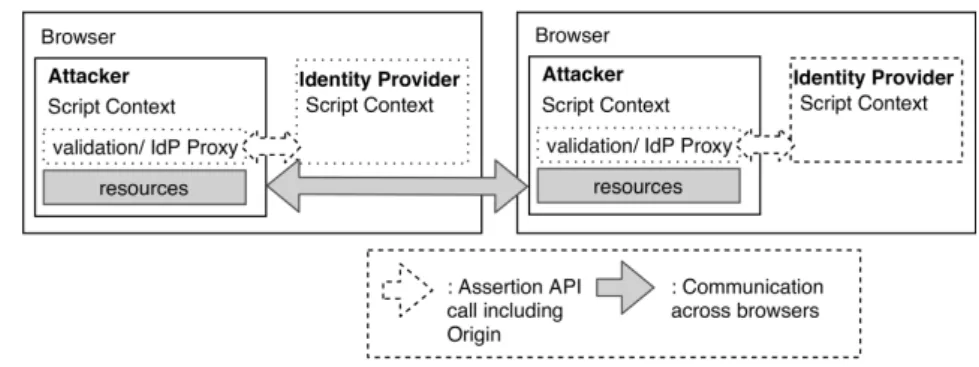
The WebRTC specification has included some ideas from the WebRTC architecture and security considerations to enable sites to rely on third-party Identity Provider (IdP)s.
Particularly, cross-Origin channels can be created across browsers, while letting developers verify the identity of users behind other browsers. More to the point, as more ideas were added to the WebRTC specification to the identity sections, the W3C decided to separate the identity specification [86] from the rest of the WebRTC protocol specification [125] in June 2018.
20
Chapter 3. The Current Web Security Model and Its Implications For Computational Resources
whichIdPis required by means of a URI. When the page registers anIdP, it must provide
the URI including its protocol, port, and domain. Subsequently, the browser loads the proper JavaScript code from the URI which instantiates anIdPproxy, i.e., representation of theIdPin the context of the developer’s site. Specifically, to register theIdPproxy, the
JavaScript from theIdPmust register anRTCIdentityProviderin the browser: an object to which the browser redirects all calls related to identity assertions. For security purposes, theIdPproxy is executed in a separate realm, i.e., Script Context. The isolation between
theIdPand the site and other aspects of the communication are shown in Figure 3.4.
TheRTCIdentityProvidermust implement two methods to handle identity assertions. On the one hand, it must provide identity assertions when the generateAssertion is called; on the other hand, the IdP verifies the assertion when the validateAssertion method is called.
In the context of WebRTC, the attacker is someone who tries to trick the developer’s application into believing that his identity has been verified. As Quote 4 from the WebRTC identity specification shows [86], the security model advises theIdP to use data confined
within its Origin to generate identity assertions. In this way, an attacker creating an
API imitating the IdP proxy cannot fool the developer’s application. Figure 3.4 shows
a scenario in which an attacker tries to establish a communication channel with another browser. In this scenario, the validation proxy interacting with the IdP would need to
validate the attacker’s identity with an account accepted by the user.
Figure 3.4.: Security-model:WebRTC
An environment that mimics the identity provider realm can be provided by any script. However, only scripts running in the origin of the IdP are able to generate an identical environment. Other origins can load and run the IdP proxy code, but they will be unable to replicate data that is unique to the origin of the IdP.
This means that it is critical that an IdP use data that is restricted to its own origin when generating identity assertions. Otherwise, another origin could load the IdP script and use it to impersonate users.
The data that the IdP script uses could be stored on the client (for example, in [INDEXEDDB]) or loaded from servers. Data that is acquired from a server SHOULD require credentials and be protected from cross-origin access.
3.2. Tailoring the Origin-Based Security Model 21
Despite the necessity of a security model fulfilling the architecture, there has not been a popularIdPimplementation yet, e.g., Google. However, in addition to standardization
progress, Firefox already implements the APIs to register and query identity providers within the browser.
3.2. Tailoring the Origin-Based Security Model
A security model based on Origins works well to isolate data under the assumption that the triple comprised of domain, port, and protocol serve as a primary key to determine a source of trusted information, i.e., policies. However, some issues have influenced this security model because this model does not always reflect the desired principals.
3.2.1. Public Suffix List
Cookies have been problematic for the Origin-based security model for a long time. To start with, Zalewski provided an overview of security issues including, but not limited to, Same Origin Policy aspects [217]. One concern regarding cookies is a historic mismatch with the Origin isolation because cookies are not set for an Origin but a domain instead. Furthermore, cookies can be set for a parent domain which permits other sub-domains of the parent domain to access the cookies. Barth explains the latter phenomenon in the cookie specification as shown by Quote 5, taken from the HTTP state management
mechanism Internet Request for Comments (RFC) [17].
The Domain attribute specifies those hosts to which the cookie will be sent. For example, if the value of the Domain attribute is “example.com”, the user agent will include the cookie in the Cookie header when making HTTP requests to example.com, www.example.com, and www.corp.example.com.
(5)
As time went by, applications were registered under domains that were not Top-Level Domain (TLD)s but behaved similarly, i.e., Effective Top-Level Domain (ETLD).
Classi-cal examples are sites with names including the “co”” sub-domain to reflect a commercial use, e.g., co.uk or co.jp. In addition to this case, it is common that multiple applica-tions are hosted in sub-domains belonging to a big organization. Thus, it is common to find domains belonging to big organizations such as Github which usesgithub.ioto host documentation pages orappspot.comused by Google to host multiple applications under the same parent domain.
Allowing sites to set cookies for sub-domains creates two security problems. On the one hand, users could be tracked across different applications without their consent when applications set cookies for their parent domains, e.g., appspot.com. Furthermore, vul-nerable applications could be exploited to set credentials to the parent domain , e.g., appspot.com, that will be passed to other applications hosted in a sub-domain, e.g., myapp.appspot.com.
22
Chapter 3. The Current Web Security Model and Its Implications For Computational Resources
is currently used by all major browsers. According to Mozilla’s description “a public suffix is one under which Internet users can (or historically could) directly register names” [59]. Thus, the suffix list can be used to prevent sites hosted by sub-domains of a public suffix such as co.uk from setting cookies for the suffix itself. As the suffix list lets browsers verify whether they should allow a site to set cookies to this level, e.g.,appspot.com, the two problems related to the scope of cookies have been solved. As we will see now, the public suffix list can be relevant to handle local storage instances and protect the user against resource abuse.
3.2.2. Local Storage
Browsers ensure confidentiality by isolating storage instances used by client-side JavaScript depending on the Origin. In other words, only scripts from the same Origin can access the local storage instance for that particular Origin. Moreover, each local storage instance has a fixed space quota, i.e., 5 MB.
However, this model would still allow a developer to register multiple sub-domains and use the maximum storage quota for each Origin. This sub-domain attack was already considered in the W3C storage specification [70], from where we take Quote 6.
User agents should guard against sites storing data under their origin’s other affiliated sites, e.g., storing up to the limit in a1.example.com, a2.example.com, a3.example.com, etc, circumventing the main example.com storage limit.
(6)
Although the W3C specification mentions user agents “should” guard against sites cir-cumventing the storage quota, it fails to specify how. An approach implemented by Firefox is to apply the quota to the first sub-domain of the TLD. However, this is conceptually
cumbersome because each site in a sub-domain would have its own local storage instance, yet with a quota that is affected by other sites. Also,a1.example.com could use all the quota and leave other sites in example.comwithout any space left. Also, domains could find out how much space is used by its siblings by attempting to fill the quota, which creates a side channel.
A Chromium issue has been open since February 2013 due to the complexity of this kind of enforcement based on the Origin of the site abusing resources [2]. Previous to the definition of the suffix list, developers mentioned the possibility to create a quota for the
TLD+1, i.e., the first sub-domain of the TLD. However, they mentioned also how this
would allow a site hosted under a sub-domain to starve other applications of storage2. According to the most recent comments on the issue from May 2017, the preferred en-forcement would take place using theETLD+1 domain, i.e., sub-domain of the ETLD.
However, this has not been implemented yet in Chrome. Further, the comment mentions
ETLDinstead ofTLD; thus, we can conclude that by May 2017 Chrome developers were already using a suffix list to differentiate effective top-level domains.
2the example given was thatme.github.iocould starveyou.github.io, also used after this comment to motivate the creation of the suffix list.
3.2. Tailoring the Origin-Based Security Model 23
In a nutshell, the isolation properties provided by local storage compartmentalize content from different Origins; however, this mechanism can be abused by an attacker to obtain multiple local storage instances by registering several domains, or sub-domains, depending on the browser under attack. We go into details and explain how this can be abused to store and distribute arbitrary content using a network of browsers in Chapter 5.
3.2.3. Suborigins
According to the draft specification for Suborigins, developers have requirements not man-ageable with the current Origin-based security model [205]. Particularly, isolating mod-ules of a Web application by using an Origin, i.e., referred to as a physical Origin in the specification, is not easy to adapt once it has been deployed. On top, Origins are too course-grained to protect separate modules of an application againstXSS, even ifCSPis
used. Alternatively, using sand-boxed environments is too restrictive for most use cases. Thus, Suborigins attempt to create a specification to fill the gap between the state of the art and what developers need.
Quote 7 shows the general objectives included in the Suborigins W3C draft specifica-tion [205].
• Provide a way for different applications hosted on a single
physi-cal origin to isolate these into separate logiphysi-cal origins. For
exam-ple, https://foobar.com/application and https://foobar.com/widget, to-day, are, by definition, in the same origin, even if they are different applications. Thus an XSS at https://foobar.com/application means an XSS at https://foobar.com/widget, even if https://foobar.com/widget is ”protected” by a strong Content Security Policy. Suborigins should allow isolating /application and /widget.
• Similarly, provide a way for content authors to split their applications
into logical modules with origin level separation without using different physical origins. Content authors should not have to choose between putting all of their content in the same origin, on different physical ori-gins, or putting content in anonymous unique origins (sandboxes).
• Provide safe defaults but also make it as simple as possible to retrofit
legacy applications on the same physical origin with minimal program-matic changes. This includes providing security-model opt-outs where necessary.
(7)
The first two goals of Suborigins explain how this standard would provide additional flexibility for developers to isolate their application’s modules and protect them against
XSSattacks in a configurable manner if adopted. An important advantage of Suborigins is
24
Chapter 3. The Current Web Security Model and Its Implications For Computational Resources
regard to safeguarding the browser against persistent storage abuse in Section 8.4.3.
3.3. Cross-Protocol Issues at Network Level
In 2006, Alcorn analysed the conditions under which encapsulating a protocol inside an-other one triggers execution of commands for the inner protocol [11]. Particularly, the report mentions how an attacker can useHTTP to execute IMAP commands. More to
the point, when the IMAP server parses theHTTP headers, errors do not terminate the
connection; thus, when the body contains valid IMAP commands, they would be executed by the server. Alcorn’s idea was extended by Topf in 2008 to other text-based protocols. Topf described how to use HTML forms from the browser to trigger actions on SMTP, POP3, and IRC servers [188]. The approaches above have a characteristic in common with the attack described in this section: they use a communication channel, e.g.,HTTP,
to interact with a different protocol, e.g., IMAP. Similarly, we are using WebSockets to interact with anHTTP endpoint in ourDDoSattack in Chapter 4.
3.3.1. WebSockets
In 2010, Auger explained how using socket-capable plug-ins, e.g., Flash, to abuse trans-parent proxies [14]. The main issue is that Transtrans-parent Proxys receive HTTP requests
from browsers and must choose how to forward the request. They can either rely on the
HTTP host header or they can use the destination IP to forward the request. Auger
observed that many transparent proxies used the HTTP host header. As a result, an
attacker can trick users into opening evil.com containing a plug-in that uses regular sockets to send a messaging complying with HTTP back to evil.com. However, if the
HTTP host header mentions anothersite.com, the proxy forwards the request to the
third-party site (othersite.com). As a result, an attacker achieves a partial Same Origin Policy bypass whereby his plug-in obtains information from a third-party site (accessible from the proxy) in the context of evil.com. This constitutes a partial bypass because all cookies an authentication information of anothersite.comis not visible to the malicious plug-in, as the browser still treats it asevil.com.
Shortly after the Auger, Huang et al. extended the idea of misusing socket-capable plug-ins (Java Applets, or Flash) to trick a Transparent Proxy into caching malicious content under any hostname chosen by the attacker [77]. Aside from the observation made by Auger, i.e., a Transparent Proxy can forward requests based on IP or HTTP headers,
Huang et al. noticed that some proxies were forwarding based on IP information but caching based on HTTP headers. As a result, an attacker using a plug-in was able to
load his site (attacker.com) and then load a plug-in generating a request to the IP of the attacker’s server, yet using a different host header (othersite.com). Afterwards, content returned by the malicious server would be stored as if it belonged to othersite.com. Thus, an attacker could poison the Transparent Proxy’s cache with arbitrary content because future requests would be resolved with the content cached based on the hostname. Furthermore, as the initial specification of the WebSocket protocol used plain text for the communication, Huang et al. also noticed similar issues appeared when using a WebSocket. They proposed to mask the bytes controlled by the Web site to prevent this attack; notably,
3.3. Cross-Protocol Issues at Network Level 25
their proposal was adopted in the final WebSocket specification resulting in the security model shown in Quote 8.
The WebSocket Protocol uses the origin model used by web browsers to restrict which web pages can contact a WebSocket server when the WebSocket Protocol is used from a web page. Naturally, when the WebSocket Protocol is used by a dedicated client directly (i.e., not from a web page through a web browser), the origin model is not useful, as the client can provide any arbitrary origin string.
This protocol is intended to fail to establish a connection with servers of pre-existing protocols like SMTP [RFC5321] and HTTP, while allowing HTTP servers to opt-in to supporting this protocol if desired. This is achieved by having a strict and elaborate handshake and by limiting the data that can be inserted into the connection before the handshake is finished (thus limiting how much the server can be influenced).
It is similarly intended to fail to establish a connection when data from other protocols, especially HTTP, is sent to a WebSocket server, for example, as might happen if an HTML ”form” were submitted to a WebSocket server. This is primarily achieved by requiring that the server prove that it read the handshake, which it can only do if the handshake contains the appropriate parts, which can only be sent by a WebSocket client. In particular, at the time
of writing of this specification, fields starting with |Sec-| cannot be set by an
attacker from a web browser using only HTML and JavaScript APIs such as XMLHttpRequest.
(8)
Even though the WebSocket specification considered that WebSocket connections should not be able to send payloads conforming to pre-existing protocols, its backwards compat-ibility can be used to trigger HTTP responses from “regular” HTTP. In other words,
servers capable of serving HTTP content, yet unaware of the WebSocket protocol,
es-tablish a TCP connection and start sending content back to the browser. We analyse in more depth the reasons behind this phenomenon when describing how WebSockets can be employed forDDoSin Section 4.3.2.
3.3.2. WebRTC
TheIETFactive draft including security considerations about WebRTC already includes
cross-protocol aspects. Rescorla describes the danger of cross-protocol attacks referencing the work by Huang et al. when he misused plug-ins for malicious caching [157]. In particu-lar, Quote 9 shows how software interpretingHTTPmessages in the network can be prone
to misinterpret communication that resemblesHTTP. Precisely, these cross-protocol
26
Chapter 3. The Current Web Security Model and Its Implications For Computational Resources
While consent verification is conceptually simple–just do a handshake before you start exchanging the real data–experience has shown that designing a cor-rect consent verification system is difficult. In particular, Huang et al. [huang-w2sp][77] have shown vulnerabilities in the existing Java and Flash consent verification techniques and in a simplified version of the WebSockets hand-shake. In particular, it is important to be wary of CROSS-PROTOCOL at-tacks in which the attacking script generates traffic which is acceptable to some non-Web protocol state machine. In order to resist this form of attack, Web-Sockets incorporates a masking technique intended to randomize the bits on the wire, thus making it more difficult to generate traffic which resembles a given protocol
(9)
3.4. Why Can Origin-Based Mechanisms Not Prevent Resource
Abuse?
In rough terms, our analysis from Section 3.1 considers an asset, i.e., data or session, an attacker, a browser’s end user, and a developer (attempting to protect the asset). However, there is a misalignment between the principals and their roles when the goal shifts to protect a different asset, i.e., browser’s resources instead of the user’s data. This issue stems from several aspects such as whether the security model provides safe defaults, or how access to the resource is obtained.
The current Origin-based security model trusts the developer to protect the confiden-tiality and integrity of the user’s data. To this end, the developer can isolate untrusted elements and execute them in different Script Contexts. A classical example of isolating untrusted content are advertisements, i.e., they are isolated using Iframes. Also, the devel-oper can use mechanisms such as CORSor the Origin headers to validate whether data
must be shared with another Script Context or not. Further, all Origin-based security mechanisms provide safe defaults because they were implemented as opt-in mechanisms with a secure default setting.
At the same, computational resources do not have safe defaults because scripts executing
in any Script Context can access all resources, e.g., WebAssembly, by default. Also, as
developers consider isolated content to be “safe”, attackers can deliver resource-abusive content to isolated containers, e.g., an advertisement inside an Iframe, and still achieve their goal. More to the point, isolation can be exploited in favour of an attacker abusing resources. For example, an attacker can register more than one domain, or create sub-domains, to deliver multiple times the same code that colludes against the user by claiming each time a separate quota for storage. Thus, for all these reasons we argue that placing the trust to safeguard the browser’s resources on the Origin delivering the code executed by the browser is, generally speaking, not a viable option.
Throughout the rest of this section we come back to the security model abstractions presented in Section 3.1 and show why they are insufficient to protect resources. To emphasize the difference between the data-centric model and the problem studied in this thesis we highlight the resources in grey, instead of the data from the user. Also, We
3.4. Why Can Origin-Based Mechanisms Not Prevent Resource Abuse? 27
coloured in grey the interactions that are under the attacker’s control, e.g., requests. Last but not least, we represent the validations that are under the attacker’s control with a dashed line to show that they are optional for the attacker.
3.4.1. CORS
Sending requests to servers controlled by the attacker is out of the scope of the CORS
specification. As Figure 3.5 shows, as soon as an attacker controls his own server, he can instruct the browser to include the data into the browser’s Script Context for further processing. Also, we show that resources are available by default to the Script Context of the attacker.
Figure 3.5.: Security-model:CORSand computational resources
3.4.2. WebSockets
WebSockets can be used in two ways to exploit resources. An attacker can either use WebSockets to optimize the resource abuse across browsers, or abuse the networking ca-pabilities of the browser as a computational resource itself. The former is shown in this thesis when we use WebSockets to coordinate efficiently different browsers in the networks presented in Chapters 5 and 6. Also, the same aspect has been abused by in-browser crypto-currency mining practices described in Chapter 7. Figure 3.6 shows how an at-tacker controls the data in the WebSocket server and the resources in the browsers; for example, this applies to delivering specific workload to multiple browsers performing min-ing, i.e., using computational resources such the CPU or GPU. We also have one case study where WebSockets are abused as a network resource per se: theDDoSattack using
28
Chapter 3. The Current Web Security Model and Its Implications For Computational Resources
Figure 3.6.: Security-model:WebSocket security and computational resources
3.4.3. PostMessages
As Figure 3.7 shows, when an attacker controls both Script Contexts, regardless of whether they are workers, Iframes, etc., he can let both Script Contexts communicate with postMes-sages. Although this seems trivial, allowing multiple contexts to communicate with each other lets the attacker write scripts colluding against the user. Naturally, the validations could ensure that the contexts only communicate with scripts under the attacker’s control or be skipped altogether. For example, in-browser crypto-currency miners explained in Chapter 7 create several workers and use postMessages to coordinate tasks. Also, we show how multiple frames can collude against the user to increase the total amount of spaced occupied in the browser in the case of a cross-browser storage network in Chapter 5.
Figure 3.7.: Security-model:PostMessage and computational resources
3.4.4. WebRTC
Quote 10, taken from the WebRTC security considerations draft [157], downplays the im-portance of throttling WebRTC channels. Specifically, Rescorla emphasizes that browsers provide already many mechanisms to download large amounts o
![Figure 4.4.: LOIC against Nginx [141]](https://thumb-us.123doks.com/thumbv2/123dok_us/782570.2598965/52.892.277.598.155.440/figure-loic-against-nginx.webp)
![Figure 4.6.: SynGUI against Nginx [141]](https://thumb-us.123doks.com/thumbv2/123dok_us/782570.2598965/54.892.279.591.154.450/figure-syngui-against-nginx.webp)
![Figure 4.12.: Chromium fixed against Nginx [141]](https://thumb-us.123doks.com/thumbv2/123dok_us/782570.2598965/58.892.271.615.531.813/figure-chromium-fixed-against-nginx.webp)
![Figure 5.2.: Proof of concept (based on [143])](https://thumb-us.123doks.com/thumbv2/123dok_us/782570.2598965/67.892.144.748.146.407/figure-proof-of-concept-based-on.webp)
![Figure 5.4.: Evaluation set-up [143]](https://thumb-us.123doks.com/thumbv2/123dok_us/782570.2598965/70.892.287.609.499.715/figure-evaluation-set-up.webp)
![Figure 5.7.: File availability [143]](https://thumb-us.123doks.com/thumbv2/123dok_us/782570.2598965/73.892.194.694.149.477/figure-file-availability.webp)
![Figure 6.1.: Scenario for anonymous communication [140]](https://thumb-us.123doks.com/thumbv2/123dok_us/782570.2598965/80.892.226.671.161.410/figure-scenario-for-anonymous-communication.webp)
![Figure 6.2.: Set-up for the scalability evaluation [140]](https://thumb-us.123doks.com/thumbv2/123dok_us/782570.2598965/84.892.204.660.144.406/figure-set-up-for-the-scalability-evaluation.webp)
![Figure 6.4.: Circuits and mean time - centralized network [140]](https://thumb-us.123doks.com/thumbv2/123dok_us/782570.2598965/86.892.272.667.640.918/figure-circuits-mean-time-centralized-network.webp)
