By: Arnold C. Mendez, Sr.
There are many methods and techniques that geologists have used in the dating of the earth's surface and formations. One method that is commonly used is radiometric dating. Radiometric dating is considered an absolute method because it supposedly is an independent technique that has no exceptions or qualification. Webster's dictionary defines absolute as follows: having no restriction, exception or qualification, unquestioned, and having no external reference. In other words radiometric dating, being an absolute method, is supposedly completely independent of any other outside method and can be relied upon without question.
It is the purpose of this paper to show that radiometric dating is not an absolute method. There are many external factors that can either increase or decrease the supposed absolute age of various geological formations and fossils. First, various dating methods will be analyzed so that one can understand how they function. Second, we will look at the various problems with the three main types of radiometric dating. Lastly, an examination and discussion will be presented of how these methods can give unreliable dates.
Basic Principles of Radiometric Dating
Radiometric dating is based on a process in which various elements emit atomic particles. This breakdown process is called disintegration or decay. Through these emissions the radioactive element gives off particles and changes into different forms of matter see table 1. This decay rate can be shown by the following equation (1):
R=λN R is the rate of disintegration
λ (lambda) is the decay constant
N is the number of radioactive atoms
Isotope Parent Daughter Half-Life of Parent (years) Useful Range (years) Carbon 14 Nitrogen 14 5,730 100-30,000 Potassium 40 Argon 40 1.3 billion 100,000 – 4.5 billion Uranium 238 Lead 206 4.5 billion 10 million-
4.6 billion Table 1. The three most common types of isotopes used in radiometric dating. Showing their half-life, and useful dating range.
For example if the amount of material (parent) at the beginning of the decay is known and the present amount of material (daughter) is known, then it is a simple matter using the above equation to mathematically compute the age of the substance containing the element. This is the basic principle behind the disintegration of uranium into lead (238U→ 234Th→ 206Pb), potassium into argon (40K →
40Ar), and to a lesser degree
The precision of these methods is based on the accuracy with which they are measured and on certain assumptions. Since all evolutionary geologists are uniformitarianist they assume that these processes have been going on for many million if not billions of years. They also assume that these processes are unalterable and therefore absolute. Most of the dates given by these methods tend to support the evolutionary scenario. It can be very easily shown that these assumptions are totally based on preconceived ideas and highly suspect. In reality these methods have many limitations. Most of these limitations have not been properly addressed.
Three Main Types of Radiometric Dating
There are many types of radiometric dating, but the three main types include, carbon 14, potassium decay into argon, and uranium decay into thorium and then many steps later into lead. The same assumptions and weaknesses that are inherent in these three methods can also be applied to the various other methods that are also used and are too numerous to mention here.
Overview of the 14C process
Outer space
Cosmic Rays Cosmic rays are composed of protons (83%), helium nuclei called (α) alpha rays (16%), elemental nuclei, and electrons traveling at the speed of light. These high-speed particles are emitted from the sun and supernova explosions.
Atmosphere These cosmic rays strike the atoms in the upper
atmosphere, mostly oxygen and nitrogen atoms.
Secondary Rays They form secondary rays from broken up particles of the oxygen and nitrogen atoms. These secondary rays include slow moving neutrons.
neutrons
14C formation (14N→14C) 14C is formed when these neutrons strike the nitrogen atom
causing the emission of a proton. The nitrogen is then converted into 14C. Over time the carbon, as shown below (2), decays back into non-radioactive, stable 14N.
14C Assumptions
• It is assumed that the decay constant (λ), The rate of disintegration (R), and the number of radioactive atoms (N), are all unchangeable as shown by R=λN. Therefore this is an absolute dating method.
Although scientists consider these assumptions to be inviolable, there is nothing sacred about them. Scientists assume that what is occurring now has always occurred in the past (uniformitarianism). Therefore the formation rate for 14C, and other radioactive decay processes, is the same now as it was in the past. This is merely educated guessing because no one was present at the start of these decay processes.
Although scientists consider these assumptions to be inviolable, there is nothing sacred about them. Scientists assume that what is occurring now has always occurred in the past (uniformitarianism). Therefore the formation rate for 14C, and other radioactive decay processes, is the same now as it was in the past. This is merely educated guessing because no one was present at the start of these decay processes.
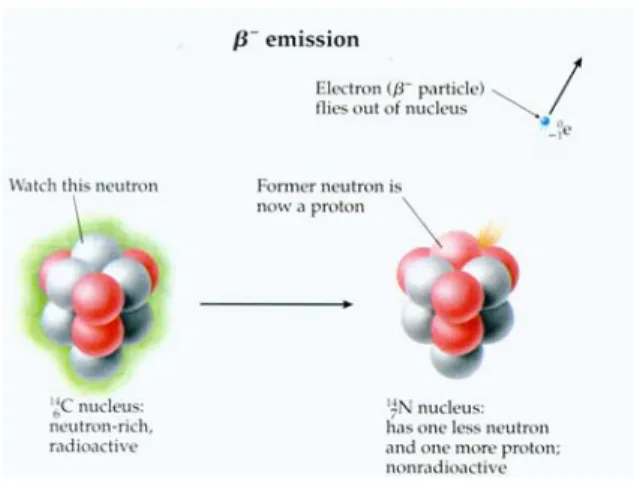
Figure 1. β- decay causing the conversion of 14C
into 14N. The half-life is 5730 years. If any of the variables in the radioactive disintegration equation are changed then the other variables will change in direct proportion. For example, if scientists have a final amount of 14C atoms, and they change the number of radioactive atoms that they began with then the rate of disintegration will have to be adjusted accordingly. Since scientists are looking at the end result
If any of the variables in the radioactive disintegration equation are changed then the other variables will change in direct proportion. For example, if scientists have a final amount of 14C atoms, and they change the number of radioactive atoms that they began with then the rate of disintegration will have to be adjusted accordingly. Since scientists are looking at the end result of the 14C disintegration process and they do not know what the starting variables are then their assumptions become very crucial. If their assumptions are wrong or incomplete then nothing about radiocarbon dating can be know with any measure of exactness.
There are several radiochemical factors that can change either the formation or the decay of 14C. In some cases these factors will give an old age for artifacts that may be indeed very young. The following section will deal with these assumptions and show that these processes are dependent on many assumptions and therefore are not absolute.
These assumptions are very important since all living organisms incorporate carbon into their bodies, through respiration and metabolism. A small percentage of this incorporated carbon is 14C. At the death of the organism this accumulation of 14C stops. Since 14C has
a known half-life the remaining 14C in the organism can be measured and its age determined see fig 1.
Factors Affecting 14C Formation and/or Ratio, and Decay
1. Differences in the rate of cosmic radiation. If there were a decrease in the rate of cosmic radiation this would have caused the production of less 14C. If the earth were covered by a high altitude blanket of water vapor and ozone (Gen. 1:7 "firmament") this would form a shielding effect and would lower the amount of cosmic radiation that could reach the earth. Radiocarbon tested artifacts before the atmospheric reorganization (i.e. Noachian flood) would appear extremely old. This would explain why radiocarbon dates for the recent past of about 4,000 years are accurate, but older dates do not correlate well with the Biblical record.
2. Change in the composition of the atmosphere. The nitrogen and carbon ratio may have been different in the past. 12C is mainly CO2, carbon dioxide and is
non-radioactive. If there were more volcanoes this would cause a release of vast quantities of carbon monoxide (CO) into the atmosphere. This CO would be converted into CO2 by reacting with atmospheric oxygen (3). This would affect
the 12C-14Cratio. More non-radioactive carbon in the air would cause an increase in the 12C as compared to the 14C and this would cause an apparent age increase. Other factors could change the composition of the atmosphere and the ratio of nitrogen and oxygen. These factors would include smaller oceans trapping less organics and carbon, increased water vapor in the atmosphere and other biological and chemical processes that could alter the nitrogen-carbon-radiocarbon ratio. 3. Less oxygen and nitrogen in the upper atmosphere. Cosmic rays would strike
these fewer atoms and produce less secondary rays of slow moving neutrons, which would then produce less 14C, causing an apparent increase in age.
4. Extraterrestrial sources such as comets and planetoid impacts. These impacts would put more non-radioactive carbon in the lower atmosphere, which would decrease the atmospheric 14C ratio. Many scientists believe that a small planetoid impact led to the Cretaceous-Tertiary (K-T) mass extinctions, including the dinosaurs (4).
5. The earth's magnetic field affected the cosmic ray patterns. Cosmic rays are observed less at the equator and more at the higher latitudes (e.g. aurora borealis). The sun's magnetic field will also affect the bombardment of the earth with solar cosmic rays. Our galaxy also has its own unique magnetic field. The historic composition of the magnetic fields of the earth, sun, and galaxy are completely unknown. A changed or nonexistent magnetic field in prehistoric time could have led to an increase or decrease of cosmic rays.
6. The lack of an atmosphere caused more cosmic rays to reach the ground. This would cause a faster decay of existing 14C into 14N. There may have been a time in the earth's past when the atmosphere was reorganized or missing. The Bible indicates that there was a time gap between the first two verses of Genesis. The primary radiation, especially α rays could have reached the earth without the filter of the atmosphere. These cosmic rays reaching the earth would have increased the energy level of the β- emissions (see fig. 1). This would cause a faster decay
of the 14C, the rate would have been dependent on the amount of cosmic rays reaching the surface of the earth and this would be unknown. This would also cause an apparent age increase.
7. The explosion of nearby supernova (5) produced and/or accelerates already produced cosmic rays. After a supernova explodes a shell of high-speed particles would strike the earth. This shell would bathe the earth in a 100-1,000 fold increase in cosmic rays (α rays) for a period of several hundred years. This increase in cosmic ray production would deplete the ozone, alter the atmospheric content, lower worldwide temperatures leading to mass extinctions (6). If the atmosphere were missing at the time of the supernova explosion (see #6 above) the primary cosmic rays would strike the surface of the earth unimpeded. The effect would be the speeding up of the radioactive decay processes on the surface of the earth. This would include accelerating the decay rates (R) of 14C, 238U, and many others radioactive processes.
The above processes can change the formation and rate of the production of radiocarbon. They can also affect other radioactive systems. Specifically, in this paper, many of these principles apply to the 238U decay into its final daughter element of lead.
When discussing the subject of radioactive dating the only thing that is certain now is the amount of daughter element present and the present decay rate. We do not know the past decay rate or the past amount of the parent and/or daughter isotope.
Overview of 40K-40Ar Process
Unlike carbon dating the radioactive decay of potassium into argon cannot be used to date living matter. However, it can be used to date rock and crystal, especially volcanic strata. If a fossil is found sandwiched between or associated with certain rocks then by dating the rocks the age of the fossil is implied.
A majority of the earth's rock contains potassium and the small percentage of this rock is radioactive 40K, which over time decays into 40Ar, see fig. 2. This method can be used to date igneous and metamorphic rocks that contain; muscovite, biotite, hornblende, and many other rocks. Thus 40K-40Ar is often used to date ancient hominid fossils associated with lava flows. The half-life of 40K
is 1.25 billion years. Figure 2. The decay process for 40K-40Ar is shown. The potassium atom captures an electron and is converted into an Argon atom.
This process relies heavily on the dating of igneous rocks
including those produced by volcanoes. In theory the volcanic rock when super heated has all the argon driven out of its surface and core. Therefore any accumulation of 40Ar can be dated to the time of the volcanic eruption. This is the principle behind the dating of many human fossils found between layers of volcanic deposits and ash. If the layer above and the layer below can be dated then the fossil's age is somewhere between the two dates.
As in all radioactive dating processes the assumptions must be clearly understood. These assumptions are taken for granted by most geologists. A proper understanding of the weaknesses of these assumptions will show the inadequacies of the process. Remember that geologist/evolutionist support these assumptions because no one knows exactly what happened in the past. Uniformitarianists believe that the present is the key to the past. There is no sure way to test this statement. For this reason Divine revelation is very important in understanding our past.
40K-40Ar Assumptions
There are several major explicit assumptions for this process to work. They include:
• The decay constant in the equation R=λN must be known.
• The amount of the 40K at the start of the process must be known.
• No 40K or 40Ar must have been added to or been removed from the rock/system.
• Heating of the rock will drive out all argon and reset the radioactive timer to zero. This occurs at crystallization.
Factors Affecting the 40K-40ArProcess
1. The decay processes and rates can be changed if enough cosmic ray energy is applied. The same principles that have been previously mentioned can be applied to changing the decay rates for 40K-40Ar.
2. Note the following quote:
It follows that the thermal history of a dated sample is very significant in determining how valid its potassium-argon age is." (7)
The thermal history of the rock is important because this resets the radioactive clock. There are many studies that have been done showing that it is possible for argon to have not been completely driven out at high temperatures (i.e. volcanic activity). If a rock has any residual argon in its system when it should have none then we cannot know the age of the rock. Some rocks have a history that is unknown. How can we be sure that a rock has not had its radioactive clock reset partly or incompletely in the past by having been reheated and/or melted?
3. Rock can gain argon by many ways. If any argon has accumulated or been added then it would be impossible to properly date a given sample. There are many chemical processes that will allow argon to enter a crystalline structure. One example is by acid degeneration of the rock/crystal surface, which would allow argon to enter. A rock with excess argon would show an older age.
4. Rock can lose argon in many ways. If any argon has left the system then the sample could not be properly dated. Weathering, leaching, and reheating are just a few examples of how argon could leave a rock matrix. If a rock leaked argon then it would appear younger.
5. There are many examples and processes that could cause potassium, the parent isotope, to enter or leave a rock system. They are similar to the processes in #3-4. If potassium enters or leaves a rock system we have no known starting place for our radioactive clock.
6. There are many examples of recent historic volcanic rock being dated at millions of years of age (8). Some specific examples include Glass Mountains in California, which erupted 500 years ago being dated as 12.6 million years and Kilauea basalt from Hawaii, which is from an eruption 200 years ago being dated as 21.8 million years ago, there are literally hundreds of such examples. Many of these are unpublished or not cited for obvious reasons!
Overview of the 238U-206Pb Process
Uranium decay is another radioactive process that has been used to date geological formations. Thereby implying that the earth is many billions of years old. It has dated strata, giving ages of millions of years for certain life forms found in these rocks. These dates are then incorporated into the evolutionary scenario showing that man has actually descended from these ancient life forms. This dating process is actually a tool used by evolutionist to further advance their philosophy. It is important that the weaknesses of these processes are understood.
Alpha particle Emission
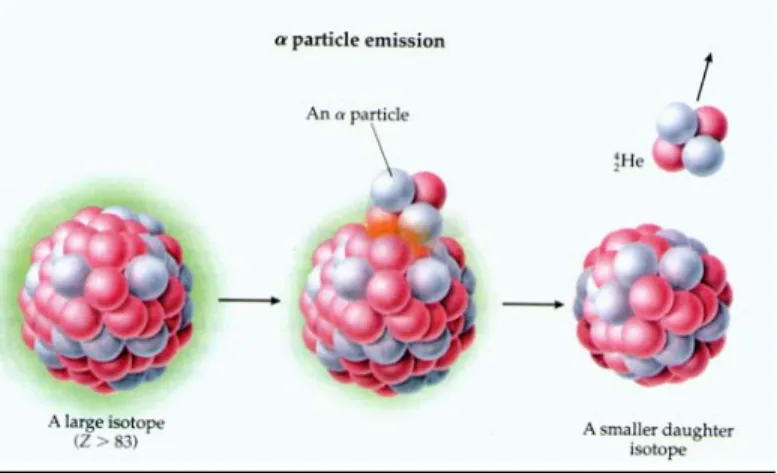
Figure 3. The alpha decay process. This along with beta decay is used in the 238U-206Pb process.
Uranium decays into lead after a many-stepped process. This progression includes the emission of eight alpha (α) particles and six beta (β-) particles see fig 3. An alpha particle is composed of the nucleus of a helium atom. An alpha particle has two protons and two neutrons. A beta particle is an electron. The half-life for this process is 4.5 billion years. It is thus used to date extremely old rock and strata.
The decay process of 238U into 206Pb showing the emission of alpha and beta particles.
238U →α→234Th →β-→234Pa →β-→234U →α→230Th →α→
226Ra →α→222Rn →α→218Po →α→214Pb →β-→214Bi →β-→
214Po →α→210Pb →β-→210Bi →β-→210Po →α→206Pb The Energy Barrier and the Decay Process
When uranium breaks down whether through alpha or beta decay, energy is required to break the atomic bonds that are holding the atoms together. The amounts of energy required to break these bonds is enormous. Thermal, electrical, or chemical processes cannot break these bonds. Therefore this bond breaking happens infrequently. Consequently this causes 238U atoms to have half-lives in the billions of years.
Alpha particles have energy of 4 Mev. The uranium nucleus has a voltage barrier(9) of 27 Mev. If the alpha or beta particles electron volt energy could be increased we could then break the bonds holding the alpha and beta particles to the nucleus of the atom. This would cause a faster decay rate, which would affect the half-life of the process. In other words, if in the past history of the earth the alpha and beta particles were imparted with more energy the decay rate would increase and the 238U decay process would give very old ages for very young geological rocks and formations.
This enormous energy is available from a very common source—cosmic rays! The energy of most cosmic rays is one billion electron volts and some have energies of over a billion billion electron volts. This is many times more energy than is needed to break the 27 Mev barrier that is holding the alpha and beta particles in place. The earth's atmosphere provides a barrier from the onslaught of these cosmic rays. If it were not for the atmosphere all life on the earth would cease to exist since the cosmic rays would reach the earth's surface. Most cosmic rays do not even penetrate the upper reaches of the stratosphere.
What would happen if the earth were stripped of its atmosphere? The cosmic rays would be able to affect the rate of the nuclear decay processes here on earth. The 238U process would be accelerated along with all the other radioactive decay processes. The book of Genesis reveals that there was a world that existed before the time of man's creations. The world had become a dump, formless and void. God reorganized the atmosphere at this time. If the atmosphere were no longer insulating the earth all radioactive processes extant at that time would have been accelerated. The rock and the strata of the earth during the time before the recreation would appear very old due to the increased effect the comic rays.
Other astronomical processes could also have come into play. These would include the earth's magnetic fields, which deflect and reroute incoming cosmic rays. Also the earth may have been bombarded with the energy shell of a nearby exploding supernova. This supernova shell would contain large amounts of cosmic rays.
The True Age of the Earth
How old is the earth? The answer is not found in scientific theories based on uniformitarian principles. The only true answer is found in the Bible. Since men have rejected this source of information they have had to develop their own ideas. Many of these manmade dating methods are highly suspect and are actually subservient to the theory of evolution.
Radiometric dating is not an absolute method. Absolute is defined as independent and without qualification. These methods have too many variables and too many assumptions. Those with preconceived notions about our origins often overlook these assumptions.
Works Cited and Research Notes
1. Encyclopedia Britannica. 1998. Alpha Decay © Encyclopedia Multimedia Edition. 2. Russo, Steve and Mike Silver. 2000. Introductory Chemistry. Addision Wesley Longman. USA. (All photos from this text)
3. Manahan, Stanley. 1999. Environmental Chemistry, 7th ed. Lewis Pub. Boca Raton FL p. 295.
4. Alvarez, Luis W. et al. 1980. Extraterrestrial Cause for the Cretaceous-Tertiary Extinction. Science. 208:1095-1108.
5. The average cosmic ray intensity has been calculated to vary less than a factor of 2 for the last 109 years. This is based on studies done of cosmic ray impacts on meteorites and the moon. The production of large amounts of cosmic rays, by a supernova for a relatively small amount of time would not alter the average cosmic ray intensity. A supernova increase of cosmic rays by a factor of 1,000 for 1,000 years would only increase the cosmic ray flux by 1%. Refer to Encyclopedia Britannica. 1985. Macropaedia; Cosmos: Cosmic ray exposure age. Encyclopedia Britannica, Inc. Chicago. p. 848, for a discussion of this principle.
6. Reid, G.C. and J.R. Mcafee. 1978. Effects of intense stratospheric ionizations events.
Nature. 275:489-492.
7. Encyclopedia Britannica. 1985. Macropaedia; Geochronology: Radiometric dating. Encyclopedia Britannica, Inc. Chicago. p. 787-8.
8. Snelling, Andrew. 1999. Excess Argon: the Achilles heel of Potassium-Argon and Argon-Argon Dating of Volcanic Rocks. Institute for Creation Research. 9. Mev is one million electron volts. Bev is one billion electron volts. An electron volt is the acceleration energy of an electron when it charged to one volt.
© Arnold C. Mendez, Sr. & Mendez Enterprises Email: [email protected]