Upjohn Press Upjohn Press Collection 1-1-2015
Guild-Ridden Labor Markets: The Curious Case of Occupational
Guild-Ridden Labor Markets: The Curious Case of Occupational
Licensing
Licensing
Morris M. KleinerUniversity of Minnesota
Follow this and additional works at: https://research.upjohn.org/up_press
Part of the Labor Economics Commons
Citation Citation
Kleiner, Morris, M. 2015. Guild-Ridden Labor Markets: The Curious Case of Occupational Licensing. Kalamazoo, MI: W.E. Upjohn Institute for Employment Research.
Guild-Ridden Labor Markets
Kleiner 2015.indb i
Guild-Ridden Labor Markets
The Curious Case of
Occupational Licensing
Morris M. Kleiner
2015
series
WE
focus
W.E. Upjohn Institute for Employment Research Kalamazoo, Michigan
Kleiner 2015.indb iii
Names: Kleiner, Morris M., author.
Title: Guild-ridden labor markets : the curious case of occupational licensing / Morris M. Kleiner.
Description: Kalamazoo, Michigan : W.E. Upjohn Institute for Employment Research, [2015] | Series: WE focus series | Includes bibliographical references and index.
Identifi ers: LCCN 2015039026 | ISBN 9780880995016 (pbk. : alk. paper) | ISBN 0880995017 (pbk. : alk. paper)
Subjects: LCSH: Occupations—Licenses—History | Professions—Licenses—History. | Guilds—History.
Classification: LCC HD3629 .K54 2015 | DDC 331.702—dc23 LC record available at http://lccn.loc.gov/2015039026
© 2015
W.E. Upjohn Institute for Employment Research 300 S. Westnedge Avenue
Kalamazoo, Michigan 49007-4686
The facts presented in this study and the observations and viewpoints expressed are the sole responsibility of the author. They do not necessarily represent positions of the W.E. Upjohn Institute for Employment Research.
Cover design by Alcorn Publication Design. Index prepared by Diane Worden. Printed in the United States of America. Printed on recycled paper.
Kleiner 2015.indb iv
v
Contents
Acknowledgments vii
1 Anatomy of Occupational Licensing 1 Incentives for Regulation 4
2 The Evolution of Occupational Licensing 9 Case Studies of Occupations Seeking Licensure 15 Summary and Conclusions 22
3 The Costs, Mobility, and Quality of Occupational 25
Licensing Services
Infl uence on Wages and Employment 30 Infl uence on Geographic Mobility 31 Infl uence on Prices 35 Occupational Licensing as Social Insurance 36 Infl uence on Quality of Services 38 The Net Effects of Occupational Licensing 43 Conclusions 43
4 Battles among Licensed Occupations 47 Health Care 47 Licensed and Certifi ed Occupations in Construction— 50 Architects versus Interior Designers
Licensed Occupations That Do Similar Tasks—Physical 53 Therapists and Occupational Therapists
Institutional Background 55 Conclusions 58
5 Occupational Licensing in Different Institutional and 61
International Contexts
Occupational Regulation in the European Union 62 Another Example: Occupational Licensing in the United Kingdom 68 Institutional Details of Occupational Regulation in the 70 United Kingdom
Nontraditional Licensing: China 72 Summary and Conclusions 76
Kleiner 2015.indb v
vi
The Federal Role 83 At the State Level 86 International Policy Issues 88 Summary and Implications for U.S. Occupational Licensing Policy 89 References 95
Author 105
Index 107
About the Institute 117
Figures
3.1 Share of Workforce Licensed, by State (%) 29 3.2 Occupational Licensing and Interstate Migration, 1950–2008 32
Tables
3.1 Percentage of Workers Who Require Specifi c Education and 28 Testing to Become Licensed or Certifi ed
5.1 Licensed Occupations in the EU-27, 2012 64 5.2 Prevalence of Occupational Regulation in EU-27 Countries, 2012 66
Kleiner 2015.indb vi
vii
Acknowledgments
The purpose of the book is to summarize the research and policy issues on occupational licensing in the United States and other countries. The book is nontechnical and is intended for practitioners and those interested in the roles of public policy and labor market institutions on labor markets and society.
I want to thank the staff at the Upjohn Institute for their assistance, espe-cially Randy Eberts, Kevin Hollenbeck, Brad Hershbein, and Linda Richer. I also greatly appreciate the outstanding efforts by Allison Hewitt Colosky; her excellent editing and comments improved the content. Richard Wyrwa offered insightful ideas and support during the writing process. The intellec-tual environment provided by the economists and staff at the Upjohn Institute greatly enhanced my productivity.
I am most fortunate to have had outstanding collaborators and coauthors while developing the research approaches that are cited in the book. My col-leagues at the Federal Reserve Bank of Minneapolis, the Humphrey School of Public Affairs and the Center for Human Resources and Labor Studies at the University of Minnesota, and the National Bureau of Economic Research provided many helpful comments.
Jim and Sheryl Siegel and their family were terrifi c hosts during my travels to the Upjohn Institute in west Michigan. I thank Sally Mosow Kleiner for her encouragement, technical knowledge, and editorial support. The book is dedicated to my children, their spouses, and my grandchildren, who were most supportive as I worked on various versions of the book.
Kleiner 2015.indb vii
1
Chapter 1
Anatomy of Occupational Licensing
D
entists, doctors, lawyers, hair braiders, tour guides, upholster-ers, and horse tooth fi lers are now licensed occupations in either all or some U.S. states. In states where occupations are licensed, the rationale for meeting the requirements is sometimes inconsistent. For example, in Minnesota, it usually takes more direct classroom time hours to become a cosmetologist than a lawyer. In other states, it takes twice as many hours of training to become a manicurist than a paramedic (Dranias 2007). In Louisiana, the only state in the country that requires licenses for fl orists, monks were until recently forbid-den to sell coffi ns because they were not licensed funeral directors (Carpenter et al. 2012). Nationally, in the 1990s, one could become a physical therapist with just a bachelor’s degree, but by 2016, in order to become a fully licensed physical therapist in most states, a practi-tioner must have a doctor of physical therapy degree, which requires a four-year college degree plus three years of graduate training and work.These regulations are not just unusual cases of state laws run amok. Instead they refl ect policies deriving from one of the fastest growing labor market institutions in the United States—the gov-ernment licensing of jobs and work tasks. This form of regulation, largely established by state governments and implemented through their licensing boards, is often referred to as “the right to practice.” Under these laws, working for pay in a licensed occupation is illegal without fi rst meeting government standards. Certifi cation, another form of government regulation, provides a “right to title” and does not forbid others from providing the service.
In the 1970s, about 10 percent of individuals who worked for pay required licenses, but by 2008, that number rose to almost 30 percent (Kleiner and Krueger 2013). By the turn of the century, more than 800 occupations, including shampoo specialists and professional
wres-Kleiner 2015.indb 1
tlers, in addition to the occupations mentioned above, were licensed in at least one state (Carpenter et al. 2012). More workers are directly impacted by occupational licensing than the minimum wage or union-ization (Kleiner and Krueger 2010).
Occupational licensing has had a curious and unusual history in the United States and in other countries. During some periods it all but disappeared, but now in the United States it is a rapidly growing labor market institution. For some occupations, such as physicians, it has dominated the labor market and its effects on consumers. For others, such as interior designers, occupational licensing has been limited to a small number of U.S. states. This book addresses several questions regarding how and why some occupations became heavily regulated while others did not. Why do some countries have lots of occupa-tions that are licensed and others a relatively small number? Why has occupational licensing grown over the past 50 years and unions have declined? What are its economic effects on mobility, wage deter-mination, prices, and the quality of services delivered? Occupational licensing, in spite of its growth, size, and economic impact, has been a stealth form of regulation. In this book, I examine why the institu-tion of occupainstitu-tional licensing has had such a curious evoluinstitu-tion and infl uence in the United States, the European Union, and China, and I discuss the many similarities it has to guilds.
With growth of licensing laws has come a national patchwork of stealth regulation that has, among other things, restricted labor markets, innovation, and worker mobility. There is little reason, for example—political, economic, or safety related—for math teachers to be relicensed every time they move from one state to another. These requirements put additional burdens on teachers who are moving across state lines, such as more course work, state residency require-ments, and often additional exams, all of which reduce the ability of good teachers to fi nd work faster and students to have high-quality instructors.
Having more fl exible reciprocity between states for occupations such as teachers, physicians, or dentists would allow these
profes-Kleiner 2015.indb 2
Anatomy of Occupational Licensing 3
sionals to move to jobs more effi ciently. But perhaps even better would be for states to certify jobs that are currently licensed—such as tour guides, hair braiders, travel agents, or locksmiths—jobs that pose minimal risk of harm to the public and that could better serve customers with a lesser form of regulation.
The political economy of occupational licensing has evolved so that both liberals and conservatives have come to oppose certain ele-ments of it. Many on the left are concerned about individuals raising prices for the essential services of licensed plumbers or electricians and the availability of essential services for those in or near poverty. Many licensed professions are relatively low-skilled jobs, such as barbers, manicurists, nurse’s aides, and cosmetologists. The social costs of a bad haircut may be negligible, but the social costs of cre-ating additional employment barriers for disadvantaged populations are not. Many education requirements, continuing education courses, and residency requirements restrict entry into occupations that are the most accessible for low-income individuals. Licensure laws often exclude ex-felons—defensible in many professions but not in all— and such prohibitions make it extremely diffi cult for ex-offenders to fi nd postprison employment, thereby contributing to America’s high recidivism rate (Raphael 2014). On the right, public interest groups such as the Institute for Justice have opposed occupational licensing based on economic liberty arguments, arguing that it reduces eco-nomic effi ciency and retards ecoeco-nomic growth (Carpenter et al. 2012).
There is good reason for workers in licensed fi elds to push for licensing laws. More occupations in a service-oriented economy are likely to be licensed than in manufacturing. With the shift to more service jobs from 40 percent in 1950 to more than 60 percent in 2007, occupational licensing has grown (Edlin and Haw 2014). As I found when I examined these issues with Princeton economist Alan Krueger, former treasury offi cial and head of President Obama’s Council of Economic Advisers, occupational licensing raises wages by 10 to 18 percent (even controlling for factors such as age, education, and other market variables) and raises benefi ts for licensed workers (Gittleman,
Kleiner 2015.indb 3
Klee, and Kleiner 2015; Kleiner and Krueger 2013). This is largely due to the ability of regulated professions working through state leg-islators and regulatory boards to limit the supply of practitioners and eventually drive up costs to consumers.1
For more necessary services, such as dentistry, less competition brought about by licensure may drive prices beyond the means of individuals with low incomes. Consumers who cannot afford licensed professionals may do the work themselves. For example, David Kruithoff, a farmhand in Michigan, gave himself a root canal because he said he could not afford a licensed dentist (Kleiner 2006).
INCENTIVES FOR REGULATION
From the time of medieval guilds, service providers have had strong incentives to create barriers to entry for their professions in order to raise wages (Ogilvie 2014). These guilds offered an effective mechanism where guild members and politicians could collaborate in capturing a larger slice of the economic rents and redistributing it to themselves at the expense of the rest of the economy. As Ogilvie (2014) notes, guilds are not just historical curiosities, they have wider implications for the role of institutions in economic growth.
Dartmouth economist Charles Wheelan’s research on licensed and unlicensed professions in Illinois fi nds that the stronger a profes-sion’s political organization, the more likely it is to become licensed (Wheelan 1998). He showed that respiratory therapists who orga-nized themselves, and raised their profession’s dues in order to lobby for licensing laws, tended to be more successful in getting these stat-utes passed.
In contrast, consumers who will be affected by the slightly higher costs of, for example, haircuts, are unorganized and arguably under-represented in the political process. The willingness of a legislature to pass licensure laws without a rigorous analysis of its benefi ts rela-tive to costs, or the alternarela-tives of less rigorous forms of regulation,
Kleiner 2015.indb 4
Anatomy of Occupational Licensing 5
creates the opportunity for well-organized producer groups to lobby for laws that will likely bring them personal gain. The arguments for occupational licensing policies are that purveyors of a service have greater information about the quality of the service and can take advantage of consumers over both price and quality.
Also, all consumers do not demand the same level of quality. When members of the legal profession told the Nobel laureate Milton Friedman that every lawyer should be of Cadillac quality (a high-priced luxury brand car), he famously replied that many people would be better off with a Chevy (a cheaper but clearly functional alterna-tive). If licensure “improves quality” simply by restricting entry into the profession, then some consumers will be forced to pay for more “quality” than they want or need (Friedman 1962).
There have been, however, movements toward stopping or reduc-ing the growth of occupational regulation in the United States. For example, during the 2012–2013 legislative sessions, Iowa Governor Terry Branstad vetoed the licensing of addictive disorder counselors and other related occupations (Branstad 2013). In Indiana, Gover-nor Mike Pence initially vetoed the licensing of diabetes counsel-ors, anesthesiologist assistants, and dietitians but a year later signed similar legislation. In their messages to the legislature (in each case, legislatures were dominated by their own parties), both Branstad and Pence mentioned that this type of regulation would result in economic losses to consumers, higher prices, and less employment (Associated Press 2013). More recently, in Idaho, Governor Butch Otter vetoed the licensing of sign-language interpreters during the 2015 legislative session (Reynolds 2015). In the eyes of these three governors, the promised benefi t of potentially better quality and health and safety was, in their view, far smaller than the costs infl icted on the citizens by unneeded regulation.
Unlike the United States, China (along with most other coun-tries), has national licensing for its regulated occupations. An unusual case study is Poland, which is in the process of deregulating many of its national occupational labor markets (Kleiner and Lachowska
Kleiner 2015.indb 5
2014). In October 2011, Poland’s national government presented an ambitious agenda of deregulating entry to many occupations. By late 2015, the government plans to liberalize the access to about 250 out of the 380 currently regulated occupations. The prime minister’s offi ce has stated that liberalizing access to occupations is expected to lead to higher employment, higher-quality services, lower prices, and lower governmental administrative costs. The fi rst phase loosened access to 51 professions; it was passed by the Polish Parliament in April 2013 and signed into law in July 2013. The liberalization of access to 33 of these fi rst 51 liberalized occupations went into effect in August 2013. For the remainder, the new legislation went into effect in Janu-ary 2014. The range of partially or totally deregulated professions is diverse as well as varying in the degree of deregulation. Among professions strongly affected by the liberalization are attorneys, solic-itors, notaries, court clerks, realtors, taxi drivers, excursion guides, employment agents, and body guards. The implementation and evalu-ation of these occupevalu-ations should be an interesting and informative case study of the infl uence of the deregulation of occupations.
Some state governors, the Federal Trade Commission, and the Institute for Justice, a public interest nonprofi t legal organization that handles legal cases for individuals involved in occupational licensing disputes among other libertarian issues, are naturally wary of pro-ducer groups. Organizations such as the American Society of Interior Designers are seeking licensure for interior designers in all states. They are attempting to present evidence on how potentially harmful certain professions are to the public, while simultaneously arguing that all existing practitioners of these potentially dangerous profes-sions be exempted from the proposed licensure requirements.
Given its importance to the economy and labor market, occupa-tional licensing is an institution that has largely been ignored as a fac-tor that may infl uence employment, wages, prices, innovation, access, and quality. The purpose of this book is to give the public, consumers, and students of the labor market a detailed nontechnical look at and an examination of the curious institution of occupational licensing
Kleiner 2015.indb 6
Anatomy of Occupational Licensing 7
in the United States, China, and the European Union. Occupational licensing is rarely discussed and does not receive the media attention that its size and scope warrant. The book will provide an examination of the institution of occupational licensing from a historical perspec-tive, a rationale for the existence of occupational licensing, an inter-national perspective, a view from the perspective of consumers, and fi nally, some unintended consequences of policies that have occurred to deal with issues that have arisen because of occupational licens-ing. Readers of this book, be they members of a regulated occupa-tion, consumers, or voters who infl uence policy, will become more informed about the curious guildlike institution of occupational regu-lation in the United States and elsewhere.
Note
1. An alternative explanation of this wage growth could be that training and education enhance the value of services provided by regulated prac-titioners, and as a consequence these individuals may earn more than their unlicensed counterparts.
Kleiner 2015.indb 7
9
Chapter 2
The Evolution of
Occupational Licensing
Those who cannot remember the past are condemned to repeat it.
–George Santayana (1905, p. 284)
I
f we look at recent characteristics of occupational licensing, we see various stages of its evolution and history. In the fi ctional short story and subsequent fi lm “The Curious Case of Benjamin Button” (Fitzgerald 2008), the main character is living his life in reverse—he begins his life as an old man and then grows younger. He fi nds the right age for his true love (who is living life in the traditional manner, going from young to old) not at the beginning or end of his life, but in the middle. In the case of licensing, it is a labor market institu-tion that has been growing over time while unions have been in a state of decline (Ham and Kleiner 2007; Kleiner and Krueger 2013). Unions and licensing were intersecting during the 1970s through the 1990s, and when these two institutions interact, their infl uence in the labor market raises wages for those fortunate enough to be in both a unionized and licensed job (Kleiner and Krueger 2010; Gittleman and Kleiner, forthcoming).Understanding the development of occupational regulation is an important element in understanding its effects in the labor and prod-uct markets, as well as how public policies have evolved and how they may be changed. This is especially the case for states, such as Colorado, that have been able to establish rigorous methods to evalu-ate the effi cacy of occupations seeking to become licensed. In this chapter I present a historical background for the evolution of occu-pational regulation and then give specifi c examples of occupations (physicians, mortgage brokers, and interior designers) that have moved from no or little regulation to full-blown levels of occupa-tional licensing for all in the occupation.
Kleiner 2015.indb 9
Milton and Rose Friedman, in their book Free to Choose and later 10-part television documentary series that was fi rst broadcast in 1980, shared their views of political economy. One chapter (or seg-ment, in the documentary series) dealt with occupational licensing and the relationship with unions. The segment in the commentary by Friedman begins as follows:
Hippocrates and his followers started medicine on the road forward to becoming a science. When Hippocrates died at the age of 104, or so legend has it, this “Greek” island was full of medical people, his students and disciples. Competition for customers was fi erce. Some 20 years after he died they got together and constructed a code of conduct. They named it the Hippocratic Oath, after their old teacher and master. Every new physician, before he could start practice, came to this spot here in front of those columns and took the Oath. The oath was full of fi ne ideals for protecting the patient. But it also had a couple of other things in it.
Listen to this one, “I will impart a knowledge of the art to my own self and those of my teachers and to disciples bound by a stipulation and oath according to the law of medicine, but to none others.” Today we’d call that a closed shop. Or listen to this one referring to patients suffering from the agonizing dis-ease of kidney or bladder stones: “I will not cut persons laboring under the stone but will leave this to be done by men who are practitioners of this work.” A nice market-sharing agreement between physicians and surgeons. Hippocrates must turn in his grave when a new class of medical men takes that oath. After all, he taught anyone, provided only they pay his tuition. He would strongly have objected to the kind of restrictive practices that physicians all over the world have adopted to protect their custom.
In the United States the American Medical Association has for decades been one of the strongest labor unions in the coun-try, keeping down the number of physicians, keeping up the costs of medical care, preventing competition by people from outside the profession with those in it; all, of course, in the name of helping the patient.
Without warning, anyone of us may suddenly need medical care. If we do, we want the very best care we can get. But who can give us that care?
Kleiner 2015.indb 10
The Evolution of Occupational Licensing 11
Is it always a graduate of an expensive medical school who has a union card called a medical license? Or might it be someone like this, a trained paramedic working for a private-enterprise organization rendering emergency care?
The sweeping statement I make is that the prosperity of this country derives primarily from freedom of enterprise and free-dom to hire, to employ, to work, and not from restrictive mea-sures imposed by trade unions. (Friedman and Friedman 1980)1 The link between licensing and unions is obvious. Traditional economic theory has generally treated the actions of trade unions in the labor market as a variant of monopoly behavior in product mar-kets (Cartter 1959). For example, at the time of contract negotiations, the trade union acts as a single voice representing its members, and consequently, the employer is faced with a single seller of labor. Furthermore, both institutions have legal protections. This has simi-larities with licensing, but with licensing there are few sellers at a given wage. This is likely to occur because fewer workers are will-ing to work because of the government-granted monopoly that lim-its new entrants and makes being in the occupation more expensive in part because of continuing education and annual state-mandated fees. Subsequent analysis by Freeman and Medoff (1984) argues that unions have both a monopoly and voice effect. The monopoly effect is similar to that presented by Cartter, who suggests that supply is reduced but the voice effect provides benefi ts beyond just the fi nan-cial ones. These benefi ts include grievance procedures and the ability to have seniority determine promotions and wages rather than having them assigned only by the employer.
Unions also can engage in concerted activities, such as strikes or work to rule, that can raise the cost to the fi rm of employing organized workers relative to nonunion ones. If the companies or plants want to avoid these concerted activities, they have to pay the higher wage and benefi t package. Therefore, unions have the ability to reallocate a fi rm’s resources away from shareholders, profi ts, or capital invest-ment and toward workers. Recent estimates of these reallocations are the present value equivalent of $40,500 per worker in 1998 dollars
Kleiner 2015.indb 11
over the duration of the worker’s employment with the fi rm (Lee and Mas 2012). To the extent that economic rents are present in the fi rm because of patents, location advantages, or economies of scale, unions are able to reallocate part of those resources to union mem-bers. In addition, unions in the private sector are given legitimacy and certain levels of economic protection through federal legislation, such as the National Labor Relations Act (Kleiner and Weil 2012).2 In the
public sector, laws governing unions are established at the state level. Consequently, through their ability to monopolize labor at the fi rm level and public policy protections through federal and state statutes, unions also should be able to drive up wages and benefi ts.
Recent histories of the evolution of guilds in the Middle Ages suggest that they evolved in large part to protect from competition the makers of small crafts and businesses, such as blacksmiths and furni-ture makers (Friedman 1962; Humphris 2013). The guilds argued that they were mainly protecting the public from incompetent or unscru-pulous purveyors of products or services. In order for quality to be high, only the skilled craftsman of the particular guild could provide the service. As long as there were small enterprises and persuasive enforcement mechanism by the guild, along with the political power of the local political establishment, these enterprises were able to maintain the largely monopoly power of the guild system throughout Europe.
With the advent of the Industrial Revolution in both the United Kingdom and the United States, smaller enterprises that competed at the local level gave way to larger enterprises, such as car manu-factures or steel mills, whose markets were national or international. Consequently, the ability to control markets was much more diffi cult. Workers in these industrial enterprises did many of the same tasks established by the enterprise and no longer needed guilds. It became much harder to restrict entry or impose governmental entry require-ments on these large enterprises, and therefore, in a largely industrial economy, occupational guilds declined (Ogilvie 2014).
Kleiner 2015.indb 12
The Evolution of Occupational Licensing 13
During the 1830s and through the later part of the nineteenth century, there were few occupations in the United States that were licensed. In response to Jacksonian populism, the dominant view about government within the political economy and politics at the time was that few occupations should be licensed by the states. Nev-ertheless, in the late 1800s, several states established educational cri-teria for the licensing of physicians. In 1882, a physician by the name of Frank Dent wanted to practice medicine in West Virginia, but he had credentials from another state, and the medical school that he had attended was not recognized in West Virginia. Dent was convicted, and his medical license was revoked.
The case reached the Supreme Court, and the Court unanimously upheld the law in West Virginia, establishing the right of states, rather than the federal government, to grant licenses; thus, in 1889, Dent v. West Virginia 129 U.S. 114 (1899) was issued. The decision estab-lished that state law purporting to protect the health, welfare, or safety of citizens was justifi ed as having a rational relationship to the legiti-mate end of government under the police powers of the states (Gross 1984). This took away the federal right of preemption in the arena of occupational licensing and gave it to the states. This is different from most other later labor laws, such as the National Labor Relations Act, which established federal law over any state provisions dealing with the regulation of unions and management on collective bargaining. The implication was that each state could establish the level of entry barriers, maintenance for remaining licensed, and the penalties for practicing without having a license.
In response to the changes that occurred during the Progressive Era, as epitomized by President Theodore Roosevelt, more states began to regulate and license more occupations. The Sherman Anti-trust Act was passed in 1890, and there was a signifi cant change in the number of occupations that became licensed. In his article “Freedom of Contract,” law professor Lawrence Friedman (1965) relates the major legal principles on licensing and other labor reforms that were taking place during this period.
Kleiner 2015.indb 13
In the same period, 1890 to 1910, occupational licensing fi rst achieved a fi rm foothold in the statute-books of most American states. Laws to license doctors, plumbers, barbers, funeral direc-tors, nurses, electricians, horseshoers, dentists, and the practi-tioners of many other occupations were debated, propounded and very often passed. Many of these laws gave rise to consti-tutional test cases. Unlike the more spectacular labor law cases, the licensing cases called down no pronouncements of doom and enlisted neither proponents nor opponents in high and aca-demic places to argue validity and propriety on the basis of fi rst principles. This was a quieter, blander area of constitutional law. From the standpoint of logic and of life, however, the cases involved fi rst principles no less than those which arose under wage and hour laws. If a workman had a constitutional and God-given right to work eleven hours a day in a bakeshop, or to be paid in kind instead of cash, he should have had a similar right to contract with an unlicensed barber or to buy a laxative from a druggist without a certifi cate on his wall. (p. 489)
During this period, physicians and dentists in the United States achieved nearly universal licensing. However, occupational licensing was mainly confi ned to a few occupations in health and law. Fol-lowing World War II and the move to a service-oriented economy, there was a resurgence of occupational licensing in which the gov-ernment—largely at the state level—determined the entry require-ments and the criteria to remain a member in good standing within an occupation. The service sector then was much like the medieval guilds—they operated in local markets and could control entry by working with local politicians and representatives of the occupations to promote occupational licensing laws. A standard method of getting an occupation license involved forming an association and establish-ing a dues collection mechanism, part of which could be used to lobby both legislative and executive branches of state government. Because fees from licensed members of the occupation are greater than the cost of monitoring the licensing provisions of the occupation, the government entity doing the licensing is more likely to gain revenue as a consequence of this form of regulation. The process provides an incentive for members of the occupation, government offi cials, and
Kleiner 2015.indb 14
The Evolution of Occupational Licensing 15
the executive branch of government to pass and sign licensing legis-lation. Even when a governor such as Mike Pence of Indiana is con-vinced of the negative consequences of the law, political factors often tend to dominate the process. In his case, he initially vetoed and then signed legislation that licensed several health-related occupations.
CASE STUDIES OF OCCUPATIONS SEEKING LICENSURE
Since all occupations reach varying levels of regulation in dif-ferent ways, I will present background for three occupations—physi-cians, mortgage brokers, and interior designers—and show how they evolved into full licensure. Specifi cally, I provide information on the evolution of licensure of these occupations across a continuum of reg-ulation, and I show how regulation infl uences a variety of occupations at various stages of regulation.
Physicians
By defi nition, a person licensed to practice medicine is a medi-cal doctor and is an individual who heals or infl uences healing. The fi rst physician licensing laws were passed in the 1870s by the states in order to stem what was viewed by physicians as uncontrolled access to the market. By 1881, half of the states had physician licensure, although serious enforcement did not begin until the 1890s (Baker 1984). Under the new regulations, unlicensed medical practice was to be punished by fi ne or imprisonment. The publication of the Flexner Report in 1910, sponsored by the American Medical Association (AMA), eventually led to AMA control of medical education and regulation of physicians and auxiliary workers (Flexner 1910).3 The
report argued for higher levels of education and greater control of the medical profession by doctors. It also recommended that the number of openings in medical school be limited. One of the main conse-quences of the rise of physician licensing is that medical doctors are
Kleiner 2015.indb 15
now required to pass additional exams after graduation from medical school and do residencies to become licensed physicians. A key issue is that licensure endows physicians with considerable control over what services and work tasks nonphysicians are allowed to perform under state law or administrative rules established by state admini- strative boards. The Flexner Report resulted in the AMA’s gaining de facto control of licensing and regulation of physicians across all states through the Federation of State Medical Boards (Beck 2004). The number of physicians relative to the population declined by 15 percent over the next 30-year period following the report, leading to substantial gains in physicians’ earnings.
In an analysis of the impact of these restrictions on wage deter-mination for doctors, Milton Friedman and Simon Kuznets, who each won the Nobel Prize in economics, noted the large impact of the AMA on enhancing the earnings of doctors following the Flexner Report (Friedman and Kuznets 1945). For example, the authors make the argument that the difference in ease of entry refl ects a deliberate policy to limit the total number of physicians to prevent so-called overcrowding of the profession. Friedman and Kuznets attribute the deliberate restrictions of supply to the AMA and its Council on Medi-cal Education—a claim that invited much criticism from the AMA (Friedman and Friedman 1998). The authors estimate that as much as 17 percent of the excess of mean income in medicine is due to these restrictions on general labor supply conditions for physicians.
In a subsequent book, Capitalism and Freedom, Friedman (1962) argues that doctors believe they need to control the supply of physi-cians, and that if the supply of doctors becomes too large, their earn-ings will fall. As a consequence, doctors claim that they will prescribe too many procedures in order to achieve their desired or expected income, and that they need that level of income in order to behave ethically. In other occupations that do not have this ability to control supply, this type of behavior would be viewed as unacceptable or ille-gal. Friedman states that the more plausible rationale for licensing
Kleiner 2015.indb 16
The Evolution of Occupational Licensing 17
for physicians—such as the ability to detect contagious diseases by a well-trained doctor—is important but rarely used by the profession.
Moreover, the ability to eliminate unethical or unscrupulous members of any occupation is rarely used. In addition, the ability to have many alternative forms of medical care is limited by occupa-tional licensing provisions. Forms of medicine that are not provided by physicians and that the medical establishment fi nds inappropriate were restricted through occupational licensure statutes or administra-tive procedures. For example, the Flexner Report forbade chiroprac-tors from being considered medical practitioners.
A noted in Chapter 1, a key argument in the political economy approach for licensing is the termthe Cadillac effect. As presented in
Capitalism and Freedom (Friedman 1962), licensing standards are set so high that only upper-income individuals can purchase the service. Lower-quality services are forbidden under the police powers of the state. Since licensing provides state-sanctioned monopolies, and those in the occupation can set the standard, the entry barrier is set high. In tying this analogy to the car market, if only expensive Cadillacs are allowed to be purchased or driven, and less expensive models, such as Fords and Chevys, are forbidden, then the consequence for the service market is that the consumer receives a very high-quality ser-vice or nothing at all. The use of substitutes—such as, for example, nurse practitioners for physicians or dental hygienists for dentists—is forbidden or restricted by efforts from the physicians’ and dentists’ lobbies in the legislature (Kleiner et al. 2014). Moreover, Friedman (1962) also said that these practices reduce innovation, because new techniques or procedures are not allowed by law or administrative statements from the licensing board. More recently, restrictions have occurred because of a limitation on the number of medical residencies that are required to become a licensed physician (Benson et al. 2014). This has had a particularly negative impact on physicians from other countries who are applying to become physicians in the United States, and it has resulted in a reduction in the quantity of physicians.
Kleiner 2015.indb 17
Mortgage Brokers
Mortgage brokers are intermediaries who both match potential mortgage borrowers and lenders and assist them in completing the loan origination process for the purpose of purchasing property. Bro-kers have typically operated as independent service providers, not as agents or employees of either borrowers or lenders, and they are com-pensated by fees paid by the borrower and sometimes the lender as well. A little more than three decades ago, the mortgage industry was made up almost entirely of large integrated fi rms (banks and savings and loans), which managed the entire process of bringing borrowers and investors together. They located investors and borrowers, recom-mended the appropriate type of loan, investigated and analyzed bor-rowers’ credit worthiness and the value of their collateral, closed the loans, serviced the loans, and made payments to the investors (Jaco-bides 2005). Mortgage broker businesses are generally small, with approximately 83 percent of companies licensed in only one state and employ between one and fi ve mortgage loan originators. Addition-ally, 87 percent of these companies have only a single location. With deregulation and technological change in the home loan industry dur-ing the 1990s, the lenddur-ing process became vertically integrated so that mortgage brokers found borrowers and worked with them to apply for an appropriate loan; mortgage banks evaluated applications and funded them, and sometimes serviced loans. They also bundled them and sold them as securities (Jacobides 2005). Brokers also sometimes initially fund loans and resell them.
Several factors have led to changes in the mortgage industry, including the rise of mortgage brokers. With the deregulation of the industry, there was a large proliferation in mortgage products avail-able to subprime markets, which are more risky investments, and the increased emphasis on volume worked together to penetrate higher-risk markets that had previously been ignored by the industry. Between 1993 and 2001, subprime lenders’ share of the home purchase lending market grew from 1 percent to 6 percent. In lower-income
house-Kleiner 2015.indb 18
The Evolution of Occupational Licensing 19
holds, the subprime share was 10 percent. Also, in lower-income households, subprime refi nance loans made up 27 percent of home refi nance loans, a growth of more than 400 percent during this same period (Apgar, Bendimerad, and Essene 2007).
Since this is a largely new occupation, its regulation began in the states only in the early 1990s. In a data collection effort and evalua-tion of the rigor of the regulaevalua-tions covering mortgage brokers, Pahl (2007) notes that they more than doubled from 1996 to 2005. Further, the key factor in the regulation of the occupation is a bonding require-ment.4 When brokers are required to have a bond of $50,000, for
example, this typically means that they pay an annual premium, rang-ing from several hundred to a few thousand dollars, to a surety bond company. It does not mean that the broker must own and place in trust a fi xed-income security with a market value of $50,000. Under specifi ed conditions of broker nonperformance of duties spelled out in the governing laws and regulations, third parties, such as the bro-ker’s customers, may collect up to the amount of the bond from the surety company. The role of the surety company is to ensure that a valid claim will be promptly paid.5 If this occurs, the surety company
will seek full compensation from the broker for the amount it paid out to the third party, plus expenses. The broker’s annual premium or the basis of his or her salary is thus a fee paid to guarantee a line of con-tingent credit up to a legally required amount. In setting the annual premium it charges a broker, a surety company considers both the expected value of claims against the broker and the probability of col-lecting from the broker for any amounts paid out. Consequently, the bond company may conduct detailed screening of applicants, similar to credit underwriting, before issuing the bond.
An analysis of the infl uence of having a stringent bonding requirement shows that tighter bonding/net worth requirements are also associated with lower volumes of loans processed and a higher percentage of high-priced loans originated. The results from Kleiner and Todd (2009) show that the relationship between mortgage broker licensing and market outcomes differs among the types of licensing
Kleiner 2015.indb 19
requirements. Specifi cally, fi nancial bonding or net worth require-ments are associated with somewhat higher earnings; modest reduc-tions in the number of mortgage brokers and the number of subprime loans originated, as well as with somewhat higher foreclosure rates; and higher interest rates on brokered loans. The evolution of regula-tion in this industry has had numerous unintended side effects for workers in the occupation, who now receive higher pay, and for the consumers of their fi nancial services, who have fewer brokers and greater constraints on their ability to compete on price and on their availability (Kleiner and Todd 2009).
Interior Designers
The Bureau of Labor Statistics’ (BLS) Occupational Outlook Handbook provides a defi nition of the occupation of interior design-ers: “Interior designers draw upon many disciplines to enhance the function, safety, and aesthetics of interior spaces. Their main concerns are with how different colors, textures, furniture, lighting, and space work together to meet the needs of a building’s occupants. Design-ers plan interior spaces of almost every type of building, including offi ces, airport terminals, theaters, shopping malls, restaurants, hotels, schools, hospitals, and private residences” (BLS 2012, p. 314).
The work of interior designers overlaps and competes with that of engineers, architects, and other construction workers. The fear of remaining unregulated among these occupations that are government-ally regulated in all states is captured in the following statement by the American Society of Interior Designers on its website: “It is no secret that some other professional groups would like to limit, control, or even eliminate the practice of interior design as a unique profession. It would be naive to believe that they are not making their cases.”6
The interior design occupation is a relatively recent addition to the purview of governmental oversight. The professional associa-tion for the occupaassocia-tion, the American Institute of Interior Designers (AIID), was founded in 1931; it was not until the postwar period in
Kleiner 2015.indb 20
The Evolution of Occupational Licensing 21
the 1950s that the organization had grown and sought to become reg-ulated (ASID 2005). In 1968, voluntary certifi cation began through ASID, the successor organization that was designed to pave the way for licensing. The professional organization also began to work with interior design programs to strengthen curriculums and develop con-tinuing education programs for the members of the occupation. In the following decade, AIID and another interior design organization merged to form ASID and were immediately assigned the task of collecting information on state regulations for the profession (ASID 2005). In the 1980s the association began encouraging state-by-state registration regulations, and they signed an accord with the architects’ professional association to support only certifi cation, or what became known within the occupation as title acts. The agreement allowed architects to register interior designers in states with these acts and establish joint regulatory boards. Within this context, the agreement gave interior designers with expertise in the fi eld the ability to use this title, and those persons who did not fulfi ll the qualifi cations were for-bidden from using the terms registered or certifi ed. In 1999, however, the ASID board voted to withdraw from the accord and aggressively pursue full occupational licensing by the states, which became known as practice acts.
When government regulation of engineers evolved to include civil, electrical, mechanical, and industrial by the 1960s, the law stated that only engineers can sign off on initial and fi nal construc-tion design and implementaconstruc-tion. As a result, interior designers were relegated to an inferior position within the construction industry. Moreover, architects were held responsible for the development of the initial design of structures, which further diminished the role of interior designers in the eyes of the law. More generally, state and local governments have gradually assumed a more important role in determining how work is to be done in construction. The appropri-ate types of labor inputs in construction are determined only through governmental statutes or administrative procedures. Working within the constraints of this institutional environment, interior designers
Kleiner 2015.indb 21
concluded that the only way to obtain access to certain types of work in this fi eld was to take steps to become a regulated occupation. With this in mind, they pushed for licensing in several states. However, they have had limited success—they have obtained full licensure in only three states plus the District of Columbia.
Overall, interior designers are lobbying government on a regular basis to become licensed or to obtain what is called a practice act. In part because of push back by developers, unregulated designers, and consumer groups, this occupation is having a diffi cult time break-ing out of the small number of states that have licensed its members, and Alabama’s Supreme Court deregulated interior designers based on insuffi cient evidence that it posed a threat to health and safety. As background, the state implemented a practice act in 2001, which was then ruled unconstitutional in 2007 by the state supreme court. If a practice act increases wages for interior designers, we would then expect to see a substantial increase in wages between 2002 and 2007 in Alabama. For example, interior designers in Alabama saw a wage increase of 46 percent under a practice act. By comparison, the national mean wage increased 17 percent over the same period of time (Alexander et al. 2009). These gains explain why the members of ASID continue to push for legislation to regulate the occupation.
SUMMARY AND CONCLUSIONS
Specialized workers have long attempted to limit competition and set standards for entry into an occupation. Friedman (1962) notes that the process can be traced to the time of ancient Greece and the Hippo-cratic Oath, and that it puts limits on entry into medicine. Also, there are many similarities between unions and occupational licensing. In medieval times, guilds also attempted to limit entry into occupations with the help of local political leaders. The movement from a nation of shopkeepers and small fi rms operating in local labor markets to the Industrial Revolution resulted in a decline in the system of guilds,
Kleiner 2015.indb 22
The Evolution of Occupational Licensing 23
as manufacturing fi rms largely trained workers for specifi c jobs that were required for large assembly line tasks, but with little need for the government to set standards. With more growth in the service economy, workers in the service sector have formed associations that lobby the state legislatures and governors in the United States.
The outcome has been growth in the regulated sector of the labor market. Physicians, mortgage brokers, and interior designers are at different stages of occupational regulation and licensure. In the case of physicians, the occupation has been able to largely control the market for new doctors since the early twentieth century. Mortgage brokers have been captive to large swings in the housing market. It is an emerging occupation that has seen state-level regulations, such as the required bonding of practitioners, and an infl uence on wages and prices for the consumers of their services.
Finally, interior designers have been trying to get on equal foot-ing with engineers and architects by seekfoot-ing state-by-state licensfoot-ing. Thus far they have had only modest success in achieving full licens-ing in the United States. In general, interior designers have promoted occupational licensing with much less input by the public. In addi-tion, this curious standard-setting legal institution seems to behave differently in different occupations and is similar to guilds because they had different tactics in different countries and across varying industries and towns. “To paraphrase Tolstoy, all unlicensed occupa-tions are alike; each licensed occupation is licensed in its own way.”7
Notes
1. For a link to the entire program, see http://vimeo.com/26912276 (accessed July 7, 2015).
2. The Taft-Hartley amendments to the act do, however, allow for unions to be voted out, and in right-to-work states, individuals do not have to join a union or pay union dues. When a union wins an election at an establishment, it is the exclusive representative of the workers for a minimum of one year.
3. This policy of giving control of regulation to an association has occurred in a number of occupations. For example, physical therapists boards
Kleiner 2015.indb 23
have largely followed the directives of the association in increasing the requirements of newly licensed physical therapists to a doctoral degree. 4. For background on the market for surety bonds in general and
mort-gage broker surety bonds in particular, see www.jwsuretybonds.com (accessed July 14, 2015).
5. Surety companies investigate the validity of claims before paying out. We are referring here to claims they consider valid.
6. See http://asidcanv.org/students/student-legislative-resources/ (accessed July 14, 2015).
7. Charles Wheelan, from the Harris School of Public Policy at the Uni-versity of Chicago, used this statement in a blurb he wrote for my book
Stages of Occupational Regulation: Analysis of Case Studies (Upjohn Institute 2013).
Kleiner 2015.indb 24
25
Chapter 3
The Costs, Mobility, and Quality
of Occupational Licensing Services
Determining the desirability of government intervention there-fore requires a careful assessment of the costs of imperfect mar-kets relative to the costs and benefi ts of imperfect regulation, with full recognition of the inevitable shortcomings in each.
—Nancy Rose (2014, p. 21)
O
ccupational licensing is a growing labor market institution in the United States. For example, during the 2012–2013 legislative ses-sions, at least seven new occupations were licensed, ranging from scrap metal recyclers in Louisiana, therapeutic shoe fi tters in Ala-bama, to body artists in the District of Columbia. On the other hand, during the same time period, three governors (from Idaho, Iowa, and Indiana) vetoed legislation from their own party’s dominated legisla-ture that would have licensed several new occupations (Associated Press 2013; Branstad 2013; Reynolds 2015).What might be the aggregate costs of licensing in the U.S. econ-omy? One measure of an upper bound can be calculated as follows. There are approximately 38 million licensed workers, with average annual earnings of about $41,000 in 2010. Using a standard economic model, at the high end of the estimates of the impact, occupational licensing can result in 2.8 million fewer jobs with an annual cost to consumers of $203 billion (Kleiner 2015; Kleiner, Krueger, and Mas 2011). This amount is a transfer of income from consumers to licensed workers. If consumers are middle-income individuals, and licensed workers are well above average, this could result in a real-location of resources from middle-income to higher-income practi-tioners. In addition, there would be lost output as well as potential misallocation effects from the misuse of labor resources related to these government-mandated regulations (Schmidt 2012). The costs
Kleiner 2015.indb 25
could include using government-mandated labor resources relative to economically effi cient inputs in the production of labor services (Kleiner 2013).1
Without doing a detailed analysis at the occupation-by-occupation and state, county, or national level, it is diffi cult to say which occupa-tions can be justifi ed based on quality consideraoccupa-tions, though when studies have been conducted they have found a number of cases where occupational licensing reduces employment and increases prices but does not result in better services (Kleiner 2013). For example, Kleiner and Kudrle (2000) fi nd that tougher occupational licensing of dentists does not lead to improved measured dental outcomes of patients, but it results in higher prices of certain services, likely because there are fewer dentists.2
Overall, current analytical research shows few signifi cant bene-fi ts of occupational regulation for consumers and no major effect on the quality of service received by consumers or on the demand for the service, other than through potential price effects.
As was noted in Chapter 2, there was little occupational licens-ing throughout much of the nineteenth century (Langford 2009). The licensing of occupations in the United States has evolved mainly at the state level. As mentioned earlier, the major Supreme Court case that established the right of states to grant licenses was the Dent v. West Virginia 129 U.S. 114 decision in 1889. The decision established state law as the appropriate venue to deal with protecting the health, welfare, or safety of citizens. There was a steady increase in the regulation of occupations in the United States, with 30 occupations licensed in 1920, including more than 2,800 statutory provisions in the different states (Greene 1969). At the beginning of the twentieth century, occupations such as doctors, dentists, and lawyers attained full licensure in most states. The duration of how long an occupation has been licensed often is a good indicator to how economically suc-cessful the occupation has become over time (Han and Kleiner 2015).
With new information technology, consumers who use compa-nies like Uber have the ability to directly contact suppliers of these
Kleiner 2015.indb 26
The Costs, Mobility, and Quality of Occupational Licensing Services 27
services, and they have lots of information about the driver. As a result, the value of occupational licenses has been questioned. Uber, an app-based transportation network, serves as a taxi company. The company provides transportation services without the benefi t of a typical occupational license. Customers and drivers rate each other immediately after a trip, and this information is shared with new potential customers and drivers. The drivers, who function as inde-pendent contractors, are vetted through the company and have private driver’s licenses, but unlike most cab drivers they are not required to have a taxi or chauffeur’s license through the state, county, or city. Consequently, they do not pay these licensing fees to the government, and Uber is not subject to other regulations of taxis, such as metered fares and guaranteed coverage of certain destinations. Many custom-ers seem to enjoy the benefi ts of competition with conventional cabs, such as the chance of lower prices, and in some cities Uber drivers almost serve as the family chauffeur (Kapp 2014). On the other hand, taxi companies and drivers and government offi cials have expressed public safety concerns about Uber’s lack of regulation, with some cities, such as Portland, Oregon, attempting to ban Uber drivers in the city. The fate of Uber and similar services, even as they continue to grow, will likely be determined through the courts and, potentially, legislation.
Unfortunately, it is diffi cult to ascertain what share of the work-force requires a license to do their jobs or how this varies across states, since this information has not been tracked in government surveys. In 2013, however, Harris Poll Interactive, in a project for the Insti-tute for Justice funded by the Templeton Foundation, conducted such a survey of approximately 10,000 workers that had been patterned on earlier smaller-scale surveys (Kleiner and Krueger 2013; Kleiner and Vorotnikov 2015). The Harris Poll found that 28.43 percent of the respondents answered that they were either licensed or certifi ed. Approximately 6.75 percent said that individuals who did not have a license could do the work, which is the defi nition of government certifi cation. Another 1.79 percent said that all who worked would
Kleiner 2015.indb 27
eventually be required to be certifi ed or licensed, bringing the total that are or eventually must be licensed or certifi ed by government to 30.22 percent.3 Table 3.1 shows the education, testing, and internship
requirements for those facing licensing or certifi cation.
These huge variations in licensing requirements across states often have little relationship to the ability of the individuals to do the tasks related to the occupation. The use of licensing varies for the same occupation. For example, only 7 states license dental assistants, and 13 states license locksmiths. Iowa requires 490 days to become a licensed cosmetologist, but the national average is 372 days, and New York and Massachusetts require only 233 days (Carpenter et al. 2012). In addition, occupational licensing is often not tied to issues of clear health and safety concerns at the point of service. To illustrate, Michi-gan requires 1,460 days to become an athletic trainer but only 26 days to be licensed as an emergency medical technician. These examples provide some illustrations of the variance in training licensed workers across states and licensing occupations within states. However, there does not appear to be a rational approach in terms of the health and safety of the public—which is the primary stated purpose of this kind of regulation—regarding why some occupations are licensed and oth-Table 3.1 Percentage of Workers Who Require Specifi c Education and
Testing to Become Licensed or Certifi ed
SOURCE: Kleiner and Vorotnikov (2015). Harris conducted the survey in early and mid-2013. Individuals aged 18 or older who were in the labor force were eligible for the survey. A total of 9,850 individuals were interviewed. Kleiner and Vorotnikov limit their analysis to those who were at the time of the survey employed or had a job during the previous 12 months.
Licensed workers facing requirement
Certifi ed workers facing requirement High school diploma 75.1 66.6 College degree 47.7 28.5 Pass an exam 88.9 85.9 Performance test 67.8 61.1 Continuing education 67.8 52.9 Internship 46.5 35.3 License/certifi cate renewal test 34.5 33.9
Kleiner 2015.indb 28
The Costs, Mobility, and Quality of Occupational Licensing Services 29
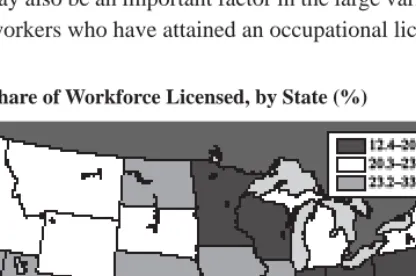
ers are not, and why some require long training programs and exams while others require relatively little time in the classroom. Although these differences may in part refl ect the industry and human capital characteristics of the state, they may also refl ect the ability of occu-pational associations to get licensing for many more of their workers. Figure 3.1 shows a map of the number of states that license various occupations by high, medium, and low. For example, Iowa has twice the percentage of licensed workers as Rhode Island, New Hampshire, or Indiana. Does the huge variation in the occupational regulation system shown in Figure 3.1 refl ect the equity and effi ciency trade-offs of this type of regulation? Beyond the characteristics of the state, the industry composition of the state may help determine the percent of the workforce that is licensed. Nevertheless, the state-specifi c politi-cal forces may also be an important factor in the large variation in the number of workers who have attained an occupational license. Figure 3.1 Share of Workforce Licensed, by State (%)
NOTE: The three categories were constructed to contain roughly the same number of states.
SOURCE: Kleiner and Vorotnikov (2015) based on an analysis of data from a Harris poll of 9,850 individuals conducted in the fi rst half of 2013.
Kleiner 2015.indb 29
INFLUENCE ON WAGES AND EMPLOYMENT
The impact of being in a licensed occupation on the hourly earnings of universally regulated occupations relative to similar un-licensed individuals has recently seen considerable research and analysis. For the occupations examined in the literature, being in a licensed occupation appears to increase earnings by 10–15 percent, which is at the lower bound of the impact of other labor market institutions, such as unions (Kleiner and Krueger 2010, 2013). For individuals whose occupations are licensed in some states and not in others, the impact of being licensed is much smaller, about 5–8 percent (Gittleman, Klee, and Kleiner 2015; Gittleman and Kleiner, forthcoming; Kleiner 2006).
Licensing generally increases the economic status of practitioners (Gittleman, Klee, and Kleiner 2015). Policymakers need to examine whether this is either a result of increased quality caused by greater training and higher quality services or a consequence of restricting competition by limiting entry into the occupations, or both. In addi-tion, the evidence using federal government surveys suggests that the benefi ts of licensing are mainly for individuals who are relatively well off (Gittleman, Klee, and Kleiner 2015).
A study of occupational laws for 10 major licensed occupations in the U.S. labor market estimates the infl uence of time from the passage of a law to its infl uence in the labor market. Time from the passage of occupational licensing laws, called duration, is important when ana-lyzing occupational licensing because states often enact “grandfather clauses” that protect existing workers, and new workers have higher entry standards than existing workers, thus increasing the costs to new entrants. This process limits the supply of labor, and those in the occupation can gain economic rents. Using historical data on the year that an occupation was licensed by a state and the data available from the American Community Survey and the Current Population Survey from 1950 to 2010, Han and Kleiner (2015) develop estimates of the impact of licensing duration on wages. Their estimates suggest that
Kleiner 2015.indb 30
The Costs, Mobility, and Quality of Occupational Licensing Services 31
it takes at least 10 years to realize the full economic wage effects of occupational licensing.
There is considerable variation in the effects of regulation. For the higher-education and higher-income occupations working mainly in the quasi-private sector, such as physicians, dentists, and lawyers, licensing appears to have large effects through either limiting entry or restricting movement between the states. However, for occupations such as teachers, nurses, and cosmetologists, the impact of licensing on earnings is murky, with some studies fi nding small effects and others fi nding none (Kleiner 2006, 2013). However, for teachers and nurses, licensing reduces interstate migration (Johnson and Kleiner 2015). The infl uence of licensing on employment growth is more gradual, but the fi ndings suggest that licensed occupations grow more slowly in states that license than in those that do not (Kleiner 2006).
INFLUENCE ON GEOGRAPHIC MOBILITY
In the last 20 years, occupational licensing has been moving in the opposite direction relative to gross interstate migration (Johnson and Kleiner 2015). Figure 3.2 shows that beginning in the mid-1980s, interstate migration started to decline as the percent of the workforce that have occupational licenses continued to grow. Several stud-ies have documented the general decline of Americans’ movement across states. To explain the decline, these studies often use models that include improved information by migrants of job opportunities, cost of living, and other amenities. Consequently, there is less return migration and cross-state movement because information in the labor market is much better than in the past. The primary reason for this improvement is the growth of the Internet and information available to potential movers. Despite its steep downward trend, migration within the United States remains higher than that within most other developed countries (Kaplan and Schulhofer-Wohl 2012; Molloy, Smith, and Wozniak 2011). However, recent empirical evidence
sug-Kleiner 2015.indb 31
gests that occupational licensing has contributed to this decline and has produced the following results: workers not being able to take jobs that they want without signifi cantly higher regulatory adminis-trative costs, and consumers not being able to take advantage of more services at the lowest cost in rapidly growing areas (Moretti 2012). This has become a particularly important issue for military families, who are often moved across state lines —10 times more than the aver-age American. If the trailing partner is licensed, he or she must spend a considerable amount of time and money to seek reaccreditation (U.S. Executive Offi ce of the President 2013, 2015).
Occupational licensing can deter geographical movements in several ways. First, under licensing statutes and administrative pro-cesses, investments for entry into an occupation are more diffi cult (especially in the absence of reciprocity, which are agreements among states to accept each other’s practitioners). The requirements com-monly involve qualifi cation criteria, passing exams, and in many cases, the engagement in continuing professional development activi-Figure 3.2 Occupational Licensing and Interstate Migration, 1950–2008
SOURCE: Johnson and Kleiner (2015).
Kleiner 2015.indb 32
The Costs, Mobility, and Quality of Occupational Licensing Services 33
ties (an investment that continues throughout one’s career). Second, in many professional labor markets, practicing the occupation also involves location-specifi c investments, such as developing social capital in local reputation, an additional cost that the worker has to bear if he or she decides to migrate (Pashigian 1979, 1980). Finally, if a worker in a particular licensed occupation moves from a highly regulated labor market to a less regulated one, there is the possibil-ity of a wage penalty if the wage premium associated with licensing is higher in the home state compared to that in the destination. As a result, one would expect licensing to add to the cost of mobility and to be inversely related to labor movements. However, to the extent that educational and other regulation-related requirements are harmo-nized, individuals would move to take advantage of economic oppor-tunities (e.g., in the form of a wage premium). Further, the ease with which one can access information on entry to the profession (e.g., procedures to follow for recognition of qualifi cations and residency requirements) also is likely to reduce the cost of movement that is taken on by the individual. Conversely, tougher licensing in the host state would deter outmigration because it is unlikely that individuals in occupations that are more heavily regulated in a state are likely to receive a wage offer that is high enough to encourage movement out of those states.
Within this model, occupational licensing has been cited as a pol-icy that not only may distort the operation of labor markets (Friedman 1962; Rottenberg 1980) but also may act as a deterrent to labor mobil-ity. Holen (1965) is among the fi rst policy studies to analyze the effects of U.S. state licensing arrangements and practices in the health care professions, focusing on interstate mobility and the allocation of pro-fessional labor resources. The author fi nds that the empirical evidence is consistent with the view that professional licensing arrangements and practices in dentistry and law restrict interstate mobility among dentists and lawyers and distort the allocation of professional person-nel in these fi elds. Follow-up work along the same lines by Pashigian
Kleiner 2015.indb 33