Vol. 7, No 1 (2013) 1–145 c
2013 Oard and Webber DOI: xxxxxx
Information Retrieval for E-Discovery
[[ DRAFT:
$Revision: 461 $
$Date: 2013-05-16 10:37:00 -0400 (Thu, 16 May 2013) $
]]
Douglas W. Oard
1and William Webber
21
University of Maryland, College Park, MD 20742, USA, [email protected] 2
University of Maryland, College Park, MD 20742, USA, [email protected]
Abstract
E-discovery refers generally to the process by which one party (e.g., the plaintiff) is entitled to “discover” evidence in the form of “electronically stored information” that is held by another party (e.g., the defendant) and that is relevant to some matter that is the subject of civil litigation (i.e., what is commonly called a “lawsuit”). This survey describes the emergence of the field, identifies the information retrieval issues that arise, reviews the work to date on this topic, and summarizes major open issues.
Contents
1 Introduction 1
2 The E-Discovery Process 4
2.1 Civil Discovery 4
2.2 The Rise of E-Discovery 10 2.3 The EDRM Reference Model 13 2.4 An IR-Centric E-Discovery Process Model 17
2.5 For Further Reading 24
3 Information Retrieval for E-Discovery 26
3.1 Defining the Unit of Retrieval 28 3.2 Extraction of Embedded Content 30
3.3 Representation 31
3.4 Specification 36
3.5 Classification 39
3.6 Clustering 41
3.7 Other E-Discovery Tasks 45
3.8 For Further Reading 50
4 Evaluating E-Discovery 52
4.1 Evaluation Methods and Metrics 53 4.2 Sampling and Estimation 62
4.3 Measurement Error 75
4.4 For Further Reading 79
5 Experimental Evaluation 81
5.1 Test Collection Design 82
5.2 The TREC Legal Track 84
5.3 Other Evaluation Venues 93 5.4 Results of Research on Test Collection Design 95 5.5 Research on System and Process Design 102
5.6 For Further Reading 111
6 Looking to the Future 112
6.1 Some Important Things We Don’t Yet Know 112
6.2 Some Prognostications 116
6.3 For Further Reading 117
7 Conclusion 118
A Interpreting Legal Citations 121
A.1 Case Law 122
A.2 Statutes and Rules 123
A.3 Other Court Documents 124
Acknowledgements 126
1
Introduction
Regular viewers of the mid-twentieth century courtroom dramaPerry Mason might be surprised to learn that the Fifth Amendment right against self-incrimination enshrined in the U.S. Constitution applies only to criminal law. In civil law, it is the obligation of parties to a lawsuit to provide documents to the other side that are responsive to proper requests and that are not subject to a claim of privilege (e.g., attorney-client privilege) (Scheindlin et al., 2012). In the law, this pro-cess is called “civil discovery,” and the resulting transfer of documents is called “production.” Amendments to the Federal Rules of Civil Proce-dure in 2006 made it clear that the scope of civil discovery encompasses all “Electronically Stored Information” (ESI), and thus was born the rapidly growing field that has come to be called “e-discovery” (the dis-covery of ESI, or Electronic Disdis-covery) (Borden et al., 2011).
A confluence of interest between those working on e-discovery and those working on information retrieval was evident from the outset, although it has taken some time for the key issues to come into sharp focus. E-discovery applications of information retrieval technology are marked by five key challenges. First, e-discovery emphasizes fixed result sets rather than ranked retrieval. Second, e-discovery focuses on high
recall, even in large collections, in contrast to the high-precision focus of many end-user applications, such as Web search. Third, e-discovery evaluation must measure not just relative, but also absolute effective-ness. Fourth, e-discovery connects information retrieval with techniques and concerns from other fields (for instance, computer forensics and document management). And fifth, the adversarial nature of civil liti-gation, and the information asymmetry between requesting party (who makes the request) and responding party (who has the documents), makes e-discovery a substantially arms-length transaction.
While these challenges are not unique to e-discovery, the demands of the e-discovery marketplace has focused research upon them. The market for vendors of e-discovery systems has been estimated at $US 1 billion in 2010 (Logan and Childs, 2012); several times that figure are spent on the staffing and processing costs to use those systems effectively (Pace and Zakaras, 2012). In view of these large costs, in-formation retrieval research can help to achieve two important societal goals: (1) improving the return on this investment by enhancing the effectiveness of the process for some given level of human effort (which has important implications for the fairness of the legal system), and (2) reducing future costs (which has important implications for broad access to the legal system by potential litigants). Furthermore, funda-mental technologies developed for e-discovery may have applications in other fields as well. For example, the preparation of systematic reviews of recent research on specific topics in medicine might benefit from ad-vances in high-recall search (Higgins and Green, 2008), and personal information management might benefit from advances in search tech-nology that focus specifically on email (which at present is of particular interest in operational e-discovery settings).
With that background in mind, the remainder of this survey is or-ganized as follows. Chapter 2 onThe E-Discovery Process begins with an introduction to the structure of the process of e-discovery, focus-ing principally on U.S. federal law, but with a brief survey of discov-ery practice in other jurisdictions. The part of the e-discovdiscov-ery pro-cess known as “document review” has been the focus of the greatest investment (Pace and Zakaras, 2012) and is therefore our central fo-cus in this manuscript. The chapter also introduces the three
canoni-3
cal information seeking processes (linear review, keyword search, and technology-assisted review) that shape current practice in document review. Chapter 3 onInformation Retrieval for E-Discovery examines specific techniques that have been (or could be) applied in e-discovery settings. Chapter 4 onEvaluating E-Discovery discusses evaluation is-sues that arise in e-discovery, focusing in detail on set-based evaluation, estimation of effectiveness metrics, computation of confidence intervals, and challenges associated with developing absolute as well as relative measures. Chapter 5 onExperimental Evaluationreviews the principal venues in which e-discovery technology has been examined, both those well known in academic research (such as the Legal Track of the Text Retrieval Conference (TREC)), and those more familiar to industry (e.g., the Data Set project of the Electronic Discovery Reference Model (EDRM) organization). Chapter 6 on Looking to the Future draws on our description of the present state of the art to identify important and as yet unresolved issues that could benefit from future information retrieval research. Finally, Chapter 7, theConclusion, draws together some broader implications of work on e-discovery.
2
The E-Discovery Process
This chapter places technical issues of e-discovery in the context of the legal process under which it is conducted. We discuss the place of discovery in civil law in Section 2.1, while Section 2.2 describes the rising importance of e-discovery in recent years. We then describe the e-discovery process itself, with the aid of two models: first, the popular EDRM model, in Section 2.3; and then, in Section 2.4, an alternative model that more clearly identifies the parts of the process where infor-mation retrieval techniques can have the greatest impact.
2.1 Civil Discovery
Discovery is the process whereby one party (the producing party) in a legal case makes available to the other (the requesting party) the materials in their possession which are pertinent to that case. The chief venue for discovery is in civil litigation, but analogous processes occur in regulatory (including antitrust) investigation, in freedom of information requests, in the conduct of commercial due diligence, and
2.1. Civil Discovery 5
in criminal law.1 We focus in this survey on e-discovery under the U.S. Federal Rules of Civil Procedure (FRCP).2 The rules in most U.S. states are modeled on the federal rules, but considerable variation in practice occurs in other countries. We therefore begin with a description of the discovery process in the USA, and then we briefly review similar processes in other jurisdictions.
2.1.1 Discovery in the USA
Which materials are pertinent to a case depends on the matter under dispute, as laid out in acomplaint document that makes specific alle-gations, and more particularly in the requests for production that the requesting party lodges with the producing party. A party may make several production requests in a case, each covering a different aspect of the case. Requests can be made not just from the plaintiffs to de-fendants, but also from defendants to plaintiffs, and by either party to third parties (The Sedona Conference, 2008b). We refer simply to re-questing and producing parties in the context of any specific production request.
Having received a request, it is the producing party’s responsibil-ity to conduct a reasonable inquiry to find and return all material in their possession that is responsive to that request. The search for re-sponsive documents thus aims at comprehensiveness—in the jargon of information retrieval, at recall. The producing party is also respon-sible for ensuring that the production is not overly broad, obscuring responsive materials amongst a mass of non-responsive materials. The producing party can be sanctioned by the court for failing to return responsive documents (under-production), as well as for returning too many non-responsive ones (over-production). The law does not require perfection at this task, but rather that the actions taken in response to the request are reasonable (Oot et al., 2010; Baron, 2008), and that the effort and expense is proportionate to the amount in dispute (Carroll,
1
For e-discovery in criminal law, see the Criminal Discovery Subcommittee of the Seventh Circuit’s Electronic Discovery Pilot Program,http://www.discoverypilot.com/content/ criminal-procedure-subcommittee.
2
2010; The Sedona Conference, 2010a).
It is in the first instance up to the two parties to agree upon what constitutes a reasonable and proportionate effort (for instance, not searching backup tapes, or only searching documents produced after a certain date). If the parties are unable to agree upon a protocol, then the court must get involved. Some judges may be unwilling to de-cide upon the technical details of production protocols (Baron, 2011);3
others may be forced to do so by the fundamental disagreements be-tween the parties;4 and yet others may be prepared to make proactive
determinations about production methods.5
The scope of discovery under the FRCP is broad; the producing party must produce not just documents that are significant to the case, but all documents that are relevant to the production request. In legal terms, the criterion is responsiveness, not materiality. Specifically, Rule 26(b)(1) of the FRCP states:
Unless otherwise limited by court order, the scope of discovery is as follows: Parties may obtain discovery regarding any nonprivileged matter that is relevant to any party’s claim or defense—including the existence, description, nature, custody, condition, and location of any documents or other tangible things and the identity and location of persons who know of any discoverable matter. For good cause, the court may order discovery of any matter relevant to the subject matter involved in the action. Relevant information need not be admissible at the trial if the discovery appears reasonably calcu-lated to lead to the discovery of admissible evidence.
Materials may be withheld from production under the claim of
priv-3
Judge Facciola inUnited States v. O’Keefe, 537 F. Supp. 2d 14, 24 (D.D.C. 2008) com-mented that choosing blind between search terms is “clearly beyond the ken of a layman and requires that any such conclusion be based on evidence.” (See Appendix A for an explanation of the legal citation practice used here and throughout this survey.) 4
Da Silva Moore v. Publicis Groupe et al., 2012 WL 607412 (S.D.N.Y. Feb. 24, 2012), approved and adopted in Da Silva Moore v. Publicis Group, 2012 WL 1446534, at *2 (S.D.N.Y. Apr. 26, 2012)
5
2.1. Civil Discovery 7
ilege, the most common forms of which are as an attorney-client com-munication or an attorney work product, as defined by Federal Rule of Evidence 502.6 Determination of privilege requires legal (rather than only subject-matter) expertise, and may be performed as a separate review of those documents previously identified as responsive. A log of privileged documents is normally provided to the requesting party.
The producing party generally regards privileged documents as highly sensitive, since client-attorney communications could disclose case strategy or otherwise prejudice the producing party’s interests. The law does provide for “clawback” of such documents if released in-advertently (Facciola and Redgrave, 2009).7 However, if the producing party is found to have not made a reasonable effort to protect their privileged materials, they can be judged by the court to have waived their privilege, thus allowing those materials to be used at trial,8though the court can release the producing party even from this reasonable ef-fort requirement by issuing what is known as a 502(d) order (Grimm et al., 2011). Even if privileged documents are successfully clawed back, the literature on hindsight bias suggests that the requesting party may simply no longer be able to think in the same way they had before seeing the privileged information (Heuer, 1999).
There is an inherent asymmetry in the nature of the discovery pro-cess (Baron, 2009). The requesting party must develop the production request without access to the ESI, while the producing party must ex-ecute that request on the ESI on behalf of the requesting party. To address this asymmetry, and reduce the scope for gamesmanship and disputes, the FRCP requires the parties meet in a pre-trial conference (known as ameet and confer) and present a case management plan to the court.9 Cooperation between parties is being increasingly urged by legal commentators and the judiciary (The Sedona Conference, 2008d; Paul and Baron, 2007). Advanced tools can allow for a more itera-tive collaboration between the parties, through joint review of training documents (Zhao et al., 2009), and recent cases using such technology
6
http://www.law.cornell.edu/rules/fre/rule_502
7
Fed. R. Civ. P. Rule 26(b)(5)(B); Fed. R. Evid. 502. 8
Mt. Hawley Ins. Co. v. Felman Prod., Inc.,271 F.R.D. 125, 136 (S.D.W.Va. 2010). 9
suggest that iterative collaboration is growing.10
2.1.2 Similar Processes In Other Jurisdictions
Discovery practice varies in jurisdictions outside the United States. To begin with, the concept of discovery is mainly confined to com-mon law jurisdictions, meaning (besides the US) the countries of the British Commonwealth, particularly Canada, Australia, Singapore, Hong Kong, and New Zealand, plus the Republic of Ireland,11 though
not all jurisdictions in the Commonwealth are common law (for in-stance, Scotland is a civil law jurisdiction, as is the province of Quebec in Canada for private law, including commercial law). Outside com-mon law countries, quite different legal processes apply. For instance, “[a] party to a German lawsuit cannot demand categories of documents from his opponent. All he can demand are documents that he is able to identify specifically—individually, not by category.”12Similarly, Chi-nese law does not require the exchange of information in litigation.13 Nevertheless, companies based in countries without discovery may still find themselves subject to discovery proceedings if they trade with countries that do observe discovery, most notably the United States. Moreover, there are also discovery-like processes outside civil litigation, such as responding to regulatory requests from government bodies.
Within the non-US common law countries, discovery practice is also variable. Perhaps the most notable divide is over the scope of produc-tion. Some jurisdictions follow the broader US standard of relevance under which a document is discoverable if it possesses “relevance to one or more facts at issue.”14 Others follow a tighter materiality standard,
10
Da Silva Moore v. Publicis Groupe et al., 11 Civ. 1279 (ALC) (AJP) (S.D.N.Y. Feb. 22, 2012) (Document 92 ofhttp://archive.recapthelaw.org/nysd/375665/);In Re: Actos (Pioglitazone) Products, 2012 WL 3899669 (W.D. La. July 27, 2012) (http://pdfserver. amlaw.com/legaltechnology/11-md-2299.pdf).
11
http://chrisdale.wordpress.com/2012/11/27/a-hong-kong-ediscovery-snapshot-in-the-company-of-epiq-systems/
12
Heraeus Kulzer, GmbH v. Biomet, Inc., 2011 U.S. App. LEXIS 1389 (7th Cir. Jan. 24, 2011).
13
http://www.insidecounsel.com/2012/12/03/like-the-great-wall-e-discovery-barriers-still-exi?ref=hp&utm_source=buffer&buffer_share=dbf7d
14
NSW (Australia) Uniform Civil Procedure Rules 2005, Regulation 21.2 (http://www. austlii.edu.au/au/legis/nsw/consol_reg/ucpr2005305/s21.2.html)
2.1. Civil Discovery 9
stating (in these or other words) that a party is required to discover only:
“(a) documents on which the party relies;
(b) documents that adversely affect the party’s own case;
(c) documents that adversely affect another party’s case; and
(d) documents that support another party’s case.”15
England and Wales follow (under the namee-disclosure) the materiality standard (Bennett and Millar, 2006), though there recent modifications to Part 31 of the Civil Procedure Rules flowing from the Jackson Review allow courts more lee-way in varying the scope of disclosure.16. Aus-tralia also observes materiality at the Federal level,17 though practice
varies at the state level, with for instance Victoria following a materi-ality standard, New South Wales a relevance standard.18 Similarly, in
Canada, some provinces (for instance, Ontario and British Columbia) follow a relevance standard, others (such as Alberta) a materiality stan-dard (The Sedona Conference, 2008a), though in all jurisdictions there is increasing emphasis on cost containment (Force, 2010; The Sedona Conference, 2011a).
The difference between a materiality standard and a relevance stan-dard from the point of view of retrieval is that the latter emphasizes recall, whereas the former arguably emphasizes precision. Moreover, the materiality standard has traditionally been seen as less onerous upon the responding party, and so, in the new age of electronic discov-ery (Section 2.2), perhaps calling for less sophisticated technological
15
Victorian Supreme Court (Australia) (General Civil Procedure) Rules 2005 – Sect 29.01.1.3 (http://www.austlii.edu.au/au/legis/vic/consol_reg/sccpr2005433/s29. 01.1.html) 16 http://www.justice.gov.uk/courts/procedure-rules/civil/rules/part31; http://www.legislation.gov.uk/uksi/2013/262/contents/made; http://www.scl. org/site.aspx?i=ed30465 17
Federal Court Rules (Commonwealth) O 15 r 2(3) (http://www.alrc.gov.au/sites/ default/files/pdfs/publications/Whole\%20ALRC\%20115\%20\%2012\%20APRIL-3.pdf)
18
involvement. Rules and practice are changing rapidly at present, how-ever, in non-US jurisdictions as in United States.
2.2 The Rise of E-Discovery
Traditionally, discovery focused on paper documents, and a paper mindset persisted for some time even as documents shifted to elec-tronic media. The shift from paper to digital content—what is termed “electronically stored information” (ESI)—has posed fundamental new challenges to the discovery process, which have had to be met with a combination of legal and technical responses.
At first, it might seem that ESI should be easier to search and pro-duce than paper documents stored in filing cabinets—and in the long term that may turn out to be true. But the rise of highly computer-ized and networked enterprises initially made discovery more difficult and expensive. The ease of creating digital content led to an explosion in the amount created. Moreover, while paper documents were con-structed and centrally filed by professional secretarial staff, electronic documents are now created autonomously by employees and stored in a profusion of locations and devices. Additionally, whereas in the age of paper records, most communications were ephemeral and unrecorded, with the advent of digital communication, much more communication is stored and therefore discoverable (Paul and Baron, 2007).
Initially, e-discovery practitioners attempted to apply paper meth-ods to electronic information, amassing all data from relevant custo-dians and displaying it page by page on screen, or even printed out on paper. Review itself was performed by an army of junior attorneys reading through the documents one at a time, and marking them with physical or virtual tags according to their responsiveness to the pro-duction request(s). Such a method of search came to be known aslinear review. Review speed depends on the collection, requests, and review-ers, but a rate of a few minutes per document is typical.19 Evidently, 19
Baron et al. (2006) report review rates for different topics at the TREC 2006 Legal Track ranging from 12.3 to 67.5 documents per hour, and averaging 24.7. The average rate was 20 documents per hour in 2007, and 21.5 per hour in 2008 (Oard et al., 2008). Roitblat et al. (2010) describe a large-scale review, for both responsiveness and privilege, requiring 225 attorneys to each work nearly 2,000 hours to review 1.6 million documents, at a rate
2.2. The Rise of E-Discovery 11
the cost of such an approach scales linearly with the collection size, and as collections have grown dramatically, linear review has become increasingly insupportable (Paul and Baron, 2007).
The next step was keyword search (Baron, 2008); that is, search based on the presence or absence of specific terms. All documents matching the keyword query were then subjected to linear manual re-view. Thus, keyword search is a filtering step, aimed at cutting the collection down to a manageable size while still (it is hoped) catching the great majority of relevant material. Keyword search is a somewhat imprecise term, however, since (almost) all techniques that might be used to automatically identify potentially relevant documents are based at least in part on the presence or absence of specific terms. Initially, keyword search was used to refer narrowly to finding all documents that contained some very specific search term (e.g., the name of a project or a person). Later, the term was used somewhat more expansively to refer to any sharply defined hand-crafted term-based specification of a re-sult set (e.g., a Boolean query). Some e-discovery vendors subsequently elaborated keyword search into what has been referred to as concept search(Laplanche et al., 2004; The Sedona Conference, 2007c).20
Con-cept search covers a range of technologies, from query expansion to clustering documents for more focused review; in general, any search method that goes beyond simple keyword matching might be referred to as concept search.21As corporate collections continued to grow,
how-ever, even filtering by keywords or (some representation of) concepts left huge document sets that had to be linearly reviewed. Moreover, there are long-standing questions about how reliable keyword searches are at capturing all relevant documents (Blair and Maron, 1985).
Solving the scalability question while maintaining comprehensive-ness has ultimately required adopting a higher degree of automation for
of 14.8 documents per hour. Borden (2010) cites a review of “fairly technical” documents running at the rate of 45 documents per hour, and states 50 to 60 documents per hour as the “e-discovery industry average.”
20
Disability Rights Council v. Washington Metropolitan Transit Authority, 242 F.R.D. 139 (D.D.C. 2007).
21
A typical definition from an e-discovery vendor is “Conceptual search is defined as the ability to retrieve relevant information without requiring the occurrence of the search terms in the retrieved documents” (Chaplin, 2008).
locating relevant documents, through the use of more advanced meth-ods. Such methods are sometimes now referred to astechnology-assisted review. One influential approach has been to apply supervised machine learning to the classification task, which is now often referred to in e-discovery circles as predictive coding. Whether predictive coding is an acceptable, or even a mandatory, approach to e-discovery has been the subject of several recent and ongoing cases.22
An important practical issue in e-discovery is the format in which ESI is to be produced. Rule 34 of the FRCP states that “If a request does not specify a form for producing electronically stored information, a party must produce it in a form or forms in which it is ordinarily main-tained or in a reasonably usable form or forms.”23 A common practice in the early days of e-discovery (remarkable though it might sound to contemporary ears) was to print all documents out and produce them in hard copy; the requesting party would then typically scan and OCR the documents to return them to digital form.24 Even today, docu-ments can be, and sometimes are, requested as rendered TIFF images if the intended process for using them will be manual (because such an approach avoids the complexity of rendering many different document types) (Marcus, 2006). Another, as yet not completely resolved, issue
22
InGlobal Aerospace Inc., et al., v. Landow Aviation, L.P. d/b/a Dulles Jet Center, et al., 2012 WL 1431215 (Va. Cir. Ct. Apr. 23, 2012), the court ordered the use of predictive coding technologies, over the objections of the plaintiff. InKleen Products LLC et al. v. Packaging Corporation of America et al., 10 C 05711 (N.D .Ill.) (Nolan, M.J) (http: //archive.recapthelaw.org/ilnd/247275/), the plaintiffs objected to the defendants’ using Boolean keyword search to construct their production, and sought to have the court force defendants to use “content-based advanced analytics;” the court instead required the two sides to negotiate further, and after discussion, the plaintiffs withdrew their objection to the use of Boolean keyword search. InDa Silva Moore v. Publicis Groupe et al., 11 Civ. 1279 (ALC) (AJP) (S.D.N.Y.) (http://archive.recapthelaw.org/nysd/375665/), plaintiffs initially objected to the defendants’ use of predictive coding; at the time of this writing, plaintiffs have removed their objection to predictive coding, and the parties are negotiating the discovery protocol to be employed. More recently still, inEORHB, Inc. v. HOA Holdings, LLC, No. 7409-VCL (Del. Ch. Oct. 15, 2012), the court preemptively ordered both parties to use predictive coding, without either party having requested such an order.
23
http://www.law.cornell.edu/rules/frcp/rule_34
24
As recently as June 2011, the emails of former Alaska Governor Sarah Palin were released in response to an open government request as 24,199 hard-copy, printed pages ( http://gizmodo.com/5810955/palins-emails-released-in-the-most-appropriately-stupid-manner-possible).
2.3. The EDRM Reference Model 13
Fig. 2.1 The EDRM Reference Model.
is which (if any) of the metadata associated with a document must be produced.25
2.3 The EDRM Reference Model
The process of e-discovery involves many, possibly iterated, stages, and these stages might be scoped and bounded in different ways when seek-ing to emphasize different aspects of the process. Figure 2.1 shows one very widely cited process model, known as the EDRM Reference Model.26 The model specifically focuses on information processing, so
procedural activities such as the conference of the parties provide con-text for the model, but are not explicitly represented.
From left to right, the model begins with the ongoing information management activities of the organization.27 Although entitled “Infor-25
National Day Laborer Organizing Network et al. v. United States Immigration and Cus-toms Enforcement Agency et al., 10 Civ. 3488 (S.D.N.Y). The court initially ordered that certain key metadata fields were an organic part of a document and must be produced by the government in response to an FOIA request. The government appealed based on the widespread ramifications of this ruling; the court subsequently agreed, and withdrew the order.
26
EDRM is the name of an organization whose first product was the Electronic Discovery Reference Model. EDRM now encompasses several projects, so we (somewhat redun-dantly) make it clear when it is EDRM’s Reference Model that we mean to refer to. 27
A detailed description of each stage in the EDRM Reference Model can be found at
mation Management,” the intent is to encompass all of the regular information processing activities of an organization prior to the start of an e-discovery process. Thus, that leftmost stage in the model also includes activities that may be outside the direct control of the infor-mation management staff of an organization, and possibly outside the control of the organization itself. Examples include records manage-ment (e.g., to meet legal, regulatory or policy goals), archival storage of records that are appraised as having permanent value, information processed using personally owned devices such as smartphones or home computers, and information managed by other providers (e.g., “cloud services”).28
The second stage in the EDRM Reference Model, “Identification,” involves finding the information in the diverse information process-ing ecosystem that must be searched. This might be done by internal staff (typically information management staff working together with lawyers), or consultants with specialized expertise may be called in. Either way, this is a team activity, calling for both legal and techni-cal knowledge. Two broad classes of activities are subsumed in this stage. First, information systems that may contain responsive informa-tion need to be identified. This process is often referred to as “data mapping,” and it produces a “data map” that depicts the informa-tion stores and informainforma-tion flows, often using generic categories (e.g., “personal computers”) when a large number of similar devices are in-volved (Fischer et al., 2011).29 Much of the work of data mapping can (and, in best practice, should) be done prior to litigation, as part of the organization’s information management procedures. Second, deci-sions need to be made, and agreed between the parties, about which systems information will be collected from, and what restrictions will be placed on the collection process (e.g., limiting collection to specific custodians, specific date ranges, and/or specific file types). Informa-tion retrieval researchers will recognize this as an instance of federated
28
See The Sedona Conference (2007a) for best-practice recommendations on information management for e-discovery.
29
In E-Discovery, “data” and “information” are often used interchangeably; the use of “data” in this context does not imply a specific focus on databases, just as our use of “information” throughout this survey is not intended to imply the exclusion of databases.
2.3. The EDRM Reference Model 15
search,30but e-discovery practitioners do not typically think of it as a search process. The reasons for that are both historical and practical. Historically, pulling boxes from a file room was the direct analogue of what is now the Identification stage in the EDRM Reference Model, a process more akin to acquisition than to search. Practically, even in the digital era, organizations typically have no index that can search across the broad range of information systems involved, which could potentially include offline backup tapes, memory sticks in the bottom of desk drawers, and email stored on home computers. As a result, decisions about Identification are typically made prior to search, and with little in the way of formal evaluation of the amount of responsive ESI that may be missed.
The third stage of the EDRM Reference Model involves two explic-itly depicted functions, “Collection” and “Preservation.” Collection is, quite simply, actually getting what you decided to get. This may in-volve using ordinary access means (e.g., issuing queries to an operating database), using specialized means for access that avoid altering the stored information (e.g., file system reads using software or hardware approaches to avoid altering the “last accessed time” metadata), or using forensic techniques to recover otherwise inaccessible information (e.g., creation of a disk image from a personal computer in order to sup-port recovery of deleted files from “slack space” that has not yet been reallocated). Preservation involves three basic functions: maintaining the bit stream, maintaining the information necessary to interpret the bit stream, and maintaining evidence of authenticity for the bit stream. To maintain the bit stream, replication is normally used for “preserva-tion copies,” and all analytical manipula“preserva-tions are performed on “service copies” (Stewart and Banks, 2000). The information necessary to in-terpret the bit stream (e.g., file type and time created) is normally captured as metadata along with the file, and is preserved in the same way. To maintain evidence of authenticity, a cryptographic hash is nor-mally created and then escrowed in separate storage to which access is restricted in a manner intended to prevent malicious alteration. Matters
30
In federated search, multiple collections are available. Two decisions must be made: which collections to search; and how to merge the results obtained from the searched collections.
related to preservation attract considerable attention in the e-discovery literature (The Sedona Conference, 2008c), though they are often not directly relevant to information retrieval.
The fourth stage of the EDRM Reference Model has been the prin-cipal focus of attention to date from the information retrieval research community. This stage involves three explicitly depicted functions, “Processing,” “Review” and “Analysis.” Processing, in this context, refers to operations performed on service copies to prepare the col-lection for review. In the era of linear review, this involved rendering page images for each file type and formatting appropriate metadata for display with each page image. In the era of technology-assisted review, the Processing function would also involve feature generation and in-dexing; essentially, processing is whatever needs to be done in advance of Review. Review, in the era of manual linear review, involved some-one looking at each document and making decisions on responsiveness, privilege, and perhaps other issues (a process referred to in e-discovery as “issue coding”). In the era of technology-assisted review, Review will generally still involve some human examination of individual doc-uments, but it can also involve aggregate specification of sets (e.g., using queries), classifier training, and automated classification. Analy-sis is the term used by EDRM to indicate the control over the Review process. Information retrieval researchers would recognize the Analysis function as combining information seeking behavior (e.g., analysis of what you want) and formative evaluation (e.g., analysis of how well you are doing at finding it).
The fifth stage of the EDRM reference model, Production, involves the delivery of responsive and non-privileged ESI to the requesting party, often accompanied by a log identifying any responsive and privi-leged ESI that has been withheld. The produced digital documents are typically accompanied by what is referred to in e-discovery as a “load file,” providing additional metadata not contained in the documents themselves.
The final (rightmost) stage in the EDRM Reference Model is Pre-sentation. This involves the use of produced ESI to elicit further infor-mation (e.g., in a deposition), to support legal analysis, and to persuade (e.g., during a trial).
2.4. An IR-Centric E-Discovery Process Model 17
Although the EDRM Reference Model is widely referred to, it vides just one way of looking at what is a complex and nuanced pro-cess. The EDRM Reference Model predates the current focus on both technology-assisted review and on “Early Case Assessment” (see Sec-tion 2.4.5), so it is not surprising that the details of the model are perhaps better suited to explaining linear review than to explaining more recent developments. Nonetheless, the EDRM Reference Model is useful to information retrieval researchers precisely because of such limitations—by capturing the ways in which e-discovery practitioners have traditionally thought about the process, the EDRM Reference Model can serve as a useful guide for helping to interpret the legal literature on this topic.
2.4 An IR-Centric E-Discovery Process Model
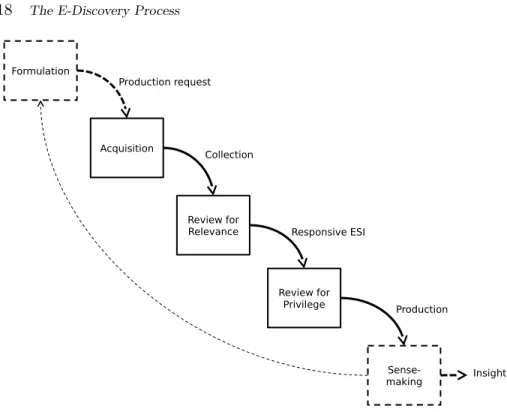
In the remainder of this section, and throughout this survey, we adopt a view of the E-Discovery process that is both broader and more focused than that of the EDRM Reference Model, one that is crafted to specif-ically focus on the potential points of impact for information retrieval research.31 Our perspective is broader than that of the EDRM Refer-ence Model because we start with the formulation and interpretation of the production request, one of the principal points of contact between e-discovery and information seeking behavior research. Our perspec-tive is narrower than that of the EDRM Reference Model in that we focus sharply on information retrieval tasks that produce five key re-sults: (1) the production request, (2) the collection to be searched, (3) the responsive documents in that collection, (4) among the responsive documents, those that are subject to a claim of privilege, and (5) the insight that results from interpreting the contents of a production. The tasks in our process model each fundamentally implicate IR research, and each will have some place in any comprehensive E-Discovery pro-cess model. Figure 2.2 depicts this model.
31
Fig. 2.2 An IR-Centric E-Discovery Process Model. Dashed lines indicate requesting party tasks and products, solid lines indicate producing party tasks and products.
2.4.1 Formulation: Creating Production Requests
The first stage of an e-discovery process begins with the production re-quest. The request resembles what in IR evaluation is called the topic, and what Taylor referred to as the “formalized information need” (Tay-lor, 1962). Although in fully automatic IR evaluation it is common to create a query automatically from the topic, that is not how production requests are intended to be used in e-discovery. Rather, it is expected that the producing party will manually interpret the production re-quest and then engage in whatever query formulation and result review process is appropriate to properly respond to the request (possibly in consultation with the requesting party). In that sense, a production request is more akin to the sort of topic statement that is presented to a user in an interactive IR user study. The meet and confer between the parties, described above in Section 2.1, occurs during this stage.
2.4. An IR-Centric E-Discovery Process Model 19
2.4.2 Acquisition: Assembling the Collection
Once the content and scope of the production have been agreed upon, the producing party must assemble the collection to be searched. Be-cause the domain from which the collection could be drawn is poten-tially huge, a drastic winnowing of this material takes place in which specific inclusion and exclusion criteria are used to bring the task down to a manageable degree of complexity and (hopefully) to bring the resulting collection down to a manageable size. These criteria (often referred to by lawyers as ‘filters’) focus on information systems, custo-dians, date ranges, and file types. Sometimes, the presence of specific terms is also required.32
It is worth reflecting on the implications of this winnowing process for the comprehensiveness of a production. Typically, when we eval-uate comprehensiveness (or, as it is more formally known, recall), we consider (and sample) only the collection at hand—that is, the set of documents collected after the winnowing process. It may be, however, that there are responsive documents amongst the chaff that has been winnowed. For instance, a custodian that organizational analysis had identified as not related to the case may unexpectedly hold relevant information (e.g., because they were cc’d on some relevant email mes-sage) (Wang et al., 2009); or there may be documents on backup tapes that are no longer held on spinning disks; or what were thought to be system files based on file-type identifiers (e.g., .bat or .exe) may actually have been documents that some bad actor had sought to conceal.
The bar to including some of these missing sources may be the prac-tical expense of obtaining specific types of ESI (e.g., deleted files on personal hard drives). But insofar as readily accessible documents have been filtered out simply to make the resulting collection smaller, we
32
An example agreement on the requirements for the search protocol isOracle America, Inc. v. Google Inc., 10 Civ. 03561 (N.D.Cal. Dec. 17, 2011) (“Response to re 56 Case Management Scheduling Order”) (Document 67 ofhttp://dockets.justia.com/docket/ california/candce/3:2010cv03561/231846/), which specifies that the producing party must include search terms specified by the requesting party in their search, as well as discussing handling of custodians and of privileged documents. More recently, a court has approved a process in which keyword filtering was used to construct a collection, which was only then entered into a predictive coding system; seein re: Biomet M2a Magnum Hip Implant Prods. Liab. Litig., NO. 3:12-MD-2391 (N.D. Ind. Apr. 18, 2013.)
should realize that such decisions raise risks regarding recall and that these risks may not be well characterized. Moreover, the costs of craft-ing algorithms to avoid collectcraft-ing specific types of content may actually exceed the costs of storing and automatically searching that content, since automated techniques allow large collections to be searched for a relatively small marginal cost when compared with smaller collections. It should be noted at this stage that, while good records manage-ment practices can, in some cases, reduce the expense and increase the reliability of discovery, it is rarely the case that a production request can be satisfied simply by running searches in a records management system.33There are two reasons for this. First, the scope of e-discovery simply exceeds the scope of records management in that records man-agement is applied only to “records” of activity that have recognized value at the time of their creation, use, or disposition, whereas e-discovery applies to all ESI regardless of whether its value was pre-viously anticipated. Second, in some organizational settings (notably, in businesses) records management is informed not just by anticipated value but also by risk management decisions.
Recognizing that retaining and managing information incurs costs (both financial costs such as for storage, and other types of costs such as the risk of unauthorized disclosure of sensitive information), the law al-lows organizations to destroy information when it is no longer required in the ordinary course of business. There are two exceptions to this broad permission: (1) information that may be relevant to reasonably anticipated litigation cannot be destroyed, and (2) some information is required to be retained for defined periods by law or regulation. Busi-nesses seeking to limit risk are wise to avail themselves of their right to destroy information before the threat of litigation arises, a fact that information retrieval researchers (who naturally tend to focus on the value of finding things over the value of not being able to find things)
33
A records management system is a system for capturing, preserving, and disposing of business records produced by a company or organization. Frequently extended nowadays to an “Electronic Document and Record Management System” (EDRMS), to incorpo-rate the management of (electronic) documents as they are being created and used, not only when they become business records. See “Implementing an EDRMS – Key Considerations”, National Archives of Australia, 2011, http://www.naa.gov.au/records-management/agency/digital/EDRMS/index.aspx.
2.4. An IR-Centric E-Discovery Process Model 21
often initially have difficulty understanding. Destroying information in a records management system may not, however, destroy all copies of that information. So implementation of a process for authorized de-struction of centrally stored records could, in at least some cases, sim-ply increase the need to look beyond the records management system for information that may still exist elsewhere that is responsive to a production request (McGann, 2010).
2.4.3 Review for Responsiveness: Finding the Relevant ESI
Review for responsiveness is the stage that is most similar to a standard information retrieval process, although there are important differences in the nature of the query and the querier (detailed, expert, and time-committed), the nature of the production (set-based, and possibly very large), and the measures of success (emphasizing recall over precision). The goal of review for responsiveness is to produce a set of relevant documents. The definition of relevance has traditionally been a legal judgment of an attorney for the producing party who must certify that the production is complete and correct. Production protocols are, how-ever, increasingly providing for validation processes that also involve the requesting party.
Collections assembled from many sources will naturally contain du-plicates: the one email sent to many recipients; the one contract held in many folders; and so forth. For example, in the TREC Legal Track Enron collection (see Chapter 5 on Evaluation Resources), 63% of the email messages were classed by the organizers as duplicates of other messages in the collection (Cormack et al., 2010). De-duplication is therefore first applied to identify a canonical version of each item and then to simply record every location where that item was found (Nel-son and Simek, 2009; Kershaw and Howie, 2009). De-duplication serves several purposes, including reducing collection size, preventing manual reviewers from having to review one document multiple times, limiting redundancy in training data for automated classification techniques, and supporting social network analysis (by noting which custodians held identical ESI). The focus at this stage is typically on “exact”, bitwise-identical duplicates (perhaps after some transformations to
nor-malize formatting and to remove incidental content such as email mes-sage path header fields that may cause inconsequential variations in otherwise identical ESI). Referring to this as de-duplication (as is com-mon in e-discovery) is perhaps somewhat misleading; what is really meant is “duplicate detection.”
How the review process itself is carried out depends upon the method employed, be it linear review, keyword search, or assisted review (Section 2.2). We focus in this survey on technology-assisted review.
2.4.4 Review for Privilege
After the review for responsiveness, a subsequent review of the respon-sive documents for privilege will often also be needed (Scheindlin et al., 2012, Chapter IX). In a full manual review, review for privilege might be conducted at the same time as review for responsiveness, or it might be conducted as a separate step. Even in technology-assisted reviews, re-view for privilege is frequently performed as a separate, manual rere-view, as attorneys may be skeptical of the reliability of automated privilege review. Moreover, since assessments of privilege can require expert le-gal knowledge, privilege review can be particularly expensive.34 Only
documents that are to be produced must be reviewed for privilege; but production sets can be quite large.
As a result of these factors, review for privilege is one of the major obstacles standing in the way of lowering production costs through the use of automated technology. The judiciary has tried to address this problem by adding the clawback provisions to rules of procedure and evidence, as discussed in Section 2.1, but technical approaches have been the focus of little work to date (though see Section 5.2.3 for the inclusion of a privilege task in the TREC 2010 Legal Track).
34
“It’s the second-line review that kills us, the one for privilege; some firms try to charge us $320 per hour for using third-year associates for this sort of work” (quoted in Pace and Zakaras (2012, page 26)).
2.4. An IR-Centric E-Discovery Process Model 23
2.4.5 Sense-Making: Generating Insight
Once the producing party delivers its production, the requesting party’s sense-making task begins (Attfield and Blandford, 2010; Wilson, 1999). The ultimate goal of discovery is to find evidence of activity in the real world, not merely to find responsive ESI; it is through the sense-making process that ESI becomes evidence. The requesting party will seek to understand the so-called “5 W’s:” Who, What, When, Where, and Why.Whoinvolves not merely which people are involved, but also their roles and their interests.What involves both what happened and what objects were involved. When involves both absolute (calendar) time and the relative sequencing of events.Whereinvolves either phys-ical location or locations in an information system. Andwhy might be established either in an explicit statement from someone involved, or by fitting together pieces of a puzzle around some hypothesis. This is Sherlock Holmes’ territory, and ESI provides only one part of a rich col-lection of sources; other potential sources include physical documents from various sources, statements and depositions from people involved, and information that is on the public record or that is otherwise avail-able to the requesting party (e.g., from its own information systems).
As the dashed lines with arrows in Figure 2.2 (which represent questing party information flows) indicate, this process yields two re-sults. One possibility is that it may directly yield needed insight; the other is that it may inform the formulation of additional production requests (or it may lead to seeking additional information in some other way). Repeated iterations of requests and production are uncommon in civil litigation, though iterativity and interactivity between the par-ties is increasingly encouraged (The Sedona Conference, 2008d). The darker lines in Figure 2.2 therefore indicate the primary information flows.
Figure 2.2 is a somewhat simplified depiction, omitting the parallel sense-making process that occurs throughout the process by the pro-ducing party. Unlike the requesting party, the propro-ducing party need not complete the reviews for relevance and privilege before beginning sense-making. Indeed they would be unwise to do so, because early sense-making results could help to improve their collection process
and/or the accuracy of their review process. When a producing party’s sense-making process is conducted early in the process, it is typically referred to in e-discovery as “Early Case Assessment” (Solomon and Baron, 2009). In such cases, the producing party’s goals will largely mirror those of the requesting party, but with the additional goals of learning which documents should be collected and how reviews for re-sponsiveness and privilege should best be conducted.
A broad range of tools might be employed to support this sense-making process. Some obvious examples include ranked retrieval, clus-tering, summarization, information extraction, data mining, gap analy-sis (e.g., to detect missing parts of email threads), and visual analytics. Indeed, this is a natural application of the so-called “concept retrieval” tools originally marketed for the more formal review process.
2.5 For Further Reading
• The Sedona Conference is an association of legal practitioners that provides impartial commentary and recommendations on issues in complex litigation. Working Group 1 of the Se-dona Conference is devoted to e-discovery, and over the years it has produced over two dozen widely-cited white papers on matters in e-discovery practice, aimed at a legal audience.35 “The Sedona Principles: Best Practice Recommendations for Addressing Electronic Document Production” (The Sedona Conference, 2007b) is a good starting point.
• Scheindlin et al. (2012) collect and provide extended com-mentary on US rules and case law across a wide range of topics in e-discovery, while Berman et al. (2011) contains essays by leading e-discovery practitioners.
• Clive Freeman maintains a web page, “Electronic Disclo-sure”, providing links to a wide range of resources on e-discovery and e-disclosure in jurisdictions outside the United States,36 while the blog of Chris Dale covers the
same territory, with a focus on practice in England and
35
https://thesedonaconference.org/publications
36
2.5. For Further Reading 25
Wales.37 Working Group 7 of the Sedona Conference (“Se-dona Canada”) produces recommendations and commen-taries upon e-discovery practice in Canada, while Working Group 6 discusses disclosure issues for organizations working across multiple international jurisdictions.
• As described above, EDRM is an industry association of ven-dors and customers of e-discovery systems.38 The EDRM Reference Model was their earliest, and still their best known, creation, but EDRM also has initiated projects on standard-ization, education, and other topics.
• The literature on sense-making for e-discovery is not yet as well developed as the literature on review for responsive-ness; the field has yet even to converge on a way of speaking about such issues with any degree of clarity or comprehen-siveness. One notable exception is Attfield and Blandford (2010), which reports on workplace studies of sense-making and refinement by lawyers in an e-discovery context.
• A workshop series known as DESI (for Discovery of Electron-ically Stored Information) has served as a point of contact between e-discovery practitioners and technologists with a broad range of interests. The proceedings of each workshop are available online.39
37
http://chrisdale.wordpress.com/
38
http://www.edrm.net/
39
3
Information Retrieval for E-Discovery
David Lewis has observed that pretty much all of e-discovery is classi-fication.1 When limited in scope to review for responsiveness and priv-ilege, this is largely true. The problem of determining whether some ESI is responsive to a request is a binary classification problem for the simple reason that in the end, the document must either be determined to be responsive (and thus to be considered for production) or not to be responsive. The problem of determining whether some responsive ESI is subject to a proper claim of privilege (and thus to have its existence disclosed, but not to be produced, or to be produced only after some redaction has been applied) is similarly a binary classification problem. That is not to say that ranking techniques might not be useful as a tool for supporting decisions regarding relevance or responsiveness, but ul-timately those are indeed binary classification tasks, whether the final decision is to be made by human or by machine.
This formulation begs one important question, however: what, in this context, do we mean by “some ESI?” In particular, we need to define the unit of retrieval. That, therefore, is where the story of
In-1
Said in a talk at the SIGIR 2011 Information Retrieval for E-Discovery (SIRE) Workshop.
27
Feature Set
Transformation
Feature
Construction
Classification
Specification
Employment
Process
Representation
Process
ESI
Result Set
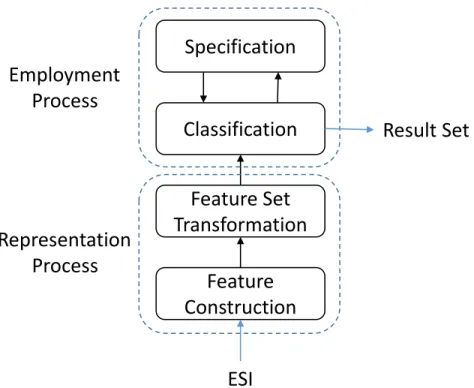
Fig. 3.1 Four layers of the classification process. The bottom two layers result in a repre-sentation of the ESI on which classification can be performed; the top two layers produce the classification result.
formation Retrieval (IR) for e-discovery must begin (in Section 3.1). That’s followed by a description of issues that arise with teasing apart embedded ESI (in Section 3.2). The classification process then proceeds in four stages, as illustrated in Figure 3.1. We focus first on represent-ing ESI in Section 3.3, then on specifyrepresent-ing to a system what ESI needs to be found in Section 3.4, and finally on actually finding that ESI (in Section 3.5). The chapter concludes with descriptions of some re-lated tasks, including broadly useful capabilities for grouping ESI (in Section 3.6) and specific tasks such as acquisition and production that occur earlier and later in the e-discovery process (in Section 3.7).
3.1 Defining the Unit of Retrieval
Justice Antonin Scalia of the U.S. Supreme Court has written “In our favored version [of an apocryphal story], an Eastern guru affirms that the earth is supported on the back of a tiger. When asked what supports the tiger, he says it stands upon an elephant; and when asked what supports the elephant he says it is a giant turtle. When asked, finally, what supports the giant turtle, he is briefly taken aback, but quickly replies ‘Ah, after that it is turtles all the way down.’ ”2 The situation
with units of review for e-discovery bears some resemblance to that story.
The Sedona Conference Glossary defines a document family to be “A collection of pages or files produced manually or by a software appli-cation, constituting a logical single communication of information, but consisting of more than a single stand-alone record” (The Sedona Con-ference, 2010b). Common examples of document families include the scanned pages of a book, a cover letter along with any attached docu-ments, or an email message along with its attached files. In e-discovery, the unit of Electronically Stored Information (ESI) that is subject to production is generally understood to be the document family, not the individual file (i.e., not the page of the scanned book, the cover letter alone, or the email message without its attachments).
A document family is therefore the information object for which decisions about responsiveness and privilege must be made. That is not to say, however, that those decisions should be made in isolation. Consider, for example, the case of an email message, the only content of which is “sure – let’s do it!” It matters a great deal whether the message being replied to had proposed murder, malfeasance, or lunch. For this reason, it is common to group email messages into threads, and to make initial decisions about the threads. Similarly, a decision that some attachment is responsive might lead to a conclusion that other copies of the same attachment might be responsive. For this reason, it is common to identify duplicate documents and to make initial decisions about each unique item.
2
3.1. Defining the Unit of Retrieval 29
Similar examples of grouping documents for the purpose of review abound in e-discovery. Even the common practice of selecting the cus-todians3 from whom documents should be collected is a coarse-grained way of grouping documents and deciding on entire sets at once. When reviewing so-called loose files (i.e., documents in a file system, as op-posed to documents attached to an email), entire directory trees might be removed from consideration. A “.zip” archive containing many ex-pense reports might be excluded after examining only a few of the reports. The unit of review need not, and often does not, equate to the unit of production. In other words, just because it is document families that are produced does not mean that it should be document families that are reviewed. Reviews can reasonably work with both finer-grained sets (e.g., individual attachments) and coarser-grained sets (e.g., email threads), at least initially.
From an information retrieval perspective, document granularity is an important design decision. In a typical information retrieval research setting, the boundaries of a document seem self-evident. In a library catalog, we might seek to find books; in newspapers, articles; on the Web, Web pages. But document granularity has always been with us to some degree: the one book might be available in different editions, some newspaper articles are part of a series of articles on the same topic, and Web pages are often organized into Web sites. The question of granularity is not new to information retrieval; what is new is the attention it demands in e-discovery.
In e-discovery, much of the publicly reported experimentation has worked with document-based measures. An exception was the TREC Legal Track’s Interactive task in 2009 and 2010, which focused on doc-ument families; specifically, on email messages together with their at-tachments (Hedin et al., 2009; Cormack et al., 2010). Exploitation of email threads has most often been discussed in the context of redun-dancy suppression (since threads often contain redundant quoted text, reviewing the later messages in a thread might obviate the need to
3
The term custodian is often used generically in e-discovery to refer to a person having control over specific ESI. The term does not necessarily imply physical control; the owner of an email account for which the messages are stored on a central server is often referred to as a custodian of the ESI in that account.
review earlier messages) (Kershaw and Howie, 2010) or as a way of grouping messages for display (Joshi et al., 2011). The direct use of threads as unit of retrieval has been reported in other settings (Elsayed et al., 2008), but we are not aware of its reported use in e-discovery. Moving beyond the domain of primarily unstructured textual docu-ments, retrieval from databases and other structured data sources poses even more complex challenges in determining the unit of retrieval (The Sedona Conference, 2011b). The work on evaluation of retrieval from XML documents offers some insight on this question (Fuhr et al., 2002).
3.2 Extraction of Embedded Content
Documents can be embedded inside other objects, and identifying, ex-tracting, and separately processing embedded content can be beneficial. Attachments are easily separable from emails, and compressed (e.g., .zip) archives can be expanded. Documents can also be embedded in-side other documents, as in Microsoft’s Object Linking and Embedding (OLE) standard, where (say) a chart from a spreadsheet can be em-bedded in a Word document.
An important special case in e-discovery is the embedding of one email message within another, sometimes as an explicit attachment, but more commonly as quoted text. The format for quoting responded-to text differs between different email client systems, and it can vary de-pending on whether a message is replied to or forwarded. Nevertheless, a small number of format parsers can accommodate the formats of the vast majority of messages in any one collection. Since responders can generally edit the email they are responding to, issues of authen-ticity and completeness arise; and the embedded email may be refor-matted and lose its original attachments. Emails recovered from such embedding are often calledhidden emailsbecause simply indexing each stored message could miss some messages (or parts of messages) that are “hidden in plain sight” within other messages, and which may not be otherwise present in the collection.
3.3. Representation 31
3.3 Representation
Once the unit of retrieval has been decided, and embedded documents have been extracted, the next question is how best to represent these units to support the classification task. In information retrieval, this process is often referred to as “indexing,” a term which places empha-sis on the construction of data structures to support rapid responses to queries. We prefer the term “representation” because it places the emphasis on what aspects of the units of retrieval can be used as a basis for classification. Information retrieval researchers have long experience with content-based retrieval in which the representation is built from counts of term occurrences in documents, but specialized systems also use other features (e.g., metadata found in library catalogs, the link structure of the Web, or patterns of purchase behavior). Borrowing a term from machine learning, we might call the process of crafting useful features “feature engineering” (Scott and Matwin, 1999). As Figure 3.1 illustrates, feature engineering involves two tasks: construction of po-tentially useful features, and (often) transformation of the resulting feature set to accommodate the capabilities and limitations of the clas-sification technique that will be employed. Four broad types of features have been found to be useful in IR generally over the years: content; context; description; and behavior. Content is what is inside the docu-ment itself; the remaining three are varieties of metadata.
3.3.1 Content Representation
What constitutes a document’s content varies depending upon docu-ment type; text predominates, but other media forms occur, and even text comes in multiple forms.
In representing text, common processing techniques such as the re-moval of stopwords and stemming are as applicable in e-discovery as in other applications, though care may need to be taken to account for domain-specific terminology and acronyms. Term weights are calcu-lated in the usual way, giving emphasis to terms frequent in a document but rare in the collection (Salton and Waldstein, 1978). In e-discovery, semi-structured text is common, particularly in an email’s wide range of header fields and body segments (e.g., new text, quoted text,
auto-matically inserted signature, boilerplate disclaimers); representations that respect this structure can be useful.
Mixed-language content, either within or between documents, can pose challenges, as available machine translation resources may not be suited to the genre (e.g., email) or content (e.g., terminology unique to an industry or organization). For the most part, however, standard techniques from cross-language information retrieval can be used. These include statistical alignment and dictionaries as sources of translation mappings, mapping term frequency and document frequency statistics to the query language language before computing term weights, pre-and post-translation blind relevance feedback, pre-and the use of cognate matching for unknown words (Oard, 2009).
The representation of spoken content for e-discovery (e.g., from voicemail) poses no unusual challenges to standard speech retrieval techniques, such as speaker adaptation (e.g., training speech recogni-tion to optimize accuracy for the owner of a voicemail account) and the use of phonetic matching for out-of-vocabulary terms (Olsson and Oard, 2009).
Scanned documents are becoming markedly less prevalent in dis-covery generally, but they are still more common in e-disdis-covery than in many other retrieval tasks, in part because it is common to find scanned documents as attachments to email messages. Layout analysis can help to extract fields with particular semantic interpretations (for instance, to identify the from address in emails that have been included in the collection by printing and scanning, as was common practice in the past) (Shin et al., 2001). Other techniques from document image re-trieval are applicable, such as Optical Character Recognition (OCR), statistical correction of OCR error effects, and character n-gram in-dexing (to accommodate moderate character error rates) (Doermann, 1998). Specialized techniques such as signature matching or handwrit-ing recognition can also be useful for identifyhandwrit-ing document authors and annotators (Zhu et al., 2009). Handwritten content is easily detected, but not as easily deciphered (Manmatha et al., 1996).
Representing image content in specialized ways can be useful when processing still and moving images. For example, face matching
tech-3.3. Representation 33
niques (e.g., eigenface) can be used to identify photographs of a spe-cific person (Zhang et al., 1997), and specialized activity detection al-gorithms (e.g., automated detection of moving objects in surveillance video) can be used to focus a reviewer’s attention on those portions of a long video that are most likely to contain specific evidence that is sought (Medioni et al., 2001).
Indeed, it is possible to imagine some e-discovery application for al-most any information retrieval content representation technique. Music fingerprinting (Wang, 2006), for example, might be useful for cases in which copyright violations in the course of file sharing are alleged; tech-niques for representing the topical expertise of individuals who have authored scientific articles (Balog, 2008) might be useful in a patent infringement case; and a standardized representation for mathematical formulas could help to find spreadsheets that implement specific types of financial models. Although e-discovery does place greater emphasis on some content representation issues than has been the case to date (e.g., by focusing attention on the consequences of gaps in the lexical coverage of translation resources for high-recall search when represent-ing mixed-language content), there is in general little about content representation that is unique to e-discovery.
3.3.2 Contextual Metadata
Defined succinctly, contextual metadata is any representation that serves to characterize the context within which some content was gen-erated. Much contextual metadata is inferred, and even some appar-ently explicit metadata requires interpretation (for instance, knowing the time zone to which a timestamp belongs). The document family to which a document belongs is a fundamental form of context; for in-stance, the email to which a document is attached. Email header fields offer rich sources for context, such as authorship, recipient, and date of transmission (Kiritchenko et al., 2004). Other document types also provide contextual metadata, or can have contextual metadata inferred for them. File systems store file creation times; some file types (e.g., Microsoft Word) can store version history information, allowing earlier versions of a document to be recreated; and near-duplicate detection