DO MORE MERGERS AND ACQUISITIONS CREATE VALUE
FOR THE FIRM?
A thesis submitted for the degree of Doctor of Philosophy
by
Shaomeng Li
School of Social Science
Brunel University
Abstract
This thesis is aimed to empirically investigate the performance impact of frequent acquisitions as an aggressive merger and acquisition (M&A) strategy for an acquiring firm. In literature related to the study of M&A, a common question is whether acquisitions improve the performance of acquirers. Neither theoretical nor empirical studies have a clear view on the performance effect of M&A. Some argue positively and some are opposite. Although existing research are mixed for their arguments, a takeover is commonly perceived as a shock to the firm with a constant effect on changing business performance. This static perception of M&A creates a difficulty in explaining why firms acquire others when the performance effect is negative. To address the issue, this thesis examines the M&A effect dynamically with taking into account the role of merger frequency in affecting performance.
On the basis of a large sample that consists of about 14,000 acquisitions from more than 100 countries over last 12 years, the thesis finds that the investors perceive a lower value if the acquiring firm is involved in frequent mergers. This is because more mergers are expected to attract considerable amount of management attention away from profitable activities in order to digest the challenges of new business integration at least in the short run. This “digesting constraint” argument is evident by our estimations. Firm becomes less profitable in the short run after a merger shock, and this adverse effect can be more severe if the firm is involved in more frequent mergers.
Evidence of the thesis further show that, the effect of merger shocks is not static and persistent, and it changes with time. The shock affects adversely profitability in the short run, usually lasting a couple of years, and then the negative effect on performance could be turned either oppositely if the firm digests the shock successfully, or otherwise, continuously but diminishing over time if the digestion takes longer such as for frequent acquisition. This finding implies that the pace of firm resilience to a merger shock can be affected by its merger strategies. The pace can be slow if the firm pursues frequent mergers aggressively.
The performance effect of a merger shock is dynamic and changes with time. The dynamic view for merger shocks from this study opens a new vision for literature in merger studies. Overall the market expectation to a merger effect on changing firm performance is quite consistently related to what has actually happened to the firm after the merger shock.
Acknowledgements
First and foremost I am in debt to my supervisor Professor Guy Liu for his
continuous support to my doctoral study and research and his patience during tough
time in my Ph.D. pursuit. His guidance helped me in all the time of research and writing
of this thesis. I could not have imagined having a better advisor and mentor for my Ph.D.
study.
Besides my advisor, I would also like to express my sincere gratitude to Dr.
Bryan Mase, Dr. Ding Wang and Dr. Siming Liu for their support and comments.
1 Table of Contents
1. Introduction ... 4
1.1. General concept and development of merger and acquisition ...4
1.1.1. The type of M&As ...4
1.1.2. Development of M&A ...5
1.2. Research Context ...6
1.2.1. Background ...6
1.2.2. Motivation and Aims ...9
1.3. Research method ...10
1.3.1. Event-study approach ...10
1.3.2. Panel data estimation ...11
1.3.3. Data ...11 1.4. Major Contributions ...12 1.4.1. Chapter 2 ...12 1.4.2. Chapter 3 ...13 1.4.3. Chapter 4 ...13 1.5. Thesis structure ...14 1.5.1. Introduction (Chapter 1) ...14
1.5.2. Short-term univariate analysis (Chapter 2) ...14
1.5.3. Short-term multivariate analysis (Chapter 3) ...15
1.5.4. Long-run empirical analysis (Chapter 4) ...16
1.5.5. Conclusion (Chapter 6) ...17
2. Do more mergers and acquisitions create value for shareholders? A univariate analysis ... 18
2.1. Introduction ...18
2.2. Literature review ...21
2.2.1. Theory ...21
2.2.2. Empirical evidence of frequent acquisition ...26
2.2.3. Empirical evidence of other determinates on merger impact ...30
2.3. Research setup ...34
2.3.1. Define performance measurement: abnormal returns ...34
2.3.2. Define merger frequency for acquiring firms ...39
2.3.3. Empirical predictions ...41
2.4. Data ...43
2.5. Empirical results ...49
2
2.5.2. The impact of frequency on subsequent acquisition performance ...51
2.6. Robustness check ...54
2.6.1. Robustness tests for merger frequency by deal-characteristics ...54
2.6.2. Robustness tests for merger frequency by firm-characteristics ...57
2.6.3. Robustness test for merger frequency by economic concerns ...60
2.6.4. Robustness test for subsequent acquisitions ...61
2.7. Conclusions ...63
Appendix A ... 65
Appendix B ... 67
Appendix C ... 69
3. How does frequent acquisition affect the market expectation of performance changes after acquisition? The role of merger quantity and time interval ... 70
3.1. Introduction ...70
3.2. Literature review ...72
3.2.1. Theory ...72
3.2.2. Empirical evidence ...74
3.3. A brief review of merger activities and announcement returns for infrequent and frequent acquirers in the past ...78
3.4. Model specification and variables ...82
3.4.1. Specification of model ...82 3.5. Specification of variables ...84 3.5.1. Announcement returns ...84 3.5.2. Merger frequency ...86 3.5.3. Control variables ...88 3.6. Data ...89
3.7. Empirical evidence and discussions ...92
3.7.1. The impact of merger frequency ...92
3.7.2. The impact of control variables ...95
3.8. Robustness checks ...99
3.9. Conclusions ...109
Appendix A ... 111
Appendix B ... 114
4. The effect of merger shocks on firm fundamentals: a dynamic estimation ... 116
4.1. Introduction ...116
4.2. Literature review ...119
4.2.1. Theoretical background ...119
4.2.2. Empirical evidence ...124
3
4.3.1. A dynamic panel model for firm operating performance ...130
4.4. Variable construction, data source and sample ...133
4.4.1. Merger frequency ...134
4.4.2. Dependent variable ...137
4.4.3. Control variables ...137
4.4.4. Data and sample selection ...140
4.5. Estimation results: from “need to chew” to “chew to change” ...146
4.5.1. Effects of merger shocks and frequency on profitability ...146
4.5.2. Effects of controls ...151
4.5.3. Effect of merger shocks on profitability for different expected merger shock-lasting time ...152
4.6. Robustness checks ...155
4.6.1. How long will the shock last? ...155
4.6.1. Labour productivity...161
4.6.2. Cash-based measure ...161
4.6.3. Additional sensitive checks ...162
4.7. Conclusions ...165
Appendix A ... 166
Appendix B ... 169
Appendix C ... 170
5. Conclusions ... 171
5.1. Findings and contributions ...171
5.2. Recommendations for future research ...174
5.3. An exception in practice ...175
5.4. Implications ...176
Appendix A ... 177
References ... 178
1
List of Tables
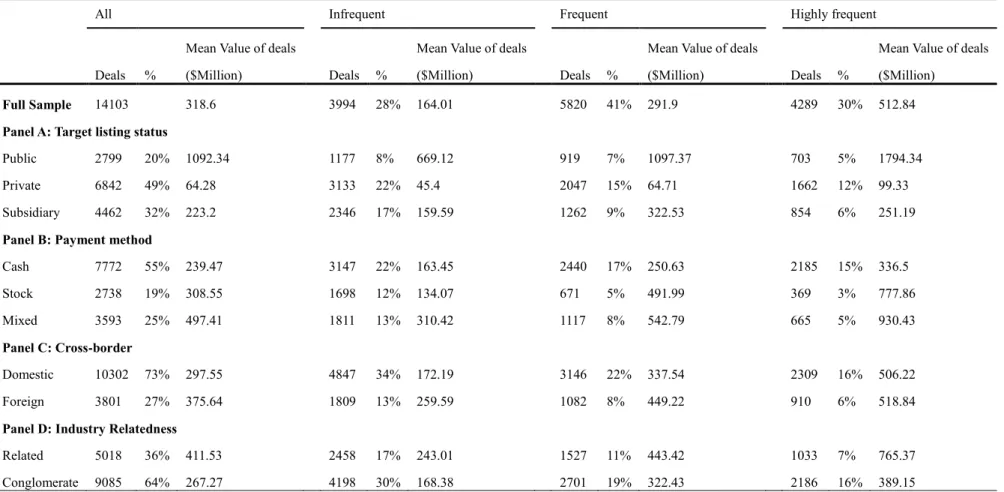
Table 2-1. Sample statistics of 14,103 takeovers from 2000 to 2010. ...46
Table 2-2. Sample statistics for payment method, target ownership and types of acquiring firms ...48
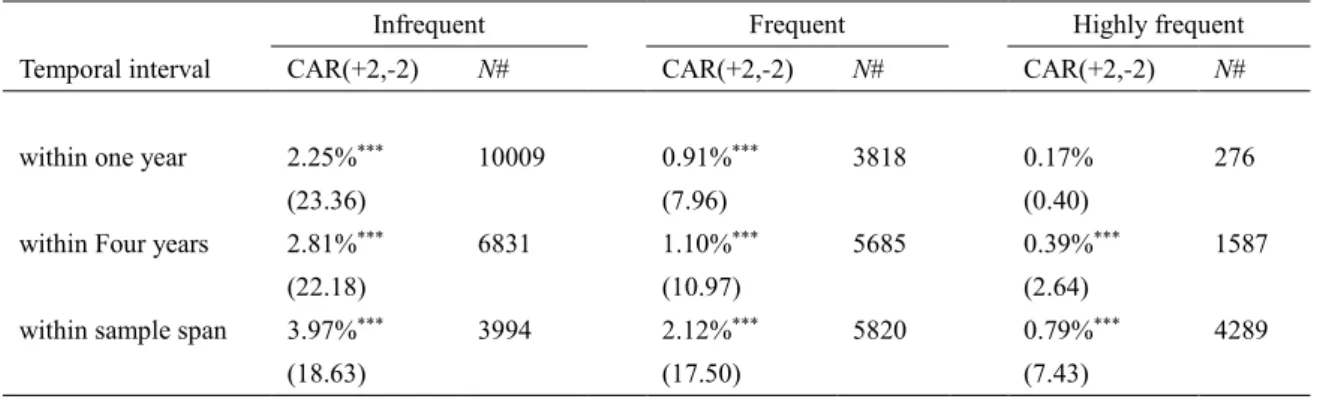
Table 2-3. Cumulative abnormal returns for infrequent, frequent and highly frequent across different time interval ...51
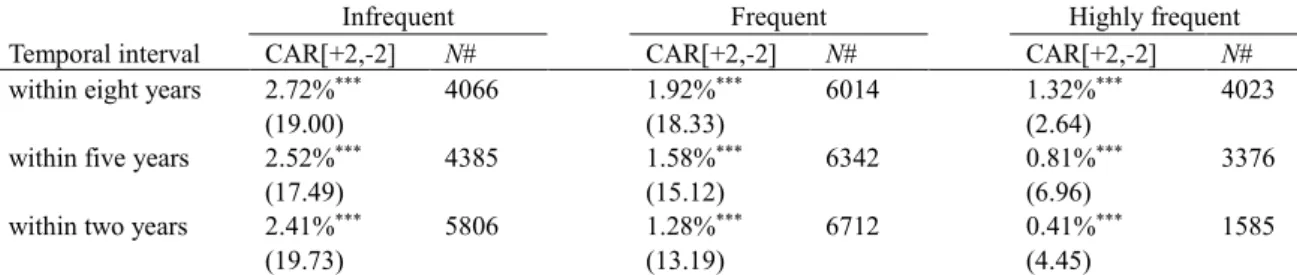
Table 2-4. Cumulative abnormal returns by the deal order and different average temporal intervals between deals ...53
Table 2-5. Cumulative abnormal returns sorted by infrequent, frequent and highly frequent acquirers based on the target ownership (Panel A) and payment method (Panel B). ...56
Table 2-6. Cumulative abnormal returns sorted by infrequent, frequent and highly frequent acquirers based on P/E ratios ...58
Table 2-7. Cumulative abnormal returns sorted by infrequent, frequent and highly frequent acquirers based on the relative acquisition size ...59
Table 2-8. Cumulative abnormal returns sorted by infrequent, frequent and highly frequent acquirers based on economic concerns ...60
Table 2-9. Cumulative abnormal returns for infrequent, frequent and highly frequent acquirers firms associated with the initial success across deal order ...61
Table 2-10. Robustness checks for cumulative abnormal returns based on deal order across different comparative controls ...62
Table 3-1. Summary of early empirical research on merger frequency by using multivariate approach ...74
Table 3-2. Example of serially coding for the three measures of merger frequency...87
Table 3-3. Summary statistics of merger frequency and firm characteristics ...91
Table 3-4. Correlation matrix...93
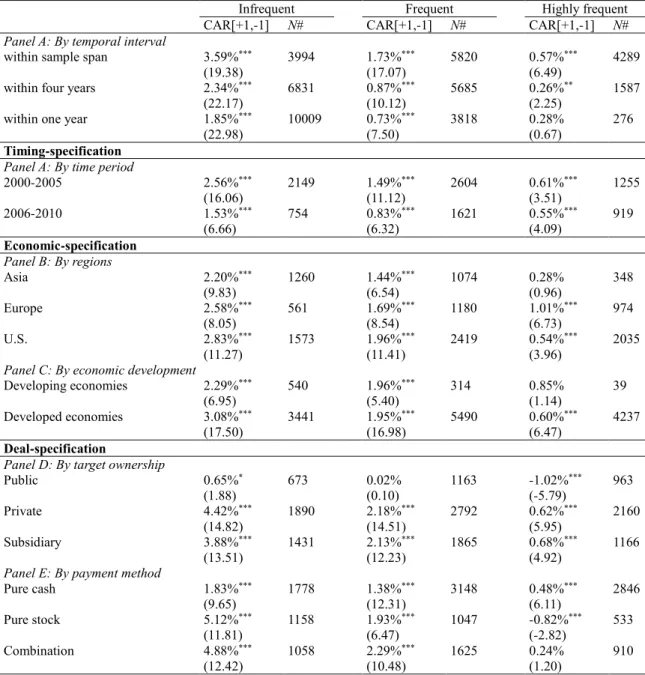
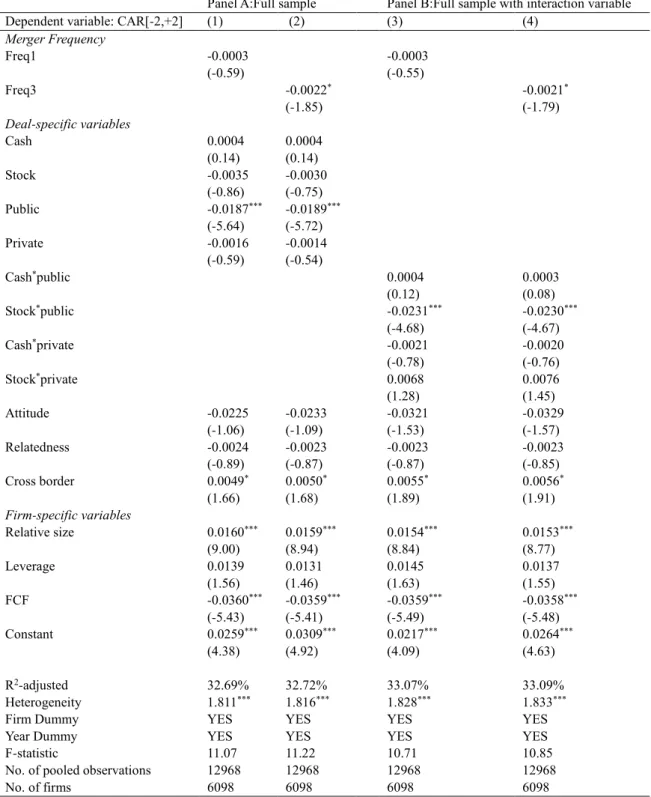
Table 3-5. The effect of merger frequency on stock performance of acquirers ...98
Table 3-6. The effect of 4-year merger frequency on stock performance of acquirers ...99
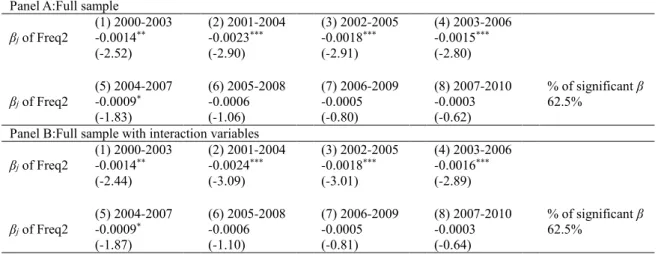
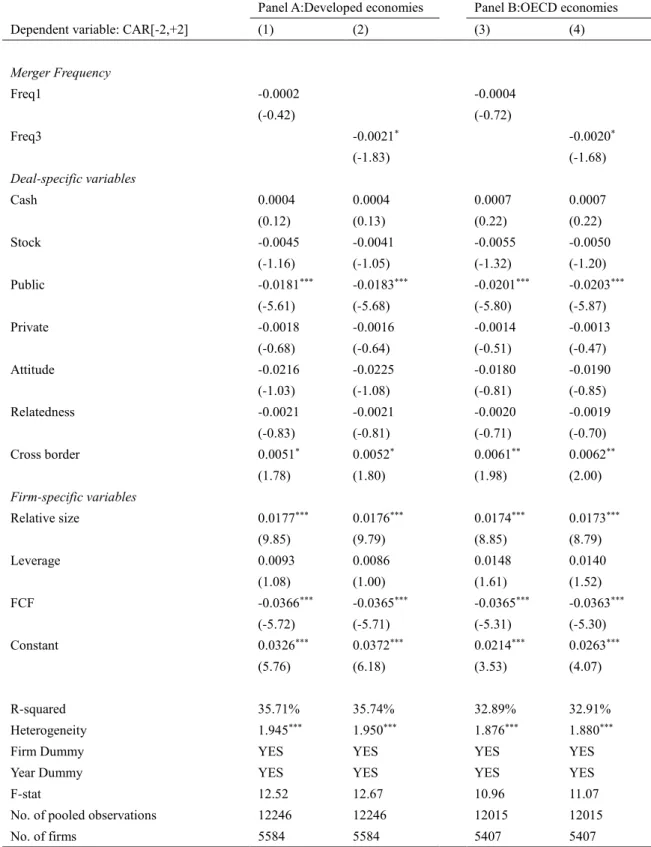
Table 3-7. The effect of merger frequency on acquirer stock performance across different economies ...103
Table 3-8. Empirical results across US and EU countries ...106
Table 4-1. Illustration of computing merger frequency under different shock-lasting time ...136
Table 4-2. Distribution of sample acquiring firms across countries ...142
Table 4-3. Summary statistics of mean of merger frequency and firm characteristics ...143
Table 4-4. Correlations between measures ...145
2
Table 4-6. Estimation of effect of merger frequency on single and multiple acquirers ...150 Table 4-7. Estimation of effect of merger frequency over different lengths of expected merger shock-lasting time ...153 Table 4-8. The lasting effect of a merger shock ...156 Table 4-9. Estimation of effect of merger frequency on labor productivity ...159 Table 4-10. Estimation of effect of merger frequency on firm labor productivity for single and multiple acquirers ...160 Table 4-11. Estimation of effect of merger frequency on firm cash flow returns on assets ...163 Table 4-12. Estimation of effect of merger frequency on cash flow returns on assets for single and multiple acquirers ...164
3 List of Figures
Figure 2-1. The relationship between CARs and the time interval ...54 Figure 3-1. Comparison of the number of acquisitions: infrequent, frequent and highly frequent acquirers ...80 Figure 3-2. Cumulative abnormal returns (CAR) across acquirers and number of mergers...81 Figure 4-1. How the effects of merger shocks on performance gradually change over the lengths of expected merger shock-lasting time ...155 Figure 4-2. How long does the performance effect of a merger shock last? ...158
4
1.
Introduction
1.1.
General concept of merger and acquisition
The compacting globally drives companies to grow rapidly, to act efficiently and effectively, to be profitable and to develop a competitively dominant position in the world. As a result, the mergers and acquisitions are inevitable for corporations to pursue in order to restructure a more competitive business for growth.
1.1.1.
The type of M&As
Merger and acquisitions (M&As) are often classified as horizontal, vertical and conglomerate mergers. A horizontal merger and acquisition occurs when two corporations in similar lines of business or competitors combine. In general, horizontal merger causes the combined firm to obtain synergy and increases the market power by merging and acquiring related business. Apart from this, firms can also benefit both economies of scale and diversification by providing different products or services for risk reduction.
Vertical mergers are a combination of companies involved in different levels of production or business for producing a good. Combined companies usually have a buyer-seller relationship. The main reason for vertical merger, by directly merging with suppliers, is to increase synergies, decrease reliance and increase profitability. In general, vertical M&As can be classified into two types. Firstly, a backward vertical merger, which usually refers to the purchase of suppliers of the raw material in the chain of production and attempts to achieve production cost-saving and efficiency improvement. Secondly, a forward acquisition, which is usually a takeover of the acquirer’s consumer and attempts to reduce marketing and delivering costs.
5
Conglomerate acquisition will create a combination of companies that have different or unrelated fields of business, which extends and diversifies an acquiring firm’s product mixes (Mueller, 1977). In addition, Brealey et al. (2006) suggest that this type of M&A is the least popular one. The main motive for conglomerate M&A is efficient capital allocation and to enter a new emerging market to seek diversification of risks (Marks and Mirvis, 1998).
1.1.2.
Development of M&A
There are six periods of intense merger activity, which are often called merger waves, driven by prevailing business growth imperatives since 1893 (e.g., Mitchell and Mulherin , 1996; Brealey and Myers, 2003).
The First Wave (1893-1904) included many horizontal mergers, creating many giants of the manufacturing and transportation industries in the US. Stigler (1950) described this as a wave of monopoly and oligopoly by merger. The wave stopped due to World War I. The Second Wave (1919-1929), was a wave of vertical merger and further consolidation in the principal industries formed by the First Wave, which was triggered by the application of radio technology and the development of automotive manufacturers. The Third Wave (1955-1970) was a wave of diversified conglomerate mergers, which mainly occurred between US firms and helped firms to enter a new market. This wave is ended because of the stock market crash in the early 1970’s. The Fourth Wave (1974-1989) was an era of co-generic mergers, hostile takeovers and corporate raiders, which is also named the “highly leveraged takeovers” era. This era ended with the collapse of banks. The Fifth Wave (1993-2000) was the era of cross-border mergers. The rise of globalization has exponentially increased the competition, therefore, this era emphasized larger economies of scale and global economics to achieve competitive advantage in the global market. The fifth wave came to an end with
6
the bursting of the “Millennium Bubble”. The Sixth Wave (2003-2008) was the era of globalization, private equity and shareholder activism.
1.2.
Research context
1.2.1.
Background
Several decades ago, mergers and acquisitions1 seldom dominated the headlines as much as at present. It has been widely documented that nowadays many economies (e.g. USA) have witnessed a dramatic increase in merger activities. This is because of M&As, as an important strategy for business growth, are increasingly influential for corporations. A glance at existing literature indicates substantial mergers and acquisitions in a wide range of sectors, such as finance, steel, pharmaceuticals and gas.
An increase in M&A activity is often referred to either a wave of merger or merger clustering in the literature. Several waves of M&As have led to substantial industrial restructuring in different parts of the world. According to data from Thomson One Banker, aggregate transaction value has sharply increased from £1.95 billion in 1968 to £2,354 billion in 2013. Over the past decades the USA, UK and Continental Europe have made their FDI predominantly through cross-border M&As rather than greenfield investment. In addition, emerging countries, such as China and India, have witnessed a rapid growth of market for corporate control, taking up roughly 30% of overall global M&As in 2013.
Mergers and acquisitions decisions are critical to the success of corporations. In a dynamic economic environment, acquiring firms are often faced with strategic decisions concerning growth by acquisitions, or by internal investment. After all,
1Mergers and acquisitions are both aspects of strategic management, corporate finance and management dealing with
the buying, selling, dividing and combining of different companies and similar entities that can help an enterprise grow rapidly in its sector or location of origin, or a new field or new location, without creating a subsidiary, other child entity or using a joint venture. Mergers and acquisitions activity can be defined as a type of restructuring in that they result in some entity reorganization with the aim to provide growth or positive value.
7
through those takeovers, a decision maker is able to develop a competitive advantage and ultimately increase and maximize (at least in theory) the actual benefits generated by takeovers to improve company fundamentals. Many acquiring firms realize that M&As could be an efficient way to expand ownership boundaries, create corporate synergies, gain economies of scale, expand operations and reduce production costs. In theory, the effects of M&A are controversial for changing firm performance. In practice also, experiences are unclear. Literature suggests that many of mergers were disappointing since the motivations behind the takeover were probably flawed, and efficiency and synergy gains from economics of scale were somewhat ambiguous.
Empirical evidence has provided many possible M&A motivations, which can be briefly summarized as follows: resource-seeking, technology-seeking, market-seeking, diversification-seeking and asset-seeking (Andrade et al., 2001; Deng, 2004). Even though different companies have various reasons for engaging in mergers and acquisitions, the main purpose is to improve shareholders’ value or firm fundamentals over and above that of the sum of two companies (Sudarsanam, 1995). Therefore, finance scholars have primarily focused on study of the issue of whether acquisitions are wealth creating or wealth reducing events for the acquiring firm.
The predominant focus of literature has focused on individual acquisitions and their performance implications. Many studies just simply and deliberately eliminate firms that undertook frequent acquisitions which may confoundingly occur during the pre- or post-acquisition window of a focal takeover. However, this would be problematic. Extensive empirical studies (e.g. Fuller et al., 2002; Conn et al. 2004; Ismail, 2008), which attempt to explain the causes and effects of takeovers on performance of acquiring firms, suggest that a large share of global acquirers has carried out multiple acquisitions during a specific short period, some of them even within the same year. When an acquirer performs frequent acquisitions, the overall impact of those
8
takeovers on its performance could not be attributed to the characteristics of individual/single merger case.
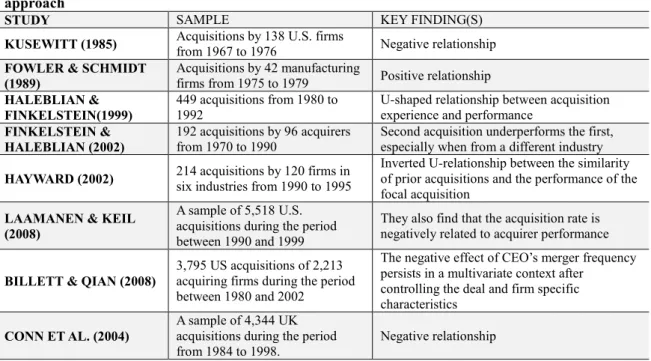
Although frequent mergers have become an increasingly important strategy widely adopted by firms, there is little evidence reported on how a frequent-merger strategy affects firm performance. For instance, from the short-run perspective, Conn et al. (2004) found a negative impact when the acquiring firms pursue frequent acquisitions. In contrast, Fowler and Schmidt (1989) suggest that frequent acquisition could enhance acquirer’s expertise in M&As, which improves merger performance. From a long-run perspective, it is found that most of the existing work is either theoretical, based on game theory models (e.g., Nilssen and Sorgard, 1998; Fumagalli and Vasconcelos, 2009), or just pursuing simple statistical tests, except for a few papers that have explored this issue theoretically from the empirical corporate finance perspective. For, instance, Capron (1999) suggests a positive relationship between merger frequency and acquirer’s performance in the long-run, in contrast to the prevalent view of the negative relationship (See for example, Bertrand and Betschinger, 2012).
In the existing studies, there are many limitations. For instance, Kusewitt (1985), Fowler and Schmidt (1989), Conn et al.(2004), Billett and Qian (2008) and Laamanen and Keil (2008) show some limitations in their studies, such as geographically biased samples, missing account of the effect of a time interval between takeovers or merger shocks in the estimation, only focusing on the market reaction; failure to find out the actual benefit of frequent acquisition and the link between it and investor expectation; and at least in the case of Conn et al. (2004) an inappropriate model specified for estimation. Overall, these limitations call for further research.
9
1.2.2.
Motivation and aims
The main focus of the thesis is on the theme of “does an aggressive merger strategy with frequent acquisitions outperform the infrequent strategy for acquiring firms”. In particular, it aims to examine a) how the different acquisition frequency patterns of acquirers affect their performance; b) whether the time interval between mergers or merger shocks can affect the relation between merger shocks and the post-merger performance; c) whether acquisitions by frequent acquirers have more favorable impacts on the performance of acquiring firms than do single takeovers.
There are three reasons for this choice of topic. Firstly, to gain a thorough understanding of frequently acquisitive behaviour and its impact on company performance. This understanding will help firms to develop either a short-run or a long-run acquisition strategy for growth, and also help investors to re-evaluate companies that become addicted to acquisition.
Secondly, although the effect of mergers on firm’s performance has drawn a large amount of attention, relatively few published studies that associated with frequent acquisition could be found. So far, there is a lack of empirical research in the nexus between a frequently acquisitive strategy and acquirer’s performance: this thesis aims to fill in the gap.
Thirdly, scholars in financial studies have a high concentration of interest in the USA, UK or any other single market (Cartwright, 2005), while few studies use worldwide sample of data for M&A studies.
10
1.3.
Research method
1.3.1.
Event-study approach
The thesis starts with an event-study chapter which explores the effect of merger frequency on performance by looking at the announcement effect of M&A on investors’ perception on acquiring firm’s value. The methodology of event study is widely applied to pursue this investigation. Generally, this methodology assumes that the market is informatively efficient, and price changes could effectively reflect new information. In merger and acquisition research, the events are assessed by a change in stock price during the period in which the event occurs.
The thesis follows the mainstream studies (e.g. Fuller et al., 2002; Conn et al, 2004) and takes the simplified method to evaluate impact of a merger announcement. The cumulative abnormal return (CAR) cumulates abnormal returns (ARs) over a “window” period or days around the event date which is set to be the date of announcement of an M&A event. The CAR is calculated as follows:
𝐶𝐴𝑅𝑖(𝑇1−𝑇2)= ∑ 𝐴𝑅𝑖𝑡 𝑇2 𝑇1 = ∑ (𝑅𝑖𝑡− 𝑅𝑚𝑡) 𝑡=𝑇2 𝑡=𝑇1
To investigate the sensitivity of the empirical results to different lengths of event window, this study first employed a 5-day event window which is commonly applied by existing studies (e.g. Faccio et al., 2006; Boubakri et al., 2012; Gaur, et al., 2013). To reduce the probability of capturing confounding events in CAR calculations, the event window was reduced from five days to three days to conduct the robustness checks.
11
1.3.2.
Panel data estimation
The panel data estimation is applied to examine the static relation between announcement returns and merger frequency and the dynamic effect of merger shocks on firm fundamentals. With a panel estimation, econometric issues relating to the specific effect such as unobserved heterogeneity and endogeneity, which may arise from the estimation of the relation between merger frequency and firm performance, have been thoroughly explored in various chapters.
To make potential econometric concerns less severe and full use of the available rich dataset, the Least Square Dummy Variable (LSDV) and the system generalized method of moments (GMM) panel estimators are applied. These techniques are further complemented by various robustness checks to ensure that the empirical results of the respective approaches are consistently estimated.
1.3.3.
Data
Compared to the existing studies, the dataset used in this thesis are substantially larger than those found in published M&A studies, and are more internationally representative. This allows a detailed analysis of the role that merger strategy or merger frequency plays. The dataset includes the most up to date and comprehensive worldwide firm-level data, which consists of two parts.
Firstly, the acquisition data used for both univariate and multivariate analysis are collected from the Securities Data Corporation (SDC)’s Global Mergers & Acquisitions database. All sample acquisitions are announced and completed during the period from January 1, 2000 to December 31, 2010. The dataset covers a larger amount successful acquisitions and tender offers of public, private and subsidiary target firms. All
12
acquiring firms included in the dataset are public companies. After a filtering process, the acquisition dataset ends up with more than 6,800 unique firms undertaking over 14,000 takeover transactions throughout 117 countries with a total transaction value of $4.49 trillion. Secondly, an accounting and a stock dataset of acquirers based on the merger dataset discussed above are used. The accounting information was retrieved from the Thomson Financials and Worldscope database. The stock data were obtained from Datastream,
1.4.
Major contributions
The section is a brief summary of the major contributions in the thesis.
1.4.1.
Chapter 2
The contribution of this chapter to the existing literature is threefold. Firstly, this chapter examines the impact of the merger frequency on the acquirer’s performance by using a large and diverse sample of 14,103 takeover deals worldwide. Secondly, it contributes to the existing literature on corporate finance by distinguishing the creation of synergy, and division of gains between acquirers with different merger frequencies. Thirdly, it extends M&A literature by recording that the greater negative effect on the announcement returns usually appears in subsequent deals for acquirers associated with higher merger frequency. Significantly, it shows that the negative effect of a merger on performance becomes lower when the time intervals between subsequent deals are longer.
13
1.4.2.
Chapter 3
This chapter makes four significant contributions to the existing literature on corporate merger strategy. Firstly, the study develops a new method of defining the merger frequency that interacts the number of mergers with the time that a merger effect may last after the event occurrence. Secondly, this study adds to the literature on how acquisitions affect the acquiring firm’s stock performance in both the temporal and quantitative perspectives. Thirdly, it builds upon studies about the different implications to relationship between the aggressiveness of merger strategy and market expectation. Fourthly, a new argument is posited that the larger deal size produces a more positive impact on performance improvement for the acquiring firms due to the risk pressure on management.
1.4.3.
Chapter 4
The research design developed in this chapter enables four new contributions to the literature. Firstly, this chapter is innovative because it systematically analyzes the operational performance implications of the frequent acquisition by employing a large global sample of acquiring companies. Secondly, this chapter introduces a new argument that the number and time of a merger shock matter simultaneously for the fundamental performance of the acquiring firm. Thirdly, it contributes to the literature by distinguishing effects between frequent acquirers and single acquirers: an area neglected in the literature. Fourthly, it extends the existing digesting theory (McCarthy, 1963) and the chewing theory (Kusewitt, 1985) into a dynamic context. It argues that the effect of merger shocks or frequency changes with time. As a result, the existing process of “Need to Chew” needs to be followed by a new process “Chew to Change”.
McCarthy (1963) suggests that the presence of the clash of cultures and conflicts of objectives between the acquirer and the acquire leads to inefficiency in digestion and
14
absorption of the “nutrition”. Kusewitt (1985) refers to this indigestion issue as “biting off more than you can chew”. Both of these arguments suggest that the negative effect of merger frequency is attributable to the number of acquisitions. However, when time is taken into account in the process of digestion, the longer process helps the firm to gradually absorb the shocks of frequent acquisition, and then allows it to gain more corporate synergies for business operation.
1.5.
Thesis structure and highlights
This thesis consists of five chapters as shown below.
1.5.1.
Introduction (Chapter 1)
This chapter includes the background, research motivation and aims, research methods, major contributions and arguments and outlines the structure of the research thesis.
1.5.2.
Short-term univariate analysis (Chapter 2)
Chapter 2 seeks to examine the effect of merger frequencies on the expectation of investors to the integration of new business for their performance in the future. Given this objective, the chapter focuses on performance assessment from an investment perspective.
By using a sample of 14,103 acquisitions collected from different countries over 11 years from 2000 to 2010, a univariate analysis is delivered to explore the effects of
15
frequent acquisition on announcement returns for three groups of acquirers: infrequent, frequent and highly frequent acquirers. The comparative results of announcements show that the low frequent acquirers outperform the highly frequent ones, in which this finding is consistent and robust across different time lengths, different regions, different time periods, different ownerships of target firms, different size of deals and different payment methods made by acquirers.
The significant findings of this chapter provide clear evidence on which the acquiring managements or firms have developed the hubris from their previously successful experiences on mergers and acquisitions. The development of hubris with more mergers drives down the expectation of investors for better performing in the future of the new integration and so lowering the value of the firm. Although the acquiring managements are expected to have declined performance after their first deal or second deals of mergers due to growing hubris in M&A, this does not mean that the management learning effect will be rejected. The chapter shows evidence about the learning effect that drives up the market expectation for the future improvement of new integration if the time interval between the two mergers pursued by the acquiring firm is longer.
1.5.3.
Short-term multivariate analysis (Chapter 3)
This chapter aims to extend the existing studies of the frequent acquisition by using a more internationally representative sample with control of firm specific fixed effects, but also by defining merger frequency in terms of how merger effect can last, in the short-term, medium-term or long-term. Splitting frequency into these three terms enables interaction between time interval and frequency as a joint effect for estimations of how frequency affects stock performance in two dimensions: number and time.
16
Based on multivariate approach, it is found that if the number of merger repetitions presents “hubris”, then it is expected that the frequency is negatively related to the market performance of acquiring firms. For a given number of mergers, if the length of time after the event occurrence reflects the amount of learning time which the management needs to digest opportunities and changes from new integrated business for more learning, then the longer time of an event repeating is expected to be positively related to performance. However, the estimation in this chapter of the interaction of frequency with time shows that the two managerial behaviours co-exist and offset each other.
In addition, the study shows that the larger size of a merger has a positive effect on performance. This supports the argument about “risk pressure” on the management of the acquiring firm. The estimation results are robust in two senses: firstly, controlled firm fixed effects in estimation, and secondly, a larger sample provides the consistency of estimation across different economies.
1.5.4.
Long-run empirical analysis (Chapter 4)
The final empirical chapter starts with a question: Can market expectation of merger events on the announcement time be consistent with what would happen to a firm’s operational performance in a later period? This chapter focuses on how the operational performance changes as an acquirer makes a different frequency of acquisition in a different time interval. If the acquiring firm can properly digest acquired assets and absorb “nutrition” from those assets, then the profitability of the acquiring firm will be improved, or at least, not damaged.
17
In Chapter 3, it is found that the investors perceive a lower value if the acquiring firm is involved in frequent mergers. This is because more mergers are expected to attract a considerable amount of management attention away from profitable activities in order to digest the challenges of new business integration at least in the short run. This “digesting constraint” argument is evident in the estimations reported in this chapter. Firms becomes less profitable in the short run after a merger shock, and this adverse effect can be more severe if a firm is involved in more frequent mergers.
Evidence in this chapter also shows that the effect of merger shocks is not static and persistent, and it changes with time. The shock adversely affects profitability in the short run, usually lasting a couple of years, and then the negative effect on performance could be turned either oppositely, if the firm digests the shock successfully, or continuously but diminishing over time if the digestion takes longer such as for frequent acquisition. In sum these findings imply that the pace of firm resilience to a merger shock can be affected by its merger strategies. The pace can be slow if the firm pursues frequent mergers aggressively.
1.5.5.
Conclusion (Chapter 5)
The last chapter summarizes the major findings and contributions of the thesis, its limitations, and provides recommendations for future research. Having presented the structure of the thesis, the next chapter will provide an event study on the impact of merger frequency through a univariate analysis.
18
2.
Do more mergers and acquisitions create value for
shareholders? A univariate analysis
2.1.
Introduction
Merger and acquisitions (M&A) are strategically important for firms to grow.
Some firms engage in frequent merger and acquisition and some do not. From the perspective of performance improvement, it is important to consider if growth by
merger and acquisition outperforms growth without M&A activities or if more
acquisitions produce better performance. Existing literature can be summarized, firstly, according to the impact of M&A on announcement returns, and secondly, on changing
the fundamentals of an acquiring firm. For the first school of studies about the impact
of M&A on announcement returns, it is evident that the market responds to the merger announcement positively (Fowler & Schmidt, 1989; Mulherin and Boone, 2000;
Andrade et al. 2001; Moeller et al., 2004). These papers take an event study approach
to examine a change in the market-perceived value of the acquiring firm from
pre-announcement of the M&A to post-pre-announcement of the event. These event-studies identify a positive change. Based on their evidence, can this study extends that the
positive experience of M&As on improving performance of acquiring firms will result
19
Fuller et al. (2002) note that frequent acquirers are able to release more
information about their own characteristics to the public due to repetitive corporate
activities in the market. The released information is helpful because it causes the stock market to perceive or expect the future stock returns that can be delivered or improved
by acquiring firms. This suggests that stock market reaction to a frequent acquirer may
be different from the stock market reaction to an infrequent acquirer. Indeed, following Fuller et al. (2002), Ismail (2008) analyses a sample of 16,221 US takeovers between
1985 and 2004 and finds that single acquirers outperform frequent acquirers. However,
Ismail (2008) limited his research to the US market.
This chapter examines the effect of merger frequency on the expectation of
investors about the integration of new business for their performance in the future. Given this objective, the chapter focuses performance assessment from an investment
perspective. If acquisition announcements are positively perceived by investors, then
the announcement returns for acquiring firms will rise, at least in the short run. In order to examine the of the relation between acquisitions and announcement returns in the
worldwide context, a large sample is collected from different countries, which includes
6,836 acquirers and 14,103 takeovers during the period 1st January 2000 to 31st December 2010. Among 6,836 acquirers, 2,842 carried out more than one acquisition
across the sample span. The sample used in this chapter consists of public acquirers
that have acquired $4.49 trillion worth of foreign and domestic companies over the sample period. It is worth noting that there are few existing studies, which use global
20
Following Fuller et al. (2002) and Billett and Qian (2008), merger frequency is
defined as the number of acquisitions undertaken by an acquirer during a specific time
horizon in this study. Given this definition, acquiring firms are classified according to infrequent, frequent and highly frequent M&A activities. Infrequent activity is defined
as an acquiring firm that has acquired only one firm over the time period of an
observed window. In contrast, frequent activity is defined as an acquirer that has pursued 2-4 M&As, and the highly frequent activity is defined as an acquirer that has
pursued five or more than five M&As during the time period.
This study begins by comparing bidder’s Cumulative Abnormal Returns (CARs) with the firm’s acquisition frequency at one day surrounding the announcement time. Four distinct results are identified. Firstly, the merger frequency is negatively related to acquirer’s stock performance. Secondly, the cumulative abnormal returns diminish in subsequent deals. More particularly, the diminishing pattern is more marked for
bidders with a higher frequency of mergers. Thirdly, past takeovers affect CARs in a timely fashion because very short temporal intervals between mergers may not be long
enough for acquirers to learn from the past experience and inferences. Fourthly, the
size of acquisition or deal size matters for the cumulative abnormal returns. The infrequent and frequent acquirers gain higher CARs in the larger size than in the
smaller size. These findings imply that the management of acquiring firms is perceived
to develop their hubris from the previous success in M&As.
The contribution of the study to the existing literature is three fold. Firstly, this chapter makes a new attempt to examine the impact of the merger frequency on the
21
acquirer’s performance by using a sample of 14,103 takeover deals worldwide. Secondly, it contributes to the existing literature of corporate finance by distinguishing
the creation of synergy, and division of gains between acquirers with different merger frequencies. Thirdly, it extends M&A literature by recording that the greater negative
effect on the announcement returns usually appears in subsequent deals for acquirers
associated with higher merger frequency. However, this negative effect becomes lower when the time intervals between subsequent deals are longer.
The chapter is organized in four sections. Section 2.2 reviews the related empirical evidence and the theoretical literature on the performance of frequent
acquirers. Section 2.3 and 2.4 state research setup and data. Section 2.5 presents the
empirical results. Section 2.6 presents robustness checks. Section 2.7 concludes.
2.2.
Literature review
2.2.1.
Theory
Current literature explores how past deals influence current acquisition (Bower and Hilgard, 1981) and how the accumulated experience of firms on acquisition can
enhance management's acquisition expertise (Kusewitt, 1985; Fowler and Schmidt,
1989; Bruton et al. 1994; Barkema et al. 1996; Ashkenas et al., 1998; Hitt et al., 1998). These studies find that an acquirer with a higher merger frequency will experience a
positive impact on performance. Specifically, they argue that later acquisitions can
generate higher cumulative abnormal returns than earlier acquisitions. Fowler and Schmidt (1989) and Bruton, Oviatt and White (1994) study the CARs associated with
22
acquisition announcements. They find that the acquiring firms’ prior experience of mergers is a predictor of success in subsequent acquisitions. In summary, acquirers
with a lot of experience are likely to succeed.
This finding can be linked with the Organizational Learning Hypothesis.
Argyris and Schon (1978) were the first to develop the Organizational Learning Hypothesis. The argument is that the number of acquisitions positively influences performance and the returns will rise with the number of acquisitions over time. That is, an experienced acquirer would be more successful than the less experienced in M&As. The organizational learning theory also suggests that the learning impact of any takeovers on acquiring firm performance would be related to how many acquisitions that have been carried out previously, have the same characteristics as the current one. Conn et al. (2004) follow the argument and state that firms making multiple acquisitions are expected to improve their absorptive capacity for innovative change (Cohen and Levinthal, 1990)
and to choose more efficient investment (Vermeulen and Barkema, 2001). In 2008, Laamanen and Keil (2008) further point out that frequent acquirers would potentially
become superior performers because more acquisition experience can lead to more
success in subsequent deals.
Fuller et al. (2002) give the empirical evidence in support of the organization learning argument. They find higher CARs for more frequent acquisitions of private
target firms based on a sample of acquisition announcements between 1990 and 2000.
An acquirer firm can learn valuable lessons from the repeated process of mergers and integration (Paine and Power, 1984; Amburger and Miner, 1992 and Pablo, 1994).
23
They gain increasingly market power from more acquisitions (Conn et al., 2004), and later
or subsequent acquisitions will perform better than earlier ones (Vermeulen and Barkema, 2001). They argue for a correlation between the number of acquisitions and the success of the outcome. The later the occurrence in the deal order position in the sequence of acquisitions then the more successful the acquirers' performance. In a follow-up piece,
Kamien and Zhang (1993) turn to the effect of endogenous mergers, defined as a merger and acquisition that occurs between identical firms selling a homogeneous
product. They argue that, if a firm makes a series of endogenous mergers, the firm may
monopolize the industry. As a result, the performance of an acquiring firm would be
improved with the number of acquisitions due to the dominant market power.
The Managerial Hubris Hypothesis, proposed by Roll in 1986, argues that some
optimistic managerial behaviour leads to corporate decisions that destroy the value of the firm. It suggests that the management may pay less attention to the current merger
than to the previous ones because an overly optimistic confidence develops. In addition, the overconfidence would cause overpayment for the targets or higher leverage being
taken on to pay for subsequent acquisitions (Moeller et al., 2004; Malmendier and Tate,
2008). Billett and Qian (2008) test the managerial hubris hypothesis. They look at whether a self-attribution bias (Daniel et al., 1998; Gervais and Odean, 2001) leads to
overconfidence by the acquirers' decision makers over the sequence of acquisitions.
Billett and Qian (2008) indicate that managerial overconfidence may distort managerial decisions so that "the subsequent acquisitions may tend to be value destructive" (Conn et al. 2004). A number of articles also find evidence in support of the hubris argument,
which generally involves data from, for instance,the U.S.: Billett and Qian(2008), Bruner (2002), Hietala et al. (2003), Malmendier and Tate (2003); and the U.K.: Doukas
and Petmezas (2007). However, overconfidence proxies used in those earlier studies,
24
In M&A, the Agency Problem Hypothesis occurs when there is conflict between management and shareholders. Management may maximize their own interests at the
expense of shareholders' wealth (Jensen, 1986). The agency view divides the firm's
directors into two groups: insider and outsider. Many articles employ an empirical test on the agency theory (e.g. Harris and Raviv, 1978), but results are mixed (e.g.
Hoskisson et al., 1993; Wright et al., 1996; Sanders, 2001; Rajgopal and Shevlin, 2002;
Wright et al. 2002; Wright et al., 2007). From the perspective of managerial
decision-making, agency issues (Eisenhardt, 1989) might cause the size effect (Moeller et al., 2004). Using a sample of US listed frequent acquirers over the 1990-2002, Croci (2005)
investigates why managers make serial acquisitions. His empirical test on building
empire cooperation suggests the motivation for conducting multiple acquisitions is that the management serves its reputation and interests and sidelines the shareholders’ value.
Apart from the above arguments, the Diminishing Returns Theory predicts the diminishing efficiency of investment for frequently acquisitive firms. In the M&A
literature, Schipper and Thompson (1983) first introduce the argument. They argue that the best investment opportunities are taken first. The latest acquisition, by contrast, will
be the worst. The decreasing attractiveness of an investment opportunity set, therefore, means that subsequent takeovers are bound to decrease in value over time. It may not have to predict a negative CAR but does predict a lower return in subsequent acquisitions. Using a sample of US listed firms between 1982 and 1999, Klasa and Stegemoller (2007) explore the relationship of acquisition sequences and acquisition performance. They find that the attractiveness of the investment opportunity decreases when sequence
increases. Consequently, the higher sequence of acquisitions would more negatively affect the acquisition performance (Conn et al., 2004).
25
The Capitalization Hypothesis of Schipper and Thompson (1983) suggests that cumulative abnormal returns at a merger programme to an acquirer performing serial
takeovers should be capitalized at or prior to the announcement of the program. This
means the market views most favourably the first announcement of a merger programme, and a zero effect on share returns of later acquisitions or, at least, their
magnitude, will be relatively small because subsequent takeovers are now events
known by the market. Both Schipper and Thompson (1983) and Loderer and Martin
(1990) provide evidence in support of this hypothesis. Schipper and Thompson (1983) examined 55 US firms that engaged in acquisition programs during the period
1952-1968. They find that stock prices react positively to the announcement of the acquisition for up to 12 months. However, they find little market reaction to the later
acquisition announcements. In addition, Loderer and Martin (1990) find a significantly
larger return in the first announcement of the program than in the later acquisitions. In
contrast, other authors reject the hypothesis (Asquith et al., 1983; Croci, 2005; Ismail, 2008). For instance, Asquith et al. (1983) found that cumulative abnormal returns of roughly comparable size are observed for the bidding firms’ first through fourth merger bids.
The valuation hypothesis indicates that if an acquiring firm's stock were overvalued, the firm would make an acquisition (Shleifer and Vishny, 2003). Shleifer
and Vishny also point out that the periods of high market valuations would cause
26
difference between single and multiple acquirers' return. He finds that the valuation of
frequent acquirers is significantly higher than that of single acquirers.
Apart from the above argument hypothesises, there are some other researches
document that the timing of acquisitions or temporal intervals as an extension to the organizational learning theory is also one factor for investor’s returns (Hayward, 2002).
Appropriate temporal intervals could benefit the acquiring firms because an
appropriate time interval provides sufficient time to allow the building processes of
inference and experience from previous acquisitions to take place. However, very short or very long temporal intervals are all have negative influence for investors’ returns
due to insufficient time of learning or ineffectiveness of inference and experience
(Hayward, 2002).
In summary, evidence about the impacts of frequent acquisition on announcement returns is mixed. Some are positive with frequency and some are
opposite in stock markets. The two opposite arguments call for further research on the
issues related to merger frequency effects on stock performance.
2.2.2.
Empirical evidence of frequent acquisition
Research with discussion of an immediate effect by an M&A event on
short-27
run studies (For example Fuller et al., 2002; Billett and Qian, 2008) found a negative
impact of takeovers on the announcement returns of acquiring firms on stock markets
if acquiring firms pursue more acquisitions. This suggests that the first or single acquisition creates the highest announcement returns, but two or more acquisitions
deteriorate the returns. A few studies argue oppositely about the negative relationship
between merger frequency and stock performance of acquiring firms in the short run (For example, Rovit and Lemire, 2003).
Asquith et al. (1983) is the very first study to identify that many acquiring firms, accounted 45% of their sample, are highly frequent acquirers, performing four or more
subsequent takeovers from 1963 to 1979. Following Asquith et al (1983), Fuller et al.
(2002) first examine the pattern of announcement returns for frequent acquirers based on a sample of 3,135 acquisitions by 539 US acquirers from 1990 to 2000. They define
a frequent acquirer as a firm that acquires at least five target firms during the sample
period. They found that the acquirers' announcement returns are negatively related to the frequency. Additionally, their study suggests that the announcement returns are
improved when privately held targets are acquired. As a limitation, the study did not
investigate differences in announcement returns between acquirers with different merger frequencies.
By using a UK sample of acquiring firms, Conn et al. (2004) examine the impact of merger frequency on acquirers’ performance. They found that infrequent acquirers gain higher announcement returns than the highly frequent ones. Ismail (2008) extends Conn et al.'s study by examining a U.S. sample over the period between
28
1985 and 2004. He classified 5,655 unique U.S. acquiring firms according to single
acquirers and multiple acquirers who acquire two or more target firms during the
sample period. Ismail shows that the announcement returns of single acquirers outperform multiple ones. Additionally, he found that the privately held targets
generate higher returns for the single acquirers than the multiple acquirers.
Billett and Qian (2008) is the first study that investigates both the effects of individual CEOs and firms’ acquisition decisions on announcement returns. They define a frequent acquirer as a firm that acquires at least two target firms within a five-year period. Based on a sample of 3,795 US acquisitions, they found that a negative
announcement effect was concentrated in subsequent acquisitions of public targets.
Billett and Qian argue that a CEO who is subject to self-attribution is more likely to overestimate their managerial ability. This suggests that a CEO tends to make more
value-destroying takeovers if the CEO develops his hubris from previous successful
acquisition experience.
From an organizational learning perspective, Haleblian and Finkelstein (1999) define a merger frequency as the experience of organizational acquisition by counting
the number of deals that a sample acquirer made prior to current event year. They
found both positive and negative impacts of merger experience based on a sample of 449 US large takeovers2. They argued that a dissimilar prior merger experience leads
to a negative effect on performance of the current acquisition. In contrast, a similar
prior acquisition makes positive influences on the current acquisition.
29
For the study of subsequent acquisitions, Schipper and Thompson (1983) investigate announcement returns by using a sample of 55 firms in the period from
1952 to 1968. They found that cumulative abnormal returns for the first mergers of
acquiring firms are much higher than subsequent acquisitions, supporting both the capitalization hypothesis3 and the diminishing returns hypothesis4.
Furthermore, Loderer and Martin (1990) explore acquisition series5 by using a sample of 5,172 M&A deals occurred between 1966 and 1984. They found that the
first takeover creates the highest cumulative abnormal returns to acquirer shareholders. In addition, the study found a significant declining trend in abnormal returns of
subsequent takeovers for acquiring firms. For a high frequency, recent literature
suggest a strong declining trend in cumulative abnormal returns which decrease from
-0.045% to -1.96 % (Firth, 1980; Dodd, 1980; Bradley et al., 1983; Lang et al., 1989; Mitchell and Lehn, 1990; Smith and Kim, 1994; Holl and Kyriazis, 1997; Higson and
Elliot, 1998; Walker, 2000; Sud Gupta and Misra upta and Misraarsanam and Mahate,
2003; Gupta and Misra, 2007; Song and Walking, 2004; Campa and Hernando, 2004).
3 The capitalization hypothesis suggests that the first acquisition yields positive returns and then no returns for later
acquisitions since the gain of the second acquisition is partly discounted in the share price.
4 The diminishing returns hypothesis suggests that the acquiring firm always choose the best investment opportunity
first, and the latest investment will be the worst.
5 An acquisition series starts after a two-year or more non-acquisition hiatus and ends with an analogous 2-year or
30
Overall, all the above cited studies either gave a definition of the frequent
acquirers or distinguished between frequent and infrequent acquirers. Most of the
studies emphasized the effects of merger activities on the performance of acquiring firms; however, they ignored the direct effect of merger frequency on the performance
of acquiring firms. More specifically, merger is a process of accumulating; it also
needs to consider the timing of acquisitions as a significant factor.
2.2.3.
Empirical evidence of other determinates on merger impact
There are also many other factors that can influence the outcome of an
acquisition for an acquirer, such as the order of a merger in a series, in addition to the number of acquisitions. For instance, the corporate status of the target (e.g. Officer et
al., 2009), the payment method used (e.g. Healy et al., 1992) and the degree of
relatedness between acquirers and targets (e.g. Palich et al., 2000), can also affect the
performance of announcement returns.
2.2.3.1. Target type
A large body of existing studies investigates the post-merger performance of
acquiring firms who take both publicly and privately held targets. Most of these studies
reveal that acquisitions of non-public firms significantly improve bidders’ value. (Chang, 1998; Koeplin et al., 2000; Andrade et al., 2001; Fuller et al., 2002; Kooli et
al., 2003; Moeller et al., 2004; Shen and Reuer, 2005; Faccio et al., 2006; and Officer
31
Using a sample of 3,135 U.S domestic takeovers during the period 1980 to
2001, Fuller et al. (2002) examine 539 frequent acquirers and a -1.02% of significant
negative change in abnormal returns on average for firms that acquired public held targets. In addition, John et al. (2010) found that returns for bidders in the
announcement period (-1 to 1) are significantly positive for the sample of acquisitions
of public traded firms with low-shareholder protection, but returns are significantly negative for takeovers of public targets in high-shareholder protection countries.
Bargerona et al. (2008) found that publicly held acquirers pay 63% higher premium to
shareholders of public targets than to shareholders of private targets.
One explanation for positive market reaction to the acquisitions of non-public
firms is that bidders purchase at a substantially discounted price when acquiring non-public companies because the illiquidity nature of non-non-public targets. Koeplin et al.
(2000) state that private targets are purchased at, on average, 18% (by using earnings
multiples) or 20% to 30% (by using book multiples) discount in comparison to public firms. In studies about subsequent acquisitions of non-public targets, they reported 20%
(by using cash flow multiples) and 34% (by using earnings multiples) median discount.
Officer (2007) suggests that private targets are sold at an average discount from 15% to 30%.
Alternatively, the transparency of information explains differences in
performance of acquisitions between publicly and privately held targets. Based on the
monitoring hypothesis, the lack of information on non-public firms leads to a difficulty for the acquirers to evaluating targets (Reuer and Ragozzino, 2008). However,
32
acquirers would receive more opportunities to gain significant abnormal returns from
the takeovers of non-public firms by exploiting private information situations. The
asymmetry of information causes private companies to suffer low market liquidity. In contrast, public targets are more visible and transparent to investors, in which this is
positively perceived by investors (Deeds et al. 1999). Hence, the classic reaction to the
risk of adverse selection for bidders is to reduce the offer price (Akerlof, 1970). Moreover, there is a possibility that the target will turn out to be a lemon and this may
lead to a reduction of value on its offer, even though the bidder has private information
on a specific target.
2.2.3.2. Payment method
The literature in the study of the M&A performance suggest that the selection of payment method is also a factor which affects acquirer’s abnormal returns (e.g.
Fuller et al., 2002).
Myers and Majluf (1984) indicate that the presence of asymmetric information
between acquirers and targets allows bidders who believe that their shares are overvalued to use stock as a medium of exchange. Within the context of managerial
control, the use of stocks payment method can dilute the existing shareholders’ control
power over the company. Faccio and Lang (2002) suggest that an acquirer will choose cash payment rather than stock payment if retaining control of target firms in
post-merger is more important. However, without sufficient size and concentration of
ownership, the acquiring firm is likely to be less apprehensive about the stock offer. There are some studies which support the managerial control argument, for instance,
33
Harris and Raviv (1988), Eckbo et al. (1990), Travlos et al. (1990), Cornu and Isakov
(2000) and Faccio and Masulis (2005).
Alternatively, an acquiring firm inclines to finance an acquisition by cash in
which the acquirer’s shares are undervalued and thus will overpay the deal (Myers and Majluf, 1984; Fishman, 1989; Linn and Switzer, 2001; Fuller et al., 2002). Travlos
(1987) suggests that acquirers always finance an acquisition in the most profitable way.
He found that acquiring firms experience significant losses when making pure stock
offers, but gain regular rates of returns for pure cash bids. In addition, scholars suggest that the effects of payment method on abnormal returns are independent of the type of
acquisitions. For instance, Ghosh (2001) and Carline et al. (2002) suggest a consistent
result that the all-cash offer leads to a significant improvement in the post-merger performance. In contrast, the tax-based hypothesis is often cited in favour of stock
offers, which suggests that shareholders of target firms will immediately experience a
tax loss if bidders pay them with cash, but tax implications are deferred (Fuller et al., 2002). This taxation hypothesis or argument is supported and evident by studies, such as
Yang et al. (1983), Fuller et al. (2002), Ismail and Krause (2010) and Ayers et al.
(2004).
The use of all-cash or higher proportion of a cash offer may send a positive signal of a bidder’s value to the market. If the acquiring firm is uncertain about the real
value of a target firm, the acquiring firm is more likely to make a stock offer since the
target only accepts cash offers with the value, at least, as much as its true value. The issue of this uncertainty in target valuation indicates that bidders force target firms to
34
share the financing risk of overpaying. Therefore, the higher the uncertainty on an acquirer’s own firm value is, the more the preference for a cash offer to be made; the higher the uncertainty on the target’s firm value is, the more the preference for a stock offer value (Martin, 1996)). Hansen (1987) defines this as a contingency pricing effect.
A number of studies show that the contingency pricing effect plays a role in
determining payment method. These studies suggest that acquirers who make cash offers gain higher abnormal returns than those who make stock offers within the
announcement period (e.g. Brown and Ryngaert, 1991; Martin, 1996).
Furthermore, a number of empirical studies demonstrate that the mix of cash
and stock as a medium of exchange in merger and acquisition activities between large
firms is increasingly selected (Betton et al., 2008). For example, Faccio and Masulis (2005) collect a larger sample of 3,667 deals occurred between European firms during
the 1990s. They found that only 414 takeovers are paid by the mixed method of
payment, accounting for 11.3% of the whole sample. Among those deals, an average proportion of 57% in cash and 43% in stock. However, transaction value of takeovers
paid by the mixed-payment is five times higher than all-cash offers. In addition, all of
these studies found that acquirers are more likely to take relatively smaller firms with cash rather than stock.
2.3.
Research setup
2.3.1.
Define performance measurement: Abnormal Returns
To investigate market reactions to the announcement of M&A deals, the methodology of event study is widely applied. Event studies can evaluate the effect of
35
merger announcements on shareholder value from both sides: the target firm and the
bidder. The evaluation is made by comparing the stock value of a firm during the
specific period before and after the announcement of a merger. The event study methodology assumes that the market is informatively efficient, and price changes
reflect new information. Indeed, Haleblian et al. (1999) suggest that the event study
methodology is related to the market efficiency assumption. In addition, evidence from Elton and Gruber (1987) shows that the market does react to the new information
rapidly.
Beginning with Dolley (1933), event study was firstly used to investigate the
relationship between stock splits and stock price. Ball and Brown (1968) and Fama et
al. (1969) then introduced modern methodology of event studies in their studies, which is essentially the same as today. They made two major improvements by considering
the information content of earnings announcements (Ball and Brown, 1968) and the
split of effects of stock after eliminating the effects of increasingly simultaneous dividend (Fama et al., 1968). In 1980, Brown and Warner further developed a simple
event study methodology based on the market model, which performs well under a
wide variety of conditions. The main purposes of this methodology are: firstly to capture ‘abnormal returns’ attributed to the event from the difference between the ‘actual returns’ and ‘normal returns’, secondly to test the existence of information effect, and thirdly to detect the factors that can explain changes in firm value at the event date (Prabhala, 1997).
In merger and acquisition research, the events are assessed by a change in stock price during the period in which the event occurs. The price change is called