PDXScholar
Dissertations and Theses Dissertations and Theses
Spring 6-5-2013
Evaluating Alternative High Schools: Program Evaluation in Action
Drew Samuel Wayne HindsPortland State University
Let us know how access to this document benefits you.
Follow this and additional works at:http://pdxscholar.library.pdx.edu/open_access_etds
Part of theEducational Assessment, Evaluation, and Research Commons,Educational Leadership Commons, and theHigher Education Administration Commons
This Dissertation is brought to you for free and open access. It has been accepted for inclusion in Dissertations and Theses by an authorized administrator of PDXScholar. For more information, please [email protected].
Recommended Citation
Hinds, Drew Samuel Wayne, "Evaluating Alternative High Schools: Program Evaluation in Action" (2013).Dissertations and Theses.
Paper 1076.
Evaluating Alternative High Schools: Program Evaluation in Action
by
Drew Samuel Wayne Hinds
A dissertation submitted in partial fulfillment of the requirements for the degree of
Doctor of Education in
Educational Leadership: Administration
Dissertation Committee: Thomas Chenoweth, Chair
Patrick Burk Samuel Henry Yves Labissiere
Portland State University 2013
Abstract
Alternative high schools serve some of the most vulnerable students and their programs present a significant challenge to evaluate. Determining the impact of an alternative high school that serves mostly at-risk students presented a significant research problem. Few studies exist that dig deeper into the characteristics and strategies of successful alternative schooling. Moreover valid program evaluation methods to identify successful alternative school practices are hit and miss. As a result, public policy and systems of accountability have either disregarded information relating to alternative high schools or unjustifiably included them in comparisons with traditional high schools.
This dissertation studied the issue of how best to evaluate alternative high schools and what tools support leaders in planning a thorough and accurate program evaluation. The Alternative High School Program Evaluation Toolkit was developed to support school leaders and evaluation teams made up of internal and external stakeholders as they facilitate the program evaluation process. The features of the Toolkit address the need for alternative school evaluation to be practical, useful, fair and accurate. The Evaluation
Toolkit includes training materials, protocols, an evaluation planning worksheet and an
evaluation planning matrix that supports the team in conducting the evaluation. The research represented in this dissertation is theoretically and practically grounded in Bridges and Hallinger’s (1995) Problem-Based Learning (PBL) and Borg and Gall’s (1989) Research and Development (R&D) Cycle. The product of the R&D Cycle was the Alternative High School Program Evaluation Toolkit and a process for use by evaluation teams assigned the task of planning and carrying out program evaluations.
Acknowledgments
I would like to acknowledge my doctoral chair, Dr. Tom Chenoweth, who ignited a fire within me that will burn for a lifetime. Without Dr. Chenoweth this dissertation would not have been possible. I would also like to thank the members of my committee, Dr. Henry, Dr. Burk, and Dr. Labissiere for their suggestions, fellow researcher Chet Edwards for his collaboration, and Dr. Ray Lindley, Dr. Gerry Balaban, Dr. Verne Duncan, Dr. Ray Morley and Dr. Dannelle Stevens for challenging me to consider how research can be ethically combined with action in the educational research ecology.
I would like to thank my mentors Mark Hinds (father), Paul Hinds (grandfather), Butch Lovall (Youth Pastor), Dr. Irving Laird (Second Paul), Dr. Randy Green, Don Wildfang, LeRoy Hedberg, Dr. Joe Broeker and Dr. Ray Lindley. Thanks to Dr. Gerry Balaban and Dr. Ray Lindley (previously mentioned), Dr. Kenneth Peterson, Pati Sluys and Donna Hinds (mother) for edits and support. I owe a debt of gratitude to my wife of 15 years Christin Hinds for attending to our children Zechariah Hinds and Alicia Hinds and for their patience while my office door remained locked late into the night.
Finally, I would like to thank previous researchers in this field of study, including Dr. Tom Chenoweth and Dr. Ray Morley (previously mentioned), Dr. Larry Cuban, Dr. Bob Barr, Dr. Terry Cash and the late Dr. Mary Anne Raywid as well as others who have paved the way for practical application of common sense approaches in leadership and policy that result in equipping children for life. It is my humble hope that I am able to “carry the torch” through research and practice in a way that honors their contributions. “It is God who arms me with strength and keeps my way secure.” (NIV, 2 Samuel 22:33)
TABLE OF CONTENTS
Page
ABSTRACT ... i
ACKNOWLEDGMENTS ... ii
LIST OF TABLES ... viii
LIST OF FIGURES ... ix
PREFACE ... x
CHAPTER 1 INTRODUCTION ... 1
Statement of the Problem ... 4
Elements of Successful Alternative Schools ... 6
Research Perspective ... 8
Purpose and Significance of the Study ... 9
The Need for Evaluation Tools ... 12
The Need to Equip Evaluators ... 13
Research Methodology ... 15
Research and Development ... 16
Summary ... 22
Definition of Terms ... 23
CHAPTER 2 REVIEW OF LITERATURE ... 29
Types and Purposes of Alternative Schools ... 31
Standards for Educational Program Evaluation ... 39
Feasibility Standards ... 47
Propriety Standards ... 48
Accuracy Standards ... 48
Accountability Standards... 49
Summative and Formative Evaluation ... 49
Alternative School History ... 51
Alternative School Policy ... 63
School Accountability and Rating Systems ... 66
Policy Involving School Choice ... 71
Local Policies for Good Schools ... 75
Evaluation Studies and Reports on Effective Alternative Schools ... 77
School Evaluation Studies–Traditional Schools ... 77
School Evaluation Studies–Alternative Schools ... 81
Reports–Alternative Schools ... 85
Alternative School Evaluation Processes and Tools ... 88
Accreditation Standards as Framework for the Evaluation Process ... 89
Evaluators’ Objective Determination of Quality ... 93
Evaluating the Organizational Leadership in Alternative High Schools... 95
Elements of the Evaluation Process ... 101
Characteristics of the Alternative High School Program Evaluation Process ... 104
Summary ... 107
CHAPTER 3 RESEARCH METHODOLOGY ... 110
Introduction ... 110
Elements, Characteristics and Assumptions of the Evaluation Toolkit Recipe ... 111
Evaluation Toolkit Elements... 112
Evaluation Process Characteristics ... 113
Assumptions about Program Evaluation ... 115
Online Survey Design ... 117
Dimensions of an Effective School Program Evaluation ... 119
Differences Between Research and Evaluation ... 121
Research Design ... 122
Toolkit Prototype Descriptions... 126
Accuracy Questions ... 133
Accountability Questions ... 133
Steps in the Research Design ... 134
Research Questions ... 144 Utility Questions ... 146 Feasibility Questions ... 146 Propriety Questions ... 146 Accuracy Questions ... 146 Accountability Questions ... 146
Data Collection Procedures ... 147
Data Analysis Strategies ... 155
Work Plan ... 158
Summary ... 160
CHAPTER 4 ANALYSIS ... 161
Overview ... 161
Research Questions and General Design ... 165
Utility Questions ... 166
Feasibility Questions ... 166
Propriety Questions ... 166
Accuracy Questions ... 166
Accountability Questions ... 166
Development and Implementation ... 169
Step 1: Research and Information Collecting ... 169
Step 2: Planning, Objectives, Learning Activities, and Small-Scale Testing ... 171
Step 4: Preliminary Field Testing ... 179
Step 5: Main Product Revision ... 182
Utility Questions (useful or purposeful) ... 183
Feasibility Questions (practical or realistic) ... 185
Propriety Questions (proper or fair) ... 187
Accuracy Questions (adequately conveys analysis) ... 189
Accountability Questions (contextualized and produces value) ... 191
Step 6: Main Field Testing ... 197
Step 7: Operational Product Revision ... 232
Summary ... 234
CHAPTER 5 CONCLUSIONS AND RECOMMENDATIONS FOR LEADERSHIP 236 Overview ... 236
Personal Reflections ... 237
Development ... 240
Product Efficacy ... 240
Step 8: Operational Field Testing ... 241
Step 9: Final Revisions ... 243
Step 10: Dissemination and Implementation ... 244
Overall Conclusions and Assessment of the Experience ... 246
Conclusions about the Efficacy of the Evaluation Toolkit... 247
Future Research and Goals ... 250
Summary ... 252
AFTERWORD ... 257
REFERENCES ... 261
APPENDIX A ... 278
Alternative High School Program Evaluation Toolkit ... 279
Alternative High School Evaluation Planning Worksheet ... 281
Alternative High School Evaluation Tool: Assessment ... 283
Alternative High School Evaluation Tool: Curriculum... 285
Alternative High School Evaluation Tool: Engagement ... 287
Alternative High School Evaluation Tool: Instruction ... 289
Alternative High School Evaluation Tool: Leadership ... 291
Alternative High School Evaluation Tool: Structures ... 293
Example: Meeting Agendas ... 295
Example: Zeeland School District Alternative School Evaluation Scope of Work 305 Example: Evaluation Planning Worksheet (Completed) ... 307
Example: Alternative High School Accountability Metrics ... 309
Example: Whyroads Alternative School Evaluation Report ... 310
APPENDIX B: DISTRICT ALTERNATIVE EDUCATION POLICIES ... 345
APPENDIX C: DRAFT OREGON INDICATORS FOR SCHOOL DISTRICTS ... 348
APPENDIX D: OREGON ACHIEVEMENT COMPACT DESCRIPTIONS ... 351
APPENDIX F: SURVEY INSTRUMENT ... 356
LIST OF TABLES
Page
Table 1: Elements of Exemplary Oregon Alternative Schools ... 7
Table 2: Steps in the Research and Development Cycle ... 19
Table 3: Alternative School Typology ... 37
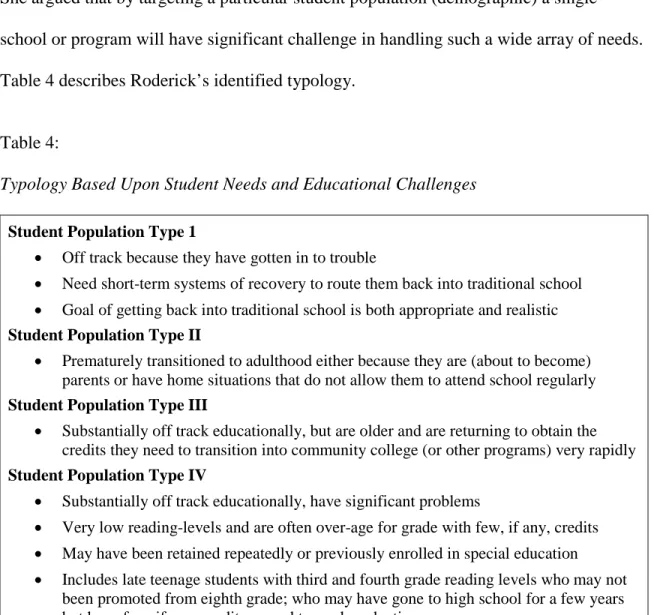
Table 4: Typology Based Upon Student Needs and Educational Challenges ... 38
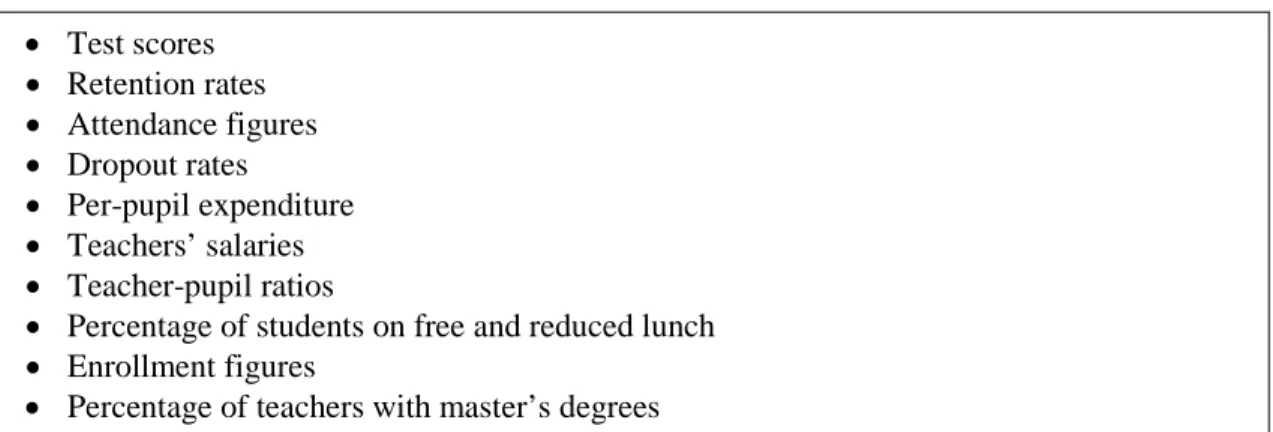
Table 5: Qualitative Information for District/State Policy-Level Program Evaluation ... 42
Table 6: Quantitative Information for District/State Policy-Level Program Evaluation . 43 Table 7: Evaluator Competencies Derived from Standards ... 44
Table 8: Dominant Themes of Progressive Education ... 58
Table 9: Comparative Analysis of State Law and Sample District Policies ... 61
Table 10: Exemplary Practices in Alternative Education... 84
Table 11: Trends and Innovations Likely to Impact Your Evaluation Practice ... 104
Table 12: Alternative High School Program Evaluation Toolkit Characteristics ... 105
Table 13: Materials and Resources Needed for the Program Evaluation ... 127
Table 14: Timeline for Evaluation for the Program Evaluation... 127
Table 15: Six Tools for Evaluation Teams ... 128
Table 16: Evaluation Planning Matrix (Assessment Evaluation Workgroup Example) . 130 Table 17: Evaluation Plan (Assessment Evaluation Workgroup Example)... 131
Table 18: Dimensions and Underlying Purpose of the Evaluation Toolkit for Teams ... 132
Table 19: Conference Presentations on Alternative School Evaluation ... 135
Table 20: Secondary (Guiding) Questions Organized by Element ... 146
Table 21: Sources of Data Used in This Study ... 154
Table 22: Research Timeline ... 159
Table 23: Secondary (Guiding) Questions Organized by Standard Element ... 166
Table 24: Utility Guiding Research Questions ... 183
Table 25: Feasibility Guiding Research Questions ... 185
Table 26: Propriety Guiding Research Questions ... 187
Table 27: Accuracy Guiding Research Questions ... 189
Table 28: Accountability Guiding Research Questions ... 191
Table 29: Participants, Roles and Meeting Attendance... 200
Table 30: Survey Data Table Question 12 ... 207
Table 31: Survey Data Table Question 21 ... 209
Table 32: Survey Data Table Question 22 ... 213
Table 33: Characteristics in Rank-Order Based on Average Ranking Method ... 215
Table 34: Characteristics in Rank-Order Based on Mean Rank of Rank Method ... 217
Table 35: Survey Data Table Question 23 ... 220
Table 36: Toolkit Elements in Rank-Order Based on Average Ranking Method ... 225
Table 37: Toolkit Elements in Rank-Order Based on Mean Rank of Rank Method ... 226
LIST OF FIGURES
Page
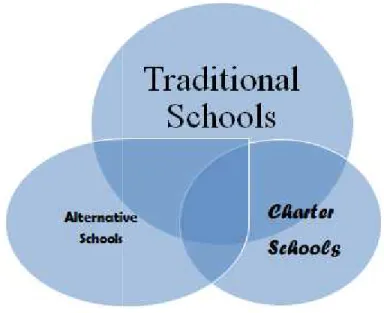
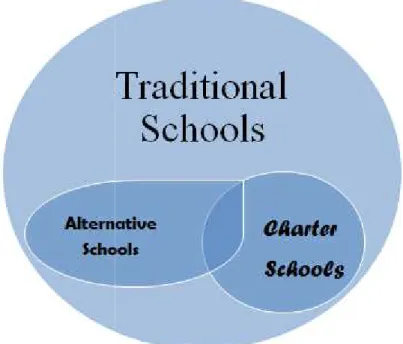
Figure 1. Types of Schools and Their Differing Missions. ... 36
Figure 2. Standards for Educational Evaluation. ... 40
Figure 3. Historical Context of Alternative Schools Over the Last 100 Years. ... 52
Figure 4. School Accountability System Under NCLB. ... 67
Figure 5. School Typology Alternative Accountability Framework. ... 109
Figure 6. Seven Evaluation Toolkit Elements. ... 113
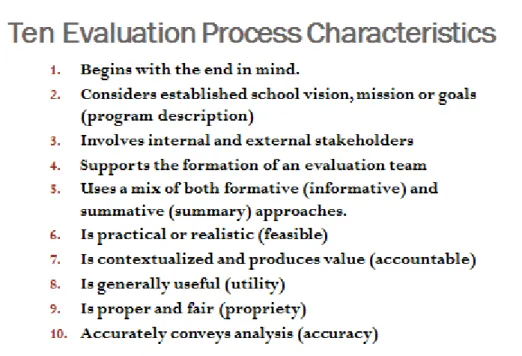
Figure 7. Ten Evaluation Process Characteristics ... 114
Figure 8. Eight Assumptions About Program Evaluation. ... 116
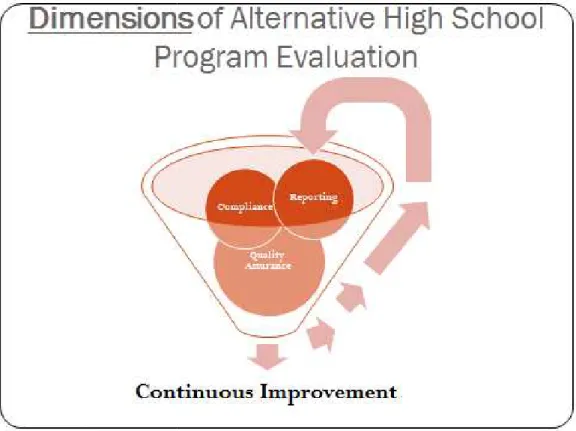
Figure 9. Dimensions of Alternative Aaccountability and Evaluation. ... 120
Figure 10. Framework for the Design and Evaluation Process. ... 125
Figure 11. Survey Data Figure Question 12 (Participation in Evaluation Process). ... 207
Figure 12. Survey Data Figure Question 21 (Assumptions About Evaluation Process). 210 Figure 13. Survey Data Figure Question 22 (Ranking of Process Characteristics). ... 214
Figure 14. Survey Data Figure Question 23 (Ranking of Toolkit Elements). ... 221
Preface
Crossroads Alternative High School had been identified as a school “in need of improvement” for the third year in a row. As the Oregon State Alternative Education Specialist, I was asked to work with school district and regional office administrators to evaluate the school. After doing some background research, speaking with the school administrator and reviewing information reported on their State-issued school report card, I assembled an evaluation team and visited the school in an attempt to make sense of what was happening.
Crossroads School is an alternative high school located near an urban area in Oregon. Student attendance at the school fluctuates during the course of the year but in September approximately 100 students are enrolled, by winter break there are usually around 125 and by April the enrollment has swelled to around 150. Most of the new students who join mid-year had experienced an event that resulted in them being given several options for their schooling such as other programs or tutoring. School placement is made with consultation of the parent and students typically choose Crossroads over some other school placement. As additional students enroll throughout the year, others may drop out, move, transition back to the school where they came from or transfer.
Crossroads operates out of a building that was previously an elementary school but there is now a full-time counselor, social worker and half-time nurse on campus that attends to the diverse needs of students. The school has a full time administrator, Mr. Lovall, who gets to know each student as a part of the student intake process. Most of the teachers, parents and students would remark that Mr. Lovall has provided strong
leadership in the school and that the school operates like a large family. The newly painted walls demonstrate a summer-time artistic contribution of high school students, there is a child-care facility for children of teen moms and night school that allows students to access the computer lab and tutoring until late-evening. Teachers demonstrate they care for the students in many visible ways, greeting each student with a personal sense of care and attention. Teachers quietly make individualized comments of encouragement as students participate in learning activities and submit classwork.
At Crossroads students refer to their teachers by their first names and often share meals together in the school cafeteria. The day begins with “homeroom” when students connect with one another and their homeroom teacher in smaller class groups. Class sizes are small and behavior expectations are made clear and reinforced regularly. An
“advisory” period provides time each day for teachers and mentors to communicate life-skills emphasizes the development of students’ non-academic life-skills. Specialized
curriculum is used during the advisory period that provides opportunities for students to discover learn and reinforce these non-academic skills.
Teachers work with students in small groups using projects and relevant examples to help students make sense of the content. Class sizes are smaller than traditional
schools, ranging from 6 to 12 in a class and students comment that work is difficult but credits and rewards are attainable with hard work and persistence. Students would also describe that their teachers have high expectations for their achievement that are
reinforced regularly by celebration for attendance demonstrating proficiency in standards and achieving academic credit that demonstrate progress toward high school graduation.
Students are encouraged to utilize the computer lab and study hall after the school day has concluded and flexible schedules for courses provide students the ability to
participate actively in both afternoon and evening classes.
The school has a low staff-to-student ratio, individualized instruction and flexible scheduling to support students in meeting learning goals. As is the case with most of Oregon’s alternative high schools, most of the students enrolled at Crossroads have significant academic challenges but initial observation made by the school evaluation team during the school visit indicate that the school is in compliance with the law and meeting the academic as well as the non-academic and behavior needs of students.
Following the school visit, the evaluation team met with school administrators from the school, district and regional office to go over the “compliance indicators” described in the State-provided toolkit for district program approval, evaluation and review of policies and procedures. The old toolkit was designed, several years ago by a previous Oregon state alternative education specialist, to assess compliance and
document that the school was or was not following identified statutes and rules. Examples of the compliance indicators include health inspections, county fire marshal approval for building occupancy and assurance of background checks of staff working in direct unsupervised contact with students. While these indicators provided some
assurance of safety for students, it was commented on by district staff that the toolkit did not address the school purpose, mission, educational setting, and curriculum or include indicators for quality programming that was demonstrated by the leadership, staff and students during the school visit. I had often felt that the toolkits did little to consider the
context of the school or evaluate on the basis of “quality” practices and strategies seen at high performing alternative high schools.
As one former State Alternative Specialist put it, quality policies and practices account for the challenges that students bring to school and measures that against what the school is doing or not doing that contributes to those challenges (R. Morley, personal communication, December 29, 2011). Quality alternative education programs account for the challenges that students are facing and where he/she wants to go next. The result of these quality program policies is student achievement, demonstrated by increased attendance and academic engagement. The tools we currently use in holding alternative schools accountable are inadequate to address this need.
The current Oregon Alternative Education Toolkits include only a checklist-style summative review of compliance indicators such as adopted policies, contracts, financial statements, and student attendance, assessment and behavior records. The toolkits do little to provide guidance for districts assembling an evaluation team to conduct a formative review and do not identify what quality policies to look for in evaluating the impact of alternative high schools within the context of the region. In Oregon, the job of annually evaluating alternative programs is left entirely to the local school district.
The evaluation team I had assembled to visit Crossroads included members with first-hand knowledge of the school’s purpose and policies, had background in alternative school leadership, teaching and assessment, school support systems, continuous
improvement planning and special purpose school accreditation. After the visit, the team met briefly and informally regarding the old evaluation toolkits. The team members
expressed that they felt constrained by these evaluation tools and didn’t find the
“compliance indicators” particularly helpful in determining overall program quality. Staff from the school and school district made similar comments when asked to provide
feedback on the toolkits.
When members of the evaluation team were asked how they would improve the
Evaluation Toolkit, some offered references to their previous experience with federal
programs, special purpose school regional accreditation, and others made
recommendations similar to the continuous improvement planning processes currently required for all Oregon schools. A few members of the evaluation team who had visited different types of alternative high schools and conducted evaluations for a variety of purposes articulately described quality indicators that were somewhat complex but identifiable in schools that served a special purpose, such as alternative high schools. Based upon the feedback of this evaluation team I began to assemble some assumptions about improvements that could be made to evaluation process and the toolkit.
With a limited understanding of how to address these improvements or what some of those quality indicators might include, I set out to contact alternative specialists in several other states, regional education research laboratories, the United States (U.S) Department of Education and national organizations in pursuit of an existing framework for determining quality in alternative schools. I would spend the better part of a year reviewing and collecting evaluation instruments and became immersed in the different types of schooling and evaluation methods utilized in public education, specifically those used in evaluating alternative high schools.
I discovered that indicators of quality programming had recently been described by alternative specialists from Tennessee working with fellow officers at the National Alternative Education Association as the “Exemplary Practices in Alternative
Education.” They included indicators organized in the categories of mission and purpose, leadership, climate and culture, staffing and professional development, curriculum and instruction, student assessment, transitional planning and support, parent/guardian involvement, collaboration, and program evaluation (Witty, 2009). During a similar period of time, a retired alternative specialist from Iowa had worked within his state alternative education organization to develop “A Framework for Learning Alternatives Environments.” His work included an” Inventory of Policies and Practices Related to Student Failure and Dropping Out” and a “Checklist of Quality Indicators for Alternative Learning Environments” (R. Morley, personal communication, January 14, 2012).
The tools I had observed up until this point were frameworks of quality indicators without context of school culture or student population. I believed improved tools may better serve the needs of the school, district and state than the current compliance toolkit. Unfortunately, the new tools were designed in the Southern and Mid-West regions of the United States and used nomenclature specific to the originating state laws in that region. The Iowa Inventory and Checklist would be useful but the summative method suggested by the tools themselves did not address the qualifications of the evaluator(s) and, being somewhat dated, did not represent the latest research on formative and impact evaluation. The framework and indicators of alternative school quality was the best I had seen over
the course of the year and, based on my experience, would transfer across different types of alternative high schools.
It was clear to me and several other members of the evaluation team that
Crossroads Alternative High School needed more of a formative evaluation, rather than a report card and an annual checklist for compliance. These tools had served their purpose in contributing toward increased awareness of the laws relating to alternative education in Oregon but had done little to contribute to quality district programming or the
improvement of alternative schools themselves. From my observation, over the past five years as the alternative education specialist for the state of Oregon, such quality
indicators were infrequently addressed in school district program evaluations. Moreover the evaluations themselves were not generally accepted as useful by schools.
Annual alternative high school planning and goal setting primarily addresses state-identified outcomes and does not describe program specific results or strategies used to support students. The State and districts need better information regarding the purpose of the school, guiding policies and information about the governance and leadership of the school. In addition, the State and district needs information regarding the curriculum, instruction, assessment, leadership and support systems that are being used for both district and school continuous improvement. Members of the evaluation team at Crossroads expressed that, in the case of alternative high schools, a summative checklist or school report card is similar to reading an obituary in the newspaper because it gives little room for improvement and by the time the information is assembled there is not much that could be done about it, but grieve the loss of life and potential.
CHAPTER 1 INTRODUCTION
I have spent the past several years as an Education Specialist at the Oregon Department of Education (ODE) and among the assignments I have at the Department is the monitoring of Alternative Education. In recent years I have been fortunate to work alongside a variety of stakeholder groups, professional organizations, contractors and consultants to facilitate both design and evaluation of alternative high schools that have contributed a great deal to me professionally. These experiences have resulted in a unique set of understandings about the connection points between alternative high school
environments and the professional field of program evaluation. From these observations I have come to understand that evaluation is an absolutely integral part of the formation of the day-to-day operation of an alternative high school. I define alternative high school evaluation as the ongoing monitoring and adjusting that goes on in the school to assure that its programming is continually improving the way students are served.
Alternative high schools serve some of the most vulnerable students but their educational programs are challenging to evaluate. I define vulnerable students as those with two or more at-risk indicators such as pregnant/parenting, irregular attendance patterns, patterns of disruptive behavior or discipline issues, drug or alcohol abuse, learning disabilities, and/or not meeting or exceeding academic standards. Described characteristics of vulnerability may include qualification for free or reduced lunch,
identification as an English Language Learner or the need of Special Education. Varying definitions of what an alternative school is make it difficult to determine indicators that would reliably indicate quality. Varying types of schools and student populations make even identifying valid indicators problematic. Despite these challenges, the need for program evaluation and improvement in alternative high schools has never been greater.
The past decade has thrust forward a new era in education accountability based primarily upon standardized assessments and measurement systems that are intended to hold traditional schools responsible for student achievement; however; there were 10,900 alternative schools operating in the United States (NCES, 2002a). A national survey, conducted in the 2007-2008 school year, reported that there were approximately 10,300 district-administered alternative schools and programs for at-risk students but did not include reference to newly publicly funded charter schools providing different forms of choice and options within public education. In that survey, 64% of districts reported having at least one alternative school or program for at-risk students that was
administered either by the district or by another entity (NCES, 2010). These alternative schools continue to introduce new and innovative ways of working with learners and provide an opportunity for small-scale experimentation with public resources. It is clear that these alternative schools are not traditional schools; however, they are often included in traditional forms of educational accountability. Researchers, such as Aron, 2003, 2006; Barr & Parrett, 1997, 2001, 2010; Moreley, 2012; R. Morley, 1996; Raywid, 1981, 1994; Reimer & Cash, 2003; Schargel & Smink, 2001; Smink & Schargel, 2004 have studied innovations and evaluation of alternative high schools.
This dissertation introduces and further explores definitions, significance, and analysis of the problem of how best to evaluate alternative high schools and describes methods for a process that will result in a product intended for use by evaluation teams in evaluating the impact of alternative high schools throughout Oregon. A review of
relevant literature, in chapter 2, provides a historical perspective and references previous work from the broader field of program evaluation. The review also includes the
generalized debated perspectives that have contributed toward my understandings in the development of the alternative high school evaluation tools.
As I have considered differences in alternative high school evaluations, I have come to a deeper understanding and respect for the Joint Committee on Standards for Educational Evaluation’s Program Evaluation Standards (Yarbrough, Shulha, Hopson, & Caruthers, 2011), which include standards organized in five parts. Brief descriptions of the five parts provide generalized best practices in the field of program evaluation as applied in educational settings. The standards are included in the definitions section in chapter 1 and are expanded upon in the literature section of this dissertation and used as organizers for the research questions in the study described.
The first part of the Standards for Educational Evaluation describe “Utility” which is used to describe the extent to which program stakeholders find the evaluation process and products valuable in meeting their needs. “Feasibility” is the second part and refers to the degree of the evaluations effectiveness. The third part is “Propriety” which depicts what is proper, fair, legal, right, acceptable and ethical in an evaluation.
findings that occur as a part of the evaluation. The fifth part is “Accountability” which, in the context of program evaluation, refers to the responsible use of resources to produce value as a result of the evaluation. These parts and the underlying Standards put forth by the Joint Committee on Standards for Educational Evaluations (Yarbrough et al., 2011) provide a first glimpse of what the field of program evaluation can offer those who seek to determine the impact of alternative high schools.
Statement of the Problem
The problem involved the investigation of how best to evaluate alternative schools. More explicitly, districts do not have adequate tools to evaluate the quality of their alternative programs. The Alternative High School Program Evaluation Toolkit is intended for use by evaluation teams assigned the task of determining the purpose and impact of alternative high schools. Alternative schools serve some of the most vulnerable students and their educational programs are difficult to evaluate. Varying definitions of what is an alternative school make it difficult to determine quality. Varying types of schools and student populations make identifying valid indicators problematic. School evaluators often act in isolation and often only address issues of compliance based upon what they know about traditional schooling. Evaluation tools made available to
evaluators are usually limited to checklists and are inadequate in accounting for a deeper understanding of how alternative schools are serving students. It is because of these challenges that the need for evaluation in alternative education has never been greater.
There is more to holding schools accountable than outcomes such as test scores, attendance, and graduation (Barr & Parrett, 2010; Goodlad, 2004; Kohn, 1999; Koretz,
2008; Milliken, 2007; Popham, 2001; Ravitch, 2010); especially when it comes to determining the impact of alternative high schools (Barr & Parrett, 2010; Leiding, 2008; Reimer & Cash, 2003; Schargel, 2005; Smink & Schargel, 2004). If methods of using these simplistic measures continue to be found not to be adequate in comparing quality among traditional high schools, they are especially inadequate in determining the impact of alternative high schools.
Variance between types of schools and experience among educational evaluators causes considerable problems with measurement, especially when it comes to alternative schools (Barr & Parrett, 1997; R. E. Morley, 2002; Reimer & Cash, 2003; Schargel, 2005). In my experience as the Oregon State Alternative Education Specialist, I have found that the principles described by the Joint Committee’s Standards for Educational Evaluation (Yarbrough et al., 2011), introduced previously in this dissertation and used as a theoretical framework in this dissertation, are rarely referenced in the context of
evaluating alternative schools and are not addressed by the elements of evaluation tools made available to support required annual evaluations. Practitioners and stakeholders alike haphazardly apply their own personal opinion about the quality of schooling in their communities. After all, most adults experience schooling in one form or another when growing up, have likely spent considerable time reflecting on those experiences, and some even went back to school to serve as a teacher or school administrator; making them an expert. However, educational experience differs widely depending upon the state, district, school and programs attended, level of involvement in the school, and if the institutions were public, private, traditional, charter, magnet, or alternative.
Elements of Successful Alternative Schools
As described previously, alternative education settings vary in both mission and goals but previous researchers have identified elements intended to be used in describing successful alternative schools. However, methods of applying these elements in program evaluation are not often explored in the literature. The Northwest Regional Educational Laboratory (NWREL) (Cotton & Paglin, 1995) have described observed elements that would indicate success. Others have recorded the observation of elements from site visits and program evaluations (Barr & Parrett, 1997; Leiding, 2008; ODE, 2006a; Schargel & Smink, 2001). Reimer and Cash (2003, p. 15) described characteristics (elements) of successful alternative schools in a synthesis of previous research and are further described the review of literature in this dissertation.
Essential Elements of Effective Alternative Schools
Barr and Parrett (1997) reported that effective alternative schools have a shared vision, educational diversity, relevant and focused curriculum, creative instructional approaches, student assessment, caring and demanding teachers, voluntary participation (school choice), comprehensive programs, small school size, and shared governance and local autonomy. Table 1contributes a dozen Elements of Exemplary Oregon Alternative
Schools I observed during alternative school visits in 2006. Elements 11 and 12 describe
new forms of program evaluation to inform alternative school improvement the Toolkit supports.
Table 1:
Elements of Exemplary Oregon Alternative Schools 1. Strong mission and sense of purpose
2. Caring and committed staff
3. Services to meet the emotional, physical and academic needs of students 4. Sustainable structures of funding and leadership
5. High expectations for student achievement
6. Low adult to student ratios that allow individual attention and care 7. Individualized learning programs to meet the needs of the students 8. Varied instructional strategies with an emphasis on active learning
9. Rigorous academic standards and clearly communicated performance expectations 10. Flexible schedule that meets the needs of students
11. Customized program evaluation that is alternative school evaluation to be practical, useful, fair and accurate
12.Communication of both summative and formative program results Sources: Hinds (2010); ODE (2006a)
The elements of this framework are representative of more than 50 years of research on successful and effective forms of alternative schooling. During the past 25 years, thousands of alternative public schools, magnet schools, experimental schools and other non-traditional programs have been developed and documented to be effective in teaching reluctant learners (Barr & Parrett, 2001, p. x). As mentioned in the introduction to this dissertation, much of this research can be described as “common sense findings” and serve to only superficially benefit educational innovators in the evaluation of alternative high schools. The framework provides starting place to continue the work of developing tools for evaluation teams to inventory and report (take into account) their existing programs and use those reflections to improve others.
Research Perspective
In addition to reviewing literature on this topic, I have served in positions at the classroom, program, school, district and state levels that have exposed me to a wide-range of experiences and involvement in school evaluation. In particular, my role at the Oregon State Department of Education (ODE) has required that I lead and participate in a variety of program, school and district evaluations as well as federal monitoring visits, civil rights, curriculum and school financial audits. I have participated in school
accreditation and program evaluation visits that have provided a unique and diverse lens of alternative and special purpose education in Oregon and the Pacific Northwest.
I have participated in accreditation and school visits in other parts of the United States (Southwest, Mid-West, South, and Northeast) and in Egypt. In addition, I have written legislative concepts and bills, testified in front of the Oregon legislature, written guidance and rules, presented at state, regional and national conferences and
implemented new state guidelines relating to various program areas such as private schools, home schooling, GED Options, High School Diploma, Credit by Proficiency, Instructional Materials, and Common Core State Standards. These experiences have allowed me to, in the words of Ravitch (2010), “think like a policy maker, looking at schools, teachers and students from an altitude of 20,000 feet” (p. 10) and view first-hand, the challenges of implementing both state and federal policy with local districts, schools, and alternative high school programs. However, I have paid special attention to my perspective as a researcher and practitioner by making regular visits and spending time in alternative school settings and grounding myself in literature in this field.
The access and experiences described have also permitted me to contrast my observations with local school district educational policy, having served as a teacher, school and district administrator. I draw upon decade of experience spent in the field of education serving in the roles of a teacher, school administrator, district administrator, college instructor, and state education program coordinator. I have been fortunate to work with other state alternative school specialists from Arkansas, California, District of Columbia, Georgia, Idaho, Iowa, Michigan, Massachusetts, New Jersey, Tennessee, and Utah. While there are differences between state laws and nomenclature used, there are often similarities in the kinds of challenges program, school, district and state leaders face in evaluating alternative high schools. Those commonalities provide for supportive dialogue and rich professional learning as state administrators collaborate.
Purpose and Significance of the Study
The product of the Research and Development (R&D) Cycle is an Alternative
High School Program Evaluation Toolkit (Evaluation Toolkit) intended for use by
evaluation teams assigned the task of determining the purpose and impact of alternative high schools. This research is theoretically and practically grounded in Bridges and Hallinger’s (1995) Problem-Based Learning (PBL) and Borg and Gall’s (1989) R&D Cycle. The research proposes a method of research study that includes information collecting, learning activities and small-scale field testing that involved evaluation teams and education stakeholders in the development, revision and refinement of a prototype of the Evaluation Toolkit.
Alternative high schools serve some of the most vulnerable students and their educational programs are challenging to evaluate. This research study was significant because, from the perspectives of the district and state, alternative schools are difficult to hold accountable. Tools are needed to support evaluation teams in determining the purpose and impact of alternative high schools. Current methods of alternative school accountability utilize a one-size-fits-all school report card or a summative compliance checklist as a part of required annual evaluations. These tools are inadequate and are not perceived to be generally useful for the school, district or the state.
Oregon’s educational accountability system primarily addresses district and school-level accountability and reports Adequate Yearly Progress (AYP) indicators for attendance, test scores and graduation rate. The evaluation of district alternative programs is annually required and district-approved programs are reported to the State annually and included in the district-level reporting. A toolkit for the evaluation of alternative
education programs is provided to support this district evaluation and the State annually produces district report cards.
The “next generation accountability system” proposed in Oregon’s request for a waiver of No Child Left Behind (2001) and AYP is based upon a student-level growth comparison that continues to mainly rely on student test scores in reading and math. This new system also proposes an early-warning system for ninth grade students not on-track to graduate with their 4-year cohort. While these new systems proposes improvements to AYP’s one-size-fits-all approaches to accountability, it still falls short of providing better
ways to hold alternative high schools accountable or validly identifying their purpose and impact on student success (ODE, 2012).
While varying definitions of what an alternative school is make evaluation
difficult, it is possible to identify elements of quality school policies within the context of alternative high school program evaluation. A toolkit is needed to support evaluation teams in identifying these generalizable characteristics of quality. Varying student populations makes identifying valid quality indicators problematic but these issues may be addressed through other tools in the toolkit such as an inventory of policies and practices (R. Morley, 1996), identification of characteristics of quality (National Alternative Education Association [NAEA], 2009), assurances of compliance (ODE, 2006b), combined with formative and mixed method program evaluation conducted by an evaluation team. These alternative high schools are primarily serving students at risk of dropping out of school and require special attention and methods of accountability that reach beyond traditional forms of school reporting.
About four of every five students attend traditional high school in America (NCES, 2010). It is easy to throw students out of school, but it is much harder to help them redirect their energy to become successful in school (Reimer & Cash, 2003, p. 36). Traditional public high schools were never designed to meet the educational needs of all students who enroll in them, nor have they kept up with changing demands of student demographics (Barr & Parrett, 1997). The need for program evaluation and alternative school improvement has never been greater and the field of educational program
evaluation has a lot to offer alternative education, if only there were adequate tools to support their improvement.
Recent articles published in The Oregonian, a daily newspaper, maintain that inclusive comprehensive (traditional) high schools are the answer to challenges in student performance on state tests and graduation. Betsy Hammond, educational writer for The
Oregonian, reported that Oregon's largest urban school district moves around struggling
students and places them in mostly unaccountable alternative schools where at least 80% drop out (Hammond, 2012a). This article represents evidence that this problem of holding alternative schools accountable is significant and worthy of study.
The Need for Evaluation Tools
Program evaluation tools used by evaluation teams may offer support in making the process useful to the school, district and state. I sought out the previous Oregon Deputy Superintendent of Schools who is now an urban district administrator and supervises the operation of a variety of district operated alternative schools. He said that evaluation tools must balance valid measurement (validity) indicators that may represent complex characteristics with ease of use (reliability) by the evaluation team (S. Noor, personal communication, January 2010). The development of valid and reliable tools for use with a variety of alternative schools would prove to be a significant challenge.
Failing to properly train the evaluation team can have serious negative effects on the outcome of the data collection process in evaluating an alternative schools (Reimer & Cash, 2003, p. 36). Many school district leaders today are involved in developing and evaluating new kinds of schools and are in need of simple research-based tools and
evaluation protocols (McDonald, 2007) to accomplish their work. Not many of these leaders have the experience of working within a broad range of schools and few have had professional experience or graduate courses in organizational assessment or program evaluation.
The Need to Equip Evaluators
A mix of internal (from inside the organization) and external (from outside the organization) evaluation team members are necessary for a valid program evaluation (Patton, 2011). Forming an evaluation leadership team is a key ingredient to
strengthening, sustaining and widely investing participants in the renewal of their schools (Chenoweth & Everhart, 2002, p. 17). Evaluation team members are carefully selected based on qualifications, selection guidelines and team responsibilities (Chenoweth & Everhart, 2002, pp. 17–21) with specific attention paid to context of the school and effort to produce value as a result of the evaluation.
Members of the evaluation team may have not had the experience of participating in district monitoring or accreditation visits and may have never been involved in
alternative high school evaluation. Evaluation team members may have had involvement in district or school-level continuous school improvement activities such as setting performance goals for attendance, setting smart goals, considering theories of action, curriculum audits, school improvement and assessment and perhaps even budget
planning. Few educational leaders have had the time or reason to investigate regional or national trends in educational innovation, program effectiveness or have had opportunity to interact with state or federal policy makers in relationship to what is being found to
work in other parts of the state or country. Moreover, many district leaders have not had a single graduate level course in program evaluation and consequently do not have
adequate training to evaluate diverse schools.
Rick Stiggins from the Assessment Training Institute asserts that administrators and teachers should be adequately trained to use student assessment and evaluation and that it should always begin with the intended learning if it is to benefit (for learning) students (Stiggins, Arter, Chappuis, & Chappuis, 2005). The development of an
Evaluation Toolkit and accompanying guidance (protocols) for the evaluation process
will contribute a great deal toward alternative school improvement and improve the usefulness of annual evaluations by addressing the weaknesses discussed here. The
Evaluation Toolkit may generate discourse among educators about the value of
assessment, program evaluation and different types of data in the context of alternative high school evaluation.
The development of state educational policies for evaluating alternative school effectiveness will involve significant challenge (Chalker, 1996; Reimer & Cash, 2003). Developing a useful toolkit for use in evaluating different types of alternative high schools is a significant step in state-wide program improvement. This is a significant challenge, in part, because there are so few published research studies on the topic.
The school accountability information maintained by the state and used for accountability could be described as a “blunt” instrument for evaluating traditional schools, containing only information such as attendance, graduation rate and test scores to determine school quality. Newer models for school accountability simply look at those
same indicators over a specified period of time (growth) for traditional schools (ODE, 2012; Quality Education Commission, 2012, p. 13). Test scores, graduation rates and attendance are not sufficient measures to capture the mission and goals of alternative programs such as increased engagement in school by the student in effort toward school work, evidence of academic progress that is not test-based as well as increased
aspirations for completion of school or post-secondary education.
Research Methodology
The research was theoretically and practically grounded in Bridges and
Hallinger’s (1995) PBL and Borg and Gall’s (1989) R&D Cycle. The methods employed information collection, planning objectives and activities and small-scale field testing. The product of the R&D Cycle is an evaluation toolkit used by evaluation teams assigned the task of determining the impact of alternative high schools. This research methodology proposes a method of research and information collecting, small-scale testing,
development, field testing, and refinement of a prototype of the Toolkit. References used were books, refereed journals, reports associated with alternative schools, evaluation tools and my own experiences as an experienced alternative school program evaluator.
The terms “alternative school” and “alternative program” are used
interchangeably throughout the literature (Barr & Parrett, 2001; Conley, 2002; Lange & Sletten, 2002), with “alternative education” as a term that includes both schools and programs. Research terms such as “dropout prevention” (Milliken, 2007) and “at-risk students” (Chalker, 1996) are also referred to in research and information collecting.
Research and Development
Having spent the greater part of the past several years collecting, using and
reflecting on various school and educational program quality evaluation instruments, I set out, as a part of my position at the ODE, to develop a Toolkit that would support teams in building consensus among evaluators. The Toolkit began with an open (funneling
approach) determination of “quality” or “not quality” (yes or no) intended to guide the evaluation teams toward indicators and the development of a logic model (theory of action) development exercise.
Information and feedback gathered in this planning phase from colleagues and school site directors provided important information in moving forward. For example, although I provided space in first portion of the instrument for both the yes/no statement and for comments, the narrow scope and early determination of quality or not quality was problematic. It lacked indicators that would provide evaluators an opportunity for an ordinal response for recorded results. It was too unstructured, especially for evaluators with little experience with organizational theory and evaluating alternative high schools.
Former state agency directors noted to me that an evaluators experience plays an important role in evaluation and those differences in evaluation experience cause
variance in the interpretation of the standards or indicators used (R. Morley & R. Lindley, personal communication, January 2012). The recommendation was made that the
statements be modified to include more traditional Likert Scale response format of strongly agree, agree, neutral, disagree, strongly disagree which were made in future revisions of the toolkit. Accompanying the Evaluation Toolkit development, I needed to
develop a process that involved stakeholders in a small-scale research and information collecting that would both serve to improve the Toolkit and contribute toward the current evaluation and monitoring of alternative schools.
Regional accreditation processes require school officials complete a self-study that includes a written reflection of how the school meets each of the standard indicators and requires documentation to support each indicator (AdvancEd, 2012a). Accreditation visits rely heavily on this self-reported documentation and seek to validate claims made in the self-study as a part of the formal evaluation visit and corresponding report written by members of the accreditation team. The team offers responses to standard statements supported by collaboration and consensus building.
Essential to this work was collaboration with Chet Edwards’ in his efforts to establish a design process for alternative high schools that asks members of a Leadership Team to “start over” based upon a clear set of standards and elements. In collaboration with Mr. Edwards I observed that the school design process appeared to benefit from participation in more formative evaluations that, to borrow from Covey (2004), “begin with the end in mind” (p. 97). These teams appeared to benefit from an initial inventory (needs assessment) that includes reporting of student information (impact), followed by consideration of policies that provide assurance of both compliance and quality.
Portions of the original Toolkit will likely be carried forward and entire portions may be removed as it moves through preliminary field testing and operational produce revisions. Future versions may include an inventory of policies as well as updated compliance components that account for curriculum, instruction and assessment. These
early steps in the R&D cycle were an organized and collaborative effort that included coming back regularly to the original planning objectives of inventory, compliance and quality; the components of the evaluation process originally expressed to be of value along with the characteristics of quality evaluation mentioned earlier and are described further in Figure 9 (Reporting, Compliance and Quality Assurance).
Preliminary field testing of the prototype (product) involved a single alternative
school in southern Oregon and was later expanded upon as a part of operational field
testing to involve additional school leaders, district administrators and participants that
better represent the alternative schools throughout the State. The process sought to narrow the Toolkit’s focus to those topics that are perceived as generally useful for accountability and decision making. Product revisions improve the Toolkits’ usefulness. The main field testing included the use of the Toolkit in evaluating an alternative school in an urban region in Oregon. The desired result of the evaluation should be that staff at the school, district, and the state perceive the evaluation to be generally useful for decision making. The Toolkit should assist the evaluation team and stakeholders in conducting a thorough and accurate evaluation that describes the impact of the alternative high school and contributes to a better understanding of what is occurring at the school.
An approach to develop such a process (alternative high school program evaluation) is to create an educational product (Toolkit) that serves to inform and equip educational leaders and school evaluation teams tasked with evaluating an alternative high school. I developed a preliminary form of the product, an Evaluation Toolkit, but further work needed to be done to revise, test and operationalize the tools. To accomplish
this work, I used a form of educational research known as PBL (Bridges & Hallinger, 1995). PBL involves the development of a product to address an actual problem and provides the opportunity to collect information, plan objectives and learning activities that result in small-scale testing and the development of preliminary form of the product. The study involved experienced school leaders and external program evaluators in the product revision and field testing in order to improve a prototype of the Alternative High
School Program Evaluation Toolkit. Borg and Gall (1989, p. 782) identify 10 steps in an
R&D Cycle, presented in Table 2.
Table 2:
Steps in the Research and Development Cycle
1. Research and information collecting
2. Planning objectives, learning activities, and small-scale testing 3. Develop preliminary form of the product
4. Preliminary field testing 5. Main product revision 6. Main field testing
7. Operational product revision 8. Operational field testing 9. Final product revision
10. Dissemination and implementation Source: Borg and Gall (1989, pp. 784–785)
PBL involves addressing and fixing real world problems and in this study it involved the field testing of the Evaluation Toolkit in order to develop an improved evaluation process for alternative high schools. The product development and prototyping process, resulted in the development of a preliminary form of the product (Step 3) is
justified and linked to the R&D cycle described by Borg and Gall (1989) as a process used to validate educational products. Operational Product Revision (Step 7) completes the R&D Cycle for PBL. For purposes of this dissertation, only steps 1 through 7 were employed. Steps 8-10 will be utilized for future research and work agenda discussed in future chapters. The study stops short of dissemination and implementation and
concludes with step 7, operational produce revision.
In my role at ODE, my intent is to work with school districts and stakeholders to conduct Operational Field Testing and make Final Product Revisions and disseminate my findings to ODE and alternative high schools around the state. This dissertation reports on the problem-based approach that improved the Evaluation Toolkit for use with Alternative High Schools. Borg and Gall’s (1989) four salient questions, responded to below, provide a framework considered in the R&D:
1. Does the product meet an important educational need?
Yes, the evaluation of alternative schools is an essential contributing factor in serving the most vulnerable students. A handful of similar products exist, including several developed by school districts and other states but some educational leaders have expressed a need for additional tools to support evaluations.
2. Is the state of the art (in relation to need or problem) sufficiently advanced that there is reasonable probability that a successful product can be built? Yes. A compliance checklist tool already exists (ODE, 2006c) and is used in annual summative evaluations of alternative schools conducted by school districts. While it addresses practices of learning and compliance with indicators that seek to assure
student safety, it fails to include policy or practice quality indicators that might result in a determination of program quality that might be generally useful for decision making. Logic models are used frequently in new forms of program evaluation that have been successfully evaluating very complex organizations in the professional fields of
medicine, and humanities, as well as in industry (Patton, 2011). Currently in most cases, alternative school evaluations are cursory or are conducted by outside contractors, perhaps demonstrating a district’s lack of interest in programs that serve the most vulnerable students. The product includes characteristics of the most recent forms of school and program evaluation, including policy inventory, new results reporting and is based upon the most recent accreditation standards and involves forms of alternative accountability
3. Are personnel available who have the skills, knowledge, and experience necessary to build this product?
Yes. In some cases, those who cooperate in current evaluations and accredit special purpose and alternative schools are those who operate similar programs in the region and state. Both formal and information professional networks and associations exist and support these evaluators with training and professional development related to evaluation. As a part of my responsibilities at ODE, I meet with a number of these
networks regularly and many of them have contributed toward refinement of my thinking about the tool and the elements that are included in the most recent version.
Yes. I have spent the past five years in my position at the ODE and the better part of six years in graduate courses exploring different types of educational programs and schools and methods used to design and evaluate them. I sometimes comment that I spent a year (2011) exploring in the “typology forest” during which I explored, visited and literally built a library of resources from research and innovative school publications, toolkits, blueprints, instruments and handbooks. I have collected little-known historical anecdotes and more than 30 instruments that have been developed over the past few decades that have been used to evaluate various types of alternative programs and schools. I compiled the frameworks side-by-side in a spreadsheet for comparison and presented this information at several conferences. These tools were each designed for an explicit purpose and were designed to benefit a specific audience.
Summary
Few research studies exist that explore the characteristics and strategies of
successful alternative high schools and link them with methods of compliance and quality program evaluation. The focus of the research is development, refinement and field testing of the Toolkit. None of the previous practice and research I am aware has sought to field test, modify and improve an educational product such as an Evaluation Toolkit. As a result of the lack of research in the area of evaluating alternative high schools, public policy and school accountability systems have either disregarded information relating to these schools or unjustifiably included them in comparisons with traditional high schools. Identifying methods to determine the impact of alternative high schools presents a significant research problem in an area of tremendous need for research.
The focus of the dissertation research was the Evaluation Toolkit. The purpose is to improve the educational product through the R&D Cycle, with the intended result of a more useful evaluation process for alternative high schools in Oregon. The research is theoretically and practically grounded in Bridges and Hallinger’s (1995) PBL and Borg and Gall’s (1989) R&D Cycle. Future chapters describe the supporting literature and further explain the method.
Definition of Terms
• Accountability: In the context of alternative high school program evaluation, accountability refers to the responsible use of resources (time and tools) to produce value as a result of the evaluation for the community of students, parents and members of the region or state.
• Alternative High School: A public or private school or separate class group designed to best serve students’ educational needs and interests and assist students in achieving the academic standards of the school district and the state. The majority of alternative high school students are enrolled in secondary grades (9-12). The school offers individualized instruction, low teacher/student ratios, flexible scheduling, and varied instructional methods to meet the learning needs of students. For the purpose of this research,
alternative high schools include magnet schools and innovative schools that draw students from outside the school or district boundary. Although some charter and private parochial schools may also be considered to be alternative under this definition; they are outside the scope of this research study.
• Alternative High School Evaluation: A combination of both formative and
summative observational records, data and information about what is
happening in the school. Evaluation and information collecting is conducted to inform decision-making and may be referred to as value-added or mixed-method evaluation. In general, evaluation examines schools to inform
recommendations regarding annual state registration, school district approval and to make recommendations for programmatic refinement that positively impact alternative high school students. For the purpose of this study, alternative high school evaluation must involve a mix of both formative (ongoing information that describes the schools impact on students) and summative (multiple day school-site visits that includes a descriptive summary) methods.
• Alternative Program: There exists some confusion about the definitions of a school and a school program in both federal and state policy. For the purposes of this research study, a program may have some features of an alternative school, but a program, especially an “alternative school program,” is part of and in service to a larger and more comprehensive school. That is to say a program is not a comprehensive school. A school, including an alternative high school, is able to stand alone to meet regional accreditation standards, including (a) an autonomous mission, (b) educational program (curriculum, instruction, and assessment system), (c) leadership and organization, (d) supports for learning, (e) finance and facilities, and (g) plans for improvement. School programs, in service to a larger traditional school, may have one or more of the features of alternative high schools, but the focus of this research study is the evaluation of comprehensive alternative high schools rather than programs within a traditional school. “School program,” as defined here, is also distinguished from “educational program” (commonly referred to as the curriculum, instruction, and assessment methods of a school).
• At-risk Students: Students with two or more at-risk indicators such as not meeting or exceeding state standards, behind in credits earned,
pregnant/parenting, multiple suspensions, expulsion or infrequent attendance. At-risk students are referred to as vulnerable students or students at risk of educational failure (dropping out of school) in this research.
• Benchmark Evaluation: Evaluation that provides the means for organizations (alternative high schools) to evaluate their success in meeting a given set of standards and outcomes. Benchmark evaluations are usually designed as a resource, not as a mandate for programs.
• Charter School: A charter school, in Oregon, is a school of choice operated under a contract (charter) between a charter authorizer and a group of parents, teachers, and members of the community. Charter schools are required to meet requirements set forth in Oregon Revised Statute which include the use of flexible learning environments and innovative teaching and assessment methods that better meet individual student academic needs and interest.
• Compliance Indicators: Statements designed to support in the determination of whether or not the alternative program practice is in accordance with the law.
• Comprehensive School: A school able to offer credits, services and instruction in standards and essential skills to support students in graduation with a regular high school diploma.
• Criteria: A set description by which something can be judged. In an
alternative high school program evaluation, criteria must be simple enough for evaluators to understand, yet complex enough to thoroughly explain the tools and indicators that describe what is being observed.