EFFICIENT HYBRID REDUCTION FOR BINARY
BASED INFORMATION SYSTEM IN SOFT SET
THEORY
AHMAD NAZARI MOHD ROSE
EFFICIENT HYBRID REDUCTION FOR BINARY BASED INFORMATION SYSTEM IN SOFT SET THEORY
AHMAD NAZARI MOHD ROSE
A thesis submitted in
fulfillment of the requirement for the award of the Degree of Doctor Philosophy of Information Technology
Faculty of Computer Science and Information Technology Universiti Tun Hussein Onn Malaysia
iii
This thesis is lovingly dedicated to my parents. For their endless love and prayers. And also a heartfelt dedication to my wife and children for the unwavered support,
ACKNOWLEDGEMENT
I would like to express the deepest appreciation to my supervisor, Prof. Dr Mustafa Mat Deris, who has been enthusiastically guiding and encouraging me in this PhD research. His untiring perseverance and relentless energy in seeing and pushing me through in this journey is unmatched and inspiring. And only to the Almighty ALLAH, I seek and ask that Prof. Dr Mustafa to be granted a healthy and a blessed life for his patience in me as his student. Without his persistent help, this thesis would not have been possible. I would like to thank Dr. Tutut Herawan who has introduced me the soft set theory. I would never forget the heartfelt motivation that they have given me. A big thank you to Universiti Tun Hussien Onn Malaysia (UTHM) for giving me the opportunity to pursue my unfinished dream. And a giant thank you also to the Universiti Sultan Zainal Abidin (UniSZA) for the trust in me . I am indeed very thankful to my colleagues for their support and encouragement.
A special thanks to my mother, mother in law and children for all of the sacrifices and prayers. The prayer for me was what sustained me thus far. I would also like to thank all of my friends who supported me in writing, and incented me to strive towards my goal.
v
ABSTRACT
ABSTRAK
vii
TABLE OF CONTENTS
DECLARATION ii
DEDICATION iii
ACKNOWLEDGEMENT iv
ABSTRACT v
ABSTRAK vi
TABLE OF CONTENTS vii
LIST OF TABLES x
LIST OF FIGURES xiii
LIST OF ALGORITHMS xiv
LIST OF SYMBOLS AND ABBREVIATIONS xv
LIST OF PUBLICATIONS
1. CHAPTER 1 1
1.1 Background 1
1.2 Problem Statement 7
1.3 Objectives and Scope 9
1.4 Research Significance 10
1.5 Thesis Organization 11
2. CHAPTER 2 12
2.1 Introduction 12
2.3 Indiscernibility Relation 19
2.4 Reduction 20
2.5 Approximations 22
2.6 Reduction Techniques in Soft Set 24 2.6.1 Analysis of Attribute Reduction of Soft Set by
Maji et al. (2003) [14] 27
2.6.2 Analysis of Parameterization Reduction of Soft Set by Chen et al. (2003,2005) [29], [63] 29
2.6.3 Analysis of parameterization reduction of soft
set by Kong et al. (2008) [17] 31
2.7 Discussion 32
2.8 Summary 34
3. CHAPTER 3 35
3.1 Soft Decision Making Based on Hybrid Reduction 35 3.1.1 Supported Set Parameter Reduction 36
3.1.2 Significance Based Parameter Reduction 45
3.1.3 Supported Set Object Reduction 47
3.1.4 The Algorithm of HRSS 53
3.2 Summary 55
4. CHAPTER 4 57
4.1 Proposed Technique 57
4.2 Analysis of Reduction Techniques in Soft Set Theory 58 4.2.1 Samsung Mobile Phone Dataset 58 4.2.2 Analysis of Hybrid Reduction of Soft Set
(HRSS) 59
4.2.3 Samsung Result Comparison Analysis 72 4.2.4 Comparison Analysis From Other Datasets 72
4.3 Discussion 97
4.4 Summary 107
5. CHAPTER 5 109
5.1 Research Summary 109
ix
5.3 Limitation 112
5.4 Conclusion 113
VITAE 124
LIST OF TABLES
Table 2.1: An information system [83] 16
Table 2.2: Tabular representation of angina diagnosis 18 Table 2.3: Tabular representation of a soft set from the Example 2.1 24 Table 2.4: Tabular representation of a soft set from Example 2.2 27 Table 2.5: A binary table of representation of
R
⊂
E
28Table 2.6: Perfomance analysis of SRR 29
Table 2.7: A binary table of representation of S ⊂E 30
Table 2.8: Performance analysis of PR 31
Table 2.9: A binary table of representation of
R
⊂
E
32Table 2.10: Performance analysis of NPR 32
Table 3.1: The reduct set of
Z
43Table 4.1: The datasets used in the experiments 58 Table 4.2: Tabular representation of a soft set from Samsung 63 Table 4.3: Objects and attribute for reduction of the soft set from
Samsung 70
Table 4.4: Comparison of the identified core sets of Samsung’s
datasets 71
Table 4.5: Compression percentage on Samsung dataset 72 Table 4.6: Comparison of the identified core sets of Nokia’s datasets75 Table 4.7: Comparison of identified core sets for Car dataset 75 Table 4.8: Comparison of the identified core sets for Animal dataset 76 Table 4.9: Comparison of the identified core sets for heart’s dataset 76 Table 4.10: Comparison of the identified core sets for Vote dataset 77 Table 4.11: Comparison of the identified core sets for Student’s
dataset 77
Table 4.12: Comparison reduced table 78
xi
Table 4.14: Comparison of reduced dataset against Animal’s dataset 79 Table 4.15: Comparison of Heart reduced table 80 Table 4.16: Comparison of Votes reduced table 80 Table 4.17: Comparison of Students reduced table 81 Table 4.18: Optimal objects obtained with Samsung dataset 81 Table 4.19: Comparison of Optimal Values Obtained with Nokia
dataset 82
Table 4.20: Optimal values comparison with Car’s dataset 82 Table 4.21: Comparison of optimal objects with Animal’s dataset 83 Table 4.22: Comparison of optimal objects with Heart dataset 83 Table 4.23: Comparison of optimal objects with Votes dataset 84 Table 4.24: Comparison of optimal objects with Students dataset 84 Table 4.25: Comparison of suboptimal values with Samsung’s
dataset 85
Table 4.26: Comparison of Suboptimal Objects 85 Table 4.27: Comparison of suboptimal objects for Animal’s dataset 86 Table 4.28: Comparison of suboptimal objects for Heart’s dataset 86 Table 4.29: Comparison of suboptimal objects for Votes dataset 87 Table 4.30: Comparison of suboptimal objects for Student dataset 87 Table 4.32: The decision computational complexity comparison 91 Table 4.33: Consistency achievement for Samsung’s dataset 92 Table 4.34: Consistency achievement for Nokia dataset 92 Table 4.35: Consistency achievement for Car dataset 93 Table 4.36: Consistency gauge for Animal dataset 93 Table 4.37: Comparison of consistency in Heart’s dataset. 93 Table 4.38: Variation on Samsung’s dataset 94 Table 4.39: Accuracy on Samsung’s dataset 94 Table 4.40: Variation on Nokia’s dataset 95 Table 4.41: Accuracy Variation on Car’s dataset 95 Table 4.42: Accuracy Variation on Animal dataset. 96 Table 4.43: Accuracy Variation on Heart’s dataset. 96
Table 4.44: Variation on Vote dataset 96
Table 4.45: Variation on Vote dataset 97
Table 4.47: The Samsung comparison results 98 Table 4.48: The Nokia comparison results 99
Table 4.49: The Car comparison results 99
xiii
LIST OF FIGURES
Figure 2.2: The mapping of parameters 23
Figure 2.3: The soft set 23
Figure 2.4: The Soft Set 26
Figure 3.1: The achieved co-occurrence from Example 2.2 37 Figure 3.2: The support of each parameter 38
Figure 3.3: The achieved co-occurrence 43
Figure 3.4: The support of each parameter 44
Figure 4.1: The mapping of parameters 61
Figure 4.2: The soft set representation 62
Figure 4.3: Co-occurrence of reduced set 64
Figure 4.4: The supported set values 65
LIST OF ALGORITHMS
3.1 Supported set parameter reduction 42
xv
LIST OF SYMBOLS AND ABBREVIATIONS
- A pair is called soft set over universe
HRSS - Hybrid Reduction of Soft Set
SBPR - Significance Based Parameter Reduction
SRR - Soft Set Rough Reduction
PR - Parameter Reduction
NPR - Normal Parameter Reduction
R⊂E - Set as the subset of E
(
U
A
V
f
)
S
=
,
,
,
- An information systemS=
(
U,A,V{1,0},f)
- A Binary information system( )
B
IND
- An indiscernibility relationB
U/ - The equivalence class in the partition
B
*
- Subset of BU - The cardinality of universe
ME - The maximum value of
f
EE
\
a
x - Set of parameters withouta
x- An equivalence class without parameter 𝑎
𝑙𝑒𝑎𝑠𝑡𝑠𝑖𝑔 𝑒! - Least significant parameter
𝑚𝑜𝑠𝑡𝑠𝑖𝑔 𝑒! - Most significant paramter
𝑢𝑙𝑡𝑚𝑎𝑥𝑠𝑢𝑝𝑝 𝑢!! - Ultimately maximal supported
supp
( )
uik - Supported set value(𝑘) for an object 𝑢!coo
(
u
i)
- The co-occurrence of an object 𝑢!ux,uy,uz
{
}
amax
! "# #$ - A maximally supported set with the value of 𝑎
(
F,E)
(
F,E)
( )
UR
{ }
(
B a)
U Bu
x,
u
y,
u
z{
}
0min
! "
#
#
$
- A minimally supported set with the value of 0
LIST OF PUBLICATIONS
Journals:
Proceedings:
i) A. N. M. Rose, M. I. Awang, H. Hassan, A. H. Zakaria, T. Herawan, and M. M. Deris, “Hybrid reduction in soft set decision making,” in
Advanced Intelligent Computing, Springer, 2012, pp. 108–115.
ii) A. N. M. Rose, H. Hassan, M. I. Awang, N. A. Mahiddin, H. M. H. M. Amin, and M. M. Deris, “Solving Incomplete Datasets in Soft Set Using Supported Sets and Aggregate Values,” Procedia CS, vol. 5, pp. 354–361, 2010.
iii) A. N. M. Rose, T. Herawan, M. M. Deris, and M. M. D., “A Framework of Decision Making Based on Maximal Supported Sets,”
1CHAPTER 1
INTRODUCTION
This chapter introduces the context of the research that is to be presented in this thesis. It starts off with an introduction to the general area of uncertain data, soft computing, soft set and discusses the fundamental motivations behind data reduction in soft set theory. Then, it presents the objectives and the scope of the research. The chapter ends with a discussion on the organization of the rest of this thesis.
1.1 Background
Huge dataset exists in lots of areas and data reduction is deemed important in areas of image processing, engineering, medical and so forth. The data reduction technique is in dire need because large memory is required when processing large datasets. If an efficient data reduction technique is available, then it will help free lots of computer resources and thus contributing to increase in the performance of the computer.
In image processing, data reduction plays a vital role in ensuring the amount of information that is just sufficient for further processing. Some techniques that has been in used for data reduction in image processing are such as clustering [3] [4], data reduction scheme for triangulated surfaces [5], adaptive quantization [6] and dimensionality reduction [7] [5]. In the engineering field, data reduction has been achieved through the techniques such as fourier transform analysis [8], Laplacian Eigenmaps [9], adaptive reduction [10], histogram reduction method [11] and so forth. While in the field of medical, symptoms observed can also be reduced through the process of different combinations of reduction [12], wavelet based statistical based on the generalized Gaussian distributed (GGD) modeling [13], application of data-reduction algorithms on ECG data [14] and automatic data reduction for the identification of novel biomarkers of renal toxicity [15]. None of the various techniques that were used as part of data reduction in the field of engineering, medical and image processing process mentioned about object reduction as one of the alternatives. Therefore it is also very appropriate and timely, to discuss the approach of object reduction as part data reduction process in this thesis.
3
In a normal database, a proven method of eliminating redundancies is through normalization [17]–[21]. But in this thesis, since the scope of discussion with regards to data representation in soft set theory is only focused to binary form, normalization as practiced in database management will not be discussed.
While the discussion on the redundancy in datasets in soft set theory has led to researchers to the usage of data reduction techniques in eliminating redundancies or non vital data. The soft set theory has an impact in the field of data reduction. The data reduction helps to improve decision making with less association of data. With less association of data, decision-making will be more competent. This is very crucial in situations where quick decision-making is required urgently and it would require the attention in alienating non-vital data from the dataset. An original Boolean-valued database usually contain large amount of data. To some extent, one does not actually need the whole amount of data for decision-making. If huge amounts of information are involved during the process of decision-making, then factors such as processing times and inefficiencies will be the main cause of concern. It is a great concern because any redundant information will have an effect on the processing time due to extraneous data. When longer time is needed to process the data, it will affect the competency of the process of decision-making. In some processes, time is crucial. Therefore, opting for lesser amount of data to be processed will be a better alternative.
As part of data transformation in achieving better performance, data needs to be reduced from its original gigantic size. But the process of data reduction must be handled with proper precautions to ensure the quality of data of the information is maintained.
An issue to addressed during data transformation, is whether all the data are required? Is it necessary, to process all the data, or can the process of decision making be made with less data. Data reduction In order to perform reduction, one may encounter this problem: for a particular property, whether all the attributes in the set of attributes are always necessary to conserve this property [17]. Data reduction must be properly taken care of in ensuring that data that are made available are adequate for the process of decision-making.
believability, and interpretability, which are assessed based on the intended use. Kong et al. [22] has defined its main objective of normal parameter reduction is to provide consistency in selecting vital valued objects. And it is very important that, any inconsistencies in the dataset can be identified, as inconsistencies contribute to inaccurate data [23]. Therefore it is the prerogative of any reduction algorithm, that it helps in upholding data consistency.
The advantage that will be gained by efficient data reduction techniques is towards less energy consumption used in the storage, efficient data transmission and storage access [24]. For a highly complex computational algorithm, the resources involved will be a lot, it may sometimes hinder processing efficiency of the datasets. Aspects that need to be considered when evaluating the quality of data is the consistency and the accuracy of object derived when reduction has been completed.
What makes a situation become more complex is that the state of data that is available is uncertain. The techniques that are currently available might contribute to either lengthy process or inaccurate decision. Dennis Lindley [25] had insisted in his book that “uncertainty is everywhere”. Interestingly, most of the problems in the world such as in the field of engineering, medical science, social science and pure science, involves uncertain data.
As mentioned, a lot of real life aspects are also surrounded by lots of uncertainty in nature, this is especially true with regards to the field of social sciences, economics, sports, medical sciences, engineering etc. The collected data in these areas may soon be very huge and it would require an intelligent approach in handling them. As pointed out by Aggarwal [26], data which contains errors are referred to as uncertain data sets as those in which the level of uncertainty can be quantified in some way and these imprecise data may come from the following scenarios:
5
value would also be obtained. Therefore, there is no limit to how precisely you can measure the pen.
(ii) Many new hardware technologies such as sensors generate data which are imprecise. Sensors are used to provide reading based on contamination, wind reading, data from rainfalls, sea level, motion and so on for observation purposes. The sensors collect and communicate their readings to the sensor databases, the system will then analyse the data received and will highlight the follow-up measures if any, based on the data received and analysed. Ma
et. al [27] has stated that due to continuous changes and possible errors in these values, the data values recorded in sensor databases may differ from the actual status, thus resulting in imprecise data collected. The quality of apparatus used may also be the hindrance in keeping track with changes in reading continuously. Sometimes the diminishing of power used in the apparatus may also cause problems to the apparatus continuously keeping track of data changes. These highlighted scenarios are all the contributing factors as to why sensored data are imprecise in nature.
Aggarwal [26] had also highlighted that the field of uncertain data management presented a number of challenges in terms of collecting, modeling, representing, querying, indexing and mining the data. The solutions of such problems involved the use of mathematical principles based on uncertainty and imprecision.
Zadeh [28] has stated that some scientist have characterized uncertain data and imprecise data as soft data. Zadeh [28] did also emphasized that the existing mathematics at that time were purely based on techniques from probability theory and statistics when coping with applications dealing with parameter estimation, hypothesis testing and system identification when encountered in various field, such as in medicine, sociology, anthropology and system analysis, and the techniques used are not that effective when dealing with this kind soft data.
When dealing with this soft data, another term known as soft computing has been coined. Zadeh [29] had defined soft computing as actually a technique of computing based on its tolerance to imprecision, uncertainty and approximation in achieving tractability, and better rapport with reality.
out some of the shortcomings in all theses theories. As for the topic of the interval mathematics, taking into account the error of calculations by constructing an interval estimate for the exact solutions of a problem, but it is not sufficiently adaptable for problems with different uncertainties since the interval estimation becoming wider. Among these theories, the fuzzy set theory by Zadeh [30] has been considered as the most appropriate theory to deal with uncertainty. Nevertheless, every union and intersection operations in fuzzy set have three rules of membership function so-called standard, algebraic and boundary that contribute to deficiencies of fuzzy set in setting the membership function in particular cases. According to Molodtsov [35], the reason for all of these difficulties is due to the inadequacy of the parameterized tool of the spoken theories. Consequently, he had introduced the soft set theory as a new mathematical tool, which he claimed to having enough parameterization tools to deal with uncertainties [35]. The soft set theory used parameterization sets as its main solution for problem solving, which makes it very convenient and easy to apply in practice as demonstrated by [35] in various applications. Presently, great advancement of study in soft set theory has been achieved on the theoretical and applications side by the researchers.
Nowadays, problems related to uncertain data can be solved using mathematical principles, and one of them is the Soft Set Theory [12-13]. Soft Set has also now become part of soft computing family due to its ability to deal with uncertain and imprecise data. Soft sets are also called binary, basic, elementary neighborhood systems [35].
Over the past 10 years, there have been a great number of researches on the soft set theory. It has become a topic of interest to researchers in providing solution based on soft set theory in areas of decision making, data reduction, incomplete data sets, clustering, forecasting, fuzzy soft set, and association rules mining. The reason for the interest from researchers as pointed out by Molodtsov [35] was that the main advantages of soft set theory is that it is free from the inadequacy of the parameterization tools, unlike in the theories of fuzzy set, probability and interval mathematics [35].
7
applications with soft set [57]–[63], data mining [64]–[66], merging with other mathematical fundamentals [29-39] and so on, has been researched and developed rapidly in meeting the numerous demands in real-world situations. The soft set theory also has an impact in the field of data reduction.
There were also researches that have been done including the fundamental research on soft set theory [36], [67], [68], soft set theory in abstract algebra [69], research on relation to rough sets [70]–[74] and fuzzy soft sets [29], [41], [43], [48], [75]–[82].
One of the frequently talked about topic with regards to soft set was on data reduction as been highlighted in [22], [50], [51], [64], [83], [84]. The main objective of data reduction is to improve decision making with less association of data. An original Boolean-valued database does usually contain large amount of data. To some extent, one does not actually need the whole amount of data for decision-making. For the purpose of data transformation, data needs to be reduced from its original size. In order to perform reduction, one may encounter this problem: for a particular property, whether all the parameters in the set of parameters are always necessary to conserve this property [85].
1.2 Problem Statement
Data reduction techniques can be applied to obtain a reduced representation of the data set that is much smaller in volume, but must still preserve the integrity of the original data and at the same time has the advantage of being more efficient when been processed by the same technique [18]. But the issues of consistency and accuracy with regards to data reduction are still questionable, when some researchers have opted to just maintaining the optimal values and neglecting other ranked values. Even the reduction approach which was based on the rough reduction, where a decision will be selected based on the maximal weighted was still questionable with regards to consistency.
obtained values of optimal and suboptimal. It is therefore highly desirable that consistency can only be achieved, if the obtained values of optimal and suboptimal were similar to the one before the dataset has been reduced.
Accuracy is another aspect of data quality that must be considered when measuring the usefulness of the reduced data. Any misclassification is unwanted because it affects the data quality and integrity.
On the other hand, efficiency will be achieved if vital data can be identified earlier on. By partitioning data according to their relevance, data search could then also be focused according to the data optimality. Quick identification of data locality will greatly enhance data search, thus improving the efficiency of the data management.
Parameter reduction as in [37], [22], [50], was only focusing on identifying suitable columns as dispensable parameters, while the proposed reduction used object and parameter reduction as part of the hybrid reduction. Although the technique involves object and parameter reduction, the reduced dataset must be void of inconsistency. Based on added feature known as object reduction, hybrid reduction will be demonstrated in the bid to show that HRSS is a better preference in data reduction in soft set theory compared to approaches adopted by [37], [22], [50].
9
Besides factors such as consistency and accuracy, issue pertaining to the complexity of an algorithm is required to be studied, as has been highlighted by [51]. Ma et al. [51] has calculated the computational complexity of selected reduction techniques, when comparing the complexity of the of the data reduction algorithms. For algorithms with higher computational complexity, it will be time consuming and thus will be very ineffective with bigger datasets. And some researchers have opted to developing parallel and distributed data mining data algorithms due to the computational complexity and huge datasets [23].
Therefore it is imperative that factors such as consistency, accuracy, complexity and good percentage of reduction ratio must be evaluated in determining the efficiency of a data reduction algorithm
1.3 Objectives
The main contribution of this research is to present a new approach of reduction based on soft set theory. Most of the contributions in data reduction in soft set theory are based on parameter reduction. The technique of object reduction was never been discussed. There are times when objects that exist in the dataset are of non-quality material or redundant, but cannot be ignored as in [37], [22], [50]. This issue has been tackled by the proposed techniques in this thesis by partitioning certain columns or rows that adhered to the definition of dispensable rows and columns.
It is also imperative that the achievements of the proposed hybrid reduction’s performance is gauged based on the following objectives:
(i) To propose the partitioning of selected data and this would likely increase the performance of the search for the partitioned data.
(ii) To complement object reduction with parameter reductions in the new approach known as hybrid reduction.
1.4 Scope
This research will focus fully on how to reduce the datasets. The proposed reduction technique will be compared to the existing reduction techniques in soft set theory. The datasets that will be used in this research is solely based on the binary information system.
1.5 Research Significance
The significance of this thesis will be related to the four areas as stated in the following:
(i) To be able to reduce dataset substantially.
The ability to reduce data by the means of attribute and object will be an added advantage because the dataset has now undergone two dimensions of reduction, and therefore this contributes greatly to the reduction of the dataset. Most of the techniques prior to this hybrid technique in soft set theory were all based on attribute reduction.
(ii) To efficiently be able to identify decision values. The decisional values were based on the optimal values and suboptimal values. Early detection of the important values is crucial and will improve the performance of processes that are related to the values.
(iii) To maintain consistency throughout all the levels of the dataset.
The obtained optimal values and suboptimal were found in some techniques to be inconsistent, have been checked and proven to be consistent throughout all the dataset that have been tested. As for some of reduction techniques that were used before this, the majority of them were plagued by the issue of consistency, thus giving rise to erroneous results.
(iv) To uphold accuracy in the reduced dataset.
11
1.6 Thesis Organization
The rest of this thesis is organized as follows. Chapter 2 describes related literature review to this research. This chapter also highlights the researches that have been done pertaining to data reduction in the field of computer science. The work by Maji
et al. [36], who actually was responsible in initiating the idea of reduction in soft set is been presented in the chapter. The chapter also discusses the research work done by Chen et al. [50], [84] and followed by the work by Kong et al. [22]. In chapter 2, the three techniques are also been discussed based on the data used for the experimentation purposes.
Chapter 3 introduces an alternative technique of reduction and decision-making using hybrid reduction based on supported sets. In the Chapter 3, some definitions that will be used as part of the hybrid reduction are been presented. Chapter 3 also discusses the algorithms that are involved in hybrid reduction. The algorithm of significant based, soft set and object reduction are been presented.
2CHAPTER 2
LITERATURE REVIEW
This chapter describes and explains some preliminary knowledge which is required in understanding the topic that is under discussion. It started off with the explanation on information system and then relating it to indiscernibility concept with regards to rough set theory. A brief description about the theory of soft set will be given by including their definitions and relationship to the information system. Next, a review on three (3) techniques of reduction techniques will be highlighted.
2.1 Introduction
In data mining, the objective of the data transformation is to ensure that it becomes more appropriate for data operation. Operation on large dataset in the field of data mining would entail a very tedious and long process due to gigantic size of the dataset. Large dataset will require extra resources in terms of processing, consequently contributing to less efficient and more time required. But the reliance on the available dataset is vital and crucial in the process of decision-making. Thus, it would be very appropriate to reduce the dataset as part of the data transformation.
13
Figure 2.1 Data reduction in knowledge discovery [23]
Hand & Kamber [18] have mentioned that some of the strategies for data reduction would include the following:
(i) Numerosity reduction (ii) Data compression
In numerosity reduction, the data are substituted by alternative, reduced representations using regression or log-linear models or histograms, clusters, sampling, or data aggregation [23]. Xiaopeng et. al [88] has also shown they are able to leverage off an original observation about the relationship between dataset size and Dynamic Time Warping (DTW) constraints by producing an extremely compact dataset with no loss in accuracy through the implementation of numerosity reduction.
As for data compression, it is also another form of data reduction. In image processing, data compression has been used extensively, as it tremendously helps in saving the processing time and reducing the storage used for storing the image. One of the popular data compression technique is the Huffman coding as arithmetic coding which provides superior compression and is faster for adaptive models [89].
Adaptive coding, as another technique of arithmetic coding, is also a powerful method of data compression in circumstances when linear treatment is found to be inapplicable [90]. The prediction by partial matching (PPM), as a data compression algorithm has also shown that it is successful in encoding English text to lesser bit per character, and thus can be considered as a very effective compression rates[91]. Other well known data compression techniques are Joint Photographic Experts Group (JPEG), Moving Picture Experts Group (MPEG) and graphic interchange format GIF. JPEG and MPEG are known as lossy data compression as it eliminates redundant information. While the technique of Lempel–Ziv–Welch (LZW) compresses a file into a smaller file using a table-based lookup algorithm and has been used as the basis for reduction in the GIF technique.
Dimensionality reduction involves reducing number or random variables or attributes under consideration [18]. Some popular techniques that have been applied are such as the concept of dimensionality reduction are Low Variance Filter (LVF) [92], Principal Component Analysis (PCA) [93] and Discrete Wavelet Transform (DWT) [23], Linear Discriminant Analysis (LDA) and Histogram [94], [7]. However, in the context of soft set theory, as practiced [37], [22], [50], they have implemented attribute subset selection as part of dimensionality reduction.
15
correlated data column does not offer any variance in the information it is giving. Jollife [93] has stated that the main idea of PCA is to reduce a dataset that consists a large number of interrelated variables. PCA calculates orthonormal vectors that points in a direction perpendicular to the each other and these vectors are referred to as the principal components [23]. The discrete wavelet transform (DWT) is a linear signal processing technique which produce different vectors, of wavelength coefficients. It then compresses the data by retaining a small fraction of the strongest of the wavelet coefficients [23]. LDA has been successfully used as a dimensionality reduction technique to many classification problems, such as speech recognition, face recognition, and multimedia information retrieval. Linear Discriminant Analysis (LDA) searches for he projection hyperplane that minimizes the interclass variance and maximizes the distance between the projected means of the classes and this hyperplane can be used for dimensionality [95]. Histogram has been used to provide peak values, whereby data reduction is been implemented through the setting of the gray-level thresholds and the gray levels at which the peaks attain their maxima [7].
A technique known as attribute reduction is also considered as dimensionality reduction. Attribute reduction is sometimes known as parameter reduction, and it reduce certain defined parameters as part of attribute reduction. In rough set theory, attribute reduction has been used by researcher to retain the discriminatory power of original features [96]. In this thesis, which discusses reduction in soft set theory, the supported set will be used as part of the attribute subset selection in performing attribute reduction. The concept of supported set values and co-occurrences will be used to support the reduction techniques that are used in this thesis. It is also the main intention of this research, to still uphold the integrity of the data, after running the selected datasets against the proposed research techniques.
2.2 Information System
(
U
A
V
f
)
S
=
,
,
,
, where U is a non-empty finite set of objects, A is a non-empty finiteset of attributes,
∪
Aa Va
V
∈
= , where
V
a is the domain (value set) of attribute a,V A U
f : × → is a total function such that
f
( )
u
,
a
∈
V
a, for every( )
u
,
a
∈
U
×
A
, called information (knowledge) function. [image:34.595.156.482.283.474.2]An information system is also called a knowledge representation systems or an attribute-valued system. An information system can be intuitively expressed in terms of an information table as seen in the Table 2.1
Table 2.1: An information system [99]
U a1 a2 … ak … aA
1
u f u 1,a1
(
)
f(
u1,a2)
… f(
u1,ak)
… f(
u1,aA)
2
u
f u
2
,
a
1(
)
f(
u2,a2)
… f(
u2,ak)
… f(
u2,aA)
3
u f
(
u3,a1)
f(
u3,a2)
… f(
u3,ak)
…(
)
A a u f 3,! ! ! ! ! ! !
U
u f
(
uU ,a1)
f uU,a2
(
)
… f(
uU ,ak)
… f(
uU ,aA)
The complexity for computing an information system
S
=
(
U
,
A
,
V
,
f
)
isA
U × since there are U × A values of f
(
ui,aj)
to be computed, whereU
i=1,2,3,!, and j=1,2,3,!, A. Note that t induces a set of maps
( )
u
a
U
A
V
f
t
=
,
:
×
→
. Each map is a tuple(
) (
) (
)
(
)
(
i i i i A)
i f u a f u a f u a f u a
t = , 1, , 2 , , 3 ,!, , , where i=1,2,3,!,U . Note that the
17
distinguished attribute, is called as the decision attribute. An information system of this kind is called a decision system.
Definition 2.1 (see [64]). An information system S is a quadruple
S
=
(
U
,
A
,
V
,
f
)
,where U=
{
x1,...,xn}
is a non-empty finite set of interested objects, A={
a1,...,am}
is a non-empty finite set of attributes, 𝑉 = ! 𝑉!
!!! where 𝑉! is the value set of the attribute 𝑎! and 𝐹 = 𝑓!,…,𝑓! is an information function where 𝑓!:𝑈×𝑎! → 𝑉! such that 𝑓(𝑥,𝑎)∈𝑉! for every (𝑥,𝑎)∈𝑈×𝐴.
Proposition 1. If
(
F
,
E
)
is a soft set over the universe U, then(
F
,
E
)
is abinary-valued information system S =
(
U,A,V{0,1},f)
.Proof. Let
(
F
,
E
)
be a soft set over the universe U, the mapping in Equation (2.1) and Equation (2.2) will be defined.F=
(
f1,f2,..., fn)
, (2.1) wherei
i U V
f : → and
( )
( )
( )
⎩ ⎨ ⎧ ∉ ∈ = i ii x F e
e F x x f , 0 , 1
, for 1≤i≤ A (2.2)
Hence, if
A
=
E
,i i A e e V
V =∪ ∈ , where Vei =
{ }
0,1, then a soft set(
F
,
E
)
can be considered as a binary-valued information system S=
(
U,A,V{ }
0,1 ,f)
.From Proposition 1, it is easy to understand that a binary-valued information system can be represented as a soft set. Thus, a one-to-one correspondence between
(
F
,
E
)
over U and S=(
U,A,V{ }
0,1, f)
can be made then.The information system is called classical information system when every 𝑉!only contains finite elements either the elements is a number or not, for every 𝑖≤ 𝑚. However, if 𝑉! ={0,1} for every𝑖≤𝑚, then the corresponding information systems are called binary information systems. Furthermore, if 𝑓! :𝑈 →𝑃 𝑉! is a mapping from to the power set of 𝑉! for all 𝑖≤ 𝑚, then the corresponding information system is called set-valued information system. Intuitively, from
Definition 2.1, an information system can be expressed in terms of an information table such as in Table 2.1
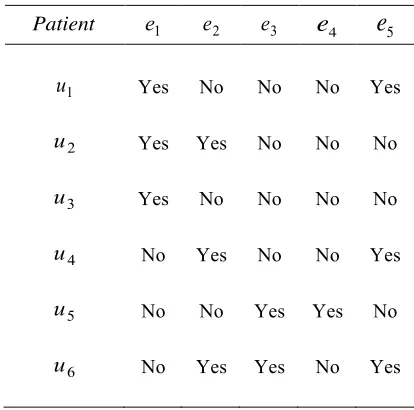
[image:36.595.214.421.299.504.2]Example 2.1. As an illustration, let’s consider a situation which describes the “symptoms of angina” that Dr. X is considering for a check-up at a hospital. Let’s assume that there are six (6) patients undergoing the coronary heart disease check-ups. The parameters are “shortness of breath”, “palpitations”, “faster heartbeat”, “dizziness”, “sweating” and “nausea” respectively . Let’s assume the information obtained is as follows:
Table 2.2: Tabular representation of angina diagnosis
1
e e2 e3 e4
e
51
u Yes No No No Yes
2
u Yes Yes No No No
3
u Yes No No No No
4
u No Yes No No Yes
5
u No No Yes Yes No
6
u No Yes Yes No Yes
The Table 2.2 is the culmination of the scenario considered in the Example 2.1. It depicts the observed symptoms in a patient with regards to angina’s symptoms. Table 2.2 can then be transformed into an information system whereby is a quadruple S=
(
U,A,V,f)
, where 𝑈 = 𝑢!,…,𝑢! is a non-empty finite set ofinterested objects, 𝐴 = 𝑒!,…,𝑒! is a non-empty finite set of attributes, 𝑉 = !!!!𝑉!
where 𝑉! is the value set of the attribute 𝑒! and 𝐹 = 𝑓!,…,𝑓! is an information function where 𝑓!:𝑈×𝑒! →𝑉! such that 𝑓(𝑥,𝑎)∈ 𝑉! for every (𝑥,𝑎)∈𝑈×𝐴 [31]. The information system where every 𝑉!only contains finite elements either the elements is a 1 (Yes) or 0 (No), for every
i
≤
m
. With 𝑉! = [0,1] for everyi
≤
m
, then the corresponding information systems can be classified as a binary information systems.Patient
19
2.3 Indiscernibility Relation
The starting point of rough set approximations is the indiscernibility relation, which is generated by information about objects of interest. Two objects in an information system are called indiscernible (indistinguishable or similar) if they have the same feature. Two objects are considered to be indiscernible or equivalent if and only if they have the same values for all attributes in the set [31].
The relative patterns between objects were studied in determining attribute-based indiscernibility relation between objects. The indiscernibility relation is a fundamental concept of the rough set theory. The concept of rough set approximations starts with the indiscernibility relation, which is generated by information about objects of interest. Two objects in an information system are called indiscernible (indistinguishable or similar) if they have the same feature [31]. Based on the definition of the required patterns, one can then verify whether the existence of indiscernibility relation between the objects or records within the real-world database.
The notion of an indiscernibility relation of two objects is given in the following definition:
Definition 2.2. (See [31]). Let
S
=
(
U
,
A
,
V
,
f
)
be an information system and let B be any subset of A. Two elements x,y∈U are said to be B-indiscernible(indiscernible by the set of parameter B in S) if only if
f
( )
x
,
a
=
f
( )
y
,
a
, for everyB
a
∈
.Obviously, every non-empty subset of A induces unique indiscernibility relation. Notice that, an indiscernibility relation induced by the set of attribute B, denoted by
IND
( )
B
, is an equivalence relation. It is well known that, an equivalence relation induces unique decision class partition. The decision class partition of Uinduced by
IND
( )
B
inS
=
(
U
,
A
,
V
,
f
)
denoted by U/B and the equivalence classin the partition
U
/
B
containingx
∈
U
, denoted by[ ]
x B.reducing data size is to store only one representative object for every set of so-called indiscernible tuples as in Definition 2.2. The second form of redundancy is more difficult to locate, especially in large data tables. Some columns of a table may be deleted without affecting the classification power of the system. This concept can be extended to information systems, where there is no distinction been made between conditional and decision attributes. Using the entire attribute set for describing the property is time-consuming, and the derived rules may be a bit difficult to understand, to apply or to verify [85]. In order to deal with this problem, attribute reduction is required. The main objective of reduction is to reduce the size of data either by reducing the attributes or removing duplicates or redundant objects. Furthermore, at the same time it preserves the property of information.
2.4 Reduction
In data mining, data reduction is one of the major steps in data preprocessing. Data reduction is considered as an important step in data mining especially when dealing with huge size of data. It is unavoidable, that the mining process will be affected in terms of time taken if a dataset of huge size is involved. Therefore in order to relieve the process in terms of time taken, data size need to be reduced and it is known as the process of data reduction.
Data reduction is a process of obtaining a reduced representation of the data set that is much smaller in volume, yet produces the same (or almost the same) analytical results and it includes dimensionality reduction [23]. In dimensionality reduction, data encoding schemes such as wavelet transforms and principal components analysis, attribute subset selection and attribute construction are applied so as to obtain a reduced or compressed representation of the original data [23].
21
Definition 2.3. (See [31]). (Let
S
=
(
U
,
A
,
V
,
f
)
be an information system and let B be any subsets of A and let a belongs to B. a is said to be dispensable (superfluous) in B ifU
/
(
B
−
{ }
a
)
=
U
/
B
, otherwise a is indispensable in B.The notions of similarities play a crucial role in fields such as in the areas of data mining, data analysis, clustering analysis and many more [23], [100]–[104] . Objects of similar grouping and integration can be achieved based on the similarities of objects that lead naturally to their grouping and integration and thus it is important to extract similarities of objects to form a useful cluster or a high-level concept [105]. For further elaboration of an information system, attributes that are identified as dispensable attributes are allowable to be eliminated if the classification of the objects are still similar or holds. As stated in the Definition 2.3. , that when an attribute 𝑎, that belongs to 𝐵 is dispensable if
U
/
(
B
−
{ }
a
)
=
U
/
B
. But if{ }
(
B
a
)
U
B
U
/
−
≠
/
, then 𝑎 is not dispensable at all because decision class partition is not similar. For a set of attributes to be dispensed, the derived decision class partition must be similar, otherwise the set of attributes involved are not to be included in the process of reduction. This thesis has proposed its reduction schemes solely guided by the principle as defined in Definition 2.3.Definition 2.4. (See [31]). Let
S
=
(
U
,
A
,
V
,
f
)
be an information system and let B be any subsets of A. B is called independent (orthogonal) set if all its attributes are indispensable.Definition 2.5. (See [31]). Let S=
(
U,A,V,f)
be an information system and let B beany subsets of A. A subset
B*
of B is a reduct of B ifB*
is independent and U/B*=U/B.Definition 2.5 has defined that a reduct is a set of attributes that preserves decision class partition. It means that a reduct is the minimal subset of attributes that enables the same classification of elements of the universe as the whole set of attributes. While computing equivalence classes is straight forward, the problem of finding minimal reducts in information systems is NP-hard. Reducts have several important properties. One of them is known as core.
Definition 2.6. (See [31]). Let S=
(
U,A,V,f)
be an information system and let B beany subsets of A. The intersection of all reducts is known as the core of B, i.e.
( )
B
Red
( )
B
Core
=
∩
.Definition 2.6 states that the core of B is the set off all indispensable attributes of B. Because the core is the intersection of all reducts, it is therefore found in every reduct. Thus the core is the most important subset of attributes, for none of its elements can be removed without affecting the classification power of attributes, as stated in Definition 2.5.
2.5 Approximations
In the soft set theory, the absence of any restrictions on the approximate description in soft set theory has made it convenient to be practiced. The use of parameterization with the help of words and sentences, real numbers and functions has been very helpful in the scope of approximations.
Definition 2.7. (See [12]). A pair (F,E) is called a soft set over U, where F is a
23
In other words, a soft set is a parameterized family of subsets of the universe
U. For
ε
∈E,F
( )
ε
may be considered as the set of -elements of the soft set(
F
,
E
)
, S=(
U,A,V{ }
0,1,f)
or as the set of -approximate elements of the soft set, instead of a (crisp) set.Based on Example 2.1, Figure 2.2 considers the soft set (F,E) for the description of the “symptoms of angina” that Dr. X is considering for check-up at a hospital. As for consideration, lets assume that U =
{
u1,u2,...,u6}
, and E as a set ofdecision parameters, E=
{
e1,e2,e3,e4,e5}
, where e1,e2,e3,e4 and e5 stands for“shortness of breath”, “palpitations”, “faster heartbeat”, “dizziness”, “sweating” and
“nausea” respectively. Consider the mapping
F
:
E
←
P
( )
U
given by“symptoms observed
()
.
”, where()
.
is to be filled in by one of parameters e∈E. Suppose that𝐹 𝑒! = 𝑢!,𝑢!,𝑢! ,
𝐹 𝑒! = 𝑢!,𝑢! ,
𝐹 𝑒! = 𝑢!,𝑢! ,
𝐹(𝑒!) = 𝑢! ,
[image:41.595.263.375.373.524.2]𝐹 𝑒! = 𝑢!,𝑢!,𝑢!
Figure 2.2: The mapping of parameters
As from the Example 2.1, 𝐹 𝑒! means patients that are experiencing palpitations characteristics whose functional value is the set 𝑢!,𝑢! . Thus the soft set (F,E) can be viewed as the collection of approximation, as illustrated by Figure 2.3.
𝐹,𝐸 =
𝑒! = 𝑢!,𝑢!,𝑢! 𝑒! = 𝑢!,𝑢! 𝑒! = 𝑢!,𝑢! 𝑒! = 𝑢! 𝑒! = 𝑢!,𝑢!,𝑢!
Figure 2.3: The soft set ε
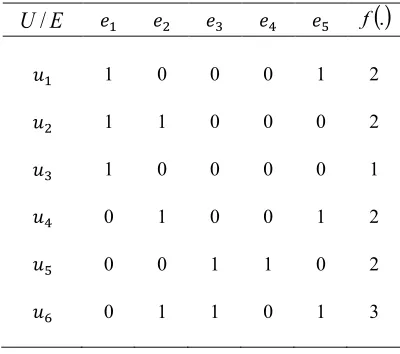
[image:41.595.230.407.651.736.2]Using the information obtained from the functional value, description of the coronary heart disease symptoms can be viewed as a Boolean-valued information system. This is based from the Proposition 1. The binary representation will be the basis of this research work, on providing rooms for improvement in scope of the reduction techniques in soft set theory. The relation between a soft set and a Boolean-valued information system is given as in the following Table 2.3
Table 2.3: Tabular representation of a soft set from the Example 2.1
𝑒! 𝑒! 𝑒! 𝑒! 𝑒!
𝑢! 1 0 0 0 1 2
𝑢! 1 1 0 0 0 2
𝑢! 1 0 0 0 0 1
𝑢! 0 1 0 0 1 2
𝑢! 0 0 1 1 0 2
𝑢! 0 1 1 0 1 3
However, in some applications, some outcomes in classification are known where this posteriori knowledge is expressed by one or more distinguished attribute known as decision attribute. Maji & Biswas [36] has defined a decision system as an information system of the form
D
=
(
U
,
A
∪
{ }
d
,
V
,
f
)
, whered
∉
A
is the decision attribute. The elements of A are called condition attributes. Thus, an informationsystem of this type is called decision system, which is in the form of 𝐷 = 𝑈,𝐴 𝑑 ,𝑉,𝐹 where 𝑑 <∉𝐴 is the decision attributes. For example, in
Table 2.3 , attribute can be regarded as a decision attribute and the attributes
{𝑒!,𝑒!,𝑒!,𝑒!,𝑒!} are known as condition attributes which can be used to specify decisions [31].
The decision attribute has vital information that is derived from the characteristics of the parameters, which were identified as condition attributes. The proposed work may somehow change the overall representation but still preserving the classification power of the system. This is to avoid from using the entire attribute set for describing the property which can be time-consuming and inefficient.
E
U/ f
( )
.116
REFERENCES
[1] M. I. Hwang, “Decision making under time pressure: a model for information systems research,” Inf. Manag., vol. 27, no. 4, pp. 197–203, 1994.
[2] A. Neely and Y. Jarrar, “Extracting value from data-the performance planning value chain,” Bus. Process Manag. J., vol. 10, no. 5, pp. 506–509, 2004. [3] S. Eschrich, J. Ke, L. O. Hall, and D. B. Goldgof, “Fast accurate fuzzy
clustering through data reduction,” Fuzzy Syst. IEEE Trans., vol. 11, no. 2, pp. 262–270, 2003.
[4] E. Bingham and H. Mannila, “Random projection in dimensionality reduction: applications to image and text data,” in Proceedings of the seventh ACM SIGKDD international conference on Knowledge discovery and data mining, 2001, pp. 245–250.
[5] B. Hamann, “A data reduction scheme for triangulated surfaces,” Comput. Aided Geom. Des., vol. 11, no. 2, pp. 197–214, 1994.
[6] W. Jass, “Process for adaptive quantization for the purpose of data reduction in the transmission of digital images.” Google Patents, 1995.
[7] M. I. Sezan, “A peak detection algorithm and its application to histogram-based image data reduction,” Comput. vision, Graph. image Process., vol. 49, no. 1, pp. 36–51, 1990.
[8] C. F. Hess and J. D. Trolinger, “Panicle Field Holography Data Reduction By Fourier Transform Analysis,” Opt. Eng., vol. 24, no. 3, p. 243470, 1985. [9] M. Belkin and P. Niyogi, “Laplacian eigenmaps for dimensionality reduction
and data representation,” Neural Comput., vol. 15, no. 6, pp. 1373–1396, 2003.
[10] E. H. Lim and D. Suter, “Conditional random field for 3D point clouds with adaptive data reduction,” in Cyberworlds, 2007. CW’07. International Conference on, 2007, pp. 404–408.
[11] G. J. Kutcher, C. Burman, L. Brewster, M. Goitein, and R. Mohan, “Histogram reduction method for calculating complication probabilities for three-dimensional treatment planning evaluations,” Int. J. Radiat. Oncol. Biol. Phys., vol. 21, no. 1, pp. 137–146, 1991.
[12] J. Zvárová and M. Studen\`y, “Information theoretical approach to constitution and reduction of medical data,” Int. J. Med. Inform., vol. 45, no. 1, pp. 65–74, 1997.
statistical approach for speckle reduction in medical ultrasound images,” in
TENCON 2003. Conference on Convergent Technologies for the Asia-Pacific Region, 2003, vol. 2, pp. 534–537.
[14] J. P. Abenstein and W. J. Tompkins, “A new data-reduction algorithm for real-time ECG analysis,” Biomed. Eng. IEEE Trans., no. 1, pp. 43–48, 1982. [15] E. Holmes, J. K. Nicholson, A. W. Nicholls, J. C. Lindon, S. C. Connor, S.
Polley, and J. Connelly, “The identification of novel biomarkers of renal toxicity using automatic data reduction techniques and PCA of proton NMR spectra of urine,” Chemom. Intell. Lab. Syst., vol. 44, no. 1, pp. 245–255, 1998.
[16] D. J. Hand, H. Mannila, and P. Smyth, Principles of data mining. MIT press, 2001.
[17] N. T. Pang, S. Michael, and K. Vipin, “ Introduction to Data Mining,” Addison Wesley, 2009.
[18] J. Han and M. Kamber, “Data Mining : Concepts and Techniques,” 2006. [19] P. Fitsilis, V. Gerogiannis, A. Kameas, and G. Pavlides, “Producing relational
database schemata from an object oriented design,” in EUROMICRO 94. System Architecture and Integration. Proceedings of the 20th EUROMICRO Conference., 1994, pp. 251–257.
[20] A. Alsaadi, “Checking Data Integrity via the UML Class Diagram,” in
Software Engineering Advances, International Conference on, 2006, p. 37. [21] G. K. Gupta, Introduction to data mining with case studies. PHI Learning Pvt.
Ltd., 2011.
[22] Z. Kong, L. Gao, L. Wang, and S. Li, “The Normal Parameter Reduction of Soft Sets and Its Algorithm,” Comput. Math. with Appl., vol. 56, pp. 3029– 3037, 2008.
[23] J. Han, M. Kamber, and J. Pei, Data mining: concepts and techniques: concepts and techniques. Elsevier, 2011.
[24] Tim Dobert (University of Hamburg), “Energy-Efficiency and Performance Trade-offs of Data Reduction Techniques,” Univeristy of hamburg, 2014. . [25] D. V Lindley, Understanding uncertainty. John Wiley & Sons, 2006.
[26] C. C. Aggarwal, “Managing And Mining Uncertain Data,” Kluwer Acad. Publ., 2009.
[27] Z. M. Ma and L. Yan, “Querying Imprecise Data in Sensor Databases,” Mob. Data Manag. 2008. MDM ’08. 9th Int. Conf. , pp. 205–210, 2008.
118
Policy Sci., pp. 69–129, 1981.
[29] L. A. Zadeh, “Roles of Soft Computing and fuzzy Logic in the Conception, Design and Deployment of Information/Intelligent Systems,” Comput. Intell. Soft Comput. Fuzzy-Neuro Integr. with Appl., pp. 1–9, 1998.
[30] L. A. Zadeh, “Fuzzy sets,” Inf. Control, vol. 8, no. 3, pp. 338–353, 1965. [31] Z. Pawlak, “Rough sets: Theoretical aspects of reasoning about data,” Rough
Sets Theor. Asp. Reason. about Data, vol. 9, no. D, 1991.
[32] Z. Pawlak, “Rough sets,” Int. J. Comput. Inf. Sci., vol. 11, no. 5, pp. 341–356, 1982.
[33] K. T. Atanassov, “Intuitionistic fuzzy sets,” Fuzzy sets Syst., vol. 20, no. 1, pp. 87–96, 1986.
[34] M. B. Gorzalczany, “A method of inference in approximate reasoning based on interval-valued fuzzy sets,” Fuzzy sets Syst., vol. 21, no. 1, pp. 1–17, 1987. [35] D. Molodtsov, “Soft Set Theory - First Results,” Comput. Math. with Appl.,
vol. 37, no. 4–5, pp. 19–31, 1999.
[36] R. B. P.K. Maji and A.R. Roy, P. K. Maji, R. Biswas, and A. R. Roy, “Soft Set Theory,” Comput. Math. with Appl., vol. 45, pp. 555–562, 2003.
[37] P. K. Maji, A. R. Roy, and R. Biswas, “An Application of Soft Sets in A Decision Making Problem,” Comput. Math. with Appl., vol. 44, pp. 1077– 1083, 2002.
[38] A. R. Roy, P. K. Maji, A. R. Roy, R. Biswas, Z. Kong, L. Wang, and Z. Wu, “Application of fuzzy soft set in decision making problems based on grey theory,” J. Comput. Appl. Math., vol. 44, no. 6, pp. 412–418, 2002.
[39] Z. Kong, L. Wang, and Z. Wu, “Application of fuzzy soft set in decision making problems based on grey theory,” J. Comput. Appl. Math., vol. 236, no. 6, pp. 1521–1530, 2011.
[40] Y. Jiang, H. Liu, Y. Tang, and Q. Chen, “Semantic decision making using ontology-based soft sets,” Math. Comput. Model., vol. 53, no. 5, pp. 1140– 1149, 2011.
[41] Y. Jiang, Y. Tang, and Q. Chen, “An adjustable approach to intuitionistic fuzzy soft sets based decision making,” Appl. Math. Model., vol. 35, no. 2, pp. 824–836, 2011.
[42] K. Gong, Z. Xiao, and X. Zhang, “The bijective soft set with its operations,”
Comput. Math. with Appl., vol. 60, no. 8, pp. 2270–2278, 2010.
no. 6, pp. 4474–4485, 2013.
[44] F. Feng, Y. Li, and N. Ça\ugman, “Generalized uni--int decision making schemes based on choice value soft sets,” Eur. J. Oper. Res., vol. 220, no. 1, pp. 162–170, 2012.
[45] Z. Zhang and S. Zhang, “A novel approach to multi attribute group decision making based on trapezoidal interval type-2 fuzzy soft sets,” Appl. Math. Model., vol. 37, no. 7, pp. 4948–4971, 2013.
[46] F. Feng, Y. B. Jun, and X. Liu, “An Adjustable Approach of Fuzzy Soft Set Based Decision Making,” 234, vol. 1, pp. 10–20, 2010.
[47] A. M. Isa, A. N. M. Rose, and M. M. Deris, “Dominance-Based Soft Set Approach in Decision-Making Analysis,” Adv. Data Min. LNAI ,Springer, Heidelb. , vol. 1, no. 7120, pp. 299–310, 2011.
[48] Z. Kong, L. Gao, and L. Wang, “Comment on ‘A fuzzy soft set theoretic approach to decision making problems,’” Comput. Math. with Appl., vol. 223, no. 2, pp. 540–542, 2009.
[49] A. N. M. Rose, T. Herawan, M. M. Deris, and M. M. D., “A Framework of Decision Making Based on Maximal Supported Sets,” Lect. Notes Comput. Sci. Adv. Neural Networks-ISNN 2010, Springer Berlin Heidelber, pp. 472– 482, 2010.
[50] D. Chen, E. C. C. Tsang, D. S. Yeung, and X. Wang, “The Parameterization Reduction of Soft Sets and its Applications,” Comput. Math. with Appl. , vol. 49, pp. 757–763, 2005.
[51] X. Ma, H. Qin, N. Sulaiman, T. Herawan, and J. H. Abawajy, “The parameter reduction of the interval-valued fuzzy soft sets and its related algorithms,”
Fuzzy Syst. IEEE Trans., vol. 22, no. 1, pp. 57–71, 2014.
[52] A. N. M. Rose, H. Hassan, M. I. Awang, N. A. Mahiddin, H. M. H. M. Amin, and M. M. Deris, “Solving Incomplete Datasets in Soft Set Using Supported Sets and Aggregate Values,” Procedia CS, vol. 5, pp. 354–361, 2010.
[53] H. Qin, X. Ma, T. Herawan, and J. M. Zain, “Data Filling Approach of Soft Sets Under Incomplete Information,” Lect. Notes Comput. Sci. Springer Verlag, vol. 6592, pp. 302–311, 2011.
[54] T. Deng and X. Wang, “An object-parameter approach to predicting unknown data in incomplete fuzzy soft sets,” Appl. Math. Model., vol. 37, no. 6, pp. 4139–4146, 2013.
![Figure 2.1 Data reduction in knowledge discovery [23]](https://thumb-us.123doks.com/thumbv2/123dok_us/8761014.894024/31.595.115.491.61.551/figure-data-reduction-in-knowledge-discovery.webp)
![Table 2.1: An information system [99]](https://thumb-us.123doks.com/thumbv2/123dok_us/8761014.894024/34.595.156.482.283.474/table-an-information-system.webp)