Multiple Segmentations of Thai Sentences for Neural Machine Translation
Alberto Poncelas
1, Wichaya Pidchamook
2, Chao-Hong Liu
3, James Hadley
4, Andy Way
1 1ADAPT Centre, School of Computing, Dublin City University, Ireland2SALIS, Dublin City University, Ireland 3Iconic Translation Machines
4Trinity Centre for Literary and Cultural Translation, Trinity College Dublin, Ireland
{alberto.poncelas, andy.way}@adaptcentre.ie
[email protected], [email protected], [email protected] Abstract
Thai is a low-resource language, so it is often the case that data is not available in sufficient quantities to train an Neural Machine Translation (NMT) model which perform to a high level of quality. In addition, the Thai script does not use white spaces to delimit the boundaries between words, which adds more complexity when building sequence to sequence models. In this work, we explore how to augment a set of English–Thai parallel data by replicating sentence-pairs with different word segmentation methods on Thai, as training data for NMT model training. Using different merge operations of Byte Pair Encoding, different segmentations of Thai sentences can be obtained. The experiments show that combining these datasets, performance is improved for NMT models trained with a dataset that has been split using a supervised splitting tool.
Keywords:Machine Translation, Word Segmentation, Thai Language
In Machine Translation (MT), low-resource languages are especially challenging as the amount of parallel data avail-able to train models may not be enough to achieve high translation quality. One approach to mitigate this problem is to augment the training data with similar languages [10] or artificially-generated text [23; 16].
State-of-the-art Neural Machine Translation (NMT) mod-els are based on the sequence-to-sequence framework (i.e. models are built using pairs of sequences as training data). Therefore, sentences are modeled as a sequence of tokens. As Thai is ascriptio continualanguage (where whitespaces are not used to indicate the boundaries between words) sen-tences need to be segmented in the preprocessing step in order to be converted into sequences of tokens.
The segmentation of sentences is a well-known problem in Natural Language Processing (NLP), Thai is no excep-tion. How Thai sentences should be split1 has been
dis-cussed at the linguistic level [3] and different algorithms have been proposed [5] including dictionary-based and ma-chine learning-based approaches.
In this work, we use the problem of segmentation to our advantage. We propose using an unsupervised training method such as Byte Pair Encoding (BPE) to obtain dif-ferent versions of the same sentence with difdif-ferent segmen-tations (by using different merge operations).
This leads to different parallel sets (each with different seg-mentation on the Thai side). These sets can be combined to train NMT models and achieve better translation perfor-mance than using one segmentation strategy alone.
1.
Combination of Segmented Texts
As the encoder-decoder framework deals with a sequence of tokens, a way to address the Thai language is to split the
1
In this work, we use interchangeably the term split or seg-mentation to refer to the process of dividing a word or a sentence into sub-units.
sentence into words (or tokens). We investigate three split-ting strategies: (i) Character-based, using each character as token. This is the simplest approach as there is no need to identify the words; (ii) Supervised word-segmentation: us-ing tokenizers which have been trained on supervised data such as the “Deepcut”2 library [6] (trained on the BEST corpus [8]); and (iii) Language-independent split: use-ing a language-independent algorithm for splituse-ing such as BPE [24]. This last method splits the sentence based on the statistics of sequences of letters. Therefore the split is not necessarily word-based. BPE is executed as follows: Ini-tially it considers each character as an independent token; then iteratively the most frequent subsequent pair of tokens
xandyare merged into a single tokenxy. The process is executed iteratively until a given number of merge opera-tion are completed.
Once the sentences of a parallel corpus have been split, they can be used as training data for an NMT engine. Among the three approaches, the supervised word-segmentation strat-egy is the one that might allow NMT to perform the best, as it encodes the information from the manually-segmented sentences. However, by changing the merge operation pa-rameter of BPE, the set can be split in different ways. Ac-cordingly, in this work we want to explore whether aug-menting the training set with the same sentences (but split with BPE using different merge operations) can be bene-ficial for training an NMT model. By doing this, we ar-tificially increase the vocabulary on the target side. This causes the number of translation candidates of source-side words to be extended, which has been shown to have a positive impact in other approaches such as in statistical MT [13; 14]. In addition, we want to explore whether this approach can be followed to augment a dataset split using Deepcut to improve the performance of NMT models. Note that in this work we are building models in the
English-to-Thai direction. The datasets with different splits are only on the target side whereas we keep the same num-ber of merge operations on the source side. The main reason for this is that using several splits on the source side would also mean that NMT models would be evalu-ated with different versions (different splits) of the test set, which would obviously affect the results.
2.
Data and Model Configuration
The models are built in the English to Thai direction us-ing OpenNMT-py [7]. We keep the default settings of OpenNMT-py: 2-layer LSTM with 500 hidden units and a maximum vocabulary size of 50000 words for each lan-guage.
We use the Asian Language Treebank (ALT) Parallel Cor-pus [21] for training and evaluation. We split the corCor-pus so we use 20K sentences for training and 106 sentences for de-velopment. We use Tatoeba [26] for evaluating the models (173 sentences).
In order to evaluate the models we translate the test set and measure the quality of the translation using an auto-matic evaluation metric, which provides an estimation of how good the translation is by comparing it to a human-translated reference. As the evaluation is made in a Thai text (which does not containn-grams, we use CHRF3 [20] which is a character-level metric, instead of BLEU [12], which is based on overlap ofn-grams.
The English side is tokenized and truecased (applying the proper case of the words) and we apply BPE with 89500 operations (the default explored in [24]).
For the Thai side we explore combinations of different ap-proaches of sentence segmentation:
1. Character-level: Split the sentences character-wise, so each character is a token of the sequence (character
dataset).
2. Deepcut: Split the sentences using the Deepcut tool. 3. Use BPE with different merge operations. In this
work we explore with: 1000, 5000, 10000 and 20000 merge operations (BPE 1000,BPE 5000,BPE 10000
andBPE 20000datasets, respectively). However, we propose as future work investigating the performance when using BPE with more merge operations. In total there are six different datasets. Note that they con-tain the same unique sentences. We train NMT models using these datasets either independently or in combina-tion. The combination is carried out by appending different datasets. In particular we usecharacter,DeepcutorBPE 1000datasets and then accumulatively addBPE 1000,BPE 5000,BPE 10000andBPE 20000datasets.
3.
Experimental Results
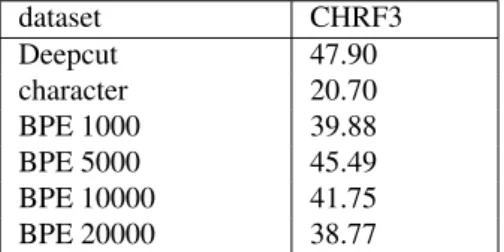
First, we evaluate the performance of the models when dif-ferent merge operations are used on the Thai side. The per-formance of the model, evaluated using CHRF3 are pre-sented in Table 1. In the table, each row shows the results (the evaluation of the translation of the test set) of an NMT model built with the training set split following one of the
dataset CHRF3 Deepcut 47.90 character 20.70 BPE 1000 39.88 BPE 5000 45.49 BPE 10000 41.75 BPE 20000 38.77
Table 1: Performance of the NMT model trained with data using different methods for word segmentation on the target-side.
thee chosen approaches. For example, the first row Deep-cutpresent the results when the model is built with the set after being split using the Deepcut tool, and in the rowBPE 1000if the dataset is split with BPE using 1,000 merge op-erations.
As expected, we see in the table that the best results are ob-tained when using the Deepcut tool (Deepcutrow), which splits Thai words grammatically.
Regarding the models in which BPE has been used, we see in Table 1 that the best performance is achieved when 5000 merge operations is used (BPE 5000row).
When too many merge operations are performed there is the risk of merging characters of different words into a single token, so the score decreases.
By contrast, if there are too few merge operations, the re-sulting text is closer to character-split which, as we can see in thecharacterrow, leads to the worst results.
3.1.
Combination of Datasets with Unsupervised
Split
dataset CHRF3 character 20.70 + 1000 38.23 + 5000 45.63 + 10000 49.93 + 20000 52.17 BPE 1000 39.88 + 5000 49.54 + 10000 52.33 + 20000 53.45Table 2: Performance of the NMT model trained with data combining different unsupervised methods for word seg-mentation on the target-side. Numbers in bold indicate sta-tistical significant improvement at p=0.01.
The main focus of this paper is to study the impact on the performance when several training sets with different splits are gathered together. We show the results in Table 2. Note that only the training set has been augmented, the develop-ment and test set remains the same for all experidevelop-ments. In the table, each subtable presents the results when the sets are appended. For example, in the first subtable the row
character indicates the performance of the model trained with the data split by character (the same as in Table 1). The
following row,+1000, shows the score of the model trained with character-wise split and that split with BPE using 1000 merge operations (so there are two instances of each source sentence). The last row of the subtable (+20000) indicates the performance of the model trained with the five datasets concatenated (five instances of each source sentence). In the table we observe that combining datasets with differ-ent segmdiffer-entations is beneficial. In each subtable of Table 2 we see that the score goes up when we add more datasets with different splits. For example, the performance of the model using data split in a character-wise achieves a score of only 20.70 (first subtable). When we concatenate the same dataset but split using 1000 merge operations, the score increases to 38.23 (85% improvement) and we see that the score increases as we add sentences with different splits. This effect is observed for all three subtables. The results also show that the lowest scores are achieved in those datasets in which a character-wise split fashion is performed. For example, the performance when using the dataset split with BPE using 1000 operations is 39.88 (BPE 1000row in Table 2), whereas when used in combi-nation with character-split set (+1000row in the first sub-table of Table 2) the score is 38.23. Another indication that character-wise splitting hurts performance is the compar-ison between the subtables of Table 2. If we compare the rows+1000,+5000,+10000and+20000of each subtable, the lower scores are seen in the first subtable
Another research question we want to answer is whether us-ing a combination of splits usus-ing BPE can outperform the model trained with a language-independent tool like Deep-cut. We see that in the second subtable of Table 2 all of the the combination of BPE-split datasets (+5000,+10000and
+20000 rows) exceed the 47.90 score achieved by using Deepcut alone.
3.2.
Augmenting the Dataset Split with Deepcut
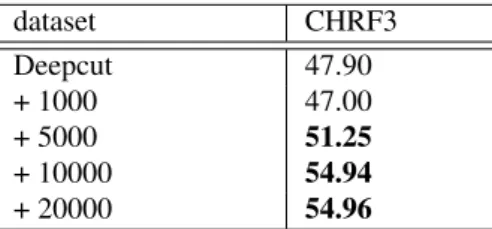
dataset CHRF3 Deepcut 47.90 + 1000 47.00 + 5000 51.25 + 10000 54.94 + 20000 54.96
Table 3: Performance of combination of dataset with dif-ferent split usingDeepcut. Numbers in bold indicate statis-tical significant improvement at p=0.01.
As combining different splits can increase the performance of the model, does it also help when used in combination with Deepcut?
In Table 3 we present the results when the dataset split us-ing Deepcut is augmented with datasets split with different merge operations using BPE. We see that initially, adding the set split with BPE using 1,000 merge operation (+1000
row) causes the performance to drop slightly. Nonetheless, the performance increases when more data are added (i.e.
+5000, +10000, +20000 rows). Moreover, it even out-performs the model trained with the Deepcut-split dataset alone.
3.3.
Analysis
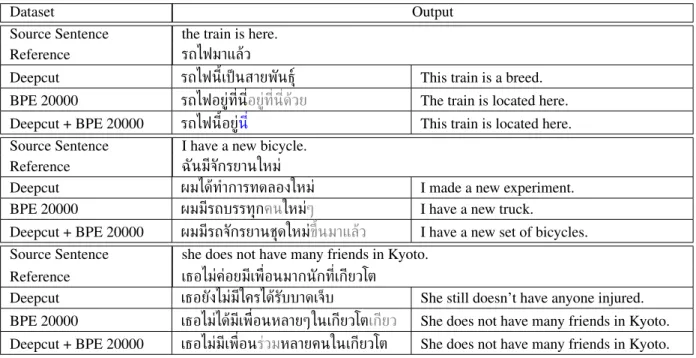
In Table 4 we show some examples of the output. For each sentence we present the translations produced by the NMT model trained on Deepcut, BPE 20000andDeepcut BPE 20000. We do not include the outputs of the NMT models trained on thecharacterdataset as all the translation con-sisted of the same, meaningless, sequence of characters. In the third column of the table we show the translation of the output of the NMT system after it has been postedited by removing characters (in gray) or replaced (in blue). In the first sub-table we present how the sentence “the train is here” (meaning that the train is here because it has ar-rived) has been translated by different models. On the one hand, we see in the Deepcut row that the model has not produced an accurate translation. On the other hand, the models trained with data containing sentences of different segmentations (i.e. BPE 20000andDeepcut BPE 20000) achieve a more accurate translation. Nevertheless, the out-put is not a perfect translation as it indicates where the train is located instead of expressing that it has arrived.
In the following subtables we observe a similar effect. The models trained with theDeepcutdataset produced a trans-lation that is either inaccurate or makes no sense. However, the models trained onBPE 20000or Deepcut BPE 20000
produce a translation closer to the input after some post-editing (i.e. removing the characters in gray).
4.
Related Work
There are several studies aiming to address the problem of splitting words in Thai. One of the first approaches to seg-menting is thelongest-matchingmethod [19], consisting of identifying the longest sequence of characters that match a word in the dictionary. Another approach is maximal-matching method [25], which consists of generating all possible segmentations and retrieving those containing the smallest amount of words.
[4] used conditional random fields to classify each character as either word-beginningorintra-word. [11] proposed an improvement to this approach by adding information from POS tags.
The use of several segmentations has also been proposed by [9], in which he tries to integrate candidates from dif-ferent segmentations. This technique has applications in a number of topics such as word-alignment [28] or language modeling [22; 1].
The use of multiple instances in the training data, where only one side is modified, has been used by [18], who showed that using multiple instances of the same target sen-tences, with different source-sides (generated by different MT engines) leads to better results than using a single in-stance of each sentence.
5.
Conclusions and Future Work
In this work we have explored whether the duplication of training sentences with different splits is useful to build NMT models with improved performance. The experi-ments show that the combination of different splits on the target side does improve NMT models involving a low-resource language such as Thai.
Dataset Output Source Sentence the train is here.
Reference รถไฟมาแล้ว
Deepcut รถไฟนี้เป็นสายพันธุ์ This train is a breed. BPE 20000 รถไฟอยู่ที่นี่อยู่ที่นี่ด้วย The train is located here. Deepcut + BPE 20000 รถไฟนี้อยู่นี่ This train is located here. Source Sentence I have a new bicycle.
Reference ฉันมีจักรยานใหม่
Deepcut ผมได้ทำการทดลองใหม่ I made a new experiment. BPE 20000 ผมมีรถบรรทุกคนใหม่ๆ I have a new truck.
Deepcut + BPE 20000 ผมมีรถจักรยานชุดใหม่ขึ้นมาแล้ว I have a new set of bicycles. Source Sentence she does not have many friends in Kyoto.
Reference เธอไม่ค่อยมีเพื่อนมากนักที่เกียวโต
Deepcut เธอยังไม่มีใครได้รับบาดเจ็บ She still doesn’t have anyone injured. BPE 20000 เธอไม่ได้มีเพื่อนหลายๆในเกียวโตเกียว She does not have many friends in Kyoto. Deepcut + BPE 20000 เธอไม่มีเพื่อนร่วมหลายคนในเกียวโต She does not have many friends in Kyoto.
Table 4: Examples of translations using different splits
The experiments also reveal that combining the same dataset using different merge operations of BPE not only improves the model trained on the dataset using the sin-gle configuration (regardless of the number of merge oper-ations), but also the model trained on data that has been split using a tool trained on supervised data such as Deepcut. In the future, we plan to conduct more fine-grained experi-ments to explore which configurations of BPE perform bet-ter. For example, would the combination ofBPE 10000and
BPE 20000 (those with the highest number of operations explored) perform better than the model’s original setup? And what would the results be if onlyBPE 1000andBPE 20000(those with the lowest and highest number of opera-tion) are combined?
Furthermore, as all the experiments with different splits have been applied on the target side, we plan to investigate NMT models when Thai is on the source side. Similarly, we will also investigate whether these improvements will be achieved using other languages.
Another variation we are interested in exploring is not to replicate all the sentences but to use data-selection algo-rithms to find a subset of sentences that may boost the per-formance of the models trained on the subset [15; 17]. Finally, we would like to investigate the applicability of the method of employing several segmentations to other NLP tasks such as text classification [2; 27].
6.
Acknowledgements
The QuantiQual Project, generously funded by the Irish Research Council’s COALESCE scheme (COA-LESCE/2019/117).
This research has been supported by the ADAPT Centre for Digital Content Technology which is funded under the SFI Research Centres Programme (Grant 13/RC/2106).
References
[1] Solomon Teferra Abate, Laurent Besacier, and Sopheap Seng. Boosting n-gram coverage for unseg-mented languages using multiple text segmentation approach. In23rd International Conference on Com-putational Linguistics, pages 1–7, Beijing, China, 2010.
[2] Chanudom Apichai, Karman Chan, and Yoshimi Suzuki. Classifying short text in social media for ex-tracting valuable ideas. In20th International Con-ference on Computational Linguistics and Intelligent Text Processing, La Rochelle, France, 2019.
[3] Wirote Aroonmanakun. Thoughts on word and sen-tence segmentation in thai. In Proceedings of the Seventh Symposium on Natural language Processing, pages 85–90, Pattaya, Thailand, 2007.
[4] Choochart Haruechaiyasak and Sarawoot Kongy-oung. Tlex: Thai lexeme analyser based on the con-ditional random fields. InProceedings of 8th Interna-tional Symposium on Natural Language Processing, Bangkok, Thailand, 2009.
[5] Choochart Haruechaiyasak, Sarawoot Kongyoung, and Matthew Dailey. A comparative study on Thai word segmentation approaches. In 2008 5th International Conference on Electrical Engineer-ing/Electronics, Computer, Telecommunications and Information Technology, volume 1, pages 125–128, 2008.
[6] Rakpong Kittinaradorn, Korakot Chaovavanich, Titi-pat Achakulvisut, and Chanwit Kaewkasi. A Thai word tokenization library using deep neural network, 2018.
[7] Guillaume Klein, Yoon Kim, Yuntian Deng, Jean Senellart, and Alexander M. Rush. Opennmt: Open-source toolkit for neural machine translation. In Pro-ceedings of the 55th Annual Meeting of the Associ-ation for ComputAssoci-ational Linguistics-System Demon-strations, pages 67–72, Vancouver, Canada, 2017. [8] Krit Kosawat, Monthika Boriboon, Patcharika
Chootrakool, Ananlada Chotimongkol, Supon Klaithin, Sarawoot Kongyoung, Kanyanut Kriengket, Sitthaa Phaholphinyo, Sumonmas Purodakananda, Tipraporn Thanakulwarapas, et al. BEST 2009: Thai word segmentation software contest. In2009 Eighth International Symposium on Natural Language Processing, pages 83–88, Bangkok, Thailand, 2009. [9] Taku Kudo. Subword regularization: Improving
neu-ral network translation models with multiple subword candidates. InProceedings of the 56th Annual Meet-ing of the Association for Computational LMeet-inguistics (Volume 1: Long Papers), pages 66–75, Melbourne, Australia, 2018.
[10] Surafel Melaku Lakew, Aliia Erofeeva, and Marcello Federico. Neural machine translation into language varieties. InProceedings of the Third Conference on Machine Translation: Research Papers, pages 156– 164, Brussels, Belgium, 2018.
[11] Rungsiman Nararatwong, Natthawut Kertkeidka-chorn, Nagul Cooharojananone, and Hitoshi Okada. Improving thai word and sentence segmentation us-ing lus-inguistic knowledge.IEICE TRANSACTIONS on Information and Systems, 101(12):3218–3225, 2018. [12] Kishore Papineni, Salim Roukos, Todd Ward, and
Wei-Jing Zhu. Bleu: a method for automatic evalu-ation of machine translevalu-ation. InProceedings of 40th Annual Meeting of the Association for Computational Linguistics, pages 311–318, Philadelphia, Pennsylva-nia, USA, 2002.
[13] Alberto Poncelas, Andy Way, and Antonio Toral. Extending feature decay algorithms using alignment entropy. InInternational Workshop on Future and Emerging Trends in Language Technology, pages 170–182, Seville, Spain, 2016.
[14] Alberto Poncelas, Gideon Maillette de Buy Wenniger, and Andy Way. Applying n-gram alignment entropy to improve feature decay algorithms.The Prague Bul-letin of Mathematical Linguistics, 108(1):245–256, 2017.
[15] Alberto Poncelas, Gideon Maillette de Buy Wenniger, and Andy Way. Data selection with feature decay al-gorithms using an approximated target side. In15th International Workshop on Spoken Language Trans-lation (IWSLT 2018), pages 173–180, Bruges, Bel-gium, 2018.
[16] Alberto Poncelas, Dimitar Shterionov, Andy Way, Gideon Maillette de Buy Wenniger, and Peyman Pass-ban. Investigating backtranslation in neural machine
translation. In 21st Annual Conference of the Eu-ropean Association for Machine Translation, pages 249–258, Alacant, Spain, 2018.
[17] Alberto Poncelas, Andy Way, and Kepa Sarasola. The ADAPT system description for the IWSLT 2018 Basque to English translation task. In 15th Inter-national Workshop on Spoken Language Translation, pages 76–82, Bruges, Belgium, 2018.
[18] Alberto Poncelas, Maja Popovic, Dimitar Shterionov, Gideon Maillette de Buy Wenniger, and Andy Way. Combining SMT and NMT back-translated data for efficient NMT. InProceedings of Recent Advances in Natural Language Processing (RANLP), pages 922– 931, Varna, Bulgaria, 2019.
[19] Yuen Poowarawan. Dictionary-based thai syllable separation. InProc. Ninth Electronics Engineering Conference (EECON-86), pages 409–418, Bangkok, Thailand, 1986.
[20] Maja Popovic. chrF: character n-gram F-score for au-tomatic MT evaluation. InProceedings of the Tenth Workshop on Statistical Machine Translation, pages 392–395, Lisbon, Portugal, 2015.
[21] Hammam Riza, Michael Purwoadi, Teduh Ulinian-syah, Aw Ai Ti, Sharifah Mahani Aljunied, Luong Chi Mai, Vu Tat Thang, Nguyen Phuong Thai, Vichet Chea, Sethserey Sam, et al. Introduction of the asian language treebank. In2016 Conference of The Ori-ental Chapter of International Committee for Coordi-nation and Standardization of Speech Databases and Assessment Techniques (O-COCOSDA), pages 1–6, 2016.
[22] Sopheap Seng, Laurent Besacier, Brigitte Bigi, and Eric Castelli. Multiple text segmentation for statis-tical language modeling. In 10th Annual Confer-ence of the International Speech Communication As-sociation (Interspeech), pages 2663–2666, Brighton, United Kingdom, 2009.
[23] Rico Sennrich, Barry Haddow, and Alexandra Birch. Improving neural machine translation models with monolingual data. In Proceedings of the 54th An-nual Meeting of the Association for Computational Linguistics (Volume 1: Long Papers), pages 86–96, Berlin, Germany, 2016.
[24] Rico Sennrich, Barry Haddow, and Alexandra Birch. Neural machine translation of rare words with sub-word units. InProceedings of the 54th Annual Meet-ing of the Association for Computational LMeet-inguistics (Volume 1: Long Papers), pages 1715–1725, Berlin, Germany, 2016.
[25] Virach Sornlertlamvanich. Word segmentation for thai in machine translation system. Machine Trans-lation, pages 556–561, 1993.
[26] Jörg Tiedemann. Parallel data, tools and interfaces in opus. InProceedings of the Eighth International con-ference on on Language Resources and Evaluation (LREC 2012), pages 2214–2218, Istanbul, Turkey, 2012.
[27] Attaporn Wangpoonsarp, Kazuya Shimura, and Fu-miyo Fukumoto. Acquisition of domain-specific senses and its extrinsic evaluation through text cate-gorization. In20th International Conference on Com-putational Linguistics and Intelligent Text Processing, La Rochelle, France, 2019.
[28] Ning Xi, Guangchao Tang, Boyuan Li, and Yinggong Zhao. Word alignment combination over multiple word segmentation. InProceedings of the ACL 2011 Student Session, pages 1–5, Portland, USA, 2011.